Julie Hynes, MA, CPS
May 28, 2015
www.preventionlane.org/CASA
This Evening’s Focus
• Current conditions in substance abuse –
Lane County
• Risk factors that lead
to those conditions
• A prevention perspective
• Resources for talking
to kids and families
• Q&A throughout
“It’s All
Connected”
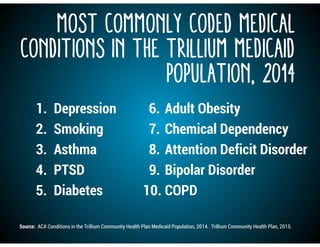
MOST COMMONLY CODED MEDICAL
CONDITIONS in the Trillium Medicaid
Population, 2014
1. Depression
2. Smoking
3. Asthma
4. PTSD
5. Diabetes
6. Adult Obesity
7. Chemical Dependency
8. Attention Deficit Disorder
9. Bipolar Disorder
10. COPD
Source: ACA Conditions in the Trillium Community Health Plan Medicaid Population, 2014. Trillium Community Health Plan, 2015.
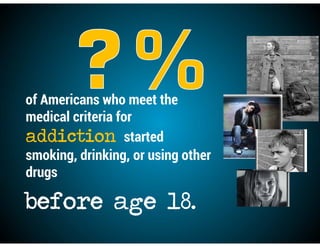
of Americans who meet the
medical criteria for
addiction started
smoking, drinking, or using other
drugs
before age 18.
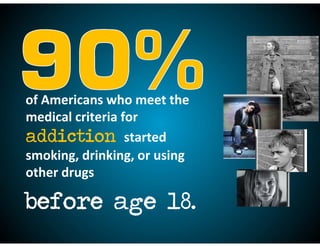
of Americans who meet the 
medical criteria for 
addiction started 
smoking, drinking, or using 
other drugs
before age 18.
The top two
drugs used by
high school
students in
Lane County…
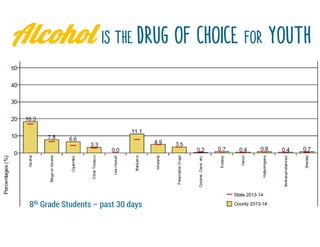
Alcohol is the drug of choice for youth
Source: Student Wellness Survey, 2014
8th Grade Students – past 30 days
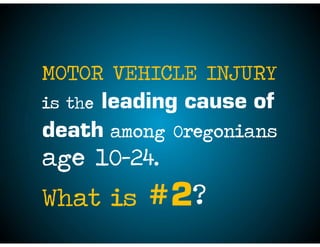
MOTOR VEHICLE INJURY
is the leading cause of
death among Oregonians
age 10-24.
What is #2?
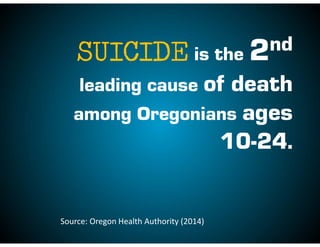
SUICIDE is the 2nd
leading cause of death
among Oregonians ages
10-24.
Source: Oregon Health Authority (2014) 
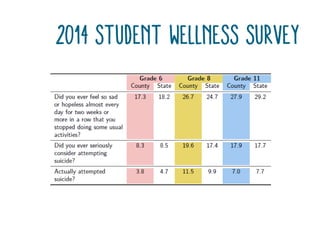
2014 Student Wellness Survey
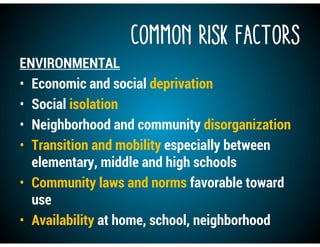
COMMON RISK FACTORS
ENVIRONMENTAL
• Economic and social deprivation
• Social isolation
• Neighborhood and community disorganization
• Transition and mobility especially between
elementary, middle and high schools
• Community laws and norms favorable toward
use
• Availability at home, school, neighborhood
COMMON RISK FACTORS
DEVELOPMENTAL / FAMILY
• Family history of alcoholism/addiction quadruples risk
of becoming addicted
• Family management problems
• Early antisocial behavior combined with withdrawal
and/or hyperactivity
• Parental drug use or positive attitude towards use
• Academic failure not tied to ability, especially in mid to
late elementary school
COMMON RISK FACTORS
DEVELOPMENTAL / FAMILY
• Little commitment to school
• Alienation, rebelliousness, lack of social bonding
• Friends who use drugs is one of the strongest
predictors
• Favorable attitude toward drug use
• Early first use of drugs prior to age 15-twice the risk of
addiction
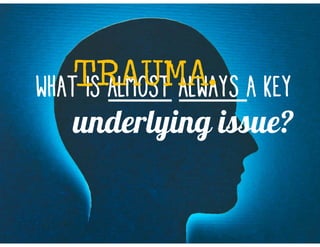
What is almost ALWAYS a KEY
underlying issue?
TRAUMA.
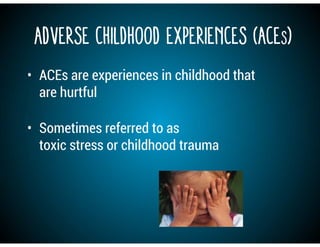
Adverse Childhood Experiences (ACEs)
• ACEs are experiences in childhood that
are hurtful
• Sometimes referred to as
toxic stress or childhood trauma
What are ACEs?
Growing up (prior to age 18) in a household
with:
• Physical abuse
• Emotional abuse
• Sexual abuse
• Emotional or physical neglect
• Loss of parent due to divorce, abandonment, or
death
• Substance use
• Mental illness
• Incarcerated household member
What are ACEs?
Growing up (prior to age 18) in a household
with:
• Physical abuse
• Emotional abuse
• Sexual abuse
• Emotional or physical neglect
• Loss of parent due to divorce, abandonment, or death
• Substance use
• Mental illness
• Incarcerated household member
http://www.cdc.gov/violenceprevention/acestudy/index.html
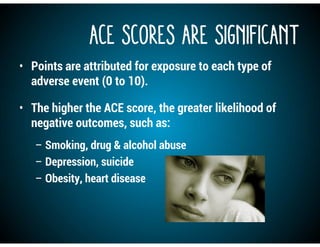
ACE Scores are Significant
• Points are attributed for exposure to each type of
adverse event (0 to 10).
• The higher the ACE score, the greater likelihood of
negative outcomes, such as:
– Smoking, drug & alcohol abuse
– Depression, suicide
– Obesity, heart disease
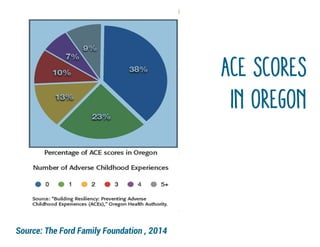
ACE SCORES
IN OREGON
Source: The Ford Family Foundation , 2014
Why is this Important?
Because ACEs are:
• Surprisingly common
• Occur in clusters
• The basis for many common public health concerns
• Strong predictors of later health risks, disease,
and death
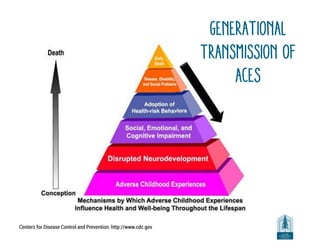
Centers for Disease Control and Prevention: http://www.cdc.gov
Generational
Transmission of
ACEs
ACEs Often Last a Lifetime…
But They Don’t Have To
• Healing can
occur
• The cycle can be
broken
• Safe, stable,
nurturing
relationships
heal both parent
and child
What Can Be Done About ACEs
Increase Protective Factors
– Conditions that increase health and well being
– Critical for everyone regardless of age, sex, ethnicity or
racial heritage, economic status, special needs, or the
dynamics of the family unit
– Buffers that provide support and coping strategies and
reduce impact of risk factors
What Can Be Done About ACEs
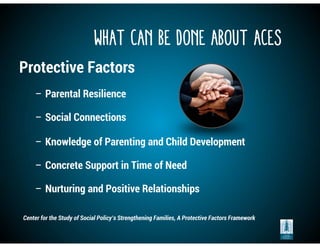
Protective Factors
– Parental Resilience
– Social Connections
– Knowledge of Parenting and Child Development
– Concrete Support in Time of Need
– Nurturing and Positive Relationships
Center for the Study of Social Policy’s Strengthening Families, A Protective Factors Framework
What Can Be Done About ACEs
Individual Level Strategies
• Parent/Family Education & Support
• Child Education/skill-building
• Screening, Early Intervention & Treatment
Relationship Level Strategies
• Parent-Child Centers (for parent training and education)
• Early Childhood Home Visitation (evidence-based programs)
Community, Organizational, and Social Level Strategies
• Public Awareness Campaigns
• Training providers on ACEs, resiliency, trauma-informed care/tools
• Creating trauma-informed, safe and nurturing schools, worksites,
communities
Start by Keeping in Mind…
• What is viewed as a problem by health
professionals may actually be a personal
solution to pain.
• Dismissing these coping devices as “bad
habits” or “self-destructive behaviors”
misses their functionality.
And…
• What is predictable is preventable.
• We don’t bounce back, we bounce forward;
• It’s not what’s wrong with you… it’s what
happened to you!
Our Challenge
• We can and must reduce the number of
ACEs for all children
• We can and must “immunize” kids against
the affects of ACEs
• We can and must work to prevent ACEs
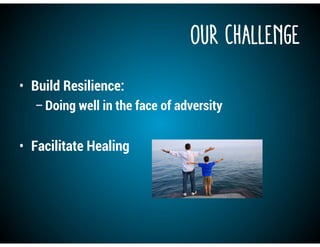
• Build Resilience:
–Doing well in the face of adversity
• Facilitate Healing
Our CHallenge
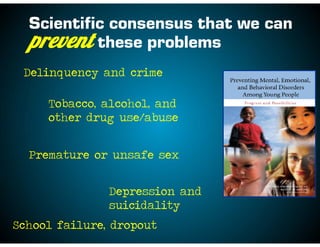
Tobacco, alcohol, and
other drug use/abuse
Scientific consensus that we can
prevent these problems
Delinquency and crime
Premature or unsafe sex
Depression and
suicidality
School failure, dropout
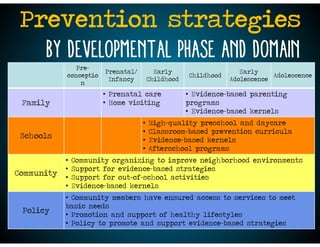
Pre-
conceptio
n
Prenatal/
Infancy
Early
Childhood
Childhood
Early
Adolescence
Adolescence
Family
• Prenatal care
• Home visiting
• Evidence-based parenting
programs
• Evidence-based kernels
Schools
• High-quality preschool and daycare
• Classroom-based prevention curricula
• Evidence-based kernels
• Afterschool programs
Community
• Community organizing to improve neighborhood environments
• Support for evidence-based strategies
• Support for out-of-school activities
• Evidence-based kernels
Policy
• Community members have ensured access to services to meet
basic needs
• Promotion and support of healthy lifestyles
• Policy to promote and support evidence-based strategies
Prevention strategies
by developmental phase and domain
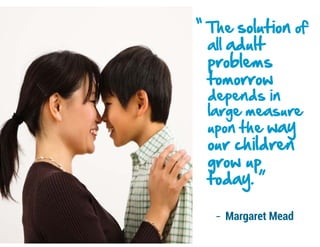
“ The solution of
all adult
problems
tomorrow
depends in
large measure
upon the way
our children
grow up
today. ”
- Margaret Mead
preventionlane.org
facebook.com/
preventionlane
twitter.com/
preventionlane

Prevention in Lane County: Information for CASAs in Training

  • 1.
    Julie Hynes, MA,CPS May 28, 2015 www.preventionlane.org/CASA
  • 2.
    This Evening’s Focus •Current conditions in substance abuse – Lane County • Risk factors that lead to those conditions • A prevention perspective • Resources for talking to kids and families • Q&A throughout
  • 4.
  • 5.
    MOST COMMONLY CODEDMEDICAL CONDITIONS in the Trillium Medicaid Population, 2014 1. Depression 2. Smoking 3. Asthma 4. PTSD 5. Diabetes 6. Adult Obesity 7. Chemical Dependency 8. Attention Deficit Disorder 9. Bipolar Disorder 10. COPD Source: ACA Conditions in the Trillium Community Health Plan Medicaid Population, 2014. Trillium Community Health Plan, 2015.
  • 6.
    of Americans whomeet the medical criteria for addiction started smoking, drinking, or using other drugs before age 18.
  • 7.
  • 8.
    The top two drugsused by high school students in Lane County…
  • 10.
    Alcohol is thedrug of choice for youth Source: Student Wellness Survey, 2014 8th Grade Students – past 30 days
  • 11.
    MOTOR VEHICLE INJURY isthe leading cause of death among Oregonians age 10-24. What is #2?
  • 12.
    SUICIDE is the2nd leading cause of death among Oregonians ages 10-24. Source: Oregon Health Authority (2014) 
  • 13.
  • 14.
    COMMON RISK FACTORS ENVIRONMENTAL •Economic and social deprivation • Social isolation • Neighborhood and community disorganization • Transition and mobility especially between elementary, middle and high schools • Community laws and norms favorable toward use • Availability at home, school, neighborhood
  • 15.
    COMMON RISK FACTORS DEVELOPMENTAL/ FAMILY • Family history of alcoholism/addiction quadruples risk of becoming addicted • Family management problems • Early antisocial behavior combined with withdrawal and/or hyperactivity • Parental drug use or positive attitude towards use • Academic failure not tied to ability, especially in mid to late elementary school
  • 16.
    COMMON RISK FACTORS DEVELOPMENTAL/ FAMILY • Little commitment to school • Alienation, rebelliousness, lack of social bonding • Friends who use drugs is one of the strongest predictors • Favorable attitude toward drug use • Early first use of drugs prior to age 15-twice the risk of addiction
  • 17.
    What is almostALWAYS a KEY underlying issue? TRAUMA.
  • 18.
    Adverse Childhood Experiences(ACEs) • ACEs are experiences in childhood that are hurtful • Sometimes referred to as toxic stress or childhood trauma
  • 19.
    What are ACEs? Growingup (prior to age 18) in a household with: • Physical abuse • Emotional abuse • Sexual abuse • Emotional or physical neglect • Loss of parent due to divorce, abandonment, or death • Substance use • Mental illness • Incarcerated household member
  • 20.
    What are ACEs? Growingup (prior to age 18) in a household with: • Physical abuse • Emotional abuse • Sexual abuse • Emotional or physical neglect • Loss of parent due to divorce, abandonment, or death • Substance use • Mental illness • Incarcerated household member http://www.cdc.gov/violenceprevention/acestudy/index.html
  • 21.
    ACE Scores areSignificant • Points are attributed for exposure to each type of adverse event (0 to 10). • The higher the ACE score, the greater likelihood of negative outcomes, such as: – Smoking, drug & alcohol abuse – Depression, suicide – Obesity, heart disease
  • 22.
    ACE SCORES IN OREGON Source:The Ford Family Foundation , 2014
  • 23.
    Why is thisImportant? Because ACEs are: • Surprisingly common • Occur in clusters • The basis for many common public health concerns • Strong predictors of later health risks, disease, and death
  • 24.
    Centers for DiseaseControl and Prevention: http://www.cdc.gov Generational Transmission of ACEs
  • 25.
    ACEs Often Lasta Lifetime… But They Don’t Have To • Healing can occur • The cycle can be broken • Safe, stable, nurturing relationships heal both parent and child
  • 26.
    What Can BeDone About ACEs Increase Protective Factors – Conditions that increase health and well being – Critical for everyone regardless of age, sex, ethnicity or racial heritage, economic status, special needs, or the dynamics of the family unit – Buffers that provide support and coping strategies and reduce impact of risk factors
  • 27.
    What Can BeDone About ACEs Protective Factors – Parental Resilience – Social Connections – Knowledge of Parenting and Child Development – Concrete Support in Time of Need – Nurturing and Positive Relationships Center for the Study of Social Policy’s Strengthening Families, A Protective Factors Framework
  • 28.
    What Can BeDone About ACEs Individual Level Strategies • Parent/Family Education & Support • Child Education/skill-building • Screening, Early Intervention & Treatment Relationship Level Strategies • Parent-Child Centers (for parent training and education) • Early Childhood Home Visitation (evidence-based programs) Community, Organizational, and Social Level Strategies • Public Awareness Campaigns • Training providers on ACEs, resiliency, trauma-informed care/tools • Creating trauma-informed, safe and nurturing schools, worksites, communities
  • 29.
    Start by Keepingin Mind… • What is viewed as a problem by health professionals may actually be a personal solution to pain. • Dismissing these coping devices as “bad habits” or “self-destructive behaviors” misses their functionality.
  • 30.
    And… • What ispredictable is preventable. • We don’t bounce back, we bounce forward; • It’s not what’s wrong with you… it’s what happened to you!
  • 31.
    Our Challenge • Wecan and must reduce the number of ACEs for all children • We can and must “immunize” kids against the affects of ACEs • We can and must work to prevent ACEs
  • 32.
    • Build Resilience: –Doingwell in the face of adversity • Facilitate Healing Our CHallenge
  • 33.
    Tobacco, alcohol, and otherdrug use/abuse Scientific consensus that we can prevent these problems Delinquency and crime Premature or unsafe sex Depression and suicidality School failure, dropout
  • 35.
    Pre- conceptio n Prenatal/ Infancy Early Childhood Childhood Early Adolescence Adolescence Family • Prenatal care •Home visiting • Evidence-based parenting programs • Evidence-based kernels Schools • High-quality preschool and daycare • Classroom-based prevention curricula • Evidence-based kernels • Afterschool programs Community • Community organizing to improve neighborhood environments • Support for evidence-based strategies • Support for out-of-school activities • Evidence-based kernels Policy • Community members have ensured access to services to meet basic needs • Promotion and support of healthy lifestyles • Policy to promote and support evidence-based strategies Prevention strategies by developmental phase and domain
  • 37.
    “ The solutionof all adult problems tomorrow depends in large measure upon the way our children grow up today. ” - Margaret Mead
  • 38.