What's going on in later stages?—Do
integral developmental theories agree?
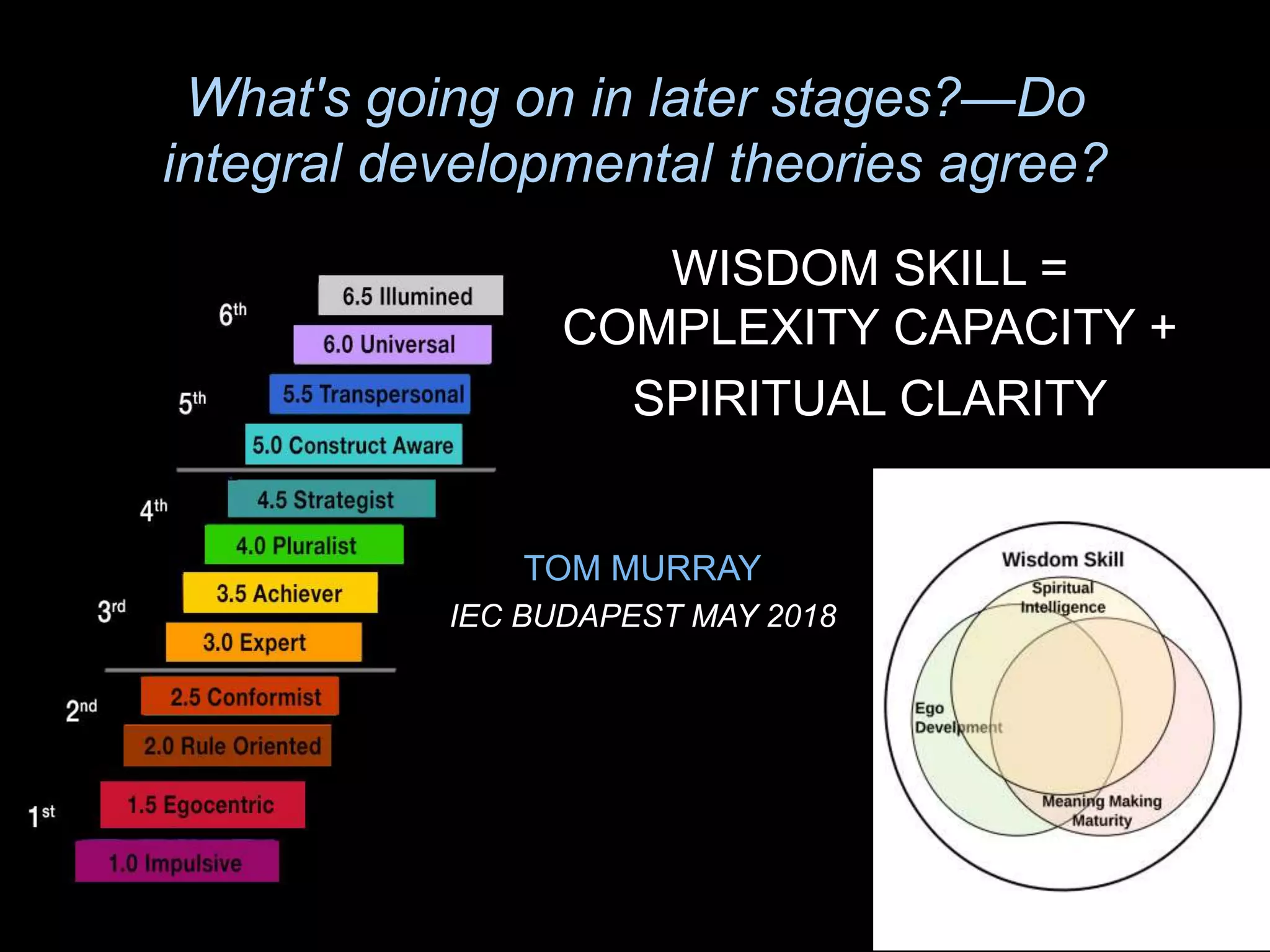
WISDOM SKILL =
COMPLEXITY CAPACITY +
SPIRITUAL CLARITY
TOM MURRAY
IEC BUDAPEST MAY 2018
What's going on in later
stages?—Do integral
developmental theories agree?
WISDOM SKILL =
COMPLEXITY CAPACITY +
SPIRITUAL CLARITY
TOM MURRAY
IEC BUDAPEST MAY 2018
Origins of this work:
Integral Review 2009 Special Issue
• My paper “Intuiting the Cognitive Line in
Developmental Assessment: Do Heart and
Ego Develop Through Hierarchical
Integration?”
• “…as we grow in wisdom there are
elements of un-learning, of letting go,
emptying, opening…the wise heart is
spacious, connected, non-attached…"
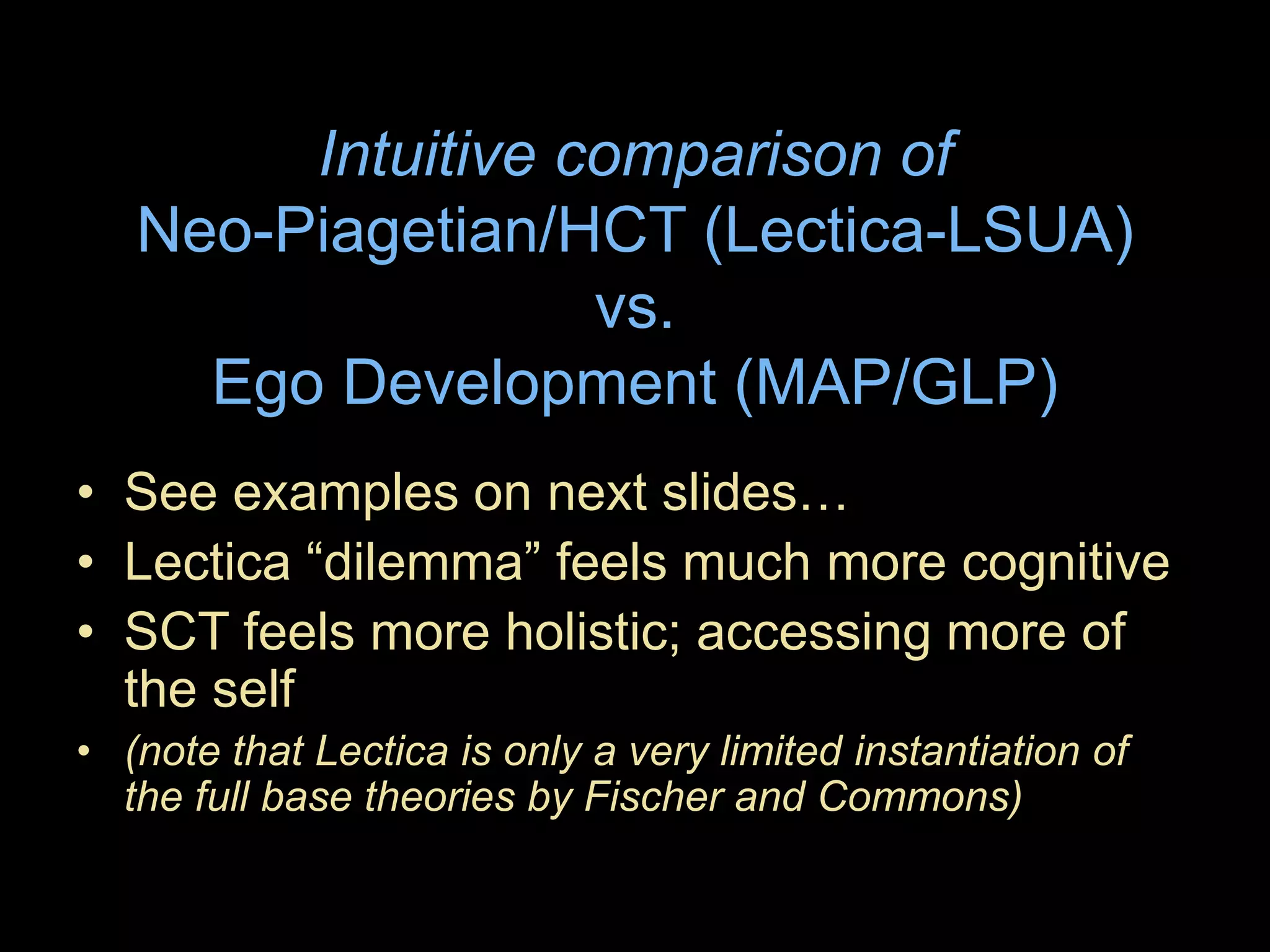
Intuitive comparison of
Neo-Piagetian/HCT (Lectica-LSUA)
vs.
Ego Development (MAP/GLP)
• See examples on next slides…
• Lectica “dilemma” feels much more cognitive
• SCT feels more holistic; accessing more of
the self
• (note that Lectica is only a very limited instantiation of
the full base theories by Fischer and Commons)
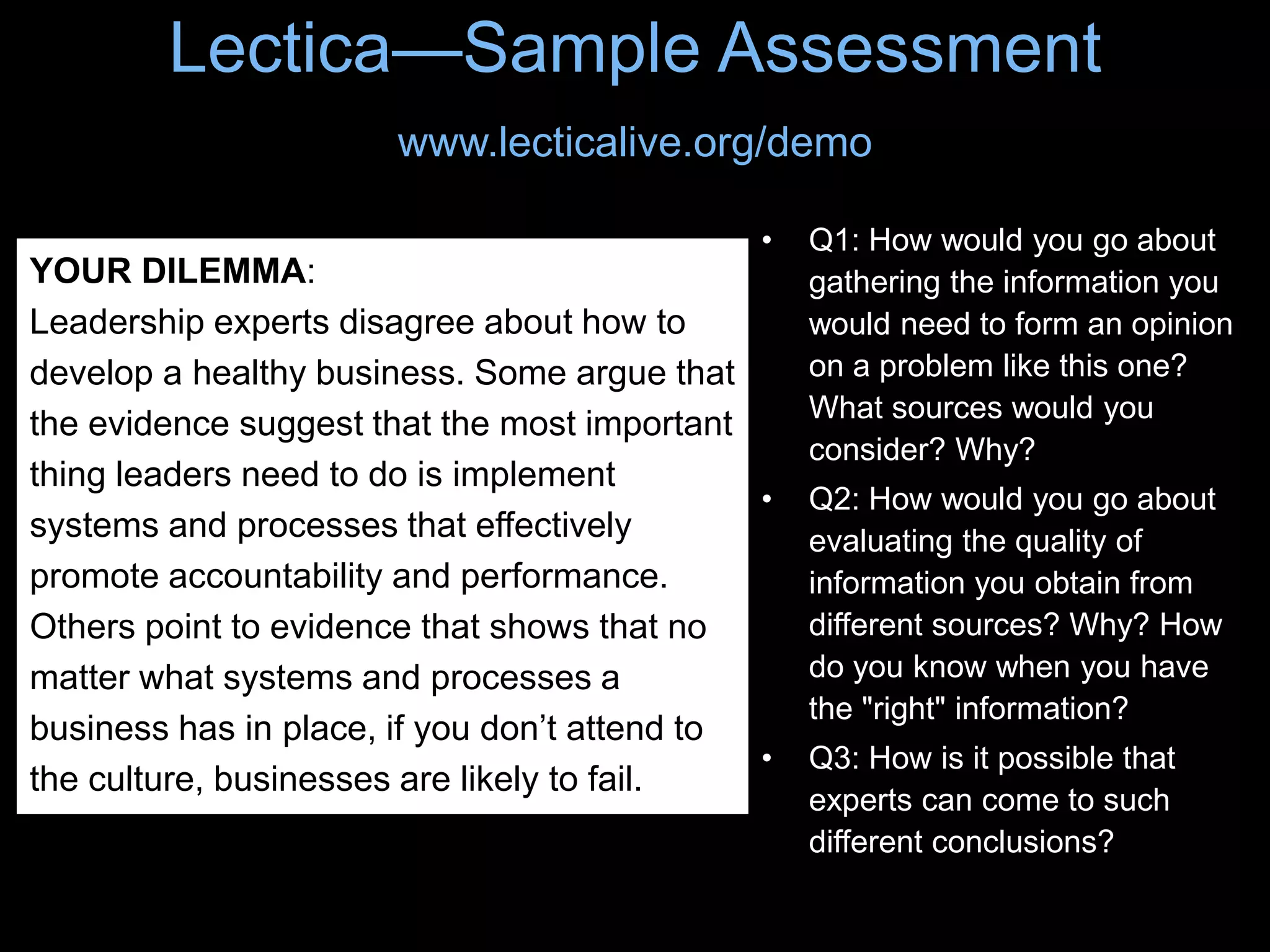
Lectica—Sample Assessment
www.lecticalive.org/demo
• Q1: How would you go about
gathering the information you
would need to form an opinion
on a problem like this one?
What sources would you
consider? Why?
• Q2: How would you go about
evaluating the quality of
information you obtain from
different sources? Why? How
do you know when you have
the "right" information?
• Q3: How is it possible that
experts can come to such
different conclusions?
YOUR DILEMMA:
Leadership experts disagree about how to
develop a healthy business. Some argue that
the evidence suggest that the most important
thing leaders need to do is implement
systems and processes that effectively
promote accountability and performance.
Others point to evidence that shows that no
matter what systems and processes a
business has in place, if you don’t attend to
the culture, businesses are likely to fail.
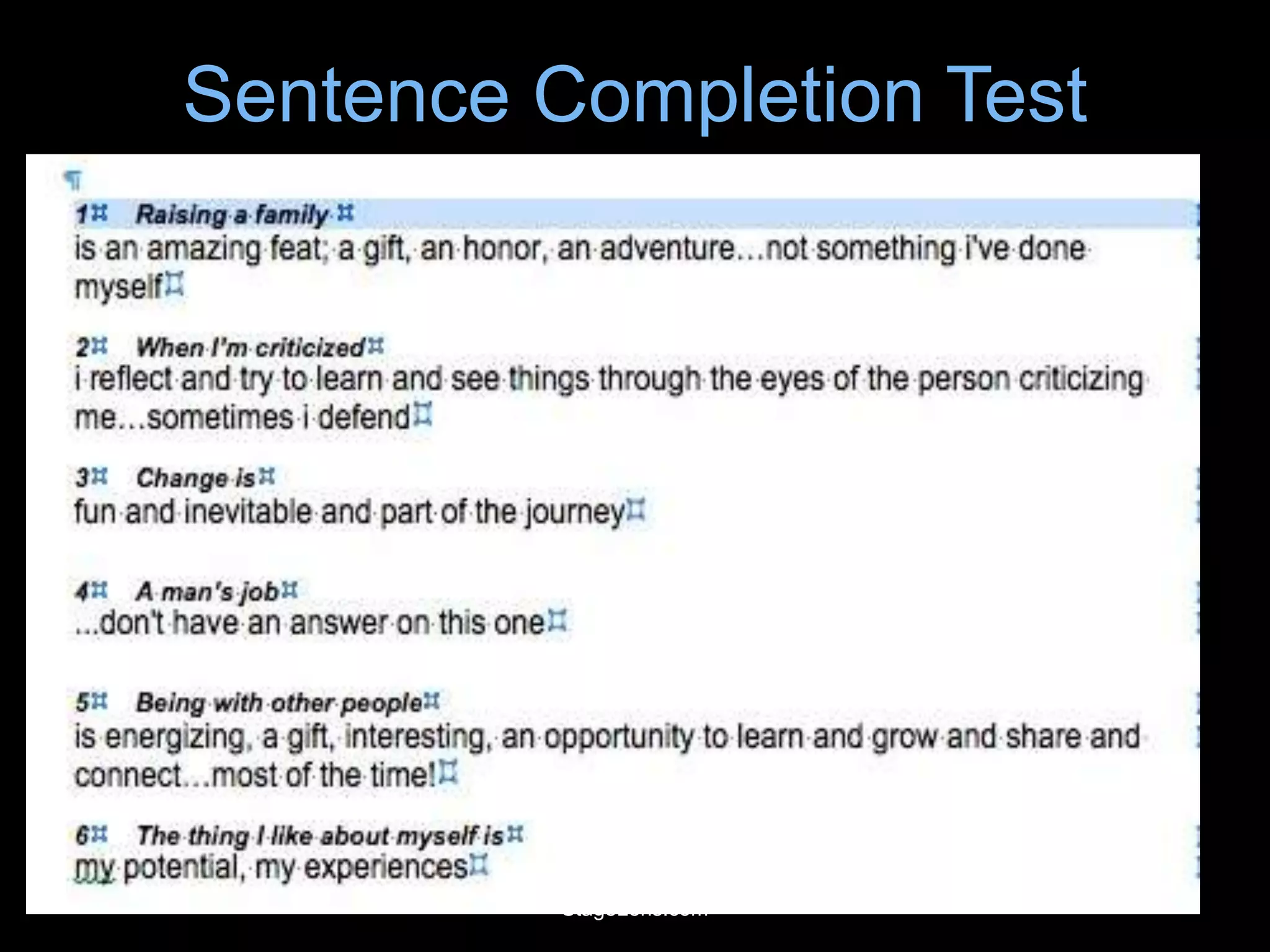
Sentence Completion Test
StageLens.com
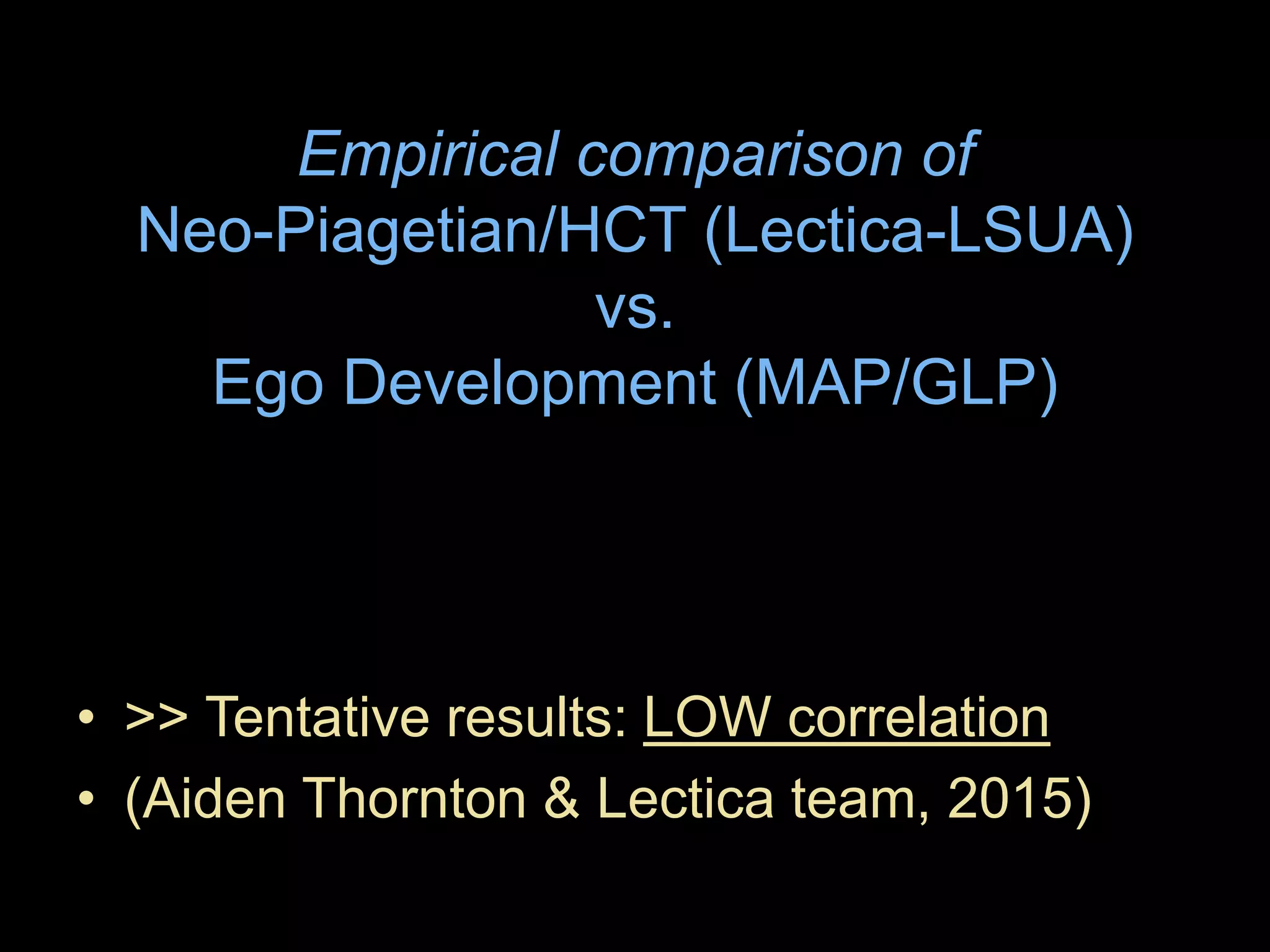
Empirical comparison of
Neo-Piagetian/HCT (Lectica-LSUA)
vs.
Ego Development (MAP/GLP)
• >> Tentative results: LOW correlation
• (Aiden Thornton & Lectica team, 2015)
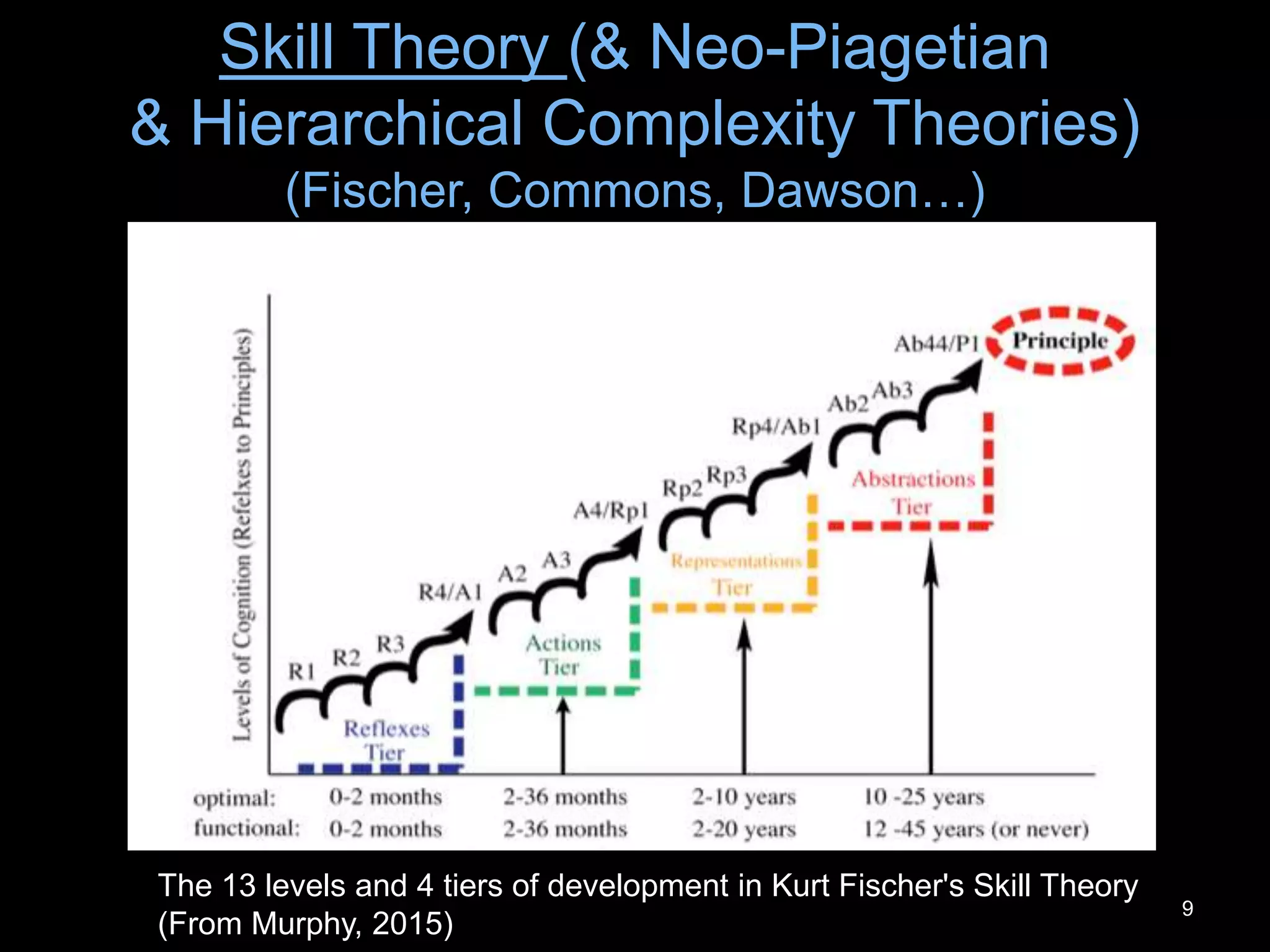
Skill Theory (& Neo-Piagetian
& Hierarchical Complexity Theories)
(Fischer, Commons, Dawson…)
The 13 levels and 4 tiers of development in Kurt Fischer's Skill Theory
(From Murphy, 2015)
9
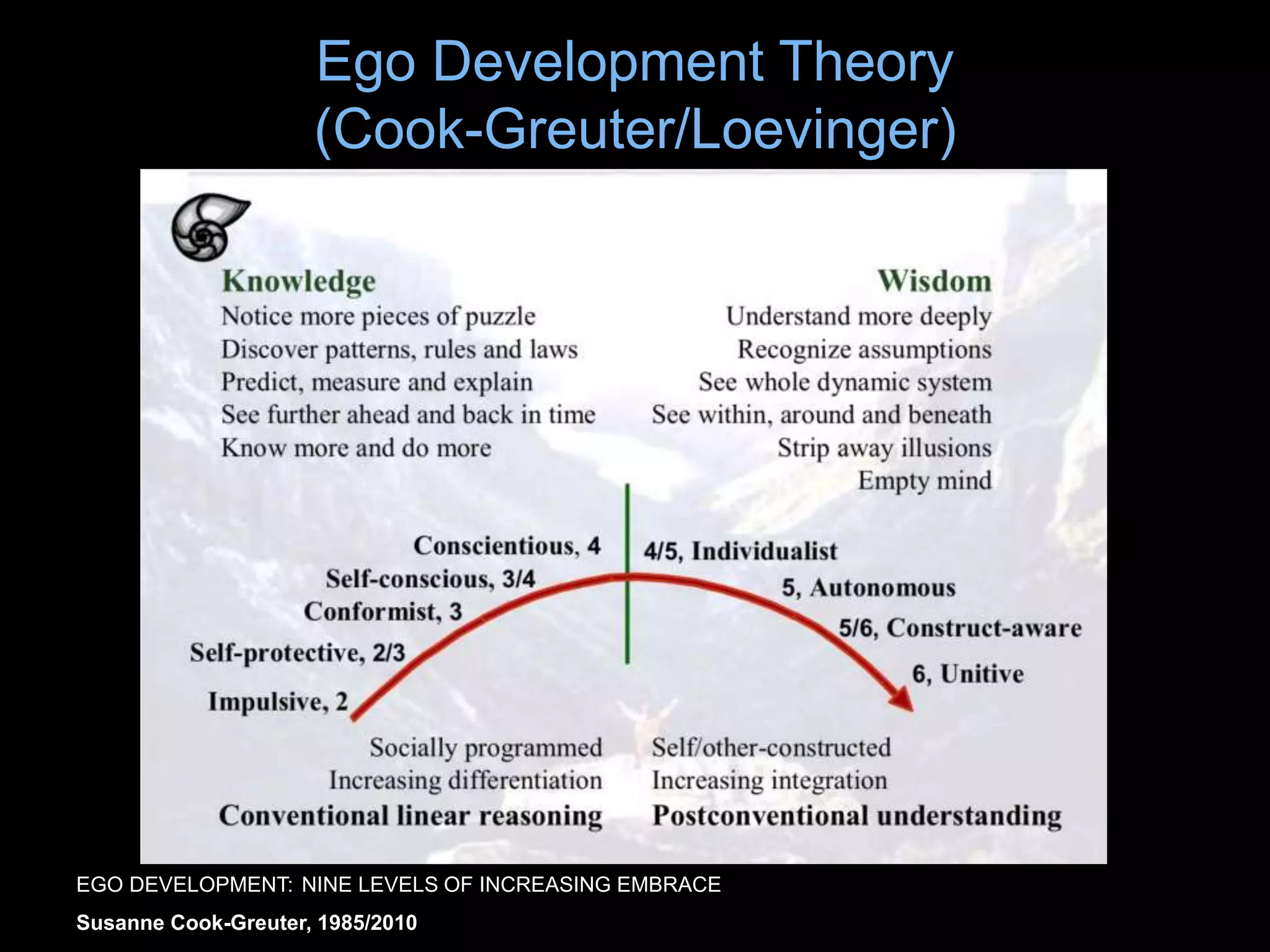
Ego Development Theory
(Cook-Greuter/Loevinger)
EGO DEVELOPMENT: NINE LEVELS OF INCREASING EMBRACE
Susanne Cook-Greuter, 1985/2010
StageLens.com
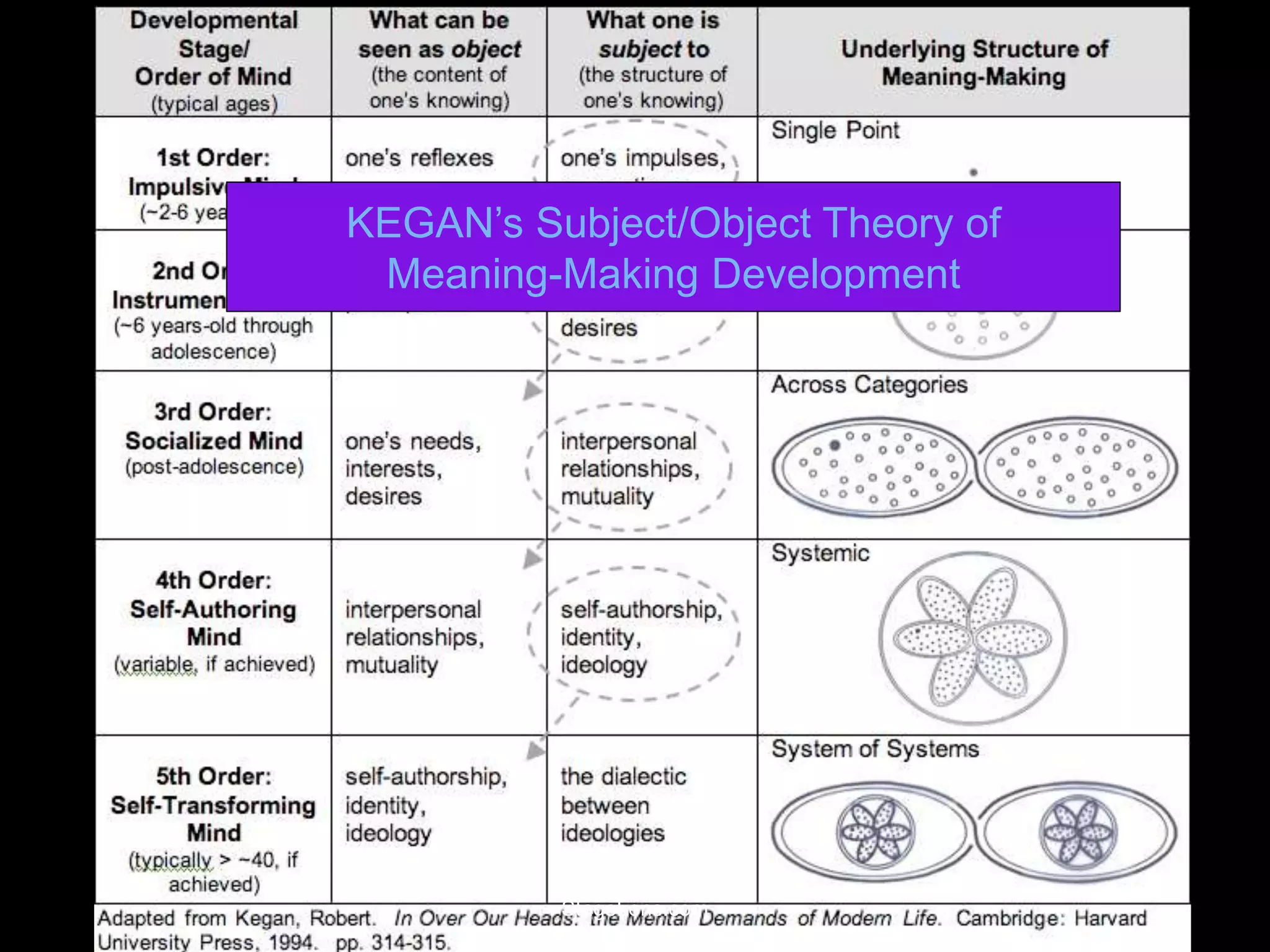
KEGAN’s Subject/Object Theory of
Meaning-Making Development
StageLens.com
Concrete
Subtle
Metaware
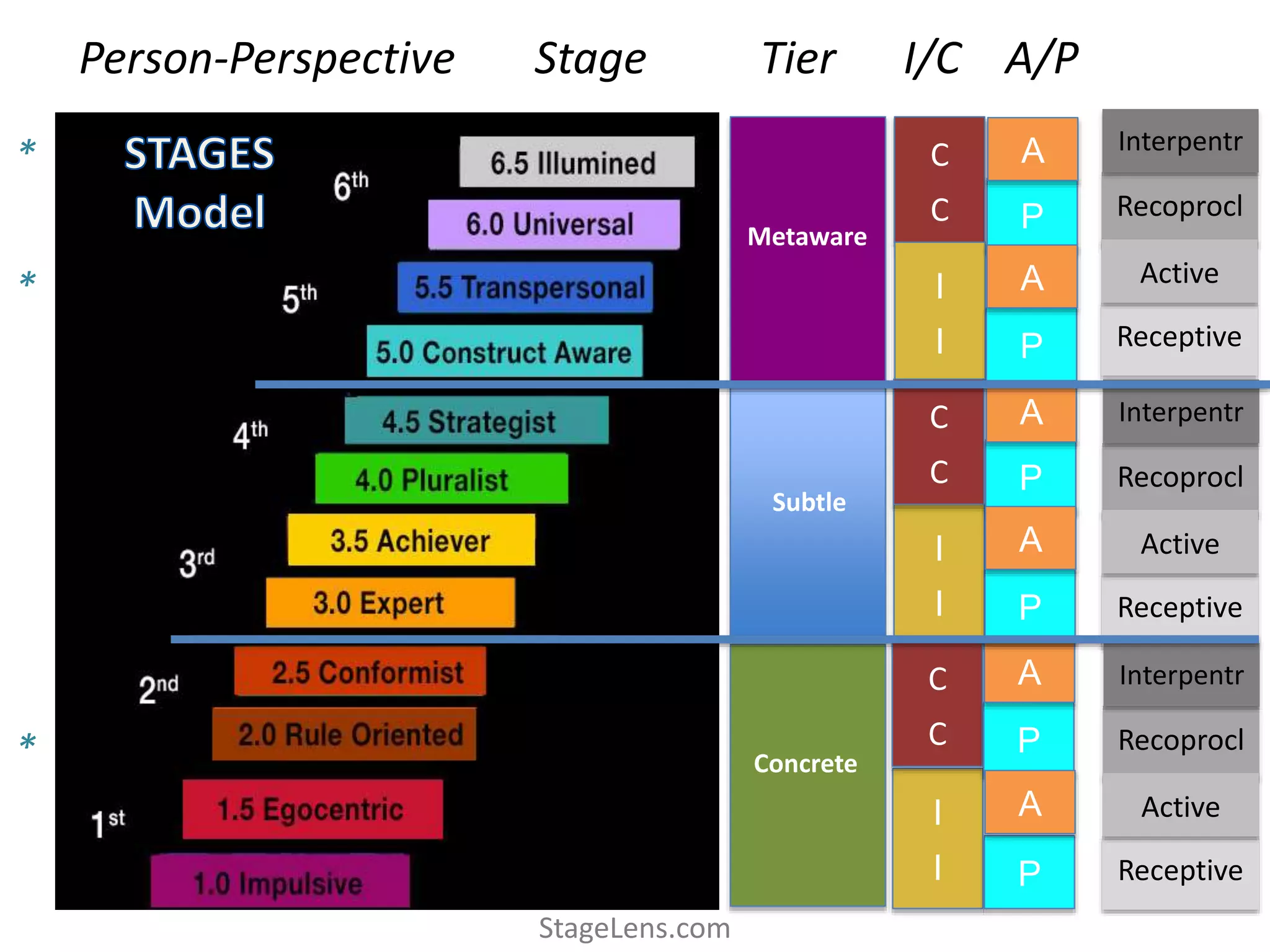
Person-Perspective Stage Tier I/C A/P
I
I
I
I
C
C
I
I
C
C
C
C
P
P
A
A
P
P
A
A
P
P
A
A
Receptive
Recoprocl
Active
Receptive
Recoprocl
Active
Interpentr
Receptive
Recoprocl
Active
Interpentr
Interpentr
*
*
*
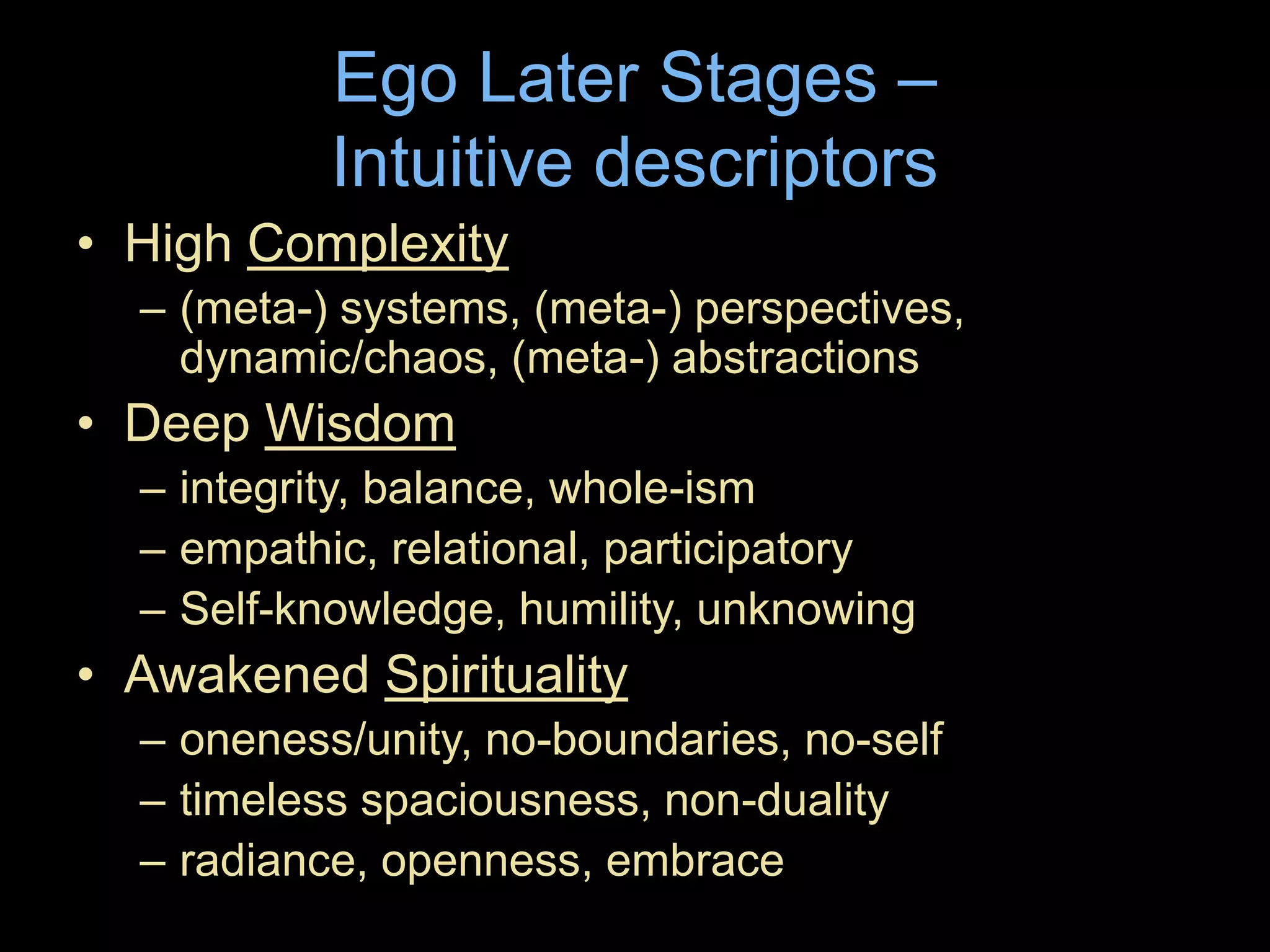
Ego Later Stages –
Intuitive descriptors
• High Complexity
– (meta-) systems, (meta-) perspectives,
dynamic/chaos, (meta-) abstractions
• Deep Wisdom
– integrity, balance, whole-ism
– empathic, relational, participatory
– Self-knowledge, humility, unknowing
• Awakened Spirituality
– oneness/unity, no-boundaries, no-self
– timeless spaciousness, non-duality
– radiance, openness, embrace
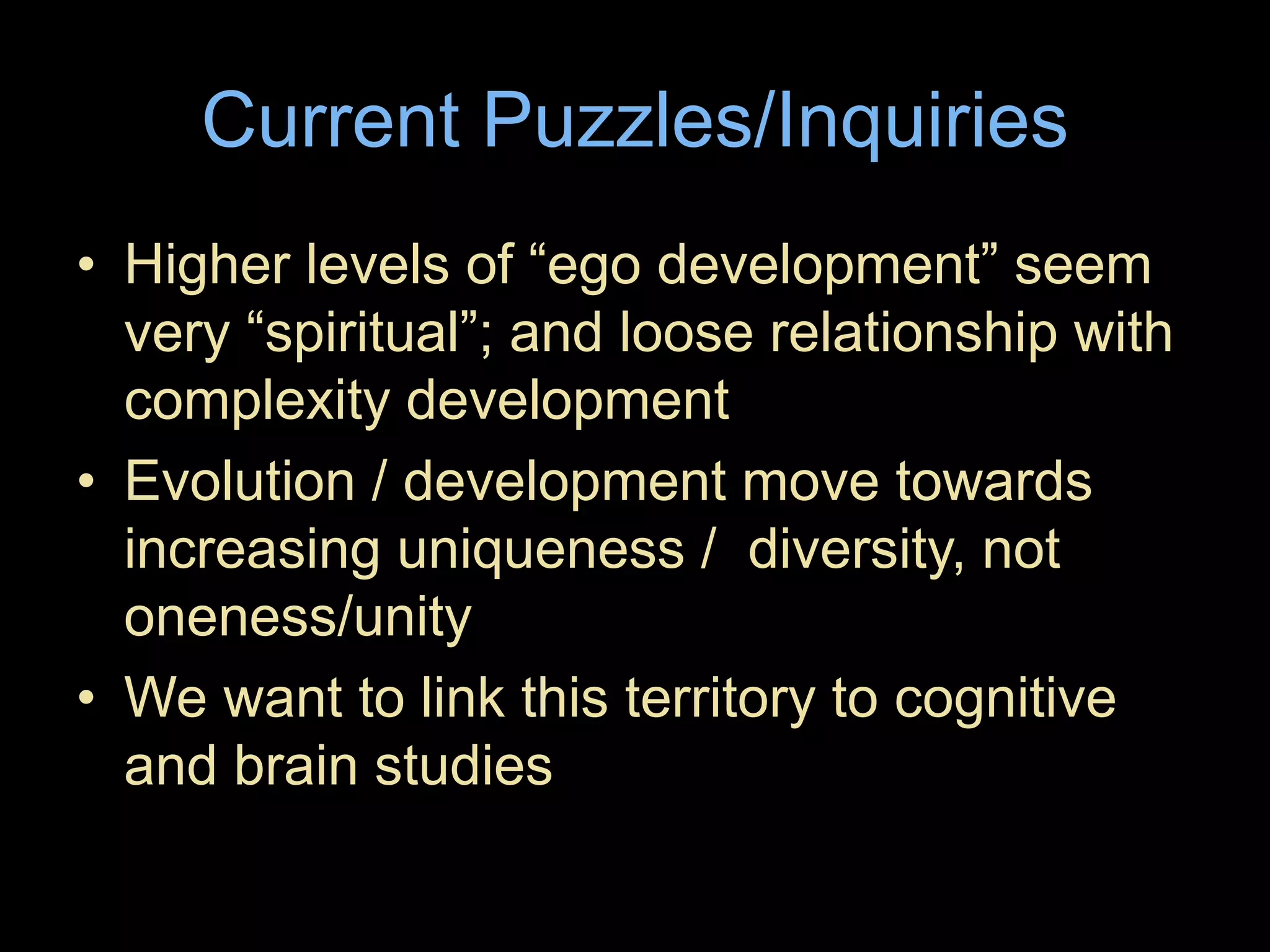
Current Puzzles/Inquiries
• Higher levels of “ego development” seem
very “spiritual”; and loose relationship with
complexity development
• Evolution / development move towards
increasing uniqueness / diversity, not
oneness/unity
• We want to link this territory to cognitive
and brain studies
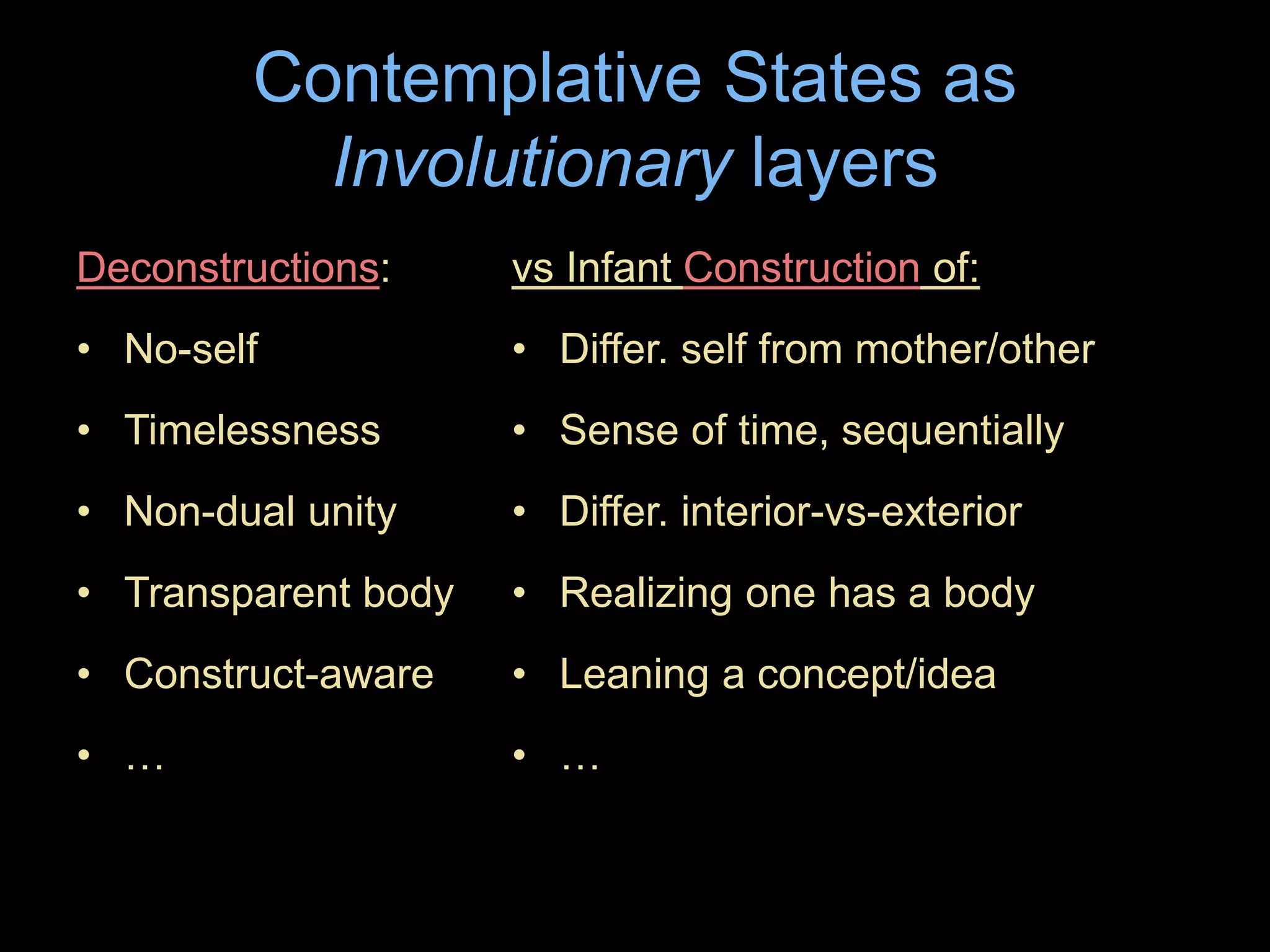
Contemplative States as
Involutionary layers
Deconstructions:
• No-self
• Timelessness
• Non-dual unity
• Transparent body
• Construct-aware
• …
vs Infant Construction of:
• Differ. self from mother/other
• Sense of time, sequentially
• Differ. interior-vs-exterior
• Realizing one has a body
• Leaning a concept/idea
• …
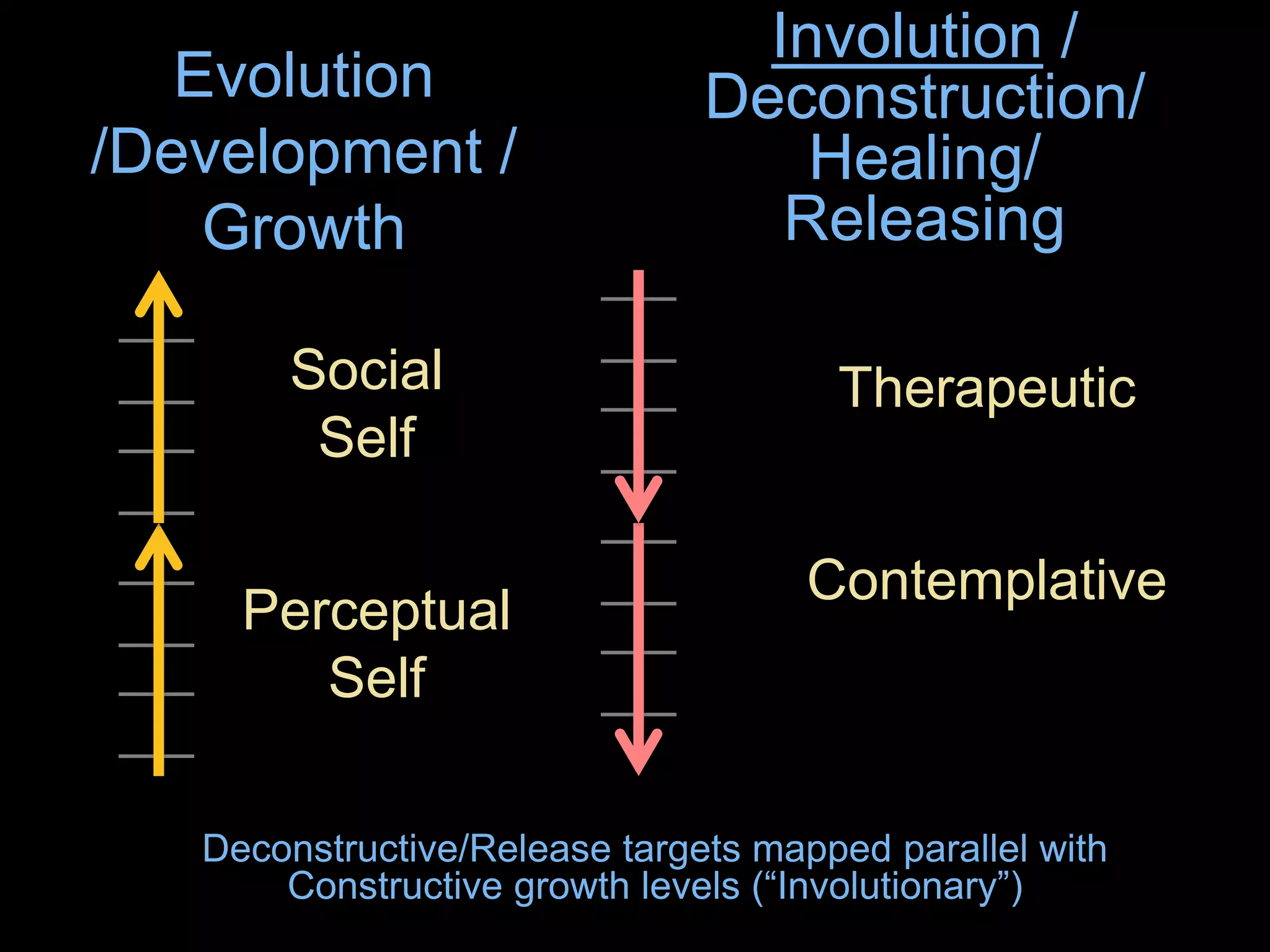
Evolution
/Development /
Growth
Social
Self
Perceptual
Self
Therapeutic
Contemplative
Involution /
Deconstruction/
Healing/
Releasing
Deconstructive/Release targets mapped parallel with
Constructive growth levels (“Involutionary”)
STAGES/Ego/MM devel.
vs HCT — #1
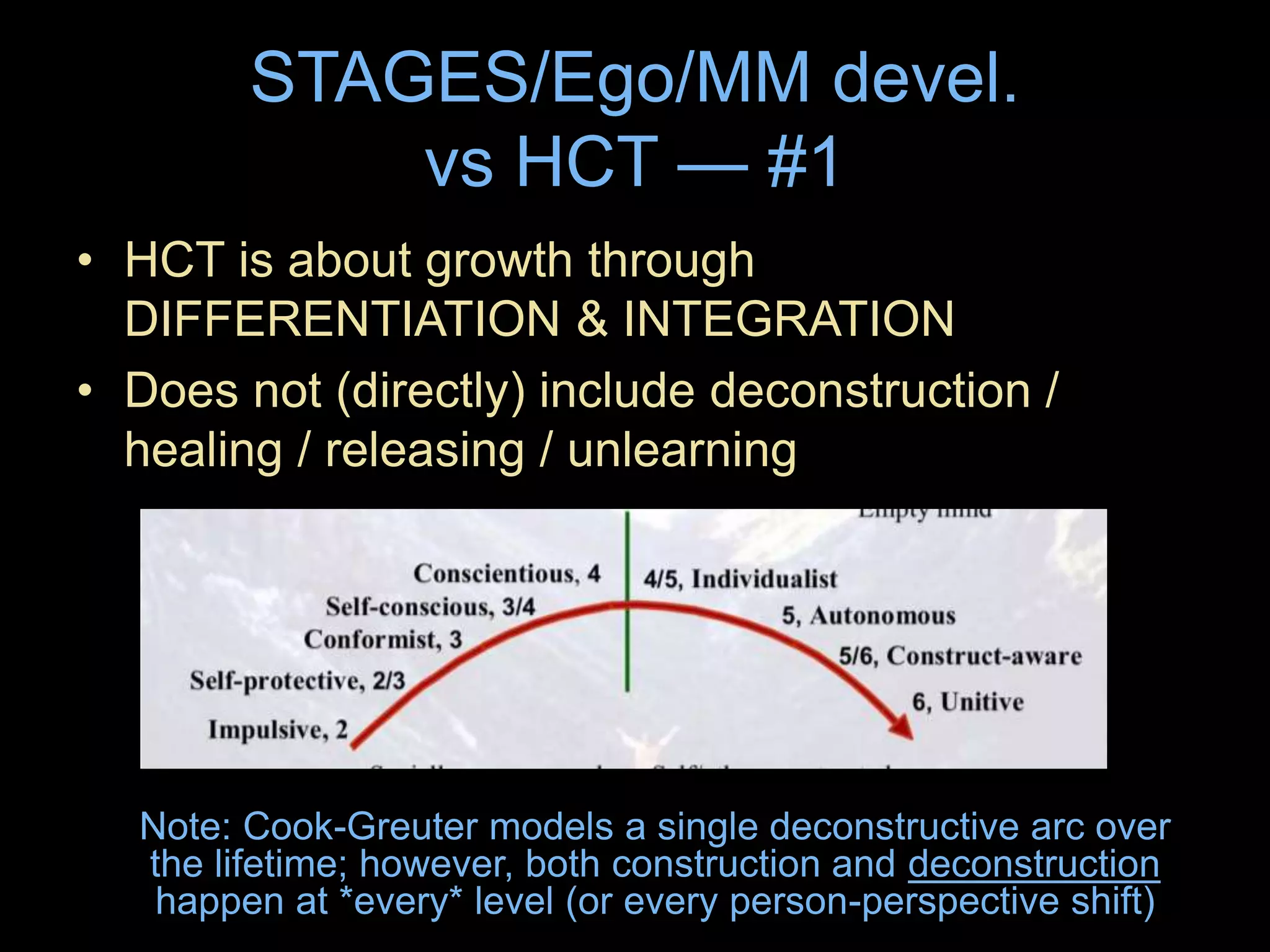
• HCT is about growth through
DIFFERENTIATION & INTEGRATION
• Does not (directly) include deconstruction /
healing / releasing / unlearning
Note: Cook-Greuter models a single deconstructive arc over
the lifetime; however, both construction and deconstruction
happen at *every* level (or every person-perspective shift)
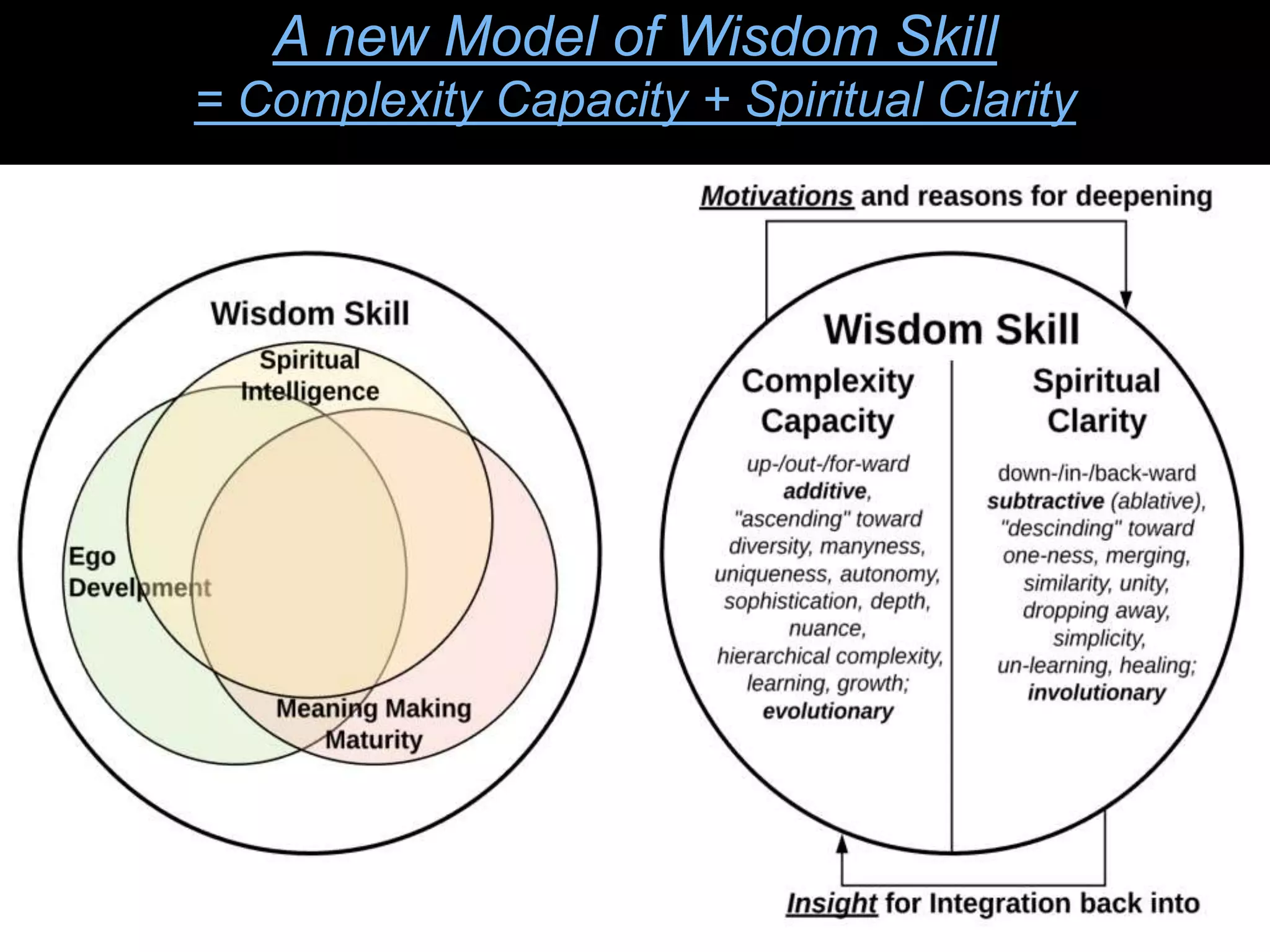
A new Model of Wisdom Skill
= Complexity Capacity + Spiritual Clarity
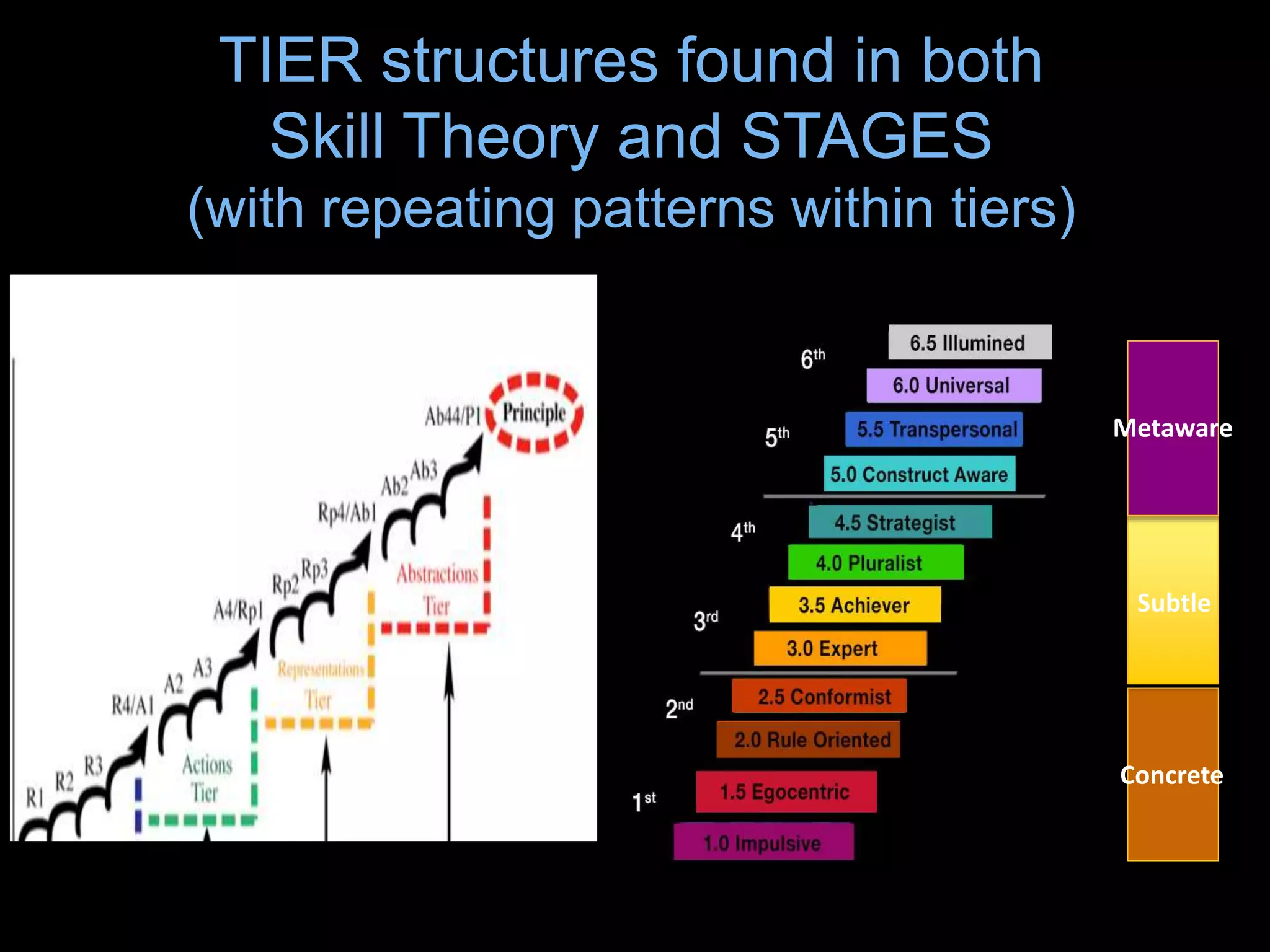
TIER structures found in both
Skill Theory and STAGES
(with repeating patterns within tiers)
Concrete
Subtle
Metaware
StageLens.com
Concrete
Subtle
Metaware
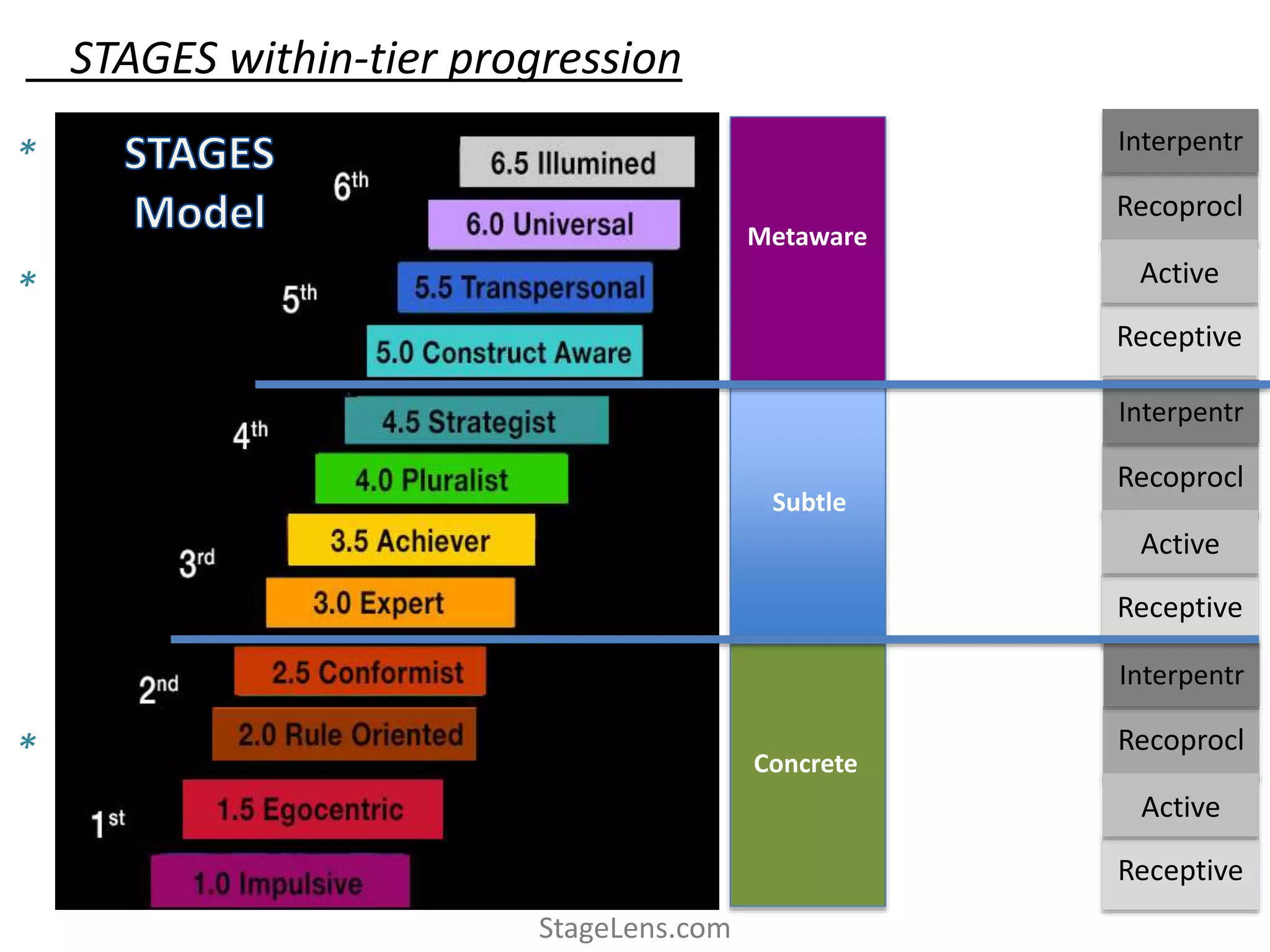
STAGES within-tier progression
Receptive
Recoprocl
Active
Receptive
Recoprocl
Active
Interpentr
Receptive
Recoprocl
Active
Interpentr
Interpentr
*
*
*
Concrete
Subtle
Metaware
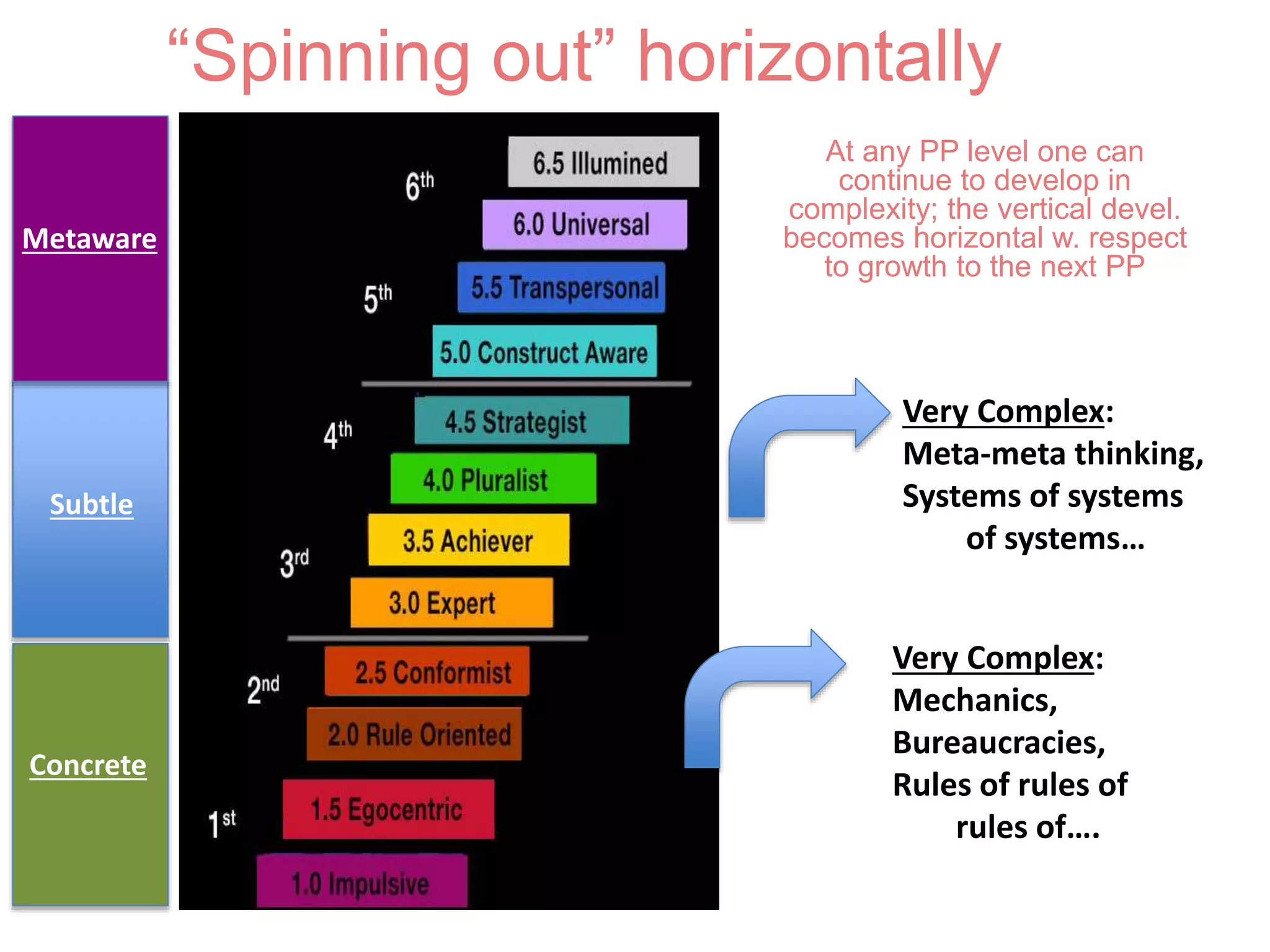
“Spinning out” horizontally
Very Complex:
Mechanics,
Bureaucracies,
Rules of rules of
rules of….
Very Complex:
Meta-meta thinking,
Systems of systems
of systems…
At any PP level one can
continue to develop in
complexity; the vertical devel.
becomes horizontal w. respect
to growth to the next PP
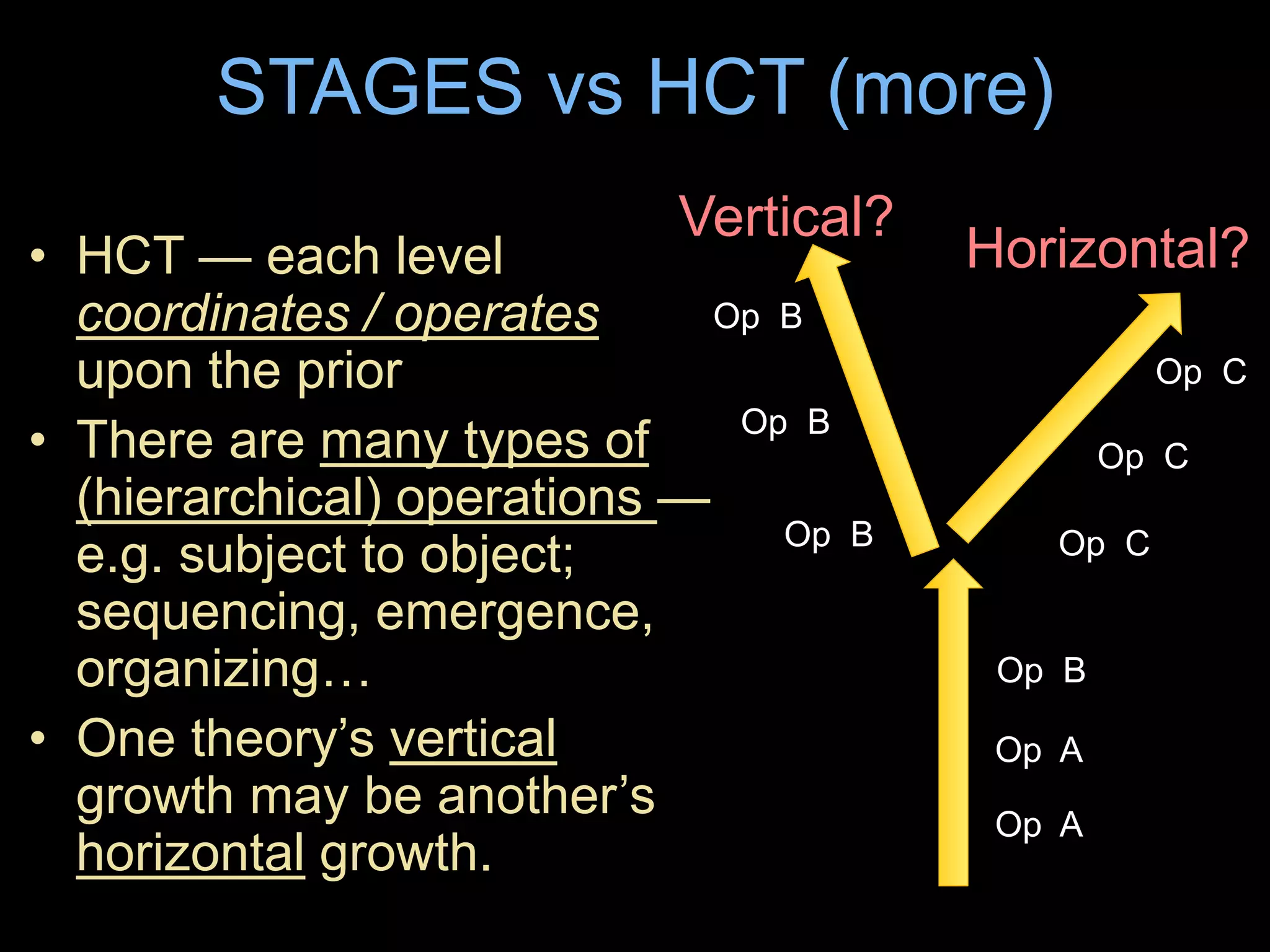
STAGES vs HCT (more)
• HCT — each level
coordinates / operates
upon the prior
• There are many types of
(hierarchical) operations —
e.g. subject to object;
sequencing, emergence,
organizing…
• One theory’s vertical
growth may be another’s
horizontal growth.
Op A
Op A
Op B
Op B
Op B
Op B
Op C
Op C
Op C
Vertical?
Horizontal?
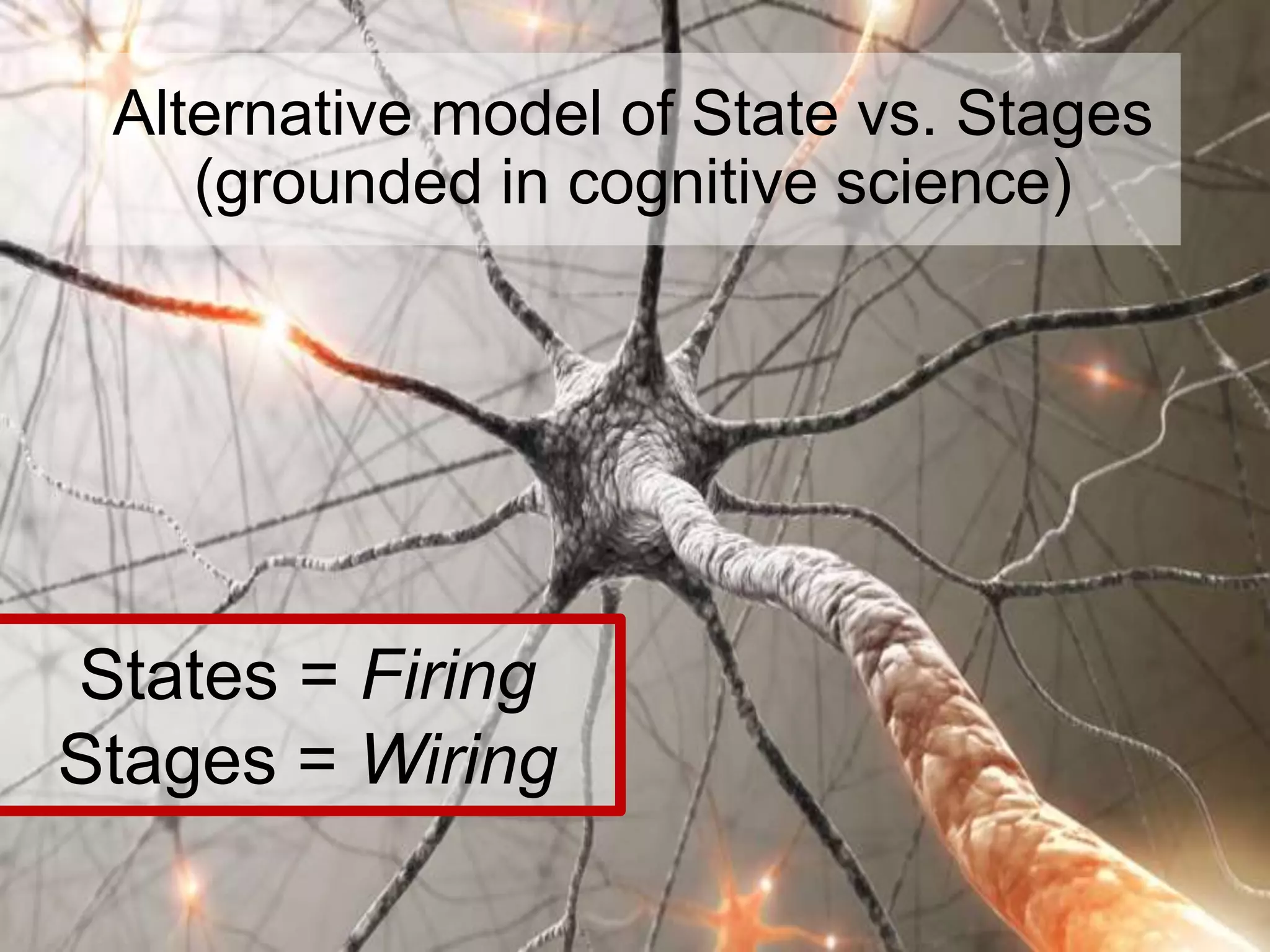
States = Firing
Stages = Wiring
Alternative model of State vs. Stages
(grounded in cognitive science)
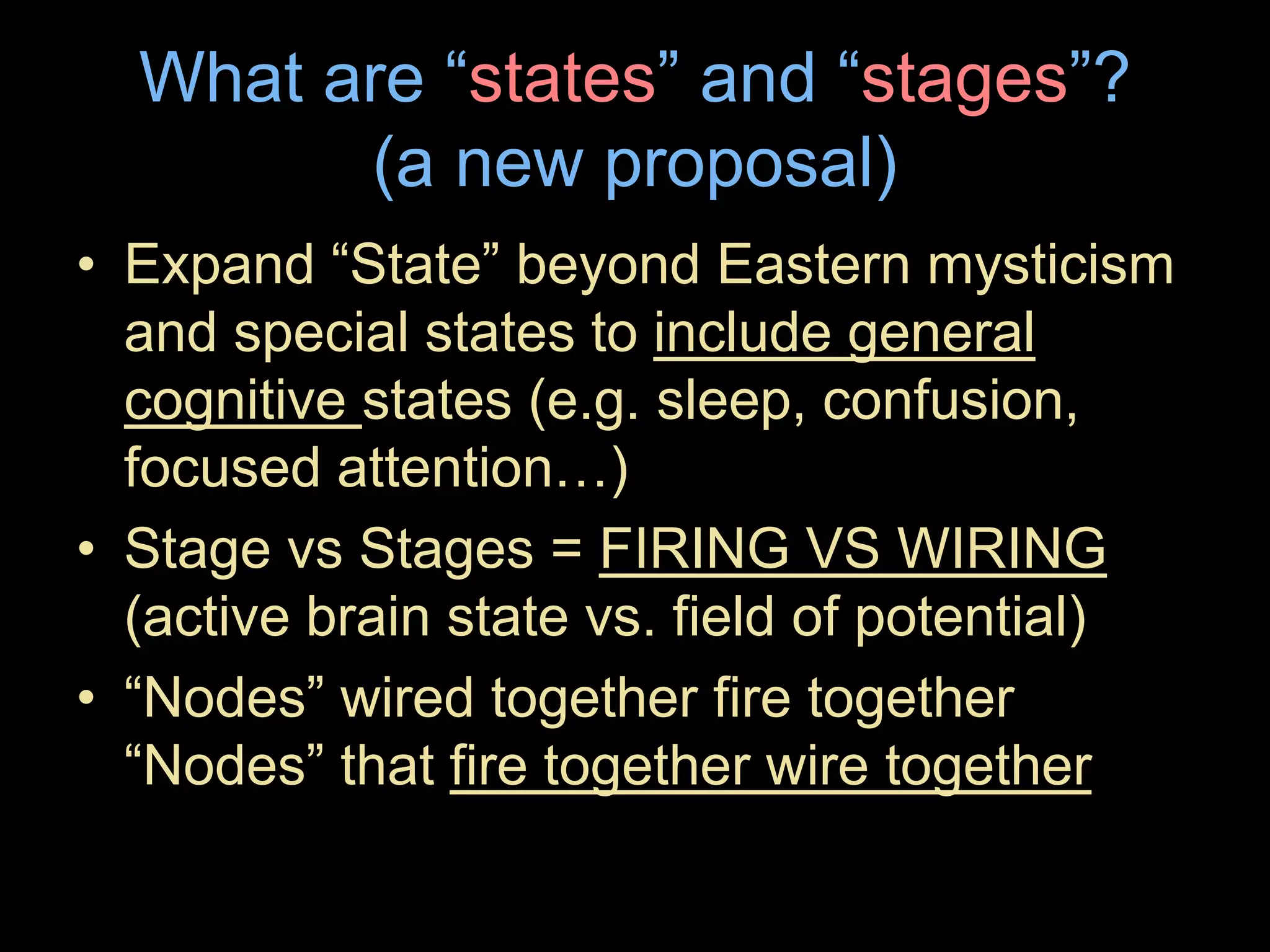
What are “states” and “stages”?
(a new proposal)
• Expand “State” beyond Eastern mysticism
and special states to include general
cognitive states (e.g. sleep, confusion,
focused attention…)
• Stage vs Stages = FIRING VS WIRING
(active brain state vs. field of potential)
• “Nodes” wired together fire together
“Nodes” that fire together wire together
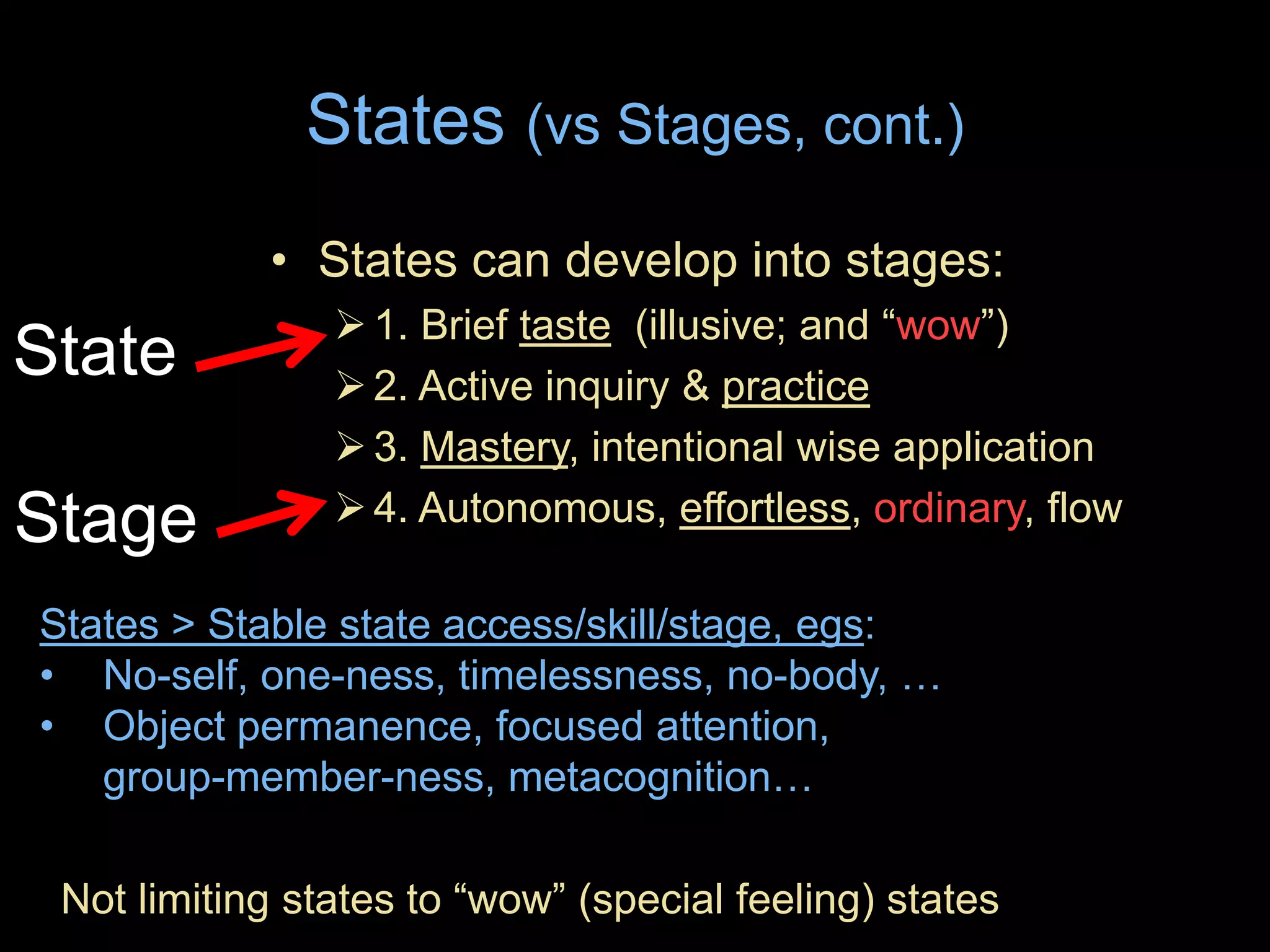
States (vs Stages, cont.)
• States can develop into stages:
1. Brief taste (illusive; and “wow”)
2. Active inquiry & practice
3. Mastery, intentional wise application
4. Autonomous, effortless, ordinary, flow
State
Stage
States > Stable state access/skill/stage, egs:
• No-self, one-ness, timelessness, no-body, …
• Object permanence, focused attention,
group-member-ness, metacognition…
Not limiting states to “wow” (special feeling) states
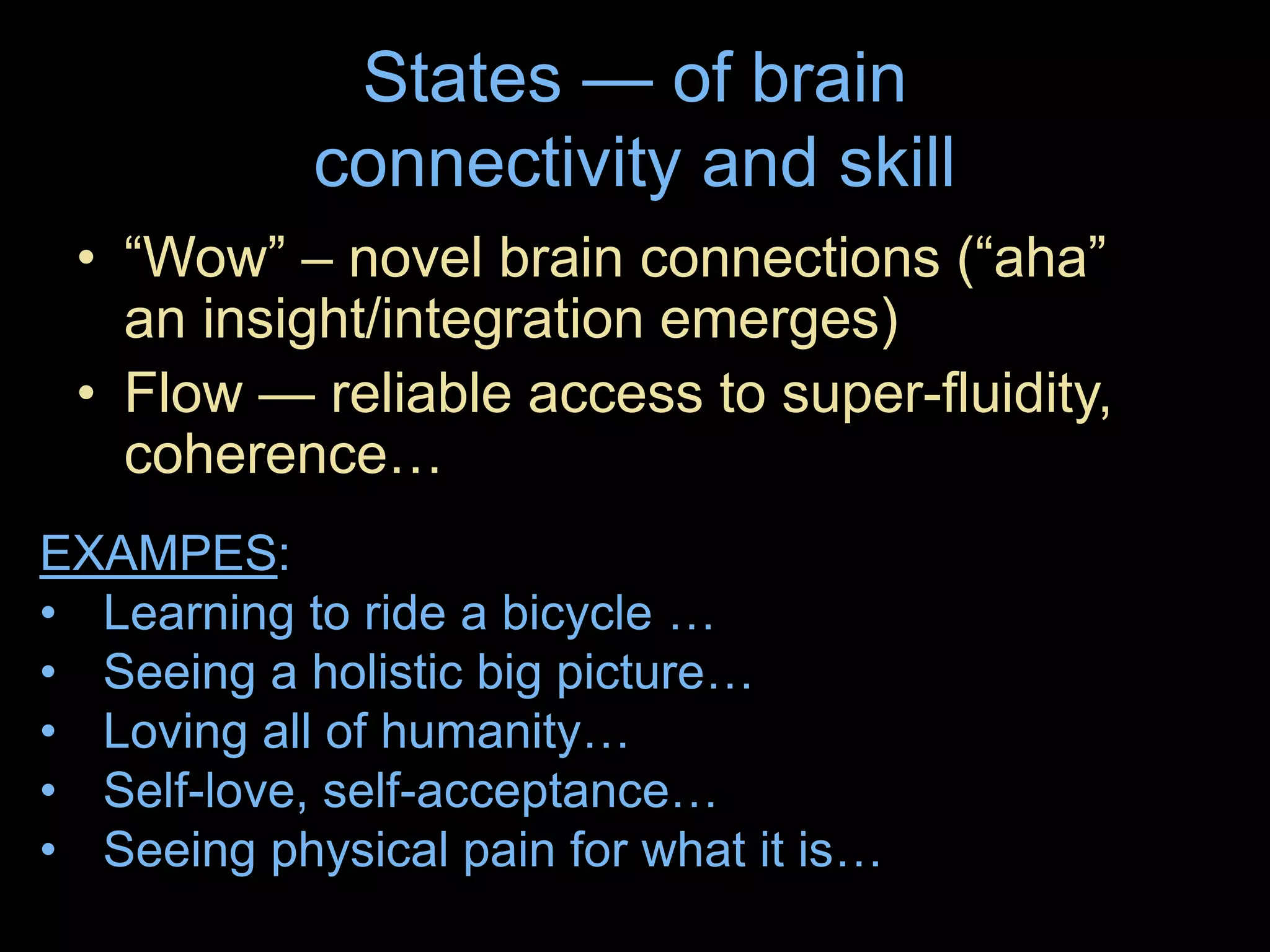
States — of brain
connectivity and skill
• “Wow” – novel brain connections (“aha”
an insight/integration emerges)
• Flow — reliable access to super-fluidity,
coherence…
EXAMPES:
• Learning to ride a bicycle …
• Seeing a holistic big picture…
• Loving all of humanity…
• Self-love, self-acceptance…
• Seeing physical pain for what it is…
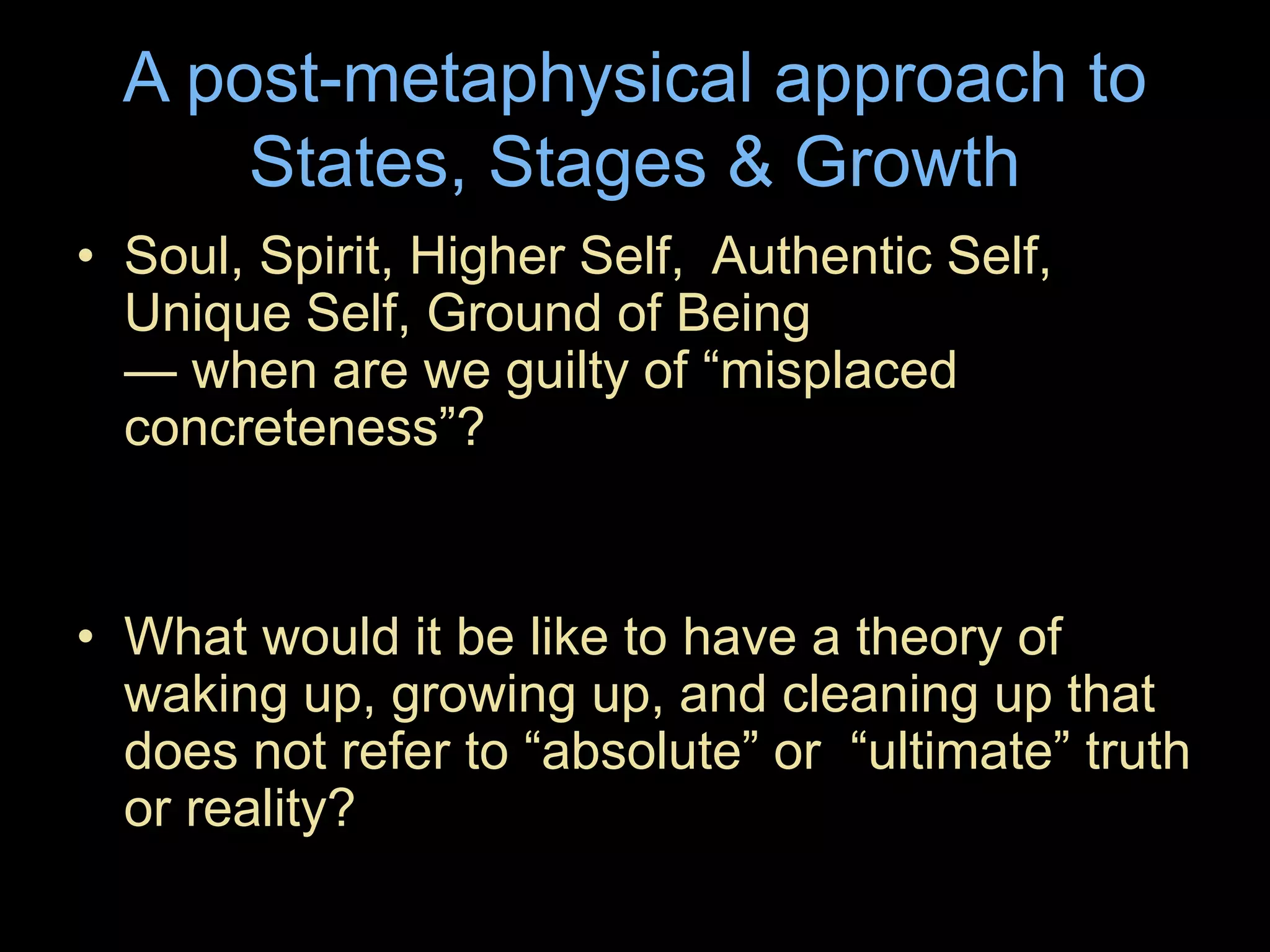
A post-metaphysical approach to
States, Stages & Growth
• Soul, Spirit, Higher Self, Authentic Self,
Unique Self, Ground of Being
— when are we guilty of “misplaced
concreteness”?
• What would it be like to have a theory of
waking up, growing up, and cleaning up that
does not refer to “absolute” or “ultimate” truth
or reality?
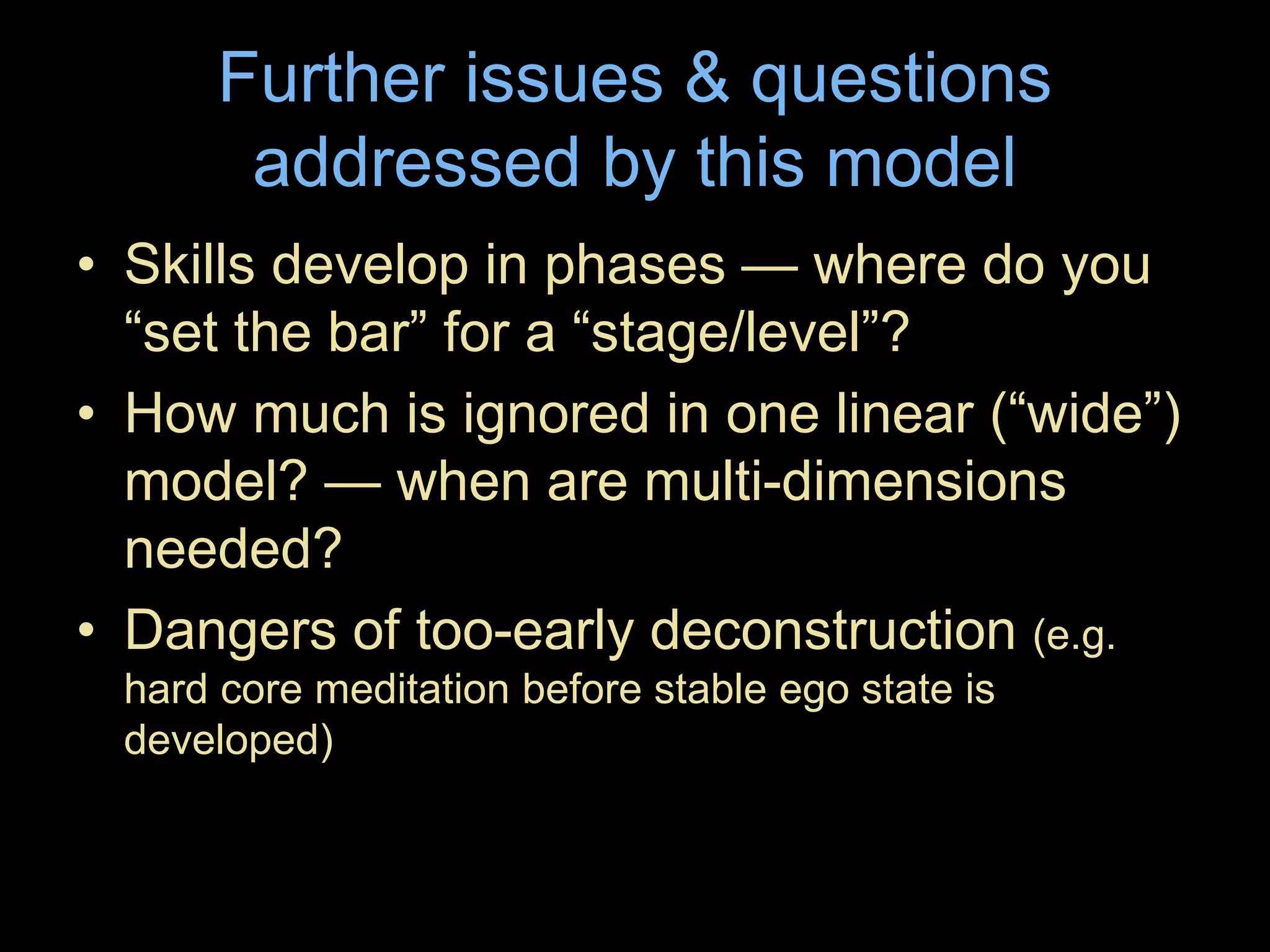
Further issues & questions
addressed by this model
• Skills develop in phases — where do you
“set the bar” for a “stage/level”?
• How much is ignored in one linear (“wide”)
model? — when are multi-dimensions
needed?
• Dangers of too-early deconstruction (e.g.
hard core meditation before stable ego state is
developed)
END – THANKS!
• Tom Murray <tommurray.us@gmail.com>
• www.tommurray.us
XTRA SLIDES
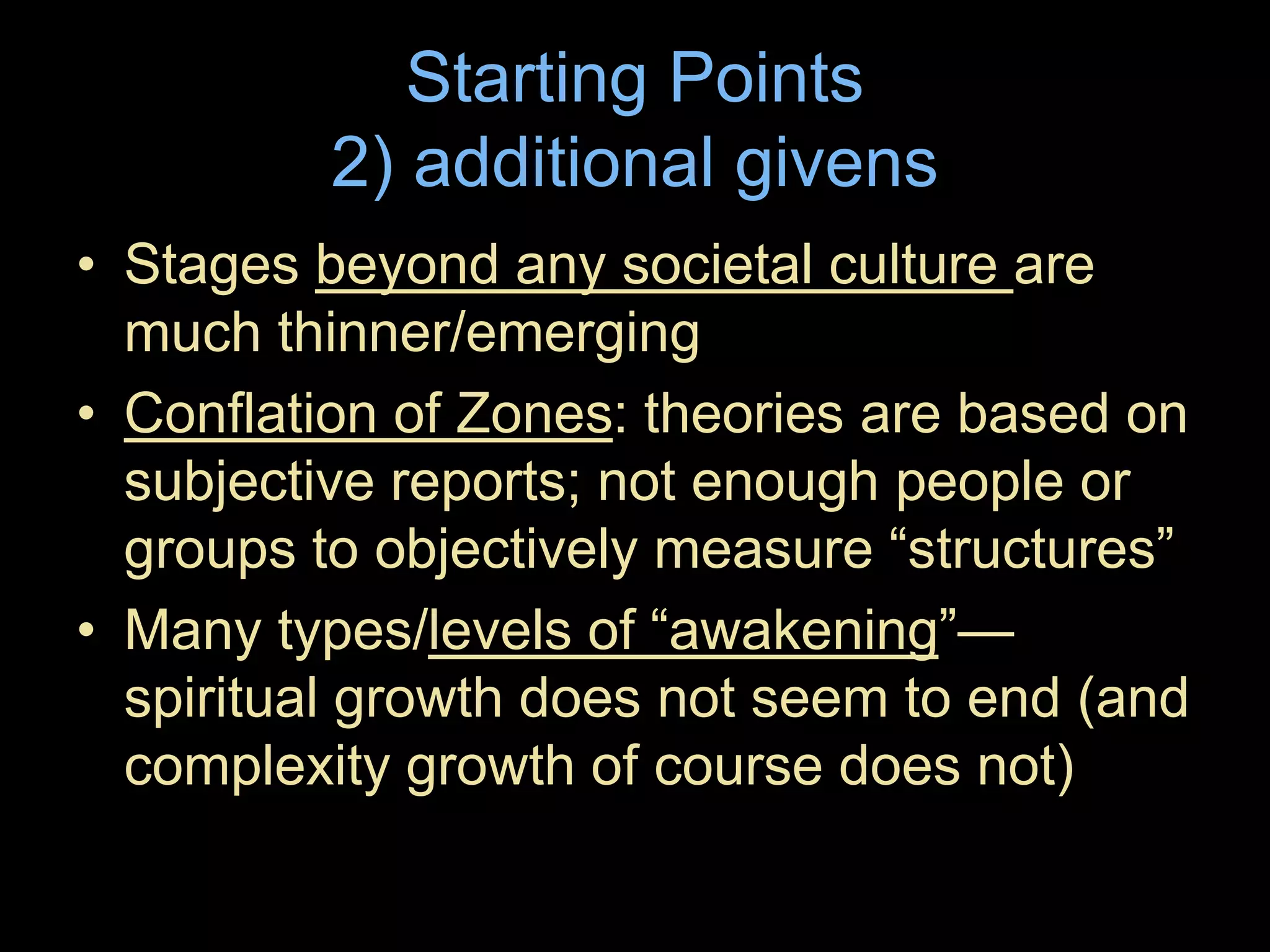
Starting points
1) from Integral Theory
• Developmental Lines:
– cognitive ≠ moral ≠ ego …
• States ≠ Stages
– Wilber-Combs matrix
– Growing up ≠ Waking up
– State-stages ≠ Ego development
• Spiritual development ≠ shadow work
– Spiritual leaders can have significant shadow
material unawares (Cleaning Up)
Starting Points
2) additional givens
• Stages beyond any societal culture are
much thinner/emerging
• Conflation of Zones: theories are based on
subjective reports; not enough people or
groups to objectively measure “structures”
• Many types/levels of “awakening”—
spiritual growth does not seem to end (and
complexity growth of course does not)
Wide/holistic Lines?
• “Ego” line hangs together….?
• Loevinger research shows “ego” as a
single factor (in factor analysis)
StageLens.com
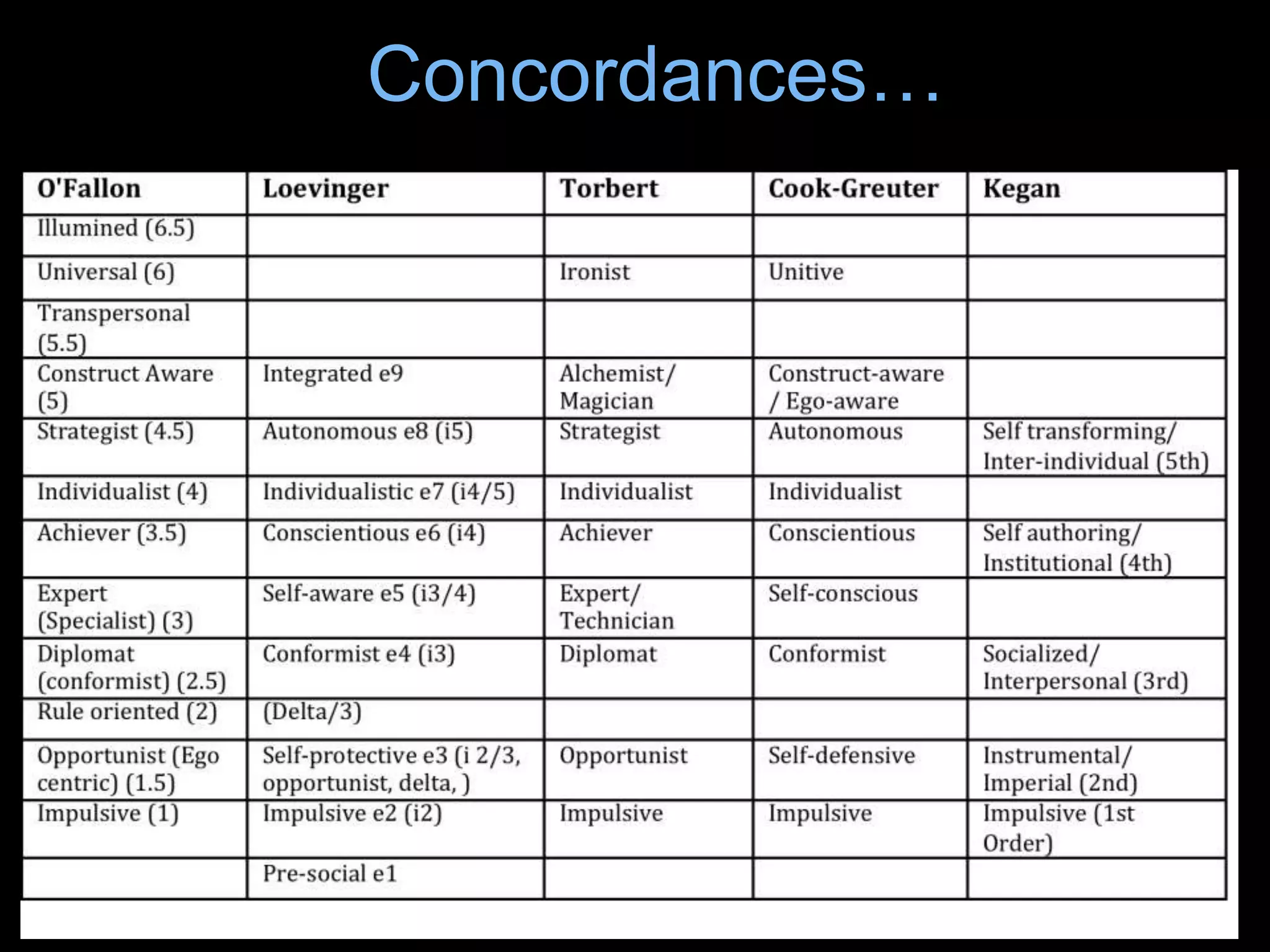
Concordances…
StageLens.com
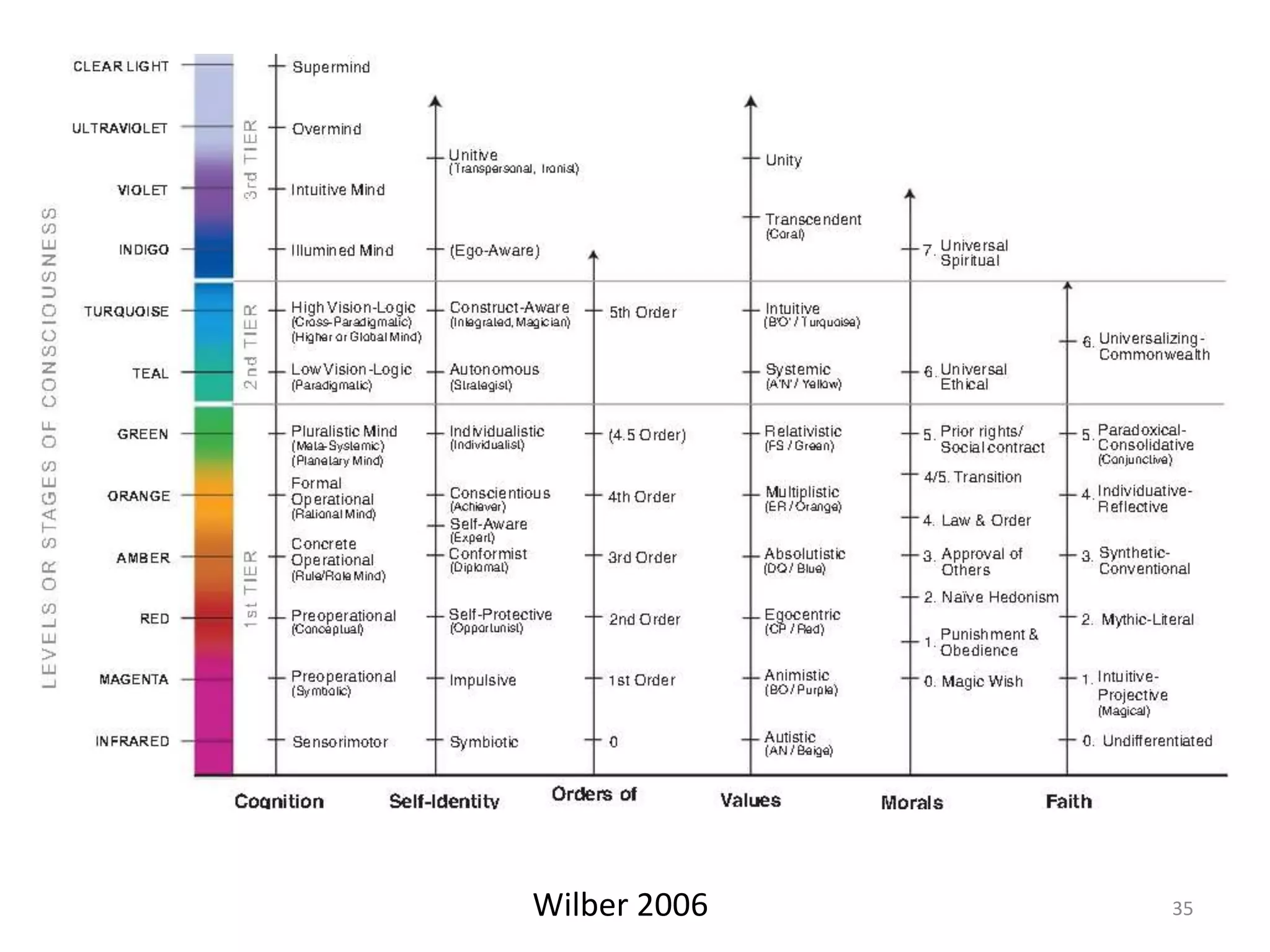
Wilber 2006 35
Concrete
Subtle
Metaware
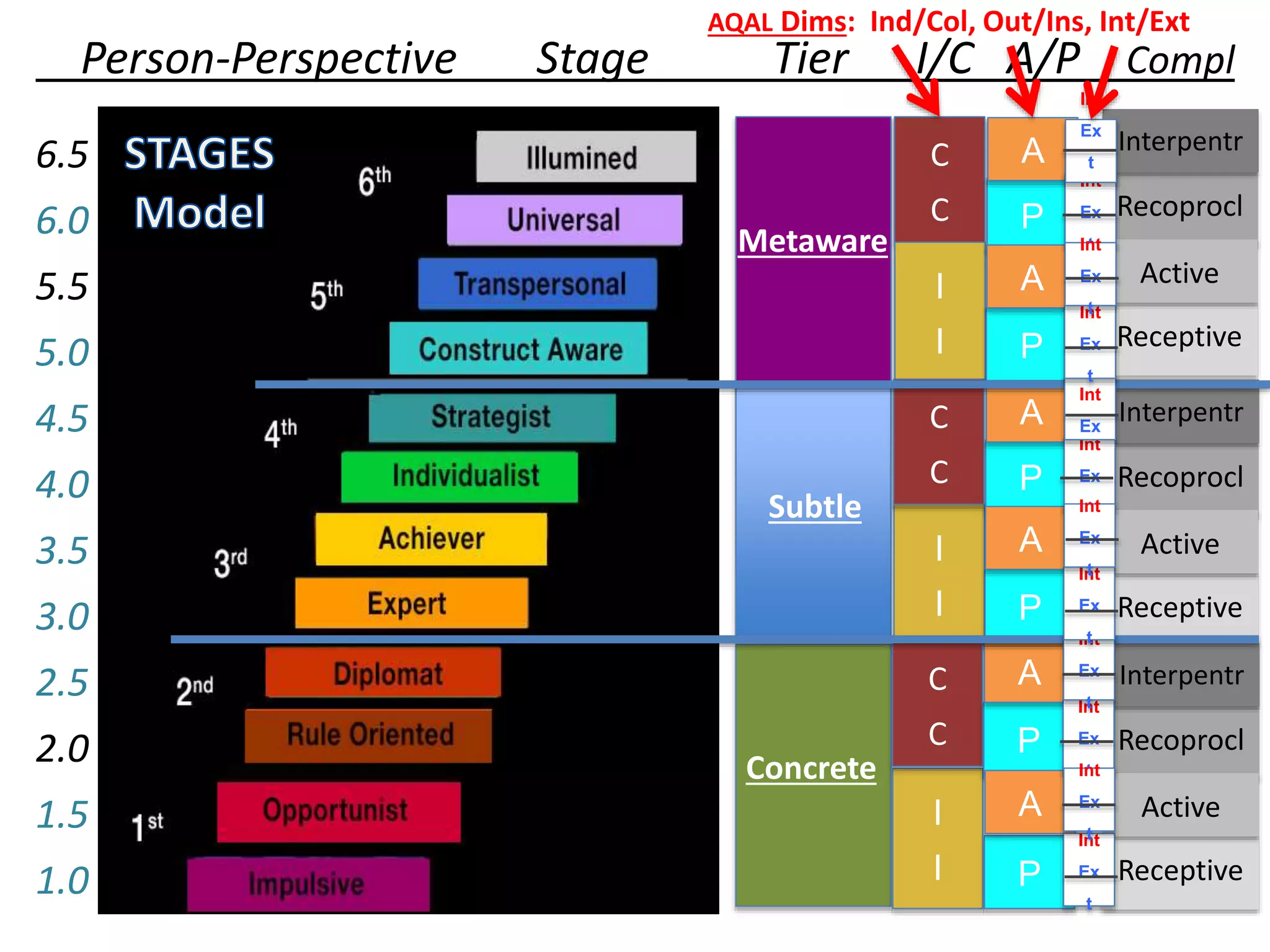
Person-Perspective Stage Tier I/C A/P Compl
6.5
6.0
5.5
5.0
4.5
4.0
3.5
3.0
2.5
2.0
1.5
1.0
I
I
I
I
C
C
I
I
C
C
C
C
P
P
A
A
P
P
A
A
P
P
A
A
Receptive
Recoprocl
Active
Receptive
Recoprocl
Active
Interpentr
Receptive
Recoprocl
Active
Interpentr
Interpentr
Int
Ex
t
Int
Ex
t
Int
Ex
t
Int
Ex
t
Int
Ex
t
Int
Ex
tInt
Ex
t
Int
Ex
Int
Ex
t
Int
Ex
tInt
Ex
t
Int
Ex
t
AQAL Dims: Ind/Col, Out/Ins, Int/Ext
Person-
perspective
Strengths Challenges
First Can orient strongly toward meeting one’s own concrete
needs and impulses. Can takes initiative in an
emergency.
Has difficulty seeing “the big picture”; Applies force or
seeks personal advantage when cooperative efforts are
more appropriate. Little focus on future or past.
Second Supports group cohesion and solidarity; Good with
structure, rules, and order. Good short term service to
others as long as it fits within role.
Can fall into ‘us-vs-them’ and ‘black and white’ thinking.
Avoids conflict and stepping outside of norms. Has difficulty
hearing feedback.
Third Rational, abstract thinking and planning. Creative
solution and achievement oriented. 1 - 5 year time
horizon. Accepts some feedback and adjusts behavior
towards defined goals.
Tends to over-focus on narrow solutions for team or
organization, without seeing environmental impacts or
deeper needs. Over emphasizes imagined goals, without
considering inevitable changes in context and knowledge,
and thus had difficulty adapting quickly.
Fourth Reciprocity, deep collaboration, concerns for the
multiple contexts, perspectives, constituencies; able
to reflect on sources of biases and uncertainties. 15 - 20
year time horizon. Sees limits of objective understanding
and anticipates need for adaptation and agility. Seeks
broad feedback.
May overemphasize systemic complexity when simpler
or more direct solutions are needed. Tends to over-focus
on collective, bottom-up, or systemic issues, rather than
individual accountability, limitations, and action. Can be
dogmatic and or arrogant and under-appreciate that others
may not share their big-picture view.
Fifth Emergent solutions; tolerance for ambiguity and
chaos; flow within complexity. In-the-moment reflection
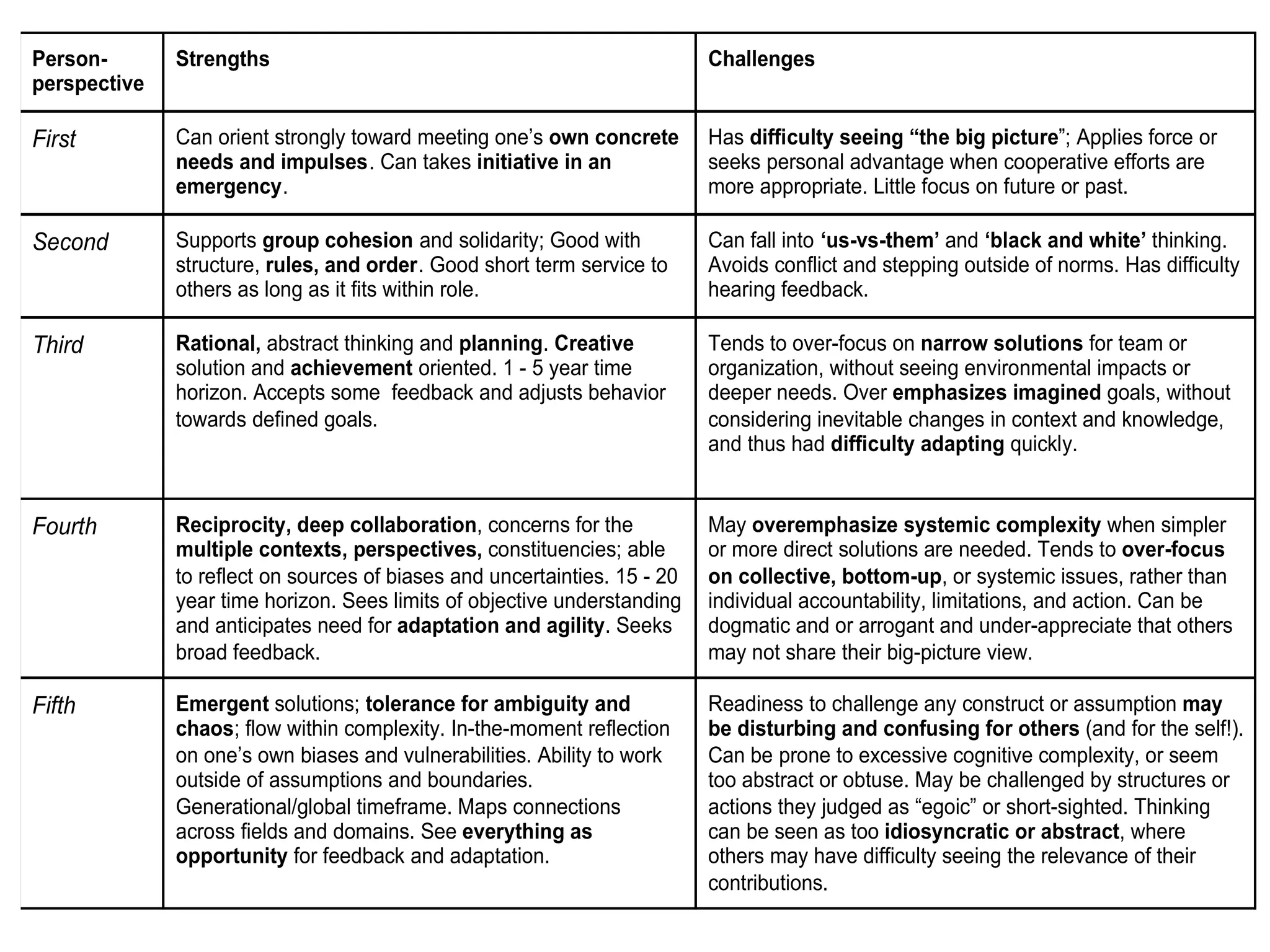
on one’s own biases and vulnerabilities. Ability to work
outside of assumptions and boundaries.
Generational/global timeframe. Maps connections
across fields and domains. See everything as
opportunity for feedback and adaptation.
Readiness to challenge any construct or assumption may
be disturbing and confusing for others (and for the self!).
Can be prone to excessive cognitive complexity, or seem
too abstract or obtuse. May be challenged by structures or
actions they judged as “egoic” or short-sighted. Thinking
can be seen as too idiosyncratic or abstract, where
others may have difficulty seeing the relevance of their
contributions.
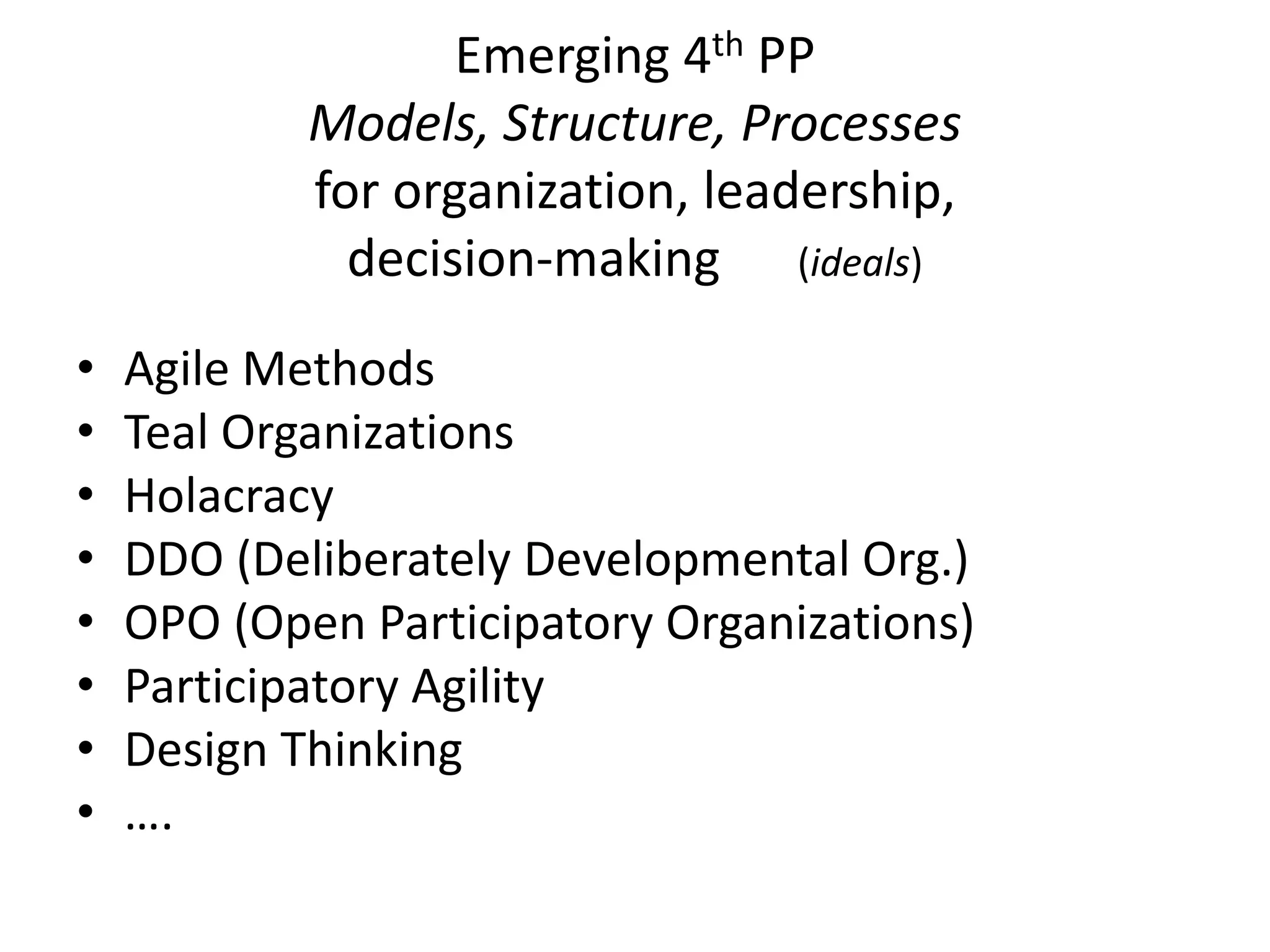
Emerging 4th PP
Models, Structure, Processes
for organization, leadership,
decision-making (ideals)
• Agile Methods
• Teal Organizations
• Holacracy
• DDO (Deliberately Developmental Org.)
• OPO (Open Participatory Organizations)
• Participatory Agility
• Design Thinking
• ….
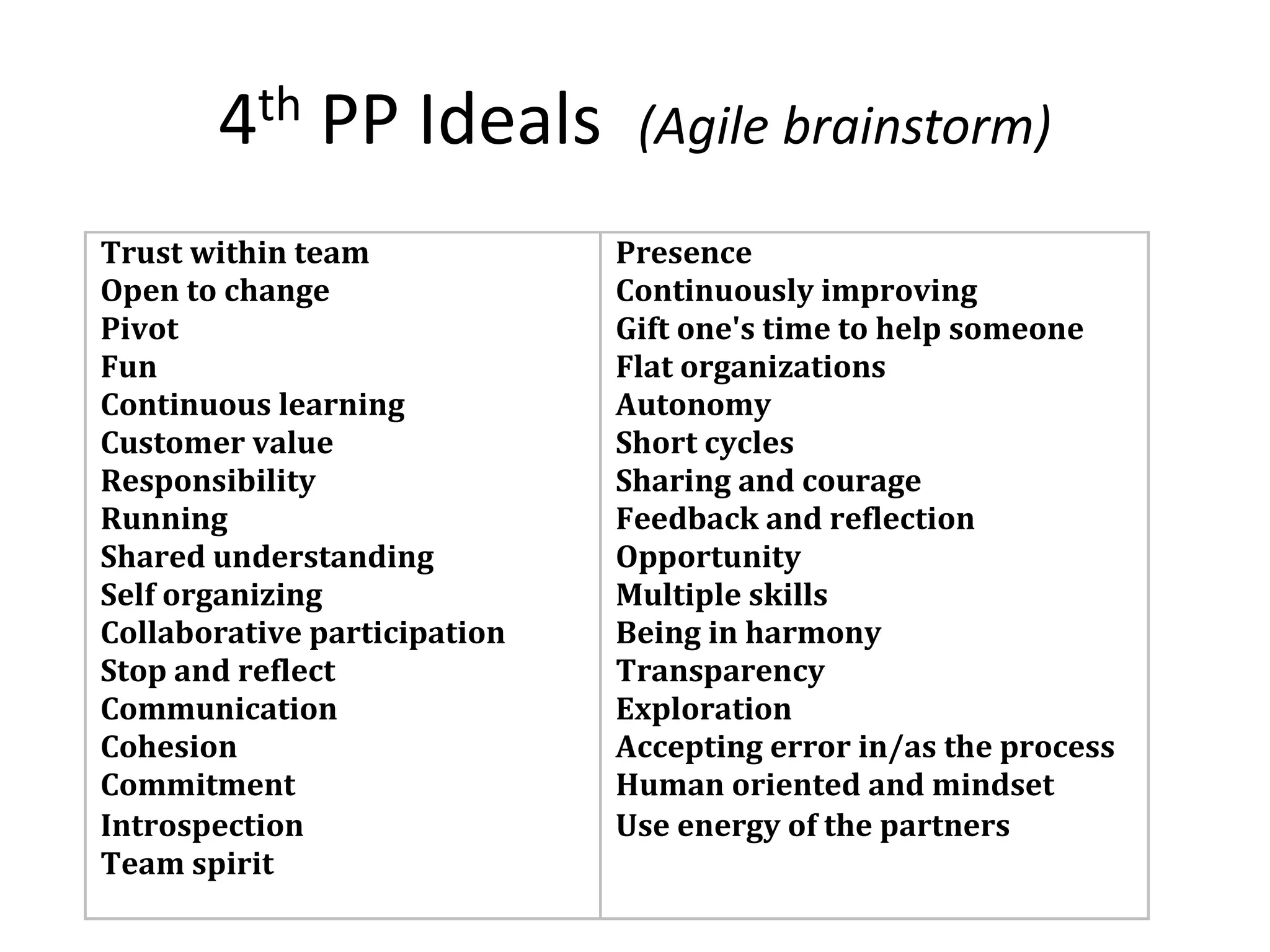
4th PP Ideals (Agile brainstorm)
Trust within team
Open to change
Pivot
Fun
Continuous learning
Customer value
Responsibility
Running
Shared understanding
Self organizing
Collaborative participation
Stop and reflect
Communication
Cohesion
Commitment
Introspection
Team spirit
Presence
Continuously improving
Gift one's time to help someone
Flat organizations
Autonomy
Short cycles
Sharing and courage
Feedback and reflection
Opportunity
Multiple skills
Being in harmony
Transparency
Exploration
Accepting error in/as the process
Human oriented and mindset
Use energy of the partners
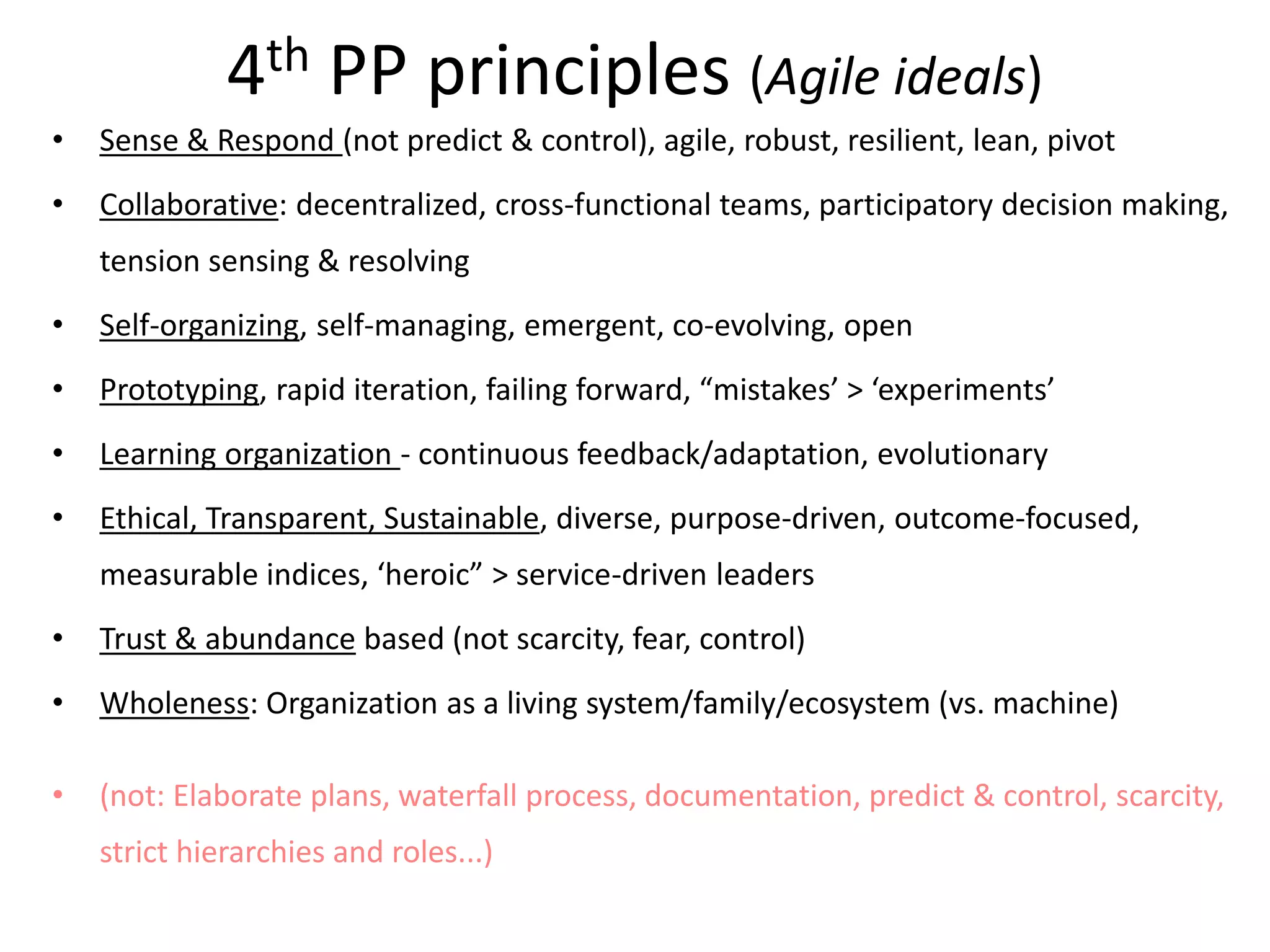
4th PP principles (Agile ideals)
• Sense & Respond (not predict & control), agile, robust, resilient, lean, pivot
• Collaborative: decentralized, cross-functional teams, participatory decision making,
tension sensing & resolving
• Self-organizing, self-managing, emergent, co-evolving, open
• Prototyping, rapid iteration, failing forward, “mistakes’ > ‘experiments’
• Learning organization - continuous feedback/adaptation, evolutionary
• Ethical, Transparent, Sustainable, diverse, purpose-driven, outcome-focused,
measurable indices, ‘heroic” > service-driven leaders
• Trust & abundance based (not scarcity, fear, control)
• Wholeness: Organization as a living system/family/ecosystem (vs. machine)
• (not: Elaborate plans, waterfall process, documentation, predict & control, scarcity,
strict hierarchies and roles...)
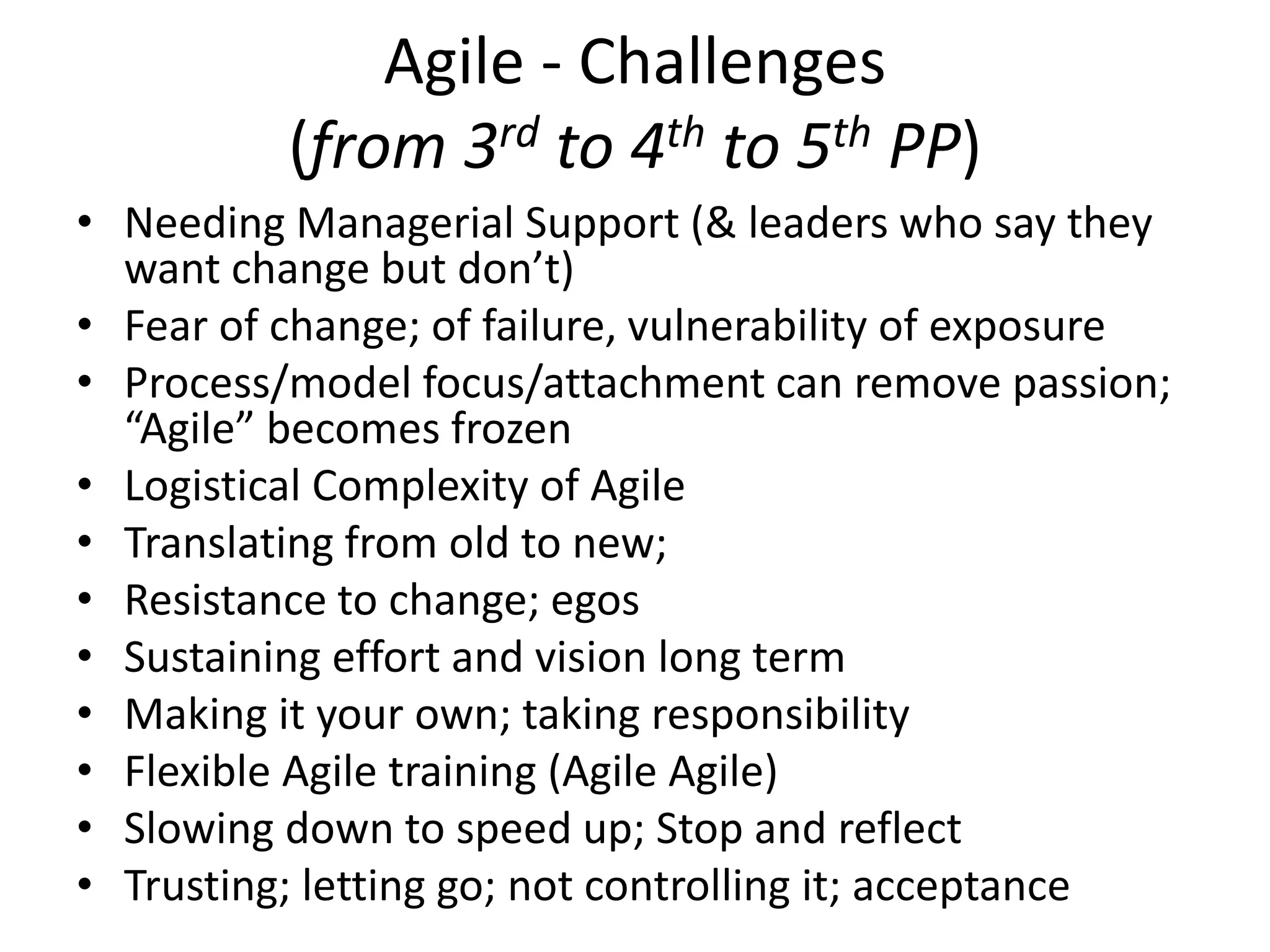
Agile - Challenges
(from 3rd to 4th to 5th PP)
• Needing Managerial Support (& leaders who say they
want change but don’t)
• Fear of change; of failure, vulnerability of exposure
• Process/model focus/attachment can remove passion;
“Agile” becomes frozen
• Logistical Complexity of Agile
• Translating from old to new;
• Resistance to change; egos
• Sustaining effort and vision long term
• Making it your own; taking responsibility
• Flexible Agile training (Agile Agile)
• Slowing down to speed up; Stop and reflect
• Trusting; letting go; not controlling it; acceptance
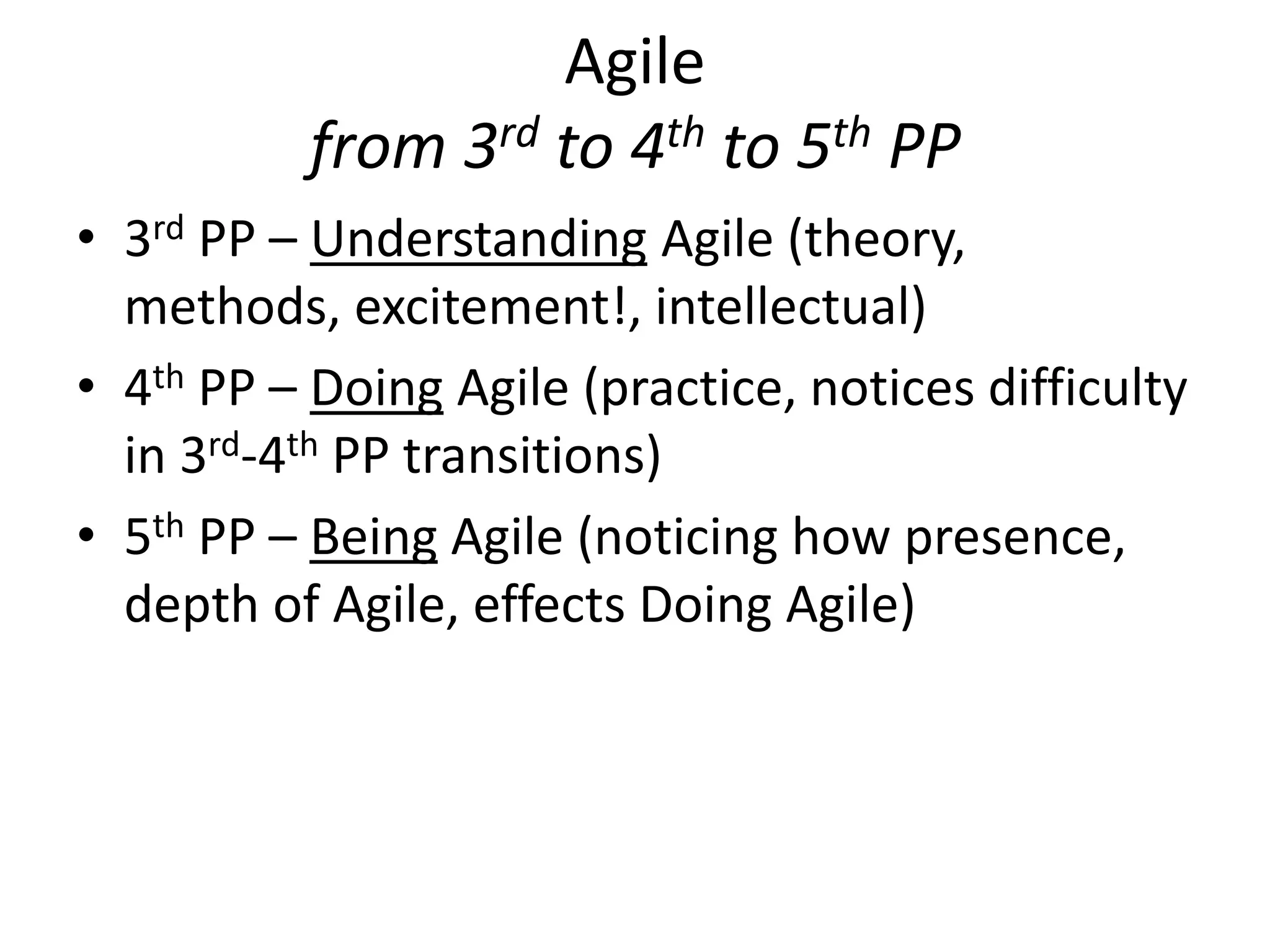
Agile
from 3rd to 4th to 5th PP
• 3rd PP – Understanding Agile (theory,
methods, excitement!, intellectual)
• 4th PP – Doing Agile (practice, notices difficulty
in 3rd-4th PP transitions)
• 5th PP – Being Agile (noticing how presence,
depth of Agile, effects Doing Agile)

What's going on in later stages?—Do integral developmental theories agree?

  • 1.
    What's going onin later stages?—Do integral developmental theories agree? WISDOM SKILL = COMPLEXITY CAPACITY + SPIRITUAL CLARITY TOM MURRAY IEC BUDAPEST MAY 2018
  • 2.
    What's going onin later stages?—Do integral developmental theories agree? WISDOM SKILL = COMPLEXITY CAPACITY + SPIRITUAL CLARITY TOM MURRAY IEC BUDAPEST MAY 2018
  • 4.
    Origins of thiswork: Integral Review 2009 Special Issue • My paper “Intuiting the Cognitive Line in Developmental Assessment: Do Heart and Ego Develop Through Hierarchical Integration?” • “…as we grow in wisdom there are elements of un-learning, of letting go, emptying, opening…the wise heart is spacious, connected, non-attached…"
  • 5.
    Intuitive comparison of Neo-Piagetian/HCT(Lectica-LSUA) vs. Ego Development (MAP/GLP) • See examples on next slides… • Lectica “dilemma” feels much more cognitive • SCT feels more holistic; accessing more of the self • (note that Lectica is only a very limited instantiation of the full base theories by Fischer and Commons)
  • 6.
    Lectica—Sample Assessment www.lecticalive.org/demo • Q1:How would you go about gathering the information you would need to form an opinion on a problem like this one? What sources would you consider? Why? • Q2: How would you go about evaluating the quality of information you obtain from different sources? Why? How do you know when you have the "right" information? • Q3: How is it possible that experts can come to such different conclusions? YOUR DILEMMA: Leadership experts disagree about how to develop a healthy business. Some argue that the evidence suggest that the most important thing leaders need to do is implement systems and processes that effectively promote accountability and performance. Others point to evidence that shows that no matter what systems and processes a business has in place, if you don’t attend to the culture, businesses are likely to fail.
  • 7.
  • 8.
    Empirical comparison of Neo-Piagetian/HCT(Lectica-LSUA) vs. Ego Development (MAP/GLP) • >> Tentative results: LOW correlation • (Aiden Thornton & Lectica team, 2015)
  • 9.
    Skill Theory (&Neo-Piagetian & Hierarchical Complexity Theories) (Fischer, Commons, Dawson…) The 13 levels and 4 tiers of development in Kurt Fischer's Skill Theory (From Murphy, 2015) 9
  • 10.
    Ego Development Theory (Cook-Greuter/Loevinger) EGODEVELOPMENT: NINE LEVELS OF INCREASING EMBRACE Susanne Cook-Greuter, 1985/2010
  • 11.
    StageLens.com KEGAN’s Subject/Object Theoryof Meaning-Making Development
  • 12.
    StageLens.com Concrete Subtle Metaware Person-Perspective Stage TierI/C A/P I I I I C C I I C C C C P P A A P P A A P P A A Receptive Recoprocl Active Receptive Recoprocl Active Interpentr Receptive Recoprocl Active Interpentr Interpentr * * *
  • 13.
    Ego Later Stages– Intuitive descriptors • High Complexity – (meta-) systems, (meta-) perspectives, dynamic/chaos, (meta-) abstractions • Deep Wisdom – integrity, balance, whole-ism – empathic, relational, participatory – Self-knowledge, humility, unknowing • Awakened Spirituality – oneness/unity, no-boundaries, no-self – timeless spaciousness, non-duality – radiance, openness, embrace
  • 14.
    Current Puzzles/Inquiries • Higherlevels of “ego development” seem very “spiritual”; and loose relationship with complexity development • Evolution / development move towards increasing uniqueness / diversity, not oneness/unity • We want to link this territory to cognitive and brain studies
  • 15.
    Contemplative States as Involutionarylayers Deconstructions: • No-self • Timelessness • Non-dual unity • Transparent body • Construct-aware • … vs Infant Construction of: • Differ. self from mother/other • Sense of time, sequentially • Differ. interior-vs-exterior • Realizing one has a body • Leaning a concept/idea • …
  • 16.
  • 17.
    STAGES/Ego/MM devel. vs HCT— #1 • HCT is about growth through DIFFERENTIATION & INTEGRATION • Does not (directly) include deconstruction / healing / releasing / unlearning Note: Cook-Greuter models a single deconstructive arc over the lifetime; however, both construction and deconstruction happen at *every* level (or every person-perspective shift)
  • 18.
    A new Modelof Wisdom Skill = Complexity Capacity + Spiritual Clarity
  • 19.
    TIER structures foundin both Skill Theory and STAGES (with repeating patterns within tiers) Concrete Subtle Metaware
  • 20.
  • 21.
    Concrete Subtle Metaware “Spinning out” horizontally VeryComplex: Mechanics, Bureaucracies, Rules of rules of rules of…. Very Complex: Meta-meta thinking, Systems of systems of systems… At any PP level one can continue to develop in complexity; the vertical devel. becomes horizontal w. respect to growth to the next PP
  • 22.
    STAGES vs HCT(more) • HCT — each level coordinates / operates upon the prior • There are many types of (hierarchical) operations — e.g. subject to object; sequencing, emergence, organizing… • One theory’s vertical growth may be another’s horizontal growth. Op A Op A Op B Op B Op B Op B Op C Op C Op C Vertical? Horizontal?
  • 23.
    States = Firing Stages= Wiring Alternative model of State vs. Stages (grounded in cognitive science)
  • 24.
    What are “states”and “stages”? (a new proposal) • Expand “State” beyond Eastern mysticism and special states to include general cognitive states (e.g. sleep, confusion, focused attention…) • Stage vs Stages = FIRING VS WIRING (active brain state vs. field of potential) • “Nodes” wired together fire together “Nodes” that fire together wire together
  • 25.
    States (vs Stages,cont.) • States can develop into stages: 1. Brief taste (illusive; and “wow”) 2. Active inquiry & practice 3. Mastery, intentional wise application 4. Autonomous, effortless, ordinary, flow State Stage States > Stable state access/skill/stage, egs: • No-self, one-ness, timelessness, no-body, … • Object permanence, focused attention, group-member-ness, metacognition… Not limiting states to “wow” (special feeling) states
  • 26.
    States — ofbrain connectivity and skill • “Wow” – novel brain connections (“aha” an insight/integration emerges) • Flow — reliable access to super-fluidity, coherence… EXAMPES: • Learning to ride a bicycle … • Seeing a holistic big picture… • Loving all of humanity… • Self-love, self-acceptance… • Seeing physical pain for what it is…
  • 27.
    A post-metaphysical approachto States, Stages & Growth • Soul, Spirit, Higher Self, Authentic Self, Unique Self, Ground of Being — when are we guilty of “misplaced concreteness”? • What would it be like to have a theory of waking up, growing up, and cleaning up that does not refer to “absolute” or “ultimate” truth or reality?
  • 28.
    Further issues &questions addressed by this model • Skills develop in phases — where do you “set the bar” for a “stage/level”? • How much is ignored in one linear (“wide”) model? — when are multi-dimensions needed? • Dangers of too-early deconstruction (e.g. hard core meditation before stable ego state is developed)
  • 29.
    END – THANKS! •Tom Murray <tommurray.us@gmail.com> • www.tommurray.us
  • 30.
  • 31.
    Starting points 1) fromIntegral Theory • Developmental Lines: – cognitive ≠ moral ≠ ego … • States ≠ Stages – Wilber-Combs matrix – Growing up ≠ Waking up – State-stages ≠ Ego development • Spiritual development ≠ shadow work – Spiritual leaders can have significant shadow material unawares (Cleaning Up)
  • 32.
    Starting Points 2) additionalgivens • Stages beyond any societal culture are much thinner/emerging • Conflation of Zones: theories are based on subjective reports; not enough people or groups to objectively measure “structures” • Many types/levels of “awakening”— spiritual growth does not seem to end (and complexity growth of course does not)
  • 33.
    Wide/holistic Lines? • “Ego”line hangs together….? • Loevinger research shows “ego” as a single factor (in factor analysis)
  • 34.
  • 35.
  • 36.
    Concrete Subtle Metaware Person-Perspective Stage TierI/C A/P Compl 6.5 6.0 5.5 5.0 4.5 4.0 3.5 3.0 2.5 2.0 1.5 1.0 I I I I C C I I C C C C P P A A P P A A P P A A Receptive Recoprocl Active Receptive Recoprocl Active Interpentr Receptive Recoprocl Active Interpentr Interpentr Int Ex t Int Ex t Int Ex t Int Ex t Int Ex t Int Ex tInt Ex t Int Ex Int Ex t Int Ex tInt Ex t Int Ex t AQAL Dims: Ind/Col, Out/Ins, Int/Ext
  • 37.
    Person- perspective Strengths Challenges First Canorient strongly toward meeting one’s own concrete needs and impulses. Can takes initiative in an emergency. Has difficulty seeing “the big picture”; Applies force or seeks personal advantage when cooperative efforts are more appropriate. Little focus on future or past. Second Supports group cohesion and solidarity; Good with structure, rules, and order. Good short term service to others as long as it fits within role. Can fall into ‘us-vs-them’ and ‘black and white’ thinking. Avoids conflict and stepping outside of norms. Has difficulty hearing feedback. Third Rational, abstract thinking and planning. Creative solution and achievement oriented. 1 - 5 year time horizon. Accepts some feedback and adjusts behavior towards defined goals. Tends to over-focus on narrow solutions for team or organization, without seeing environmental impacts or deeper needs. Over emphasizes imagined goals, without considering inevitable changes in context and knowledge, and thus had difficulty adapting quickly. Fourth Reciprocity, deep collaboration, concerns for the multiple contexts, perspectives, constituencies; able to reflect on sources of biases and uncertainties. 15 - 20 year time horizon. Sees limits of objective understanding and anticipates need for adaptation and agility. Seeks broad feedback. May overemphasize systemic complexity when simpler or more direct solutions are needed. Tends to over-focus on collective, bottom-up, or systemic issues, rather than individual accountability, limitations, and action. Can be dogmatic and or arrogant and under-appreciate that others may not share their big-picture view. Fifth Emergent solutions; tolerance for ambiguity and chaos; flow within complexity. In-the-moment reflection on one’s own biases and vulnerabilities. Ability to work outside of assumptions and boundaries. Generational/global timeframe. Maps connections across fields and domains. See everything as opportunity for feedback and adaptation. Readiness to challenge any construct or assumption may be disturbing and confusing for others (and for the self!). Can be prone to excessive cognitive complexity, or seem too abstract or obtuse. May be challenged by structures or actions they judged as “egoic” or short-sighted. Thinking can be seen as too idiosyncratic or abstract, where others may have difficulty seeing the relevance of their contributions.
  • 38.
    Emerging 4th PP Models,Structure, Processes for organization, leadership, decision-making (ideals) • Agile Methods • Teal Organizations • Holacracy • DDO (Deliberately Developmental Org.) • OPO (Open Participatory Organizations) • Participatory Agility • Design Thinking • ….
  • 39.
    4th PP Ideals(Agile brainstorm) Trust within team Open to change Pivot Fun Continuous learning Customer value Responsibility Running Shared understanding Self organizing Collaborative participation Stop and reflect Communication Cohesion Commitment Introspection Team spirit Presence Continuously improving Gift one's time to help someone Flat organizations Autonomy Short cycles Sharing and courage Feedback and reflection Opportunity Multiple skills Being in harmony Transparency Exploration Accepting error in/as the process Human oriented and mindset Use energy of the partners
  • 40.
    4th PP principles(Agile ideals) • Sense & Respond (not predict & control), agile, robust, resilient, lean, pivot • Collaborative: decentralized, cross-functional teams, participatory decision making, tension sensing & resolving • Self-organizing, self-managing, emergent, co-evolving, open • Prototyping, rapid iteration, failing forward, “mistakes’ > ‘experiments’ • Learning organization - continuous feedback/adaptation, evolutionary • Ethical, Transparent, Sustainable, diverse, purpose-driven, outcome-focused, measurable indices, ‘heroic” > service-driven leaders • Trust & abundance based (not scarcity, fear, control) • Wholeness: Organization as a living system/family/ecosystem (vs. machine) • (not: Elaborate plans, waterfall process, documentation, predict & control, scarcity, strict hierarchies and roles...)
  • 41.
    Agile - Challenges (from3rd to 4th to 5th PP) • Needing Managerial Support (& leaders who say they want change but don’t) • Fear of change; of failure, vulnerability of exposure • Process/model focus/attachment can remove passion; “Agile” becomes frozen • Logistical Complexity of Agile • Translating from old to new; • Resistance to change; egos • Sustaining effort and vision long term • Making it your own; taking responsibility • Flexible Agile training (Agile Agile) • Slowing down to speed up; Stop and reflect • Trusting; letting go; not controlling it; acceptance
  • 42.
    Agile from 3rd to4th to 5th PP • 3rd PP – Understanding Agile (theory, methods, excitement!, intellectual) • 4th PP – Doing Agile (practice, notices difficulty in 3rd-4th PP transitions) • 5th PP – Being Agile (noticing how presence, depth of Agile, effects Doing Agile)

Editor's Notes

  • #3 Theory talk assumes you know a lot of integral theory – but you can still get the gist of it whether you do or not… Not explaining later stages so much as offering a new framework for asking better questions about what happens….
  • #5 I have a bias! – I am a fan and user of ego development models; I appreciate rigor, theoretical depth,
  • #6 Assessment vs theory
  • #8 Reflective reasoning; reflective abstraction….
  • #9 Assessment vs theory
  • #10 General theories about all human skills and developed capacities; but we are concerned here with only their application to adult skills related to complexity of thinking about common life-tasks;
  • #13 See all stages.psd
  • #14 How do we make sense of this territory? Diff theories say different things. Its not as simple as saying all these are different ‘lines’. That does not add much additional insight, I propose we look deeper.
  • #20 General theories about all human skills and developed capacities; but we are concerned here with only their application to adult skills related to complexity of thinking about common life-tasks;
  • #21 See all stages.psd
  • #22 See all stages.psd
  • #25 Nerons > nodes
  • #26 “wow factor” Effortless and invisible…
  • #27 Qualities of a *cogntive* experience that are not quite “emotions”; Truth, wholenss, connection, emptiness, fullness, -- are as much FEELINGS/experiences as a type of “knowledge”
  • #37 See all stages.psd