122 Australasian Dental Practice	 July/August 2018
D
igital imaging has revo-
lutionised the ability to
quickly and accurately
diagnose underlying
symptoms and provide
far greater confidence in
treatment planning.
Modern x-ray, OPG and CBCT units,
digital sensors and phosphor plate units
mean effective diagnosis can be conducted
in-house, saving time and greatly
enhancing patient convenience.
The benefits of digital imaging
devices including x-ray units and
even intraoral cameras are
a valuable patient educa-
tion tool and have been
shown to greatly increase
case acceptance.
Where to start
As with most things, it’s
wise to invest in a quality suite
of products that are easy to integrate
on a common software platform and
it is also a good idea to buy from an
established company with local tech-
nical service backup and easy access
to spare parts.
Purchasing compatible components
from one supplier ensures no integra-
tion issues, simplifies training and
maintenance so any issues are dealt with
quickly with no buck-passing or finger
pointing between different suppliers.
Image quality
The top of the list for anyone con-
templating purchasing digital
imaging products is image quality
using the latest technology such as
CMOS digital sensors and Automatic
Controlled Exposure (ACE), which
ensures sharp radiographic images. Look
for a small focal spot with x-ray generators
and a fine pixel size and voxel count for
Panoramic and CBCT units respectively.
X-rays
French company, Acteon,
available in Australia
through A-dec, developed the
award-winning X-Mind Unity
x-ray with inbuilt Sopix2
sensor
thatautomaticallyadjustsradiation
depending on patient morphology.
This ensures consistent image
quality, no over-exposed images,
prolonged sensor life and reduced
radiation exposure.
Acteon’s X-Mind x-ray gener-
ator, when used with the Sopix2
sensor, results in up to 50%
lower radiation emissions giving
better results and greater peace-of-mind
for patients.
Automatic Controlled Exposure (ACE),
built-in filters and user preferences such
as contrast settings that are automatically
saved, ensure all images are processed
uniformly to reveal the required detail
in either hard or soft tissue without dis-
tracting artefacts caused by metals and
other filling materials.
Phosphor plates
Acteon makes high quality digital
imaging affordable and practical with
the world’s smallest and quickest per-
sonal phosphor plate scanner, the PSPIX,
which uses fibre to pixel technology for
superior image quality.
This compact unit with its in-built
touchpad is the fastest and most com-
pact phosphor plate scanner available,
processing images in just 12 seconds and
being fully networkable throughout the
practice on either Mac or PC.
The small phosphor plates are more
comfortable for smaller and younger
patients and the streamlined designed and
automatic loading function make it easy
to keep clean.
What to look for in a
digital imaging solution
digital | IMAGING
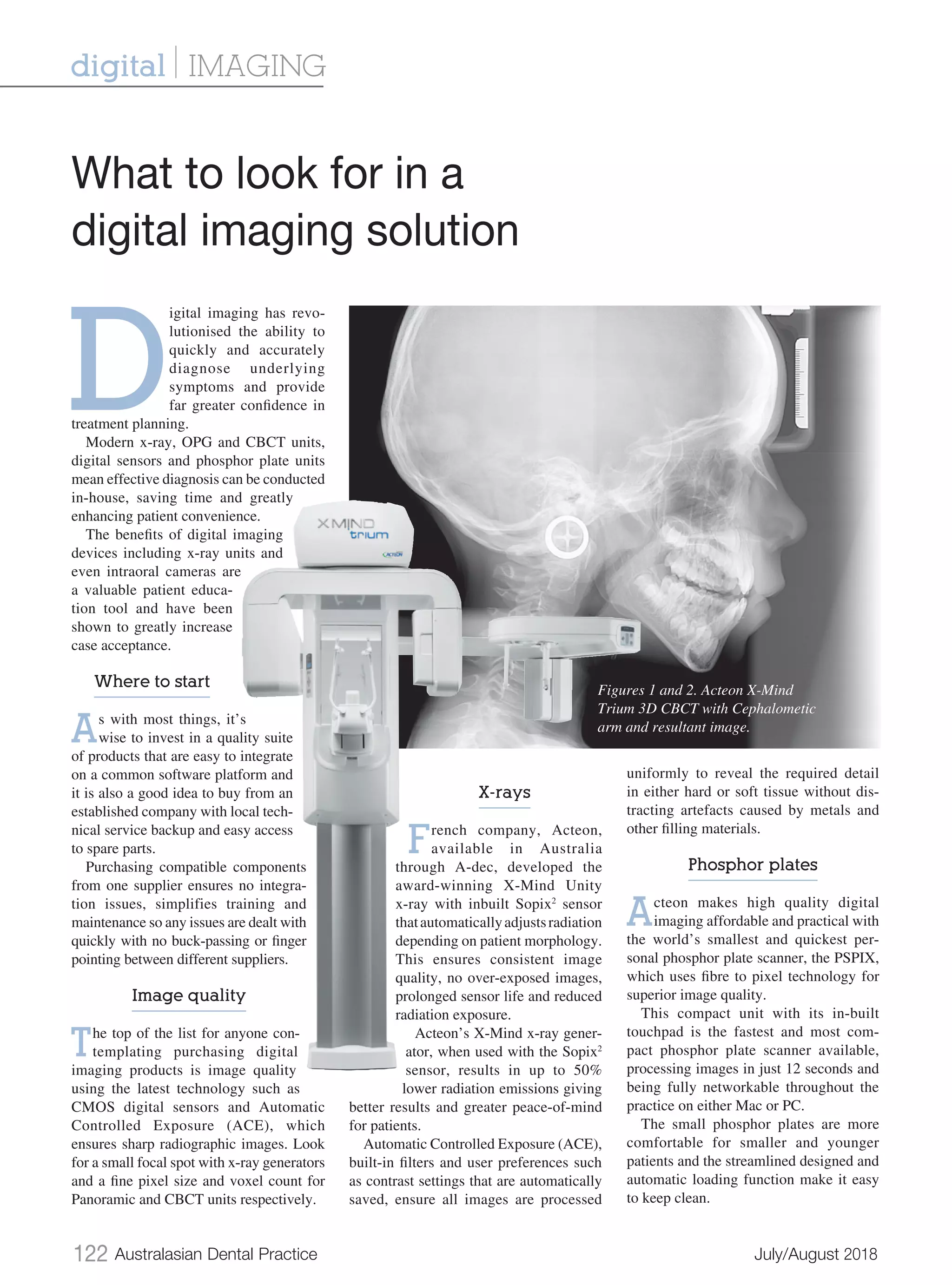
Figures 1 and 2. Acteon X-Mind
Trium 3D CBCT with Cephalometic
arm and resultant image.
124 Australasian Dental Practice	 July/August 2018
PSPIX is the only scanner that offers
optional removable parts that can be steri-
lised in an autoclave, offering maximum
protection and simplicity in maintaining
infection control.
Digital sensors
For real time information to assist in
endodontic treatments and implant
placement, the Sopix2
digital intraoral
sensor is unbeatable in image quality
and immediate access to images, making
it the choice of many specialists. The
X-Mind Unity comes with Sopix2
built in so there are no messy cords to
worry about.
Affordable CBCT
For more advanced diagnosis, many
practices are now opting for Pano-
ramic and CBCT units as an adjunct
to conventional x-rays. The Acteon
X-Mind Trium extraoral unit combines
superior image quality available as a
base panoramic unit with the ability to
add CBCT, 3D and full cephalometric
capabilities at a later time as practice
needs grow.
X-Mind Trium set new benchmarks
in image quality, yielding detail as fine
as 75-100 microns, together with a pow-
erful, but easy to use Acteon Imaging
Suite (AIS) software. AIS makes it easy to
view, import and export, manipulate and
store images in patient management soft-
ware or other third party programs.
The X-Mind Trium has a simple to use
icon-based keypad and is the smallest
ceph arm unit currently available, making
it easy to install in any practice with
minimal training.
3D view shows hidden detail
X-Mind Trium’s 3-dimensional capa-
bility effectively allows dentists to
identify critical anatomical structures such
as the inferior alveolar nerve, which may
be obscured by molar roots on conven-
tional 2D x-ray or panoramic images.
Ease of use
All of Acteon’s digital imaging devices
have simple icon-based touchpads
and use AIS software which has an intui-
tive mouse driven interface which allows
quick and easy access to images, plus
powerful in-built tools depending on
the application.
AIS 2D and 3D software includes
implant-planning tools with implant
library, bone density measurement, angle
and volumetric calculations for implant
placement and sinus lift surgery and full
reporting to guide your surgery. It also
allows the importation of images from
optical scanners or implant databases in
STL format.
The full range of Acteon digital imaging
equipment, together with installation and
training are available from your local
A-dec dealer in partnership with Acteon
in Australia.
For more info, contact A-dec Australia on
1800-225-010 or see acteongroup.com.
digital | IMAGING
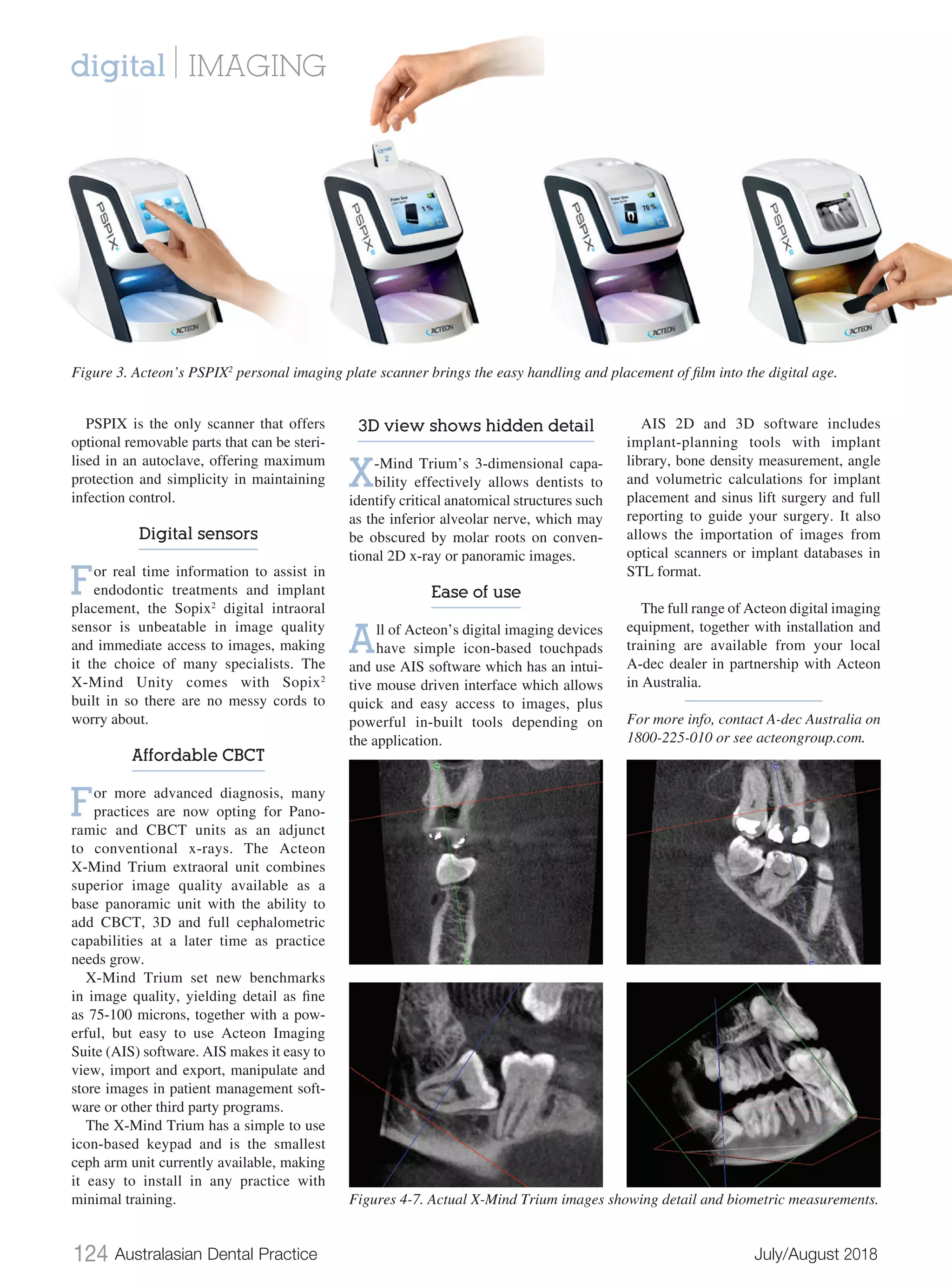
Figure 3. Acteon’s PSPIX2
personal imaging plate scanner brings the easy handling and placement of film into the digital age.
Figures 4-7. Actual X-Mind Trium images showing detail and biometric measurements.

What to look for in a digital imaging solution

  • 1.
    122 Australasian DentalPractice July/August 2018 D igital imaging has revo- lutionised the ability to quickly and accurately diagnose underlying symptoms and provide far greater confidence in treatment planning. Modern x-ray, OPG and CBCT units, digital sensors and phosphor plate units mean effective diagnosis can be conducted in-house, saving time and greatly enhancing patient convenience. The benefits of digital imaging devices including x-ray units and even intraoral cameras are a valuable patient educa- tion tool and have been shown to greatly increase case acceptance. Where to start As with most things, it’s wise to invest in a quality suite of products that are easy to integrate on a common software platform and it is also a good idea to buy from an established company with local tech- nical service backup and easy access to spare parts. Purchasing compatible components from one supplier ensures no integra- tion issues, simplifies training and maintenance so any issues are dealt with quickly with no buck-passing or finger pointing between different suppliers. Image quality The top of the list for anyone con- templating purchasing digital imaging products is image quality using the latest technology such as CMOS digital sensors and Automatic Controlled Exposure (ACE), which ensures sharp radiographic images. Look for a small focal spot with x-ray generators and a fine pixel size and voxel count for Panoramic and CBCT units respectively. X-rays French company, Acteon, available in Australia through A-dec, developed the award-winning X-Mind Unity x-ray with inbuilt Sopix2 sensor thatautomaticallyadjustsradiation depending on patient morphology. This ensures consistent image quality, no over-exposed images, prolonged sensor life and reduced radiation exposure. Acteon’s X-Mind x-ray gener- ator, when used with the Sopix2 sensor, results in up to 50% lower radiation emissions giving better results and greater peace-of-mind for patients. Automatic Controlled Exposure (ACE), built-in filters and user preferences such as contrast settings that are automatically saved, ensure all images are processed uniformly to reveal the required detail in either hard or soft tissue without dis- tracting artefacts caused by metals and other filling materials. Phosphor plates Acteon makes high quality digital imaging affordable and practical with the world’s smallest and quickest per- sonal phosphor plate scanner, the PSPIX, which uses fibre to pixel technology for superior image quality. This compact unit with its in-built touchpad is the fastest and most com- pact phosphor plate scanner available, processing images in just 12 seconds and being fully networkable throughout the practice on either Mac or PC. The small phosphor plates are more comfortable for smaller and younger patients and the streamlined designed and automatic loading function make it easy to keep clean. What to look for in a digital imaging solution digital | IMAGING Figures 1 and 2. Acteon X-Mind Trium 3D CBCT with Cephalometic arm and resultant image.
  • 2.
    124 Australasian DentalPractice July/August 2018 PSPIX is the only scanner that offers optional removable parts that can be steri- lised in an autoclave, offering maximum protection and simplicity in maintaining infection control. Digital sensors For real time information to assist in endodontic treatments and implant placement, the Sopix2 digital intraoral sensor is unbeatable in image quality and immediate access to images, making it the choice of many specialists. The X-Mind Unity comes with Sopix2 built in so there are no messy cords to worry about. Affordable CBCT For more advanced diagnosis, many practices are now opting for Pano- ramic and CBCT units as an adjunct to conventional x-rays. The Acteon X-Mind Trium extraoral unit combines superior image quality available as a base panoramic unit with the ability to add CBCT, 3D and full cephalometric capabilities at a later time as practice needs grow. X-Mind Trium set new benchmarks in image quality, yielding detail as fine as 75-100 microns, together with a pow- erful, but easy to use Acteon Imaging Suite (AIS) software. AIS makes it easy to view, import and export, manipulate and store images in patient management soft- ware or other third party programs. The X-Mind Trium has a simple to use icon-based keypad and is the smallest ceph arm unit currently available, making it easy to install in any practice with minimal training. 3D view shows hidden detail X-Mind Trium’s 3-dimensional capa- bility effectively allows dentists to identify critical anatomical structures such as the inferior alveolar nerve, which may be obscured by molar roots on conven- tional 2D x-ray or panoramic images. Ease of use All of Acteon’s digital imaging devices have simple icon-based touchpads and use AIS software which has an intui- tive mouse driven interface which allows quick and easy access to images, plus powerful in-built tools depending on the application. AIS 2D and 3D software includes implant-planning tools with implant library, bone density measurement, angle and volumetric calculations for implant placement and sinus lift surgery and full reporting to guide your surgery. It also allows the importation of images from optical scanners or implant databases in STL format. The full range of Acteon digital imaging equipment, together with installation and training are available from your local A-dec dealer in partnership with Acteon in Australia. For more info, contact A-dec Australia on 1800-225-010 or see acteongroup.com. digital | IMAGING Figure 3. Acteon’s PSPIX2 personal imaging plate scanner brings the easy handling and placement of film into the digital age. Figures 4-7. Actual X-Mind Trium images showing detail and biometric measurements.