Encyclopedia You
AYMAN SIRAJ | aymansir@usc.edu
about me
 Education: Junior at the University
of Southern California
 Major: Chemical Engineering
 Minor: Digital Forensics
 Uninteresting Interests: Aviation,
History of Central Banking, Shoes
Structure
 Importance of Cyber Security
 How people usually become victims?
 What’s out there about you?
 Why the internet isn’t secure
 Have you been pwned?
importance of the topic
 Grand Engineering Challenges:
“some of the most pressing issues facing society in the 21st century”
 Securing Cyberspace through Engineering:
1. Engineering more secure software.
2. Providing better security for data flow
the problem
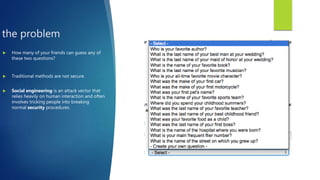
 How many of your friends can guess any of
these two questions?
 Traditional methods are not secure.
 Social engineering is an attack vector that
relies heavily on human interaction and often
involves tricking people into breaking
normal security procedures.
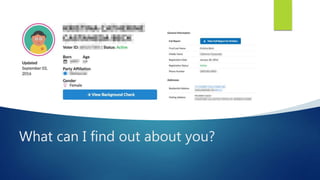
What can I find out about you?
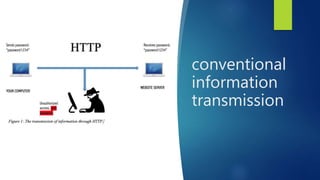
conventional
information
transmission
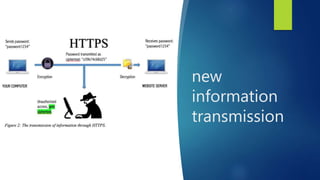
new
information
transmission
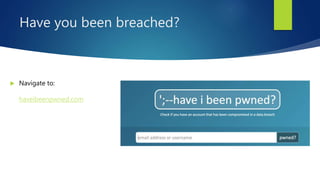
Have you been breached?
 Navigate to:
haveibeenpwned.com
questions?
the end

What the Internet Knows About You?

  • 1.
    Encyclopedia You AYMAN SIRAJ| aymansir@usc.edu
  • 2.
    about me  Education:Junior at the University of Southern California  Major: Chemical Engineering  Minor: Digital Forensics  Uninteresting Interests: Aviation, History of Central Banking, Shoes
  • 3.
    Structure  Importance ofCyber Security  How people usually become victims?  What’s out there about you?  Why the internet isn’t secure  Have you been pwned?
  • 4.
    importance of thetopic  Grand Engineering Challenges: “some of the most pressing issues facing society in the 21st century”  Securing Cyberspace through Engineering: 1. Engineering more secure software. 2. Providing better security for data flow
  • 5.
    the problem  Howmany of your friends can guess any of these two questions?  Traditional methods are not secure.  Social engineering is an attack vector that relies heavily on human interaction and often involves tricking people into breaking normal security procedures.
  • 6.
    What can Ifind out about you?
  • 7.
  • 8.
  • 9.
    Have you beenbreached?  Navigate to: haveibeenpwned.com
  • 10.

Editor's Notes

  • #2 Hello everyone! My name is Ayman Siraj and today I will be presenting about Cybersecurity and it’s application to the everyday internet user.
  • #3 Just to go a bit more in depth on my background. I’m a junior here at USC studying Chemical Engineering. I am also in the Digital Forensics minor. Besides the usual interests of sleeping, procrastinating and eating, here are some of my more uninteresting interests: Aviation, History of Central Banking and Shoes.
  • #5 Electronic computing and communication pose some of the most complex challenges engineering has ever faced. They range from protecting the confidentiality and integrity of transmitted information and deterring identity theft to preventing the scenario recently dramatized in the Bruce Willis movie "Live Free or Die Hard," in which hackers take down the transportation system, then communications, and finally the power grid. One way to do this may be through better programming languages that have security protection built into the ways programs are written. Current protocols such as TCP/IP for directing data traffic on the Internet can be exploited to make messages appear to come from someplace other than their true origin.
  • #6 Take a look at this drop down menu. How many of your friends and family know the answer to any two of these questions? For many websites on the internet this is still the way to reset passwords. You go on the site, you click forgot password and then they ask you your preset security questions. Now, even if you don’t tell someone the answers to these questions, what if someone with malicious intent was talking to someone that knows the answers to these questions and socially engineers it out of them? Most Social Engineering occurs at places where alcohol is involved. The two most common cases where an individual is vulnerable is after a bad breakup (common amongst teens) – where one partner tries to defame the other and the other is a members of one company trying to extort information from an employee of another company by gaining access to email. Now how you defend yourself against such attacks per say? Give the wrong answer to a question and remember it. What is the favorite name of your sports team? Put Business Accounting.
  • #7 If you are a registered voter, I know how to find all this stuff about you with just your first and last name, or your first name and your likely home location. Now, how many of you are alarmed that this much information about you is widely available? Right? The problem we internet users don’t seem to take our very own personal identity very seriously. Yes 99/100 no one is going to use this information against you, but once you start becoming successful, things like part affiliation can be used against you.
  • #8 Most of you know that the way data is transferred over the internet is over HTTP. HTTP is short for HyperText Transfer Protocol. HTTP is the underlying protocol used by the World Wide Web and this protocol defines how messages are formatted and transmitted, and what actions Web servers and browsers should take in response to various commands.
  • #9 The 'S' at the end of HTTPS stands for 'Secure'. It means all communications between your browser and the website are encrypted. HTTPS is often used to protect highly confidential online transactions like online banking and online shopping order forms. The problem is not all sites use HTTPS currently as for HTTPS to function properly all websites need to have the protocol. For example, when you’re chatting on Facebook Messenger, chat encryption is not encrypted by default. If the NSA wanted to, they could snoop on your conversations. Facebook now though has an option to start chat encryption with chats, but most users don’t even know about it.
  • #10 If you have ever wondered if any account of yours has ever been breached, you can go to this site and see on what website and what sort of information was stolen about you. Try your personal and educational emails.