Management Information Systems (MIS) in the Context of an MBA Program
Introduction
In the ever-evolving landscape of business, the role of Management Information Systems
(MIS) has become increasingly pivotal. For students pursuing a Master of Business
Administration (MBA), understanding MIS is crucial as it integrates technology with business
processes to support decision-making and strategic planning. This article delves into the
essence of MIS, its significance in the business world, and its relevance for MBA students.
We will explore key concepts, applications, challenges, and future trends in MIS to provide a
comprehensive overview tailored to MBA professionals.
1. Understanding Management Information Systems
Management Information Systems (MIS) refers to the coordinated use of technology, people,
and processes to manage and analyze information within an organization. The primary goal
of MIS is to provide accurate, timely, and relevant information to support management
decisions and enhance organizational efficiency. MIS encompasses various subsystems,
including Transaction Processing Systems (TPS), Decision Support Systems (DSS),
Executive Information Systems (EIS), and Knowledge Management Systems (KMS).
1.1 Components of MIS
● Hardware: The physical components of a computer system, such as servers,
computers, and network devices.
● Software: Applications and programs that process data and facilitate tasks. This
includes operating systems, database management systems (DBMS), and
specialized business applications.
● Data: Raw facts and figures that are processed to produce meaningful information.
Data management is critical for ensuring data accuracy and security.
● People: Users who interact with the system, including IT professionals, managers,
and end-users. Their skills and training are crucial for effective MIS implementation.
● Processes: The procedures and methods used to collect, process, and distribute
information. Well-defined processes ensure that information flows efficiently within
the organization.
1.2 Types of MIS
● Transaction Processing Systems (TPS): Handle day-to-day transactions, such as
order processing, payroll, and inventory management. TPS ensures that routine
transactions are processed efficiently and accurately.
● Decision Support Systems (DSS): Assist in making complex decisions by providing
analytical tools and models. DSS supports decision-making in scenarios that require
judgment and interpretation of data.
● Executive Information Systems (EIS): Provide top executives with summary
information and performance indicators. EIS offers high-level insights into
organizational performance and strategic issues.
● Knowledge Management Systems (KMS): Facilitate the creation, sharing, and
utilization of knowledge within an organization. KMS support innovation and
continuous improvement by leveraging organizational knowledge.
2. Significance of MIS in Business
MIS plays a vital role in modern businesses by enhancing decision-making, improving
operational efficiency, and supporting strategic planning. For MBA students, understanding
the impact of MIS on business operations is essential for several reasons.
2.1 Enhancing Decision-Making
Effective decision-making relies on accurate and timely information. MIS provides managers
with the necessary data to make informed decisions, analyze trends, and forecast future
outcomes. By utilizing MIS, organizations can improve their responsiveness to market
changes, customer preferences, and competitive pressures.
2.2 Improving Operational Efficiency
MIS streamlines business processes by automating routine tasks and reducing manual
errors. For instance, Enterprise Resource Planning (ERP) systems integrate various
functional areas, such as finance, human resources, and supply chain management, into a
unified system. This integration enhances coordination, reduces redundancy, and improves
overall efficiency.
2.3 Supporting Strategic Planning
Strategic planning involves setting long-term goals and determining the best course of action
to achieve them. MIS provides executives with tools and information to evaluate different
strategic options, assess performance metrics, and align resources with organizational
objectives. Business intelligence (BI) systems and data analytics play a crucial role in
supporting strategic planning by providing actionable insights and identifying growth
opportunities.
2.4 Facilitating Communication and Collaboration
MIS enhances communication and collaboration within an organization by providing
platforms for sharing information and coordinating activities. Tools such as intranets,
collaboration software, and project management systems enable teams to work together
more effectively, regardless of their physical location.
2.5 Ensuring Data Security and Compliance
As businesses increasingly rely on digital information, data security and regulatory
compliance become critical concerns. MIS includes security measures and protocols to
protect sensitive information from unauthorized access and cyber threats. Additionally, MIS
helps organizations comply with legal and regulatory requirements related to data privacy
and protection.
3. Applications of MIS in Various Business Functions
MIS is integrated into various business functions, each serving distinct purposes and
contributing to overall organizational success. Understanding these applications helps MBA
students grasp the practical implications of MIS in different contexts.
3.1 Marketing
In marketing, MIS supports customer relationship management (CRM) by analyzing
customer data and tracking marketing campaigns. CRM systems enable businesses to
segment their customer base, personalize marketing efforts, and measure campaign
effectiveness. Additionally, marketing analytics tools provide insights into consumer behavior,
market trends, and competitive positioning.
3.2 Finance
MIS plays a crucial role in financial management by providing tools for budgeting,
forecasting, and financial analysis. Financial information systems assist in managing
accounts payable and receivable, tracking investments, and evaluating financial
performance. Business intelligence tools and dashboards offer real-time visibility into
financial metrics and support decision-making.
3.3 Human Resources
In human resources, MIS facilitates employee management, recruitment, and performance
evaluation. Human Resource Information Systems (HRIS) automate tasks such as payroll
processing, benefits administration, and employee records management. Additionally, HR
analytics tools help organizations assess workforce productivity, identify skill gaps, and
improve talent management.
3.4 Supply Chain Management
MIS enhances supply chain management by optimizing inventory control, order processing,
and logistics. Supply Chain Management Systems (SCMS) provide visibility into the entire
supply chain, from procurement to delivery. These systems enable businesses to streamline
operations, reduce costs, and respond to supply chain disruptions more effectively.
3.5 Operations Management
In operations management, MIS supports process improvement and quality control.
Manufacturing Execution Systems (MES) and Operations Information Systems (OIS) monitor
production processes, track performance metrics, and ensure adherence to quality
standards. MIS helps organizations identify inefficiencies, implement best practices, and
achieve operational excellence.
4. Challenges in Implementing MIS
Despite its benefits, implementing MIS comes with several challenges. MBA students must
be aware of these challenges to effectively manage and leverage MIS in real-world
scenarios.
4.1 Cost of Implementation
The cost of implementing MIS can be substantial, especially for large organizations.
Expenses include purchasing hardware and software, training employees, and maintaining
the system. Small and medium-sized enterprises (SMEs) may face budget constraints that
impact their ability to adopt advanced MIS solutions.
4.2 Data Security and Privacy
Ensuring data security and privacy is a major concern in MIS. Organizations must implement
robust security measures to protect sensitive information from breaches and cyber-attacks.
Compliance with data protection regulations, such as the General Data Protection
Regulation (GDPR), is essential for maintaining trust and avoiding legal repercussions.
4.3 Integration with Existing Systems
Integrating MIS with existing systems can be complex and challenging. Organizations may
encounter compatibility issues, data migration difficulties, and disruptions to ongoing
operations. Effective planning, testing, and coordination are necessary to ensure a smooth
integration process.
4.4 Change Management
The successful implementation of MIS often requires changes to organizational processes
and workflows. Managing these changes and addressing employee resistance can be
challenging. Effective communication, training, and support are crucial for ensuring a smooth
transition and maximizing the benefits of MIS.
4.5 Keeping Up with Technological Advances
Technology is constantly evolving, and keeping up with the latest advancements can be
challenging. Organizations must continually assess and update their MIS to remain
competitive and leverage new technologies. Staying informed about emerging trends and
innovations is essential for maintaining a relevant and effective MIS.
5. Future Trends in MIS
As technology continues to advance, several trends are shaping the future of MIS. MBA
students should be aware of these trends to anticipate changes and opportunities in the
field.
5.1 Artificial Intelligence and Machine Learning
Artificial intelligence (AI) and machine learning (ML) are transforming MIS by enabling
advanced data analysis and automation. AI-powered analytics tools can identify patterns,
make predictions, and provide actionable insights. Machine learning algorithms enhance
decision-making by learning from historical data and adapting to new information.
5.2 Cloud Computing
Cloud computing is revolutionizing the way organizations manage and access information.
Cloud-based MIS solutions offer scalability, flexibility, and cost-efficiency. Organizations can
leverage cloud services to store and process data, access applications, and collaborate with
remote teams. Cloud computing also facilitates the integration of MIS with other digital tools
and platforms.
5.3 Big Data and Analytics
The rise of big data has created new opportunities for MIS to deliver valuable insights.
Advanced analytics tools can process vast amounts of data from various sources, such as
social media, IoT devices, and transactional systems. Big data analytics enables
organizations to uncover trends, optimize operations, and drive innovation.
5.4 Internet of Things (IoT)
The Internet of Things (IoT) connects physical devices and sensors to the internet,
generating vast amounts of data. MIS can integrate IoT data to monitor and control assets,
track performance, and optimize processes. IoT applications include smart manufacturing,
supply chain monitoring, and asset management.
5.5 Blockchain Technology
Blockchain technology offers a decentralized and secure approach to managing transactions
and information. In MIS, blockchain can enhance data integrity, transparency, and
traceability. Applications include secure financial transactions, supply chain tracking, and
digital identity management.
Conclusion
Management Information Systems (MIS) are integral to modern business operations,
providing valuable tools and insights for decision-making, efficiency, and strategic planning.
For MBA students, understanding MIS is essential for navigating the complexities of today’s
business environment and leveraging technology to achieve organizational goals. By
exploring the components, applications, challenges, and future trends of MIS, MBA students
can gain a comprehensive understanding of how to effectively utilize information systems in
their future careers. As technology continues to advance, staying informed and adaptable
Do check the important Management Information
System Questions below -:
Management Information System solved MCQ Questions :
Management information systems are an organized method of collecting information
from various sources, compiling it, and presenting it in a readable format. It helps
business leaders and managers make strategic management decisions. This section
focus on all topics of the Management Information System subject. Here you can get
important mcq questions on Management Information System with answers. These
questions will help you to prepare for interviews, entrance exams, online tests, and
semester exams. These Management Information System multiple choice questions
are for both freshers and experienced candidates.
Management Information System MCQ Chapter Wise :
Here you will find a list of important questions and answers with detailed solution on
management information system in MCQ quiz style for competitive exams and
interviews. Here, You can practice these MCQs chapter-wise for FREE.
Below section consists of important multiple choice questions on management
information system with answers -:
1. Management information systems (MIS):
a) create and share documents that support day-today office activities
b) process business transactions (e.g., time cards, payments, orders, etc.)
c) capture and reproduce the knowledge of an expert problem solver
d) use the transaction data to produce information needed by managers to run the
business
View Answer
Answer: d
Explanation: Management information systems use the transaction data to produce
information needed by managers to run the business
2. The term used to describe those people whose jobs involve sponsoring and
funding the project to develop, operate, and maintain the information system is
a) information worker
b) internal system user
c) systems owner
d) external system user
View Answer
Answer: c
Explanation: The term used to describe those people whose jobs involve sponsoring
and funding the project to develop, operate, and maintain the information system is
systems owner
3. The person who ensures that systems are developed on time, within budget, and
with acceptable quality is a
a) systems designer
b) project manager
c) systems owner
d) external system user
View Answer
Answer: b
Explanation: The person who ensures that systems are developed on time, within
budget, and with acceptable quality is a project manager
4. Which one of the following is not a business driver for an information system?
a) business process redesign
b) knowledge asset management
c) proliferation of networks and the Internet
d) collaboration and partnership
View Answer
Answer: c
Explanation: Proliferation of networks and the Internet
For more Management Information System Questions, Visit this Link
5. A task of developing a technical blueprint and specifications for a solution that
fulfills the business requirements is undertaken in the following phase of the system
development process
a) system initiation
b) system implementation
c) system analysis
d) system design
View Answer
Answer: d
Explanation: System Design is a task of developing a technical blueprint and
specifications for a solution that fulfills the business requirements is undertaken in
the following phase of the system development process
6. If a university sets up a web-based information system that faculty could access to
record student grades and to advise students, that would be an example of a/an
a) CRM
b) Intranet
c) ERP
d) none of the above
View Answer
Answer: b
Explanation: If a university sets up a web-based information system that faculty
could access to record student grades and to advise students, that would be an
example of an Intranet
For more Management Information System Questions, Visit this Link
7. Which of the following is not a technology driver for an information system?
a) enterprise applications
b) object technologies
c) knowledge asset management
d) collaborative technologies
View Answer
Answer: c
Explanation: knowledge asset management is not a technology driver for an
information system
For more Management Information System Questions, Visit this Link
8. Which of the following is a deliverable of the system implementation phase in a
formal system development process?
a) technical hardware and software solution for the business problem
b) business problem statement
c) statement of the system users’ business requirements
d) technical blueprint and specifications for a solution that fulfills the business
requirements
View Answer
Answer: a
Explanation: Technical hardware and software solution for the business problem
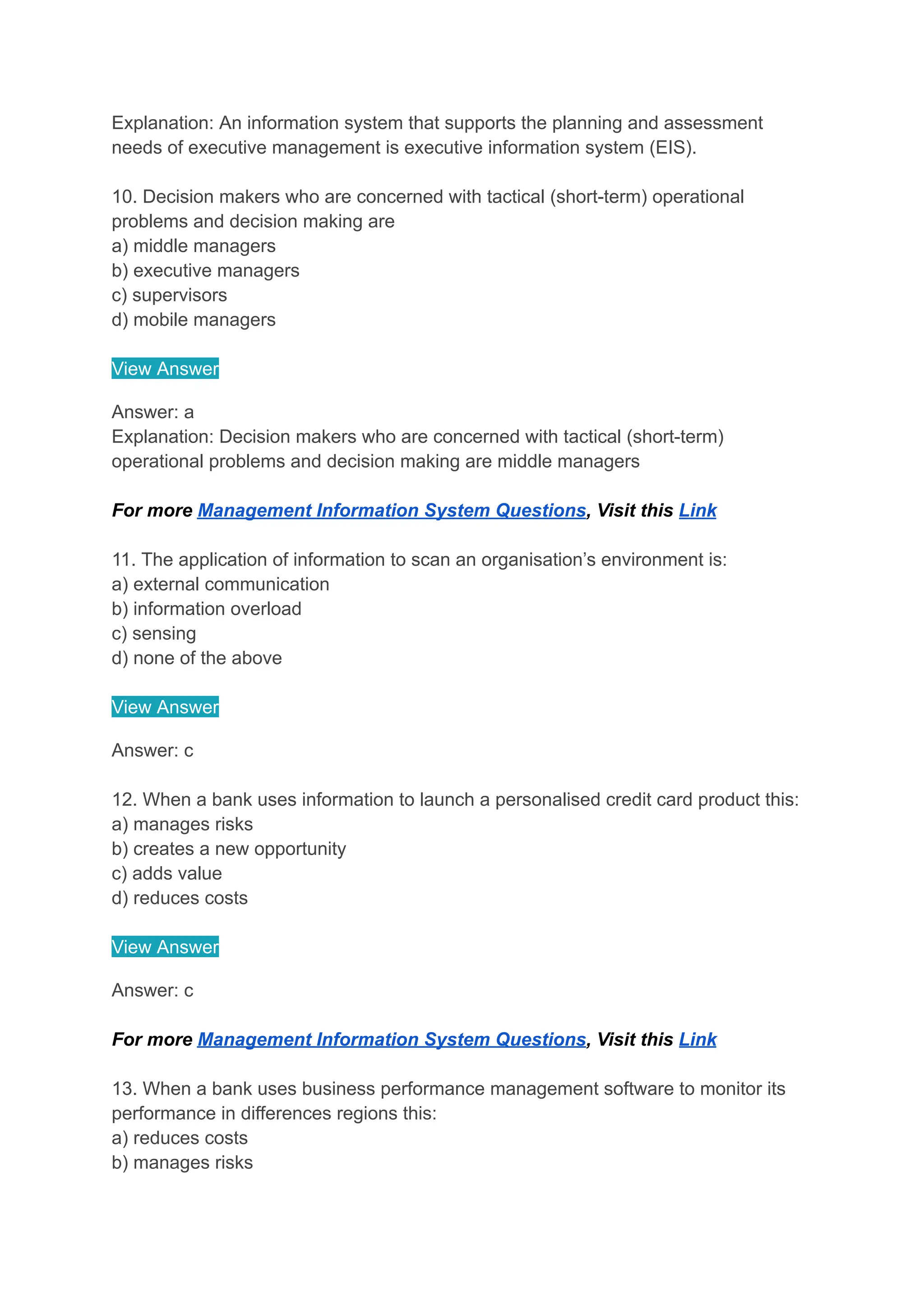
9. An information system that supports the planning and assessment needs of
executive management is
a) DSS
b) TPS
c) ERP
d) none of the above
View Answer
Answer: d
Explanation: An information system that supports the planning and assessment
needs of executive management is executive information system (EIS).
10. Decision makers who are concerned with tactical (short-term) operational
problems and decision making are
a) middle managers
b) executive managers
c) supervisors
d) mobile managers
View Answer
Answer: a
Explanation: Decision makers who are concerned with tactical (short-term)
operational problems and decision making are middle managers
For more Management Information System Questions, Visit this Link
11. The application of information to scan an organisation’s environment is:
a) external communication
b) information overload
c) sensing
d) none of the above
View Answer
Answer: c
12. When a bank uses information to launch a personalised credit card product this:
a) manages risks
b) creates a new opportunity
c) adds value
d) reduces costs
View Answer
Answer: c
For more Management Information System Questions, Visit this Link
13. When a bank uses business performance management software to monitor its
performance in differences regions this:
a) reduces costs
b) manages risks
c) adds value
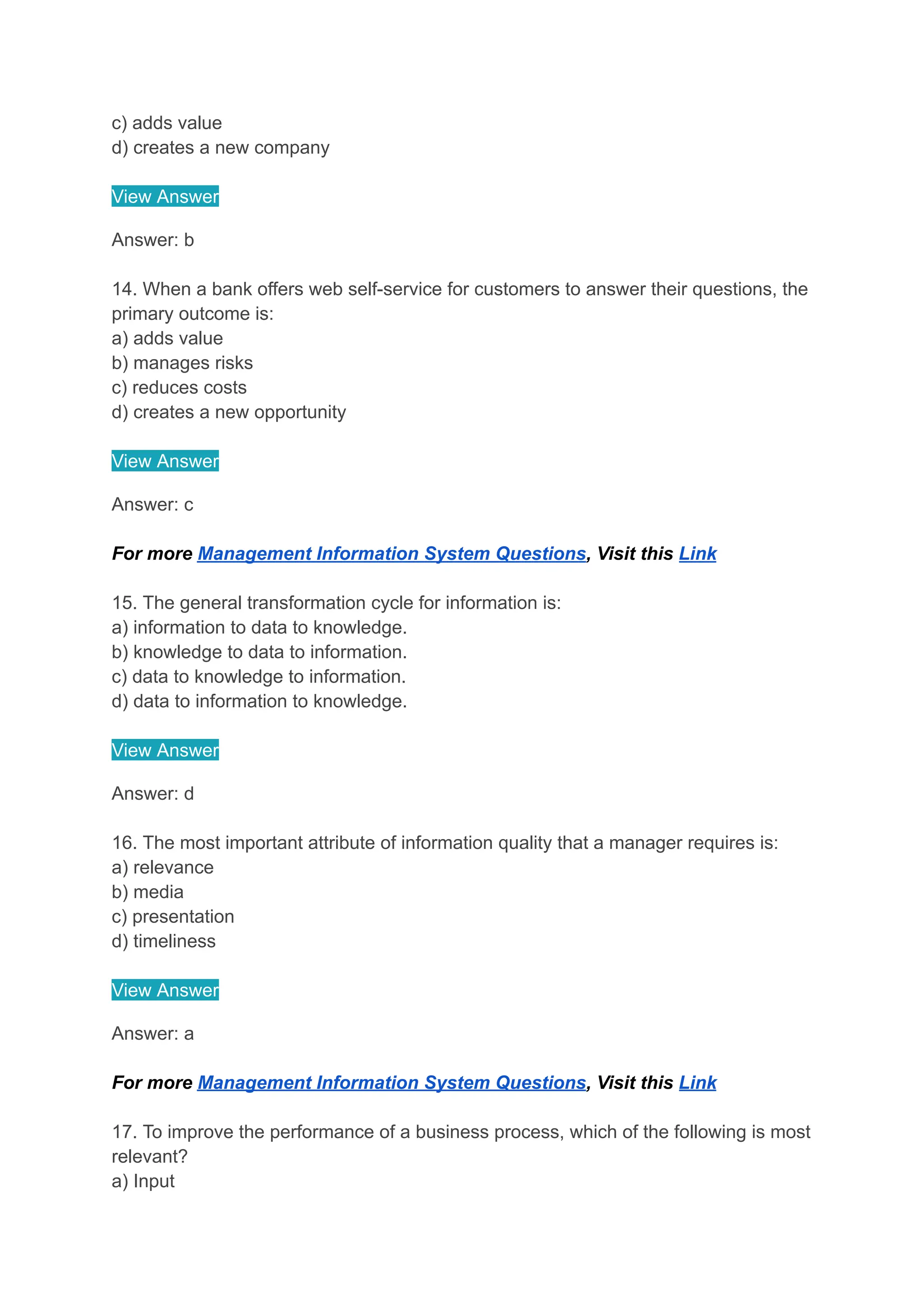
d) creates a new company
View Answer
Answer: b
14. When a bank offers web self-service for customers to answer their questions, the
primary outcome is:
a) adds value
b) manages risks
c) reduces costs
d) creates a new opportunity
View Answer
Answer: c
For more Management Information System Questions, Visit this Link
15. The general transformation cycle for information is:
a) information to data to knowledge.
b) knowledge to data to information.
c) data to knowledge to information.
d) data to information to knowledge.
View Answer
Answer: d
16. The most important attribute of information quality that a manager requires is:
a) relevance
b) media
c) presentation
d) timeliness
View Answer
Answer: a
For more Management Information System Questions, Visit this Link
17. To improve the performance of a business process, which of the following is most
relevant?
a) Input
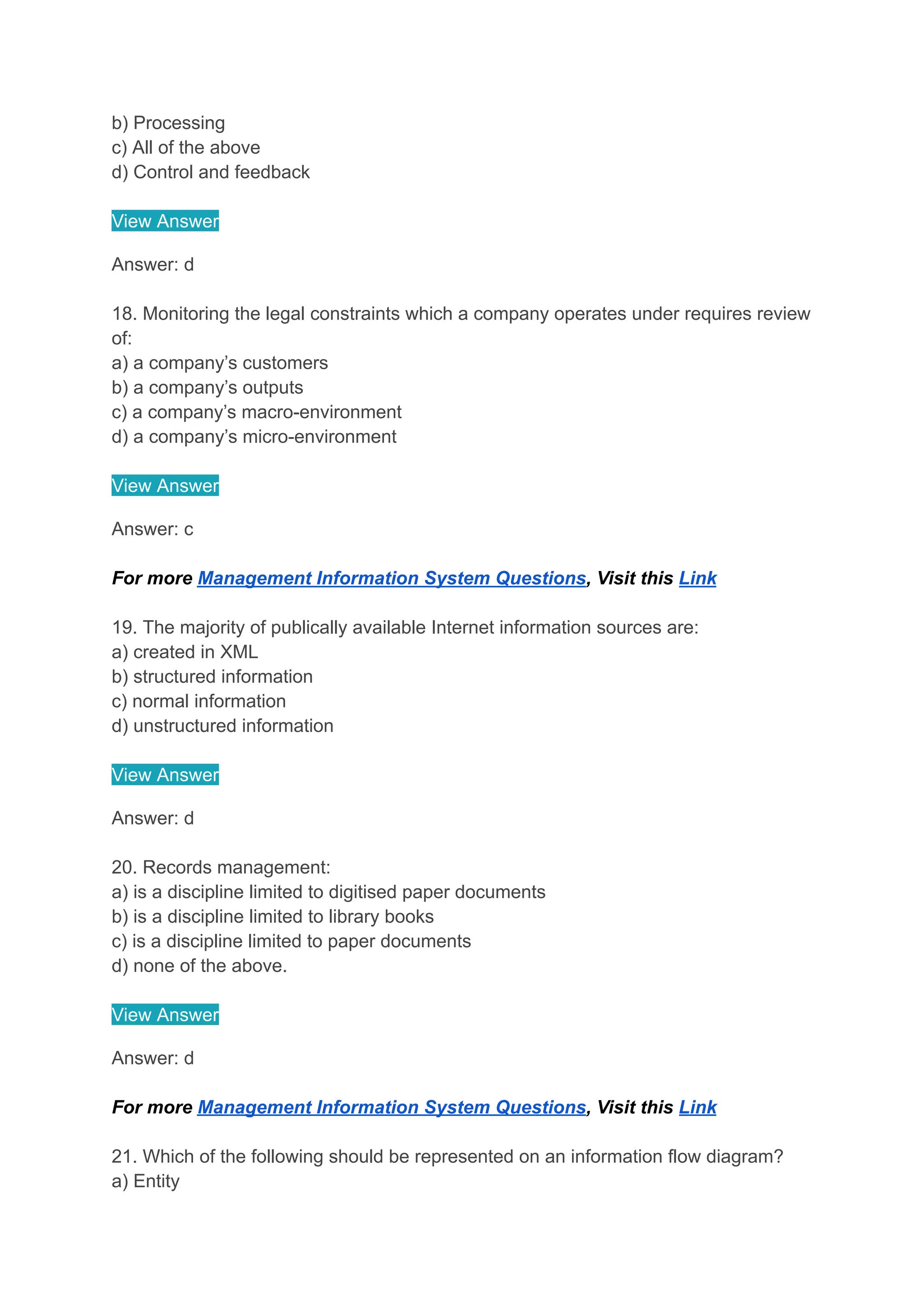
b) Processing
c) All of the above
d) Control and feedback
View Answer
Answer: d
18. Monitoring the legal constraints which a company operates under requires review
of:
a) a company’s customers
b) a company’s outputs
c) a company’s macro-environment
d) a company’s micro-environment
View Answer
Answer: c
For more Management Information System Questions, Visit this Link
19. The majority of publically available Internet information sources are:
a) created in XML
b) structured information
c) normal information
d) unstructured information
View Answer
Answer: d
20. Records management:
a) is a discipline limited to digitised paper documents
b) is a discipline limited to library books
c) is a discipline limited to paper documents
d) none of the above.
View Answer
Answer: d
For more Management Information System Questions, Visit this Link
21. Which of the following should be represented on an information flow diagram?
a) Entity
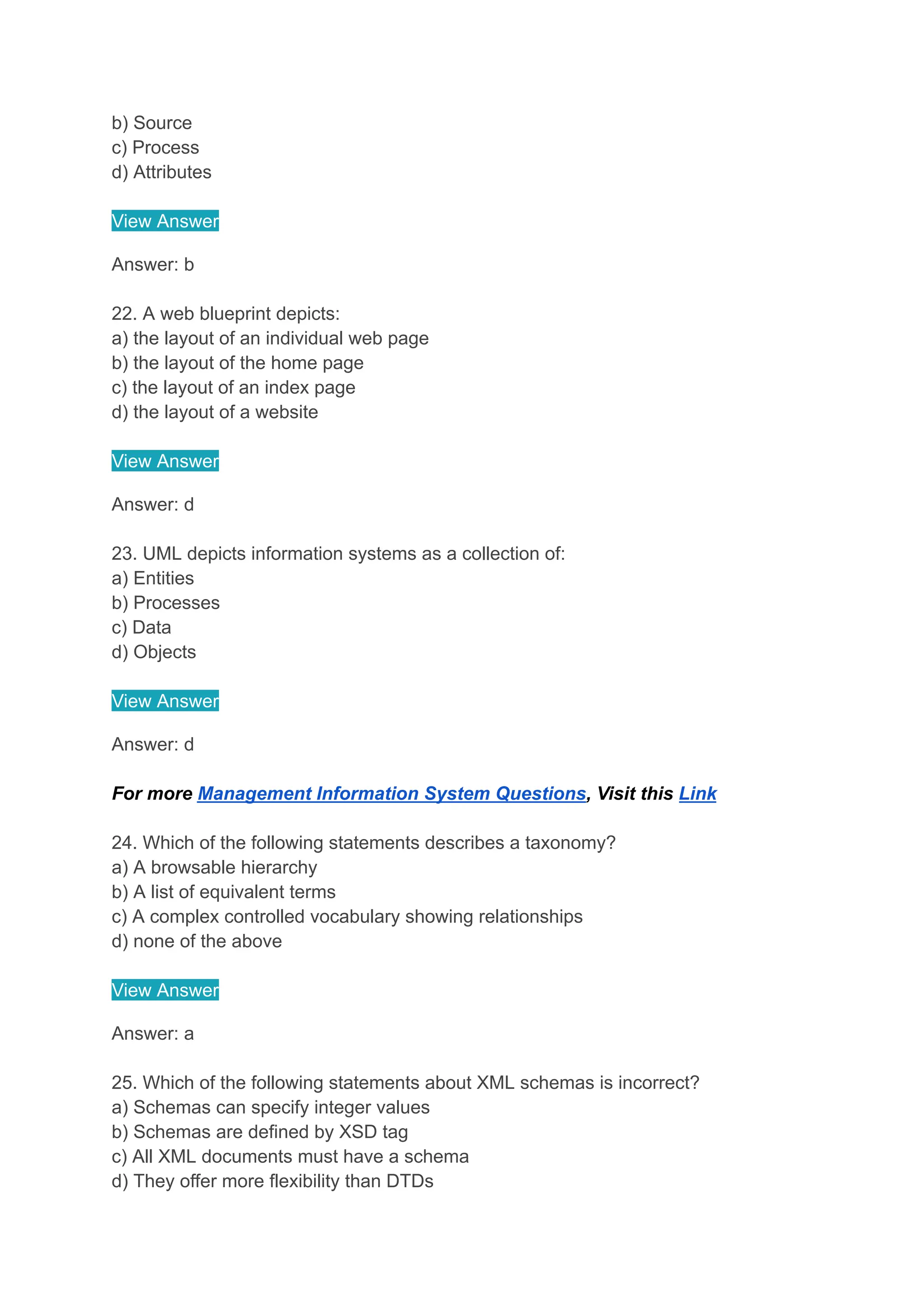
b) Source
c) Process
d) Attributes
View Answer
Answer: b
22. A web blueprint depicts:
a) the layout of an individual web page
b) the layout of the home page
c) the layout of an index page
d) the layout of a website
View Answer
Answer: d
23. UML depicts information systems as a collection of:
a) Entities
b) Processes
c) Data
d) Objects
View Answer
Answer: d
For more Management Information System Questions, Visit this Link
24. Which of the following statements describes a taxonomy?
a) A browsable hierarchy
b) A list of equivalent terms
c) A complex controlled vocabulary showing relationships
d) none of the above
View Answer
Answer: a
25. Which of the following statements about XML schemas is incorrect?
a) Schemas can specify integer values
b) Schemas are defined by XSD tag
c) All XML documents must have a schema
d) They offer more flexibility than DTDs
View Answer
Answer: c
For more Management Information System Questions, Visit this Link
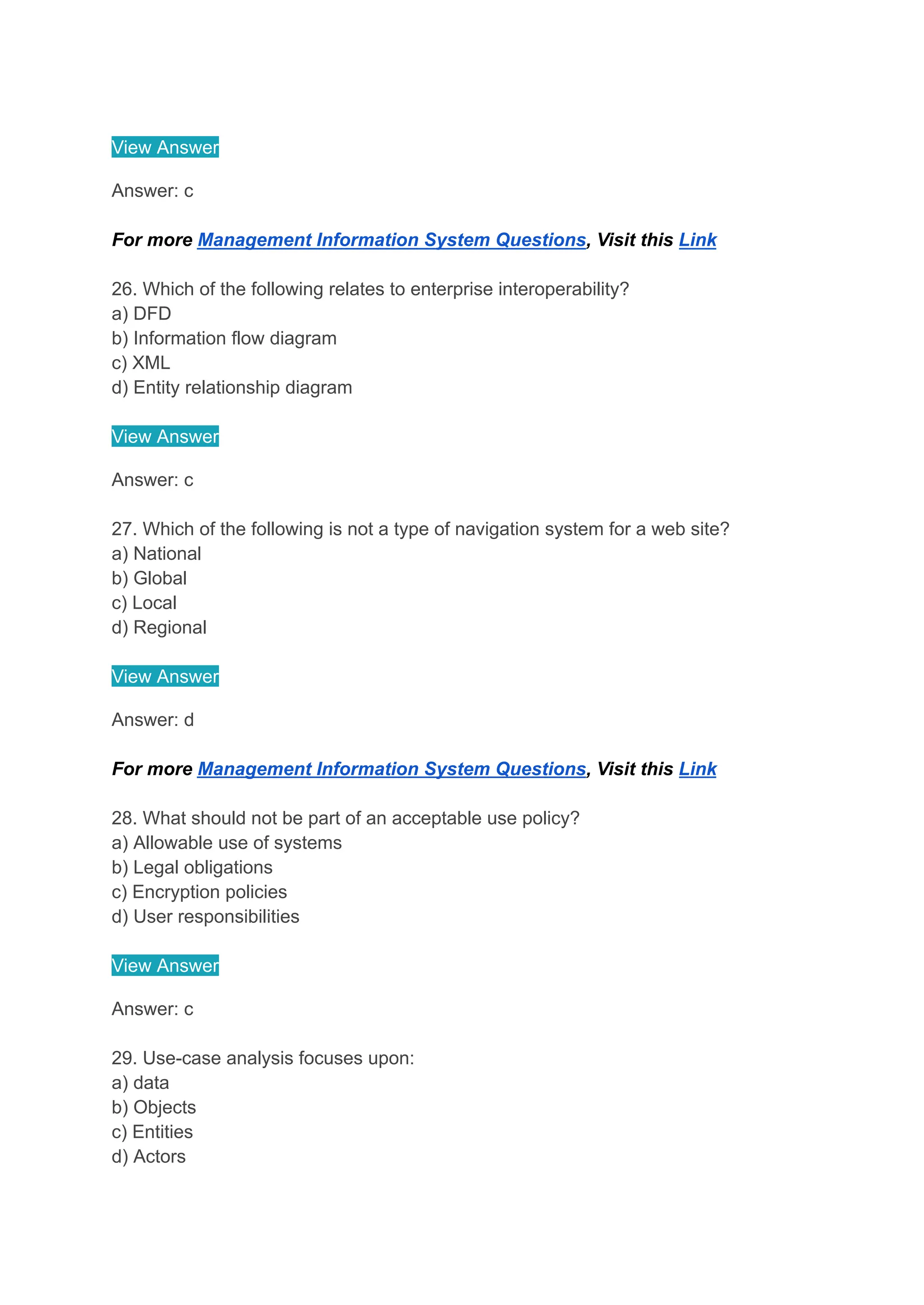
26. Which of the following relates to enterprise interoperability?
a) DFD
b) Information flow diagram
c) XML
d) Entity relationship diagram
View Answer
Answer: c
27. Which of the following is not a type of navigation system for a web site?
a) National
b) Global
c) Local
d) Regional
View Answer
Answer: d
For more Management Information System Questions, Visit this Link
28. What should not be part of an acceptable use policy?
a) Allowable use of systems
b) Legal obligations
c) Encryption policies
d) User responsibilities
View Answer
Answer: c
29. Use-case analysis focuses upon:
a) data
b) Objects
c) Entities
d) Actors
View Answer
Answer: d
For more Management Information System Questions, Visit this Link
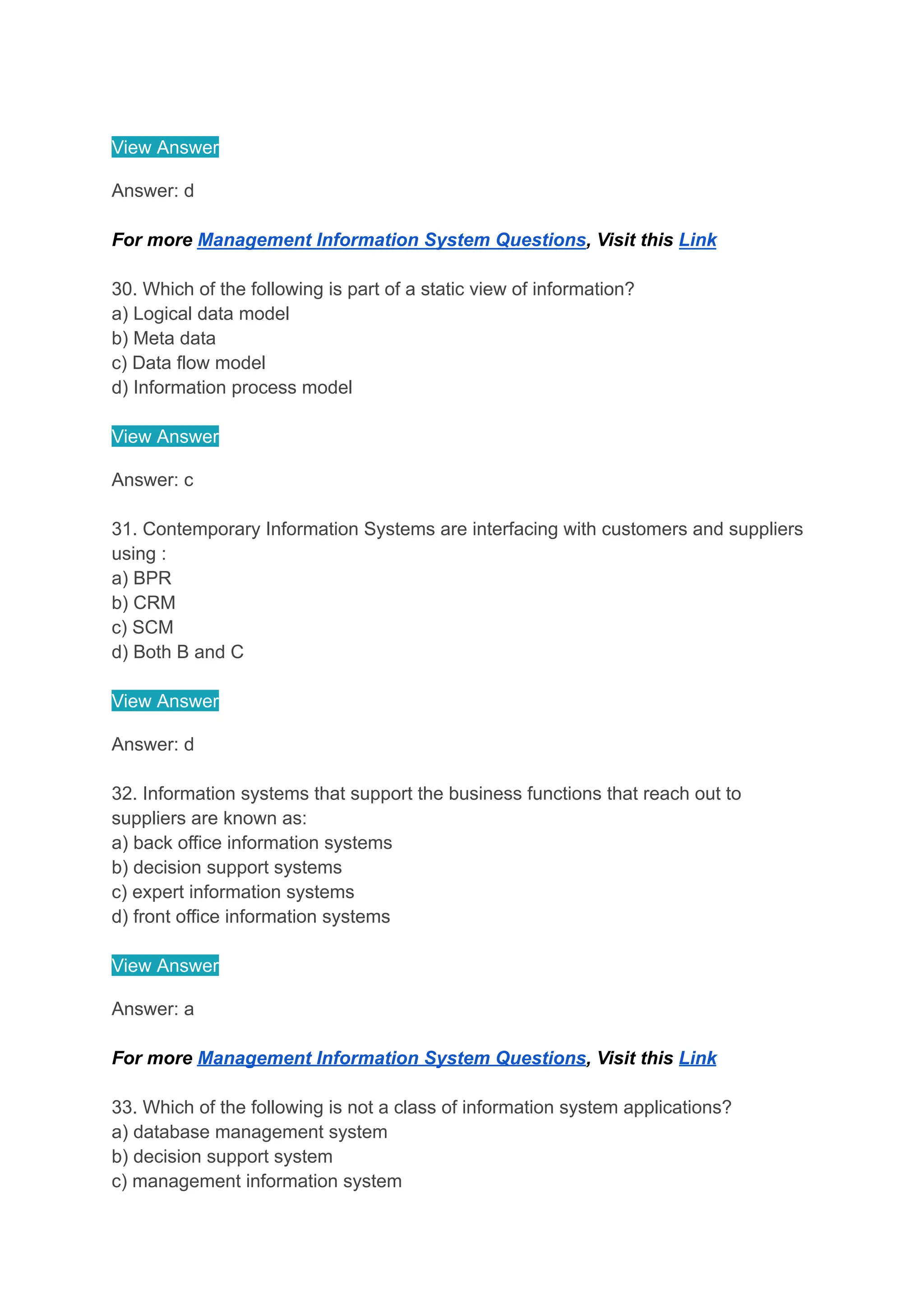
30. Which of the following is part of a static view of information?
a) Logical data model
b) Meta data
c) Data flow model
d) Information process model
View Answer
Answer: c
31. Contemporary Information Systems are interfacing with customers and suppliers
using :
a) BPR
b) CRM
c) SCM
d) Both B and C
View Answer
Answer: d
32. Information systems that support the business functions that reach out to
suppliers are known as:
a) back office information systems
b) decision support systems
c) expert information systems
d) front office information systems
View Answer
Answer: a
For more Management Information System Questions, Visit this Link
33. Which of the following is not a class of information system applications?
a) database management system
b) decision support system
c) management information system
d) office automation system
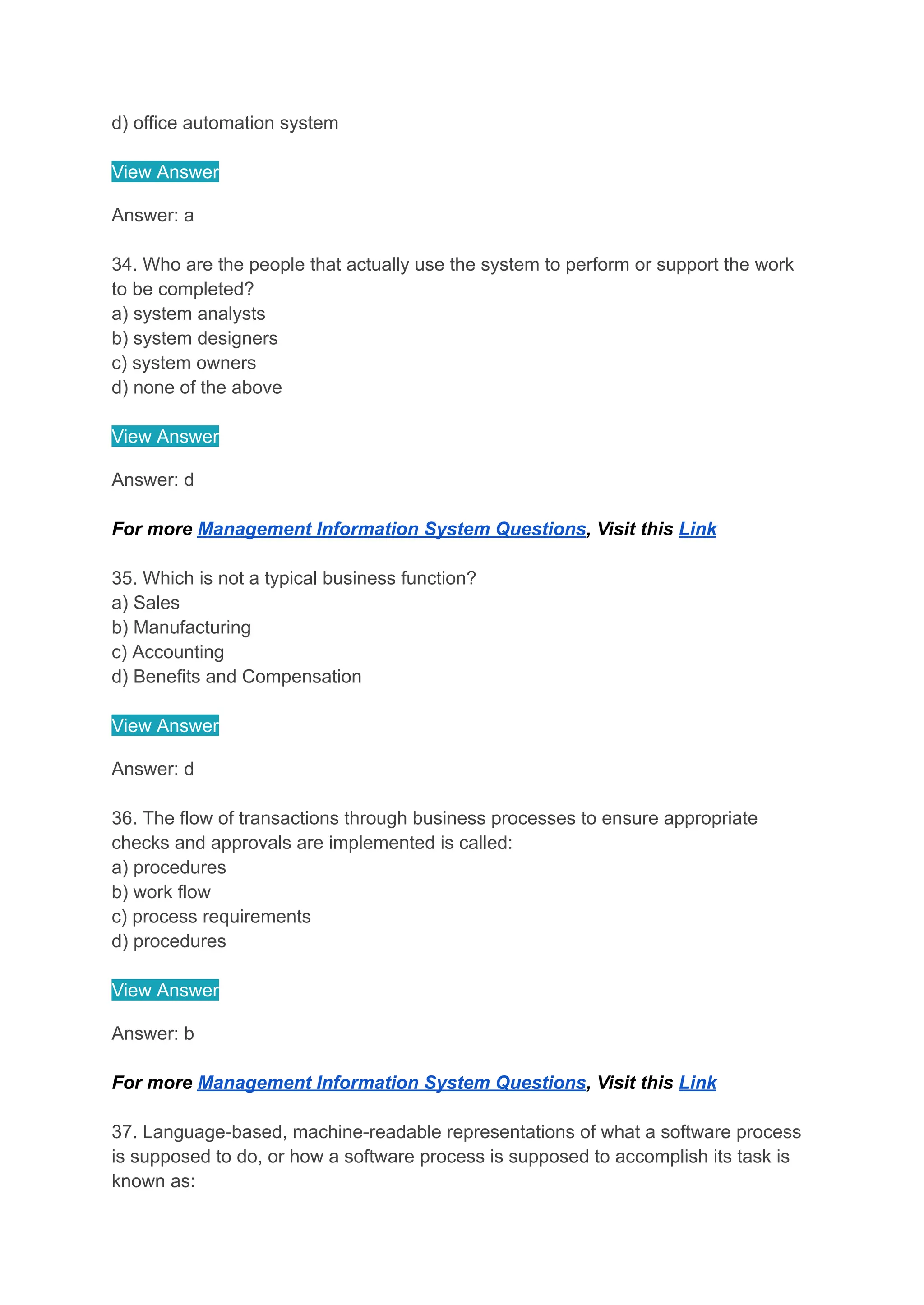
View Answer
Answer: a
34. Who are the people that actually use the system to perform or support the work
to be completed?
a) system analysts
b) system designers
c) system owners
d) none of the above
View Answer
Answer: d
For more Management Information System Questions, Visit this Link
35. Which is not a typical business function?
a) Sales
b) Manufacturing
c) Accounting
d) Benefits and Compensation
View Answer
Answer: d
36. The flow of transactions through business processes to ensure appropriate
checks and approvals are implemented is called:
a) procedures
b) work flow
c) process requirements
d) procedures
View Answer
Answer: b
For more Management Information System Questions, Visit this Link
37. Language-based, machine-readable representations of what a software process
is supposed to do, or how a software process is supposed to accomplish its task is
known as:
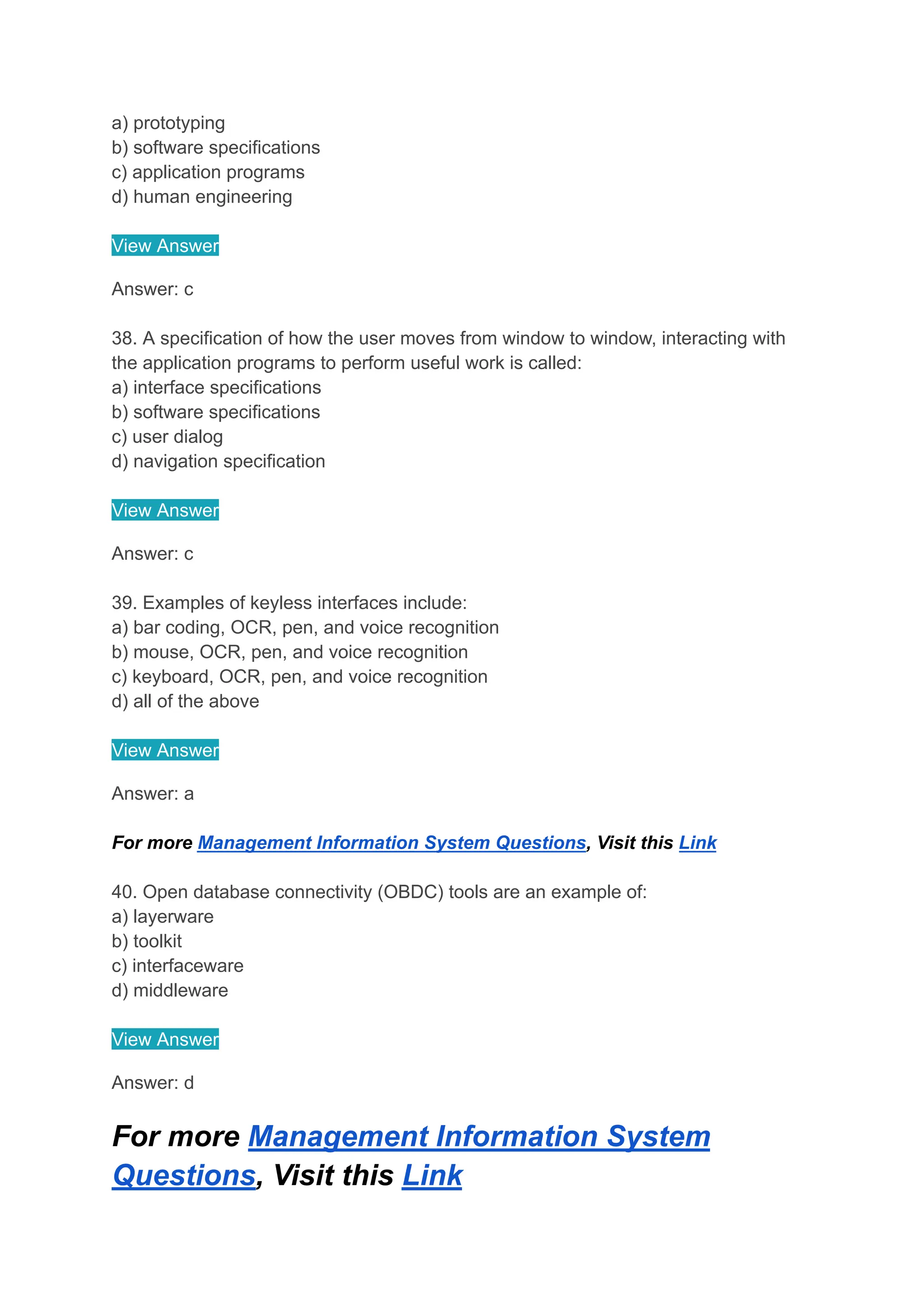
a) prototyping
b) software specifications
c) application programs
d) human engineering
View Answer
Answer: c
38. A specification of how the user moves from window to window, interacting with
the application programs to perform useful work is called:
a) interface specifications
b) software specifications
c) user dialog
d) navigation specification
View Answer
Answer: c
39. Examples of keyless interfaces include:
a) bar coding, OCR, pen, and voice recognition
b) mouse, OCR, pen, and voice recognition
c) keyboard, OCR, pen, and voice recognition
d) all of the above
View Answer
Answer: a
For more Management Information System Questions, Visit this Link
40. Open database connectivity (OBDC) tools are an example of:
a) layerware
b) toolkit
c) interfaceware
d) middleware
View Answer
Answer: d
For more Management Information System
Questions, Visit this Link

What is Management Information System (Questions included)

  • 1.
    Management Information Systems(MIS) in the Context of an MBA Program Introduction In the ever-evolving landscape of business, the role of Management Information Systems (MIS) has become increasingly pivotal. For students pursuing a Master of Business Administration (MBA), understanding MIS is crucial as it integrates technology with business processes to support decision-making and strategic planning. This article delves into the essence of MIS, its significance in the business world, and its relevance for MBA students. We will explore key concepts, applications, challenges, and future trends in MIS to provide a comprehensive overview tailored to MBA professionals. 1. Understanding Management Information Systems Management Information Systems (MIS) refers to the coordinated use of technology, people, and processes to manage and analyze information within an organization. The primary goal of MIS is to provide accurate, timely, and relevant information to support management decisions and enhance organizational efficiency. MIS encompasses various subsystems, including Transaction Processing Systems (TPS), Decision Support Systems (DSS), Executive Information Systems (EIS), and Knowledge Management Systems (KMS). 1.1 Components of MIS ● Hardware: The physical components of a computer system, such as servers, computers, and network devices. ● Software: Applications and programs that process data and facilitate tasks. This includes operating systems, database management systems (DBMS), and specialized business applications. ● Data: Raw facts and figures that are processed to produce meaningful information. Data management is critical for ensuring data accuracy and security. ● People: Users who interact with the system, including IT professionals, managers, and end-users. Their skills and training are crucial for effective MIS implementation. ● Processes: The procedures and methods used to collect, process, and distribute information. Well-defined processes ensure that information flows efficiently within the organization. 1.2 Types of MIS ● Transaction Processing Systems (TPS): Handle day-to-day transactions, such as order processing, payroll, and inventory management. TPS ensures that routine transactions are processed efficiently and accurately. ● Decision Support Systems (DSS): Assist in making complex decisions by providing analytical tools and models. DSS supports decision-making in scenarios that require judgment and interpretation of data. ● Executive Information Systems (EIS): Provide top executives with summary information and performance indicators. EIS offers high-level insights into organizational performance and strategic issues.
  • 2.
    ● Knowledge ManagementSystems (KMS): Facilitate the creation, sharing, and utilization of knowledge within an organization. KMS support innovation and continuous improvement by leveraging organizational knowledge. 2. Significance of MIS in Business MIS plays a vital role in modern businesses by enhancing decision-making, improving operational efficiency, and supporting strategic planning. For MBA students, understanding the impact of MIS on business operations is essential for several reasons. 2.1 Enhancing Decision-Making Effective decision-making relies on accurate and timely information. MIS provides managers with the necessary data to make informed decisions, analyze trends, and forecast future outcomes. By utilizing MIS, organizations can improve their responsiveness to market changes, customer preferences, and competitive pressures. 2.2 Improving Operational Efficiency MIS streamlines business processes by automating routine tasks and reducing manual errors. For instance, Enterprise Resource Planning (ERP) systems integrate various functional areas, such as finance, human resources, and supply chain management, into a unified system. This integration enhances coordination, reduces redundancy, and improves overall efficiency. 2.3 Supporting Strategic Planning Strategic planning involves setting long-term goals and determining the best course of action to achieve them. MIS provides executives with tools and information to evaluate different strategic options, assess performance metrics, and align resources with organizational objectives. Business intelligence (BI) systems and data analytics play a crucial role in supporting strategic planning by providing actionable insights and identifying growth opportunities. 2.4 Facilitating Communication and Collaboration MIS enhances communication and collaboration within an organization by providing platforms for sharing information and coordinating activities. Tools such as intranets, collaboration software, and project management systems enable teams to work together more effectively, regardless of their physical location. 2.5 Ensuring Data Security and Compliance As businesses increasingly rely on digital information, data security and regulatory compliance become critical concerns. MIS includes security measures and protocols to protect sensitive information from unauthorized access and cyber threats. Additionally, MIS helps organizations comply with legal and regulatory requirements related to data privacy and protection. 3. Applications of MIS in Various Business Functions
  • 3.
    MIS is integratedinto various business functions, each serving distinct purposes and contributing to overall organizational success. Understanding these applications helps MBA students grasp the practical implications of MIS in different contexts. 3.1 Marketing In marketing, MIS supports customer relationship management (CRM) by analyzing customer data and tracking marketing campaigns. CRM systems enable businesses to segment their customer base, personalize marketing efforts, and measure campaign effectiveness. Additionally, marketing analytics tools provide insights into consumer behavior, market trends, and competitive positioning. 3.2 Finance MIS plays a crucial role in financial management by providing tools for budgeting, forecasting, and financial analysis. Financial information systems assist in managing accounts payable and receivable, tracking investments, and evaluating financial performance. Business intelligence tools and dashboards offer real-time visibility into financial metrics and support decision-making. 3.3 Human Resources In human resources, MIS facilitates employee management, recruitment, and performance evaluation. Human Resource Information Systems (HRIS) automate tasks such as payroll processing, benefits administration, and employee records management. Additionally, HR analytics tools help organizations assess workforce productivity, identify skill gaps, and improve talent management. 3.4 Supply Chain Management MIS enhances supply chain management by optimizing inventory control, order processing, and logistics. Supply Chain Management Systems (SCMS) provide visibility into the entire supply chain, from procurement to delivery. These systems enable businesses to streamline operations, reduce costs, and respond to supply chain disruptions more effectively. 3.5 Operations Management In operations management, MIS supports process improvement and quality control. Manufacturing Execution Systems (MES) and Operations Information Systems (OIS) monitor production processes, track performance metrics, and ensure adherence to quality standards. MIS helps organizations identify inefficiencies, implement best practices, and achieve operational excellence. 4. Challenges in Implementing MIS Despite its benefits, implementing MIS comes with several challenges. MBA students must be aware of these challenges to effectively manage and leverage MIS in real-world scenarios. 4.1 Cost of Implementation
  • 4.
    The cost ofimplementing MIS can be substantial, especially for large organizations. Expenses include purchasing hardware and software, training employees, and maintaining the system. Small and medium-sized enterprises (SMEs) may face budget constraints that impact their ability to adopt advanced MIS solutions. 4.2 Data Security and Privacy Ensuring data security and privacy is a major concern in MIS. Organizations must implement robust security measures to protect sensitive information from breaches and cyber-attacks. Compliance with data protection regulations, such as the General Data Protection Regulation (GDPR), is essential for maintaining trust and avoiding legal repercussions. 4.3 Integration with Existing Systems Integrating MIS with existing systems can be complex and challenging. Organizations may encounter compatibility issues, data migration difficulties, and disruptions to ongoing operations. Effective planning, testing, and coordination are necessary to ensure a smooth integration process. 4.4 Change Management The successful implementation of MIS often requires changes to organizational processes and workflows. Managing these changes and addressing employee resistance can be challenging. Effective communication, training, and support are crucial for ensuring a smooth transition and maximizing the benefits of MIS. 4.5 Keeping Up with Technological Advances Technology is constantly evolving, and keeping up with the latest advancements can be challenging. Organizations must continually assess and update their MIS to remain competitive and leverage new technologies. Staying informed about emerging trends and innovations is essential for maintaining a relevant and effective MIS. 5. Future Trends in MIS As technology continues to advance, several trends are shaping the future of MIS. MBA students should be aware of these trends to anticipate changes and opportunities in the field. 5.1 Artificial Intelligence and Machine Learning Artificial intelligence (AI) and machine learning (ML) are transforming MIS by enabling advanced data analysis and automation. AI-powered analytics tools can identify patterns, make predictions, and provide actionable insights. Machine learning algorithms enhance decision-making by learning from historical data and adapting to new information. 5.2 Cloud Computing Cloud computing is revolutionizing the way organizations manage and access information. Cloud-based MIS solutions offer scalability, flexibility, and cost-efficiency. Organizations can
  • 5.
    leverage cloud servicesto store and process data, access applications, and collaborate with remote teams. Cloud computing also facilitates the integration of MIS with other digital tools and platforms. 5.3 Big Data and Analytics The rise of big data has created new opportunities for MIS to deliver valuable insights. Advanced analytics tools can process vast amounts of data from various sources, such as social media, IoT devices, and transactional systems. Big data analytics enables organizations to uncover trends, optimize operations, and drive innovation. 5.4 Internet of Things (IoT) The Internet of Things (IoT) connects physical devices and sensors to the internet, generating vast amounts of data. MIS can integrate IoT data to monitor and control assets, track performance, and optimize processes. IoT applications include smart manufacturing, supply chain monitoring, and asset management. 5.5 Blockchain Technology Blockchain technology offers a decentralized and secure approach to managing transactions and information. In MIS, blockchain can enhance data integrity, transparency, and traceability. Applications include secure financial transactions, supply chain tracking, and digital identity management. Conclusion Management Information Systems (MIS) are integral to modern business operations, providing valuable tools and insights for decision-making, efficiency, and strategic planning. For MBA students, understanding MIS is essential for navigating the complexities of today’s business environment and leveraging technology to achieve organizational goals. By exploring the components, applications, challenges, and future trends of MIS, MBA students can gain a comprehensive understanding of how to effectively utilize information systems in their future careers. As technology continues to advance, staying informed and adaptable Do check the important Management Information System Questions below -: Management Information System solved MCQ Questions : Management information systems are an organized method of collecting information from various sources, compiling it, and presenting it in a readable format. It helps business leaders and managers make strategic management decisions. This section focus on all topics of the Management Information System subject. Here you can get important mcq questions on Management Information System with answers. These questions will help you to prepare for interviews, entrance exams, online tests, and
  • 6.
    semester exams. TheseManagement Information System multiple choice questions are for both freshers and experienced candidates. Management Information System MCQ Chapter Wise : Here you will find a list of important questions and answers with detailed solution on management information system in MCQ quiz style for competitive exams and interviews. Here, You can practice these MCQs chapter-wise for FREE. Below section consists of important multiple choice questions on management information system with answers -: 1. Management information systems (MIS): a) create and share documents that support day-today office activities b) process business transactions (e.g., time cards, payments, orders, etc.) c) capture and reproduce the knowledge of an expert problem solver d) use the transaction data to produce information needed by managers to run the business View Answer Answer: d Explanation: Management information systems use the transaction data to produce information needed by managers to run the business 2. The term used to describe those people whose jobs involve sponsoring and funding the project to develop, operate, and maintain the information system is a) information worker b) internal system user c) systems owner d) external system user View Answer Answer: c Explanation: The term used to describe those people whose jobs involve sponsoring and funding the project to develop, operate, and maintain the information system is systems owner 3. The person who ensures that systems are developed on time, within budget, and with acceptable quality is a a) systems designer b) project manager c) systems owner d) external system user
  • 7.
    View Answer Answer: b Explanation:The person who ensures that systems are developed on time, within budget, and with acceptable quality is a project manager 4. Which one of the following is not a business driver for an information system? a) business process redesign b) knowledge asset management c) proliferation of networks and the Internet d) collaboration and partnership View Answer Answer: c Explanation: Proliferation of networks and the Internet For more Management Information System Questions, Visit this Link 5. A task of developing a technical blueprint and specifications for a solution that fulfills the business requirements is undertaken in the following phase of the system development process a) system initiation b) system implementation c) system analysis d) system design View Answer Answer: d Explanation: System Design is a task of developing a technical blueprint and specifications for a solution that fulfills the business requirements is undertaken in the following phase of the system development process 6. If a university sets up a web-based information system that faculty could access to record student grades and to advise students, that would be an example of a/an a) CRM b) Intranet c) ERP d) none of the above View Answer Answer: b
  • 8.
    Explanation: If auniversity sets up a web-based information system that faculty could access to record student grades and to advise students, that would be an example of an Intranet For more Management Information System Questions, Visit this Link 7. Which of the following is not a technology driver for an information system? a) enterprise applications b) object technologies c) knowledge asset management d) collaborative technologies View Answer Answer: c Explanation: knowledge asset management is not a technology driver for an information system For more Management Information System Questions, Visit this Link 8. Which of the following is a deliverable of the system implementation phase in a formal system development process? a) technical hardware and software solution for the business problem b) business problem statement c) statement of the system users’ business requirements d) technical blueprint and specifications for a solution that fulfills the business requirements View Answer Answer: a Explanation: Technical hardware and software solution for the business problem 9. An information system that supports the planning and assessment needs of executive management is a) DSS b) TPS c) ERP d) none of the above View Answer Answer: d
  • 9.
    Explanation: An informationsystem that supports the planning and assessment needs of executive management is executive information system (EIS). 10. Decision makers who are concerned with tactical (short-term) operational problems and decision making are a) middle managers b) executive managers c) supervisors d) mobile managers View Answer Answer: a Explanation: Decision makers who are concerned with tactical (short-term) operational problems and decision making are middle managers For more Management Information System Questions, Visit this Link 11. The application of information to scan an organisation’s environment is: a) external communication b) information overload c) sensing d) none of the above View Answer Answer: c 12. When a bank uses information to launch a personalised credit card product this: a) manages risks b) creates a new opportunity c) adds value d) reduces costs View Answer Answer: c For more Management Information System Questions, Visit this Link 13. When a bank uses business performance management software to monitor its performance in differences regions this: a) reduces costs b) manages risks
  • 10.
    c) adds value d)creates a new company View Answer Answer: b 14. When a bank offers web self-service for customers to answer their questions, the primary outcome is: a) adds value b) manages risks c) reduces costs d) creates a new opportunity View Answer Answer: c For more Management Information System Questions, Visit this Link 15. The general transformation cycle for information is: a) information to data to knowledge. b) knowledge to data to information. c) data to knowledge to information. d) data to information to knowledge. View Answer Answer: d 16. The most important attribute of information quality that a manager requires is: a) relevance b) media c) presentation d) timeliness View Answer Answer: a For more Management Information System Questions, Visit this Link 17. To improve the performance of a business process, which of the following is most relevant? a) Input
  • 11.
    b) Processing c) Allof the above d) Control and feedback View Answer Answer: d 18. Monitoring the legal constraints which a company operates under requires review of: a) a company’s customers b) a company’s outputs c) a company’s macro-environment d) a company’s micro-environment View Answer Answer: c For more Management Information System Questions, Visit this Link 19. The majority of publically available Internet information sources are: a) created in XML b) structured information c) normal information d) unstructured information View Answer Answer: d 20. Records management: a) is a discipline limited to digitised paper documents b) is a discipline limited to library books c) is a discipline limited to paper documents d) none of the above. View Answer Answer: d For more Management Information System Questions, Visit this Link 21. Which of the following should be represented on an information flow diagram? a) Entity
  • 12.
    b) Source c) Process d)Attributes View Answer Answer: b 22. A web blueprint depicts: a) the layout of an individual web page b) the layout of the home page c) the layout of an index page d) the layout of a website View Answer Answer: d 23. UML depicts information systems as a collection of: a) Entities b) Processes c) Data d) Objects View Answer Answer: d For more Management Information System Questions, Visit this Link 24. Which of the following statements describes a taxonomy? a) A browsable hierarchy b) A list of equivalent terms c) A complex controlled vocabulary showing relationships d) none of the above View Answer Answer: a 25. Which of the following statements about XML schemas is incorrect? a) Schemas can specify integer values b) Schemas are defined by XSD tag c) All XML documents must have a schema d) They offer more flexibility than DTDs
  • 13.
    View Answer Answer: c Formore Management Information System Questions, Visit this Link 26. Which of the following relates to enterprise interoperability? a) DFD b) Information flow diagram c) XML d) Entity relationship diagram View Answer Answer: c 27. Which of the following is not a type of navigation system for a web site? a) National b) Global c) Local d) Regional View Answer Answer: d For more Management Information System Questions, Visit this Link 28. What should not be part of an acceptable use policy? a) Allowable use of systems b) Legal obligations c) Encryption policies d) User responsibilities View Answer Answer: c 29. Use-case analysis focuses upon: a) data b) Objects c) Entities d) Actors
  • 14.
    View Answer Answer: d Formore Management Information System Questions, Visit this Link 30. Which of the following is part of a static view of information? a) Logical data model b) Meta data c) Data flow model d) Information process model View Answer Answer: c 31. Contemporary Information Systems are interfacing with customers and suppliers using : a) BPR b) CRM c) SCM d) Both B and C View Answer Answer: d 32. Information systems that support the business functions that reach out to suppliers are known as: a) back office information systems b) decision support systems c) expert information systems d) front office information systems View Answer Answer: a For more Management Information System Questions, Visit this Link 33. Which of the following is not a class of information system applications? a) database management system b) decision support system c) management information system
  • 15.
    d) office automationsystem View Answer Answer: a 34. Who are the people that actually use the system to perform or support the work to be completed? a) system analysts b) system designers c) system owners d) none of the above View Answer Answer: d For more Management Information System Questions, Visit this Link 35. Which is not a typical business function? a) Sales b) Manufacturing c) Accounting d) Benefits and Compensation View Answer Answer: d 36. The flow of transactions through business processes to ensure appropriate checks and approvals are implemented is called: a) procedures b) work flow c) process requirements d) procedures View Answer Answer: b For more Management Information System Questions, Visit this Link 37. Language-based, machine-readable representations of what a software process is supposed to do, or how a software process is supposed to accomplish its task is known as:
  • 16.
    a) prototyping b) softwarespecifications c) application programs d) human engineering View Answer Answer: c 38. A specification of how the user moves from window to window, interacting with the application programs to perform useful work is called: a) interface specifications b) software specifications c) user dialog d) navigation specification View Answer Answer: c 39. Examples of keyless interfaces include: a) bar coding, OCR, pen, and voice recognition b) mouse, OCR, pen, and voice recognition c) keyboard, OCR, pen, and voice recognition d) all of the above View Answer Answer: a For more Management Information System Questions, Visit this Link 40. Open database connectivity (OBDC) tools are an example of: a) layerware b) toolkit c) interfaceware d) middleware View Answer Answer: d For more Management Information System Questions, Visit this Link