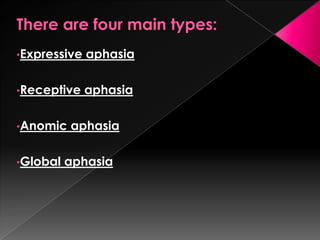
•Expressive   aphasia

•Receptive    aphasia

•Anomic   aphasia

•Global   aphasia
•Simplify   your sentences and slow down your
pace.
•Allow the person time to talk.
•Don't finish sentences or correct errors.
•Reduce distracting noise in the environment.
•Keep paper and pencils or pens readily
available.
•Write a key word or a short sentence to help
explain something.
•Help the person with aphasia create a book
of words, pictures and photos to assist with
conversations.
•Use drawings or gestures when you aren't
understood.
•Involve   the person with aphasia in
conversations as much as possible.
•Check for comprehension or summarize what
you've discussed.
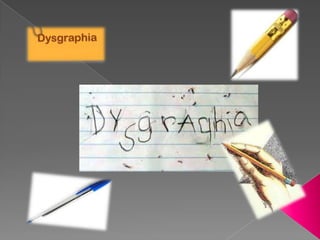
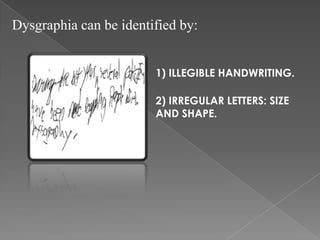
Dysgraphia can be identified by:


                        1) ILLEGIBLE HANDWRITING.

                        2) IRREGULAR LETTERS: SIZE
                        AND SHAPE.
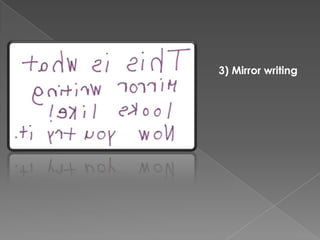
3) Mirror writing
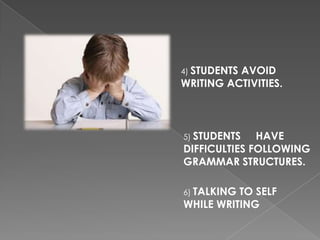
4) STUDENTS
          AVOID
WRITING ACTIVITIES.


5) STUDENTS   HAVE
DIFFICULTIES FOLLOWING
GRAMMAR STRUCTURES.

6) TALKINGTO SELF
WHILE WRITING
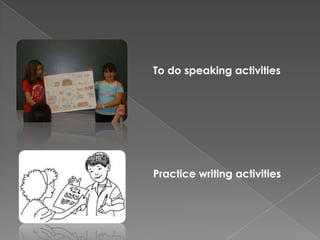
To do speaking activities


Practice writing activities
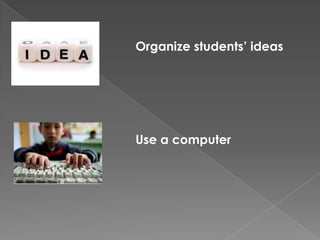
Organize students’ ideas


Use a computer

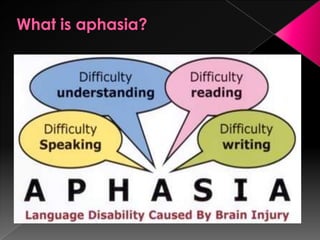
What is aphasia

  • 4.
    •Expressive aphasia •Receptive aphasia •Anomic aphasia •Global aphasia
  • 5.
    •Simplify your sentences and slow down your pace. •Allow the person time to talk. •Don't finish sentences or correct errors. •Reduce distracting noise in the environment. •Keep paper and pencils or pens readily available.
  • 6.
    •Write a keyword or a short sentence to help explain something. •Help the person with aphasia create a book of words, pictures and photos to assist with conversations. •Use drawings or gestures when you aren't understood. •Involve the person with aphasia in conversations as much as possible. •Check for comprehension or summarize what you've discussed.
  • 8.
    Dysgraphia can beidentified by: 1) ILLEGIBLE HANDWRITING. 2) IRREGULAR LETTERS: SIZE AND SHAPE.
  • 9.
  • 10.
    4) STUDENTS AVOID WRITING ACTIVITIES. 5) STUDENTS HAVE DIFFICULTIES FOLLOWING GRAMMAR STRUCTURES. 6) TALKINGTO SELF WHILE WRITING
  • 12.
    To do speakingactivities Practice writing activities
  • 13.