Anxiety Disorder
Shivangi Jaiswal
Application Number :
5289b394e85611e98de88de29dd6fdfb
Affiliation : Banaras Hindu University
Acknowledgement
I would like to express my special thanks of gratitudes to the
‘Academic writing team’ who gave me the opportunity to do
this project. While completing my project, I came to know
about so many new things. I am really thankful to them.
Secondly, I would like to thanks to my professors who
introduced me to ‘Swayam- an online education’ and
informed about the Academic writing course. I pay my deep
sense of gratitude for valuable guidance and support.
Lastly, I would also like to thanks my family and friends
who helped me a lot in finalizing this project within the
limited time.
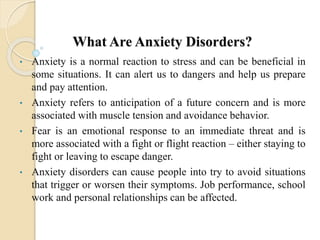
What Are Anxiety Disorders?
• Anxiety is a normal reaction to stress and can be beneficial in
some situations. It can alert us to dangers and help us prepare
and pay attention.
• Anxiety refers to anticipation of a future concern and is more
associated with muscle tension and avoidance behavior.
• Fear is an emotional response to an immediate threat and is
more associated with a fight or flight reaction – either staying to
fight or leaving to escape danger.
• Anxiety disorders can cause people into try to avoid situations
that trigger or worsen their symptoms. Job performance, school
work and personal relationships can be affected.
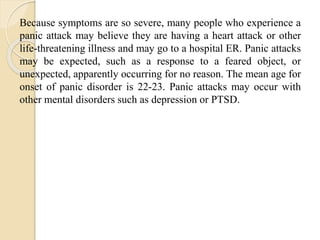
Because symptoms are so severe, many people who experience a
panic attack may believe they are having a heart attack or other
life-threatening illness and may go to a hospital ER. Panic attacks
may be expected, such as a response to a feared object, or
unexpected, apparently occurring for no reason. The mean age for
onset of panic disorder is 22-23. Panic attacks may occur with
other mental disorders such as depression or PTSD.
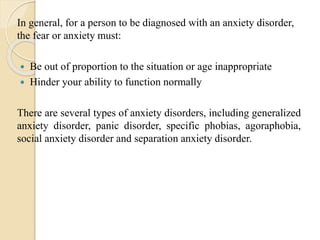
In general, for a person to be diagnosed with an anxiety disorder,
the fear or anxiety must:
 Be out of proportion to the situation or age inappropriate
 Hinder your ability to function normally
There are several types of anxiety disorders, including generalized
anxiety disorder, panic disorder, specific phobias, agoraphobia,
social anxiety disorder and separation anxiety disorder.
Types of Anxiety Disorders
1. Generalized Anxiety Disorder
Generalized anxiety disorder involves persistent and excessive
worry that interferes with daily activities. This ongoing worry
and tension may be accompanied by physical symptoms, such as
restlessness, feeling on edge or easily fatigued, difficulty
concentrating, muscle tension or problems sleeping.
2. Panic Disorder
The core symptom of panic disorder is recurrent panic attacks, an
overwhelming combination of physical and psychological
distress. During an attack several of these symptoms occur in
combination:
 Palpitations, pounding heart or rapid heart rate
 Sweating
 Trembling or shaking
 Feeling of shortness of breath or smothering sensations
 Chest pain
 Feeling dizzy, light-headed or faint
 Feeling of choking
 Numbness or tingling
 Chills or hot flashes
 Nausea or abdominal pains
 Feeling detached
 Fear of losing control
 Fear of dying
3. Phobias, Specific Phobia
A specific phobia is excessive and persistent fear of a specific
object, situation or activity that is generally not harmful. Patients
know their fear is excessive, but they can’t overcome it. These
fears cause such distress that some people go to extreme lengths
to avoid what they fear. Examples are fear of flying or fear of
spiders.
4. Agoraphobia
Agoraphobia is the fear of being in situations where escape may
be difficult or embarrassing, or help might not be available in the
event of panic symptoms. The fear is out of proportion to the
actual situation and lasts generally six months or more and causes
problems in functioning. A person with agoraphobia experiences
this fear in two or more of the following situations:
 Using public transportation
 Being in open spaces
 Being in enclosed places
 Standing in line or being in a crowd
 Being outside the home alone
The individual actively avoids the situation, requires a
companion or endures with intense fear or anxiety. Untreated
agoraphobia can become so serious that a person may be unable
to leave the house. A person can only be diagnosed with
agoraphobia if the fear is intensely upsetting, or if it significantly
interferes with normal daily activities.
5. Social Anxiety Disorder (previously called social phobia)
A person with social anxiety disorder has significant anxiety and
discomfort about being embarrassed, humiliated, rejected or
looked down on in social interactions. People with this disorder
will try to avoid the situation or endure it with great anxiety.
Common examples are extreme fear of public speaking, meeting
new people or eating/drinking in public. The fear or anxiety
causes problems with daily functioning and lasts at least six
months.
6. Separation Anxiety Disorder
A person with separation anxiety disorder is excessively fearful
or anxious about separation from those with whom he or she is
attached. The feeling is beyond what is appropriate for the
person’s age, persists (at least four weeks in children and six
months in adults) and causes problems functioning. A person
with separation anxiety disorder may be persistently worried
about losing the person closest to him or her, may be reluctant or
refuse to go out or sleep away from home or without that person,
or may experience nightmares about separation. Physical
symptoms of distress often develop in childhood, but symptoms
can carry though adulthood.
Risk Factors
The causes of anxiety disorders are currently unknown but likely
involve a combination of factors including genetic,
environmental, psychological and developmental. Anxiety
disorders can run in families, suggesting that a combination of
genes and environmental stresses can produce the disorders.
Diagnosis and Treatment
The first step is to see your doctor to make sure there is no
physical problem causing the symptoms. If an anxiety disorder is
diagnosed, a mental health professional can work with you on the
best treatment. Unfortunately, many people with anxiety
disorders don’t seek help. They don’t realize that they have an
illness that has effective treatments.
Although each anxiety disorder has unique characteristics, most
respond well to two types of treatment: psychotherapy, or “talk
therapy,” and medications. These treatments can be given alone
or in combination. Cognitive behavior therapy (CBT), a type of
talk therapy, can help a person learn a different way of thinking,
reacting and behaving to help feel less anxious. Medications will
not cure anxiety disorders, but can give significant relief from
symptoms.
Reference
 Richard A. King
 Carson, R. C., Butcher, J. N., &Jine ka, S. (2001).
Abnormal psychology and modern life(11thEd.). New
York, Allyn and Bacon
 Clifford T. Morgan
 Kaplan, H. J., & sadock, B. j. (2004). Synopsis of
comprehensive textbook of psychiatry (10thEd.).
Baltimore: Williams & Wlkins
FEEDBACK
Subject : Experience of this Swayam online course “
Academic writing”.
Thanks to the team of academic writing course which
provided with the best knowledge about the subject academic
writing. It was great experiencing the new way of learning
that is online learning method which is slightly different from
the regular offline course.
Facilities and information provided was up to the mark and
came to be very helpful in learning this new course.
Thank You

What are anxiety disorders 1

  • 1.
    Anxiety Disorder Shivangi Jaiswal ApplicationNumber : 5289b394e85611e98de88de29dd6fdfb Affiliation : Banaras Hindu University
  • 2.
    Acknowledgement I would liketo express my special thanks of gratitudes to the ‘Academic writing team’ who gave me the opportunity to do this project. While completing my project, I came to know about so many new things. I am really thankful to them. Secondly, I would like to thanks to my professors who introduced me to ‘Swayam- an online education’ and informed about the Academic writing course. I pay my deep sense of gratitude for valuable guidance and support. Lastly, I would also like to thanks my family and friends who helped me a lot in finalizing this project within the limited time.
  • 3.
    What Are AnxietyDisorders? • Anxiety is a normal reaction to stress and can be beneficial in some situations. It can alert us to dangers and help us prepare and pay attention. • Anxiety refers to anticipation of a future concern and is more associated with muscle tension and avoidance behavior. • Fear is an emotional response to an immediate threat and is more associated with a fight or flight reaction – either staying to fight or leaving to escape danger. • Anxiety disorders can cause people into try to avoid situations that trigger or worsen their symptoms. Job performance, school work and personal relationships can be affected.
  • 4.
    Because symptoms areso severe, many people who experience a panic attack may believe they are having a heart attack or other life-threatening illness and may go to a hospital ER. Panic attacks may be expected, such as a response to a feared object, or unexpected, apparently occurring for no reason. The mean age for onset of panic disorder is 22-23. Panic attacks may occur with other mental disorders such as depression or PTSD.
  • 5.
    In general, fora person to be diagnosed with an anxiety disorder, the fear or anxiety must:  Be out of proportion to the situation or age inappropriate  Hinder your ability to function normally There are several types of anxiety disorders, including generalized anxiety disorder, panic disorder, specific phobias, agoraphobia, social anxiety disorder and separation anxiety disorder.
  • 6.
    Types of AnxietyDisorders 1. Generalized Anxiety Disorder Generalized anxiety disorder involves persistent and excessive worry that interferes with daily activities. This ongoing worry and tension may be accompanied by physical symptoms, such as restlessness, feeling on edge or easily fatigued, difficulty concentrating, muscle tension or problems sleeping. 2. Panic Disorder The core symptom of panic disorder is recurrent panic attacks, an overwhelming combination of physical and psychological distress. During an attack several of these symptoms occur in combination:
  • 7.
     Palpitations, poundingheart or rapid heart rate  Sweating  Trembling or shaking  Feeling of shortness of breath or smothering sensations  Chest pain  Feeling dizzy, light-headed or faint  Feeling of choking  Numbness or tingling  Chills or hot flashes  Nausea or abdominal pains  Feeling detached  Fear of losing control  Fear of dying
  • 8.
    3. Phobias, SpecificPhobia A specific phobia is excessive and persistent fear of a specific object, situation or activity that is generally not harmful. Patients know their fear is excessive, but they can’t overcome it. These fears cause such distress that some people go to extreme lengths to avoid what they fear. Examples are fear of flying or fear of spiders. 4. Agoraphobia Agoraphobia is the fear of being in situations where escape may be difficult or embarrassing, or help might not be available in the event of panic symptoms. The fear is out of proportion to the actual situation and lasts generally six months or more and causes problems in functioning. A person with agoraphobia experiences this fear in two or more of the following situations:
  • 9.
     Using publictransportation  Being in open spaces  Being in enclosed places  Standing in line or being in a crowd  Being outside the home alone The individual actively avoids the situation, requires a companion or endures with intense fear or anxiety. Untreated agoraphobia can become so serious that a person may be unable to leave the house. A person can only be diagnosed with agoraphobia if the fear is intensely upsetting, or if it significantly interferes with normal daily activities.
  • 10.
    5. Social AnxietyDisorder (previously called social phobia) A person with social anxiety disorder has significant anxiety and discomfort about being embarrassed, humiliated, rejected or looked down on in social interactions. People with this disorder will try to avoid the situation or endure it with great anxiety. Common examples are extreme fear of public speaking, meeting new people or eating/drinking in public. The fear or anxiety causes problems with daily functioning and lasts at least six months. 6. Separation Anxiety Disorder
  • 11.
    A person withseparation anxiety disorder is excessively fearful or anxious about separation from those with whom he or she is attached. The feeling is beyond what is appropriate for the person’s age, persists (at least four weeks in children and six months in adults) and causes problems functioning. A person with separation anxiety disorder may be persistently worried about losing the person closest to him or her, may be reluctant or refuse to go out or sleep away from home or without that person, or may experience nightmares about separation. Physical symptoms of distress often develop in childhood, but symptoms can carry though adulthood.
  • 12.
    Risk Factors The causesof anxiety disorders are currently unknown but likely involve a combination of factors including genetic, environmental, psychological and developmental. Anxiety disorders can run in families, suggesting that a combination of genes and environmental stresses can produce the disorders. Diagnosis and Treatment The first step is to see your doctor to make sure there is no physical problem causing the symptoms. If an anxiety disorder is diagnosed, a mental health professional can work with you on the best treatment. Unfortunately, many people with anxiety disorders don’t seek help. They don’t realize that they have an illness that has effective treatments.
  • 13.
    Although each anxietydisorder has unique characteristics, most respond well to two types of treatment: psychotherapy, or “talk therapy,” and medications. These treatments can be given alone or in combination. Cognitive behavior therapy (CBT), a type of talk therapy, can help a person learn a different way of thinking, reacting and behaving to help feel less anxious. Medications will not cure anxiety disorders, but can give significant relief from symptoms.
  • 14.
    Reference  Richard A.King  Carson, R. C., Butcher, J. N., &Jine ka, S. (2001). Abnormal psychology and modern life(11thEd.). New York, Allyn and Bacon  Clifford T. Morgan  Kaplan, H. J., & sadock, B. j. (2004). Synopsis of comprehensive textbook of psychiatry (10thEd.). Baltimore: Williams & Wlkins
  • 15.
    FEEDBACK Subject : Experienceof this Swayam online course “ Academic writing”. Thanks to the team of academic writing course which provided with the best knowledge about the subject academic writing. It was great experiencing the new way of learning that is online learning method which is slightly different from the regular offline course. Facilities and information provided was up to the mark and came to be very helpful in learning this new course. Thank You