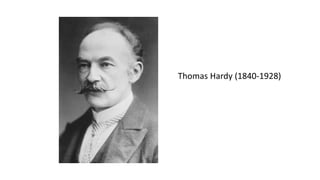
Thomas Hardy (1840-1928)
• Wessex Poems and Other Verses , 1898
• Collection of poems by Thomas Hardy
• Called the Wessex Poems
• Readers did not like the poems because Hardy was already an
established novelist by then
• Criticisms against his final novel “Jude the Obscure” affected
Hardy- (Hardy took it as ‘failure’)
• (Hardy was particularly unconventional to that time)
• these poems have a personal tone, and a romantic
mood/tone/setting
• Wessex is a fictional landscape; many of his novels are set in
Wessex.
• He has a sentimental attachment to this landscape
• In real, it is said to be Dorset, where Hardy was born
• Wessex Heights
• eight stanza poem
• AABB CCDD
• Has a certain Romanticist sentiment
• Wessex Heights- Wessex Hill
• the speaker says the only places that comforts him is the ‘outside’,
away from the town.
• He is standing on the Wessex Heights and now he can see the
world from the top.
• He is looking out over his own life (a top-down view)
• He contemplates his own life as a poet/creative person
• (he tries to see himself as a poet and hence being different/separate
from the rest)
• About people (the mass) who fail to understand
• His plight in the common everyday world of prudery/pretention/
artificiality/materialistic outlook

wessex.pptx

  • 1.
  • 2.
    • Wessex Poemsand Other Verses , 1898 • Collection of poems by Thomas Hardy • Called the Wessex Poems • Readers did not like the poems because Hardy was already an established novelist by then • Criticisms against his final novel “Jude the Obscure” affected Hardy- (Hardy took it as ‘failure’) • (Hardy was particularly unconventional to that time) • these poems have a personal tone, and a romantic mood/tone/setting • Wessex is a fictional landscape; many of his novels are set in Wessex. • He has a sentimental attachment to this landscape • In real, it is said to be Dorset, where Hardy was born
  • 3.
    • Wessex Heights •eight stanza poem • AABB CCDD • Has a certain Romanticist sentiment • Wessex Heights- Wessex Hill • the speaker says the only places that comforts him is the ‘outside’, away from the town. • He is standing on the Wessex Heights and now he can see the world from the top. • He is looking out over his own life (a top-down view) • He contemplates his own life as a poet/creative person • (he tries to see himself as a poet and hence being different/separate from the rest) • About people (the mass) who fail to understand • His plight in the common everyday world of prudery/pretention/ artificiality/materialistic outlook