Samuel Taylor Coleridge (1772-1834)
Submitted To: Sir Bilal Asmat
Submitted By: Muhammad Kashif
Introduction:
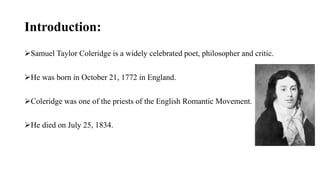
Samuel Taylor Coleridge is a widely celebrated poet, philosopher and critic.
He was born in October 21, 1772 in England.
Coleridge was one of the priests of the English Romantic Movement.
He died on July 25, 1834.
Siblings:
Samuel Taylor Coleridge was the youngest of the fourteen children of his parents.
His surviving siblings included seven brothers; John, William, James, George,
Edward, Luke, and Francis Coleridge and a sister named Ann Coleridge.
From his father’s first marriage, he had four sisters named Elizabeth, Mary,
Florella, and Sarah Coleridge.
Coleridge’s Meeting and Friendship with William Wordsworth:
Samuel Taylor Coleridge met William Wordsworth in 1797 in the Village of
Racedown in Dorsetshire.
Wordsworth’s friendship helped to ripen Coleridge’s poetic genius.
Coleridge’s alliance with Wordsworth and his sister resulted in the form of Lyrical
Ballads (1798).
In 1798, Coleridge, Wordsworth, and Dorothy went to Germany to learn German
and some of the philosophy and literature of that country.
Samuel Taylor Coleridge’s Famous Poems:
The poems of Samuel Taylor Coleridge can be divided into three groups:
 Romantic Poems
 Personal Poems
 Political Poems
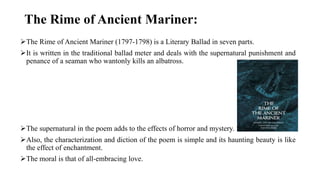
The Rime of Ancient Mariner:
The Rime of Ancient Mariner (1797-1798) is a Literary Ballad in seven parts.
It is written in the traditional ballad meter and deals with the supernatural punishment and
penance of a seaman who wantonly kills an albatross.
The supernatural in the poem adds to the effects of horror and mystery.
Also, the characterization and diction of the poem is simple and its haunting beauty is like
the effect of enchantment.
The moral is that of all-embracing love.
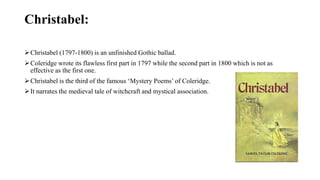
Christabel:
Christabel (1797-1800) is an unfinished Gothic ballad.
Coleridge wrote its flawless first part in 1797 while the second part in 1800 which is not as
effective as the first one.
Christabel is the third of the famous ‘Mystery Poems’ of Coleridge.
It narrates the medieval tale of witchcraft and mystical association.
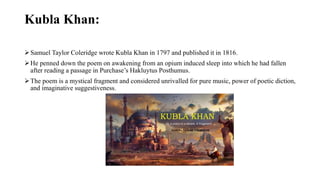
Kubla Khan:
Samuel Taylor Coleridge wrote Kubla Khan in 1797 and published it in 1816.
He penned down the poem on awakening from an opium induced sleep into which he had fallen
after reading a passage in Purchase’s Hakluytus Posthumus.
The poem is a mystical fragment and considered unrivalled for pure music, power of poetic diction,
and imaginative suggestiveness.
Frost at Midnight:
Coleridge wrote Frost at Midnight in 1798.
The poem is a quiet and extremely personal restatement of the enduring themes of early
English Romantic Movement; nature’s impact on the imagination.
Dejection: An Ode:
Dejection: An Ode (1802) is the poet’s dirge to his own imagination.
The poem is an agonized cry of one who feels he has lost his potent voice before he could create all
the symphonies, he was capable of creating.
Youth and Age:
In his poem Youth and Age (1823, Published in 1832), Coleridge presents a sharp contrast between
youth and old age.
The poem vividly explains the difference between these two stages of life.
Youth is like a budding flower, while old age is like the dawn.
France: An Ode
Coleridge wrote France: An Ode in 1793.
Evoked by Napoleon’s invasion of neutral Switzerland, Coleridge condemns the French as not
obedient to the moral law and no longer representing the true spirit of Liberty.
The Ode seems to mark the end of his impassioned defense of France, and the beginning of his
conservative, somewhat Burkite philosophy.
Religious Musings:
Coleridge wrote Religious Musings in 1794. It is a desultory poem suffering from a turgid style
and somewhat inconsistent thought.
It is, in fact, one of Coleridge’s first poems of critical merit and expresses his early feelings about
religion and politics.

Muhammad Kashif (S.T coleridge).pptx

  • 1.
    Samuel Taylor Coleridge(1772-1834) Submitted To: Sir Bilal Asmat Submitted By: Muhammad Kashif
  • 2.
    Introduction: Samuel Taylor Coleridgeis a widely celebrated poet, philosopher and critic. He was born in October 21, 1772 in England. Coleridge was one of the priests of the English Romantic Movement. He died on July 25, 1834.
  • 3.
    Siblings: Samuel Taylor Coleridgewas the youngest of the fourteen children of his parents. His surviving siblings included seven brothers; John, William, James, George, Edward, Luke, and Francis Coleridge and a sister named Ann Coleridge. From his father’s first marriage, he had four sisters named Elizabeth, Mary, Florella, and Sarah Coleridge.
  • 4.
    Coleridge’s Meeting andFriendship with William Wordsworth: Samuel Taylor Coleridge met William Wordsworth in 1797 in the Village of Racedown in Dorsetshire. Wordsworth’s friendship helped to ripen Coleridge’s poetic genius. Coleridge’s alliance with Wordsworth and his sister resulted in the form of Lyrical Ballads (1798). In 1798, Coleridge, Wordsworth, and Dorothy went to Germany to learn German and some of the philosophy and literature of that country.
  • 5.
    Samuel Taylor Coleridge’sFamous Poems: The poems of Samuel Taylor Coleridge can be divided into three groups:  Romantic Poems  Personal Poems  Political Poems
  • 6.
    The Rime ofAncient Mariner: The Rime of Ancient Mariner (1797-1798) is a Literary Ballad in seven parts. It is written in the traditional ballad meter and deals with the supernatural punishment and penance of a seaman who wantonly kills an albatross. The supernatural in the poem adds to the effects of horror and mystery. Also, the characterization and diction of the poem is simple and its haunting beauty is like the effect of enchantment. The moral is that of all-embracing love.
  • 7.
    Christabel: Christabel (1797-1800) isan unfinished Gothic ballad. Coleridge wrote its flawless first part in 1797 while the second part in 1800 which is not as effective as the first one. Christabel is the third of the famous ‘Mystery Poems’ of Coleridge. It narrates the medieval tale of witchcraft and mystical association.
  • 8.
    Kubla Khan: Samuel TaylorColeridge wrote Kubla Khan in 1797 and published it in 1816. He penned down the poem on awakening from an opium induced sleep into which he had fallen after reading a passage in Purchase’s Hakluytus Posthumus. The poem is a mystical fragment and considered unrivalled for pure music, power of poetic diction, and imaginative suggestiveness.
  • 9.
    Frost at Midnight: Coleridgewrote Frost at Midnight in 1798. The poem is a quiet and extremely personal restatement of the enduring themes of early English Romantic Movement; nature’s impact on the imagination.
  • 10.
    Dejection: An Ode: Dejection:An Ode (1802) is the poet’s dirge to his own imagination. The poem is an agonized cry of one who feels he has lost his potent voice before he could create all the symphonies, he was capable of creating.
  • 11.
    Youth and Age: Inhis poem Youth and Age (1823, Published in 1832), Coleridge presents a sharp contrast between youth and old age. The poem vividly explains the difference between these two stages of life. Youth is like a budding flower, while old age is like the dawn.
  • 12.
    France: An Ode Coleridgewrote France: An Ode in 1793. Evoked by Napoleon’s invasion of neutral Switzerland, Coleridge condemns the French as not obedient to the moral law and no longer representing the true spirit of Liberty. The Ode seems to mark the end of his impassioned defense of France, and the beginning of his conservative, somewhat Burkite philosophy.
  • 13.
    Religious Musings: Coleridge wroteReligious Musings in 1794. It is a desultory poem suffering from a turgid style and somewhat inconsistent thought. It is, in fact, one of Coleridge’s first poems of critical merit and expresses his early feelings about religion and politics.