PROJECT PROPOSAL ONCOMPARATIVE ANALYSIS OF WELL COMPLETION
MODELS IN NIGER DELTA WELLS USING PROSPER SOFTWARE
BY
PETER ANTHONY CHIDIEBERE
PTE/18/320
FACULTY OF ENGINEERING
PRESENTED TO
THE DEPARTMENT OF PETROLEUM ENGINEERING
2.
INTRODUCTION
This research isa Comparative Analysis of Well Completion Models in the Niger Delta Wells
using PROSPER Software
Wellbore completion is a critical part or component of an efficient producing oil and gas well
system.
From investigation of several wells used in the Niger Delta, there are five primary types or classification of
well completion methods used to produce oil and gas wells.
This implies that any other completion method is classified as secondary and actually a smart or technically
advanced combination of the primary completion.
3.
WHAT IS WELLCOMPLETION?
Well completion is defined as a single operation involving the installation
of production casing and equipment in order to bring the well into
production from one or more zones.
Concept on types of well completion
From investigation of several wells used in the Niger Delta, there are five primary
types or classification of well completion methods used to produce oil and gas wells.
This implies that any other completion method is classified as secondary and actually
a smart or technically advanced combination of the primary completion.
4.
*Open hole completion:Here, casing is set usually directly above the producing horizon prior to penetration of the zone.
In system analysis, the open hole is generally regarded with no pressure loss between the sand face and the well bore.
*Open perforation completion: This is the most common form of well completion used in the industry today. In this case,
production case pipe is set and cemented through the producing formation. Subsequently, the well is perforated to allow the
flow of fluids from the formation into the wellbore.
*Stable perforation completion: The model used to determine the effects of stable perforation completion is obtained by
modifying open perforation models to account for not very severe damage to the formation near the well bore. It is an
alternative for considering pressure drop through the completion.
*Collapsed perforation completion: This perforation is used when the damage caused to the boundary near the well bore
is severe. It is also an alternative method for determining pressure loss through a perforated well completion system.
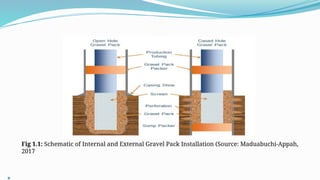
*Gravel pack completion: In many wells, the matrix cementing within the formation sand is insufficient to prevent sand
from being produced when well is exposed to a pressure drawdown. The problems encountered : restricted production,
erosion of equipment and sand disposal problems. This technique is used to predict completion effects through a gravel
pack is simply pressure loss due to linear flow through the gravel.
Types of well completion methods
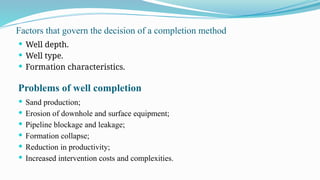
Factors that governthe decision of a completion method
Well depth.
Well type.
Formation characteristics.
Problems of well completion
Sand production;
Erosion of downhole and surface equipment;
Pipeline blockage and leakage;
Formation collapse;
Reduction in productivity;
Increased intervention costs and complexities.
7.
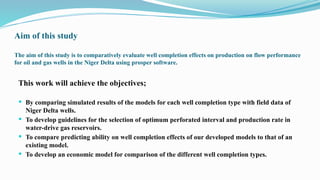
Aim of thisstudy
The aim of this study is to comparatively evaluate well completion effects on production on flow performance
for oil and gas wells in the Niger Delta using prosper software.
This work will achieve the objectives;
By comparing simulated results of the models for each well completion type with field data of
Niger Delta wells.
To develop guidelines for the selection of optimum perforated interval and production rate in
water-drive gas reservoirs.
To compare predicting ability on well completion effects of our developed models to that of an
existing model.
To develop an economic model for comparison of the different well completion types.
8.
Significant of thestudy
Reservoir management strategy
Completion design
Sand monitoring strategy
Design of surface facilities and pipelines
Field economics.
9.
LITERATURE REVIEW
Improvementof Oil Production: Case Study of Three Wells in
Niger Delta
Formation damage is a major problem experienced in the
operation and development of petroleum reservoir. Its occurrence,
occasioned with the release of particles, water, emulsions or
scales, hitherto impairs the hydrocarbon delivery/transport
system.
The production loss directly reflects the economic loss due to
formation damage. In the extreme, damage may cause the Well to
be uneconomic and be shut-in Usiayo and Ogiriki (2017).
10.
The Effect ofReservoir Pressure Drawdown on Well
Completion/Performance Efficiency
Using a database from Niger Delta, this study developed correlation of well
completion/production efficiency as functions of pressure drawdown and
sand control type to quantitatively evaluate the effect of pressure drawdown
on well performance.
Completion/performance efficiency declines exponentially with reservoir
pressure drawdown. Critical pressure draw-down for various sand control
types beyond which significant formation damage will occur are
recommended.
According to Isehunwa and Olarewaju (2010), Apart from external gravel-
pack (EGP) and milled casing under-reamed gravel-pack (MCUGP) wells
which can tolerate drawdown of ±400 psi, the critical drawdown for other
sand control types is ±250psi.
11.
Analytical Model forPredicting Sand Production in a Niger Delta Oil Field
The development of sanding predictive tools and effective management
strategies has received much attention in literature. However, most of the
published theoretical models have been validated with laboratory or data
obtained from petroleum provinces other than the Niger Delta, Isehunwa and
Farotade, 2010.
A simple analytical model is developed by adapting Vardoulakis method,
Vardoulakis (2006). The basic assumptions were:
1. Sand particles are spherical and submerged in a moving fluid.
2. Drag and buoyancy forces are predominantly acting on the sand particles.
3. During flow, sand production will cause the radius of a cylindrical cavity to
grow until equilibrium is attained.
4. Fluid flow can be described by Darcy’s law.
12.
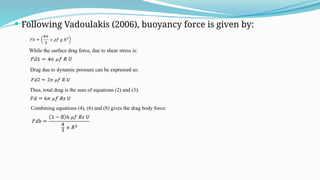
Following Vadoulakis(2006), buoyancy force is given by:
Drag due to dynamic pressure can be expressed as:
Thus, total drag is the sum of equations (2) and (3):
Combining equations (4), (6) and (8) gives the drag body force:
While the surface drag force, due to shear stress is:
13.
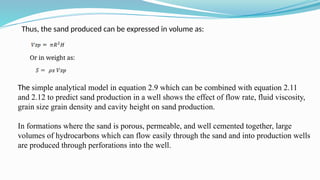
Thus, the sandproduced can be expressed in volume as:
Or in weight as:
The simple analytical model in equation 2.9 which can be combined with equation 2.11
and 2.12 to predict sand production in a well shows the effect of flow rate, fluid viscosity,
grain size grain density and cavity height on sand production.
In formations where the sand is porous, permeable, and well cemented together, large
volumes of hydrocarbons which can flow easily through the sand and into production wells
are produced through perforations into the well.
14.
REFERENCE
Amieibibama Joseph,Joseph Atubokiki Ajienka, Samuel Osita Onyeizugbe and Samuel Okorie, (July 2016); ‘The use of
well completion efficiency in the assessment of formation damage in initial well completion and work-over
operations’, Department of Petroleum & Gas Engineering, University of Port Harcourt, Nigeria.
Isehunwa, S.O., Ph.D. and Olanrewaju, O., M. Sc., ‘A Simple Analytical Model for Predicting Sand Production in a Niger
Delta Oil Field’, (2010); Department of Petroleum Engineering, University of Ibadan, Nigeria International Journal of
Engineering Science and Technology Vol. 2(9).
Nicholas Kume; Forster Uzoho; Victor Ogoke; Afolabi F. Abiodun, (September 2001): ‘Adding Value to Well
Completions via Effective Wellbore Cleanup: Smart Thinking, Big Rewards’, Paper presented at the SPE Annual
Technical Conference and Exhibition, New Orleans, Louisiana, Paper Number: SPE-71687-MS.
Uchendu Chinwe; Erasmus Nnanna; Obaro Okpokpor; Ibrahim Yahaya; Otutu Friday; Cardinal Agbonaye (September
2013): ‘Milestone in Production Optimization in the Niger Delta Using Intelligent Completions’; Paper presented at
the SPE Annual Technical Conference and Exhibition, New Orleans, Louisiana, USA, Paper Number: SPE-166158-MS.



![[IJET-V1I2P10] Authors :L. O. Osuman, A. Dosunmu , B .S. Odagme](https://cdn.slidesharecdn.com/ss_thumbnails/ijet-v1i2p10-150506100610-conversion-gate02-thumbnail.jpg?width=640&height=640&fit=bounds)


