Copyright © 2002 by Pearson Education, Inc., publishing as Longman Publishers. All rights reserved.
Chapter 1
Understanding Professional
Communication
Professional Communication:
Strategies for College and the Workplace
by Dan Jones & Karen Lane
Copyright © 2002 by Pearson Education, Inc., publishing as Longman Publishers. All rights reserved.
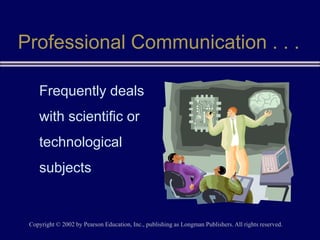
Professional Communication . . .
Frequently deals
with scientific or
technological
subjects
Copyright © 2002 by Pearson Education, Inc., publishing as Longman Publishers. All rights reserved.
Professional Communication
must . . .
• meet the information needs of the audience
• work with a specialized vocabulary
• create a helpful design
• provide illustrations whenever appropriate
Copyright © 2002 by Pearson Education, Inc., publishing as Longman Publishers. All rights reserved.
Workplace writing includes. . .
• correspondence (letters, memos, e-mail)
• notes
• manuals (instructions)
• proposals
• reports —Continued—
Copyright © 2002 by Pearson Education, Inc., publishing as Longman Publishers. All rights reserved.
Workplace writing includes. . .
• policies and procedures
• job descriptions
• performance evaluations
• promotional materials
(posters, brochures, flyers)
Professional Communication
fails . . .
when writers focus on what they want to
say rather than on what the readers
need to read or on what the listeners
need to hear.
Copyright © 2002 by Pearson Education, Inc., publishing as Longman Publishers. All rights reserved.
A Professional document that
ignores the audience . . .
• is poorly organized
• has inappropriate content
• does not allow readers to picture
themselves in the text
• lacks clarity
Copyright © 2002 by Pearson Education, Inc., publishing as Longman Publishers. All rights reserved.
Ineffective Professional
Communication . . .
• wastes time
• increases expenses
• causes missed deadlines
• decreases productivity
—Continued—
Copyright © 2002 by Pearson Education, Inc., publishing as Longman Publishers. All rights reserved.
Ineffective Professional
Communication . . .
• affects
promotions
• affects morale
• damages
reputations
Copyright © 2002 by Pearson Education, Inc., publishing as Longman Publishers. All rights reserved.
Effective Professional
Communication . . .
• saves time
• saves money
• achieves the
purpose
• enhances your
career

Chapter 1 Understanding Professional Communication.ppt

  • 1.
    Copyright © 2002by Pearson Education, Inc., publishing as Longman Publishers. All rights reserved. Chapter 1 Understanding Professional Communication Professional Communication: Strategies for College and the Workplace by Dan Jones & Karen Lane
  • 2.
    Copyright © 2002by Pearson Education, Inc., publishing as Longman Publishers. All rights reserved. Professional Communication . . . Frequently deals with scientific or technological subjects
  • 3.
    Copyright © 2002by Pearson Education, Inc., publishing as Longman Publishers. All rights reserved. Professional Communication must . . . • meet the information needs of the audience • work with a specialized vocabulary • create a helpful design • provide illustrations whenever appropriate
  • 4.
    Copyright © 2002by Pearson Education, Inc., publishing as Longman Publishers. All rights reserved. Workplace writing includes. . . • correspondence (letters, memos, e-mail) • notes • manuals (instructions) • proposals • reports —Continued—
  • 5.
    Copyright © 2002by Pearson Education, Inc., publishing as Longman Publishers. All rights reserved. Workplace writing includes. . . • policies and procedures • job descriptions • performance evaluations • promotional materials (posters, brochures, flyers)
  • 6.
    Professional Communication fails .. . when writers focus on what they want to say rather than on what the readers need to read or on what the listeners need to hear.
  • 7.
    Copyright © 2002by Pearson Education, Inc., publishing as Longman Publishers. All rights reserved. A Professional document that ignores the audience . . . • is poorly organized • has inappropriate content • does not allow readers to picture themselves in the text • lacks clarity
  • 8.
    Copyright © 2002by Pearson Education, Inc., publishing as Longman Publishers. All rights reserved. Ineffective Professional Communication . . . • wastes time • increases expenses • causes missed deadlines • decreases productivity —Continued—
  • 9.
    Copyright © 2002by Pearson Education, Inc., publishing as Longman Publishers. All rights reserved. Ineffective Professional Communication . . . • affects promotions • affects morale • damages reputations
  • 10.
    Copyright © 2002by Pearson Education, Inc., publishing as Longman Publishers. All rights reserved. Effective Professional Communication . . . • saves time • saves money • achieves the purpose • enhances your career