The Global
Competitiveness Report
2011–2012


Klaus Schwab, World Economic Forum


                          The Global Competitiveness Report 2011-2012 © 2011 World Economic Forum
World Economic Forum
Geneva, Switzerland 2011


                                                                                      Professor Klaus Schwab
                                                                                      World Economic Forum
                                                                                      Editor


The Global
Competitiveness Report
2011–2012


Professor Xavier Sala-i-Martin
Columbia University
Chief Advisor of the Centre for Global Competitiveness and Performance


                       The Global Competitiveness Report 2011-2012 © 2011 World Economic Forum
The Global Competitiveness Report 2011–                                   World Economic Forum
2012 is published by the World Economic                                   Geneva
Forum within the framework of the Centre for
Global Competitiveness and Performance                                    Copyright © 2011
                                                                          by the World Economic Forum

Professor Klaus Schwab                                                    All rights reserved. No part of this publication
Executive Chairman                                                        may be reproduced, stored in a retrieval system,
                                                                          or transmitted, in any form or by any means,
Professor Xavier Sala-i-Martin
                                                                          electronic, mechanical, photocopying, or other-
                                                                                                                     other
Chief Advisor of the Centre for Global
                                                                          wise without the prior permission of the World
Competitiveness and Performance
                                                                          Economic Forum.

Robert Greenhill
                                                                          ISBN-13: 978-92-95044-74-6
Chief Business Officer
                                                                          ISBN-10: 92-95044-74-6

                                                                          This book is printed on paper suitable for
CENTRE FOR GLOBAL COMPETITIVENESS AND PERFORMANCE
                                                                          recycling and made from fully managed and
Jennifer Blanke, Senior Director, Lead                                    sustained forest sources.
Economist, Head of the Centre for Global
Competitiveness and Performance                                           Printed and bound in Switzerland by SRO-Kundig.
Beñat Bilbao-Osorio, Associate Director,
Economist
Roberto Crotti, Junior Quantitative
Economist
Margareta Drzeniek Hanouz, Director,
Senior Economist
Brindusa Fidanza, Associate Director,
Environmental Initiatives
Thierry Geiger, Associate Director,
Economist
Ciara Browne, Associate Director
Pearl Samandari, Community Manager
Satu Kauhanen, Coordinator


We thank Hope Steele for her superb edit-
ing work and Neil Weinberg for his excellent
graphic design and layout. We are grateful to
Djemila Zouyene for her invaluable research
assistance.

The terms country and nation as used in this
report do not in all cases refer to a territorial
entity that is a state as understood by inter-
                                          inter
national law and practice. The terms cover
well-defined, geographically self-contained
economic areas that may not be states but
for which statistical data are maintained on a
separate and independent basis.


                                       The Global Competitiveness Report 2011-2012 © 2011 World Economic Forum
Contents


Partner Institutes                                                 v    Part 2: Data Presentation                                                                   85

Preface                                                          xiii   2.1 Country/Economy Profiles                                                                87
by Klaus Schwab and Robert Greenhill                                    How to Read the Country/Economy Profiles ................................89
                                                                        List of Countries/Economies .........................................................91
                                                                        Country/Economy Profiles.............................................................92


Part I: Measuring Competitiveness                                  1    2.2 Data Tables                                                                           377
                                                                        How to Read the Data Tables .....................................................379
                                                                        Index of Data Tables ...................................................................381
1.1 The Global Competitiveness Index 2011–2012:                    3
                                                                        Data Tables..................................................................................383
Setting the Foundations for Strong Productivity
by Xavier Sala-i-Martin, Beñat Bilbao-Osorio, Jennifer Blanke,
Margareta Drzeniek Hanouz, and Thierry Geiger                           Technical Notes and Sources                                                               521


1.2 The Long-Term View: Developing a Framework for                51    About the Authors                                                                         525
Assessing Sustainable Competitiveness
by Jennifer Blanke, Roberto Crotti, Margareta Drzeniek Hanouz,
Brindusa Fidanza, and Thierry Geiger                                    Acknowledgments                                                                           527


1.3 The Executive Opinion Survey: An Indispensable                75
Tool in the Assessment of National Competitiveness
by Ciara Browne and Thierry Geiger


                               The Global Competitiveness Report 2011-2012 © 2011 World Economic Forum
The Global Competitiveness Report 2011-2012 © 2011 World Economic Forum
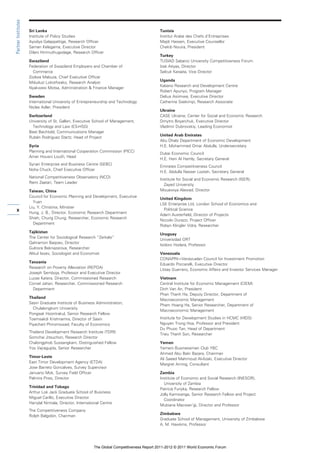
Partner Institutes
Partner Institutes


The World Economic Forum’s Centre for Global                           Bangladesh
                                                                       Centre for Policy Dialogue (CPD)
Competitiveness and Performance is pleased to
                                                                       Mustafizur Rahman, Executive Director
acknowledge and thank the following organizations                      Khondaker Golam Moazzem, Senior Research Fellow
as its valued Partner Institutes, without which the                    Kishore Kumer Basak, Research Associate
realization of The Global Competitiveness Report 2011–                 Barbados
2012 would not have been feasible:                                     Arthur Lewis Institute for Social and Economic Studies,
                                                                         University of West Indies (UWI)
Albania                                                                Andrew Downes, Director
Institute for Contemporary Studies (ISB)
Artan Hoxha, President                                                 Belgium
Elira Jorgoni, Senior Expert and Project Manager                       Vlerick Leuven Gent Management School
Denalada Kuzumi, Researcher                                            Priscilla Boairdi, Associate, Competence Centre
                                                                         Entrepreneurship, Governance and Strategy
Algeria                                                                Wim Moesen, Professor
Centre de Recherche en Economie Appliquée pour le                      Leo Sleuwaegen, Professor, Competence Centre
  Développement (CREAD)                                                  Entrepreneurship, Governance and Strategy
Youcef Benabdallah, Assistant Professor
Yassine Ferfera, Director                                              Benin
                                                                       CAPOD—Conception et Analyse de Politiques de
Angola                                                                   Développement
MITC Investimentos                                                     Epiphane Adjovi, Director                                      v
Estefania Jover, Senior Adviser                                        Maria-Odile Attanasso, Deputy Coordinator
South Africa-Angola Chamber of Commerce (SA-ACC)                       Fructueux Deguenonvo, Researcher
Roger Ballard-Tremeer, Hon Chief Executive
                                                                       Bosnia and Herzegovina
Argentina                                                              MIT Center, School of Economics and Business in Sarajevo,
IAE—Universidad Austral                                                  University of Sarajevo
Cristian Alonso, Project Manager                                       Zlatko Lagumdzija, Professor
Eduardo Luis Fracchia, Professor                                       Zeljko Sain, Executive Director
                                                                       Jasmina Selimovic, Assistant Director
Armenia
Economy and Values Research Center                                     Botswana
Manuk Hergnyan, Chairman                                               Botswana National Productivity Centre
Sevak Hovhannisyan, Board Member and Senior Associate                  Letsogile Batsetswe, Research Consultant and Statistician
Gohar Malumyan, Research Associate                                     Parmod Chandna, Acting Executive Director
                                                                       Phumzile Thobokwe, Manager, Information and Research
Australia                                                                Services Department
Australian Industry Group
Carola Lehmer, Senior Research Coordinator                             Brazil
Heather Ridout, Chief Executive                                        Fundação Dom Cabral
Nikki Wilson, Administrative Assistant                                 Marina Araújo, Economist and Researcher, The
                                                                         Competitiveness and Innovation Center
Austria                                                                Carlos Arruda, Executive Director, International Advisory
Austrian Institute of Economic Research (WIFO)                           Council and Professor, The Competitiveness and
Karl Aiginger, Director                                                  Innovation Center
Gerhard Schwarz, Coordinator, Survey Department                        Fabiana Madsen, Economist and Researcher, The
Azerbaijan                                                               Competitiveness and Innovation Center
Azerbaijan Marketing Society                                           Movimento Brasil Competitivo (MBC)
Fuad Aliyev, Project Manager                                           Erik Camarano, Director President
Ashraf Hajiyev, Consultant                                             Nikelma Moura, Communications Assistant
                                                                       Tatiana Ribeiro, Project Coordinator
Bahrain
Bahrain Competitiveness Council, Bahrain Economic                      Brunei Darussalam
  Development Board                                                    Ministry of Industry and Primary Resources
Nada Azmi, Manager, Economic Planning and Development                  Pehin Dato Yahya Bakar, Minister
Mohammed bin Essa Al-Khalifa, Chief Executive                          Dato Dr Amin Abdullah, Permanent Secretary
Maryam Matter, Coordinator, Economic Planning and
  Development                                                          Bulgaria
                                                                       Center for Economic Development
                                                                       Anelia Damianova, Senior Expert


                               The Global Competitiveness Report 2011-2012 © 2011 World Economic Forum
Partner Institutes

                     Burkina Faso                                                           Croatia
                     lnstitut Supérieure des Sciences de la Population (ISSP),              National Competitiveness Council
                       University of Ouagadougou                                            Jadranka Gable, Project Administrator
                     Samuel Kabore, Economist and Head of Development                       Kresimir Jurlin, Research Associate
                       Strategy and Population Research                                     Mira Lenardic, Senior Advisor

                     Burundi                                                                Cyprus
                     University Research Centre for Economic and Social                     Cyprus College Research Center
                       Development (CURDES), National University of Burundi                 Bambos Papageorgiou, Head of Socioeconomic and
                     Banderembako Deo, Director                                               Academic Research
                     Gilbert Niyongabo, Dean, Faculty of Economics &
                                                                                            cdbbank—The Cyprus Development Bank
                       Management
                                                                                            Maria Markidou-Georgiadou, Manager, International Business
                     Cambodia                                                                 Banking
                     Economic Institute of Cambodia
                                                                                            Czech Republic
                     Sok Hach, President
                                                                                            CMC Graduate School of Business
                     Seiha Neou, Research Manager
                                                                                            Tomas Janca, Executive Director
                     Sokheng Sam, Researcher
                                                                                            Denmark
                     Cameroon
                                                                                            Innoption EMEA ApS
                     Comité de Compétitivité (Competitiveness Committee)
                                                                                            Carsten Snedker, Managing Partner
                     Lucien Sanzouango, Permanent Secretary
                                                                                            Ecuador
                     Canada
                                                                                            ESPAE Graduate School of Management, Escuela Superior
                     The Conference Board of Canada
                                                                                               Politécnica del Litoral (ESPOL)
                     Michael R. Bloom, Vice-President, Organizational
                                                                                            Elizabeth Arteaga, Project Assistant
                       Effectiveness & Learning
                                                                                            Virginia Lasio, Director
                     Anne Golden, President and Chief Executive Officer
                                                                                            Sara Wong, Professor
                     P. Derek Hughes, Senior Research Associate
                                                                                            Egypt
                     Cape Verde
                                                                                            The Egyptian Center for Economic Studies
                     INOVE RESEARCH—Investigação e Desenvolvimento, Lda
                                                                                            Iman Al-Ayouty, Senior Economist
                     Sara Mendes, Senior Researcher
                                                                                            Omneia Helmy, Deputy Director of Research and Lead
                     Júlio Delgado, Partner and Senior Researcher
                                                                                              Economist
                     Frantz Tavares, Partner and Chief Executive Officer
                                                                                            Magda Kandil, Executive Director and Director of Research
vi                   Chad
                                                                                            Estonia
                     Groupe de Recherches Alternatives et de Monitoring du
                                                                                            Estonian Institute of Economic Research
                       Projet Pétrole-Tchad-Cameroun (GRAMP-TC)
                                                                                            Evelin Ahermaa, Head of Economic Research Sector
                     Antoine Doudjidingao, Researcher
                                                                                            Marje Josing, Director
                     Gilbert Maoundonodji, Director
                     Celine Nénodji Mbaipeur, Programme Officer                             Estonian Development Fund
                                                                                            Kitty Kubo, Head of Foresight
                     Chile                                                                  Ott Pärna, Chief Executive Officer
                     Universidad Adolfo Ibáñez
                     Fernando Larrain Aninat, Director of the Master in                     Ethiopia
                       Management and Public Policy, School of Government                   African Institute of Management, Development and
                     Camila Chadwick, Project Coordinator                                     Governance
                     Leonidas Montes, Dean, School of Government                            Tegegne Teka, General Manager

                     China                                                                  Finland
                     Institute of Economic System and Management                            ETLA—The Research Institute of the Finnish Economy
                     National Development and Reform Commission                             Petri Rouvinen, Research Director
                     Zhou Haichun, Deputy Director and Professor                            Markku Kotilainen, Research Director
                     Chen Wei, Research Fellow                                              Pekka Ylä-Anttila, Managing Director
                     Dong Ying, Professor
                                                                                            France
                     China Center for Economic Statistics Research,                         HEC School of Management, Paris
                       Tianjin University of Finance and Economics                          Bertrand Moingeon, Professor and Deputy Dean
                     Lu Dong, Professor                                                     Bernard Ramanantsoa, Professor and Dean
                     Hongye Xiao, Professor
                                                                                            Gambia, The
                     Bojuan Zhao, Professor
                                                                                            Gambia Economic and Social Development Research Institute
                     Huazhang Zheng, Associate Professor
                                                                                             (GESDRI)
                     Colombia                                                               Makaireh A. Njie, Director
                     National Planning Department
                                                                                            Georgia
                     Alvaro Edgar Balcazar, Entrepreneurial Development Director
                                                                                            Business Initiative for Reforms in Georgia
                     Hernando José Gómez, General Director
                                                                                            Tamara Janashia, Executive Director
                     Nelson Fabián Villareal Rincón, Advisor
                                                                                            Giga Makharadze, Founding Member of the Board of
                     Colombian Council of Competitiveness                                     Directors
                     Rosario Córdoba, President                                             Mamuka Tsereteli, Founding Member of the Board of
                                                                                              Directors
                     Côte d’Ivoire
                     Chambre de Commerce et d’Industrie de Côte d’Ivoire
                     Jean-Louis Billon, President
                     Jean-Louis Giacometti, Technical Advisor to the President
                     Mamadou Sarr, Director General


                                                         The Global Competitiveness Report 2011-2012 © 2011 World Economic Forum
Partner Institutes
Germany                                                               Ireland
IW Consult GmbH, Cologne Institute for Economic Research              Competitiveness Survey Group, Department of Economics,
Adriana Sonia Neligan, Head of Department                                University College Cork
                                                                      Eleanor Doyle, Professor, Department of Economics
WHU—Otto Beisheim School of Management, Vallendar
                                                                      Niall O’Sullivan
Ralf Fendel, Professor of Monetary Economics
                                                                      Bernadette Power
Michael Frenkel, Professor, Chair of Macroeconomics and
  International Economics                                             National Competitiveness Council
                                                                      Adrian Devitt, Manager
Ghana
                                                                      Michelle Nic Gearailt, Assistant Economist
Association of Ghana Industries (AGI)
Patricia Djorbuah, Projects Officer                                   Israel
Cletus Kosiba, Executive Director                                     Manufacturers’ Association of Israel (MAI)
Nana Owusu-Afari, President                                           Shraga Brosh, President
                                                                      Dan Catarivas, Director
Greece
                                                                      Amir Hayek, Managing Director
SEV Hellenic Federation of Enterprises
Michael Mitsopoulos, Coordinator, Research and Analysis               Italy
Thanasis Printsipas, Economist, Research and Analysis                 SDA Bocconi School of Management
                                                                      Secchi Carlo, Full Professor of Economic Policy, Bocconi
Guatemala
                                                                         University
FUNDESA
                                                                      Paola Dubini, Associate Professor, Bocconi University
Edgar A. Heinemann, President of the Board of Directors
                                                                      Francesco A. Saviozzi, SDA Assistant Professor,
Pablo Schneider, Economic Director
                                                                         Strategic and Entrepreneurial Management Department
Juan Carlos Zapata, General Manager
                                                                      Jamaica
Guyana
                                                                      Mona School of Business (MSB), The University of the West
Institute of Development Studies, University of Guyana
                                                                        Indies
Karen Pratt, Research Associate
                                                                      Patricia Douce, Project Administrator
Clive Thomas, Director
                                                                      Evan Duggan, Executive Director and Professor
Haiti                                                                 William Lawrence, Director, Professional Services Unit
Private Sector Economic Forum
                                                                      Japan
Edouard Baussan, Deputy Coordinator
                                                                      Keio University in cooperation with Keizai Doyukai Keizai
Reginald Boulos, Coordinator
                                                                        (Japan Association of Corporate Executives)
Bernard Craan, Secretary General
                                                                      Yoko Ishikura, Professor,Graduate School of Media Design,
                                                                        Keio University
                                                                                                                                         vii
Hong Kong SAR
Hong Kong General Chamber of Commerce                                 Kiyohiko Ito, Managing Director, Keizai Doyukai
David O’Rear, Chief Economist                                         Heizo Takenaka, Director, Global Security Research Institute,
                                                                        Keio University
Federation of Hong Kong Industries
Alexandra Poon, Director                                              Jordan
                                                                      Ministry of Planning & International Cooperation
The Chinese General Chamber of Commerce
                                                                      Jordan National Competitiveness Team
Hungary                                                               Mukhallad Omari, Director of Policies and Studies
KOPINT-TÁRKI Economic Research Ltd.                                     Department
Peter Vakhal,, Project Manager                                        Aktham Al-Zubi, Senior Researcher
Éva Palócz, Chief Executive Officer                                   Kawther Al-Zou’bi, Head of Competitiveness Division

Iceland                                                               Kazakhstan
Innovation Center Iceland                                             JSC “National Analytical Centre of the Government of the
Karl Fridriksson, Managing Director of Human Resources and              Republic of Kazakhstan”
  Marketing                                                           Takhir Aslyaliyev, Project Manager
Ardis Armannsdottir, Marketing Manager                                Ayana Manasova, Chairperson
Thorsteinn I. Sigfusson, Director                                     Alikhan Yerzhanov, Expert Analyst

India                                                                 Kenya
Confederation of Indian Industry (CII)                                Institute for Development Studies, University of Nairobi
Chandrajit Banerjee, Director General                                 Mohamud Jama, Director and Associate Professor
Marut Sengupta, Deputy Director General                               Paul Kamau, Senior Research Fellow
Gantakolla Srivastava, Head, Financial Services                       Dorothy McCormick, Research Professor

Indonesia                                                             Korea, Republic of
Center for Industry, SME & Business Competition Studies,              College of Business School, Korea Advanced Institute of
  University of Trisakti                                                Science and Technology KAIST
Tulus Tambunan, Professor and Director                                Ingoo Han, Senior Associate Dean and Professor
                                                                      Byungtae Lee, Acting Dean
Iran, Islamic Republic of
                                                                      Professor Kayla Jisoo Lee, Manager, Exchange Programme
The Centre for Economic Studies and Surveys (CESS), Iran
   Chamber of Commerce, Industries and Mines                          Korea Development Institute
Hammed Roohani, Director                                              Joohee Cho, Senior Research Associate
                                                                      Yongsoo Lee, Head, Policy Survey Unit


                              The Global Competitiveness Report 2011-2012 © 2011 World Economic Forum
Partner Institutes

                      Kuwait                                                                   Mauritania
                      Kuwait National Competitiveness Committee                                Centre d’Information Mauritanien pour le Développement
                      Adel Al-Husainan, Committee Member                                         Economique et Technique (CIMDET/CCIAM)
                      Fahed Al-Rashed, Committee Chairman                                      Khira Mint Cheikhnani, Director
                      Sayer Al-Sayer, Committee Member                                         Lô Abdoul, Consultant and Analyst
                                                                                               Habib Sy, Analyst
                      Kyrgyz Republic
                      Economic Policy Institute “Bishkek Consensus”                            Mauritius
                      Lola Abduhametova, Program Coordinator                                   Joint Economic Council of Mauritius
                      Marat Tazabekov, Chairman                                                Raj Makoond, Director

                      Latvia                                                                   Board of Investment
                      Institute of Economics, Latvian Academy of Sciences                      Kevin Bessondyal, Assistant Director, Planning and Policy
                      Helma Jirgena, Director                                                  Dev Chamroo, Director, Planning and Policy
                      Irina Curkina, Researcher                                                Raju Jaddoo, Managing Director

                      Lebanon                                                                  Mexico
                      Bader Young Entrepreneurs Program                                        Center for Intellectual Capital and Competitiveness
                      Antoine Abou-Samra, Managing Director                                    Erika Ruiz Manzur, Executive Director
                      Hiba Zunji, Assistant                                                    René Villarreal Arrambide, President and Chief Executive
                                                                                                 Officer
                      Lesotho                                                                  Jesús Zurita González, General Director
                      Private Sector Foundation of Lesotho
                                                                                               Instituto Mexicano para la Competitividad (IMCO)
                      O.S.M. Moosa, Chaiperson
                                                                                               Priscila Garcia, Researcher
                      Tiisetso Sekhonyana, Researcher
                                                                                               Manuel Molano, Deputy General Director
                      Lindiwe Sephomolo, Chief Executive Officer
                                                                                               Juan E. Pardinas, General Director
                      Lithuania
                                                                                               Ministry of the Economy
                      Statistics Lithuania
                                .     .                                                        Jose Antonio Torre, Undersecretary for Competitiveness and
                      Vilija Lapeniene, Director General
                                                                                                 Standardization
                      Gediminas Samuolis, Head, Knowledge Economy and Special
                                                                                               Enrique Perret Erhard, Technical Secretary for
                         Surveys Statistics Division
                                    .                                                            Competitiveness
                      Ona Grigiene, Deputy Head, Knowledge Economy and
                                                                                               Narciso Suarez, Research Director, Secretary for
                         Special Surveys Statistics Division
                                                                                                 Competitiveness
                      Luxembourg
                                                                                               Moldova
viii                  Chamber of Commerce of the Grand Duchy of Luxembourg
                                                                                               Academy of Economic Studies of Moldova (AESM)
                      François-Xavier Borsi, Attaché, Economic Department
                                                                                               Grigore Belostecinic, Rector
                      Carlo Thelen, Chief Economist, Member of the Managing
                        Board                                                                  Centre for Economic Research (CER)
                      Christel Chatelain, Attachée, Economic Department                        Corneliu Gutu, Director

                      Macedonia, FYR                                                           Mongolia
                      National Entrepreneurship and Competitiveness Council                    Open Society Forum (OSF)
                        (NECC)                                                                 Munkhsoyol Baatarjav, Manager of Economic Policy
                      Dejan Janevski, Project Coordinator                                      Erdenejargal Perenlei, Executive Director
                      Zoran Stavreski, President of the Managing Board
                                                                                               Montenegro
                      Saso Trajkoski, Executive Director
                                                                                               Institute for Strategic Studies and Prognoses (ISSP)
                      Madagascar                                                               Maja Drakic, Project Manager
                      Centre of Economic Studies, University of Antananarivo                   Petar Ivanovic, Chief Executive Officer
                      Ravelomanana Mamy Raoul, Director                                        Veselin Vukotic, President
                      Razato Rarijaona Simon, Executive Secretary
                                                                                               Morocco
                      Malawi                                                                   Université Hassan II, LASAARE
                      Malawi Confederation of Chambers of Commerce and                         Fouzi Mourji, Professor of Economics
                        Industry                                                               General Confederation of Moroccan Entreprise (CGEM)
                      Hope Chavula, Public Private Dialogue Manager                            Mounir Ferram, Delegate Director
                      Chancellor L. Kaferapanjira, Chief Executive Officer
                                                                                               Mozambique
                      Malaysia                                                                 EconPolicy Research Group, Lda.
                      Institute of Strategic and International Studies (ISIS)                  Peter Coughlin, Director
                      Mahani Zainal Abidin, Chief Executive                                    Donaldo Miguel Soares, Researcher
                      Steven C.M. Wong, Senior Director, Economics                             Ema Marta Soares, Assistant
                      Malaysia Productivity Corporation (MPC)
                                                                                               Namibia
                      Mohd Razali Hussain, Director General
                                                                                               Institute for Public Policy Research (IPPR)
                      Lee Saw Hoon, Senior Director
                                                                                               Graham Hopwood, Executive Director
                      Mali
                                                                                               Nepal
                      Groupe de Recherche en Economie Appliquée et Théorique
                                                                                               Centre for Economic Development and Administration
                        (GREAT)
                                                                                                 (CEDA)
                      Massa Coulibaly, Coordinator
                                                                                               Ramesh Chandra Chitrakar, Professor and Country
                      Malta                                                                      Coordinator
                      Competitive Malta—Foundation for National Competitiveness                Bharat Pokharel, Project Director and Executive Director
                      Margrith Lutschg-Emmenegger, Vice President                              Mahendra Raj Joshi, Member
                      Adrian Said, Chief Coordinator
                      Caroline Sciortino, Research Coordinator


                                                            The Global Competitiveness Report 2011-2012 © 2011 World Economic Forum
Partner Institutes
Netherlands                                                              Puerto Rico
INSCOPE: Research for Innovation, Erasmus University                     Puerto Rico 2000, Inc.
  Rotterdam                                                              Suzette M. Jimenez, President
Frans A. J. Van den Bosch, Professor                                     Francisco Montalvo Fiol, Project Coordinator
Henk W. Volberda, Director and Professor
                                                                         Qatar
New Zealand                                                              Qatari Businessmen Association (QBA)
Business New Zealand                                                     Issa Abdul Salam Abu Issa, Secretary-General
Phil O’Reilly, Chief Executive                                           Sarah Abdallah, Deputy General Manager
The New Zealand Institute                                                Romania
Catherine Harland, Project Leader                                        Group of Applied Economics (GEA)
Rick Boven, Director                                                     Liviu Voinea, Executive Director
                                                                         Irina Zgreaban, Program Coordinator
Nigeria
Nigerian Economic Summit Group (NESG)                                    Russian Federation
Frank Nweke Jr., Director General                                        Bauman Innovation & Eurasia Competitiveness Institute
Chris Okpoko, Associate Director, Research                               Katerina Marandi, Programme Manager
Foluso Phillips, Chairman                                                Alexey Prazdnichnykh, Principal and Managing Director
Norway                                                                   Stockholm School of Economics, Russia
BI Norwegian School of Management                                        Igor Dukeov, Area Principal
Eskil Goldeng, Researcher                                                Carl F. Fey, Associate Dean of Research
Torger Reve, Professor
                                                                         Rwanda
Oman                                                                     Private Sector Federation
The International Research Foundation                                    Roger Munyampenda, Chief Executive Officer
Salem Ben Nasser Al-Ismaily, Chairman                                    Vincent S. Safari, Director, Trade and Policy Advocacy
Public Authority for Investment Promotion and Export                     Saudi Arabia
  Development (PAIPED)                                                   National Competitiveness Center (NCC)
Mehdi Ali Juma, Expert for Economic Research                             Awwad Al-Awwad, President
                                                                         Khaldon Mahasen, Vice President
Pakistan
Competitiveness Support Fund                                             Senegal
Maryam Jawaid, Communication Specialist                                  Centre de Recherches Economiques Appliquées (CREA),
Imran Khan, Economist                                                    University of Dakar
Shahab Khawaja, Chief Executive Officer
                                                                                                                                     ix
                                                                         Diop Ibrahima Thione, Director
Paraguay                                                                 Serbia
Centro de Análisis y Difusión de Economia Paraguaya                      Foundation for the Advancement of Economics (FREN)
  (CADEP)                                                                Mihail Arandarenko, Chairman of the Board of Directors
Dionisio Borda, Research Member                                          Katarina Bojie, Project Coordinator
Fernando Masi, Director                                                  Bojan Ristic, Researcher
María Belén Servín, Research Member
                                                                         Singapore
Peru                                                                     Economic Development Board
Centro de Desarrollo Industrial (CDI), Sociedad Nacional                 Angeline Poh, Director Planning
  de Industrias                                                          Cheng Wai San, Head, Research & Statistics Unit
Néstor Asto, Project Director
Luis Tenorio, Executive Director                                         Slovak Republic
                                                                         Business Alliance of Slovakia (PAS)
Philippines                                                              Robert Kicina, Executive Director
Makati Business Club (MBC)
Marc P. Opulencia, Deputy Director                                       Slovenia
Michael B. Mundo, Chief Economist                                        Institute for Economic Research
Peter Angelo V. Perfecto, Executive Director                             Sonja Uršic, Senior Researcher
                                                                         Peter Stanovnik, Professor
In cooperation with the Management Association of
  the Philippines (MAP)                                                  University of Ljubljana, Faculty of Economics
Arnold P. Salvador, Executive Director                                   Mateja Drnovšek, Professor
                                                                         Aleš Vahcic, Professor
Poland
Economic Institute, National Bank of Poland                              South Africa
Jarosław T. Jakubik, Deputy Director                                     Business Leadership South Africa
Piotr Boguszewski, Advisor                                               Friede Dowie, Director
                                                                         Michael Spicer, Chief Executive Officer
Portugal
                                                                         Business Unity South Africa
PROFORUM, Associação para o Desenvolvimento da
                                                                         Coenraad Bezuidenhout, Executive Director for Economic
   Engenharia
                                                                           Policy
Ilídio António de Ayala Serôdio, Vice President of the Board
                                                                         Jerry Vilakazi, Chief Executive Officer
   of Directors
Fórum de Administradores de Empresas (FAE)                               Spain
Paulo Bandeira, General Director                                         IESE Business School, International Center for
Pedro do Carmo Costa, Member of the Board of Directors                     Competitiveness
Esmeralda Dourado, President of the Board of Directors                   María Luisa Blázquez, Research Associate
                                                                         Enrique de Diego, Research Assistant
                                                                         Antoni Subirà, Professor


                                 The Global Competitiveness Report 2011-2012 © 2011 World Economic Forum
Partner Institutes

                     Sri Lanka                                                               Tunisia
                     Institute of Policy Studies                                             Institut Arabe des Chefs d’Entreprises
                     Ayodya Galappattige, Research Officer                                   Majdi Hassen, Executive Counsellor
                     Saman Kelegama, Executive Director                                      Chekib Nouira, President
                     Dilani Hirimuthugodage, Research Officer
                                                                                             Turkey
                     Swaziland                                                               TUSIAD Sabanci University Competitiveness Forum
                     Federation of Swaziland Employers and Chamber of                        Izak Atiyas, Director
                       Commerce                                                              Selcuk Karaata, Vice Director
                     Zodwa Mabuza, Chief Executive Officer
                                                                                             Uganda
                     Mduduzi Lokotfwako, Research Analyst
                                                                                             Kabano Research and Development Centre
                     Nyakwesi Motsa, Administration & Finance Manager
                                                                                             Robert Apunyo, Program Manager
                     Sweden                                                                  Delius Asiimwe, Executive Director
                     International University of Entrepreneurship and Technology             Catherine Ssekimpi, Research Associate
                     Niclas Adler, President
                                                                                             Ukraine
                     Switzerland                                                             CASE Ukraine, Center for Social and Economic Research
                     University of St. Gallen, Executive School of Management,               Dmytro Boyarchuk, Executive Director
                       Technology and Law (ES-HSG)                                           Vladimir Dubrovskiy, Leading Economist
                     Beat Bechtold, Communications Manager
                                                                                             United Arab Emirates
                     Rubén Rodriguez Startz, Head of Project
                                                                                             Abu Dhabi Department of Economic Development
                     Syria                                                                   H.E. Mohammed Omar Abdulla, Undersecretary
                     Planning and International Cooperation Commission (PICC)
                                                                                             Dubai Economic Council
                     Amer Housni Loutfi, Head
                                                                                             H.E. Hani Al Hamly, Secretary General
                     Syrian Enterprise and Business Centre (SEBC)
                                                                                             Emirates Competitiveness Council
                     Noha Chuck, Chief Executive Officer
                                                                                             H.E. Abdulla Nasser Lootah, Secretary General
                     National Competitiveness Observatory (NCO)
                                                                                             Institute for Social and Economic Research (ISER),
                     Rami Zaatari, Team Leader
                                                                                               Zayed University
                     Taiwan, China                                                           Mouawiya Alawad, Director
                     Council for Economic Planning and Development, Executive
                                                                                             United Kingdom
                       Yuan
                                                                                             LSE Enterprise Ltd, London School of Economics and
                     Liu, Y. Christina, Minister
     x               Hung, J. B., Director, Economic Research Department
                                                                                               Political Science
                                                                                             Adam Austerfield, Director of Projects
                     Shieh, Chung Chung, Researcher, Economic Research
                                                                                             Niccolo Durazzi, Project Officer
                       Department
                                                                                             Robyn Klingler Vidra, Researcher
                     Tajikistan
                                                                                             Uruguay
                     The Center for Sociological Research “Zerkalo”
                                                                                             Universidad ORT
                     Qahramon Baqoev, Director
                                                                                             Isidoro Hodara, Professor
                     Gulnora Beknazarova, Researcher
                     Alikul Isoev, Sociologist and Economist                                 Venezuela
                                                                                             CONAPRI—Venezuelan Council for Investment Promotion
                     Tanzania
                                                                                             Eduardo Porcarelli, Executive Director
                     Research on Poverty Alleviation (REPOA)
                                                                                             Litsay Guerrero, Economic Affairs and Investor Services Manager
                     Joseph Semboja, Professor and Executive Director
                     Lucas Katera, Director, Commissioned Research                           Vietnam
                     Cornel Jahari, Researcher, Commissioned Research                        Central Institute for Economic Management (CIEM)
                       Department                                                            Dinh Van An, President
                                                                                             Phan Thanh Ha, Deputy Director, Department of
                     Thailand
                                                                                             Macroeconomic Management
                     Sasin Graduate Institute of Business Administration,
                                                                                             Pham Hoang Ha, Senior Researcher, Department of
                       Chulalongkorn University
                                                                                             Macroeconomic Management
                     Pongsak Hoontrakul, Senior Research Fellow
                     Toemsakdi Krishnamra, Director of Sasin                                 Institute for Development Studies in HCMC (HIDS)
                     Piyachart Phiromswad, Faculty of Economics                              Nguyen Trong Hoa, Professor and President
                                                                                             Du Phuoc Tan, Head of Department
                     Thailand Development Research Institute (TDRI)
                                                                                             Trieu Thanh Son, Researcher
                     Somchai Jitsuchon, Research Director
                     Chalongphob Sussangkarn, Distinguished Fellow                           Yemen
                     Yos Vajragupta, Senior Researcher                                       Yemeni Businessmen Club YBC
                                                                                             Ahmed Abu Bakr Bazara, Chairman
                     Timor-Leste
                                                                                             Ali Saeed Mahmoud Al-Azaki, Executive Director
                     East Timor Development Agency (ETDA)
                                                                                             Margret Arning, Consultant
                     Jose Barreto Goncalves, Survey Supervisor
                     Januario Mok, Survey Field Officer                                      Zambia
                     Palmira Pires, Director                                                 Institute of Economic and Social Research (INESOR),
                                                                                               University of Zambia
                     Trinidad and Tobago
                                                                                             Patricia Funjika, Research Fellow
                     Arthur Lok Jack Graduate School of Business
                                                                                             Jolly Kamwanga, Senior Research Fellow and Project
                     Miguel Carillo, Executive Director
                                                                                               Coordinator
                     Harrylal Nirmala, Director, International Centre
                                                                                             Mubiana Macwan’gi, Director and Professor
                     The Competitiveness Company
                                                                                             Zimbabwe
                     Rolph Balgobin, Chairman
                                                                                             Graduate School of Management, University of Zimbabwe
                                                                                             A. M. Hawkins, Professor


                                                          The Global Competitiveness Report 2011-2012 © 2011 World Economic Forum
Partner Institutes
Belize, Bolivia, Costa Rica, Dominican Republic, Ecuador,
El Salvador, Honduras, Nicaragua, Panama
INCAE Business School, Latin American Center for
  Competitiveness and Sustainable Development (CLACDS)
Arturo Condo, Rector
Lawrence Pratt, Director, CLACDS
Marlene de Estrella, Director of External Relations
Víctor Umaña, Researcher and Project Manager, CLACDS

Latvia, Lithuania
Stockholm School of Economics in Riga
Karlis Kreslins, Executive MBA Programme Director
Anders Paalzow, Rector


                                                                                                          xi


                             The Global Competitiveness Report 2011-2012 © 2011 World Economic Forum
The Global Competitiveness Report 2011-2012 © 2011 World Economic Forum
Preface
Preface
KLAUS SCHWAB, Executive Chairman, World Economic Forum
ROBERT GREENHILL, Chief Business Officer, World Economic Forum


The Global Competitiveness Report 2011–2012 comes out               “quality growth” in its various activities. In this context,
amid multiple challenges to the global economy. After a             the Forum’s Centre for Global Competitiveness and
number of difficult years, a recovery from the economic             Performance has begun to explore which factors are
crisis is tentatively emerging, although it has been very           necessary to ensure that national competitiveness
unequally distributed: much of the developing world is              remains sustainable over the longer term. To this end,
still seeing relatively strong growth, despite some risk of         Chapter 1.2 of this Report presents our preliminary
overheating, while most advanced economies continue                 thoughts on how to understand and measure quality
to experience sluggish recovery, persistent unemploy-               growth through a competitiveness lens by defining
ment, and financial vulnerability, with no clear horizon            sustainable competitiveness in economic, social, and
for improvement. In addition, rising commodity prices               environmental terms. Issues of quality growth and
are eroding the purchasing power of consumers and are               sustainable competitiveness represent important areas for
likely to slow the pace of recovery. Such uncertainties             the World Economic Forum’s research going forward.
are being exacerbated by growing concerns about the                      This year’s Report features a record number of 142
sustainability of public debt amidst the slow growth of             economies, and thus continues to be the most com-
some advanced economies. The damage that would be                   prehensive assessment of its kind. It contains a detailed
wrought by the first sovereign defaults among advanced              profile for each of the economies featured in the study
economies since the 1940s is impossible to gauge,                   as well as an extensive section of data tables with global      xiii
although the mere possibility of this eventuality has               rankings covering over 100 indicators. This Report
already hit investor confidence, put the very viability             remains the flagship publication within the Forum’s
of the euro into question, and further undermined the               Centre for Global Competitiveness and Performance,
US dollar’s value and its place as the world’s preferred            which produces a number of research studies that mir-
reserve currency.                                                   ror the increased integration and complexity of the
       Policymakers are struggling to find ways to manage           world economy.
the present economic challenges while preparing their                    The Global Competitiveness Report 2011–2012 could
economies to perform well in an increasingly complex                not have been put together without the thought lead-
global landscape. Given the extensive and necessary                 ership of Professor Xavier Sala-i-Martin at Columbia
short-term efforts related to addressing the most pressing          University, who has provided ongoing intellectual
fiscal concerns, it remains critical for countries to estab-        support for our competitiveness research. We are also
lish the fundamentals underpinning economic growth                  grateful to the members of our Advisory Board on
and development for the longer term. The World                      Competitiveness and Sustainability, who have provided
Economic Forum has, for more than three decades,                    their valuable time and knowledge to help us develop
played a facilitating role in this process by providing de-         the preliminary framework on sustainability and com-
tailed assessments of the productive potential of nations           petitiveness presented in this Report: James Cameron,
worldwide. The Report contributes to the understanding              Founder and Vice-Chairman, Climate Change Capital;
of the key factors determining economic growth, helps               Dan Esty, Commissioner, Connecticut Department
to explain why some countries are more successful than              of Energy and Environmental Protection; Edwin
others in raising income levels and opportunities for               J. Feulner Jr, President, The Heritage Foundation;
their respective populations, and offers policymakers and           Clément Gignac, Minister of Economic Development,
business leaders an important tool in the formulation of            Innovation and Export Trade of Quebec, Canada; Jeni
improved economic policies and institutional reforms.               Klugman, Director, Gender and Development, World
       The complexity of today’s global economic                    Bank; Hans-Juergen Matern, Vice-President, Head of
environment has made it more important than ever to                 Strategic Quality Management, METRO GROUP;
recognize and encourage the qualitative as well as the              John McArthur, Chief Executive Officer and Executive
quantitative aspects of growth, integrating such concepts           Director, Millennium Promise; Kevin X. Murphy,
as inclusiveness and environmental sustainability to                President and Chief Executive Officer, J.E. Austin
provide a fuller picture of what is needed and what                 Associates; Mari Elka Pangestu, Minister of Trade
works. Indeed, the Forum is focusing increasingly on                of Indonesia; Luis Guillermo Plata, Chief Executive


                            The Global Competitiveness Report 2011-2012 © 2011 World Economic Forum
Preface

           Officer, The Cornerstone Group; Mark Spelman,
           Global Head, Strategy, Accenture; and Simon Zadek,
           Senior Visiting Fellow, Global Green Growth Institute
           (GGGI).
                Appreciation also goes to Jennifer Blanke,
           Head of the Centre for Global Competitiveness and
           Performance, as well as competitiveness team mem-
           bers Beñat Bilbao-Osorio, Ciara Browne, Roberto
           Crotti, Margareta Drzeniek Hanouz, Thierry Geiger,
           and Satu Kauhanen. We thank FedEx and the Africa
           Commission, our partners in this Report, for their sup-
           port in this important publication. In addition, this
           Report would have not been possible without the com-
           mitment and enthusiasm of our network of over 150
           Partner Institutes worldwide. The Partner Institutes are
           instrumental in carrying out the Executive Opinion
           Survey that provides the foundation data of this Report
           as well as imparting the results of the Report at the
           national level. Finally, we would like to convey our
           sincere gratitude to all the business executives around
           the world who took the time to participate in our
           Executive Opinion Survey.


xiv


                                         The Global Competitiveness Report 2011-2012 © 2011 World Economic Forum
Part 1
Measuring Competitiveness


       The Global Competitiveness Report 2011-2012 © 2011 World Economic Forum
The Global Competitiveness Report 2011-2012 © 2011 World Economic Forum
1.1: The Global Competitiveness Index 2011–2012
CHAPTER 1.1
                                                               The Global Competitiveness Report 2011–2012 is coming
                                                               out at a time of re-emerging uncertainty in the global
The Global Competitiveness                                     economy. At the beginning of the year, worldwide
                                                               recovery appeared fairly certain, with economic growth
Index 2011–2012: Setting                                       for 2011 and 2012 projected by the International
                                                               Monetary Fund (IMF) at 4.3 percent and 4.5 percent,
the Foundations for Strong                                     respectively. However, the middle of the year saw
                                                               uncertainties regarding the future economic outlook
Productivity                                                   re-emerge, as growth figures for many economies had
                                                               to be adjusted downward and the political wrangling in
XAVIER SALA-I-MARTIN                                           the United States and Europe undermined confidence
BEÑAT BILBAO-OSORIO                                            in the ability of governments to take the necessary steps
JENNIFER BLANKE                                                to restore growth.
                                                                     Recent developments reinforce the observation
MARGARETA DRZENIEK HANOUZ
                                                               that economic growth is unequally distributed and
THIERRY GEIGER
                                                               highlight the shift of balance of economic activity. On
World Economic Forum                                           the one hand, emerging markets and developing econo-
                                                               mies, particularly in Asia, have seen relatively strong
                                                               economic growth—estimated at 6.6 and 6.4 percent for
                                                               2011 and 2012, respectively, and attracting increasing
                                                               financial flows. On the other hand, the United States,
                                                               Japan, and Europe are experiencing slow and deceler-
                                                               ating growth with persistent high unemployment and
                                                               continued financial vulnerability, particularly in some
                                                               European economies. GDP growth rates for advanced
                                                               economies in 2011 are expected to remain at levels that,             3
                                                               for most countries, are not strong enough to reduce the
                                                               unemployment built up during the recession.
                                                                     In this context, policymakers across all regions are
                                                               facing difficult economic management challenges. After
                                                               closing the output gap and reducing the excess capacity
                                                               generated during the crisis, emerging and developing
                                                               countries are benefitting from buoyant internal demand,
                                                               although they are now facing inflationary pressures caused
                                                               by rising commodity prices. In advanced economies,
                                                               the devastating earthquake in Japan and doubts about
                                                               the sustainability of public debt in Europe, the United
                                                               States, and Japan—issues that could further burden
                                                               the still-fragile banking sectors in these countries—are
                                                               undermining investor and business confidence and
                                                               casting a shadow of uncertainty over the short-term
                                                               economic outlook. Particularly worrisome is the situ-
                                                               ation in some peripheral economies of the euro zone,
                                                               where—in spite of the adoption of recovery plans—
                                                               high public deficit and debt levels, coupled with anemic
                                                               growth, have led to an increased vulnerability of the
                                                               economy and much distress in financial markets, as fears
                                                               of default continue to spread. This complex situation in
                                                               turn encumbers the fiscal consolidation that will reduce
                                                               debt burdens to the more manageable levels necessary
                                                               to support longer-term economic performance.
                                                                     Meeting the economic policy challenges resulting
                                                               from this two-speed recovery requires not losing sight
                                                               of long-term competitiveness fundamentals amid nu-
                                                               merous short-term political pressures in industrialized
                                                               and emerging economies alike. Many of the current
                                                               difficulties experienced by advanced economies, notably


                       The Global Competitiveness Report 2011-2012 © 2011 World Economic Forum
1.1: The Global Competitiveness Index 2011–2012


                                                  in the peripheral euro zone, are closely related to                   training, technological progress, macroeconomic stabil-
                                                  modest competitiveness performances that limit long-                  ity, good governance, firm sophistication, and market
                                                  term productivity growth. Efforts to stabilize fiscal                 efficiency, among others. While all of these factors are
                                                  positions and reduce debt burdens must therefore be                   likely to be important for competitiveness and growth,
                                                  complemented by competitiveness-enhancing reforms                     they are not mutually exclusive—two or more of them
                                                  aimed at improving the potential for growth in the                    can be significant at the same time, and in fact that is
                                                  medium-to-longer run. In emerging markets, high                       what has been shown in the economic literature.3
                                                  growth rates provide a propitious environment for                           This open-endedness is captured within the GCI by
                                                  enhancing competitiveness through structural reforms                  including a weighted average of many different compo-
                                                  and growth-enhancing investments in order to make                     nents, each measuring a different aspect of competitive-
                                                  economic development more sustainable. Competitive                    ness. These components are grouped into 12 pillars of
                                                  economies have in place elements driving the produc-                  competitiveness:
                                                  tivity enhancements that support high incomes and that,
                                                  at the same time, ensure that the mechanisms enabling                 First pillar: Institutions
                                                  solid economic performance going into the future are in               The institutional environment is determined by the legal
                                                  position.                                                             and administrative framework within which individuals,
                                                        For more than three decades, the World Economic                 firms, and governments interact to generate wealth. The
                                                  Forum’s annual Global Competitiveness Reports have stud-              importance of a sound and fair institutional environ-
                                                  ied and benchmarked the many factors underpinning                     ment became even more apparent during the economic
                                                  national competitiveness. From the onset, the goal has                crisis and is especially important for solidifying the fragile
                                                  been to provide insight and stimulate discussion among                recovery given the increasing role played by the state at
                                                  all stakeholders on the best strategies and policies to               the international level and for the economies of many
                                                  overcome the obstacles to improved competitiveness.                   countries.
                                                  In the current challenging economic environment, our                        The quality of institutions has a strong bearing on
                                                  work is a critical reminder of the importance of taking               competitiveness and growth.4 It influences investment
               4                                  into account the consequences of our present actions on               decisions and the organization of production and plays
                                                  future prosperity based on sustained growth.                          a key role in the ways in which societies distribute the
                                                        Since 2005, the World Economic Forum has based its              benefits and bear the costs of development strategies
                                                  competitiveness analysis on the Global Competitiveness                and policies. For example, owners of land, corporate
                                                  Index (GCI), a comprehensive tool that measures the                   shares, or intellectual property are unwilling to invest in
                                                  microeconomic and macroeconomic foundations of                        the improvement and upkeep of their property if their
                                                  national competitiveness.1                                            rights as owners are not protected.5
                                                        We define competitiveness as the set of institutions,                 The role of institutions goes beyond the legal
                                                  policies, and factors that determine the level of productivity of a   framework. Government attitudes toward markets and
                                                  country. The level of productivity, in turn, sets the level           freedoms and the efficiency of its operations are also
                                                  of prosperity that can be earned by an economy. The                   very important: excessive bureaucracy and red tape,6
                                                  productivity level also determines the rates of return                overregulation, corruption, dishonesty in dealing with
                                                  obtained by investments in an economy, which in turn                  public contracts, lack of transparency and trustworthi-
                                                  are the fundamental drivers of its growth rates. In other             ness, and political dependence of the judicial system
                                                  words, a more competitive economy is one that is likely               impose significant economic costs to businesses and
                                                  to grow faster over time.                                             slow the process of economic development.
                                                        The concept of competitiveness thus involves static                   In addition, the proper management of public
                                                  and dynamic components: although the productivity of                  finances is also critical to ensuring trust in the national
                                                  a country determines its ability to sustain a high level of           business environment. Indicators capturing the qual-
                                                  income, it is also one of the central determinants of its             ity of government management of public finances are
                                                  returns to investment, which is one of the key factors                therefore included here to complement the measures of
                                                  explaining an economy’s growth potential.                             macroeconomic stability captured in pillar 3 below.
                                                                                                                              Although the economic literature has focused
                                                  The 12 pillars of competitiveness                                     mainly on public institutions, private institutions are also
                                                  There are many determinants driving productivity and                  an important element in the process of creating wealth.
                                                  competitiveness. Understanding the factors behind this                The recent global financial crisis, along with numerous
                                                  process has occupied the minds of economists for hun-                 corporate scandals, have highlighted the relevance of
                                                  dreds of years, engendering theories ranging from Adam                accounting and reporting standards and transparency for
                                                  Smith’s focus on specialization and the division of labor             preventing fraud and mismanagement, ensuring good
                                                  to neoclassical economists’ emphasis on investment in                 governance, and maintaining investor and consumer
                                                  physical capital and infrastructure,2 and, more recently,             confidence. An economy is well served by businesses
                                                  to interest in other mechanisms such as education and                 that are run honestly, where managers abide by strong


                                                                                     The Global Competitiveness Report 2011-2012 © 2011 World Economic Forum
1.1: The Global Competitiveness Index 2011–2012
ethical practices in their dealings with the government,           indebtedness on competitiveness, a topic of particular
other firms, and the public at large.7 Private-sector              relevance given the growing concerns about the poten-
transparency is indispensable to business, and can be              tial sovereign defaults in Europe, Japan, and the United
brought about through the use of standards as well as              States, which, if not prevented, could endanger the still-
auditing and accounting practices that ensure access to            fragile recovery worldwide.
information in a timely manner.8                                         It is important to note that this pillar evaluates the
                                                                   stability of the macroeconomic environment, so it does
Second pillar: Infrastructure                                      not directly take into account the way in which public
Extensive and efficient infrastructure is critical for en-         accounts are managed by the government. This quali-
suring the effective functioning of the economy, as it             tative dimension is captured in the institutions pillar
is an important factor determining the location of eco-            described above.
nomic activity and the kinds of activities or sectors that
can develop in a particular instance. Well-developed               Fourth pillar: Health and primary education
infrastructure reduces the effect of distance between re-          A healthy workforce is vital to a country’s competi-
gions, integrating the national market and connecting it           tiveness and productivity. Workers who are ill cannot
at low cost to markets in other countries and regions. In          function to their potential and will be less productive.
addition, the quality and extensiveness of infrastructure          Poor health leads to significant costs to business, as sick
networks significantly impact economic growth and                  workers are often absent or operate at lower levels of
reduce income inequalities and poverty in a variety of             efficiency. Investment in the provision of health services
ways.9 A well-developed transport and communications               is thus critical for clear economic, as well as moral,
infrastructure network is a prerequisite for the access of         considerations.11
less-developed communities to core economic activities                   In addition to health, this pillar takes into account
and services.                                                      the quantity and quality of the basic education received
      Effective modes of transport, including quality              by the population, which is increasingly important in
roads, railroads, ports, and air transport, enable entre-          today’s economy. Basic education increases the effi-
preneurs to get their goods and services to market in a            ciency of each individual worker. Moreover, workers                    5
secure and timely manner and facilitate the movement               who have received little formal education can carry out
of workers to the most suitable jobs. Economies also               only simple manual tasks and find it much more dif-   dif
depend on electricity supplies that are free of interrup-          ficult to adapt to more advanced production processes
tions and shortages so that businesses and factories can           and techniques. Lack of basic education can therefore
work unimpeded. Finally, a solid and extensive tele-               become a constraint on business development, with
communications network allows for a rapid and free                 firms finding it difficult to move up the value chain
flow of information, which increases overall economic              by producing more sophisticated or value-intensive
efficiency by helping to ensure that businesses can com-           products.
municate and decisions are made by economic actors                       For the longer term, it will be essential to avoid
taking into account all available relevant information.            significant reductions in resource allocation to these
                                                                   critical areas, in spite of the fact that many government
Third pillar: Macroeconomic environment                            budgets will need to be cut to reduce the fiscal burden
The stability of the macroeconomic environment is                  built up over the past years.
important for business and, therefore, is important for
the overall competitiveness of a country.10 Although               Fifth pillar: Higher education and training
it is certainly true that macroeconomic stability alone            Quality higher education and training is crucial for
cannot increase the productivity of a nation, it is also           economies that want to move up the value chain
recognized that macroeconomic disarray harms the                   beyond simple production processes and products.12 In
economy, as we have seen recently. The government                  particular, today’s globalizing economy requires coun-
cannot provide services efficiently if it has to make              tries to nurture pools of well-educated workers who are
high-interest payments on its past debts. Running fiscal           able to adapt rapidly to their changing environment and
deficits limits the government’s future ability to react to        the evolving needs of the production system. This pillar
business cycles. Firms cannot operate efficiently when             measures secondary and tertiary enrollment rates as well
inflation rates are out of hand. In sum, the economy               as the quality of education as evaluated by the business
cannot grow in a sustainable manner unless the macro               community. The extent of staff training is also taken
environment is stable. Macroeconomic stability has                 into consideration because of the importance of voca-
captured the attention of the public most recently when            tional and continuous on-the-job training—which is
some European countries needed the support of the                  neglected in many economies—for ensuring a constant
IMF and other euro zone countries to prevent sover-                upgrading of workers’ skills.
eign default, as their public debt reached unsustainable
levels. Box 1 discusses the potential impact of high


                           The Global Competitiveness Report 2011-2012 © 2011 World Economic Forum
1.1: The Global Competitiveness Index 2011–2012


                                                  Box 1: The link between public debt and competitiveness

                                                  The average of public debt as a percentage of GDP for the G-7        fiscal consolidation is required. Reducing public debt to pre-
                                                  countries crossed the 100 percent mark in 2010 (see Table 1 for      crisis levels will constrain government expenditures for at least
                                                  details). Indeed, for the first time in 60 years, some advanced      a decade.2
                                                  economies face the threat of sovereign default. Interventions to           Public spending cuts may have an adverse effect on
                                                  avoid default in some countries in peripheral Europe, as well as     competitiveness, especially if investments in growth-enhancing
                                                  political brinkmanship over the debt ceiling in the United States    areas are affected. There is no doubt that reducing public
                                                  and the ensuing downgrade of the US credit rating by Standard        investments for health, education, research and development
                                                  & Poor’s, have raised questions about the sustainability of debt     (R&D), or the upkeep of infrastructure will erode competitive-
                                                                                                                                                                             competitive-
                                                  in a number of countries. These questions are particularly acute     ness over the medium to longer term. R&D and education espe-    espe-
                                                  in the concerned euro zone economies, where a combination            cially are among the areas that matter most for the competi-
                                                                                                                                                                                competi-
                                                  of low competitiveness and a cautious growth outlook calls the       tiveness of advanced economies. Investments in these areas
                                                  ability of governments to repay their debt into question.            should therefore be preserved as much as possible.
                                                        In the short term, sovereign defaults in advanced econo-
                                                                                                             econo-          Although it is still too early to judge the effects of the pres-
                                                                                                                                                                                        pres-
                                                  mies could push the world into recession, notably by trigger-
                                                                                                           trigger-    ent debt crisis on different categories of public expenditure,
                                                  ing another wave of failures of still-fragile banking systems.       a recent survey in European countries shows that, over the
                                                  Further, higher public debt levels generally bring about higher      next years, fiscal pressures may lead to a reduction of R&D
                                                  interest rates across the economy, which in turn raise the cost      investment in only four EU countries out of eighteen that were
                                                  of finance for businesses, crowding out the private investment       surveyed, while nine countries plan to increase public spend-
                                                                                                                                                                                   spend-
                                                  that is so crucial for growth. Moreover, as public debt levels       ing in this category.3 In the United States, however, although
                                                  rise, governments are under pressure to raise taxes, which may       overall government spending rose between 2007 and 2009, the
                                                  be distortive or can further stifle business activity.               share spent on education declined from 16.8 to 15.8 percent of
                                                                                                                       the total.4
                                                  Table 1: Public debt levels in G-7 economies
                                                                                                                             Given the importance of public investment in the com- com-
                                                  Country                             Public debt as percent of GDP    petitiveness-enhancing areas such as education or innovation
                                                  Japan                                          220.3                 for future competitiveness, policymakers must measure very
               6                                  Italy                                          119.0                 carefully the effects of reducing such investments, as this may
                                                  United States                                   91.6
                                                                                                                       endanger future growth and prosperity. This would have the
                                                  France                                          84.3
                                                  Canada                                          84.0                 unfortunate effect of converting short-term financial difficulties
                                                  Germany                                         80.0                 into longer-term competitiveness weaknesses. Policymakers
                                                  United Kingdom                                  77.2                 should therefore focus on measures to enhance competitive-
                                                                                                                                                                             competitive-
                                                  Average                                        101.3
                                                                                                                       ness that would strengthen their countries’ growth potential and
                                                                                                                       thus improve the budgetary situation. In peripheral European
                                                         In addition to these relatively short-term effects, high
                                                                                                                       economies that have accumulated debt over the past years
                                                  public debt can impact competitiveness and the future growth
                                                                                                                       while their competitiveness has not improved, competitiveness-
                                                  performance of an economy in the longer term. In general,
                                                                                                                       enhancing reforms would support economic growth and thus
                                                  the impact of public debt on competitiveness depends to a
                                                                                                                       create a virtuous cycle that could make high debt burdens more
                                                  large extent on how it is spent. The accrual of public debt can
                                                                                                                       sustainable.
                                                  enhance competitiveness if it is used to finance investments
                                                  that raise productivity, such as upgrading schools or supporting
                                                  research. However, if debt is used to finance present consump-
                                                                                                            consump-     Notes
                                                  tion, it burdens the economy in the long run with little tangible           1   OECD Economic Outlook, May 2011.
                                                                                                                                                Outlook,
                                                  benefit. Indeed, in addition to crowding out private investment,            2   For example, by one estimate public indebtedness in
                                                  which may also reduce growth, higher debt implies that interest                 OECD countries can be reduced to its 2007 level by 2023
                                                  payments and debt service will take up a bigger share of the                    only provided that no new debt is created after 2014, and
                                                                                                                                  that growth rates of 4 percent annually are achieved. See
                                                  government budget, forcing a reduction in public spending in                    Bofinger 2011.
                                                  other areas.
                                                                                                                              3   European Commission 2011.
                                                         In OECD countries, where public debt is expected to rise
                                                  on average from 73 percent of GDP in 2007 to over 100 percent               4   However, the absolute public spending on education
                                                                                                                                  increased. See OECD.stat, Dataset 11: Government
                                                  in 2012, governments’ interest payments will grow from 1.7 to                   spending by function. Available at http://stats.oecd.org/
                                                  2.2 percent of GDP.1 A consensus is emerging that the present                   Index.aspx (retrieved on August 12, 2011).
                                                  levels of debt in many advanced economies are so high that


                                                                                    The Global Competitiveness Report 2011-2012 © 2011 World Economic Forum
1.1: The Global Competitiveness Index 2011–2012
Sixth pillar: Goods market efficiency                              allocates the resources saved by a nation’s citizens, as
Countries with efficient goods markets are well posi-              well as those entering the economy from abroad, to
tioned to produce the right mix of products and services           their most productive uses. It channels resources to
given their particular supply-and-demand conditions, as            those entrepreneurial or investment projects with the
well as to ensure that these goods can be most effectively         highest expected rates of return rather than to the po-
traded in the economy. Healthy market competition,                 litically connected. A thorough and proper assessment
both domestic and foreign, is important in driving                 of risk is therefore a key ingredient of a sound financial
market efficiency and thus business productivity by                market.
ensuring that the most efficient firms, producing goods                  Business investment is also critical to productivity.
demanded by the market, are those that thrive. The best            Therefore economies require sophisticated financial
possible environment for the exchange of goods requires            markets that can make capital available for private-sector
a minimum of impediments to business activity through              investment from such sources as loans from a sound
government intervention. For example, competitiveness              banking sector, well-regulated securities exchanges,
is hindered by distortionary or burdensome taxes and               venture capital, and other financial products. In order
by restrictive and discriminatory rules on foreign direct          to fulfill all those functions, the banking sector needs to
investment (FDI)—limiting foreign ownership—as well                be trustworthy and transparent, and—as has been made
as on international trade. The recent economic crisis has          so clear recently—financial markets need appropriate
highlighted the degree of interdependence of economies             regulation to protect investors and other actors in the
worldwide and the degree to which growth depends on                economy at large.
open markets. Protectionist measures are counterproduc-
tive as they reduce aggregate economic activity.                   Ninth pillar: Technological readiness
      Market efficiency also depends on demand condi-              In today’s globalized world, technology is increasingly
tions such as customer orientation and buyer sophistica-           essential for firms to compete and prosper. The techno-
tion. For cultural or historical reasons, customers may            logical readiness pillar measures the agility with which
be more demanding in some countries than in others.                an economy adopts existing technologies to enhance the
This can create an important competitive advantage, as it          productivity of its industries, with specific emphasis on             7
forces companies to be more innovative and customer-               its capacity to fully leverage information and commu-
oriented and thus imposes the discipline necessary for             nication technologies (ICT) in daily activities and pro-
efficiency to be achieved in the market.                           duction processes for increased efficiency and competi-
                                                                   tiveness.14 ICT has evolved into the “general purpose
Seventh pillar: Labor market efficiency                            technology” of our time,15 given the critical spillovers
The efficiency and flexibility of the labor market are             to the other economic sectors and their role as industry-
critical for ensuring that workers are allocated to their          wide enabling infrastructure. Therefore ICT access and
most efficient use in the economy and provided with                usage are key enablers of countries’ overall technologi-
incentives to give their best effort in their jobs. Labor          cal readiness.
markets must therefore have the flexibility to shift                     Whether the technology used has or has not been
workers from one economic activity to another rapidly              developed within national borders is irrelevant for its
and at low cost, and to allow for wage fluctuations                ability to enhance productivity. The central point is that
without much social disruption.13 The importance of                the firms operating in the country need to have access
the latter has been dramatically highlighted by the re-            to advanced products and blueprints and the ability to
cent events in Arab countries, where high youth un-                use them. Among the main sources of foreign technol-
employment sparked social unrest in Tunisia that spread            ogy, FDI often plays a key role. It is important to note
across the region.                                                 that, in this context, the level of technology available
      Efficient labor markets must also ensure a clear             to firms in a country needs to be distinguished from the
relationship between worker incentives and their ef- ef            country’s ability to innovate and expand the frontiers
forts to promote meritocracy at the workplace, and                 of knowledge. That is why we separate technological
they must provide equity in the business environment               readiness from innovation, captured in the 12th pillar,
between women and men. Taken together these factors                described below.
have a positive effect on worker performance and the
attractiveness of the country for talent, two aspects that         Tenth pillar: Market size
are growing more important as talent shortages loom on             The size of the market affects productivity since large
the horizon.                                                       markets allow firms to exploit economies of scale.
                                                                   Traditionally, the markets available to firms have been
Eighth pillar: Financial market development                        constrained by national borders. In the era of globaliza-
The recent economic crisis has highlighted the central             tion, international markets have become a substitute for
role of a sound and well-functioning financial sector              domestic markets, especially for small countries. There
for economic activities. An efficient financial sector             is vast empirical evidence showing that trade openness is


                           The Global Competitiveness Report 2011-2012 © 2011 World Economic Forum
1.1: The Global Competitiveness Index 2011–2012


                                                  positively associated with growth. Even if some recent             productivity. Firms in these countries must design and
                                                  research casts doubts on the robustness of this relation-          develop cutting-edge products and processes to main-
                                                  ship, there is a general sense that trade has a positive           tain a competitive edge. This progression requires an
                                                  effect on growth, especially for countries with small              environment that is conducive to innovative activity,
                                                  domestic markets.16                                                supported by both the public and the private sectors. In
                                                       Thus exports can be thought of as a substitute for            particular, it means sufficient investment in research and
                                                  domestic demand in determining the size of the market              development (R&D), especially by the private sector;
                                                  for the firms of a country.17 By including both domestic           the presence of high-quality scientific research institu-
                                                  and foreign markets in our measure of market size, we              tions; extensive collaboration in research between uni-
                                                  give credit to export-driven economies and geographic              versities and industry; and the protection of intellectual
                                                  areas (such as the European Union) that are divided into           property. In light of the recent sluggish recovery and
                                                  many countries but have a single common market.                    rising fiscal pressures faced by advanced economies, it is
                                                                                                                     important that public and private sectors resist pressures
                                                  Eleventh pillar: Business sophistication                           to cut back on the R&D spending that will be so criti-
                                                  There is no doubt that sophisticated business practices            cal for sustainable growth going into the future.
                                                  are conducive to higher efficiency in the production
                                                  of goods and services. Business sophistication concerns            The interrelation of the 12 pillars
                                                  two elements that are intricately linked: the quality of           While we report the results of the 12 pillars of competi-
                                                  a country’s overall business networks and the quality of           tiveness separately, it is important to keep in mind that
                                                  individual firms’ operations and strategies. These factors         they are not independent: they tend to reinforce each
                                                  are particularly important for countries at an advanced            other, and a weakness in one area often has a negative
                                                  stage of development, when, to a large extent, the                 impact on other areas. For example, a strong innova-
                                                  more basic sources of productivity improvements have               tion capacity (pillar 12) will be very difficult to achieve
                                                  been exhausted. The quality of a country’s business                without a healthy, well-educated and trained workforce
                                                  networks and supporting industries, as measured by the             (pillars 4 and 5) that is adept at absorbing new technolo-
               8                                  quantity and quality of local suppliers and the extent of          gies (pillar 9), and without sufficient financing (pillar 8)
                                                  their interaction, is important for a variety of reasons.          for R&D or an efficient goods market that makes it
                                                  When companies and suppliers from a particular sector              possible to take new innovations to market (pillar 6).
                                                  are interconnected in geographically proximate groups,             Although the pillars are aggregated into a single index,
                                                  called clusters, efficiency is heightened, greater oppor-          measures are reported for the 12 pillars separately be-
                                                  tunities for innovation in processes and products are              cause such details provide a sense of the specific areas in
                                                  created, and barriers to entry for new firms are reduced.          which a particular country needs to improve.
                                                  Individual firms’ advanced operations and strategies                     The appendix describes the exact composition of
                                                  (branding, marketing, distribution, advanced production            the GCI and technical details of its construction.
                                                  processes, and the production of unique and sophisti-
                                                  cated products) spill over into the economy and lead to            Stages of development and the weighted Index
                                                  sophisticated and modern business processes across the             While all of the pillars described above will matter to a
                                                  country’s business sectors.                                        certain extent for all economies, it is clear that they will
                                                                                                                     affect them in different ways: the best way for Vietnam
                                                  Twelfth pillar: Innovation                                         to improve its competitiveness is not the same as the
                                                  The final pillar of competitiveness is technological in-           best way for Canada to do so. This is because Vietnam
                                                  novation. Although substantial gains can be obtained by            and Canada are in different stages of development: as
                                                  improving institutions, building infrastructure, reducing          countries move along the development path, wages
                                                  macroeconomic instability, or improving human capital,             tend to increase and, in order to sustain this higher
                                                  all these factors eventually seem to run into diminishing          income, labor productivity must increase.
                                                  returns. The same is true for the efficiency of the labor,              In line with the economic theory of stages of de-
                                                  financial, and goods markets. In the long run, standards           velopment, the GCI assumes that, in the first stage, the
                                                  of living can be enhanced only by technological inno-              economy is factor-driven and countries compete based on
                                                  vation. Innovation is particularly important for econo-            their factor endowments—primarily unskilled labor and
                                                  mies as they approach the frontiers of knowledge and               natural resources.19 Companies compete on the basis of
                                                  the possibility of integrating and adapting exogenous              price and sell basic products or commodities, with their
                                                  technologies tends to disappear.18                                 low productivity reflected in low wages. Maintaining
                                                        Although less-advanced countries can still improve           competitiveness at this stage of development hinges
                                                  their productivity by adopting existing technologies               primarily on well-functioning public and private institu-
                                                  or making incremental improvements in other areas,                 tions (pillar 1), a well-developed infrastructure (pillar
                                                  for those that have reached the innovation stage of                2), a stable macroeconomic environment (pillar 3), and
                                                  development this is no longer sufficient for increasing


                                                                                  The Global Competitiveness Report 2011-2012 © 2011 World Economic Forum
1.1: The Global Competitiveness Index 2011–2012
Figure 1: The 12 pillars of competitiveness


                  Basic requirements
             •	   Institutions                                                                          Key for
             •	   Infrastructure                                                                  factor-driven
             •	   Macroeconomic environment                                                         economies
             •	   Health and primary education


                  Efficiency enhancers
             •	   Higher education and training
             •	   Goods market efficiency                                                               Key for
             •	   Labor market efficiency                                                      efficiency-driven
             •	   Financial market development                                                      economies
             •	   Technological readiness
             •	   Market size


                  Innovation and sophistication factors                                                 Key for
             •	 Business sophistication                                                        innovation-driven
             •	 Innovation                                                                          economies


                                                                                                                                            9


a healthy workforce that has received at least a basic                pillars matter to a certain extent for all countries, the
education (pillar 4).                                                 relative importance of each one depends on a country’s
       Yet as a country becomes more competitive, pro-                particular stage of development. To implement this
ductivity will increase and wages will rise with advanc-              concept, the pillars are organized into three subindexes,
ing development. Countries will then move into the                    each critical to a particular stage of development.
efficiency-driven stage of development, when they must                      The basic requirements subindex groups those pillars
begin to develop more efficient production processes                  most critical for countries in the factor-driven stage.
and increase product quality because wages have risen                 The efficiency enhancers subindex includes those pillars
and they cannot increase prices. At this point, com-                  critical for countries in the efficiency-driven stage. And
petitiveness is increasingly driven by higher education               the innovation and sophistication factors subindex includes
and training (pillar 5), efficient goods markets (pillar              the pillars critical to countries in the innovation-driven
6), well-functioning labor markets (pillar 7), developed              stage. The three subindexes are shown in Figure 1.
financial markets (pillar 8), the ability to harness the                    The weights attributed to each subindex in every
benefits of existing technologies (pillar 9), and a large             stage of development are shown in Table 1. To obtain
domestic or foreign market (pillar 10).                               the weights shown in the table, a maximum likelihood
       Finally, as countries move into the innovation-driven          regression of GDP per capita was run against each sub-
stage, wages will have risen by so much that they are                 index for past years, allowing for different coefficients
able to sustain those higher wages and the associated                 for each stage of development.20 The rounding of these
standard of living only if their businesses are able to               econometric estimates led to the choice of weights
compete with new and unique products. At this stage,                  displayed in Table 1.
companies must compete by producing new and differ-
ent goods using the most sophisticated production pro-                Implementation of stages of development:
cesses (pillar 11) and by innovating new ones (pillar 12).            Smooth transitions
       The GCI takes the stages of development into                   Two criteria are used to allocate countries into stages of
account by attributing higher relative weights to those               development. The first is the level of GDP per capita
pillars that are more relevant for an economy given its               at market exchange rates. This widely available measure
particular stage of development. That is, although all 12             is used as a proxy for wages, because internationally


                              The Global Competitiveness Report 2011-2012 © 2011 World Economic Forum
1.1: The Global Competitiveness Index 2011–2012

                                                  Table 1: Subindex weights and income thresholds for stages of development


                                                                                                                                                    STAGES OF DEVELOPMENT
                                                                                                                 Stage 1:           Transition from           Stage 2:          Transition from         Stage 3:
                                                                                                               Factor-driven       stage 1 to stage 2    Efficiency-driven     stage 2 to stage 3   Innovation-driven

                                                   GDP per capita (US$) thresholds*                                <2,000            2,000–2,999           3,000–8,999          9,000–17,000             >17,000

                                                   Weight for basic requirements subindex                            60%                 40–60%                    40%                20–40%                 20%
                                                   Weight for efficiency enhancers subindex                          35%                 35–50%                    50%                    50%                50%
                                                   Weight for innovation and sophistication factors subindex          5%                  5–10%                    10%                10–30%                 30%

                                                  * For economies with a high dependency on mineral resources, GDP per capita is not the sole criterion for the determination of the stage of development. See text
                                                     for details.


                                                  comparable data on wages are not available for all                                  Adjustments to the GCI
                                                  countries covered. The thresholds used are also shown                               This year the GCI drops one variable: within the finan-
                                                  in Table 1. A second criterion measures the extent to                               cial market development pillar (8th), the measurement of
                                                  which countries are factor driven. This is measured by                              restrictions on capital flows had to be removed from the
                                                  the share of exports of mineral goods in total exports                              Index as this information is no longer collected. In ad-
                                                  (goods and services), assuming that countries that export                           dition, the sources for some variables changed this year;
                                                  more than 70 percent of mineral resources (measured                                 these are discussed in detail in Box 2.
                                                  using a five-year average) are to a large extent factor
                                                  driven.21                                                                           Country coverage
                                                        Any countries falling in between two of the three                             A number of new countries have been added to the
10                                                stages are considered to be “in transition.” For these                              GCI sample this year. These include Belize, Haiti,
                                                  countries, the weights change smoothly as a country                                 and Yemen. Additionally, Suriname, which had to be
                                                  develops, reflecting the smooth transition from one                                 dropped in the last edition because of a lack of Survey
                                                  stage of development to another. This allows us to                                  data, has been reinstated this year. At the same time, it
                                                  place increasingly more weight on those areas that are                              was not possible to cover Libya because of the social
                                                  becoming more important for the country’s competi-                                  unrest in the country at the time the Survey was car-
                                                  tiveness as the country develops, ensuring that the GCI                             ried out. Overall, these changes have led to an increase
                                                  can gradually “penalize” those countries that are not                               in coverage to a record number of 142 economies this
                                                  preparing for the next stage. The classification of coun-                           year.
                                                  tries into stages of development is shown in Table 2.
                                                                                                                                      The Global Competitiveness Index 2011–2012 rankings
                                                  Data sources                                                                        Tables 3 through 7 provide the detailed rankings of this
                                                  To measure these concepts, the GCI uses statistical                                 year’s GCI. The following sections discuss the findings
                                                  data such as enrollment rates, government debt, bud-                                of the GCI 2011–2012 for the top performers globally,
                                                  get deficit, and life expectancy, which are obtained                                as well as for a number of selected economies in each of
                                                  from internationally recognized agencies, notably the                               the five following regions: Europe and North America,
                                                  United Nations Educational, Scientific and Cultural                                 Asia and the Pacific, Latin America and the Caribbean,
                                                  Organization (UNESCO), the IMF, and the World                                       the Middle East and North Africa, and sub-Saharan
                                                  Health Organization (WHO). The descriptions and                                     Africa.22 An overview of the recent main trends in
                                                  data sources of all these statistical variables are summa-                          competitiveness is provided in Box 3.
                                                  rized in the Technical Notes and Sources at the end of
                                                  this Report. Furthermore, the GCI uses data from the                                Top 10
                                                  World Economic Forum’s annual Executive Opinion                                     As in previous years, this year’s top 10 remain domi-
                                                  Survey (Survey) to capture concepts that require a more                             nated by a number of European countries, with Sweden,
                                                  qualitative assessment or for which internationally com-                            Finland, Denmark, Germany, and the Netherlands
                                                  parable statistical data are not available for the entire                           confirming their place among the most competitive
                                                  set of economies. The Survey process and the statistical                            economies. Singapore continues its upward trend to
                                                  treatment of data are described in detail in Chapter 1.3                            become the second-most competitive economy in the
                                                  of this Report.                                                                     world, overtaking Sweden, while the United Kingdom
                                                                                                                                      returns to the top 10 as it recovers from the crisis.


                                                                                           The Global Competitiveness Report 2011-2012 © 2011 World Economic Forum
1.1: The Global Competitiveness Index 2011–2012
Table 2: Countries/economies at each stage of development
 Stage 1:               Transition from                Stage 2:                     Transition from          Stage 3:
 Factor-driven          stage 1 to stage 2             Efficiency-driven            stage 2 to stage 3       Innovation-driven
 (37 economies)         (24 economies)                 (28 economies)               (18 economies)           (35 economies)

 Bangladesh             Algeria                        Albania                      Argentina                Australia
 Benin                  Angola                         Belize                       Barbados                 Austria
 Bolivia                Armenia                        Bosnia and Herzegovina       Brazil                   Bahrain
 Burkina Faso           Azerbaijan                     Bulgaria                     Chile                    Belgium
 Burundi                Botswana                       Cape Verde                   Croatia                  Canada
 Cambodia               Brunei Darussalam              China                        Estonia                  Cyprus
 Cameroon               Egypt                          Colombia                     Hungary                  Czech Republic
 Chad                   Georgia                        Costa Rica                   Latvia                   Denmark
 Côte d’Ivoire          Guatemala                      Dominican Republic           Lebanon                  Finland
 Ethiopia               Guyana                         Ecuador                      Lithuania                France
 Gambia, The            Honduras                       El Salvador                  Mexico                   Germany
 Ghana                  Iran, Islamic Rep.             Indonesia                    Oman                     Greece
 Haiti                  Jamaica                        Jordan                       Poland                   Hong Kong SAR
 India                  Kazakhstan                     Macedonia, FYR               Russian Federation       Iceland
 Kenya                  Kuwait                         Malaysia                     Slovak Republic          Ireland
 Kyrgyz Republic        Mongolia                       Mauritius                    Trinidad and Tobago      Israel
 Lesotho                Paraguay                       Montenegro                   Turkey                   Italy
 Madagascar             Philippines                    Morocco                      Uruguay                  Japan
 Malawi                 Qatar                          Namibia                                               Korea, Rep.
 Mali                   Saudi Arabia                   Panama                                                Luxembourg
 Mauritania             Sri Lanka                      Peru                                                  Malta
 Moldova                Syria                          Romania                                               Netherlands
 Mozambique             Ukraine                        Serbia                                                New Zealand
 Nepal                  Venezuela                      South Africa                                          Norway
 Nicaragua                                             Suriname                                              Portugal
 Nigeria                                               Swaziland                                             Puerto Rico
 Pakistan                                              Thailand                                              Singapore
 Rwanda                                                Tunisia                                               Slovenia
 Senegal                                                                                                     Spain
                                                                                                                                             11
 Tajikistan                                                                                                  Sweden
 Tanzania                                                                                                    Switzerland
 Timor-Leste                                                                                                 Taiwan, China
 Uganda                                                                                                      United Arab Emirates
 Vietnam                                                                                                     United Kingdom
 Yemen                                                                                                       United States
 Zambia
 Zimbabwe


      Switzerland retains its 1st place position again this            include an independent judiciary, a strong rule of law,
year as a result of its continuing strong performance                  and a highly accountable public sector. Competitiveness
across the board. The country’s most notable strengths                 is also buttressed by excellent infrastructure (5th), well-
are related to innovation, technological readiness, and                functioning goods markets (5th), and highly developed
labor market efficiency, where it tops the GCI rankings.               financial markets (7th), which benefit from a sounder
Switzerland’s scientific research institutions are among               banking sector than seen in last year’s assessment.
the world’s best, and the strong collaboration between                 Finally, Switzerland’s macroeconomic environment is
its academic and business sectors, combined with high                  among the most stable in the world (11th) at a time
company spending on R&D, ensures that much of this                     when many neighboring economies continue to strug-
research is translated into marketable products and pro-               gle in this area.
cesses that are reinforced by strong intellectual property                   While Switzerland demonstrates many competi-
protection. This robust innovative capacity is captured                tive strengths, maintaining its innovative capacity will
by its high rate of patenting, for which Switzerland                   require boosting the university enrollment rate of 49.4
ranks 7th worldwide. Productivity is further enhanced                  percent, which continues to lag behind that of many
by a business sector and a population that are proac-                  other high-innovation countries.
tive at adapting latest technologies, as well as by labor                    Singapore moves up by one place to 2nd posi-
markets that balance employee protection with the                      tion, maintaining the lead among Asian economies.
interests of employers. Moreover, public institutions in               The country’s institutions continue to be assessed as
Switzerland are among the most effective and transpar-                 the best in the world, ranked 1st for both their lack
ent in the world (7th). Governance structures ensure a                 of corruption and government efficiency. Singapore
level playing field, enhancing business confidence; these              places 1st and 2nd, respectively, for the efficiency of its


                           The Global Competitiveness Report 2011-2012 © 2011 World Economic Forum
1.1: The Global Competitiveness Index 2011–2012


                                                    Box 2: Macroeconomic indicators

                                                    The collection of data is a critical phase in the computation of      up to 183 economies. Although almost all countries are covered
                                                    the Global Competitiveness Index (GCI). The GCI itself compris-
                                                                                                              compris-    for GDP and price-related data, data coverage for savings,
                                                    es 113 indicators, and additional variables are used to compute       government debt, and budget data had until this year included
                                                    countries’ stages of development, the validation of other data        only few, mainly advanced, economies. For those indicators, we
                                                    points, and for empirical analysis. In total, about 20,000 data       therefore were required to rely on a variety of sources, includ-
                                                                                                                                                                                     includ-
                                                    points are collected each year for the purpose of calculating         ing the IMF’s International Financial Statistics and Country
                                                    the GCI. About 12,000 data points are drawn from the Forum’s          Reports (Article IV consultations); regional development banks’
                                                    Executive Opinion Survey, and the remainder are derived from          statistical publications; central banks and ministries; and the
                                                    external sources.                                                     Economist Intelligence Unit, an economic research firm.
                                                          One guiding principle in this process is that we always                In its April 2011 edition of the WEO database, the IMF
                                                    use, to the extent possible, the most well respected interna-
                                                                                                            interna-      significantly expanded its country coverage for the indicators
                                                    tional institution in each particular issue area as the data pro-
                                                                                                                  pro-    in question. It now reports budgetary, debt, and savings data
                                                    vider for each indicator. Indeed, comparability across countries      for a vast majority of the 142 economies included in the GCI
                                                    and quality of the data are paramount. Cross-country and inter-       (see Table 1). In accordance with the principle of using a cen-
                                                                                                                                                                                       cen-
                                                    year comparisons are meaningful only if, for any given indicator,     tral source to the degree possible, we have decided to use the
                                                    all the data points capture the same concept over the same            WEO as the main source for all macroeconomic indicators with
                                                    period. Of course, given the extensive country coverage of the        the exception of the country credit rating measure, which is
                                                    GCI—a record 142 economies this year—it is not always pos-    pos-    not covered by the IMF.1 For the many countries with data not
                                                    sible to obtain all the data points for an indicator from a unique    previously obtained from the IMF, this change in source creates
                                                    source. In order to address missing data points, which can            a break in the time series and results in variations for some
                                                    also lead to less reliable results, sometimes other sources are       countries that are larger than the year-on-year change that
                                                    used and/or previous years’ data are taken, assuming that the         would have been observed had the same source been used
                                                    time-sensitivity of the particular indicator is not too great. The    again this year. Readers should therefore be careful when
                                                    Forum’s Partner Institutes assist with data collection. Thanks        drawing comparisons between this year’s and last year’s
                                                    to their local presence, they have access to data from national       macroeconomic
                                                                                                                          macroeconomic data, as part of the difference can be attributed
12
                                                    statistical offices, ministries, and government agencies. As a        to this change in source. For the newly published indicators, the
                                                    result of these efforts, the percentage of missing data points is     WEO reports time-series data going back several years, thus
                                                    usually below 0.5 percent.                                            allowing the evolution in a country’s situation as assessed by
                                                          The collection of several indicators composing the macro-
                                                                                                                 macro-   the IMF to be tracked.
                                                    economic environment pillar of the GCI, including government                 Moving to a single source with a common definition
                                                    debt and budget balance, has proven challenging in past years         contributes to ensuring comparability across countries. And
                                                    because there is no one central source for these data. The            because the IMF is, because of its expertise, arguably the
                                                    International Monetary Fund (IMF) has always been the prime           best source of macroeconomic data internationally, this year’s
                                                    source for all macroeconomic data. One of the IMF’s flagship          change in source for these data ensures a more accurate, time- time-
                                                    publications, the World Economic Outlook (WEO), provides time-        lier, and ultimately better assessment of the fiscal situation of
                                                    series data for dozens of financial and economic indicators for       the countries going forward.2

                                                                                                                                                                                      (Cont’d.)


                                                  goods and labor markets and leads the world in terms                    for innovation-led growth. The quality of its public
                                                  of financial market development, ensuring the proper                    institutions is first-rate, with a very high degree of
                                                  allocation of these factors to their best use. Singapore                efficiency, trust, and transparency. Private institutions
                                                  also has world-class infrastructure (3rd), with excellent               also receive excellent marks (3rd), with firms that dem-
                                                  roads, ports, and air transport facilities. In addition,                onstrate the highest ethical behavior (3rd), supported
                                                  the country’s competitiveness is reinforced by a strong                 by strong auditing and reporting standards (2nd) and
                                                  focus on education, providing individuals with the skills               well-functioning corporate boards (1st). Goods and
                                                  needed for a rapidly changing global economy. In order                  financial markets are also very efficient, although the
                                                  to strengthen its competitiveness further, Singapore                    labor market could be more flexible (25th). Combined
                                                  could encourage even stronger adoption of the latest                    with a strong focus on education over the years (2nd
                                                  technologies (10th) as well as measures that support the                for higher education and training) and a high level of
                                                  sophistication of its companies (15th).                                 technological adoption (2nd), Sweden has developed a
                                                       Sweden, overtaken by Singapore, falls one place                    very sophisticated business culture (2nd) and is one of
                                                  to 3rd position. Like Switzerland, the country has been                 the world’s leading innovators (2nd). Last but not least,
                                                  placing significant emphasis on creating the conditions                 the country boasts a stable macroeconomic environment


                                                                                      The Global Competitiveness Report 2011-2012 © 2011 World Economic Forum
1.1: The Global Competitiveness Index 2011–2012
Box 2: Macroeconomic indicators (cont’d.)


Table 1: Description of selected GCI macroeconomic indicators

                              WEO coverage/142*
          Indicator title     Exceptions          Period      Alternative sources (if any)   General definition

 Macroeconomic indicators primarily obtained from the World Economic Outlook (April 2011)

 3.01     Government          139                 2010        African Development            Net lending (+)/ borrowing (–) is calculated
          budget balance,      Malawi;                        Bank, African Statistical      as general government revenue minus total
          % GDP               Puerto Rico;                    Yearbook 2011;
                                                                         2011;               expenditure. This is a core Government Finance
                              Rwanda                          AfricanEconomicOutlook.        Statistics (GFS) balance that measures the
                                                              org (accessed July 1,          extent to which general government is either
                                                              2011); national sources        putting financial resources at the disposal of
                                                                                             other sectors in the economy and nonresidents
                                                                                             (net lending), or utilizing the financial resources
                                                                                             generated by other sectors and nonresidents (net
                                                                                             borrowing).


 3.02     Gross national      137                 2010 or     IMF, Public Information        Aggregate national savings is defined as public-
          savings, % GDP      Brunei              most        Notices (various issues);      and private-sector savings as a percentage of
                              Darussalam;         recent      national sources               nominal GDP. National savings equals gross
                              Puerto Rico;        year                                       domestic investment plus the current-account
                              Switzerland;        available                                  balance.
                              Timor-Leste;
                              Zimbabwe


 3.03     Inflation,          141                 2010        National sources               Annual percent change in year average consumer
          annual %            Puerto Rico                                                    price index.
          change                                                                                                                                                 13

 3.05     General             136                 2010        IMF, Public Information        Gross debt consists of all liabilities that require
          government          Algeria;                        Notices (various issues);      payment or payments of interest and/or principal
          debt, % GDP         Bangladesh;                     Asian Development Bank,        by the debtor to the creditor at a date or dates
                              Mongolia;                       Asian Development              in the future. This includes debt liabilities in
                              Puerto Rico;                    Outlook 2011; Economist        the form of special drawing rights, currency
                              Sri Lanka;                      Intelligence Unit,             and deposits, debt securities, loans, insurance,
                              Timor-Leste                     CountryData Database           pensions and standardized guarantee schemes,
                                                              (accessed 17 July 2011);       and other accounts payable. Thus, all liabilities in
                                                              national sources               the Government Finance Statistics Manual 2001
                                                                                             system are debt, except for equity and investment
                                                                                             fund shares and financial derivatives and
                                                                                             employee stock options.


 0.01     GDP (US$            141                 2010        National source                GDP values are based upon GDP in the current
          billions)           Puerto Rico                                                    national currency and US dollar exchange rate
                                                                                             projections. According to the System of National
                                                                                             Accounts 2008, the valuation of output should be
                                                                                             carried out at basic prices.


 0.03     GDP per capita      139                 2010        Authors’ calculation;          GDP per capita is derived by first converting
          (US$)               Montenegro;                     national source                GDP in national currency to US dollars and then
                              Puerto Rico;                                                   dividing it by total population.
                              Trinidad and
                              Tobago


                                                                                                                                             (Cont’d.)


                            The Global Competitiveness Report 2011-2012 © 2011 World Economic Forum
1.1: The Global Competitiveness Index 2011–2012


                                                    Box 2: Macroeconomic indicators (cont’d.)

                                                    Table 1: Description of selected GCI macroeconomic indicators (cont’d.)

                                                                                         WEO coverage/142*
                                                                  Indicator title        Exceptions            Period          Alternative sources (if any)     General definition

                                                      Macroeconomic indicators obtained from a different source

                                                      3.04        Interest rate          Not applicable        2010 or         IMF, International               This indicator measures the difference between
                                                                  spread, %                                    most            Financial Statistics             the typical short-term lending and deposit rates.
                                                                                                               recent          database (accessed July
                                                                                                               year            17, 2011) and country
                                                                                                               available       tables (July 2011);
                                                                                                                               Economist Intelligence
                                                                                                                               Unit, CountryData
                                                                                                                               Database (accessed July
                                                                                                                               17, 2011)


                                                      3.06        Country credit         Not applicable        March           Institutional Investor           Country credit ratings developed by Institutional
                                                                  rating, 0–100                                2011                                             Investor are based on information provided by
                                                                  (best)                                                                                        senior economists and sovereign-debt analysts
                                                                                                                                                                at leading global banks and money management
                                                                                                                                                                and security firms. Twice a year, the respondents
                                                                                                                                                                grade each country on a scale of 0 to 100, with
                                                                                                                                                                100 representing the least chance of default.


                                                    * Number of economies for which the IMF’s World Economic Outlook (WEO) database was used. Economies for which data were obtained from a different provider appear in
                                                       italics.


14

                                                       Notes
                                                             1   Most of the data on lending and deposit interest rates                        2    It must be noted that although the IMF does provide
                                                                 used to compute the interest spread (indicator 3.04)                               a general definition for the indicators, country analysts
                                                                 are from the International Financial Statistics database, a                        make adjustments when accounting for expenses and
                                                                 statistical database maintained by the IMF     .                                   revenues (government balance), as well as liabilities and
                                                                                                                                                    assets (government debt).


                                                  (13th), with an almost balanced budget and manageable                                  healthy, despite a small increase in the government’s
                                                  public debt levels. These characteristics come together                                budget deficit.
                                                  to make Sweden one of the most productive and com-                                          The United States continues the decline that
                                                  petitive economies in the world.                                                       began three years ago, falling one more position to
                                                       Finland moves up three places since last year to                                  5th place. While many structural features continue to
                                                  reach 4th position. Similar to other countries in the                                  make its economy extremely productive, a number of
                                                  region, the country boasts well-functioning and highly                                 escalating weaknesses have lowered the US ranking in
                                                  transparent public institutions (3rd), topping several                                 recent years. US companies are highly sophisticated
                                                  indicators included in this category. It also occupies the                             and innovative, supported by an excellent university
                                                  top position in the higher education and training pillar,                              system that collaborates admirably with the business
                                                  the result of a strong focus on education over recent                                  sector in R&D. Combined with flexible labor markets
                                                  decades. This has provided the workforce with the skills                               and the scale opportunities afforded by the sheer size
                                                  needed to adapt rapidly to a changing environment and                                  of its domestic economy—the largest in the world by
                                                  has laid the groundwork for high levels of technological                               far—these qualities continue to make the United States
                                                  adoption and innovation. Finland is one of the inno-                                   very competitive. On the other hand, there are some
                                                  vation powerhouses in Europe, ranking 3rd, behind                                      weaknesses in particular areas that have deepened since
                                                  only Switzerland and Singapore, on the related pillar.                                 past assessments. The business community continues to
                                                  Finland’s macroeconomic environment remains fairly                                     be critical toward public and private institutions (39th).


                                                                                            The Global Competitiveness Report 2011-2012 © 2011 World Economic Forum
1.1: The Global Competitiveness Index 2011–2012
Table 3: The Global Competitiveness Index 2011–2012 rankings and 2010–2011 comparisons
                                             GCI 2011–                                                                GCI 2011–
                        GCI 2011–2012        2012 rank                                             GCI 2011–2012      2012 rank
                                            among 2010   GCI 2010–2011                                               among 2010   GCI 2010–2011
Country/Economy        Rank/142   Score      countries        rank       Country/Economy          Rank/142   Score    countries        rank

Switzerland                1      5.74          1              1         Kazakhstan                  72      4.18       72             72
Singapore                  2      5.63          2              3         Morocco                     73      4.16       73             75
Sweden                     3      5.61          3              2         Bulgaria                    74      4.16       74             71
Finland                    4      5.47          4              7         Philippines                 75      4.08       75             85
United States              5      5.43          5              4         Croatia                     76      4.08       76             77
Germany                    6      5.41          6              5         Romania                     77      4.08       77             67
Netherlands                7      5.41          7              8         Albania                     78      4.06       78             88
Denmark                    8      5.40          8              9         Macedonia, FYR              79      4.05       79             79
Japan                      9      5.40          9              6         Botswana                    80      4.05       80             76
United Kingdom            10      5.39         10             12         Trinidad and Tobago         81      4.00       81             84
Hong Kong SAR             11      5.36         11             11         Ukraine                     82      4.00       82             89
Canada                    12      5.33         12             10         Namibia                     83      4.00       83             74
Taiwan, China             13      5.26         13             13         Guatemala                   84      4.00       84             78
Qatar                     14      5.24         14             17         Argentina                   85      3.99       85             87
Belgium                   15      5.20         15             19         Honduras                    86      3.98       86             91
Norway                    16      5.18         16             14         Algeria                     87      3.96       87             86
Saudi Arabia              17      5.17         17             21         Georgia                     88      3.95       88             93
France                    18      5.14         18             15         Lebanon                     89      3.95       89             92
Austria                   19      5.14         19             18         Greece                      90      3.92       90             83
Australia                 20      5.11         20             16         El Salvador                 91      3.89       91             82
Malaysia                  21      5.08         21             26         Armenia                     92      3.89       92             98
Israel                    22      5.07         22             24         Moldova                     93      3.89       93             94
Luxembourg                23      5.03         23             20         Egypt                       94      3.88       94             81
Korea, Rep.               24      5.02         24             22         Serbia                      95      3.88       95             96
New Zealand               25      4.93         25             23         Mongolia                    96      3.86       96             99
China                     26      4.90         26             27         Cambodia                    97      3.85       97            109
United Arab Emirates      27      4.89         27             25         Syria                       98      3.85       98             97
Brunei Darussalam         28      4.78         28             28         Gambia, The                 99      3.84       99             90
Ireland                   29      4.77         29             29         Bosnia and Herzegovina     100      3.83      100            102
Iceland                   30      4.75         30             31         Ecuador                    101      3.82      101            105                 15
Chile                     31      4.70         31             30         Kenya                      102      3.82      102            106
Oman                      32      4.64         32             34         Bolivia                    103      3.82      103            108
Estonia                   33      4.62         33             33         Benin                      104      3.78      104            103
Kuwait                    34      4.62         34             35         Tajikistan                 105      3.77      105            116
Puerto Rico               35      4.58         35             41         Ethiopia                   106      3.76      106            119
Spain                     36      4.54         36             42         Jamaica                    107      3.76      107             95
Bahrain                   37      4.54         37             37         Bangladesh                 108      3.73      108            107
Czech Republic            38      4.52         38             36         Guyana                     109      3.73      109            110
Thailand                  39      4.52         39             38         Dominican Republic         110      3.73      110            101
Tunisia                   40      4.47         40             32         Senegal                    111      3.70      111            104
Poland                    41      4.46         41             39         Suriname                   112      3.67      n/a            n/a
Barbados                  42      4.44         42             43         Zambia                     113      3.67      112            115
Italy                     43      4.43         43             48         Ghana                      114      3.65      113            114
Lithuania                 44      4.41         44             47         Nicaragua                  115      3.61      114            112
Portugal                  45      4.40         45             46         Cameroon                   116      3.61      115            111
Indonesia                 46      4.38         46             44         Malawi                     117      3.58      116            125
Cyprus                    47      4.36         47             40         Pakistan                   118      3.58      117            123
Hungary                   48      4.36         48             52         Cape Verde                 119      3.58      118            117
Panama                    49      4.35         49             53         Tanzania                   120      3.56      119            113
South Africa              50      4.34         50             54         Uganda                     121      3.56      120            118
Malta                     51      4.33         51             50         Paraguay                   122      3.53      121            120
Sri Lanka                 52      4.33         52             62         Belize                     123      3.52      n/a            n/a
Brazil                    53      4.32         53             58         Venezuela                  124      3.51      122            122
Mauritius                 54      4.31         54             55         Nepal                      125      3.47      123            130
Azerbaijan                55      4.31         55             57         Kyrgyz Republic            126      3.45      124            121
India                     56      4.30         56             51         Nigeria                    127      3.45      125            127
Slovenia                  57      4.30         57             45         Mali                       128      3.39      126            132
Mexico                    58      4.29         58             66         Côte d’Ivoire              129      3.37      127            129
Turkey                    59      4.28         59             61         Madagascar                 130      3.36      128            124
Montenegro                60      4.27         60             49         Timor-Leste                131      3.35      129            133
Costa Rica                61      4.27         61             56         Zimbabwe                   132      3.33      130            136
Iran, Islamic Rep.        62      4.26         62             69         Mozambique                 133      3.31      131            131
Uruguay                   63      4.25         63             64         Swaziland                  134      3.30      132            126
Latvia                    64      4.24         64             70         Lesotho                    135      3.26      133            128
Vietnam                   65      4.24         65             59         Burkina Faso               136      3.25      134            134
Russian Federation        66      4.21         66             63         Mauritania                 137      3.20      135            135
Peru                      67      4.21         67             73         Yemen                      138      3.06      n/a            n/a
Colombia                  68      4.20         68             68         Angola                     139      2.96      136            138
Slovak Republic           69      4.19         69             60         Burundi                    140      2.95      137            137
Rwanda                    70      4.19         70             80         Haiti                      141      2.90      n/a            n/a
Jordan                    71      4.19         71             65         Chad                       142      2.87      138            139


                               The Global Competitiveness Report 2011-2012 © 2011 World Economic Forum
1.1: The Global Competitiveness Index 2011–2012

                                                  Table 4: The Global Competitiveness Index 2011–2012

                                                                                                                                 SUBINDEXES
                                                                                                                                                           Innovation and
                                                                             OVERALL INDEX           Basic requirements       Efficiency enhancers      sophistication factors
                                                  Country/Economy           Rank      Score          Rank       Score          Rank        Score         Rank        Score

                                                  Switzerland                  1       5.74             3         6.18            2          5.53           1          5.79
                                                  Singapore                    2       5.63             1         6.33            1          5.58          11          5.23
                                                  Sweden                       3       5.61             4         6.06            7          5.33           2          5.79
                                                  Finland                      4       5.47             5         6.02           10          5.19           4          5.56
                                                  United States                5       5.43            36         5.21            3          5.49           6          5.46
                                                  Germany                      6       5.41            11         5.83           13          5.18           5          5.53
                                                  Netherlands                  7       5.41             7         5.88            8          5.29           9          5.30
                                                  Denmark                      8       5.40             8         5.86            9          5.27           8          5.31
                                                  Japan                        9       5.40            28         5.40           11          5.19           3          5.75
                                                  United Kingdom              10       5.39            21         5.60            5          5.43          12          5.17
                                                  Hong Kong SAR               11       5.36             2         6.21            4          5.48          25          4.58
                                                  Canada                      12       5.33            13         5.77            6          5.36          15          4.99
                                                  Taiwan, China               13       5.26            15         5.69           16          5.10          10          5.25
                                                  Qatar                       14       5.24            12         5.81           27          4.68          16          4.98
                                                  Belgium                     15       5.20            22         5.58           15          5.13          14          5.06
                                                  Norway                      16       5.18             9         5.85           14          5.15          19          4.78
                                                  Saudi Arabia                17       5.17            16         5.66           24          4.82          24          4.64
                                                  France                      18       5.14            23         5.57           17          5.09          17          4.93
                                                  Austria                     19       5.14            18         5.65           19          4.94          13          5.12
                                                  Australia                   20       5.11            14         5.74           12          5.18          26          4.57
                                                  Malaysia                    21       5.08            25         5.45           20          4.88          22          4.65
                                                  Israel                      22       5.07            35         5.23           21          4.86           7          5.32
                                                  Luxembourg                  23       5.03             6         5.90           23          4.86          20          4.75
                                                  Korea, Rep.                 24       5.02            19         5.65           22          4.86          18          4.87
                                                  New Zealand                 25       4.93            17         5.66           18          4.99          28          4.34
                                                  China                       26       4.90            30         5.33           26          4.70          31          4.15
                                                  United Arab Emirates        27       4.89            10         5.84           25          4.78          27          4.43
                                                  Brunei Darussalam           28       4.78            24         5.48           71          4.03          73          3.45
16                                                Ireland                     29       4.77            37         5.20           28          4.67          23          4.65
                                                  Iceland                     30       4.75            31         5.31           33          4.57          21          4.67
                                                  Chile                       31       4.70            29         5.37           34          4.54          42          3.88
                                                  Oman                        32       4.64            20         5.62           45          4.33          44          3.87
                                                  Estonia                     33       4.62            27         5.41           36          4.52          37          3.98
                                                  Kuwait                      34       4.62            34         5.25           67          4.05          66          3.51
                                                  Puerto Rico                 35       4.58            41         5.09           35          4.53          29          4.32
                                                  Spain                       36       4.54            38         5.18           32          4.58          33          4.03
                                                  Bahrain                     37       4.54            26         5.42           31          4.59          46          3.86
                                                  Czech Republic              38       4.52            45         4.90           29          4.63          32          4.09
                                                  Thailand                    39       4.52            46         4.88           43          4.38          51          3.75
                                                  Tunisia                     40       4.47            42         5.08           58          4.11          43          3.87
                                                  Poland                      41       4.46            56         4.70           30          4.61          57          3.64
                                                  Barbados                    42       4.44            33         5.25           49          4.28          47          3.86
                                                  Italy                       43       4.43            47         4.84           40          4.41          30          4.18
                                                  Lithuania                   44       4.41            49         4.82           48          4.31          50          3.78
                                                  Portugal                    45       4.40            44         5.00           39          4.42          38          3.98
                                                  Indonesia                   46       4.38            53         4.74           56          4.18          41          3.90
                                                  Cyprus                      47       4.36            32         5.26           46          4.32          48          3.83
                                                  Hungary                     48       4.36            55         4.72           42          4.39          52          3.75
                                                  Panama                      49       4.35            50         4.81           57          4.13          54          3.68
                                                  South Africa                50       4.34            85         4.32           38          4.44          39          3.93
                                                  Malta                       51       4.33            40         5.12           47          4.32          49          3.83
                                                  Sri Lanka                   52       4.33            65         4.61           69          4.03          34          4.03
                                                  Brazil                      53       4.32            83         4.33           41          4.40          35          4.02
                                                  Mauritius                   54       4.31            48         4.83           68          4.04          60          3.62
                                                  Azerbaijan                  55       4.31            59         4.68           77          3.99          67          3.51
                                                  India                       56       4.30            91         4.25           37          4.46          40          3.92
                                                  Slovenia                    57       4.30            39         5.12           51          4.23          45          3.87
                                                  Mexico                      58       4.29            67         4.59           53          4.21          55          3.65
                                                  Turkey                      59       4.28            64         4.61           52          4.22          58          3.62
                                                  Montenegro                  60       4.27            57         4.69           63          4.07          59          3.62
                                                  Costa Rica                  61       4.27            70         4.54           61          4.09          36          4.02
                                                  Iran, Islamic Rep.          62       4.26            51         4.80           88          3.76          83          3.37
                                                  Uruguay                     63       4.25            43         5.04           75          4.00          65          3.51
                                                  Latvia                      64       4.24            66         4.60           54          4.20          64          3.53
                                                  Vietnam                     65       4.24            76         4.41           66          4.05          75          3.44
                                                  Russian Federation          66       4.21            63         4.61           55          4.19          97          3.24
                                                  Peru                        67       4.21            78         4.38           50          4.25          89          3.32
                                                  Colombia                    68       4.20            73         4.47           60          4.10          56          3.65
                                                  Slovak Republic             69       4.19            60         4.66           44          4.38          71          3.46
                                                  Rwanda                      70       4.19            72         4.53           95          3.71          68          3.51
                                                  Jordan                      71       4.19            61         4.65           78          3.95          70          3.48
                                                                                                                                                                                 (Cont’d.)


                                                                              The Global Competitiveness Report 2011-2012 © 2011 World Economic Forum
1.1: The Global Competitiveness Index 2011–2012
Table 4: The Global Competitiveness Index 2011–2012 (cont’d.)

                                                                                 SUBINDEXES
                                                                                                        Innovation and
                            OVERALL INDEX            Basic requirements       Efficiency enhancers   sophistication factors
Country/Economy            Rank      Score           Rank       Score          Rank        Score      Rank        Score

Kazakhstan                    72       4.18             62        4.64            76         4.00      114          3.04
Morocco                       73       4.16             54        4.74            83         3.86       79          3.40
Bulgaria                      74       4.16             74        4.46            59         4.10       96          3.24
Philippines                   75       4.08            100        4.17            70         4.03       74          3.45
Croatia                       76       4.08             52        4.76            72         4.01       82          3.37
Romania                       77       4.08             89        4.28            62         4.09       99          3.20
Albania                       78       4.06             71        4.53            82         3.87      102          3.18
Macedonia, FYR                79       4.05             69        4.55            87         3.83      104          3.14
Botswana                      80       4.05             81        4.35            86         3.83       94          3.26
Trinidad and Tobago           81       4.00             58        4.68            79         3.89       76          3.44
Ukraine                       82       4.00             98        4.18            74         4.00       93          3.29
Namibia                       83       4.00             68        4.56            97         3.70       95          3.25
Guatemala                     84       4.00             93        4.24            81         3.87       63          3.53
Argentina                     85       3.99             84        4.33            84         3.85       77          3.43
Honduras                      86       3.98             90        4.25           104         3.60       90          3.31
Algeria                       87       3.96             75        4.44           122         3.35      136          2.65
Georgia                       88       3.95             86        4.32            89         3.74      117          3.01
Lebanon                       89       3.95            109        3.97            64         4.06       78          3.43
Greece                        90       3.92             80        4.36            65         4.06       81          3.39
El Salvador                   91       3.89             87        4.31            96         3.71      106          3.14
Armenia                       92       3.89             94        4.24            91         3.73      110          3.09
Moldova                       93       3.89            102        4.13           103         3.62      127          2.86
Egypt                         94       3.88             99        4.17            94         3.71       86          3.33
Serbia                        95       3.88             88        4.28            90         3.73      118          2.99
Mongolia                      96       3.86            101        4.16           105         3.56      112          3.04
Cambodia                      97       3.85            108        3.99            98         3.69       91          3.31
Syria                         98       3.85             77        4.41           109         3.51      111          3.06
Gambia, The                   99       3.84            103        4.08           111         3.48       61          3.55
Bosnia and Herzegovina       100       3.83             92        4.25           102         3.63      108          3.13              17
Ecuador                      101       3.82             82        4.35           107         3.53      103          3.17
Kenya                        102       3.82            118        3.72            73         4.01       53          3.72
Bolivia                      103       3.82             95        4.21           125         3.24      107          3.13
Benin                        104       3.78            107        4.02           117         3.43       88          3.33
Tajikistan                   105       3.77            106        4.03           118         3.42      100          3.19
Ethiopia                     106       3.76            105        4.06           121         3.37      120          2.92
Jamaica                      107       3.76            116        3.76            85         3.84       84          3.36
Bangladesh                   108       3.73            112        3.81            99         3.69      113          3.04
Guyana                       109       3.73            104        4.07           110         3.50       87          3.33
Dominican Republic           110       3.73            110        3.90            93         3.71      109          3.12
Senegal                      111       3.70            113        3.81           108         3.53       62          3.54
Suriname                     112       3.67             79        4.37           124         3.27      122          2.91
Zambia                       113       3.67            115        3.77           106         3.54       80          3.40
Ghana                        114       3.65            122        3.64            92         3.72       98          3.20
Nicaragua                    115       3.61            111        3.85           123         3.31      129          2.81
Cameroon                     116       3.61            114        3.78           120         3.37      101          3.19
Malawi                       117       3.58            120        3.68           116         3.43       85          3.35
Pakistan                     118       3.58            130        3.53           100         3.68       72          3.45
Cape Verde                   119       3.58             96        4.19           126         3.22      124          2.87
Tanzania                     120       3.56            123        3.64           113         3.47       92          3.29
Uganda                       121       3.56            127        3.55           101         3.64      105          3.14
Paraguay                     122       3.53            117        3.75           114         3.47      125          2.86
Belize                       123       3.52             97        4.18           130         3.14      131          2.78
Venezuela                    124       3.51            125        3.62           112         3.48      128          2.82
Nepal                        125       3.47            121        3.67           127         3.22      132          2.73
Kyrgyz Republic              126       3.45            131        3.52           115         3.44      138          2.57
Nigeria                      127       3.45            139        3.19            80         3.88       69          3.49
Mali                         128       3.39            126        3.59           134         3.10      116          3.02
Côte d’Ivoire                129       3.37            135        3.41           119         3.38      121          2.92
Madagascar                   130       3.36            128        3.53           131         3.14      123          2.90
Timor-Leste                  131       3.35            119        3.70           138         2.88      137          2.59
Zimbabwe                     132       3.33            132        3.49           133         3.10      119          2.93
Mozambique                   133       3.31            133        3.43           129         3.16      115          3.02
Swaziland                    134       3.30            124        3.63           128         3.17      134          2.67
Lesotho                      135       3.26            134        3.42           135         3.08      133          2.69
Burkina Faso                 136       3.25            136        3.37           132         3.12      126          2.86
Mauritania                   137       3.20            129        3.53           141         2.71      135          2.67
Yemen                        138       3.06            138        3.21           137         2.91      141          2.33
Angola                       139       2.96            141        2.98           136         3.04      142          2.23
Burundi                      140       2.95            137        3.25           142         2.51      140          2.44
Haiti                        141       2.90            140        3.03           140         2.76      139          2.44
Chad                         142       2.87            142        2.88           139         2.87      130          2.81


                         The Global Competitiveness Report 2011-2012 © 2011 World Economic Forum
1.1: The Global Competitiveness Index 2011–2012

                                                  Table 5: The Global Competitiveness Index 2011–2012: Basic requirements

                                                                                                                                                PILLARS
                                                                                                                                                          3. Macroeconomic     4. Health and
                                                                           BASIC REQUIREMENTS           1. Institutions     2. Infrastructure                 environment    primary education
                                                  Country/Economy            Rank    Score             Rank       Score     Rank       Score               Rank     Score    Rank      Score

                                                  Albania                      71     4.53               57         4.01       72        3.87                86       4.53      65       5.73
                                                  Algeria                      75     4.44              127         3.11       93        3.43                19       5.72      82       5.50
                                                  Angola                      141     2.98              135         2.91      140        1.89               110       4.23     142       2.89
                                                  Argentina                    84     4.33              134         2.93       81        3.70                62       4.88      56       5.80
                                                  Armenia                      94     4.24               83         3.65       77        3.75               114       4.19      94       5.37
                                                  Australia                    14     5.74               13         5.39       24        5.43                26       5.62      10       6.51
                                                  Austria                      18     5.65               20         5.24       18        5.64                33       5.39      19       6.32
                                                  Azerbaijan                   59     4.68               68         3.84       73        3.87                16       5.89     105       5.12
                                                  Bahrain                      26     5.42               17         5.29       30        5.08                45       5.15      31       6.17
                                                  Bangladesh                  112     3.81              112         3.31      134        2.24                75       4.70     108       5.01
                                                  Barbados                     33     5.25               18         5.29       22        5.49               126       3.88      17       6.35
                                                  Belgium                      22     5.58               27         5.03       17        5.65                60       4.90       2       6.75
                                                  Belize                       97     4.18              120         3.21      100        3.21                88       4.50      53       5.81
                                                  Benin                       107     4.02               92         3.58      119        2.69                58       4.92     110       4.89
                                                  Bolivia                      95     4.21              123         3.14      104        3.10                32       5.39     103       5.20
                                                  Bosnia and Herzegovina       92     4.25              109         3.32       99        3.24                78       4.65      58       5.79
                                                  Botswana                     81     4.35               32         4.87       92        3.48                82       4.60     120       4.46
                                                  Brazil                       83     4.33               77         3.72       64        3.99               115       4.16      87       5.45
                                                  Brunei Darussalam            24     5.48               34         4.80       56        4.23                 1       6.70      30       6.17
                                                  Bulgaria                     74     4.46              110         3.32       87        3.62                46       5.13      57       5.80
                                                  Burkina Faso                136     3.37               91         3.58      137        2.12               104       4.30     136       3.46
                                                  Burundi                     137     3.25              139         2.70      136        2.17               123       3.93     126       4.20
                                                  Cambodia                    108     3.99               79         3.69      107        3.01               101       4.42     111       4.86
                                                  Cameroon                    114     3.78              104         3.43      129        2.47                77       4.68     116       4.54
                                                  Canada                       13     5.77               11         5.57       11        5.88                49       5.06       6       6.58
                                                  Cape Verde                   96     4.19               54         4.11      109        2.91               102       4.40      95       5.36
                                                  Chad                        142     2.88              138         2.83      139        2.00               133       3.71     141       2.96
                                                  Chile                        29     5.37               26         5.06       41        4.67                14       6.07      71       5.68
18                                                China                        30     5.33               48         4.32       44        4.63                10       6.22      32       6.16
                                                  Colombia                     73     4.47              100         3.47       85        3.66                42       5.17      78       5.58
                                                  Costa Rica                   70     4.54               53         4.13       83        3.70               109       4.26      39       6.08
                                                  Côte d’Ivoire               135     3.41              137         2.87      108        2.97                98       4.43     138       3.35
                                                  Croatia                      52     4.76               90         3.59       39        4.73                70       4.75      48       5.96
                                                  Cyprus                       32     5.26               36         4.76       31        5.01                64       4.81      13       6.45
                                                  Czech Republic               45     4.90               84         3.65       36        4.87                43       5.17      51       5.91
                                                  Denmark                       8     5.86                5         5.94       10        5.89                31       5.39      28       6.24
                                                  Dominican Republic          110     3.90              126         3.11      106        3.03                96       4.45     109       5.00
                                                  Ecuador                      82     4.35              125         3.11       94        3.39                40       5.21      70       5.68
                                                  Egypt                        99     4.17               74         3.78       75        3.81               132       3.74      96       5.36
                                                  El Salvador                  87     4.31              118         3.21       65        3.98                80       4.61      90       5.42
                                                  Estonia                      27     5.41               29         4.99       40        4.71                21       5.71      26       6.26
                                                  Ethiopia                    105     4.06               58         4.00      120        2.64                47       5.13     117       4.50
                                                  Finland                       5     6.02                4         5.98       19        5.62                20       5.71       1       6.76
                                                  France                       23     5.57               28         5.00        4        6.30                83       4.60      16       6.37
                                                  Gambia, The                 103     4.08               37         4.69       80        3.73               135       3.67     125       4.21
                                                  Georgia                      86     4.32               60         3.97       68        3.95               137       3.65      67       5.70
                                                  Germany                      11     5.83               19         5.27        2        6.35                30       5.43      23       6.27
                                                  Ghana                       122     3.64               61         3.96      110        2.84               139       3.49     124       4.29
                                                  Greece                       80     4.36               96         3.52       45        4.54               140       3.29      37       6.09
                                                  Guatemala                    93     4.24              129         3.08       70        3.91                76       4.70     100       5.28
                                                  Guyana                      104     4.07               93         3.55      102        3.12               119       4.00      76       5.62
                                                  Haiti                       140     3.03              141         2.46      142        1.62                71       4.72     139       3.32
                                                  Honduras                     90     4.25              102         3.44       91        3.53                81       4.61      89       5.43
                                                  Hong Kong SAR                 2     6.21                9         5.63        1        6.71                 8       6.26      27       6.25
                                                  Hungary                      55     4.72               73         3.79       46        4.52                67       4.77      54       5.81
                                                  Iceland                      31     5.31               25         5.16       14        5.70               131       3.78       5       6.59
                                                  India                        91     4.25               69         3.84       89        3.60               105       4.30     101       5.25
                                                  Indonesia                    53     4.74               71         3.81       76        3.77                23       5.66      64       5.74
                                                  Iran, Islamic Rep.           51     4.80               72         3.79       67        3.96                27       5.56      50       5.91
                                                  Ireland                      37     5.20               23         5.19       29        5.12               118       4.01      12       6.49
                                                  Israel                       35     5.23               33         4.81       33        4.98                53       5.00      36       6.11
                                                  Italy                        47     4.84               88         3.61       32        5.01                92       4.47      20       6.28
                                                  Jamaica                     116     3.76               86         3.63       79        3.74               142       2.55     106       5.11
                                                  Japan                        28     5.40               24         5.18       15        5.69               113       4.20       9       6.52
                                                  Jordan                       61     4.65               45         4.38       59        4.13                97       4.43      72       5.67
                                                  Kazakhstan                   62     4.64               94         3.54       82        3.70                18       5.86      85       5.46
                                                  Kenya                       118     3.72              114         3.30      103        3.10               117       4.02     118       4.46
                                                  Korea, Rep.                  19     5.65               65         3.89        9        5.94                 6       6.37      15       6.38
                                                  Kuwait                       34     5.25               47         4.35       50        4.45                 2       6.59      77       5.60
                                                  Kyrgyz Republic             131     3.52              136         2.91      114        2.77               141       3.27     104       5.15
                                                  Latvia                       66     4.60               66         3.87       61        4.12                93       4.46      49       5.94
                                                                                                                                                                                          (Cont’d.)


                                                                                    The Global Competitiveness Report 2011-2012 © 2011 World Economic Forum
1.1: The Global Competitiveness Index 2011–2012
Table 5: The Global Competitiveness Index 2011–2012: Basic requirements (cont’d.)

                                                                                            PILLARS
                                                                                                      3. Macroeconomic     4. Health and
                       BASIC REQUIREMENTS          1. Institutions      2. Infrastructure                 environment    primary education
Country/Economy          Rank    Score            Rank       Score      Rank       Score               Rank     Score    Rank      Score

Lebanon                   109     3.97             115         3.26      121         2.62               125       3.89      35       6.12
Lesotho                   134     3.42             113         3.31      124         2.55               107       4.29     135       3.53
Lithuania                  49     4.82              62         3.94       43         4.64                73       4.71      46       5.99
Luxembourg                  6     5.90               8         5.67       21         5.61                15       6.04      25       6.26
Macedonia, FYR             69     4.55              81         3.68       86         3.66                37       5.34      80       5.53
Madagascar                128     3.53             133         2.93      133         2.25               134       3.70     102       5.24
Malawi                    120     3.68              56         4.05      131         2.27               108       4.28     128       4.13
Malaysia                   25     5.45              30         4.94       26         5.22                29       5.50      33       6.14
Mali                      126     3.59             108         3.36      113         2.78                66       4.77     137       3.44
Malta                      40     5.12              38         4.69       47         4.52                51       5.04      29       6.22
Mauritania                129     3.53             122         3.14      126         2.49                95       4.45     129       4.03
Mauritius                  48     4.83              40         4.54       54         4.33                79       4.64      55       5.81
Mexico                     67     4.59             103         3.44       66         3.98                39       5.25      69       5.69
Moldova                   102     4.13             106         3.38       96         3.32               103       4.34      86       5.46
Mongolia                  101     4.16             119         3.21      118         2.72                34       5.35      98       5.35
Montenegro                 57     4.69              42         4.53       63         4.01                94       4.45      59       5.79
Morocco                    54     4.74              59         3.98       69         3.95                25       5.65      93       5.38
Mozambique                133     3.43             105         3.39      123         2.57               122       3.94     132       3.81
Namibia                    68     4.56              43         4.50       58         4.22                63       4.86     114       4.64
Nepal                     121     3.67             124         3.12      141         1.87                50       5.05     115       4.64
Netherlands                 7     5.88              10         5.61        7         6.02                36       5.34       7       6.54
New Zealand                17     5.66               3         5.98       34         4.97                48       5.07       4       6.61
Nicaragua                 111     3.85             130         3.06      116         2.75               106       4.30      99       5.30
Nigeria                   139     3.19             111         3.31      135         2.21               121       3.96     140       3.28
Norway                      9     5.85               7         5.74       35         4.95                 4       6.45      21       6.28
Oman                       20     5.62              16         5.33       28         5.16                 3       6.48      81       5.52
Pakistan                  130     3.53             107         3.36      115         2.77               138       3.62     121       4.36
Panama                     50     4.81              75         3.76       38         4.74                41       5.18      79       5.55
Paraguay                  117     3.75             132         2.96      125         2.53               100       4.42     107       5.10            19
Peru                       78     4.38              95         3.54       88         3.62                52       5.02      97       5.36
Philippines               100     4.17             117         3.22      105         3.09                54       4.99      92       5.38
Poland                     56     4.70              52         4.17       74         3.87                74       4.71      40       6.06
Portugal                   44     5.00              51         4.20       23         5.48               111       4.21      34       6.12
Puerto Rico                41     5.09              44         4.44       55         4.26                17       5.88      63       5.76
Qatar                      12     5.81              14         5.39       27         5.17                 5       6.40      22       6.28
Romania                    89     4.28              99         3.49       95         3.37                87       4.52      66       5.72
Russian Federation         63     4.61             128         3.08       48         4.52                44       5.16      68       5.70
Rwanda                     72     4.53              21         5.23      101         3.20                61       4.89     112       4.78
Saudi Arabia               16     5.66              12         5.47       25         5.31                12       6.09      61       5.78
Senegal                   113     3.81              78         3.70      122         2.57                89       4.50     119       4.46
Serbia                     88     4.28             121         3.15       84         3.67                91       4.48      52       5.82
Singapore                   1     6.33               1         6.11        3         6.33                 9       6.22       3       6.65
Slovak Republic            60     4.66             101         3.46       57         4.23                56       4.92      43       6.04
Slovenia                   39     5.12              55         4.08       37         4.81                35       5.34      24       6.26
South Africa               85     4.32              46         4.36       62         4.02                55       4.96     131       3.96
Spain                      38     5.18              49         4.27       12         5.83                84       4.60      44       6.04
Sri Lanka                  65     4.61              50         4.23       60         4.13               116       4.08      45       6.00
Suriname                   79     4.37              89         3.59       78         3.74                72       4.71      88       5.44
Swaziland                 124     3.63              76         3.73       98         3.26               124       3.90     134       3.61
Sweden                      4     6.06               2         6.06       13         5.74                13       6.08      18       6.35
Switzerland                 3     6.18               6         5.78        5         6.15                 7       6.28       8       6.53
Syria                      77     4.41              70         3.82       97         3.31                68       4.76      62       5.77
Taiwan, China              15     5.69              31         4.94       20         5.62                22       5.70      11       6.51
Tajikistan                106     4.03              63         3.93      111         2.84               120       3.97      91       5.39
Tanzania                  123     3.64              85         3.63      130         2.41               129       3.85     113       4.67
Thailand                   46     4.88              67         3.85       42         4.65                28       5.52      83       5.49
Timor-Leste               119     3.70             116         3.25      138         2.07                24       5.65     133       3.81
Trinidad and Tobago        58     4.68              82         3.67       53         4.36                57       4.92      60       5.79
Tunisia                    42     5.08              41         4.54       52         4.36                38       5.33      38       6.09
Turkey                     64     4.61              80         3.69       51         4.39                69       4.76      75       5.62
Uganda                    127     3.55              98         3.50      128         2.49               127       3.87     122       4.33
Ukraine                    98     4.18             131         2.98       71         3.87               112       4.21      74       5.64
United Arab Emirates       10     5.84              22         5.21        8         5.97                11       6.14      41       6.06
United Kingdom             21     5.60              15         5.34        6         6.09                85       4.54      14       6.42
United States              36     5.21              39         4.64       16         5.68                90       4.49      42       6.05
Uruguay                    43     5.04              35         4.80       49         4.46                59       4.90      47       5.98
Venezuela                 125     3.62             142         2.42      117         2.72               128       3.85      84       5.48
Vietnam                    76     4.41              87         3.63       90         3.59                65       4.78      73       5.66
Yemen                     138     3.21             140         2.58      132         2.26               130       3.83     127       4.15
Zambia                    115     3.77              64         3.90      112         2.78                99       4.43     130       3.97
Zimbabwe                  132     3.49              97         3.50      127         2.49               136       3.67     123       4.29


                          The Global Competitiveness Report 2011-2012 © 2011 World Economic Forum
1.1: The Global Competitiveness Index 2011–2012

                                                  Table 6: The Global Competitiveness Index 2011–2012: Efficiency enhancers

                                                                                                                                                       PILLARS
                                                                           EFFICIENCY        5. Higher education   6. Goods market   7. Labor market     8. Financial market   9. Technological   10. Market
                                                                           ENHANCERS             and training          efficiency       efficiency           development           readiness          size
                                                  Country/Economy          Rank   Score        Rank     Score       Rank    Score     Rank   Score           Rank      Score     Rank   Score     Rank Score

                                                  Albania                    82    3.87           82      3.97         43     4.46      49     4.57              107    3.59       62     3.76      101     2.86
                                                  Algeria                   122    3.35          101      3.51        134     3.38     137     3.41              137    2.64      120     2.83       47     4.35
                                                  Angola                    136    3.04          142      1.91        138     3.21     109     3.96              136    2.67      129     2.65       62     3.83
                                                  Argentina                  84    3.85           54      4.48        137     3.23     131     3.52              126    3.26       64     3.71       24     4.88
                                                  Armenia                    91    3.73           76      4.01        108     3.88      34     4.71               95    3.76       88     3.43      115     2.57
                                                  Australia                  12    5.18           11      5.62         22     4.84      13     5.04                6    5.38       22     5.11       19     5.10
                                                  Austria                    19    4.94           18      5.38         20     4.89      29     4.76               31    4.64       15     5.40       35     4.58
                                                  Azerbaijan                 77    3.99           75      4.01         79     4.12      14     4.95               94    3.76       74     3.60       75     3.50
                                                  Bahrain                    31    4.59           28      5.00          6     5.24      19     4.87               14    5.12       39     4.48      104     2.83
                                                  Bangladesh                 99    3.69          126      2.81         81     4.09     100     4.02               67    4.07      122     2.82       49     4.32
                                                  Barbados                   49    4.28           25      5.08         56     4.31      35     4.69               29    4.70       29     4.93      134     1.94
                                                  Belgium                    15    5.13            5      5.75         14     5.06      44     4.61               28    4.76       11     5.80       26     4.78
                                                  Belize                    130    3.14          112      3.20        121     3.73      82     4.19              111    3.49      118     2.86      140     1.40
                                                  Benin                     117    3.43          111      3.24        101     3.93      63     4.42               98    3.71      119     2.85      123     2.41
                                                  Bolivia                   125    3.24           95      3.68        136     3.27     140     3.29              122    3.29      125     2.70       84     3.22
                                                  Bosnia and Herzegovina    102    3.63           86      3.91        115     3.81      85     4.15              124    3.27       73     3.62       97     3.03
                                                  Botswana                   86    3.83           93      3.72         68     4.22      52     4.55               44    4.44      101     3.12       99     2.95
                                                  Brazil                     41    4.40           57      4.35        113     3.81      83     4.19               43    4.47       54     3.98       10     5.61
                                                  Brunei Darussalam          71    4.03           61      4.25         82     4.08       9     5.25               57    4.21       57     3.86      121     2.50
                                                  Bulgaria                   59    4.10           70      4.16         86     4.08      56     4.49               75    3.99       50     4.11       64     3.80
                                                  Burkina Faso              132    3.12          135      2.52        127     3.61      78     4.27              131    3.15      132     2.59      116     2.55
                                                  Burundi                   142    2.51          140      1.99        141     3.02      77     4.28              141    2.29      142     2.16      141     1.32
                                                  Cambodia                   98    3.69          120      3.07         58     4.30      38     4.64               74    4.00      110     3.03       93     3.07
                                                  Cameroon                  120    3.37          115      3.16         97     3.95      93     4.08              130    3.17      123     2.73       90     3.14
                                                  Canada                      6    5.36           12      5.59         12     5.12       5     5.43               13    5.20       16     5.40       14     5.44
                                                  Cape Verde                126    3.22          102      3.48        106     3.89     124     3.77              109    3.53       81     3.49      142     1.19
                                                  Chad                      139    2.87          137      2.38        139     3.07      97     4.04              135    2.77      141     2.28      112     2.68
                                                  Chile                      34    4.54           43      4.67         25     4.79      39     4.64               37    4.56       45     4.26       46     4.35
20                                                China                      26    4.70           58      4.34         45     4.42      36     4.68               48    4.42       77     3.57        2     6.77
                                                  Colombia                   60    4.10           60      4.27         99     3.94      88     4.12               68    4.07       75     3.60       32     4.59
                                                  Costa Rica                 61    4.09           47      4.65         57     4.31      55     4.51               91    3.83       56     3.94       83     3.31
                                                  Côte d’Ivoire             119    3.38          124      2.96        126     3.70      84     4.16              118    3.33      108     3.06       94     3.06
                                                  Croatia                    72    4.01           56      4.41        114     3.81     116     3.89               87    3.87       38     4.50       72     3.57
                                                  Cyprus                     46    4.32           39      4.70         27     4.78      60     4.44               25    4.83       41     4.36      103     2.83
                                                  Czech Republic             29    4.63           30      4.95         36     4.58      42     4.62               53    4.31       31     4.82       40     4.48
                                                  Denmark                     9    5.27            6      5.75         16     5.06       6     5.39               17    5.01        4     6.20       53     4.21
                                                  Dominican Republic         93    3.71           99      3.56        111     3.85     104     3.98              103    3.61       70     3.65       69     3.62
                                                  Ecuador                   107    3.53           90      3.85        131     3.57     138     3.37              112    3.47      103     3.10       60     3.84
                                                  Egypt                      94    3.71          107      3.44        118     3.75     141     3.19               92    3.78       95     3.31       27     4.77
                                                  El Salvador                96    3.71          105      3.46         69     4.22     108     3.96               72    4.01       90     3.37       86     3.21
                                                  Estonia                    36    4.52           23      5.15         29     4.74      16     4.92               41    4.51       27     4.95      100     2.89
                                                  Ethiopia                  121    3.37          132      2.68        100     3.94      69     4.36              125    3.27      138     2.43       74     3.53
                                                  Finland                    10    5.19            1      6.09         21     4.89      15     4.94                9    5.34       12     5.75       54     4.15
                                                  France                     17    5.09           20      5.24         38     4.56      68     4.38               18    5.00       13     5.63        7     5.74
                                                  Gambia, The               111    3.48           97      3.62         90     4.03      27     4.79               81    3.95      107     3.07      139     1.44
                                                  Georgia                    89    3.74           88      3.87         74     4.16      32     4.74               99    3.68      100     3.23      106     2.80
                                                  Germany                    13    5.18            7      5.73         26     4.79      64     4.41               39    4.54       14     5.61        5     6.00
                                                  Ghana                      92    3.72          109      3.35         72     4.20      79     4.25               61    4.16      113     2.97       81     3.42
                                                  Greece                     65    4.06           46      4.66        107     3.88     126     3.63              110    3.52       47     4.21       42     4.42
                                                  Guatemala                  81    3.87          100      3.52         65     4.24      98     4.03               46    4.44       80     3.50       76     3.50
                                                  Guyana                    110    3.50           79      3.99         94     3.99      91     4.10               93    3.77       97     3.26      135     1.92
                                                  Haiti                     140    2.76          141      1.98        140     3.04      89     4.11              140    2.52      134     2.56      126     2.33
                                                  Honduras                  104    3.60          108      3.36         85     4.08     135     3.48               56    4.23       91     3.37       91     3.12
                                                  Hong Kong SAR               4    5.48           24      5.13          3     5.41       3     5.67                2    5.78        6     6.11       28     4.76
                                                  Hungary                    42    4.39           45      4.66         55     4.32      66     4.38               63    4.15       36     4.55       52     4.24
                                                  Iceland                    33    4.57            9      5.65         40     4.49      10     5.19              108    3.58        3     6.21      128     2.32
                                                  India                      37    4.46           87      3.88         70     4.21      81     4.20               21    4.93       93     3.36        3     6.16
                                                  Indonesia                  56    4.18           69      4.16         67     4.23      94     4.06               69    4.06       94     3.33       15     5.22
                                                  Iran, Islamic Rep.         88    3.76           89      3.86        103     3.91     139     3.34              123    3.28      104     3.09       21     5.06
                                                  Ireland                    28    4.67           22      5.15         13     5.10      17     4.90              115    3.44       17     5.34       56     4.12
                                                  Israel                     21    4.86           27      5.03         33     4.65      24     4.82               10    5.30       21     5.12       51     4.25
                                                  Italy                      40    4.41           41      4.69         59     4.30     123     3.77               97    3.73       42     4.34        9     5.62
                                                  Jamaica                    85    3.84           85      3.92         78     4.12      80     4.22               52    4.33       72     3.63      102     2.83
                                                  Japan                      11    5.19           19      5.27         18     4.98      12     5.04               32    4.64       25     5.06        4     6.12
                                                  Jordan                     78    3.95           59      4.33         54     4.33     107     3.97               65    4.12       59     3.81       88     3.17
                                                  Kazakhstan                 76    4.00           65      4.18         87     4.07      21     4.86              121    3.30       87     3.44       55     4.12
                                                  Kenya                      73    4.01           94      3.72         80     4.09      37     4.67               26    4.83       98     3.26       77     3.48
                                                  Korea, Rep.                22    4.86           17      5.44         37     4.57      76     4.30               80    3.95       18     5.33       11     5.57
                                                  Kuwait                     67    4.05           91      3.83         53     4.34      62     4.44               59    4.17       65     3.69       61     3.84
                                                  Kyrgyz Republic           115    3.44           92      3.76        119     3.74      53     4.55              113    3.47      131     2.60      118     2.53
                                                  Latvia                     54    4.20           34      4.84         60     4.28      47     4.59               60    4.17       46     4.26       95     3.05
                                                                                                                                                                                                          (Cont’d.)


                                                                                     The Global Competitiveness Report 2011-2012 © 2011 World Economic Forum
1.1: The Global Competitiveness Index 2011–2012
Table 6: The Global Competitiveness Index 2011–2012: Efficiency enhancers (cont’d.)

                                                                                                     PILLARS
                       EFFICIENCY          5. Higher education   6. Goods market   7. Labor market     8. Financial market   9. Technological   10. Market
                       ENHANCERS               and training          efficiency       efficiency           development           readiness          size
Country/Economy        Rank     Score        Rank     Score       Rank    Score     Rank   Score           Rank      Score     Rank   Score     Rank Score

Lebanon                  64      4.06           49      4.63         35     4.60     110     3.96               58    4.18       89     3.39       71   3.58
Lesotho                 135      3.08          130      2.74         95     3.97      86     4.14              120    3.32      133     2.56      136   1.76
Lithuania                48      4.31           26      5.08         64     4.25      54     4.53               89    3.86       34     4.70       79   3.46
Luxembourg               23      4.86           40      4.69          2     5.44      41     4.63                8    5.34        9     6.00       96   3.04
Macedonia, FYR           87      3.83           80      3.98         63     4.26      72     4.33               82    3.94       67     3.67      107   2.79
Madagascar              131      3.14          133      2.66        122     3.72      74     4.32              134    2.93      136     2.54      113   2.67
Malawi                  116      3.43          123      2.99         91     4.02      51     4.56               77    3.98      124     2.70      125   2.36
Malaysia                 20      4.88           38      4.76         15     5.06      20     4.87                3    5.53       44     4.29       29   4.75
Mali                    134      3.10          128      2.79        120     3.73     121     3.79              133    3.04      127     2.69      117   2.55
Malta                    47      4.32           37      4.81         34     4.61     103     3.99               15    5.11       26     5.05      127   2.33
Mauritania              141      2.71          139      2.09        135     3.31     125     3.71              138    2.61      137     2.51      131   2.03
Mauritius                68      4.04           68      4.17         28     4.75      67     4.38               42    4.49       61     3.76      110   2.71
Mexico                   53      4.21           72      4.07         84     4.08     114     3.92               83    3.92       63     3.75       12   5.55
Moldova                 103      3.62           83      3.93         98     3.94      75     4.31              105    3.60       78     3.52      122   2.43
Mongolia                105      3.56           84      3.93         92     4.02      31     4.74              129    3.19      102     3.10      124   2.37
Montenegro               63      4.07           48      4.65         39     4.50      45     4.60               35    4.57       53     4.02      130   2.05
Morocco                  83      3.86           98      3.62         76     4.15     132     3.52               62    4.16       66     3.69       57   4.03
Mozambique              129      3.16          136      2.52        116     3.80     120     3.79              128    3.20      117     2.86      108   2.76
Namibia                  97      3.70          113      3.19         71     4.21      57     4.48               36    4.57       99     3.25      120   2.51
Nepal                   127      3.22          129      2.74        125     3.70     128     3.60              100    3.67      130     2.65       98   2.98
Netherlands               8      5.29            8      5.66          9     5.17      23     4.84               23    4.86        5     6.13       18   5.10
New Zealand              18      4.99           14      5.53          8     5.18      11     5.11               12    5.21       23     5.10       65   3.80
Nicaragua               123      3.31          117      3.13        123     3.71      96     4.05              114    3.45      121     2.82      109   2.73
Nigeria                  80      3.88          114      3.18         73     4.18      70     4.36               86    3.89      106     3.08       34   4.59
Norway                   14      5.15           15      5.49         31     4.69      18     4.89                5    5.46        7     6.08       50   4.30
Oman                     45      4.33           63      4.24         23     4.81      40     4.63               30    4.66       51     4.08       73   3.56
Pakistan                100      3.68          122      3.01         93     4.00     136     3.47               70    4.03      115     2.94       30   4.67
Panama                   57      4.13           78      3.99         46     4.40     115     3.91               27    4.79       40     4.44       85   3.22
Paraguay                114      3.47          116      3.16         83     4.08     127     3.63               88    3.86      112     2.99       92   3.09           21
Peru                     50      4.25           77      4.00         50     4.37      43     4.62               38    4.54       69     3.65       48   4.34
Philippines              70      4.03           71      4.13         88     4.05     113     3.92               71    4.02       83     3.47       36   4.57
Poland                   30      4.61           31      4.95         52     4.36      58     4.48               34    4.60       48     4.18       20   5.08
Portugal                 39      4.42           35      4.82         62     4.27     122     3.79               78    3.98       19     5.31       45   4.35
Puerto Rico              35      4.53           29      4.97         30     4.71      48     4.58               40    4.51       35     4.67       68   3.72
Qatar                    27      4.68           50      4.62         17     5.04      22     4.86               19    4.96       33     4.74       59   3.86
Romania                  62      4.09           55      4.42         96     3.96      92     4.10               84    3.91       60     3.76       44   4.39
Russian Federation       55      4.19           52      4.54        128     3.60      65     4.40              127    3.21       68     3.66        8   5.73
Rwanda                   95      3.71          119      3.09         49     4.37       8     5.25               54    4.26      109     3.05      129   2.21
Saudi Arabia             24      4.82           36      4.81          4     5.25      50     4.57               16    5.06       43     4.33       23   4.92
Senegal                 108      3.53          110      3.27         89     4.05      99     4.02              106    3.59       86     3.45      105   2.81
Serbia                   90      3.73           81      3.98        132     3.49     112     3.94               96    3.74       71     3.63       70   3.61
Singapore                 1      5.58            4      5.77          1     5.57       2     5.86                1    5.84       10     5.90       37   4.56
Slovak Republic          44      4.38           53      4.50         51     4.36      59     4.47               47    4.44       37     4.54       58   3.99
Slovenia                 51      4.23           21      5.16         48     4.37     102     4.00              102    3.62       32     4.76       80   3.44
South Africa             38      4.44           73      4.03         32     4.66      95     4.06                4    5.48       76     3.60       25   4.81
Spain                    32      4.58           32      4.90         66     4.23     119     3.84               64    4.14       28     4.95       13   5.44
Sri Lanka                69      4.03           66      4.18         41     4.48     117     3.89               45    4.44       85     3.46       67   3.73
Suriname                124      3.27          104      3.46        130     3.58     101     4.01              101    3.66       96     3.29      138   1.64
Swaziland               128      3.17          127      2.80        109     3.87     111     3.94               90    3.85      135     2.54      132   2.00
Sweden                    7      5.33            2      5.81          7     5.21      25     4.82               11    5.24        2     6.29       31   4.59
Switzerland               2      5.53            3      5.80          5     5.24       1     5.95                7    5.35        1     6.30       39   4.51
Syria                   109      3.51          106      3.45        102     3.92     134     3.49              117    3.35      105     3.09       66   3.76
Taiwan, China            16      5.10           10      5.64         11     5.13      33     4.71               24    4.84       24     5.08       16   5.21
Tajikistan              118      3.42           96      3.64        117     3.78      71     4.33              119    3.32      116     2.90      119   2.53
Tanzania                113      3.47          131      2.69        112     3.82      73     4.33               85    3.89      126     2.70       82   3.39
Thailand                 43      4.38           62      4.25         42     4.47      30     4.75               50    4.35       84     3.47       22   5.02
Timor-Leste             138      2.88          134      2.63        110     3.87      90     4.11              139    2.58      140     2.40      137   1.65
Trinidad and Tobago      79      3.89           64      4.20        104     3.91      87     4.12               49    4.39       52     4.04      111   2.70
Tunisia                  58      4.11           44      4.67         44     4.42     106     3.97               76    3.99       58     3.82       63   3.81
Turkey                   52      4.22           74      4.02         47     4.38     133     3.51               55    4.26       55     3.95       17   5.19
Uganda                  101      3.64          125      2.86        105     3.89      26     4.80               66    4.12      111     3.00       89   3.16
Ukraine                  74      4.00           51      4.58        129     3.58      61     4.44              116    3.39       82     3.47       38   4.54
United Arab Emirates     25      4.78           33      4.84         10     5.17      28     4.79               33    4.61       30     4.88       43   4.42
United Kingdom            5      5.43           16      5.47         19     4.97       7     5.36               20    4.94        8     6.08        6   5.77
United States             3      5.49           13      5.57         24     4.80       4     5.57               22    4.87       20     5.23        1   6.92
Uruguay                  75      4.00           42      4.69         77     4.15     118     3.84               79    3.97       49     4.18       87   3.17
Venezuela               112      3.48           67      4.17        142     2.89     142     2.88              132    3.11       92     3.36       41   4.46
Vietnam                  66      4.05          103      3.47         75     4.16      46     4.60               73    4.00       79     3.51       33   4.59
Yemen                   137      2.91          138      2.30        133     3.47     129     3.59              142    2.22      139     2.41       78   3.46
Zambia                  106      3.54          121      3.03         61     4.27     105     3.97               51    4.34      114     2.96      114   2.64
Zimbabwe                133      3.10          118      3.12        124     3.70     130     3.56              104    3.60      128     2.69      133   1.97


                              The Global Competitiveness Report 2011-2012 © 2011 World Economic Forum
1.1: The Global Competitiveness Index 2011–2012

                                                  Table 7: The Global Competitiveness Index 2011–2012: Innovation and sophistication factors

                                                                       INNOVATION AND                   PILLARS                                            INNOVATION AND                PILLARS
                                                                        SOPHISTICATION        11. Business            12.                                   SOPHISTICATION     11. Business            12.
                                                                           FACTORS           sophistication       Innovation                                   FACTORS        sophistication       Innovation
                                                  Country/Economy          Rank   Score     Rank    Score     Rank Score            Country/Economy         Rank   Score     Rank    Score     Rank Score

                                                  Albania                   102    3.18       78     3.78         123     2.58      Lebanon                   78     3.43      51      4.17        115    2.68
                                                  Algeria                   136    2.65      135     2.93         132     2.37      Lesotho                  133     2.69     133      3.00        131    2.38
                                                  Angola                    142    2.23      142     2.42         140     2.05      Lithuania                 50     3.78      54      4.13         48    3.43
                                                  Argentina                  77    3.43       79     3.78          78     3.08      Luxembourg                20     4.75      21      4.98         21    4.52
                                                  Armenia                   110    3.09      107     3.43         112     2.74      Macedonia, FYR           104     3.14     105      3.47        105    2.81
                                                  Australia                  26    4.57       29     4.67          22     4.48      Madagascar               123     2.90     132      3.03        109    2.78
                                                  Austria                    13    5.12        7     5.46          16     4.79      Malawi                    85     3.35      97      3.54         65    3.17
                                                  Azerbaijan                 67    3.51       73     3.81          60     3.20      Malaysia                  22     4.65      20      4.99         24    4.32
                                                  Bahrain                    46    3.86       33     4.51          61     3.20      Mali                     116     3.02     131      3.06         87    2.98
                                                  Bangladesh                113    3.04       98     3.51         124     2.57      Malta                     49     3.83      42      4.28         51    3.38
                                                  Barbados                   47    3.86       41     4.29          49     3.42      Mauritania               135     2.67     137      2.93        129    2.41
                                                  Belgium                    14    5.06       11     5.30          15     4.83      Mauritius                 60     3.62      44      4.27         89    2.96
                                                  Belize                    131    2.78      116     3.30         135     2.26      Mexico                    55     3.65      56      4.11         63    3.19
                                                  Benin                      88    3.33      100     3.49          67     3.16      Moldova                  127     2.86     117      3.27        128    2.44
                                                  Bolivia                   107    3.13      106     3.45         106     2.81      Mongolia                 112     3.04     119      3.24        102    2.85
                                                  Bosnia and Herzegovina    108    3.13      108     3.42         104     2.84      Montenegro                59     3.62      70      3.85         50    3.39
                                                  Botswana                   94    3.26      101     3.49          79     3.04      Morocco                   79     3.40      80      3.78         80    3.02
                                                  Brazil                     35    4.02       31     4.54          44     3.50      Mozambique               115     3.02     118      3.26        107    2.79
                                                  Brunei Darussalam          73    3.45       85     3.75          68     3.15      Namibia                   95     3.25      95      3.56         92    2.94
                                                  Bulgaria                   96    3.24       96     3.55          93     2.94      Nepal                    132     2.73     125      3.15        134    2.32
                                                  Burkina Faso              126    2.86      139     2.86         100     2.86      Netherlands                9     5.30       5      5.58         12    5.03
                                                  Burundi                   140    2.44      141     2.68         138     2.19      New Zealand               28     4.34      30      4.62         27    4.05
                                                  Cambodia                   91    3.31       90     3.63          85     3.00      Nicaragua                129     2.81     123      3.21        130    2.40
                                                  Cameroon                  101    3.19      113     3.37          81     3.02      Nigeria                   69     3.49      64      3.96         82    3.01
                                                  Canada                     15    4.99       24     4.91          11     5.07      Norway                    19     4.78      18      5.04         20    4.53
                                                  Cape Verde                124    2.87      126     3.14         119     2.61      Oman                      44     3.87      40      4.30         47    3.44
                                                  Chad                      130    2.81      136     2.93         114     2.69      Pakistan                  72     3.45      76      3.80         75    3.10
                                                  Chile                      42    3.88       39     4.32          46     3.45      Panama                    54     3.68      46      4.21         72    3.14
                                                  China                      31    4.15       37     4.37          29     3.92      Paraguay                 125     2.86     111      3.39        133    2.34
22
                                                  Colombia                   56    3.65       61     4.04          57     3.26      Peru                      89     3.32      65      3.93        113    2.72
                                                  Costa Rica                 36    4.02       35     4.42          35     3.61      Philippines               74     3.45      57      4.11        108    2.79
                                                  Côte d’Ivoire             121    2.92      122     3.23         120     2.60      Poland                    57     3.64      60      4.06         58    3.23
                                                  Croatia                    82    3.37       88     3.66          76     3.09      Portugal                  38     3.98      50      4.19         32    3.77
                                                  Cyprus                     48    3.83       48     4.19          45     3.48      Puerto Rico               29     4.32      27      4.85         31    3.80
                                                  Czech Republic             32    4.09       36     4.42          33     3.77      Qatar                     16     4.98      12      5.27         18    4.69
                                                  Denmark                     8    5.31        6     5.53          10     5.10      Romania                   99     3.20     102      3.48         95    2.91
                                                  Dominican Republic        109    3.12       89     3.65         122     2.59      Russian Federation        97     3.24     114      3.34         71    3.14
                                                  Ecuador                   103    3.17       93     3.57         110     2.77      Rwanda                    68     3.51      84      3.75         56    3.26
                                                  Egypt                      86    3.33       72     3.82         103     2.84      Saudi Arabia              24     4.64      17      5.11         26    4.16
                                                  El Salvador               106    3.14       74     3.81         127     2.46      Senegal                   62     3.54      86      3.72         53    3.35
                                                  Estonia                    37    3.98       53     4.16          30     3.81      Serbia                   118     2.99     130      3.08         97    2.90
                                                  Ethiopia                  120    2.92      129     3.09         111     2.76      Singapore                 11     5.23      15      5.13          8    5.33
                                                  Finland                     4    5.56        9     5.40           3     5.72      Slovak Republic           71     3.46      63      4.00         96    2.91
                                                  France                     17    4.93       14     5.14          17     4.72      Slovenia                  45     3.87      49      4.19         40    3.55
                                                  Gambia, The                61    3.55       66     3.90          62     3.20      South Africa              39     3.93      38      4.32         41    3.53
                                                  Georgia                   117    3.01      110     3.39         118     2.62      Spain                     33     4.03      34      4.51         39    3.55
                                                  Germany                     5    5.53        4     5.66           7     5.39      Sri Lanka                 34     4.03      32      4.54         42    3.52
                                                  Ghana                      98    3.20       99     3.51          98     2.89      Suriname                 122     2.91     121      3.24        121    2.59
                                                  Greece                     81    3.39       77     3.79          88     2.98      Swaziland                134     2.67     128      3.12        137    2.22
                                                  Guatemala                  63    3.53       55     4.12          91     2.94      Sweden                     2     5.79       2      5.83          2    5.76
                                                  Guyana                     87    3.33       82     3.77          99     2.89      Switzerland                1     5.79       3      5.82          1    5.77
                                                  Haiti                     139    2.44      140     2.78         139     2.09      Syria                    111     3.06      94      3.57        125    2.55
                                                  Honduras                   90    3.31       81     3.77         101     2.86      Taiwan, China             10     5.25      13      5.23          9    5.27
                                                  Hong Kong SAR              25    4.58       19     4.99          25     4.18      Tajikistan               100     3.19     112      3.38         83    3.01
                                                  Hungary                    52    3.75       69     3.88          34     3.62      Tanzania                  92     3.29     104      3.48         73    3.11
                                                  Iceland                    21    4.67       28     4.69          19     4.65      Thailand                  51     3.75      47      4.20         54    3.30
                                                  India                      40    3.92       43     4.27          38     3.58      Timor-Leste              137     2.59     138      2.92        136    2.26
                                                  Indonesia                  41    3.90       45     4.22          36     3.59      Trinidad and Tobago       76     3.44      67      3.89         86    2.99
                                                  Iran, Islamic Rep.         83    3.37       92     3.59          70     3.15      Tunisia                   43     3.87      52      4.16         37    3.58
                                                  Ireland                    23    4.65       22     4.93          23     4.37      Turkey                    58     3.62      58      4.09         69    3.15
                                                  Israel                      7    5.32       16     5.11           6     5.53      Uganda                   105     3.14     115      3.33         90    2.95
                                                  Italy                      30    4.18       26     4.85          43     3.51      Ukraine                   93     3.29     103      3.48         74    3.11
                                                  Jamaica                    84    3.36       75     3.81          94     2.92      United Arab Emirates      27     4.43      23      4.91         28    3.96
                                                  Japan                       3    5.75        1     5.91           4     5.59      United Kingdom            12     5.17       8      5.41         13    4.94
                                                  Jordan                     70    3.48       68     3.88          77     3.08      United States              6     5.46      10      5.35          5    5.57
                                                  Kazakhstan                114    3.04      109     3.42         116     2.67      Uruguay                   65     3.51      83      3.76         55    3.27
                                                  Kenya                      53    3.72       59     4.07          52     3.37      Venezuela                128     2.82     124      3.15        126    2.50
                                                  Korea, Rep.                18    4.87       25     4.86          14     4.89      Vietnam                   75     3.44      87      3.72         66    3.16
                                                  Kuwait                     66    3.51       62     4.02          84     3.00      Yemen                    141     2.33     134      2.98        142    1.68
                                                  Kyrgyz Republic           138    2.57      127     3.13         141     2.01      Zambia                    80     3.40      91      3.61         64    3.18
                                                  Latvia                     64    3.53       71     3.84          59     3.21      Zimbabwe                 119     2.93     120      3.24        117    2.63
                                                                                                                        (Cont’d.)


                                                                                          The Global Competitiveness Report 2011-2012 © 2011 World Economic Forum
1.1: The Global Competitiveness Index 2011–2012
Box 3: Trends in competitiveness: An analysis

Launched in 2005, the Global Competitiveness Index (GCI) is                    developing world is boosted by the strong dynamics of some of
now in its seventh edition. Although the drivers of competitive-
                                                      competitive-             the largest economies, including China (+0.5), Brazil (+0.2), India
ness are many and complex and their factors are complicated                    (+0.1), and Indonesia (+0.3).
and evolve only slowly, some trends are emerging. The past few                        By contrast, the United States has experienced an erosion
years have witnessed a shift of economic power toward the                      of its competitive edge. Ranked 1st overall in 2005, the country
emerging and developing nations, a trend accentuated by the                    is now 5th. Rank-wise this remains a strong performance.
recent global economic crisis. This shift is also reflected to a               However, the 0.4 point drop in its GCI score is the largest among
certain extent in the competitiveness trends observed in differ-
                                                             differ-           the 113 economies covered in this analysis. As a result, the
                                                                                        economies
ent regions of the world.                                                      spread with fast-improving China has been reduced by a full
      The emerging and developing economies seem to be                         point to just 0.5 in 2011. The diametrically opposed trends of the
catching up, albeit gradually. The weighted average overall GCI                world’s two largest economies partly explain the reduction of
score of the 80 emerging and developing countries included                     the gap between the emerging and advanced blocks.
since 2005 has improved from 4.1 in 2005 to 4.4 in 2011 on a                          Indeed, four of the five countries with the largest score
1-to-7 scale.1 Meanwhile, the weighted average of the 33                       loss belong to the group of advanced economies: the United
advanced economies in the constant sample has decreased                        States (–0.4); and Greece, Ireland, and Iceland (–0.2 each).
from 5.4 to 5.2. As a result, since 2005 the point spread between              The fifth is Nigeria (–0.3). However, countries such as lead-
                                                                                                                                         lead-
the two groups has narrowed from 1.3 down to 0.8 (see                          ing Switzerland and third-ranked Sweden have gained 0.3
Figure 1).                                                                     points since 2005, demonstrating that stagnation or decline for
      Within the developing and emerging world, only sub-                      advanced economies is by no means inevitable.
Saharan Africa fails to improve, thus losing ground to other
regions. Developing Asia, on the other hand, has advanced the
                                                                                   Note
most of all the regions, with a gain of 0.4 points. Central and
                                                                                      1      The analysis is based on a constant sample composed
Eastern Europe (+0.3), Latin America (+0.2), the Middle East
                                                                                             of the 113 economies already covered in 2005. Group
and North Africa (+0.2), and the Commonwealth of Independent                                 averages take into account only countries included then.
States (+0.1) all progress, though from different bases and                                  Country classification is derived from the International
                                                                                             Monetary Fund (IMF) and reflects the situation as of                   23
at different paces. This convergence is not surprising given
                                                                                             April 2011. Weights for the computation of group weighted
that efficiency gains are easier to realize for countries in                                 averages are based on each economy’s share of GDP in
lower stages of development. The group performance of the                                    its group. Data are taken from the April 2011 edition of the
                                                                                             IMF’s World Economic Outlook.
                                                                                                                      Outlook.


                                                                                               China
                                                                                               China
Figure 1: Competitiveness trends, 2005–11
                                                                                               United States

                                                               China                           United States
                                                                                               Advanced economies
                                                       United States
                                                            United States                 Advanced economies
                                                                                              Advanced economies
                 7                                     China                              Emerging andand Developing Economies
                                                                                              Emerging developing economies
                                                            China
                                                               Advanced economies              Emerging and Developing Economies
                 6
                                                               United States
                 5                                             Emerging and Developing Economies
     GCI score


                                                               Advanced economies
                 4

                                                               Emerging and Developing Economies
                 3

                 2

                 1
                     2005–2006       2006–2007     2007–2008           2008–2009      2009–2010         2010–2011       2011–2012

                                                                   GCI edition


                                 The Global Competitiveness Report 2011-2012 © 2011 World Economic Forum
1.1: The Global Competitiveness Index 2011–2012


                                                  In particular, its trust in politicians is not strong (50th),      And although the country registered a fiscal deficit in
                                                  it remains concerned about the government’s ability to             2010 (5.18 percent of GDP), its macroeconomic envi-
                                                  maintain arms-length relationships with the private sec-           ronment is more stable than that of a number of other
                                                  tor (50th), and it considers that the government spends            advanced economies (36th). Last but not least, the qual-
                                                  its resources relatively wastefully (66th). In comparison          ity of its infrastructure is among the best in the world,
                                                  with last year, policymaking is assessed as less transpar-         reflecting excellent facilities for maritime, railroad, and
                                                  ent (50th) and regulation as more burdensome (58th).               air transport, ranked 2nd, 6th, and 5th, respectively.
                                                        A lack of macroeconomic stability continues to                     Denmark moves up one position to 8th place.
                                                  be the United States’ greatest area of weakness (90th).            Similar to its Nordic neighbors, the country benefits
                                                  Over the past decade, the country has been running                 from what is one of the best-functioning and most
                                                  repeated fiscal deficits, leading to burgeoning levels of          transparent institutional frameworks in the world (5th)
                                                  public indebtedness that are likely to weigh heavily on            and an excellent infrastructure for transport as well as
                                                  the country’s future growth. On a more positive note,              electricity and telephony. Denmark also continues to
                                                  after having declined for two years in a row, measures             receive a first-rate assessment for its higher education
                                                  of financial market development are showing a hesitant             and training system, the positive result of a strong focus
                                                  recovery, improving from 31st last year to 22nd overall            on education over recent decades. This has provided
                                                  this year in that pillar.                                          the Danish workforce with the skills needed to reach
                                                        Germany is ranked 6th this year, a decline of one            high levels of technological adoption and innovation.
                                                  place but with a slight increase in score. Since our last          A marked difference with regard to the other Nordic
                                                  assessment, the quality of its public institutions as well         countries relates to labor market flexibility, where
                                                  as the efficiency of its goods markets have deteriorated           Denmark (6th) continues to distinguish itself as having
                                                  slightly; in other areas, Germany either improves or               one of the most efficient labor markets internationally,
                                                  maintains its performance. The country is ranked an                with more flexibility in setting wages, firing, and there-
                                                  excellent 2nd for the quality of its infrastructure, boast-        fore hiring workers than in the other Nordics and in
                                                  ing in particular first-rate facilities across all modes of        most countries more generally.
24                                                transport. Despite the slight drop in rankings, the goods                Japan falls three places to rank 9th, with a perfor-
                                                  market is quite efficient, characterized by intense local          mance similar to last year’s.23 The country continues to
                                                  competition (9th) and low market dominance by large                enjoy a major competitive edge in business sophistica-
                                                  companies (3rd). Germany’s business sector is highly so-           tion and innovation, ranking 1st and 4th, respectively,
                                                  phisticated, especially when it comes to production pro-           in these two pillars. Company spending on R&D
                                                  cesses and distribution channels, and German companies             remains high and Japan benefits from the availability
                                                  are among the most innovative in the world, spending               of many scientists and engineers, buttressing a strong
                                                  heavily on R&D (5th) and displaying a strong capacity              capacity for innovation. Indeed, in terms of innovation
                                                  for innovation (3rd)—traits that are complemented by               output, this pays off with the second-highest number
                                                  the country’s well-developed ability to absorb the latest          of patents per capita. Further, companies operate at
                                                  technologies at the firm level (14th). These attributes            the highest end of the value chain, producing high-
                                                  allow Germany to benefit greatly from its significant              value-added goods and services. The country’s overall
                                                  market size (5th), which is based on both its large do-            competitive performance, however, continues to be
                                                  mestic market and its strong exports. On a less positive           dragged down by severe macroeconomic weaknesses
                                                  note and despite some efforts, Germany’s labor market              (113th), with high budget deficits over several years
                                                  remains rigid (125th for the labor market flexibility sub-         (135th), which have led to the highest public debt levels
                                                  pillar), where a lack of flexibility in wage determination         in the entire sample by far (over 220 percent of GDP in
                                                  and the high cost of firing present a hindrance to job             2010).
                                                  creation. At the same time, the deteriorating availability               The United Kingdom (10th) continues to make
                                                  of scientists and engineers (down from 27th to 41st this           up lost ground in the rankings this year, rising by two
                                                  year) may erode the country’s major competitive advan-             more places and now moving back to the top 10 for the
                                                  tage in innovation if it remains unaddressed.                      first time since 2007. The country improves its perfor-
                                                        The Netherlands improves one rank to 7th this                mance across the board, benefitting from clear strengths
                                                  year, reflecting a modest strengthening of its institu-            such as the efficiency of its labor market (7th), in sharp
                                                  tional framework as well as the efficiency and stability           contrast to the rigidity of those of many other European
                                                  of its financial markets. Overall, Dutch businesses are            countries. The United Kingdom continues to have
                                                  highly sophisticated (5th) and innovative (12th), and              sophisticated (8th) and innovative (13th) businesses that
                                                  the country is rapidly and aggressively harnessing new             are highly adept at harnessing the latest technologies
                                                  technologies for productivity improvements (5th). Its              for productivity improvements and operating in a very
                                                  excellent educational system (8th in the two related               large market (it is ranked 6th for market size). All these
                                                  categories) and efficient markets—especially its goods             characteristics are important for spurring productivity
                                                  market (9th)—are highly supportive of business activity.           enhancements. On the other hand, although improved


                                                                                  The Global Competitiveness Report 2011-2012 © 2011 World Economic Forum
1.1: The Global Competitiveness Index 2011–2012
since last year, the country’s macroeconomic environ-              business creation. Business operations are also distin-
ment (85th) represents the greatest drag on its com-               guished by high levels of sophistication and profes-
petitiveness, with a double-digit fiscal deficit in 2010           sional management. On the other hand, there are some
(placing the country 138th) that must be reined in to              concerns about government inefficiency (56th), and its
provide a more sustainable economic footing going into             macroeconomic environment is burdened by persistent
the future. The situation is made worse by the mount-              deficit spending and high public debt, although over-
ing public debt (77 percent of GDP in 2010, 120th) and             all the country has seen some marginal improvements
a comparatively low national savings rate (12.3 percent            here since the last assessment (advancing from 72nd to
of GDP in 2010, 119th).                                            60th place in the macroeconomic environment pillar)
                                                                   and remains better assessed in this area than many other
Europe and North America                                           European countries.
European economies have faced a number of challenges                     Norway is ranked 16th this year, down two places
in the past few years. After weathering the significant            since last year but with a slight improvement in score.
difficulties brought about by the global economic cri-             Similar to the other Nordic countries, Norway is char-
sis, a tentative recovery is being threatened by rising            acterized by well-functioning and transparent public
concerns about the sustainability of sovereign debt in             institutions; private institutions also get admirable marks
Greece and a number of other European countries,                   for ethics and accountability. Markets in the country
raising questions about the very viability of the euro.            are efficient, with goods, labor, and financial markets
Despite these challenges, several European countries               ranked 31st, 18th, and 5th, respectively. Productivity
continue to feature prominently among the most com-                is also boosted by a high uptake of new technolo-
petitive regions in the world. As described above, seven           gies, ranked 7th overall for technological readiness.
of them are among the top 10. In total, eleven are                 Moreover, Norway’s macroeconomic environment is
among the top 20, as follows: Switzerland (1st), Sweden            ranked an impressive 4th out of all countries, driven
(3rd), Finland (4th), Germany (6th), the Netherlands               by windfall oil revenues combined with prudent fiscal
(7th), Denmark (8th), the United Kingdom (10th),                   management. On the other hand, Norway’s competi-
Belgium (15th), Norway (16th), France (18th), and                  tiveness would be further enhanced by upgrading its                   25
Austria (19th). However, Europe is also a region with              infrastructure (35th) and encouraging more innovative
significant disparities in competitiveness, with several           businesses (20th).
countries from the region significantly lower in the                     France is ranked 18th, down three places from
rankings. As in previous years, the two countries from             last year but with a relatively stable score. The coun-
North America feature among the most competitive                   try’s infrastructure is among the best in the world (4th),
economies worldwide, with the United States occupy-                with outstanding transport links, energy infrastructure,
ing the 5th position and Canada the 12th.                          and communications. The health of the workforce and
      Canada has dropped two positions this year to                the quality and quantity of education are other clear
12th place, with a slight improvement in score. Canada             strengths (ranked 16th for health and primary education
continues to benefit from highly efficient markets (with           and 20th for higher education and training). These ele-
its goods, labor, and financial markets ranked 12th, 5th,          ments have provided the basis for a business sector that
and 13th, respectively), well-functioning and transparent          is aggressive in adopting new technologies for produc-
institutions (11th), and excellent infrastructure (11th). In       tivity enhancements (it is ranked 13th for technological
addition, the country has been successful in nurturing its         readiness). In addition, the sophistication of the coun-
human resources: it is ranked 6th for health and primary           try’s business culture (14th in the business sophistication
education and 12th for higher education and training.              pillar) and its leadership in the area of innovation (17th
As we have noted in recent years, improving the so-                in the innovation pillar), bolstered by a highly devel-
phistication and innovative potential of the private sec-          oped financial market (18th) and a large market (7th),
tor, with greater R&D spending and producing goods                 are important attributes that have helped to boost the
and services higher on the value chain, would enhance              country’s growth potential. On the other hand, France’s
Canada’s competitiveness and productive potential                  competitiveness would be enhanced by injecting more
going into the future.                                             flexibility into its labor market, which is ranked a low
      Belgium is ranked 15th, up four spots since last             113th both because of the strict rules on firing and hir-
year. The country has outstanding health indicators                ing and the rather conflict-ridden labor-employer rela-
and a primary education system that is among the best              tions in the country.
in the world (2nd). Belgium also boasts an exceptional                   After declining in rank over the past two editions
higher education and training system, with excellent               of the Report, Ireland remains stable at 29th position
math and science education, top-notch management                   this year. The country continues to benefit from a
schools, and a strong propensity for on-the-job train-             number of strengths, including its excellent health and
ing. Its goods market is characterized by high levels of           primary education (10th) and strong higher education
competition and an environment that facilitates new                and training (22nd), along with its well-functioning


                           The Global Competitiveness Report 2011-2012 © 2011 World Economic Forum
1.1: The Global Competitiveness Index 2011–2012


                                                  goods and labor markets, ranked 13th and 17th, respec-            (83rd) have caused a great deal of distress in its financial
                                                  tively. These attributes have fostered a sophisticated and        markets and are asphyxiating access to financial re-
                                                  innovative business culture (ranked 22nd for business             sources—both in equity investment (85th) and in access
                                                  sophistication and 23rd for innovation). Yet the coun-            to loans (99th)—thus jeopardizing future investment
                                                  try’s macroeconomic environment continues to raise                plans.
                                                  significant concern (118th), with its budget deficit of                 Regaining macroeconomic stability not only by
                                                  more than 32 percent in 2010, following the govern-               decreasing the public deficit but also by adopting the
                                                  ment’s bailout of the banking sector, placing Ireland last        necessary reforms to boost growth should be a prior-
                                                  out of all 142 countries in the sample. Of related and            ity in the short run. The rigidities in the labor market
                                                  continuing concern is also Ireland’s financial market             (134th)—both in terms of hiring and firing practices
                                                  (with a precipitous drop from 7th place three years ago           (137th) and in the disconnect between wage setting
                                                  to 115th this year in this pillar).                               and productivity levels (126th) that eroded much inter-
                                                       After falling 11 positions over the past two years,          national competitiveness in the past decade—are wor-
                                                  Iceland reverses the trend this year and moves up one             risome. These rigidities have not allowed it to adjust
                                                  to 30th place. Despite recent difficulties, Iceland con-          rapidly after the economic crisis and the bursting of the
                                                  tinues to benefit from a number of clear competitive              construction bubble, and have left a substantial share
                                                  strengths in moving to a more sustainable economic                of the labor force out of work. Moreover, despite high
                                                  situation. These include the country’s top-notch educa-           educational enrollment rates (Spain ranks 3rd at second-
                                                  tional system at all levels (5th and 9th in the health and        ary and 18th at university levels), the inadequate edu-
                                                  primary education and higher education and training               cational system seems to fail to provide a large share of
                                                  pillars, respectively) coupled with an innovative business        the population with the skills necessary for participating
                                                  sector (19th) that is highly adept at adopting new tech-          in an increasingly knowledge-driven economy. While
                                                  nologies for productivity enhancements (3rd). Business            Spain can still leverage its large market size (13th) and
                                                  activity is further supported by an extremely flexible            its world-class infrastructure (12th), addressing these
                                                  labor market (10th) and well-developed infrastructure             structural weaknesses and further developing its innova-
26                                                (14th). On the other hand, persisting macroeconomic               tion performance will be crucial for the country’s sus-
                                                  weaknesses (131st) and weakened financial markets                 tainable economic growth.
                                                  (108th) continue to be areas of concern.                                After having moved up by six positions last year,
                                                       Estonia and the Czech Republic remain the best               Poland drops back two places to 41st. The country
                                                  performers within Eastern Europe, ranking 33rd and                displays a fairly even performance across all 12 pillars
                                                  38th, respectively. As in previous years, the countries’          of competitiveness. Notable strengths include its large
                                                  competitive strengths are based on a number of com-               market size (20th) and high educational standards, in
                                                  mon features. They rely on excellent education and                particular its high enrollment rates (17th). The financial
                                                  highly efficient and well-developed goods, labor, and             sector is well developed (34th) and Poland’s increased
                                                  financial markets, as well as their strong commitment             trustworthiness (16th) has contributed to its very good
                                                  to advancing technological readiness, particularly in the         performance in this domain. Indeed, banks are assessed
                                                  case of Estonia. In addition, Estonia’s 33rd rank reflects        as more sound than they were only two years ago, al-
                                                  solid institutions and well-managed public finances.              though additional strengthening will be necessary given
                                                       Spain regains some ground to place 36th this year,           the country’s still mediocre 60th rank on this indica-
                                                  after two years of sharp decline that led it to fall from         tor. Further enhancing competitiveness will require a
                                                  29th place in 2008–09 to 42nd place last year. This               significant upgrading of transport infrastructure, which
                                                  year’s progress can be attributed to slight improve-              trails international standards by a considerable margin
                                                  ments in several areas measured by the Index, as well as          (111th). While some progress has been made in this area
                                                  a deterioration in the performance of other economies             since last year, it is not sufficient to increase its ranking.
                                                  that previously ranked ahead of Spain. Despite a slug-            The quality of roads in Poland continues to be assessed
                                                  gish economic recovery and an important weakening of              particularly poorly (134th). And although the improve-
                                                  its macroeconomic stability (falling from 66th to 84th            ments to some aspects of the institutional framework,
                                                  position), the country has managed to improve its per-            such as the transparency of government policymaking
                                                  formance thanks to a greater use of ICT (up from 29th             and physical security, are notable, the business sector
                                                  to 24th) and its resilience in terms of R&D investment            remains very concerned about the burden of govern-
                                                  and innovation capacity. Further improvement of these             ment regulation (124th). As Poland transitions to the
                                                  growth-enhancing factors will be crucial for its future           innovation-driven stage of development, it will have to
                                                  recovery and a much-needed economic transformation.               focus more strongly on developing capacities in in-
                                                  Overall, Spain’s competitive edge is hampered by its              novation and business sophistication. Stronger clusters,
                                                  macroeconomic imbalances. Its very high and increas-              more R&D orientation of companies, and intensified
                                                  ing public deficit (134th), its high level of public debt         collaboration between universities and the private sector
                                                  (108th), and its enduring very low national savings rate


                                                                                 The Global Competitiveness Report 2011-2012 © 2011 World Economic Forum
1.1: The Global Competitiveness Index 2011–2012
would help the country to move toward a more future-              competition (13th). Turkey also benefits from its rea-
oriented development path.                                        sonably developed infrastructure (51st), particularly
     Italy moves up by five places to 43rd position this          roads and air transport, although ports and the elec-
year, although it remains the lowest-ranked of the G-7            tricity supply require upgrading. In order to further
countries. Italy continues to do well in more complex             enhance its competitiveness, Turkey must focus on
areas measured by the GCI, particularly the sophistica-           improving its human resources base through better pri-
tion of its businesses, where it is ranked 26th, producing        mary education and healthcare (75th) and higher educa-
goods high on the value chain with one of the world’s             tion and training (74th), increasing the efficiency of its
best business clusters (2nd). Italy also benefits from its        labor market (133rd), and reinforcing the efficiency and
large market size—the 9th largest in the world—which              transparency of its public institutions (86th).
allows for significant economies of scale. However,                     The Russian Federation drops three ranks to
Italy’s overall competitiveness performance continues to          66th position this year. The drop reflects the fact that
be hampered by some critical structural weaknesses in             an improvement in macroeconomic stability was out-
its economy. Its labor market remains extremely rigid,            weighed by deterioration in other areas, notably the
ranked 123rd for its labor market efficiency, hinder-             quality of institutions, labor market efficiency, business
ing employment creation. Financial markets are not                sophistication, and innovation. The lack of progress
sufficiently developed to provide needed finance for              with respect to the institutional framework is of par-
business development (97th). Other institutional weak-            ticular concern, as this area is likely to be among the
nesses include high levels of corruption and organized            most significant constraints to Russia’s competitive-
crime and a perceived lack of independence within the             ness. Strengthening the rule of law and the protection
judicial system, which increase business costs and under-         of property rights, improving the functioning of the
mine investor confidence—Italy is ranked 88th overall             judiciary, and raising security levels across the country
for its institutional environment.                                would greatly benefit the economy and would provide
     Despite the country’s critical financial situation,          for spillover effects into other areas. In addition to its
which led to a recovery plan earlier in the year—and              weak institutional framework, Russia’s competitiveness
notwithstanding the negative economic forecasts for the           remains negatively affected by the low efficiency of its                27
next two years as the consolidation plans start to reduce         goods market. Competition, both domestic as well as
public spending—Portugal improves its competitive-                foreign, is stifled by market structures dominated by a
ness performance slightly and moves up one position to            few large firms, inefficient anti-monopoly policies, and
45th place. This positive development is largely led by           restrictions on trade and foreign ownership. And despite
an increase in ICT use throughout the economy (18th)              many efforts, its financial markets remain unstable, with
and an improvement in the quality of its overall infra-           banks assessed very poorly (129th). Taken together,
structure (12th), especially of roads (5th). Despite this         these challenges reduce the country’s ability to take
slight progress, the country still holds one of the poorest       advantage of some of its strengths—particularly its high
competitive positions among advanced economies and                innovation potential (38th for capacity for innovation),
suffers from serious weaknesses. In addition to the well-         its large and growing market size (8th), and its solid
documented macroeconomic difficulties of a national               performance in higher education and training (27th for
savings rate below 10 percent (128th), a high deficit             the quantity of education).
(122nd), and high public debt (128th) that hinder the                   After falling 16 places over the last two years—one
availability of financial resources for local companies,          of the steepest declines of all countries, which reflects the
the economy suffers from rigidities in its labor market           many economic and political challenges the country has
(136th) and a disconnect between salaries and produc-             faced in recent years—Ukraine reverses the trend and
                                                                                    years—
tivity (112th) that have hampered Portugal’s capac-               moves up 7 positions this year. The country continues
ity to remain internationally competitive. Moreover,              to demonstrate a number of competitive strengths. A
the traditional lag in company R&D (41st) and other               well-educated population, flexible and efficient labor
innovation-oriented investments have prevented it                 markets, and a large market size continue to set a good
from moving toward higher-value-added activities, so              base for the country’s future growth performance. On
it suffers the consequences of fierce competition from            the other hand, despite its impressive reform agenda, no
cheaper production sites, such as Eastern Europe and              real improvements have been measured in the country’s
China. Addressing these weaknesses by adopting the                weak institutional framework (131st) or in its highly
necessary reforms and preserving growth-enhancing                 inefficient markets for goods and services (129th),
investments will be crucial to boost the competitive              which stifle competition and prevent entrepreneurship
edge of the economy and set the national economy on               from flourishing. In this context, it is hoped that the
a path of growth after a decade of stagnation.                    country’s accession to the World Trade Organization
     Turkey moves up by two places this year to                   (WTO) will further contribute to intensifying compe-
59th position. The country benefits from its large                tition in the country by reducing both trade barriers
market (17th), which is characterized by intense local            and domestic obstacles. Priority should also be given


                          The Global Competitiveness Report 2011-2012 © 2011 World Economic Forum
1.1: The Global Competitiveness Index 2011–2012


                                                  to continuing the stabilization and development of its            constrained by the limited availability of scientists and
                                                  financial sector (116th), building on recent reforms.             engineers (43rd), among other things.
                                                        This year Greece falls another seven places in                    Taiwan, China remains stable in 13th position,
                                                  the rankings to 90th, remaining the lowest-ranked                 with its competitiveness profile essentially unchanged
                                                  country of the European Union. In the context of the              from last year. Taiwan displays a consistent performance
                                                  ongoing sovereign debt crisis, Greece continues to                across the pillars of the GCI, although it enters the
                                                  fall precipitously in the macroeconomic environment               top 10 in only two of them. Its prowess in innova-
                                                  pillar, dropping to 140th position this year. Similarly,          tion is undeniable. Ranked 9th in the innovation pil-
                                                  Greece’s financial markets are assessed more poorly than          lar, Taiwan boasts the largest number of United States
                                                  in the past, at 110th this year, showing particularly low         Patent and Trademark Office (USPTO)–granted patents
                                                  confidence on the part of investors. The evaluation of            on a per capita basis, more than the United States. In
                                                  public institutions (e.g., government efficiency, corrup-         addition, the quality and presence of business clusters in
                                                  tion, undue influence) continues to suffer and is ranked          high-end manufacturing, along with its first-class R&D,
                                                  a low 89th overall. Another major area of concern is              earns Taiwan the top spot on the related indicator. The
                                                  the country’s inefficient labor market (126th), which             economy’s capacity for innovation is further supported
                                                  continues to constrain Greece’s ability to emerge from            by an excellent educational system, which is charac-
                                                  the crisis, demonstrating the importance of recent efforts        terized at all levels by high enrollment rates and first-
                                                  to increase the retirement age and increase labor market          rate quality. Specifically, Taiwan ranks 10th in higher
                                                  flexibility. In working to overcome the present difficul-         education and training. The economy can also rely
                                                  ties, Greece has a number of strengths to build upon,             on a high level of technological readiness (24th) and
                                                  including a reasonably well educated workforce that               well-developed infrastructure, with the exception of air
                                                  is adept at adopting new technologies for productivity            transport (51st). Among the country’s relative weak-
                                                  enhancements.                                                     nesses, its labor market is characterized by much rigidity
                                                                                                                    (98th); the situation has been deteriorating over the past
                                                  Asia and the Pacific                                              two years (it now ranks 33rd, down nine places in two
28                                                Asia’s rise to economic prominence has been accompa-              years). Room for improvement also exists in public and
                                                  nied by a remarkable dynamism in terms of competi-                private institutions (31st), although consistent advances
                                                  tiveness. Over the past five years, several countries in          have been achieved in this area since 2008.
                                                  the region—including China, Indonesia, Vietnam, and                     With an unchanged score, Australia drops four
                                                  Sri Lanka—have made important strides in the GCI                  spots to 20th place as other countries move ahead.
                                                  rankings. Yet the disparities in terms of competitiveness         Among the country’s most notable advantages are its
                                                  within the region are unique, ranging from Singapore at           efficient financial system (6th), supported by a banking
                                                  2nd place to Timor-Leste at 131st. Two of the region’s            sector that counts among the most stable and sound
                                                  largest economies, Bangladesh (108th) and Pakistan                in the world, ranked 4th. Also noteworthy is its very
                                                  (118th), continue to rank very low, while a number of             good—and improving—performance in education:
                                                  Asian emerging economies enter the top 30.                        Australia ranks 11th in both the health and primary
                                                        As the third-placed Asian economy behind                    education subpillar and the higher education and train-
                                                  Singapore (2nd) and Japan (9th), Hong Kong SAR                    ing pillar. Australia’s macroeconomic situation is satis-
                                                  maintains its 11th position while slightly improving              factory in the current context (26th), especially when
                                                  its score. Although absent from the overall top 10,               considering the difficulties many other economies face
                                                  it features in the top 3 of four individual pillars and           in this area. Despite repeated budget deficits in recent
                                                  in the top 10 of three others. Among the highlights               years, its government debt, at 22.3 percent of GDP,
                                                  of this consistent performance, Hong Kong tops the                is the second lowest among the advanced economies
                                                  infrastructure pillar with the outstanding quality of its         behind Luxembourg. Finally, Australia’s public and
                                                  facilities across all modes of transportation and its tele-       private institutions are transparent and efficient, ranked
                                                  phony infrastructure. The dynamism and efficiency of              17th and 8th, respectively, and physical security is as-
                                                  its goods market (3rd), labor market (3rd), and financial         sured (19th), although business leaders continue to be
                                                  market (2nd) also contribute to the economy’s very                concerned about the burden of government regulation
                                                  good overall positioning. In order to enhance its com-            (75th).
                                                  petitiveness and move it up into the top 10, continued                  On a less positive note, Australia still lags behind
                                                  improvements in two areas—higher education and                    the top performers of the GCI when it comes to in-
                                                  innovation—will be necessary. Although the quality of             novation (22nd) and business sophistication (29th), two
                                                  education in Hong Kong is good (14th), participation              critical drivers of competitiveness for advanced econo-
                                                  remains below levels found in other economies (53rd).             mies. Finally, because of intensifying trade in commodi-
                                                  Improving educational outcomes will also help boost               ties, the country’s transport infrastructure, particularly
                                                  Hong Kong’s innovative capacity (25th), which remains             seaports, has been increasingly strained in recent years
                                                                                                                    and it lags behind the world’s best.


                                                                                 The Global Competitiveness Report 2011-2012 © 2011 World Economic Forum
1.1: The Global Competitiveness Index 2011–2012
      Malaysia gains five ranks to reach 21st position,           BRICS. China also achieves relatively high standards
registering improvements across the board. The coun-              in terms of health and basic education (32nd), with
try’s progress is particularly noteworthy in the institu-         positive trends in health indicators and nearly univer-
tions and macroeconomic environment pillars, as well              sal access to primary education, which is well assessed
as in several measures of market efficiency. Among                in terms of quality. Turning to the more sophisticated
the prominent advantages of this strong and consistent            areas of competitiveness, China ranks high in business
performance are its efficient and sound financial sector—         sophistication (37th) and innovation (29th), particularly
which places among the world’s most developed, just               when considering its level of development.
behind Singapore and Hong Kong—and its highly                           On a less positive note, a number of challenges
efficient goods market, ranked 15th. In addition, its             persist in the areas of corruption and judicial indepen-
macroeconomic situation has improved markedly over                dence within the institutions pillar (48th). Moreover,
the past year to reach 29th place, even though the                the sentiment among businesses is that the country has
country continues to run a budget deficit of about 5              become less safe over the past three years, resulting
percent of GDP. As it moves toward becoming more                  in higher costs for protection against diverse forms of
innovation driven, Malaysia will need to improve its              crime and violence. Finally, standards of business eth-
performance in education and technological readiness.             ics (57th) and corporate accountability (66th) are below
In the latter dimension, the country places a low 44th,           those found in a number of other economies.
with room for improvement in technological adoption                     As in previous years, China’s fairly poor results
by both businesses and the population at large. In terms          in the financial market development and technologi-
of higher education and training (38th), improving                cal readiness pillars pull down the economy’s overall
access remains a priority in light of low enrollment rates        competitiveness performance. However, the country
of 69 percent (101st) and 36 percent (66th) for second-           improves markedly in the first of these (48th, up nine
ary and tertiary education, respectively.                         spots), thanks to an increased availability and affordabil-
      The Republic of Korea improves its score but                ity of financial services and better access to credit. It also
falls by two places to 24th. Korea’s performance is very          makes strides in the technological readiness pillar (77th,
uneven across the 12 pillars of competitiveness. The              up one), largely because of double-digit growth in the                   29
country’s outstanding infrastructure (9th) and stable             penetration rates of Internet use and mobile telephony.
macroeconomic environment (6th) are among its key                       Although dropping one more rank, Thailand
competitive strengths. Furthermore, primary educa-                (39th) maintains its score and appears to be stabiliz-
tion (15th) and higher education (17th) are accessible            ing after its eroding performance of the previous four
and of high quality. These factors, combined with the             years. The improved macroeconomic environment
country’s high degree of technological readiness (18th),          (28th, up 18 places) represents the most positive aspect
are among the building blocks of its remarkable capacity          of Thailand’s accomplishment in this year’s assessment.
for innovation (14th). On the other hand, consider-               Its public deficit has been reined in and brought to a
able room for improvement remains with respect to                 more manageable level, and the efficiency of its labor
the quality of its institutions (65th) and its rigid labor        market also stands out positively (30th). Moreover,
market (76th), as well as its largely inefficient financial       labor markets are flexible (44th) and allow for an effi-
market (80th). Improvements across these dimensions               cient allocation of talent (34th). However, many chal-
would help the country to raise its competitiveness and           lenges will need to be addressed to make Thailand more
ranking in the GCI after three years of decline or static         competitive. One of the biggest areas of concern is the
performance.                                                      efficiency of its public institutions (74th), which has
      China continues its steady progression in the               been deteriorating over the past three years. Property
rankings, rising by one rank to 26th. Indeed, it has              rights for intellectual as well as physical and financial
improved its score and rank each year since 2005. The             goods remain underprotected (101st), and the worrying
world’s most populous country continues to lead the               security situation imposes a high cost on business (91st).
BRICS economies by a significant margin, with South               It remains to be seen what impact the new political
Africa—second among the BRICS—placing 50th.24                     landscape will have on the economy and whether the
China’s performance improves in most pillars of the               new government will succeed in restoring the trust and
GCI and is stable in the remaining ones.                          confidence of the business community.
      As in previous years, its macroeconomic situa-                    India ranks 56th in this year’s assessment. The
tion is again very favorable (10th), despite a prolonged          country drops five places and demonstrates only minor
episode of high inflation. China is one of the world’s            changes in its competitiveness performance since last
least indebted countries, boasts a savings rate of some           year.25 Among the BRICS, India continues to rank on
53 percent of GDP, and runs only moderate budget                  a par with South Africa (50th) and Brazil (53rd) and
deficits. These factors, combined with good economic              ahead of Russia (66th), but its gap with China is widen-
prospects, contribute to an improvement of the quality            ing: the score difference between the two economies
of its sovereign debt far greater than that of the other


                          The Global Competitiveness Report 2011-2012 © 2011 World Economic Forum
1.1: The Global Competitiveness Index 2011–2012


                                                  has increased sixfold between 2006 and today, the gap             levels, attributes that contribute to further upgrading
                                                  expanding from less than 0.1 to 0.6 points.                       the country’s credit rating and to raising the country’s
                                                       India continues to be penalized for its mediocre             ranking on the macroeconomic environment pillar to
                                                  accomplishments in the areas considered to be the basic           23rd this year (up from 89th in 2007). The situation is
                                                  factors underpinning competitiveness. The country’s               also improving, albeit from a much lower base, in the
                                                  supply of transport, ICT, and energy infrastructure               area of physical infrastructure (76th, up six places), yet
                                                  remains largely insufficient and ill-adapted to the needs         the quality of port facilities remains alarming and shows
                                                  business (89th). Indeed, the Indian business community            no sign of progress (103rd, down seven places, with a
                                                  continues to cite infrastructure as the single biggest            score of 3.6) and the electricity supply continues to be
                                                  hindrance to doing business in the country. It must               unreliable and scarce (98th). The assessment of public
                                                  be noted, however, that the situation has been slowly             institutions continues to deteriorate, with a 10-place
                                                  improving since 2006, although this does not translate            drop in the related pillar (71st), even though Indonesia
                                                  into a higher ranking because other countries have been           does relatively well on selected components. Despite
                                                  improving faster. The picture is similar in the health            efforts to tackle the issue, corruption and bribery remain
                                                  and basic education pillar (101st). Despite improvements          pervasive and are singled out by business executives as
                                                  across the board over the past few years, public health           the most problematic factor for doing business in the
                                                  and education quality remain a prime cause of concern.            country. Security, or the lack thereof, is again becom-
                                                       While we observe some encouraging trends in                  ing a concern, and the business community assessed this
                                                  these two areas, the same cannot be said of the coun-             indicator at levels similar to those seen in 2005 (91st).
                                                  try’s institutions and macroeconomic environment, the                   Because it is now close to entering the efficiency-
                                                  other two dimensions comprising the basic require-                driven stage of development, according to the GCI
                                                  ments component of the GCI. In the past five years,               classification, Indonesia’s competitiveness increasingly
                                                  discontent in the business community about the lack of            depends on more complex elements, such as market
                                                  reforms and the apparent inability of the government              efficiency. Addressing the many rigidities (120th) and
                                                  to provide a more conducive environment for business              inefficiencies of the labor market (94th) would ensure
30                                                has been growing. Corruption (99th) and burdensome                a more efficient allocation of labor. Additional produc-
                                                  regulation (96th) certainly fuel this discontent. Since           tivity gains could be reaped by boosting technological
                                                  2006, India’s score in the institutions pillar has plunged        readiness (94th), which remains very low, with slow
                                                  from 4.5 to 3.8. Once ranked a satisfactory 37th in this          and scant adoption of ICT by businesses and the popu-
                                                  dimension, India now ranks 69th, having dropped 11                lation at large.
                                                  places this year alone. Meanwhile, the macroeconomic                    Vietnam’s competitiveness assessment declines in
                                                  environment (105th) continues to be characterized by              this edition, dropping six places to 65th. The country
                                                  large and repeated public deficits and the highest debt-          loses ground in 10 of the 12 pillars of the GCI and
                                                  to-GDP ratio among the BRICS. More recently, the                  only a significant improvement in the macroeconomic
                                                  stability of the country’s macroeconomic environment              environment (65th, up 20 places) limits its fall in the
                                                  is being undermined by high inflation, near or above 10           rankings. Despite this considerable improvement, some
                                                  percent. As a result, India has been hovering around the          macroeconomic challenges remain. The 2010 budget
                                                  100 mark in this pillar for the past five years.                  deficit was still too large, at 6 percent of GDP, and
                                                       Despite these considerable challenges, India does            inflation moved back to near double-digit levels after
                                                  possess a number of remarkable strengths in the more              having briefly receded the year before. Going forward,
                                                  advanced and complex drivers of competitiveness. This             Vietnam will have to build on its strengths while ad-
                                                  “reversed” pattern of development is characteristic of            dressing the economy’s numerous challenges. Among its
                                                  India. The country boasts a vast domestic market that             competitive strengths are its fairly efficient labor market
                                                  allows for economies of scale and attracts investors. It          (46th) and its innovation potential (66th) given its stage
                                                  can rely on a well-developed and sophisticated financial          of development, including its relatively large market size
                                                  market (21st) that can channel financial resources to             (33rd), which benefits from a particularly large export
                                                  good use, and it boasts reasonably sophisticated (43rd)           market.
                                                  and innovative (38th) businesses.                                       However, the challenges going forward are numer-
                                                       Indonesia drops two places this year to 46th, fol-           ous and significant. Infrastructure, strained by rapid
                                                  lowing an impressive improvement of 11 places over                economic growth, remains a major challenge for the
                                                  the past two years. Indonesia remains one of the best-            country despite some improvement in recent years,
                                                  performing countries within the developing Asia region,           with particular concerns about the quality of roads
                                                  behind Malaysia and China yet ahead of India, Vietnam,            (123rd) and ports (111th). And although education
                                                  and the Philippines. The macroeconomic environment                appears to be satisfactory in terms of quality, enrollment
                                                  (23rd, up 12 places) continues to improve despite rising          rates at all levels remain low (64th, 103rd, and 110th
                                                  fears of inflation. Sound fiscal management has brought           for primary, secondary, and tertiary enrollments, respec-
                                                  the budget deficit and public debt down to very low               tively). In order to further improve its competitiveness,


                                                                                 The Global Competitiveness Report 2011-2012 © 2011 World Economic Forum
1.1: The Global Competitiveness Index 2011–2012
Vietnam must also continue to strengthen its institu-             from the scale advantages associated with its significant
tional environment. Regulation is perceived as burden-            market size (30th), Pakistan will have to decrease regu-
some (113rd), with the number of procedures (9, 94th)             latory rigidities in the labor market (now ranked 136th)
and time (44 days, 119th) required to start a business            and reduce barriers to domestic and foreign competition
making this a cumbersome process. In addition, there              in order to render the markets for goods and services
are concerns regarding the level of intellectual property         more efficient (93rd). Last but not least, boosting the
protection (127th) and, to a lesser extent, the respect of        technological adoption of firms and the public at large
property rights (98th). Finally, corruption is considered         would allow for considerable productivity increases in
frequent and pervasive (104th).                                   the country.
     Up 10 places to 75th, the Philippines posts one
of the largest improvements in this year’s rankings. The          Latin America and the Caribbean
vast majority of individual indicators composing the              The economic outlook for Latin America shows a rela-
GCI improve, sometimes markedly. Yet the challenges               tively rosy picture for the coming years, notwithstand-
are many, especially in the areas at the foundation of            ing some uncertainty linked to a possible slowdown in
any competitive economy, even at an early stage of                Europe and the United States, both important trading
development.                                                      partners. Despite a decrease in GDP of 1.8 percent in
     The quality of the country’s public institutions             2009, the region has managed to weather the global
continues to be assessed as poor: the Philippines ranks           recession relatively well and has been growing steadily
beyond the 100 mark on each of the 16 related indica-             ever since. With a growth rate of around 6 percent
tors. Issues of corruption and physical security appear           in 2010 and expected rates of 4.75 percent in 2011
particularly acute (127th and 117th, respectively). The           and 4.25 percent in 2012, the region has closed the
state of its infrastructure is improving marginally, but          output gap and the excess of capacity generated dur-
not nearly fast enough to meet the needs of the busi-             ing the recession years, outperforming most advanced
ness sector. The country ranks a mediocre 113th for               economies. However, in some commodity-exporting
the overall state of its infrastructure, with particularly        countries—such as Chile and Brazil, where economic
low marks for the quality of its seaport (123rd) and              growth is forecasted to reach 6.5 percent and 4.1 percent,           31
airport infrastructure (115th). Finally, despite an enroll-       respectively, in 2011—some signals of overheating with
ment rate of around 90 percent, primary education is              inflationary pressures have already started to accrue and
characterized by low-quality standards (110th). Against           are becoming increasingly worrisome.
such weaknesses, the macroeconomic situation of the                    The region’s overall positive performance is linked
Philippines is more positive: the country is up 14 places         both to an improvement in some competitiveness fun-
to 54th in the macroeconomic environment pillar,                  damentals, such as sounder fiscal and monetary policies
thanks to slightly lower public deficit and debt, an im-          and buoyant internal demand, and to favorable external
proved country credit rating, and inflation that remains          conditions, including a robust demand for commodities
under control.                                                    from China and the progressive recovery of importing
     In the other, more complex pillars of the Index,             economies, notably the United States.
the Philippines continues to have a vast opportunity for               In terms of competitiveness, many countries have
improvement. In particular, the largely inflexible and            experienced significant improvements. Mexico (up
inefficient labor market (113th) has shown very little            eight positions), Peru (up six), Bolivia (up five), and
progress over the past four years. On a more positive             Brazil (also up five) register the largest improvements,
note, the country ranks a good 57th in the business               while Panama (up four) Ecuador (up four), Argentina
sophistication category, thanks to a large quantity of            (up two), Barbados (up one), and Uruguay (also up
local suppliers, the existence of numerous and well-              one) have seen more moderate progress. The rest of
developed clusters, and an increased presence of Filipino         the countries in the region have either remained stable
businesses in the higher segments of the value chain.             like Colombia, or have slightly declined. The highest
Finally, the sheer size of the domestic market (36th)             drops in the region have been experienced in some
confers a notable competitive advantage.                          countries of Central America—for example, in Costa
     Up five places, Pakistan (118th) partially bounces           Rica, Guatemala, El Salvador, Nicaragua, and Jamaica—
back from last year’s significant drop in rank. Yet, in           mainly due to a deterioration of the security conditions.
several categories, it remains one the poorest perform-                In order to keep the positive momentum going,
ers of the developing Asia region, and indeed of the              Latin America and the Caribbean will need to address
entire sample of economies. It is particularly worrisome          some of the persistent challenges that constrain its com-
that Pakistan earns its lowest marks, with no sign of             petitiveness. While the region is vast and heterogeneous
improvement, in the most basic areas of competitive-              as a whole, four main key challenges that affect each
ness, namely institutions (107th), infrastructure (115th),        country differently can be highlighted: (1) weak institu-
health and primary education (121st), and the macro-              tions with high costs associated with a lack of physical
economic environment (138th). In order to benefit                 security; (2) poor development of infrastructure;


                          The Global Competitiveness Report 2011-2012 © 2011 World Economic Forum
1.1: The Global Competitiveness Index 2011–2012


                                                  (3) an inefficient allocation of production and human             as its public finances in recent years. A large and rising
                                                  resources; and, increasingly, (4) a lag in innovation vis-        government debt coupled with persistent budget deficits
                                                  à-vis more developed, but also emerging, economies, as            and a low national savings rate highlight some signifi-
                                                  discussed in Box 4. Addressing these challenges in the            cant weaknesses that can affect the future capacity of the
                                                  next decade will be crucial to ensure the economic and            country to undertake the necessary investments to boost
                                                  social progress of the region.                                    its competitiveness performance. Notwithstanding these
                                                        Chile, at 31st—one position down but with a                 weaknesses, Barbados can still leverage its strengths in
                                                  slight improvement in its score this year—remains                 terms of its stable, transparent, and reliable institutions
                                                  the most competitive economy in the region. A solid               (18th), high-quality infrastructures (22nd), and excel-
                                                  institutional framework (26th) with a high level of trust         lent educational system (ranked 5th in terms of primary
                                                  in the rule of law and transparent public governance              education quality, 15th for the entire system, and 10th
                                                  mechanisms, coupled with a sound and traditionally                for the quality of math and science education).
                                                  counter-cyclical macroeconomic policy (14th), have                       Panama, for the second consecutive year, depicts
                                                  set solid foundations that have allowed Chile to grow             the strongest competitive position in Central America
                                                  at a steady pace since the early 1990s and benefit from           and is the only country in the isthmus that manages to
                                                  one of the highest per capita incomes in the region.              improve its performance, entering the top 50 at 49th
                                                  Early measures to open and liberalize its markets by              position. The country has remained relatively stable in
                                                  introducing high levels of domestic (24th) and foreign            most competitiveness drivers. Overall, it benefits from
                                                  (17th) competition, a relatively flexible labor market            important strengths in its efficient financial market
                                                  (49th), and one of the most sophisticated and efficient           (16th), solid transport infrastructures (39th), and very
                                                  financial markets (21st) have also helped the country             good technological adoption (12th), especially through
                                                  to maintain its long-term growth prospects in the past            FDI, where it is ranked 4th. In dynamic terms, it is im-
                                                  decades. Moreover, in recent years, the increase in               portant to highlight the progress the country has made
                                                  international prices of commodities such as copper has            in the quality of its port and air transport infrastructure
                                                  provided Chile with an important source of revenue                (5th and 15th, respectively) and its fostering of stronger
32                                                that has boosted the economic prospects of the coun-              domestic competition (43rd). Notwithstanding these
                                                  try: GDP growth forecasts are at 6.5 percent for 2011             advantages, the country still faces important weaknesses
                                                  and 5.1 percent for 2012. This source of growth should            in terms of education, where it demonstrates a relatively
                                                  provide the government with enough financial muscle               low level of secondary education enrollment (99th) and
                                                  to undertake the reconstruction needed after the 2009             an overall poor quality of its educational system (131st).
                                                  earthquake without jeopardizing public finances, and to           Panama also struggles with rigidities in its labor market
                                                  invest in those areas where the country depicts a weaker          (109th), low levels of public trust of politicians (109th),
                                                  performance.                                                      insufficient judicial independence (133rd), and favorit-
                                                        As Chile moves quickly toward higher levels of              ism in the decisions of government officials (120th)—a
                                                  rent and the next stage of development, the solid basic           situation that has deteriorated in the past years.
                                                  requirements and efficiency enhancers that have paved                    Brazil improves five places to rank 53rd overall.
                                                  the way for the economic success of the country thus              The country benefits from several competitive strengths,
                                                  far will give way to innovation, a pillar where at present        including one of the world’s largest internal markets
                                                  Chile is lagging behind. Companies with low invest-               (10th) and a sophisticated business environment (31st),
                                                  ment in R&D (60th) and a weak capacity for innova-                thus allowing for important economies of scale and
                                                  tion (66th) act in an innovation environment charac-              scope. Moreover, the country has one of the most
                                                  terized by relatively low-quality scientific research             efficient financial markets (40th) and one of the highest
                                                  institutions (51st) and weak university-industry collabo-         rates of technological adoption (47th) and innovation
                                                  ration in R&D (44th). Moreover, the perceived poor                (44th) in the region. On a less positive note, Brazil
                                                  quality of the overall educational system (87th)—                 still suffers from weaknesses that hinder its capacity to
                                                  especially of primary education (123rd), along with               fulfill its tremendous competitive potential. The lagging
                                                  poor results in math and science (124th)—hinder the               quality of its overall infrastructure (104th) despite its
                                                  capacity of the economy to generate, diffuse, and use             Growth Acceleration Programme (PAC), its macro-
                                                  knowledge that can be brought into the market in the              economic imbalances (115th), the poor overall quality
                                                  shape of new products or services. Making sufficient              of its educational system (115th), the rigidities in its
                                                  progress on this front is the major challenge that Chile          labor market (121st), and insufficient progress to boost
                                                  will face in the next decade.                                     competition (132nd) are areas of increasing concern.
                                                        Barbados, at 42nd place, moves up one posi-                        With one of the highest improvements in the
                                                  tion in the rankings despite a severe deterioration of            regional rankings, moving up eight spots, Mexico
                                                  its macroeconomic stability. The decline in tourism               occupies 58th position this year. The country’s efforts
                                                  resulting from the economic downturn has had a serious            to boost competition—although it remains an important
                                                  negative impact on the island’s general economy as well           weakness (103rd)—and its regulatory improvements


                                                                                 The Global Competitiveness Report 2011-2012 © 2011 World Economic Forum
1.1: The Global Competitiveness Index 2011–2012
that facilitate entrepreneurial dynamism by reducing              pre-university enrollment rates and overall quality
the number of procedures (34th) and the time (35th)               (23th). Moreover, the country presents strong levels of
required to start a business seem to be paying off,               technological adoption (44th) with many companies in
contributing to an improvement of the overall busi-               high-tech industries, as well as solid business sophisti-
ness environment. This development, coupled with the              cation (35th) and innovation (35th). All these factors
country’s traditional competitive strengths such as its           facilitate the creation, diffusion, and adoption of new
large internal market size (12th), fairly good transport          knowledge that, if properly brought into the market,
infrastructure (47th), sound macroeconomic policies               can generate significant benefits.
(39th), and strong levels of technological adoption                     With a stable performance, Uruguay moves up
(58th) have led Mexico to improve its competitive                 one place to 63rd position. The country leverages its
edge.                                                             traditional competitiveness strengths: its transparent
      However, the country still suffers from important           and well-functioning public institutions (35th), its high
weaknesses that are holding back its capacity to further          rates of education enrollment (16th for primary edu-
enhance competitiveness. Not much progress has been               cation and 25th for tertiary education), and its stable
made in addressing the flaws in the public institutional          policies that encourage FDI (6th) allow the country to
framework (109th). Despite many efforts to fight orga-            gain access to technology transfers (9th). Moreover, its
nized crime, security concerns still exact a high price           rapid economic growth of the past years—with annual
from the business community (139th). Adopting and                 growth rates of around 6.5 percent since 2004, 2.9
implementing policies to boost domestic competi-                  percent in 2009 (a result of the global downturn), and
tion (107th), especially in strategic sectors such as ICT,        8.5 percent in 2010—has allowed the country to regain
energy, and retailing, along with additional reforms to           a greater macroeconomic stability, climbing from 107th
render the labor market more efficient (114th) are still          to 59th place. Economic growth has been led by private
needed to increase the efficiency of the Mexican econ-            consumption and rising international commodity prices,
omy. Moreover, as the country continues to grow and               which in the last year has allowed a reduction of the
move toward a higher stage of development and pro-                government deficit and the overall level of public debt.
duction costs rise, sustainable growth and higher wages           However, despite this progress, inflationary pressures               33
will increasingly call for further reforms and investment         (110th) and the reduction of the national savings rate
to improve the educational and innovation systems. The            (84th) hint to an overheating of the economy, which
current overall poor quality of the educational system            can bring about significant macroeconomic distress
(107th), insufficient company spending in R&D (79th),             if not properly tackled. Moreover, as Uruguay keeps
and limited innovation capacity (76th) can jeopardize             growing and moves steadily toward a higher stage of
the future ability of the country to compete interna-             development, policies to increase domestic competi-
tionally in higher-value-added sectors.                           tion (today ranked 92nd) that would incentivize higher
      Costa Rica, at 61st position, declines slightly in          business-sector investment in R&D (56th) and innova-
this year’s rankings. The main reasons for this drop are          tion capacity (65th) will become increasingly important.
the perceived deterioration in the country’s sense of                   As in recent editions, Peru at 67th place contin-
security (97th)—a common feature of almost all Central            ues to move upward in the rankings. Its improvements
American economies—and the lack of improvement                    in macroeconomic stability (52nd), thanks to a better
to its transport infrastructure (121st), caused by insuf-
                                                     insuf        control of inflation and a reduction of the government
ficient maintenance and investment. These two areas,              deficit and debt, coupled with a friendlier environment
in addition to the macroeconomic imbalances seen in               for entrepreneurship with fewer procedures (34th) and
its high budget deficit (103rd) and inflation (100th), the        less time (91st) needed to start a business, have contrib-
excessive red tape that makes it cumbersome and time              uted to strengthening the country’s competitive edge.
consuming to start a new business, and a scarcity of              Moreover, the consolidation of the efficiency gains in
financial resources for the private sector—be it through          both the labor (43rd) and financial (38th) markets, the
equity finance (121st) or loans (119th)—are the most              relatively large size of the domestic market (43rd), and
important constraints to the country’s competitive                the country’s openness to international trade and FDI
potential. With solid economic growth over the past               have also contributed to sustaining Peru’s competitive-
two years and fairly rosy forecasts of around 4.5 percent         ness progress in the past four years.
GDP growth rates for the coming years, the country                      Notwithstanding these past improvements, Peru’s
should use this window of opportunity to address these            economy still faces a number of important challenges
challenges and leverage its many important strengths.             that hamper its competitiveness potential. A relatively
      Notwithstanding these challenges, Costa Rica                weak public institutional environment (103rd), an insuf-
                                                                                                                       insuf
still depicts a fairly strong overall position in the re-         ficiently developed transport infrastructure network
gion thanks to its friendly policies toward trade, with           (93rd), an educational system in need of higher quality
low trade tariffs (44th) and few constraints on FDI,              (128th), and the very low level of innovation (113th)
and its strong educational system—both in terms of                are areas for further effort. The impressive economic


                          The Global Competitiveness Report 2011-2012 © 2011 World Economic Forum
1.1: The Global Competitiveness Index 2011–2012


                                                   Box 4: The innovation challenge for Latin America

                                                   The rapid and robust recovery of Latin America from the global                               allows companies—and countries—to shift toward higher-
                                                   economic downturn has demonstrated the economic and finan-   finan-                          value-added activities, secure higher-paid jobs, and address
                                                   cial strength of the region. Efforts to maintain a stable mac-
                                                                                                             mac-                               important societal challenges such as climate change, pollution,
                                                   roeconomic framework coupled with a buoyant international                                    and poor health.
                                                   demand for commodities and strong internal consumption have                                        Traditionally, innovation has been dominated by developed
                                                   paved the way for this good result and for positive forecasts                                economies. However, the global landscape of innovation is rap-  rap-
                                                   for its future economic growth. This optimistic outlook has led                              idly changing with the appearance of new players. In the past
                                                   many to speak about a “Latin American decade” to describe the                                decade, emerging economies such as China have boosted their
                                                   expectations of economic progress for the region, similar to that                            innovation performance, becoming important centers of R&D
                                                   experienced in many Asian economies in the past decade.                                      investment, publications, and patent applications.2 While inno-
                                                                                                                                                                                                              inno-
                                                          Notwithstanding past improvements and positive pros-
                                                                                                             pros-                              vation is a broader concept than technological development,
                                                   pects, the persistence of low productivity rates casts some                                  these indicators show the sharp rise of the capacity of the new
                                                   doubt about the capacity of the region to sustain this recent                                players to generate new knowledge.
                                                   economic growth in the long run.1 Overall, the region still suf-
                                                                                                                suf-                                  In this changing context, Latin America seems to trail
                                                   fers from important bottlenecks that hamper competitiveness.                                 many other countries. The Global Competitiveness Index
                                                   Among these are physical insecurity, a weak institutional frame-
                                                                                                                frame-                          includes several indicators that measure the conditions and
                                                   work, poor infrastructure, and, in some cases, low levels of                                 performance of innovation. As Figure 1 shows, on average, Latin
                                                   competition and rigid labor markets.                                                         America has had a relatively stable innovation performance
                                                          Moreover, as several countries steadily move toward                                   in recent years, although it is still lagging substantially behind
                                                   higher stages of development, a new challenge gains increas-
                                                                                                            increas-                            Organisation for Economic Co-operation and Development
                                                   ing importance: the need to boost innovation. Innovation is                                  (OECD) economies. Moreover, while some countries such as
                                                   widely recognized as one of the most important engines behind                                China have started to catch up with advanced economies, Latin
                                                   productivity gains and societal progress. Innovation, defined                                America has not managed to start converging yet.
                                                   broadly as the capacity to bring new ideas into the market,

34


                                                   Figure 1: Trends in the GCI innovation pillar score, 2005–11
                                                                                                                                                                                 China

                                                                                                                                                                                 China
                                                                                                                                                                                 United States

                                                                                                                                                                                 United States
                                                                                            7                                                                               OECD  Advanced economies
                                                                                                                                                                                  China
                                                                                                                                                                            China Advanced economies
                                                        GCI innovation pillar score (1–7)


                                                                                            6
                                                                                                                                                                            Latin United States Developing Economies
                                                                                                                                                                                  Emerging and
                                                                                                                                                                                  America*
                                                                                                                                                                                 Emerging and Developing Economies
                                                                                            5
                                                                                                                                                                                 Advanced economies
                                                                                            4

                                                                                                                                                                                 Emerging and Developing Economies
                                                                                            3

                                                                                            2

                                                                                            1
                                                                                                2005–2006   2006–2007     2007–2008     2008–2009     2009–2010      2010–2011       2011–2012

                                                                                                                                       GCI edition


                                                  * The Latin American average includes Argentina, Barbados, Brazil, Chile, Colombia, Mexico, Panama, Costa Rica, Mexico, Panama, Peru, Puerto Rico,
                                                     and Uruguay. Together these countries represent more than 90 percent of the regional GDP.


                                                                                                                                                                                                              (Cont’d.)


                                                                                                             The Global Competitiveness Report 2011-2012 © 2011 World Economic Forum
1.1: The Global Competitiveness Index 2011–2012
Box 4: The innovation challenge for Latin America (cont’d.)

      While innovation performance is not homogeneous across                        to undertake risk-taking initiatives, develop a better protec-
                                                                                                                                           protec-
the region, with some countries (such as Brazil and Chile)                          tion of intellectual property rights, and engage in more active
performing better than others (such as Argentina and Peru), all                     innovation-led procurement policies in order to accelerate the
countries in the region underperform vis-à-vis the OECD aver-
                                                            aver-                   creation of new markets for innovative products and services.
age and rapidly emerging economies such as China.                                         In recent years, the region has become increasingly
      In order to boost their innovation potential, countries in                    aware of the need to boost innovation in order to facilitate the
Latin America will have to invest more and better in innovation                     transition toward higher productivity models. While several
as well as develop environments that are more conducive to it.                      countries, such as Chile, have designed and implemented pro-
Higher investment in innovation will require a larger allocation                    innovation policies, more effort should be made to strengthen
of public and private resources toward education and train-
                                                         train-                     the innovation systems in the region. The current positive eco-
                                                                                                                                                 eco-
ing activities and R&D. In order to enhance the efficiency of                       nomic outlook provides a very good opportunity to adopt the
these investments, countries will need to identify those areas                      required reforms and investments needed and to start bridging
where they can reach a meaningful critical mass to achieve                          the productivity gap.
competitive advantages. Moreover, better enabling environ-
                                                      environ-
ments for innovation will require boosting competition so that
                                                                                      Notes
firms engage in innovation activities to differentiate their prod-
                                                             prod-
                                                                                            1         IADB 2010.
uct or service offering; reforming the educational and training
systems in the country to improve their quality and ensure a                                2         European Commission 2011.
better alignment with the changing requirements of firms; and
incentivizing the use of information and communication tech-
                                                           tech-
nologies throughout the economy. In addition, governments will
also have to ensure sufficient access to financial resources


                                                                                                                                                                     35

Table 1: Innovation investment, conditions, and performance

                                                OECD       China        Brazil          Chile            Colombia      Mexico      Argentina      Peru
                                                 Score   Rank Score   Rank Score      Rank Score         Rank Score   Rank Score   Rank Score   Rank Score

 INNOVATION PILLAR                                4.4    29    3.9     44    3.5      46        3.5       57   3.3    63    3.2    78    3.1    113   2.7

 Enabling environment
 Competition                                      4.8     66   4.3     132    3.6     23        4.9      128   3.7    103   4.0    141   3.0    59    4.4
 Quality of math and science education            4.6     31   4.7     127    2.7     87        2.8       83   3.7    126   2.7    113   3.2    135   2.4
 Quality of education system                      4.4     54   4.0     115    3.0     124       3.4       72   3.7    107   3.1     86   3.4    128   2.6
 ICT use                                          4.9     74   2.5      63    2.7     56        3.0      78    2.5    73    2.5    55    3.0    82    2.3
 Gov’t procurement of advanced tech products      3.9     16   4.4      52    3.9     47        4.0       45   4.0     75   3.6    127   2.8     98   3.3
 Intellectual property protection                 4.9     47   4.0      84    3.2     63        3.6      86    3.2    85    3.2    128   2.5    122   2.5
 Venture capital availability                     3.1     22   3.5      52    2.8     34        3.1      49    2.9    78    2.5    129   1.9    38    3.0

 Investment
 Company spending on R&D                          4.2     23   4.2     30     3.8      60       3.1       76   3.0     79   2.9     72   3.0    118   2.6
 Quality of scientific research institutions      5.0     38   4.3     42     4.1      51       4.0       69   3.6     54   3.9     41   4.2    109   2.9
 University-industry collaboration in R&D         4.7     29   4.5     38     4.2      44       4.1       43   4.1     45   4.0     48   3.9    103   3.2
 Availability of scientists and engineers         4.8     33   4.6     91     3.8      29       4.7       77   4.0     86   3.9     75   4.0    102   3.5

 Performance
 Capacity for innovation                          4.3     23   4.2     31     3.8      66       3.0       59   3.2     76   2.9     77   2.9     99   2.7
 Utility patents per million population          89.8     46   2.0     60     0.9      53       1.3       76   0.1     58   0.9     55   1.1     83   0.0

Note: The score on the innovation pillar is composed of a subset of the variables that appear in the table above.


                                     The Global Competitiveness Report 2011-2012 © 2011 World Economic Forum
1.1: The Global Competitiveness Index 2011–2012


                                                  outlook for the next years, with GDP growth rates                 is unlikely to continue, especially once favorable inter-
                                                  forecasted at 7.5 percent for 2011 and 5.8 percent for            national conditions and high food prices start to fade.
                                                  2012 thanks to high mineral prices, provides a good               This could lead the economy back into the erratic fluc-
                                                  opportunity to undertake the necessary investments and            tuations of the past, characterized by high expansionary
                                                  reforms to address its pending competitive limitations.           periods followed by deep recessions.
                                                        In the same position as last year, Colombia at 68th               This edition of the GCR analyzes the competitive-
                                                  place experiences an improvement in its overall score,            ness of Belize for the first time. The country ranks
                                                  which goes up from 4.14 last year to 4.20. The com-               123rd, due to weak institutions (120th), especially in
                                                  petitive strengths of the country cluster around a sound          terms of lack of security (122nd), poor infrastructure,
                                                  and stable macroeconomic environment (42nd) charac-               and an insufficient level of competition that hinders
                                                  terized by a low inflation rate and manageable levels of          efficient allocation of resources in the goods market.
                                                  public debt and deficit; an improving educational sys-            Moreover, while the country scores well in terms of
                                                  tem with a high level of enrollment and, although still           primary education enrollment with virtually universal
                                                  a challenge, rising quality (72nd); and a large domestic          schooling, the rate of people attending higher educa-
                                                  market (28th). On the other hand, despite the sustained           tion is very low (105th), as is the quality of the overall
                                                  efforts of the government to improve social pacification          educational system (126th). Policies addressing these
                                                  and eradicate organized crime, security concerns (138th)          weaknesses will help boosting the competitive edge of
                                                  remain very high on the list of factors dragging down its         the country.
                                                  competitive potential. In addition, improved regulation                 Venezuela (124th) continues to fall in the rankings,
                                                  to foster domestic competition (124th) and facilitate a           despite a slight improvement in its overall score. The
                                                  more efficient allocation of resources, as well as further        poor quality of the country’s public institutions is ranked
                                                  investments to improve the transport infrastructure               the worst in the sample at 142nd place. This dismal
                                                  (105th), are needed.                                              showing, coupled with severe weaknesses in its markets
                                                        Argentina remains fairly stable this year at 85th,          efficiency—especially for its goods and labor markets,
                                                  rising two positions in the rankings. The extraordinary           where the country repeats as the worst performer—and
36                                                competitive potential of the country that benefits from           a deterioration in the macroeconomic stability have led
                                                  a large domestic market size (22nd) and a population              Venezuela to feature at the bottom of the region and
                                                  that has a fairly high level of education, with one of the        among the least competitive countries in the world.
                                                  highest tertiary education enrollment rates in the region         Despite being at the forefront in of its tertiary education
                                                  (21st), remains unfulfilled because of both a lack of             enrollment rate (8th), the overall quality of the educa-
                                                  trust in its institutions (134th) and the large inefficien-       tional system is weak (121st). This, added to a lack of
                                                  cies in its allocation of goods (137th), as well as labor         sophisticated businesses (124th) and poor innovation
                                                  (131st) and financial (126th) resources. More precisely,          potential (126th), critically constrain the competitiveness
                                                  the country’s low public trust of politicians (138th), the        performance of the country.
                                                  uncertainties and favoritism in the decisions of govern-                Haiti is included in the analysis for the first time
                                                  ment officials (139th), and the poor assessment of gov-           and comes in at 141st place. The country suffers from
                                                  ernment efficiency (138th) contribute to weakening the            important weaknesses in many areas and is still recov-
                                                  foundations of the country’s institutional framework.             ering from the consequences of the devastating earth-
                                                  Excessive red tape (131st) that benefits the expansion of         quake of 2010. Nevertheless, some positive aspects of
                                                  the informal economy, enduring distortions of domestic            its macroeconomic environment, its openness to trade,
                                                  competition (140th), and high barriers to trade (142nd)           and its flexible labor market bode well for the country’s
                                                  bring about an inefficient allocation of resources in the         future and could provide a fruitful basis for future re-
                                                  goods market. Moreover, a lack of confidence in the               forms. We hope that Haiti’s inclusion in the GCR will
                                                  financial system (116th) hinders the economy’s capac-             help guide and define the strategic agenda for its recon-
                                                  ity to mobilize and channel financial resources in an             struction, putting its economy on a more solid footing
                                                  efficient manner. The result is that businesses in the            and contributing to eradicating poverty in the country.
                                                  country face difficulties in accessing equity through
                                                  local markets (114th), loans (134th), or venture capital          Middle East and North Africa
                                                  (129th) to finance their investment decisions. Finally,           Over the past year, the Middle East and North Africa
                                                  the progressive deterioration of the country’s macro-             (MENA) region has been affected by a great deal of
                                                  economic stability (62nd), which was firmly controlled            turbulence that will have an impact on national com-
                                                  after the 2001 crisis with the adoption of pro-cyclical           petitiveness and might further exacerbate the competi-
                                                  policies and a two-digit inflation rate, casts additional         tiveness gap between the Gulf economies and the rest
                                                  worrisome uncertainties about the sustainability of               of the region. This trend is reflected in this year’s GCI
                                                  its economic growth. Unless these weaknesses are                  results, where most Gulf countries continue to move
                                                  addressed and structural reforms introduced, the high             up in the rankings, while the competitiveness of many
                                                  growth that the economy has experienced since 2003                countries from North Africa and the Levant stagnates


                                                                                 The Global Competitiveness Report 2011-2012 © 2011 World Economic Forum
1.1: The Global Competitiveness Index 2011–2012
or deteriorates. Box 5 further analyzes how the Arab
                                                                       Box 5: Arab Spring and the GCI competitiveness
Spring could influence competitiveness in the region.
                                                                       assessment
One country, Yemen, has been added to the sample
this year and enters at 138th position.
                                                                       The events now being called the Arab Spring began
      Qatar reaffirms its position as the most competi-                sweeping across the region in early 2011, bringing about
tive economy in the region by moving up three places                   political change and creating expectations of increased
to 14th position, sustained by improvements in its                     prosperity over time. The Global Competitiveness Report
macroeconomic environment, business sophistication,                    covers a number of countries that were affected by these
and innovation. Its strong performance in terms of                     events and notes shifts in the competitiveness perfor-
                                                                                                                         perfor-
competitiveness rests on solid foundations made up of                  mance of some economies. However, the full extent of the
a high-quality institutional framework where it ranks                  impact of the Arab Spring could not be captured this year
14th overall, a stable macroeconomic environment                       because of lags in data.
(5th), and an efficient goods market (17th). Low lev-                        Statistical data used in the Global Competitive
els of corruption and undue influence on government                    Index (GCI), which accounts for about one third of the
                                                                       variables, dates back to 2010 and in some cases earlier,
decisions, high efficiency of government institutions,
                                                                       and therefore does not capture the changing situation.
and high levels of security are the cornerstones of the
                                                                       The Executive Opinion Survey (Survey), which includes
country’s very solid institutional framework. These                    the remaining data, was carried out between February
institutional attributes provide good foundations for                  and May 2011 and captures the turbulence and political
efficiency. Going forward, as noted in previous editions               change in the region to varying degrees. In one case,
of this Report, reducing the country’s vulnerability to                Libya, social unrest was so disruptive that the data could
commodity price fluctuations will require diversification              not be collected, making the inclusion of the country not
into other sectors of the economy and reinforcing some                 possible in this year’s edition of the Report. Tunisia and
areas of competitiveness. Despite efforts to strengthen                Egypt, where the events peaked in mid January and mid
the financial sector, its trustworthiness and confidence               February with the resignation of their respective presi-
                                                                                                                           presi-
and the soundness of banks are assessed as low by the                  dents, are the only countries where the Survey data cap-cap-
business community (80th) and legal rights of borrowers                tured the situation in the wake of the political change. For
                                                                                                                                                 37
                                                                       both countries, the GCI ranking drops considerably—by
and lenders are seen as underprotected (105th). Given
                                                                       13 places for Egypt and 8 for Tunisia. In both countries,
its high wage level, diversification into other sectors will
                                                                       the drop likely reflects increased uncertainty regarding
require the country to raise productivity by continuing to             the future direction of economic policy as well as higher
promote a greater use of the latest technologies (33rd)                public awareness of the countries’ structural weak-
                                                                                                                        weak-
and by fostering more openness to foreign competition,                 nesses, resulting mainly in poorer assessments of dif-dif-
currently ranked at 53rd—reflecting barriers to interna-               ferent aspects of public and private institutions and, to a
tional trade and investment.                                           lesser degree, also deteriorating goods and labor markets
      Saudi Arabia maintains the second-best place in                  efficiency. Similar developments can be observed in some
the region and moves up by four ranks to reach 17th                    other countries from North Africa and the Levant, notably
position. The country has seen a number of improve-                    Jordan, Lebanon, and Algeria.
ments to its competitiveness in recent years, which have                     The extent to which competitiveness is affected var- var-
resulted in a solid institutional framework, efficient                 ies across countries and is impossible to quantify at this
                                                                       early stage. The full impact of political change on national
markets, and sophisticated businesses. Improvements to
                                                                       competitiveness will thus be captured only in the next
the institutional framework (up by nine places)—in par-
                                                                       iteration of this Report.
ticular, a better assessment of the security situation by
business (4th) and stronger private institutions (17th), as
well as better macroeconomic results—have contributed
to a better positioning in this year’s GCI. The macro-
economic environment benefitted from rising energy                 the country continues to occupy low ranks in the
prices, which buoyed the budget balance into surplus in            health and primary education pillar (61st), and room
2010, although it still remained significantly below pre-          for improvement remains on the higher education and
crisis levels. Additionally, the country’s largest stimulus        training pillar (36th). Boosting these areas, in addition
package among the G-20 contributed to improving                    to fostering a more efficient labor market (50th), are
infrastructure in the country.                                     of great significance to Saudi Arabia given the grow-
       As much as the recent developments are com-                 ing numbers of its young people who will enter the
mendable, the country faces important challenges                   labor market over the next years. More efficient use of
going forward. Health and education do not reach the               talent will increase in importance as global talent short-
standards of other countries at similar income levels.             ages loom on the horizon and the country attempts to
While some progress is visible in health outcomes and              diversify its economy, which will require a more skilled
the quality of education is increasing quickly, improve-           and educated workforce. Last but not least, the use of
ments are taking place from a low level. As a result,              the latest technologies can be enhanced (43rd); this is an


                           The Global Competitiveness Report 2011-2012 © 2011 World Economic Forum
1.1: The Global Competitiveness Index 2011–2012


                                                  area where Saudi Arabia continues to lag behind other             but also incentivizing the population to attend schools
                                                  Gulf economies.                                                   at the primary and secondary levels.
                                                        Israel ranks 22nd in this year’s GCI, gaining                     Tunisia, the country where the Arab Spring began,
                                                  ground for the second year in a row after having pre-             drops by eight positions to 40th place overall, likely re-
                                                  viously declined in the rankings. The country’s main              flecting instability of the business environment during the
                                                  strengths remain its world-class capacity for innovation          uprising (see also Box 5) as well as a heightened aware-
                                                  (6th), which rests on highly innovative businesses that           ness of a number of challenges the country is facing.
                                                  benefit from the presence of the world’s best research            These include a less favorable assessment of the quality
                                                  institutions, geared toward the needs of the business             of public and private institutions, which drops from 23rd
                                                  sector. The excellent innovation capacity, which is               last year to 41st this year. The institutional framework is
                                                  additionally supported by the government’s public                 perceived as more prone to corruption and government
                                                  procurement policies, is reflected in the country’s high          favoritism, and the judiciary as less independent, than in
                                                  number of patents (4th). Its favorable financial environ-         previous years. Not surprisingly, the security situation—
                                                  ment (10th), particularly the solid availability of venture       one of the country’s main competitive advantages in the
                                                  capital (2nd), has further contributed to making Israel           past—takes a much higher toll on business activity in this
                                                  an innovation powerhouse; these elements have become              year’s GCI, dropping from 14th to 47th.
                                                  stronger in the course of the past year. Challenges to                  However, the fact that the events have not affected
                                                  maintaining and improving national competitiveness                two of the country’s core competitive strengths bodes
                                                  relate to the need for continued upgrading of institu-            well for the future. First, Tunisia continues to display
                                                  tions (33rd) and a renewed focus on raising the bar               solid educational outcomes, which remain significantly
                                                  in terms of the quality of education. If not addressed,           above the North African average not only in terms of
                                                  poor educational outcomes, in particular in the area of           quality (33rd), but also for participation at the primary
                                                  math and science (79th), could undermine the country’s            and secondary levels. And second, a healthy macroeco-
                                                  innovation-driven competitiveness strategy over the               nomic environment was maintained so the country’s
                                                  longer term. As in previous years, the security situa-            new government will benefit from manageable levels
38                                                tion remains fragile and imposes a high cost on business          of public debt and a low budget deficit. Despite these
                                                  (74th). Room for improvement also remains with re-                strengths, the future economic agenda is challenging.
                                                  spect to the macroeconomic environment (53rd), where              It will require that political leaders not lose sight of
                                                  increased budgetary discipline with a view to reducing            the long-term picture by resisting public pressures that
                                                  debt levels would help the country maintain stability             might take the focus off competitiveness-enhancing
                                                  and support economic growth going into the future.                reforms and investments. Providing the country’s
                                                        For the second year in a row, the United Arab               youth with employment opportunities in the future
                                                  Emirates loses two places in the GCI to take the 27th             will require not only more efficient and flexible labor
                                                  position. The drop reflects deterioration in a number             markets and a more meritocratic business culture, but
                                                  of areas, but the most striking is the country’s loss of          also business activity must be unleashed by creating a
                                                  its ability to harness the latest technologies for produc-        business environment that is more conducive to vibrant
                                                  tivity improvements. The country’s overall competi-               and healthy competition, notably by reducing domestic
                                                  tiveness reflects the high quality of its infrastructure,         barriers to market entry—presently constrained by red
                                                  where it ranks a very good 8th, as well as its highly             tape and high taxes—and by lowering import tariffs.
                                                  efficient goods markets (10th). Strong macroeconomic                    Similar to Tunisia, Egypt drops 13 places to 94th
                                                  stability (11th) and some positive aspects of the coun-           in this year’s GCI rankings. Recent events brought to
                                                  try’s institutions—such as an improving public trust              light the country’s numerous challenges, a number of
                                                  in politicians (8th) and high government efficiency               which are among the root causes of the uprising. The
                                                  (5th)—round up the list of competitive advantages.                country’s new political leadership will need to address
                                                  However, over recent years, we have observed a lower              several competitive challenges, starting with a reform of
                                                  assessment of institutions overall—an assessment that             the labor market, which suffers from an inefficient use
                                                  was probably affected by the particular severity of the           of available talent, rigid labor regulations, and little co-
                                                  country’s economic crisis. The resulting reorientation            operation between labor and employers. Yet unleashing
                                                  of the country’s development model will demand solid              job creation will also necessitate boosting demand for
                                                  foundations in competitiveness and a continuation of              labor by establishing a framework that would allow for
                                                  competitiveness-enhancing structural reforms to reduce            more vibrant domestic competition and greater open-
                                                  the risk of asset bubbles and put economic develop-               ness to trade and FDI. Combined with the country’s
                                                  ment on a more stable footing. Priorities in this context         large market size and its potential for increasing exports
                                                  should include further investment to boost health and             given its proximity to the large European market,
                                                  educational outcomes. Raising the bar with respect to             competitiveness-enhancing reforms could efficiently
                                                  education will require not only measures to improve               enhance business activity in the shorter to medium
                                                  the quality of teaching and the relevance of curricula,           term. A longer-term issue that remains to be tackled


                                                                                 The Global Competitiveness Report 2011-2012 © 2011 World Economic Forum
1.1: The Global Competitiveness Index 2011–2012
is the overhaul of the educational system, which needs            property protection (30th), property rights (30th), the
to gear educational outcomes more strongly toward                 accountability of its private institutions (3rd), and its
the needs of the business community and ensure high               goods market efficiency (32nd). Particularly impressive
enrollment. Contrary to Tunisia, the macroeconomic                is the country’s financial market development (4th),
situation in Egypt is less favorable than the country’s           indicating high confidence in South Africa’s financial
other indicators. Although public debt has been reduced           markets at a time when trust is returning only slowly in
in the past, the fiscal deficit and inflation continue to         many other parts of the world. South Africa also does
burden the economy. Going forward, providing Egypt’s              reasonably well in more complex areas such as business
population with opportunities and prosperity in the               sophistication (38th) and innovation (41st), benefiting
future will require putting the country on a higher and           from good scientific research institutions (30th) and
more sustainable growth path. This can be achieved                strong collaboration between universities and the busi-
only by resisting pressures against the reform process in         ness sector in innovation (26th).
these challenging times and focusing on a competitive-                  These combined attributes make South Africa the
ness-enhancing agenda that will raise the economy’s               most competitive economy in the region. However, in
productivity levels.                                              order to further enhance its competitiveness the coun-
     The regional rankings close with Yemen, which                try will need to address some weaknesses. South Africa
enters the GCI sample for the first time at 138th place.          ranks 95th in labor market efficiency, with rigid hiring
The low ranking reflects the numerous challenges the              and firing practices (139th), a lack of flexibility in wage
country faces in order to improve competitiveness and             determination by companies (138th), and significant
enhance economic growth. Among the limitations to be              tensions in labor-employer relations (138th). Efforts
addressed on a priority basis, given the country’s factor-        must also be made to increase the university enrollment
driven stage of development, are its weak institutional           rate of only 15 percent, which places the country 97th
framework (140th) as it relates to both public-sector and         overall, in order to better develop its innovation poten-
private-sector governance and its poor educational and            tial. In addition, South Africa’s infrastructure, although
health outcomes (127th), as well as its underdeveloped            good by regional standards, requires upgrading (62nd).
infrastructure (132nd). Tackling these challenges would           The poor security situation remains another important                 39
enable the country to experience some productivity                obstacle to doing business in South Africa. The business
improvements, building on strengths such as its market            costs of crime and violence (136th) and the sense that
size, the economy’s openness to trade, and its flexible           the police are unable to provide protection from crime
labor markets.                                                    (95th) do not contribute to an environment that fosters
                                                                  competitiveness. Another major concern remains the
Sub-Saharan Africa                                                health of the workforce, which is ranked 129th out of
Sub-Saharan Africa has grown impressively over the last           142 economies—the result of high rates of communi-
15 years. It has bounced back rapidly from the global             cable diseases and poor health indicators more generally.
economic crisis, and its growth rates continue to ex-                   Mauritius is ranked 54th this year, up one place
ceed the global average. Indeed, some African countries           since last year, the second-highest ranked country in
improve with respect to national competitiveness this             the region after South Africa. The country benefits
year. South Africa and Mauritius remain in the top half           from strong and transparent public institutions, with
of the rankings, having advanced since last year. There           clear property rights, strong judicial independence, and
have also been measurable improvements across specific            an efficient government. Private institutions are rated
areas in a number of other African countries. On the              as highly accountable (19th), with effective auditing
other hand, some significant declines have registered             and accounting standards and strong investor protec-
in countries that were previously striding ahead. More            tion. The country’s infrastructure is well developed by
generally, sub-Saharan Africa as a whole lags behind the          regional standards, particularly its ports, air transport,
rest of the world in competitiveness, requiring efforts           and fixed telephony. Its health standards are also impres-
across many areas to place the region on a firmly sus-            sive compared with those of other sub-Saharan African
tainable growth and development path going forward.               countries. Further, its goods markets are efficient (28th).
For a discussion of the recent trends in competitiveness                However, efforts continue to be required in the
of the sub-Saharan African countries, see Box 6.                  area of education. Educational enrollment rates remain
      South Africa moves up by four places to attain              low at all levels, and its educational system gets only
50th position this year, remaining the highest-ranked             mediocre marks for quality. Beyond its educational
country in sub-Saharan Africa and the second-placed               weaknesses, its labor markets could be made more effi-
among the BRICS economies. The country benefits                   cient—it has stringent hiring and firing laws (82nd) and
from the large size of its economy, particularly by               wages that are not flexibly determined (107th), reducing
regional standards (it is ranked 25th in the market size          the incentive for job creation in the country.
pillar). It also does well on measures of the quality of                Rwanda moves up by 10 places this year to 70th
institutions and factor allocation, such as intellectual          position, placing third in the sub-Saharan African


                          The Global Competitiveness Report 2011-2012 © 2011 World Economic Forum
1.1: The Global Competitiveness Index 2011–2012


                                                  Box 6: Is Sub-Saharan Africa’s competitiveness improving?

                                                  Sub-Saharan Africa has seen an economic resurgence over               for Economic Co-operation and Development (OECD) average,
                                                  the past decade. According to the International Monetary              providing a sense of how Africa’s competitiveness has com- com-
                                                  Fund, GDP growth on the continent averaged 5.5 percent annu-  annu-   pared over the period with that of the world’s most advanced
                                                  ally between 2000 and 2010; the same rate is also expected            economies.
                                                  in 2011. This is higher than the global average of 4.4 percent,              As the figure shows, over the seven-year period there has
                                                  and well above the projected advanced economy growth rate             been mild convergence in terms of score with that of the OECD.
                                                  of 2.4 percent. Although the region experienced a small dip in        Specifically, the average score for the OECD remained stable at
                                                  growth in 2009 to below 3 percent, it is notable that Africa’s        4.9 (out of a maximum of 7) over the period, whereas the aver-aver-
                                                  growth remained positive while the global economy actually            age score for the sub-Saharan African countries improved by
                                                  contracted. Africa has clearly weathered the global economic          0.3, going up from 3.4 in 2005 to 3.7 in 2011. Since 2005, there-
                                                                                                                                                                                   there-
                                                  crisis better than many other parts of the world.                     fore, the results show that African countries have made some
                                                        Given Africa’s recent impressive economic performance,          improvements in their competitiveness fundamentals. African
                                                  the question of whether the growth can be expected to con-  con-      countries have introduced more sustainable fiscal policies,
                                                  tinue into the future remains. Future growth would require that       better managed inflation, and reduced their debt (often in the
                                                  the recent growth surge be based on improvements in competi-
                                                                                                            competi-    context of international efforts on Least Developed Countries’
                                                  tiveness and productivity. There is no doubt that the key driver      debt reduction). Some have gone further, addressing fundamen-
                                                                                                                                                                                 fundamen-
                                                  of the recent growth surge was the increase in commodity              tal structural rigidities by divesting from private-sector activity,
                                                  prices, which does not necessarily translate into higher pro-
                                                                                                              pro-      opening up some publicly dominated sectors—such as tele-    tele-
                                                  ductivity unless it is accompanied by appropriate measures and        communications—and improving market efficiency, particularly
                                                  policies. It has also been argued that one of the main reasons        labor markets.
                                                  Africa has been less affected by the global economic crisis than             This trend is accompanied by a more optimistic outlook for
                                                  some other regions, notably many advanced economies, was              the future. Figure 2 shows the responses to a question in the
                                                  not its strong productivity fundamentals but the limited integra-
                                                                                                             integra-   Executive Opinion Survey, which asks business leaders about
                                                  tion of most of the region’s economies, especially their financial    the likelihood of a recession over the next year in economy in
                                                  markets, into the global economy. Although this fact sheltered        which they operate. As the figure indicates, since 2005, when
40
                                                  African economies over the shorter term, it will hold back their      business leaders from the OECD were only slightly more opti-  opti-
                                                  development over the longer term.                                     mistic about their countries’ economic prospects, those from
                                                        The Global Competitiveness Index (GCI) provides a useful        sub-Saharan Africa have been measurably more positive, par-    par-
                                                  diagnostic of how African countries are faring in terms of put-
                                                                                                                put-    ticularly over the past two years. Recently they have also been
                                                  ting into place the fundamentals that will keep them growing          getting closer to the understandably high comparative optimism
                                                  quickly—indeed, that will get them onto the higher growth tra- tra-   of business leaders operating in China.
                                                  jectory needed to ensure the rapid increases in living standards             Yet despite recent positive trends and perspectives,
                                                  seen in other developing regions, such as much of emerging            Figure 1 also shows that Africa’s competitiveness continues to
                                                  Asia.                                                                 lag significantly behind those of more advanced economies. It
                                                        It is clear from the discussion in the chapter that much        is therefore clear that much remains to be achieved to ensure
                                                  remains to be achieved across most of Africa in order to make         that the recent strong growth continues into the future. The GCI
                                                  the region more competitive. Only two African economies,              results indicate that among the areas most in need of improve-
                                                                                                                                                                                  improve-
                                                  South Africa and Mauritius, are in the top half of the GCI rank-
                                                                                                               rank-    ment are upgrading infrastructure, improving educational
                                                  ings; in fact, among the bottom 20 economies, 13 hail from            systems, and developing the more solid institutional structures
                                                  the region. However, given recent achievements, a pertinent           required to support rapid economic development.
                                                  question is whether Africa is going in the right direction. In               Indeed, to complement the analysis in the chapter, Figure 3
                                                  other words, have African countries been improving their              shows the most problematic factors for African countries from
                                                  competitiveness?                                                      the perspective of Africa’s business leaders. As the figure
                                                        In order to get a sense of the progress that has been made      illustrates, access to financing, corruption, and an inadequate
                                                  and the extent of the region’s convergence with other coun-
                                                                                                            coun-       supply of infrastructure are seen to be significant hindrances to
                                                  tries, Figure 1 shows the trend in Africa’s average GCI scores,       doing business in Africa. These are issues that must be tackled
                                                  based on the constant sample of African countries that have           in order facilitate the wealth and job creation that is still so
                                                  been included since the GCI was introduced in 2005. Africa’s          needed in the region.
                                                  average performance is compared with that of the Organisation


                                                                                                                                                                                    (Cont’d.)


                                                                                    The Global Competitiveness Report 2011-2012 © 2011 World Economic Forum
1.1: The Global Competitiveness Index 2011–2012
 Box 6: Is Sub-Saharan Africa’s competitiveness improving? (cont’d.)


 Figure 1: Trends in GCI scores, 2005–11                                             China


                                                                                     United States


                                                                                     Advanced economies
                    7
                                                                              OECDChina
                    6                                                         Sub-Saharan Africa (2005 constant sample)
                                                                                  Emerging and Developing Economies

                                                                                     United States
                    5
      Score (1–7)


                                                                                     Advanced economies
                    4

                    3                                                                Emerging and Developing Economies


                    2

                    1
                        2005–2006       2006–2007     2007–2008       2008–2009        2009–2010      2010–2011       2011–2012

                                                                    GCI edition


Source: Authors’ calculations based on the World Economic Forum’s Global Competitiveness Reports, various years.
                                                                                         Reports,
Note: Seventeen sub-Saharan countries are included in the constant sample average: namely Benin, Botswana, Cameroon, Chad, Ethiopia, Gambia,
                                                                                                                           Ethiopia,
  Kenya, Madagascar, Mali, Mauritius, Mozambique, Namibia, Nigeria, South Africa, Tanzania, Uganda, and Zimbabwe.

                                                                                                                                                                   41


                                                                 China
 Figure 2: Recession expectations in the business community, 2005–11

                                                                                      United States
                                                                                      China


                                                                                  ChinaAdvanced economies
                                                                                       United States
                    7
                                                                                  OECD China
                    6                                                             Sub-Saharan Africa (2005 constant sample)
                                                                                       Emerging and Developing Economies
                                                                                       Advanced economies
                                                                                      United States
                    5                                                                 Emerging and Developing Economies
      Score (1–7)


                                                                                      Advanced economies
                    4

                    3                                                                 Emerging and Developing Economies


                    2

                    1
                        2005–2006       2006–2007     2007–2008       2008–2009        2009–2010      2010–2011       2011–2012

                                                                    GCI edition


Source: World Economic Forum, Executive Opinion Survey (various years).


                                                                                                                                               (Cont’d.)


                                    The Global Competitiveness Report 2011-2012 © 2011 World Economic Forum
1.1: The Global Competitiveness Index 2011–2012


                                                    Box 6: Is Sub-Saharan Africa’s competitiveness improving? (cont’d.)

                                                          The results provide cause for cautious optimism. Africa’s          means keeping a clear focus on strengthening the institutional,
                                                    competitiveness has been improving in recent years in spe-
                                                                                                            spe-             physical, and human capital prerequisites for a strong and com-
                                                                                                                                                                                         com-
                                                    cific areas. However, looking forward, to better enable African          petitive private-sector led development. Only in this way will
                                                    economies to ensure a solid future economic performance,                 Africa be able to sustain and even accelerate its progress in the
                                                    they must continue to make efforts to develop economic envi-
                                                                                                             envi-           positive direction that it has taken over the past decade.
                                                    ronments that are based on productivity enhancements. This


                                                    Figure 3: The most problematic factors for doing business: Sub-Saharan African average


                                                                                  Access to financing
                                                                                            Corruption
                                                                  Inadequate supply of infrastructure
                                                                 Inefficient government bureaucracy
                                                                                              Tax rates
                                                                    Inadequately educated workforce
                                                               Poor work ethic in national labor force
                                                                                               Inflation
                                                                                      Policy instability
                                                                                       Tax regulations
                                                                         Restrictive labor regulations
                                                                        Foreign currency regulations
                                                                                       Crime and theft
                                                                        Government instability/coups
                                                                                   Poor public health
42
                                                                                                           0            5                 10                 15                  20
                                                                                                                                 Percent of responses


                                                  region. As do the other comparatively successful                            from 41st place two years ago to 82nd this year.
                                                  African countries, Rwanda benefits from strong and                          Botswana’s primary weaknesses continue to be related
                                                  well-functioning institutions, with very low levels of                      to its human resources base. Educational enrollment
                                                  corruption (an outcome that is certainly related to the                     rates at all levels remain low by international standards,
                                                  government’s non-tolerance policy) and a good security                      and the quality of the educational system receives
                                                  environment. Its labor markets are efficient, its financial                 mediocre marks. Yet it is clear that by far the biggest
                                                  markets are relatively well developed, and Rwanda is                        obstacle facing Botswana in its efforts to improve its
                                                  characterized by a capacity for innovation that is quite                    competitiveness remains its health situation. The rates of
                                                  good for a country at its stage of development. The                         disease remain very high despite some improvements in
                                                  greatest challenges facing Rwanda in improving its                          recent years.
                                                  competitiveness are the state of the country’s infrastruc-                        Namibia falls nine places this year to 83rd place,
                                                  ture, its low secondary and university enrollment rates,                    with a particular weakening of the macroeconomic
                                                  and the poor health of its workforce.                                       environment since last year, caused in large part by a
                                                       Although Botswana falls four places to 80th rank,                      significant government budget deficit in 2010. The
                                                  it remains one of the four most competitive economies                       country continues to benefit from a solid institutional
                                                  in the region. Among the country’s strengths are its                        environment (43rd), with well-protected property
                                                  reliable and legitimate institutions (32nd), with efficient                 rights, an independent judiciary, and strong public trust
                                                  government spending, strong public trust of politicians,                    of politicians. The country’s transport infrastructure
                                                  and low levels of corruption. While it is still better rated                is also good by regional standards (40th) and its labor
                                                  than a number of industrialized countries, Botswana’s                       market (57th) functions fairly well. Financial markets
                                                  macroeconomic environment has deteriorated, dropping                        are well developed by international standards (36th),


                                                                                           The Global Competitiveness Report 2011-2012 © 2011 World Economic Forum
1.1: The Global Competitiveness Index 2011–2012
along with a solid confidence in financial institutions.          The country’s performance remains quite stable and the
With regard to weaknesses, as in much of the region,              change in rank is mainly the result of other countries
Namibia’s health and education indicators are worri-              improving more quickly. Tanzania benefits from public
some. The country is ranked a low 116th on the health             institutions characterized by a reasonable public trust
subpillar, with high infant mortality and low life ex-            of politicians (53rd) and relative evenhandedness in the
pectancy—the result, in large part, of the high rates of          government’s dealings with the private sector (49th).
communicable diseases. On the educational side, enroll-           In addition, some aspects of the labor markets lend
ment rates remain low and the quality of the educa-               themselves to efficiency, such as a high female participa-
tional system remains poor, ranked 127th. In addition,            tion in the labor force (5th) and reasonable redundancy
Namibia could do more to harness new technologies to              costs. On the other hand, infrastructure in the country
improve its productivity levels; it currently shows low           is underdeveloped (130th), with poor-quality roads and
penetration rates of new technologies such as mobile              ports, unreliable electricity supply, and few telephone
phones and the Internet.                                          lines. And although primary education enrollment is
      Kenya moves up four places to rank 102nd this               commendably high, providing universal access, enroll-
year. The country’s strengths continue to be found in             ment rates at the secondary and university levels are
the more complex areas measured by the GCI. Kenya’s               among the lowest in the world (132nd and 139th,
innovative capacity is ranked an impressive 52nd, with            respectively). In addition, the quality of the educational
high company spending on R&D and good scientific                  system needs upgrading. A related area of concern is the
research institutions that collaborate well with the              low level of technological readiness in Tanzania (126th),
business sector in research activities. Supporting this           with very low uptake of ICTs such as the Internet
innovative potential is an educational system that—               and mobile telephony. In addition, the basic health of
although educating a relatively small proportion of the           its workforce is also a serious concern; the country is
population compared with most other countries—gets                ranked 123rd in this area, with poor health indicators
fairly good marks for quality (51st) as well as for on-           and high levels of diseases.
the-job training (54th). The economy is also supported                  After falling in the rankings over recent years,
by financial markets that are well developed by inter-            Nigeria retains the same 127th place this year; this                 43
national standards (26th) and a relatively efficient labor        represents an improvement by two ranks in a constant
market (37th). On the other hand, Kenya’s overall                 sample of economies since last year. The country has
competitiveness is held back by a number of factors.              a number of strengths on which to build, including
Health is an area of serious concern (122nd), with a              its relatively large market (34th), which provides its
high prevalence of communicable diseases contribut-               companies with opportunities for economies of scale.
ing to the low life expectancy of less than 55 years              Nigeria’s businesses are also sophisticated by regional
and reducing the productivity of the workforce. The               standards (64th), with some cluster development, com-
security situation in Kenya is also worrisome (129th).            panies that tend to hire professional managers, and
It is hoped that the reforms in the context of the new            a willingness to delegate decision-making authority
constitution will bring about improvements in several of          within the organization. On the other hand, despite
these areas.                                                      a slight improvement since last year, the institutional
      Ghana is ranked 114th this year, the same as                environment does not support a competitive economy
last year, although it gains one position in a constant           because of concerns about the protection of property
sample. The country continues to display strong public            rights, ethics and corruption, undue influence, and
institutions and governance indicators with relatively            government inefficiencies. The security situation in
high government efficiency, particularly in regional              the country continues to be dire (128th). Additionally,
comparison. Some aspects of its infrastructure are also           Nigeria receives poor assessments for its infrastructure
good by regional standards, particularly the state of its         (135th) as well as its health and primary education levels
ports (66th). Financial markets are also relatively well          (140th). In addition, the country is not harnessing the
developed (61st). On the other hand, education levels             latest technologies for productivity enhancements, as
continue to lag behind international standards at all             demonstrated by its low rates of ICT penetration.
levels, labor markets continue to be characterized by                   After falling in the rankings for many years,
inefficiencies, and the country is not harnessing new             Zimbabwe tentatively reverses the trend this year for
technologies for productivity enhancements (ICT adop-             the first time, moving up to 132nd place, an improve-
tion rates are very low). Finally, Ghana suffers from             ment of six places in a constant sample. The assessment
macroeconomic instability (it is ranked a low 139th in            of public institutions, while still weak, has improved
this pillar), with the government running high fiscal             measurably, increasing from 125th two years ago to
deficits and building up significant debt; the country is         107th this year. Specific areas of improvement are ethics
also experiencing high, albeit improving, inflation.              and corruption and government inefficiency, although
      Tanzania is ranked 120th, falling by six positions          significant room for improvement remains. On the
in a constant sample of economies included last year.             other hand, some major concerns linger with regard


                          The Global Competitiveness Report 2011-2012 © 2011 World Economic Forum
1.1: The Global Competitiveness Index 2011–2012

                                                                                                                              8 See Kaufmann and Vishwanath 2001.
                                                  to the protection of property rights (140th), where
                                                                                                                              9 See Aschauer 1989; Canning et al. 1994; Gramlich 1994; and
                                                  Zimbabwe is second-to-last, reducing the incentive for                        Easterly 2002.
                                                  businesses to invest. And despite efforts to improve its
                                                                                                                             10 See Fischer 1993.
                                                  macroeconomic environment—including the dollariza-
                                                                                                                             11 See Sachs 2001.
                                                  tion of its economy in early 2009, which brought down
                                                                                                                             12 See Schultz 1961; Lucas 1988; Becker 1993; and Kremer 1993.
                                                  inflation and interest rates—the situation continues to
                                                  be bad enough to place Zimbabwe among the lowest-                          13 See Almeida and Carneiro 2009; Amin 2009; and Kaplan 2009 for
                                                                                                                                country studies demonstrating the importance of flexible labor
                                                  ranked countries in this pillar (136th), demonstrating                        markets for higher employment rates and, therefore, economic
                                                  the extent of efforts still needed to ensure its macro-                       performance.
                                                  economic stability. Weaknesses in other areas include                      14 See Aghion and Howitt 1992 and Barro and Sala-i-Martin 2003 for
                                                  health (137th in the health subpillar), low educational                       a technical exposition of technology-based growth theories.

                                                  enrollment rates, and official markets that continue                       15 A general purpose technology (GPT), according to Trajtenberg
                                                                                                                                (2005), is one that, in any given period, gives a particular con-
                                                  to function with difficulty (particularly with regard                         tribution to an overall economy’s growth thanks to its ability to
                                                  to goods and labor markets, ranked 124th and 130th,                           transform the methods of production in a wide array of industries.
                                                                                                                                Examples of GPTs are the invention of the steam engine and the
                                                  respectively).
                                                                                                                                electric dynamo.

                                                                                                                             16 See Sachs and Warner 1995; Frenkel and Romer 1999; Rodrik and
                                                  Conclusions                                                                   Rodriguez 1999; Alesina et al. 2005; and Feyrer 2009.
                                                  This chapter has discussed the results of the Global
                                                                                                                             17 This is particularly important in a world in which economic borders
                                                  Competitiveness Index, covering 142 economies from                            are not as clearly delineated as political ones. In other words,
                                                  all of the world’s regions. The GCI aims to capture the                       when Belgium sells goods to the Netherlands, the national
                                                                                                                                accounts register the transaction as an export (so the Netherlands
                                                  complexity of the phenomenon of national competitive-                         is a foreign market for Belgium), but when California sells the
                                                  ness, which can be improved only through an array of                          same kind of output to Nevada, the national accounts register
                                                                                                                                the transaction as domestic (so Nevada is a domestic market for
                                                  reforms in different areas that affect the longer-term                        California).
                                                  productivity of a country.
                                                                                                                             18 See Romer 1990; Grossman and Helpman 1991; and Aghion and
                                                       Since its introduction in 2005, the GCI has been                         Howitt 1992.
44                                                used by an increasing number of countries and institu-                     19 Probably the most famous theory of stages of development was
                                                  tions to benchmark national competitiveness. The clear                        developed by the American historian W. W. Rostow in the 1960s
                                                                                                                                (see Rostow 1960). Here we adapt Michael Porter’s theory of
                                                  and intuitive structure of the GCI framework is useful                        stages (see Porter 1990). Please see Sala-i-Martin et al. 2007
                                                  for prioritizing policy reforms because it allows each                        (Chapter 1.1 of The Global Competitiveness Report 2007–2008)
                                                                                                                                for a complete description of how we have adapted Michael
                                                  country to identify strengths and weaknesses of its na-
                                                                                                                                Porter’s theory for the present application.
                                                  tional competitiveness environment and pinpoint those
                                                                                                                             20 Some restrictions were imposed on the coefficients estimated.
                                                  factors most constraining its economic development.                           For example, the three coefficients for each stage had to add up
                                                  More specifically, the GCI provides a platform for                            to one, and all the weights had to be non-negative.
                                                  dialogue among government, business, and civil society                     21 In order to capture the resource intensity of the economy, we use
                                                  that can serve as a catalyst for productivity-improving                       as a proxy the exports of mineral products as a share of overall
                                                                                                                                exports according to the sector classification developed by the
                                                  reforms, with the aim of boosting the living standards of                     International Trade Centre in their Trade Performance Index. In
                                                  the world’s citizens.                                                         addition to crude oil and gas, this category also contains all metal
                                                                                                                                ores and other minerals as well as petroleum products, liquefied
                                                       While the GCI has thus proved extremely useful                           gas, coal, and precious stones. The data used cover the years
                                                  over the years, the World Economic Forum has been                             2005 through 2009. Further information on these data can be
                                                                                                                                found at http://www.intracen.org/menus/countries.htm.
                                                  exploring the relationship between competitiveness
                                                  and sustainability in an effort to identify those drivers                      All countries that export more than 70 percent of mineral products
                                                                                                                                 are considered to be to some extent factor driven. The stage of
                                                  of competitiveness that are of particular importance for                       development for these countries is adjusted downward smoothly
                                                  productivity over the longer term. The work carried                            depending on the exact primary export share. The higher the min-
                                                                                                                                 erals export share, the stronger the adjustment and the closer the
                                                  out to date on this additional aspect of competitiveness                       country will move to stage 1. For example, a country that exports
                                                  is described in Chapter 1.2.                                                   95 percent of mineral exports and that, based on the income
                                                                                                                                 criteria, would be in stage 3 will be in transition between stages
                                                                                                                                 1 and 2. The income and primary exports criteria are weighted
                                                  Notes                                                                          identically. Stages of development are dictated solely by income
                                                    1 The first version of the Global Competitiveness Index was pub-             for countries that export less than 70 percent minerals. Countries
                                                      lished in 2004. See Sala-i-Martin and Artadi 2004.                         that export only primary products would automatically fall into the
                                                                                                                                 factor-driven stage (stage 1).
                                                    2 Schumpeter 1942; Solow 1956; and Swan 1956.
                                                                                                                             22 The reader should note that, as in any benchmarking exercise of
                                                    3 See, for example, Sala-i-Martin et al. 2004 for an extensive list of      this nature, the data are necessarily subject to a time lag and do
                                                      potential robust determinants of economic growth.                         not fully capture economic circumstances at the time of publica-
                                                                                                                                tion. However, this does not significantly hinder our ability to
                                                    4 See Easterly and Levine 1997; Acemoglu et al. 2001, 2002; Rodrik          assess competitiveness, given its medium- to long-term nature.
                                                      et al. 2002; and Sala-i-Martin and Subramanian 2003.
                                                                                                                             23 It has to be noted, however, that the devastating earthquake and
                                                    5 See de Soto 2000.                                                         the ensuing economic consequences are not fully reflected in the
                                                    6 See de Soto and Abbot 1990.                                               assessment, because of the time lag in hard data and because
                                                                                                                                the Survey data were partly collected before these events.
                                                    7 See Shleifer and Vishny 1997; Zingales 1998.


                                                                                         The Global Competitiveness Report 2011-2012 © 2011 World Economic Forum
1.1: The Global Competitiveness Index 2011–2012
 24 The BRICS countries are Brazil, Russia, India, China, and South         Grossman, G. and E. Helpman. 1991. Innovation and Growth in the
    Africa.                                                                      World Economy. Cambridge, MA: MIT Press. Chapters 3 and 4.

 25 It is important to mention that part of the loss is the result of the   IADB (Inter-American Development Bank). 2010. The Age of
    change of data source for some macroeconomic indicators, as                  Productivity: Transforming Economies from the Bottom Up.
    explained in Box 2.                                                          Washington DC: IADB.

                                                                            ILO (International Labour Organization). 2008. LABORSTA International
                                                                                  Labour Office database on labour statistics. Geneva: ILO
References                                                                        Department of Statistics. Available at http://laborsta.ilo.org/.
Acemoglu, D., S. Johnson, and J. Robinson. 2001. “The Colonial
                                                                            IMF (International Monetary Fund). 2011. World Economic Outlook
    Origins of Comparative Development: An Empirical Investigation.”
                                                                                  database, April. Available at http://www.imf.org/external/pubs/ft/
    American Economic Review 91: 1369–401.
                                                                                  weo/2011/01/weodata/index.aspx.
———. 2002. “Reversal of Fortune: Geography and Institutions in the
                                                                            Kaplan, D. 2009. “Job Creation and Labor Reform in Latin America.”
   Making of the Modern World Distribution of Income.” Quarterly
                                                                                 Journal of Comparative Economics 37 (1): 91–105.
   Journal of Economics 117 (4): 1231–94.
                                                                            Kaufmann, D. and T. Vishwanath. 2001. “Toward Transparency: New
Africa Commission, AfDB (African Development Bank), and World
                                                                                 Approaches and their Application to Financial Markets.” World
      Economic Forum. 2011. The Africa Competitiveness Report 2011.
                                                                                 Bank Observer 16 (1): 41–57.
      Geneva: World Economic Forum, African Development Bank, and
      Africa Commission.                                                    Kremer, M. 1993. “The O-Ring Theory of Economic Development.”
                                                                                Quarterly Journal of Economics 108 (3): 551–75.
AfDB and OECD (African Development Bank and Organisation for
     Economic Co-operation and Development). 2011. The African              Lucas, R. E. 1988. “On the Mechanics of Economic Development.”
     Economic Outlook 2011. Paris: OECD.                                         Journal of Monetary Economics 22 (1): 3–42.
Aghion P. and P. Howitt. 1992. “A Model of Growth through Creative          OECD (Organisation for Economic Co-operation and Development).
     Destruction.” Econometrica LX: 323–51.                                     2011. Economic Outlook. May. Paris: OECD.
Alesina, A., E. Spolaore, and R. Enrico. 1998. Endogenous Growth.           ———. OECD.stat, Dataset 11: Government spending by function.
      Cambridge, MA: MIT Press.                                                Available at http://stats.oecd.org/Index.aspx (retrieved on August
                                                                               12, 2011).
———. 2005. “Trade, Growth and the Size of Countries.” In P. Aghion
   and S. Durlauf, eds., Handbook of Economic Growth, 1st edition,          Porter, M. 1990. The Competitive Advantage of Nations. New York: The
   volume 1. Amsterdam: Elsevier. 1499–542.                                       Free Press.
Almeida, R., and P. Carneiro, 2009. “Enforcement of Labor Regulation        Rodrik, D. and F. Rodriguez. 1999. “Trade Policy and Growth: A
     and Firm Size.” Journal of Comparative Economics 37 (1): 28–46.             Skeptics’ Guide to Cross National Evidence.” NBER Working
                                                                                 Paper No. 7081, April. Cambridge, MA: National Bureau of
Amin, M. 2009. “Labor Regulation and Employment in India’s Retail                                                                                              45
                                                                                 Economic Research.
     Stores.” Journal of Comparative Economics 37 (1): 47–61.
                                                                            Rodrik, D., A. Subramanian, and F. Trebbi. 2002. “Institutions Rule:
Aschauer, D. A. 1989. “Is Public Expenditure Productive?” Journal of
                                                                                 The Primacy of Institutions over Geography and Integration in
     Monetary Economics 23 (2): 117–200.
                                                                                 Economic Development.” Mimeo, Harvard University, October.
Barro, R. J. and X. Sala-i-Martin. 1992. “Convergence.” Journal of
                                                                            Romer, P. 1990. “Endogenous Technological Change.” Journal of
      Political Economy 100 (April): 223–51.
                                                                                Political Economy 98 (October): X71–S102.
———. 2003. Economic Growth, 2nd edition. Cambridge, MA: MIT
                                                                            Rostow, W. W. 1960. The Stages of Economic Growth, a Non-
   Press.
                                                                                 Communist Manifesto. Cambridge: University Press.
Becker, G. S. 1993. Human Capital: A Theoretical and Empirical
                                                                            Sachs, J. 2001. Macroeconomics and Health: Investing in Health
     Analysis, with Special Reference to Education, 3rd edition.
                                                                                 for Economic Development: Report of the Commission on
     Chicago: University of Chicago Press.
                                                                                 Macroeconomics and Health. Geneva: World Health Organization.
Bofinger, P. 2011. “Miesenmeister der Welt, schaut auf Deutschland!”
                                                                            Sachs, J. and A. Warner. 1995. “Economic Reform and the Process of
     Der Spiegel, August 11.
                                                                                 Economic Integration.” Brookings Papers on Economic Activity
Canning, D., M. Fay, and R. Perotti. 1994. “Infrastructure and Economic          1995 (1): 1–118.
     Growth.” In M. Baldarassi, L. Paganetto, and E. Phelps, eds.,
                                                                            Sala-i-Martin, X. and E. V. Artadi, 2004. “The Global Competitiveness
     International Differences in Growth Rates. New York: MacMillan.
                                                                                   Index.” The Global Competitiveness Report 2004–2005.
De Soto, H. 2000. The Mystery of Capital: Why Capitalism Triumphs in               Hampshire: Palgrave Macmillan. 51–80.
     the West and Fails Everywhere Else. New York: Basic Books.
                                                                            Sala-i-Martin X., J. Blanke, M. Drzeniek Hanouz, T. Geiger, I. Mia, and
De Soto, H. and J. Abbot. 1990. The Other Path: The Economic Answer                F. Paua. 2007. “The Global Competitiveness Index: Measuring
     to Terrorism. New York: Harper Perennial.                                     the Productive Potential of Nations.” The Global Competitiveness
                                                                                   Report 2007–2008. Hampshire: Palgrave Macmillan. 3–50.
Easterly, W. 2002. The Elusive Quest for Growth. Cambridge, MA: MIT
     Press.                                                                 Sala-i-Martin, X., G. Doppelhoffer, and R. Miller. 2004. “Cross-
                                                                                   Sectional Growth Regressions: Robustness and Bayesian Model
Easterly W. and R. Levine. 1997. “Africa’s Growth Tragedy: Policies and            Averaging.” American Economic Review 94 (4) September.
     Ethnic Divisions.” Quarterly Journal of Economics CXII: 1203–50.
                                                                            Sala-i-Martin, X. and A. Subramanian. 2003. “Addressing the Natural
European Commission. 2011. Innovation Union Competitiveness Report                 Resources Curse: An Illustration from Nigeria.” NBER Working
     2011. Brussels: European Commission.                                          Paper No. 9804, June. Cambridge, MA: National Bureau of
                                                                                   Economic Research.
Feyrer, J. 2009. “Trade and Income: Exploiting Time Series in
     Geography.” NBER Working Paper No. 14910. Cambridge, MA:               Schultz, T. W. 1961. “Investment in Human Capital.” American
     National Bureau of Economic Research.                                       Economic Review 1 (2): 1–17.
Fischer, S. 1993. “The Role of Macroeconomic Factors in Growth.”            Schumpeter, J. 1942. Capitalism, Socialism and Democracy. New York:
     Journal of Monetary Economics 32 (3): 485–512.                             Harper & Row; 3rd Edition, 1950.
Frenkel, J. and D. Romer. 1999. “Does Trade Cause Growth?”                  Shleifer, A. and R. Vishny. 1997, “A Survey of Corporate Governance.”
     American Economic Review 89 (3): 379–99.                                     Nobel Symposium on Law and Finance, August, 1995. Journal of
                                                                                  Finance 52 (June): 737–83.
Gramlich, E. M. 1994. “Infrastructure Investment: A Review Essay.”
     Journal of Economic Literature 32 (3): 1176–96.


                                 The Global Competitiveness Report 2011-2012 © 2011 World Economic Forum
1.1: The Global Competitiveness Index 2011–2012

                                                  Solow, R. 1956. “A Contribution to the Theory of Economic Growth.”
                                                       Quarterly Journal of Economics 70 (February): 65–94.

                                                  Swan, T. W. 1956. “Economic Growth and Capital Accumulation.”
                                                      Economic Record 32 (2): 334–61.

                                                  Trajtenberg, M. 2005. “Innovation Policy for Development: An
                                                        Overview.” Paper prepared for LAEBA, Second Annual Meeting.
                                                        November 28–29. Tel Aviv University.

                                                  World Economic Forum. 2010. The Global Competitiveness Report
                                                       2010–2011. Geneva: World Economic Forum.

                                                  Zingales, L. 1998. “Corporate Governance.” In P. Newman, ed., The
                                                        New Palgrave Dictionary of Economics and the Law. New York:
                                                        Macmillan.


46


                                                                                      The Global Competitiveness Report 2011-2012 © 2011 World Economic Forum
1.1: The Global Competitiveness Index 2011–2012
Appendix: Computation and structure of the Global Competitiveness Index 2011–2012


                                                                                                                                                   Weight (%) within
                                                                                                                                           immediate parent category
This appendix presents the structure of the Global
Competitiveness Index 2011–2012 (GCI). The numbering                  BASIC REQUIREMENTS
of the variables matches the numbering of the data tables.
The number preceding the period indicates to which pillar             1st pillar: Institutions................................................ 25%
the variable belongs (e.g., variable 1.11 belongs to the 1st
                                                                      A. Public institutions ................................................... 75%
pillar and variable 9.04 belongs to the 9th pillar).
                                                                          1. Property rights ......................................................................... 20%
       The computation of the GCI is based on successive                       1.01 Property rights
aggregations of scores from the indicator level (i.e., the                     1.02 Intellectual property protection 1/2
most disaggregated level) all the way up to the overall GCI               2. Ethics and corruption ............................................................. 20%
score. Unless mentioned otherwise, we use an arithmetic                        1.03 Diversion of public funds
mean to aggregate individual variables within a category.a                     1.04 Public trust of politicians
For the higher aggregation levels, we use the percentage                       1.05 Irregular payments and bribes
shown next to each category. This percentage represents                   3. Undue influence ...................................................................... 20%
the category’s weight within its immediate parent category.                   1.06 Judicial independence
                                                                              1.07 Favoritism in decisions of government officials
Reported percentages are rounded to the nearest integer,
                                                                          4. Government inefficiency........................................................ 20%
but exact figures are used in the calculation of the GCI.
                                                                              1.08 Wastefulness of government spending
For example, the score a country achieves in the 9th pil-                     1.09 Burden of government regulation
lar accounts for 17 percent of this country’s score in the                    1.10 Efficiency of legal framework in settling disputes
efficiency enhancers subindex, irrespective of the country’s                  1.11 Efficiency of legal framework in challenging regula-
stage of development. Similarly, the score achieved on the                         tions
subpillar transport infrastructure accounts for 50 percent of the             1.12 Transparency of government policymaking

score of the infrastructure pillar.                                       5. Security ..................................................................................... 20%
                                                                              1.13 Business costs of terrorism
       Unlike the case for the lower levels of aggregation,                                                                                                                               47
                                                                              1.14 Business costs of crime and violence
the weight put on each of the three subindexes (basic                         1.15 Organized crime
requirements, efficiency enhancers, and innovation and sophistica-            1.16 Reliability of police services
tion factors) is not fixed. Instead, it depends on each coun-
      factors                                                         B. Private institutions .................................................. 25%
try’s stage of development, as discussed in the chapter.b                 1. Corporate ethics...................................................................... 50%
For instance, in the case of Burundi—a country in the first                   1.17 Ethical behavior of firms
stage of development—the score in the basic requirements                  2. Accountability .......................................................................... 50%
subindex accounts for 65 percent of its overall GCI score,                    1.18 Strength of auditing and reporting standards
while it represents just 20 percent of the overall GCI score                  1.19 Efficacy of corporate boards
of Norway, a country in the third stage of development.                       1.20 Protection of minority shareholders’ interests
                                                                              1.21 Strength of investor protection*
For countries in transition between stages, the weighting
applied to each subindex is reported in the corresponding             2nd pillar: Infrastructure .......................................... 25%
profile at the end of this volume. For instance, in the case          A. Transport infrastructure .......................................... 50%
of Algeria, currently in transition from stage 1 to stage 2,                 2.01 Quality of overall infrastructure
the weight on each subindex is 59 percent, 36 percent,                       2.02 Quality of roads
and 5 percent, respectively, as reported in Algeria’s profile                2.03 Quality of railroad infrastructure
on page 94.                                                                  2.04 Quality of port infrastructure
                                                                             2.05 Quality of air transport infrastructure
       Variables that are not derived from the Executive
                                                                             2.06 Available seat kilometers*
Opinion Survey (Survey) are identified by an asterisk (*)
                                                                      B. Energy and telephony infrastructure ..................... 50%
in the following pages. The Technical Notes and Sources                     2.07 Quality of electricity supply
section at the end of the Report provides detailed infor-                   2.08 Fixed telephone lines* 1/2
mation about these indicators. To make the aggregation                      2.09 Mobile telephone subscriptions* 1/2
possible, these variables are transformed onto a 1-to-7 scale
in order to align them with the Survey results. We apply a            3rd pillar: Macroeconomic environment.............. 25%
                                                                                3.01      Government budget balance*
min-max transformation, which preserves the order of, and                       3.02      National savings rate*
the relative distance between, country scores.c                                 3.03      Inflation* e
       Indicators that are followed by the designation “1/2”                    3.04      Interest rate spread*
enter the GCI in two different pillars. In order to avoid                       3.05      Government debt*
double counting, we assign a half-weight to each instance.d                     3.06      Country credit rating*


                              The Global Competitiveness Report 2011-2012 © 2011 World Economic Forum
1.1: The Global Competitiveness Index 2011–2012

                                                   Appendix: Computation and structure of the Global Competitiveness Index 2011–2012 (cont’d.)


                                                  4th pillar: Health and primary education .............. 25%                                    7th pillar: Labor market efficiency......................... 17%
                                                  A. Health………………... ............................................. 50%                           A. Flexibility ................................................................. 50%
                                                        4.01 Business impact of malaria f                                                               7.01 Cooperation in labor-employer relations
                                                        4.02 Malaria incidence* f                                                                       7.02 Flexibility of wage determination
                                                        4.03 Business impact of tuberculosis f                                                          7.03 Rigidity of employment*
                                                        4.04 Tuberculosis incidence* f                                                                  7.04 Hiring and firing practices
                                                        4.05 Business impact of HIV/AIDS f                                                              7.05 Redundancy costs*
                                                        4.06 HIV prevalence* f                                                                          6.04 Extent and effect of taxation 1/2
                                                        4.07 Infant mortality*                                                                   B. Efficient     use of talent.............................................. 50%
                                                        4.08 Life expectancy*                                                                            7.06     Pay and productivity
                                                  B. Primary education ................................................... 50%                           7.07     Reliance on professional management 1/2
                                                         4.09 Quality of primary education                                                               7.08     Brain drain
                                                         4.10 Primary education enrollment rate*                                                         7.09     Female participation in labor force*

                                                                                                                                                 8th pillar: Financial market development............. 17%
                                                                                                                                                 A. Efficiency.................................................................. 50%
                                                  EFFICIENCY ENHANCERS                                                                                   8.01 Availability of financial services
                                                                                                                                                         8.02 Affordability of financial services
                                                                                                                                                         8.03 Financing through local equity market
                                                  5th pillar: Higher education and training ............. 17%                                            8.04 Ease of access to loans
                                                  A. Quantity of education ............................................ 33%                              8.05 Venture capital availability
                                                        5.01 Secondary education enrollment rate*
                                                                                                                                                 B. Trustworthiness and confidence ............................ 50%
                                                        5.02 Tertiary education enrollment rate*
                                                                                                                                                        8.06 Soundness of banks
                                                  B. Quality of education ............................................... 33%                           8.07 Regulation of securities exchanges
                                                        5.03 Quality of the educational system                                                          8.08 Legal rights index*
                                                        5.04 Quality of math and science education
48                                                      5.05 Quality of management schools                                                       9th pillar: Technological readiness ....................... 17%
                                                        5.06 Internet access in schools                                                          A. Technological adoption ........................................... 50%
                                                  C. On-the-job training ................................................. 33%                          9.01 Availability of latest technologies
                                                         5.07 Local availability of specialized research                                                9.02 Firm-level technology absorption
                                                              and training services                                                                     9.03 FDI and technology transfer
                                                         5.08 Extent of staff training                                                           B. ICT use...................................................................... 50%
                                                                                                                                                        9.04 Internet users*
                                                  6th pillar: Goods market efficiency ....................... 17%                                       9.05 Broadband Internet subscriptions*
                                                  A. Competition............................................................. 67%                       9.06 Internet bandwidth*
                                                      1. Domestic competition ................................................... variableg             2.08 Fixed telephone lines* 1/2
                                                          6.01 Intensity of local competition                                                           2.09 Mobile telephone subscriptions* 1/2
                                                          6.02 Extent of market dominance
                                                          6.03 Effectiveness of anti-monopoly policy                                             10th pillar: Market size ............................................ 17%
                                                          6.04 Extent and effect of taxation 1/2                                                 A. Domestic market size ............................................. 75%
                                                          6.05 Total tax rate*                                                                        10.01 Domestic market size index* j
                                                          6.06 Number of procedures required to start                                            B. Foreign market size ................................................. 25%
                                                                a business* h                                                                          10.02 Foreign market size index* k
                                                          6.07 Time required to start a business* h
                                                          6.08 Agricultural policy costs
                                                      2. Foreign competition .......................................................variable g
                                                           6.09 Prevalence of trade barriers
                                                                                                                                                 INNOVATION AND SOPHISTICATION FACTORS
                                                           6.10 Trade tariffs*
                                                           6.11 Prevalence of foreign ownership
                                                           6.12 Business impact of rules on FDI                                                  11th pillar: Business sophistication ..................... 50%
                                                           6.13 Burden of customs procedures                                                             11.01    Local supplier quantity
                                                           6.14 Imports as a percentage of GDP* i                                                        11.02    Local supplier quality
                                                                                                                                                         11.03    State of cluster development
                                                  B. Quality of demand conditions ............................... 33%
                                                                                                                                                         11.04    Nature of competitive advantage
                                                        6.15 Degree of customer orientation
                                                                                                                                                         11.05    Value chain breadth
                                                        6.16 Buyer sophistication
                                                                                                                                                         11.06    Control of international distribution
                                                                                                                                                         11.07    Production process sophistication
                                                                                                                                                         11.08    Extent of marketing
                                                                                                                                                         11.09    Willingness to delegate authority
                                                                                                                                                          7.07    Reliance on professional management 1/2


                                                                                                     The Global Competitiveness Report 2011-2012 © 2011 World Economic Forum
1.1: The Global Competitiveness Index 2011–2012
 Appendix: Computation and structure of the Global Competitiveness Index 2011–2012 (cont’d.)


12th pillar: Innovation............................................... 50%                      e In order to capture the idea that both high inflation and deflation
                                                                                                  are detrimental, inflation enters the model in a U-shaped manner
       12.01 Capacity for innovation
                                                                                                  as follows: for values of inflation between 0.5 and 2.9 percent,
       12.02 Quality of scientific research institutions                                          a country receives the highest possible score of 7. Outside this
       12.03 Company spending on R&D                                                              range, scores decrease linearly as they move away from these
       12.04 University-industry collaboration in R&D                                             values.
       12.05 Government procurement of advanced technology                                      f The impact of malaria, tuberculosis, and HIV/AIDS on competitive-
             products                                                                             ness depends not only on their respective incidence rates but
       12.06 Availability of scientists and engineers                                             also on how costly they are for business. Therefore, in order to
       12.07 Utility patents*                                                                     estimate the impact of each of the three diseases, we combine
                                                                                                  its incidence rate with the Survey question on its perceived cost
        1.02 Intellectual property protection 1/2                                                 to businesses. To combine these data we first take the ratio of
                                                                                                  each country’s disease incidence rate relative to the highest inci-
                                                                                                  dence rate in the whole sample. The inverse of this ratio is then
                                                                                                  multiplied by each country’s score on the related Survey question.
                                                                                                  This product is then normalized to a 1-to-7 scale. Note that coun-
NOTES                                                                                             tries with zero reported incidence receive a 7, regardless of their
                                                                                                  scores on the related Survey question.
  a Formally, for a category i composed of K indicators, we have:
                                                                                                g The competition subpillar is the weighted average of two com-
                           K
                                                                                                  ponents: domestic competition and foreign competition. In both
                                 indicatork
                           k=1                                                                    components, the included variables provide an indication of the
      categoryi
                                    K                                                             extent to which competition is distorted. The relative importance
                                                                                                  of these distortions depends on the relative size of domestic ver-
                                                                                                  sus foreign competition. This interaction between the domestic
  b As described in the chapter, the weights are as specified below.                              market and the foreign market is captured by the way we deter-
    Refer to Table 2 of the chapter for country classification according                          mine the weights of the two components. Domestic competi-
    to stage of development:                                                                      tion is the sum of consumption (C), investment (I), government
                                                                                                  spending (G), and exports (X), while foreign competition is equal
                                              Stage of development                                to imports (M). Thus we assign a weight of (C + I + G + X)/(C + I
                   Factor-           Transition Efficiency- Transition Innovation-                + G + X + M) to domestic competition and a weight of M/(C + I +
                   driven          from stage 1   driven    from stage 2  driven                  G + X + M) to foreign competition.
                  stage (1)          to stage 2  stage (2)    to stage 3 stage (3)
                                                                                                h Variables 6.06 and 6.07 combine to form one single variable.                  49
    GDP per capita (US$) thresholds*                                                            i For variable 6.14, imports as a percentage of GDP, we first apply
                   <2,000          2,000–2,999 3,000–8,999 9,000–17,000               >17,000     a log-transformation and then a min-max transformation. This
                                                                                                  indicator was formerly numbered 10.04. It still enters the compu-
    Weight for basic requirements subindex                                                        tation of the market size indexes (see note j).
                     60%             40–60%           40%           20–40%              20%     j The size of the domestic market is constructed by taking the
    Weight for efficiency enhancers subindex                                                      natural log of the sum of the gross domestic product valued at
                                                                                                  purchased power parity (PPP) plus the total value (PPP estimates)
                     35%             35–50%           50%             50%               50%
                                                                                                  of imports of goods and services, minus the total value (PPP esti-
    Weight for innovation and sophistication factors subindex                                     mates) of exports of goods and services. Data are then normal-
                                                                                                  ized on a 1-to-7 scale. PPP estimates of imports and exports are
                      5%             5–10%            10%           10–30%              30%
                                                                                                  obtained by taking the product of exports as a percentage of GDP
                                                                                                  and GDP valued at PPP. The underlying data are reported in the
  * For economies with a high dependency on mineral resources,
                                                                                                  data tables section (see Tables 10.03, 6.14, and 10.05).
    GDP per capita is not the sole criterion for the determination of
    the stage of development. See text for details.                                             k The size of the foreign market is estimated as the natural log
                                                                                                  of the total value (PPP estimates) of exports of goods and ser-
                                                                                                  vices, normalized on a 1-to-7 scale. PPP estimates of exports are
  c Formally, we have:                                                                            obtained by taking the product of exports as a percentage of GDP
                                                                                                  and GDP valued at PPP. The underlying data are reported in the
                                                                                                  data tables.
                (country score – sample minimum)
      6 x                                                           + 1
            (sample maximum – sample minimum)


      The sample minimum and sample maximum are, respectively, the
      lowest and highest country scores in the sample of economies
      covered by the GCI. In some instances, adjustments were made
      to account for extreme outliers. For those indicators for which a
      higher value indicates a worse outcome (e.g., disease incidence,
      government debt), the transformation formula takes the following
      form, thus ensuring that 1 and 7 still corresponds to the worst
      and best possible outcomes, respectively:


                 (country score – sample minimum)
      –6 x                                                           + 7
              (sample maximum – sample minimum)


  d For those categories that contain one or several half-weight
    variables, country scores are computed as follows:

      (sum of scores on full-weight variables)       (sum of scores on half-weight variables)

               (count of full-weight variables)         (count of half-weight variables)


                                              The Global Competitiveness Report 2011-2012 © 2011 World Economic Forum
The Global Competitiveness Report 2011-2012 © 2011 World Economic Forum
1.2: Sustainable Competitiveness
CHAPTER 1.2                                                    For more than three decades, the World Economic
                                                               Forum has been studying the concept of competitive-
                                                               ness, defined as the set of institutions, policies, and factors
The Long-Term View:                                            that determine the level of productivity of a country, in an

Developing a Framework                                         effort to understand and measure the drivers of eco-
                                                               nomic prosperity. The goal of this work is to provide
for Assessing Sustainable                                      diagnostic tools that indicate the areas of strength
                                                               upon which economies can build as well as the chal-
Competitiveness                                                lenges that must be overcome in order to increase
                                                               national competitiveness. Over the years the Forum
JENNIFER BLANKE
                                                               has adapted and updated its approach as the research
                                                               and thinking on the topic has evolved. Integrating the
ROBERTO CROTTI
                                                               latest concepts into the Forum’s work has ensured that
MARGARETA DRZENIEK HANOUZ
                                                               it remains highly relevant in the ever-changing global
BRINDUSA FIDANZA                                               economic context.
THIERRY GEIGER                                                       The concept of sustainability, along with a sense
World Economic Forum                                           of urgency about its achievement, have recently cap-
                                                               tured the attention of policymakers, business leaders,
                                                               and the public at large. Sustainable development can be
                                                               broadly defined as development that satisfies the needs of
                                                               the present without compromising the ability of future genera-
                                                               tions to meet their own needs.1 A commonly used conven-
                                                               tion stipulates that being sustainable requires the ability
                                                               to meet society’s economic, social, and environmental needs.2
                                                                     The literature on sustainability and its measure-
                                                               ment is vast and growing rapidly. Several efforts have
                                                                                                                                            51
                                                               been made over recent decades to devise methods to
                                                               capture the concept of sustainability. One such effort
                                                               is triple bottom line accounting, which emerged in the
                                                               1980s in an attempt to expand the traditional report-
                                                               ing framework to take into account environmental and
                                                               social performance as well as financial or economic
                                                               performance.3 Another effort can be seen in the work
                                                               of the Commission on the Measurement of Economic
                                                               Performance and Social Progress, led by Joseph
                                                               Stiglitz, Amartya Sen, and Jean-Paul Fitoussi. The
                                                               Stiglitz-Sen-Fitoussi commission made a remarkable
                                                               attempt to open a new path for assessing the measure-
                                                               ment of economic performance, one that embraces the
                                                               ambition of going “beyond measures of market activ-
                                                               ity to measure wellbeing.”4
                                                                     In addition, some progress has been made toward
                                                               measuring many of the environmental aspects of sus-
                                                               tainability. These include the broad effort to mea-
                                                               sure net domestic product—the economic output that
                                                               considers the capital that has been consumed, such as
                                                               the depreciation of cars, housing, and machinery, for
                                                               example. This measure is seen as a better gauge of sus-
                                                               tainability than gross domestic product (which con-
                                                               siders only the market value of the goods and services
                                                               produced and does not take into account what they
                                                               consume on the way to producing that value) because
                                                               it accounts for the depreciation of physical capital.


                                                               The authors would like to thank Chloé Langevin-Bourdon and Marc Levy
                                                               for their critical input into the work presented in this chapter.


                       The Global Competitiveness Report 2011-2012 © 2011 World Economic Forum
1.2: Sustainable Competitiveness

                                        A futher step, developed primarily by the World             being released ahead of the the Annual Meeting of the
                                   Bank, is the calculation of the “genuine” or “ad-                New Champions 2011 to be held in Dalian, China,
                                   justed” net savings rate, which tends to “correct”               under the theme “Mastering Quality Growth.” At this
                                   the gross savings rate not only by taking into ac-               meeting, participants will discuss strategies to achieve
                                   count the consumption of fixed capital, but also by              strong, sustained, inclusive, and clean growth that
                                   including education expenditure and the depletion                durably increases the prosperity of all while simultane-
                                   of resources. According to this approach, a posi-                ously protecting the environment. Further, to encour-
                                   tive net savings rate suggests that the present value            age concrete action in these areas, a number of ongo-
                                   of social welfare is increasing.5 Other indicators in-           ing business-driven initiatives catalyzed by the Forum
                                   clude environmentally focused measures, such as the              address key economic and social sustainability issues
                                   Environmental Performance Index (and its predecessor             such as chronic diseases and wellness, food security,
                                   the Environmental Sustainability Index), developed               education reform and talent mobility, and long-term
                                   by researchers at Yale and Columbia Universities;6 and           investing, among many others.
                                   the Ecological Footprint, developed by the Global                      Turning to the primary topic of this particular
                                   Footprint Network to measure the ecological resource             Report, national competitiveness, we note that despite
                                   use and resource capacity of countries.7 It should be            much work in the area of sustainability, there is not
                                   noted that all these measures are continuing to evolve.          yet a well-established body of literature on the link
                                        Further, a number of initiatives focus on mea-              between productivity (which is at the heart of com-
                                   suring the social and economic aspects of sustain-               petitiveness) and sustainability. However, at the World
                                   ability. Among these are the European Commission’s               Economic Forum we believe that the relationship be-
                                   Sustainability Report, which assesses the sustainability         tween competitiveness and sustainability is crucial.
                                   of public finance as it relates to aging populations; the              In order for an economy to ensure high levels of
                                   World Bank’s Worldwide Governance Indicators frame-              prosperity for its citizens going well into the future,
                                   work, which measures such different aspects of gov-              a high level of productivity is essential, as described
                                   ernance as political instability, political voice, and           above and more in detail in Chapter 1.1. However,
                                   accountability, among other attributes of governing              it has become increasingly clear that over the longer
52
                                   systems; and the International Monetary Fund (IMF)’s             term, in order to maintain national competitiveness,
                                   Global Financial Stability Report, which measures the            it is not enough to focus only on short- and medium-
                                   financial soundness of advanced countries.8                      term productivity drivers, but a number of additional
                                        More recently, efforts have been made to integrate          characteristics are also important for supporting pro-
                                   the concept of sustainability into existing benchmark-           ductivity over the longer term. An economy should
                                   ing work. Perhaps most notably, in its annual Human              be socially cohesive, should live within its financial
                                   Development Report, the United Nations Development               means, and should ensure the correct and efficient use
                                   Programme (UNDP) is increasingly integrating the                 of its resources.
                                   concepts of environmental sustainability and equity                    Another way of looking at this issue is that coun-
                                   into its work on assessing the level of human devel-             tries might face a number of vulnerabilities that could
                                   opment, making the case that the extent to which an              be sources of instability tomorrow, and thus erode
                                   economy is environmentally sustainable and equitable             their competitiveness over time. By vulnerability we
                                   has a critical bearing on the level of human develop-            mean the degree to which a country’s competitiveness
                                   ment that can be attained. In other words, insufficient          is susceptible to negative consequences through poten-
                                   environmental sustainability and equity will erode a             tial future adverse environmental, social, or economic
                                   country’s level of human development.9                           shocks.
                                        The World Economic Forum has found itself at                      Given the importance of countries’ longer-term
                                   the center of this discussion, providing a key con-              economic performance, and the emergence of many
                                   vening platform for debating and developing a better             factors that are now recognized as having a bearing
                                   understanding of what these different aspects of sus-            on it, the Forum has embarked on an effort to inte-
                                   tainability require from the international community             grate the concept of sustainability more fully and more
                                   and national policymakers as well as from business               explicitly into its competitiveness work. This chapter
                                   leaders. Issues of economic, social, and environmental           provides a summary of our preliminary work in this
                                   sustainability have been showcased and discussed at              area.
                                   many of its recent regional and annual meetings. The
                                   Forum has been at the forefront of the discussions on
                                   environmental sustainability, shaping the agenda by              Understanding sustainable competitiveness
                                   catalyzing international public-private platforms that           The Global Competitiveness Index (GCI), the main
                                   help governments draw on private expertise to co-                index at the heart of this volume as discussed in
                                   design robust proposals for addressing a large variety           Chaper 1.1, defines competitiveness as the set of insti-
                                   of environmental issues.10 In fact, the present Report is        tutions, policies, and factors that determine the level of


                                                                 The Global Competitiveness Report 2011-2012 © 2011 World Economic Forum
1.2: Sustainable Competitiveness
productivity of a country. The GCI is a comprehensive             that they should consider social, economic, and envi-
index that takes into account 12 pillars, or drivers, of          ronmental factors as well as more traditional ones in
competitiveness: institutions, infrastructure, macro-             their competitiveness strategies.
economic environment, health and primary education,                    As mentioned above, the conversation on sustain-
higher education and training, goods market effi-                 able competitiveness can also be cast in the light of
ciency, labor market efficiency, financial market devel-          longer-term vulnerabilities. Discussions to date have
opment, technological readiness, market size, business            identified a number of potential areas of vulnerability
sophistication, and innovation. With regard to a time             for national competitiveness. A first relates to human
horizon, the GCI considers the drivers of productivity            capital and incorporates individual factors such as de-
that are important over the short to medium term.                 mographics, social cohesion, and the degree of politi-
     In overlaying a sustainability perspective with the          cal freedom in a country. These elements could point
GCI approach, it becomes apparent that some drivers               to vulnerabilities embedded in a political or social
do not matter significantly in the shorter term—and               situation that is unsustainable because the population
are therefore not accounted for in the GCI—but are                is challenged by a lack of civil and political rights,
nevertheless important over the longer term and there-            weak socio-economic rights, or excessive inequality.
fore essential from a sustainability perspective. In this         For example, in some countries involved in what has
light, it is necessary to integrate concepts that correct         come to be known as the Arab Spring of 2011, the
for situations that might have no negative impact on              presence of an educated but unemployed young popu-
productivity, or might even enhance it in the short               lation that had limited official outlets through which
term, but that are not sustainable or are even detri-             to express their frustration was instrumental in bring-
mental in the longer run.                                         ing about revolution and political change. While the
     It is important to note that there is a body of liter-       denouement of the political transition has the potential
ature that suggests that when resources become scarcer,           to raise the competitiveness of these countries going
economic agents automatically adjust their consump-               forward, it is also clear that prior to the Arab Spring,
tion and production patterns in response to chang-                the lack of social cohesion was a serious vulnerability
ing social dynamics, resource availability, and relative          for the existing economic structure.
                                                                                                                                   53
prices. For instance, drawing on Robert Solow’s work,                  A second area of vulnerability relates to aspects
the Commission on Geosciences, Environment and                    of the markets that are not sustainable. For example,
Resources described how “lost natural assets may be               markets that encourage the buildup of unsustainable
compensated for by other natural assets. For example,             private debt and bubbles, as seen numerous times in
if a given industry is dependent on some particular re-           history—most recently in the form of the subprime
source which becomes increasingly scarce, it is possible          mortgage crisis—can invite massive repercussions for
that the industrial processes may be reconfigured to              the global financial and economic system, and there-
rely on some alternative material or process.”11                  fore for national competitiveness, both in the shorter
     According to this view, little attention needs to be         and longer terms.
paid to conserving and managing resources, and efforts                 Finally, a number of environmental elements are
should be devoted primarily to pricing assets at their            critical over the longer term. In particular, the way
proper value. However, because some market failures               that the physical environment is managed can have a
are inevitable, we have taken a different approach and            serious impact on future productivity. The extent to
make several important assumptions. First, we assume              which it is well managed can be measured by factors
that some resources (for example, water) are not sub-             such as the efficient use of resources and, more gener-
stitutable. We also assume, based on the vast public              ally, by environmental quality. Countries that do not
goods literature,12 that markets alone may lead to the            properly manage their environmental assets face direct
sub-optimal allocation and usage of those non-substi-             risks to the productivity of their human resources base
tutable resources. Of course, it is very possible that in         by damaging the health of the workforce. For exam-
the future markets will indeed assign a price that is in          ple, it has been demonstrated by a climate–air pollu-
line with the actual value of these factors. However,             tion model that fossil fuel CO2 increases surface ozone,
even those future market prices may not guarantee                 carcinogens, and particulate matter; the result is an
that the consumption of such resources is compatible              increase in asthma, hospitalization, cancer, and death
with both high economic productivity and human                    rates. According to this study there is an actual causal
prosperity. The goal in this work is therefore to delin-          link between air pollution and the increase in deaths
eate some of the areas that we believe will eventually            brought about by respiratory illnesses, not simply a
become clear areas of vulnerability; in this way we               correlation.13
can avoid being blindsided by the sudden realization                   These longer-term issues of resource management
of a vulnerability, or even prevent its occurrence. In            and areas of vulnerability are not accounted for in the
the meantime, integrating the concept of sustainability           GCI, but it would be important to include them when
into our competitiveness work signals to stakeholders             measuring sustainable competitiveness.


                          The Global Competitiveness Report 2011-2012 © 2011 World Economic Forum
1.2: Sustainable Competitiveness


                                     Box 1: Advisory Board on Sustainability and Competitiveness

                                     The Advisory Board on Sustainability and Competitiveness             •	 Kevin X. Murphy, President and Chief Executive
                                     advises the World Economic Forum on integrating the concept             Officer, J.E. Austin Associates, United States
                                     of sustainability more fully into The Global Competitiveness            (GAC on Competitiveness)
                                     Report. The Board’s 13 members are drawn from the network
                                                                                                          •	 Mari Elka Pangestu, Minister of Trade of Indonesia (GAC
                                     of Global Agenda Councils (GAC), which is the World Economic
                                                                                                             on Competitiveness)
                                     Forum’s knowledge backbone. They represent voices from key
                                     business sectors, government, and civil society.                     •	 Luis Guillermo Plata, Chief Executive Officer,
                                                                                                             The Cornerstone Group, Colombia (GAC on
                                       •	 James Cameron, Founder and Vice-Chairman,
                                                                                                             Competitiveness)
                                          Climate Change Capital, United Kingdom (GAC on Climate
                                          Change)                                                         •	 Xavier Sala-i-Martin, Professor, Economics Department,
                                                                                                             Columbia University, United States
                                       •	 Dan Esty, Commissioner, Connecticut Department
                                                                                                             (GAC on Competitiveness)
                                          of Energy and Environmental Protection, United
                                          States (GAC on Benchmarking Process)                            •	 Mark Spelman, Global Head of Strategy, Accenture, United
                                                                                                             Kingdom (GAC on Competitiveness)
                                       •	 Edwin J. Feulner Jr, President, The Heritage Foundation,
                                          United States (GAC on Benchmarking Process)                     •	 Simon Zadek, Senior Visiting Fellow, Global Green Growth
                                                                                                             Institute, Switzerland (GAC on Sustainable Consumption)
                                       •	 Clément Gignac, Minister of Economic Development,
                                          Innovation and Export Trade of Quebec, Canada
                                                                                                             Board members have participated in a number of meet-
                                                                                                                                                              meet-
                                          (GAC on Competitiveness)
                                                                                                       ings and conference calls over the past year to develop the
                                       •	 Jeni Klugman, Director, Gender and Development, World        preliminary concept presented in this chapter. The Board’s work
                                          Bank, United States (GAC on Benchmarking Process)            will continue over the coming year, during which time the con-
                                                                                                                                                                 con-
                                                                                                       cept will be refined and adapted to incorporate feedback from
                                       •	 Hans-Juergen Matern, Vice-President, Head of Strategic
                                                                                                       experts and the public at large.
                                          Quality Management, METRO GROUP, Germany (GAC on
54
                                          Ocean Governance)

                                       •	 John McArthur, Chief Executive Officer and Executive
                                          Director of Millennium Promise, United States (GAC on
                                          Benchmarking Process)


                                   The Sustainable Competitiveness Index: A preliminary                 but it also integrates a number of additional concepts
                                   approach                                                             that are particularly important over the longer term
                                   With the above concerns in mind, this chapter lays out               (e.g., demographics, social cohesion, and environmen-
                                   the Forum’s preliminary thinking about a new index                   tal stewardship). The resulting broader index provides
                                   that aims to integrate a number of such factors. The                 a deeper understanding of the drivers of longer-term
                                   Sustainable Competitiveness Index (SCI), introduced                  sustainable competitiveness while retaining the time-
                                   in its preliminary, or beta, version in this chapter, re-            series data of the Forum’s well-established GCI.
                                   f lects the fact that some components of sustainability                    In this way, the GCI can be seen as presenting a
                                   affect national productivity in the longer run but are               short- to medium-term view of the future, while the
                                   not important in the short term. In this light, sustain-             SCI presents the longer-term view, looking to 20 years
                                   able competitiveness is defined as the set of institutions,          ahead. Such an approach makes it possible to highlight
                                   policies, and factors that determine the level of productivity of    the relationship between competitiveness and sustain-
                                   a country while ensuring the ability of future generations to        ability while isolating its shorter- and longer-term ef-
                                                                                                                                                              ef
                                   meet their own needs.                                                fects. It also makes it possible to compare and contrast
                                         In other words, the SCI accounts for the elements              those countries that are preparing well not only for a
                                   required to make competitiveness sustainable over the                short- to medium-term future, but also for the longer
                                   longer run, in economic, social, and environmental                   term, and those that are proving less adept at doing so.
                                   terms. Specifically, this new Index maintains almost                       In order to ensure that this issue is approached in
                                   all of the elements already captured by the GCI, which               a comprehensive way, the World Economic Forum has
                                   are important over both the shorter as well as the                   created a high-level Advisory Board on Sustainability
                                   longer term (e.g., governance, education and health,                 and Competitiveness to provide guidance and input
                                   infrastructure, the functioning of markets, innovation),             into the process. Advisory Board members are drawn


                                                                     The Global Competitiveness Report 2011-2012 © 2011 World Economic Forum
1.2: Sustainable Competitiveness
Figure 1: The Sustainable Competitiveness Index framework


      Human                           Market                          Technology                      Policy environment               Physical
      capital                         conditions                      and innovation                  and enabling conditions          environment
      •	 Health	and	primary	          •	 Labor market                 •	 Technological                •	 Institutions                  •	 Resource	
         education                       efficiency                      readiness                    •	 Infrastructure                   efficiency
      •	 Higher education             •	 Financial market             •	 Business                     •	 Macroeconomic	                •	 Management	
         and training                    development                     sophistication                  environment                      of renewable
      •	 Social	cohesion              •	 Market size                  •	 Innovation                   •	 Environmental	                   resources
                                      •	 Goods market                                                    policy                        •	 Environmental	
                                         efficiency                                                                                       degradation


Notes: See Appendix A for the detailed structure of the SCI and Appendix B for the definitions and sources of its additional variables. The pillars that incorporate
variables not already included in the GCI are highlighted in blue in this figure.


from the Forum’s network of Global Agenda Councils,                                   cohesion, environmental policy, resource efficiency,
and represent the perspectives of leaders from gov-                                   management of renewable resources, and environmen-
ernment, business, academia, and civil society. The                                   tal degradation. As well as adding these new pillars,
Advisory Board has worked closely with the World                                      each composed of a number of individual variables
Economic Forum over the past year to develop the ap-                                  described below, we have included or modified a small
proach described in this chapter. Box 1 provides more                                 number of individual variables within the more famil-
details on its composition.                                                           iar pillars originating in the GCI in order to provide
     Sustainable competitiveness is a nacent area of                                  an index that is more appropriate to gauging sustain-
research, and our initial work has shown that many of                                 ability aspects of competitiveness.14
                                                                                                                                                                             55
the data for measuring key concepts are not yet avail-                                     What follows is a description of the organization
able. We therefore recognize that the effort to prop-                                 of the SCI, by subindex, with particular emphasis on
erly capture the concept of sustainable competitiveness                               the indicators that are new to this Index. In selecting
through reliable indicators that can be gathered for a                                new indicators we have given priority to those that
large number of countries will require a multi-year                                   can be affected by actions, rather than those that sim-
effort. However, with the goals of contributing to the                                ply represent natural endowments.
discourse about the drivers of sustainable competitive-
neness, and also of encouraging feedback at this early
stage that can serve as input for refining and further                                Subindex 1: Human capital
developing the concept, the World Economic Forum                                      High-quality human capital is a critical driver of pro-
has decided to release the preliminary results of this                                ductivity over the shorter as well as the longer term.
evolving work in the present volume.                                                  Today’s globalizing economy requires countries to
     The structure of the SCI is presented in Figure 1.                               nurture pools of healthy and well-educated workers
As noted earlier, it retains most of the elements of the                              who are able to adapt rapidly to their changing en-
GCI, while recognizing that the present GCI is miss-                                  vironment and the evolving needs of the production
ing some factors that matter over the longer term. For                                system. These aspects of health and education are al-
this reason, the indicators that compose the SCI have                                 ready included in the GCI because they are important
been reorganized to highlight a number of areas where                                 for both the short- and longer-term productivity of
long-term vulnerabilities may manifest themselves, as                                 economies worldwide.
discussed above.                                                                           A key feature of human capital over the longer
     As Figure 1 shows, all of the 12 pillars of the                                  term that is not part of the GCI is that of changing
GCI, as described in Chapter 1.1, have been retained                                  demographics. On the one hand, some countries—
in the SCI, but here they are reorganized into a frame-                               particularly in the developing world—have young
work of five subindexes that makes it possible to high-                               populations with the potential to contribute to pro-
light the new elements that are critical over the longer                              ductivity and to support the non-working population,
term. The five subindexes are human capital, market                                   most notably those who have retired from the work-
conditions, technology and innovation, policy envi-                                   force, for years to come. On the other hand, a number
ronment and enabling conditions, and the physical                                     of advanced economies—including Japan and several
environment. To this reorganized framework we have                                    European countries—are characterized by aging popu-
added a number of entirely new categories that capture                                lations and relatively low fertility rates, which means
areas that are important over the longer term: social


                                    The Global Competitiveness Report 2011-2012 © 2011 World Economic Forum
1.2: Sustainable Competitiveness

                                                                                                          society, a population that is increasingly growing older
                                     Box 2: Market distortions and sustainable                            may require a greater focus on the needs, expectations,
                                     competitiveness                                                      and rights of the elderly.15 An excessively young popu-
                                                                                                          lation also increases costs by raising the dependency
                                     “Bubbles” in markets have occurred for centuries. They form          ratio.
                                     when high-volume trading and financial speculation affects
                                                                                                                Further, social cohesion has come to be recog-
                                     the expectations of future price increases, leading to a sig-
                                                                                              sig-
                                                                                                          nized as another critical factor in ensuring the proper
                                     nificant divergence between market prices and underlying
                                                                                                          functioning of the economy and the optimal alloca-
                                     fundamental prices. Examples of important bubbles were
                                     the Dutch tulip mania in the 17th century (when prices for
                                                                                                          tion of resources. Social cohesion can be defined as “the
                                     tulip bulbs rose to extraordinary heights and then suddenly          capacity of a society to ensure the well-being of all its
                                     collapsed entirely); the South Sea bubble in the 18th cen-
                                                                                           cen-           members, minimising disparities and avoiding margin-
                                     tury (during which stocks in the British South Sea Company           alisation.”16 Indeed, unequal societies are vulnerable to
                                     soared and then were reduced to nothing); and, more recent-
                                                                                            recent-       instability over the longer term, as they foster discontent
                                     ly, the dot.com bubble in the late 1990s and the housing price       among those excluded from the benefits of the social
                                     bubble and subprime crisis of the 2000s.                             and economic progress enjoyed by some. Sustainable
                                           Fallout from such phenomena can have a negative                competitiveness thus requires a focus both on economic
                                     impact on productivity over the longer term, thus negatively         performance and on social development and cohesion.
                                     affecting sustainable competitiveness, through a variety of
                                                                                                                To address these elements, the human capital sub-
                                     channels. These repercussions include:
                                                                                                          index includes the two GCI pillars on health and pri-
                                       •	 a misallocation of financial and human resources away           mary education and on higher education and training,
                                          from their optimal use, as resources are pulled into the        as described in Chapter 1.1. Within the higher educa-
                                          bubble; and                                                     tion and training pillar, the SCI replaces the indica-
                                       •	 the destruction of wealth, which affects spending               tor describing the overall secondary enrollment rate
                                          habits by creating a negative “wealth effect.” Such a           with separate enrollment rates for males and females.
                                          decline in spending can potentially lead to a prolonged         Splitting this indicator by gender makes it possible to
                                          recession once the bubble bursts.                               highlight whether the economy educates boys and girls
56
                                           By creating such distortions in the national and global
                                                                                                          equally, an issue of particular relevance given the im-
                                     economy, the effects can be long lasting, greatly weakening          portance of female education for the health and well-
                                     competitiveness over time.                                           being of future generations.17
                                           Although the negative effects of bubbles seem to be                  In addition, the SCI adds a third pillar on social
                                     evident, much debate surrounds the reasons behind their              cohesion, measuring the extent to which the social
                                     formation. Further, whether or not it is possible to identify        fabric can be expected to support competitiveness
                                     bubbles when they are developing remains unclear, as no              and productivity going well into the future. Variables
                                     agreement exists among academics and financial market                taken into account include the extent of the infor-
                                     experts as to how to estimate the fundamental price of               mal economy, which is important because it provides
                                     assets. This means that it is not possible to reliably estimate
                                                                                                          a sense of how well integrated the workforce is into
                                     how far the fundamental prices are from the actual, exist-
                                                                                             exist-
                                                                                                          official structures: a workforce that is less integrated
                                     ing market prices. Therefore, although a measure of market
                                                                                                          leaves workers more vulnerable to concerns related to
                                     distortions of this type would be extremely useful to include
                                     in the SCI, we have not been able to do so in this iteration.
                                                                                                          job loss, old age, maternity, disability, or illness. We
                                     Determining a method of measuring the extent of bubble-like          also include the Gini index as a measure of income
                                     situations remains a goal for our ongoing work and an impor-
                                                                                               impor-     inequality in the economy because excessive inequal-
                                     tant area for future research.                                       ity would be expected to have a negative bearing on
                                                                                                          productivity. On this matter, although the impact of
                                                                                                          inequality on productivity remains open to debate,
                                                                                                          government policy choices would be the most relevant
                                                                                                          channel through which excessive inequality would
                                                                                                          have a detrimental effect on productivity. For exam-
                                                                                                          ple, according to Esteban and Ray, “wealth inequality
                                   that they are facing significant increases in the median               may distort public resource allocation. A government
                                   age of their populations over the coming decades.                      seeks to allocate limited resources to productive sec-
                                        An aging population may translate into lower                      tors, but sectoral productivity is privately known by
                                   worker productivity, a smaller economically active                     agents with vested interests in those sectors. They
                                   percentage of the population, and higher age-related                   lobby the government for preferential treatment.”18
                                   costs (such as retirement benefits and healthcare                      Moreover, a recent IMF study found that, although
                                   needs). Such a demographic development represents                      the relationship between growth and inequality is
                                   a significant vulnerability to national competitive-                   mixed, economies characterized by less inequality tend
                                   ness. Additionally, in order to retain a socially cohesive             to grow more steadily, asserting that “longer growth


                                                                       The Global Competitiveness Report 2011-2012 © 2011 World Economic Forum
1.2: Sustainable Competitiveness
spells are robustly associated with more equality in the          are critical for both shorter- and longer-term national
income distribution.”19                                           productivity and competitiveness.
     A third measure included in the social cohesion
pillar is the extent of youth unemployment. High                  Subindex 3: Technology and innovation
unemployment of the younger population not only                   As described in Chapter 1.1, technological adoption
limits future productivity by preventing their smooth             and the ability to innovate are critical competitiveness
start into productive employment, but also—particu-               drivers that have both become important elements for
larly when combined with relatively high educational              firms to compete and prosper, and that will remain
attainment rates and inefficient goods and labor mar-             important going into the future. Those economies that
kets—can place significant pressure on existing social            are innovative and that harness the latest technologies
structures, with sometimes violent results.                       will be better able to adjust to the rapidly changing
     Finally, we include the expected dependency                  global economy and confront future vulnerabilities.
ratio in the year 2030, which provides a sense of how             It is these economies that will be best able to sustain
demographic trends can be expected to weaken com-                 their competitiveness.
petitiveness over the next two decades in some coun-                    The technology and innovation subindex includes
tries. Some research has shown that a country with a              three key pillars from the GCI: technological readi-
population that is excessively old or excessively young           ness, business sophistication, and innovation, as these
tends to be less productive than a country with a more            represent both short- and longer-term drivers of com-
balanced population, particularly one with a strong               petitiveness. No specific indicators related to “green
cohort of workers in their 40s. As 20 years is approxi-           technologies” have been integrated because we con-
mately the time required to shape the age strucuture              sider that countries that are highly innovative will be
of the workforce, we have taken projections to 2030.              those that move toward the most appropriate innova-
                                                                  tions and technologies going forward, which will also
 Subindex 2: Market conditions                                    likely include green technologies.
The proper functioning of markets ensures that goods,
labor, and financial capital are allocated in the most            Subindex 4: Policy environment and enabling conditions
                                                                                                                                      57
productive manner and put to the best possible use.               The policy environment as well as the physical and
As discussed in Chapter 1.1, there is a vast literature           macroeconomic infrastructure of economies are criti-
showing the adverse effects of market distortions on              cal for ensuring a level playing field, providing much
the efficient functioning of the economy and the wel-             of the backbone on which economies are constructed.
fare of its population. In the case of goods markets,             The policy environment—which includes overall gov-
the main vehicle for achieving market efficiency is               ernance, judicial structures, security, and environmen-
maintaining a healthy level of competition for prod-              tal stewardship as well as sound macroeconomic man-
ucts and services while keeping economic distortions              agement—has a bearing on the level of trust among
to a minimum. In the case of labor markets, efficiency            economic actors in the national business environment
and f lexibility are critical for ensuring that workers are       and the organization of the elements of production; it
allocated to their best use in the economy. In addition,          also inf luences investment decisions (Box 3 provides a
well-developed financial markets ensure that available            discussion of the intertemporal nature of investment).
capital is invested in the most efficient and productive          For its part, well-developed physical infrastructure re-
way, providing firms with access to the capital they              duces the effect of distance between regions, integrat-
need to expand their business activities. Further, the            ing the national market and connecting it at low cost
size of the market affects productivity since large mar-          to markets in other countries and regions. In addition,
kets allow firms to exploit economies of scale, both              the quality and extensiveness of infrastructure net-
through their domestic market and through foreign                 works have a substantial impact on economic growth
markets via trade.                                                and reduce income inequalities and poverty, all with
     The market conditions subindex is composed of the            significant implications for sustainable competitiveness.
pillars from the GCI that measure the efficiency of the                 The policy environment and enabling conditions subin-
goods, labor, and financial markets as well as market             dex includes three pillars from the GCI: institutions,
size. Although we plan to include a measure of mar-               infrastructure, and the macroeconomic environment.
ket distortions, such as asset price bubbles, within the          Within the macroeconomic environment pillar, we
financial market development pillar of this subindex              have made two adjustments to increase its relevance
in the future, a lack of current relevant data has made           to productivity in the longer term. First, we have
this impossible at the present stage. Box 2 outlines              removed the inf lation rate, because this is a phenom-
how such market distortions have a negative impact on             enon that is not persistent over time. Second, we have
sustainable competitiveness. For this preliminary ver-            replaced the annual government budget deficit with
sion of the SCI, this subindex is therefore composed              a five-year average, in order to better capture longer-
entirely of elements also included in the GCI, which              run fiscal management soundness.


                          The Global Competitiveness Report 2011-2012 © 2011 World Economic Forum
1.2: Sustainable Competitiveness


                                   Box 3: Sustainability and the financial system

                                   JAMES CAMERON AND BEN CALDECOTT, Climate Change Capital


                                   Environmental sustainability can affect the financial system and        Longer-term investment decisions
                                   thus the competitiveness of economies in a number of different          The transition to a sustainable global economy will involve mov-
                                                                                                                                                                          mov-
                                   ways. These include reducing exposure to volatile commodity             ing from an energy system with low capital and high marginal
                                   prices, minimizing the risks of dangerous climate change on             costs to one with the opposite characteristics—high capital
                                   portfolios, enhancing political stability, and protecting the value     and low marginal costs. This reflects the intrinsic nature of
                                   of ecosystem services that underpin investments.                        renewables: the sun shines and the wind blows for free, but the
                                         Of the effects that greater environmental sustainability          technologies able to capture their energy are capital intensive.
                                   can have on the financial system, two in particular stand out as              As a result, one of the key barriers to deploying renew-
                                                                                                                                                                    renew-
                                   having a bearing on future economic competitiveness, although           ables at the scale and pace necessary is overcoming the chal- chal-
                                   they remain poorly understood. The first is the systemic risk           lenges associated with financing high upfront capital costs.
                                   in financial systems that is created by an overexposure to              This is difficult to do, as many investors are driven by the need
                                   unsustainable investments as we move to a sustainable global            to deliver returns in the short run and are reluctant to lock
                                   economy. The second concerns the need for a longer-term and             in capital for long, while longer-term investors find it hard to
                                   more holistic approach to financing sustainable assets.                 deploy capital into renewables because of their relative market
                                                                                                           immaturity. Moreover, because renewable projects are capital
                                   Systemic risk from unsustainable investments
                                                                                                           intensive, the cost of capital becomes a significant variable in
                                   The transition to a sustainable global economy is a necessity.
                                                                                                           determining their overall cost. By making renewable projects
                                   Nevertheless, it will be a complex and challenging process,
                                                                                                           more attractive to the low-cost capital held by long-term inves-
                                                                                                                                                                        inves-
                                   with significant value being created, and other value being
                                                                                                           tors, such as pension funds and insurance companies, the aver- aver-
                                   destroyed. The process of value creation and destruction could
                                                                                                           age cost of capital can be reduced, which in turn can decrease
                                   have significant implications for national and international
                                                                                                           the overall cost of renewables. This could generate competitive
                                   financial systems, and consequently on the competitiveness of
                                                                                                           advantages.
                                   economies.
58                                                                                                               Economies that create mechanisms and instruments for
                                         In this context, the depth and breadth of current finan-
                                                                                              finan-
                                                                                                           longer-term investors to invest in renewables, and that simul-
                                                                                                                                                                      simul-
                                   cial exposure to high-carbon, extractive, and environmentally
                                                                                                           taneously create regulatory frameworks that value low-risk
                                   unsustainable investments could become a major problem as
                                                                                                           renewable assets appropriately, can help overcome these bar-   bar-
                                   we transition to a sustainable global economy. In the United
                                                                                                           riers. By doing so, these economies could more easily attract
                                   Kingdom, for example, five of the top ten FTSE 100 companies
                                                                                                           investment in infrastructure assets that are able to reduce
                                   are almost exclusively high carbon, and alone they account
                                                                                                           exposure to volatile fossil fuel prices, while delivering other
                                   for 25 percent of that index’s entire market capitalization. This
                                                                                                           positive externalities.
                                   exposure is likely to be replicated in other indexes, by compa-
                                                                                               compa-
                                   nies, in bank loan books, and in the strategic asset allocation         Research questions
                                   decisions taken by institutional investors.                             For these and other related issues to be reflected in the World
                                         As a result, if policy, technology, and markets work consis-
                                                                                                 consis-   Economic Forum’s work on sustainable competitiveness in the
                                   tently to reduce returns in environmentally unsustainable areas         future, further research is needed to understand these topics
                                   while supporting sustainable ones, investing in high-carbon or          in more detail. The following are questions that may need to be
                                   extractive industries—say as an institutional investor looking          explored:
                                   to generate good long-term returns—could result in under-under-
                                                                                                             •	 What is the extent of financial exposure to high-
                                   performing or even stranded assets. Despite this, institutional
                                                                                                                carbon, extractive, and environmentally unsustainable
                                   investors, as well as banks, companies, mutual funds, and retail
                                                                                                                investments?
                                   investors continue to deploy significant amounts of capital into
                                   unsustainable assets, or into companies with a significant expo-expo-     •	 How might relative values, between sustainable and
                                   sure to those unsustainable assets.                                          unsustainable investments, change over time and how
                                         Is this building up trouble for the future? Could it be                this might affect different parts of the financial system? To
                                   another example of capital markets fundamentally mispric-
                                                                                         mispric-               what extent could this affect the real economy?
                                   ing assets and, as a result, building up a systemic risk that
                                                                                                             •	 What instruments might be designed and deployed
                                   threatens long-term growth? If this proves to be the case, could
                                                                                                                to help to restrain the buildup of risk associated with
                                   economies that reduce their financial exposure to unsustain-
                                                                                         unsustain-
                                                                                                                environmentally unsustainable assets, while encouraging
                                   able assets be exposed to less risk and thus gain a competitive
                                                                                                                investment in more sustainable assets?
                                   advantage?
                                                                                                             •	 What might we do to create sustainable, low-carbon
                                                                                                                alternatives for investors with the right risk-reward
                                                                                                                profiles?


                                                                      The Global Competitiveness Report 2011-2012 © 2011 World Economic Forum
1.2: Sustainable Competitiveness
     In addition to these three pillars, a new pillar on          the Center for International Earth Science Information
environmental policy has been added, with four new                Network (CIESIN) at Columbia University’s Earth
indicators that measure the extent to which economies             Institute to define the best existing indicators to use
have instituted the types of policies necessary to pro-           in this area, and to understand the shortcomings of
tect the environment from degradation. In this pillar             these data. The measures captured here are meant
we measure the stringency of the government’s envi-               to complement the analysis carried out through the
ronmental regulations in each country as well as the              Environmental Performance Index (EPI) produced by
extent to which they are actually enforced. Also in-              these two organizations, which provides a much more
cluded is a measure of the number of key international            comprehensive indication of national performance on
environmental treaties, out of a group of 25, in which            a variety of environmental indicators.
the country is a participant. The variable indicates the               The resource efficiency pillar aims to measure the
country’s level of engagement with environmental                  extent to which countries are using existing resources
issues and thus its willingness to become involved in             in an efficient manner, thus directly supporting higher
international efforts toward addressing global envi-              productivity and competitiveness. It is measured
ronmental challenges. Finally, the percentage of land             through through three variables: the water intensity of
that has been designated as a protected area is also              agriculture in an economy, which considers the extent
included, providing a measure of national commit-                 to which the agriculture sector is efficient in its use of
ment to ensuring the protection of natural capital for            water; the efficiency of energy use as measured by the
sustaining competitiveness.                                       economy’s energy output as a percentage of GDP; and
     Some statistical evidence in the literature has              the CO2 intensity of energy use at the national level,
shown that there is no direct relationship between                which measures the emissions of CO2 that result from
environmental regulation and competitiveness at the               the consumption of solid fuel in an economy.
country level.20 For this reason, a normative approach                 The management of renewable resources pillar
that assumes there may be indirect effects is taken               measures how well countries are faring in terms of
here. We assume that a protected environment has                  ensuring that their resources will continue to be avail-
benefits for overall competitiveness through health and           able into the future. The three variables included to
                                                                                                                                     59
ecology advantages that may not be easily measurable.             capture this concept are the percent of the population
                                                                  who have access to improved drinking water in the
Subindex 5: Physical environment                                  country; marine trophic intensity, which considers the
A high-quality and well-managed physical environ-                 extent to which marine fisheries in the country are in-
ment is critical for sustainable competitiveness through          creasing, stable, or declining; and the annual change to
three key channels. First, the efficient use of energy            the forest cover, measured in the percent of total land
and other resources lowers costs and directly boosts              area that is afforested (or deforested), over time.
productivity by virtue of making better use of inputs.                 Finally, the environmental degradation pillar
Second, the efficient management of renewable re-                 captures the extent to which countries are ensuring
sources (such as wood or fish that can be replenished             (or not) a healthy physical environment, thus setting
naturally with the passage of time) ensures that the              the stage for a healthy and productive workforce and
extraction and use of resources today, such as water              economic sectors going into the future. Here we in-
and forests, does not come at the expense of the abil-            clude pollution measures of both the air (by looking at
ity to fully use such inputs in the future.21 Third, a            particulate matter concentration) and water (through
high-quality natural environment supports a healthy               the water stress index, which considers the degree of
workforce, avoiding damaging effects on human capi-               oversubscription of a country’s water supply) in indi-
tal (such as illness and lower human capital productiv-           vidual economies.
ity) that can be brought about by pollution and other                  It is important to note that although some indica-
environmental degradation. Environmental degrada-                 tors that have been included, such as CO2 intensity,
tion can also directly reduce the productivity of sectors         provide a sense of national contributions to climate
such as agriculture, which in turn lowers output and              change, at present the decision was taken to not in-
potentially the ability for a country to meet the food            clude climate change as a specific factor in the SCI.
needs of the population.22                                        This is because there is no agreement about how to al-
      The physical environment subindex is an entirely new        locate emissions to countries—for example, in a world
element that has been added to the Forum’s competi-               of global markets, should they be allocated to the
tiveness work. This subindex integrates three pillars             producing country of the goods that created the emis-
that focus on the three channels described above: the             sions, or to the consuming country? Also it is not yet
efficiency of resources, the management of renewable              clear how contributing to climate change is related to
resources, and the degradation of the environment.                national competitiveness, particularly in the absence of
The Forum has worked closely with experts at Yale’s               an international agreement that would impose costs on
Center for Environmental Law and Policy and with


                          The Global Competitiveness Report 2011-2012 © 2011 World Economic Forum
1.2: Sustainable Competitiveness


                                   Box 4: Climate change and competitiveness in a global context

                                   Climate change presents a pressing environmental challenge.            reconcile activities and policies that lower carbon emissions
                                   Scientists estimate that an increase in the global average             with an increase in productivity remains.
                                   temperature of 2 degrees Celsius (2°C) by 2050 is the threshold
                                                                                                          Accounting for trade
                                   beyond which there is no longer a measure of assurance that
                                                                                                          In global environmental terms, a ton of CO2 emitted is the same
                                   we can avoid many negative climate impacts.1 Even within a
                                                                                                          wherever it occurs. However, it is estimated that approximately
                                   rise of 2°C, before reaching the precise threshold, a certain
                                                                                                          25 percent of all CO2 emissions from human activities “flow”—
                                   degree of adaptation to climate change will be required in most
                                                                                                          meaning they are either imported or exported—from one coun-   coun-
                                   parts of the world. To have a reasonable chance of containing
                                                                                                          try to another. Net importers of embodied carbon emissions
                                   warming to 2°C, long-term concentrations of global greenhouse
                                                                                                          include, for example, the United Kingdom (with consumption
                                   gas must be stabilized below 450 parts per million (ppm) of
                                                                                                          emissions estimated at 34 percent higher than production
                                   carbon dioxide equivalent (CO2e). Achieving this goal demands
                                                                                                          emissions), Germany (29 percent), Japan (19 percent) and the
                                   mitigating 17 gigatonnes (Gt) of CO2e by 2020, rather than
                                                                                                          United States (13 percent). In 2004, for example, it is estimated
                                   continuing with business as usual.2 In June 2011, the global
                                                                                                          that China exported about 23 percent of all its domestically pro-pro-
                                   recorded CO2 concentration reached 393.69 ppm.3
                                                                                                          duced CO2.8 From the point of view of its impact on productivity
                                          Although uncertainties remain, there has been enough
                                                                                                          within national borders, this is particularly difficult to quantify
                                   well-founded research about the expected significant impacts
                                                                                                          because it is not clear whether the responsibility and primary
                                   of climate change to consider them a serious risk to sustained
                                                                                                          impact on competitiveness lies with the exporter (the producer)
                                   growth for many countries. Arguably, these impacts will have
                                                                                                          or the importer (the consumer), or how to allocate responsibility
                                   major consequences for the more vulnerable, developing coun-   coun-
                                                                                                          fairly and accurately between the two.
                                   tries. As remarked in the Stern Review on the Economics of
                                   Climate Change, “climate change threatens the basic elements           Valuing the future
                                   of life for people around the world—access to water, food,             From an environmental perspective, it is cumulative emissions,
                                   health, and use of land and the environment. On current trends,        over time, that have a profound influence on the maximum
                                   average global temperatures could rise by 2–3°C within the next        increase of temperature in the atmosphere.9 Consequently, the
                                   fifty years or so, leading to many severe impacts, often medi-
                                                                                                medi-     impacts of climate change will continue to intensify the longer
60
                                   ated by water, including more frequent droughts and floods.”4          the world squanders in inaction. In 2006, the Stern Review con-
                                   Among these impacts are falling crop yields, significant               cluded that “the cost of inaction will be significantly higher than
                                   changes in water availability, ecosystem damage, increased             the cost of action.”10 Yet some argue that the costs of dealing
                                   frequency and intensity of extreme events, a rise of sea level,        with climate change should be paid for by future generations,
                                   and so on. These in turn may affect food production, fisheries,        which—by historical trends—one would expect to be richer
                                   widespread vector-borne diseases, and population migration             than the present generation. From a national productivity and
                                   and displacement, among other consequences.5                           competitiveness perspective, this raises a problem we face
                                          The efforts required to mitigate and adapt to climate           across all aspects of sustainability—what is an appropriate
                                   change, as well as the costs of doing so,6 have been at the            measure of discounting the distant future?
                                   center of international climate change negotiations for many                In addition to these major categories of questions, a
                                   years. The discourse has focused particularly on efficiency,           number of other questions arise:
                                   cost-effectiveness—domestic and international—and on equity
                                                                                                            •	 Should developing versus developed economies be
                                   and fairness among nations.7
                                                                                                               treated differently in an assessment of climate change and
                                          However, while there can be many linkages to national
                                                                                                               productivity? How should we account for climate differ-
                                                                                                                                                                 differ-
                                   competitiveness as described above, given the global nature of
                                                                                                               ences across regions of the world?
                                   the climate challenge it is very difficult to isolate its impact on
                                   the competitiveness of individual countries. Some of the main            •	 How can one translate climate change impacts into quan- quan-
                                   unresolved issues include:                                                  tifiable risks for investment, thereby allowing for a longer-
                                                                                                               term assessment of vulnerability of investment portfolios?
                                   Is there a first-mover advantage?
                                                                                                               What is the best method for valuing investment in qualita-
                                                                                                                                                                    qualita-
                                   The optimal way to address a collective action problem is to
                                                                                                               tive, inter-generational assets (such as education, or the
                                   create a global agreement that creates obligations to reduce
                                                                                                               maintenance of stock, etc.)—in other words, for valuing
                                   carbon emissions for all countries and has an effective
                                                                                                               factors that affect the future?
                                   enforcement mechanism. In the short term, the United Nations
                                   Framework Convention on Climate Change is still undergoing               •	 What is the best way to integrate the ability of a country
                                   negotiations and a global treaty has not yet been adopted. In               to assess and manage risk into a competitiveness assess-
                                                                                                                                                                   assess-
                                   the absence of a global treaty, and given the high cost of clean            ment?
                                   technologies, it is not at present clear whether there will be a
                                   first-mover advantage to be gained by countries that take action
                                   early to mitigate climate change, or if indeed undertaking costly
                                   transformation would have a negative effect on productivity.
                                   In the context of this assessment, the question of how best to
                                                                                                                                                                        (Cont’d.)


                                                                     The Global Competitiveness Report 2011-2012 © 2011 World Economic Forum
1.2: Sustainable Competitiveness
                                                                       poor infrastructure or with weak institutions become
 Box 4: Climate change and competitiveness in a                        a major competitiveness vulnerability. Similarly, the
 global context (cont’d.)
                                                                       Asian financial crisis, which was driven in large part
                                                                       by the large current account deficits that were fu-
    •	 Given that climate change is a global issue requiring           elled by short-term portfolio investments rather than
       global cooperation, what is the value of cooperation            longer-term foreign direct investment, became a major
       among countries and how can it be captured through              vulnerability. When that capital was rapidly pulled
       data measures?                                                  out, a huge recession ensued.
                                                                            In addition, interlinkages among multiple aspects
       Because of these and a number of other related ques-
                                                        ques-
                                                                       can create systemic risks: if you fail, you fail across the
 tions, it is not yet clear how to model climate change directly
 in the SCI. This issue remains an important area for further
                                                                       system. One of the goals of our future research will
 research, and it is our hope that we can encourage a con-
                                                        con-           be to find a way to identify, illustrate, and potentially
 structive discussion on this topic.                                   quantify these interlinkages, drawing on the Forum’s
                                                                       work on global risks.

   Notes
       1   See UNEP 2010a. Based on a review of the scientific         Concepts not yet captured by the SCI
           literature, the Intergovernmental Panel on Climate
           Change (IPCC) has summarized the benefits of limiting
                                                                       There are a number of areas that we recognize as criti-
           the increase of global average surface temperature to       cal for sustainable competitiveness, but that have not
           around 1.6–2.6°C relative to pre-industrial conditions
                                                                       yet been included in the SCI because of the lack of
           and, conversely, the risks of allowing temperature to
           rise above this level. Summaries may be found in vari-
                                                               vari-   relevant, reliable data. A goal will be to include these
           ous Fourth Assessment reports including the Synthesis       elements as the data become available in coming years.
           Report; in Table 19.1 of the Working Group II report;
           and in Table 3.11 of the Working Group III Report of the    Among these elements are:
           IPCC.
                                                                         •	 The incidence of political violence and civil
       2   Project Catalyst 2009.
                                                                            war. Although this has a clear bearing on sustain-
       3   US Department of Commerce, NOAA Research,
                                                                            able competitiveness via physical security and the              61
           “Trends in Atmospheric Carbon Dioxide.
                                                ”
                                                                            ability of institutions to function, as well as a clear
       4   HM Treasury 2006, Stern Review.
                                                                            impact on social cohesion, we are still in the pro-
       5   HM Treasury 2006, Stern Review.
                                                                            cess of identifying the most relevant data to mea-
       6   The cost of action to mitigate climate change is esti-
                                                            esti-           sure this concept.
           mated globally at around US$500 billion per annum.
           See World Economic Forum 2011.
                                                                         •	 Market imbalances or “bubbles.” Throughout
       7   Pew Center on Global Climate Change 2003.                        modern history, financial markets have been repeat-
       8   The Carbon Trust, “Global Flows.
                                          ”                                 edly plagued by excessive price developments
       9   This is because carbon dioxide and some other green-
                                                            green-          caused by speculation that is out of tune with mar-
           house substances have long residence times in the                ket fundamentals. As discussed above, such situa-
           atmosphere, which means that their concentration at
           any particular time relies on their accumulation over            tions have the potential to create a massive misallo-
           many previous years. See UNEP 2010.                              cation of human and financial resources. However,
       10 HM Treasury 2006, Stern Review.                                   there is no agreement yet in the academic commu-
                                                                            nity about how best to measure the correct price
                                                                            of assets, so this remains an area for future research.
                                                                            Related to this issue, a measure of the transparency
                                                                            of financial markets would also provide an impor-
                                                                            tant angle on sustainable competitiveness in this
emissions. The relationship between competitiveness                         area.
and climate change is discussed in Box 4.
                                                                         •	 Natural disasters. A country’s ability to prepare
                                                                            for and address natural disasters has a significant
Interlinkages of the sustainable competitiveness                            impact on its ability to be productive and com-
drivers                                                                     petitive over the longer term. However, a lack of
                                                                            relevant data has made it impossible to include this
It is clear that the interrelations between the vari-
                                                                            measure this year, although it remains an important
ous factors mentioned above are also a critical part of
                                                                            area for future research.
the sustainable competitiveness story. Vulnerability is
brought about not only by individual factors but also                    •	 Environmental damage and resource depletion.
by combinations of phenomena that together can have                         For a number of concepts critical to measuring
a greater impact on vulnerability than the individual                       environmental damage and resource depletion, such
concepts. For example, natural disasters coupled with                       as the amount of waste produced or soil pollution,


                              The Global Competitiveness Report 2011-2012 © 2011 World Economic Forum
1.2: Sustainable Competitiveness

                                       cross-country comparable data are not available.              countries are preparing well for their future competi-
                                       Work in this area is urgently needed.                         tiveness. To do so, we have categorized the subset of
                                                                                                     100 countries into five potential groupings: (1) those
                                     •	 Better measures of food security. Interlinked
                                                                                                     that are much higher than in the GCI (countries that
                                        with the areas of natural disasters, environmen-
                                                                                                     are 10 or more places higher in the SCI than they are
                                        tal damage, and the physical environment, better
                                                                                                     in the GCI, shown by an arrow pointing straight up);
                                        measures of the reliable availability of food (or lack
                                                                                                     (2) those that are somewhat higher (between 3 and 9
                                        thereof) are needed.
                                                                                                     places higher, shown by an upward-slanting arrow);
                                     •	 Non-communicable diseases. To better mea-                    (3) those with a stable performance (between 2 places
                                        sure the health of the stock of human capital of a           higher and 2 places lower, shown by a horizontal
                                        country, data on the prevelance and treatment of             arrow); (4) those that are somewhat lower (between
                                        non-communicable diseases, such as heart disease,            3 and 9 places lower, shown by a downward-slanting
                                        cancer, diabetes, and obesity, are required.                 arrow); and (5) those that are much lower (10 or more
                                                                                                     places lower, shown by an arrow pointing straight
                                     •	 Worker protection. One critical area of social
                                                                                                     down).
                                        cohesion that needs to be addressed further is that
                                                                                                          Although the results of the SCI are still very pre-
                                        of the protection of workers. Data that can provide
                                                                                                     liminary, Table 1 provides a general sense of the vul-
                                        an accurate measure of worker protection that is
                                                                                                     nerability of national-level competitiveness when the
                                        comparable across a large number of countries are,
                                                                                                     new sustainable competitiveness factors are taken into
                                        to the best of our knowledge, not yet available.
                                                                                                     account. For presentational purposes, economies are
                                                                                                     shown in the same order in which they appear in the
                                                                                                     GCI, with their GCI rankings in the left column. The
                                   Weighting scheme                                                  42 countries that appear in the GCI but not included
                                   At present we have not implemented a weighting                    in the SCI are not shown. Thus there are gaps in the
                                   scheme that prioritizes among the five subindexes of              ranks, so, for example, the United Kingdom (rank 10
                                   the SCI. No particular theory exists that would guide             in the GCI) is followed by Canada (rank 12 in the
62
                                   such a weighting scheme, and there is no specific                 GCI) because the country that appears in the GCI be-
                                   variable that could be used as a dependent variable to            tween the United Kingdom and Canada with the 11th
                                   test the model. The SCI shown here is therefore an                rank was not included in the SCI. The third column
                                   unweighted average of the five subindexes. However,               reports the GCI rank but based on the 100 countries
                                   this represents yet another important area for further            (instead of 142), listing them from 1 to 100, in the
                                   analysis and research.                                            same order as the GCI ranking. The results for the
                                                                                                     SCI are indicated by the five categories of arrows de-
                                                                                                     scribed above, which indicate the extent to which the
                                   Country coverage                                                  SCI ranking differs from the GCI ranking. Please note
                                   From the 142 economies covered by the GCI in                      that the SCI comprises only those countries covered in
                                   Chapter 1.1, we cover in the SCI a subsample of 100               the GCI for which no more than one additional SCI
                                   countries for which we have been able to gather suf-suf           variable is unavailable.23
                                   ficient data. Data availability represents a major chal-               Switzerland performs very well in the SCI, as
                                   lenge and constraint in this exercise: for many of                it does in the GCI rankings. Along with its strong
                                   the concepts we are trying to capture, no measures                showing across the traditional competitiveness factors
                                   exist, or data are available for only a limited num-              already included in the GCI, Switzerland is well as-
                                   ber of countries (e.g., countries in the Organisation             sessed for its environmental policy measures, as well
                                   for Co-operation and Development, the G-20, or the                as for the management of renewable resources and the
                                   European Union). The goal going forward is to in-                 extent to which resources are employed efficiently in
                                   clude an increasing number of countries in the analysis           the economy. The country also receives relatively high
                                   as data become more readily available.                            marks for social cohesion.
                                                                                                          The Nordic countries are among the top-ranked
                                                                                                     countries in the SCI, with Sweden, Norway, Finland,
                                   Selected results of the Sustainable Competitiveness               and Denmark performing very well. Norway in par-
                                   Index                                                             ticular shows some improvement in the SCI compared
                                   Given that the methodology discussed in this chap-                with the GCI, indicating that it is preparing better for
                                   ter remains preliminary, and given also the need for              the future than it is performing today in terms of com-
                                   further refinement, the full results are not presented            petitiveness. All the Nordic countries have put into place
                                   here. Instead, Table 1 shows how the results of the SCI           very stringent and well-enforced environmental policies,
                                   differ from those of the GCI discussed in Chapter 1.1,            which are leading to positive outcomes. Their social
                                   in a first attempt to demonstrate the extent to which             cohesion indicators are sustainable overall, although this


                                                                  The Global Competitiveness Report 2011-2012 © 2011 World Economic Forum
1.2: Sustainable Competitiveness
Table 1: The impact of sustainability on competitiveness
 GCI 2011−                                       GCI rank within   Sustainability      GCI 2011−                                      GCI rank within   Sustainability
 2012 rank*   Country/Economy                   the SCI sample†      impact‡           2012 rank*   Country/Economy                  the SCI sample†      impact‡

      1       Switzerland                              1                ⇒                  64       Latvia                                 51                ⇑
      2       Singapore                                2                ⇒                  65       Vietnam                                52                ⇒
      3       Sweden                                   3                ⇒                  66       Russian Federation                     53                ⇑
      4       Finland                                  4                ⇒                  67       Peru                                   54                ⇗
      5       United States                            5                ⇓                  68       Colombia                               55                ⇑
      6       Germany                                  6                ⇒                  71       Jordan                                 56                ⇓
      7       Netherlands                              7                ⇒                  72       Kazakhstan                             57                ⇒
      8       Denmark                                  8                ⇒                  73       Morocco                                58                ⇓
      9       Japan                                    9                ⇒                  74       Bulgaria                               59                ⇒
     10       United Kingdom                          10                ⇘                  75       Philippines                            60                ⇑
     12       Canada                                  11                ⇒                  76       Croatia                                61                ⇑
     15       Belgium                                 12                ⇘                  78       Albania                                62                ⇑
     16       Norway                                  13                ⇗                  81       Trinidad and Tobago                    63                ⇑
     17       Saudi Arabia                            14                ⇓                  82       Ukraine                                64                ⇒
     18       France                                  15                ⇒                  83       Namibia                                65                ⇗
     19       Austria                                 16                ⇗                  84       Guatemala                              66                ⇗
     20       Australia                               17                ⇗                  85       Argentina                              67                ⇗
     21       Malaysia                                18                ⇒                  86       Honduras                               68                ⇒
     22       Israel                                  19                ⇓                  87       Algeria                                69                ⇓
     24       Korea, Rep.                             20                ⇒                  88       Georgia                                70                ⇗
     25       New Zealand                             21                ⇗                  89       Lebanon                                71                ⇗
     26       China                                   22                ⇓                  90       Greece                                 72                ⇑
     27       United Arab Emirates                    23                ⇒                  91       El Salvador                            73                ⇗
     29       Ireland                                 24                ⇗                  92       Armenia                                74                ⇓
     31       Chile                                   25                ⇗                  93       Moldova                                75                ⇓                 63
     33       Estonia                                 26                ⇗                  94       Egypt                                  76                ⇘
     34       Kuwait                                  27                ⇓                  96       Mongolia                               77                ⇘
     36       Spain                                   28                ⇒                  97       Cambodia                               78                ⇒
     39       Thailand                                29                ⇘                  98       Syria                                  79                ⇓
     40       Tunisia                                 30                ⇓                 100       Bosnia and Herzegovina                 80                ⇒
     41       Poland                                  31                ⇘                 101       Ecuador                                81                ⇑
     43       Italy                                   32                ⇓                 102       Kenya                                  82                ⇑
     44       Lithuania                               33                ⇘                 103       Bolivia                                83                ⇗
     45       Portugal                                34                ⇗                 104       Benin                                  84                ⇒
     46       Indonesia                               35                ⇘                 106       Ethiopia                               85                ⇓
     47       Cyprus                                  36                ⇑                 107       Jamaica                                86                ⇑
     48       Hungary                                 37                ⇘                 108       Bangladesh                             87                ⇒
     49       Panama                                  38                ⇗                 110       Dominican Republic                     88                ⇑
     50       South Africa                            39                ⇓                 111       Senegal                                89                ⇘
     51       Malta                                   40                ⇗                 114       Ghana                                  90                ⇑
     52       Sri Lanka                               41                ⇘                 115       Nicaragua                              91                ⇗
     53       Brazil                                  42                ⇗                 116       Cameroon                               92                ⇗
     55       Azerbaijan                              43                ⇓                 118       Pakistan                               93                ⇘
     56       India                                   44                ⇓                 120       Tanzania                               94                ⇗
     57       Slovenia                                45                ⇑                 122       Paraguay                               95                ⇗
     58       Mexico                                  46                ⇘                 124       Venezuela                              96                ⇑
     59       Turkey                                  47                ⇘                 126       Kyrgyz Republic                        97                ⇒
     61       Costa Rica                              48                ⇑                 127       Nigeria                                98                ⇗
     62       Iran, Islamic rep.                      49                ⇓                 133       Mozambique                             99                ⇒
     63       Uruguay                                 50                ⇑                 139       Angola                                 100               ⇒

* This is the GCI rank, as presented in Chapter 1.1. Only the 100 countries included in the SCI are reported here.
† The SCI sample is the set of 100 countries included in the SCI, based on data availability. For further details, please see the text.
‡ The sustainability impact refers to the direction and magnitude of the difference in a country’s rank between the GCI and the SCI. This applies to only those
countries covered by the SCI.

Legend:
Higher (by 10 or more positions):                       ⇑
Slightly higher (by 3 to 9 positions):                  ⇗
Stable (higher or lower by 2 or fewer positions):       ⇒
Slightly lower (by 3 to 9 positions):                   ⇘
Lower (by 10 or more positions):                        ⇓


                                    The Global Competitiveness Report 2011-2012 © 2011 World Economic Forum
1.2: Sustainable Competitiveness


                                     Box 5: Policies to mitigate vulnerability

                                     The Sustainable Competitiveness Index provides a picture of           •	 Morocco’s National Renewable Energy and Energy
                                     the vulnerability of national competitiveness over a 20-year             Efficiency plan aims to achieve 42 percent renewable
                                     horizon as reflected by quantifiable indicators that are available       energy and 15 percent energy savings by 2020,7 objectives
                                     today. In doing so, however, the SCI does not capture some of            supported by a renewable energy law passed in June
                                     the policy efforts that countries are presently making.                  2010.8
                                           For example, policies intended to mitigate environmental
                                                                                                           •	 South Africa has put forward a number of planning docu-
                                                                                                                                                                  docu-
                                     vulnerability have been multiplying in recent years, spurred
                                                                                                              ments, including its National Climate Change Response
                                     particularly by international climate change processes, but
                                                                                                              Green Paper, which highlights solutions planned across
                                     also more generally under an overarching green growth aegis.
                                                                                                              a number of key adaptation sectors including water, agri-
                                                                                                                                                                   agri-
                                     Should they bear fruit, these policies would contribute to the
                                                                                                              culture, and energy.9 The country also has developed a
                                     reduction of risk from environmental factors, and would thus be
                                                                                                              New Economic Growth Path that prioritizes support for the
                                     expected, over time, to improve the sustainable competitiveness
                                                                                                              green economy,10 an Industrial Policy Action Plan,11 and
                                     of the countries that implement them.
                                                                                                              an Integrated Resource Plan,12 among others, that include
                                           Some of the current policy efforts that may not yet be fac-
                                                                                                   fac-
                                                                                                              setting targets for renewable energy scale-up.
                                     tored into the measures of sustainable competitiveness include
                                     the following:

                                       •	 China’s 12th five-year plan includes objectives to reduce        Notes
                                          energy intensity by 16 percent, carbon intensity by 17 per-
                                                                                                 per-          1   The Climate Group 2011.
                                          cent, and new energy as a percentage of primary energy               2   Rodriguez 2011.
                                          by 11.4 percent, while maintaining a 7 percent rate of GDP
                                                                                                               3   GOI, Prime Minister’s Council on Climate Change 2008.
                                          growth between 2011 and 2015.1
                                                                                                               4   GOI, Jawaharlal Nehru National Solar Mission 2009.
                                       •	 Ethiopia aims to cut its carbon emissions in half by under-
                                                                                               under-
                                                                                                               5   GOI, Ministry of Water Resources 2009.
                                          taking soil and forest development works, according to its
                                          Green Growth plan, which will be unveiled in time for the            6   UNEP 2010b.
64
                                          Durban climate change negotiation weeks in December                  7   Ministère de l’Énergie, des Mines, de l’Eau et de
                                          2011.2                                                                   l’Environnement 2011 and UNCTAD 2011.

                                                                                                               8   The Kingdom of Morocco, Ministry of Energy, Mines,
                                       •	 India’s National Action Plan on Climate Change, launched                 Water, and Environment 2010.
                                          in 2008,3 establishes eight National Missions. Among these
                                                                                                               9   Government of the Republic of South Africa, Department
                                          are the National Solar Mission with the aim of generating                of Environmental Affairs 2010.
                                          20 gigawatts of solar power by 2022;4 the National Mission
                                                                                                               10 Government of the Republic of South Africa, Ministry of
                                          for Enhanced Energy Efficiency; and the National Water                  Economic Development 2010.
                                          Mission,5 which aims to increase water use efficiency by
                                                                                                               11 Government of the Republic of South Africa, Economic
                                          20 percent, among other goals.                                          Sectors and Employment Cluster 2010.

                                       •	 Korea’s Green Growth plan includes the objectives of                 12 Government of the Republic of South Africa, Department
                                          reducing, by 2020, its greenhouse gas emissions by 30                   of Energy 2011.

                                          percent of its previously projected growth, increasing the
                                          share of renewable energies in its total energy supply to
                                          11 percent by 2030, and promoting the development of 27
                                          core green technologies that would provide future engines
                                          of growth for its economy.6


                                   pillar demonstrates varying performances across these                       Japan is also stable across the SCI and the GCI
                                   countries (mainly because of differences in their depen-               assessments. On the environmental side, it displays
                                   dency ratios and youth unemployment rates).                            insufficient resource efficiency and a poor showing
                                         Canada is another country with an overall stable                 on degradation of its physical environment, although
                                   performance across both the SCI and the GCI. Canada                    these problems are compensated for by good envi-
                                   is relatively better assessed than a number of other                   ronmental policy and good management of resources.
                                   advanced economies for its environmental policy and                    Perhaps the greatest concern for this country is its
                                   resource efficiency, and in particular it shows a lack of              demographic outlook: Japan faces a particularly bleak
                                   environmental degradation.                                             dependency ratio in 2030, an issue of major concern
                                                                                                          for the country going forward.


                                                                      The Global Competitiveness Report 2011-2012 © 2011 World Economic Forum
1.2: Sustainable Competitiveness
      The United States performs more poorly in the                   Among other large emerging market economies,
SCI than it does in the GCI. This is traced in large             China is significantly lower in the SCI than in its GCI
part to the country’s showing on a number of envi-               ranking. In particular, some of its environmental indi-
ronmental indicators: its relatively good management             cators raise concerns, particularly in its lack of resource
of renewable resources is offset by insufficient resource        efficiency and its high environmental degredation.
efficiency and a fairly high level of environmental                   Similarly, India is also significantly lower in the
degradation. In addition, and even more dramatically,            SCI rankings than in its showing in the GCI. Mainly
the country does not fare well with regard to some               because of is offset by environmental concerns. India’s
social cohesion factors. For example, the country’s              sustainable competitiveness would be well served by
inequality and dependency ratio indicators are of some           stronger environmental policies, a more efficient use
concern: its Gini index is somewhat high and grow-               of resources, and better protection of the environment
ing, showing movement toward an increasingly un-                 more generally.
equal society. Additionally, although not at the same                 It is important to note that a number of efforts
level as other advanced economies, its dependency                are being made in several countries that, if successful,
ratio is expected to worsen over coming decades.                 would be expected to improve their sustainable com-
      On a regional basis, we find that North African            petitiveness (see Box 5 on policy efforts to enhance
countries tend to be assessed less well in the SCI than          environmental sustainability).
they do in the GCI. For example, Tunisia is sig-
nificantly lower in the SCI, a result mainly linked
to lower ranks in the area of resource efficiency and            Conclusions and next steps
environmental degredation. In addition, some aspects             As described above, there are several concepts we have
of social cohesion are a concern, including its degree           not been able to capture because of lack of data, or
of youth unemployment—which is considered to be                  because the relationship between the factor and sus-
one of the main catalysts of the social unrest earlier           tainable competitiveness is not yet clearly established.
this year. Morocco and Egypt are also evaluated                  In this light, it is important to see the work presented
lower than they are in the GCI. As well as high youth            in this chapter as the first step in a process. We will
                                                                                                                                     65
unemployment rates, their use of resources could be              update and refine our thinking and methodology over
more efficient and they have experienced relatively              time, integrating feedback and the latest research on an
high environmental degradation.                                  ongoing basis.
      Similar results are found among countries from                  A first step in this process will be the creation
the Middle East, with Israel, Jordan, and Saudi                  of an online site where feedback on the preliminary
Arabia all significantly lower in the SCI rankings               methodology can be collected from the public. To
than they are in the GCI, indicating some vulner-                this end, the Forum has set up a dedicated page, avail-
abilities with respect to their competitiveness going            able at www.weforum.org/sci, to collect responses
forward.                                                         and comments. A number of expert peer reviewers
      On the other hand, the trend among Latin                   will also be asked to provide their feedback through a
American countries is for the most part to show more             structured process.
positive results in the SCI than in the GCI. In par-                  In addition, the Forum will create a dialogue
ticular, Colombia, Costa Rica, and Ecuador are                   series where experts from the business sector, govern-
especially well assessed by a number of the sustainable          ments, academia, and civil society will be invited to
competitiveness factors, with good to excellent results          participate in working sessions at each of the Forum’s
among the environmental indicators. In addition, they            regional events, as well as at the Annual Meeting in
are all characterized by good demographic prospects,             Davos, and asked to provide their advice and sug-
and Costa Rica and Ecuador also have relatively low              gestions regarding the key elements of sustainable
youth unemployment.                                              competitiveness.
      Brazil is rated slightly better in the SCI than in              The Advisory Board on Sustinability and
the GCI. The country fares rather poorly on some                 Competitiveness will continue to deliberate and to
aspects of the social cohesion measures of the SCI,              work with the Forum throughout the coming year and
with its notably high inequality partially offset by its         to integrate the feedback collected into this work. The
positive projected demographic trend. Further, Brazil’s          goal will be to present an updated, more comprehen-
performance in many of the environmental indicators              sive, and improved methodology in the next edition of
is strong. Despite a worrisome deforestation rate, over-         The Global Competitiveness Report.
all its strong and well-enforced environmental policies
ensure low environmental degradation. The economy
is also characterized by a level of resource efficiency          Notes
that is among the best in the world.                                1 WCED 1987.

                                                                    2 See, for example, United Nations 2005.


                         The Global Competitiveness Report 2011-2012 © 2011 World Economic Forum
1.2: Sustainable Competitiveness

                                    3 The phrase triple bottom line was first introduced in John                15 For more on changing demographics and the impact of aging
                                      Elkington’s 1998 book entitled Cannibals with Forks: The Triple              populations, see the United Nations Population fund at http://
                                      Bottom Line of 21st Century Business.                                        www.unfpa.org/pds/ageing.html, and conference papers from
                                                                                                                   the Federal Reserve Bank of Boston 2011 conference entitled
                                    4 Stiglitz, et al. 2009, p. 3.                                                 “Seismic Shifts: The Economic Impact of Demographic Change,”
                                    5 See, for example, Hamilton and Clemens 1998; Heal 2011; and                  available at http://www.bos.frb.org/economic/conf/conf46/.
                                      the World Bank’s World Development Indicators 2011.                       16 Council of Europe 2008, Box 3, p. 14.
                                    6 For more information on the EPI, see http://www.epi.yale.edu/.            17 According to the World Bank, “Systematic exclusion of women
                                    7 For more information about the Ecological Footprint project, see             from access to schooling and the labor force translates into a less
                                      http://www.footprintnetwork.org/en/index.php/GFN/.                           educated workforce, inefficient allocation of labor, lost productiv-
                                                                                                                   ity, and consequently diminished progress of economic develop-
                                    8 An important distinction remains in the literature on environmental          ment. Evidence across countries suggests that countries with
                                      sustainability between what are termed “weak” and “strong”                   better gender equality are more likely to have higher economic
                                      sustainability. Weak sustainability is interested in ensuring that           growth. The benefits of women’s education go beyond higher
                                      future generations can attain present living standards or better,            productivity for 50 percent of the population. More educated
                                      and considers different types of capital to be substitutes for each          women also tend to be healthier, participate more in the for-
                                      other. Thus the loss of some natural capital can be made up for              mal labor market, earn more income, have fewer children, and
                                      by an increase through innovations of human or knowledge capital             provide better health care and education to their children, all of
                                      that allows living standards to be maintained. So, for example,              which eventually improve the well-being of all individuals and lift
                                      the loss of a water supply can be balanced out by an innovative              households out of poverty. These benefits also transmit across
                                      method for conserving or treating water. Strong sustainability, on           generations, as well as to their communities at large.” In particu-
                                      the other hand, sees inherent value in natural capital and looks             lar, “several of the studies on health care indicate substantially
                                      beyond maintaining living standards to the goal of conserving all            stronger effects of secondary schooling.” See World Bank, Girls’
                                      life forms on the planet. In the work done to date on the SCI,               Education.
                                      the approach that has been adopted is closer to that of fostering
                                      weak sustainability, given that the goal is by definition to measure      18 Esteban and Ray 2006, p. 1.
                                      impacts on living standards and productivity. It could be argued,         19 Berg and Ostry 2011, p. 3.
                                      however, that the inevitable uncertainties about tomorrow render
                                      a strong sustainability approach more prudent. For an excellent           20 For example, an empirical study on the relationship between
                                      discussion on this debate, see Heal 2011.                                    environmental regulation and competitiveness of the manufac-
                                                                                                                   turing sector in the United States found that “there is little to
                                    9 The UNDP argues that “the urgent global challenges of sustain-               document that environmental regulation have had a measurably
                                      ability and equity must be addressed together.” See UNDP 2010,               adverse effect on competitiveness.” See Stavins et al. 1994, p. 3
                                      Chapter 4, “Good Things Don’t Always Come Together,” and
                                      the forthcoming Human Development Report 2011 (to launch in               21 For a discussion of the increasing importance of resource effi-
                                      November 2011), available at http://hdr.undp.org/en/.                        ciency, see Moody and Nogrady 2010.
66                                 10 Areas of the World Economic Forum’s work in this area include             22 See, for example, Marshall et al. 1997.
                                      helping developing country governments develop specific public-
                                      finance tools and policies that draw private capital at scale             23 The 42 countries included in the GCI but not covered in the
                                      into low-carbon industry sectors such as energy, land use, and               SCI because of missing data are: Bahrain, Barbados, Belize,
                                      transportation; combining best-in-class economic analysis with               Botswana, Brunei Darussalam, Burkina Faso, Burundi, Cape
                                      public-private expert advisory networks to help governments that             Verde, Chad, Côte d’Ivoire, Czech Republic, Gambia, Guyana,
                                      are facing water security challenges design and implement practi-            Haiti, Hong Kong SAR, Iceland, Iran, Lesotho, Luxembourg,
                                      cal national water sector transformation strategies; establishing            Macedonia, FYR, Madagascar, Malawi, Mali, Mauritania,
                                      the business case for sustainability and exploring transformative            Mauritius, Montenegro, Nepal, Oman, Puerto Rico, Qatar,
                                      forms of collaboration along the value chain; exploring creative             Romania, Rwanda, Serbia, Slovak Republic, Suriname, Swaziland,
                                      energy-efficient financing solutions that allow real estate portfolio        Taiwan, Tajikistan, Timor-Leste, Uganda, Yemen, Zambia.
                                      holders to access capital and recommending policy tools that
                                      jump-start the investment market; addressing key barriers to
                                      energy efficiency through discussions among regional and sector-
                                      based stakeholders in energy, engineering, mining, chemicals,            References
                                      and information technology; addressing intermodal policy chal-
                                                                                                               Berg A. and J. Ostry. 2011. “Inequlity and Unsustainable Growth: Two
                                      lenges and catalyzing initiatives in aviation biofuels, road transport
                                                                                                                    Sides of the Same Coin?” IMF Staff Discussion Note. Washington
                                      electrification, and carbon reporting; developing a new methodolo-
                                                                                                                    DC: International Monetary Fund. Available at http://www.imf.org/
                                      gy to assess critical actions required to increase the effectiveness
                                                                                                                    external/pubs/ft/sdn/2011/sdn1108.pdf.
                                      and speed of the transition to future energy systems that balance
                                      the need to underpin environmental sustainability, economic com-         The Carbon Trust. “Global Flows.” International Carbon Flows. Available
                                      petitiveness and energy security.                                             at http://www.carbontrust.co.uk/policy-legislation/international-
                                                                                                                    carbon-flows/pages/default.aspx.
                                   11 See Commission on Geosciences, Environment, and Resources,
                                      and National Research Council 1994, p. 7.                                The Climate Group. 2011. Delivering Low Carbon Growth: A Guide
                                                                                                                    to China’s 12th Five Year Plan. Report commissioned by HSBC
                                   12 See, for example, Stiglitz 1986; Samuelson 1954; and Cowen
                                                                                                                    Climate Change Centre of Excellence. Available at http://www.
                                      1992.
                                                                                                                    theclimategroup.org/_assets/files/FINAL_14Mar11_-TCG_
                                   13 See Jacobson 2008.                                                            DELIVERING-LOW-CARBON-GROWTH-V3.pdf.

                                   14 Some factors are important for competitiveness and productiv-            Coase, R. 1960. “The Problem of Social Cost.” Journal of Law and
                                      ity in the shorter term, but are not persistent and thefore not               Economics 3 (October): 1–44.
                                      as important for the longer term. Changes or omissions have
                                                                                                               Commission on Geosciences, Environment, and Resources, and
                                      affected the following three variables: inflation, which appears in
                                                                                                                   National Research Council. 1994. Assigning Economic Value to
                                      the GCI in the macroecononmic environment pillar, is excluded
                                                                                                                   Natural Resources. Washington DC: National Academies Press.
                                      entirely from the SCI because it is not persistent in the longer
                                      term; the (annual) government budget balances of the same pillar         Council of Europe. 2008. Report of High-Level Task Force on Social
                                      in the GCI have been replaced by five-year averages because this             Cohesion: Towards an Active, Fair and Socially Cohesive Europe.
                                      reflects longer-term policy trends better; and aggregated second-            Strasbourg: Council of Europe. TFSC (2007) 31E. Available at
                                      ary education enrollment rates have been replaced by separate                www.coe.int/t/dg3/socialpolicies/source/TFSC(2007)31E.doc.
                                      rates for males and females, assigning a half weight to each
                                      instance, because this provides a sense of gender equality in the        Cowen, T., ed. 1992. Public Goods and Market Failures. New
                                      economy, which is very important to social sustainability.                   Brunswick, NJ: Transaction Publishers.


                                                                         The Global Competitiveness Report 2011-2012 © 2011 World Economic Forum
1.2: Sustainable Competitiveness
Driscoll, T., K. Steenland, D. Imel Nelson, and J. Leigh. 2004.            Jacobson, M. Z. 2008. “On the Causal Link between Carbon Dioxide
      Occupational Airborne Particulates: Assessing the Environmental           and Air Pollution Mortality.” Geophysical Research Letters 35,
      Burden of Disease at National and Local Levels. Environmental             L03809, doi:10.1029/2007GL031101.
      Burden of Disease Series, No. 7. Geneva: World Health
      Organization.                                                        Kaufmann, D., A. Kraay, and M. Mastruzzi. 2010. “The Worldwide
                                                                                Governance Indicators: Methodology and Analytical Issues.”
Elkington, J. 1997. Cannibals with Forks: The Triple Bottom Line of 21st        World Bank Policy Research Working Paper No. 5430.
      Century Business. Oxford, United Kingdom: John Wiley & Sons.              Washington DC: World Bank.

Esteban, J. and D. Ray. 2006. “Inequality, Lobbying and Resource           King, R. R., V. L. Smith, A. W. Williams, and M. V. van Boening. 1993.
     Allocation.” The American Economic Review 96 (1): 257–79.                   “The Robustness of Bubbles and Crashes in Experimental Stock
                                                                                 Markets.” In Nonlinear Dynamics and Evolutionary Economics,
Esty, D. C., M. Levy, T. Srebotnjak, and A. de Sherbinin. 2005. 2005             ed. R. H. Day and P. Chen. New York: Oxford University Press.
      Environmental Sustainability Index: Benchmarking National
      Environmental Stewardship. New Haven: Yale Center for                The Kingdom of Morocco, Ministry of Energy, Mines, Water, and
      Environmental Law & Policy. Available at http://www.yale.edu/             Environment. 2010. Law No. 13-09 on Renewable Energy.
      esi/.                                                                     Available at http://www.mem.gov.ma/Documentation/pdf/loi%20
                                                                                Energies%20renouvelables/loi%20Energies%20renouvelables.
European Commision, Economic and Financial Affairs. 2009.                       pdf.
     Sustainability Report 2009. Luxembourg: European Communities.
                                                                           Malik, A. and J. R. W. Temple, 2009. “The Geography of Output
Ewing B., A. Reed, A. Galli, J. Kitzes, and M. Wackernagel. 2010.                Volatility.” Journal of Development Economics 90 (2): 163–78.
     Calculation Methodology for the National Footprint Accounts.
     Oakland: Global Footprint Network.                                    Marshall, A. 1925. Principles of Economics, 8th edition. London:
                                                                                Macmillan.
Federal Reserve Bank of Boston. 2011. Seismic Shifts: The Economic
     Impact of Demographic Change. Conference Series 46, ed. J. S.         Marshall, F., M. Ashmore, and F. Hinchcliffe. 1997. A Hidden Threat to
     Little and R. K. Triest. Available at http://www.bos.frb.org/eco-          Food Production: Air Pollution and Agriculture in the Developing
     nomic/conf/conf46/.                                                        World. Gatekeeper series, NO SA 73. London: International
                                                                                Institute for Environment and Development.
Feyrer, J. 2007. “Demographics and Productivity.” The Review of
     Economics and Statistics 89 (1): 100–09.                              Mercer. 2011. Climate Change Scenarios: Implications for Strategic
                                                                               Asset Allocation. Public Report. Washington DC: Mercer, sup-
Fuentes-Nieva, R. and I. Pereira. 2010. “The Disconnect Between                ported by Carbon Trust, and IFC. Available at www.mercer.com/
     Indicators of Sustainability and Human Development.” Human                climatechange.
     Development Research Paper No. 2010/34. New York: UNDP.
                                                                           Meyer, S. 1999. The Economic Impact of Environmental Regulation.
GOI (Government of India), Jawaharlal Nehru National Solar Mission.            MIT Project on Environmental Politics & Policy. Available at
     2009. Towards Building SOLAR INDIA. Available at http://india.            http://web.mit.edu/polisci/mpepp/Reports/Econ%20Impact%20
     gov.in/allimpfrms/alldocs/15657.pdf.                                      Enviro%20Reg.pdf.
———, Ministry of Water Resources. 2009. National Water Mission
                                                                                                                                                           67
                                                                           Ministère de l’Énergie, des Mines, de l’Eau et de l’Environnement.
   under National Action Plan on Climate Change. April. Available at            2011. Stratégie Energétique Bilan d’Etape, May. Available at
   http://www.india.gov.in/allimpfrms/alldocs/15658.pdf.                        http://www.mem.gov.ma/Actualites/2011/aout/pdf/Bilan.pdf.
———, Prime Minister’s Council on Climate Change. 2008. National            Mishan, E. J. 1971. “The Postwar Literature on Externalities: An
   Action Plan on Climate Change. Available at http://pmindia.nic.in/           Interpretative Essay.” Journal of Economic Literature 9 (1): 1–28.
   Pg01-52.pdf.
                                                                           Malhotra, A., R. Pande, and C. Grown. 2003. “Impact of Investements
Government of the Republic of South Africa, Department of Energy.               in Female Education on Gender Equality.” Paper commissioned
     2011. Government Notice: Electricity Regulation Act No. 4 of               by The World Bank Gender and Development Group, Washington
     2006: Electricity Regulations on the Integrated Resource Plan              DC.
     2010–2030. Available at http://www.energy.gov.za/IRP/2010/
     IRP2010.pdf.                                                          Moody, J. B. and B. Nogrady. 2010. The Sixth Wave. North Sydney:
                                                                               Random House Australia.
———, Department of Environmental Affairs. 2010. National Climate
   Change Response Green Paper 2010. Available at http://www.              Neumayer, E. 2010. “Human Development and Sustainability.” Human
   environment.gov.za/HotIssues/2010/cgreenpaper.pdf.                          Development Research Paper No. 2010/05. Available at http://hdr.
                                                                               undp.org/en/reports/global/hdr2010/papers/HDRP_2010_05.pdf.
———, Economic Sectors and Employment Cluster. 2010. 2010/11–
   2012/13 Industrial Action Plan. Available at http://www.info.gov.       Pew Center on Global Climate Change. 2003. Beyond Kyoto: Advancing
   za/view/DownloadFileAction?id=117330.                                       the International Effort Against Climate Change. Arlington, VA:
                                                                               Pew Center on Global Climate Change.
———, Ministry of Economic Development. 2010. The New Growth
   Path: The Framework. November. Available at http://www.info.            Pigou, A. C. 1946. The Economics of Welfare, 4th edition. London:
   gov.za/view/DownloadFileAction?id=135748.                                    Macmillan.

Hamilton, K. and M. Clemens. 1998. “Genuine Savings Rates in               Project Catalyst. 2009. “Project Catalyst Brief Synthesis Summary,”
     Developing Countries.” World Bank Economic Review 13 (2):                   December. Project Catalyst, an initiative of the ClimateWorks
     333–56.                                                                     Foundation and the European Climate Foundation. Available at
                                                                                 http://project-catalyst.info.
Hanley, N., J. Shogren, and B. White. 2007. Environmental Economics
     in Theory and Practice. London: Palgrave Macmillan.                   Rajan, R. 2010. Fault Lines: How Hidden Fractures Still Threaten the
                                                                                World Economy. Princeton: Princeton University Press.
Hardin, G. 1968. “The Tragedy of the Commons.” Science 162 (3859):
     1243–48.                                                              Rodriguez, D. 2011. “Ethiopia to Launch FIrst Green Growth Plan in
                                                                                Africa.” Climate Action, August 11. Available at http://www.cli-
Heal, G. 2011. “Sustainability and Its Measurement.” NBER Working               mateactionprogramme.org/news/ethiopia_to_launch_first_green_
      Paper No. 17008. Cambridge: National Bureau of Economic                   growth_plan_in_africa/.
      Research. Available at http://www.nber.org/papers/w17008.
                                                                           Rohàc, D. 2011. “Does Inequality Matter?” Briefing Paper. London:
HM Treasury. 2006. Stern Review on the Economics of Climate                     Adam Smith Institute. Available at http://www.adamsmith.org/
    Change. Available at http://webarchive.nationalarchives.gov.uk/+/           files/Does_Inequality_Matter_ASI.pdf.
    http:/www.hm-treasury.gov.uk/sternreview_index.htm
                                                                           Samuelson, P. A. 1954. “The Pure Theory of Public Expenditure.”
IMF (International Monetary Fund). 2011. Global Financial Stability            Review of Economics and Statistics 36 (1954): 387–90.
      Report: Durable Financial Stability: Getting There from Here.
      Washington DC: IMF.                                                  Solow, R. 1992. An Almost Practical Step Toward Sustainability.
                                                                                Washington DC: Resources for the Future.


                                 The Global Competitiveness Report 2011-2012 © 2011 World Economic Forum
1.2: Sustainable Competitiveness

                                   Smit, B. and O. Pilifosova. 2001. “Adaptation to Climate Change in
                                         the Context of Sustainable Development and Equity.” In Climate
                                         Change 2001: Impacts, Adaptation, and Vulnerability, ed. J. J.
                                         McCarthy, O. F. Canziani, N. A. Leary, D. J. Dokken, and K. S.
                                         White. Contribution of Working Group II to the Third Assessment
                                         Report of the Intergovernmental Panel on Climate Change.
                                         Cambridge: Cambridge University Press.

                                   Stavins, R., A. Jaffe, S. Peterson, and P. Portney. 1994 “Environment
                                         Regulation and the Competitiveness of U.S. Manufacturing: What
                                         Does the Evidence Tell Us?” Center for Science and International
                                         Affairs (CSIA) Discussion Paper No. E-94-04. Cambridge: Kennedy
                                         School of Government, Harvard University. Available at http://
                                         belfercenter.ksg.harvard.edu/files/1994_Stavins_Environmental_
                                         Regulation_and_the_Competitiveness_of_US_Manufacturing.pdf.

                                   Stiglitz, J. E. 1986. Economics of the Public Sector. New York: Norton
                                          & Company.

                                   Stiglitz, J., A. Sen, and J. Fitoussi. 2009. The Measurement of
                                          Economic Performance and Social Progress Revisited: Reflections
                                          and Overview. Available at http://www.stiglitz-sen-fitoussi.fr/docu-
                                          ments/overview-eng.pdf.

                                   UNCTAD (United Nations Conference on Trade and Development).
                                       2011. The Road to Rio + 20. New York and Geneva: UNCTAD.
                                       Issue 1, March. Available at http://www.unctad.org/trade_env/
                                       greeneconomy/road2rioGE2.asp.

                                   UNDP (United Nations Development Programme). 2010. Human
                                       Development Report 2010. Houndsmills, Basingstoke, Hampshire
                                       and New York: Palgrave Macmillan. Available at http://hdr.undp.
                                       org/en/media/HDR_2010_EN_Complete_reprint.pdf.

                                   ———. 2011 in press. Human Development Report 2011. Houndsmills,
                                      Basingstoke, Hampshire and New York: Palgrave Macmillan.
                                      Available at http://hdr.undp.org/en/.

                                   UNEP (United Nations Environment Programme. 2010a. “How Close
                                       Are We to the Two Degree Limit?” Information Note. UNEP
68                                     Governing Council Meeting & Global Ministerial Environment
                                       Forum, February 24–26, 2010. Bali, Indonesia. Available at http://
                                       www.rona.unep.org/documents/news/20100223-temperature-
                                       briefing.pdf.

                                   ———. 2010b. Overview of the Republic of Korea’s National
                                      Strategy for Green Growth. Report prepared by the United
                                      Nations Environment Programme as part of its Green Economy
                                      Initiative, April. Available at http://www.unep.org/PDF/
                                      PressReleases/201004_UNEP_NATIONAL_STRATEGY.pdf.

                                   United Nations. 2005. Resolution adopted by the General Assembly:
                                        2005 World Summit Outcome. Available at http://data.
                                        unaids.org/Topics/UniversalAccess/worldsummitoutcome_
                                        resolution_24oct2005_en.pdf.

                                   US Department of Commerce, NOAA (National Oceanic & Atmospheric
                                       Administration) Research. “Trends in Atmospheric Carbon
                                       Dioxide.” Earth System Research Laboratory, Global Monitoring
                                       Division. Available at http://www.esrl.noaa.gov/gmd/ccgg/trends/.

                                   WCED (World Commission on Environment and Development).
                                      1987. Our Common Future. WCED Report. Oxford, UK: Oxford
                                      University Press.

                                   WHO/UNEP (World Health Organization/United Nations Environment
                                      Programme). 1992. Urban Air Pollution in Megacities of the
                                      World. Oxford, UK: Blackwell.

                                   World Bank. Girls’ Education. Available at http://web.worldbank.org/
                                        WBSITE/EXTERNAL/TOPICS/EXTEDUCATION/0,,contentMDK:20
                                        298916~menuPK:617572~pagePK:148956~piPK:216618~theSite
                                        PK:282386,00.html#why.

                                   World Economic Forum. 2011. Green Investing 2011: Reducing the
                                        Cost of Financing. New York: World Economic Forum USA.


                                                                           The Global Competitiveness Report 2011-2012 © 2011 World Economic Forum
1.2: Sustainable Competitiveness
Appendix A: Structure of the Sustainable Competitiveness Index


This appendix presents the structure of the Sustainable
                                                                  HUMAN CAPITAL
Competitiveness Index (SCI).
     The numbers identifying the indicators that come             Health and primary education
from the Global Competitiveness Index (GCI) are the               A. Health
same as they are in that index, and are preceded by the               G4.01    Business impact of malaria d
letter “G.” Numbers for indicators that are included                  G4.02    Malaria incidence * d
only in the SCI are assigned in the order in which                    G4.03    Business impact of tuberculosis d
they appear, and are preceded by the letter “S.” All of               G4.04    Tuberculosis incidence * d
                                                                      G4.05    Business impact of HIV/AIDS d
these new indicators also appear in blue.
                                                                      G4.06    HIV prevalence * d
     The computation of the SCI is based on successive                G4.07    Infant mortality *
aggregations of scores from the indicator level (i.e., the            G4.08    Life expectancy *
most disaggregated level) all the way up to the overall           B. Primary education
score. An arithmetic mean is always used to aggregate                 G4.09 Quality of primary education
individual variables within a category and at all levels              G4.10 Primary education enrollment rate *
of aggregation.a
     Variables that are not derived from the Executive            Higher education and training
Opinion Survey (Survey) are identified by an asterisk             A. Quantity of education
(*). To make the aggregation possible, these variables                S01    Secondary education enrollment rate, males * c
are transformed into a 1-to-7 scale in order to align                 S02    Secondary education enrollment rate, females * c
them with the Survey results. We apply a min-max                      G5.02 Tertiary education enrollment rate *
transformation, which preserves the order of, and the             B. Quality   of education
relative distance between, country scores.b                           G5.03     Quality of the education system
                                                                      G5.04     Quality of math and science education
     Indicators marked with a “½” superscript means
                                                                      G5.05     Quality of management schools
that we assign a half-weight to each instance.                                                                                        69
                                                                      G5.06     Internet access in schools
                                                                  C. On-the-job training
                                                                      G5.07 Local availability of research and training serv.
                                                                      G5.08 Extent of staff training


                                                                  Social cohesion
                                                                       S03     Expected dependency ratio *
                                                                       S04     Gini index *
                                                                       S05     Youth unemployment *
                                                                       S06     Extent of informal economy


                                                                  MARKET CONDITIONS

                                                                  Labor market efficiency
                                                                  A. Flexibility
                                                                       G7.01 Cooperation in labor-employer relations
                                                                       G7.02 Flexibility of wage determination
                                                                       G7.03 Rigidity of employment *
                                                                       G7.04 Hiring and firing practices
                                                                       G7.05 Redundancy costs *
                                                                       G6.04 Extent and effect of taxation ½
                                                                  B. Efficient use of talent
                                                                      G7.06 Pay and productivity
                                                                      G7.07 Reliance on professional management ½
                                                                      G7.08 Brain drain
                                                                      G7.09 Female participation in labor force *


                          The Global Competitiveness Report 2011-2012 © 2011 World Economic Forum
1.2: Sustainable Competitiveness

                                   Appendix A: Structure of the Sustainable Competitiveness Index (cont’d.)


                                   Financial market development                                           Business sophistication
                                   A. Efficiency                                                               G11.01   Local supplier quantity
                                       G8.01 Availability of financial services                                G11.02   Local supplier quality
                                       G8.02 Affordability of financial services                               G11.03   State of cluster development
                                       G8.03 Financing through local equity market                             G11.04   Nature of competitive advantage
                                       G8.04 Ease of access to loans                                           G11.05   Value chain breadth
                                       G8.05 Venture capital availability                                      G11.06   Control of international distribution
                                       G8.06 Restriction on capital flows                                      G11.07   Production process sophistication
                                                                                                               G11.08   Extent of marketing
                                   A. Trustworthiness and confidence
                                                                                                               G11.09   Willingness to delegate authority
                                        G8.07 Soundness of banks
                                                                                                               G7.07    Reliance on professional management ½
                                        G8.08 Regulation of securities exchanges
                                        G8.09 Legal rights index *
                                                                                                           Innovation
                                                                                                               G12.01 Capacity for innovation
                                   Market size                                                                 G12.02 Quality of scientific research institutions
                                   A. Domestic market size                                                     G12.03 Company spending on R&D
                                       G10.01 Domestic market size index * h                                   G12.04 University-industry collaboration in R&D
                                   B. Foreign market size                                                      G12.05 Government procurement of advanced technology
                                        G10.02 Foreign market size index * i                                          products
                                                                                                               G12.06 Availability of scientists and engineers
                                                                                                               G12.07 Utility patents *
                                   Goods market efficiency                                                     G1.02 Intellectual property protection ½
                                   A. Competitione
                                      1. Domestic competitione
                                        G6.01 Intensity of local competition
                                        G6.02 Extent of market dominance                                  POLICY ENVIRONMENT AND ENABLING CONDITIONS
70                                      G6.03 Effectiveness of anti-monopoly policy
                                        G6.04 Extent and effect of taxation                                Institutions
                                        G6.05 Total tax rate*                                             A. Public institutions
                                        G6.06 Number of procedures required to start a business * f
                                                                                                             1. Property rights
                                        G6.07 Time required to start a business * f
                                                                                                               G1.01 Property rights
                                        G6.08 Agricultural policy costs
                                                                                                               G1.02 Intellectual property protection ½
                                       2. Foreign competition
                                                                                                             2. Ethics and corruption
                                        G6.09 Prevalence of trade barriers
                                                                                                               G1.03 Diversion of public funds
                                        G6.10 Trade tariffs *
                                                                                                               G1.04 Public trust of politicians
                                        G6.11 Prevalence of foreign ownership
                                                                                                               G1.05 Irregular payments and bribes
                                        G6.12 Business impact of rules on FDI
                                        G6.13 Burden of customs procedures                                   3. Undue influence
                                        G6.14 Imports as a percentage of GDP * g                               G1.06 Judicial independence
                                                                                                               G1.07 Favoritism in decisions of government officials
                                   B. Quality of demand conditions
                                       G6.15 Degree of customer orientation                                  4. Government inefficiency
                                       G6.16 Buyer sophistication                                              G1.08 Wastefulness of government spending
                                                                                                               G1.09 Burden of government regulation
                                                                                                               G1.10 Efficiency of legal framework in settling disputes
                                                                                                               G1.11 Efficiency of legal framework in challenging
                                                                                                                      regulations
                                   TECHNOLOGY AND INNOVATION                                                   G1.12 Transparency of government policymaking

                                   Technological readiness                                                    5. Security
                                                                                                               G1.13 Business costs of terrorism
                                   A. Technological adoption
                                                                                                               G1.14 Business costs of crime and violence
                                        G9.01 Availability of latest technologies
                                                                                                               G1.15 Organized crime
                                        G9.02 Firm-level technology absorption
                                                                                                               G1.16 Reliability of police services
                                        G9.03 FDI and technology transfer
                                                                                                          B. Private institutions
                                   B. ICT use
                                        G9.04   Internet users *                                             1. Corporate ethics
                                        G9.05   Broadband Internet subscriptions *                             G1.17 Ethical behavior of firms
                                        G9.06   Internet bandwidth *                                         2. Accountability
                                        G2.08   Fixed telephone lines * ½                                      G1.18 Strength of auditing and reporting standards
                                        G2.09   Mobile telephone subscriptions * ½                             G1.19 Efficacy of corporate boards
                                                                                                               G1.20 Protection of minority shareholders’ interests
                                                                                                               G1.21 Strength of investor protection *


                                                                       The Global Competitiveness Report 2011-2012 © 2011 World Economic Forum
1.2: Sustainable Competitiveness
Appendix A: Structure of the Sustainable Competitiveness Index (cont’d.)


Infrastructure                                                                       The sample minimum and sample maximum are, respectively, the
                                                                                     lowest and highest country scores in the sample of economies
A. Transport infrastructure                                                          covered by the GCI. In some instances, adjustments were made
     G2.01 Quality of overall infrastructure                                         to account for extreme outliers. For those indicators for which a
     G2.02 Quality of roads                                                          higher value indicates a worse outcome (e.g., disease incidence,
                                                                                     government debt), the transformation formula takes the following
     G2.03 Quality of railroad infrastructure
                                                                                     form, thus ensuring that 1 and 7 still corresponds to the worst
     G2.04 Quality of port infrastructure                                            and best possible outcomes, respectively:
     G2.05 Quality of air transport infrastructure
     G2.06 Available seat kilometers *
                                                                                             (country score – sample minimum)
                                                                                     –6 x                                         + 7
B. Energy and telephony infrastructure                                                      (sample maximum – sample minimum)
     G2.07 Quality of electricity supply
     G2.08 Fixed telephone lines * ½
                                                                                  c Variables S01 and S02 combine to form one single variable.
     G2.09 Mobile telephone subscriptions * ½
                                                                                  d The impact of malaria, tuberculosis, and HIV/AIDS on competitive-
                                                                                    ness depends not only on their respective incidence rates but
Macroeconomic environment j                                                         also on how costly they are for business. Therefore, in order to
     G3.02    National savings rate *                                               estimate the impact of each of the three diseases, we combine
                                                                                    its incidence rate with the Survey question on its perceived cost
     G3.04    Interest rate spread *                                                to businesses. To combine these data we first take the ratio of
     G3.05    Government debt *                                                     each country’s disease incidence rate relative to the highest inci-
     G3.06    Country credit rating *                                               dence rate in the whole sample. The inverse of this ratio is then
     S07      Government budget balance (5-year average) *                          multiplied by each country’s score on the related Survey question.
                                                                                    This product is then normalized to a 1-to-7 scale. Note that coun-
                                                                                    tries with zero reported incidence receive a 7, regardless of their
                                                                                    scores on the related Survey question.
Environmental policy
     S08      Stringency of environmental regulation                              e The competition subpillar is the weighted average of two com-
     S09      Enforcement of environmental regulation                               ponents: domestic competition and foreign competition. In both
                                                                                    components, the included variables provide an indication of the
     S10      Eco-region protection *                                               extent to which competition is distorted. The relative importance
     S11      No. of ratified international environmental treaties *                of these distortions depends on the relative size of domestic ver-
                                                                                    sus foreign competition. This interaction between the domestic              71
                                                                                    market and the foreign market is captured by the way we deter-
                                                                                    mine the weights of the two components. Domestic competi-
                                                                                    tion is the sum of consumption (C), investment (I), government
PHYSICAL ENVIRONMENT                                                                spending (G), and exports (X), while foreign competition is equal
                                                                                    to imports (M). Thus we assign a weight of (C + I + G + X)/(C + I
                                                                                    + G + X + M) to domestic competition and a weight of M/(C + I +
Resource efficiency                                                                 G + X + M) to foreign competition.
     S12      Energy intensity *
     S13      Agricultural water intensity *                                      f Variables G6.06 and G6.07 combine to form one single variable.
     S14      CO2 intensity *                                                     g For variable G6.14, imports as a percentage of GDP, we first
                                                                                    apply a log-transformation and then a min-max transformation.
                                                                                    This indicator was formerly numbered G10.04. It still enters the
Management of renewable resources                                                   computation of the market size indexes (see note j).
     S15      Access to improved drinking water *                                 h The size of the domestic market is constructed by taking the
     S16      Marine trophic intensity *                                            natural log of the sum of the gross domestic product valued at
     S17      Forest cover change *                                                 purchased power parity (PPP) plus the total value (PPP estimates)
                                                                                    of imports of goods and services, minus the total value (PPP esti-
                                                                                    mates) of exports of goods and services. Data are then normal-
                                                                                    ized on a 1-to-7 scale. PPP estimates of imports and exports are
Environmental degradation                                                           obtained by taking the product of exports as a percentage of GDP
     S18      Air pollution *                                                       and GDP valued at PPP. The underlying data are reported in the
     S19      Water stress index *                                                  data tables section.

                                                                                  i The size of the foreign market is estimated as the natural log
                                                                                    of the total value (PPP estimates) of exports of goods and ser-
                                                                                    vices, normalized on a 1-to-7 scale. PPP estimates of exports are
                                                                                    obtained by taking the product of exports as a percentage of GDP
NOTES                                                                               and GDP valued at PPP. The underlying data are reported in the
  a Formally, for a category i composed of K indicators, we have:                   data tables.
                    K
                                                                                  j Unlike the macroeconomic environment pillar in the GCI, we
                          indicatork
                    k=1                                                             have removed the inflation rate and we have replaced the annual
     categoryi
                             K                                                      government budget deficit with a five-year average.


  b Formally, we have:


             (country score – sample minimum)
     6 x                                               + 1
           (sample maximum – sample minimum)


                                       The Global Competitiveness Report 2011-2012 © 2011 World Economic Forum
1.2: Sustainable Competitiveness

                                   Appendix B: Technical notes and sources for the Sustainable Competitiveness Index variables


                                   This appendix presents the technical descriptions and             S01 Gross secondary enrollment rate, males
                                   sources for the additional 19 variables that are specific               Gross secondary enrollment rate, males | 2009
                                                                                                           The reported value corresponds to the ratio of total secondary
                                   to the Sustainable Competitiveness Index (SCI).These                    enrollment among boys, regardless of age, to the male popula-
                                   variables are identified by an “S” before the variable                  tion of the age group that officially corresponds to the second-
                                                                                                           ary education level. Secondary education (ISCED levels 2 and
                                   number. They appear here in order, from S01 through                     3) completes the provision of basic education that began at the
                                   S19. The numbering indicates only the order of these                    primary level, and aims to lay the foundations for lifelong learn-
                                                                                                           ing and human development, by offering more subject- or skills-
                                   variables in the structure, but not the pillar to which                 oriented instruction using more specialized teachers.
                                   they belong.
                                                                                                           Sources: UNESCO Institute for Statistics (accessed May 4,
                                        The descriptions and sources for the variables                     2011); national sources
                                   common to the GCI are available in the Technical
                                                                                                     S02 Gross secondary enrollment rate, females
                                   Notes and Sources at the end of the Report.
                                                                                                           Gross secondary enrollment rate, females | 2009
                                                                                                           The reported value corresponds to the ratio of total second-
                                                                                                           ary enrollment among girls, regardless of age, to the female
                                                                                                           population of the age group that officially corresponds to the
                                                                                                           secondary education level. Secondary education (ISCED levels 2
                                                                                                           and 3) completes the provision of basic education that began at
                                                                                                           the primary level, and aims at laying the foundations for lifelong
                                                                                                           learning and human development, by offering more subject- or
                                                                                                           skills-oriented instruction using more specialized teachers.

                                                                                                           Sources: UNESCO Institute for Statistics (accessed May 4,
                                                                                                           2011); national sources

                                                                                                     S03 Expected dependency ratio
                                                                                                           Number of dependents (people younger than 15 or older
                                                                                                           than 64) to the working-age population (those aged 15–64)
                                                                                                           in 2030 | 2010

72                                                                                                         Source: Authors’ calculation based on United Nations World
                                                                                                           Population Prospects: The 2010 revision

                                                                                                     S04 Gini index
                                                                                                           Measure of income inequality [0 = perfect equality; 1 =
                                                                                                           perfect inequality] | 2008
                                                                                                           This index measures the extent to which the distribution of
                                                                                                           income among individuals or households within an economy
                                                                                                           deviates from a perfectly equal distribution. A Lorenz curve
                                                                                                           plots the cumulative percentages of total income received
                                                                                                           against the cumulative number of recipients, starting with the
                                                                                                           poorest individual. The Gini index measures the area between
                                                                                                           the Lorenz curve and a hypothetical line of absolute equality,
                                                                                                           expressed as a percentage of the maximum area under the
                                                                                                           line. Thus a Gini index of 0 represents perfect equality, while an
                                                                                                           index of 100 implies perfect inequality.

                                                                                                           Sources: The World Bank, World Development Indicators
                                                                                                           & Global Development Finance Catalog (April 2011 edition);
                                                                                                           national sources

                                                                                                     S05 Youth unemployment
                                                                                                           Unemployment, youth total (percent of total labor force
                                                                                                           ages 15–24) | 2009
                                                                                                           Youth unemployment refers to the share of the labor force ages
                                                                                                           15–24 without work but available for and seeking employment.

                                                                                                           Sources: The World Bank, World Development Indicators
                                                                                                           & Global Development Finance Catalog (April 2011 edition);
                                                                                                           the World Bank in turn sources from the International Labour
                                                                                                           Organization, Key Indicators of the Labour Market database;
                                                                                                           national sources

                                                                                                     S06 Extent of informal economy
                                                                                                           How much economic activity in your country would you
                                                                                                           estimate to be undeclared or unregistered? [1 = most
                                                                                                           economic activity is undeclared or unregistered; 7 = most
                                                                                                           economic activity is declared or registered] | 2010–11
                                                                                                           weighted average

                                                                                                           Source: World Economic Forum, Executive Opinion Survey


                                                                 The Global Competitiveness Report 2011-2012 © 2011 World Economic Forum
1.2: Sustainable Competitiveness
Appendix B: Technical notes and sources for the Sustainable Competitiveness Index variables (cont’d.)


S07 Government budget balance (5-year average)                          S11 No. of ratified international environmental treaties
     General government budget balance as a percentage of                    Total number of ratified environmental treaties | 2010
     GDP (average of the 5 latest years) | 2006–10                           This provides the total number of ratified environmental trea-
     Government budget balance as a percentage of GDP, calculated            ties. This variable measures the total number of international
     as a 5-year average of the difference between general govern-           treaties from a set of 25 for which a state is a participant. A
     ment revenue and general government expenditure.                        state becomes a “participant” by Ratification, Formal confirma-
                                                                             tion, Accession, Acceptance, Definitive signature, Approval,
     Source: Authors’ calculation based on International Monetary            Simplified procedure, Consent to be bound, Succession, and
     Fund, World Economic Outlook Database (April 2011 edition)              Provisional application (which are here grouped under the
                                                                             term ratification, for reasons of convenience). The treaties
S08 Stringency of environmental regulation                                   included are: the International Convention for the Regulation
     How would you assess the stringency of your country’s                   of Whaling, 1948 Washington; the International Convention
     environmental regulations? [1 = very lax; 7 = among the                 for the Prevention of Pollution of the Sea by Oil, 1954 London,
     world’s most stringent] | 2010–11 weighted average                      as amended in 1962 and 1969; the Convention on Wetlands
                                                                             of International Importance especially as Waterfowl Habitat,
     Source: World Economic Forum, Executive Opinion Survey                  1971 Ramsar; the Convention Concerning the Protection
                                                                             of the World Cultural and Natural Heritage, 1972 Paris;
S09 Enforcement of environmental regulation                                  the Convention on the Prevention of Marine Pollution by
     How would you assess the enforcement of environmental                   Dumping of Wastes and Other Matter, 1972 London, Mexico
     regulations in your country? [1 = very lax; 7 = among the               City, Moscow, Washington; the Convention on International
     world’s most rigorous] | 2010–11 weighted average                       Trade in Endangered Species of Wild Fauna and Flora, 1973
                                                                             Washington; the International Convention for the Prevention
     Source: World Economic Forum, Executive Opinion Survey                  of Pollution from Ships (MARPOL) as modified by the Protocol
                                                                             of 1978, 1978 London; the Convention on the Conservation
S10 Eco-region protection                                                    of Migratory Species of Wild Animals, 1979 Bonn; the United
     Terrestrial area and territorial waters protected (in km2 and           Nations Convention on the Law of the Sea, 1982 Montego
     as a percentage of terrestrial area and territorial waters up           Bay; the Convention on the Protection of the Ozone Layer,
     to 12 nautical miles) | 2010                                            1985 Vienna; the Protocol on Substances that Deplete the
     This indicator assesses whether a country is protecting at              Ozone Layer, 1987 Montreal; the Convention on the Control
     least 10 percent of all of its biomes (e.g., deserts, forests,          of Transboundary Movements of Hazardous Wastes and
     grasslands, aquatic area, and tundra). It is designed to capture        their Disposal, 1989 Basel; the International Convention on
     the comprehensiveness of a government’s commitment to                   Oil Pollution Preparedness, Response and Co-operation,
     habitat preservation and biodiversity protection. The World             1990 London; the United Nations Framework Convention on
                                                                             Climate Change, 1992 New York; the Convention on Biological               73
     Wildlife Fund provides the underlying biome data, and the
     United Nations Environment Programme World Conservation                 Diversity, 1992 Rio de Janeiro; the International Convention
     Monitoring Centre provides the underlying data on protected             to Combat Desertification in Those Countries Experiencing
     areas.                                                                  Serious Drought and/or Desertification, particularly Africa, 1994
                                                                             Paris; the Agreement relating to the Implementation of Part
     Sources: IUCN and UNEP-WCMC (2011), The World Database                  XI of the United Nations Convention on the Law of the Sea of
     on Protected Areas (WDPA): January 2011                                 10 December 1982, 1994 New York; the Agreement relating
                                                                             to the Provisions of the United Nations Convention on the Lay
                                                                             of the Sea relating to the Conservation and Management of
                                                                             Straddling Fish Stocks and Highly Migratory Fish Stocks, 1995
                                                                             New York; the Kyoto Protocol to the United Nations Framework
                                                                             Convention on the Climate Change, Kyoto 1997; the Rotterdam
                                                                             Convention on the Prior Informed Consent Procedure for
                                                                             Certain Hazardous Chemicals and Pesticides in International
                                                                             Trade, 1998 Rotterdam; the Cartagena Protocol of Biosafety
                                                                             to the Convention on Biological Diversity, 2000 Montreal;
                                                                             the Protocol on Preparedness, Response and Cooperation to
                                                                             Pollution Incidents by Hazardous and Noxious Substances,
                                                                             2000 London; the Stockholm Convention on Persistent Organic
                                                                             Pollutants, 2001 Stockholm; the International Treaty on Plant
                                                                             Genetic Resources for Food and Agriculture, 2001 Rome; and
                                                                             the International Tropical Timber Agreement 206, 1994 Geneva.

                                                                             Source: The International Union for Conservation of Nature
                                                                             (IUCN) Environmental Law Centre ELIS Treaty Database

                                                                        S12 Energy intensity
                                                                             Energy use (kilotonnes TNT [kt] of oil equivalent) per
                                                                             industry value-added (US$) | 2008
                                                                             This indicator is calculated as a ratio between the total energy
                                                                             use (expressed as kt of oil equivalent) to the value-added of the
                                                                             industry sector (expressed as current US$). Energy use refers
                                                                             to the use of primary energy before its transformation to other
                                                                             end-use fuels, which is equal to indigenous production plus
                                                                             imports and stock changes, minus exports and fuels supplied to
                                                                             ships and aircraft engaged in international transport. The ratio-
                                                                             nale for dividing the energy use by the industry value- added is
                                                                             to obtain a proxy of energy consumption proportional to indus-
                                                                             trial activity. This is necessary in order to compare countries
                                                                             characterized by different levels of economic activity.

                                                                             Sources: Authors’ calculation based on The World Bank, World
                                                                             Development Indicators & Global Development Finance Catalog
                                                                             (April 2011 edition); national sources


                              The Global Competitiveness Report 2011-2012 © 2011 World Economic Forum
1.2: Sustainable Competitiveness

                                   Appendix B: Technical notes and sources for the Sustainable Competitiveness Index variables (cont’d.)


                                   S13 Agricultural water intensity                                            S16 Marine trophic intensity
                                        Agricultural water withdrawal as a percent of total                         Trend line slope | 2004
                                        renewable water resources | 2002                                            This indicator measures the slope of the trend line in the
                                        This indicator is calculated as the ratio of (100 × Agricultural            Marine Trophic Index (MTI) from 1980 to 2004. If the slope is
                                        water withdrawal) to Total renewable water resources, where                 0 or positive, the fishery is either stable or improving. If the
                                        Total renewable water resources = (Total surface renewable                  slope is negative (below 0), it means the fishery is declining,
                                        water + Total renewable groundwater – Overlap between sur-                  and that smaller and smaller fish are being caught. Using the
                                        face water and groundwater). Where available, Total renewable               Sea Around Us website, data were gathered on the slope of
                                        water resources include the percent of desalinated water used               the trend line in the Marine Trophic Index (MTI) from 1980
                                        for agriculture (Kuwait, Saudi Arabia, the United Arab Emirates,            to 2004 for a country’s exclusive economic zones (EEZs). For
                                        Qatar, Bahrain, and Spain). They also include renewable fresh-              countries with more than one EEZ, a weighted average slope
                                        water resources as well as the potential over-abstraction of                was calculated on the basis of the relative size of the EEZs. The
                                        renewable groundwater or the withdrawal of fossil ground-                   marine trophic level ranges from 1 in plants to 4 or 5 in larger
                                        water, the use of agricultural drainage water, and desalinated              predators. It expresses the relative position of fish and other
                                        water and treated wastewater. They include water withdrawn                  animals in the hierarchical food chain that nourishes them. They
                                        for irrigation purposes and for livestock watering, although—               provide food for small fish that have a trophic level of about 3,
                                        depending on the country—this last category sometimes is                    and the small fish are eaten by slightly larger fish that have a
                                        included in municipal water withdrawal. The value of water                  trophic level of 4, which, in turn, are what large predators such
                                        withdrawn for irrigation far exceeds the consumptive use of                 as sharks and marine mammals and humans typically eat (Pauly
                                        irrigation because of water lost in its distribution from its source        and MacLean 2003). If the average level at which a country’s
                                        to the crops. The term water requirement ratio (sometimes also              fisheries are catching fish declines over time, it means that
                                        called irrigation efficiency) is used to indicate the ratio between
                                                           efficiency                                               the overall the trophic structure of the marine ecosystem is
                                        the net irrigation water requirements or crop water require-                becoming depleted of larger fish higher up the food chain, and
                                        ments, which is the volume of water needed to compensate                    is resorting to smaller fish.
                                        for the deficit between potential evapotranspiration and effec-
                                        tive precipitation over the growing period of the crop, and the             Sources: Environmental Performance Index (EPI), Yale
                                        amount of water withdrawn for irrigation, including the losses.             University; the Sea Around Us Project; the Convention on
                                        In the specific case of paddy rice irrigation, additional water is          Biological Diversity
                                        needed for flooding to facilitate land preparation and to protect
                                        plants. In that case, irrigation water requirements are the sum        S17 Forest cover change
                                        of rainfall deficit and the water needed to flood paddy fields. At          Annual percent change in forest cover between 2000 and
                                        the scheme level, water requirement ratio values can vary from              2010 | 2000–2010
                                        less than 20 percent to more than 95 percent. For livestock
74                                      watering, the ratio between net consumptive use and water                   Source: Food and Agriculture Organization of the United
                                        withdrawn is estimated to be between 60 and 90 percent.                     Nations (FAO), State of the World’s Forests 2011
                                        By default, livestock water use is accounted for in agricultural
                                        water use, although some countries include it in municipal             S18 Air pollution
                                        water withdrawal.                                                           Annual average PM2.5 (particulate matter with an
                                                                                                                    aerodynamic diameter less than or equal to 2.5
                                        Sources: Environmental Performance Index (EPI), Yale
                                                                                                                    micrometers) concentration for 2001–06, population
                                        University; Food and Agricultural Organization of the United
                                                                                                                    weighted by country | 2010
                                        Nations (FAO), Aquastat
                                                                                                                    This indicator is based on satellite data that are then converted
                                                                                                                    to ground-level concentrations using the GEOS-Chem global
                                   S14 CO2 intensity
                                                                                                                    chemical transport model to account for the meteorological and
                                        CO2 intensity (kg of CO2 per kg of oil equivalent energy use)               chemical factors that influence the spatially and temporally vary-
                                        | 2007                                                                      ing relationship between column and surface concentrations.
                                        Carbon dioxide emissions from solid fuel consumption refer                  The 0.1 x 0.1° resolution aerosol optical depth (AOD) values for
                                        mainly to emissions from the use of coal as an energy source.               2001–06 are derived from the NASA Terra MODIS and MISR
                                                                                                                    sensors, averaged to get a 6-year mean AOD for each grid cell,
                                        Sources: The World Bank, World Development Indicators
                                                                                                                    and then population-weighted to better represent human expo-
                                        & Global Development Finance Catalog (April 2011 edition);
                                                                                                                    sure by country.
                                        national sources
                                                                                                                    Source: NASA MODIS and MISR data, processed by Dalhousie
                                   S15 Access to improved drinking water                                            University (van Donkelaar et al. [2010]), Battelle, and CIESIN
                                        Access to improved drinking water, percentage of
                                        population | 2008                                                      S19 Water stress index
                                        This variable refers to the percentage of the population with               Percentage of a country’s territory affected by
                                        reasonable access to an adequate amount of water from an                    oversubscription of water resources | 1995
                                        improved source, such as a household connection, public stand-              Countries can to some extent accommodate oversubscription
                                        pipe, borehole, protected well or spring, or rainwater collection.          in one region with inter-basin transfers, but these engender
                                        Unimproved sources include vendors, tanker trucks, and unpro-               significant environmental impacts of their own. Thus, the ulti-
                                        tected wells and springs. Reasonable access is defined as the               mate target for each country is to have no area of their territory
                                        availability of at least 20 liters per person per day from a source         affected by oversubscription. A high degree of oversubscription
                                        within 1 kilometer of the dwelling.                                         is indicated when the water use is more than 40 percent of
                                                                                                                    available supply. This indicator is calculated as: Total freshwater
                                        Source: World Health Organization, World Health Statistics
                                                                                                                    withdrawal (surface water + groundwater) + Desalinated water
                                        2011, retrieved May 2011
                                                                                                                    produced + Treated wastewater reused, as a percent of total
                                                                                                                    renewable water resources.

                                                                                                                    Sources: Environmental Performance Index (EPI), Yale
                                                                                                                    University; University of New Hampshire, Water Systems
                                                                                                                    Analysis Group


                                                                        The Global Competitiveness Report 2011-2012 © 2011 World Economic Forum
1.3: The Executive Opinion Survey
CHAPTER 1.3
                                                               The Global Competitiveness Report remains the most
                                                               respected assessment of national competitiveness, pro-
The Executive Opinion Survey:                                  viding a useful portrait of a nation’s economic envi-
                                                               ronment and its ability to achieve sustained levels of
An Indispensable Tool in                                       prosperity and growth. For a portrayal that represents
                                                               reality as accurately as possible, the World Economic
the Assessment of National                                     Forum draws its data from two sources: interna-
                                                               tional organizations and national sources, and its own
Competitiveness                                                Executive Opinion Survey (Survey). The Survey is a
                                                               one-of-a-kind tool for capturing vital information that
CIARA BROWNE                                                   is not otherwise available at a global level. The data
THIERRY GEIGER                                                 gathered thus provide a unique source of insight and a
World Economic Forum                                           qualitative portrait of each nation’s economic and busi-
                                                               ness environment, as well as an understanding of how
                                                               it compares with the situation in other countries.
                                                                    The World Economic Forum has conducted its
                                                               annual Survey for over 30 years, modifying it over
                                                               time to capture new data points essential to the Global
                                                               Competitiveness Index (GCI) and other Forum indexes.
                                                               It has also expanded the scope of its sample, achiev-
                                                               ing this year a record of over 15,000 surveys from 142
                                                               economies between January and June 2011.
                                                                    Following the data editing process (see below), a
                                                               total of 13,395 surveys were retained. This represents an
                                                               average of 98 respondents per country, while the me-
                                                               dian country sample size is 89 responses. Table 1 shows           75
                                                               key attributes of the Survey respondents for the 2011
                                                               dataset. Given the extent of the Survey’s country cov-
                                                               erage and in order to maximize its outreach, it is trans-
                                                               lated into over 20 languages.

                                                               Geographic expansion
                                                               In 1979, the first competitiveness report using survey
                                                               data covering just 16 European countries was launched.
                                                               This year, the Report covers 142 economies where the
                                                               Survey was administered and where a large enough
                                                               sample was collected for inclusion. Together the econ-
                                                               omies covered in the Report account for 98 percent of
                                                               the world’s gross domestic product (see Figure 1).
                                                               Three new economies are included in this edition:
                                                               Belize, Haiti, and Yemen, while Suriname has been
                                                               reinstated.1 Libya is not covered because the ongoing
                                                               political and social unrest made it impossible to carry
                                                               out the Survey.

                                                               Survey structure and methodology
                                                               The Survey is divided into 13 sections:

                                                                       I.   About Your Company
                                                                      II.   Overall Perceptions of Your Economy
                                                                     III.   Government and Public Institutions
                                                                     IV.    Infrastructure
                                                                      V.    Innovation and Technology
                                                                     VI.    Financial Environment
                                                                    VII.    Domestic Competition
                                                                    VIII.   Company Operations and Strategy
                                                                     IX.    Education and Human Capital


                       The Global Competitiveness Report 2011-2012 © 2011 World Economic Forum
1.3: The Executive Opinion Survey

                                    Figure 1: Country/economy coverage of the Executive Opinion Survey


                                          n Previous coverage
                                          n 2011 additions


76
                                         X.    Corruption, Ethics, and Social Responsibility
                                                                                                          Box 1: Example of a typical Survey question
                                        XI.    Travel & Tourism
                                       XII.    Environment
                                                                                                          To what extent is the judiciary in your country
                                       XIII.   Health                                                     independent from influences of members of government,
                                                                                                          citizens, or firms?
                                         Every year, the Survey instrument is reviewed and
                                                                                                             Heavily influenced < 1 2 3 4 5 6 7 > Entirely independent
                                    adapted as needed to reflect changes in the structure
                                    of the Forum indexes and to meet the need for new
                                                                                                         Circling 1 ... means you agree completely with the answer
                                    data. However, this year’s Survey underwent almost no                               on the left-hand side
                                    alteration.
                                                                                                         Circling 2 ... means you largely agree with the left-hand side
                                         Most questions in the Survey ask respondents to
                                                                                                         Circling 3 ... means you somewhat agree with the left-hand
                                    evaluate, on a scale of 1 to 7, one particular aspect of                            side
                                    their operating environment. At one end of the scale,                Circling 4 ... means your opinion is indifferent between the
                                    1 represents the worst possible situation; at the other                             two answers
                                    end of the scale, 7 represents the best (see Box 1 for an            Circling 5 ... means you somewhat agree with the right-hand
                                    example).                                                                           side
                                         The Forum’s Centre for Global Competitiveness                   Circling 6 ... means you largely agree with the right-hand side
                                    and Performance works closely with a network of over                 Circling 7 ... means you agree completely with the answer
                                    150 Partner Institutes that administer the Executive                                on the right-hand side
                                    Opinion Survey in their respective countries. They are
                                    selected because of their capacity to reach out to leading
                                    business executives as well as their understanding of the
                                    national business environment and their commitment to              guidelines and therefore in a consistent manner across
                                    the Forum’s research on competitiveness. The Partner               the globe during the same time of the year.
                                    Institutes are, for the most part, recognized economics                 The guidelines underwent a stringent review in
                                    departments of national universities, independent re-              2008, with the consultation of an internationally re-
                                    search institutes, or business organizations.2 The full list       nowned survey consultancy. The improved sampling
                                    of Partner Institutes can be found at the beginning of             guidelines have now been adopted in all countries for
                                    the Report. This valuable collaboration helps to ensure            the last four years of the Survey administration pro-
                                    that the Survey is conducted according to the sampling             cess, implementing a best practice procedure and thus


                                                                    The Global Competitiveness Report 2011-2012 © 2011 World Economic Forum
1.3: The Executive Opinion Survey
ensuring greater data accuracy and allowing for more               Report, The Gender Gap Report, and The Financial
robust comparison across economies.                                Development Report. The data are also used for regional
     The Survey sampling follows a dual stratification             studies.
procedure based on the size of the company and the                      Furthermore, the Executive Opinion Survey data
sector of activity.3 Specifically, the Survey sampling             have long served a number of international and na-
guidelines ask the Partner Institutes to carry out the fol-        tional organizations, government bodies, academia, and
lowing steps:                                                      private-sector companies for their policy or strategy
                                                                   review. For example, the data are used for the elabo-
    1.   Prepare a “sample frame,” or large list of
                                                                   ration of the renowned Corruption Perceptions Index
         potential respondents, which includes firms
                                                                   and the International Bribe Payers Index published by
         representing the main sectors of the economy
                                                                   Transparency International as well as a number of aca-
         (agriculture, manufacturing industry, non-
                                                                   demic publications.
         manufacturing industry, and services).
                                                                        Finally, an increasing number of national competi-
    2.   Separate the frame into two lists: one that               tiveness reports make use of or refer to the Survey data.
         includes only large firms, and a second list that
         includes all other firms (both lists representing         Data treatment and score computation
         the various economic sectors).4                           This section details the process whereby individual
                                                                   survey responses are edited and aggregated in order to
    3.   Based on these lists, and in view of reducing
                                                                   produce country scores. These results, together with
         survey bias, choose a random selection of these
                                                                   other indicators obtained from other sources, feed into
         firms to receive the Survey.5
                                                                   the Global Competitiveness Index (GCI) and other
     Furthermore, the sampling guidelines specify that             projects.6
the Partner Institute should aim to collect a combina-
tion of random respondents with some repeat respon-                Data editing
dents for further comparative analysis.                            The collected respondent-level data are subjected to
     The administration of the Survey may take a vari-             a careful editing process. The first editing rule con-              77
ety of forms. These include face-to-face interviews with           sists of excluding those surveys with a completion rate
business executives, mailed or telephone interviews, and           inferior to 50 percent.7 This is because partially com-
a version administered online as an alternative. Deciding          pleted surveys likely demonstrate a lack of sufficient
which of these differing methodologies to use may be               focus on the part of the respondent. In a second step, a
based on the particular country’s infrastructure, distances        multivariate outlier analysis is applied to the data using
between cities, cultural preferences, and other such               the Mahalanobis distance technique. This test assesses
issues.                                                            whether each individual survey is representative, given
     For energy, time, and cost considerations, the                the overall sample of survey responses in the specific
Forum encourages the use of the online Survey, which               country, and allows for the deletion of clear outliers.
was available this year in 20 languages. The share of                    More specifically, the Mahalonobis distance mea-
online participation has significantly increased over the          sure estimates the likelihood that one particular point
years and now represents almost 36 percent of all re-              of N dimensions belongs to a set of such points. One
sponses, up from 30 percent last year and 27 percent in            single survey made up of N answers can be viewed as
2009. Online responses account for more than 50 per-               the point of N dimensions, while a particular country
cent of the sample in 52 countries and for 90 percent              sample c is the set of points. The Mahalanobis distance
or more in 29 countries. Indeed, 13 countries use the              is used to compute the probability that any survey i
online system exclusively (see Table 1).                           does not belong to the sample c. If the probability is
     The Partner Institutes also take an active and                high enough—we use 99.9 percent as the threshold—
essential part in disseminating the findings of the                we conclude that a survey is a clear outlier and does not
various reports published by the Centre for Global                 “belong” to the sample. The implementation of this test
Competitiveness and Performance by holding press                   requires that the number of responses in a country be
events and workshops to explain the results at the na-             greater than the number of answers, N, used in the test.
tional level.                                                      The test uses 66 questions, selected by their relevance
                                                                   and placement in the Survey instrument. Based on this
Where else is the Executive Opinion Survey used?                   test, a total of 184 surveys are excluded this year.
The Survey data used for the calculation of the GCI                      A univariate test is then applied at the county level
is also used as a prime data source for the Forum’s                for each question of each survey. We use the standard-
other industry-specific projects, including The Global             ized score—or “z-score”— method, which indicates by
Information Technology Report, The Travel & Tourism                how many standard deviations any one individual an-
Competitiveness Report, The Global Enabling Trade                  swer deviates from the mean of the country sample.


                           The Global Competitiveness Report 2011-2012 © 2011 World Economic Forum
1.3: The Executive Opinion Survey

                                    Table 1: Distribution of respondents to the Executive Opinion Survey 2011 by country and firm size
                                                                 Sample size                                         Respondents by firm size as a share (%) of country sample
                                                                                                              101–         501–        1,001–     5,001–
                                    Country/Economy           Count       Online (%)               <101       500         1,000        5,000      20,000      >20,000   No response

                                    Albania                     79            0                     65         30            4           1           0           0               0
                                    Algeria                     39            0                     77          8            3           5           0           0               8
                                    Angola                      31           23                     61         19           10          10           0           0               0
                                    Argentina                   86           99                     30         29           10          17          12           1               0
                                    Armenia                     83           12                     64         28            4           4           0           0               1
                                    Australia                   72           76                     46         29            7          11           6           1               0
                                    Austria                     46           30                     46          4            7          33           9           2               0
                                    Azerbaijan                  96            1                     80         15            1           3           0           0               1
                                    Bahrain                     80           99                     46         31           13           9           1           0               0
                                    Bangladesh                  69            0                     19         19           16          35           3           6               3
                                    Barbados                    37           27                     59         19           16           3           0           0               3
                                    Belgium                     68          100                     46         19            7          19           4           4               0
                                    Belize                      30          100                     63         33            0           0           3           0               0
                                    Benin                      105            0                     88          9            1           1           0           0               2
                                    Bolivia                     79          100                     92          5            1           0           0           0               1
                                    Bosnia and Herzegovina*    100            0                     66         24            3           5           1           0               1
                                    Botswana                   114           42                     70         17            4           6           1           0               2
                                    Brazil                     185           81                     22         14            9          27          21           6               1
                                    Brunei Darussalam           91           58                     71         24            2           1           0           0               1
                                    Bulgaria                   126            0                     43         45            6           6           1           0               0
                                    Burkina Faso                40            0                     65         28            5           3           0           0               0
                                    Burundi                     77            0                     81         17            1           0           0           0               1
                                    Côte d’Ivoire              132            0                     77         14            3           2           4           0               1
                                    Cambodia                   100            0                     51         23           13          10           1           0               2
                                    Cameroon                    83            0                     51         30            8           8           0           0               2
                                    Canada                      98           97                     34         16            9          21          12           5               2
                                    Cape Verde                  83           28                     77         18            4           0           0           0               1
                                    Chad                       113            0                     88          4            1           1           0           0               6
                                    Chile                       75           48                     23         17           11          27          15           4               4
                                    China                      370            1                     29         20           13          18          12           8               0
78                                  Colombia                   137           52                     49         39            6           4           1           0               1
                                    Costa Rica                  99           90                     47         33            9           8           2           0               0
                                    Croatia                     97            5                     38         38            7          14           1           1               0
                                    Cyprus                      99            0                     63         30            3           1           1           0               2
                                    Czech Republic             153          100                     57         27            7           7           1           1               1
                                    Denmark                     33           82                     36         18            9          27           9           0               0
                                    Dominican Republic          54           11                     26         44           11           9           6           2               2
                                    Ecuador                    134           49                     35         37           13          10           4           0               1
                                    Egypt                      121            0                     17         32           21          23           2           4               2
                                    El Salvador                 90          100                     46         37            6          11           1           0               0
                                    Estonia                     93          100                     66         30            0           4           0           0               0
                                    Ethiopia                   100            0                     59         31            2           7           0           0               1
                                    Finland                     33          100                     48         24            9          15           3           0               0
                                    France                     109            1                     19         24            5          19          13          19               1
                                    Gambia, The                 91            0                     87          9            0           0           0           0               4
                                    Georgia                     95          100                     82         11            4           2           1           0               0
                                    Germany                     95           91                     33         13           14          21           4          16               0
                                    Ghana                       84           98                     55         27            8           7           0           1               1
                                    Greece                      85           59                     40         19           15          15           6           4               1
                                    Guatemala                   78            0                     42         27           14          13           3           1               0
                                    Guyana                      84            0                     81         12            4           1           0           0               2
                                    Haiti                      146            0                     69         27            1           1           0           0               1
                                    Honduras                    85           18                     48         29            5          13           4           1               0
                                    Hong Kong SAR               51           71                     45          8            8          22          14           4               0
                                    Hungary                     50           38                     26         36           26           8           2           2               0
                                    Iceland                     81          100                     68         27            4           1           0           0               0
                                    India                      248           34                     29         25            9          19          11           5               4
                                    Indonesia                   86            3                     35         23           17          14           1           8               1
                                    Iran, Islamic Rep.         328           73                     52         32            7           6           1           0               2
                                    Ireland                     49           98                     49         22            8          12           4           4               0
                                    Israel                      47          100                     36         38           13           9           4           0               0
                                    Italy                       92            4                     37         18           16          14           8           7               0
                                    Jamaica                     53            0                     55         17           11          17           0           0               0
                                    Japan                      105            5                     11         15           27          33          10           4               0
                                    Jordan                      96           74                     56         24           14           4           0           0               2
                                    Kazakhstan*                122            0                     42         43            7           7           0           1               0
                                    Kenya                      104            0                     54         31            4           4           5           1               2
                                    Korea, Rep.                112            0                     49         13           13          17           6           1               0
                                    Kuwait                      49           37                     43         33            6          14           2           0               2
                                    Kyrgyz Republic             99            0                     75         19            3           3           0           0               0
                                    Latvia                     176           98                     50         39            6           5           0           0               0
                                    Lebanon                     48           96                     38         31           15          15           2           0               0
                                                                                                                                                                                 (Cont’d.)


                                                                      The Global Competitiveness Report 2011-2012 © 2011 World Economic Forum
1.3: The Executive Opinion Survey
Table 1: Distribution of respondents to the Executive Opinion Survey 2011 by country and firm size (cont’d.)
                                        Sample size                                                    Respondents by firm size as a share (%) of country sample
                                                                                                101–         501–        1,001–     5,001–
 Country/Economy                     Count       Online (%)                     <101            500         1,000        5,000      20,000      >20,000   No response

 Lesotho                                79            3                           53            29             9           6           0           1            1
 Lithuania                             178           79                           44            40             6           7           1           0            2
 Luxembourg                             35           94                           37            29            11          20           3           0            0
 Macedonia, FYR                        115            9                           65            30             3           0           0           0            1
 Madagascar                             86            0                           49            38             8           5           0           0            0
 Malawi                                 64           23                           58            25             5           8           3           0            2
 Malaysia                               87           39                           41            25             7          15           8           2            1
 Mali                                  129            0                           76            16             4           1           0           0            3
 Malta                                  52           60                           69            21             6           0           2           2            0
 Mauritania                             71            0                           70            11             0           0           0           0           18
 Mauritius                              95           57                           40            33             7          19           1           0            0
 Mexico                                354           67                           38            16             7          18          10           8            1
 Moldova                               108            0                           43            29            16          10           2           0            1
 Mongolia                               84            0                           52            33            13           0           1           0            0
 Montenegro                             78            0                           73            13             1           1           0           0           12
 Morocco*                               94            0                           76            11             5           3           5           0            0
 Mozambique                            112            3                           64            22             8           4           0           0            2
 Namibia                                75            0                           59            24            11           4           1           0            1
 Nepal                                 102            3                           49            35            11           5           0           0            0
 Netherlands                            87           99                           24            31            14          18           8           5            0
 New Zealand                            51           88                           24            24            20          20          10           4            0
 Nicaragua                              93           57                           59            26             4          11           0           0            0
 Nigeria                               110            0                           71            16             4           4           0           2            4
 Norway                                 47           96                           15            53             2          13          13           2            2
 Oman                                   70           20                           29            41             6          23           0           1            0
 Pakistan                              130           22                           45            31            12          10           2           0            1
 Panama                                134           45                           66            19             4           7           2           0            1
 Paraguay                               94           41                           48            38             9           5           0           0            0
 Peru                                   88            0                           16            44            19          18           2           0            0
 Philippines                            93            1                           44            23            17          10           4           1            1
 Poland                                198           96                           26            28            21          19           1           4            2
                                                                                                                                                                              79
 Portugal                              136           35                           33            26            13          18           9           1            0
 Puerto Rico                            63          100                           63            16            11           6           3           0            0
 Qatar*                                 75            9                           28            33            13           8           8           4            5
 Romania                                94            0                           88             4             2           2           2           1            0
 Russian Federation                    377            2                           33            28            24          11           2           2            0
 Rwanda                                 40            0                           45            38             5           5           0           0            8
 Saudi Arabia*                         152            1                           59            14             9          13           5           1            0
 Senegal                                90            0                           76            19             6           0           0           0            0
 Serbia                                 81            0                           46            43             6           5           0           0            0
 Singapore                             152           57                           17            39            18          20           5           0            1
 Slovak Republic                        78           81                           56            27            10           5           1           0            0
 Slovenia*                             101            0                           46            27            16           9           1           0            2
 South Africa                           57           54                           23             7             0          30          12          28            0
 Spain                                 103           80                           32            23             6          22          12           5            0
 Sri Lanka                             105            0                           41            33             7          15           2           0            2
 Suriname                               34            9                           79            15             3           3           0           0            0
 Swaziland                              40           53                           60            33             3           5           0           0            0
 Sweden                                 32           94                            9            16            22          38          16           0            0
 Switzerland                            90           96                           43            17             7          11           9          13            0
 Syria                                  85            4                           67            25             4           2           0           0            2
 Taiwan, China                          68           65                            4            21            15          40          16           4            0
 Tajikistan                            101            0                           88             9             1           2           0           0            0
 Tanzania                               92            0                           78            18             1           1           0           0            1
 Thailand                               55            2                           27            25            15          27           2           4            0
 Timor-Leste                            31            0                           84             6             0           0           0           0           10
 Trinidad and Tobago                   116           48                           50            27             9          12           0           1            2
 Tunisia                               101           57                           53            31             6           8           1           0            1
 Turkey                                 79            4                            8            24            25          34           8           1            0
 Uganda                                 94            0                           60            26             9           4           0           0            2
 Ukraine                               104            0                           41            34            12          13           1           0            0
 United Arab Emirates                  108           12                           33            16            23          18           7           2            1
 United Kingdom                         93           99                           49             9             4          11           6          20            0
 United States                         422           98                           41            19             8          13           9           9            1
 Uruguay                                82            0                           56            30             9           2           0           0            2
 Venezuela                              45          100                           44            24             7          18           4           0            2
 Vietnam                                96            1                           54            28             7           7           2           0            1
 Yemen                                  52            0                           71            13            10           4           0           0            2
 Zambia                                 88            0                           74            19             3           2           0           1            0
 Zimbabwe                               56           38                           11            25            27          30           7           0            0
 GRAND TOTAL                        14,039           36                           49            25             9          11           4           2               1

* Statistics are from the 2010 edition of the Executive Opinion Survey. See text for details.


                                     The Global Competitiveness Report 2011-2012 © 2011 World Economic Forum
1.3: The Executive Opinion Survey


                                       Formally, this is calculated as follows:                                        mechanism described above might not be sufficient to
                                                                                                                       prevent an individual response from receiving a dispro-
                                                                  xi,q,c – xq,c                                        portionate weight. In such a case the economic sector
                                                 zi,q,c =                            ,
                                                                        σq,c                                           stratification average is abandoned and a simple average
                                                                                                                       of the surveys is applied, where all individual responses
                                                                    xi,q,c – xq,c
                                       where xi,q,c – x=
                                                  z is respondent i ’s answer to question q in
                                                         q,c                                                           contribute equally to the country score regardless of
                                    zi,q,c = xi,q,ci,q,c xq,c and σq,c are the average and standard
                                       country c; and–                                                                 the sector of activity of the respondents’ companies.
                                     zi,q,c =     σq,c
                                       deviation, respectively, of individual answers to ques-                         In 2011, this was the case for seven countries: Angola,
                                                   σq,c
                                       tion q within country c’s sample.                                               Burkina Faso, Israel, Kuwait, Swaziland, Turkey, and
                                              Individual–answers with an absolute value for
                                                   xi,q,c xq,c                                                         Venezuela. Going forward, we will work closely with
                                        zi,q,c =
                                               greater than 3 are dropped.                                             our Partner Institutes to increase the sample size and
                                                     σq,c                                                              improve the sector representation in these countries.
                                       Data weighting: Sector-weighted country averages
                                       Once the data have been edited, individual answers                              Data weighting: Moving average
                                       are aggregated at the country level. We compute                                 As a final step, the sector-weighted country averages
                                       sector-weighted country averages to obtain a more                               for 2011 are combined with the 2010 averages to pro-
                                       representative average that takes into account the                              duce the country scores that are used for the computa-
                                       structure of a country’s economy. The structure is                              tion of the GCI 2010–2011 and for other projects.9
                                       defined by the estimated contributions to a country’s                                This moving average technique, introduced in
                                       gross domestic product of each of the four main eco-                            2007, consists of taking a weighted average of the most
                                       nomic sectors: agriculture, manufacturing industry, non-                        recent year’s Survey results together with a discounted
                                       manufacturing industry, and services (see Table 2).8                            average of the previous year. There are several reasons
                                            An additional step is taken to prevent individual                          for doing this. First, it makes results less sensitive to the
                                       responses within a sample from receiving an excessive                           specific point in time when the Survey is administered.
                                       weight when the structure of the sample and the under-                          Second, it increases the amount of available information
80                                     lying economy differ greatly. As an extreme example,                            by providing a larger sample size. Additionally, because
                                       imagine the case of a country where just 3 percent of                           the Survey is carried out during the first quarter of
                                       responses come from the services sector, but that sector                        the year, the average of the responses in the first quar-
                                       actually represents 90 percent of the country’s econ-                           ter of 2010 and the first quarter of 2011 better aligns
                                       omy. By applying the above sector-weighting scheme,                             the Survey data with many of the data indicators from
                                       we would be giving a very heavy weight to a very few                            sources other than the Forum, which are often year-
                                       surveys. This is avoided by trimming the sector weights.                        average data. For newly introduced questions, for which
                                       When for a country the ratio of the weight of one sec-                          no time series exists, the final country score simply cor-
                                       tor in the economy to the percentage of surveys from                            responds to the country score in 2011.
                                       that sector in the country sample exceeds 5, the sector                              To calculate the moving average, we use a weight-
                                       weight used for the weighted average is capped to five                          ing scheme composed of two overlapping elements.
                                       times the percentage of surveys from that sector in the                         On one hand, we want to give each response an equal
                                       sample. The weights of the other sectors are then ad-                           weight and, therefore, place more weight on the year
                                       justed proportionally to their weight in the country’s                          with the larger sample size. At the same time, we want to
                                       GDP.                                                                            give more weight to the most recent responses because
                                            Formally, the sector-weighted country average of
                                                                    S                                                  they contain more updated information. That is, we
                                       a Survey indicator, qc ,= computedqas follows:
                                                               is     ws,c s,c                                         also “discount the past.” Box 2 details the methodology
                                                                             s
                                                                                                                       and provides a clarifying example.
                                                             S
                                                  qc =              ws,c qs,c
                                                              s                                                        Inter-year robustness test
                                                                                                                       The two tests described above addresses variability
                                                            N s,c
                                                                     q j,s,c                                           issues among individual responses in a country. Yet
                                       with       qc =                       ,
                                                             j       Ns,c                                              they were not designed to track the evolution of
                                           S                                                                           country scores across time. Therefore, we introduce
                                    qc =
                                       where ws,c isqsector s’s contribution to the economy of
                                               S       s,c                                                             an additional test this year that assesses the reliability
                                       qc = s c,wand qs,c s,cis the mean of the responses from
                                       country s,c                                                                     and consistency of the Survey data. The inter-quartile
                                                            N q j,s,c
                                                           N
                                       sector ss in country s,c ( q j,s,c is response j from sector
                                                                c                                                      range test, or IQR test, is used to identify large swings—
                                                   qqc=
                                                     c =
                                       s and country c, and Ns,c is the number of responses
                                                            j     Ns,c                                                 positive and negative—in the country scores. More
                                                              j
                                       from sector s in country c).
                                                                  c                                                    specifically, for each country we compute c as the
                                            When, for a given country, the sample size is too                          average difference in country scores across all the
                                       small or the sectoral representation of the sample is too                       Survey questions. We then compute the inter-quartile
                                       different from the actual structure in the economy, the                         range (i.e., the difference between the 25th percentile


                                                                                    The Global Competitiveness Report 2011-2012 © 2011 World Economic Forum
1.3: The Executive Opinion Survey
Table 2: Sectoral value-added as a share (%) of GDP
                                          Manu-         Non-                                                                 Manu-         Non-
                                        facturing   manufacturing                                                          facturing   manufacturing
Country/Economy          Agriculture     industry     industry    Services      Country/Economy           Agriculture       industry     industry    Services

Albania                       21           12             8          59         Lesotho                         8             17             17           58
Algeria                       12            6            48          34         Lithuania                       4             18             14           64
Angola*                       10            6            53          31         Luxembourg                      0              7              7           86
Argentina                      8           21            11          61         Macedonia, FYR                 11             23             13           52
Armenia                       21           16            19          45         Madagascar                     29             14              2           55
Australia                      3           10            19          68         Malawi                         31             10              6           53
Austria                        2           19            11          69         Malaysia                       10             25             19           46
Azerbaijan                     8            4            56          32         Mali                           37              3             21           39
Bahrain                        0           12            51          36         Malta                           2             14             19           65
Bangladesh                    19           18            11          53         Mauritania                     21              4             31           45
Barbados                       4            7            11          78         Mauritius                       4             19             10           67
Belgium                        1           14             8          78         Mexico                          4             17             18           61
Belize                        12           14             8          65         Moldova                        10             12              0           77
Benin                         32            8             6          54         Mongolia                       24              5             28           44
Bolivia                       14           14            22          50         Montenegro                     10              6             14           70
Bosnia and Herzegovina         8           13            15          64         Morocco                        16             16             13           55
Botswana                       3            4            35          57         Mozambique                     31             14             10           45
Brazil                         6           16            10          69         Namibia                         9             15             18           58
Brunei Darussalam              1           10            61          28         Nepal                          34              7              9           50
Bulgaria                       6           15            15          64         Netherlands                     2             13             11           74
Burkina Faso*                 33           14             9          44         New Zealand                     6             15             10           69
Burundi                       35            9            11          45         Nicaragua                      19             20             10           51
Cambodia                      35           15             8          42         Nigeria                        33              3             38           27
Cameroon                      19           17            14          50         Norway                          1             10             31           59
Canada                         2           14            18          67         Oman                            2              8             47           43
Cape Verde                     9            7            13          71         Pakistan                       22             17              7           54
Chad                          14            7            42          38         Panama                          6              6             11           77
Chile                          3           13            29          55         Paraguay                       19             13              8           59
China                         10           34            12          43         Peru                            7             14             20           59
Colombia                       7           14            20          58         Philippines                    15             20             10           55
Costa Rica                     7           19             8          66         Poland                          4             16             14           66            81
Côte d’Ivoire                 24           18             7          50         Portugal                        2             13             10           75
Croatia                        7           16            11          66         Puerto Rico                     1             40              3           56
Cyprus                         2            8            12          78         Qatar                           0              8             64           29
Czech Republic                 2           23            14          60         Romania                         7             22              4           67
Denmark                        1           13             9          77         Russian Federation              5             15             18           62
Dominican Republic             6           24             8          61         Rwanda                         34              6              8           51
Ecuador                        6           10            13          71         Saudi Arabia                    3             10             40           46
Egypt                         14           16            21          49         Senegal                        17             13              9           62
El Salvador                   12           21             6          60         Serbia                         13             25              3           59
Estonia                        3           17            12          68         Singapore                       0             19              7           74
Ethiopia                      51            4             7          39         Slovak Republic                 3             19             15           63
Finland                        3           18            10          69         Slovenia                        2             22             12           64
France                         2           11             8          79         South Africa                    3             15             16           66
Gambia, The                   27            5            10          57         Spain                           3             13             13           71
Georgia                       10           12            10          69         Sri Lanka                      13             18             12           58
Germany                        1           19             7          73         Suriname                        5             21             19           55
Ghana                         32            7            12          49         Swaziland*                      7             44              5           43
Greece                         3           10             7          79         Sweden                          2             16              9           73
Guatemala                     12           20             9          59         Switzerland                     1             19              8           72
Guyana                        21            8            27          45         Syria                          21             13             20           45
Haiti                         25           16†           —           59         Taiwan, China                   2             25              3           70
Honduras                      12           19             9          60         Tajikistan                     22             11             13           54
Hong Kong SAR                  0            2             6          92         Tanzania                       29             10             15           47
Hungary                        4           22             8          66         Thailand                       12             34              9           45
Iceland                        6           13            14          66         Timor-Leste                     9              3             21           68
India                         18           15            12          55         Trinidad and Tobago             0              6             46           47
Indonesia                     16           27            22          35         Tunisia                         8             16             13           62
Iran, Islamic Rep.            10           11            34          45         Turkey*                         9             17              9           65
Ireland                        1           24             8          68         Uganda                         25              8             18           50
Israel*                        3           22            10          63         Ukraine                         8             18             11           62
Italy                          2           16             9          73         United Arab Emirates            2             12             48           38
Jamaica                        6            9            13          72         United Kingdom                  1             11             10           78
Japan                          1           20             8          71         United States                   1             13              8           77
Jordan                         3           20            12          65         Uruguay                        10             16             10           64
Kazakhstan                     6           11            29          53         Venezuela*                      4             16             41           38
Kenya                         23            9             7          62         Vietnam                        21             20             20           39
Korea, Rep.                    3           28             9          61         Yemen                          14              5             36           45
Kuwait*                        0            2            49          49         Zambia                         22             10             24           44
Kyrgyz Republic               29           13             7          51         Zimbabwe                       18             17             12           53
Latvia                         3           10            11          77
Lebanon                        5            9             8          78        Sources: World Bank, Data Catalog (accessed April 17, 2011); Central Information
                                                                                  Agency, World Factbook (accessed June 3, 2011); national sources.
                                                                   (Cont’d.)   * Countries for which a simple average was used for computing 2011 scores.
                                                                                  See text for details.
                                                                               † Combined share of manufacturing and non-manufacturing industries.

                                   The Global Competitiveness Report 2011-2012 © 2011 World Economic Forum
1.3: The Executive Opinion Survey


                                                                                Box 2: Country score calculation

                                                                                This box presents the method applied to compute the country scores for the vast majority of economies
                                                                                included in The Global Competitiveness Report 2011–2012.
                                                                                           10–11
                                                                           qi,           qi,c
                                                                                         10–11                                                                         10–11
                                                                      For any qi,c
                                                                         qi,            given Survey question qi , country c’s score, qi,c , is given by:
                                                                                                                                                        qi,
                                                                                          10–11
                                                                                         10–11
                                                                         qi,10–11 qi,c 2010
                                                                             i,
                                                                                          10–11
                                                                            i,
                                                                         qi,c
                                                                                         i,c
                                                                                         i,c
                                                                                         wc           qi,c –2010
                                                                                                                         wc2011 qi,c     –2011
                                                                                                                                                                qi,c qi,c
                                                                                                                                                                    10–11        –2010
                                                                                                                                                                                           qi,c qi,c
                                                                                                                                                                                               10–11    –2011
                                                                                                                                                                                                                                                           (1)
                                                                      qi,c 10–11
                                                                                       wc  2010
                                                                                                    qi,c –2010
                                                                                                                      wc  2011         –2011
                                                                                                                                    qi,c               qi,c qi,c wc qi,c qi,c qi,c wcqi,c qi,c
                                                                                                                                                          10–11 10–11 2010 –2010 –201010–11 2011      –2011     –2011
                                                                                                                                                                                                                                   qi,c qi,c
                                                                                                                                                                                                                                      10–11    –2010
                                                                                                                                                                                                                                                        qi,c qi,c
                                                                                                                                                                                                                                                          10–11 –2011

                                                                      where 2010                                                                                  10–11         –2010         10–11    –2011
                                                                            10–11
                                                                           10–11
                                                                           q10–11
                                                                          i,c
                                                                          i,c
                                                                                 –t
                                                                      qi,c i,c wcc        c
                                                                                           2010
                                                                                           2010           –2010
                                                                                                         –2010 t
                                                                                                    qi,c N c wcc
                                                                                                          –2010
                                                                                                        i,c
                                                                                                        i,c               c
                                                                                                                           2011
                                                                                                                          2011
                                                                                                                           2011
                                                                                                                                    qi,c
                                                                                                                                        –2011
                                                                                                                                       –2011
                                                                                                                                        –2011
                                                                                                                                      i,c
                                                                                                                                      i,c
                                                                                                                                                              qi,c qi,c
                                                                                                                                                                 10–11
                                                                                                                                                                  10–11
                                                                                                                                                                 i,c
                                                                                                                                                                 i,c
                                                                                                                                                                               –2010
                                                                                                                                                                                –2010
                                                                                                                                                                              i,c
                                                                                                                                                                              i,c
                                                                                                                                                                                         qi,c qi,c
                                                                                                                                                                                             10–11
                                                                                                                                                                                              10–11
                                                                                                                                                                                             i,c
                                                                                                                                                                                             i,c
                                                                                                                                                                                                      –2011
                                                                                                                                                                                                       –2011
                                                                                                                                                                                                     i,c
                                                                                                                                                                                                     i,c
                                                                                                                       t
                                                                         qi,ct is country c ’s Nn=1qi,n,con question qi in year i,c with t = 2010, 2011, as computed following the
                                                                                                                                                           –t
                                                                             –t
                                                                                                            score
                                                                                                              t                                          q t,         Nc2010             Nc
                                                                                                                                                                                           t
                                                                           q–t –t
                                                                              –t
                                                                                                     –t       c
                                                                                                 qi,c ttt q t t                                 (1 )                                             t
                                                                                                                                                                                              qi,n,c
                                                                         qi,ci,n,c
                                                                             t approach –t
                                                                              i,c
                                                                              i,c                   described in the text;
                                                                                                            n=1 Nttc
                                                                                                            N c i,n,c
                                                                                                             Nc
                                                                                                             Nc
                                                                                                                                                                 2010 2010 2011
                                                                                                                                                           t Nc Nc Nc –t                                                                Nc2010
                                                                         qi,n,c  t              qi,c             qti,n,c
                                                                                                                     t               wc2010 (1 ) qi,n,c2010 2010 2011i,c n=1 t
                                                                                                                                                                        2010 q
                                                                                                                                                                        2010                                            (1 )
                                                                          Nc                                        i,n,c                                  N2 Ncc Nc                       N year t;                             Nc 2010
                                                                                                                                                                                                                                            Nc2011
                                                                         qi,n,c is respondent N’s responsec2010 a(1 scale)c2010 question qi in c
                                                                                                            n=1 i,n,c
                                                                             ttt                   –t                                                                  c
                                                                             ti,n,c
                                                                                                  –t
                                                                                                qi,c n=1 cttt
                                                                                                   –t
                                                                                                  i,c
                                                                                                            n=1n                    w (on 1–7 ) N t 2010        to
                                                                                                                                                                2010         2011                            wc2010
                                                                        Nc t  i,n,c               i,c
                                                                                                              N cc                       2010
                                                                                                                                         2010              Nc
                                                                                                                                                           c2 cc         Nccc
                                                                                                                                                                             2011
                                                                                                                                                                             2011
                                                                                                                                                                                                                                 2
                                                                         Nccc is the sample size (i.e., the wcc
                                                                          wtt                                      c                     2010
 1                                                                           t                                                          c                 Nc2011
                                                                                                                                    number of respondents) for country c in year t; and
                                                                             t
                                                                              c                                                                            t2
 11                                                                    wc                                                                               w 2011
                                                                                                                                                   Nc2010cc Nc2011
                                                                                                                                                         N                                                                      Nc2011
                                                                             tt                                                     wc2011
                                                                        wcc is the weight applied to country c ’s score N c20112011 t (see below). 0
                                                                               t
                                                                                                                                                     2010in 2011
                                                                                                                                                              year
                                                                                                                                                             2011                     wc2010               wc2011 1         2010
                                                                                                                                                  N           N                                                           Nc       Nc2011
                                                                                                            qi,c qi,c wc2011i,c qi,c c2010 2cc c2011
                                                                              c
 0            –2010
           qi,c                                              wc2011 qi,c 10–11
                                                                             –2011                              10–11         –2010
                                                                                                                                         q 10–11 –2011
                                                                                                                                                     2010          2011             wc2010 0                wc2011
                                                                                                                                                                                                          wc2011 1                                  wc2010 0       wc2011 1
                                                                     qi,            qi,c                                                2011
                                                                                                                               –2010 2011 10–11
                                                                                                                                                  Ncc 2 Ncc
                                                                                                                                                    c
                                                                                                                                                     2010
                                                                                                                                                                 c
                                                                                                                                                                   2011
                                                                                                                                                                                        2010
                                                                                                                                                                                       2010                   2011
                                                                                                                                                                                                              2011             2
 10               –2010
               qi,c                                          wc 2011
                                                                         qi,c   –2011
                                                                                                             qi,c qi,c wcc qi,c qi,c
                                                                                                                 10–11
                                                                                                                                      c
                                                                                                                                        2011       –2011                            wccc
                                                                                                                                                                                        2010
                                                                                                                                                                                                 0        wccc
                                                                                                                                                                                                              2011
                                                                                                                                                                                                                      1
                           t
                                                                      The weights for each year are determined as follows:                              2
                    Nc
                                      t      1 –2010                                                      1 10–11 q –2010c q 10–11 qq–2010                                                                                                                                     N 2010                                                                                N 2011
                      10–11
                   qi,c             qi,n,c
                              qwc2010 qi,c (1 wc2011 qi,cqi,c
                                   10–11
                                                               N)c2010           –2011
                                                                             –2010
                                                                                           qi,c–2011
                                                                                                          qi,c        i,c             i,c          i,c
                                                                                                                                                        –2011
                                                                                                                                                      i,c
                                                                                                                                                                              c
                                                                                                                                                                                                                                                                                                                                                                                                    qi,c–2011

  q       –t       n=1t
                    Nc            i,c
                                        (1 12 )                                                           2 10–11 Nc2010c2010Nc2011
                                                                                                        1 q             1N                                          N 2010 2011Nc2011–2011
                                                                                                                                                                –2010 c Nc                                                                                                                                                                                                                               1              Nc2010                          –2010
                                                                                                                                                                                                                                                                                                                                                                                                                                                                   Nc2011                    –2011
         i,ctt
          Nqi,n,c
                               10–11
                            qi,c                     (1 c2010)N 20102011
                                                      N            Nqi,c
                                                                          –2010
                                                                                         qi,c–2011
                                                                                                                                   (1 qi,c qi,c 2010 2011 2011i,c
                                                                                                                                               ) –2010                             q                                                                                                                                                                                                                  –2011
                                                                                                                                                                                                                                                                                                                                                                                                   qi,c                                              qi,c                                 qi,c
           c
                          w 2010            2
                                            1                     c c –2010                             1                 N 2010
                                                                                                                        2 c2010
                                                                                                                         N N
                                                                                                        2 i,c Nc2010Ncc2010c2011sample-size weighted average              N 2011
                                                                                                                                                                 Nc Ncc2011c
                                                                                                                                                                          Nc N                                                                                                                                                                                                                           2            N     2010
                                                                                                                                                                                                                                                                                                                                                                                                                           Nc2011                                N     2010
                                                                                                                                                                                                                                                                                                                                                                                                                                                                      Nc2011
                     qi,c cqi,c (11 ) (1N 2010 Nq2011                                                   1
                                                       discounted-past weighted average
                             q10–11 1                                                                   1
    –t
  qi,c n=1 t            –t      10–11
                                10–11
                             qi,c                    (1
                                                     N2
                                                        t      ) qi,c
                                                     (1 )) qi,c–2010      –2010
                                                                         i,c             qi,c –2011
                                                                                             –2011
                                                                                         qi,c–2011
                                                                                         qi,c                                                  qi,c–2010
                                                                                                                                                  –2010
                                                                                                                                               qi,c–2010
                                                                                                                                               qi,c                                                                                                                                                                                                                                                qi,c–2011
                                                                                                                                                                                                                                                                                                                                                                                                      –2011
                                                                                                                                                                                                                                                                                                                                                                                                   qi,c–2011
                                                                                                                                                                                                                                                                                                                                                                                                   qi,c
                                                                                                                                                                                                                                                                                                                                                                                                                           c
                                                                                                                                                                                                                                                                                                                                                                                                                                              (2a)                    c

          Nc
                               i,c
                                            2
                                            2
                                            2
                                                       c
                                                     discounted-past weighted average
                                                            ct         c                                22
                                                                                                         2         N 2010 N 2011
                                                                                                                   Ncc2010 Ncc2011
                                                                                                                   N 2010 Nc2011    discounted-past Ncc
                                                                                                                                                                      2010
                                                                                                                                                                  N 2010 Nc2011N 2011
                                                                                                                                                                  Nc2010 Ncc2011
                                                                                                                                                                  weighted average
                           wc2010                         qi,n,c                                              Nc2010c              sample-size weighted average                                                                                                                                                                                                                                                                            sample-size weighted average
                        t
                     qi,n,c
                      and
                                                     n=1  2
                                            qi,c Ndiscounted-past weighted average )
                                              –t      discounted-past weighted average
                                                     discounted-past weighted average
                                                        2011                           (1                                          sample-size weighted average
                                                                                                                                   sample-size weighted average
                                                      c t
                                                        N c2011                                        Nc2010 Nc2011t              sample-size weighted average
                        t
                                             1
                                                2010
                                             Nc NcNc                          wc2010                   12             Nc                                         Nct                                                                                                            1                                                                       2

                    Nc 2011 t –t                          2011
                                                       (1 ) qi,c wc2010 0qi,c
                                                                             –t               –t
                                                                                                                                        qi,c–t                                       –t
                                                                                                                                                                                  qi,c
                        wc qi,c                                                                       wc2011 1 tN t N t
                                                                                                   1       2                                                                     1                          2                                                                                                    1                                                                     2
                                                                                                                                                            t            t
                                            12 c2010(1 Nc2011 . q –t                                  12 2011 t –tNc c1 c (1 –t ) NqNc Nc                                                                                                                                                                                                                                                                          Nct                              Nct
                                                                                                                                                                   t                                                                                              1        1             2                                             1           2             2                                                             1                                  2

                                              N    2                                                                                                       c –t                   –t –t                                                                                                                                                                                                              1                                         –t                                 –t
                        t
                    wcwc2011–t
                               t –t
                            qi,c                               )
                                                                                           –t
                                                                                        qi,c   1       2
                                                                                                            q                        qi,c                                   1
                                                                                                                                                                                 qqi,c                 2                                        1       2                                                   1                                  1                                  2 2
                                                                                                                                                                                                                                                                                                                                                                                                                                            qi,c1
                                                                                                                                                                                                                                                                                                                                                                                                                                                                                 qi,c
                                                                                                                                                                                                                                                                                                                                                                                                                                                                                    2


                                            2
                                            1
                                            1
                                                                        i,c
                                                                                 wc2010 0–t           2wc i,c 1t Nct t
                                                                                                     N 2011 Nc NcNc
                                                                                                      1             N2   tt
                                                                                                                                                   Nct NcNct   Nct
                                                                                                                                                              i,c tt
                                                                                                                                                               Nc
                                                                                                                                                                                  i,c                                                                        1              1
                                                                                                                                                                                                                                                                           11       2                                             1                 2
                                                                                                                                                                                                                                                                                                                                                   22       2
                                                                                                                                                                                                                                                                                                                                                                                                     2           N    t1
                                                                                                                                                                                                                                                                                                                                                                                                                     Nct           2
                                                                                                                                                                                                                                                                                                                                                                                                                                              (2b) N Nc
                                                                                                                                                                                                                                                                                                                                                                                                                                                        t   t1          2

                                            1                                           qi,c–t 20101 c 2011 ttt c ttt
                                                                                                      1
                                                                           –t               –t                                            –t                                       –t
                                                    2(1 )) qi,c–t     qi,c              qi,c                                          qi,c                                       q–t                                                                                                                                                                                                                                 c                                     c
                             qti,c–t                 (1 ) qi,c
                                                     (1
                                t                                         –t                                                              –t
                            qi,c –t
                                t
                             qi,c                                                       qi,c
                                                                                                1 2
                                                                                               11 22
                                                                                                                                      qi,c–t
                                                                                                                                      qi,c                t            t
                                                                                                                                                                             1
                                                                                                                                                                            11
                                                                                                                                                                                 qi,c
                                                                                                                                                                                   –t
                                                                                                                                                                                 qi,c
                                                                                                                                                                                   i,c
                                                                                                                                                                                                        2
                                                                                                                                                                                                       22                                                                                                    1
                                                                                                                                                                                                                                                                                                            11                                                                     2
                                                                                                                                                                                                                                                                                                                                                                                  22


         82                                 2
                                            2
                                            2                                                 Nc 2 c N2 N Ncc Ncc
                                                                                                      2          Nc Nc   N                          Ncctt Ncctt
                                                                                                                                                   Nc N
                                                                                                                                                    N              Nc                                                                                         1
                                                                                                                                                                                                                                                             11                      2
                                                                                                                                                                                                                                                                                    22                                             1
                                                                                                                                                                                                                                                                                                                                  11                         2
                                                                                                                                                                                                                                                                                                                                                            22


                                                                            w 2011                                            wc2010 0                         wc2011 1
1                                                                    Nc2010 c                        2 Nc
                                                                                                            2011

                                      q –20111 1 (1 ) 2010 q –2005
                                                                                                                              2005
       (1 ) qi,c
                  –2010
                                                                                       qi,cq –2006 20101 2011 Nci,c
                                                                                          –2010
                                                                                                                             q –2011                –2005
                                                                                                                                                                           Nc2006                             –2006
2                             qi,c 05–06i,c
                      Plugging equations (2a) c N i,c c2011 into (1) i,c NrearrangingN 2005N 2006
                                                    2           Nand 2010   (2b)
                                                                            N                  and c 2 2011c N 2005         yields:             qi,c                                                       qi,c
 1                                           2       –2011    1          –2010  1 c                       NN
                                                                                                       –2010         1 q 05–06 c1 c q –2011
                                                                                                                          c                                         NN N2005 2006 2006
                                                                                                                                                                                                               1          Nc2005                                                                                                                                                                                                                                   Nc2006
                 (1 )                      05–06
                discounted-past weighted average   i,c                qi,c q q q
                                                              (1 ) 2010 i,c 2011
                                                                                  –2005
                                                                                                 qi,c
                                                                                                   qi,c –2006                                        c
                                                                                                                                                 i,c (1          ) –2005   –2005 c     c      c –2006
                                                                                                                                                                 qi,c qi,c 2005 2006 2006i,c qi,c
                                                                                                                                                                                         2006 q
                                                                                                                                                                                                           –2006                                                                                                                                                                                                                                       –2005
                                                                                                                                                                                                                                                                                                                                                                                                                                                     qi,c                                   –2006
                                                                                                                                                                                                                                                                                                                                                                                                                                                                                          qi,c
 2                                        i,c
                                                              2           Nc –2005 csample-size–2006 Nc2010 i,c c2011c2005Ncc2005 c2006
                                                                                2
                                                                                1
                                                                                1    N                     weighted1         N N 2 c2005
                                                                                                                     1average 2010 N
                                                                                                                     2                   NN 2005                                    NNcc2006c
                                                                                                                                                                             Nc 2011c N
                                                                                                                                                                                     N                         2     Nc2005
                                                                                                                                                                                                                             Nc2006                                                                                                                                                                                                                              N     2005
                                                                                                                                                                                                                                                                                                                                                                                                                                                                      Nc2006
                                                                                1 –2005
                                                                               qi,c                      –2006
                                                                                                    q–2006           1                                              –2005
                                                                                                                                                                  q–2005                                    –2006
                                                                                                                                                                                                          q–2006                                                                                                                                                                                                                                                      c
                                                               (1 ) qi,c
                                                               (1
                                            05–06
                                           05–06
                                            05–06
                                                                           q
                                                              (1 )) –2010–2005
                                                                           q
                                                                           q   qi,c                qi,c
                                                                                                    qi,c                                                         qi,c
                                                                                                                                                                    –2005
                                                                                                                                                                  qi,c                                   qi,c
                                                                                                                                                                                                            –2006
                                                                                                                                                                                                          qi,c
                                           i,c
                                          i,c
                                                                              1 2
                                                                                2
                                                                                2
                                                                                                        i,c
                                                                                                                  1 2 average Nc Ncc2006 q –2010
                                                                                                                     2            N
                                                                                                                                       2005
                                                                                                                                                N 2006
                                                                                                                                   Ncc2005 Nc2006
                                                                                                                                       2005                        i,c          Nc N 2006
                                                                                                                                                                                  2005        2006
                                                                                                                                                                              Ncc2005 Ncc2006 q –2011 .
                                                                                                                                                                             Nc   2005                     i,c

                                                                              3.73 sample-size3.24 2 23.45 2010c N 2011
                                                                                          0.576 weighted N N                                                                  N           Nc
                                           i,c
                 discounted-past weighted average
                                      10–11 10–11
                                                          (1 0.424 qi,c
                                                                   )      q q
                                                                                                  –2011
                                                                                               qi,c                                                                                                                                                                                                                                                                                                                                                 (3)
                                  i, i,c       i,c                      q     2
                                                                                                                                                              i,c
                                                                                                                                                                          Nc2010 Nc2011
                                                                                                                                                                                                      i,c
                                                                                                                                c             c
                                                              0.424 3.73 2010            0.576 3.24 t 3.45
                                                                                                  2011                                                0.424 3.73                    0.576 3.24                  3.45
                                                          discounted-past weighted average N
                                                                           Nct                                                                  sample-size weighted average 2011
                                                                                                                                                            1                                                               2
1                         –t                    –t       1 –2010 20102011
                                                               0.424 3.73                0.576 3.24
                                                                                         0.576
                                                              0.424 t 3.73t –2011–t 2011 3.24 c t 3.45 qi,c –2010
                                                               0.424 3.73                0.576 3.24                    3.45
                                                                                                                       3.45 –t q                                2010 –2011
                (1 ) qi,c 10–11 q2010                                                     qi,c
                                                                                                                  N qi,c                               qi,c qi,c
                                                                        1                                      2                                                                          1                                                                  2
                                                                                                                           10–11                           10–11
2                           qi,c           wc i,c
                                                         qi,c
                                                         2          N2010 NNc qi,c
                                                                       wc t
                                                                       2010                            N
                                                                                                2011 c Nc c
                                                                                                2011
                                                                                                            t
                                                                                                                   t                   i,c     1
                                                                                                                                                                1
                                                                                                                                                                        2                                       1
                                                                                                                                                                                                                                2
                                                                                                                                                                                                                                    2

 1                         –t                    –t       1             c
                                                                       2010 c
                                                                                           q –t
                                                                                                2011                              –t
                 (1 ) qi,c In equation (3), the firstt componenti,cof thet weightingqscheme is the discounted-past weighted average. The
                                             qi,c                           1
                                                                                   t
                                                                                                                   2
                                                                                                                     t            i,c
                                                                                                                                                                                              1                                                                   2

 2                               –t
                                                          2            Nc Nc                            Nc Nc                                      1                        2                                       1                   2


                              qi,c t –t component is the –t= Q1 – 1.5 1 IQM Nct The two components are given half-weight each.
                              second 1 lowerNbound sample-size weighted average.
                                                                 t
                                                                                                                                                                       Nct                                                                                            1                                                                2


                                   qi,c
                                                                 c
                                                          (1 qi,n,c qi,c
                                                                   )t                 1    2
                                                                                                –t
                                                                                             qi,c                              ,
                                                                                                                             t 2010 t               qi,c–t      1                          –t
                                                                                                                                                                                        qi,c      2                                                                                                   1                                                                       2


                                                     uppern=1 which corresponds 2 IQM N 2011 –2006 of 2/3.c =NQ1 – 2010 IQM ,
                                                                                                                                                                     t        t
                              The value loweris bound= 2005 ––1.5 )IQMNc , c Nlower boundThatc is, the1.5 score of country c is
                              q  t               2 for–t bound =Q1
                                                                 0.6,          Nc    Q3 1.5 to a N2010
                                                                                                 (1                    discountc factor
                                                                                                                          2006                                   N                                                                                  1                     2                                              1                         2


1                                                     q
                          –2005 i,n,c
                                             q –2006 i,c 1 bound2005 Q32010 1.5
                                                                                                                         c
                (1 ) qi,c given 2/3i,cof the weight givenQ1its 2011 score.Nc additional property = Q3 approach is that it prevents a
                                                                                                                      One N
                                                                                                    –2005
                                                   upper2 N c Nc = 2005c2006 – qi,c IQM 2006c2006 c qi,c bound of this – 1.5 IQM
                                                                     t
2                                                   lower                            to                          Nc2005N N, upper
 1                            Nc t                                              Nc Nwc
                 (1 ) qi,c country qi,c            upper1bound 2005 larger inqone IQM overwhelming the smaller sample from the other year.
                                               sample that is much Q3 – 1.5 year2from 2006                                c
                           –2005                   –2006
                                                                              = 2006                  –2005
                                                                                                     i,c                                      qi,c–2006

 2                                                            2           Nc         Nc                           Nc2005 Nc
                                 t                                                                                                       2005
                                                                                                                                      Nc                                        Nc2006
                0.424 3.73 wcqi,c  0.576 1
                                     05–06
                                                  3.24 (13.45) qi,c           –2005              –2006
                                                                                               qi,c               1 c2011
                                                                                                                   N
                                                                                                                                 2005          2006
                                                                                                                                                               –2005
                                                                                                                                                            qi,c             2005                  qi,c–2006

                                                 2                                                                2
                                                                                                               2010          N
                                                                                                                           2011 c          Nc                             Nc         Nc2006
                     2010
                                    0.576 in the 3.45
                                           2011
                                                                                        2011               Nc          Nc
                 0.424 3.73 Note that 3.24 case of a newly introduced Survey question and newly included countries—where, by
                                                                                     w10–11               qi,     qi,c
                                                                                                                   c                            w 2010 0
                                                                                                                                                       c     c             w 2011 1
                                            2010                                        2011                                         2
                                                                                definition, no past data exist—the weight applied is wc2010 = 0 and wc2011 = 1. Equation (1) then becomes
           q     10–11
                i,c                             q              –2010
                                                             i,c                qi,c qi,c . In0.424case of countries 3.24 failed the inter-year robustness check described in the text, the
                                                                                  10–11    –2011
                                                                                                 the 3.73         0.576 that 3.45
                                                                                                                  w w 2011 i,c1. wc2011 q –2011 becomes qi,c    qi,c . qi,c
                                                                                                                                                          10–11    –2010  10–11    –2011
                                                                                weight applied is w2010 qi,c 0 andc2010c2011 q=–2010Equation (1)i,c
                                                                                                     c      =
                                                                                                       2010 10–11                                 then                          qi,c
ower bound = Q1 – 1.5 1 IQM ,                                       1         N                          N                                                   –2010                                  –2011                                                                 c
                                                                                                                                                                                                                                                                           2010
                                                                                                                                                                                                                                                                                                                  –2010                                     c
                                                                                                                                                                                                                                                                                                                                                             2011
                                                                                                                                                                                                                                                                                                                                                                                                 –2011

 pper bound = Q3q– 1.5 2 IQM ) , qq
                                 (1                         q                             q                       q
                                                                                       10–11
                                                                                                                                                           i,c                                    i,c                                                        2010                        2011                   i,c                             2010                      2011                 i,c
 ower bound = Q1 – 1.5 IQM
        Nc2010                                –t                     2     N     N    i,c
                                                                                                    N       N                                                                                                           t                                   c                           c                                                      c                         c
                                             i,c                 N                                                                                                                                                      c

upper bound = Q3 – 1.5 is easily generalized. average two
   Nc2010 Nc2011
                 The formula IQM discounted-past weighted For any qi,n,c
                                              t
                                                                     t consecutive editions t and t 2010 the Survey, country c’s score
                                                                                    sample-size 1      Nc of
                                                                                                weighted 2
                                                                                                         average
                 on question i isbound qi,n,c follows:
                        lower computed Q1 – 1.5i,c IQM ,
                                            = as           q –t n=1 t                (1 )           2010
   2                                                               Nc                             Nc       Nc2011
                        upper bound N t Q3 – 1.5 IQM
                                            =                                wc2010
                                                                                                                                                       c                                                                                                                                                                      2
   Nc2011                                                                                                                                                                                                                                        Nct                  1
                                                                                                                                                                                                                                                                                                                              Nct          2
                                                                                                               1                                       t –t1                                    –t2                     1                                                                             –t1                                                                 –t
 10
      Nc2011
                                                                                    t
                                                                                  qi,c–t
                                                                                       1   2
                                                                                                                               (1           ) wq       c i,c
                                                                                                                                                                                         q    i,c                                                                                               q   i,c      N 2011                                                      qi,c .
                                                                                                                                                                                                                                                                                                                                                                              2
                                                                                                                                                                                                                                                                                                                                                                                                                                                    (4)
                                                                         2010                                  2            2011                                                                                        2                    Nc Nct
                                                                                                                                                                                                                                               t    1                      2
                                                                                                                                                                                                                                                                                                           Nct c Nct      1                        2

                                                                      w                0                               w            1                                                                                                                                                                    2010
    2
                                                                        c                                                  c
                                                                                                                                                                                                                                                                                                       Nc       Nc2011
                                                                                                                                                                                                                                                            wc2011                                                                                                                wc2010 0                       wc2011 1
                                                                                Example                                                                                                                                                                                                                              2

                                                                                       1 the                                    1                                                                                                                                     N 2005                                                                           N 2006
     1                                            N           c
                                                               2010
                                                                          Wei,ccompute Nc(1 score of i,c
                                                                            q 05–06
                                                                                 –2010
                                                                                              2011
                                                                                                        ) q Trinidad and Tobago on indicator 2006 oni,cthe nature of2006
                                                                                                            –2005
                                                                                                             –2011
                                                                                                                         –2006
                                                                                                                       qi,c
                                                                                                                                            c
                                                                                                                                                7.01 q –2005       c
                                                                                                                                                                        relations between employ-
                                                                                                                                                                                –2006
                                                                                                                                                                              qi,c              employ-
                                                                             qi,c      2 2010             qi,c                  2     Nc2005 Nc              Nc2005 Nc2010
     2              Nc2010                                         Nc ers and employees. Trinidad and 1
                                                                     2011
                                                                                        Nc     Nc  2011
                                                                                                                    Tobago’s score was 3.73 in 2010 and 3.24 in 2011. The weighting scheme
                                                                                                                                    –2010          –2011  1          Nc              –2010
                                                                                                                                                                                                Nc2011                                                                                                                                                                                                                                            –2011
                                                                                                           q 10–11          (1 ) qi,c           qi,c                              qi,c                                                                                                                                                                                                                                                         qi,c
                                                                          described above indicates i,c
                                                                      sample-size weighted average
                                                                                                               how the two scores are combined.
                                                                                                                    2                                     2     Nc2010 Nc2011              Nc2010 Nc2011
                                                                                                                               0.424           3.73                              0.576            3.24      3.45
                                                                                                                                                                                                    discounted-past weighted average                                                                                                                                              sample-size weighted average                                                                (Cont’d.)
                                                                                                                                        2010                                             2011


1                 Nct                                1
                                                                               –t
                                                                                                 Nct                   2
                                                                                                                                     –t
                    t1                                                      qi,c  1
                                                                                                                                    qi,c2

2               N  cNct                                        2
                                                                                               N   c
                                                                                                    t1
                                                                                                   Nct                     2
                                                                                                                                                                                     1                                                         –t                                           –t                  1                        Nct                         1
                                                                                                                                                                                                                                                                                                                                                                                              –t
                                                                                                                                                                                                                                                                                                                                                                                                           Nct   2
                                                                                                                                                                                                                                                                                                                                                                                                                                    –t
                                                                                                                                                             t
                                                                                                                                                           qi,c–t   1       2
                                                                                                                                                                                                      (1                    )               qi,c1
                                                                                                                                                                                                                                                                                         qi,c   2
                                                                                                                                                                                                                                                                                                                                                 t1                                        qi,c1
                                                                                                                                                                                                                                                                                                                                                                                                                                   qi,c2

                                                                                                                                                                                     2                                                                                                                          2                      N   Nct                            2
                                                                                                                                                                                                                                                                                                                                                                                                         N  t1
                                                                                                                                                                                                                                                                                                                                                                                                             Nct       2

                                                                                                           lower bound = Q1 – The Global Competitiveness Report 2011-2012 © 2011 World Economic Forum
                                                                                                                              1.5 IQM ,                                                                                                                                                                                                         c                                                          c
i,c                   i,c                                                         i,c                                                   i,c
  i,c
            2                                 t
                                            qi,n,c                              2         Nc2010 Nc2011                                   N 2010 N 2011
                    t                                                                                                  Nc2010 c           c

                  qi,n,c           –t
                  discounted-pastqi,c
                                        n=1
                                 weighted average                                              (1           )       2010      2011
                                             t                                                                  sample-size N
                                                                                                                  Nc        weighted average
                                          Nc                                                                                 c
                    t                                                           wc2010
                  Nc                                                                                                2


                                                                                                                                                                                                                                                          1.3: The Executive Opinion Survey
                    t
                  w c                                                                     Nct       1
                                                                                                     Nc –t          2011
                                                                                                                   Nct                        2
            1                            –t
                                      qi,c                     –t
                                                            qi,c          1                                                                                    –t
qi,c–t             (1         )                                                                t 2010 q i,c 2011                                              qi,c
  t1    2                                       1                2                                                      1                                           2

            2                                                             2         2011N
                                                                                          t1
                                                                                            NNc        Nc Nc Nct
                                                                                                        2        t                   1            2

                 Box 2: Country score calculation (cont’d.)
                                           wc                                            c    c
                                                                                                                                                  w   c
                                                                                                                                                       2010
                                                                                                                                                                   0               wc2011 1
                                                                                                                2

                 In Trinidad and Tobago, the size of the sample was 94 in 2010 and 116 in 2011. Using = 0.6 and applying
                                                               Nc2005                        2006
            1                                         1                             2010 Nc                      2011
  05–06
qi,c                      ) q
                               –2005
                   (1 10–11 1 i,c
                                            –2006
                                     (2b) qi,c q weights of –2011 N 2006
                 formulas (2a) and(1 )yields–2010 2                       qi,c Nc and 57.6 percent for 2011. The final country
                                                                            –2005
                                                                                                       qi,c Nc
                                                                                                         –2006

            2        qi,c                         i,c    Ni,c42.4 percent for 20102005 Nc2006–2010
                                                         qc
                                                            2005
                                                                      c
                                                                        1
                                                                               2010  Nc 2011      qi,c      2010
                                                                                                                            –2011
                                                                                                                         qi,c
                             2 question is given by formula (1): 2
                 score for this                                            Nc        Nc                 Nc        Nc2011
                                                    discounted-past weighted average                                                              sample-size weighted average
                   0.424             3.73           0.576        3.24           3.45 .
                              2010                       2011


                 This is–tthe final score used in the computation of the GCI and reported inNTable 7.01. Although numbers are
                              1                 –t         –t   1         Nct        –t      c
                                                                                              t
                                                                                                      –t
                                                                                                                                      1                                            2


                                             qi,c       qi,c                      qi,c               qi,c
                               two (1 )
                       t
                     qi,c 1    2                                          1                     2                                                             1                                2

                 rounded to 2 decimal places in this example andNct onet decimal place in ct data tables, exact figures are
                                                                2      to Nc            Nc Nthe
                                                                                          t                                 1             2                                 1            2


                 used in all calculations.
            lower bound = Q1 – 1.5                                      IQM ,
            upper bound = Q3 – 1.5                                      IQM
                                      1                                 –2005               –2006               1             Nc2005                                –2005
                                                                                                                                                                                    Nc2006           –2006
                          05–06
                        qi,c                        (1      )         qi,c                qi,c                                     2005                           qi,c                             qi,c
                                      2                                                                         2           N    Nc2006
                                                                                                                                  c                                               N    c
                                                                                                                                                                                        2005
                                                                                                                                                                                       Nc2006
                and the 75th percentile), denoted iq, of the sample of                                                                                                  the integrity of our publication and related research,
                142 economies. Any value c lying outside the range                                                                                                      sampling and comparability across the globe remains
                                 0.424 3.73   0.576 3.24   3.45
                bounded by the 25th percentile 2011
                                      2010
                                                   minus 1.5 times iq and                                                                                               an essential and ongoing endeavor of the Centre for
                the 75th percentile plus 1.5 times iq is identified as a                                                                                                Global Competitiveness and Performance.
                potential outlier. Formally, we have:
                                                                                                                                                                        Notes
                                     lower bound = Q1 – 1.5                                             IQM ,                                                                   1 For all four of these countries, only 2011 Survey data are used.
                                     upper bound = Q3 – 1.5                                             IQM                                                                     2 The World Economic Forum’s Centre for Global Competitiveness
                                                                                                                                                                                  and Performance would like to acknowledge e-Rewards Market
                                                                                                                                                                                  Research for carrying out the Executive Opinion Survey 2011
                where Q1 and Q3 correspond to the 25th and 75th                                                                                                                   in the United States, collecting over 450 surveys following the
                percentiles of the sample, respectively, and IQM is the                                                                                                           detailed sampling guidelines.

                difference between these two values.                                                                                                                            3 The Survey sampling guidelines each year emphasize the need                   83
                                                                                                                                                                                  to have a sample with a sufficient presence of large companies
                      This test is complemented by an analysis of the                                                                                                             because these companies tend to have better knowledge about
                evolution in the results over the past five editions of                                                                                                           the overall economy and the relative quality of the business
                the Report and by a comparison with the evolution in                                                                                                              environment. The size stratification of the sample helps to better
                                                                                                                                                                                  achieve this goal.
                the data used in the GCI that are not derived from the
                                                                                                                                                                                4 Company size is defined as the number of employees of the firm
                Survey. In addition, we examine the latest develop-                                                                                                               in the country of the Survey respondent. The company size value
                ments in all the countries identified as outliers by the                                                                                                          used for delineating the large and small company sample frames
                                                                                                                                                                                  varies across countries. The size value tracks closely with the
                tests that might help to explain such large swings.                                                                                                               overall size of the economy. Adjustments were made to the value
                      Based on this analysis, the 2010–2011 Survey                                                                                                                based on searches in company directories and data gathered
                data collected in Bosnia and Herzegovina, Kazakhstan,                                                                                                             through the administration of the Survey in past years.

                Morocco, Qatar, Saudi Arabia, and Slovenia are identified                                                                                                       5 In order to reach the required number of surveys in each country
                                                                                                                                                                                  (80 for most economies and 300 for the BRIC countries and the
                as significantly deviating from the 2009–2010 results.                                                                                                            United States), a Partner Institute uses the response rate from
                This departure is not accompanied by a similar trend                                                                                                              previous years.
                in GCI indicators derived from sources other than the                                                                                                           6 The results are the scores obtained by each country in the various
                Survey. For these six countries, only the 2010 Survey                                                                                                             questions of the Survey. The two terms are used interchangeably
                                                                                                                                                                                  throughout the text.
                data are used for the computation of this year’s GCI.
                                                                                                                                                                                7 The completion rate is the proportion of unanswered questions
                This remains a remedial measure to address, in the short                                                                                                          among the 120 core questions in the Survey instrument.
                term, large unexplained swings; going forward we will
                                                                                                                                                                                8 In a few cases, the respondent has not answered the question
                investigate the situation in an effort to understand what                                                                                                         relative to their company’s activity. In order to include the surveys
                is driving such high volatility in the Survey data in these                                                                                                       with missing sector information in the country averages, the aver-
                                                                                                                                                                                  age response values for the surveys without sector information
                countries.                                                                                                                                                        are apportioned to the other sectors according to the sample
                                                                                                                                                                                  sizes in those other sectors. This has the effect of including these
                                                                                                                                                                                  surveys on a one-for-one basis as they occur in the sample—that
                Conclusion                                                                                                                                                        is, with no adjustment for sector.
                The Executive Opinion Survey remains the largest
                                                                                                                                                                                9 For details about the 2010 Survey dataset, please refer to Browne
                poll of its kind, this year collecting the insight of more                                                                                                        and Geiger 2010.
                than 15,000 executives into their business operating
                environment. This scale could not be achieved with-
                out the tremendous efforts of the Forum’s network of                                                                                                    Reference
                over 150 Partner Institutes in carrying out the Survey                                                                                                  Browne, C. and T. Geiger. 2010. “The Executive Opinion Survey: The
                                                                                                                                                                            Business Executives’ Insight into their Operating Environment.”
                at a national level. It gathers valuable information                                                                                                        The Global Competitiveness Report 2010–2011. Geneva: World
                on a broad range of variables for which data sources                                                                                                        Economic Forum.
                are scarce or nonexistent. For this reason, and for


                                                                        The Global Competitiveness Report 2011-2012 © 2011 World Economic Forum
The Global Competitiveness Report 2011-2012 © 2011 World Economic Forum
Part 2
Data Presentation


       The Global Competitiveness Report 2011-2012 © 2011 World Economic Forum
The Global Competitiveness Report 2011-2012 © 2011 World Economic Forum
2.1
Country/Economy Profiles


       The Global Competitiveness Report 2011-2012 © 2011 World Economic Forum
The Global Competitiveness Report 2011-2012 © 2011 World Economic Forum
How to Read the Country/Economy Profiles


The Country/Economy Profiles section presents a two-
page profile for each of the 142 economies covered in                                                         Albania


                                                                              2.1: Country/Economy Profiles
The Global Competitiveness Report 2011–2012.                                                                  Key indicators, 2010
                                                                                                                                                                                                                           GDP (PPP) per capita (int’l $), 1985–2010
                                                                                                              Population (millions) ...................................................3.2
                                                                                                              GDP (US$ billions) .....................................................11.8                                                           Albania            Central and Eastern Europe
                                                                                                                                                                                                                    15,000
                                                                                                              GDP per capita (US$) .............................................3,677
                                                                                                                                                                                                                    12,000
                                                                                                              GDP (PPP) as share (%) of world total..................0.03
                                                                                                                                                                                                                       9,000

                                                                                                                                                                                                                       6,000

                                                                                                                                                                                                                       3,000


Page 1
                                                                                                                                                                                                                           0
                                                                                                                                                                                                                               1986       1988   1990    1992    1994     1996   1998   2000     2002   2004   2006   2008       2010


                                                                                                              Global Competitiveness Index

    Key indicators
                                                                                                                                                                                                   Rank           Score                   Stage of development
                                                                                                                                                                                             (out of 142)          (1–7)
                                                                                                              GCI 2011–2012 ........................................................ 78 ......4.1                                                               Transition                          Transition
                                                                                                                                                                                                                                                 1                 1–2                  2              2–3                   3
                                                                                                              GCI 2010–2011 (out of 139)..................................................88........ 3.9


The first section presents a selection of key indicators:
                                                                                                              GCI 2009–2010 (out of 133)..................................................96........ 3.7                                     Factor                               Efficiency                          Innovation
                                                                                                                                                                                                                                             driven                                 driven                              driven
                                                                                                              Basic requirements (40.0%)...............................................71........ 4.5
                                                                                                              Institutions.............................................................................57........ 4.0
                                                                                                                                                                                                                                                                                 Institutions
                                                                                                              Infrastructure........................................................................72........3.9                                                                       7
                                                                                                              Macroeconomic environment ...........................................86........ 4.5                                                         Innovation                                    Infrastructure
                                                                                                                                                                                                                                                                                        6
                                                                                                              Health and primary education ...........................................65........ 5.7                                                                                    5
                                                                                                                                                                                                                                             Business                                                           Macroeconomic
                                                                                                                                                                                                                                                                                        4
                                                                                                              Efficiency enhancers (50.0%) ............................................82........ 3.9                                      sophistication                                                        environment


  •	 Population figures come from the United Nations
                                                                                                                                                                                                                                                                                        3
                                                                                                              Higher education and training ...........................................82........ 4.0
                                                                                                                                                                                                                                                                                        2
                                                                                                              Goods market efficiency.....................................................43........ 4.5                                                                                                            Health and
                                                                                                                                                                                                                                           Market size                                  1                            primary
                                                                                                              Labor market efficiency ......................................................49........ 4.6                                                                                                          education
                                                                                                              Financial market development ........................................107........ 3.6


     Population Fund (UNFPA)’s State of World Population
                                     o                                                                        T
                                                                                                              Technological readiness.....................................................62........ 3.8
                                                                                                              Market size .........................................................................101........ 2.9
                                                                                                              Innovation and sophistication factors (10.0%) ............102........ 3.2
                                                                                                                                                                                                                                           Technological
                                                                                                                                                                                                                                             readiness

                                                                                                                                                                                                                                                 Financial market
                                                                                                                                                                                                                                                                                                                 Higher education


                                                                                                                                                                                                                                                                                                        Goods market
                                                                                                                                                                                                                                                                                                                    and training


                                                                                                                                                                                                                                                   development                                            efficiency


     2011. Figures for Puerto Rico are from national
                                                                                                              Business sophistication .....................................................78........ 3.8
                                                                                                                                                                                                                                                                          Labor market efficiency
                                                                                                              Innovation............................................................................123........ 2.6

                                                                                                                                                                                                                                                                Albania             Efficiency-driven economies


     sources.                                                                                                 The most problematic factors for doing business
                                                                                                              Access to financing.............................................................19.2
                                                                                                              T
                                                                                                              Tax rates ................................................................................12.0
                                                                                                              Corruption..............................................................................10.9


  •	 Gross domestic product (GDP) data come from
                                                                                                              T
                                                                                                              Tax regulations .....................................................................10.2
                                                                                                              Inefficient government bureaucracy..................................8.7
                                                                                                              Inadequate supply of infrastructure ...................................7.7
                                                                                                              Policy instability .....................................................................7.5


     the April 2011 edition of the International                                                              Foreign currency regulations ..............................................6.7
                                                                                                              Poor work ethic in national labor force .............................4.9
                                                                                                              Inadequately educated workforce .....................................3.8


     Monetary Fund (IMF)’s World Economic Outlook
                                                                                                              Inflation ....................................................................................3.4
                                                                                                              Government instability/coups ..............................................2.1
                                                                                                              Crime and theft .......................................................................1.5
                                                                                                                                                                                                                                                                                                                                               89
                                                                                                              Restrictive labor regulations................................................1.1
                                                                                                              Poor public health..................................................................0.3

     (WEO) Database, with the exception of                                                                                                                                                                         0                  5                10            15
                                                                                                                                                                                                                                                     Percent of responses
                                                                                                                                                                                                                                                                                            20                 25                 30


     Montenegro, Puerto Rico, and Trinidad and
                                                                                                              Note: From a list of 15 factors, respondents were asked to select the five most problematic for doing business in their country and to rank them between
                                                                                                                    1 (most problematic) and 5. The bars in the figure show the responses weighted according to their rankings.


     Tobago, for which figures were calculated using
     data from the WEO as well as national sources.
     Reported GDP and GDP per capita are valued at                      Global Competitiveness Index
     current prices.                                               This section details the economy’s performance on the
                                                                   various components of the Global Competitiveness
  •	 The chart on the upper right-hand side displays the           Index (GCI). The first column shows the country’s rank
     evolution of GDP per capita at purchasing power               among the 142 economies, while the second column
     parity (PPP) from 1985 through 2010 (or the period            presents the score. The percentage contribution to the
     for which data are available) for the economy                 overall GCI score of each subindex score is reported
     under review (blue line). The black line plots the            next to the subindex name. These weights vary depend-
     GDP-weighted average of GDP per capita of the                 ing on the country’s stage of development. For more
     group of economies to which the economy under                 information on the methodology of the GCI, refer to
     review belongs. We draw on the IMF classification,            Chapter 1.1. On the right-hand side, a chart shows the
     which divides the world into six regions: Central             country’s performance in the 12 pillars of the GCI (blue
     and Eastern Europe; Commonwealth of Independent               line) measured against the average scores across all the
     States (CIS), which includes Georgia and Mongolia             economies in the same stage of development (black
     although they are not members; Developing Asia;               line).
     Middle East and North Africa; Sub-Saharan Africa; and
     Latin America and the Caribbean. A last group is made              The most problematic factors for doing business
     up of Advanced economies. GDP figures come from               This chart summarizes those factors seen by business
     the WEO database. For more information regard-                executives as the most problematic for doing business
     ing the classification and the data, please consult           in their economy. The information is drawn from the
     www.imf.org/weo. Note that no data are available              2011 edition of the World Economic Forum’s Executive
     for Puerto Rico.                                              Opinion Survey. From a list of 15 factors, respondents
                                                                   were asked to select the five most problematic and rank
                                                                   them from 1 (most problematic) to 5.The results were
                                                                   then tabulated and weighted according to the ranking
                                                                   assigned by respondents.


                           The Global Competitiveness Report 2011-2012 © 2011 World Economic Forum
How to Read the Country/Economy Profiles

                                           Page 2
                                                                                                                                                                                                                                                                                       Albania


                                                                                                                                                                                                                                                                                                                                     2.1: Country/Economy Profiles
                                               The Global Competitiveness Index in detail                                 The Global Competitiveness Index in detail

                                           This page details the country’s performance on each
                                                                                                                                  INDICATOR                                                        VALUE RANK/142                     INDICATOR                                                          VALUE RANK/142
                                                                                                                                  1st pillar: Institutions                                                                            6th pillar: Goods market efficiency
                                                                                                                           1.01   Property rights....................................................... 3.4 .......... 115    6.01   Intensity of local competition ................................ 4.0 .......... 122
                                                                                                                           1.02   Intellectual property protection ............................. 3.0 ............94            6.02   Extent of market dominance................................. 3.5 ............78


                                           of the indicators entering the composition of the GCI.
                                                                                                                           1.03   Diversion of public funds ...................................... 3.3 ............69          6.03   Effectiveness of anti-monopoly policy................... 3.7 ............87
                                                                                                                           1.04   Public trust of politicians ....................................... 2.9 ............63       6.04   Extent and effect of taxation ................................. 4.2 ............24
                                                                                                                           1.05   Irregular payments and bribes .............................. 4.1 ............62              6.05   Total tax rate, % profits*..................................... 40.6 ............73
                                                                                                                           1.06   Judicial independence ........................................... 3.0 .......... 101         6.06   No. procedures to start a business* ........................ 5 ............23
                                                                                                                           1.07   Favoritism in decisions of government officials .... 3.0 ............66                      6.07   No. days to start a business* .................................. 5 ..............9


                                           Indicators are organized by pillar. For indicators entering
                                                                                                                           1.08   Wastefulness of government spending ................ 3.5 ............51                      6.08   Agricultural policy costs ........................................ 3.9 ............66
                                                                                                                           1.09   Burden of government regulation ......................... 4.4 ..............9                6.09   Prevalence of trade barriers .................................. 4.8 ............46
                                                                                                                           1.10   Efficiency of legal framework in settling disputes 3.7 ............63                        6.10   T
                                                                                                                                                                                                                                      Trade tariffs, % duty*............................................ 3.4 ............43
                                                                                                                           1.11   Efficiency of legal framework in challenging regs . 3.7 ............65                       6.11   Prevalence of foreign ownership........................... 4.6 ............80
                                                                                                                           1.12   T
                                                                                                                                  Transparency of government policymaking ........... 4.7 ............43                       6.12   Business impact of rules on FDI ........................... 5.1 ............33


                                           at the GCI in two different pillars, only the first instance                    1.13
                                                                                                                           1.14
                                                                                                                           1.15
                                                                                                                           1.16
                                                                                                                                  Business costs of terrorism .................................. 6.0 ............44
                                                                                                                                  Business costs of crime and violence .................. 5.3 ............44
                                                                                                                                  Organized crime .................................................... 5.2 ............69
                                                                                                                                  Reliability of police services .................................. 4.5 ............57
                                                                                                                                                                                                                               6.13
                                                                                                                                                                                                                               6.14
                                                                                                                                                                                                                               6.15
                                                                                                                                                                                                                               6.16
                                                                                                                                                                                                                                      Burden of customs procedures ............................ 4.2 ............66
                                                                                                                                                                                                                                      Imports as a percentage of GDP* ...................... 55.2 ............47
                                                                                                                                                                                                                                      Degree of customer orientation ............................ 5.3 ............23
                                                                                                                                                                                                                                      Buyer sophistication .............................................. 3.5 ............63


                                           is shown on this page.
                                                                                                                           1.17   Ethical behavior of firms ....................................... 4.5 ............44
                                                                                                                           1.18   Strength of auditing and reporting standards ....... 4.4 ............83                             7th pillar: Labor market efficiency
                                                                                                                           1.19   Efficacy of corporate boards ................................. 5.0 ............27            7.01   Cooperation in labor-employer relations ................ 5.1 ............21
                                                                                                                                                                                                                                                         labor
                                                                                                                           1.20   Protection of minority shareholders’ interests ...... 4.2 ............69                     7.02   Flexibility of wage determination .......................... 5.1 ............73
                                                                                                                           1.21   Strength of investor protection, 0–10 (best)* ........7 ............15 7.3                   7.03   Rigidity of employment index, 0–100 (worst)* ... 25.0 ............68
                                                                                                                                                                                                                               7.04   Hiring and firing practices ..................................... 4.7 ............21
                                                                                                                                  2nd pillar: Infrastructure                                                                   7.05   Redundancy costs, weeks of salary* .................... 56 ............93
                                                                                                                           2.01   Quality of overall infrastructure ............................. 4.2 ............72           7.06   Pay and productivity .............................................. 4.7 ............17
                                                                                                                           2.02   Quality of roads ..................................................... 4.2 ............58    7.07   Reliance on professional management ................. 4.3 ............69
                                                                                                                           2.03   Quality of railroad infrastructure .............................1.1 .......... 120           7.08   Brain drain ............................................................. 3.1 ............83


                                             •	 INDICATOR: This column contains the title of
                                                                                                                           2.04   Quality of port infrastructure ................................. 3.9 ............85          7.09   Women in labor force, ratio to men* .................. 0.73 ............87
                                                                                                                           2.05   Quality of air transport infrastructure .................... 5.1 ............56
                                                                                                                           2.06   Available airline seat kms/week, millions* .......... 23.5 .......... 114                           8th pillar: Financial market development
                                                                                                                           2.07   Quality of electricity supply................................... 5.0 ............63          8.01   Availability of financial services ............................. 3.8 .......... 108
                                                                                                                           2.08   Fixed telephone lines/100 pop.* ......................... 10.3 ............91                8.02   Affordability of financial services .......................... 3.6 ............99


                                                each indicator and, where relevant, the units in                           2.09


                                                                                                                           3.01
                                                                                                                                  Mobile telephone subscriptions/100 pop.* ........141.9 ............18

                                                                                                                                  3rd pillar: Macroeconomic environment
                                                                                                                                  Government budget balance, % GDP*................ -3.7 ............73
                                                                                                                                                                                                                               8.03
                                                                                                                                                                                                                               8.04
                                                                                                                                                                                                                               8.05
                                                                                                                                                                                                                               8.06
                                                                                                                                                                                                                                      Financing through local equity market ...................1.4 .......... 140
                                                                                                                                                                                                                                      Ease of access to loans ........................................ 2.1 .......... 121
                                                                                                                                                                                                                                      V
                                                                                                                                                                                                                                      Venture capital availability ..................................... 2.0 .......... 124
                                                                                                                                                                                                                                      Soundness of banks.............................................. 4.7 ............96


                                                which it is measured—for example, “days” or “%
                                                                                                                           3.02   Gross national savings, % GDP* ........................ 15.0 .......... 102                  8.07   Regulation of securities exchanges....................... 2.6 .......... 132
                                                                                                                           3.03   Inflation, annual % change* .................................. 3.6 ............67            8.08   Legal rights index, 0–10 (best)* ............................ 9.0 ..............8
                                                                                                                           3.04   Interest rate spread, %* ....................................... 6.4 ............86
                                                                                                                           3.05   General government debt, % GDP* ................... 59.7 .......... 107                             9th pillar: Technological readiness
                                                                                                                                                                                                                                                  T
                                                                                                                           3.06   Country credit rating, 0–100 (best)* ................... 38.1 ............83                 9.01   Availability of latest technologies .......................... 4.9 ............75


                                                GDP.” Indicators that are not derived from the
                                                                                                                                                                                                                               9.02   Firm-level technology absorption .......................... 4.7 ............73
                                                                                                                                  4th pillar: Health and primary education                                                     9.03   FDI and technology transfer .................................. 5.0 ............42
                                                                                                                           4.01   Business impact of malaria ............................ N/Appl. ..............1              9.04   Internet users/100 pop.* ..................................... 45.0 ............53
                                                                                                                           4.02   Malaria cases/100,000 pop.* .............................. (NE) ..............1              9.05   Broadband Internet subscriptions/100 pop.* ........ 3.4 ............79
                                                                                                                           4.03   Business impact of tuberculosis ........................... 6.8 ..............4              9.06   Internet bandwidth, kb/s/capita*........................... 4.4 ............69


                                                Executive Opinion Survey are identified by an
                                                                                                                           4.04   T
                                                                                                                                  Tuberculosis incidence/100,000 pop.* ................ 15.0 ............35
                                                                                                                           4.05   Business impact of HIV/AIDS ............................... 6.9 ..............1                     10th pillar: Market size
                                                                                                                           4.06   HIV prevalence, % adult pop.* ...........................<0.1 ..............1               10.01 Domestic market size index, 1–7 (best)* .............. 2.7 ............99
                                                                                                                           4.07   Infant mortality, deaths/1,000 live births*........... 13.5 ............64                  10.02 Foreign market size index, 1–7 (best)* ................. 3.3 .......... 107


                                                asterisk (*). Indicators derived from the Executive
                                                                                                                           4.08   Life expectancy, years* ....................................... 76.8 ............40
                                                                                                                           4.09   Quality of primary education ................................. 4.4 ............49                   11th pillar: Business sophistication
                                                                                                                           4.10   Primary education enrollment, net %* ............... 84.7 ...........117                    11.01   Local supplier quantity .......................................... 4.0 .......... 123
                                                                                                                                                                                                                              11.02   Local supplier quality............................................. 3.9 .......... 108
                                                                                                                                  5th pillar: Higher education and training                                                   11.03   State of cluster development................................ 2.4 .......... 130


                                                Opinion Survey are always expressed as scores on a
                                                                                                                           5.01   Secondary education enrollment, gross %* ....... 72.4 .......... 100                        11.04   Nature of competitive advantage .......................... 3.1 ............88
                                                                                                                           5.02   T
                                                                                                                                  Tertiar y education enrollment, gross %* ............ 19.3 ............89                   11.05   V
                                                                                                                                                                                                                                      Value chain breadth ............................................... 2.7 .......... 131
                                                                                                                           5.03   Quality of the educational system ........................ 4.2 ............45               11.06   Control of international distribution ....................... 4.7 ............23
                                                                                                                           5.04   Quality of math and science education ................ 4.5 ............42                   11.07   Production process sophistication ........................ 4.0 ............50
                                                                                                                           5.05   Quality of management schools ........................... 4.2 ............69                11.08   Extent of marketing............................................... 4.9 ............33


                                                1–7 scale, with 7 being the most desirable outcome.
                                                                                                                           5.06   Internet access in schools..................................... 4.4 ............57          11.09   Willingness to delegate authority ......................... 4.0 ............40
                                                                                                                           5.07   Availability of research and training services ........ 3.5 .......... 100
                                                                                                                           5.08   Extent of staff training .......................................... 4.5 ............32              12th pillar: Innovation
                                                                                                                                                                                                                              12.01   Capacity for innovation .......................................... 2.4 .......... 119
                                                                                                                                                                                                                              12.02   Quality of scientific research institutions .............. 2.2 .......... 134
                                                                                                                                                                                                                              12.03   Company spending on R&D.................................. 3.2 ............51
                                                                                                                                                                                                                              12.04   University-industry collaboration in R&D............... 2.1 .......... 139
                                                                                                                                                                                                                              12.05   Gov’t procurement of advanced tech products..... 3.8 ............58
                                                                                                                                                                                                                              12.06   Availability of scientists and engineers ................. 3.2 .......... 126


                                             •	 VALUE: This column reports the country’s score
                                                                                                                                                                                                                              12.07   Utility patents granted/million pop.* ..................... 0.0 ............90


                                                                                                                          Notes: Values are on a 1-to-7 scale unless otherwise annotated with an asterisk (*). For further details and explanation, please refer to the section “How to
                                                                                                                                 Read the Country/Economy Profiles” on page 89.


                                                on each of the variables that compose the GCI.

                                             •	 RANK/142:This column reports the country’s
                                                position among the 142 economies covered by the
                                                GCI 2011–2012. The ranks of those indicators
                                                that constitute a notable competitive advantage are
                                                highlighted in blue bold typeface (except for infla-
90                                              tion). Competitive advantages are defined as follows:

                                                  For those economies ranked in the top 10 in the
                                                  overall GCI, individual indicators ranked from
                                                  1 through 10 are considered to be advantages.
                                                  For instance, in the case of Germany —which
                                                  is ranked 6th overall—its 7th rank on indicator
                                                  1.06 Judicial independence makes this indicator a
                                                  competitive advantage.

                                                  For those economies ranked from 11 through
                                                  50 in the overall GCI, variables ranked higher
                                                  than the economy’s own rank are considered to
                                                  be advantages. In the case of Chile, ranked 31st
                                                  overall, its rank of 29 on indicator 7.02 Flexibility
                                                  of wage determination makes this indicator a
                                                  competitive advantage.

                                                  For those economies ranked lower than 50 in
                                                  the overall GCI, any individual indicators ranked
                                                  higher than 51 are considered to be advantages.
                                                  For Mauritius, ranked 54th overall, indicator
                                                  11.03 State of cluster development, where the
                                                  country ranks 38th, constitutes a competitive
                                                  advantage.

                                           For further analysis, the data tables in the following
                                           section of the Report provide ranks, values, and the year
                                           of each data point, indicator by indicator.


                                                                           The Global Competitiveness Report 2011-2012 © 2011 World Economic Forum
List of Countries/Economies


Country/Economy                 Page       Country/Economy                    Page        Country/Economy        Page

Albania                          92        Greece                              188        Oman                   284
Algeria                          94        Guatemala                           190        Pakistan               286
Angola                           96        Guyana                              192        Panama                 288
Argentina                        98        Haiti                               194        Paraguay               290
Armenia                         100        Honduras                            196        Peru                   292
Australia                       102        Hong Kong SAR                       198        Philippines            294
Austria                         104        Hungary                             200        Poland                 296
Azerbaijan                      106        Iceland                             202        Portugal               298
Bahrain                         108        India                               204        Puerto Rico            300
Bangladesh                      110        Indonesia                           206        Qatar                  302
Barbados                        112        Iran, Islamic Rep.                  208        Romania                304
Belgium                         114        Ireland                             210        Russian Federation     306
Belize                          116        Israel                              212        Rwanda                 308
Benin                           118        Italy                               214        Saudi Arabia           310
Bolivia                         120        Jamaica                             216        Senegal                312
Bosnia and Herzegovina          122        Japan                               218        Serbia                 314
Botswana                        124        Jordan                              220        Singapore              316         91
Brazil                          126        Kazakhstan                          222        Slovak Republic        318
Brunei Darussalam               128        Kenya                               224        Slovenia               320
Bulgaria                        130        Korea, Rep.                         226        South Africa           322
Burkina Faso                    132        Kuwait                              228        Spain                  324
Burundi                         134        Kyrgyz Republic                     230        Sri Lanka              326
Cambodia                        136        Latvia                              232        Suriname               328
Cameroon                        138        Lebanon                             234        Swaziland              330
Canada                          140        Lesotho                             236        Sweden                 332
Cape Verde                      142        Lithuania                           238        Switzerland            334
Chad                            144        Luxembourg                          240        Syria                  336
Chile                           146        Macedonia, FYR                      242        Taiwan, China          338
China                           148        Madagascar                          244        Tajikistan             340
Colombia                        150        Malawi                              246        Tanzania               342
Costa Rica                      152        Malaysia                            248        Thailand               344
Côte d’Ivoire                   154        Mali                                250        Timor-Leste            346
Croatia                         156        Malta                               252        Trinidad and Tobago    348
Cyprus                          158        Mauritania                          254        Tunisia                350
Czech Republic                  160        Mauritius                           256        Turkey                 352
Denmark                         162        Mexico                              258        Uganda                 354
Dominican Republic              164        Moldova                             260        Ukraine                356
Ecuador                         166        Mongolia                            262        United Arab Emirates   358
Egypt                           168        Montenegro                          264        United Kingdom         360
El Salvador                     170        Morocco                             266        United States          362
Estonia                         172        Mozambique                          268        Uruguay                364
Ethiopia                        174        Namibia                             270        Venezuela              366
Finland                         176        Nepal                               272        Vietnam                368
France                          178        Netherlands                         274        Yemen                  370
Gambia, The                     180        New Zealand                         276        Zambia                 372
Georgia                         182        Nicaragua                           278        Zimbabwe               374
Germany                         184        Nigeria                             280
Ghana                           186        Norway                              282


                         The Global Competitiveness Report 2011-2012 © 2011 World Economic Forum
Albania
2.1: Country/Economy Profiles


                                Key indicators, 2010
                                                                                                                                            GDP (PPP) per capita (int’l $), 1985–2010
                                Population (millions)...................................................3.2
                                GDP (US$ billions).....................................................11.8                                                           Albania            Central and Eastern Europe
                                                                                                                                     15,000
                                GDP per capita (US$) .............................................3,677
                                                                                                                                     12,000
                                GDP (PPP) as share (%) of world total..................0.03
                                                                                                                                        9,000

                                                                                                                                        6,000

                                                                                                                                        3,000

                                                                                                                                            0
                                                                                                                                                1986       1988   1990    1992    1994     1996   1998   2000     2002   2004   2006   2008       2010


                                Global Competitiveness Index
                                                                                                                     Rank          Score                   Stage of development
                                                                                                               (out of 142)         (1–7)
                                GCI 2011–2012 ........................................................ 78......4.1                                                               Transition                          Transition
                                                                                                                                                                  1                 1–2                  2              2–3                   3
                                GCI 2010–2011 (out of 139)..................................................88........ 3.9
                                GCI 2009–2010 (out of 133)..................................................96........ 3.7                                    Factor                               Efficiency                          Innovation
                                                                                                                                                              driven                                 driven                              driven
                                Basic requirements (40.0%)...............................................71........ 4.5
                                Institutions.............................................................................57........ 4.0
                                                                                                                                                                                                  Institutions
                                Infrastructure........................................................................72........ 3.9                                                                     7
                                Macroeconomic environment ...........................................86........ 4.5                                                        Innovation                                    Infrastructure
                                                                                                                                                                                                         6
                                Health and primary education...........................................65........ 5.7                                                                                    5
                                                                                                                                                              Business                                                           Macroeconomic
                                                                                                                                                                                                         4
                                Efficiency enhancers (50.0%)............................................82........ 3.9                                      sophistication                                                        environment
92                                                                                                                                                                                                       3
                                Higher education and training...........................................82........ 4.0
                                                                                                                                                                                                         2
                                Goods market efficiency.....................................................43........ 4.5                                                                                                           Health and
                                                                                                                                                            Market size                                  1                            primary
                                Labor market efficiency......................................................49........ 4.6                                                                                                          education
                                Financial market development ........................................107........ 3.6
                                Technological readiness.....................................................62........ 3.8                                  Technological                                                         Higher education
                                Market size .........................................................................101........ 2.9                          readiness                                                              and training

                                Innovation and sophistication factors (10.0%) ............102........ 3.2                                                         Financial market                                       Goods market
                                                                                                                                                                    development                                            efficiency
                                Business sophistication .....................................................78........ 3.8
                                                                                                                                                                                           Labor market efficiency
                                Innovation............................................................................123........ 2.6

                                                                                                                                                                                 Albania             Efficiency-driven economies


                                The most problematic factors for doing business
                                Access to financing.............................................................19.2
                                Tax rates ................................................................................12.0
                                Corruption..............................................................................10.9
                                Tax regulations .....................................................................10.2
                                Inefficient government bureaucracy..................................8.7
                                Inadequate supply of infrastructure...................................7.7
                                Policy instability .....................................................................7.5
                                Foreign currency regulations ..............................................6.7
                                Poor work ethic in national labor force.............................4.9
                                Inadequately educated workforce .....................................3.8
                                Inflation....................................................................................3.4
                                Government instability/coups..............................................2.1
                                Crime and theft.......................................................................1.5
                                Restrictive labor regulations................................................1.1
                                Poor public health..................................................................0.3

                                                                                                                                    0                  5                10            15                     20                 25                 30
                                                                                                                                                                      Percent of responses

                                Note: From a list of 15 factors, respondents were asked to select the five most problematic for doing business in their country and to rank them between
                                      1 (most problematic) and 5. The bars in the figure show the responses weighted according to their rankings.


                                                                                           The Global Competitiveness Report 2011-2012 © 2011 World Economic Forum
Albania


                                                                                                                                                                                                           2.1: Country/Economy Profiles
The Global Competitiveness Index in detail
        INDICATOR                                                        VALUE RANK/142                     INDICATOR                                                          VALUE RANK/142
        1st pillar: Institutions                                                                            6th pillar: Goods market efficiency
 1.01   Property rights....................................................... 3.4 .......... 115    6.01   Intensity of local competition................................ 4.0 .......... 122
 1.02   Intellectual property protection ............................. 3.0 ............94            6.02   Extent of market dominance................................. 3.5 ............78
 1.03   Diversion of public funds ...................................... 3.3 ............69          6.03   Effectiveness of anti-monopoly policy................... 3.7 ............87
 1.04   Public trust of politicians ....................................... 2.9 ............63       6.04   Extent and effect of taxation................................. 4.2 ............24
 1.05   Irregular payments and bribes .............................. 4.1 ............62              6.05   Total tax rate, % profits*..................................... 40.6 ............73
 1.06   Judicial independence........................................... 3.0 .......... 101          6.06   No. procedures to start a business*........................ 5 ............23
 1.07   Favoritism in decisions of government officials .... 3.0 ............66                      6.07   No. days to start a business* .................................. 5 ..............9
 1.08   Wastefulness of government spending ................ 3.5 ............51                      6.08   Agricultural policy costs ........................................ 3.9 ............66
 1.09   Burden of government regulation ......................... 4.4 ..............9                6.09   Prevalence of trade barriers .................................. 4.8 ............46
 1.10   Efficiency of legal framework in settling disputes 3.7 ............63                        6.10   Trade tariffs, % duty*............................................ 3.4 ............43
 1.11   Efficiency of legal framework in challenging regs. 3.7 ............65                        6.11   Prevalence of foreign ownership........................... 4.6 ............80
 1.12   Transparency of government policymaking........... 4.7 ............43                        6.12   Business impact of rules on FDI........................... 5.1 ............33
 1.13   Business costs of terrorism .................................. 6.0 ............44            6.13   Burden of customs procedures ............................ 4.2 ............66
 1.14   Business costs of crime and violence .................. 5.3 ............44                   6.14   Imports as a percentage of GDP* ...................... 55.2 ............47
 1.15   Organized crime .................................................... 5.2 ............69      6.15   Degree of customer orientation............................ 5.3 ............23
 1.16   Reliability of police services.................................. 4.5 ............57          6.16   Buyer sophistication.............................................. 3.5 ............63
 1.17   Ethical behavior of firms ....................................... 4.5 ............44
 1.18   Strength of auditing and reporting standards ....... 4.4 ............83                             7th pillar: Labor market efficiency
 1.19   Efficacy of corporate boards ................................. 5.0 ............27            7.01   Cooperation in labor-employer relations................ 5.1 ............21
 1.20   Protection of minority shareholders’ interests...... 4.2 ............69                      7.02   Flexibility of wage determination .......................... 5.1 ............73
 1.21   Strength of investor protection, 0–10 (best)* ........7 ............15  .3                   7.03   Rigidity of employment index, 0–100 (worst)* ... 25.0 ............68
                                                                                                     7.04   Hiring and firing practices ..................................... 4.7 ............21
        2nd pillar: Infrastructure                                                                   7.05   Redundancy costs, weeks of salary* .................... 56 ............93
 2.01   Quality of overall infrastructure ............................. 4.2 ............72           7.06   Pay and productivity .............................................. 4.7 ............17
 2.02   Quality of roads..................................................... 4.2 ............58     7.07   Reliance on professional management ................. 4.3 ............69
 2.03   Quality of railroad infrastructure.............................1.1 .......... 120            7.08   Brain drain ............................................................. 3.1 ............83
 2.04   Quality of port infrastructure................................. 3.9 ............85           7.09   Women in labor force, ratio to men*.................. 0.73 ............87
 2.05   Quality of air transport infrastructure .................... 5.1 ............56
 2.06   Available airline seat kms/week, millions* .......... 23.5 .......... 114                           8th pillar: Financial market development                                                            93
 2.07   Quality of electricity supply................................... 5.0 ............63          8.01   Availability of financial services............................. 3.8 .......... 108
 2.08   Fixed telephone lines/100 pop.* ......................... 10.3 ............91                8.02   Affordability of financial services .......................... 3.6 ............99
 2.09   Mobile telephone subscriptions/100 pop.* ........141.9 ............18                        8.03   Financing through local equity market ...................1.4 .......... 140
                                                                                                     8.04   Ease of access to loans ........................................ 2.1 .......... 121
        3rd pillar: Macroeconomic environment                                                        8.05   Venture capital availability ..................................... 2.0 .......... 124
 3.01   Government budget balance, % GDP*................ -3.7 ............73                        8.06   Soundness of banks.............................................. 4.7 ............96
 3.02   Gross national savings, % GDP* ........................ 15.0 .......... 102                  8.07   Regulation of securities exchanges....................... 2.6 .......... 132
 3.03   Inflation, annual % change*.................................. 3.6 ............67             8.08   Legal rights index, 0–10 (best)* ............................ 9.0 ..............8
 3.04   Interest rate spread, %* ....................................... 6.4 ............86
 3.05   General government debt, % GDP* ................... 59.7 .......... 107                             9th pillar: Technological readiness
 3.06   Country credit rating, 0–100 (best)* ................... 38.1 ............83                 9.01   Availability of latest technologies .......................... 4.9 ............75
                                                                                                     9.02   Firm-level technology absorption .......................... 4.7 ............73
        4th pillar: Health and primary education                                                     9.03   FDI and technology transfer.................................. 5.0 ............42
 4.01   Business impact of malaria ............................ N/Appl. ..............1              9.04   Internet users/100 pop.*..................................... 45.0 ............53
 4.02   Malaria cases/100,000 pop.* .............................. (NE) ..............1              9.05   Broadband Internet subscriptions/100 pop.* ........ 3.4 ............79
 4.03   Business impact of tuberculosis ........................... 6.8 ..............4              9.06   Internet bandwidth, kb/s/capita*........................... 4.4 ............69
 4.04   Tuberculosis incidence/100,000 pop.* ................ 15.0 ............35
 4.05   Business impact of HIV/AIDS ............................... 6.9 ..............1                     10th pillar: Market size
 4.06   HIV prevalence, % adult pop.* ...........................<0.1 ..............1               10.01 Domestic market size index, 1–7 (best)*.............. 2.7 ............99
 4.07   Infant mortality, deaths/1,000 live births*........... 13.5 ............64                  10.02 Foreign market size index, 1–7 (best)* ................. 3.3 .......... 107
 4.08   Life expectancy, years*....................................... 76.8 ............40
 4.09   Quality of primary education................................. 4.4 ............49                    11th pillar: Business sophistication
 4.10   Primary education enrollment, net %* ............... 84.7 ...........117                    11.01   Local supplier quantity .......................................... 4.0 .......... 123
                                                                                                    11.02   Local supplier quality............................................. 3.9 .......... 108
        5th pillar: Higher education and training                                                   11.03   State of cluster development................................ 2.4 .......... 130
 5.01   Secondary education enrollment, gross %*....... 72.4 .......... 100                         11.04   Nature of competitive advantage .......................... 3.1 ............88
 5.02   Tertiary education enrollment, gross %* ............ 19.3 ............89                    11.05   Value chain breadth ............................................... 2.7 .......... 131
 5.03   Quality of the educational system ........................ 4.2 ............45               11.06   Control of international distribution....................... 4.7 ............23
 5.04   Quality of math and science education ................ 4.5 ............42                   11.07   Production process sophistication ........................ 4.0 ............50
 5.05   Quality of management schools ........................... 4.2 ............69                11.08   Extent of marketing............................................... 4.9 ............33
 5.06   Internet access in schools..................................... 4.4 ............57          11.09   Willingness to delegate authority ......................... 4.0 ............40
 5.07   Availability of research and training services ........ 3.5 .......... 100
 5.08   Extent of staff training .......................................... 4.5 ............32              12th pillar: Innovation
                                                                                                    12.01   Capacity for innovation.......................................... 2.4 .......... 119
                                                                                                    12.02   Quality of scientific research institutions .............. 2.2 .......... 134
                                                                                                    12.03   Company spending on R&D.................................. 3.2 ............51
                                                                                                    12.04   University-industry collaboration in R&D............... 2.1 .......... 139
                                                                                                    12.05   Gov’t procurement of advanced tech products..... 3.8 ............58
                                                                                                    12.06   Availability of scientists and engineers ................. 3.2 .......... 126
                                                                                                    12.07   Utility patents granted/million pop.* ..................... 0.0 ............90


Notes: Values are on a 1-to-7 scale unless otherwise annotated with an asterisk (*). For further details and explanation, please refer to the section “How to
       Read the Country/Economy Profiles” on page 89.


                                           The Global Competitiveness Report 2011-2012 © 2011 World Economic Forum
Algeria
2.1: Country/Economy Profiles


                                Key indicators, 2010
                                                                                                                                            GDP (PPP) per capita (int’l $), 1985–2010
                                Population (millions).................................................35.4
                                GDP (US$ billions)...................................................160.3                                                            Algeria            Middle East and North Africa
                                                                                                                                     10,000
                                GDP per capita (US$) .............................................4,435
                                GDP (PPP) as share (%) of world total..................0.34                                             8,000

                                                                                                                                        6,000

                                                                                                                                        4,000

                                                                                                                                        2,000
                                                                                                                                                1986       1988   1990    1992    1994    1996   1998   2000     2002   2004   2006   2008       2010


                                Global Competitiveness Index
                                                                                                                     Rank          Score                   Stage of development
                                                                                                               (out of 142)         (1–7)
                                GCI 2011–2012 ........................................................ 87......4.0                                                               Transition                         Transition
                                                                                                                                                                  1                 1–2                 2              2–3                   3
                                GCI 2010–2011 (out of 139)..................................................86........ 4.0
                                GCI 2009–2010 (out of 133)..................................................83........ 3.9                                    Factor                              Efficiency                          Innovation
                                                                                                                                                              driven                                driven                              driven
                                Basic requirements (59.1%)...............................................75........ 4.4
                                Institutions...........................................................................127........ 3.1
                                                                                                                                                                                                 Institutions
                                Infrastructure........................................................................93........ 3.4                                                                    7
                                Macroeconomic environment ...........................................19........ 5.7                                                        Innovation                                   Infrastructure
                                                                                                                                                                                                        6
                                Health and primary education...........................................82........ 5.5                                                                                   5
                                                                                                                                                              Business                                                          Macroeconomic
                                                                                                                                                                                                        4
                                Efficiency enhancers (35.6%)..........................................122........ 3.4                                       sophistication                                                       environment
94                                                                                                                                                                                                      3
                                Higher education and training.........................................101........ 3.5
                                                                                                                                                                                                        2
                                Goods market efficiency...................................................134........ 3.4                                                                                                           Health and
                                                                                                                                                            Market size                                 1                            primary
                                Labor market efficiency....................................................137........ 3.4                                                                                                          education
                                Financial market development ........................................137........ 2.6
                                Technological readiness...................................................120........ 2.8                                   Technological                                                        Higher education
                                Market size ...........................................................................47........ 4.3                         readiness                                                             and training

                                Innovation and sophistication factors (5.2%) ..............136........ 2.7                                                        Financial market                                      Goods market
                                                                                                                                                                    development                                           efficiency
                                Business sophistication ...................................................135........ 2.9
                                                                                                                                                                                           Labor market efficiency
                                Innovation............................................................................132........ 2.4

                                                                                                                                                                            Algeria              Economies in transition from 1 to 2


                                The most problematic factors for doing business
                                Access to financing.............................................................19.2
                                Inefficient government bureaucracy................................18.4
                                Corruption..............................................................................16.0
                                Inadequately educated workforce .....................................7.7
                                Tax rates ..................................................................................6.9
                                Inflation....................................................................................5.8
                                Tax regulations .......................................................................5.5
                                Poor work ethic in national labor force.............................4.3
                                Foreign currency regulations ..............................................3.8
                                Policy instability .....................................................................3.8
                                Inadequate supply of infrastructure...................................2.7
                                Restrictive labor regulations................................................2.2
                                Government instability/coups..............................................1.9
                                Crime and theft.......................................................................1.7
                                Poor public health..................................................................0.2

                                                                                                                                    0                  5                 10            15                   20                 25                 30
                                                                                                                                                                       Percent of responses

                                Note: From a list of 15 factors, respondents were asked to select the five most problematic for doing business in their country and to rank them between
                                      1 (most problematic) and 5. The bars in the figure show the responses weighted according to their rankings.


                                                                                           The Global Competitiveness Report 2011-2012 © 2011 World Economic Forum
Algeria


                                                                                                                                                                                                           2.1: Country/Economy Profiles
The Global Competitiveness Index in detail
        INDICATOR                                                        VALUE RANK/142                     INDICATOR                                                          VALUE RANK/142
        1st pillar: Institutions                                                                            6th pillar: Goods market efficiency
 1.01   Property rights....................................................... 3.1 .......... 127    6.01   Intensity of local competition................................ 3.9 .......... 131
 1.02   Intellectual property protection ............................. 2.2 .......... 135            6.02   Extent of market dominance................................. 3.3 ............98
 1.03   Diversion of public funds ...................................... 2.8 ............99          6.03   Effectiveness of anti-monopoly policy................... 3.3 .......... 114
 1.04   Public trust of politicians ....................................... 2.0 ...........117       6.04   Extent and effect of taxation................................. 3.6 ............58
 1.05   Irregular payments and bribes .............................. 3.1 .......... 116              6.05   Total tax rate, % profits*..................................... 72.0 .......... 134
 1.06   Judicial independence........................................... 2.5 .......... 126          6.06   No. procedures to start a business*...................... 14 .......... 131
 1.07   Favoritism in decisions of government officials .... 2.6 .......... 101                      6.07   No. days to start a business* ................................ 24 ............88
 1.08   Wastefulness of government spending ................ 3.0 ............79                      6.08   Agricultural policy costs ........................................ 3.6 ............97
 1.09   Burden of government regulation ......................... 2.3 .......... 136                 6.09   Prevalence of trade barriers .................................. 3.8 .......... 124
 1.10   Efficiency of legal framework in settling disputes 3.0 .......... 109                        6.10   Trade tariffs, % duty*.......................................... 13.8 .......... 131
 1.11   Efficiency of legal framework in challenging regs. 3.0 .......... 104                        6.11   Prevalence of foreign ownership........................... 3.7 .......... 125
 1.12   Transparency of government policymaking........... 3.1 .......... 137                        6.12   Business impact of rules on FDI........................... 3.4 .......... 131
 1.13   Business costs of terrorism .................................. 3.9 .......... 135            6.13   Burden of customs procedures ............................ 2.8 .......... 138
 1.14   Business costs of crime and violence .................. 4.0 .......... 107                   6.14   Imports as a percentage of GDP* ...................... 36.1 ............98
 1.15   Organized crime .................................................... 4.5 .......... 103      6.15   Degree of customer orientation............................ 3.7 .......... 129
 1.16   Reliability of police services.................................. 3.7 ............89          6.16   Buyer sophistication.............................................. 2.7 .......... 125
 1.17   Ethical behavior of firms ....................................... 3.3 .......... 115
 1.18   Strength of auditing and reporting standards ....... 3.5 .......... 130                             7th pillar: Labor market efficiency
 1.19   Efficacy of corporate boards ................................. 3.8 .......... 133            7.01   Cooperation in labor-employer relations................ 3.6 .......... 127
 1.20   Protection of minority shareholders’ interests...... 3.7 ...........111                      7.02   Flexibility of wage determination .......................... 3.9 .......... 125
 1.21   Strength of investor protection, 0–10 (best)* ....... 5.3 ............60                     7.03   Rigidity of employment index, 0–100 (worst)* ....41.0 .......... 108
                                                                                                     7.04   Hiring and firing practices ..................................... 3.8 ............79
        2nd pillar: Infrastructure                                                                   7.05   Redundancy costs, weeks of salary* .................... 17 ............29
 2.01   Quality of overall infrastructure ............................. 3.7 ............92           7.06   Pay and productivity .............................................. 2.8 .......... 136
 2.02   Quality of roads..................................................... 3.8 ............77     7.07   Reliance on professional management ................. 2.8 .......... 139
 2.03   Quality of railroad infrastructure............................ 2.6 ............65            7.08   Brain drain ..............................................................1.7 .......... 141
 2.04   Quality of port infrastructure................................. 3.0 .......... 122           7.09   Women in labor force, ratio to men*.................. 0.47 .......... 127
 2.05   Quality of air transport infrastructure .................... 3.8 .......... 106
 2.06   Available airline seat kms/week, millions* .........151.0 ............71                            8th pillar: Financial market development                                                            95
 2.07   Quality of electricity supply................................... 4.6 ............75          8.01   Availability of financial services............................. 2.7 .......... 139
 2.08   Fixed telephone lines/100 pop.* ........................... 8.2 .......... 101               8.02   Affordability of financial services .......................... 2.3 .......... 142
 2.09   Mobile telephone subscriptions/100 pop.* ......... 92.4 ............80                       8.03   Financing through local equity market .................. 2.1 .......... 132
                                                                                                     8.04   Ease of access to loans ........................................ 2.4 ............95
        3rd pillar: Macroeconomic environment                                                        8.05   Venture capital availability ..................................... 2.1 ...........110
 3.01   Government budget balance, % GDP*................ -2.7 ............54                        8.06   Soundness of banks.............................................. 3.6 .......... 138
 3.02   Gross national savings, % GDP* ........................ 53.4 ..............3                 8.07   Regulation of securities exchanges....................... 2.4 .......... 136
 3.03   Inflation, annual % change*.................................. 4.3 ............79             8.08   Legal rights index, 0–10 (best)* ............................ 3.0 .......... 105
 3.04   Interest rate spread, %* ....................................... 6.3 ............85
 3.05   General government debt, % GDP* ................... 10.3 ..............8                            9th pillar: Technological readiness
 3.06   Country credit rating, 0–100 (best)* ................... 53.4 ............66                 9.01   Availability of latest technologies .......................... 4.0 .......... 122
                                                                                                     9.02   Firm-level technology absorption .......................... 3.7 .......... 134
        4th pillar: Health and primary education                                                     9.03   FDI and technology transfer.................................. 3.8 .......... 123
 4.01   Business impact of malaria ............................ N/Appl. ..............1              9.04   Internet users/100 pop.*..................................... 12.5 .......... 103
 4.02   Malaria cases/100,000 pop.* ................................ 0.0 ..............1             9.05   Broadband Internet subscriptions/100 pop.* ........ 2.5 ............87
 4.03   Business impact of tuberculosis ........................... 4.6 .......... 104               9.06   Internet bandwidth, kb/s/capita*............................1.0 ............90
 4.04   Tuberculosis incidence/100,000 pop.* ................ 59.0 ............75
 4.05   Business impact of HIV/AIDS ............................... 4.9 ............88                      10th pillar: Market size
 4.06   HIV prevalence, % adult pop.* ............................. 0.1 ............21              10.01 Domestic market size index, 1–7 (best)*.............. 4.2 ............45
 4.07   Infant mortality, deaths/1,000 live births*........... 29.0 ............98                  10.02 Foreign market size index, 1–7 (best)* ................. 4.8 ............48
 4.08   Life expectancy, years*....................................... 72.6 ............79
 4.09   Quality of primary education................................. 3.0 .......... 113                    11th pillar: Business sophistication
 4.10   Primary education enrollment, net %* ............... 93.8 ............65                    11.01   Local supplier quantity .......................................... 4.7 ............78
                                                                                                    11.02   Local supplier quality............................................. 3.6 .......... 128
        5th pillar: Higher education and training                                                   11.03   State of cluster development................................ 2.3 .......... 137
 5.01   Secondary education enrollment, gross %*....... 83.2 ............79                         11.04   Nature of competitive advantage .......................... 2.0 .......... 141
 5.02   Tertiary education enrollment, gross %* ............ 30.6 ............73                    11.05   Value chain breadth ............................................... 2.7 .......... 132
 5.03   Quality of the educational system ........................ 2.8 .......... 123               11.06   Control of international distribution....................... 2.8 .......... 140
 5.04   Quality of math and science education ................ 3.4 ............96                   11.07   Production process sophistication ........................ 2.9 ...........117
 5.05   Quality of management schools ........................... 3.7 .......... 101                11.08   Extent of marketing............................................... 3.0 .......... 125
 5.06   Internet access in schools..................................... 2.6 .......... 125          11.09   Willingness to delegate authority ......................... 2.4 .......... 138
 5.07   Availability of research and training services ........ 3.0 .......... 125
 5.08   Extent of staff training .......................................... 3.1 .......... 126              12th pillar: Innovation
                                                                                                    12.01   Capacity for innovation.......................................... 2.0 .......... 138
                                                                                                    12.02   Quality of scientific research institutions .............. 2.5 .......... 126
                                                                                                    12.03   Company spending on R&D.................................. 2.0 .......... 139
                                                                                                    12.04   University-industry collaboration in R&D............... 2.3 .......... 136
                                                                                                    12.05   Gov’t procurement of advanced tech products..... 2.4 .......... 137
                                                                                                    12.06   Availability of scientists and engineers ................. 4.4 ............44
                                                                                                    12.07   Utility patents granted/million pop.* ..................... 0.0 ............85


Notes: Values are on a 1-to-7 scale unless otherwise annotated with an asterisk (*). For further details and explanation, please refer to the section “How to
       Read the Country/Economy Profiles” on page 89.


                                           The Global Competitiveness Report 2011-2012 © 2011 World Economic Forum
Angola
2.1: Country/Economy Profiles


                                Key indicators, 2010
                                                                                                                                                GDP (PPP) per capita (int’l $), 1985–2010
                                Population (millions).................................................19.0
                                GDP (US$ billions).....................................................85.3                                                                 Angola             Sub-Saharan Africa
                                                                                                                                        6,000
                                GDP per capita (US$) .............................................4,478
                                                                                                                                        5,000
                                GDP (PPP) as share (%) of world total..................0.15
                                                                                                                                        4,000

                                                                                                                                        3,000

                                                                                                                                        2,000

                                                                                                                                        1,000
                                                                                                                                                  1986       1988   1990   1992    1994   1996    1998   2000        2002     2004   2006    2008       2010


                                Global Competitiveness Index
                                                                                                                     Rank          Score                     Stage of development
                                                                                                               (out of 142)         (1–7)
                                GCI 2011–2012 ...................................................... 139......3.0                                                                 Transition                                Transition
                                                                                                                                                                    1                1–2                 2                     2–3                  3
                                GCI 2010–2011 (out of 139)................................................138........ 2.9
                                GCI 2009–2010 (out of 133)................................................n/a....... n/a                                        Factor                             Efficiency                                Innovation
                                                                                                                                                                driven                               driven                                    driven
                                Basic requirements (59.4%).............................................141........ 3.0
                                Institutions...........................................................................135........ 2.9
                                                                                                                                                                                                 Institutions
                                Infrastructure......................................................................140........ 1.9                                                                      7
                                Macroeconomic environment .........................................110........ 4.2                                                          Innovation                                       Infrastructure
                                                                                                                                                                                                         6
                                Health and primary education.........................................142........ 2.9                                                                                     5
                                                                                                                                                                Business                                                              Macroeconomic
                                                                                                                                                                                                         4
                                Efficiency enhancers (35.4%)..........................................136........ 3.0                                         sophistication                                                           environment
96                                                                                                                                                                                                       3
                                Higher education and training.........................................142........ 1.9
                                                                                                                                                                                                         2
                                Goods market efficiency...................................................138........ 3.2                                                                                                                   Health and
                                                                                                                                                              Market size                                1                                   primary
                                Labor market efficiency....................................................109........ 4.0                                                                                                                  education
                                Financial market development ........................................136........ 2.7
                                Technological readiness...................................................129........ 2.7                                     Technological                                                              Higher education
                                Market size ...........................................................................62........ 3.8                           readiness                                                                   and training

                                Innovation and sophistication factors (5.1%) ..............142........ 2.2                                                          Financial market                                          Goods market
                                                                                                                                                                      development                                               efficiency
                                Business sophistication ...................................................142........ 2.4
                                                                                                                                                                                          Labor market efficiency
                                Innovation............................................................................140........ 2.1

                                                                                                                                                                             Angola              Economies in transition from 1 to 2


                                The most problematic factors for doing business
                                Inadequately educated workforce ...................................17.6
                                Inefficient government bureaucracy................................16.8
                                Inadequate supply of infrastructure.................................15.3
                                Corruption..............................................................................12.0
                                Access to financing.............................................................11.2
                                Poor work ethic in national labor force.............................6.7
                                Foreign currency regulations ..............................................6.5
                                Policy instability .....................................................................3.4
                                Restrictive labor regulations................................................2.4
                                Crime and theft.......................................................................2.2
                                Inflation....................................................................................1.9
                                Tax rates ..................................................................................1.5
                                Tax regulations .......................................................................1.5
                                Poor public health..................................................................1.1
                                Government instability/coups..............................................0.0

                                                                                                                                    0                    5                10            15                      20                   25                  30
                                                                                                                                                                        Percent of responses

                                Note: From a list of 15 factors, respondents were asked to select the five most problematic for doing business in their country and to rank them between
                                      1 (most problematic) and 5. The bars in the figure show the responses weighted according to their rankings.


                                                                                           The Global Competitiveness Report 2011-2012 © 2011 World Economic Forum
Angola


                                                                                                                                                                                                           2.1: Country/Economy Profiles
The Global Competitiveness Index in detail
        INDICATOR                                                        VALUE RANK/142                     INDICATOR                                                          VALUE RANK/142
        1st pillar: Institutions                                                                            6th pillar: Goods market efficiency
 1.01   Property rights....................................................... 2.7 .......... 134    6.01   Intensity of local competition................................ 3.2 .......... 142
 1.02   Intellectual property protection ............................. 2.4 .......... 130            6.02   Extent of market dominance................................. 2.2 .......... 142
 1.03   Diversion of public funds ...................................... 2.0 .......... 137          6.03   Effectiveness of anti-monopoly policy................... 2.3 .......... 142
 1.04   Public trust of politicians ....................................... 2.4 ............87       6.04   Extent and effect of taxation................................. 4.2 ............25
 1.05   Irregular payments and bribes .............................. 2.9 .......... 126              6.05   Total tax rate, % profits*..................................... 53.2 .......... 113
 1.06   Judicial independence........................................... 2.4 .......... 129          6.06   No. procedures to start a business*........................ 8 ............78
 1.07   Favoritism in decisions of government officials .....1.9 .......... 138                      6.07   No. days to start a business* ................................ 68 .......... 131
 1.08   Wastefulness of government spending ................ 2.4 .......... 120                      6.08   Agricultural policy costs ........................................ 3.4 .......... 107
 1.09   Burden of government regulation ......................... 2.1 .......... 141                 6.09   Prevalence of trade barriers .................................. 3.8 .......... 125
 1.10   Efficiency of legal framework in settling disputes 2.5 .......... 136                        6.10   Trade tariffs, % duty*............................................ 8.6 ............93
 1.11   Efficiency of legal framework in challenging regs. 2.5 .......... 133                        6.11   Prevalence of foreign ownership........................... 4.5 ............86
 1.12   Transparency of government policymaking........... 3.5 .......... 124                        6.12   Business impact of rules on FDI........................... 3.7 ...........117
 1.13   Business costs of terrorism .................................. 6.1 ............37            6.13   Burden of customs procedures ............................ 2.7 .......... 140
 1.14   Business costs of crime and violence .................. 4.4 ............92                   6.14   Imports as a percentage of GDP* ...................... 54.1 ............49
 1.15   Organized crime .................................................... 5.2 ............68      6.15   Degree of customer orientation............................ 2.5 .......... 142
 1.16   Reliability of police services.................................. 3.5 .......... 102          6.16   Buyer sophistication.............................................. 2.8 ...........117
 1.17   Ethical behavior of firms ....................................... 2.4 .......... 142
 1.18   Strength of auditing and reporting standards ....... 2.6 .......... 142                             7th pillar: Labor market efficiency
 1.19   Efficacy of corporate boards ................................. 3.2 .......... 141            7.01   Cooperation in labor-employer relations................ 3.9 .......... 106
 1.20   Protection of minority shareholders’ interests...... 3.2 .......... 130                      7.02   Flexibility of wage determination .......................... 4.8 ............93
 1.21   Strength of investor protection, 0–10 (best)* ....... 5.7 ............47                     7.03   Rigidity of employment index, 0–100 (worst)* ... 66.0 .......... 137
                                                                                                     7.04   Hiring and firing practices ..................................... 3.5 ............95
        2nd pillar: Infrastructure                                                                   7.05   Redundancy costs, weeks of salary* .................... 58 ............97
 2.01   Quality of overall infrastructure ............................. 2.1 .......... 141           7.06   Pay and productivity .............................................. 3.3 .......... 109
 2.02   Quality of roads..................................................... 2.5 .......... 127     7.07   Reliance on professional management ................. 2.8 .......... 138
 2.03   Quality of railroad infrastructure.............................1.6 .......... 106            7.08   Brain drain ............................................................. 3.4 ............67
 2.04   Quality of port infrastructure................................. 2.3 .......... 138           7.09   Women in labor force, ratio to men*.................. 0.86 ............41
 2.05   Quality of air transport infrastructure .................... 3.1 .......... 135
 2.06   Available airline seat kms/week, millions* ......... 107 ............77.7                           8th pillar: Financial market development                                                            97
 2.07   Quality of electricity supply....................................1.4 .......... 140          8.01   Availability of financial services............................. 2.8 .......... 138
 2.08   Fixed telephone lines/100 pop.* ............................1.6 .......... 122               8.02   Affordability of financial services .......................... 2.8 .......... 137
 2.09   Mobile telephone subscriptions/100 pop.* ......... 46.7 .......... 126                       8.03   Financing through local equity market ...................1.2 .......... 141
                                                                                                     8.04   Ease of access to loans .........................................1.9 .......... 130
        3rd pillar: Macroeconomic environment                                                        8.05   Venture capital availability ......................................1.5 .......... 140
 3.01   Government budget balance, % GDP*..................7 ..............7
                                                                         .9                          8.06   Soundness of banks.............................................. 4.4 .......... 119
 3.02   Gross national savings, % GDP* .......................... 8.6 .......... 130                 8.07   Regulation of securities exchanges....................... 2.1 .......... 138
 3.03   Inflation, annual % change*................................ 14.5 .......... 141              8.08   Legal rights index, 0–10 (best)* ............................ 4.0 ............89
 3.04   Interest rate spread, %* ..................................... 10.0 .......... 112
 3.05   General government debt, % GDP* ....................31.4 ............46                             9th pillar: Technological readiness
 3.06   Country credit rating, 0–100 (best)* ................... 36.2 ............93                 9.01   Availability of latest technologies .......................... 3.4 .......... 140
                                                                                                     9.02   Firm-level technology absorption .......................... 3.7 .......... 133
        4th pillar: Health and primary education                                                     9.03   FDI and technology transfer.................................. 4.6 ............ 74
 4.01   Business impact of malaria ....................................1.8 .......... 142            9.04   Internet users/100 pop.*..................................... 10.0 .......... 114
 4.02   Malaria cases/100,000 pop.* ....................... 21,470.7 .......... 120                  9.05   Broadband Internet subscriptions/100 pop.* ........ 0.1 .......... 120
 4.03   Business impact of tuberculosis ........................... 3.5 .......... 134               9.06   Internet bandwidth, kb/s/capita*........................... 0.1 .......... 125
 4.04   Tuberculosis incidence/100,000 pop.* .............. 298.0 .......... 124
 4.05   Business impact of HIV/AIDS ............................... 3.1 .......... 129                      10th pillar: Market size
 4.06   HIV prevalence, % adult pop.* ............................. 2.0 .......... 121              10.01 Domestic market size index, 1–7 (best)*.............. 3.6 ............64
 4.07   Infant mortality, deaths/1,000 live births*........... 98.1 .......... 139                  10.02 Foreign market size index, 1–7 (best)* ................. 4.6 ............61
 4.08   Life expectancy, years*........................................47 .......... 138
                                                                         .6
 4.09   Quality of primary education..................................1.5 .......... 142                    11th pillar: Business sophistication
 4.10   Primary education enrollment, net %* ............... 58.0 .......... 140                    11.01   Local supplier quantity .......................................... 2.5 .......... 142
                                                                                                    11.02   Local supplier quality............................................. 2.5 .......... 142
        5th pillar: Higher education and training
Wef gcr report_2011-12[1]

Wef gcr report_2011-12[1]

  • 1.
    The Global Competitiveness Report 2011–2012 KlausSchwab, World Economic Forum The Global Competitiveness Report 2011-2012 © 2011 World Economic Forum
  • 2.
    World Economic Forum Geneva,Switzerland 2011 Professor Klaus Schwab World Economic Forum Editor The Global Competitiveness Report 2011–2012 Professor Xavier Sala-i-Martin Columbia University Chief Advisor of the Centre for Global Competitiveness and Performance The Global Competitiveness Report 2011-2012 © 2011 World Economic Forum
  • 3.
    The Global CompetitivenessReport 2011– World Economic Forum 2012 is published by the World Economic Geneva Forum within the framework of the Centre for Global Competitiveness and Performance Copyright © 2011 by the World Economic Forum Professor Klaus Schwab All rights reserved. No part of this publication Executive Chairman may be reproduced, stored in a retrieval system, or transmitted, in any form or by any means, Professor Xavier Sala-i-Martin electronic, mechanical, photocopying, or other- other Chief Advisor of the Centre for Global wise without the prior permission of the World Competitiveness and Performance Economic Forum. Robert Greenhill ISBN-13: 978-92-95044-74-6 Chief Business Officer ISBN-10: 92-95044-74-6 This book is printed on paper suitable for CENTRE FOR GLOBAL COMPETITIVENESS AND PERFORMANCE recycling and made from fully managed and Jennifer Blanke, Senior Director, Lead sustained forest sources. Economist, Head of the Centre for Global Competitiveness and Performance Printed and bound in Switzerland by SRO-Kundig. Beñat Bilbao-Osorio, Associate Director, Economist Roberto Crotti, Junior Quantitative Economist Margareta Drzeniek Hanouz, Director, Senior Economist Brindusa Fidanza, Associate Director, Environmental Initiatives Thierry Geiger, Associate Director, Economist Ciara Browne, Associate Director Pearl Samandari, Community Manager Satu Kauhanen, Coordinator We thank Hope Steele for her superb edit- ing work and Neil Weinberg for his excellent graphic design and layout. We are grateful to Djemila Zouyene for her invaluable research assistance. The terms country and nation as used in this report do not in all cases refer to a territorial entity that is a state as understood by inter- inter national law and practice. The terms cover well-defined, geographically self-contained economic areas that may not be states but for which statistical data are maintained on a separate and independent basis. The Global Competitiveness Report 2011-2012 © 2011 World Economic Forum
  • 4.
    Contents Partner Institutes v Part 2: Data Presentation 85 Preface xiii 2.1 Country/Economy Profiles 87 by Klaus Schwab and Robert Greenhill How to Read the Country/Economy Profiles ................................89 List of Countries/Economies .........................................................91 Country/Economy Profiles.............................................................92 Part I: Measuring Competitiveness 1 2.2 Data Tables 377 How to Read the Data Tables .....................................................379 Index of Data Tables ...................................................................381 1.1 The Global Competitiveness Index 2011–2012: 3 Data Tables..................................................................................383 Setting the Foundations for Strong Productivity by Xavier Sala-i-Martin, Beñat Bilbao-Osorio, Jennifer Blanke, Margareta Drzeniek Hanouz, and Thierry Geiger Technical Notes and Sources 521 1.2 The Long-Term View: Developing a Framework for 51 About the Authors 525 Assessing Sustainable Competitiveness by Jennifer Blanke, Roberto Crotti, Margareta Drzeniek Hanouz, Brindusa Fidanza, and Thierry Geiger Acknowledgments 527 1.3 The Executive Opinion Survey: An Indispensable 75 Tool in the Assessment of National Competitiveness by Ciara Browne and Thierry Geiger The Global Competitiveness Report 2011-2012 © 2011 World Economic Forum
  • 5.
    The Global CompetitivenessReport 2011-2012 © 2011 World Economic Forum
  • 6.
    Partner Institutes Partner Institutes TheWorld Economic Forum’s Centre for Global Bangladesh Centre for Policy Dialogue (CPD) Competitiveness and Performance is pleased to Mustafizur Rahman, Executive Director acknowledge and thank the following organizations Khondaker Golam Moazzem, Senior Research Fellow as its valued Partner Institutes, without which the Kishore Kumer Basak, Research Associate realization of The Global Competitiveness Report 2011– Barbados 2012 would not have been feasible: Arthur Lewis Institute for Social and Economic Studies, University of West Indies (UWI) Albania Andrew Downes, Director Institute for Contemporary Studies (ISB) Artan Hoxha, President Belgium Elira Jorgoni, Senior Expert and Project Manager Vlerick Leuven Gent Management School Denalada Kuzumi, Researcher Priscilla Boairdi, Associate, Competence Centre Entrepreneurship, Governance and Strategy Algeria Wim Moesen, Professor Centre de Recherche en Economie Appliquée pour le Leo Sleuwaegen, Professor, Competence Centre Développement (CREAD) Entrepreneurship, Governance and Strategy Youcef Benabdallah, Assistant Professor Yassine Ferfera, Director Benin CAPOD—Conception et Analyse de Politiques de Angola Développement MITC Investimentos Epiphane Adjovi, Director v Estefania Jover, Senior Adviser Maria-Odile Attanasso, Deputy Coordinator South Africa-Angola Chamber of Commerce (SA-ACC) Fructueux Deguenonvo, Researcher Roger Ballard-Tremeer, Hon Chief Executive Bosnia and Herzegovina Argentina MIT Center, School of Economics and Business in Sarajevo, IAE—Universidad Austral University of Sarajevo Cristian Alonso, Project Manager Zlatko Lagumdzija, Professor Eduardo Luis Fracchia, Professor Zeljko Sain, Executive Director Jasmina Selimovic, Assistant Director Armenia Economy and Values Research Center Botswana Manuk Hergnyan, Chairman Botswana National Productivity Centre Sevak Hovhannisyan, Board Member and Senior Associate Letsogile Batsetswe, Research Consultant and Statistician Gohar Malumyan, Research Associate Parmod Chandna, Acting Executive Director Phumzile Thobokwe, Manager, Information and Research Australia Services Department Australian Industry Group Carola Lehmer, Senior Research Coordinator Brazil Heather Ridout, Chief Executive Fundação Dom Cabral Nikki Wilson, Administrative Assistant Marina Araújo, Economist and Researcher, The Competitiveness and Innovation Center Austria Carlos Arruda, Executive Director, International Advisory Austrian Institute of Economic Research (WIFO) Council and Professor, The Competitiveness and Karl Aiginger, Director Innovation Center Gerhard Schwarz, Coordinator, Survey Department Fabiana Madsen, Economist and Researcher, The Azerbaijan Competitiveness and Innovation Center Azerbaijan Marketing Society Movimento Brasil Competitivo (MBC) Fuad Aliyev, Project Manager Erik Camarano, Director President Ashraf Hajiyev, Consultant Nikelma Moura, Communications Assistant Tatiana Ribeiro, Project Coordinator Bahrain Bahrain Competitiveness Council, Bahrain Economic Brunei Darussalam Development Board Ministry of Industry and Primary Resources Nada Azmi, Manager, Economic Planning and Development Pehin Dato Yahya Bakar, Minister Mohammed bin Essa Al-Khalifa, Chief Executive Dato Dr Amin Abdullah, Permanent Secretary Maryam Matter, Coordinator, Economic Planning and Development Bulgaria Center for Economic Development Anelia Damianova, Senior Expert The Global Competitiveness Report 2011-2012 © 2011 World Economic Forum
  • 7.
    Partner Institutes Burkina Faso Croatia lnstitut Supérieure des Sciences de la Population (ISSP), National Competitiveness Council University of Ouagadougou Jadranka Gable, Project Administrator Samuel Kabore, Economist and Head of Development Kresimir Jurlin, Research Associate Strategy and Population Research Mira Lenardic, Senior Advisor Burundi Cyprus University Research Centre for Economic and Social Cyprus College Research Center Development (CURDES), National University of Burundi Bambos Papageorgiou, Head of Socioeconomic and Banderembako Deo, Director Academic Research Gilbert Niyongabo, Dean, Faculty of Economics & cdbbank—The Cyprus Development Bank Management Maria Markidou-Georgiadou, Manager, International Business Cambodia Banking Economic Institute of Cambodia Czech Republic Sok Hach, President CMC Graduate School of Business Seiha Neou, Research Manager Tomas Janca, Executive Director Sokheng Sam, Researcher Denmark Cameroon Innoption EMEA ApS Comité de Compétitivité (Competitiveness Committee) Carsten Snedker, Managing Partner Lucien Sanzouango, Permanent Secretary Ecuador Canada ESPAE Graduate School of Management, Escuela Superior The Conference Board of Canada Politécnica del Litoral (ESPOL) Michael R. Bloom, Vice-President, Organizational Elizabeth Arteaga, Project Assistant Effectiveness & Learning Virginia Lasio, Director Anne Golden, President and Chief Executive Officer Sara Wong, Professor P. Derek Hughes, Senior Research Associate Egypt Cape Verde The Egyptian Center for Economic Studies INOVE RESEARCH—Investigação e Desenvolvimento, Lda Iman Al-Ayouty, Senior Economist Sara Mendes, Senior Researcher Omneia Helmy, Deputy Director of Research and Lead Júlio Delgado, Partner and Senior Researcher Economist Frantz Tavares, Partner and Chief Executive Officer Magda Kandil, Executive Director and Director of Research vi Chad Estonia Groupe de Recherches Alternatives et de Monitoring du Estonian Institute of Economic Research Projet Pétrole-Tchad-Cameroun (GRAMP-TC) Evelin Ahermaa, Head of Economic Research Sector Antoine Doudjidingao, Researcher Marje Josing, Director Gilbert Maoundonodji, Director Celine Nénodji Mbaipeur, Programme Officer Estonian Development Fund Kitty Kubo, Head of Foresight Chile Ott Pärna, Chief Executive Officer Universidad Adolfo Ibáñez Fernando Larrain Aninat, Director of the Master in Ethiopia Management and Public Policy, School of Government African Institute of Management, Development and Camila Chadwick, Project Coordinator Governance Leonidas Montes, Dean, School of Government Tegegne Teka, General Manager China Finland Institute of Economic System and Management ETLA—The Research Institute of the Finnish Economy National Development and Reform Commission Petri Rouvinen, Research Director Zhou Haichun, Deputy Director and Professor Markku Kotilainen, Research Director Chen Wei, Research Fellow Pekka Ylä-Anttila, Managing Director Dong Ying, Professor France China Center for Economic Statistics Research, HEC School of Management, Paris Tianjin University of Finance and Economics Bertrand Moingeon, Professor and Deputy Dean Lu Dong, Professor Bernard Ramanantsoa, Professor and Dean Hongye Xiao, Professor Gambia, The Bojuan Zhao, Professor Gambia Economic and Social Development Research Institute Huazhang Zheng, Associate Professor (GESDRI) Colombia Makaireh A. Njie, Director National Planning Department Georgia Alvaro Edgar Balcazar, Entrepreneurial Development Director Business Initiative for Reforms in Georgia Hernando José Gómez, General Director Tamara Janashia, Executive Director Nelson Fabián Villareal Rincón, Advisor Giga Makharadze, Founding Member of the Board of Colombian Council of Competitiveness Directors Rosario Córdoba, President Mamuka Tsereteli, Founding Member of the Board of Directors Côte d’Ivoire Chambre de Commerce et d’Industrie de Côte d’Ivoire Jean-Louis Billon, President Jean-Louis Giacometti, Technical Advisor to the President Mamadou Sarr, Director General The Global Competitiveness Report 2011-2012 © 2011 World Economic Forum
  • 8.
    Partner Institutes Germany Ireland IW Consult GmbH, Cologne Institute for Economic Research Competitiveness Survey Group, Department of Economics, Adriana Sonia Neligan, Head of Department University College Cork Eleanor Doyle, Professor, Department of Economics WHU—Otto Beisheim School of Management, Vallendar Niall O’Sullivan Ralf Fendel, Professor of Monetary Economics Bernadette Power Michael Frenkel, Professor, Chair of Macroeconomics and International Economics National Competitiveness Council Adrian Devitt, Manager Ghana Michelle Nic Gearailt, Assistant Economist Association of Ghana Industries (AGI) Patricia Djorbuah, Projects Officer Israel Cletus Kosiba, Executive Director Manufacturers’ Association of Israel (MAI) Nana Owusu-Afari, President Shraga Brosh, President Dan Catarivas, Director Greece Amir Hayek, Managing Director SEV Hellenic Federation of Enterprises Michael Mitsopoulos, Coordinator, Research and Analysis Italy Thanasis Printsipas, Economist, Research and Analysis SDA Bocconi School of Management Secchi Carlo, Full Professor of Economic Policy, Bocconi Guatemala University FUNDESA Paola Dubini, Associate Professor, Bocconi University Edgar A. Heinemann, President of the Board of Directors Francesco A. Saviozzi, SDA Assistant Professor, Pablo Schneider, Economic Director Strategic and Entrepreneurial Management Department Juan Carlos Zapata, General Manager Jamaica Guyana Mona School of Business (MSB), The University of the West Institute of Development Studies, University of Guyana Indies Karen Pratt, Research Associate Patricia Douce, Project Administrator Clive Thomas, Director Evan Duggan, Executive Director and Professor Haiti William Lawrence, Director, Professional Services Unit Private Sector Economic Forum Japan Edouard Baussan, Deputy Coordinator Keio University in cooperation with Keizai Doyukai Keizai Reginald Boulos, Coordinator (Japan Association of Corporate Executives) Bernard Craan, Secretary General Yoko Ishikura, Professor,Graduate School of Media Design, Keio University vii Hong Kong SAR Hong Kong General Chamber of Commerce Kiyohiko Ito, Managing Director, Keizai Doyukai David O’Rear, Chief Economist Heizo Takenaka, Director, Global Security Research Institute, Keio University Federation of Hong Kong Industries Alexandra Poon, Director Jordan Ministry of Planning & International Cooperation The Chinese General Chamber of Commerce Jordan National Competitiveness Team Hungary Mukhallad Omari, Director of Policies and Studies KOPINT-TÁRKI Economic Research Ltd. Department Peter Vakhal,, Project Manager Aktham Al-Zubi, Senior Researcher Éva Palócz, Chief Executive Officer Kawther Al-Zou’bi, Head of Competitiveness Division Iceland Kazakhstan Innovation Center Iceland JSC “National Analytical Centre of the Government of the Karl Fridriksson, Managing Director of Human Resources and Republic of Kazakhstan” Marketing Takhir Aslyaliyev, Project Manager Ardis Armannsdottir, Marketing Manager Ayana Manasova, Chairperson Thorsteinn I. Sigfusson, Director Alikhan Yerzhanov, Expert Analyst India Kenya Confederation of Indian Industry (CII) Institute for Development Studies, University of Nairobi Chandrajit Banerjee, Director General Mohamud Jama, Director and Associate Professor Marut Sengupta, Deputy Director General Paul Kamau, Senior Research Fellow Gantakolla Srivastava, Head, Financial Services Dorothy McCormick, Research Professor Indonesia Korea, Republic of Center for Industry, SME & Business Competition Studies, College of Business School, Korea Advanced Institute of University of Trisakti Science and Technology KAIST Tulus Tambunan, Professor and Director Ingoo Han, Senior Associate Dean and Professor Byungtae Lee, Acting Dean Iran, Islamic Republic of Professor Kayla Jisoo Lee, Manager, Exchange Programme The Centre for Economic Studies and Surveys (CESS), Iran Chamber of Commerce, Industries and Mines Korea Development Institute Hammed Roohani, Director Joohee Cho, Senior Research Associate Yongsoo Lee, Head, Policy Survey Unit The Global Competitiveness Report 2011-2012 © 2011 World Economic Forum
  • 9.
    Partner Institutes Kuwait Mauritania Kuwait National Competitiveness Committee Centre d’Information Mauritanien pour le Développement Adel Al-Husainan, Committee Member Economique et Technique (CIMDET/CCIAM) Fahed Al-Rashed, Committee Chairman Khira Mint Cheikhnani, Director Sayer Al-Sayer, Committee Member Lô Abdoul, Consultant and Analyst Habib Sy, Analyst Kyrgyz Republic Economic Policy Institute “Bishkek Consensus” Mauritius Lola Abduhametova, Program Coordinator Joint Economic Council of Mauritius Marat Tazabekov, Chairman Raj Makoond, Director Latvia Board of Investment Institute of Economics, Latvian Academy of Sciences Kevin Bessondyal, Assistant Director, Planning and Policy Helma Jirgena, Director Dev Chamroo, Director, Planning and Policy Irina Curkina, Researcher Raju Jaddoo, Managing Director Lebanon Mexico Bader Young Entrepreneurs Program Center for Intellectual Capital and Competitiveness Antoine Abou-Samra, Managing Director Erika Ruiz Manzur, Executive Director Hiba Zunji, Assistant René Villarreal Arrambide, President and Chief Executive Officer Lesotho Jesús Zurita González, General Director Private Sector Foundation of Lesotho Instituto Mexicano para la Competitividad (IMCO) O.S.M. Moosa, Chaiperson Priscila Garcia, Researcher Tiisetso Sekhonyana, Researcher Manuel Molano, Deputy General Director Lindiwe Sephomolo, Chief Executive Officer Juan E. Pardinas, General Director Lithuania Ministry of the Economy Statistics Lithuania . . Jose Antonio Torre, Undersecretary for Competitiveness and Vilija Lapeniene, Director General Standardization Gediminas Samuolis, Head, Knowledge Economy and Special Enrique Perret Erhard, Technical Secretary for Surveys Statistics Division . Competitiveness Ona Grigiene, Deputy Head, Knowledge Economy and Narciso Suarez, Research Director, Secretary for Special Surveys Statistics Division Competitiveness Luxembourg Moldova viii Chamber of Commerce of the Grand Duchy of Luxembourg Academy of Economic Studies of Moldova (AESM) François-Xavier Borsi, Attaché, Economic Department Grigore Belostecinic, Rector Carlo Thelen, Chief Economist, Member of the Managing Board Centre for Economic Research (CER) Christel Chatelain, Attachée, Economic Department Corneliu Gutu, Director Macedonia, FYR Mongolia National Entrepreneurship and Competitiveness Council Open Society Forum (OSF) (NECC) Munkhsoyol Baatarjav, Manager of Economic Policy Dejan Janevski, Project Coordinator Erdenejargal Perenlei, Executive Director Zoran Stavreski, President of the Managing Board Montenegro Saso Trajkoski, Executive Director Institute for Strategic Studies and Prognoses (ISSP) Madagascar Maja Drakic, Project Manager Centre of Economic Studies, University of Antananarivo Petar Ivanovic, Chief Executive Officer Ravelomanana Mamy Raoul, Director Veselin Vukotic, President Razato Rarijaona Simon, Executive Secretary Morocco Malawi Université Hassan II, LASAARE Malawi Confederation of Chambers of Commerce and Fouzi Mourji, Professor of Economics Industry General Confederation of Moroccan Entreprise (CGEM) Hope Chavula, Public Private Dialogue Manager Mounir Ferram, Delegate Director Chancellor L. Kaferapanjira, Chief Executive Officer Mozambique Malaysia EconPolicy Research Group, Lda. Institute of Strategic and International Studies (ISIS) Peter Coughlin, Director Mahani Zainal Abidin, Chief Executive Donaldo Miguel Soares, Researcher Steven C.M. Wong, Senior Director, Economics Ema Marta Soares, Assistant Malaysia Productivity Corporation (MPC) Namibia Mohd Razali Hussain, Director General Institute for Public Policy Research (IPPR) Lee Saw Hoon, Senior Director Graham Hopwood, Executive Director Mali Nepal Groupe de Recherche en Economie Appliquée et Théorique Centre for Economic Development and Administration (GREAT) (CEDA) Massa Coulibaly, Coordinator Ramesh Chandra Chitrakar, Professor and Country Malta Coordinator Competitive Malta—Foundation for National Competitiveness Bharat Pokharel, Project Director and Executive Director Margrith Lutschg-Emmenegger, Vice President Mahendra Raj Joshi, Member Adrian Said, Chief Coordinator Caroline Sciortino, Research Coordinator The Global Competitiveness Report 2011-2012 © 2011 World Economic Forum
  • 10.
    Partner Institutes Netherlands Puerto Rico INSCOPE: Research for Innovation, Erasmus University Puerto Rico 2000, Inc. Rotterdam Suzette M. Jimenez, President Frans A. J. Van den Bosch, Professor Francisco Montalvo Fiol, Project Coordinator Henk W. Volberda, Director and Professor Qatar New Zealand Qatari Businessmen Association (QBA) Business New Zealand Issa Abdul Salam Abu Issa, Secretary-General Phil O’Reilly, Chief Executive Sarah Abdallah, Deputy General Manager The New Zealand Institute Romania Catherine Harland, Project Leader Group of Applied Economics (GEA) Rick Boven, Director Liviu Voinea, Executive Director Irina Zgreaban, Program Coordinator Nigeria Nigerian Economic Summit Group (NESG) Russian Federation Frank Nweke Jr., Director General Bauman Innovation & Eurasia Competitiveness Institute Chris Okpoko, Associate Director, Research Katerina Marandi, Programme Manager Foluso Phillips, Chairman Alexey Prazdnichnykh, Principal and Managing Director Norway Stockholm School of Economics, Russia BI Norwegian School of Management Igor Dukeov, Area Principal Eskil Goldeng, Researcher Carl F. Fey, Associate Dean of Research Torger Reve, Professor Rwanda Oman Private Sector Federation The International Research Foundation Roger Munyampenda, Chief Executive Officer Salem Ben Nasser Al-Ismaily, Chairman Vincent S. Safari, Director, Trade and Policy Advocacy Public Authority for Investment Promotion and Export Saudi Arabia Development (PAIPED) National Competitiveness Center (NCC) Mehdi Ali Juma, Expert for Economic Research Awwad Al-Awwad, President Khaldon Mahasen, Vice President Pakistan Competitiveness Support Fund Senegal Maryam Jawaid, Communication Specialist Centre de Recherches Economiques Appliquées (CREA), Imran Khan, Economist University of Dakar Shahab Khawaja, Chief Executive Officer ix Diop Ibrahima Thione, Director Paraguay Serbia Centro de Análisis y Difusión de Economia Paraguaya Foundation for the Advancement of Economics (FREN) (CADEP) Mihail Arandarenko, Chairman of the Board of Directors Dionisio Borda, Research Member Katarina Bojie, Project Coordinator Fernando Masi, Director Bojan Ristic, Researcher María Belén Servín, Research Member Singapore Peru Economic Development Board Centro de Desarrollo Industrial (CDI), Sociedad Nacional Angeline Poh, Director Planning de Industrias Cheng Wai San, Head, Research & Statistics Unit Néstor Asto, Project Director Luis Tenorio, Executive Director Slovak Republic Business Alliance of Slovakia (PAS) Philippines Robert Kicina, Executive Director Makati Business Club (MBC) Marc P. Opulencia, Deputy Director Slovenia Michael B. Mundo, Chief Economist Institute for Economic Research Peter Angelo V. Perfecto, Executive Director Sonja Uršic, Senior Researcher Peter Stanovnik, Professor In cooperation with the Management Association of the Philippines (MAP) University of Ljubljana, Faculty of Economics Arnold P. Salvador, Executive Director Mateja Drnovšek, Professor Aleš Vahcic, Professor Poland Economic Institute, National Bank of Poland South Africa Jarosław T. Jakubik, Deputy Director Business Leadership South Africa Piotr Boguszewski, Advisor Friede Dowie, Director Michael Spicer, Chief Executive Officer Portugal Business Unity South Africa PROFORUM, Associação para o Desenvolvimento da Coenraad Bezuidenhout, Executive Director for Economic Engenharia Policy Ilídio António de Ayala Serôdio, Vice President of the Board Jerry Vilakazi, Chief Executive Officer of Directors Fórum de Administradores de Empresas (FAE) Spain Paulo Bandeira, General Director IESE Business School, International Center for Pedro do Carmo Costa, Member of the Board of Directors Competitiveness Esmeralda Dourado, President of the Board of Directors María Luisa Blázquez, Research Associate Enrique de Diego, Research Assistant Antoni Subirà, Professor The Global Competitiveness Report 2011-2012 © 2011 World Economic Forum
  • 11.
    Partner Institutes Sri Lanka Tunisia Institute of Policy Studies Institut Arabe des Chefs d’Entreprises Ayodya Galappattige, Research Officer Majdi Hassen, Executive Counsellor Saman Kelegama, Executive Director Chekib Nouira, President Dilani Hirimuthugodage, Research Officer Turkey Swaziland TUSIAD Sabanci University Competitiveness Forum Federation of Swaziland Employers and Chamber of Izak Atiyas, Director Commerce Selcuk Karaata, Vice Director Zodwa Mabuza, Chief Executive Officer Uganda Mduduzi Lokotfwako, Research Analyst Kabano Research and Development Centre Nyakwesi Motsa, Administration & Finance Manager Robert Apunyo, Program Manager Sweden Delius Asiimwe, Executive Director International University of Entrepreneurship and Technology Catherine Ssekimpi, Research Associate Niclas Adler, President Ukraine Switzerland CASE Ukraine, Center for Social and Economic Research University of St. Gallen, Executive School of Management, Dmytro Boyarchuk, Executive Director Technology and Law (ES-HSG) Vladimir Dubrovskiy, Leading Economist Beat Bechtold, Communications Manager United Arab Emirates Rubén Rodriguez Startz, Head of Project Abu Dhabi Department of Economic Development Syria H.E. Mohammed Omar Abdulla, Undersecretary Planning and International Cooperation Commission (PICC) Dubai Economic Council Amer Housni Loutfi, Head H.E. Hani Al Hamly, Secretary General Syrian Enterprise and Business Centre (SEBC) Emirates Competitiveness Council Noha Chuck, Chief Executive Officer H.E. Abdulla Nasser Lootah, Secretary General National Competitiveness Observatory (NCO) Institute for Social and Economic Research (ISER), Rami Zaatari, Team Leader Zayed University Taiwan, China Mouawiya Alawad, Director Council for Economic Planning and Development, Executive United Kingdom Yuan LSE Enterprise Ltd, London School of Economics and Liu, Y. Christina, Minister x Hung, J. B., Director, Economic Research Department Political Science Adam Austerfield, Director of Projects Shieh, Chung Chung, Researcher, Economic Research Niccolo Durazzi, Project Officer Department Robyn Klingler Vidra, Researcher Tajikistan Uruguay The Center for Sociological Research “Zerkalo” Universidad ORT Qahramon Baqoev, Director Isidoro Hodara, Professor Gulnora Beknazarova, Researcher Alikul Isoev, Sociologist and Economist Venezuela CONAPRI—Venezuelan Council for Investment Promotion Tanzania Eduardo Porcarelli, Executive Director Research on Poverty Alleviation (REPOA) Litsay Guerrero, Economic Affairs and Investor Services Manager Joseph Semboja, Professor and Executive Director Lucas Katera, Director, Commissioned Research Vietnam Cornel Jahari, Researcher, Commissioned Research Central Institute for Economic Management (CIEM) Department Dinh Van An, President Phan Thanh Ha, Deputy Director, Department of Thailand Macroeconomic Management Sasin Graduate Institute of Business Administration, Pham Hoang Ha, Senior Researcher, Department of Chulalongkorn University Macroeconomic Management Pongsak Hoontrakul, Senior Research Fellow Toemsakdi Krishnamra, Director of Sasin Institute for Development Studies in HCMC (HIDS) Piyachart Phiromswad, Faculty of Economics Nguyen Trong Hoa, Professor and President Du Phuoc Tan, Head of Department Thailand Development Research Institute (TDRI) Trieu Thanh Son, Researcher Somchai Jitsuchon, Research Director Chalongphob Sussangkarn, Distinguished Fellow Yemen Yos Vajragupta, Senior Researcher Yemeni Businessmen Club YBC Ahmed Abu Bakr Bazara, Chairman Timor-Leste Ali Saeed Mahmoud Al-Azaki, Executive Director East Timor Development Agency (ETDA) Margret Arning, Consultant Jose Barreto Goncalves, Survey Supervisor Januario Mok, Survey Field Officer Zambia Palmira Pires, Director Institute of Economic and Social Research (INESOR), University of Zambia Trinidad and Tobago Patricia Funjika, Research Fellow Arthur Lok Jack Graduate School of Business Jolly Kamwanga, Senior Research Fellow and Project Miguel Carillo, Executive Director Coordinator Harrylal Nirmala, Director, International Centre Mubiana Macwan’gi, Director and Professor The Competitiveness Company Zimbabwe Rolph Balgobin, Chairman Graduate School of Management, University of Zimbabwe A. M. Hawkins, Professor The Global Competitiveness Report 2011-2012 © 2011 World Economic Forum
  • 12.
    Partner Institutes Belize, Bolivia,Costa Rica, Dominican Republic, Ecuador, El Salvador, Honduras, Nicaragua, Panama INCAE Business School, Latin American Center for Competitiveness and Sustainable Development (CLACDS) Arturo Condo, Rector Lawrence Pratt, Director, CLACDS Marlene de Estrella, Director of External Relations Víctor Umaña, Researcher and Project Manager, CLACDS Latvia, Lithuania Stockholm School of Economics in Riga Karlis Kreslins, Executive MBA Programme Director Anders Paalzow, Rector xi The Global Competitiveness Report 2011-2012 © 2011 World Economic Forum
  • 13.
    The Global CompetitivenessReport 2011-2012 © 2011 World Economic Forum
  • 14.
    Preface Preface KLAUS SCHWAB, ExecutiveChairman, World Economic Forum ROBERT GREENHILL, Chief Business Officer, World Economic Forum The Global Competitiveness Report 2011–2012 comes out “quality growth” in its various activities. In this context, amid multiple challenges to the global economy. After a the Forum’s Centre for Global Competitiveness and number of difficult years, a recovery from the economic Performance has begun to explore which factors are crisis is tentatively emerging, although it has been very necessary to ensure that national competitiveness unequally distributed: much of the developing world is remains sustainable over the longer term. To this end, still seeing relatively strong growth, despite some risk of Chapter 1.2 of this Report presents our preliminary overheating, while most advanced economies continue thoughts on how to understand and measure quality to experience sluggish recovery, persistent unemploy- growth through a competitiveness lens by defining ment, and financial vulnerability, with no clear horizon sustainable competitiveness in economic, social, and for improvement. In addition, rising commodity prices environmental terms. Issues of quality growth and are eroding the purchasing power of consumers and are sustainable competitiveness represent important areas for likely to slow the pace of recovery. Such uncertainties the World Economic Forum’s research going forward. are being exacerbated by growing concerns about the This year’s Report features a record number of 142 sustainability of public debt amidst the slow growth of economies, and thus continues to be the most com- some advanced economies. The damage that would be prehensive assessment of its kind. It contains a detailed wrought by the first sovereign defaults among advanced profile for each of the economies featured in the study economies since the 1940s is impossible to gauge, as well as an extensive section of data tables with global xiii although the mere possibility of this eventuality has rankings covering over 100 indicators. This Report already hit investor confidence, put the very viability remains the flagship publication within the Forum’s of the euro into question, and further undermined the Centre for Global Competitiveness and Performance, US dollar’s value and its place as the world’s preferred which produces a number of research studies that mir- reserve currency. ror the increased integration and complexity of the Policymakers are struggling to find ways to manage world economy. the present economic challenges while preparing their The Global Competitiveness Report 2011–2012 could economies to perform well in an increasingly complex not have been put together without the thought lead- global landscape. Given the extensive and necessary ership of Professor Xavier Sala-i-Martin at Columbia short-term efforts related to addressing the most pressing University, who has provided ongoing intellectual fiscal concerns, it remains critical for countries to estab- support for our competitiveness research. We are also lish the fundamentals underpinning economic growth grateful to the members of our Advisory Board on and development for the longer term. The World Competitiveness and Sustainability, who have provided Economic Forum has, for more than three decades, their valuable time and knowledge to help us develop played a facilitating role in this process by providing de- the preliminary framework on sustainability and com- tailed assessments of the productive potential of nations petitiveness presented in this Report: James Cameron, worldwide. The Report contributes to the understanding Founder and Vice-Chairman, Climate Change Capital; of the key factors determining economic growth, helps Dan Esty, Commissioner, Connecticut Department to explain why some countries are more successful than of Energy and Environmental Protection; Edwin others in raising income levels and opportunities for J. Feulner Jr, President, The Heritage Foundation; their respective populations, and offers policymakers and Clément Gignac, Minister of Economic Development, business leaders an important tool in the formulation of Innovation and Export Trade of Quebec, Canada; Jeni improved economic policies and institutional reforms. Klugman, Director, Gender and Development, World The complexity of today’s global economic Bank; Hans-Juergen Matern, Vice-President, Head of environment has made it more important than ever to Strategic Quality Management, METRO GROUP; recognize and encourage the qualitative as well as the John McArthur, Chief Executive Officer and Executive quantitative aspects of growth, integrating such concepts Director, Millennium Promise; Kevin X. Murphy, as inclusiveness and environmental sustainability to President and Chief Executive Officer, J.E. Austin provide a fuller picture of what is needed and what Associates; Mari Elka Pangestu, Minister of Trade works. Indeed, the Forum is focusing increasingly on of Indonesia; Luis Guillermo Plata, Chief Executive The Global Competitiveness Report 2011-2012 © 2011 World Economic Forum
  • 15.
    Preface Officer, The Cornerstone Group; Mark Spelman, Global Head, Strategy, Accenture; and Simon Zadek, Senior Visiting Fellow, Global Green Growth Institute (GGGI). Appreciation also goes to Jennifer Blanke, Head of the Centre for Global Competitiveness and Performance, as well as competitiveness team mem- bers Beñat Bilbao-Osorio, Ciara Browne, Roberto Crotti, Margareta Drzeniek Hanouz, Thierry Geiger, and Satu Kauhanen. We thank FedEx and the Africa Commission, our partners in this Report, for their sup- port in this important publication. In addition, this Report would have not been possible without the com- mitment and enthusiasm of our network of over 150 Partner Institutes worldwide. The Partner Institutes are instrumental in carrying out the Executive Opinion Survey that provides the foundation data of this Report as well as imparting the results of the Report at the national level. Finally, we would like to convey our sincere gratitude to all the business executives around the world who took the time to participate in our Executive Opinion Survey. xiv The Global Competitiveness Report 2011-2012 © 2011 World Economic Forum
  • 16.
    Part 1 Measuring Competitiveness The Global Competitiveness Report 2011-2012 © 2011 World Economic Forum
  • 17.
    The Global CompetitivenessReport 2011-2012 © 2011 World Economic Forum
  • 18.
    1.1: The GlobalCompetitiveness Index 2011–2012 CHAPTER 1.1 The Global Competitiveness Report 2011–2012 is coming out at a time of re-emerging uncertainty in the global The Global Competitiveness economy. At the beginning of the year, worldwide recovery appeared fairly certain, with economic growth Index 2011–2012: Setting for 2011 and 2012 projected by the International Monetary Fund (IMF) at 4.3 percent and 4.5 percent, the Foundations for Strong respectively. However, the middle of the year saw uncertainties regarding the future economic outlook Productivity re-emerge, as growth figures for many economies had to be adjusted downward and the political wrangling in XAVIER SALA-I-MARTIN the United States and Europe undermined confidence BEÑAT BILBAO-OSORIO in the ability of governments to take the necessary steps JENNIFER BLANKE to restore growth. Recent developments reinforce the observation MARGARETA DRZENIEK HANOUZ that economic growth is unequally distributed and THIERRY GEIGER highlight the shift of balance of economic activity. On World Economic Forum the one hand, emerging markets and developing econo- mies, particularly in Asia, have seen relatively strong economic growth—estimated at 6.6 and 6.4 percent for 2011 and 2012, respectively, and attracting increasing financial flows. On the other hand, the United States, Japan, and Europe are experiencing slow and deceler- ating growth with persistent high unemployment and continued financial vulnerability, particularly in some European economies. GDP growth rates for advanced economies in 2011 are expected to remain at levels that, 3 for most countries, are not strong enough to reduce the unemployment built up during the recession. In this context, policymakers across all regions are facing difficult economic management challenges. After closing the output gap and reducing the excess capacity generated during the crisis, emerging and developing countries are benefitting from buoyant internal demand, although they are now facing inflationary pressures caused by rising commodity prices. In advanced economies, the devastating earthquake in Japan and doubts about the sustainability of public debt in Europe, the United States, and Japan—issues that could further burden the still-fragile banking sectors in these countries—are undermining investor and business confidence and casting a shadow of uncertainty over the short-term economic outlook. Particularly worrisome is the situ- ation in some peripheral economies of the euro zone, where—in spite of the adoption of recovery plans— high public deficit and debt levels, coupled with anemic growth, have led to an increased vulnerability of the economy and much distress in financial markets, as fears of default continue to spread. This complex situation in turn encumbers the fiscal consolidation that will reduce debt burdens to the more manageable levels necessary to support longer-term economic performance. Meeting the economic policy challenges resulting from this two-speed recovery requires not losing sight of long-term competitiveness fundamentals amid nu- merous short-term political pressures in industrialized and emerging economies alike. Many of the current difficulties experienced by advanced economies, notably The Global Competitiveness Report 2011-2012 © 2011 World Economic Forum
  • 19.
    1.1: The GlobalCompetitiveness Index 2011–2012 in the peripheral euro zone, are closely related to training, technological progress, macroeconomic stabil- modest competitiveness performances that limit long- ity, good governance, firm sophistication, and market term productivity growth. Efforts to stabilize fiscal efficiency, among others. While all of these factors are positions and reduce debt burdens must therefore be likely to be important for competitiveness and growth, complemented by competitiveness-enhancing reforms they are not mutually exclusive—two or more of them aimed at improving the potential for growth in the can be significant at the same time, and in fact that is medium-to-longer run. In emerging markets, high what has been shown in the economic literature.3 growth rates provide a propitious environment for This open-endedness is captured within the GCI by enhancing competitiveness through structural reforms including a weighted average of many different compo- and growth-enhancing investments in order to make nents, each measuring a different aspect of competitive- economic development more sustainable. Competitive ness. These components are grouped into 12 pillars of economies have in place elements driving the produc- competitiveness: tivity enhancements that support high incomes and that, at the same time, ensure that the mechanisms enabling First pillar: Institutions solid economic performance going into the future are in The institutional environment is determined by the legal position. and administrative framework within which individuals, For more than three decades, the World Economic firms, and governments interact to generate wealth. The Forum’s annual Global Competitiveness Reports have stud- importance of a sound and fair institutional environ- ied and benchmarked the many factors underpinning ment became even more apparent during the economic national competitiveness. From the onset, the goal has crisis and is especially important for solidifying the fragile been to provide insight and stimulate discussion among recovery given the increasing role played by the state at all stakeholders on the best strategies and policies to the international level and for the economies of many overcome the obstacles to improved competitiveness. countries. In the current challenging economic environment, our The quality of institutions has a strong bearing on work is a critical reminder of the importance of taking competitiveness and growth.4 It influences investment 4 into account the consequences of our present actions on decisions and the organization of production and plays future prosperity based on sustained growth. a key role in the ways in which societies distribute the Since 2005, the World Economic Forum has based its benefits and bear the costs of development strategies competitiveness analysis on the Global Competitiveness and policies. For example, owners of land, corporate Index (GCI), a comprehensive tool that measures the shares, or intellectual property are unwilling to invest in microeconomic and macroeconomic foundations of the improvement and upkeep of their property if their national competitiveness.1 rights as owners are not protected.5 We define competitiveness as the set of institutions, The role of institutions goes beyond the legal policies, and factors that determine the level of productivity of a framework. Government attitudes toward markets and country. The level of productivity, in turn, sets the level freedoms and the efficiency of its operations are also of prosperity that can be earned by an economy. The very important: excessive bureaucracy and red tape,6 productivity level also determines the rates of return overregulation, corruption, dishonesty in dealing with obtained by investments in an economy, which in turn public contracts, lack of transparency and trustworthi- are the fundamental drivers of its growth rates. In other ness, and political dependence of the judicial system words, a more competitive economy is one that is likely impose significant economic costs to businesses and to grow faster over time. slow the process of economic development. The concept of competitiveness thus involves static In addition, the proper management of public and dynamic components: although the productivity of finances is also critical to ensuring trust in the national a country determines its ability to sustain a high level of business environment. Indicators capturing the qual- income, it is also one of the central determinants of its ity of government management of public finances are returns to investment, which is one of the key factors therefore included here to complement the measures of explaining an economy’s growth potential. macroeconomic stability captured in pillar 3 below. Although the economic literature has focused The 12 pillars of competitiveness mainly on public institutions, private institutions are also There are many determinants driving productivity and an important element in the process of creating wealth. competitiveness. Understanding the factors behind this The recent global financial crisis, along with numerous process has occupied the minds of economists for hun- corporate scandals, have highlighted the relevance of dreds of years, engendering theories ranging from Adam accounting and reporting standards and transparency for Smith’s focus on specialization and the division of labor preventing fraud and mismanagement, ensuring good to neoclassical economists’ emphasis on investment in governance, and maintaining investor and consumer physical capital and infrastructure,2 and, more recently, confidence. An economy is well served by businesses to interest in other mechanisms such as education and that are run honestly, where managers abide by strong The Global Competitiveness Report 2011-2012 © 2011 World Economic Forum
  • 20.
    1.1: The GlobalCompetitiveness Index 2011–2012 ethical practices in their dealings with the government, indebtedness on competitiveness, a topic of particular other firms, and the public at large.7 Private-sector relevance given the growing concerns about the poten- transparency is indispensable to business, and can be tial sovereign defaults in Europe, Japan, and the United brought about through the use of standards as well as States, which, if not prevented, could endanger the still- auditing and accounting practices that ensure access to fragile recovery worldwide. information in a timely manner.8 It is important to note that this pillar evaluates the stability of the macroeconomic environment, so it does Second pillar: Infrastructure not directly take into account the way in which public Extensive and efficient infrastructure is critical for en- accounts are managed by the government. This quali- suring the effective functioning of the economy, as it tative dimension is captured in the institutions pillar is an important factor determining the location of eco- described above. nomic activity and the kinds of activities or sectors that can develop in a particular instance. Well-developed Fourth pillar: Health and primary education infrastructure reduces the effect of distance between re- A healthy workforce is vital to a country’s competi- gions, integrating the national market and connecting it tiveness and productivity. Workers who are ill cannot at low cost to markets in other countries and regions. In function to their potential and will be less productive. addition, the quality and extensiveness of infrastructure Poor health leads to significant costs to business, as sick networks significantly impact economic growth and workers are often absent or operate at lower levels of reduce income inequalities and poverty in a variety of efficiency. Investment in the provision of health services ways.9 A well-developed transport and communications is thus critical for clear economic, as well as moral, infrastructure network is a prerequisite for the access of considerations.11 less-developed communities to core economic activities In addition to health, this pillar takes into account and services. the quantity and quality of the basic education received Effective modes of transport, including quality by the population, which is increasingly important in roads, railroads, ports, and air transport, enable entre- today’s economy. Basic education increases the effi- preneurs to get their goods and services to market in a ciency of each individual worker. Moreover, workers 5 secure and timely manner and facilitate the movement who have received little formal education can carry out of workers to the most suitable jobs. Economies also only simple manual tasks and find it much more dif- dif depend on electricity supplies that are free of interrup- ficult to adapt to more advanced production processes tions and shortages so that businesses and factories can and techniques. Lack of basic education can therefore work unimpeded. Finally, a solid and extensive tele- become a constraint on business development, with communications network allows for a rapid and free firms finding it difficult to move up the value chain flow of information, which increases overall economic by producing more sophisticated or value-intensive efficiency by helping to ensure that businesses can com- products. municate and decisions are made by economic actors For the longer term, it will be essential to avoid taking into account all available relevant information. significant reductions in resource allocation to these critical areas, in spite of the fact that many government Third pillar: Macroeconomic environment budgets will need to be cut to reduce the fiscal burden The stability of the macroeconomic environment is built up over the past years. important for business and, therefore, is important for the overall competitiveness of a country.10 Although Fifth pillar: Higher education and training it is certainly true that macroeconomic stability alone Quality higher education and training is crucial for cannot increase the productivity of a nation, it is also economies that want to move up the value chain recognized that macroeconomic disarray harms the beyond simple production processes and products.12 In economy, as we have seen recently. The government particular, today’s globalizing economy requires coun- cannot provide services efficiently if it has to make tries to nurture pools of well-educated workers who are high-interest payments on its past debts. Running fiscal able to adapt rapidly to their changing environment and deficits limits the government’s future ability to react to the evolving needs of the production system. This pillar business cycles. Firms cannot operate efficiently when measures secondary and tertiary enrollment rates as well inflation rates are out of hand. In sum, the economy as the quality of education as evaluated by the business cannot grow in a sustainable manner unless the macro community. The extent of staff training is also taken environment is stable. Macroeconomic stability has into consideration because of the importance of voca- captured the attention of the public most recently when tional and continuous on-the-job training—which is some European countries needed the support of the neglected in many economies—for ensuring a constant IMF and other euro zone countries to prevent sover- upgrading of workers’ skills. eign default, as their public debt reached unsustainable levels. Box 1 discusses the potential impact of high The Global Competitiveness Report 2011-2012 © 2011 World Economic Forum
  • 21.
    1.1: The GlobalCompetitiveness Index 2011–2012 Box 1: The link between public debt and competitiveness The average of public debt as a percentage of GDP for the G-7 fiscal consolidation is required. Reducing public debt to pre- countries crossed the 100 percent mark in 2010 (see Table 1 for crisis levels will constrain government expenditures for at least details). Indeed, for the first time in 60 years, some advanced a decade.2 economies face the threat of sovereign default. Interventions to Public spending cuts may have an adverse effect on avoid default in some countries in peripheral Europe, as well as competitiveness, especially if investments in growth-enhancing political brinkmanship over the debt ceiling in the United States areas are affected. There is no doubt that reducing public and the ensuing downgrade of the US credit rating by Standard investments for health, education, research and development & Poor’s, have raised questions about the sustainability of debt (R&D), or the upkeep of infrastructure will erode competitive- competitive- in a number of countries. These questions are particularly acute ness over the medium to longer term. R&D and education espe- espe- in the concerned euro zone economies, where a combination cially are among the areas that matter most for the competi- competi- of low competitiveness and a cautious growth outlook calls the tiveness of advanced economies. Investments in these areas ability of governments to repay their debt into question. should therefore be preserved as much as possible. In the short term, sovereign defaults in advanced econo- econo- Although it is still too early to judge the effects of the pres- pres- mies could push the world into recession, notably by trigger- trigger- ent debt crisis on different categories of public expenditure, ing another wave of failures of still-fragile banking systems. a recent survey in European countries shows that, over the Further, higher public debt levels generally bring about higher next years, fiscal pressures may lead to a reduction of R&D interest rates across the economy, which in turn raise the cost investment in only four EU countries out of eighteen that were of finance for businesses, crowding out the private investment surveyed, while nine countries plan to increase public spend- spend- that is so crucial for growth. Moreover, as public debt levels ing in this category.3 In the United States, however, although rise, governments are under pressure to raise taxes, which may overall government spending rose between 2007 and 2009, the be distortive or can further stifle business activity. share spent on education declined from 16.8 to 15.8 percent of the total.4 Table 1: Public debt levels in G-7 economies Given the importance of public investment in the com- com- Country Public debt as percent of GDP petitiveness-enhancing areas such as education or innovation Japan 220.3 for future competitiveness, policymakers must measure very 6 Italy 119.0 carefully the effects of reducing such investments, as this may United States 91.6 endanger future growth and prosperity. This would have the France 84.3 Canada 84.0 unfortunate effect of converting short-term financial difficulties Germany 80.0 into longer-term competitiveness weaknesses. Policymakers United Kingdom 77.2 should therefore focus on measures to enhance competitive- competitive- Average 101.3 ness that would strengthen their countries’ growth potential and thus improve the budgetary situation. In peripheral European In addition to these relatively short-term effects, high economies that have accumulated debt over the past years public debt can impact competitiveness and the future growth while their competitiveness has not improved, competitiveness- performance of an economy in the longer term. In general, enhancing reforms would support economic growth and thus the impact of public debt on competitiveness depends to a create a virtuous cycle that could make high debt burdens more large extent on how it is spent. The accrual of public debt can sustainable. enhance competitiveness if it is used to finance investments that raise productivity, such as upgrading schools or supporting research. However, if debt is used to finance present consump- consump- Notes tion, it burdens the economy in the long run with little tangible 1 OECD Economic Outlook, May 2011. Outlook, benefit. Indeed, in addition to crowding out private investment, 2 For example, by one estimate public indebtedness in which may also reduce growth, higher debt implies that interest OECD countries can be reduced to its 2007 level by 2023 payments and debt service will take up a bigger share of the only provided that no new debt is created after 2014, and that growth rates of 4 percent annually are achieved. See government budget, forcing a reduction in public spending in Bofinger 2011. other areas. 3 European Commission 2011. In OECD countries, where public debt is expected to rise on average from 73 percent of GDP in 2007 to over 100 percent 4 However, the absolute public spending on education increased. See OECD.stat, Dataset 11: Government in 2012, governments’ interest payments will grow from 1.7 to spending by function. Available at http://stats.oecd.org/ 2.2 percent of GDP.1 A consensus is emerging that the present Index.aspx (retrieved on August 12, 2011). levels of debt in many advanced economies are so high that The Global Competitiveness Report 2011-2012 © 2011 World Economic Forum
  • 22.
    1.1: The GlobalCompetitiveness Index 2011–2012 Sixth pillar: Goods market efficiency allocates the resources saved by a nation’s citizens, as Countries with efficient goods markets are well posi- well as those entering the economy from abroad, to tioned to produce the right mix of products and services their most productive uses. It channels resources to given their particular supply-and-demand conditions, as those entrepreneurial or investment projects with the well as to ensure that these goods can be most effectively highest expected rates of return rather than to the po- traded in the economy. Healthy market competition, litically connected. A thorough and proper assessment both domestic and foreign, is important in driving of risk is therefore a key ingredient of a sound financial market efficiency and thus business productivity by market. ensuring that the most efficient firms, producing goods Business investment is also critical to productivity. demanded by the market, are those that thrive. The best Therefore economies require sophisticated financial possible environment for the exchange of goods requires markets that can make capital available for private-sector a minimum of impediments to business activity through investment from such sources as loans from a sound government intervention. For example, competitiveness banking sector, well-regulated securities exchanges, is hindered by distortionary or burdensome taxes and venture capital, and other financial products. In order by restrictive and discriminatory rules on foreign direct to fulfill all those functions, the banking sector needs to investment (FDI)—limiting foreign ownership—as well be trustworthy and transparent, and—as has been made as on international trade. The recent economic crisis has so clear recently—financial markets need appropriate highlighted the degree of interdependence of economies regulation to protect investors and other actors in the worldwide and the degree to which growth depends on economy at large. open markets. Protectionist measures are counterproduc- tive as they reduce aggregate economic activity. Ninth pillar: Technological readiness Market efficiency also depends on demand condi- In today’s globalized world, technology is increasingly tions such as customer orientation and buyer sophistica- essential for firms to compete and prosper. The techno- tion. For cultural or historical reasons, customers may logical readiness pillar measures the agility with which be more demanding in some countries than in others. an economy adopts existing technologies to enhance the This can create an important competitive advantage, as it productivity of its industries, with specific emphasis on 7 forces companies to be more innovative and customer- its capacity to fully leverage information and commu- oriented and thus imposes the discipline necessary for nication technologies (ICT) in daily activities and pro- efficiency to be achieved in the market. duction processes for increased efficiency and competi- tiveness.14 ICT has evolved into the “general purpose Seventh pillar: Labor market efficiency technology” of our time,15 given the critical spillovers The efficiency and flexibility of the labor market are to the other economic sectors and their role as industry- critical for ensuring that workers are allocated to their wide enabling infrastructure. Therefore ICT access and most efficient use in the economy and provided with usage are key enablers of countries’ overall technologi- incentives to give their best effort in their jobs. Labor cal readiness. markets must therefore have the flexibility to shift Whether the technology used has or has not been workers from one economic activity to another rapidly developed within national borders is irrelevant for its and at low cost, and to allow for wage fluctuations ability to enhance productivity. The central point is that without much social disruption.13 The importance of the firms operating in the country need to have access the latter has been dramatically highlighted by the re- to advanced products and blueprints and the ability to cent events in Arab countries, where high youth un- use them. Among the main sources of foreign technol- employment sparked social unrest in Tunisia that spread ogy, FDI often plays a key role. It is important to note across the region. that, in this context, the level of technology available Efficient labor markets must also ensure a clear to firms in a country needs to be distinguished from the relationship between worker incentives and their ef- ef country’s ability to innovate and expand the frontiers forts to promote meritocracy at the workplace, and of knowledge. That is why we separate technological they must provide equity in the business environment readiness from innovation, captured in the 12th pillar, between women and men. Taken together these factors described below. have a positive effect on worker performance and the attractiveness of the country for talent, two aspects that Tenth pillar: Market size are growing more important as talent shortages loom on The size of the market affects productivity since large the horizon. markets allow firms to exploit economies of scale. Traditionally, the markets available to firms have been Eighth pillar: Financial market development constrained by national borders. In the era of globaliza- The recent economic crisis has highlighted the central tion, international markets have become a substitute for role of a sound and well-functioning financial sector domestic markets, especially for small countries. There for economic activities. An efficient financial sector is vast empirical evidence showing that trade openness is The Global Competitiveness Report 2011-2012 © 2011 World Economic Forum
  • 23.
    1.1: The GlobalCompetitiveness Index 2011–2012 positively associated with growth. Even if some recent productivity. Firms in these countries must design and research casts doubts on the robustness of this relation- develop cutting-edge products and processes to main- ship, there is a general sense that trade has a positive tain a competitive edge. This progression requires an effect on growth, especially for countries with small environment that is conducive to innovative activity, domestic markets.16 supported by both the public and the private sectors. In Thus exports can be thought of as a substitute for particular, it means sufficient investment in research and domestic demand in determining the size of the market development (R&D), especially by the private sector; for the firms of a country.17 By including both domestic the presence of high-quality scientific research institu- and foreign markets in our measure of market size, we tions; extensive collaboration in research between uni- give credit to export-driven economies and geographic versities and industry; and the protection of intellectual areas (such as the European Union) that are divided into property. In light of the recent sluggish recovery and many countries but have a single common market. rising fiscal pressures faced by advanced economies, it is important that public and private sectors resist pressures Eleventh pillar: Business sophistication to cut back on the R&D spending that will be so criti- There is no doubt that sophisticated business practices cal for sustainable growth going into the future. are conducive to higher efficiency in the production of goods and services. Business sophistication concerns The interrelation of the 12 pillars two elements that are intricately linked: the quality of While we report the results of the 12 pillars of competi- a country’s overall business networks and the quality of tiveness separately, it is important to keep in mind that individual firms’ operations and strategies. These factors they are not independent: they tend to reinforce each are particularly important for countries at an advanced other, and a weakness in one area often has a negative stage of development, when, to a large extent, the impact on other areas. For example, a strong innova- more basic sources of productivity improvements have tion capacity (pillar 12) will be very difficult to achieve been exhausted. The quality of a country’s business without a healthy, well-educated and trained workforce networks and supporting industries, as measured by the (pillars 4 and 5) that is adept at absorbing new technolo- 8 quantity and quality of local suppliers and the extent of gies (pillar 9), and without sufficient financing (pillar 8) their interaction, is important for a variety of reasons. for R&D or an efficient goods market that makes it When companies and suppliers from a particular sector possible to take new innovations to market (pillar 6). are interconnected in geographically proximate groups, Although the pillars are aggregated into a single index, called clusters, efficiency is heightened, greater oppor- measures are reported for the 12 pillars separately be- tunities for innovation in processes and products are cause such details provide a sense of the specific areas in created, and barriers to entry for new firms are reduced. which a particular country needs to improve. Individual firms’ advanced operations and strategies The appendix describes the exact composition of (branding, marketing, distribution, advanced production the GCI and technical details of its construction. processes, and the production of unique and sophisti- cated products) spill over into the economy and lead to Stages of development and the weighted Index sophisticated and modern business processes across the While all of the pillars described above will matter to a country’s business sectors. certain extent for all economies, it is clear that they will affect them in different ways: the best way for Vietnam Twelfth pillar: Innovation to improve its competitiveness is not the same as the The final pillar of competitiveness is technological in- best way for Canada to do so. This is because Vietnam novation. Although substantial gains can be obtained by and Canada are in different stages of development: as improving institutions, building infrastructure, reducing countries move along the development path, wages macroeconomic instability, or improving human capital, tend to increase and, in order to sustain this higher all these factors eventually seem to run into diminishing income, labor productivity must increase. returns. The same is true for the efficiency of the labor, In line with the economic theory of stages of de- financial, and goods markets. In the long run, standards velopment, the GCI assumes that, in the first stage, the of living can be enhanced only by technological inno- economy is factor-driven and countries compete based on vation. Innovation is particularly important for econo- their factor endowments—primarily unskilled labor and mies as they approach the frontiers of knowledge and natural resources.19 Companies compete on the basis of the possibility of integrating and adapting exogenous price and sell basic products or commodities, with their technologies tends to disappear.18 low productivity reflected in low wages. Maintaining Although less-advanced countries can still improve competitiveness at this stage of development hinges their productivity by adopting existing technologies primarily on well-functioning public and private institu- or making incremental improvements in other areas, tions (pillar 1), a well-developed infrastructure (pillar for those that have reached the innovation stage of 2), a stable macroeconomic environment (pillar 3), and development this is no longer sufficient for increasing The Global Competitiveness Report 2011-2012 © 2011 World Economic Forum
  • 24.
    1.1: The GlobalCompetitiveness Index 2011–2012 Figure 1: The 12 pillars of competitiveness Basic requirements • Institutions Key for • Infrastructure factor-driven • Macroeconomic environment economies • Health and primary education Efficiency enhancers • Higher education and training • Goods market efficiency Key for • Labor market efficiency efficiency-driven • Financial market development economies • Technological readiness • Market size Innovation and sophistication factors Key for • Business sophistication innovation-driven • Innovation economies 9 a healthy workforce that has received at least a basic pillars matter to a certain extent for all countries, the education (pillar 4). relative importance of each one depends on a country’s Yet as a country becomes more competitive, pro- particular stage of development. To implement this ductivity will increase and wages will rise with advanc- concept, the pillars are organized into three subindexes, ing development. Countries will then move into the each critical to a particular stage of development. efficiency-driven stage of development, when they must The basic requirements subindex groups those pillars begin to develop more efficient production processes most critical for countries in the factor-driven stage. and increase product quality because wages have risen The efficiency enhancers subindex includes those pillars and they cannot increase prices. At this point, com- critical for countries in the efficiency-driven stage. And petitiveness is increasingly driven by higher education the innovation and sophistication factors subindex includes and training (pillar 5), efficient goods markets (pillar the pillars critical to countries in the innovation-driven 6), well-functioning labor markets (pillar 7), developed stage. The three subindexes are shown in Figure 1. financial markets (pillar 8), the ability to harness the The weights attributed to each subindex in every benefits of existing technologies (pillar 9), and a large stage of development are shown in Table 1. To obtain domestic or foreign market (pillar 10). the weights shown in the table, a maximum likelihood Finally, as countries move into the innovation-driven regression of GDP per capita was run against each sub- stage, wages will have risen by so much that they are index for past years, allowing for different coefficients able to sustain those higher wages and the associated for each stage of development.20 The rounding of these standard of living only if their businesses are able to econometric estimates led to the choice of weights compete with new and unique products. At this stage, displayed in Table 1. companies must compete by producing new and differ- ent goods using the most sophisticated production pro- Implementation of stages of development: cesses (pillar 11) and by innovating new ones (pillar 12). Smooth transitions The GCI takes the stages of development into Two criteria are used to allocate countries into stages of account by attributing higher relative weights to those development. The first is the level of GDP per capita pillars that are more relevant for an economy given its at market exchange rates. This widely available measure particular stage of development. That is, although all 12 is used as a proxy for wages, because internationally The Global Competitiveness Report 2011-2012 © 2011 World Economic Forum
  • 25.
    1.1: The GlobalCompetitiveness Index 2011–2012 Table 1: Subindex weights and income thresholds for stages of development STAGES OF DEVELOPMENT Stage 1: Transition from Stage 2: Transition from Stage 3: Factor-driven stage 1 to stage 2 Efficiency-driven stage 2 to stage 3 Innovation-driven GDP per capita (US$) thresholds* <2,000 2,000–2,999 3,000–8,999 9,000–17,000 >17,000 Weight for basic requirements subindex 60% 40–60% 40% 20–40% 20% Weight for efficiency enhancers subindex 35% 35–50% 50% 50% 50% Weight for innovation and sophistication factors subindex 5% 5–10% 10% 10–30% 30% * For economies with a high dependency on mineral resources, GDP per capita is not the sole criterion for the determination of the stage of development. See text for details. comparable data on wages are not available for all Adjustments to the GCI countries covered. The thresholds used are also shown This year the GCI drops one variable: within the finan- in Table 1. A second criterion measures the extent to cial market development pillar (8th), the measurement of which countries are factor driven. This is measured by restrictions on capital flows had to be removed from the the share of exports of mineral goods in total exports Index as this information is no longer collected. In ad- (goods and services), assuming that countries that export dition, the sources for some variables changed this year; more than 70 percent of mineral resources (measured these are discussed in detail in Box 2. using a five-year average) are to a large extent factor driven.21 Country coverage Any countries falling in between two of the three A number of new countries have been added to the 10 stages are considered to be “in transition.” For these GCI sample this year. These include Belize, Haiti, countries, the weights change smoothly as a country and Yemen. Additionally, Suriname, which had to be develops, reflecting the smooth transition from one dropped in the last edition because of a lack of Survey stage of development to another. This allows us to data, has been reinstated this year. At the same time, it place increasingly more weight on those areas that are was not possible to cover Libya because of the social becoming more important for the country’s competi- unrest in the country at the time the Survey was car- tiveness as the country develops, ensuring that the GCI ried out. Overall, these changes have led to an increase can gradually “penalize” those countries that are not in coverage to a record number of 142 economies this preparing for the next stage. The classification of coun- year. tries into stages of development is shown in Table 2. The Global Competitiveness Index 2011–2012 rankings Data sources Tables 3 through 7 provide the detailed rankings of this To measure these concepts, the GCI uses statistical year’s GCI. The following sections discuss the findings data such as enrollment rates, government debt, bud- of the GCI 2011–2012 for the top performers globally, get deficit, and life expectancy, which are obtained as well as for a number of selected economies in each of from internationally recognized agencies, notably the the five following regions: Europe and North America, United Nations Educational, Scientific and Cultural Asia and the Pacific, Latin America and the Caribbean, Organization (UNESCO), the IMF, and the World the Middle East and North Africa, and sub-Saharan Health Organization (WHO). The descriptions and Africa.22 An overview of the recent main trends in data sources of all these statistical variables are summa- competitiveness is provided in Box 3. rized in the Technical Notes and Sources at the end of this Report. Furthermore, the GCI uses data from the Top 10 World Economic Forum’s annual Executive Opinion As in previous years, this year’s top 10 remain domi- Survey (Survey) to capture concepts that require a more nated by a number of European countries, with Sweden, qualitative assessment or for which internationally com- Finland, Denmark, Germany, and the Netherlands parable statistical data are not available for the entire confirming their place among the most competitive set of economies. The Survey process and the statistical economies. Singapore continues its upward trend to treatment of data are described in detail in Chapter 1.3 become the second-most competitive economy in the of this Report. world, overtaking Sweden, while the United Kingdom returns to the top 10 as it recovers from the crisis. The Global Competitiveness Report 2011-2012 © 2011 World Economic Forum
  • 26.
    1.1: The GlobalCompetitiveness Index 2011–2012 Table 2: Countries/economies at each stage of development Stage 1: Transition from Stage 2: Transition from Stage 3: Factor-driven stage 1 to stage 2 Efficiency-driven stage 2 to stage 3 Innovation-driven (37 economies) (24 economies) (28 economies) (18 economies) (35 economies) Bangladesh Algeria Albania Argentina Australia Benin Angola Belize Barbados Austria Bolivia Armenia Bosnia and Herzegovina Brazil Bahrain Burkina Faso Azerbaijan Bulgaria Chile Belgium Burundi Botswana Cape Verde Croatia Canada Cambodia Brunei Darussalam China Estonia Cyprus Cameroon Egypt Colombia Hungary Czech Republic Chad Georgia Costa Rica Latvia Denmark Côte d’Ivoire Guatemala Dominican Republic Lebanon Finland Ethiopia Guyana Ecuador Lithuania France Gambia, The Honduras El Salvador Mexico Germany Ghana Iran, Islamic Rep. Indonesia Oman Greece Haiti Jamaica Jordan Poland Hong Kong SAR India Kazakhstan Macedonia, FYR Russian Federation Iceland Kenya Kuwait Malaysia Slovak Republic Ireland Kyrgyz Republic Mongolia Mauritius Trinidad and Tobago Israel Lesotho Paraguay Montenegro Turkey Italy Madagascar Philippines Morocco Uruguay Japan Malawi Qatar Namibia Korea, Rep. Mali Saudi Arabia Panama Luxembourg Mauritania Sri Lanka Peru Malta Moldova Syria Romania Netherlands Mozambique Ukraine Serbia New Zealand Nepal Venezuela South Africa Norway Nicaragua Suriname Portugal Nigeria Swaziland Puerto Rico Pakistan Thailand Singapore Rwanda Tunisia Slovenia Senegal Spain 11 Tajikistan Sweden Tanzania Switzerland Timor-Leste Taiwan, China Uganda United Arab Emirates Vietnam United Kingdom Yemen United States Zambia Zimbabwe Switzerland retains its 1st place position again this include an independent judiciary, a strong rule of law, year as a result of its continuing strong performance and a highly accountable public sector. Competitiveness across the board. The country’s most notable strengths is also buttressed by excellent infrastructure (5th), well- are related to innovation, technological readiness, and functioning goods markets (5th), and highly developed labor market efficiency, where it tops the GCI rankings. financial markets (7th), which benefit from a sounder Switzerland’s scientific research institutions are among banking sector than seen in last year’s assessment. the world’s best, and the strong collaboration between Finally, Switzerland’s macroeconomic environment is its academic and business sectors, combined with high among the most stable in the world (11th) at a time company spending on R&D, ensures that much of this when many neighboring economies continue to strug- research is translated into marketable products and pro- gle in this area. cesses that are reinforced by strong intellectual property While Switzerland demonstrates many competi- protection. This robust innovative capacity is captured tive strengths, maintaining its innovative capacity will by its high rate of patenting, for which Switzerland require boosting the university enrollment rate of 49.4 ranks 7th worldwide. Productivity is further enhanced percent, which continues to lag behind that of many by a business sector and a population that are proac- other high-innovation countries. tive at adapting latest technologies, as well as by labor Singapore moves up by one place to 2nd posi- markets that balance employee protection with the tion, maintaining the lead among Asian economies. interests of employers. Moreover, public institutions in The country’s institutions continue to be assessed as Switzerland are among the most effective and transpar- the best in the world, ranked 1st for both their lack ent in the world (7th). Governance structures ensure a of corruption and government efficiency. Singapore level playing field, enhancing business confidence; these places 1st and 2nd, respectively, for the efficiency of its The Global Competitiveness Report 2011-2012 © 2011 World Economic Forum
  • 27.
    1.1: The GlobalCompetitiveness Index 2011–2012 Box 2: Macroeconomic indicators The collection of data is a critical phase in the computation of up to 183 economies. Although almost all countries are covered the Global Competitiveness Index (GCI). The GCI itself compris- compris- for GDP and price-related data, data coverage for savings, es 113 indicators, and additional variables are used to compute government debt, and budget data had until this year included countries’ stages of development, the validation of other data only few, mainly advanced, economies. For those indicators, we points, and for empirical analysis. In total, about 20,000 data therefore were required to rely on a variety of sources, includ- includ- points are collected each year for the purpose of calculating ing the IMF’s International Financial Statistics and Country the GCI. About 12,000 data points are drawn from the Forum’s Reports (Article IV consultations); regional development banks’ Executive Opinion Survey, and the remainder are derived from statistical publications; central banks and ministries; and the external sources. Economist Intelligence Unit, an economic research firm. One guiding principle in this process is that we always In its April 2011 edition of the WEO database, the IMF use, to the extent possible, the most well respected interna- interna- significantly expanded its country coverage for the indicators tional institution in each particular issue area as the data pro- pro- in question. It now reports budgetary, debt, and savings data vider for each indicator. Indeed, comparability across countries for a vast majority of the 142 economies included in the GCI and quality of the data are paramount. Cross-country and inter- (see Table 1). In accordance with the principle of using a cen- cen- year comparisons are meaningful only if, for any given indicator, tral source to the degree possible, we have decided to use the all the data points capture the same concept over the same WEO as the main source for all macroeconomic indicators with period. Of course, given the extensive country coverage of the the exception of the country credit rating measure, which is GCI—a record 142 economies this year—it is not always pos- pos- not covered by the IMF.1 For the many countries with data not sible to obtain all the data points for an indicator from a unique previously obtained from the IMF, this change in source creates source. In order to address missing data points, which can a break in the time series and results in variations for some also lead to less reliable results, sometimes other sources are countries that are larger than the year-on-year change that used and/or previous years’ data are taken, assuming that the would have been observed had the same source been used time-sensitivity of the particular indicator is not too great. The again this year. Readers should therefore be careful when Forum’s Partner Institutes assist with data collection. Thanks drawing comparisons between this year’s and last year’s to their local presence, they have access to data from national macroeconomic macroeconomic data, as part of the difference can be attributed 12 statistical offices, ministries, and government agencies. As a to this change in source. For the newly published indicators, the result of these efforts, the percentage of missing data points is WEO reports time-series data going back several years, thus usually below 0.5 percent. allowing the evolution in a country’s situation as assessed by The collection of several indicators composing the macro- macro- the IMF to be tracked. economic environment pillar of the GCI, including government Moving to a single source with a common definition debt and budget balance, has proven challenging in past years contributes to ensuring comparability across countries. And because there is no one central source for these data. The because the IMF is, because of its expertise, arguably the International Monetary Fund (IMF) has always been the prime best source of macroeconomic data internationally, this year’s source for all macroeconomic data. One of the IMF’s flagship change in source for these data ensures a more accurate, time- time- publications, the World Economic Outlook (WEO), provides time- lier, and ultimately better assessment of the fiscal situation of series data for dozens of financial and economic indicators for the countries going forward.2 (Cont’d.) goods and labor markets and leads the world in terms for innovation-led growth. The quality of its public of financial market development, ensuring the proper institutions is first-rate, with a very high degree of allocation of these factors to their best use. Singapore efficiency, trust, and transparency. Private institutions also has world-class infrastructure (3rd), with excellent also receive excellent marks (3rd), with firms that dem- roads, ports, and air transport facilities. In addition, onstrate the highest ethical behavior (3rd), supported the country’s competitiveness is reinforced by a strong by strong auditing and reporting standards (2nd) and focus on education, providing individuals with the skills well-functioning corporate boards (1st). Goods and needed for a rapidly changing global economy. In order financial markets are also very efficient, although the to strengthen its competitiveness further, Singapore labor market could be more flexible (25th). Combined could encourage even stronger adoption of the latest with a strong focus on education over the years (2nd technologies (10th) as well as measures that support the for higher education and training) and a high level of sophistication of its companies (15th). technological adoption (2nd), Sweden has developed a Sweden, overtaken by Singapore, falls one place very sophisticated business culture (2nd) and is one of to 3rd position. Like Switzerland, the country has been the world’s leading innovators (2nd). Last but not least, placing significant emphasis on creating the conditions the country boasts a stable macroeconomic environment The Global Competitiveness Report 2011-2012 © 2011 World Economic Forum
  • 28.
    1.1: The GlobalCompetitiveness Index 2011–2012 Box 2: Macroeconomic indicators (cont’d.) Table 1: Description of selected GCI macroeconomic indicators WEO coverage/142* Indicator title Exceptions Period Alternative sources (if any) General definition Macroeconomic indicators primarily obtained from the World Economic Outlook (April 2011) 3.01 Government 139 2010 African Development Net lending (+)/ borrowing (–) is calculated budget balance, Malawi; Bank, African Statistical as general government revenue minus total % GDP Puerto Rico; Yearbook 2011; 2011; expenditure. This is a core Government Finance Rwanda AfricanEconomicOutlook. Statistics (GFS) balance that measures the org (accessed July 1, extent to which general government is either 2011); national sources putting financial resources at the disposal of other sectors in the economy and nonresidents (net lending), or utilizing the financial resources generated by other sectors and nonresidents (net borrowing). 3.02 Gross national 137 2010 or IMF, Public Information Aggregate national savings is defined as public- savings, % GDP Brunei most Notices (various issues); and private-sector savings as a percentage of Darussalam; recent national sources nominal GDP. National savings equals gross Puerto Rico; year domestic investment plus the current-account Switzerland; available balance. Timor-Leste; Zimbabwe 3.03 Inflation, 141 2010 National sources Annual percent change in year average consumer annual % Puerto Rico price index. change 13 3.05 General 136 2010 IMF, Public Information Gross debt consists of all liabilities that require government Algeria; Notices (various issues); payment or payments of interest and/or principal debt, % GDP Bangladesh; Asian Development Bank, by the debtor to the creditor at a date or dates Mongolia; Asian Development in the future. This includes debt liabilities in Puerto Rico; Outlook 2011; Economist the form of special drawing rights, currency Sri Lanka; Intelligence Unit, and deposits, debt securities, loans, insurance, Timor-Leste CountryData Database pensions and standardized guarantee schemes, (accessed 17 July 2011); and other accounts payable. Thus, all liabilities in national sources the Government Finance Statistics Manual 2001 system are debt, except for equity and investment fund shares and financial derivatives and employee stock options. 0.01 GDP (US$ 141 2010 National source GDP values are based upon GDP in the current billions) Puerto Rico national currency and US dollar exchange rate projections. According to the System of National Accounts 2008, the valuation of output should be carried out at basic prices. 0.03 GDP per capita 139 2010 Authors’ calculation; GDP per capita is derived by first converting (US$) Montenegro; national source GDP in national currency to US dollars and then Puerto Rico; dividing it by total population. Trinidad and Tobago (Cont’d.) The Global Competitiveness Report 2011-2012 © 2011 World Economic Forum
  • 29.
    1.1: The GlobalCompetitiveness Index 2011–2012 Box 2: Macroeconomic indicators (cont’d.) Table 1: Description of selected GCI macroeconomic indicators (cont’d.) WEO coverage/142* Indicator title Exceptions Period Alternative sources (if any) General definition Macroeconomic indicators obtained from a different source 3.04 Interest rate Not applicable 2010 or IMF, International This indicator measures the difference between spread, % most Financial Statistics the typical short-term lending and deposit rates. recent database (accessed July year 17, 2011) and country available tables (July 2011); Economist Intelligence Unit, CountryData Database (accessed July 17, 2011) 3.06 Country credit Not applicable March Institutional Investor Country credit ratings developed by Institutional rating, 0–100 2011 Investor are based on information provided by (best) senior economists and sovereign-debt analysts at leading global banks and money management and security firms. Twice a year, the respondents grade each country on a scale of 0 to 100, with 100 representing the least chance of default. * Number of economies for which the IMF’s World Economic Outlook (WEO) database was used. Economies for which data were obtained from a different provider appear in italics. 14 Notes 1 Most of the data on lending and deposit interest rates 2 It must be noted that although the IMF does provide used to compute the interest spread (indicator 3.04) a general definition for the indicators, country analysts are from the International Financial Statistics database, a make adjustments when accounting for expenses and statistical database maintained by the IMF . revenues (government balance), as well as liabilities and assets (government debt). (13th), with an almost balanced budget and manageable healthy, despite a small increase in the government’s public debt levels. These characteristics come together budget deficit. to make Sweden one of the most productive and com- The United States continues the decline that petitive economies in the world. began three years ago, falling one more position to Finland moves up three places since last year to 5th place. While many structural features continue to reach 4th position. Similar to other countries in the make its economy extremely productive, a number of region, the country boasts well-functioning and highly escalating weaknesses have lowered the US ranking in transparent public institutions (3rd), topping several recent years. US companies are highly sophisticated indicators included in this category. It also occupies the and innovative, supported by an excellent university top position in the higher education and training pillar, system that collaborates admirably with the business the result of a strong focus on education over recent sector in R&D. Combined with flexible labor markets decades. This has provided the workforce with the skills and the scale opportunities afforded by the sheer size needed to adapt rapidly to a changing environment and of its domestic economy—the largest in the world by has laid the groundwork for high levels of technological far—these qualities continue to make the United States adoption and innovation. Finland is one of the inno- very competitive. On the other hand, there are some vation powerhouses in Europe, ranking 3rd, behind weaknesses in particular areas that have deepened since only Switzerland and Singapore, on the related pillar. past assessments. The business community continues to Finland’s macroeconomic environment remains fairly be critical toward public and private institutions (39th). The Global Competitiveness Report 2011-2012 © 2011 World Economic Forum
  • 30.
    1.1: The GlobalCompetitiveness Index 2011–2012 Table 3: The Global Competitiveness Index 2011–2012 rankings and 2010–2011 comparisons GCI 2011– GCI 2011– GCI 2011–2012 2012 rank GCI 2011–2012 2012 rank among 2010 GCI 2010–2011 among 2010 GCI 2010–2011 Country/Economy Rank/142 Score countries rank Country/Economy Rank/142 Score countries rank Switzerland 1 5.74 1 1 Kazakhstan 72 4.18 72 72 Singapore 2 5.63 2 3 Morocco 73 4.16 73 75 Sweden 3 5.61 3 2 Bulgaria 74 4.16 74 71 Finland 4 5.47 4 7 Philippines 75 4.08 75 85 United States 5 5.43 5 4 Croatia 76 4.08 76 77 Germany 6 5.41 6 5 Romania 77 4.08 77 67 Netherlands 7 5.41 7 8 Albania 78 4.06 78 88 Denmark 8 5.40 8 9 Macedonia, FYR 79 4.05 79 79 Japan 9 5.40 9 6 Botswana 80 4.05 80 76 United Kingdom 10 5.39 10 12 Trinidad and Tobago 81 4.00 81 84 Hong Kong SAR 11 5.36 11 11 Ukraine 82 4.00 82 89 Canada 12 5.33 12 10 Namibia 83 4.00 83 74 Taiwan, China 13 5.26 13 13 Guatemala 84 4.00 84 78 Qatar 14 5.24 14 17 Argentina 85 3.99 85 87 Belgium 15 5.20 15 19 Honduras 86 3.98 86 91 Norway 16 5.18 16 14 Algeria 87 3.96 87 86 Saudi Arabia 17 5.17 17 21 Georgia 88 3.95 88 93 France 18 5.14 18 15 Lebanon 89 3.95 89 92 Austria 19 5.14 19 18 Greece 90 3.92 90 83 Australia 20 5.11 20 16 El Salvador 91 3.89 91 82 Malaysia 21 5.08 21 26 Armenia 92 3.89 92 98 Israel 22 5.07 22 24 Moldova 93 3.89 93 94 Luxembourg 23 5.03 23 20 Egypt 94 3.88 94 81 Korea, Rep. 24 5.02 24 22 Serbia 95 3.88 95 96 New Zealand 25 4.93 25 23 Mongolia 96 3.86 96 99 China 26 4.90 26 27 Cambodia 97 3.85 97 109 United Arab Emirates 27 4.89 27 25 Syria 98 3.85 98 97 Brunei Darussalam 28 4.78 28 28 Gambia, The 99 3.84 99 90 Ireland 29 4.77 29 29 Bosnia and Herzegovina 100 3.83 100 102 Iceland 30 4.75 30 31 Ecuador 101 3.82 101 105 15 Chile 31 4.70 31 30 Kenya 102 3.82 102 106 Oman 32 4.64 32 34 Bolivia 103 3.82 103 108 Estonia 33 4.62 33 33 Benin 104 3.78 104 103 Kuwait 34 4.62 34 35 Tajikistan 105 3.77 105 116 Puerto Rico 35 4.58 35 41 Ethiopia 106 3.76 106 119 Spain 36 4.54 36 42 Jamaica 107 3.76 107 95 Bahrain 37 4.54 37 37 Bangladesh 108 3.73 108 107 Czech Republic 38 4.52 38 36 Guyana 109 3.73 109 110 Thailand 39 4.52 39 38 Dominican Republic 110 3.73 110 101 Tunisia 40 4.47 40 32 Senegal 111 3.70 111 104 Poland 41 4.46 41 39 Suriname 112 3.67 n/a n/a Barbados 42 4.44 42 43 Zambia 113 3.67 112 115 Italy 43 4.43 43 48 Ghana 114 3.65 113 114 Lithuania 44 4.41 44 47 Nicaragua 115 3.61 114 112 Portugal 45 4.40 45 46 Cameroon 116 3.61 115 111 Indonesia 46 4.38 46 44 Malawi 117 3.58 116 125 Cyprus 47 4.36 47 40 Pakistan 118 3.58 117 123 Hungary 48 4.36 48 52 Cape Verde 119 3.58 118 117 Panama 49 4.35 49 53 Tanzania 120 3.56 119 113 South Africa 50 4.34 50 54 Uganda 121 3.56 120 118 Malta 51 4.33 51 50 Paraguay 122 3.53 121 120 Sri Lanka 52 4.33 52 62 Belize 123 3.52 n/a n/a Brazil 53 4.32 53 58 Venezuela 124 3.51 122 122 Mauritius 54 4.31 54 55 Nepal 125 3.47 123 130 Azerbaijan 55 4.31 55 57 Kyrgyz Republic 126 3.45 124 121 India 56 4.30 56 51 Nigeria 127 3.45 125 127 Slovenia 57 4.30 57 45 Mali 128 3.39 126 132 Mexico 58 4.29 58 66 Côte d’Ivoire 129 3.37 127 129 Turkey 59 4.28 59 61 Madagascar 130 3.36 128 124 Montenegro 60 4.27 60 49 Timor-Leste 131 3.35 129 133 Costa Rica 61 4.27 61 56 Zimbabwe 132 3.33 130 136 Iran, Islamic Rep. 62 4.26 62 69 Mozambique 133 3.31 131 131 Uruguay 63 4.25 63 64 Swaziland 134 3.30 132 126 Latvia 64 4.24 64 70 Lesotho 135 3.26 133 128 Vietnam 65 4.24 65 59 Burkina Faso 136 3.25 134 134 Russian Federation 66 4.21 66 63 Mauritania 137 3.20 135 135 Peru 67 4.21 67 73 Yemen 138 3.06 n/a n/a Colombia 68 4.20 68 68 Angola 139 2.96 136 138 Slovak Republic 69 4.19 69 60 Burundi 140 2.95 137 137 Rwanda 70 4.19 70 80 Haiti 141 2.90 n/a n/a Jordan 71 4.19 71 65 Chad 142 2.87 138 139 The Global Competitiveness Report 2011-2012 © 2011 World Economic Forum
  • 31.
    1.1: The GlobalCompetitiveness Index 2011–2012 Table 4: The Global Competitiveness Index 2011–2012 SUBINDEXES Innovation and OVERALL INDEX Basic requirements Efficiency enhancers sophistication factors Country/Economy Rank Score Rank Score Rank Score Rank Score Switzerland 1 5.74 3 6.18 2 5.53 1 5.79 Singapore 2 5.63 1 6.33 1 5.58 11 5.23 Sweden 3 5.61 4 6.06 7 5.33 2 5.79 Finland 4 5.47 5 6.02 10 5.19 4 5.56 United States 5 5.43 36 5.21 3 5.49 6 5.46 Germany 6 5.41 11 5.83 13 5.18 5 5.53 Netherlands 7 5.41 7 5.88 8 5.29 9 5.30 Denmark 8 5.40 8 5.86 9 5.27 8 5.31 Japan 9 5.40 28 5.40 11 5.19 3 5.75 United Kingdom 10 5.39 21 5.60 5 5.43 12 5.17 Hong Kong SAR 11 5.36 2 6.21 4 5.48 25 4.58 Canada 12 5.33 13 5.77 6 5.36 15 4.99 Taiwan, China 13 5.26 15 5.69 16 5.10 10 5.25 Qatar 14 5.24 12 5.81 27 4.68 16 4.98 Belgium 15 5.20 22 5.58 15 5.13 14 5.06 Norway 16 5.18 9 5.85 14 5.15 19 4.78 Saudi Arabia 17 5.17 16 5.66 24 4.82 24 4.64 France 18 5.14 23 5.57 17 5.09 17 4.93 Austria 19 5.14 18 5.65 19 4.94 13 5.12 Australia 20 5.11 14 5.74 12 5.18 26 4.57 Malaysia 21 5.08 25 5.45 20 4.88 22 4.65 Israel 22 5.07 35 5.23 21 4.86 7 5.32 Luxembourg 23 5.03 6 5.90 23 4.86 20 4.75 Korea, Rep. 24 5.02 19 5.65 22 4.86 18 4.87 New Zealand 25 4.93 17 5.66 18 4.99 28 4.34 China 26 4.90 30 5.33 26 4.70 31 4.15 United Arab Emirates 27 4.89 10 5.84 25 4.78 27 4.43 Brunei Darussalam 28 4.78 24 5.48 71 4.03 73 3.45 16 Ireland 29 4.77 37 5.20 28 4.67 23 4.65 Iceland 30 4.75 31 5.31 33 4.57 21 4.67 Chile 31 4.70 29 5.37 34 4.54 42 3.88 Oman 32 4.64 20 5.62 45 4.33 44 3.87 Estonia 33 4.62 27 5.41 36 4.52 37 3.98 Kuwait 34 4.62 34 5.25 67 4.05 66 3.51 Puerto Rico 35 4.58 41 5.09 35 4.53 29 4.32 Spain 36 4.54 38 5.18 32 4.58 33 4.03 Bahrain 37 4.54 26 5.42 31 4.59 46 3.86 Czech Republic 38 4.52 45 4.90 29 4.63 32 4.09 Thailand 39 4.52 46 4.88 43 4.38 51 3.75 Tunisia 40 4.47 42 5.08 58 4.11 43 3.87 Poland 41 4.46 56 4.70 30 4.61 57 3.64 Barbados 42 4.44 33 5.25 49 4.28 47 3.86 Italy 43 4.43 47 4.84 40 4.41 30 4.18 Lithuania 44 4.41 49 4.82 48 4.31 50 3.78 Portugal 45 4.40 44 5.00 39 4.42 38 3.98 Indonesia 46 4.38 53 4.74 56 4.18 41 3.90 Cyprus 47 4.36 32 5.26 46 4.32 48 3.83 Hungary 48 4.36 55 4.72 42 4.39 52 3.75 Panama 49 4.35 50 4.81 57 4.13 54 3.68 South Africa 50 4.34 85 4.32 38 4.44 39 3.93 Malta 51 4.33 40 5.12 47 4.32 49 3.83 Sri Lanka 52 4.33 65 4.61 69 4.03 34 4.03 Brazil 53 4.32 83 4.33 41 4.40 35 4.02 Mauritius 54 4.31 48 4.83 68 4.04 60 3.62 Azerbaijan 55 4.31 59 4.68 77 3.99 67 3.51 India 56 4.30 91 4.25 37 4.46 40 3.92 Slovenia 57 4.30 39 5.12 51 4.23 45 3.87 Mexico 58 4.29 67 4.59 53 4.21 55 3.65 Turkey 59 4.28 64 4.61 52 4.22 58 3.62 Montenegro 60 4.27 57 4.69 63 4.07 59 3.62 Costa Rica 61 4.27 70 4.54 61 4.09 36 4.02 Iran, Islamic Rep. 62 4.26 51 4.80 88 3.76 83 3.37 Uruguay 63 4.25 43 5.04 75 4.00 65 3.51 Latvia 64 4.24 66 4.60 54 4.20 64 3.53 Vietnam 65 4.24 76 4.41 66 4.05 75 3.44 Russian Federation 66 4.21 63 4.61 55 4.19 97 3.24 Peru 67 4.21 78 4.38 50 4.25 89 3.32 Colombia 68 4.20 73 4.47 60 4.10 56 3.65 Slovak Republic 69 4.19 60 4.66 44 4.38 71 3.46 Rwanda 70 4.19 72 4.53 95 3.71 68 3.51 Jordan 71 4.19 61 4.65 78 3.95 70 3.48 (Cont’d.) The Global Competitiveness Report 2011-2012 © 2011 World Economic Forum
  • 32.
    1.1: The GlobalCompetitiveness Index 2011–2012 Table 4: The Global Competitiveness Index 2011–2012 (cont’d.) SUBINDEXES Innovation and OVERALL INDEX Basic requirements Efficiency enhancers sophistication factors Country/Economy Rank Score Rank Score Rank Score Rank Score Kazakhstan 72 4.18 62 4.64 76 4.00 114 3.04 Morocco 73 4.16 54 4.74 83 3.86 79 3.40 Bulgaria 74 4.16 74 4.46 59 4.10 96 3.24 Philippines 75 4.08 100 4.17 70 4.03 74 3.45 Croatia 76 4.08 52 4.76 72 4.01 82 3.37 Romania 77 4.08 89 4.28 62 4.09 99 3.20 Albania 78 4.06 71 4.53 82 3.87 102 3.18 Macedonia, FYR 79 4.05 69 4.55 87 3.83 104 3.14 Botswana 80 4.05 81 4.35 86 3.83 94 3.26 Trinidad and Tobago 81 4.00 58 4.68 79 3.89 76 3.44 Ukraine 82 4.00 98 4.18 74 4.00 93 3.29 Namibia 83 4.00 68 4.56 97 3.70 95 3.25 Guatemala 84 4.00 93 4.24 81 3.87 63 3.53 Argentina 85 3.99 84 4.33 84 3.85 77 3.43 Honduras 86 3.98 90 4.25 104 3.60 90 3.31 Algeria 87 3.96 75 4.44 122 3.35 136 2.65 Georgia 88 3.95 86 4.32 89 3.74 117 3.01 Lebanon 89 3.95 109 3.97 64 4.06 78 3.43 Greece 90 3.92 80 4.36 65 4.06 81 3.39 El Salvador 91 3.89 87 4.31 96 3.71 106 3.14 Armenia 92 3.89 94 4.24 91 3.73 110 3.09 Moldova 93 3.89 102 4.13 103 3.62 127 2.86 Egypt 94 3.88 99 4.17 94 3.71 86 3.33 Serbia 95 3.88 88 4.28 90 3.73 118 2.99 Mongolia 96 3.86 101 4.16 105 3.56 112 3.04 Cambodia 97 3.85 108 3.99 98 3.69 91 3.31 Syria 98 3.85 77 4.41 109 3.51 111 3.06 Gambia, The 99 3.84 103 4.08 111 3.48 61 3.55 Bosnia and Herzegovina 100 3.83 92 4.25 102 3.63 108 3.13 17 Ecuador 101 3.82 82 4.35 107 3.53 103 3.17 Kenya 102 3.82 118 3.72 73 4.01 53 3.72 Bolivia 103 3.82 95 4.21 125 3.24 107 3.13 Benin 104 3.78 107 4.02 117 3.43 88 3.33 Tajikistan 105 3.77 106 4.03 118 3.42 100 3.19 Ethiopia 106 3.76 105 4.06 121 3.37 120 2.92 Jamaica 107 3.76 116 3.76 85 3.84 84 3.36 Bangladesh 108 3.73 112 3.81 99 3.69 113 3.04 Guyana 109 3.73 104 4.07 110 3.50 87 3.33 Dominican Republic 110 3.73 110 3.90 93 3.71 109 3.12 Senegal 111 3.70 113 3.81 108 3.53 62 3.54 Suriname 112 3.67 79 4.37 124 3.27 122 2.91 Zambia 113 3.67 115 3.77 106 3.54 80 3.40 Ghana 114 3.65 122 3.64 92 3.72 98 3.20 Nicaragua 115 3.61 111 3.85 123 3.31 129 2.81 Cameroon 116 3.61 114 3.78 120 3.37 101 3.19 Malawi 117 3.58 120 3.68 116 3.43 85 3.35 Pakistan 118 3.58 130 3.53 100 3.68 72 3.45 Cape Verde 119 3.58 96 4.19 126 3.22 124 2.87 Tanzania 120 3.56 123 3.64 113 3.47 92 3.29 Uganda 121 3.56 127 3.55 101 3.64 105 3.14 Paraguay 122 3.53 117 3.75 114 3.47 125 2.86 Belize 123 3.52 97 4.18 130 3.14 131 2.78 Venezuela 124 3.51 125 3.62 112 3.48 128 2.82 Nepal 125 3.47 121 3.67 127 3.22 132 2.73 Kyrgyz Republic 126 3.45 131 3.52 115 3.44 138 2.57 Nigeria 127 3.45 139 3.19 80 3.88 69 3.49 Mali 128 3.39 126 3.59 134 3.10 116 3.02 Côte d’Ivoire 129 3.37 135 3.41 119 3.38 121 2.92 Madagascar 130 3.36 128 3.53 131 3.14 123 2.90 Timor-Leste 131 3.35 119 3.70 138 2.88 137 2.59 Zimbabwe 132 3.33 132 3.49 133 3.10 119 2.93 Mozambique 133 3.31 133 3.43 129 3.16 115 3.02 Swaziland 134 3.30 124 3.63 128 3.17 134 2.67 Lesotho 135 3.26 134 3.42 135 3.08 133 2.69 Burkina Faso 136 3.25 136 3.37 132 3.12 126 2.86 Mauritania 137 3.20 129 3.53 141 2.71 135 2.67 Yemen 138 3.06 138 3.21 137 2.91 141 2.33 Angola 139 2.96 141 2.98 136 3.04 142 2.23 Burundi 140 2.95 137 3.25 142 2.51 140 2.44 Haiti 141 2.90 140 3.03 140 2.76 139 2.44 Chad 142 2.87 142 2.88 139 2.87 130 2.81 The Global Competitiveness Report 2011-2012 © 2011 World Economic Forum
  • 33.
    1.1: The GlobalCompetitiveness Index 2011–2012 Table 5: The Global Competitiveness Index 2011–2012: Basic requirements PILLARS 3. Macroeconomic 4. Health and BASIC REQUIREMENTS 1. Institutions 2. Infrastructure environment primary education Country/Economy Rank Score Rank Score Rank Score Rank Score Rank Score Albania 71 4.53 57 4.01 72 3.87 86 4.53 65 5.73 Algeria 75 4.44 127 3.11 93 3.43 19 5.72 82 5.50 Angola 141 2.98 135 2.91 140 1.89 110 4.23 142 2.89 Argentina 84 4.33 134 2.93 81 3.70 62 4.88 56 5.80 Armenia 94 4.24 83 3.65 77 3.75 114 4.19 94 5.37 Australia 14 5.74 13 5.39 24 5.43 26 5.62 10 6.51 Austria 18 5.65 20 5.24 18 5.64 33 5.39 19 6.32 Azerbaijan 59 4.68 68 3.84 73 3.87 16 5.89 105 5.12 Bahrain 26 5.42 17 5.29 30 5.08 45 5.15 31 6.17 Bangladesh 112 3.81 112 3.31 134 2.24 75 4.70 108 5.01 Barbados 33 5.25 18 5.29 22 5.49 126 3.88 17 6.35 Belgium 22 5.58 27 5.03 17 5.65 60 4.90 2 6.75 Belize 97 4.18 120 3.21 100 3.21 88 4.50 53 5.81 Benin 107 4.02 92 3.58 119 2.69 58 4.92 110 4.89 Bolivia 95 4.21 123 3.14 104 3.10 32 5.39 103 5.20 Bosnia and Herzegovina 92 4.25 109 3.32 99 3.24 78 4.65 58 5.79 Botswana 81 4.35 32 4.87 92 3.48 82 4.60 120 4.46 Brazil 83 4.33 77 3.72 64 3.99 115 4.16 87 5.45 Brunei Darussalam 24 5.48 34 4.80 56 4.23 1 6.70 30 6.17 Bulgaria 74 4.46 110 3.32 87 3.62 46 5.13 57 5.80 Burkina Faso 136 3.37 91 3.58 137 2.12 104 4.30 136 3.46 Burundi 137 3.25 139 2.70 136 2.17 123 3.93 126 4.20 Cambodia 108 3.99 79 3.69 107 3.01 101 4.42 111 4.86 Cameroon 114 3.78 104 3.43 129 2.47 77 4.68 116 4.54 Canada 13 5.77 11 5.57 11 5.88 49 5.06 6 6.58 Cape Verde 96 4.19 54 4.11 109 2.91 102 4.40 95 5.36 Chad 142 2.88 138 2.83 139 2.00 133 3.71 141 2.96 Chile 29 5.37 26 5.06 41 4.67 14 6.07 71 5.68 18 China 30 5.33 48 4.32 44 4.63 10 6.22 32 6.16 Colombia 73 4.47 100 3.47 85 3.66 42 5.17 78 5.58 Costa Rica 70 4.54 53 4.13 83 3.70 109 4.26 39 6.08 Côte d’Ivoire 135 3.41 137 2.87 108 2.97 98 4.43 138 3.35 Croatia 52 4.76 90 3.59 39 4.73 70 4.75 48 5.96 Cyprus 32 5.26 36 4.76 31 5.01 64 4.81 13 6.45 Czech Republic 45 4.90 84 3.65 36 4.87 43 5.17 51 5.91 Denmark 8 5.86 5 5.94 10 5.89 31 5.39 28 6.24 Dominican Republic 110 3.90 126 3.11 106 3.03 96 4.45 109 5.00 Ecuador 82 4.35 125 3.11 94 3.39 40 5.21 70 5.68 Egypt 99 4.17 74 3.78 75 3.81 132 3.74 96 5.36 El Salvador 87 4.31 118 3.21 65 3.98 80 4.61 90 5.42 Estonia 27 5.41 29 4.99 40 4.71 21 5.71 26 6.26 Ethiopia 105 4.06 58 4.00 120 2.64 47 5.13 117 4.50 Finland 5 6.02 4 5.98 19 5.62 20 5.71 1 6.76 France 23 5.57 28 5.00 4 6.30 83 4.60 16 6.37 Gambia, The 103 4.08 37 4.69 80 3.73 135 3.67 125 4.21 Georgia 86 4.32 60 3.97 68 3.95 137 3.65 67 5.70 Germany 11 5.83 19 5.27 2 6.35 30 5.43 23 6.27 Ghana 122 3.64 61 3.96 110 2.84 139 3.49 124 4.29 Greece 80 4.36 96 3.52 45 4.54 140 3.29 37 6.09 Guatemala 93 4.24 129 3.08 70 3.91 76 4.70 100 5.28 Guyana 104 4.07 93 3.55 102 3.12 119 4.00 76 5.62 Haiti 140 3.03 141 2.46 142 1.62 71 4.72 139 3.32 Honduras 90 4.25 102 3.44 91 3.53 81 4.61 89 5.43 Hong Kong SAR 2 6.21 9 5.63 1 6.71 8 6.26 27 6.25 Hungary 55 4.72 73 3.79 46 4.52 67 4.77 54 5.81 Iceland 31 5.31 25 5.16 14 5.70 131 3.78 5 6.59 India 91 4.25 69 3.84 89 3.60 105 4.30 101 5.25 Indonesia 53 4.74 71 3.81 76 3.77 23 5.66 64 5.74 Iran, Islamic Rep. 51 4.80 72 3.79 67 3.96 27 5.56 50 5.91 Ireland 37 5.20 23 5.19 29 5.12 118 4.01 12 6.49 Israel 35 5.23 33 4.81 33 4.98 53 5.00 36 6.11 Italy 47 4.84 88 3.61 32 5.01 92 4.47 20 6.28 Jamaica 116 3.76 86 3.63 79 3.74 142 2.55 106 5.11 Japan 28 5.40 24 5.18 15 5.69 113 4.20 9 6.52 Jordan 61 4.65 45 4.38 59 4.13 97 4.43 72 5.67 Kazakhstan 62 4.64 94 3.54 82 3.70 18 5.86 85 5.46 Kenya 118 3.72 114 3.30 103 3.10 117 4.02 118 4.46 Korea, Rep. 19 5.65 65 3.89 9 5.94 6 6.37 15 6.38 Kuwait 34 5.25 47 4.35 50 4.45 2 6.59 77 5.60 Kyrgyz Republic 131 3.52 136 2.91 114 2.77 141 3.27 104 5.15 Latvia 66 4.60 66 3.87 61 4.12 93 4.46 49 5.94 (Cont’d.) The Global Competitiveness Report 2011-2012 © 2011 World Economic Forum
  • 34.
    1.1: The GlobalCompetitiveness Index 2011–2012 Table 5: The Global Competitiveness Index 2011–2012: Basic requirements (cont’d.) PILLARS 3. Macroeconomic 4. Health and BASIC REQUIREMENTS 1. Institutions 2. Infrastructure environment primary education Country/Economy Rank Score Rank Score Rank Score Rank Score Rank Score Lebanon 109 3.97 115 3.26 121 2.62 125 3.89 35 6.12 Lesotho 134 3.42 113 3.31 124 2.55 107 4.29 135 3.53 Lithuania 49 4.82 62 3.94 43 4.64 73 4.71 46 5.99 Luxembourg 6 5.90 8 5.67 21 5.61 15 6.04 25 6.26 Macedonia, FYR 69 4.55 81 3.68 86 3.66 37 5.34 80 5.53 Madagascar 128 3.53 133 2.93 133 2.25 134 3.70 102 5.24 Malawi 120 3.68 56 4.05 131 2.27 108 4.28 128 4.13 Malaysia 25 5.45 30 4.94 26 5.22 29 5.50 33 6.14 Mali 126 3.59 108 3.36 113 2.78 66 4.77 137 3.44 Malta 40 5.12 38 4.69 47 4.52 51 5.04 29 6.22 Mauritania 129 3.53 122 3.14 126 2.49 95 4.45 129 4.03 Mauritius 48 4.83 40 4.54 54 4.33 79 4.64 55 5.81 Mexico 67 4.59 103 3.44 66 3.98 39 5.25 69 5.69 Moldova 102 4.13 106 3.38 96 3.32 103 4.34 86 5.46 Mongolia 101 4.16 119 3.21 118 2.72 34 5.35 98 5.35 Montenegro 57 4.69 42 4.53 63 4.01 94 4.45 59 5.79 Morocco 54 4.74 59 3.98 69 3.95 25 5.65 93 5.38 Mozambique 133 3.43 105 3.39 123 2.57 122 3.94 132 3.81 Namibia 68 4.56 43 4.50 58 4.22 63 4.86 114 4.64 Nepal 121 3.67 124 3.12 141 1.87 50 5.05 115 4.64 Netherlands 7 5.88 10 5.61 7 6.02 36 5.34 7 6.54 New Zealand 17 5.66 3 5.98 34 4.97 48 5.07 4 6.61 Nicaragua 111 3.85 130 3.06 116 2.75 106 4.30 99 5.30 Nigeria 139 3.19 111 3.31 135 2.21 121 3.96 140 3.28 Norway 9 5.85 7 5.74 35 4.95 4 6.45 21 6.28 Oman 20 5.62 16 5.33 28 5.16 3 6.48 81 5.52 Pakistan 130 3.53 107 3.36 115 2.77 138 3.62 121 4.36 Panama 50 4.81 75 3.76 38 4.74 41 5.18 79 5.55 Paraguay 117 3.75 132 2.96 125 2.53 100 4.42 107 5.10 19 Peru 78 4.38 95 3.54 88 3.62 52 5.02 97 5.36 Philippines 100 4.17 117 3.22 105 3.09 54 4.99 92 5.38 Poland 56 4.70 52 4.17 74 3.87 74 4.71 40 6.06 Portugal 44 5.00 51 4.20 23 5.48 111 4.21 34 6.12 Puerto Rico 41 5.09 44 4.44 55 4.26 17 5.88 63 5.76 Qatar 12 5.81 14 5.39 27 5.17 5 6.40 22 6.28 Romania 89 4.28 99 3.49 95 3.37 87 4.52 66 5.72 Russian Federation 63 4.61 128 3.08 48 4.52 44 5.16 68 5.70 Rwanda 72 4.53 21 5.23 101 3.20 61 4.89 112 4.78 Saudi Arabia 16 5.66 12 5.47 25 5.31 12 6.09 61 5.78 Senegal 113 3.81 78 3.70 122 2.57 89 4.50 119 4.46 Serbia 88 4.28 121 3.15 84 3.67 91 4.48 52 5.82 Singapore 1 6.33 1 6.11 3 6.33 9 6.22 3 6.65 Slovak Republic 60 4.66 101 3.46 57 4.23 56 4.92 43 6.04 Slovenia 39 5.12 55 4.08 37 4.81 35 5.34 24 6.26 South Africa 85 4.32 46 4.36 62 4.02 55 4.96 131 3.96 Spain 38 5.18 49 4.27 12 5.83 84 4.60 44 6.04 Sri Lanka 65 4.61 50 4.23 60 4.13 116 4.08 45 6.00 Suriname 79 4.37 89 3.59 78 3.74 72 4.71 88 5.44 Swaziland 124 3.63 76 3.73 98 3.26 124 3.90 134 3.61 Sweden 4 6.06 2 6.06 13 5.74 13 6.08 18 6.35 Switzerland 3 6.18 6 5.78 5 6.15 7 6.28 8 6.53 Syria 77 4.41 70 3.82 97 3.31 68 4.76 62 5.77 Taiwan, China 15 5.69 31 4.94 20 5.62 22 5.70 11 6.51 Tajikistan 106 4.03 63 3.93 111 2.84 120 3.97 91 5.39 Tanzania 123 3.64 85 3.63 130 2.41 129 3.85 113 4.67 Thailand 46 4.88 67 3.85 42 4.65 28 5.52 83 5.49 Timor-Leste 119 3.70 116 3.25 138 2.07 24 5.65 133 3.81 Trinidad and Tobago 58 4.68 82 3.67 53 4.36 57 4.92 60 5.79 Tunisia 42 5.08 41 4.54 52 4.36 38 5.33 38 6.09 Turkey 64 4.61 80 3.69 51 4.39 69 4.76 75 5.62 Uganda 127 3.55 98 3.50 128 2.49 127 3.87 122 4.33 Ukraine 98 4.18 131 2.98 71 3.87 112 4.21 74 5.64 United Arab Emirates 10 5.84 22 5.21 8 5.97 11 6.14 41 6.06 United Kingdom 21 5.60 15 5.34 6 6.09 85 4.54 14 6.42 United States 36 5.21 39 4.64 16 5.68 90 4.49 42 6.05 Uruguay 43 5.04 35 4.80 49 4.46 59 4.90 47 5.98 Venezuela 125 3.62 142 2.42 117 2.72 128 3.85 84 5.48 Vietnam 76 4.41 87 3.63 90 3.59 65 4.78 73 5.66 Yemen 138 3.21 140 2.58 132 2.26 130 3.83 127 4.15 Zambia 115 3.77 64 3.90 112 2.78 99 4.43 130 3.97 Zimbabwe 132 3.49 97 3.50 127 2.49 136 3.67 123 4.29 The Global Competitiveness Report 2011-2012 © 2011 World Economic Forum
  • 35.
    1.1: The GlobalCompetitiveness Index 2011–2012 Table 6: The Global Competitiveness Index 2011–2012: Efficiency enhancers PILLARS EFFICIENCY 5. Higher education 6. Goods market 7. Labor market 8. Financial market 9. Technological 10. Market ENHANCERS and training efficiency efficiency development readiness size Country/Economy Rank Score Rank Score Rank Score Rank Score Rank Score Rank Score Rank Score Albania 82 3.87 82 3.97 43 4.46 49 4.57 107 3.59 62 3.76 101 2.86 Algeria 122 3.35 101 3.51 134 3.38 137 3.41 137 2.64 120 2.83 47 4.35 Angola 136 3.04 142 1.91 138 3.21 109 3.96 136 2.67 129 2.65 62 3.83 Argentina 84 3.85 54 4.48 137 3.23 131 3.52 126 3.26 64 3.71 24 4.88 Armenia 91 3.73 76 4.01 108 3.88 34 4.71 95 3.76 88 3.43 115 2.57 Australia 12 5.18 11 5.62 22 4.84 13 5.04 6 5.38 22 5.11 19 5.10 Austria 19 4.94 18 5.38 20 4.89 29 4.76 31 4.64 15 5.40 35 4.58 Azerbaijan 77 3.99 75 4.01 79 4.12 14 4.95 94 3.76 74 3.60 75 3.50 Bahrain 31 4.59 28 5.00 6 5.24 19 4.87 14 5.12 39 4.48 104 2.83 Bangladesh 99 3.69 126 2.81 81 4.09 100 4.02 67 4.07 122 2.82 49 4.32 Barbados 49 4.28 25 5.08 56 4.31 35 4.69 29 4.70 29 4.93 134 1.94 Belgium 15 5.13 5 5.75 14 5.06 44 4.61 28 4.76 11 5.80 26 4.78 Belize 130 3.14 112 3.20 121 3.73 82 4.19 111 3.49 118 2.86 140 1.40 Benin 117 3.43 111 3.24 101 3.93 63 4.42 98 3.71 119 2.85 123 2.41 Bolivia 125 3.24 95 3.68 136 3.27 140 3.29 122 3.29 125 2.70 84 3.22 Bosnia and Herzegovina 102 3.63 86 3.91 115 3.81 85 4.15 124 3.27 73 3.62 97 3.03 Botswana 86 3.83 93 3.72 68 4.22 52 4.55 44 4.44 101 3.12 99 2.95 Brazil 41 4.40 57 4.35 113 3.81 83 4.19 43 4.47 54 3.98 10 5.61 Brunei Darussalam 71 4.03 61 4.25 82 4.08 9 5.25 57 4.21 57 3.86 121 2.50 Bulgaria 59 4.10 70 4.16 86 4.08 56 4.49 75 3.99 50 4.11 64 3.80 Burkina Faso 132 3.12 135 2.52 127 3.61 78 4.27 131 3.15 132 2.59 116 2.55 Burundi 142 2.51 140 1.99 141 3.02 77 4.28 141 2.29 142 2.16 141 1.32 Cambodia 98 3.69 120 3.07 58 4.30 38 4.64 74 4.00 110 3.03 93 3.07 Cameroon 120 3.37 115 3.16 97 3.95 93 4.08 130 3.17 123 2.73 90 3.14 Canada 6 5.36 12 5.59 12 5.12 5 5.43 13 5.20 16 5.40 14 5.44 Cape Verde 126 3.22 102 3.48 106 3.89 124 3.77 109 3.53 81 3.49 142 1.19 Chad 139 2.87 137 2.38 139 3.07 97 4.04 135 2.77 141 2.28 112 2.68 Chile 34 4.54 43 4.67 25 4.79 39 4.64 37 4.56 45 4.26 46 4.35 20 China 26 4.70 58 4.34 45 4.42 36 4.68 48 4.42 77 3.57 2 6.77 Colombia 60 4.10 60 4.27 99 3.94 88 4.12 68 4.07 75 3.60 32 4.59 Costa Rica 61 4.09 47 4.65 57 4.31 55 4.51 91 3.83 56 3.94 83 3.31 Côte d’Ivoire 119 3.38 124 2.96 126 3.70 84 4.16 118 3.33 108 3.06 94 3.06 Croatia 72 4.01 56 4.41 114 3.81 116 3.89 87 3.87 38 4.50 72 3.57 Cyprus 46 4.32 39 4.70 27 4.78 60 4.44 25 4.83 41 4.36 103 2.83 Czech Republic 29 4.63 30 4.95 36 4.58 42 4.62 53 4.31 31 4.82 40 4.48 Denmark 9 5.27 6 5.75 16 5.06 6 5.39 17 5.01 4 6.20 53 4.21 Dominican Republic 93 3.71 99 3.56 111 3.85 104 3.98 103 3.61 70 3.65 69 3.62 Ecuador 107 3.53 90 3.85 131 3.57 138 3.37 112 3.47 103 3.10 60 3.84 Egypt 94 3.71 107 3.44 118 3.75 141 3.19 92 3.78 95 3.31 27 4.77 El Salvador 96 3.71 105 3.46 69 4.22 108 3.96 72 4.01 90 3.37 86 3.21 Estonia 36 4.52 23 5.15 29 4.74 16 4.92 41 4.51 27 4.95 100 2.89 Ethiopia 121 3.37 132 2.68 100 3.94 69 4.36 125 3.27 138 2.43 74 3.53 Finland 10 5.19 1 6.09 21 4.89 15 4.94 9 5.34 12 5.75 54 4.15 France 17 5.09 20 5.24 38 4.56 68 4.38 18 5.00 13 5.63 7 5.74 Gambia, The 111 3.48 97 3.62 90 4.03 27 4.79 81 3.95 107 3.07 139 1.44 Georgia 89 3.74 88 3.87 74 4.16 32 4.74 99 3.68 100 3.23 106 2.80 Germany 13 5.18 7 5.73 26 4.79 64 4.41 39 4.54 14 5.61 5 6.00 Ghana 92 3.72 109 3.35 72 4.20 79 4.25 61 4.16 113 2.97 81 3.42 Greece 65 4.06 46 4.66 107 3.88 126 3.63 110 3.52 47 4.21 42 4.42 Guatemala 81 3.87 100 3.52 65 4.24 98 4.03 46 4.44 80 3.50 76 3.50 Guyana 110 3.50 79 3.99 94 3.99 91 4.10 93 3.77 97 3.26 135 1.92 Haiti 140 2.76 141 1.98 140 3.04 89 4.11 140 2.52 134 2.56 126 2.33 Honduras 104 3.60 108 3.36 85 4.08 135 3.48 56 4.23 91 3.37 91 3.12 Hong Kong SAR 4 5.48 24 5.13 3 5.41 3 5.67 2 5.78 6 6.11 28 4.76 Hungary 42 4.39 45 4.66 55 4.32 66 4.38 63 4.15 36 4.55 52 4.24 Iceland 33 4.57 9 5.65 40 4.49 10 5.19 108 3.58 3 6.21 128 2.32 India 37 4.46 87 3.88 70 4.21 81 4.20 21 4.93 93 3.36 3 6.16 Indonesia 56 4.18 69 4.16 67 4.23 94 4.06 69 4.06 94 3.33 15 5.22 Iran, Islamic Rep. 88 3.76 89 3.86 103 3.91 139 3.34 123 3.28 104 3.09 21 5.06 Ireland 28 4.67 22 5.15 13 5.10 17 4.90 115 3.44 17 5.34 56 4.12 Israel 21 4.86 27 5.03 33 4.65 24 4.82 10 5.30 21 5.12 51 4.25 Italy 40 4.41 41 4.69 59 4.30 123 3.77 97 3.73 42 4.34 9 5.62 Jamaica 85 3.84 85 3.92 78 4.12 80 4.22 52 4.33 72 3.63 102 2.83 Japan 11 5.19 19 5.27 18 4.98 12 5.04 32 4.64 25 5.06 4 6.12 Jordan 78 3.95 59 4.33 54 4.33 107 3.97 65 4.12 59 3.81 88 3.17 Kazakhstan 76 4.00 65 4.18 87 4.07 21 4.86 121 3.30 87 3.44 55 4.12 Kenya 73 4.01 94 3.72 80 4.09 37 4.67 26 4.83 98 3.26 77 3.48 Korea, Rep. 22 4.86 17 5.44 37 4.57 76 4.30 80 3.95 18 5.33 11 5.57 Kuwait 67 4.05 91 3.83 53 4.34 62 4.44 59 4.17 65 3.69 61 3.84 Kyrgyz Republic 115 3.44 92 3.76 119 3.74 53 4.55 113 3.47 131 2.60 118 2.53 Latvia 54 4.20 34 4.84 60 4.28 47 4.59 60 4.17 46 4.26 95 3.05 (Cont’d.) The Global Competitiveness Report 2011-2012 © 2011 World Economic Forum
  • 36.
    1.1: The GlobalCompetitiveness Index 2011–2012 Table 6: The Global Competitiveness Index 2011–2012: Efficiency enhancers (cont’d.) PILLARS EFFICIENCY 5. Higher education 6. Goods market 7. Labor market 8. Financial market 9. Technological 10. Market ENHANCERS and training efficiency efficiency development readiness size Country/Economy Rank Score Rank Score Rank Score Rank Score Rank Score Rank Score Rank Score Lebanon 64 4.06 49 4.63 35 4.60 110 3.96 58 4.18 89 3.39 71 3.58 Lesotho 135 3.08 130 2.74 95 3.97 86 4.14 120 3.32 133 2.56 136 1.76 Lithuania 48 4.31 26 5.08 64 4.25 54 4.53 89 3.86 34 4.70 79 3.46 Luxembourg 23 4.86 40 4.69 2 5.44 41 4.63 8 5.34 9 6.00 96 3.04 Macedonia, FYR 87 3.83 80 3.98 63 4.26 72 4.33 82 3.94 67 3.67 107 2.79 Madagascar 131 3.14 133 2.66 122 3.72 74 4.32 134 2.93 136 2.54 113 2.67 Malawi 116 3.43 123 2.99 91 4.02 51 4.56 77 3.98 124 2.70 125 2.36 Malaysia 20 4.88 38 4.76 15 5.06 20 4.87 3 5.53 44 4.29 29 4.75 Mali 134 3.10 128 2.79 120 3.73 121 3.79 133 3.04 127 2.69 117 2.55 Malta 47 4.32 37 4.81 34 4.61 103 3.99 15 5.11 26 5.05 127 2.33 Mauritania 141 2.71 139 2.09 135 3.31 125 3.71 138 2.61 137 2.51 131 2.03 Mauritius 68 4.04 68 4.17 28 4.75 67 4.38 42 4.49 61 3.76 110 2.71 Mexico 53 4.21 72 4.07 84 4.08 114 3.92 83 3.92 63 3.75 12 5.55 Moldova 103 3.62 83 3.93 98 3.94 75 4.31 105 3.60 78 3.52 122 2.43 Mongolia 105 3.56 84 3.93 92 4.02 31 4.74 129 3.19 102 3.10 124 2.37 Montenegro 63 4.07 48 4.65 39 4.50 45 4.60 35 4.57 53 4.02 130 2.05 Morocco 83 3.86 98 3.62 76 4.15 132 3.52 62 4.16 66 3.69 57 4.03 Mozambique 129 3.16 136 2.52 116 3.80 120 3.79 128 3.20 117 2.86 108 2.76 Namibia 97 3.70 113 3.19 71 4.21 57 4.48 36 4.57 99 3.25 120 2.51 Nepal 127 3.22 129 2.74 125 3.70 128 3.60 100 3.67 130 2.65 98 2.98 Netherlands 8 5.29 8 5.66 9 5.17 23 4.84 23 4.86 5 6.13 18 5.10 New Zealand 18 4.99 14 5.53 8 5.18 11 5.11 12 5.21 23 5.10 65 3.80 Nicaragua 123 3.31 117 3.13 123 3.71 96 4.05 114 3.45 121 2.82 109 2.73 Nigeria 80 3.88 114 3.18 73 4.18 70 4.36 86 3.89 106 3.08 34 4.59 Norway 14 5.15 15 5.49 31 4.69 18 4.89 5 5.46 7 6.08 50 4.30 Oman 45 4.33 63 4.24 23 4.81 40 4.63 30 4.66 51 4.08 73 3.56 Pakistan 100 3.68 122 3.01 93 4.00 136 3.47 70 4.03 115 2.94 30 4.67 Panama 57 4.13 78 3.99 46 4.40 115 3.91 27 4.79 40 4.44 85 3.22 Paraguay 114 3.47 116 3.16 83 4.08 127 3.63 88 3.86 112 2.99 92 3.09 21 Peru 50 4.25 77 4.00 50 4.37 43 4.62 38 4.54 69 3.65 48 4.34 Philippines 70 4.03 71 4.13 88 4.05 113 3.92 71 4.02 83 3.47 36 4.57 Poland 30 4.61 31 4.95 52 4.36 58 4.48 34 4.60 48 4.18 20 5.08 Portugal 39 4.42 35 4.82 62 4.27 122 3.79 78 3.98 19 5.31 45 4.35 Puerto Rico 35 4.53 29 4.97 30 4.71 48 4.58 40 4.51 35 4.67 68 3.72 Qatar 27 4.68 50 4.62 17 5.04 22 4.86 19 4.96 33 4.74 59 3.86 Romania 62 4.09 55 4.42 96 3.96 92 4.10 84 3.91 60 3.76 44 4.39 Russian Federation 55 4.19 52 4.54 128 3.60 65 4.40 127 3.21 68 3.66 8 5.73 Rwanda 95 3.71 119 3.09 49 4.37 8 5.25 54 4.26 109 3.05 129 2.21 Saudi Arabia 24 4.82 36 4.81 4 5.25 50 4.57 16 5.06 43 4.33 23 4.92 Senegal 108 3.53 110 3.27 89 4.05 99 4.02 106 3.59 86 3.45 105 2.81 Serbia 90 3.73 81 3.98 132 3.49 112 3.94 96 3.74 71 3.63 70 3.61 Singapore 1 5.58 4 5.77 1 5.57 2 5.86 1 5.84 10 5.90 37 4.56 Slovak Republic 44 4.38 53 4.50 51 4.36 59 4.47 47 4.44 37 4.54 58 3.99 Slovenia 51 4.23 21 5.16 48 4.37 102 4.00 102 3.62 32 4.76 80 3.44 South Africa 38 4.44 73 4.03 32 4.66 95 4.06 4 5.48 76 3.60 25 4.81 Spain 32 4.58 32 4.90 66 4.23 119 3.84 64 4.14 28 4.95 13 5.44 Sri Lanka 69 4.03 66 4.18 41 4.48 117 3.89 45 4.44 85 3.46 67 3.73 Suriname 124 3.27 104 3.46 130 3.58 101 4.01 101 3.66 96 3.29 138 1.64 Swaziland 128 3.17 127 2.80 109 3.87 111 3.94 90 3.85 135 2.54 132 2.00 Sweden 7 5.33 2 5.81 7 5.21 25 4.82 11 5.24 2 6.29 31 4.59 Switzerland 2 5.53 3 5.80 5 5.24 1 5.95 7 5.35 1 6.30 39 4.51 Syria 109 3.51 106 3.45 102 3.92 134 3.49 117 3.35 105 3.09 66 3.76 Taiwan, China 16 5.10 10 5.64 11 5.13 33 4.71 24 4.84 24 5.08 16 5.21 Tajikistan 118 3.42 96 3.64 117 3.78 71 4.33 119 3.32 116 2.90 119 2.53 Tanzania 113 3.47 131 2.69 112 3.82 73 4.33 85 3.89 126 2.70 82 3.39 Thailand 43 4.38 62 4.25 42 4.47 30 4.75 50 4.35 84 3.47 22 5.02 Timor-Leste 138 2.88 134 2.63 110 3.87 90 4.11 139 2.58 140 2.40 137 1.65 Trinidad and Tobago 79 3.89 64 4.20 104 3.91 87 4.12 49 4.39 52 4.04 111 2.70 Tunisia 58 4.11 44 4.67 44 4.42 106 3.97 76 3.99 58 3.82 63 3.81 Turkey 52 4.22 74 4.02 47 4.38 133 3.51 55 4.26 55 3.95 17 5.19 Uganda 101 3.64 125 2.86 105 3.89 26 4.80 66 4.12 111 3.00 89 3.16 Ukraine 74 4.00 51 4.58 129 3.58 61 4.44 116 3.39 82 3.47 38 4.54 United Arab Emirates 25 4.78 33 4.84 10 5.17 28 4.79 33 4.61 30 4.88 43 4.42 United Kingdom 5 5.43 16 5.47 19 4.97 7 5.36 20 4.94 8 6.08 6 5.77 United States 3 5.49 13 5.57 24 4.80 4 5.57 22 4.87 20 5.23 1 6.92 Uruguay 75 4.00 42 4.69 77 4.15 118 3.84 79 3.97 49 4.18 87 3.17 Venezuela 112 3.48 67 4.17 142 2.89 142 2.88 132 3.11 92 3.36 41 4.46 Vietnam 66 4.05 103 3.47 75 4.16 46 4.60 73 4.00 79 3.51 33 4.59 Yemen 137 2.91 138 2.30 133 3.47 129 3.59 142 2.22 139 2.41 78 3.46 Zambia 106 3.54 121 3.03 61 4.27 105 3.97 51 4.34 114 2.96 114 2.64 Zimbabwe 133 3.10 118 3.12 124 3.70 130 3.56 104 3.60 128 2.69 133 1.97 The Global Competitiveness Report 2011-2012 © 2011 World Economic Forum
  • 37.
    1.1: The GlobalCompetitiveness Index 2011–2012 Table 7: The Global Competitiveness Index 2011–2012: Innovation and sophistication factors INNOVATION AND PILLARS INNOVATION AND PILLARS SOPHISTICATION 11. Business 12. SOPHISTICATION 11. Business 12. FACTORS sophistication Innovation FACTORS sophistication Innovation Country/Economy Rank Score Rank Score Rank Score Country/Economy Rank Score Rank Score Rank Score Albania 102 3.18 78 3.78 123 2.58 Lebanon 78 3.43 51 4.17 115 2.68 Algeria 136 2.65 135 2.93 132 2.37 Lesotho 133 2.69 133 3.00 131 2.38 Angola 142 2.23 142 2.42 140 2.05 Lithuania 50 3.78 54 4.13 48 3.43 Argentina 77 3.43 79 3.78 78 3.08 Luxembourg 20 4.75 21 4.98 21 4.52 Armenia 110 3.09 107 3.43 112 2.74 Macedonia, FYR 104 3.14 105 3.47 105 2.81 Australia 26 4.57 29 4.67 22 4.48 Madagascar 123 2.90 132 3.03 109 2.78 Austria 13 5.12 7 5.46 16 4.79 Malawi 85 3.35 97 3.54 65 3.17 Azerbaijan 67 3.51 73 3.81 60 3.20 Malaysia 22 4.65 20 4.99 24 4.32 Bahrain 46 3.86 33 4.51 61 3.20 Mali 116 3.02 131 3.06 87 2.98 Bangladesh 113 3.04 98 3.51 124 2.57 Malta 49 3.83 42 4.28 51 3.38 Barbados 47 3.86 41 4.29 49 3.42 Mauritania 135 2.67 137 2.93 129 2.41 Belgium 14 5.06 11 5.30 15 4.83 Mauritius 60 3.62 44 4.27 89 2.96 Belize 131 2.78 116 3.30 135 2.26 Mexico 55 3.65 56 4.11 63 3.19 Benin 88 3.33 100 3.49 67 3.16 Moldova 127 2.86 117 3.27 128 2.44 Bolivia 107 3.13 106 3.45 106 2.81 Mongolia 112 3.04 119 3.24 102 2.85 Bosnia and Herzegovina 108 3.13 108 3.42 104 2.84 Montenegro 59 3.62 70 3.85 50 3.39 Botswana 94 3.26 101 3.49 79 3.04 Morocco 79 3.40 80 3.78 80 3.02 Brazil 35 4.02 31 4.54 44 3.50 Mozambique 115 3.02 118 3.26 107 2.79 Brunei Darussalam 73 3.45 85 3.75 68 3.15 Namibia 95 3.25 95 3.56 92 2.94 Bulgaria 96 3.24 96 3.55 93 2.94 Nepal 132 2.73 125 3.15 134 2.32 Burkina Faso 126 2.86 139 2.86 100 2.86 Netherlands 9 5.30 5 5.58 12 5.03 Burundi 140 2.44 141 2.68 138 2.19 New Zealand 28 4.34 30 4.62 27 4.05 Cambodia 91 3.31 90 3.63 85 3.00 Nicaragua 129 2.81 123 3.21 130 2.40 Cameroon 101 3.19 113 3.37 81 3.02 Nigeria 69 3.49 64 3.96 82 3.01 Canada 15 4.99 24 4.91 11 5.07 Norway 19 4.78 18 5.04 20 4.53 Cape Verde 124 2.87 126 3.14 119 2.61 Oman 44 3.87 40 4.30 47 3.44 Chad 130 2.81 136 2.93 114 2.69 Pakistan 72 3.45 76 3.80 75 3.10 Chile 42 3.88 39 4.32 46 3.45 Panama 54 3.68 46 4.21 72 3.14 China 31 4.15 37 4.37 29 3.92 Paraguay 125 2.86 111 3.39 133 2.34 22 Colombia 56 3.65 61 4.04 57 3.26 Peru 89 3.32 65 3.93 113 2.72 Costa Rica 36 4.02 35 4.42 35 3.61 Philippines 74 3.45 57 4.11 108 2.79 Côte d’Ivoire 121 2.92 122 3.23 120 2.60 Poland 57 3.64 60 4.06 58 3.23 Croatia 82 3.37 88 3.66 76 3.09 Portugal 38 3.98 50 4.19 32 3.77 Cyprus 48 3.83 48 4.19 45 3.48 Puerto Rico 29 4.32 27 4.85 31 3.80 Czech Republic 32 4.09 36 4.42 33 3.77 Qatar 16 4.98 12 5.27 18 4.69 Denmark 8 5.31 6 5.53 10 5.10 Romania 99 3.20 102 3.48 95 2.91 Dominican Republic 109 3.12 89 3.65 122 2.59 Russian Federation 97 3.24 114 3.34 71 3.14 Ecuador 103 3.17 93 3.57 110 2.77 Rwanda 68 3.51 84 3.75 56 3.26 Egypt 86 3.33 72 3.82 103 2.84 Saudi Arabia 24 4.64 17 5.11 26 4.16 El Salvador 106 3.14 74 3.81 127 2.46 Senegal 62 3.54 86 3.72 53 3.35 Estonia 37 3.98 53 4.16 30 3.81 Serbia 118 2.99 130 3.08 97 2.90 Ethiopia 120 2.92 129 3.09 111 2.76 Singapore 11 5.23 15 5.13 8 5.33 Finland 4 5.56 9 5.40 3 5.72 Slovak Republic 71 3.46 63 4.00 96 2.91 France 17 4.93 14 5.14 17 4.72 Slovenia 45 3.87 49 4.19 40 3.55 Gambia, The 61 3.55 66 3.90 62 3.20 South Africa 39 3.93 38 4.32 41 3.53 Georgia 117 3.01 110 3.39 118 2.62 Spain 33 4.03 34 4.51 39 3.55 Germany 5 5.53 4 5.66 7 5.39 Sri Lanka 34 4.03 32 4.54 42 3.52 Ghana 98 3.20 99 3.51 98 2.89 Suriname 122 2.91 121 3.24 121 2.59 Greece 81 3.39 77 3.79 88 2.98 Swaziland 134 2.67 128 3.12 137 2.22 Guatemala 63 3.53 55 4.12 91 2.94 Sweden 2 5.79 2 5.83 2 5.76 Guyana 87 3.33 82 3.77 99 2.89 Switzerland 1 5.79 3 5.82 1 5.77 Haiti 139 2.44 140 2.78 139 2.09 Syria 111 3.06 94 3.57 125 2.55 Honduras 90 3.31 81 3.77 101 2.86 Taiwan, China 10 5.25 13 5.23 9 5.27 Hong Kong SAR 25 4.58 19 4.99 25 4.18 Tajikistan 100 3.19 112 3.38 83 3.01 Hungary 52 3.75 69 3.88 34 3.62 Tanzania 92 3.29 104 3.48 73 3.11 Iceland 21 4.67 28 4.69 19 4.65 Thailand 51 3.75 47 4.20 54 3.30 India 40 3.92 43 4.27 38 3.58 Timor-Leste 137 2.59 138 2.92 136 2.26 Indonesia 41 3.90 45 4.22 36 3.59 Trinidad and Tobago 76 3.44 67 3.89 86 2.99 Iran, Islamic Rep. 83 3.37 92 3.59 70 3.15 Tunisia 43 3.87 52 4.16 37 3.58 Ireland 23 4.65 22 4.93 23 4.37 Turkey 58 3.62 58 4.09 69 3.15 Israel 7 5.32 16 5.11 6 5.53 Uganda 105 3.14 115 3.33 90 2.95 Italy 30 4.18 26 4.85 43 3.51 Ukraine 93 3.29 103 3.48 74 3.11 Jamaica 84 3.36 75 3.81 94 2.92 United Arab Emirates 27 4.43 23 4.91 28 3.96 Japan 3 5.75 1 5.91 4 5.59 United Kingdom 12 5.17 8 5.41 13 4.94 Jordan 70 3.48 68 3.88 77 3.08 United States 6 5.46 10 5.35 5 5.57 Kazakhstan 114 3.04 109 3.42 116 2.67 Uruguay 65 3.51 83 3.76 55 3.27 Kenya 53 3.72 59 4.07 52 3.37 Venezuela 128 2.82 124 3.15 126 2.50 Korea, Rep. 18 4.87 25 4.86 14 4.89 Vietnam 75 3.44 87 3.72 66 3.16 Kuwait 66 3.51 62 4.02 84 3.00 Yemen 141 2.33 134 2.98 142 1.68 Kyrgyz Republic 138 2.57 127 3.13 141 2.01 Zambia 80 3.40 91 3.61 64 3.18 Latvia 64 3.53 71 3.84 59 3.21 Zimbabwe 119 2.93 120 3.24 117 2.63 (Cont’d.) The Global Competitiveness Report 2011-2012 © 2011 World Economic Forum
  • 38.
    1.1: The GlobalCompetitiveness Index 2011–2012 Box 3: Trends in competitiveness: An analysis Launched in 2005, the Global Competitiveness Index (GCI) is developing world is boosted by the strong dynamics of some of now in its seventh edition. Although the drivers of competitive- competitive- the largest economies, including China (+0.5), Brazil (+0.2), India ness are many and complex and their factors are complicated (+0.1), and Indonesia (+0.3). and evolve only slowly, some trends are emerging. The past few By contrast, the United States has experienced an erosion years have witnessed a shift of economic power toward the of its competitive edge. Ranked 1st overall in 2005, the country emerging and developing nations, a trend accentuated by the is now 5th. Rank-wise this remains a strong performance. recent global economic crisis. This shift is also reflected to a However, the 0.4 point drop in its GCI score is the largest among certain extent in the competitiveness trends observed in differ- differ- the 113 economies covered in this analysis. As a result, the economies ent regions of the world. spread with fast-improving China has been reduced by a full The emerging and developing economies seem to be point to just 0.5 in 2011. The diametrically opposed trends of the catching up, albeit gradually. The weighted average overall GCI world’s two largest economies partly explain the reduction of score of the 80 emerging and developing countries included the gap between the emerging and advanced blocks. since 2005 has improved from 4.1 in 2005 to 4.4 in 2011 on a Indeed, four of the five countries with the largest score 1-to-7 scale.1 Meanwhile, the weighted average of the 33 loss belong to the group of advanced economies: the United advanced economies in the constant sample has decreased States (–0.4); and Greece, Ireland, and Iceland (–0.2 each). from 5.4 to 5.2. As a result, since 2005 the point spread between The fifth is Nigeria (–0.3). However, countries such as lead- lead- the two groups has narrowed from 1.3 down to 0.8 (see ing Switzerland and third-ranked Sweden have gained 0.3 Figure 1). points since 2005, demonstrating that stagnation or decline for Within the developing and emerging world, only sub- advanced economies is by no means inevitable. Saharan Africa fails to improve, thus losing ground to other regions. Developing Asia, on the other hand, has advanced the Note most of all the regions, with a gain of 0.4 points. Central and 1 The analysis is based on a constant sample composed Eastern Europe (+0.3), Latin America (+0.2), the Middle East of the 113 economies already covered in 2005. Group and North Africa (+0.2), and the Commonwealth of Independent averages take into account only countries included then. States (+0.1) all progress, though from different bases and Country classification is derived from the International Monetary Fund (IMF) and reflects the situation as of 23 at different paces. This convergence is not surprising given April 2011. Weights for the computation of group weighted that efficiency gains are easier to realize for countries in averages are based on each economy’s share of GDP in lower stages of development. The group performance of the its group. Data are taken from the April 2011 edition of the IMF’s World Economic Outlook. Outlook. China China Figure 1: Competitiveness trends, 2005–11 United States China United States Advanced economies United States United States Advanced economies Advanced economies 7 China Emerging andand Developing Economies Emerging developing economies China Advanced economies Emerging and Developing Economies 6 United States 5 Emerging and Developing Economies GCI score Advanced economies 4 Emerging and Developing Economies 3 2 1 2005–2006 2006–2007 2007–2008 2008–2009 2009–2010 2010–2011 2011–2012 GCI edition The Global Competitiveness Report 2011-2012 © 2011 World Economic Forum
  • 39.
    1.1: The GlobalCompetitiveness Index 2011–2012 In particular, its trust in politicians is not strong (50th), And although the country registered a fiscal deficit in it remains concerned about the government’s ability to 2010 (5.18 percent of GDP), its macroeconomic envi- maintain arms-length relationships with the private sec- ronment is more stable than that of a number of other tor (50th), and it considers that the government spends advanced economies (36th). Last but not least, the qual- its resources relatively wastefully (66th). In comparison ity of its infrastructure is among the best in the world, with last year, policymaking is assessed as less transpar- reflecting excellent facilities for maritime, railroad, and ent (50th) and regulation as more burdensome (58th). air transport, ranked 2nd, 6th, and 5th, respectively. A lack of macroeconomic stability continues to Denmark moves up one position to 8th place. be the United States’ greatest area of weakness (90th). Similar to its Nordic neighbors, the country benefits Over the past decade, the country has been running from what is one of the best-functioning and most repeated fiscal deficits, leading to burgeoning levels of transparent institutional frameworks in the world (5th) public indebtedness that are likely to weigh heavily on and an excellent infrastructure for transport as well as the country’s future growth. On a more positive note, electricity and telephony. Denmark also continues to after having declined for two years in a row, measures receive a first-rate assessment for its higher education of financial market development are showing a hesitant and training system, the positive result of a strong focus recovery, improving from 31st last year to 22nd overall on education over recent decades. This has provided this year in that pillar. the Danish workforce with the skills needed to reach Germany is ranked 6th this year, a decline of one high levels of technological adoption and innovation. place but with a slight increase in score. Since our last A marked difference with regard to the other Nordic assessment, the quality of its public institutions as well countries relates to labor market flexibility, where as the efficiency of its goods markets have deteriorated Denmark (6th) continues to distinguish itself as having slightly; in other areas, Germany either improves or one of the most efficient labor markets internationally, maintains its performance. The country is ranked an with more flexibility in setting wages, firing, and there- excellent 2nd for the quality of its infrastructure, boast- fore hiring workers than in the other Nordics and in ing in particular first-rate facilities across all modes of most countries more generally. 24 transport. Despite the slight drop in rankings, the goods Japan falls three places to rank 9th, with a perfor- market is quite efficient, characterized by intense local mance similar to last year’s.23 The country continues to competition (9th) and low market dominance by large enjoy a major competitive edge in business sophistica- companies (3rd). Germany’s business sector is highly so- tion and innovation, ranking 1st and 4th, respectively, phisticated, especially when it comes to production pro- in these two pillars. Company spending on R&D cesses and distribution channels, and German companies remains high and Japan benefits from the availability are among the most innovative in the world, spending of many scientists and engineers, buttressing a strong heavily on R&D (5th) and displaying a strong capacity capacity for innovation. Indeed, in terms of innovation for innovation (3rd)—traits that are complemented by output, this pays off with the second-highest number the country’s well-developed ability to absorb the latest of patents per capita. Further, companies operate at technologies at the firm level (14th). These attributes the highest end of the value chain, producing high- allow Germany to benefit greatly from its significant value-added goods and services. The country’s overall market size (5th), which is based on both its large do- competitive performance, however, continues to be mestic market and its strong exports. On a less positive dragged down by severe macroeconomic weaknesses note and despite some efforts, Germany’s labor market (113th), with high budget deficits over several years remains rigid (125th for the labor market flexibility sub- (135th), which have led to the highest public debt levels pillar), where a lack of flexibility in wage determination in the entire sample by far (over 220 percent of GDP in and the high cost of firing present a hindrance to job 2010). creation. At the same time, the deteriorating availability The United Kingdom (10th) continues to make of scientists and engineers (down from 27th to 41st this up lost ground in the rankings this year, rising by two year) may erode the country’s major competitive advan- more places and now moving back to the top 10 for the tage in innovation if it remains unaddressed. first time since 2007. The country improves its perfor- The Netherlands improves one rank to 7th this mance across the board, benefitting from clear strengths year, reflecting a modest strengthening of its institu- such as the efficiency of its labor market (7th), in sharp tional framework as well as the efficiency and stability contrast to the rigidity of those of many other European of its financial markets. Overall, Dutch businesses are countries. The United Kingdom continues to have highly sophisticated (5th) and innovative (12th), and sophisticated (8th) and innovative (13th) businesses that the country is rapidly and aggressively harnessing new are highly adept at harnessing the latest technologies technologies for productivity improvements (5th). Its for productivity improvements and operating in a very excellent educational system (8th in the two related large market (it is ranked 6th for market size). All these categories) and efficient markets—especially its goods characteristics are important for spurring productivity market (9th)—are highly supportive of business activity. enhancements. On the other hand, although improved The Global Competitiveness Report 2011-2012 © 2011 World Economic Forum
  • 40.
    1.1: The GlobalCompetitiveness Index 2011–2012 since last year, the country’s macroeconomic environ- business creation. Business operations are also distin- ment (85th) represents the greatest drag on its com- guished by high levels of sophistication and profes- petitiveness, with a double-digit fiscal deficit in 2010 sional management. On the other hand, there are some (placing the country 138th) that must be reined in to concerns about government inefficiency (56th), and its provide a more sustainable economic footing going into macroeconomic environment is burdened by persistent the future. The situation is made worse by the mount- deficit spending and high public debt, although over- ing public debt (77 percent of GDP in 2010, 120th) and all the country has seen some marginal improvements a comparatively low national savings rate (12.3 percent here since the last assessment (advancing from 72nd to of GDP in 2010, 119th). 60th place in the macroeconomic environment pillar) and remains better assessed in this area than many other Europe and North America European countries. European economies have faced a number of challenges Norway is ranked 16th this year, down two places in the past few years. After weathering the significant since last year but with a slight improvement in score. difficulties brought about by the global economic cri- Similar to the other Nordic countries, Norway is char- sis, a tentative recovery is being threatened by rising acterized by well-functioning and transparent public concerns about the sustainability of sovereign debt in institutions; private institutions also get admirable marks Greece and a number of other European countries, for ethics and accountability. Markets in the country raising questions about the very viability of the euro. are efficient, with goods, labor, and financial markets Despite these challenges, several European countries ranked 31st, 18th, and 5th, respectively. Productivity continue to feature prominently among the most com- is also boosted by a high uptake of new technolo- petitive regions in the world. As described above, seven gies, ranked 7th overall for technological readiness. of them are among the top 10. In total, eleven are Moreover, Norway’s macroeconomic environment is among the top 20, as follows: Switzerland (1st), Sweden ranked an impressive 4th out of all countries, driven (3rd), Finland (4th), Germany (6th), the Netherlands by windfall oil revenues combined with prudent fiscal (7th), Denmark (8th), the United Kingdom (10th), management. On the other hand, Norway’s competi- Belgium (15th), Norway (16th), France (18th), and tiveness would be further enhanced by upgrading its 25 Austria (19th). However, Europe is also a region with infrastructure (35th) and encouraging more innovative significant disparities in competitiveness, with several businesses (20th). countries from the region significantly lower in the France is ranked 18th, down three places from rankings. As in previous years, the two countries from last year but with a relatively stable score. The coun- North America feature among the most competitive try’s infrastructure is among the best in the world (4th), economies worldwide, with the United States occupy- with outstanding transport links, energy infrastructure, ing the 5th position and Canada the 12th. and communications. The health of the workforce and Canada has dropped two positions this year to the quality and quantity of education are other clear 12th place, with a slight improvement in score. Canada strengths (ranked 16th for health and primary education continues to benefit from highly efficient markets (with and 20th for higher education and training). These ele- its goods, labor, and financial markets ranked 12th, 5th, ments have provided the basis for a business sector that and 13th, respectively), well-functioning and transparent is aggressive in adopting new technologies for produc- institutions (11th), and excellent infrastructure (11th). In tivity enhancements (it is ranked 13th for technological addition, the country has been successful in nurturing its readiness). In addition, the sophistication of the coun- human resources: it is ranked 6th for health and primary try’s business culture (14th in the business sophistication education and 12th for higher education and training. pillar) and its leadership in the area of innovation (17th As we have noted in recent years, improving the so- in the innovation pillar), bolstered by a highly devel- phistication and innovative potential of the private sec- oped financial market (18th) and a large market (7th), tor, with greater R&D spending and producing goods are important attributes that have helped to boost the and services higher on the value chain, would enhance country’s growth potential. On the other hand, France’s Canada’s competitiveness and productive potential competitiveness would be enhanced by injecting more going into the future. flexibility into its labor market, which is ranked a low Belgium is ranked 15th, up four spots since last 113th both because of the strict rules on firing and hir- year. The country has outstanding health indicators ing and the rather conflict-ridden labor-employer rela- and a primary education system that is among the best tions in the country. in the world (2nd). Belgium also boasts an exceptional After declining in rank over the past two editions higher education and training system, with excellent of the Report, Ireland remains stable at 29th position math and science education, top-notch management this year. The country continues to benefit from a schools, and a strong propensity for on-the-job train- number of strengths, including its excellent health and ing. Its goods market is characterized by high levels of primary education (10th) and strong higher education competition and an environment that facilitates new and training (22nd), along with its well-functioning The Global Competitiveness Report 2011-2012 © 2011 World Economic Forum
  • 41.
    1.1: The GlobalCompetitiveness Index 2011–2012 goods and labor markets, ranked 13th and 17th, respec- (83rd) have caused a great deal of distress in its financial tively. These attributes have fostered a sophisticated and markets and are asphyxiating access to financial re- innovative business culture (ranked 22nd for business sources—both in equity investment (85th) and in access sophistication and 23rd for innovation). Yet the coun- to loans (99th)—thus jeopardizing future investment try’s macroeconomic environment continues to raise plans. significant concern (118th), with its budget deficit of Regaining macroeconomic stability not only by more than 32 percent in 2010, following the govern- decreasing the public deficit but also by adopting the ment’s bailout of the banking sector, placing Ireland last necessary reforms to boost growth should be a prior- out of all 142 countries in the sample. Of related and ity in the short run. The rigidities in the labor market continuing concern is also Ireland’s financial market (134th)—both in terms of hiring and firing practices (with a precipitous drop from 7th place three years ago (137th) and in the disconnect between wage setting to 115th this year in this pillar). and productivity levels (126th) that eroded much inter- After falling 11 positions over the past two years, national competitiveness in the past decade—are wor- Iceland reverses the trend this year and moves up one risome. These rigidities have not allowed it to adjust to 30th place. Despite recent difficulties, Iceland con- rapidly after the economic crisis and the bursting of the tinues to benefit from a number of clear competitive construction bubble, and have left a substantial share strengths in moving to a more sustainable economic of the labor force out of work. Moreover, despite high situation. These include the country’s top-notch educa- educational enrollment rates (Spain ranks 3rd at second- tional system at all levels (5th and 9th in the health and ary and 18th at university levels), the inadequate edu- primary education and higher education and training cational system seems to fail to provide a large share of pillars, respectively) coupled with an innovative business the population with the skills necessary for participating sector (19th) that is highly adept at adopting new tech- in an increasingly knowledge-driven economy. While nologies for productivity enhancements (3rd). Business Spain can still leverage its large market size (13th) and activity is further supported by an extremely flexible its world-class infrastructure (12th), addressing these labor market (10th) and well-developed infrastructure structural weaknesses and further developing its innova- 26 (14th). On the other hand, persisting macroeconomic tion performance will be crucial for the country’s sus- weaknesses (131st) and weakened financial markets tainable economic growth. (108th) continue to be areas of concern. After having moved up by six positions last year, Estonia and the Czech Republic remain the best Poland drops back two places to 41st. The country performers within Eastern Europe, ranking 33rd and displays a fairly even performance across all 12 pillars 38th, respectively. As in previous years, the countries’ of competitiveness. Notable strengths include its large competitive strengths are based on a number of com- market size (20th) and high educational standards, in mon features. They rely on excellent education and particular its high enrollment rates (17th). The financial highly efficient and well-developed goods, labor, and sector is well developed (34th) and Poland’s increased financial markets, as well as their strong commitment trustworthiness (16th) has contributed to its very good to advancing technological readiness, particularly in the performance in this domain. Indeed, banks are assessed case of Estonia. In addition, Estonia’s 33rd rank reflects as more sound than they were only two years ago, al- solid institutions and well-managed public finances. though additional strengthening will be necessary given Spain regains some ground to place 36th this year, the country’s still mediocre 60th rank on this indica- after two years of sharp decline that led it to fall from tor. Further enhancing competitiveness will require a 29th place in 2008–09 to 42nd place last year. This significant upgrading of transport infrastructure, which year’s progress can be attributed to slight improve- trails international standards by a considerable margin ments in several areas measured by the Index, as well as (111th). While some progress has been made in this area a deterioration in the performance of other economies since last year, it is not sufficient to increase its ranking. that previously ranked ahead of Spain. Despite a slug- The quality of roads in Poland continues to be assessed gish economic recovery and an important weakening of particularly poorly (134th). And although the improve- its macroeconomic stability (falling from 66th to 84th ments to some aspects of the institutional framework, position), the country has managed to improve its per- such as the transparency of government policymaking formance thanks to a greater use of ICT (up from 29th and physical security, are notable, the business sector to 24th) and its resilience in terms of R&D investment remains very concerned about the burden of govern- and innovation capacity. Further improvement of these ment regulation (124th). As Poland transitions to the growth-enhancing factors will be crucial for its future innovation-driven stage of development, it will have to recovery and a much-needed economic transformation. focus more strongly on developing capacities in in- Overall, Spain’s competitive edge is hampered by its novation and business sophistication. Stronger clusters, macroeconomic imbalances. Its very high and increas- more R&D orientation of companies, and intensified ing public deficit (134th), its high level of public debt collaboration between universities and the private sector (108th), and its enduring very low national savings rate The Global Competitiveness Report 2011-2012 © 2011 World Economic Forum
  • 42.
    1.1: The GlobalCompetitiveness Index 2011–2012 would help the country to move toward a more future- competition (13th). Turkey also benefits from its rea- oriented development path. sonably developed infrastructure (51st), particularly Italy moves up by five places to 43rd position this roads and air transport, although ports and the elec- year, although it remains the lowest-ranked of the G-7 tricity supply require upgrading. In order to further countries. Italy continues to do well in more complex enhance its competitiveness, Turkey must focus on areas measured by the GCI, particularly the sophistica- improving its human resources base through better pri- tion of its businesses, where it is ranked 26th, producing mary education and healthcare (75th) and higher educa- goods high on the value chain with one of the world’s tion and training (74th), increasing the efficiency of its best business clusters (2nd). Italy also benefits from its labor market (133rd), and reinforcing the efficiency and large market size—the 9th largest in the world—which transparency of its public institutions (86th). allows for significant economies of scale. However, The Russian Federation drops three ranks to Italy’s overall competitiveness performance continues to 66th position this year. The drop reflects the fact that be hampered by some critical structural weaknesses in an improvement in macroeconomic stability was out- its economy. Its labor market remains extremely rigid, weighed by deterioration in other areas, notably the ranked 123rd for its labor market efficiency, hinder- quality of institutions, labor market efficiency, business ing employment creation. Financial markets are not sophistication, and innovation. The lack of progress sufficiently developed to provide needed finance for with respect to the institutional framework is of par- business development (97th). Other institutional weak- ticular concern, as this area is likely to be among the nesses include high levels of corruption and organized most significant constraints to Russia’s competitive- crime and a perceived lack of independence within the ness. Strengthening the rule of law and the protection judicial system, which increase business costs and under- of property rights, improving the functioning of the mine investor confidence—Italy is ranked 88th overall judiciary, and raising security levels across the country for its institutional environment. would greatly benefit the economy and would provide Despite the country’s critical financial situation, for spillover effects into other areas. In addition to its which led to a recovery plan earlier in the year—and weak institutional framework, Russia’s competitiveness notwithstanding the negative economic forecasts for the remains negatively affected by the low efficiency of its 27 next two years as the consolidation plans start to reduce goods market. Competition, both domestic as well as public spending—Portugal improves its competitive- foreign, is stifled by market structures dominated by a ness performance slightly and moves up one position to few large firms, inefficient anti-monopoly policies, and 45th place. This positive development is largely led by restrictions on trade and foreign ownership. And despite an increase in ICT use throughout the economy (18th) many efforts, its financial markets remain unstable, with and an improvement in the quality of its overall infra- banks assessed very poorly (129th). Taken together, structure (12th), especially of roads (5th). Despite this these challenges reduce the country’s ability to take slight progress, the country still holds one of the poorest advantage of some of its strengths—particularly its high competitive positions among advanced economies and innovation potential (38th for capacity for innovation), suffers from serious weaknesses. In addition to the well- its large and growing market size (8th), and its solid documented macroeconomic difficulties of a national performance in higher education and training (27th for savings rate below 10 percent (128th), a high deficit the quantity of education). (122nd), and high public debt (128th) that hinder the After falling 16 places over the last two years—one availability of financial resources for local companies, of the steepest declines of all countries, which reflects the the economy suffers from rigidities in its labor market many economic and political challenges the country has (136th) and a disconnect between salaries and produc- faced in recent years—Ukraine reverses the trend and years— tivity (112th) that have hampered Portugal’s capac- moves up 7 positions this year. The country continues ity to remain internationally competitive. Moreover, to demonstrate a number of competitive strengths. A the traditional lag in company R&D (41st) and other well-educated population, flexible and efficient labor innovation-oriented investments have prevented it markets, and a large market size continue to set a good from moving toward higher-value-added activities, so base for the country’s future growth performance. On it suffers the consequences of fierce competition from the other hand, despite its impressive reform agenda, no cheaper production sites, such as Eastern Europe and real improvements have been measured in the country’s China. Addressing these weaknesses by adopting the weak institutional framework (131st) or in its highly necessary reforms and preserving growth-enhancing inefficient markets for goods and services (129th), investments will be crucial to boost the competitive which stifle competition and prevent entrepreneurship edge of the economy and set the national economy on from flourishing. In this context, it is hoped that the a path of growth after a decade of stagnation. country’s accession to the World Trade Organization Turkey moves up by two places this year to (WTO) will further contribute to intensifying compe- 59th position. The country benefits from its large tition in the country by reducing both trade barriers market (17th), which is characterized by intense local and domestic obstacles. Priority should also be given The Global Competitiveness Report 2011-2012 © 2011 World Economic Forum
  • 43.
    1.1: The GlobalCompetitiveness Index 2011–2012 to continuing the stabilization and development of its constrained by the limited availability of scientists and financial sector (116th), building on recent reforms. engineers (43rd), among other things. This year Greece falls another seven places in Taiwan, China remains stable in 13th position, the rankings to 90th, remaining the lowest-ranked with its competitiveness profile essentially unchanged country of the European Union. In the context of the from last year. Taiwan displays a consistent performance ongoing sovereign debt crisis, Greece continues to across the pillars of the GCI, although it enters the fall precipitously in the macroeconomic environment top 10 in only two of them. Its prowess in innova- pillar, dropping to 140th position this year. Similarly, tion is undeniable. Ranked 9th in the innovation pil- Greece’s financial markets are assessed more poorly than lar, Taiwan boasts the largest number of United States in the past, at 110th this year, showing particularly low Patent and Trademark Office (USPTO)–granted patents confidence on the part of investors. The evaluation of on a per capita basis, more than the United States. In public institutions (e.g., government efficiency, corrup- addition, the quality and presence of business clusters in tion, undue influence) continues to suffer and is ranked high-end manufacturing, along with its first-class R&D, a low 89th overall. Another major area of concern is earns Taiwan the top spot on the related indicator. The the country’s inefficient labor market (126th), which economy’s capacity for innovation is further supported continues to constrain Greece’s ability to emerge from by an excellent educational system, which is charac- the crisis, demonstrating the importance of recent efforts terized at all levels by high enrollment rates and first- to increase the retirement age and increase labor market rate quality. Specifically, Taiwan ranks 10th in higher flexibility. In working to overcome the present difficul- education and training. The economy can also rely ties, Greece has a number of strengths to build upon, on a high level of technological readiness (24th) and including a reasonably well educated workforce that well-developed infrastructure, with the exception of air is adept at adopting new technologies for productivity transport (51st). Among the country’s relative weak- enhancements. nesses, its labor market is characterized by much rigidity (98th); the situation has been deteriorating over the past Asia and the Pacific two years (it now ranks 33rd, down nine places in two 28 Asia’s rise to economic prominence has been accompa- years). Room for improvement also exists in public and nied by a remarkable dynamism in terms of competi- private institutions (31st), although consistent advances tiveness. Over the past five years, several countries in have been achieved in this area since 2008. the region—including China, Indonesia, Vietnam, and With an unchanged score, Australia drops four Sri Lanka—have made important strides in the GCI spots to 20th place as other countries move ahead. rankings. Yet the disparities in terms of competitiveness Among the country’s most notable advantages are its within the region are unique, ranging from Singapore at efficient financial system (6th), supported by a banking 2nd place to Timor-Leste at 131st. Two of the region’s sector that counts among the most stable and sound largest economies, Bangladesh (108th) and Pakistan in the world, ranked 4th. Also noteworthy is its very (118th), continue to rank very low, while a number of good—and improving—performance in education: Asian emerging economies enter the top 30. Australia ranks 11th in both the health and primary As the third-placed Asian economy behind education subpillar and the higher education and train- Singapore (2nd) and Japan (9th), Hong Kong SAR ing pillar. Australia’s macroeconomic situation is satis- maintains its 11th position while slightly improving factory in the current context (26th), especially when its score. Although absent from the overall top 10, considering the difficulties many other economies face it features in the top 3 of four individual pillars and in this area. Despite repeated budget deficits in recent in the top 10 of three others. Among the highlights years, its government debt, at 22.3 percent of GDP, of this consistent performance, Hong Kong tops the is the second lowest among the advanced economies infrastructure pillar with the outstanding quality of its behind Luxembourg. Finally, Australia’s public and facilities across all modes of transportation and its tele- private institutions are transparent and efficient, ranked phony infrastructure. The dynamism and efficiency of 17th and 8th, respectively, and physical security is as- its goods market (3rd), labor market (3rd), and financial sured (19th), although business leaders continue to be market (2nd) also contribute to the economy’s very concerned about the burden of government regulation good overall positioning. In order to enhance its com- (75th). petitiveness and move it up into the top 10, continued On a less positive note, Australia still lags behind improvements in two areas—higher education and the top performers of the GCI when it comes to in- innovation—will be necessary. Although the quality of novation (22nd) and business sophistication (29th), two education in Hong Kong is good (14th), participation critical drivers of competitiveness for advanced econo- remains below levels found in other economies (53rd). mies. Finally, because of intensifying trade in commodi- Improving educational outcomes will also help boost ties, the country’s transport infrastructure, particularly Hong Kong’s innovative capacity (25th), which remains seaports, has been increasingly strained in recent years and it lags behind the world’s best. The Global Competitiveness Report 2011-2012 © 2011 World Economic Forum
  • 44.
    1.1: The GlobalCompetitiveness Index 2011–2012 Malaysia gains five ranks to reach 21st position, BRICS. China also achieves relatively high standards registering improvements across the board. The coun- in terms of health and basic education (32nd), with try’s progress is particularly noteworthy in the institu- positive trends in health indicators and nearly univer- tions and macroeconomic environment pillars, as well sal access to primary education, which is well assessed as in several measures of market efficiency. Among in terms of quality. Turning to the more sophisticated the prominent advantages of this strong and consistent areas of competitiveness, China ranks high in business performance are its efficient and sound financial sector— sophistication (37th) and innovation (29th), particularly which places among the world’s most developed, just when considering its level of development. behind Singapore and Hong Kong—and its highly On a less positive note, a number of challenges efficient goods market, ranked 15th. In addition, its persist in the areas of corruption and judicial indepen- macroeconomic situation has improved markedly over dence within the institutions pillar (48th). Moreover, the past year to reach 29th place, even though the the sentiment among businesses is that the country has country continues to run a budget deficit of about 5 become less safe over the past three years, resulting percent of GDP. As it moves toward becoming more in higher costs for protection against diverse forms of innovation driven, Malaysia will need to improve its crime and violence. Finally, standards of business eth- performance in education and technological readiness. ics (57th) and corporate accountability (66th) are below In the latter dimension, the country places a low 44th, those found in a number of other economies. with room for improvement in technological adoption As in previous years, China’s fairly poor results by both businesses and the population at large. In terms in the financial market development and technologi- of higher education and training (38th), improving cal readiness pillars pull down the economy’s overall access remains a priority in light of low enrollment rates competitiveness performance. However, the country of 69 percent (101st) and 36 percent (66th) for second- improves markedly in the first of these (48th, up nine ary and tertiary education, respectively. spots), thanks to an increased availability and affordabil- The Republic of Korea improves its score but ity of financial services and better access to credit. It also falls by two places to 24th. Korea’s performance is very makes strides in the technological readiness pillar (77th, uneven across the 12 pillars of competitiveness. The up one), largely because of double-digit growth in the 29 country’s outstanding infrastructure (9th) and stable penetration rates of Internet use and mobile telephony. macroeconomic environment (6th) are among its key Although dropping one more rank, Thailand competitive strengths. Furthermore, primary educa- (39th) maintains its score and appears to be stabiliz- tion (15th) and higher education (17th) are accessible ing after its eroding performance of the previous four and of high quality. These factors, combined with the years. The improved macroeconomic environment country’s high degree of technological readiness (18th), (28th, up 18 places) represents the most positive aspect are among the building blocks of its remarkable capacity of Thailand’s accomplishment in this year’s assessment. for innovation (14th). On the other hand, consider- Its public deficit has been reined in and brought to a able room for improvement remains with respect to more manageable level, and the efficiency of its labor the quality of its institutions (65th) and its rigid labor market also stands out positively (30th). Moreover, market (76th), as well as its largely inefficient financial labor markets are flexible (44th) and allow for an effi- market (80th). Improvements across these dimensions cient allocation of talent (34th). However, many chal- would help the country to raise its competitiveness and lenges will need to be addressed to make Thailand more ranking in the GCI after three years of decline or static competitive. One of the biggest areas of concern is the performance. efficiency of its public institutions (74th), which has China continues its steady progression in the been deteriorating over the past three years. Property rankings, rising by one rank to 26th. Indeed, it has rights for intellectual as well as physical and financial improved its score and rank each year since 2005. The goods remain underprotected (101st), and the worrying world’s most populous country continues to lead the security situation imposes a high cost on business (91st). BRICS economies by a significant margin, with South It remains to be seen what impact the new political Africa—second among the BRICS—placing 50th.24 landscape will have on the economy and whether the China’s performance improves in most pillars of the new government will succeed in restoring the trust and GCI and is stable in the remaining ones. confidence of the business community. As in previous years, its macroeconomic situa- India ranks 56th in this year’s assessment. The tion is again very favorable (10th), despite a prolonged country drops five places and demonstrates only minor episode of high inflation. China is one of the world’s changes in its competitiveness performance since last least indebted countries, boasts a savings rate of some year.25 Among the BRICS, India continues to rank on 53 percent of GDP, and runs only moderate budget a par with South Africa (50th) and Brazil (53rd) and deficits. These factors, combined with good economic ahead of Russia (66th), but its gap with China is widen- prospects, contribute to an improvement of the quality ing: the score difference between the two economies of its sovereign debt far greater than that of the other The Global Competitiveness Report 2011-2012 © 2011 World Economic Forum
  • 45.
    1.1: The GlobalCompetitiveness Index 2011–2012 has increased sixfold between 2006 and today, the gap levels, attributes that contribute to further upgrading expanding from less than 0.1 to 0.6 points. the country’s credit rating and to raising the country’s India continues to be penalized for its mediocre ranking on the macroeconomic environment pillar to accomplishments in the areas considered to be the basic 23rd this year (up from 89th in 2007). The situation is factors underpinning competitiveness. The country’s also improving, albeit from a much lower base, in the supply of transport, ICT, and energy infrastructure area of physical infrastructure (76th, up six places), yet remains largely insufficient and ill-adapted to the needs the quality of port facilities remains alarming and shows business (89th). Indeed, the Indian business community no sign of progress (103rd, down seven places, with a continues to cite infrastructure as the single biggest score of 3.6) and the electricity supply continues to be hindrance to doing business in the country. It must unreliable and scarce (98th). The assessment of public be noted, however, that the situation has been slowly institutions continues to deteriorate, with a 10-place improving since 2006, although this does not translate drop in the related pillar (71st), even though Indonesia into a higher ranking because other countries have been does relatively well on selected components. Despite improving faster. The picture is similar in the health efforts to tackle the issue, corruption and bribery remain and basic education pillar (101st). Despite improvements pervasive and are singled out by business executives as across the board over the past few years, public health the most problematic factor for doing business in the and education quality remain a prime cause of concern. country. Security, or the lack thereof, is again becom- While we observe some encouraging trends in ing a concern, and the business community assessed this these two areas, the same cannot be said of the coun- indicator at levels similar to those seen in 2005 (91st). try’s institutions and macroeconomic environment, the Because it is now close to entering the efficiency- other two dimensions comprising the basic require- driven stage of development, according to the GCI ments component of the GCI. In the past five years, classification, Indonesia’s competitiveness increasingly discontent in the business community about the lack of depends on more complex elements, such as market reforms and the apparent inability of the government efficiency. Addressing the many rigidities (120th) and to provide a more conducive environment for business inefficiencies of the labor market (94th) would ensure 30 has been growing. Corruption (99th) and burdensome a more efficient allocation of labor. Additional produc- regulation (96th) certainly fuel this discontent. Since tivity gains could be reaped by boosting technological 2006, India’s score in the institutions pillar has plunged readiness (94th), which remains very low, with slow from 4.5 to 3.8. Once ranked a satisfactory 37th in this and scant adoption of ICT by businesses and the popu- dimension, India now ranks 69th, having dropped 11 lation at large. places this year alone. Meanwhile, the macroeconomic Vietnam’s competitiveness assessment declines in environment (105th) continues to be characterized by this edition, dropping six places to 65th. The country large and repeated public deficits and the highest debt- loses ground in 10 of the 12 pillars of the GCI and to-GDP ratio among the BRICS. More recently, the only a significant improvement in the macroeconomic stability of the country’s macroeconomic environment environment (65th, up 20 places) limits its fall in the is being undermined by high inflation, near or above 10 rankings. Despite this considerable improvement, some percent. As a result, India has been hovering around the macroeconomic challenges remain. The 2010 budget 100 mark in this pillar for the past five years. deficit was still too large, at 6 percent of GDP, and Despite these considerable challenges, India does inflation moved back to near double-digit levels after possess a number of remarkable strengths in the more having briefly receded the year before. Going forward, advanced and complex drivers of competitiveness. This Vietnam will have to build on its strengths while ad- “reversed” pattern of development is characteristic of dressing the economy’s numerous challenges. Among its India. The country boasts a vast domestic market that competitive strengths are its fairly efficient labor market allows for economies of scale and attracts investors. It (46th) and its innovation potential (66th) given its stage can rely on a well-developed and sophisticated financial of development, including its relatively large market size market (21st) that can channel financial resources to (33rd), which benefits from a particularly large export good use, and it boasts reasonably sophisticated (43rd) market. and innovative (38th) businesses. However, the challenges going forward are numer- Indonesia drops two places this year to 46th, fol- ous and significant. Infrastructure, strained by rapid lowing an impressive improvement of 11 places over economic growth, remains a major challenge for the the past two years. Indonesia remains one of the best- country despite some improvement in recent years, performing countries within the developing Asia region, with particular concerns about the quality of roads behind Malaysia and China yet ahead of India, Vietnam, (123rd) and ports (111th). And although education and the Philippines. The macroeconomic environment appears to be satisfactory in terms of quality, enrollment (23rd, up 12 places) continues to improve despite rising rates at all levels remain low (64th, 103rd, and 110th fears of inflation. Sound fiscal management has brought for primary, secondary, and tertiary enrollments, respec- the budget deficit and public debt down to very low tively). In order to further improve its competitiveness, The Global Competitiveness Report 2011-2012 © 2011 World Economic Forum
  • 46.
    1.1: The GlobalCompetitiveness Index 2011–2012 Vietnam must also continue to strengthen its institu- from the scale advantages associated with its significant tional environment. Regulation is perceived as burden- market size (30th), Pakistan will have to decrease regu- some (113rd), with the number of procedures (9, 94th) latory rigidities in the labor market (now ranked 136th) and time (44 days, 119th) required to start a business and reduce barriers to domestic and foreign competition making this a cumbersome process. In addition, there in order to render the markets for goods and services are concerns regarding the level of intellectual property more efficient (93rd). Last but not least, boosting the protection (127th) and, to a lesser extent, the respect of technological adoption of firms and the public at large property rights (98th). Finally, corruption is considered would allow for considerable productivity increases in frequent and pervasive (104th). the country. Up 10 places to 75th, the Philippines posts one of the largest improvements in this year’s rankings. The Latin America and the Caribbean vast majority of individual indicators composing the The economic outlook for Latin America shows a rela- GCI improve, sometimes markedly. Yet the challenges tively rosy picture for the coming years, notwithstand- are many, especially in the areas at the foundation of ing some uncertainty linked to a possible slowdown in any competitive economy, even at an early stage of Europe and the United States, both important trading development. partners. Despite a decrease in GDP of 1.8 percent in The quality of the country’s public institutions 2009, the region has managed to weather the global continues to be assessed as poor: the Philippines ranks recession relatively well and has been growing steadily beyond the 100 mark on each of the 16 related indica- ever since. With a growth rate of around 6 percent tors. Issues of corruption and physical security appear in 2010 and expected rates of 4.75 percent in 2011 particularly acute (127th and 117th, respectively). The and 4.25 percent in 2012, the region has closed the state of its infrastructure is improving marginally, but output gap and the excess of capacity generated dur- not nearly fast enough to meet the needs of the busi- ing the recession years, outperforming most advanced ness sector. The country ranks a mediocre 113th for economies. However, in some commodity-exporting the overall state of its infrastructure, with particularly countries—such as Chile and Brazil, where economic low marks for the quality of its seaport (123rd) and growth is forecasted to reach 6.5 percent and 4.1 percent, 31 airport infrastructure (115th). Finally, despite an enroll- respectively, in 2011—some signals of overheating with ment rate of around 90 percent, primary education is inflationary pressures have already started to accrue and characterized by low-quality standards (110th). Against are becoming increasingly worrisome. such weaknesses, the macroeconomic situation of the The region’s overall positive performance is linked Philippines is more positive: the country is up 14 places both to an improvement in some competitiveness fun- to 54th in the macroeconomic environment pillar, damentals, such as sounder fiscal and monetary policies thanks to slightly lower public deficit and debt, an im- and buoyant internal demand, and to favorable external proved country credit rating, and inflation that remains conditions, including a robust demand for commodities under control. from China and the progressive recovery of importing In the other, more complex pillars of the Index, economies, notably the United States. the Philippines continues to have a vast opportunity for In terms of competitiveness, many countries have improvement. In particular, the largely inflexible and experienced significant improvements. Mexico (up inefficient labor market (113th) has shown very little eight positions), Peru (up six), Bolivia (up five), and progress over the past four years. On a more positive Brazil (also up five) register the largest improvements, note, the country ranks a good 57th in the business while Panama (up four) Ecuador (up four), Argentina sophistication category, thanks to a large quantity of (up two), Barbados (up one), and Uruguay (also up local suppliers, the existence of numerous and well- one) have seen more moderate progress. The rest of developed clusters, and an increased presence of Filipino the countries in the region have either remained stable businesses in the higher segments of the value chain. like Colombia, or have slightly declined. The highest Finally, the sheer size of the domestic market (36th) drops in the region have been experienced in some confers a notable competitive advantage. countries of Central America—for example, in Costa Up five places, Pakistan (118th) partially bounces Rica, Guatemala, El Salvador, Nicaragua, and Jamaica— back from last year’s significant drop in rank. Yet, in mainly due to a deterioration of the security conditions. several categories, it remains one the poorest perform- In order to keep the positive momentum going, ers of the developing Asia region, and indeed of the Latin America and the Caribbean will need to address entire sample of economies. It is particularly worrisome some of the persistent challenges that constrain its com- that Pakistan earns its lowest marks, with no sign of petitiveness. While the region is vast and heterogeneous improvement, in the most basic areas of competitive- as a whole, four main key challenges that affect each ness, namely institutions (107th), infrastructure (115th), country differently can be highlighted: (1) weak institu- health and primary education (121st), and the macro- tions with high costs associated with a lack of physical economic environment (138th). In order to benefit security; (2) poor development of infrastructure; The Global Competitiveness Report 2011-2012 © 2011 World Economic Forum
  • 47.
    1.1: The GlobalCompetitiveness Index 2011–2012 (3) an inefficient allocation of production and human as its public finances in recent years. A large and rising resources; and, increasingly, (4) a lag in innovation vis- government debt coupled with persistent budget deficits à-vis more developed, but also emerging, economies, as and a low national savings rate highlight some signifi- discussed in Box 4. Addressing these challenges in the cant weaknesses that can affect the future capacity of the next decade will be crucial to ensure the economic and country to undertake the necessary investments to boost social progress of the region. its competitiveness performance. Notwithstanding these Chile, at 31st—one position down but with a weaknesses, Barbados can still leverage its strengths in slight improvement in its score this year—remains terms of its stable, transparent, and reliable institutions the most competitive economy in the region. A solid (18th), high-quality infrastructures (22nd), and excel- institutional framework (26th) with a high level of trust lent educational system (ranked 5th in terms of primary in the rule of law and transparent public governance education quality, 15th for the entire system, and 10th mechanisms, coupled with a sound and traditionally for the quality of math and science education). counter-cyclical macroeconomic policy (14th), have Panama, for the second consecutive year, depicts set solid foundations that have allowed Chile to grow the strongest competitive position in Central America at a steady pace since the early 1990s and benefit from and is the only country in the isthmus that manages to one of the highest per capita incomes in the region. improve its performance, entering the top 50 at 49th Early measures to open and liberalize its markets by position. The country has remained relatively stable in introducing high levels of domestic (24th) and foreign most competitiveness drivers. Overall, it benefits from (17th) competition, a relatively flexible labor market important strengths in its efficient financial market (49th), and one of the most sophisticated and efficient (16th), solid transport infrastructures (39th), and very financial markets (21st) have also helped the country good technological adoption (12th), especially through to maintain its long-term growth prospects in the past FDI, where it is ranked 4th. In dynamic terms, it is im- decades. Moreover, in recent years, the increase in portant to highlight the progress the country has made international prices of commodities such as copper has in the quality of its port and air transport infrastructure provided Chile with an important source of revenue (5th and 15th, respectively) and its fostering of stronger 32 that has boosted the economic prospects of the coun- domestic competition (43rd). Notwithstanding these try: GDP growth forecasts are at 6.5 percent for 2011 advantages, the country still faces important weaknesses and 5.1 percent for 2012. This source of growth should in terms of education, where it demonstrates a relatively provide the government with enough financial muscle low level of secondary education enrollment (99th) and to undertake the reconstruction needed after the 2009 an overall poor quality of its educational system (131st). earthquake without jeopardizing public finances, and to Panama also struggles with rigidities in its labor market invest in those areas where the country depicts a weaker (109th), low levels of public trust of politicians (109th), performance. insufficient judicial independence (133rd), and favorit- As Chile moves quickly toward higher levels of ism in the decisions of government officials (120th)—a rent and the next stage of development, the solid basic situation that has deteriorated in the past years. requirements and efficiency enhancers that have paved Brazil improves five places to rank 53rd overall. the way for the economic success of the country thus The country benefits from several competitive strengths, far will give way to innovation, a pillar where at present including one of the world’s largest internal markets Chile is lagging behind. Companies with low invest- (10th) and a sophisticated business environment (31st), ment in R&D (60th) and a weak capacity for innova- thus allowing for important economies of scale and tion (66th) act in an innovation environment charac- scope. Moreover, the country has one of the most terized by relatively low-quality scientific research efficient financial markets (40th) and one of the highest institutions (51st) and weak university-industry collabo- rates of technological adoption (47th) and innovation ration in R&D (44th). Moreover, the perceived poor (44th) in the region. On a less positive note, Brazil quality of the overall educational system (87th)— still suffers from weaknesses that hinder its capacity to especially of primary education (123rd), along with fulfill its tremendous competitive potential. The lagging poor results in math and science (124th)—hinder the quality of its overall infrastructure (104th) despite its capacity of the economy to generate, diffuse, and use Growth Acceleration Programme (PAC), its macro- knowledge that can be brought into the market in the economic imbalances (115th), the poor overall quality shape of new products or services. Making sufficient of its educational system (115th), the rigidities in its progress on this front is the major challenge that Chile labor market (121st), and insufficient progress to boost will face in the next decade. competition (132nd) are areas of increasing concern. Barbados, at 42nd place, moves up one posi- With one of the highest improvements in the tion in the rankings despite a severe deterioration of regional rankings, moving up eight spots, Mexico its macroeconomic stability. The decline in tourism occupies 58th position this year. The country’s efforts resulting from the economic downturn has had a serious to boost competition—although it remains an important negative impact on the island’s general economy as well weakness (103rd)—and its regulatory improvements The Global Competitiveness Report 2011-2012 © 2011 World Economic Forum
  • 48.
    1.1: The GlobalCompetitiveness Index 2011–2012 that facilitate entrepreneurial dynamism by reducing pre-university enrollment rates and overall quality the number of procedures (34th) and the time (35th) (23th). Moreover, the country presents strong levels of required to start a business seem to be paying off, technological adoption (44th) with many companies in contributing to an improvement of the overall busi- high-tech industries, as well as solid business sophisti- ness environment. This development, coupled with the cation (35th) and innovation (35th). All these factors country’s traditional competitive strengths such as its facilitate the creation, diffusion, and adoption of new large internal market size (12th), fairly good transport knowledge that, if properly brought into the market, infrastructure (47th), sound macroeconomic policies can generate significant benefits. (39th), and strong levels of technological adoption With a stable performance, Uruguay moves up (58th) have led Mexico to improve its competitive one place to 63rd position. The country leverages its edge. traditional competitiveness strengths: its transparent However, the country still suffers from important and well-functioning public institutions (35th), its high weaknesses that are holding back its capacity to further rates of education enrollment (16th for primary edu- enhance competitiveness. Not much progress has been cation and 25th for tertiary education), and its stable made in addressing the flaws in the public institutional policies that encourage FDI (6th) allow the country to framework (109th). Despite many efforts to fight orga- gain access to technology transfers (9th). Moreover, its nized crime, security concerns still exact a high price rapid economic growth of the past years—with annual from the business community (139th). Adopting and growth rates of around 6.5 percent since 2004, 2.9 implementing policies to boost domestic competi- percent in 2009 (a result of the global downturn), and tion (107th), especially in strategic sectors such as ICT, 8.5 percent in 2010—has allowed the country to regain energy, and retailing, along with additional reforms to a greater macroeconomic stability, climbing from 107th render the labor market more efficient (114th) are still to 59th place. Economic growth has been led by private needed to increase the efficiency of the Mexican econ- consumption and rising international commodity prices, omy. Moreover, as the country continues to grow and which in the last year has allowed a reduction of the move toward a higher stage of development and pro- government deficit and the overall level of public debt. duction costs rise, sustainable growth and higher wages However, despite this progress, inflationary pressures 33 will increasingly call for further reforms and investment (110th) and the reduction of the national savings rate to improve the educational and innovation systems. The (84th) hint to an overheating of the economy, which current overall poor quality of the educational system can bring about significant macroeconomic distress (107th), insufficient company spending in R&D (79th), if not properly tackled. Moreover, as Uruguay keeps and limited innovation capacity (76th) can jeopardize growing and moves steadily toward a higher stage of the future ability of the country to compete interna- development, policies to increase domestic competi- tionally in higher-value-added sectors. tion (today ranked 92nd) that would incentivize higher Costa Rica, at 61st position, declines slightly in business-sector investment in R&D (56th) and innova- this year’s rankings. The main reasons for this drop are tion capacity (65th) will become increasingly important. the perceived deterioration in the country’s sense of As in recent editions, Peru at 67th place contin- security (97th)—a common feature of almost all Central ues to move upward in the rankings. Its improvements American economies—and the lack of improvement in macroeconomic stability (52nd), thanks to a better to its transport infrastructure (121st), caused by insuf- insuf control of inflation and a reduction of the government ficient maintenance and investment. These two areas, deficit and debt, coupled with a friendlier environment in addition to the macroeconomic imbalances seen in for entrepreneurship with fewer procedures (34th) and its high budget deficit (103rd) and inflation (100th), the less time (91st) needed to start a business, have contrib- excessive red tape that makes it cumbersome and time uted to strengthening the country’s competitive edge. consuming to start a new business, and a scarcity of Moreover, the consolidation of the efficiency gains in financial resources for the private sector—be it through both the labor (43rd) and financial (38th) markets, the equity finance (121st) or loans (119th)—are the most relatively large size of the domestic market (43rd), and important constraints to the country’s competitive the country’s openness to international trade and FDI potential. With solid economic growth over the past have also contributed to sustaining Peru’s competitive- two years and fairly rosy forecasts of around 4.5 percent ness progress in the past four years. GDP growth rates for the coming years, the country Notwithstanding these past improvements, Peru’s should use this window of opportunity to address these economy still faces a number of important challenges challenges and leverage its many important strengths. that hamper its competitiveness potential. A relatively Notwithstanding these challenges, Costa Rica weak public institutional environment (103rd), an insuf- insuf still depicts a fairly strong overall position in the re- ficiently developed transport infrastructure network gion thanks to its friendly policies toward trade, with (93rd), an educational system in need of higher quality low trade tariffs (44th) and few constraints on FDI, (128th), and the very low level of innovation (113th) and its strong educational system—both in terms of are areas for further effort. The impressive economic The Global Competitiveness Report 2011-2012 © 2011 World Economic Forum
  • 49.
    1.1: The GlobalCompetitiveness Index 2011–2012 Box 4: The innovation challenge for Latin America The rapid and robust recovery of Latin America from the global allows companies—and countries—to shift toward higher- economic downturn has demonstrated the economic and finan- finan- value-added activities, secure higher-paid jobs, and address cial strength of the region. Efforts to maintain a stable mac- mac- important societal challenges such as climate change, pollution, roeconomic framework coupled with a buoyant international and poor health. demand for commodities and strong internal consumption have Traditionally, innovation has been dominated by developed paved the way for this good result and for positive forecasts economies. However, the global landscape of innovation is rap- rap- for its future economic growth. This optimistic outlook has led idly changing with the appearance of new players. In the past many to speak about a “Latin American decade” to describe the decade, emerging economies such as China have boosted their expectations of economic progress for the region, similar to that innovation performance, becoming important centers of R&D experienced in many Asian economies in the past decade. investment, publications, and patent applications.2 While inno- inno- Notwithstanding past improvements and positive pros- pros- vation is a broader concept than technological development, pects, the persistence of low productivity rates casts some these indicators show the sharp rise of the capacity of the new doubt about the capacity of the region to sustain this recent players to generate new knowledge. economic growth in the long run.1 Overall, the region still suf- suf- In this changing context, Latin America seems to trail fers from important bottlenecks that hamper competitiveness. many other countries. The Global Competitiveness Index Among these are physical insecurity, a weak institutional frame- frame- includes several indicators that measure the conditions and work, poor infrastructure, and, in some cases, low levels of performance of innovation. As Figure 1 shows, on average, Latin competition and rigid labor markets. America has had a relatively stable innovation performance Moreover, as several countries steadily move toward in recent years, although it is still lagging substantially behind higher stages of development, a new challenge gains increas- increas- Organisation for Economic Co-operation and Development ing importance: the need to boost innovation. Innovation is (OECD) economies. Moreover, while some countries such as widely recognized as one of the most important engines behind China have started to catch up with advanced economies, Latin productivity gains and societal progress. Innovation, defined America has not managed to start converging yet. broadly as the capacity to bring new ideas into the market, 34 Figure 1: Trends in the GCI innovation pillar score, 2005–11 China China United States United States 7 OECD Advanced economies China China Advanced economies GCI innovation pillar score (1–7) 6 Latin United States Developing Economies Emerging and America* Emerging and Developing Economies 5 Advanced economies 4 Emerging and Developing Economies 3 2 1 2005–2006 2006–2007 2007–2008 2008–2009 2009–2010 2010–2011 2011–2012 GCI edition * The Latin American average includes Argentina, Barbados, Brazil, Chile, Colombia, Mexico, Panama, Costa Rica, Mexico, Panama, Peru, Puerto Rico, and Uruguay. Together these countries represent more than 90 percent of the regional GDP. (Cont’d.) The Global Competitiveness Report 2011-2012 © 2011 World Economic Forum
  • 50.
    1.1: The GlobalCompetitiveness Index 2011–2012 Box 4: The innovation challenge for Latin America (cont’d.) While innovation performance is not homogeneous across to undertake risk-taking initiatives, develop a better protec- protec- the region, with some countries (such as Brazil and Chile) tion of intellectual property rights, and engage in more active performing better than others (such as Argentina and Peru), all innovation-led procurement policies in order to accelerate the countries in the region underperform vis-à-vis the OECD aver- aver- creation of new markets for innovative products and services. age and rapidly emerging economies such as China. In recent years, the region has become increasingly In order to boost their innovation potential, countries in aware of the need to boost innovation in order to facilitate the Latin America will have to invest more and better in innovation transition toward higher productivity models. While several as well as develop environments that are more conducive to it. countries, such as Chile, have designed and implemented pro- Higher investment in innovation will require a larger allocation innovation policies, more effort should be made to strengthen of public and private resources toward education and train- train- the innovation systems in the region. The current positive eco- eco- ing activities and R&D. In order to enhance the efficiency of nomic outlook provides a very good opportunity to adopt the these investments, countries will need to identify those areas required reforms and investments needed and to start bridging where they can reach a meaningful critical mass to achieve the productivity gap. competitive advantages. Moreover, better enabling environ- environ- ments for innovation will require boosting competition so that Notes firms engage in innovation activities to differentiate their prod- prod- 1 IADB 2010. uct or service offering; reforming the educational and training systems in the country to improve their quality and ensure a 2 European Commission 2011. better alignment with the changing requirements of firms; and incentivizing the use of information and communication tech- tech- nologies throughout the economy. In addition, governments will also have to ensure sufficient access to financial resources 35 Table 1: Innovation investment, conditions, and performance OECD China Brazil Chile Colombia Mexico Argentina Peru Score Rank Score Rank Score Rank Score Rank Score Rank Score Rank Score Rank Score INNOVATION PILLAR 4.4 29 3.9 44 3.5 46 3.5 57 3.3 63 3.2 78 3.1 113 2.7 Enabling environment Competition 4.8 66 4.3 132 3.6 23 4.9 128 3.7 103 4.0 141 3.0 59 4.4 Quality of math and science education 4.6 31 4.7 127 2.7 87 2.8 83 3.7 126 2.7 113 3.2 135 2.4 Quality of education system 4.4 54 4.0 115 3.0 124 3.4 72 3.7 107 3.1 86 3.4 128 2.6 ICT use 4.9 74 2.5 63 2.7 56 3.0 78 2.5 73 2.5 55 3.0 82 2.3 Gov’t procurement of advanced tech products 3.9 16 4.4 52 3.9 47 4.0 45 4.0 75 3.6 127 2.8 98 3.3 Intellectual property protection 4.9 47 4.0 84 3.2 63 3.6 86 3.2 85 3.2 128 2.5 122 2.5 Venture capital availability 3.1 22 3.5 52 2.8 34 3.1 49 2.9 78 2.5 129 1.9 38 3.0 Investment Company spending on R&D 4.2 23 4.2 30 3.8 60 3.1 76 3.0 79 2.9 72 3.0 118 2.6 Quality of scientific research institutions 5.0 38 4.3 42 4.1 51 4.0 69 3.6 54 3.9 41 4.2 109 2.9 University-industry collaboration in R&D 4.7 29 4.5 38 4.2 44 4.1 43 4.1 45 4.0 48 3.9 103 3.2 Availability of scientists and engineers 4.8 33 4.6 91 3.8 29 4.7 77 4.0 86 3.9 75 4.0 102 3.5 Performance Capacity for innovation 4.3 23 4.2 31 3.8 66 3.0 59 3.2 76 2.9 77 2.9 99 2.7 Utility patents per million population 89.8 46 2.0 60 0.9 53 1.3 76 0.1 58 0.9 55 1.1 83 0.0 Note: The score on the innovation pillar is composed of a subset of the variables that appear in the table above. The Global Competitiveness Report 2011-2012 © 2011 World Economic Forum
  • 51.
    1.1: The GlobalCompetitiveness Index 2011–2012 outlook for the next years, with GDP growth rates is unlikely to continue, especially once favorable inter- forecasted at 7.5 percent for 2011 and 5.8 percent for national conditions and high food prices start to fade. 2012 thanks to high mineral prices, provides a good This could lead the economy back into the erratic fluc- opportunity to undertake the necessary investments and tuations of the past, characterized by high expansionary reforms to address its pending competitive limitations. periods followed by deep recessions. In the same position as last year, Colombia at 68th This edition of the GCR analyzes the competitive- place experiences an improvement in its overall score, ness of Belize for the first time. The country ranks which goes up from 4.14 last year to 4.20. The com- 123rd, due to weak institutions (120th), especially in petitive strengths of the country cluster around a sound terms of lack of security (122nd), poor infrastructure, and stable macroeconomic environment (42nd) charac- and an insufficient level of competition that hinders terized by a low inflation rate and manageable levels of efficient allocation of resources in the goods market. public debt and deficit; an improving educational sys- Moreover, while the country scores well in terms of tem with a high level of enrollment and, although still primary education enrollment with virtually universal a challenge, rising quality (72nd); and a large domestic schooling, the rate of people attending higher educa- market (28th). On the other hand, despite the sustained tion is very low (105th), as is the quality of the overall efforts of the government to improve social pacification educational system (126th). Policies addressing these and eradicate organized crime, security concerns (138th) weaknesses will help boosting the competitive edge of remain very high on the list of factors dragging down its the country. competitive potential. In addition, improved regulation Venezuela (124th) continues to fall in the rankings, to foster domestic competition (124th) and facilitate a despite a slight improvement in its overall score. The more efficient allocation of resources, as well as further poor quality of the country’s public institutions is ranked investments to improve the transport infrastructure the worst in the sample at 142nd place. This dismal (105th), are needed. showing, coupled with severe weaknesses in its markets Argentina remains fairly stable this year at 85th, efficiency—especially for its goods and labor markets, rising two positions in the rankings. The extraordinary where the country repeats as the worst performer—and 36 competitive potential of the country that benefits from a deterioration in the macroeconomic stability have led a large domestic market size (22nd) and a population Venezuela to feature at the bottom of the region and that has a fairly high level of education, with one of the among the least competitive countries in the world. highest tertiary education enrollment rates in the region Despite being at the forefront in of its tertiary education (21st), remains unfulfilled because of both a lack of enrollment rate (8th), the overall quality of the educa- trust in its institutions (134th) and the large inefficien- tional system is weak (121st). This, added to a lack of cies in its allocation of goods (137th), as well as labor sophisticated businesses (124th) and poor innovation (131st) and financial (126th) resources. More precisely, potential (126th), critically constrain the competitiveness the country’s low public trust of politicians (138th), the performance of the country. uncertainties and favoritism in the decisions of govern- Haiti is included in the analysis for the first time ment officials (139th), and the poor assessment of gov- and comes in at 141st place. The country suffers from ernment efficiency (138th) contribute to weakening the important weaknesses in many areas and is still recov- foundations of the country’s institutional framework. ering from the consequences of the devastating earth- Excessive red tape (131st) that benefits the expansion of quake of 2010. Nevertheless, some positive aspects of the informal economy, enduring distortions of domestic its macroeconomic environment, its openness to trade, competition (140th), and high barriers to trade (142nd) and its flexible labor market bode well for the country’s bring about an inefficient allocation of resources in the future and could provide a fruitful basis for future re- goods market. Moreover, a lack of confidence in the forms. We hope that Haiti’s inclusion in the GCR will financial system (116th) hinders the economy’s capac- help guide and define the strategic agenda for its recon- ity to mobilize and channel financial resources in an struction, putting its economy on a more solid footing efficient manner. The result is that businesses in the and contributing to eradicating poverty in the country. country face difficulties in accessing equity through local markets (114th), loans (134th), or venture capital Middle East and North Africa (129th) to finance their investment decisions. Finally, Over the past year, the Middle East and North Africa the progressive deterioration of the country’s macro- (MENA) region has been affected by a great deal of economic stability (62nd), which was firmly controlled turbulence that will have an impact on national com- after the 2001 crisis with the adoption of pro-cyclical petitiveness and might further exacerbate the competi- policies and a two-digit inflation rate, casts additional tiveness gap between the Gulf economies and the rest worrisome uncertainties about the sustainability of of the region. This trend is reflected in this year’s GCI its economic growth. Unless these weaknesses are results, where most Gulf countries continue to move addressed and structural reforms introduced, the high up in the rankings, while the competitiveness of many growth that the economy has experienced since 2003 countries from North Africa and the Levant stagnates The Global Competitiveness Report 2011-2012 © 2011 World Economic Forum
  • 52.
    1.1: The GlobalCompetitiveness Index 2011–2012 or deteriorates. Box 5 further analyzes how the Arab Box 5: Arab Spring and the GCI competitiveness Spring could influence competitiveness in the region. assessment One country, Yemen, has been added to the sample this year and enters at 138th position. The events now being called the Arab Spring began Qatar reaffirms its position as the most competi- sweeping across the region in early 2011, bringing about tive economy in the region by moving up three places political change and creating expectations of increased to 14th position, sustained by improvements in its prosperity over time. The Global Competitiveness Report macroeconomic environment, business sophistication, covers a number of countries that were affected by these and innovation. Its strong performance in terms of events and notes shifts in the competitiveness perfor- perfor- competitiveness rests on solid foundations made up of mance of some economies. However, the full extent of the a high-quality institutional framework where it ranks impact of the Arab Spring could not be captured this year 14th overall, a stable macroeconomic environment because of lags in data. (5th), and an efficient goods market (17th). Low lev- Statistical data used in the Global Competitive els of corruption and undue influence on government Index (GCI), which accounts for about one third of the variables, dates back to 2010 and in some cases earlier, decisions, high efficiency of government institutions, and therefore does not capture the changing situation. and high levels of security are the cornerstones of the The Executive Opinion Survey (Survey), which includes country’s very solid institutional framework. These the remaining data, was carried out between February institutional attributes provide good foundations for and May 2011 and captures the turbulence and political efficiency. Going forward, as noted in previous editions change in the region to varying degrees. In one case, of this Report, reducing the country’s vulnerability to Libya, social unrest was so disruptive that the data could commodity price fluctuations will require diversification not be collected, making the inclusion of the country not into other sectors of the economy and reinforcing some possible in this year’s edition of the Report. Tunisia and areas of competitiveness. Despite efforts to strengthen Egypt, where the events peaked in mid January and mid the financial sector, its trustworthiness and confidence February with the resignation of their respective presi- presi- and the soundness of banks are assessed as low by the dents, are the only countries where the Survey data cap-cap- business community (80th) and legal rights of borrowers tured the situation in the wake of the political change. For 37 both countries, the GCI ranking drops considerably—by and lenders are seen as underprotected (105th). Given 13 places for Egypt and 8 for Tunisia. In both countries, its high wage level, diversification into other sectors will the drop likely reflects increased uncertainty regarding require the country to raise productivity by continuing to the future direction of economic policy as well as higher promote a greater use of the latest technologies (33rd) public awareness of the countries’ structural weak- weak- and by fostering more openness to foreign competition, nesses, resulting mainly in poorer assessments of dif-dif- currently ranked at 53rd—reflecting barriers to interna- ferent aspects of public and private institutions and, to a tional trade and investment. lesser degree, also deteriorating goods and labor markets Saudi Arabia maintains the second-best place in efficiency. Similar developments can be observed in some the region and moves up by four ranks to reach 17th other countries from North Africa and the Levant, notably position. The country has seen a number of improve- Jordan, Lebanon, and Algeria. ments to its competitiveness in recent years, which have The extent to which competitiveness is affected var- var- resulted in a solid institutional framework, efficient ies across countries and is impossible to quantify at this early stage. The full impact of political change on national markets, and sophisticated businesses. Improvements to competitiveness will thus be captured only in the next the institutional framework (up by nine places)—in par- iteration of this Report. ticular, a better assessment of the security situation by business (4th) and stronger private institutions (17th), as well as better macroeconomic results—have contributed to a better positioning in this year’s GCI. The macro- economic environment benefitted from rising energy the country continues to occupy low ranks in the prices, which buoyed the budget balance into surplus in health and primary education pillar (61st), and room 2010, although it still remained significantly below pre- for improvement remains on the higher education and crisis levels. Additionally, the country’s largest stimulus training pillar (36th). Boosting these areas, in addition package among the G-20 contributed to improving to fostering a more efficient labor market (50th), are infrastructure in the country. of great significance to Saudi Arabia given the grow- As much as the recent developments are com- ing numbers of its young people who will enter the mendable, the country faces important challenges labor market over the next years. More efficient use of going forward. Health and education do not reach the talent will increase in importance as global talent short- standards of other countries at similar income levels. ages loom on the horizon and the country attempts to While some progress is visible in health outcomes and diversify its economy, which will require a more skilled the quality of education is increasing quickly, improve- and educated workforce. Last but not least, the use of ments are taking place from a low level. As a result, the latest technologies can be enhanced (43rd); this is an The Global Competitiveness Report 2011-2012 © 2011 World Economic Forum
  • 53.
    1.1: The GlobalCompetitiveness Index 2011–2012 area where Saudi Arabia continues to lag behind other but also incentivizing the population to attend schools Gulf economies. at the primary and secondary levels. Israel ranks 22nd in this year’s GCI, gaining Tunisia, the country where the Arab Spring began, ground for the second year in a row after having pre- drops by eight positions to 40th place overall, likely re- viously declined in the rankings. The country’s main flecting instability of the business environment during the strengths remain its world-class capacity for innovation uprising (see also Box 5) as well as a heightened aware- (6th), which rests on highly innovative businesses that ness of a number of challenges the country is facing. benefit from the presence of the world’s best research These include a less favorable assessment of the quality institutions, geared toward the needs of the business of public and private institutions, which drops from 23rd sector. The excellent innovation capacity, which is last year to 41st this year. The institutional framework is additionally supported by the government’s public perceived as more prone to corruption and government procurement policies, is reflected in the country’s high favoritism, and the judiciary as less independent, than in number of patents (4th). Its favorable financial environ- previous years. Not surprisingly, the security situation— ment (10th), particularly the solid availability of venture one of the country’s main competitive advantages in the capital (2nd), has further contributed to making Israel past—takes a much higher toll on business activity in this an innovation powerhouse; these elements have become year’s GCI, dropping from 14th to 47th. stronger in the course of the past year. Challenges to However, the fact that the events have not affected maintaining and improving national competitiveness two of the country’s core competitive strengths bodes relate to the need for continued upgrading of institu- well for the future. First, Tunisia continues to display tions (33rd) and a renewed focus on raising the bar solid educational outcomes, which remain significantly in terms of the quality of education. If not addressed, above the North African average not only in terms of poor educational outcomes, in particular in the area of quality (33rd), but also for participation at the primary math and science (79th), could undermine the country’s and secondary levels. And second, a healthy macroeco- innovation-driven competitiveness strategy over the nomic environment was maintained so the country’s longer term. As in previous years, the security situa- new government will benefit from manageable levels 38 tion remains fragile and imposes a high cost on business of public debt and a low budget deficit. Despite these (74th). Room for improvement also remains with re- strengths, the future economic agenda is challenging. spect to the macroeconomic environment (53rd), where It will require that political leaders not lose sight of increased budgetary discipline with a view to reducing the long-term picture by resisting public pressures that debt levels would help the country maintain stability might take the focus off competitiveness-enhancing and support economic growth going into the future. reforms and investments. Providing the country’s For the second year in a row, the United Arab youth with employment opportunities in the future Emirates loses two places in the GCI to take the 27th will require not only more efficient and flexible labor position. The drop reflects deterioration in a number markets and a more meritocratic business culture, but of areas, but the most striking is the country’s loss of also business activity must be unleashed by creating a its ability to harness the latest technologies for produc- business environment that is more conducive to vibrant tivity improvements. The country’s overall competi- and healthy competition, notably by reducing domestic tiveness reflects the high quality of its infrastructure, barriers to market entry—presently constrained by red where it ranks a very good 8th, as well as its highly tape and high taxes—and by lowering import tariffs. efficient goods markets (10th). Strong macroeconomic Similar to Tunisia, Egypt drops 13 places to 94th stability (11th) and some positive aspects of the coun- in this year’s GCI rankings. Recent events brought to try’s institutions—such as an improving public trust light the country’s numerous challenges, a number of in politicians (8th) and high government efficiency which are among the root causes of the uprising. The (5th)—round up the list of competitive advantages. country’s new political leadership will need to address However, over recent years, we have observed a lower several competitive challenges, starting with a reform of assessment of institutions overall—an assessment that the labor market, which suffers from an inefficient use was probably affected by the particular severity of the of available talent, rigid labor regulations, and little co- country’s economic crisis. The resulting reorientation operation between labor and employers. Yet unleashing of the country’s development model will demand solid job creation will also necessitate boosting demand for foundations in competitiveness and a continuation of labor by establishing a framework that would allow for competitiveness-enhancing structural reforms to reduce more vibrant domestic competition and greater open- the risk of asset bubbles and put economic develop- ness to trade and FDI. Combined with the country’s ment on a more stable footing. Priorities in this context large market size and its potential for increasing exports should include further investment to boost health and given its proximity to the large European market, educational outcomes. Raising the bar with respect to competitiveness-enhancing reforms could efficiently education will require not only measures to improve enhance business activity in the shorter to medium the quality of teaching and the relevance of curricula, term. A longer-term issue that remains to be tackled The Global Competitiveness Report 2011-2012 © 2011 World Economic Forum
  • 54.
    1.1: The GlobalCompetitiveness Index 2011–2012 is the overhaul of the educational system, which needs property protection (30th), property rights (30th), the to gear educational outcomes more strongly toward accountability of its private institutions (3rd), and its the needs of the business community and ensure high goods market efficiency (32nd). Particularly impressive enrollment. Contrary to Tunisia, the macroeconomic is the country’s financial market development (4th), situation in Egypt is less favorable than the country’s indicating high confidence in South Africa’s financial other indicators. Although public debt has been reduced markets at a time when trust is returning only slowly in in the past, the fiscal deficit and inflation continue to many other parts of the world. South Africa also does burden the economy. Going forward, providing Egypt’s reasonably well in more complex areas such as business population with opportunities and prosperity in the sophistication (38th) and innovation (41st), benefiting future will require putting the country on a higher and from good scientific research institutions (30th) and more sustainable growth path. This can be achieved strong collaboration between universities and the busi- only by resisting pressures against the reform process in ness sector in innovation (26th). these challenging times and focusing on a competitive- These combined attributes make South Africa the ness-enhancing agenda that will raise the economy’s most competitive economy in the region. However, in productivity levels. order to further enhance its competitiveness the coun- The regional rankings close with Yemen, which try will need to address some weaknesses. South Africa enters the GCI sample for the first time at 138th place. ranks 95th in labor market efficiency, with rigid hiring The low ranking reflects the numerous challenges the and firing practices (139th), a lack of flexibility in wage country faces in order to improve competitiveness and determination by companies (138th), and significant enhance economic growth. Among the limitations to be tensions in labor-employer relations (138th). Efforts addressed on a priority basis, given the country’s factor- must also be made to increase the university enrollment driven stage of development, are its weak institutional rate of only 15 percent, which places the country 97th framework (140th) as it relates to both public-sector and overall, in order to better develop its innovation poten- private-sector governance and its poor educational and tial. In addition, South Africa’s infrastructure, although health outcomes (127th), as well as its underdeveloped good by regional standards, requires upgrading (62nd). infrastructure (132nd). Tackling these challenges would The poor security situation remains another important 39 enable the country to experience some productivity obstacle to doing business in South Africa. The business improvements, building on strengths such as its market costs of crime and violence (136th) and the sense that size, the economy’s openness to trade, and its flexible the police are unable to provide protection from crime labor markets. (95th) do not contribute to an environment that fosters competitiveness. Another major concern remains the Sub-Saharan Africa health of the workforce, which is ranked 129th out of Sub-Saharan Africa has grown impressively over the last 142 economies—the result of high rates of communi- 15 years. It has bounced back rapidly from the global cable diseases and poor health indicators more generally. economic crisis, and its growth rates continue to ex- Mauritius is ranked 54th this year, up one place ceed the global average. Indeed, some African countries since last year, the second-highest ranked country in improve with respect to national competitiveness this the region after South Africa. The country benefits year. South Africa and Mauritius remain in the top half from strong and transparent public institutions, with of the rankings, having advanced since last year. There clear property rights, strong judicial independence, and have also been measurable improvements across specific an efficient government. Private institutions are rated areas in a number of other African countries. On the as highly accountable (19th), with effective auditing other hand, some significant declines have registered and accounting standards and strong investor protec- in countries that were previously striding ahead. More tion. The country’s infrastructure is well developed by generally, sub-Saharan Africa as a whole lags behind the regional standards, particularly its ports, air transport, rest of the world in competitiveness, requiring efforts and fixed telephony. Its health standards are also impres- across many areas to place the region on a firmly sus- sive compared with those of other sub-Saharan African tainable growth and development path going forward. countries. Further, its goods markets are efficient (28th). For a discussion of the recent trends in competitiveness However, efforts continue to be required in the of the sub-Saharan African countries, see Box 6. area of education. Educational enrollment rates remain South Africa moves up by four places to attain low at all levels, and its educational system gets only 50th position this year, remaining the highest-ranked mediocre marks for quality. Beyond its educational country in sub-Saharan Africa and the second-placed weaknesses, its labor markets could be made more effi- among the BRICS economies. The country benefits cient—it has stringent hiring and firing laws (82nd) and from the large size of its economy, particularly by wages that are not flexibly determined (107th), reducing regional standards (it is ranked 25th in the market size the incentive for job creation in the country. pillar). It also does well on measures of the quality of Rwanda moves up by 10 places this year to 70th institutions and factor allocation, such as intellectual position, placing third in the sub-Saharan African The Global Competitiveness Report 2011-2012 © 2011 World Economic Forum
  • 55.
    1.1: The GlobalCompetitiveness Index 2011–2012 Box 6: Is Sub-Saharan Africa’s competitiveness improving? Sub-Saharan Africa has seen an economic resurgence over for Economic Co-operation and Development (OECD) average, the past decade. According to the International Monetary providing a sense of how Africa’s competitiveness has com- com- Fund, GDP growth on the continent averaged 5.5 percent annu- annu- pared over the period with that of the world’s most advanced ally between 2000 and 2010; the same rate is also expected economies. in 2011. This is higher than the global average of 4.4 percent, As the figure shows, over the seven-year period there has and well above the projected advanced economy growth rate been mild convergence in terms of score with that of the OECD. of 2.4 percent. Although the region experienced a small dip in Specifically, the average score for the OECD remained stable at growth in 2009 to below 3 percent, it is notable that Africa’s 4.9 (out of a maximum of 7) over the period, whereas the aver-aver- growth remained positive while the global economy actually age score for the sub-Saharan African countries improved by contracted. Africa has clearly weathered the global economic 0.3, going up from 3.4 in 2005 to 3.7 in 2011. Since 2005, there- there- crisis better than many other parts of the world. fore, the results show that African countries have made some Given Africa’s recent impressive economic performance, improvements in their competitiveness fundamentals. African the question of whether the growth can be expected to con- con- countries have introduced more sustainable fiscal policies, tinue into the future remains. Future growth would require that better managed inflation, and reduced their debt (often in the the recent growth surge be based on improvements in competi- competi- context of international efforts on Least Developed Countries’ tiveness and productivity. There is no doubt that the key driver debt reduction). Some have gone further, addressing fundamen- fundamen- of the recent growth surge was the increase in commodity tal structural rigidities by divesting from private-sector activity, prices, which does not necessarily translate into higher pro- pro- opening up some publicly dominated sectors—such as tele- tele- ductivity unless it is accompanied by appropriate measures and communications—and improving market efficiency, particularly policies. It has also been argued that one of the main reasons labor markets. Africa has been less affected by the global economic crisis than This trend is accompanied by a more optimistic outlook for some other regions, notably many advanced economies, was the future. Figure 2 shows the responses to a question in the not its strong productivity fundamentals but the limited integra- integra- Executive Opinion Survey, which asks business leaders about tion of most of the region’s economies, especially their financial the likelihood of a recession over the next year in economy in markets, into the global economy. Although this fact sheltered which they operate. As the figure indicates, since 2005, when 40 African economies over the shorter term, it will hold back their business leaders from the OECD were only slightly more opti- opti- development over the longer term. mistic about their countries’ economic prospects, those from The Global Competitiveness Index (GCI) provides a useful sub-Saharan Africa have been measurably more positive, par- par- diagnostic of how African countries are faring in terms of put- put- ticularly over the past two years. Recently they have also been ting into place the fundamentals that will keep them growing getting closer to the understandably high comparative optimism quickly—indeed, that will get them onto the higher growth tra- tra- of business leaders operating in China. jectory needed to ensure the rapid increases in living standards Yet despite recent positive trends and perspectives, seen in other developing regions, such as much of emerging Figure 1 also shows that Africa’s competitiveness continues to Asia. lag significantly behind those of more advanced economies. It It is clear from the discussion in the chapter that much is therefore clear that much remains to be achieved to ensure remains to be achieved across most of Africa in order to make that the recent strong growth continues into the future. The GCI the region more competitive. Only two African economies, results indicate that among the areas most in need of improve- improve- South Africa and Mauritius, are in the top half of the GCI rank- rank- ment are upgrading infrastructure, improving educational ings; in fact, among the bottom 20 economies, 13 hail from systems, and developing the more solid institutional structures the region. However, given recent achievements, a pertinent required to support rapid economic development. question is whether Africa is going in the right direction. In Indeed, to complement the analysis in the chapter, Figure 3 other words, have African countries been improving their shows the most problematic factors for African countries from competitiveness? the perspective of Africa’s business leaders. As the figure In order to get a sense of the progress that has been made illustrates, access to financing, corruption, and an inadequate and the extent of the region’s convergence with other coun- coun- supply of infrastructure are seen to be significant hindrances to tries, Figure 1 shows the trend in Africa’s average GCI scores, doing business in Africa. These are issues that must be tackled based on the constant sample of African countries that have in order facilitate the wealth and job creation that is still so been included since the GCI was introduced in 2005. Africa’s needed in the region. average performance is compared with that of the Organisation (Cont’d.) The Global Competitiveness Report 2011-2012 © 2011 World Economic Forum
  • 56.
    1.1: The GlobalCompetitiveness Index 2011–2012 Box 6: Is Sub-Saharan Africa’s competitiveness improving? (cont’d.) Figure 1: Trends in GCI scores, 2005–11 China United States Advanced economies 7 OECDChina 6 Sub-Saharan Africa (2005 constant sample) Emerging and Developing Economies United States 5 Score (1–7) Advanced economies 4 3 Emerging and Developing Economies 2 1 2005–2006 2006–2007 2007–2008 2008–2009 2009–2010 2010–2011 2011–2012 GCI edition Source: Authors’ calculations based on the World Economic Forum’s Global Competitiveness Reports, various years. Reports, Note: Seventeen sub-Saharan countries are included in the constant sample average: namely Benin, Botswana, Cameroon, Chad, Ethiopia, Gambia, Ethiopia, Kenya, Madagascar, Mali, Mauritius, Mozambique, Namibia, Nigeria, South Africa, Tanzania, Uganda, and Zimbabwe. 41 China Figure 2: Recession expectations in the business community, 2005–11 United States China ChinaAdvanced economies United States 7 OECD China 6 Sub-Saharan Africa (2005 constant sample) Emerging and Developing Economies Advanced economies United States 5 Emerging and Developing Economies Score (1–7) Advanced economies 4 3 Emerging and Developing Economies 2 1 2005–2006 2006–2007 2007–2008 2008–2009 2009–2010 2010–2011 2011–2012 GCI edition Source: World Economic Forum, Executive Opinion Survey (various years). (Cont’d.) The Global Competitiveness Report 2011-2012 © 2011 World Economic Forum
  • 57.
    1.1: The GlobalCompetitiveness Index 2011–2012 Box 6: Is Sub-Saharan Africa’s competitiveness improving? (cont’d.) The results provide cause for cautious optimism. Africa’s means keeping a clear focus on strengthening the institutional, competitiveness has been improving in recent years in spe- spe- physical, and human capital prerequisites for a strong and com- com- cific areas. However, looking forward, to better enable African petitive private-sector led development. Only in this way will economies to ensure a solid future economic performance, Africa be able to sustain and even accelerate its progress in the they must continue to make efforts to develop economic envi- envi- positive direction that it has taken over the past decade. ronments that are based on productivity enhancements. This Figure 3: The most problematic factors for doing business: Sub-Saharan African average Access to financing Corruption Inadequate supply of infrastructure Inefficient government bureaucracy Tax rates Inadequately educated workforce Poor work ethic in national labor force Inflation Policy instability Tax regulations Restrictive labor regulations Foreign currency regulations Crime and theft Government instability/coups Poor public health 42 0 5 10 15 20 Percent of responses region. As do the other comparatively successful from 41st place two years ago to 82nd this year. African countries, Rwanda benefits from strong and Botswana’s primary weaknesses continue to be related well-functioning institutions, with very low levels of to its human resources base. Educational enrollment corruption (an outcome that is certainly related to the rates at all levels remain low by international standards, government’s non-tolerance policy) and a good security and the quality of the educational system receives environment. Its labor markets are efficient, its financial mediocre marks. Yet it is clear that by far the biggest markets are relatively well developed, and Rwanda is obstacle facing Botswana in its efforts to improve its characterized by a capacity for innovation that is quite competitiveness remains its health situation. The rates of good for a country at its stage of development. The disease remain very high despite some improvements in greatest challenges facing Rwanda in improving its recent years. competitiveness are the state of the country’s infrastruc- Namibia falls nine places this year to 83rd place, ture, its low secondary and university enrollment rates, with a particular weakening of the macroeconomic and the poor health of its workforce. environment since last year, caused in large part by a Although Botswana falls four places to 80th rank, significant government budget deficit in 2010. The it remains one of the four most competitive economies country continues to benefit from a solid institutional in the region. Among the country’s strengths are its environment (43rd), with well-protected property reliable and legitimate institutions (32nd), with efficient rights, an independent judiciary, and strong public trust government spending, strong public trust of politicians, of politicians. The country’s transport infrastructure and low levels of corruption. While it is still better rated is also good by regional standards (40th) and its labor than a number of industrialized countries, Botswana’s market (57th) functions fairly well. Financial markets macroeconomic environment has deteriorated, dropping are well developed by international standards (36th), The Global Competitiveness Report 2011-2012 © 2011 World Economic Forum
  • 58.
    1.1: The GlobalCompetitiveness Index 2011–2012 along with a solid confidence in financial institutions. The country’s performance remains quite stable and the With regard to weaknesses, as in much of the region, change in rank is mainly the result of other countries Namibia’s health and education indicators are worri- improving more quickly. Tanzania benefits from public some. The country is ranked a low 116th on the health institutions characterized by a reasonable public trust subpillar, with high infant mortality and low life ex- of politicians (53rd) and relative evenhandedness in the pectancy—the result, in large part, of the high rates of government’s dealings with the private sector (49th). communicable diseases. On the educational side, enroll- In addition, some aspects of the labor markets lend ment rates remain low and the quality of the educa- themselves to efficiency, such as a high female participa- tional system remains poor, ranked 127th. In addition, tion in the labor force (5th) and reasonable redundancy Namibia could do more to harness new technologies to costs. On the other hand, infrastructure in the country improve its productivity levels; it currently shows low is underdeveloped (130th), with poor-quality roads and penetration rates of new technologies such as mobile ports, unreliable electricity supply, and few telephone phones and the Internet. lines. And although primary education enrollment is Kenya moves up four places to rank 102nd this commendably high, providing universal access, enroll- year. The country’s strengths continue to be found in ment rates at the secondary and university levels are the more complex areas measured by the GCI. Kenya’s among the lowest in the world (132nd and 139th, innovative capacity is ranked an impressive 52nd, with respectively). In addition, the quality of the educational high company spending on R&D and good scientific system needs upgrading. A related area of concern is the research institutions that collaborate well with the low level of technological readiness in Tanzania (126th), business sector in research activities. Supporting this with very low uptake of ICTs such as the Internet innovative potential is an educational system that— and mobile telephony. In addition, the basic health of although educating a relatively small proportion of the its workforce is also a serious concern; the country is population compared with most other countries—gets ranked 123rd in this area, with poor health indicators fairly good marks for quality (51st) as well as for on- and high levels of diseases. the-job training (54th). The economy is also supported After falling in the rankings over recent years, by financial markets that are well developed by inter- Nigeria retains the same 127th place this year; this 43 national standards (26th) and a relatively efficient labor represents an improvement by two ranks in a constant market (37th). On the other hand, Kenya’s overall sample of economies since last year. The country has competitiveness is held back by a number of factors. a number of strengths on which to build, including Health is an area of serious concern (122nd), with a its relatively large market (34th), which provides its high prevalence of communicable diseases contribut- companies with opportunities for economies of scale. ing to the low life expectancy of less than 55 years Nigeria’s businesses are also sophisticated by regional and reducing the productivity of the workforce. The standards (64th), with some cluster development, com- security situation in Kenya is also worrisome (129th). panies that tend to hire professional managers, and It is hoped that the reforms in the context of the new a willingness to delegate decision-making authority constitution will bring about improvements in several of within the organization. On the other hand, despite these areas. a slight improvement since last year, the institutional Ghana is ranked 114th this year, the same as environment does not support a competitive economy last year, although it gains one position in a constant because of concerns about the protection of property sample. The country continues to display strong public rights, ethics and corruption, undue influence, and institutions and governance indicators with relatively government inefficiencies. The security situation in high government efficiency, particularly in regional the country continues to be dire (128th). Additionally, comparison. Some aspects of its infrastructure are also Nigeria receives poor assessments for its infrastructure good by regional standards, particularly the state of its (135th) as well as its health and primary education levels ports (66th). Financial markets are also relatively well (140th). In addition, the country is not harnessing the developed (61st). On the other hand, education levels latest technologies for productivity enhancements, as continue to lag behind international standards at all demonstrated by its low rates of ICT penetration. levels, labor markets continue to be characterized by After falling in the rankings for many years, inefficiencies, and the country is not harnessing new Zimbabwe tentatively reverses the trend this year for technologies for productivity enhancements (ICT adop- the first time, moving up to 132nd place, an improve- tion rates are very low). Finally, Ghana suffers from ment of six places in a constant sample. The assessment macroeconomic instability (it is ranked a low 139th in of public institutions, while still weak, has improved this pillar), with the government running high fiscal measurably, increasing from 125th two years ago to deficits and building up significant debt; the country is 107th this year. Specific areas of improvement are ethics also experiencing high, albeit improving, inflation. and corruption and government inefficiency, although Tanzania is ranked 120th, falling by six positions significant room for improvement remains. On the in a constant sample of economies included last year. other hand, some major concerns linger with regard The Global Competitiveness Report 2011-2012 © 2011 World Economic Forum
  • 59.
    1.1: The GlobalCompetitiveness Index 2011–2012 8 See Kaufmann and Vishwanath 2001. to the protection of property rights (140th), where 9 See Aschauer 1989; Canning et al. 1994; Gramlich 1994; and Zimbabwe is second-to-last, reducing the incentive for Easterly 2002. businesses to invest. And despite efforts to improve its 10 See Fischer 1993. macroeconomic environment—including the dollariza- 11 See Sachs 2001. tion of its economy in early 2009, which brought down 12 See Schultz 1961; Lucas 1988; Becker 1993; and Kremer 1993. inflation and interest rates—the situation continues to be bad enough to place Zimbabwe among the lowest- 13 See Almeida and Carneiro 2009; Amin 2009; and Kaplan 2009 for country studies demonstrating the importance of flexible labor ranked countries in this pillar (136th), demonstrating markets for higher employment rates and, therefore, economic the extent of efforts still needed to ensure its macro- performance. economic stability. Weaknesses in other areas include 14 See Aghion and Howitt 1992 and Barro and Sala-i-Martin 2003 for health (137th in the health subpillar), low educational a technical exposition of technology-based growth theories. enrollment rates, and official markets that continue 15 A general purpose technology (GPT), according to Trajtenberg (2005), is one that, in any given period, gives a particular con- to function with difficulty (particularly with regard tribution to an overall economy’s growth thanks to its ability to to goods and labor markets, ranked 124th and 130th, transform the methods of production in a wide array of industries. Examples of GPTs are the invention of the steam engine and the respectively). electric dynamo. 16 See Sachs and Warner 1995; Frenkel and Romer 1999; Rodrik and Conclusions Rodriguez 1999; Alesina et al. 2005; and Feyrer 2009. This chapter has discussed the results of the Global 17 This is particularly important in a world in which economic borders Competitiveness Index, covering 142 economies from are not as clearly delineated as political ones. In other words, all of the world’s regions. The GCI aims to capture the when Belgium sells goods to the Netherlands, the national accounts register the transaction as an export (so the Netherlands complexity of the phenomenon of national competitive- is a foreign market for Belgium), but when California sells the ness, which can be improved only through an array of same kind of output to Nevada, the national accounts register the transaction as domestic (so Nevada is a domestic market for reforms in different areas that affect the longer-term California). productivity of a country. 18 See Romer 1990; Grossman and Helpman 1991; and Aghion and Since its introduction in 2005, the GCI has been Howitt 1992. 44 used by an increasing number of countries and institu- 19 Probably the most famous theory of stages of development was tions to benchmark national competitiveness. The clear developed by the American historian W. W. Rostow in the 1960s (see Rostow 1960). Here we adapt Michael Porter’s theory of and intuitive structure of the GCI framework is useful stages (see Porter 1990). Please see Sala-i-Martin et al. 2007 for prioritizing policy reforms because it allows each (Chapter 1.1 of The Global Competitiveness Report 2007–2008) for a complete description of how we have adapted Michael country to identify strengths and weaknesses of its na- Porter’s theory for the present application. tional competitiveness environment and pinpoint those 20 Some restrictions were imposed on the coefficients estimated. factors most constraining its economic development. For example, the three coefficients for each stage had to add up More specifically, the GCI provides a platform for to one, and all the weights had to be non-negative. dialogue among government, business, and civil society 21 In order to capture the resource intensity of the economy, we use that can serve as a catalyst for productivity-improving as a proxy the exports of mineral products as a share of overall exports according to the sector classification developed by the reforms, with the aim of boosting the living standards of International Trade Centre in their Trade Performance Index. In the world’s citizens. addition to crude oil and gas, this category also contains all metal ores and other minerals as well as petroleum products, liquefied While the GCI has thus proved extremely useful gas, coal, and precious stones. The data used cover the years over the years, the World Economic Forum has been 2005 through 2009. Further information on these data can be found at http://www.intracen.org/menus/countries.htm. exploring the relationship between competitiveness and sustainability in an effort to identify those drivers All countries that export more than 70 percent of mineral products are considered to be to some extent factor driven. The stage of of competitiveness that are of particular importance for development for these countries is adjusted downward smoothly productivity over the longer term. The work carried depending on the exact primary export share. The higher the min- erals export share, the stronger the adjustment and the closer the out to date on this additional aspect of competitiveness country will move to stage 1. For example, a country that exports is described in Chapter 1.2. 95 percent of mineral exports and that, based on the income criteria, would be in stage 3 will be in transition between stages 1 and 2. The income and primary exports criteria are weighted Notes identically. Stages of development are dictated solely by income 1 The first version of the Global Competitiveness Index was pub- for countries that export less than 70 percent minerals. Countries lished in 2004. See Sala-i-Martin and Artadi 2004. that export only primary products would automatically fall into the factor-driven stage (stage 1). 2 Schumpeter 1942; Solow 1956; and Swan 1956. 22 The reader should note that, as in any benchmarking exercise of 3 See, for example, Sala-i-Martin et al. 2004 for an extensive list of this nature, the data are necessarily subject to a time lag and do potential robust determinants of economic growth. not fully capture economic circumstances at the time of publica- tion. However, this does not significantly hinder our ability to 4 See Easterly and Levine 1997; Acemoglu et al. 2001, 2002; Rodrik assess competitiveness, given its medium- to long-term nature. et al. 2002; and Sala-i-Martin and Subramanian 2003. 23 It has to be noted, however, that the devastating earthquake and 5 See de Soto 2000. the ensuing economic consequences are not fully reflected in the 6 See de Soto and Abbot 1990. assessment, because of the time lag in hard data and because the Survey data were partly collected before these events. 7 See Shleifer and Vishny 1997; Zingales 1998. The Global Competitiveness Report 2011-2012 © 2011 World Economic Forum
  • 60.
    1.1: The GlobalCompetitiveness Index 2011–2012 24 The BRICS countries are Brazil, Russia, India, China, and South Grossman, G. and E. Helpman. 1991. Innovation and Growth in the Africa. World Economy. Cambridge, MA: MIT Press. Chapters 3 and 4. 25 It is important to mention that part of the loss is the result of the IADB (Inter-American Development Bank). 2010. The Age of change of data source for some macroeconomic indicators, as Productivity: Transforming Economies from the Bottom Up. explained in Box 2. Washington DC: IADB. ILO (International Labour Organization). 2008. LABORSTA International Labour Office database on labour statistics. Geneva: ILO References Department of Statistics. Available at http://laborsta.ilo.org/. Acemoglu, D., S. Johnson, and J. Robinson. 2001. “The Colonial IMF (International Monetary Fund). 2011. World Economic Outlook Origins of Comparative Development: An Empirical Investigation.” database, April. Available at http://www.imf.org/external/pubs/ft/ American Economic Review 91: 1369–401. weo/2011/01/weodata/index.aspx. ———. 2002. “Reversal of Fortune: Geography and Institutions in the Kaplan, D. 2009. “Job Creation and Labor Reform in Latin America.” Making of the Modern World Distribution of Income.” Quarterly Journal of Comparative Economics 37 (1): 91–105. Journal of Economics 117 (4): 1231–94. Kaufmann, D. and T. Vishwanath. 2001. “Toward Transparency: New Africa Commission, AfDB (African Development Bank), and World Approaches and their Application to Financial Markets.” World Economic Forum. 2011. The Africa Competitiveness Report 2011. Bank Observer 16 (1): 41–57. Geneva: World Economic Forum, African Development Bank, and Africa Commission. Kremer, M. 1993. “The O-Ring Theory of Economic Development.” Quarterly Journal of Economics 108 (3): 551–75. AfDB and OECD (African Development Bank and Organisation for Economic Co-operation and Development). 2011. The African Lucas, R. E. 1988. “On the Mechanics of Economic Development.” Economic Outlook 2011. Paris: OECD. Journal of Monetary Economics 22 (1): 3–42. Aghion P. and P. Howitt. 1992. “A Model of Growth through Creative OECD (Organisation for Economic Co-operation and Development). Destruction.” Econometrica LX: 323–51. 2011. Economic Outlook. May. Paris: OECD. Alesina, A., E. Spolaore, and R. Enrico. 1998. Endogenous Growth. ———. OECD.stat, Dataset 11: Government spending by function. Cambridge, MA: MIT Press. Available at http://stats.oecd.org/Index.aspx (retrieved on August 12, 2011). ———. 2005. “Trade, Growth and the Size of Countries.” In P. Aghion and S. Durlauf, eds., Handbook of Economic Growth, 1st edition, Porter, M. 1990. The Competitive Advantage of Nations. New York: The volume 1. Amsterdam: Elsevier. 1499–542. Free Press. Almeida, R., and P. Carneiro, 2009. “Enforcement of Labor Regulation Rodrik, D. and F. Rodriguez. 1999. “Trade Policy and Growth: A and Firm Size.” Journal of Comparative Economics 37 (1): 28–46. Skeptics’ Guide to Cross National Evidence.” NBER Working Paper No. 7081, April. Cambridge, MA: National Bureau of Amin, M. 2009. “Labor Regulation and Employment in India’s Retail 45 Economic Research. Stores.” Journal of Comparative Economics 37 (1): 47–61. Rodrik, D., A. Subramanian, and F. Trebbi. 2002. “Institutions Rule: Aschauer, D. A. 1989. “Is Public Expenditure Productive?” Journal of The Primacy of Institutions over Geography and Integration in Monetary Economics 23 (2): 117–200. Economic Development.” Mimeo, Harvard University, October. Barro, R. J. and X. Sala-i-Martin. 1992. “Convergence.” Journal of Romer, P. 1990. “Endogenous Technological Change.” Journal of Political Economy 100 (April): 223–51. Political Economy 98 (October): X71–S102. ———. 2003. Economic Growth, 2nd edition. Cambridge, MA: MIT Rostow, W. W. 1960. The Stages of Economic Growth, a Non- Press. Communist Manifesto. Cambridge: University Press. Becker, G. S. 1993. Human Capital: A Theoretical and Empirical Sachs, J. 2001. Macroeconomics and Health: Investing in Health Analysis, with Special Reference to Education, 3rd edition. for Economic Development: Report of the Commission on Chicago: University of Chicago Press. Macroeconomics and Health. Geneva: World Health Organization. Bofinger, P. 2011. “Miesenmeister der Welt, schaut auf Deutschland!” Sachs, J. and A. Warner. 1995. “Economic Reform and the Process of Der Spiegel, August 11. Economic Integration.” Brookings Papers on Economic Activity Canning, D., M. Fay, and R. Perotti. 1994. “Infrastructure and Economic 1995 (1): 1–118. Growth.” In M. Baldarassi, L. Paganetto, and E. Phelps, eds., Sala-i-Martin, X. and E. V. Artadi, 2004. “The Global Competitiveness International Differences in Growth Rates. New York: MacMillan. Index.” The Global Competitiveness Report 2004–2005. De Soto, H. 2000. The Mystery of Capital: Why Capitalism Triumphs in Hampshire: Palgrave Macmillan. 51–80. the West and Fails Everywhere Else. New York: Basic Books. Sala-i-Martin X., J. Blanke, M. Drzeniek Hanouz, T. Geiger, I. Mia, and De Soto, H. and J. Abbot. 1990. The Other Path: The Economic Answer F. Paua. 2007. “The Global Competitiveness Index: Measuring to Terrorism. New York: Harper Perennial. the Productive Potential of Nations.” The Global Competitiveness Report 2007–2008. Hampshire: Palgrave Macmillan. 3–50. Easterly, W. 2002. The Elusive Quest for Growth. Cambridge, MA: MIT Press. Sala-i-Martin, X., G. Doppelhoffer, and R. Miller. 2004. “Cross- Sectional Growth Regressions: Robustness and Bayesian Model Easterly W. and R. Levine. 1997. “Africa’s Growth Tragedy: Policies and Averaging.” American Economic Review 94 (4) September. Ethnic Divisions.” Quarterly Journal of Economics CXII: 1203–50. Sala-i-Martin, X. and A. Subramanian. 2003. “Addressing the Natural European Commission. 2011. Innovation Union Competitiveness Report Resources Curse: An Illustration from Nigeria.” NBER Working 2011. Brussels: European Commission. Paper No. 9804, June. Cambridge, MA: National Bureau of Economic Research. Feyrer, J. 2009. “Trade and Income: Exploiting Time Series in Geography.” NBER Working Paper No. 14910. Cambridge, MA: Schultz, T. W. 1961. “Investment in Human Capital.” American National Bureau of Economic Research. Economic Review 1 (2): 1–17. Fischer, S. 1993. “The Role of Macroeconomic Factors in Growth.” Schumpeter, J. 1942. Capitalism, Socialism and Democracy. New York: Journal of Monetary Economics 32 (3): 485–512. Harper & Row; 3rd Edition, 1950. Frenkel, J. and D. Romer. 1999. “Does Trade Cause Growth?” Shleifer, A. and R. Vishny. 1997, “A Survey of Corporate Governance.” American Economic Review 89 (3): 379–99. Nobel Symposium on Law and Finance, August, 1995. Journal of Finance 52 (June): 737–83. Gramlich, E. M. 1994. “Infrastructure Investment: A Review Essay.” Journal of Economic Literature 32 (3): 1176–96. The Global Competitiveness Report 2011-2012 © 2011 World Economic Forum
  • 61.
    1.1: The GlobalCompetitiveness Index 2011–2012 Solow, R. 1956. “A Contribution to the Theory of Economic Growth.” Quarterly Journal of Economics 70 (February): 65–94. Swan, T. W. 1956. “Economic Growth and Capital Accumulation.” Economic Record 32 (2): 334–61. Trajtenberg, M. 2005. “Innovation Policy for Development: An Overview.” Paper prepared for LAEBA, Second Annual Meeting. November 28–29. Tel Aviv University. World Economic Forum. 2010. The Global Competitiveness Report 2010–2011. Geneva: World Economic Forum. Zingales, L. 1998. “Corporate Governance.” In P. Newman, ed., The New Palgrave Dictionary of Economics and the Law. New York: Macmillan. 46 The Global Competitiveness Report 2011-2012 © 2011 World Economic Forum
  • 62.
    1.1: The GlobalCompetitiveness Index 2011–2012 Appendix: Computation and structure of the Global Competitiveness Index 2011–2012 Weight (%) within immediate parent category This appendix presents the structure of the Global Competitiveness Index 2011–2012 (GCI). The numbering BASIC REQUIREMENTS of the variables matches the numbering of the data tables. The number preceding the period indicates to which pillar 1st pillar: Institutions................................................ 25% the variable belongs (e.g., variable 1.11 belongs to the 1st A. Public institutions ................................................... 75% pillar and variable 9.04 belongs to the 9th pillar). 1. Property rights ......................................................................... 20% The computation of the GCI is based on successive 1.01 Property rights aggregations of scores from the indicator level (i.e., the 1.02 Intellectual property protection 1/2 most disaggregated level) all the way up to the overall GCI 2. Ethics and corruption ............................................................. 20% score. Unless mentioned otherwise, we use an arithmetic 1.03 Diversion of public funds mean to aggregate individual variables within a category.a 1.04 Public trust of politicians For the higher aggregation levels, we use the percentage 1.05 Irregular payments and bribes shown next to each category. This percentage represents 3. Undue influence ...................................................................... 20% the category’s weight within its immediate parent category. 1.06 Judicial independence 1.07 Favoritism in decisions of government officials Reported percentages are rounded to the nearest integer, 4. Government inefficiency........................................................ 20% but exact figures are used in the calculation of the GCI. 1.08 Wastefulness of government spending For example, the score a country achieves in the 9th pil- 1.09 Burden of government regulation lar accounts for 17 percent of this country’s score in the 1.10 Efficiency of legal framework in settling disputes efficiency enhancers subindex, irrespective of the country’s 1.11 Efficiency of legal framework in challenging regula- stage of development. Similarly, the score achieved on the tions subpillar transport infrastructure accounts for 50 percent of the 1.12 Transparency of government policymaking score of the infrastructure pillar. 5. Security ..................................................................................... 20% 1.13 Business costs of terrorism Unlike the case for the lower levels of aggregation, 47 1.14 Business costs of crime and violence the weight put on each of the three subindexes (basic 1.15 Organized crime requirements, efficiency enhancers, and innovation and sophistica- 1.16 Reliability of police services tion factors) is not fixed. Instead, it depends on each coun- factors B. Private institutions .................................................. 25% try’s stage of development, as discussed in the chapter.b 1. Corporate ethics...................................................................... 50% For instance, in the case of Burundi—a country in the first 1.17 Ethical behavior of firms stage of development—the score in the basic requirements 2. Accountability .......................................................................... 50% subindex accounts for 65 percent of its overall GCI score, 1.18 Strength of auditing and reporting standards while it represents just 20 percent of the overall GCI score 1.19 Efficacy of corporate boards of Norway, a country in the third stage of development. 1.20 Protection of minority shareholders’ interests 1.21 Strength of investor protection* For countries in transition between stages, the weighting applied to each subindex is reported in the corresponding 2nd pillar: Infrastructure .......................................... 25% profile at the end of this volume. For instance, in the case A. Transport infrastructure .......................................... 50% of Algeria, currently in transition from stage 1 to stage 2, 2.01 Quality of overall infrastructure the weight on each subindex is 59 percent, 36 percent, 2.02 Quality of roads and 5 percent, respectively, as reported in Algeria’s profile 2.03 Quality of railroad infrastructure on page 94. 2.04 Quality of port infrastructure 2.05 Quality of air transport infrastructure Variables that are not derived from the Executive 2.06 Available seat kilometers* Opinion Survey (Survey) are identified by an asterisk (*) B. Energy and telephony infrastructure ..................... 50% in the following pages. The Technical Notes and Sources 2.07 Quality of electricity supply section at the end of the Report provides detailed infor- 2.08 Fixed telephone lines* 1/2 mation about these indicators. To make the aggregation 2.09 Mobile telephone subscriptions* 1/2 possible, these variables are transformed onto a 1-to-7 scale in order to align them with the Survey results. We apply a 3rd pillar: Macroeconomic environment.............. 25% 3.01 Government budget balance* min-max transformation, which preserves the order of, and 3.02 National savings rate* the relative distance between, country scores.c 3.03 Inflation* e Indicators that are followed by the designation “1/2” 3.04 Interest rate spread* enter the GCI in two different pillars. In order to avoid 3.05 Government debt* double counting, we assign a half-weight to each instance.d 3.06 Country credit rating* The Global Competitiveness Report 2011-2012 © 2011 World Economic Forum
  • 63.
    1.1: The GlobalCompetitiveness Index 2011–2012 Appendix: Computation and structure of the Global Competitiveness Index 2011–2012 (cont’d.) 4th pillar: Health and primary education .............. 25% 7th pillar: Labor market efficiency......................... 17% A. Health………………... ............................................. 50% A. Flexibility ................................................................. 50% 4.01 Business impact of malaria f 7.01 Cooperation in labor-employer relations 4.02 Malaria incidence* f 7.02 Flexibility of wage determination 4.03 Business impact of tuberculosis f 7.03 Rigidity of employment* 4.04 Tuberculosis incidence* f 7.04 Hiring and firing practices 4.05 Business impact of HIV/AIDS f 7.05 Redundancy costs* 4.06 HIV prevalence* f 6.04 Extent and effect of taxation 1/2 4.07 Infant mortality* B. Efficient use of talent.............................................. 50% 4.08 Life expectancy* 7.06 Pay and productivity B. Primary education ................................................... 50% 7.07 Reliance on professional management 1/2 4.09 Quality of primary education 7.08 Brain drain 4.10 Primary education enrollment rate* 7.09 Female participation in labor force* 8th pillar: Financial market development............. 17% A. Efficiency.................................................................. 50% EFFICIENCY ENHANCERS 8.01 Availability of financial services 8.02 Affordability of financial services 8.03 Financing through local equity market 5th pillar: Higher education and training ............. 17% 8.04 Ease of access to loans A. Quantity of education ............................................ 33% 8.05 Venture capital availability 5.01 Secondary education enrollment rate* B. Trustworthiness and confidence ............................ 50% 5.02 Tertiary education enrollment rate* 8.06 Soundness of banks B. Quality of education ............................................... 33% 8.07 Regulation of securities exchanges 5.03 Quality of the educational system 8.08 Legal rights index* 5.04 Quality of math and science education 48 5.05 Quality of management schools 9th pillar: Technological readiness ....................... 17% 5.06 Internet access in schools A. Technological adoption ........................................... 50% C. On-the-job training ................................................. 33% 9.01 Availability of latest technologies 5.07 Local availability of specialized research 9.02 Firm-level technology absorption and training services 9.03 FDI and technology transfer 5.08 Extent of staff training B. ICT use...................................................................... 50% 9.04 Internet users* 6th pillar: Goods market efficiency ....................... 17% 9.05 Broadband Internet subscriptions* A. Competition............................................................. 67% 9.06 Internet bandwidth* 1. Domestic competition ................................................... variableg 2.08 Fixed telephone lines* 1/2 6.01 Intensity of local competition 2.09 Mobile telephone subscriptions* 1/2 6.02 Extent of market dominance 6.03 Effectiveness of anti-monopoly policy 10th pillar: Market size ............................................ 17% 6.04 Extent and effect of taxation 1/2 A. Domestic market size ............................................. 75% 6.05 Total tax rate* 10.01 Domestic market size index* j 6.06 Number of procedures required to start B. Foreign market size ................................................. 25% a business* h 10.02 Foreign market size index* k 6.07 Time required to start a business* h 6.08 Agricultural policy costs 2. Foreign competition .......................................................variable g 6.09 Prevalence of trade barriers INNOVATION AND SOPHISTICATION FACTORS 6.10 Trade tariffs* 6.11 Prevalence of foreign ownership 6.12 Business impact of rules on FDI 11th pillar: Business sophistication ..................... 50% 6.13 Burden of customs procedures 11.01 Local supplier quantity 6.14 Imports as a percentage of GDP* i 11.02 Local supplier quality 11.03 State of cluster development B. Quality of demand conditions ............................... 33% 11.04 Nature of competitive advantage 6.15 Degree of customer orientation 11.05 Value chain breadth 6.16 Buyer sophistication 11.06 Control of international distribution 11.07 Production process sophistication 11.08 Extent of marketing 11.09 Willingness to delegate authority 7.07 Reliance on professional management 1/2 The Global Competitiveness Report 2011-2012 © 2011 World Economic Forum
  • 64.
    1.1: The GlobalCompetitiveness Index 2011–2012 Appendix: Computation and structure of the Global Competitiveness Index 2011–2012 (cont’d.) 12th pillar: Innovation............................................... 50% e In order to capture the idea that both high inflation and deflation are detrimental, inflation enters the model in a U-shaped manner 12.01 Capacity for innovation as follows: for values of inflation between 0.5 and 2.9 percent, 12.02 Quality of scientific research institutions a country receives the highest possible score of 7. Outside this 12.03 Company spending on R&D range, scores decrease linearly as they move away from these 12.04 University-industry collaboration in R&D values. 12.05 Government procurement of advanced technology f The impact of malaria, tuberculosis, and HIV/AIDS on competitive- products ness depends not only on their respective incidence rates but 12.06 Availability of scientists and engineers also on how costly they are for business. Therefore, in order to 12.07 Utility patents* estimate the impact of each of the three diseases, we combine its incidence rate with the Survey question on its perceived cost 1.02 Intellectual property protection 1/2 to businesses. To combine these data we first take the ratio of each country’s disease incidence rate relative to the highest inci- dence rate in the whole sample. The inverse of this ratio is then multiplied by each country’s score on the related Survey question. This product is then normalized to a 1-to-7 scale. Note that coun- NOTES tries with zero reported incidence receive a 7, regardless of their scores on the related Survey question. a Formally, for a category i composed of K indicators, we have: g The competition subpillar is the weighted average of two com- K ponents: domestic competition and foreign competition. In both indicatork k=1 components, the included variables provide an indication of the categoryi K extent to which competition is distorted. The relative importance of these distortions depends on the relative size of domestic ver- sus foreign competition. This interaction between the domestic b As described in the chapter, the weights are as specified below. market and the foreign market is captured by the way we deter- Refer to Table 2 of the chapter for country classification according mine the weights of the two components. Domestic competi- to stage of development: tion is the sum of consumption (C), investment (I), government spending (G), and exports (X), while foreign competition is equal Stage of development to imports (M). Thus we assign a weight of (C + I + G + X)/(C + I Factor- Transition Efficiency- Transition Innovation- + G + X + M) to domestic competition and a weight of M/(C + I + driven from stage 1 driven from stage 2 driven G + X + M) to foreign competition. stage (1) to stage 2 stage (2) to stage 3 stage (3) h Variables 6.06 and 6.07 combine to form one single variable. 49 GDP per capita (US$) thresholds* i For variable 6.14, imports as a percentage of GDP, we first apply <2,000 2,000–2,999 3,000–8,999 9,000–17,000 >17,000 a log-transformation and then a min-max transformation. This indicator was formerly numbered 10.04. It still enters the compu- Weight for basic requirements subindex tation of the market size indexes (see note j). 60% 40–60% 40% 20–40% 20% j The size of the domestic market is constructed by taking the Weight for efficiency enhancers subindex natural log of the sum of the gross domestic product valued at purchased power parity (PPP) plus the total value (PPP estimates) 35% 35–50% 50% 50% 50% of imports of goods and services, minus the total value (PPP esti- Weight for innovation and sophistication factors subindex mates) of exports of goods and services. Data are then normal- ized on a 1-to-7 scale. PPP estimates of imports and exports are 5% 5–10% 10% 10–30% 30% obtained by taking the product of exports as a percentage of GDP and GDP valued at PPP. The underlying data are reported in the * For economies with a high dependency on mineral resources, data tables section (see Tables 10.03, 6.14, and 10.05). GDP per capita is not the sole criterion for the determination of the stage of development. See text for details. k The size of the foreign market is estimated as the natural log of the total value (PPP estimates) of exports of goods and ser- vices, normalized on a 1-to-7 scale. PPP estimates of exports are c Formally, we have: obtained by taking the product of exports as a percentage of GDP and GDP valued at PPP. The underlying data are reported in the data tables. (country score – sample minimum) 6 x + 1 (sample maximum – sample minimum) The sample minimum and sample maximum are, respectively, the lowest and highest country scores in the sample of economies covered by the GCI. In some instances, adjustments were made to account for extreme outliers. For those indicators for which a higher value indicates a worse outcome (e.g., disease incidence, government debt), the transformation formula takes the following form, thus ensuring that 1 and 7 still corresponds to the worst and best possible outcomes, respectively: (country score – sample minimum) –6 x + 7 (sample maximum – sample minimum) d For those categories that contain one or several half-weight variables, country scores are computed as follows: (sum of scores on full-weight variables) (sum of scores on half-weight variables) (count of full-weight variables) (count of half-weight variables) The Global Competitiveness Report 2011-2012 © 2011 World Economic Forum
  • 65.
    The Global CompetitivenessReport 2011-2012 © 2011 World Economic Forum
  • 66.
    1.2: Sustainable Competitiveness CHAPTER1.2 For more than three decades, the World Economic Forum has been studying the concept of competitive- ness, defined as the set of institutions, policies, and factors The Long-Term View: that determine the level of productivity of a country, in an Developing a Framework effort to understand and measure the drivers of eco- nomic prosperity. The goal of this work is to provide for Assessing Sustainable diagnostic tools that indicate the areas of strength upon which economies can build as well as the chal- Competitiveness lenges that must be overcome in order to increase national competitiveness. Over the years the Forum JENNIFER BLANKE has adapted and updated its approach as the research and thinking on the topic has evolved. Integrating the ROBERTO CROTTI latest concepts into the Forum’s work has ensured that MARGARETA DRZENIEK HANOUZ it remains highly relevant in the ever-changing global BRINDUSA FIDANZA economic context. THIERRY GEIGER The concept of sustainability, along with a sense World Economic Forum of urgency about its achievement, have recently cap- tured the attention of policymakers, business leaders, and the public at large. Sustainable development can be broadly defined as development that satisfies the needs of the present without compromising the ability of future genera- tions to meet their own needs.1 A commonly used conven- tion stipulates that being sustainable requires the ability to meet society’s economic, social, and environmental needs.2 The literature on sustainability and its measure- ment is vast and growing rapidly. Several efforts have 51 been made over recent decades to devise methods to capture the concept of sustainability. One such effort is triple bottom line accounting, which emerged in the 1980s in an attempt to expand the traditional report- ing framework to take into account environmental and social performance as well as financial or economic performance.3 Another effort can be seen in the work of the Commission on the Measurement of Economic Performance and Social Progress, led by Joseph Stiglitz, Amartya Sen, and Jean-Paul Fitoussi. The Stiglitz-Sen-Fitoussi commission made a remarkable attempt to open a new path for assessing the measure- ment of economic performance, one that embraces the ambition of going “beyond measures of market activ- ity to measure wellbeing.”4 In addition, some progress has been made toward measuring many of the environmental aspects of sus- tainability. These include the broad effort to mea- sure net domestic product—the economic output that considers the capital that has been consumed, such as the depreciation of cars, housing, and machinery, for example. This measure is seen as a better gauge of sus- tainability than gross domestic product (which con- siders only the market value of the goods and services produced and does not take into account what they consume on the way to producing that value) because it accounts for the depreciation of physical capital. The authors would like to thank Chloé Langevin-Bourdon and Marc Levy for their critical input into the work presented in this chapter. The Global Competitiveness Report 2011-2012 © 2011 World Economic Forum
  • 67.
    1.2: Sustainable Competitiveness A futher step, developed primarily by the World being released ahead of the the Annual Meeting of the Bank, is the calculation of the “genuine” or “ad- New Champions 2011 to be held in Dalian, China, justed” net savings rate, which tends to “correct” under the theme “Mastering Quality Growth.” At this the gross savings rate not only by taking into ac- meeting, participants will discuss strategies to achieve count the consumption of fixed capital, but also by strong, sustained, inclusive, and clean growth that including education expenditure and the depletion durably increases the prosperity of all while simultane- of resources. According to this approach, a posi- ously protecting the environment. Further, to encour- tive net savings rate suggests that the present value age concrete action in these areas, a number of ongo- of social welfare is increasing.5 Other indicators in- ing business-driven initiatives catalyzed by the Forum clude environmentally focused measures, such as the address key economic and social sustainability issues Environmental Performance Index (and its predecessor such as chronic diseases and wellness, food security, the Environmental Sustainability Index), developed education reform and talent mobility, and long-term by researchers at Yale and Columbia Universities;6 and investing, among many others. the Ecological Footprint, developed by the Global Turning to the primary topic of this particular Footprint Network to measure the ecological resource Report, national competitiveness, we note that despite use and resource capacity of countries.7 It should be much work in the area of sustainability, there is not noted that all these measures are continuing to evolve. yet a well-established body of literature on the link Further, a number of initiatives focus on mea- between productivity (which is at the heart of com- suring the social and economic aspects of sustain- petitiveness) and sustainability. However, at the World ability. Among these are the European Commission’s Economic Forum we believe that the relationship be- Sustainability Report, which assesses the sustainability tween competitiveness and sustainability is crucial. of public finance as it relates to aging populations; the In order for an economy to ensure high levels of World Bank’s Worldwide Governance Indicators frame- prosperity for its citizens going well into the future, work, which measures such different aspects of gov- a high level of productivity is essential, as described ernance as political instability, political voice, and above and more in detail in Chapter 1.1. However, accountability, among other attributes of governing it has become increasingly clear that over the longer 52 systems; and the International Monetary Fund (IMF)’s term, in order to maintain national competitiveness, Global Financial Stability Report, which measures the it is not enough to focus only on short- and medium- financial soundness of advanced countries.8 term productivity drivers, but a number of additional More recently, efforts have been made to integrate characteristics are also important for supporting pro- the concept of sustainability into existing benchmark- ductivity over the longer term. An economy should ing work. Perhaps most notably, in its annual Human be socially cohesive, should live within its financial Development Report, the United Nations Development means, and should ensure the correct and efficient use Programme (UNDP) is increasingly integrating the of its resources. concepts of environmental sustainability and equity Another way of looking at this issue is that coun- into its work on assessing the level of human devel- tries might face a number of vulnerabilities that could opment, making the case that the extent to which an be sources of instability tomorrow, and thus erode economy is environmentally sustainable and equitable their competitiveness over time. By vulnerability we has a critical bearing on the level of human develop- mean the degree to which a country’s competitiveness ment that can be attained. In other words, insufficient is susceptible to negative consequences through poten- environmental sustainability and equity will erode a tial future adverse environmental, social, or economic country’s level of human development.9 shocks. The World Economic Forum has found itself at Given the importance of countries’ longer-term the center of this discussion, providing a key con- economic performance, and the emergence of many vening platform for debating and developing a better factors that are now recognized as having a bearing understanding of what these different aspects of sus- on it, the Forum has embarked on an effort to inte- tainability require from the international community grate the concept of sustainability more fully and more and national policymakers as well as from business explicitly into its competitiveness work. This chapter leaders. Issues of economic, social, and environmental provides a summary of our preliminary work in this sustainability have been showcased and discussed at area. many of its recent regional and annual meetings. The Forum has been at the forefront of the discussions on environmental sustainability, shaping the agenda by Understanding sustainable competitiveness catalyzing international public-private platforms that The Global Competitiveness Index (GCI), the main help governments draw on private expertise to co- index at the heart of this volume as discussed in design robust proposals for addressing a large variety Chaper 1.1, defines competitiveness as the set of insti- of environmental issues.10 In fact, the present Report is tutions, policies, and factors that determine the level of The Global Competitiveness Report 2011-2012 © 2011 World Economic Forum
  • 68.
    1.2: Sustainable Competitiveness productivityof a country. The GCI is a comprehensive that they should consider social, economic, and envi- index that takes into account 12 pillars, or drivers, of ronmental factors as well as more traditional ones in competitiveness: institutions, infrastructure, macro- their competitiveness strategies. economic environment, health and primary education, As mentioned above, the conversation on sustain- higher education and training, goods market effi- able competitiveness can also be cast in the light of ciency, labor market efficiency, financial market devel- longer-term vulnerabilities. Discussions to date have opment, technological readiness, market size, business identified a number of potential areas of vulnerability sophistication, and innovation. With regard to a time for national competitiveness. A first relates to human horizon, the GCI considers the drivers of productivity capital and incorporates individual factors such as de- that are important over the short to medium term. mographics, social cohesion, and the degree of politi- In overlaying a sustainability perspective with the cal freedom in a country. These elements could point GCI approach, it becomes apparent that some drivers to vulnerabilities embedded in a political or social do not matter significantly in the shorter term—and situation that is unsustainable because the population are therefore not accounted for in the GCI—but are is challenged by a lack of civil and political rights, nevertheless important over the longer term and there- weak socio-economic rights, or excessive inequality. fore essential from a sustainability perspective. In this For example, in some countries involved in what has light, it is necessary to integrate concepts that correct come to be known as the Arab Spring of 2011, the for situations that might have no negative impact on presence of an educated but unemployed young popu- productivity, or might even enhance it in the short lation that had limited official outlets through which term, but that are not sustainable or are even detri- to express their frustration was instrumental in bring- mental in the longer run. ing about revolution and political change. While the It is important to note that there is a body of liter- denouement of the political transition has the potential ature that suggests that when resources become scarcer, to raise the competitiveness of these countries going economic agents automatically adjust their consump- forward, it is also clear that prior to the Arab Spring, tion and production patterns in response to chang- the lack of social cohesion was a serious vulnerability ing social dynamics, resource availability, and relative for the existing economic structure. 53 prices. For instance, drawing on Robert Solow’s work, A second area of vulnerability relates to aspects the Commission on Geosciences, Environment and of the markets that are not sustainable. For example, Resources described how “lost natural assets may be markets that encourage the buildup of unsustainable compensated for by other natural assets. For example, private debt and bubbles, as seen numerous times in if a given industry is dependent on some particular re- history—most recently in the form of the subprime source which becomes increasingly scarce, it is possible mortgage crisis—can invite massive repercussions for that the industrial processes may be reconfigured to the global financial and economic system, and there- rely on some alternative material or process.”11 fore for national competitiveness, both in the shorter According to this view, little attention needs to be and longer terms. paid to conserving and managing resources, and efforts Finally, a number of environmental elements are should be devoted primarily to pricing assets at their critical over the longer term. In particular, the way proper value. However, because some market failures that the physical environment is managed can have a are inevitable, we have taken a different approach and serious impact on future productivity. The extent to make several important assumptions. First, we assume which it is well managed can be measured by factors that some resources (for example, water) are not sub- such as the efficient use of resources and, more gener- stitutable. We also assume, based on the vast public ally, by environmental quality. Countries that do not goods literature,12 that markets alone may lead to the properly manage their environmental assets face direct sub-optimal allocation and usage of those non-substi- risks to the productivity of their human resources base tutable resources. Of course, it is very possible that in by damaging the health of the workforce. For exam- the future markets will indeed assign a price that is in ple, it has been demonstrated by a climate–air pollu- line with the actual value of these factors. However, tion model that fossil fuel CO2 increases surface ozone, even those future market prices may not guarantee carcinogens, and particulate matter; the result is an that the consumption of such resources is compatible increase in asthma, hospitalization, cancer, and death with both high economic productivity and human rates. According to this study there is an actual causal prosperity. The goal in this work is therefore to delin- link between air pollution and the increase in deaths eate some of the areas that we believe will eventually brought about by respiratory illnesses, not simply a become clear areas of vulnerability; in this way we correlation.13 can avoid being blindsided by the sudden realization These longer-term issues of resource management of a vulnerability, or even prevent its occurrence. In and areas of vulnerability are not accounted for in the the meantime, integrating the concept of sustainability GCI, but it would be important to include them when into our competitiveness work signals to stakeholders measuring sustainable competitiveness. The Global Competitiveness Report 2011-2012 © 2011 World Economic Forum
  • 69.
    1.2: Sustainable Competitiveness Box 1: Advisory Board on Sustainability and Competitiveness The Advisory Board on Sustainability and Competitiveness • Kevin X. Murphy, President and Chief Executive advises the World Economic Forum on integrating the concept Officer, J.E. Austin Associates, United States of sustainability more fully into The Global Competitiveness (GAC on Competitiveness) Report. The Board’s 13 members are drawn from the network • Mari Elka Pangestu, Minister of Trade of Indonesia (GAC of Global Agenda Councils (GAC), which is the World Economic on Competitiveness) Forum’s knowledge backbone. They represent voices from key business sectors, government, and civil society. • Luis Guillermo Plata, Chief Executive Officer, The Cornerstone Group, Colombia (GAC on • James Cameron, Founder and Vice-Chairman, Competitiveness) Climate Change Capital, United Kingdom (GAC on Climate Change) • Xavier Sala-i-Martin, Professor, Economics Department, Columbia University, United States • Dan Esty, Commissioner, Connecticut Department (GAC on Competitiveness) of Energy and Environmental Protection, United States (GAC on Benchmarking Process) • Mark Spelman, Global Head of Strategy, Accenture, United Kingdom (GAC on Competitiveness) • Edwin J. Feulner Jr, President, The Heritage Foundation, United States (GAC on Benchmarking Process) • Simon Zadek, Senior Visiting Fellow, Global Green Growth Institute, Switzerland (GAC on Sustainable Consumption) • Clément Gignac, Minister of Economic Development, Innovation and Export Trade of Quebec, Canada Board members have participated in a number of meet- meet- (GAC on Competitiveness) ings and conference calls over the past year to develop the • Jeni Klugman, Director, Gender and Development, World preliminary concept presented in this chapter. The Board’s work Bank, United States (GAC on Benchmarking Process) will continue over the coming year, during which time the con- con- cept will be refined and adapted to incorporate feedback from • Hans-Juergen Matern, Vice-President, Head of Strategic experts and the public at large. Quality Management, METRO GROUP, Germany (GAC on 54 Ocean Governance) • John McArthur, Chief Executive Officer and Executive Director of Millennium Promise, United States (GAC on Benchmarking Process) The Sustainable Competitiveness Index: A preliminary but it also integrates a number of additional concepts approach that are particularly important over the longer term With the above concerns in mind, this chapter lays out (e.g., demographics, social cohesion, and environmen- the Forum’s preliminary thinking about a new index tal stewardship). The resulting broader index provides that aims to integrate a number of such factors. The a deeper understanding of the drivers of longer-term Sustainable Competitiveness Index (SCI), introduced sustainable competitiveness while retaining the time- in its preliminary, or beta, version in this chapter, re- series data of the Forum’s well-established GCI. f lects the fact that some components of sustainability In this way, the GCI can be seen as presenting a affect national productivity in the longer run but are short- to medium-term view of the future, while the not important in the short term. In this light, sustain- SCI presents the longer-term view, looking to 20 years able competitiveness is defined as the set of institutions, ahead. Such an approach makes it possible to highlight policies, and factors that determine the level of productivity of the relationship between competitiveness and sustain- a country while ensuring the ability of future generations to ability while isolating its shorter- and longer-term ef- ef meet their own needs. fects. It also makes it possible to compare and contrast In other words, the SCI accounts for the elements those countries that are preparing well not only for a required to make competitiveness sustainable over the short- to medium-term future, but also for the longer longer run, in economic, social, and environmental term, and those that are proving less adept at doing so. terms. Specifically, this new Index maintains almost In order to ensure that this issue is approached in all of the elements already captured by the GCI, which a comprehensive way, the World Economic Forum has are important over both the shorter as well as the created a high-level Advisory Board on Sustainability longer term (e.g., governance, education and health, and Competitiveness to provide guidance and input infrastructure, the functioning of markets, innovation), into the process. Advisory Board members are drawn The Global Competitiveness Report 2011-2012 © 2011 World Economic Forum
  • 70.
    1.2: Sustainable Competitiveness Figure1: The Sustainable Competitiveness Index framework Human Market Technology Policy environment Physical capital conditions and innovation and enabling conditions environment • Health and primary • Labor market • Technological • Institutions • Resource education efficiency readiness • Infrastructure efficiency • Higher education • Financial market • Business • Macroeconomic • Management and training development sophistication environment of renewable • Social cohesion • Market size • Innovation • Environmental resources • Goods market policy • Environmental efficiency degradation Notes: See Appendix A for the detailed structure of the SCI and Appendix B for the definitions and sources of its additional variables. The pillars that incorporate variables not already included in the GCI are highlighted in blue in this figure. from the Forum’s network of Global Agenda Councils, cohesion, environmental policy, resource efficiency, and represent the perspectives of leaders from gov- management of renewable resources, and environmen- ernment, business, academia, and civil society. The tal degradation. As well as adding these new pillars, Advisory Board has worked closely with the World each composed of a number of individual variables Economic Forum over the past year to develop the ap- described below, we have included or modified a small proach described in this chapter. Box 1 provides more number of individual variables within the more famil- details on its composition. iar pillars originating in the GCI in order to provide Sustainable competitiveness is a nacent area of an index that is more appropriate to gauging sustain- research, and our initial work has shown that many of ability aspects of competitiveness.14 55 the data for measuring key concepts are not yet avail- What follows is a description of the organization able. We therefore recognize that the effort to prop- of the SCI, by subindex, with particular emphasis on erly capture the concept of sustainable competitiveness the indicators that are new to this Index. In selecting through reliable indicators that can be gathered for a new indicators we have given priority to those that large number of countries will require a multi-year can be affected by actions, rather than those that sim- effort. However, with the goals of contributing to the ply represent natural endowments. discourse about the drivers of sustainable competitive- neness, and also of encouraging feedback at this early stage that can serve as input for refining and further Subindex 1: Human capital developing the concept, the World Economic Forum High-quality human capital is a critical driver of pro- has decided to release the preliminary results of this ductivity over the shorter as well as the longer term. evolving work in the present volume. Today’s globalizing economy requires countries to The structure of the SCI is presented in Figure 1. nurture pools of healthy and well-educated workers As noted earlier, it retains most of the elements of the who are able to adapt rapidly to their changing en- GCI, while recognizing that the present GCI is miss- vironment and the evolving needs of the production ing some factors that matter over the longer term. For system. These aspects of health and education are al- this reason, the indicators that compose the SCI have ready included in the GCI because they are important been reorganized to highlight a number of areas where for both the short- and longer-term productivity of long-term vulnerabilities may manifest themselves, as economies worldwide. discussed above. A key feature of human capital over the longer As Figure 1 shows, all of the 12 pillars of the term that is not part of the GCI is that of changing GCI, as described in Chapter 1.1, have been retained demographics. On the one hand, some countries— in the SCI, but here they are reorganized into a frame- particularly in the developing world—have young work of five subindexes that makes it possible to high- populations with the potential to contribute to pro- light the new elements that are critical over the longer ductivity and to support the non-working population, term. The five subindexes are human capital, market most notably those who have retired from the work- conditions, technology and innovation, policy envi- force, for years to come. On the other hand, a number ronment and enabling conditions, and the physical of advanced economies—including Japan and several environment. To this reorganized framework we have European countries—are characterized by aging popu- added a number of entirely new categories that capture lations and relatively low fertility rates, which means areas that are important over the longer term: social The Global Competitiveness Report 2011-2012 © 2011 World Economic Forum
  • 71.
    1.2: Sustainable Competitiveness society, a population that is increasingly growing older Box 2: Market distortions and sustainable may require a greater focus on the needs, expectations, competitiveness and rights of the elderly.15 An excessively young popu- lation also increases costs by raising the dependency “Bubbles” in markets have occurred for centuries. They form ratio. when high-volume trading and financial speculation affects Further, social cohesion has come to be recog- the expectations of future price increases, leading to a sig- sig- nized as another critical factor in ensuring the proper nificant divergence between market prices and underlying functioning of the economy and the optimal alloca- fundamental prices. Examples of important bubbles were the Dutch tulip mania in the 17th century (when prices for tion of resources. Social cohesion can be defined as “the tulip bulbs rose to extraordinary heights and then suddenly capacity of a society to ensure the well-being of all its collapsed entirely); the South Sea bubble in the 18th cen- cen- members, minimising disparities and avoiding margin- tury (during which stocks in the British South Sea Company alisation.”16 Indeed, unequal societies are vulnerable to soared and then were reduced to nothing); and, more recent- recent- instability over the longer term, as they foster discontent ly, the dot.com bubble in the late 1990s and the housing price among those excluded from the benefits of the social bubble and subprime crisis of the 2000s. and economic progress enjoyed by some. Sustainable Fallout from such phenomena can have a negative competitiveness thus requires a focus both on economic impact on productivity over the longer term, thus negatively performance and on social development and cohesion. affecting sustainable competitiveness, through a variety of To address these elements, the human capital sub- channels. These repercussions include: index includes the two GCI pillars on health and pri- • a misallocation of financial and human resources away mary education and on higher education and training, from their optimal use, as resources are pulled into the as described in Chapter 1.1. Within the higher educa- bubble; and tion and training pillar, the SCI replaces the indica- • the destruction of wealth, which affects spending tor describing the overall secondary enrollment rate habits by creating a negative “wealth effect.” Such a with separate enrollment rates for males and females. decline in spending can potentially lead to a prolonged Splitting this indicator by gender makes it possible to recession once the bubble bursts. highlight whether the economy educates boys and girls 56 By creating such distortions in the national and global equally, an issue of particular relevance given the im- economy, the effects can be long lasting, greatly weakening portance of female education for the health and well- competitiveness over time. being of future generations.17 Although the negative effects of bubbles seem to be In addition, the SCI adds a third pillar on social evident, much debate surrounds the reasons behind their cohesion, measuring the extent to which the social formation. Further, whether or not it is possible to identify fabric can be expected to support competitiveness bubbles when they are developing remains unclear, as no and productivity going well into the future. Variables agreement exists among academics and financial market taken into account include the extent of the infor- experts as to how to estimate the fundamental price of mal economy, which is important because it provides assets. This means that it is not possible to reliably estimate a sense of how well integrated the workforce is into how far the fundamental prices are from the actual, exist- exist- official structures: a workforce that is less integrated ing market prices. Therefore, although a measure of market leaves workers more vulnerable to concerns related to distortions of this type would be extremely useful to include in the SCI, we have not been able to do so in this iteration. job loss, old age, maternity, disability, or illness. We Determining a method of measuring the extent of bubble-like also include the Gini index as a measure of income situations remains a goal for our ongoing work and an impor- impor- inequality in the economy because excessive inequal- tant area for future research. ity would be expected to have a negative bearing on productivity. On this matter, although the impact of inequality on productivity remains open to debate, government policy choices would be the most relevant channel through which excessive inequality would have a detrimental effect on productivity. For exam- ple, according to Esteban and Ray, “wealth inequality that they are facing significant increases in the median may distort public resource allocation. A government age of their populations over the coming decades. seeks to allocate limited resources to productive sec- An aging population may translate into lower tors, but sectoral productivity is privately known by worker productivity, a smaller economically active agents with vested interests in those sectors. They percentage of the population, and higher age-related lobby the government for preferential treatment.”18 costs (such as retirement benefits and healthcare Moreover, a recent IMF study found that, although needs). Such a demographic development represents the relationship between growth and inequality is a significant vulnerability to national competitive- mixed, economies characterized by less inequality tend ness. Additionally, in order to retain a socially cohesive to grow more steadily, asserting that “longer growth The Global Competitiveness Report 2011-2012 © 2011 World Economic Forum
  • 72.
    1.2: Sustainable Competitiveness spellsare robustly associated with more equality in the are critical for both shorter- and longer-term national income distribution.”19 productivity and competitiveness. A third measure included in the social cohesion pillar is the extent of youth unemployment. High Subindex 3: Technology and innovation unemployment of the younger population not only As described in Chapter 1.1, technological adoption limits future productivity by preventing their smooth and the ability to innovate are critical competitiveness start into productive employment, but also—particu- drivers that have both become important elements for larly when combined with relatively high educational firms to compete and prosper, and that will remain attainment rates and inefficient goods and labor mar- important going into the future. Those economies that kets—can place significant pressure on existing social are innovative and that harness the latest technologies structures, with sometimes violent results. will be better able to adjust to the rapidly changing Finally, we include the expected dependency global economy and confront future vulnerabilities. ratio in the year 2030, which provides a sense of how It is these economies that will be best able to sustain demographic trends can be expected to weaken com- their competitiveness. petitiveness over the next two decades in some coun- The technology and innovation subindex includes tries. Some research has shown that a country with a three key pillars from the GCI: technological readi- population that is excessively old or excessively young ness, business sophistication, and innovation, as these tends to be less productive than a country with a more represent both short- and longer-term drivers of com- balanced population, particularly one with a strong petitiveness. No specific indicators related to “green cohort of workers in their 40s. As 20 years is approxi- technologies” have been integrated because we con- mately the time required to shape the age strucuture sider that countries that are highly innovative will be of the workforce, we have taken projections to 2030. those that move toward the most appropriate innova- tions and technologies going forward, which will also Subindex 2: Market conditions likely include green technologies. The proper functioning of markets ensures that goods, labor, and financial capital are allocated in the most Subindex 4: Policy environment and enabling conditions 57 productive manner and put to the best possible use. The policy environment as well as the physical and As discussed in Chapter 1.1, there is a vast literature macroeconomic infrastructure of economies are criti- showing the adverse effects of market distortions on cal for ensuring a level playing field, providing much the efficient functioning of the economy and the wel- of the backbone on which economies are constructed. fare of its population. In the case of goods markets, The policy environment—which includes overall gov- the main vehicle for achieving market efficiency is ernance, judicial structures, security, and environmen- maintaining a healthy level of competition for prod- tal stewardship as well as sound macroeconomic man- ucts and services while keeping economic distortions agement—has a bearing on the level of trust among to a minimum. In the case of labor markets, efficiency economic actors in the national business environment and f lexibility are critical for ensuring that workers are and the organization of the elements of production; it allocated to their best use in the economy. In addition, also inf luences investment decisions (Box 3 provides a well-developed financial markets ensure that available discussion of the intertemporal nature of investment). capital is invested in the most efficient and productive For its part, well-developed physical infrastructure re- way, providing firms with access to the capital they duces the effect of distance between regions, integrat- need to expand their business activities. Further, the ing the national market and connecting it at low cost size of the market affects productivity since large mar- to markets in other countries and regions. In addition, kets allow firms to exploit economies of scale, both the quality and extensiveness of infrastructure net- through their domestic market and through foreign works have a substantial impact on economic growth markets via trade. and reduce income inequalities and poverty, all with The market conditions subindex is composed of the significant implications for sustainable competitiveness. pillars from the GCI that measure the efficiency of the The policy environment and enabling conditions subin- goods, labor, and financial markets as well as market dex includes three pillars from the GCI: institutions, size. Although we plan to include a measure of mar- infrastructure, and the macroeconomic environment. ket distortions, such as asset price bubbles, within the Within the macroeconomic environment pillar, we financial market development pillar of this subindex have made two adjustments to increase its relevance in the future, a lack of current relevant data has made to productivity in the longer term. First, we have this impossible at the present stage. Box 2 outlines removed the inf lation rate, because this is a phenom- how such market distortions have a negative impact on enon that is not persistent over time. Second, we have sustainable competitiveness. For this preliminary ver- replaced the annual government budget deficit with sion of the SCI, this subindex is therefore composed a five-year average, in order to better capture longer- entirely of elements also included in the GCI, which run fiscal management soundness. The Global Competitiveness Report 2011-2012 © 2011 World Economic Forum
  • 73.
    1.2: Sustainable Competitiveness Box 3: Sustainability and the financial system JAMES CAMERON AND BEN CALDECOTT, Climate Change Capital Environmental sustainability can affect the financial system and Longer-term investment decisions thus the competitiveness of economies in a number of different The transition to a sustainable global economy will involve mov- mov- ways. These include reducing exposure to volatile commodity ing from an energy system with low capital and high marginal prices, minimizing the risks of dangerous climate change on costs to one with the opposite characteristics—high capital portfolios, enhancing political stability, and protecting the value and low marginal costs. This reflects the intrinsic nature of of ecosystem services that underpin investments. renewables: the sun shines and the wind blows for free, but the Of the effects that greater environmental sustainability technologies able to capture their energy are capital intensive. can have on the financial system, two in particular stand out as As a result, one of the key barriers to deploying renew- renew- having a bearing on future economic competitiveness, although ables at the scale and pace necessary is overcoming the chal- chal- they remain poorly understood. The first is the systemic risk lenges associated with financing high upfront capital costs. in financial systems that is created by an overexposure to This is difficult to do, as many investors are driven by the need unsustainable investments as we move to a sustainable global to deliver returns in the short run and are reluctant to lock economy. The second concerns the need for a longer-term and in capital for long, while longer-term investors find it hard to more holistic approach to financing sustainable assets. deploy capital into renewables because of their relative market immaturity. Moreover, because renewable projects are capital Systemic risk from unsustainable investments intensive, the cost of capital becomes a significant variable in The transition to a sustainable global economy is a necessity. determining their overall cost. By making renewable projects Nevertheless, it will be a complex and challenging process, more attractive to the low-cost capital held by long-term inves- inves- with significant value being created, and other value being tors, such as pension funds and insurance companies, the aver- aver- destroyed. The process of value creation and destruction could age cost of capital can be reduced, which in turn can decrease have significant implications for national and international the overall cost of renewables. This could generate competitive financial systems, and consequently on the competitiveness of advantages. economies. 58 Economies that create mechanisms and instruments for In this context, the depth and breadth of current finan- finan- longer-term investors to invest in renewables, and that simul- simul- cial exposure to high-carbon, extractive, and environmentally taneously create regulatory frameworks that value low-risk unsustainable investments could become a major problem as renewable assets appropriately, can help overcome these bar- bar- we transition to a sustainable global economy. In the United riers. By doing so, these economies could more easily attract Kingdom, for example, five of the top ten FTSE 100 companies investment in infrastructure assets that are able to reduce are almost exclusively high carbon, and alone they account exposure to volatile fossil fuel prices, while delivering other for 25 percent of that index’s entire market capitalization. This positive externalities. exposure is likely to be replicated in other indexes, by compa- compa- nies, in bank loan books, and in the strategic asset allocation Research questions decisions taken by institutional investors. For these and other related issues to be reflected in the World As a result, if policy, technology, and markets work consis- consis- Economic Forum’s work on sustainable competitiveness in the tently to reduce returns in environmentally unsustainable areas future, further research is needed to understand these topics while supporting sustainable ones, investing in high-carbon or in more detail. The following are questions that may need to be extractive industries—say as an institutional investor looking explored: to generate good long-term returns—could result in under-under- • What is the extent of financial exposure to high- performing or even stranded assets. Despite this, institutional carbon, extractive, and environmentally unsustainable investors, as well as banks, companies, mutual funds, and retail investments? investors continue to deploy significant amounts of capital into unsustainable assets, or into companies with a significant expo-expo- • How might relative values, between sustainable and sure to those unsustainable assets. unsustainable investments, change over time and how Is this building up trouble for the future? Could it be this might affect different parts of the financial system? To another example of capital markets fundamentally mispric- mispric- what extent could this affect the real economy? ing assets and, as a result, building up a systemic risk that • What instruments might be designed and deployed threatens long-term growth? If this proves to be the case, could to help to restrain the buildup of risk associated with economies that reduce their financial exposure to unsustain- unsustain- environmentally unsustainable assets, while encouraging able assets be exposed to less risk and thus gain a competitive investment in more sustainable assets? advantage? • What might we do to create sustainable, low-carbon alternatives for investors with the right risk-reward profiles? The Global Competitiveness Report 2011-2012 © 2011 World Economic Forum
  • 74.
    1.2: Sustainable Competitiveness In addition to these three pillars, a new pillar on the Center for International Earth Science Information environmental policy has been added, with four new Network (CIESIN) at Columbia University’s Earth indicators that measure the extent to which economies Institute to define the best existing indicators to use have instituted the types of policies necessary to pro- in this area, and to understand the shortcomings of tect the environment from degradation. In this pillar these data. The measures captured here are meant we measure the stringency of the government’s envi- to complement the analysis carried out through the ronmental regulations in each country as well as the Environmental Performance Index (EPI) produced by extent to which they are actually enforced. Also in- these two organizations, which provides a much more cluded is a measure of the number of key international comprehensive indication of national performance on environmental treaties, out of a group of 25, in which a variety of environmental indicators. the country is a participant. The variable indicates the The resource efficiency pillar aims to measure the country’s level of engagement with environmental extent to which countries are using existing resources issues and thus its willingness to become involved in in an efficient manner, thus directly supporting higher international efforts toward addressing global envi- productivity and competitiveness. It is measured ronmental challenges. Finally, the percentage of land through through three variables: the water intensity of that has been designated as a protected area is also agriculture in an economy, which considers the extent included, providing a measure of national commit- to which the agriculture sector is efficient in its use of ment to ensuring the protection of natural capital for water; the efficiency of energy use as measured by the sustaining competitiveness. economy’s energy output as a percentage of GDP; and Some statistical evidence in the literature has the CO2 intensity of energy use at the national level, shown that there is no direct relationship between which measures the emissions of CO2 that result from environmental regulation and competitiveness at the the consumption of solid fuel in an economy. country level.20 For this reason, a normative approach The management of renewable resources pillar that assumes there may be indirect effects is taken measures how well countries are faring in terms of here. We assume that a protected environment has ensuring that their resources will continue to be avail- benefits for overall competitiveness through health and able into the future. The three variables included to 59 ecology advantages that may not be easily measurable. capture this concept are the percent of the population who have access to improved drinking water in the Subindex 5: Physical environment country; marine trophic intensity, which considers the A high-quality and well-managed physical environ- extent to which marine fisheries in the country are in- ment is critical for sustainable competitiveness through creasing, stable, or declining; and the annual change to three key channels. First, the efficient use of energy the forest cover, measured in the percent of total land and other resources lowers costs and directly boosts area that is afforested (or deforested), over time. productivity by virtue of making better use of inputs. Finally, the environmental degradation pillar Second, the efficient management of renewable re- captures the extent to which countries are ensuring sources (such as wood or fish that can be replenished (or not) a healthy physical environment, thus setting naturally with the passage of time) ensures that the the stage for a healthy and productive workforce and extraction and use of resources today, such as water economic sectors going into the future. Here we in- and forests, does not come at the expense of the abil- clude pollution measures of both the air (by looking at ity to fully use such inputs in the future.21 Third, a particulate matter concentration) and water (through high-quality natural environment supports a healthy the water stress index, which considers the degree of workforce, avoiding damaging effects on human capi- oversubscription of a country’s water supply) in indi- tal (such as illness and lower human capital productiv- vidual economies. ity) that can be brought about by pollution and other It is important to note that although some indica- environmental degradation. Environmental degrada- tors that have been included, such as CO2 intensity, tion can also directly reduce the productivity of sectors provide a sense of national contributions to climate such as agriculture, which in turn lowers output and change, at present the decision was taken to not in- potentially the ability for a country to meet the food clude climate change as a specific factor in the SCI. needs of the population.22 This is because there is no agreement about how to al- The physical environment subindex is an entirely new locate emissions to countries—for example, in a world element that has been added to the Forum’s competi- of global markets, should they be allocated to the tiveness work. This subindex integrates three pillars producing country of the goods that created the emis- that focus on the three channels described above: the sions, or to the consuming country? Also it is not yet efficiency of resources, the management of renewable clear how contributing to climate change is related to resources, and the degradation of the environment. national competitiveness, particularly in the absence of The Forum has worked closely with experts at Yale’s an international agreement that would impose costs on Center for Environmental Law and Policy and with The Global Competitiveness Report 2011-2012 © 2011 World Economic Forum
  • 75.
    1.2: Sustainable Competitiveness Box 4: Climate change and competitiveness in a global context Climate change presents a pressing environmental challenge. reconcile activities and policies that lower carbon emissions Scientists estimate that an increase in the global average with an increase in productivity remains. temperature of 2 degrees Celsius (2°C) by 2050 is the threshold Accounting for trade beyond which there is no longer a measure of assurance that In global environmental terms, a ton of CO2 emitted is the same we can avoid many negative climate impacts.1 Even within a wherever it occurs. However, it is estimated that approximately rise of 2°C, before reaching the precise threshold, a certain 25 percent of all CO2 emissions from human activities “flow”— degree of adaptation to climate change will be required in most meaning they are either imported or exported—from one coun- coun- parts of the world. To have a reasonable chance of containing try to another. Net importers of embodied carbon emissions warming to 2°C, long-term concentrations of global greenhouse include, for example, the United Kingdom (with consumption gas must be stabilized below 450 parts per million (ppm) of emissions estimated at 34 percent higher than production carbon dioxide equivalent (CO2e). Achieving this goal demands emissions), Germany (29 percent), Japan (19 percent) and the mitigating 17 gigatonnes (Gt) of CO2e by 2020, rather than United States (13 percent). In 2004, for example, it is estimated continuing with business as usual.2 In June 2011, the global that China exported about 23 percent of all its domestically pro-pro- recorded CO2 concentration reached 393.69 ppm.3 duced CO2.8 From the point of view of its impact on productivity Although uncertainties remain, there has been enough within national borders, this is particularly difficult to quantify well-founded research about the expected significant impacts because it is not clear whether the responsibility and primary of climate change to consider them a serious risk to sustained impact on competitiveness lies with the exporter (the producer) growth for many countries. Arguably, these impacts will have or the importer (the consumer), or how to allocate responsibility major consequences for the more vulnerable, developing coun- coun- fairly and accurately between the two. tries. As remarked in the Stern Review on the Economics of Climate Change, “climate change threatens the basic elements Valuing the future of life for people around the world—access to water, food, From an environmental perspective, it is cumulative emissions, health, and use of land and the environment. On current trends, over time, that have a profound influence on the maximum average global temperatures could rise by 2–3°C within the next increase of temperature in the atmosphere.9 Consequently, the fifty years or so, leading to many severe impacts, often medi- medi- impacts of climate change will continue to intensify the longer 60 ated by water, including more frequent droughts and floods.”4 the world squanders in inaction. In 2006, the Stern Review con- Among these impacts are falling crop yields, significant cluded that “the cost of inaction will be significantly higher than changes in water availability, ecosystem damage, increased the cost of action.”10 Yet some argue that the costs of dealing frequency and intensity of extreme events, a rise of sea level, with climate change should be paid for by future generations, and so on. These in turn may affect food production, fisheries, which—by historical trends—one would expect to be richer widespread vector-borne diseases, and population migration than the present generation. From a national productivity and and displacement, among other consequences.5 competitiveness perspective, this raises a problem we face The efforts required to mitigate and adapt to climate across all aspects of sustainability—what is an appropriate change, as well as the costs of doing so,6 have been at the measure of discounting the distant future? center of international climate change negotiations for many In addition to these major categories of questions, a years. The discourse has focused particularly on efficiency, number of other questions arise: cost-effectiveness—domestic and international—and on equity • Should developing versus developed economies be and fairness among nations.7 treated differently in an assessment of climate change and However, while there can be many linkages to national productivity? How should we account for climate differ- differ- competitiveness as described above, given the global nature of ences across regions of the world? the climate challenge it is very difficult to isolate its impact on the competitiveness of individual countries. Some of the main • How can one translate climate change impacts into quan- quan- unresolved issues include: tifiable risks for investment, thereby allowing for a longer- term assessment of vulnerability of investment portfolios? Is there a first-mover advantage? What is the best method for valuing investment in qualita- qualita- The optimal way to address a collective action problem is to tive, inter-generational assets (such as education, or the create a global agreement that creates obligations to reduce maintenance of stock, etc.)—in other words, for valuing carbon emissions for all countries and has an effective factors that affect the future? enforcement mechanism. In the short term, the United Nations Framework Convention on Climate Change is still undergoing • What is the best way to integrate the ability of a country negotiations and a global treaty has not yet been adopted. In to assess and manage risk into a competitiveness assess- assess- the absence of a global treaty, and given the high cost of clean ment? technologies, it is not at present clear whether there will be a first-mover advantage to be gained by countries that take action early to mitigate climate change, or if indeed undertaking costly transformation would have a negative effect on productivity. In the context of this assessment, the question of how best to (Cont’d.) The Global Competitiveness Report 2011-2012 © 2011 World Economic Forum
  • 76.
    1.2: Sustainable Competitiveness poor infrastructure or with weak institutions become Box 4: Climate change and competitiveness in a a major competitiveness vulnerability. Similarly, the global context (cont’d.) Asian financial crisis, which was driven in large part by the large current account deficits that were fu- • Given that climate change is a global issue requiring elled by short-term portfolio investments rather than global cooperation, what is the value of cooperation longer-term foreign direct investment, became a major among countries and how can it be captured through vulnerability. When that capital was rapidly pulled data measures? out, a huge recession ensued. In addition, interlinkages among multiple aspects Because of these and a number of other related ques- ques- can create systemic risks: if you fail, you fail across the tions, it is not yet clear how to model climate change directly in the SCI. This issue remains an important area for further system. One of the goals of our future research will research, and it is our hope that we can encourage a con- con- be to find a way to identify, illustrate, and potentially structive discussion on this topic. quantify these interlinkages, drawing on the Forum’s work on global risks. Notes 1 See UNEP 2010a. Based on a review of the scientific Concepts not yet captured by the SCI literature, the Intergovernmental Panel on Climate Change (IPCC) has summarized the benefits of limiting There are a number of areas that we recognize as criti- the increase of global average surface temperature to cal for sustainable competitiveness, but that have not around 1.6–2.6°C relative to pre-industrial conditions yet been included in the SCI because of the lack of and, conversely, the risks of allowing temperature to rise above this level. Summaries may be found in vari- vari- relevant, reliable data. A goal will be to include these ous Fourth Assessment reports including the Synthesis elements as the data become available in coming years. Report; in Table 19.1 of the Working Group II report; and in Table 3.11 of the Working Group III Report of the Among these elements are: IPCC. • The incidence of political violence and civil 2 Project Catalyst 2009. war. Although this has a clear bearing on sustain- 3 US Department of Commerce, NOAA Research, able competitiveness via physical security and the 61 “Trends in Atmospheric Carbon Dioxide. ” ability of institutions to function, as well as a clear 4 HM Treasury 2006, Stern Review. impact on social cohesion, we are still in the pro- 5 HM Treasury 2006, Stern Review. cess of identifying the most relevant data to mea- 6 The cost of action to mitigate climate change is esti- esti- sure this concept. mated globally at around US$500 billion per annum. See World Economic Forum 2011. • Market imbalances or “bubbles.” Throughout 7 Pew Center on Global Climate Change 2003. modern history, financial markets have been repeat- 8 The Carbon Trust, “Global Flows. ” edly plagued by excessive price developments 9 This is because carbon dioxide and some other green- green- caused by speculation that is out of tune with mar- house substances have long residence times in the ket fundamentals. As discussed above, such situa- atmosphere, which means that their concentration at any particular time relies on their accumulation over tions have the potential to create a massive misallo- many previous years. See UNEP 2010. cation of human and financial resources. However, 10 HM Treasury 2006, Stern Review. there is no agreement yet in the academic commu- nity about how best to measure the correct price of assets, so this remains an area for future research. Related to this issue, a measure of the transparency of financial markets would also provide an impor- tant angle on sustainable competitiveness in this emissions. The relationship between competitiveness area. and climate change is discussed in Box 4. • Natural disasters. A country’s ability to prepare for and address natural disasters has a significant Interlinkages of the sustainable competitiveness impact on its ability to be productive and com- drivers petitive over the longer term. However, a lack of relevant data has made it impossible to include this It is clear that the interrelations between the vari- measure this year, although it remains an important ous factors mentioned above are also a critical part of area for future research. the sustainable competitiveness story. Vulnerability is brought about not only by individual factors but also • Environmental damage and resource depletion. by combinations of phenomena that together can have For a number of concepts critical to measuring a greater impact on vulnerability than the individual environmental damage and resource depletion, such concepts. For example, natural disasters coupled with as the amount of waste produced or soil pollution, The Global Competitiveness Report 2011-2012 © 2011 World Economic Forum
  • 77.
    1.2: Sustainable Competitiveness cross-country comparable data are not available. countries are preparing well for their future competi- Work in this area is urgently needed. tiveness. To do so, we have categorized the subset of 100 countries into five potential groupings: (1) those • Better measures of food security. Interlinked that are much higher than in the GCI (countries that with the areas of natural disasters, environmen- are 10 or more places higher in the SCI than they are tal damage, and the physical environment, better in the GCI, shown by an arrow pointing straight up); measures of the reliable availability of food (or lack (2) those that are somewhat higher (between 3 and 9 thereof) are needed. places higher, shown by an upward-slanting arrow); • Non-communicable diseases. To better mea- (3) those with a stable performance (between 2 places sure the health of the stock of human capital of a higher and 2 places lower, shown by a horizontal country, data on the prevelance and treatment of arrow); (4) those that are somewhat lower (between non-communicable diseases, such as heart disease, 3 and 9 places lower, shown by a downward-slanting cancer, diabetes, and obesity, are required. arrow); and (5) those that are much lower (10 or more places lower, shown by an arrow pointing straight • Worker protection. One critical area of social down). cohesion that needs to be addressed further is that Although the results of the SCI are still very pre- of the protection of workers. Data that can provide liminary, Table 1 provides a general sense of the vul- an accurate measure of worker protection that is nerability of national-level competitiveness when the comparable across a large number of countries are, new sustainable competitiveness factors are taken into to the best of our knowledge, not yet available. account. For presentational purposes, economies are shown in the same order in which they appear in the GCI, with their GCI rankings in the left column. The Weighting scheme 42 countries that appear in the GCI but not included At present we have not implemented a weighting in the SCI are not shown. Thus there are gaps in the scheme that prioritizes among the five subindexes of ranks, so, for example, the United Kingdom (rank 10 the SCI. No particular theory exists that would guide in the GCI) is followed by Canada (rank 12 in the 62 such a weighting scheme, and there is no specific GCI) because the country that appears in the GCI be- variable that could be used as a dependent variable to tween the United Kingdom and Canada with the 11th test the model. The SCI shown here is therefore an rank was not included in the SCI. The third column unweighted average of the five subindexes. However, reports the GCI rank but based on the 100 countries this represents yet another important area for further (instead of 142), listing them from 1 to 100, in the analysis and research. same order as the GCI ranking. The results for the SCI are indicated by the five categories of arrows de- scribed above, which indicate the extent to which the Country coverage SCI ranking differs from the GCI ranking. Please note From the 142 economies covered by the GCI in that the SCI comprises only those countries covered in Chapter 1.1, we cover in the SCI a subsample of 100 the GCI for which no more than one additional SCI countries for which we have been able to gather suf-suf variable is unavailable.23 ficient data. Data availability represents a major chal- Switzerland performs very well in the SCI, as lenge and constraint in this exercise: for many of it does in the GCI rankings. Along with its strong the concepts we are trying to capture, no measures showing across the traditional competitiveness factors exist, or data are available for only a limited num- already included in the GCI, Switzerland is well as- ber of countries (e.g., countries in the Organisation sessed for its environmental policy measures, as well for Co-operation and Development, the G-20, or the as for the management of renewable resources and the European Union). The goal going forward is to in- extent to which resources are employed efficiently in clude an increasing number of countries in the analysis the economy. The country also receives relatively high as data become more readily available. marks for social cohesion. The Nordic countries are among the top-ranked countries in the SCI, with Sweden, Norway, Finland, Selected results of the Sustainable Competitiveness and Denmark performing very well. Norway in par- Index ticular shows some improvement in the SCI compared Given that the methodology discussed in this chap- with the GCI, indicating that it is preparing better for ter remains preliminary, and given also the need for the future than it is performing today in terms of com- further refinement, the full results are not presented petitiveness. All the Nordic countries have put into place here. Instead, Table 1 shows how the results of the SCI very stringent and well-enforced environmental policies, differ from those of the GCI discussed in Chapter 1.1, which are leading to positive outcomes. Their social in a first attempt to demonstrate the extent to which cohesion indicators are sustainable overall, although this The Global Competitiveness Report 2011-2012 © 2011 World Economic Forum
  • 78.
    1.2: Sustainable Competitiveness Table1: The impact of sustainability on competitiveness GCI 2011− GCI rank within Sustainability GCI 2011− GCI rank within Sustainability 2012 rank* Country/Economy the SCI sample† impact‡ 2012 rank* Country/Economy the SCI sample† impact‡ 1 Switzerland 1 ⇒ 64 Latvia 51 ⇑ 2 Singapore 2 ⇒ 65 Vietnam 52 ⇒ 3 Sweden 3 ⇒ 66 Russian Federation 53 ⇑ 4 Finland 4 ⇒ 67 Peru 54 ⇗ 5 United States 5 ⇓ 68 Colombia 55 ⇑ 6 Germany 6 ⇒ 71 Jordan 56 ⇓ 7 Netherlands 7 ⇒ 72 Kazakhstan 57 ⇒ 8 Denmark 8 ⇒ 73 Morocco 58 ⇓ 9 Japan 9 ⇒ 74 Bulgaria 59 ⇒ 10 United Kingdom 10 ⇘ 75 Philippines 60 ⇑ 12 Canada 11 ⇒ 76 Croatia 61 ⇑ 15 Belgium 12 ⇘ 78 Albania 62 ⇑ 16 Norway 13 ⇗ 81 Trinidad and Tobago 63 ⇑ 17 Saudi Arabia 14 ⇓ 82 Ukraine 64 ⇒ 18 France 15 ⇒ 83 Namibia 65 ⇗ 19 Austria 16 ⇗ 84 Guatemala 66 ⇗ 20 Australia 17 ⇗ 85 Argentina 67 ⇗ 21 Malaysia 18 ⇒ 86 Honduras 68 ⇒ 22 Israel 19 ⇓ 87 Algeria 69 ⇓ 24 Korea, Rep. 20 ⇒ 88 Georgia 70 ⇗ 25 New Zealand 21 ⇗ 89 Lebanon 71 ⇗ 26 China 22 ⇓ 90 Greece 72 ⇑ 27 United Arab Emirates 23 ⇒ 91 El Salvador 73 ⇗ 29 Ireland 24 ⇗ 92 Armenia 74 ⇓ 31 Chile 25 ⇗ 93 Moldova 75 ⇓ 63 33 Estonia 26 ⇗ 94 Egypt 76 ⇘ 34 Kuwait 27 ⇓ 96 Mongolia 77 ⇘ 36 Spain 28 ⇒ 97 Cambodia 78 ⇒ 39 Thailand 29 ⇘ 98 Syria 79 ⇓ 40 Tunisia 30 ⇓ 100 Bosnia and Herzegovina 80 ⇒ 41 Poland 31 ⇘ 101 Ecuador 81 ⇑ 43 Italy 32 ⇓ 102 Kenya 82 ⇑ 44 Lithuania 33 ⇘ 103 Bolivia 83 ⇗ 45 Portugal 34 ⇗ 104 Benin 84 ⇒ 46 Indonesia 35 ⇘ 106 Ethiopia 85 ⇓ 47 Cyprus 36 ⇑ 107 Jamaica 86 ⇑ 48 Hungary 37 ⇘ 108 Bangladesh 87 ⇒ 49 Panama 38 ⇗ 110 Dominican Republic 88 ⇑ 50 South Africa 39 ⇓ 111 Senegal 89 ⇘ 51 Malta 40 ⇗ 114 Ghana 90 ⇑ 52 Sri Lanka 41 ⇘ 115 Nicaragua 91 ⇗ 53 Brazil 42 ⇗ 116 Cameroon 92 ⇗ 55 Azerbaijan 43 ⇓ 118 Pakistan 93 ⇘ 56 India 44 ⇓ 120 Tanzania 94 ⇗ 57 Slovenia 45 ⇑ 122 Paraguay 95 ⇗ 58 Mexico 46 ⇘ 124 Venezuela 96 ⇑ 59 Turkey 47 ⇘ 126 Kyrgyz Republic 97 ⇒ 61 Costa Rica 48 ⇑ 127 Nigeria 98 ⇗ 62 Iran, Islamic rep. 49 ⇓ 133 Mozambique 99 ⇒ 63 Uruguay 50 ⇑ 139 Angola 100 ⇒ * This is the GCI rank, as presented in Chapter 1.1. Only the 100 countries included in the SCI are reported here. † The SCI sample is the set of 100 countries included in the SCI, based on data availability. For further details, please see the text. ‡ The sustainability impact refers to the direction and magnitude of the difference in a country’s rank between the GCI and the SCI. This applies to only those countries covered by the SCI. Legend: Higher (by 10 or more positions): ⇑ Slightly higher (by 3 to 9 positions): ⇗ Stable (higher or lower by 2 or fewer positions): ⇒ Slightly lower (by 3 to 9 positions): ⇘ Lower (by 10 or more positions): ⇓ The Global Competitiveness Report 2011-2012 © 2011 World Economic Forum
  • 79.
    1.2: Sustainable Competitiveness Box 5: Policies to mitigate vulnerability The Sustainable Competitiveness Index provides a picture of • Morocco’s National Renewable Energy and Energy the vulnerability of national competitiveness over a 20-year Efficiency plan aims to achieve 42 percent renewable horizon as reflected by quantifiable indicators that are available energy and 15 percent energy savings by 2020,7 objectives today. In doing so, however, the SCI does not capture some of supported by a renewable energy law passed in June the policy efforts that countries are presently making. 2010.8 For example, policies intended to mitigate environmental • South Africa has put forward a number of planning docu- docu- vulnerability have been multiplying in recent years, spurred ments, including its National Climate Change Response particularly by international climate change processes, but Green Paper, which highlights solutions planned across also more generally under an overarching green growth aegis. a number of key adaptation sectors including water, agri- agri- Should they bear fruit, these policies would contribute to the culture, and energy.9 The country also has developed a reduction of risk from environmental factors, and would thus be New Economic Growth Path that prioritizes support for the expected, over time, to improve the sustainable competitiveness green economy,10 an Industrial Policy Action Plan,11 and of the countries that implement them. an Integrated Resource Plan,12 among others, that include Some of the current policy efforts that may not yet be fac- fac- setting targets for renewable energy scale-up. tored into the measures of sustainable competitiveness include the following: • China’s 12th five-year plan includes objectives to reduce Notes energy intensity by 16 percent, carbon intensity by 17 per- per- 1 The Climate Group 2011. cent, and new energy as a percentage of primary energy 2 Rodriguez 2011. by 11.4 percent, while maintaining a 7 percent rate of GDP 3 GOI, Prime Minister’s Council on Climate Change 2008. growth between 2011 and 2015.1 4 GOI, Jawaharlal Nehru National Solar Mission 2009. • Ethiopia aims to cut its carbon emissions in half by under- under- 5 GOI, Ministry of Water Resources 2009. taking soil and forest development works, according to its Green Growth plan, which will be unveiled in time for the 6 UNEP 2010b. 64 Durban climate change negotiation weeks in December 7 Ministère de l’Énergie, des Mines, de l’Eau et de 2011.2 l’Environnement 2011 and UNCTAD 2011. 8 The Kingdom of Morocco, Ministry of Energy, Mines, • India’s National Action Plan on Climate Change, launched Water, and Environment 2010. in 2008,3 establishes eight National Missions. Among these 9 Government of the Republic of South Africa, Department are the National Solar Mission with the aim of generating of Environmental Affairs 2010. 20 gigawatts of solar power by 2022;4 the National Mission 10 Government of the Republic of South Africa, Ministry of for Enhanced Energy Efficiency; and the National Water Economic Development 2010. Mission,5 which aims to increase water use efficiency by 11 Government of the Republic of South Africa, Economic 20 percent, among other goals. Sectors and Employment Cluster 2010. • Korea’s Green Growth plan includes the objectives of 12 Government of the Republic of South Africa, Department reducing, by 2020, its greenhouse gas emissions by 30 of Energy 2011. percent of its previously projected growth, increasing the share of renewable energies in its total energy supply to 11 percent by 2030, and promoting the development of 27 core green technologies that would provide future engines of growth for its economy.6 pillar demonstrates varying performances across these Japan is also stable across the SCI and the GCI countries (mainly because of differences in their depen- assessments. On the environmental side, it displays dency ratios and youth unemployment rates). insufficient resource efficiency and a poor showing Canada is another country with an overall stable on degradation of its physical environment, although performance across both the SCI and the GCI. Canada these problems are compensated for by good envi- is relatively better assessed than a number of other ronmental policy and good management of resources. advanced economies for its environmental policy and Perhaps the greatest concern for this country is its resource efficiency, and in particular it shows a lack of demographic outlook: Japan faces a particularly bleak environmental degradation. dependency ratio in 2030, an issue of major concern for the country going forward. The Global Competitiveness Report 2011-2012 © 2011 World Economic Forum
  • 80.
    1.2: Sustainable Competitiveness The United States performs more poorly in the Among other large emerging market economies, SCI than it does in the GCI. This is traced in large China is significantly lower in the SCI than in its GCI part to the country’s showing on a number of envi- ranking. In particular, some of its environmental indi- ronmental indicators: its relatively good management cators raise concerns, particularly in its lack of resource of renewable resources is offset by insufficient resource efficiency and its high environmental degredation. efficiency and a fairly high level of environmental Similarly, India is also significantly lower in the degradation. In addition, and even more dramatically, SCI rankings than in its showing in the GCI. Mainly the country does not fare well with regard to some because of is offset by environmental concerns. India’s social cohesion factors. For example, the country’s sustainable competitiveness would be well served by inequality and dependency ratio indicators are of some stronger environmental policies, a more efficient use concern: its Gini index is somewhat high and grow- of resources, and better protection of the environment ing, showing movement toward an increasingly un- more generally. equal society. Additionally, although not at the same It is important to note that a number of efforts level as other advanced economies, its dependency are being made in several countries that, if successful, ratio is expected to worsen over coming decades. would be expected to improve their sustainable com- On a regional basis, we find that North African petitiveness (see Box 5 on policy efforts to enhance countries tend to be assessed less well in the SCI than environmental sustainability). they do in the GCI. For example, Tunisia is sig- nificantly lower in the SCI, a result mainly linked to lower ranks in the area of resource efficiency and Conclusions and next steps environmental degredation. In addition, some aspects As described above, there are several concepts we have of social cohesion are a concern, including its degree not been able to capture because of lack of data, or of youth unemployment—which is considered to be because the relationship between the factor and sus- one of the main catalysts of the social unrest earlier tainable competitiveness is not yet clearly established. this year. Morocco and Egypt are also evaluated In this light, it is important to see the work presented lower than they are in the GCI. As well as high youth in this chapter as the first step in a process. We will 65 unemployment rates, their use of resources could be update and refine our thinking and methodology over more efficient and they have experienced relatively time, integrating feedback and the latest research on an high environmental degradation. ongoing basis. Similar results are found among countries from A first step in this process will be the creation the Middle East, with Israel, Jordan, and Saudi of an online site where feedback on the preliminary Arabia all significantly lower in the SCI rankings methodology can be collected from the public. To than they are in the GCI, indicating some vulner- this end, the Forum has set up a dedicated page, avail- abilities with respect to their competitiveness going able at www.weforum.org/sci, to collect responses forward. and comments. A number of expert peer reviewers On the other hand, the trend among Latin will also be asked to provide their feedback through a American countries is for the most part to show more structured process. positive results in the SCI than in the GCI. In par- In addition, the Forum will create a dialogue ticular, Colombia, Costa Rica, and Ecuador are series where experts from the business sector, govern- especially well assessed by a number of the sustainable ments, academia, and civil society will be invited to competitiveness factors, with good to excellent results participate in working sessions at each of the Forum’s among the environmental indicators. In addition, they regional events, as well as at the Annual Meeting in are all characterized by good demographic prospects, Davos, and asked to provide their advice and sug- and Costa Rica and Ecuador also have relatively low gestions regarding the key elements of sustainable youth unemployment. competitiveness. Brazil is rated slightly better in the SCI than in The Advisory Board on Sustinability and the GCI. The country fares rather poorly on some Competitiveness will continue to deliberate and to aspects of the social cohesion measures of the SCI, work with the Forum throughout the coming year and with its notably high inequality partially offset by its to integrate the feedback collected into this work. The positive projected demographic trend. Further, Brazil’s goal will be to present an updated, more comprehen- performance in many of the environmental indicators sive, and improved methodology in the next edition of is strong. Despite a worrisome deforestation rate, over- The Global Competitiveness Report. all its strong and well-enforced environmental policies ensure low environmental degradation. The economy is also characterized by a level of resource efficiency Notes that is among the best in the world. 1 WCED 1987. 2 See, for example, United Nations 2005. The Global Competitiveness Report 2011-2012 © 2011 World Economic Forum
  • 81.
    1.2: Sustainable Competitiveness 3 The phrase triple bottom line was first introduced in John 15 For more on changing demographics and the impact of aging Elkington’s 1998 book entitled Cannibals with Forks: The Triple populations, see the United Nations Population fund at http:// Bottom Line of 21st Century Business. www.unfpa.org/pds/ageing.html, and conference papers from the Federal Reserve Bank of Boston 2011 conference entitled 4 Stiglitz, et al. 2009, p. 3. “Seismic Shifts: The Economic Impact of Demographic Change,” 5 See, for example, Hamilton and Clemens 1998; Heal 2011; and available at http://www.bos.frb.org/economic/conf/conf46/. the World Bank’s World Development Indicators 2011. 16 Council of Europe 2008, Box 3, p. 14. 6 For more information on the EPI, see http://www.epi.yale.edu/. 17 According to the World Bank, “Systematic exclusion of women 7 For more information about the Ecological Footprint project, see from access to schooling and the labor force translates into a less http://www.footprintnetwork.org/en/index.php/GFN/. educated workforce, inefficient allocation of labor, lost productiv- ity, and consequently diminished progress of economic develop- 8 An important distinction remains in the literature on environmental ment. Evidence across countries suggests that countries with sustainability between what are termed “weak” and “strong” better gender equality are more likely to have higher economic sustainability. Weak sustainability is interested in ensuring that growth. The benefits of women’s education go beyond higher future generations can attain present living standards or better, productivity for 50 percent of the population. More educated and considers different types of capital to be substitutes for each women also tend to be healthier, participate more in the for- other. Thus the loss of some natural capital can be made up for mal labor market, earn more income, have fewer children, and by an increase through innovations of human or knowledge capital provide better health care and education to their children, all of that allows living standards to be maintained. So, for example, which eventually improve the well-being of all individuals and lift the loss of a water supply can be balanced out by an innovative households out of poverty. These benefits also transmit across method for conserving or treating water. Strong sustainability, on generations, as well as to their communities at large.” In particu- the other hand, sees inherent value in natural capital and looks lar, “several of the studies on health care indicate substantially beyond maintaining living standards to the goal of conserving all stronger effects of secondary schooling.” See World Bank, Girls’ life forms on the planet. In the work done to date on the SCI, Education. the approach that has been adopted is closer to that of fostering weak sustainability, given that the goal is by definition to measure 18 Esteban and Ray 2006, p. 1. impacts on living standards and productivity. It could be argued, 19 Berg and Ostry 2011, p. 3. however, that the inevitable uncertainties about tomorrow render a strong sustainability approach more prudent. For an excellent 20 For example, an empirical study on the relationship between discussion on this debate, see Heal 2011. environmental regulation and competitiveness of the manufac- turing sector in the United States found that “there is little to 9 The UNDP argues that “the urgent global challenges of sustain- document that environmental regulation have had a measurably ability and equity must be addressed together.” See UNDP 2010, adverse effect on competitiveness.” See Stavins et al. 1994, p. 3 Chapter 4, “Good Things Don’t Always Come Together,” and the forthcoming Human Development Report 2011 (to launch in 21 For a discussion of the increasing importance of resource effi- November 2011), available at http://hdr.undp.org/en/. ciency, see Moody and Nogrady 2010. 66 10 Areas of the World Economic Forum’s work in this area include 22 See, for example, Marshall et al. 1997. helping developing country governments develop specific public- finance tools and policies that draw private capital at scale 23 The 42 countries included in the GCI but not covered in the into low-carbon industry sectors such as energy, land use, and SCI because of missing data are: Bahrain, Barbados, Belize, transportation; combining best-in-class economic analysis with Botswana, Brunei Darussalam, Burkina Faso, Burundi, Cape public-private expert advisory networks to help governments that Verde, Chad, Côte d’Ivoire, Czech Republic, Gambia, Guyana, are facing water security challenges design and implement practi- Haiti, Hong Kong SAR, Iceland, Iran, Lesotho, Luxembourg, cal national water sector transformation strategies; establishing Macedonia, FYR, Madagascar, Malawi, Mali, Mauritania, the business case for sustainability and exploring transformative Mauritius, Montenegro, Nepal, Oman, Puerto Rico, Qatar, forms of collaboration along the value chain; exploring creative Romania, Rwanda, Serbia, Slovak Republic, Suriname, Swaziland, energy-efficient financing solutions that allow real estate portfolio Taiwan, Tajikistan, Timor-Leste, Uganda, Yemen, Zambia. holders to access capital and recommending policy tools that jump-start the investment market; addressing key barriers to energy efficiency through discussions among regional and sector- based stakeholders in energy, engineering, mining, chemicals, References and information technology; addressing intermodal policy chal- Berg A. and J. Ostry. 2011. “Inequlity and Unsustainable Growth: Two lenges and catalyzing initiatives in aviation biofuels, road transport Sides of the Same Coin?” IMF Staff Discussion Note. Washington electrification, and carbon reporting; developing a new methodolo- DC: International Monetary Fund. Available at http://www.imf.org/ gy to assess critical actions required to increase the effectiveness external/pubs/ft/sdn/2011/sdn1108.pdf. and speed of the transition to future energy systems that balance the need to underpin environmental sustainability, economic com- The Carbon Trust. “Global Flows.” International Carbon Flows. Available petitiveness and energy security. at http://www.carbontrust.co.uk/policy-legislation/international- carbon-flows/pages/default.aspx. 11 See Commission on Geosciences, Environment, and Resources, and National Research Council 1994, p. 7. The Climate Group. 2011. Delivering Low Carbon Growth: A Guide to China’s 12th Five Year Plan. Report commissioned by HSBC 12 See, for example, Stiglitz 1986; Samuelson 1954; and Cowen Climate Change Centre of Excellence. Available at http://www. 1992. theclimategroup.org/_assets/files/FINAL_14Mar11_-TCG_ 13 See Jacobson 2008. DELIVERING-LOW-CARBON-GROWTH-V3.pdf. 14 Some factors are important for competitiveness and productiv- Coase, R. 1960. “The Problem of Social Cost.” Journal of Law and ity in the shorter term, but are not persistent and thefore not Economics 3 (October): 1–44. as important for the longer term. Changes or omissions have Commission on Geosciences, Environment, and Resources, and affected the following three variables: inflation, which appears in National Research Council. 1994. Assigning Economic Value to the GCI in the macroecononmic environment pillar, is excluded Natural Resources. Washington DC: National Academies Press. entirely from the SCI because it is not persistent in the longer term; the (annual) government budget balances of the same pillar Council of Europe. 2008. Report of High-Level Task Force on Social in the GCI have been replaced by five-year averages because this Cohesion: Towards an Active, Fair and Socially Cohesive Europe. reflects longer-term policy trends better; and aggregated second- Strasbourg: Council of Europe. TFSC (2007) 31E. Available at ary education enrollment rates have been replaced by separate www.coe.int/t/dg3/socialpolicies/source/TFSC(2007)31E.doc. rates for males and females, assigning a half weight to each instance, because this provides a sense of gender equality in the Cowen, T., ed. 1992. Public Goods and Market Failures. New economy, which is very important to social sustainability. Brunswick, NJ: Transaction Publishers. The Global Competitiveness Report 2011-2012 © 2011 World Economic Forum
  • 82.
    1.2: Sustainable Competitiveness Driscoll,T., K. Steenland, D. Imel Nelson, and J. Leigh. 2004. Jacobson, M. Z. 2008. “On the Causal Link between Carbon Dioxide Occupational Airborne Particulates: Assessing the Environmental and Air Pollution Mortality.” Geophysical Research Letters 35, Burden of Disease at National and Local Levels. Environmental L03809, doi:10.1029/2007GL031101. Burden of Disease Series, No. 7. Geneva: World Health Organization. Kaufmann, D., A. Kraay, and M. Mastruzzi. 2010. “The Worldwide Governance Indicators: Methodology and Analytical Issues.” Elkington, J. 1997. Cannibals with Forks: The Triple Bottom Line of 21st World Bank Policy Research Working Paper No. 5430. Century Business. Oxford, United Kingdom: John Wiley & Sons. Washington DC: World Bank. Esteban, J. and D. Ray. 2006. “Inequality, Lobbying and Resource King, R. R., V. L. Smith, A. W. Williams, and M. V. van Boening. 1993. Allocation.” The American Economic Review 96 (1): 257–79. “The Robustness of Bubbles and Crashes in Experimental Stock Markets.” In Nonlinear Dynamics and Evolutionary Economics, Esty, D. C., M. Levy, T. Srebotnjak, and A. de Sherbinin. 2005. 2005 ed. R. H. Day and P. Chen. New York: Oxford University Press. Environmental Sustainability Index: Benchmarking National Environmental Stewardship. New Haven: Yale Center for The Kingdom of Morocco, Ministry of Energy, Mines, Water, and Environmental Law & Policy. Available at http://www.yale.edu/ Environment. 2010. Law No. 13-09 on Renewable Energy. esi/. Available at http://www.mem.gov.ma/Documentation/pdf/loi%20 Energies%20renouvelables/loi%20Energies%20renouvelables. European Commision, Economic and Financial Affairs. 2009. pdf. Sustainability Report 2009. Luxembourg: European Communities. Malik, A. and J. R. W. Temple, 2009. “The Geography of Output Ewing B., A. Reed, A. Galli, J. Kitzes, and M. Wackernagel. 2010. Volatility.” Journal of Development Economics 90 (2): 163–78. Calculation Methodology for the National Footprint Accounts. Oakland: Global Footprint Network. Marshall, A. 1925. Principles of Economics, 8th edition. London: Macmillan. Federal Reserve Bank of Boston. 2011. Seismic Shifts: The Economic Impact of Demographic Change. Conference Series 46, ed. J. S. Marshall, F., M. Ashmore, and F. Hinchcliffe. 1997. A Hidden Threat to Little and R. K. Triest. Available at http://www.bos.frb.org/eco- Food Production: Air Pollution and Agriculture in the Developing nomic/conf/conf46/. World. Gatekeeper series, NO SA 73. London: International Institute for Environment and Development. Feyrer, J. 2007. “Demographics and Productivity.” The Review of Economics and Statistics 89 (1): 100–09. Mercer. 2011. Climate Change Scenarios: Implications for Strategic Asset Allocation. Public Report. Washington DC: Mercer, sup- Fuentes-Nieva, R. and I. Pereira. 2010. “The Disconnect Between ported by Carbon Trust, and IFC. Available at www.mercer.com/ Indicators of Sustainability and Human Development.” Human climatechange. Development Research Paper No. 2010/34. New York: UNDP. Meyer, S. 1999. The Economic Impact of Environmental Regulation. GOI (Government of India), Jawaharlal Nehru National Solar Mission. MIT Project on Environmental Politics & Policy. Available at 2009. Towards Building SOLAR INDIA. Available at http://india. http://web.mit.edu/polisci/mpepp/Reports/Econ%20Impact%20 gov.in/allimpfrms/alldocs/15657.pdf. Enviro%20Reg.pdf. ———, Ministry of Water Resources. 2009. National Water Mission 67 Ministère de l’Énergie, des Mines, de l’Eau et de l’Environnement. under National Action Plan on Climate Change. April. Available at 2011. Stratégie Energétique Bilan d’Etape, May. Available at http://www.india.gov.in/allimpfrms/alldocs/15658.pdf. http://www.mem.gov.ma/Actualites/2011/aout/pdf/Bilan.pdf. ———, Prime Minister’s Council on Climate Change. 2008. National Mishan, E. J. 1971. “The Postwar Literature on Externalities: An Action Plan on Climate Change. Available at http://pmindia.nic.in/ Interpretative Essay.” Journal of Economic Literature 9 (1): 1–28. Pg01-52.pdf. Malhotra, A., R. Pande, and C. Grown. 2003. “Impact of Investements Government of the Republic of South Africa, Department of Energy. in Female Education on Gender Equality.” Paper commissioned 2011. Government Notice: Electricity Regulation Act No. 4 of by The World Bank Gender and Development Group, Washington 2006: Electricity Regulations on the Integrated Resource Plan DC. 2010–2030. Available at http://www.energy.gov.za/IRP/2010/ IRP2010.pdf. Moody, J. B. and B. Nogrady. 2010. The Sixth Wave. North Sydney: Random House Australia. ———, Department of Environmental Affairs. 2010. National Climate Change Response Green Paper 2010. Available at http://www. Neumayer, E. 2010. “Human Development and Sustainability.” Human environment.gov.za/HotIssues/2010/cgreenpaper.pdf. Development Research Paper No. 2010/05. Available at http://hdr. undp.org/en/reports/global/hdr2010/papers/HDRP_2010_05.pdf. ———, Economic Sectors and Employment Cluster. 2010. 2010/11– 2012/13 Industrial Action Plan. Available at http://www.info.gov. Pew Center on Global Climate Change. 2003. Beyond Kyoto: Advancing za/view/DownloadFileAction?id=117330. the International Effort Against Climate Change. Arlington, VA: Pew Center on Global Climate Change. ———, Ministry of Economic Development. 2010. The New Growth Path: The Framework. November. Available at http://www.info. Pigou, A. C. 1946. The Economics of Welfare, 4th edition. London: gov.za/view/DownloadFileAction?id=135748. Macmillan. Hamilton, K. and M. Clemens. 1998. “Genuine Savings Rates in Project Catalyst. 2009. “Project Catalyst Brief Synthesis Summary,” Developing Countries.” World Bank Economic Review 13 (2): December. Project Catalyst, an initiative of the ClimateWorks 333–56. Foundation and the European Climate Foundation. Available at http://project-catalyst.info. Hanley, N., J. Shogren, and B. White. 2007. Environmental Economics in Theory and Practice. London: Palgrave Macmillan. Rajan, R. 2010. Fault Lines: How Hidden Fractures Still Threaten the World Economy. Princeton: Princeton University Press. Hardin, G. 1968. “The Tragedy of the Commons.” Science 162 (3859): 1243–48. Rodriguez, D. 2011. “Ethiopia to Launch FIrst Green Growth Plan in Africa.” Climate Action, August 11. Available at http://www.cli- Heal, G. 2011. “Sustainability and Its Measurement.” NBER Working mateactionprogramme.org/news/ethiopia_to_launch_first_green_ Paper No. 17008. Cambridge: National Bureau of Economic growth_plan_in_africa/. Research. Available at http://www.nber.org/papers/w17008. Rohàc, D. 2011. “Does Inequality Matter?” Briefing Paper. London: HM Treasury. 2006. Stern Review on the Economics of Climate Adam Smith Institute. Available at http://www.adamsmith.org/ Change. Available at http://webarchive.nationalarchives.gov.uk/+/ files/Does_Inequality_Matter_ASI.pdf. http:/www.hm-treasury.gov.uk/sternreview_index.htm Samuelson, P. A. 1954. “The Pure Theory of Public Expenditure.” IMF (International Monetary Fund). 2011. Global Financial Stability Review of Economics and Statistics 36 (1954): 387–90. Report: Durable Financial Stability: Getting There from Here. Washington DC: IMF. Solow, R. 1992. An Almost Practical Step Toward Sustainability. Washington DC: Resources for the Future. The Global Competitiveness Report 2011-2012 © 2011 World Economic Forum
  • 83.
    1.2: Sustainable Competitiveness Smit, B. and O. Pilifosova. 2001. “Adaptation to Climate Change in the Context of Sustainable Development and Equity.” In Climate Change 2001: Impacts, Adaptation, and Vulnerability, ed. J. J. McCarthy, O. F. Canziani, N. A. Leary, D. J. Dokken, and K. S. White. Contribution of Working Group II to the Third Assessment Report of the Intergovernmental Panel on Climate Change. Cambridge: Cambridge University Press. Stavins, R., A. Jaffe, S. Peterson, and P. Portney. 1994 “Environment Regulation and the Competitiveness of U.S. Manufacturing: What Does the Evidence Tell Us?” Center for Science and International Affairs (CSIA) Discussion Paper No. E-94-04. Cambridge: Kennedy School of Government, Harvard University. Available at http:// belfercenter.ksg.harvard.edu/files/1994_Stavins_Environmental_ Regulation_and_the_Competitiveness_of_US_Manufacturing.pdf. Stiglitz, J. E. 1986. Economics of the Public Sector. New York: Norton & Company. Stiglitz, J., A. Sen, and J. Fitoussi. 2009. The Measurement of Economic Performance and Social Progress Revisited: Reflections and Overview. Available at http://www.stiglitz-sen-fitoussi.fr/docu- ments/overview-eng.pdf. UNCTAD (United Nations Conference on Trade and Development). 2011. The Road to Rio + 20. New York and Geneva: UNCTAD. Issue 1, March. Available at http://www.unctad.org/trade_env/ greeneconomy/road2rioGE2.asp. UNDP (United Nations Development Programme). 2010. Human Development Report 2010. Houndsmills, Basingstoke, Hampshire and New York: Palgrave Macmillan. Available at http://hdr.undp. org/en/media/HDR_2010_EN_Complete_reprint.pdf. ———. 2011 in press. Human Development Report 2011. Houndsmills, Basingstoke, Hampshire and New York: Palgrave Macmillan. Available at http://hdr.undp.org/en/. UNEP (United Nations Environment Programme. 2010a. “How Close Are We to the Two Degree Limit?” Information Note. UNEP 68 Governing Council Meeting & Global Ministerial Environment Forum, February 24–26, 2010. Bali, Indonesia. Available at http:// www.rona.unep.org/documents/news/20100223-temperature- briefing.pdf. ———. 2010b. Overview of the Republic of Korea’s National Strategy for Green Growth. Report prepared by the United Nations Environment Programme as part of its Green Economy Initiative, April. Available at http://www.unep.org/PDF/ PressReleases/201004_UNEP_NATIONAL_STRATEGY.pdf. United Nations. 2005. Resolution adopted by the General Assembly: 2005 World Summit Outcome. Available at http://data. unaids.org/Topics/UniversalAccess/worldsummitoutcome_ resolution_24oct2005_en.pdf. US Department of Commerce, NOAA (National Oceanic & Atmospheric Administration) Research. “Trends in Atmospheric Carbon Dioxide.” Earth System Research Laboratory, Global Monitoring Division. Available at http://www.esrl.noaa.gov/gmd/ccgg/trends/. WCED (World Commission on Environment and Development). 1987. Our Common Future. WCED Report. Oxford, UK: Oxford University Press. WHO/UNEP (World Health Organization/United Nations Environment Programme). 1992. Urban Air Pollution in Megacities of the World. Oxford, UK: Blackwell. World Bank. Girls’ Education. Available at http://web.worldbank.org/ WBSITE/EXTERNAL/TOPICS/EXTEDUCATION/0,,contentMDK:20 298916~menuPK:617572~pagePK:148956~piPK:216618~theSite PK:282386,00.html#why. World Economic Forum. 2011. Green Investing 2011: Reducing the Cost of Financing. New York: World Economic Forum USA. The Global Competitiveness Report 2011-2012 © 2011 World Economic Forum
  • 84.
    1.2: Sustainable Competitiveness AppendixA: Structure of the Sustainable Competitiveness Index This appendix presents the structure of the Sustainable HUMAN CAPITAL Competitiveness Index (SCI). The numbers identifying the indicators that come Health and primary education from the Global Competitiveness Index (GCI) are the A. Health same as they are in that index, and are preceded by the G4.01 Business impact of malaria d letter “G.” Numbers for indicators that are included G4.02 Malaria incidence * d only in the SCI are assigned in the order in which G4.03 Business impact of tuberculosis d they appear, and are preceded by the letter “S.” All of G4.04 Tuberculosis incidence * d G4.05 Business impact of HIV/AIDS d these new indicators also appear in blue. G4.06 HIV prevalence * d The computation of the SCI is based on successive G4.07 Infant mortality * aggregations of scores from the indicator level (i.e., the G4.08 Life expectancy * most disaggregated level) all the way up to the overall B. Primary education score. An arithmetic mean is always used to aggregate G4.09 Quality of primary education individual variables within a category and at all levels G4.10 Primary education enrollment rate * of aggregation.a Variables that are not derived from the Executive Higher education and training Opinion Survey (Survey) are identified by an asterisk A. Quantity of education (*). To make the aggregation possible, these variables S01 Secondary education enrollment rate, males * c are transformed into a 1-to-7 scale in order to align S02 Secondary education enrollment rate, females * c them with the Survey results. We apply a min-max G5.02 Tertiary education enrollment rate * transformation, which preserves the order of, and the B. Quality of education relative distance between, country scores.b G5.03 Quality of the education system G5.04 Quality of math and science education Indicators marked with a “½” superscript means G5.05 Quality of management schools that we assign a half-weight to each instance. 69 G5.06 Internet access in schools C. On-the-job training G5.07 Local availability of research and training serv. G5.08 Extent of staff training Social cohesion S03 Expected dependency ratio * S04 Gini index * S05 Youth unemployment * S06 Extent of informal economy MARKET CONDITIONS Labor market efficiency A. Flexibility G7.01 Cooperation in labor-employer relations G7.02 Flexibility of wage determination G7.03 Rigidity of employment * G7.04 Hiring and firing practices G7.05 Redundancy costs * G6.04 Extent and effect of taxation ½ B. Efficient use of talent G7.06 Pay and productivity G7.07 Reliance on professional management ½ G7.08 Brain drain G7.09 Female participation in labor force * The Global Competitiveness Report 2011-2012 © 2011 World Economic Forum
  • 85.
    1.2: Sustainable Competitiveness Appendix A: Structure of the Sustainable Competitiveness Index (cont’d.) Financial market development Business sophistication A. Efficiency G11.01 Local supplier quantity G8.01 Availability of financial services G11.02 Local supplier quality G8.02 Affordability of financial services G11.03 State of cluster development G8.03 Financing through local equity market G11.04 Nature of competitive advantage G8.04 Ease of access to loans G11.05 Value chain breadth G8.05 Venture capital availability G11.06 Control of international distribution G8.06 Restriction on capital flows G11.07 Production process sophistication G11.08 Extent of marketing A. Trustworthiness and confidence G11.09 Willingness to delegate authority G8.07 Soundness of banks G7.07 Reliance on professional management ½ G8.08 Regulation of securities exchanges G8.09 Legal rights index * Innovation G12.01 Capacity for innovation Market size G12.02 Quality of scientific research institutions A. Domestic market size G12.03 Company spending on R&D G10.01 Domestic market size index * h G12.04 University-industry collaboration in R&D B. Foreign market size G12.05 Government procurement of advanced technology G10.02 Foreign market size index * i products G12.06 Availability of scientists and engineers G12.07 Utility patents * Goods market efficiency G1.02 Intellectual property protection ½ A. Competitione 1. Domestic competitione G6.01 Intensity of local competition G6.02 Extent of market dominance POLICY ENVIRONMENT AND ENABLING CONDITIONS 70 G6.03 Effectiveness of anti-monopoly policy G6.04 Extent and effect of taxation Institutions G6.05 Total tax rate* A. Public institutions G6.06 Number of procedures required to start a business * f 1. Property rights G6.07 Time required to start a business * f G1.01 Property rights G6.08 Agricultural policy costs G1.02 Intellectual property protection ½ 2. Foreign competition 2. Ethics and corruption G6.09 Prevalence of trade barriers G1.03 Diversion of public funds G6.10 Trade tariffs * G1.04 Public trust of politicians G6.11 Prevalence of foreign ownership G1.05 Irregular payments and bribes G6.12 Business impact of rules on FDI G6.13 Burden of customs procedures 3. Undue influence G6.14 Imports as a percentage of GDP * g G1.06 Judicial independence G1.07 Favoritism in decisions of government officials B. Quality of demand conditions G6.15 Degree of customer orientation 4. Government inefficiency G6.16 Buyer sophistication G1.08 Wastefulness of government spending G1.09 Burden of government regulation G1.10 Efficiency of legal framework in settling disputes G1.11 Efficiency of legal framework in challenging regulations TECHNOLOGY AND INNOVATION G1.12 Transparency of government policymaking Technological readiness 5. Security G1.13 Business costs of terrorism A. Technological adoption G1.14 Business costs of crime and violence G9.01 Availability of latest technologies G1.15 Organized crime G9.02 Firm-level technology absorption G1.16 Reliability of police services G9.03 FDI and technology transfer B. Private institutions B. ICT use G9.04 Internet users * 1. Corporate ethics G9.05 Broadband Internet subscriptions * G1.17 Ethical behavior of firms G9.06 Internet bandwidth * 2. Accountability G2.08 Fixed telephone lines * ½ G1.18 Strength of auditing and reporting standards G2.09 Mobile telephone subscriptions * ½ G1.19 Efficacy of corporate boards G1.20 Protection of minority shareholders’ interests G1.21 Strength of investor protection * The Global Competitiveness Report 2011-2012 © 2011 World Economic Forum
  • 86.
    1.2: Sustainable Competitiveness AppendixA: Structure of the Sustainable Competitiveness Index (cont’d.) Infrastructure The sample minimum and sample maximum are, respectively, the lowest and highest country scores in the sample of economies A. Transport infrastructure covered by the GCI. In some instances, adjustments were made G2.01 Quality of overall infrastructure to account for extreme outliers. For those indicators for which a G2.02 Quality of roads higher value indicates a worse outcome (e.g., disease incidence, government debt), the transformation formula takes the following G2.03 Quality of railroad infrastructure form, thus ensuring that 1 and 7 still corresponds to the worst G2.04 Quality of port infrastructure and best possible outcomes, respectively: G2.05 Quality of air transport infrastructure G2.06 Available seat kilometers * (country score – sample minimum) –6 x + 7 B. Energy and telephony infrastructure (sample maximum – sample minimum) G2.07 Quality of electricity supply G2.08 Fixed telephone lines * ½ c Variables S01 and S02 combine to form one single variable. G2.09 Mobile telephone subscriptions * ½ d The impact of malaria, tuberculosis, and HIV/AIDS on competitive- ness depends not only on their respective incidence rates but Macroeconomic environment j also on how costly they are for business. Therefore, in order to G3.02 National savings rate * estimate the impact of each of the three diseases, we combine its incidence rate with the Survey question on its perceived cost G3.04 Interest rate spread * to businesses. To combine these data we first take the ratio of G3.05 Government debt * each country’s disease incidence rate relative to the highest inci- G3.06 Country credit rating * dence rate in the whole sample. The inverse of this ratio is then S07 Government budget balance (5-year average) * multiplied by each country’s score on the related Survey question. This product is then normalized to a 1-to-7 scale. Note that coun- tries with zero reported incidence receive a 7, regardless of their scores on the related Survey question. Environmental policy S08 Stringency of environmental regulation e The competition subpillar is the weighted average of two com- S09 Enforcement of environmental regulation ponents: domestic competition and foreign competition. In both components, the included variables provide an indication of the S10 Eco-region protection * extent to which competition is distorted. The relative importance S11 No. of ratified international environmental treaties * of these distortions depends on the relative size of domestic ver- sus foreign competition. This interaction between the domestic 71 market and the foreign market is captured by the way we deter- mine the weights of the two components. Domestic competi- tion is the sum of consumption (C), investment (I), government PHYSICAL ENVIRONMENT spending (G), and exports (X), while foreign competition is equal to imports (M). Thus we assign a weight of (C + I + G + X)/(C + I + G + X + M) to domestic competition and a weight of M/(C + I + Resource efficiency G + X + M) to foreign competition. S12 Energy intensity * S13 Agricultural water intensity * f Variables G6.06 and G6.07 combine to form one single variable. S14 CO2 intensity * g For variable G6.14, imports as a percentage of GDP, we first apply a log-transformation and then a min-max transformation. This indicator was formerly numbered G10.04. It still enters the Management of renewable resources computation of the market size indexes (see note j). S15 Access to improved drinking water * h The size of the domestic market is constructed by taking the S16 Marine trophic intensity * natural log of the sum of the gross domestic product valued at S17 Forest cover change * purchased power parity (PPP) plus the total value (PPP estimates) of imports of goods and services, minus the total value (PPP esti- mates) of exports of goods and services. Data are then normal- ized on a 1-to-7 scale. PPP estimates of imports and exports are Environmental degradation obtained by taking the product of exports as a percentage of GDP S18 Air pollution * and GDP valued at PPP. The underlying data are reported in the S19 Water stress index * data tables section. i The size of the foreign market is estimated as the natural log of the total value (PPP estimates) of exports of goods and ser- vices, normalized on a 1-to-7 scale. PPP estimates of exports are obtained by taking the product of exports as a percentage of GDP NOTES and GDP valued at PPP. The underlying data are reported in the a Formally, for a category i composed of K indicators, we have: data tables. K j Unlike the macroeconomic environment pillar in the GCI, we indicatork k=1 have removed the inflation rate and we have replaced the annual categoryi K government budget deficit with a five-year average. b Formally, we have: (country score – sample minimum) 6 x + 1 (sample maximum – sample minimum) The Global Competitiveness Report 2011-2012 © 2011 World Economic Forum
  • 87.
    1.2: Sustainable Competitiveness Appendix B: Technical notes and sources for the Sustainable Competitiveness Index variables This appendix presents the technical descriptions and S01 Gross secondary enrollment rate, males sources for the additional 19 variables that are specific Gross secondary enrollment rate, males | 2009 The reported value corresponds to the ratio of total secondary to the Sustainable Competitiveness Index (SCI).These enrollment among boys, regardless of age, to the male popula- variables are identified by an “S” before the variable tion of the age group that officially corresponds to the second- ary education level. Secondary education (ISCED levels 2 and number. They appear here in order, from S01 through 3) completes the provision of basic education that began at the S19. The numbering indicates only the order of these primary level, and aims to lay the foundations for lifelong learn- ing and human development, by offering more subject- or skills- variables in the structure, but not the pillar to which oriented instruction using more specialized teachers. they belong. Sources: UNESCO Institute for Statistics (accessed May 4, The descriptions and sources for the variables 2011); national sources common to the GCI are available in the Technical S02 Gross secondary enrollment rate, females Notes and Sources at the end of the Report. Gross secondary enrollment rate, females | 2009 The reported value corresponds to the ratio of total second- ary enrollment among girls, regardless of age, to the female population of the age group that officially corresponds to the secondary education level. Secondary education (ISCED levels 2 and 3) completes the provision of basic education that began at the primary level, and aims at laying the foundations for lifelong learning and human development, by offering more subject- or skills-oriented instruction using more specialized teachers. Sources: UNESCO Institute for Statistics (accessed May 4, 2011); national sources S03 Expected dependency ratio Number of dependents (people younger than 15 or older than 64) to the working-age population (those aged 15–64) in 2030 | 2010 72 Source: Authors’ calculation based on United Nations World Population Prospects: The 2010 revision S04 Gini index Measure of income inequality [0 = perfect equality; 1 = perfect inequality] | 2008 This index measures the extent to which the distribution of income among individuals or households within an economy deviates from a perfectly equal distribution. A Lorenz curve plots the cumulative percentages of total income received against the cumulative number of recipients, starting with the poorest individual. The Gini index measures the area between the Lorenz curve and a hypothetical line of absolute equality, expressed as a percentage of the maximum area under the line. Thus a Gini index of 0 represents perfect equality, while an index of 100 implies perfect inequality. Sources: The World Bank, World Development Indicators & Global Development Finance Catalog (April 2011 edition); national sources S05 Youth unemployment Unemployment, youth total (percent of total labor force ages 15–24) | 2009 Youth unemployment refers to the share of the labor force ages 15–24 without work but available for and seeking employment. Sources: The World Bank, World Development Indicators & Global Development Finance Catalog (April 2011 edition); the World Bank in turn sources from the International Labour Organization, Key Indicators of the Labour Market database; national sources S06 Extent of informal economy How much economic activity in your country would you estimate to be undeclared or unregistered? [1 = most economic activity is undeclared or unregistered; 7 = most economic activity is declared or registered] | 2010–11 weighted average Source: World Economic Forum, Executive Opinion Survey The Global Competitiveness Report 2011-2012 © 2011 World Economic Forum
  • 88.
    1.2: Sustainable Competitiveness AppendixB: Technical notes and sources for the Sustainable Competitiveness Index variables (cont’d.) S07 Government budget balance (5-year average) S11 No. of ratified international environmental treaties General government budget balance as a percentage of Total number of ratified environmental treaties | 2010 GDP (average of the 5 latest years) | 2006–10 This provides the total number of ratified environmental trea- Government budget balance as a percentage of GDP, calculated ties. This variable measures the total number of international as a 5-year average of the difference between general govern- treaties from a set of 25 for which a state is a participant. A ment revenue and general government expenditure. state becomes a “participant” by Ratification, Formal confirma- tion, Accession, Acceptance, Definitive signature, Approval, Source: Authors’ calculation based on International Monetary Simplified procedure, Consent to be bound, Succession, and Fund, World Economic Outlook Database (April 2011 edition) Provisional application (which are here grouped under the term ratification, for reasons of convenience). The treaties S08 Stringency of environmental regulation included are: the International Convention for the Regulation How would you assess the stringency of your country’s of Whaling, 1948 Washington; the International Convention environmental regulations? [1 = very lax; 7 = among the for the Prevention of Pollution of the Sea by Oil, 1954 London, world’s most stringent] | 2010–11 weighted average as amended in 1962 and 1969; the Convention on Wetlands of International Importance especially as Waterfowl Habitat, Source: World Economic Forum, Executive Opinion Survey 1971 Ramsar; the Convention Concerning the Protection of the World Cultural and Natural Heritage, 1972 Paris; S09 Enforcement of environmental regulation the Convention on the Prevention of Marine Pollution by How would you assess the enforcement of environmental Dumping of Wastes and Other Matter, 1972 London, Mexico regulations in your country? [1 = very lax; 7 = among the City, Moscow, Washington; the Convention on International world’s most rigorous] | 2010–11 weighted average Trade in Endangered Species of Wild Fauna and Flora, 1973 Washington; the International Convention for the Prevention Source: World Economic Forum, Executive Opinion Survey of Pollution from Ships (MARPOL) as modified by the Protocol of 1978, 1978 London; the Convention on the Conservation S10 Eco-region protection of Migratory Species of Wild Animals, 1979 Bonn; the United Terrestrial area and territorial waters protected (in km2 and Nations Convention on the Law of the Sea, 1982 Montego as a percentage of terrestrial area and territorial waters up Bay; the Convention on the Protection of the Ozone Layer, to 12 nautical miles) | 2010 1985 Vienna; the Protocol on Substances that Deplete the This indicator assesses whether a country is protecting at Ozone Layer, 1987 Montreal; the Convention on the Control least 10 percent of all of its biomes (e.g., deserts, forests, of Transboundary Movements of Hazardous Wastes and grasslands, aquatic area, and tundra). It is designed to capture their Disposal, 1989 Basel; the International Convention on the comprehensiveness of a government’s commitment to Oil Pollution Preparedness, Response and Co-operation, habitat preservation and biodiversity protection. The World 1990 London; the United Nations Framework Convention on Climate Change, 1992 New York; the Convention on Biological 73 Wildlife Fund provides the underlying biome data, and the United Nations Environment Programme World Conservation Diversity, 1992 Rio de Janeiro; the International Convention Monitoring Centre provides the underlying data on protected to Combat Desertification in Those Countries Experiencing areas. Serious Drought and/or Desertification, particularly Africa, 1994 Paris; the Agreement relating to the Implementation of Part Sources: IUCN and UNEP-WCMC (2011), The World Database XI of the United Nations Convention on the Law of the Sea of on Protected Areas (WDPA): January 2011 10 December 1982, 1994 New York; the Agreement relating to the Provisions of the United Nations Convention on the Lay of the Sea relating to the Conservation and Management of Straddling Fish Stocks and Highly Migratory Fish Stocks, 1995 New York; the Kyoto Protocol to the United Nations Framework Convention on the Climate Change, Kyoto 1997; the Rotterdam Convention on the Prior Informed Consent Procedure for Certain Hazardous Chemicals and Pesticides in International Trade, 1998 Rotterdam; the Cartagena Protocol of Biosafety to the Convention on Biological Diversity, 2000 Montreal; the Protocol on Preparedness, Response and Cooperation to Pollution Incidents by Hazardous and Noxious Substances, 2000 London; the Stockholm Convention on Persistent Organic Pollutants, 2001 Stockholm; the International Treaty on Plant Genetic Resources for Food and Agriculture, 2001 Rome; and the International Tropical Timber Agreement 206, 1994 Geneva. Source: The International Union for Conservation of Nature (IUCN) Environmental Law Centre ELIS Treaty Database S12 Energy intensity Energy use (kilotonnes TNT [kt] of oil equivalent) per industry value-added (US$) | 2008 This indicator is calculated as a ratio between the total energy use (expressed as kt of oil equivalent) to the value-added of the industry sector (expressed as current US$). Energy use refers to the use of primary energy before its transformation to other end-use fuels, which is equal to indigenous production plus imports and stock changes, minus exports and fuels supplied to ships and aircraft engaged in international transport. The ratio- nale for dividing the energy use by the industry value- added is to obtain a proxy of energy consumption proportional to indus- trial activity. This is necessary in order to compare countries characterized by different levels of economic activity. Sources: Authors’ calculation based on The World Bank, World Development Indicators & Global Development Finance Catalog (April 2011 edition); national sources The Global Competitiveness Report 2011-2012 © 2011 World Economic Forum
  • 89.
    1.2: Sustainable Competitiveness Appendix B: Technical notes and sources for the Sustainable Competitiveness Index variables (cont’d.) S13 Agricultural water intensity S16 Marine trophic intensity Agricultural water withdrawal as a percent of total Trend line slope | 2004 renewable water resources | 2002 This indicator measures the slope of the trend line in the This indicator is calculated as the ratio of (100 × Agricultural Marine Trophic Index (MTI) from 1980 to 2004. If the slope is water withdrawal) to Total renewable water resources, where 0 or positive, the fishery is either stable or improving. If the Total renewable water resources = (Total surface renewable slope is negative (below 0), it means the fishery is declining, water + Total renewable groundwater – Overlap between sur- and that smaller and smaller fish are being caught. Using the face water and groundwater). Where available, Total renewable Sea Around Us website, data were gathered on the slope of water resources include the percent of desalinated water used the trend line in the Marine Trophic Index (MTI) from 1980 for agriculture (Kuwait, Saudi Arabia, the United Arab Emirates, to 2004 for a country’s exclusive economic zones (EEZs). For Qatar, Bahrain, and Spain). They also include renewable fresh- countries with more than one EEZ, a weighted average slope water resources as well as the potential over-abstraction of was calculated on the basis of the relative size of the EEZs. The renewable groundwater or the withdrawal of fossil ground- marine trophic level ranges from 1 in plants to 4 or 5 in larger water, the use of agricultural drainage water, and desalinated predators. It expresses the relative position of fish and other water and treated wastewater. They include water withdrawn animals in the hierarchical food chain that nourishes them. They for irrigation purposes and for livestock watering, although— provide food for small fish that have a trophic level of about 3, depending on the country—this last category sometimes is and the small fish are eaten by slightly larger fish that have a included in municipal water withdrawal. The value of water trophic level of 4, which, in turn, are what large predators such withdrawn for irrigation far exceeds the consumptive use of as sharks and marine mammals and humans typically eat (Pauly irrigation because of water lost in its distribution from its source and MacLean 2003). If the average level at which a country’s to the crops. The term water requirement ratio (sometimes also fisheries are catching fish declines over time, it means that called irrigation efficiency) is used to indicate the ratio between efficiency the overall the trophic structure of the marine ecosystem is the net irrigation water requirements or crop water require- becoming depleted of larger fish higher up the food chain, and ments, which is the volume of water needed to compensate is resorting to smaller fish. for the deficit between potential evapotranspiration and effec- tive precipitation over the growing period of the crop, and the Sources: Environmental Performance Index (EPI), Yale amount of water withdrawn for irrigation, including the losses. University; the Sea Around Us Project; the Convention on In the specific case of paddy rice irrigation, additional water is Biological Diversity needed for flooding to facilitate land preparation and to protect plants. In that case, irrigation water requirements are the sum S17 Forest cover change of rainfall deficit and the water needed to flood paddy fields. At Annual percent change in forest cover between 2000 and the scheme level, water requirement ratio values can vary from 2010 | 2000–2010 less than 20 percent to more than 95 percent. For livestock 74 watering, the ratio between net consumptive use and water Source: Food and Agriculture Organization of the United withdrawn is estimated to be between 60 and 90 percent. Nations (FAO), State of the World’s Forests 2011 By default, livestock water use is accounted for in agricultural water use, although some countries include it in municipal S18 Air pollution water withdrawal. Annual average PM2.5 (particulate matter with an aerodynamic diameter less than or equal to 2.5 Sources: Environmental Performance Index (EPI), Yale micrometers) concentration for 2001–06, population University; Food and Agricultural Organization of the United weighted by country | 2010 Nations (FAO), Aquastat This indicator is based on satellite data that are then converted to ground-level concentrations using the GEOS-Chem global S14 CO2 intensity chemical transport model to account for the meteorological and CO2 intensity (kg of CO2 per kg of oil equivalent energy use) chemical factors that influence the spatially and temporally vary- | 2007 ing relationship between column and surface concentrations. Carbon dioxide emissions from solid fuel consumption refer The 0.1 x 0.1° resolution aerosol optical depth (AOD) values for mainly to emissions from the use of coal as an energy source. 2001–06 are derived from the NASA Terra MODIS and MISR sensors, averaged to get a 6-year mean AOD for each grid cell, Sources: The World Bank, World Development Indicators and then population-weighted to better represent human expo- & Global Development Finance Catalog (April 2011 edition); sure by country. national sources Source: NASA MODIS and MISR data, processed by Dalhousie S15 Access to improved drinking water University (van Donkelaar et al. [2010]), Battelle, and CIESIN Access to improved drinking water, percentage of population | 2008 S19 Water stress index This variable refers to the percentage of the population with Percentage of a country’s territory affected by reasonable access to an adequate amount of water from an oversubscription of water resources | 1995 improved source, such as a household connection, public stand- Countries can to some extent accommodate oversubscription pipe, borehole, protected well or spring, or rainwater collection. in one region with inter-basin transfers, but these engender Unimproved sources include vendors, tanker trucks, and unpro- significant environmental impacts of their own. Thus, the ulti- tected wells and springs. Reasonable access is defined as the mate target for each country is to have no area of their territory availability of at least 20 liters per person per day from a source affected by oversubscription. A high degree of oversubscription within 1 kilometer of the dwelling. is indicated when the water use is more than 40 percent of available supply. This indicator is calculated as: Total freshwater Source: World Health Organization, World Health Statistics withdrawal (surface water + groundwater) + Desalinated water 2011, retrieved May 2011 produced + Treated wastewater reused, as a percent of total renewable water resources. Sources: Environmental Performance Index (EPI), Yale University; University of New Hampshire, Water Systems Analysis Group The Global Competitiveness Report 2011-2012 © 2011 World Economic Forum
  • 90.
    1.3: The ExecutiveOpinion Survey CHAPTER 1.3 The Global Competitiveness Report remains the most respected assessment of national competitiveness, pro- The Executive Opinion Survey: viding a useful portrait of a nation’s economic envi- ronment and its ability to achieve sustained levels of An Indispensable Tool in prosperity and growth. For a portrayal that represents reality as accurately as possible, the World Economic the Assessment of National Forum draws its data from two sources: interna- tional organizations and national sources, and its own Competitiveness Executive Opinion Survey (Survey). The Survey is a one-of-a-kind tool for capturing vital information that CIARA BROWNE is not otherwise available at a global level. The data THIERRY GEIGER gathered thus provide a unique source of insight and a World Economic Forum qualitative portrait of each nation’s economic and busi- ness environment, as well as an understanding of how it compares with the situation in other countries. The World Economic Forum has conducted its annual Survey for over 30 years, modifying it over time to capture new data points essential to the Global Competitiveness Index (GCI) and other Forum indexes. It has also expanded the scope of its sample, achiev- ing this year a record of over 15,000 surveys from 142 economies between January and June 2011. Following the data editing process (see below), a total of 13,395 surveys were retained. This represents an average of 98 respondents per country, while the me- dian country sample size is 89 responses. Table 1 shows 75 key attributes of the Survey respondents for the 2011 dataset. Given the extent of the Survey’s country cov- erage and in order to maximize its outreach, it is trans- lated into over 20 languages. Geographic expansion In 1979, the first competitiveness report using survey data covering just 16 European countries was launched. This year, the Report covers 142 economies where the Survey was administered and where a large enough sample was collected for inclusion. Together the econ- omies covered in the Report account for 98 percent of the world’s gross domestic product (see Figure 1). Three new economies are included in this edition: Belize, Haiti, and Yemen, while Suriname has been reinstated.1 Libya is not covered because the ongoing political and social unrest made it impossible to carry out the Survey. Survey structure and methodology The Survey is divided into 13 sections: I. About Your Company II. Overall Perceptions of Your Economy III. Government and Public Institutions IV. Infrastructure V. Innovation and Technology VI. Financial Environment VII. Domestic Competition VIII. Company Operations and Strategy IX. Education and Human Capital The Global Competitiveness Report 2011-2012 © 2011 World Economic Forum
  • 91.
    1.3: The ExecutiveOpinion Survey Figure 1: Country/economy coverage of the Executive Opinion Survey n Previous coverage n 2011 additions 76 X. Corruption, Ethics, and Social Responsibility Box 1: Example of a typical Survey question XI. Travel & Tourism XII. Environment To what extent is the judiciary in your country XIII. Health independent from influences of members of government, citizens, or firms? Every year, the Survey instrument is reviewed and Heavily influenced < 1 2 3 4 5 6 7 > Entirely independent adapted as needed to reflect changes in the structure of the Forum indexes and to meet the need for new Circling 1 ... means you agree completely with the answer data. However, this year’s Survey underwent almost no on the left-hand side alteration. Circling 2 ... means you largely agree with the left-hand side Most questions in the Survey ask respondents to Circling 3 ... means you somewhat agree with the left-hand evaluate, on a scale of 1 to 7, one particular aspect of side their operating environment. At one end of the scale, Circling 4 ... means your opinion is indifferent between the 1 represents the worst possible situation; at the other two answers end of the scale, 7 represents the best (see Box 1 for an Circling 5 ... means you somewhat agree with the right-hand example). side The Forum’s Centre for Global Competitiveness Circling 6 ... means you largely agree with the right-hand side and Performance works closely with a network of over Circling 7 ... means you agree completely with the answer 150 Partner Institutes that administer the Executive on the right-hand side Opinion Survey in their respective countries. They are selected because of their capacity to reach out to leading business executives as well as their understanding of the national business environment and their commitment to guidelines and therefore in a consistent manner across the Forum’s research on competitiveness. The Partner the globe during the same time of the year. Institutes are, for the most part, recognized economics The guidelines underwent a stringent review in departments of national universities, independent re- 2008, with the consultation of an internationally re- search institutes, or business organizations.2 The full list nowned survey consultancy. The improved sampling of Partner Institutes can be found at the beginning of guidelines have now been adopted in all countries for the Report. This valuable collaboration helps to ensure the last four years of the Survey administration pro- that the Survey is conducted according to the sampling cess, implementing a best practice procedure and thus The Global Competitiveness Report 2011-2012 © 2011 World Economic Forum
  • 92.
    1.3: The ExecutiveOpinion Survey ensuring greater data accuracy and allowing for more Report, The Gender Gap Report, and The Financial robust comparison across economies. Development Report. The data are also used for regional The Survey sampling follows a dual stratification studies. procedure based on the size of the company and the Furthermore, the Executive Opinion Survey data sector of activity.3 Specifically, the Survey sampling have long served a number of international and na- guidelines ask the Partner Institutes to carry out the fol- tional organizations, government bodies, academia, and lowing steps: private-sector companies for their policy or strategy review. For example, the data are used for the elabo- 1. Prepare a “sample frame,” or large list of ration of the renowned Corruption Perceptions Index potential respondents, which includes firms and the International Bribe Payers Index published by representing the main sectors of the economy Transparency International as well as a number of aca- (agriculture, manufacturing industry, non- demic publications. manufacturing industry, and services). Finally, an increasing number of national competi- 2. Separate the frame into two lists: one that tiveness reports make use of or refer to the Survey data. includes only large firms, and a second list that includes all other firms (both lists representing Data treatment and score computation the various economic sectors).4 This section details the process whereby individual survey responses are edited and aggregated in order to 3. Based on these lists, and in view of reducing produce country scores. These results, together with survey bias, choose a random selection of these other indicators obtained from other sources, feed into firms to receive the Survey.5 the Global Competitiveness Index (GCI) and other Furthermore, the sampling guidelines specify that projects.6 the Partner Institute should aim to collect a combina- tion of random respondents with some repeat respon- Data editing dents for further comparative analysis. The collected respondent-level data are subjected to The administration of the Survey may take a vari- a careful editing process. The first editing rule con- 77 ety of forms. These include face-to-face interviews with sists of excluding those surveys with a completion rate business executives, mailed or telephone interviews, and inferior to 50 percent.7 This is because partially com- a version administered online as an alternative. Deciding pleted surveys likely demonstrate a lack of sufficient which of these differing methodologies to use may be focus on the part of the respondent. In a second step, a based on the particular country’s infrastructure, distances multivariate outlier analysis is applied to the data using between cities, cultural preferences, and other such the Mahalanobis distance technique. This test assesses issues. whether each individual survey is representative, given For energy, time, and cost considerations, the the overall sample of survey responses in the specific Forum encourages the use of the online Survey, which country, and allows for the deletion of clear outliers. was available this year in 20 languages. The share of More specifically, the Mahalonobis distance mea- online participation has significantly increased over the sure estimates the likelihood that one particular point years and now represents almost 36 percent of all re- of N dimensions belongs to a set of such points. One sponses, up from 30 percent last year and 27 percent in single survey made up of N answers can be viewed as 2009. Online responses account for more than 50 per- the point of N dimensions, while a particular country cent of the sample in 52 countries and for 90 percent sample c is the set of points. The Mahalanobis distance or more in 29 countries. Indeed, 13 countries use the is used to compute the probability that any survey i online system exclusively (see Table 1). does not belong to the sample c. If the probability is The Partner Institutes also take an active and high enough—we use 99.9 percent as the threshold— essential part in disseminating the findings of the we conclude that a survey is a clear outlier and does not various reports published by the Centre for Global “belong” to the sample. The implementation of this test Competitiveness and Performance by holding press requires that the number of responses in a country be events and workshops to explain the results at the na- greater than the number of answers, N, used in the test. tional level. The test uses 66 questions, selected by their relevance and placement in the Survey instrument. Based on this Where else is the Executive Opinion Survey used? test, a total of 184 surveys are excluded this year. The Survey data used for the calculation of the GCI A univariate test is then applied at the county level is also used as a prime data source for the Forum’s for each question of each survey. We use the standard- other industry-specific projects, including The Global ized score—or “z-score”— method, which indicates by Information Technology Report, The Travel & Tourism how many standard deviations any one individual an- Competitiveness Report, The Global Enabling Trade swer deviates from the mean of the country sample. The Global Competitiveness Report 2011-2012 © 2011 World Economic Forum
  • 93.
    1.3: The ExecutiveOpinion Survey Table 1: Distribution of respondents to the Executive Opinion Survey 2011 by country and firm size Sample size Respondents by firm size as a share (%) of country sample 101– 501– 1,001– 5,001– Country/Economy Count Online (%) <101 500 1,000 5,000 20,000 >20,000 No response Albania 79 0 65 30 4 1 0 0 0 Algeria 39 0 77 8 3 5 0 0 8 Angola 31 23 61 19 10 10 0 0 0 Argentina 86 99 30 29 10 17 12 1 0 Armenia 83 12 64 28 4 4 0 0 1 Australia 72 76 46 29 7 11 6 1 0 Austria 46 30 46 4 7 33 9 2 0 Azerbaijan 96 1 80 15 1 3 0 0 1 Bahrain 80 99 46 31 13 9 1 0 0 Bangladesh 69 0 19 19 16 35 3 6 3 Barbados 37 27 59 19 16 3 0 0 3 Belgium 68 100 46 19 7 19 4 4 0 Belize 30 100 63 33 0 0 3 0 0 Benin 105 0 88 9 1 1 0 0 2 Bolivia 79 100 92 5 1 0 0 0 1 Bosnia and Herzegovina* 100 0 66 24 3 5 1 0 1 Botswana 114 42 70 17 4 6 1 0 2 Brazil 185 81 22 14 9 27 21 6 1 Brunei Darussalam 91 58 71 24 2 1 0 0 1 Bulgaria 126 0 43 45 6 6 1 0 0 Burkina Faso 40 0 65 28 5 3 0 0 0 Burundi 77 0 81 17 1 0 0 0 1 Côte d’Ivoire 132 0 77 14 3 2 4 0 1 Cambodia 100 0 51 23 13 10 1 0 2 Cameroon 83 0 51 30 8 8 0 0 2 Canada 98 97 34 16 9 21 12 5 2 Cape Verde 83 28 77 18 4 0 0 0 1 Chad 113 0 88 4 1 1 0 0 6 Chile 75 48 23 17 11 27 15 4 4 China 370 1 29 20 13 18 12 8 0 78 Colombia 137 52 49 39 6 4 1 0 1 Costa Rica 99 90 47 33 9 8 2 0 0 Croatia 97 5 38 38 7 14 1 1 0 Cyprus 99 0 63 30 3 1 1 0 2 Czech Republic 153 100 57 27 7 7 1 1 1 Denmark 33 82 36 18 9 27 9 0 0 Dominican Republic 54 11 26 44 11 9 6 2 2 Ecuador 134 49 35 37 13 10 4 0 1 Egypt 121 0 17 32 21 23 2 4 2 El Salvador 90 100 46 37 6 11 1 0 0 Estonia 93 100 66 30 0 4 0 0 0 Ethiopia 100 0 59 31 2 7 0 0 1 Finland 33 100 48 24 9 15 3 0 0 France 109 1 19 24 5 19 13 19 1 Gambia, The 91 0 87 9 0 0 0 0 4 Georgia 95 100 82 11 4 2 1 0 0 Germany 95 91 33 13 14 21 4 16 0 Ghana 84 98 55 27 8 7 0 1 1 Greece 85 59 40 19 15 15 6 4 1 Guatemala 78 0 42 27 14 13 3 1 0 Guyana 84 0 81 12 4 1 0 0 2 Haiti 146 0 69 27 1 1 0 0 1 Honduras 85 18 48 29 5 13 4 1 0 Hong Kong SAR 51 71 45 8 8 22 14 4 0 Hungary 50 38 26 36 26 8 2 2 0 Iceland 81 100 68 27 4 1 0 0 0 India 248 34 29 25 9 19 11 5 4 Indonesia 86 3 35 23 17 14 1 8 1 Iran, Islamic Rep. 328 73 52 32 7 6 1 0 2 Ireland 49 98 49 22 8 12 4 4 0 Israel 47 100 36 38 13 9 4 0 0 Italy 92 4 37 18 16 14 8 7 0 Jamaica 53 0 55 17 11 17 0 0 0 Japan 105 5 11 15 27 33 10 4 0 Jordan 96 74 56 24 14 4 0 0 2 Kazakhstan* 122 0 42 43 7 7 0 1 0 Kenya 104 0 54 31 4 4 5 1 2 Korea, Rep. 112 0 49 13 13 17 6 1 0 Kuwait 49 37 43 33 6 14 2 0 2 Kyrgyz Republic 99 0 75 19 3 3 0 0 0 Latvia 176 98 50 39 6 5 0 0 0 Lebanon 48 96 38 31 15 15 2 0 0 (Cont’d.) The Global Competitiveness Report 2011-2012 © 2011 World Economic Forum
  • 94.
    1.3: The ExecutiveOpinion Survey Table 1: Distribution of respondents to the Executive Opinion Survey 2011 by country and firm size (cont’d.) Sample size Respondents by firm size as a share (%) of country sample 101– 501– 1,001– 5,001– Country/Economy Count Online (%) <101 500 1,000 5,000 20,000 >20,000 No response Lesotho 79 3 53 29 9 6 0 1 1 Lithuania 178 79 44 40 6 7 1 0 2 Luxembourg 35 94 37 29 11 20 3 0 0 Macedonia, FYR 115 9 65 30 3 0 0 0 1 Madagascar 86 0 49 38 8 5 0 0 0 Malawi 64 23 58 25 5 8 3 0 2 Malaysia 87 39 41 25 7 15 8 2 1 Mali 129 0 76 16 4 1 0 0 3 Malta 52 60 69 21 6 0 2 2 0 Mauritania 71 0 70 11 0 0 0 0 18 Mauritius 95 57 40 33 7 19 1 0 0 Mexico 354 67 38 16 7 18 10 8 1 Moldova 108 0 43 29 16 10 2 0 1 Mongolia 84 0 52 33 13 0 1 0 0 Montenegro 78 0 73 13 1 1 0 0 12 Morocco* 94 0 76 11 5 3 5 0 0 Mozambique 112 3 64 22 8 4 0 0 2 Namibia 75 0 59 24 11 4 1 0 1 Nepal 102 3 49 35 11 5 0 0 0 Netherlands 87 99 24 31 14 18 8 5 0 New Zealand 51 88 24 24 20 20 10 4 0 Nicaragua 93 57 59 26 4 11 0 0 0 Nigeria 110 0 71 16 4 4 0 2 4 Norway 47 96 15 53 2 13 13 2 2 Oman 70 20 29 41 6 23 0 1 0 Pakistan 130 22 45 31 12 10 2 0 1 Panama 134 45 66 19 4 7 2 0 1 Paraguay 94 41 48 38 9 5 0 0 0 Peru 88 0 16 44 19 18 2 0 0 Philippines 93 1 44 23 17 10 4 1 1 Poland 198 96 26 28 21 19 1 4 2 79 Portugal 136 35 33 26 13 18 9 1 0 Puerto Rico 63 100 63 16 11 6 3 0 0 Qatar* 75 9 28 33 13 8 8 4 5 Romania 94 0 88 4 2 2 2 1 0 Russian Federation 377 2 33 28 24 11 2 2 0 Rwanda 40 0 45 38 5 5 0 0 8 Saudi Arabia* 152 1 59 14 9 13 5 1 0 Senegal 90 0 76 19 6 0 0 0 0 Serbia 81 0 46 43 6 5 0 0 0 Singapore 152 57 17 39 18 20 5 0 1 Slovak Republic 78 81 56 27 10 5 1 0 0 Slovenia* 101 0 46 27 16 9 1 0 2 South Africa 57 54 23 7 0 30 12 28 0 Spain 103 80 32 23 6 22 12 5 0 Sri Lanka 105 0 41 33 7 15 2 0 2 Suriname 34 9 79 15 3 3 0 0 0 Swaziland 40 53 60 33 3 5 0 0 0 Sweden 32 94 9 16 22 38 16 0 0 Switzerland 90 96 43 17 7 11 9 13 0 Syria 85 4 67 25 4 2 0 0 2 Taiwan, China 68 65 4 21 15 40 16 4 0 Tajikistan 101 0 88 9 1 2 0 0 0 Tanzania 92 0 78 18 1 1 0 0 1 Thailand 55 2 27 25 15 27 2 4 0 Timor-Leste 31 0 84 6 0 0 0 0 10 Trinidad and Tobago 116 48 50 27 9 12 0 1 2 Tunisia 101 57 53 31 6 8 1 0 1 Turkey 79 4 8 24 25 34 8 1 0 Uganda 94 0 60 26 9 4 0 0 2 Ukraine 104 0 41 34 12 13 1 0 0 United Arab Emirates 108 12 33 16 23 18 7 2 1 United Kingdom 93 99 49 9 4 11 6 20 0 United States 422 98 41 19 8 13 9 9 1 Uruguay 82 0 56 30 9 2 0 0 2 Venezuela 45 100 44 24 7 18 4 0 2 Vietnam 96 1 54 28 7 7 2 0 1 Yemen 52 0 71 13 10 4 0 0 2 Zambia 88 0 74 19 3 2 0 1 0 Zimbabwe 56 38 11 25 27 30 7 0 0 GRAND TOTAL 14,039 36 49 25 9 11 4 2 1 * Statistics are from the 2010 edition of the Executive Opinion Survey. See text for details. The Global Competitiveness Report 2011-2012 © 2011 World Economic Forum
  • 95.
    1.3: The ExecutiveOpinion Survey Formally, this is calculated as follows: mechanism described above might not be sufficient to prevent an individual response from receiving a dispro- xi,q,c – xq,c portionate weight. In such a case the economic sector zi,q,c = , σq,c stratification average is abandoned and a simple average of the surveys is applied, where all individual responses xi,q,c – xq,c where xi,q,c – x= z is respondent i ’s answer to question q in q,c contribute equally to the country score regardless of zi,q,c = xi,q,ci,q,c xq,c and σq,c are the average and standard country c; and– the sector of activity of the respondents’ companies. zi,q,c = σq,c deviation, respectively, of individual answers to ques- In 2011, this was the case for seven countries: Angola, σq,c tion q within country c’s sample. Burkina Faso, Israel, Kuwait, Swaziland, Turkey, and Individual–answers with an absolute value for xi,q,c xq,c Venezuela. Going forward, we will work closely with zi,q,c = greater than 3 are dropped. our Partner Institutes to increase the sample size and σq,c improve the sector representation in these countries. Data weighting: Sector-weighted country averages Once the data have been edited, individual answers Data weighting: Moving average are aggregated at the country level. We compute As a final step, the sector-weighted country averages sector-weighted country averages to obtain a more for 2011 are combined with the 2010 averages to pro- representative average that takes into account the duce the country scores that are used for the computa- structure of a country’s economy. The structure is tion of the GCI 2010–2011 and for other projects.9 defined by the estimated contributions to a country’s This moving average technique, introduced in gross domestic product of each of the four main eco- 2007, consists of taking a weighted average of the most nomic sectors: agriculture, manufacturing industry, non- recent year’s Survey results together with a discounted manufacturing industry, and services (see Table 2).8 average of the previous year. There are several reasons An additional step is taken to prevent individual for doing this. First, it makes results less sensitive to the responses within a sample from receiving an excessive specific point in time when the Survey is administered. weight when the structure of the sample and the under- Second, it increases the amount of available information 80 lying economy differ greatly. As an extreme example, by providing a larger sample size. Additionally, because imagine the case of a country where just 3 percent of the Survey is carried out during the first quarter of responses come from the services sector, but that sector the year, the average of the responses in the first quar- actually represents 90 percent of the country’s econ- ter of 2010 and the first quarter of 2011 better aligns omy. By applying the above sector-weighting scheme, the Survey data with many of the data indicators from we would be giving a very heavy weight to a very few sources other than the Forum, which are often year- surveys. This is avoided by trimming the sector weights. average data. For newly introduced questions, for which When for a country the ratio of the weight of one sec- no time series exists, the final country score simply cor- tor in the economy to the percentage of surveys from responds to the country score in 2011. that sector in the country sample exceeds 5, the sector To calculate the moving average, we use a weight- weight used for the weighted average is capped to five ing scheme composed of two overlapping elements. times the percentage of surveys from that sector in the On one hand, we want to give each response an equal sample. The weights of the other sectors are then ad- weight and, therefore, place more weight on the year justed proportionally to their weight in the country’s with the larger sample size. At the same time, we want to GDP. give more weight to the most recent responses because Formally, the sector-weighted country average of S they contain more updated information. That is, we a Survey indicator, qc ,= computedqas follows: is ws,c s,c also “discount the past.” Box 2 details the methodology s and provides a clarifying example. S qc = ws,c qs,c s Inter-year robustness test The two tests described above addresses variability N s,c q j,s,c issues among individual responses in a country. Yet with qc = , j Ns,c they were not designed to track the evolution of S country scores across time. Therefore, we introduce qc = where ws,c isqsector s’s contribution to the economy of S s,c an additional test this year that assesses the reliability qc = s c,wand qs,c s,cis the mean of the responses from country s,c and consistency of the Survey data. The inter-quartile N q j,s,c N sector ss in country s,c ( q j,s,c is response j from sector c range test, or IQR test, is used to identify large swings— qqc= c = s and country c, and Ns,c is the number of responses j Ns,c positive and negative—in the country scores. More j from sector s in country c). c specifically, for each country we compute c as the When, for a given country, the sample size is too average difference in country scores across all the small or the sectoral representation of the sample is too Survey questions. We then compute the inter-quartile different from the actual structure in the economy, the range (i.e., the difference between the 25th percentile The Global Competitiveness Report 2011-2012 © 2011 World Economic Forum
  • 96.
    1.3: The ExecutiveOpinion Survey Table 2: Sectoral value-added as a share (%) of GDP Manu- Non- Manu- Non- facturing manufacturing facturing manufacturing Country/Economy Agriculture industry industry Services Country/Economy Agriculture industry industry Services Albania 21 12 8 59 Lesotho 8 17 17 58 Algeria 12 6 48 34 Lithuania 4 18 14 64 Angola* 10 6 53 31 Luxembourg 0 7 7 86 Argentina 8 21 11 61 Macedonia, FYR 11 23 13 52 Armenia 21 16 19 45 Madagascar 29 14 2 55 Australia 3 10 19 68 Malawi 31 10 6 53 Austria 2 19 11 69 Malaysia 10 25 19 46 Azerbaijan 8 4 56 32 Mali 37 3 21 39 Bahrain 0 12 51 36 Malta 2 14 19 65 Bangladesh 19 18 11 53 Mauritania 21 4 31 45 Barbados 4 7 11 78 Mauritius 4 19 10 67 Belgium 1 14 8 78 Mexico 4 17 18 61 Belize 12 14 8 65 Moldova 10 12 0 77 Benin 32 8 6 54 Mongolia 24 5 28 44 Bolivia 14 14 22 50 Montenegro 10 6 14 70 Bosnia and Herzegovina 8 13 15 64 Morocco 16 16 13 55 Botswana 3 4 35 57 Mozambique 31 14 10 45 Brazil 6 16 10 69 Namibia 9 15 18 58 Brunei Darussalam 1 10 61 28 Nepal 34 7 9 50 Bulgaria 6 15 15 64 Netherlands 2 13 11 74 Burkina Faso* 33 14 9 44 New Zealand 6 15 10 69 Burundi 35 9 11 45 Nicaragua 19 20 10 51 Cambodia 35 15 8 42 Nigeria 33 3 38 27 Cameroon 19 17 14 50 Norway 1 10 31 59 Canada 2 14 18 67 Oman 2 8 47 43 Cape Verde 9 7 13 71 Pakistan 22 17 7 54 Chad 14 7 42 38 Panama 6 6 11 77 Chile 3 13 29 55 Paraguay 19 13 8 59 China 10 34 12 43 Peru 7 14 20 59 Colombia 7 14 20 58 Philippines 15 20 10 55 Costa Rica 7 19 8 66 Poland 4 16 14 66 81 Côte d’Ivoire 24 18 7 50 Portugal 2 13 10 75 Croatia 7 16 11 66 Puerto Rico 1 40 3 56 Cyprus 2 8 12 78 Qatar 0 8 64 29 Czech Republic 2 23 14 60 Romania 7 22 4 67 Denmark 1 13 9 77 Russian Federation 5 15 18 62 Dominican Republic 6 24 8 61 Rwanda 34 6 8 51 Ecuador 6 10 13 71 Saudi Arabia 3 10 40 46 Egypt 14 16 21 49 Senegal 17 13 9 62 El Salvador 12 21 6 60 Serbia 13 25 3 59 Estonia 3 17 12 68 Singapore 0 19 7 74 Ethiopia 51 4 7 39 Slovak Republic 3 19 15 63 Finland 3 18 10 69 Slovenia 2 22 12 64 France 2 11 8 79 South Africa 3 15 16 66 Gambia, The 27 5 10 57 Spain 3 13 13 71 Georgia 10 12 10 69 Sri Lanka 13 18 12 58 Germany 1 19 7 73 Suriname 5 21 19 55 Ghana 32 7 12 49 Swaziland* 7 44 5 43 Greece 3 10 7 79 Sweden 2 16 9 73 Guatemala 12 20 9 59 Switzerland 1 19 8 72 Guyana 21 8 27 45 Syria 21 13 20 45 Haiti 25 16† — 59 Taiwan, China 2 25 3 70 Honduras 12 19 9 60 Tajikistan 22 11 13 54 Hong Kong SAR 0 2 6 92 Tanzania 29 10 15 47 Hungary 4 22 8 66 Thailand 12 34 9 45 Iceland 6 13 14 66 Timor-Leste 9 3 21 68 India 18 15 12 55 Trinidad and Tobago 0 6 46 47 Indonesia 16 27 22 35 Tunisia 8 16 13 62 Iran, Islamic Rep. 10 11 34 45 Turkey* 9 17 9 65 Ireland 1 24 8 68 Uganda 25 8 18 50 Israel* 3 22 10 63 Ukraine 8 18 11 62 Italy 2 16 9 73 United Arab Emirates 2 12 48 38 Jamaica 6 9 13 72 United Kingdom 1 11 10 78 Japan 1 20 8 71 United States 1 13 8 77 Jordan 3 20 12 65 Uruguay 10 16 10 64 Kazakhstan 6 11 29 53 Venezuela* 4 16 41 38 Kenya 23 9 7 62 Vietnam 21 20 20 39 Korea, Rep. 3 28 9 61 Yemen 14 5 36 45 Kuwait* 0 2 49 49 Zambia 22 10 24 44 Kyrgyz Republic 29 13 7 51 Zimbabwe 18 17 12 53 Latvia 3 10 11 77 Lebanon 5 9 8 78 Sources: World Bank, Data Catalog (accessed April 17, 2011); Central Information Agency, World Factbook (accessed June 3, 2011); national sources. (Cont’d.) * Countries for which a simple average was used for computing 2011 scores. See text for details. † Combined share of manufacturing and non-manufacturing industries. The Global Competitiveness Report 2011-2012 © 2011 World Economic Forum
  • 97.
    1.3: The ExecutiveOpinion Survey Box 2: Country score calculation This box presents the method applied to compute the country scores for the vast majority of economies included in The Global Competitiveness Report 2011–2012. 10–11 qi, qi,c 10–11 10–11 For any qi,c qi, given Survey question qi , country c’s score, qi,c , is given by: qi, 10–11 10–11 qi,10–11 qi,c 2010 i, 10–11 i, qi,c i,c i,c wc qi,c –2010 wc2011 qi,c –2011 qi,c qi,c 10–11 –2010 qi,c qi,c 10–11 –2011 (1) qi,c 10–11 wc 2010 qi,c –2010 wc 2011 –2011 qi,c qi,c qi,c wc qi,c qi,c qi,c wcqi,c qi,c 10–11 10–11 2010 –2010 –201010–11 2011 –2011 –2011 qi,c qi,c 10–11 –2010 qi,c qi,c 10–11 –2011 where 2010 10–11 –2010 10–11 –2011 10–11 10–11 q10–11 i,c i,c –t qi,c i,c wcc c 2010 2010 –2010 –2010 t qi,c N c wcc –2010 i,c i,c c 2011 2011 2011 qi,c –2011 –2011 –2011 i,c i,c qi,c qi,c 10–11 10–11 i,c i,c –2010 –2010 i,c i,c qi,c qi,c 10–11 10–11 i,c i,c –2011 –2011 i,c i,c t qi,ct is country c ’s Nn=1qi,n,con question qi in year i,c with t = 2010, 2011, as computed following the –t –t score t q t, Nc2010 Nc t q–t –t –t –t c qi,c ttt q t t (1 ) t qi,n,c qi,ci,n,c t approach –t i,c i,c described in the text; n=1 Nttc N c i,n,c Nc Nc 2010 2010 2011 t Nc Nc Nc –t Nc2010 qi,n,c t qi,c qti,n,c t wc2010 (1 ) qi,n,c2010 2010 2011i,c n=1 t 2010 q 2010 (1 ) Nc i,n,c N2 Ncc Nc N year t; Nc 2010 Nc2011 qi,n,c is respondent N’s responsec2010 a(1 scale)c2010 question qi in c n=1 i,n,c ttt –t c ti,n,c –t qi,c n=1 cttt –t i,c n=1n w (on 1–7 ) N t 2010 to 2010 2011 wc2010 Nc t i,n,c i,c N cc 2010 2010 Nc c2 cc Nccc 2011 2011 2 Nccc is the sample size (i.e., the wcc wtt c 2010 1 t c Nc2011 number of respondents) for country c in year t; and t c t2 11 wc w 2011 Nc2010cc Nc2011 N Nc2011 tt wc2011 wcc is the weight applied to country c ’s score N c20112011 t (see below). 0 t 2010in 2011 year 2011 wc2010 wc2011 1 2010 N N Nc Nc2011 qi,c qi,c wc2011i,c qi,c c2010 2cc c2011 c 0 –2010 qi,c wc2011 qi,c 10–11 –2011 10–11 –2010 q 10–11 –2011 2010 2011 wc2010 0 wc2011 wc2011 1 wc2010 0 wc2011 1 qi, qi,c 2011 –2010 2011 10–11 Ncc 2 Ncc c 2010 c 2011 2010 2010 2011 2011 2 10 –2010 qi,c wc 2011 qi,c –2011 qi,c qi,c wcc qi,c qi,c 10–11 c 2011 –2011 wccc 2010 0 wccc 2011 1 t The weights for each year are determined as follows: 2 Nc t 1 –2010 1 10–11 q –2010c q 10–11 qq–2010 N 2010 N 2011 10–11 qi,c qi,n,c qwc2010 qi,c (1 wc2011 qi,cqi,c 10–11 N)c2010 –2011 –2010 qi,c–2011 qi,c i,c i,c i,c –2011 i,c c qi,c–2011 q –t n=1t Nc i,c (1 12 ) 2 10–11 Nc2010c2010Nc2011 1 q 1N N 2010 2011Nc2011–2011 –2010 c Nc 1 Nc2010 –2010 Nc2011 –2011 i,ctt Nqi,n,c 10–11 qi,c (1 c2010)N 20102011 N Nqi,c –2010 qi,c–2011 (1 qi,c qi,c 2010 2011 2011i,c ) –2010 q –2011 qi,c qi,c qi,c c w 2010 2 1 c c –2010 1 N 2010 2 c2010 N N 2 i,c Nc2010Ncc2010c2011sample-size weighted average N 2011 Nc Ncc2011c Nc N 2 N 2010 Nc2011 N 2010 Nc2011 qi,c cqi,c (11 ) (1N 2010 Nq2011 1 discounted-past weighted average q10–11 1 1 –t qi,c n=1 t –t 10–11 10–11 qi,c (1 N2 t ) qi,c (1 )) qi,c–2010 –2010 i,c qi,c –2011 –2011 qi,c–2011 qi,c qi,c–2010 –2010 qi,c–2010 qi,c qi,c–2011 –2011 qi,c–2011 qi,c c (2a) c Nc i,c 2 2 2 c discounted-past weighted average ct c 22 2 N 2010 N 2011 Ncc2010 Ncc2011 N 2010 Nc2011 discounted-past Ncc 2010 N 2010 Nc2011N 2011 Nc2010 Ncc2011 weighted average wc2010 qi,n,c Nc2010c sample-size weighted average sample-size weighted average t qi,n,c and n=1 2 qi,c Ndiscounted-past weighted average ) –t discounted-past weighted average discounted-past weighted average 2011 (1 sample-size weighted average sample-size weighted average c t N c2011 Nc2010 Nc2011t sample-size weighted average t 1 2010 Nc NcNc wc2010 12 Nc Nct 1 2 Nc 2011 t –t 2011 (1 ) qi,c wc2010 0qi,c –t –t qi,c–t –t qi,c wc qi,c wc2011 1 tN t N t 1 2 1 2 1 2 t t 12 c2010(1 Nc2011 . q –t 12 2011 t –tNc c1 c (1 –t ) NqNc Nc Nct Nct t 1 1 2 1 2 2 1 2 N 2 c –t –t –t 1 –t –t t wcwc2011–t t –t qi,c ) –t qi,c 1 2 q qi,c 1 qqi,c 2 1 2 1 1 2 2 qi,c1 qi,c 2 2 1 1 i,c wc2010 0–t 2wc i,c 1t Nct t N 2011 Nc NcNc 1 N2 tt Nct NcNct Nct i,c tt Nc i,c 1 1 11 2 1 2 22 2 2 N t1 Nct 2 (2b) N Nc t t1 2 1 qi,c–t 20101 c 2011 ttt c ttt 1 –t –t –t –t 2(1 )) qi,c–t qi,c qi,c qi,c q–t c c qti,c–t (1 ) qi,c (1 t –t –t qi,c –t t qi,c qi,c 1 2 11 22 qi,c–t qi,c t t 1 11 qi,c –t qi,c i,c 2 22 1 11 2 22 82 2 2 2 Nc 2 c N2 N Ncc Ncc 2 Nc Nc N Ncctt Ncctt Nc N N Nc 1 11 2 22 1 11 2 22 w 2011 wc2010 0 wc2011 1 1 Nc2010 c 2 Nc 2011 q –20111 1 (1 ) 2010 q –2005 2005 (1 ) qi,c –2010 qi,cq –2006 20101 2011 Nci,c –2010 q –2011 –2005 Nc2006 –2006 2 qi,c 05–06i,c Plugging equations (2a) c N i,c c2011 into (1) i,c NrearrangingN 2005N 2006 2 Nand 2010 (2b) N and c 2 2011c N 2005 yields: qi,c qi,c 1 2 –2011 1 –2010 1 c NN –2010 1 q 05–06 c1 c q –2011 c NN N2005 2006 2006 1 Nc2005 Nc2006 (1 ) 05–06 discounted-past weighted average i,c qi,c q q q (1 ) 2010 i,c 2011 –2005 qi,c qi,c –2006 c i,c (1 ) –2005 –2005 c c c –2006 qi,c qi,c 2005 2006 2006i,c qi,c 2006 q –2006 –2005 qi,c –2006 qi,c 2 i,c 2 Nc –2005 csample-size–2006 Nc2010 i,c c2011c2005Ncc2005 c2006 2 1 1 N weighted1 N N 2 c2005 1average 2010 N 2 NN 2005 NNcc2006c Nc 2011c N N 2 Nc2005 Nc2006 N 2005 Nc2006 1 –2005 qi,c –2006 q–2006 1 –2005 q–2005 –2006 q–2006 c (1 ) qi,c (1 05–06 05–06 05–06 q (1 )) –2010–2005 q q qi,c qi,c qi,c qi,c –2005 qi,c qi,c –2006 qi,c i,c i,c 1 2 2 2 i,c 1 2 average Nc Ncc2006 q –2010 2 N 2005 N 2006 Ncc2005 Nc2006 2005 i,c Nc N 2006 2005 2006 Ncc2005 Ncc2006 q –2011 . Nc 2005 i,c 3.73 sample-size3.24 2 23.45 2010c N 2011 0.576 weighted N N N Nc i,c discounted-past weighted average 10–11 10–11 (1 0.424 qi,c ) q q –2011 qi,c (3) i, i,c i,c q 2 i,c Nc2010 Nc2011 i,c c c 0.424 3.73 2010 0.576 3.24 t 3.45 2011 0.424 3.73 0.576 3.24 3.45 discounted-past weighted average N Nct sample-size weighted average 2011 1 2 1 –t –t 1 –2010 20102011 0.424 3.73 0.576 3.24 0.576 0.424 t 3.73t –2011–t 2011 3.24 c t 3.45 qi,c –2010 0.424 3.73 0.576 3.24 3.45 3.45 –t q 2010 –2011 (1 ) qi,c 10–11 q2010 qi,c N qi,c qi,c qi,c 1 2 1 2 10–11 10–11 2 qi,c wc i,c qi,c 2 N2010 NNc qi,c wc t 2010 N 2011 c Nc c 2011 t t i,c 1 1 2 1 2 2 1 –t –t 1 c 2010 c q –t 2011 –t (1 ) qi,c In equation (3), the firstt componenti,cof thet weightingqscheme is the discounted-past weighted average. The qi,c 1 t 2 t i,c 1 2 2 –t 2 Nc Nc Nc Nc 1 2 1 2 qi,c t –t component is the –t= Q1 – 1.5 1 IQM Nct The two components are given half-weight each. second 1 lowerNbound sample-size weighted average. t Nct 1 2 qi,c c (1 qi,n,c qi,c )t 1 2 –t qi,c , t 2010 t qi,c–t 1 –t qi,c 2 1 2 uppern=1 which corresponds 2 IQM N 2011 –2006 of 2/3.c =NQ1 – 2010 IQM , t t The value loweris bound= 2005 ––1.5 )IQMNc , c Nlower boundThatc is, the1.5 score of country c is q t 2 for–t bound =Q1 0.6, Nc Q3 1.5 to a N2010 (1 discountc factor 2006 N 1 2 1 2 1 q –2005 i,n,c q –2006 i,c 1 bound2005 Q32010 1.5 c (1 ) qi,c given 2/3i,cof the weight givenQ1its 2011 score.Nc additional property = Q3 approach is that it prevents a One N –2005 upper2 N c Nc = 2005c2006 – qi,c IQM 2006c2006 c qi,c bound of this – 1.5 IQM t 2 lower to Nc2005N N, upper 1 Nc t Nc Nwc (1 ) qi,c country qi,c upper1bound 2005 larger inqone IQM overwhelming the smaller sample from the other year. sample that is much Q3 – 1.5 year2from 2006 c –2005 –2006 = 2006 –2005 i,c qi,c–2006 2 2 Nc Nc Nc2005 Nc t 2005 Nc Nc2006 0.424 3.73 wcqi,c 0.576 1 05–06 3.24 (13.45) qi,c –2005 –2006 qi,c 1 c2011 N 2005 2006 –2005 qi,c 2005 qi,c–2006 2 2 2010 N 2011 c Nc Nc Nc2006 2010 0.576 in the 3.45 2011 2011 Nc Nc 0.424 3.73 Note that 3.24 case of a newly introduced Survey question and newly included countries—where, by w10–11 qi, qi,c c w 2010 0 c c w 2011 1 2010 2011 2 definition, no past data exist—the weight applied is wc2010 = 0 and wc2011 = 1. Equation (1) then becomes q 10–11 i,c q –2010 i,c qi,c qi,c . In0.424case of countries 3.24 failed the inter-year robustness check described in the text, the 10–11 –2011 the 3.73 0.576 that 3.45 w w 2011 i,c1. wc2011 q –2011 becomes qi,c qi,c . qi,c 10–11 –2010 10–11 –2011 weight applied is w2010 qi,c 0 andc2010c2011 q=–2010Equation (1)i,c c = 2010 10–11 then qi,c ower bound = Q1 – 1.5 1 IQM , 1 N N –2010 –2011 c 2010 –2010 c 2011 –2011 pper bound = Q3q– 1.5 2 IQM ) , qq (1 q q q 10–11 i,c i,c 2010 2011 i,c 2010 2011 i,c ower bound = Q1 – 1.5 IQM Nc2010 –t 2 N N i,c N N t c c c c i,c N c upper bound = Q3 – 1.5 is easily generalized. average two Nc2010 Nc2011 The formula IQM discounted-past weighted For any qi,n,c t t consecutive editions t and t 2010 the Survey, country c’s score sample-size 1 Nc of weighted 2 average on question i isbound qi,n,c follows: lower computed Q1 – 1.5i,c IQM , = as q –t n=1 t (1 ) 2010 2 Nc Nc Nc2011 upper bound N t Q3 – 1.5 IQM = wc2010 c 2 Nc2011 Nct 1 Nct 2 1 t –t1 –t2 1 –t1 –t 10 Nc2011 t qi,c–t 1 2 (1 ) wq c i,c q i,c q i,c N 2011 qi,c . 2 (4) 2010 2 2011 2 Nc Nct t 1 2 Nct c Nct 1 2 w 0 w 1 2010 2 c c Nc Nc2011 wc2011 wc2010 0 wc2011 1 Example 2 1 the 1 N 2005 N 2006 1 N c 2010 Wei,ccompute Nc(1 score of i,c q 05–06 –2010 2011 ) q Trinidad and Tobago on indicator 2006 oni,cthe nature of2006 –2005 –2011 –2006 qi,c c 7.01 q –2005 c relations between employ- –2006 qi,c employ- qi,c 2 2010 qi,c 2 Nc2005 Nc Nc2005 Nc2010 2 Nc2010 Nc ers and employees. Trinidad and 1 2011 Nc Nc 2011 Tobago’s score was 3.73 in 2010 and 3.24 in 2011. The weighting scheme –2010 –2011 1 Nc –2010 Nc2011 –2011 q 10–11 (1 ) qi,c qi,c qi,c qi,c described above indicates i,c sample-size weighted average how the two scores are combined. 2 2 Nc2010 Nc2011 Nc2010 Nc2011 0.424 3.73 0.576 3.24 3.45 discounted-past weighted average sample-size weighted average (Cont’d.) 2010 2011 1 Nct 1 –t Nct 2 –t t1 qi,c 1 qi,c2 2 N cNct 2 N c t1 Nct 2 1 –t –t 1 Nct 1 –t Nct 2 –t t qi,c–t 1 2 (1 ) qi,c1 qi,c 2 t1 qi,c1 qi,c2 2 2 N Nct 2 N t1 Nct 2 lower bound = Q1 – The Global Competitiveness Report 2011-2012 © 2011 World Economic Forum 1.5 IQM , c c
  • 98.
    i,c i,c i,c i,c i,c 2 t qi,n,c 2 Nc2010 Nc2011 N 2010 N 2011 t Nc2010 c c qi,n,c –t discounted-pastqi,c n=1 weighted average (1 ) 2010 2011 t sample-size N Nc weighted average Nc c t wc2010 Nc 2 1.3: The Executive Opinion Survey t w c Nct 1 Nc –t 2011 Nct 2 1 –t qi,c –t qi,c 1 –t qi,c–t (1 ) t 2010 q i,c 2011 qi,c t1 2 1 2 1 2 2 2 2011N t1 NNc Nc Nc Nct 2 t 1 2 Box 2: Country score calculation (cont’d.) wc c c w c 2010 0 wc2011 1 2 In Trinidad and Tobago, the size of the sample was 94 in 2010 and 116 in 2011. Using = 0.6 and applying Nc2005 2006 1 1 2010 Nc 2011 05–06 qi,c ) q –2005 (1 10–11 1 i,c –2006 (2b) qi,c q weights of –2011 N 2006 formulas (2a) and(1 )yields–2010 2 qi,c Nc and 57.6 percent for 2011. The final country –2005 qi,c Nc –2006 2 qi,c i,c Ni,c42.4 percent for 20102005 Nc2006–2010 qc 2005 c 1 2010 Nc 2011 qi,c 2010 –2011 qi,c 2 question is given by formula (1): 2 score for this Nc Nc Nc Nc2011 discounted-past weighted average sample-size weighted average 0.424 3.73 0.576 3.24 3.45 . 2010 2011 This is–tthe final score used in the computation of the GCI and reported inNTable 7.01. Although numbers are 1 –t –t 1 Nct –t c t –t 1 2 qi,c qi,c qi,c qi,c two (1 ) t qi,c 1 2 1 2 1 2 rounded to 2 decimal places in this example andNct onet decimal place in ct data tables, exact figures are 2 to Nc Nc Nthe t 1 2 1 2 used in all calculations. lower bound = Q1 – 1.5 IQM , upper bound = Q3 – 1.5 IQM 1 –2005 –2006 1 Nc2005 –2005 Nc2006 –2006 05–06 qi,c (1 ) qi,c qi,c 2005 qi,c qi,c 2 2 N Nc2006 c N c 2005 Nc2006 and the 75th percentile), denoted iq, of the sample of the integrity of our publication and related research, 142 economies. Any value c lying outside the range sampling and comparability across the globe remains 0.424 3.73 0.576 3.24 3.45 bounded by the 25th percentile 2011 2010 minus 1.5 times iq and an essential and ongoing endeavor of the Centre for the 75th percentile plus 1.5 times iq is identified as a Global Competitiveness and Performance. potential outlier. Formally, we have: Notes lower bound = Q1 – 1.5 IQM , 1 For all four of these countries, only 2011 Survey data are used. upper bound = Q3 – 1.5 IQM 2 The World Economic Forum’s Centre for Global Competitiveness and Performance would like to acknowledge e-Rewards Market Research for carrying out the Executive Opinion Survey 2011 where Q1 and Q3 correspond to the 25th and 75th in the United States, collecting over 450 surveys following the percentiles of the sample, respectively, and IQM is the detailed sampling guidelines. difference between these two values. 3 The Survey sampling guidelines each year emphasize the need 83 to have a sample with a sufficient presence of large companies This test is complemented by an analysis of the because these companies tend to have better knowledge about evolution in the results over the past five editions of the overall economy and the relative quality of the business the Report and by a comparison with the evolution in environment. The size stratification of the sample helps to better achieve this goal. the data used in the GCI that are not derived from the 4 Company size is defined as the number of employees of the firm Survey. In addition, we examine the latest develop- in the country of the Survey respondent. The company size value ments in all the countries identified as outliers by the used for delineating the large and small company sample frames varies across countries. The size value tracks closely with the tests that might help to explain such large swings. overall size of the economy. Adjustments were made to the value Based on this analysis, the 2010–2011 Survey based on searches in company directories and data gathered data collected in Bosnia and Herzegovina, Kazakhstan, through the administration of the Survey in past years. Morocco, Qatar, Saudi Arabia, and Slovenia are identified 5 In order to reach the required number of surveys in each country (80 for most economies and 300 for the BRIC countries and the as significantly deviating from the 2009–2010 results. United States), a Partner Institute uses the response rate from This departure is not accompanied by a similar trend previous years. in GCI indicators derived from sources other than the 6 The results are the scores obtained by each country in the various Survey. For these six countries, only the 2010 Survey questions of the Survey. The two terms are used interchangeably throughout the text. data are used for the computation of this year’s GCI. 7 The completion rate is the proportion of unanswered questions This remains a remedial measure to address, in the short among the 120 core questions in the Survey instrument. term, large unexplained swings; going forward we will 8 In a few cases, the respondent has not answered the question investigate the situation in an effort to understand what relative to their company’s activity. In order to include the surveys is driving such high volatility in the Survey data in these with missing sector information in the country averages, the aver- age response values for the surveys without sector information countries. are apportioned to the other sectors according to the sample sizes in those other sectors. This has the effect of including these surveys on a one-for-one basis as they occur in the sample—that Conclusion is, with no adjustment for sector. The Executive Opinion Survey remains the largest 9 For details about the 2010 Survey dataset, please refer to Browne poll of its kind, this year collecting the insight of more and Geiger 2010. than 15,000 executives into their business operating environment. This scale could not be achieved with- out the tremendous efforts of the Forum’s network of Reference over 150 Partner Institutes in carrying out the Survey Browne, C. and T. Geiger. 2010. “The Executive Opinion Survey: The Business Executives’ Insight into their Operating Environment.” at a national level. It gathers valuable information The Global Competitiveness Report 2010–2011. Geneva: World on a broad range of variables for which data sources Economic Forum. are scarce or nonexistent. For this reason, and for The Global Competitiveness Report 2011-2012 © 2011 World Economic Forum
  • 99.
    The Global CompetitivenessReport 2011-2012 © 2011 World Economic Forum
  • 100.
    Part 2 Data Presentation The Global Competitiveness Report 2011-2012 © 2011 World Economic Forum
  • 101.
    The Global CompetitivenessReport 2011-2012 © 2011 World Economic Forum
  • 102.
    2.1 Country/Economy Profiles The Global Competitiveness Report 2011-2012 © 2011 World Economic Forum
  • 103.
    The Global CompetitivenessReport 2011-2012 © 2011 World Economic Forum
  • 104.
    How to Readthe Country/Economy Profiles How to Read the Country/Economy Profiles The Country/Economy Profiles section presents a two- page profile for each of the 142 economies covered in Albania 2.1: Country/Economy Profiles The Global Competitiveness Report 2011–2012. Key indicators, 2010 GDP (PPP) per capita (int’l $), 1985–2010 Population (millions) ...................................................3.2 GDP (US$ billions) .....................................................11.8 Albania Central and Eastern Europe 15,000 GDP per capita (US$) .............................................3,677 12,000 GDP (PPP) as share (%) of world total..................0.03 9,000 6,000 3,000 Page 1 0 1986 1988 1990 1992 1994 1996 1998 2000 2002 2004 2006 2008 2010 Global Competitiveness Index Key indicators Rank Score Stage of development (out of 142) (1–7) GCI 2011–2012 ........................................................ 78 ......4.1 Transition Transition 1 1–2 2 2–3 3 GCI 2010–2011 (out of 139)..................................................88........ 3.9 The first section presents a selection of key indicators: GCI 2009–2010 (out of 133)..................................................96........ 3.7 Factor Efficiency Innovation driven driven driven Basic requirements (40.0%)...............................................71........ 4.5 Institutions.............................................................................57........ 4.0 Institutions Infrastructure........................................................................72........3.9 7 Macroeconomic environment ...........................................86........ 4.5 Innovation Infrastructure 6 Health and primary education ...........................................65........ 5.7 5 Business Macroeconomic 4 Efficiency enhancers (50.0%) ............................................82........ 3.9 sophistication environment • Population figures come from the United Nations 3 Higher education and training ...........................................82........ 4.0 2 Goods market efficiency.....................................................43........ 4.5 Health and Market size 1 primary Labor market efficiency ......................................................49........ 4.6 education Financial market development ........................................107........ 3.6 Population Fund (UNFPA)’s State of World Population o T Technological readiness.....................................................62........ 3.8 Market size .........................................................................101........ 2.9 Innovation and sophistication factors (10.0%) ............102........ 3.2 Technological readiness Financial market Higher education Goods market and training development efficiency 2011. Figures for Puerto Rico are from national Business sophistication .....................................................78........ 3.8 Labor market efficiency Innovation............................................................................123........ 2.6 Albania Efficiency-driven economies sources. The most problematic factors for doing business Access to financing.............................................................19.2 T Tax rates ................................................................................12.0 Corruption..............................................................................10.9 • Gross domestic product (GDP) data come from T Tax regulations .....................................................................10.2 Inefficient government bureaucracy..................................8.7 Inadequate supply of infrastructure ...................................7.7 Policy instability .....................................................................7.5 the April 2011 edition of the International Foreign currency regulations ..............................................6.7 Poor work ethic in national labor force .............................4.9 Inadequately educated workforce .....................................3.8 Monetary Fund (IMF)’s World Economic Outlook Inflation ....................................................................................3.4 Government instability/coups ..............................................2.1 Crime and theft .......................................................................1.5 89 Restrictive labor regulations................................................1.1 Poor public health..................................................................0.3 (WEO) Database, with the exception of 0 5 10 15 Percent of responses 20 25 30 Montenegro, Puerto Rico, and Trinidad and Note: From a list of 15 factors, respondents were asked to select the five most problematic for doing business in their country and to rank them between 1 (most problematic) and 5. The bars in the figure show the responses weighted according to their rankings. Tobago, for which figures were calculated using data from the WEO as well as national sources. Reported GDP and GDP per capita are valued at Global Competitiveness Index current prices. This section details the economy’s performance on the various components of the Global Competitiveness • The chart on the upper right-hand side displays the Index (GCI). The first column shows the country’s rank evolution of GDP per capita at purchasing power among the 142 economies, while the second column parity (PPP) from 1985 through 2010 (or the period presents the score. The percentage contribution to the for which data are available) for the economy overall GCI score of each subindex score is reported under review (blue line). The black line plots the next to the subindex name. These weights vary depend- GDP-weighted average of GDP per capita of the ing on the country’s stage of development. For more group of economies to which the economy under information on the methodology of the GCI, refer to review belongs. We draw on the IMF classification, Chapter 1.1. On the right-hand side, a chart shows the which divides the world into six regions: Central country’s performance in the 12 pillars of the GCI (blue and Eastern Europe; Commonwealth of Independent line) measured against the average scores across all the States (CIS), which includes Georgia and Mongolia economies in the same stage of development (black although they are not members; Developing Asia; line). Middle East and North Africa; Sub-Saharan Africa; and Latin America and the Caribbean. A last group is made The most problematic factors for doing business up of Advanced economies. GDP figures come from This chart summarizes those factors seen by business the WEO database. For more information regard- executives as the most problematic for doing business ing the classification and the data, please consult in their economy. The information is drawn from the www.imf.org/weo. Note that no data are available 2011 edition of the World Economic Forum’s Executive for Puerto Rico. Opinion Survey. From a list of 15 factors, respondents were asked to select the five most problematic and rank them from 1 (most problematic) to 5.The results were then tabulated and weighted according to the ranking assigned by respondents. The Global Competitiveness Report 2011-2012 © 2011 World Economic Forum
  • 105.
    How to Readthe Country/Economy Profiles Page 2 Albania 2.1: Country/Economy Profiles The Global Competitiveness Index in detail The Global Competitiveness Index in detail This page details the country’s performance on each INDICATOR VALUE RANK/142 INDICATOR VALUE RANK/142 1st pillar: Institutions 6th pillar: Goods market efficiency 1.01 Property rights....................................................... 3.4 .......... 115 6.01 Intensity of local competition ................................ 4.0 .......... 122 1.02 Intellectual property protection ............................. 3.0 ............94 6.02 Extent of market dominance................................. 3.5 ............78 of the indicators entering the composition of the GCI. 1.03 Diversion of public funds ...................................... 3.3 ............69 6.03 Effectiveness of anti-monopoly policy................... 3.7 ............87 1.04 Public trust of politicians ....................................... 2.9 ............63 6.04 Extent and effect of taxation ................................. 4.2 ............24 1.05 Irregular payments and bribes .............................. 4.1 ............62 6.05 Total tax rate, % profits*..................................... 40.6 ............73 1.06 Judicial independence ........................................... 3.0 .......... 101 6.06 No. procedures to start a business* ........................ 5 ............23 1.07 Favoritism in decisions of government officials .... 3.0 ............66 6.07 No. days to start a business* .................................. 5 ..............9 Indicators are organized by pillar. For indicators entering 1.08 Wastefulness of government spending ................ 3.5 ............51 6.08 Agricultural policy costs ........................................ 3.9 ............66 1.09 Burden of government regulation ......................... 4.4 ..............9 6.09 Prevalence of trade barriers .................................. 4.8 ............46 1.10 Efficiency of legal framework in settling disputes 3.7 ............63 6.10 T Trade tariffs, % duty*............................................ 3.4 ............43 1.11 Efficiency of legal framework in challenging regs . 3.7 ............65 6.11 Prevalence of foreign ownership........................... 4.6 ............80 1.12 T Transparency of government policymaking ........... 4.7 ............43 6.12 Business impact of rules on FDI ........................... 5.1 ............33 at the GCI in two different pillars, only the first instance 1.13 1.14 1.15 1.16 Business costs of terrorism .................................. 6.0 ............44 Business costs of crime and violence .................. 5.3 ............44 Organized crime .................................................... 5.2 ............69 Reliability of police services .................................. 4.5 ............57 6.13 6.14 6.15 6.16 Burden of customs procedures ............................ 4.2 ............66 Imports as a percentage of GDP* ...................... 55.2 ............47 Degree of customer orientation ............................ 5.3 ............23 Buyer sophistication .............................................. 3.5 ............63 is shown on this page. 1.17 Ethical behavior of firms ....................................... 4.5 ............44 1.18 Strength of auditing and reporting standards ....... 4.4 ............83 7th pillar: Labor market efficiency 1.19 Efficacy of corporate boards ................................. 5.0 ............27 7.01 Cooperation in labor-employer relations ................ 5.1 ............21 labor 1.20 Protection of minority shareholders’ interests ...... 4.2 ............69 7.02 Flexibility of wage determination .......................... 5.1 ............73 1.21 Strength of investor protection, 0–10 (best)* ........7 ............15 7.3 7.03 Rigidity of employment index, 0–100 (worst)* ... 25.0 ............68 7.04 Hiring and firing practices ..................................... 4.7 ............21 2nd pillar: Infrastructure 7.05 Redundancy costs, weeks of salary* .................... 56 ............93 2.01 Quality of overall infrastructure ............................. 4.2 ............72 7.06 Pay and productivity .............................................. 4.7 ............17 2.02 Quality of roads ..................................................... 4.2 ............58 7.07 Reliance on professional management ................. 4.3 ............69 2.03 Quality of railroad infrastructure .............................1.1 .......... 120 7.08 Brain drain ............................................................. 3.1 ............83 • INDICATOR: This column contains the title of 2.04 Quality of port infrastructure ................................. 3.9 ............85 7.09 Women in labor force, ratio to men* .................. 0.73 ............87 2.05 Quality of air transport infrastructure .................... 5.1 ............56 2.06 Available airline seat kms/week, millions* .......... 23.5 .......... 114 8th pillar: Financial market development 2.07 Quality of electricity supply................................... 5.0 ............63 8.01 Availability of financial services ............................. 3.8 .......... 108 2.08 Fixed telephone lines/100 pop.* ......................... 10.3 ............91 8.02 Affordability of financial services .......................... 3.6 ............99 each indicator and, where relevant, the units in 2.09 3.01 Mobile telephone subscriptions/100 pop.* ........141.9 ............18 3rd pillar: Macroeconomic environment Government budget balance, % GDP*................ -3.7 ............73 8.03 8.04 8.05 8.06 Financing through local equity market ...................1.4 .......... 140 Ease of access to loans ........................................ 2.1 .......... 121 V Venture capital availability ..................................... 2.0 .......... 124 Soundness of banks.............................................. 4.7 ............96 which it is measured—for example, “days” or “% 3.02 Gross national savings, % GDP* ........................ 15.0 .......... 102 8.07 Regulation of securities exchanges....................... 2.6 .......... 132 3.03 Inflation, annual % change* .................................. 3.6 ............67 8.08 Legal rights index, 0–10 (best)* ............................ 9.0 ..............8 3.04 Interest rate spread, %* ....................................... 6.4 ............86 3.05 General government debt, % GDP* ................... 59.7 .......... 107 9th pillar: Technological readiness T 3.06 Country credit rating, 0–100 (best)* ................... 38.1 ............83 9.01 Availability of latest technologies .......................... 4.9 ............75 GDP.” Indicators that are not derived from the 9.02 Firm-level technology absorption .......................... 4.7 ............73 4th pillar: Health and primary education 9.03 FDI and technology transfer .................................. 5.0 ............42 4.01 Business impact of malaria ............................ N/Appl. ..............1 9.04 Internet users/100 pop.* ..................................... 45.0 ............53 4.02 Malaria cases/100,000 pop.* .............................. (NE) ..............1 9.05 Broadband Internet subscriptions/100 pop.* ........ 3.4 ............79 4.03 Business impact of tuberculosis ........................... 6.8 ..............4 9.06 Internet bandwidth, kb/s/capita*........................... 4.4 ............69 Executive Opinion Survey are identified by an 4.04 T Tuberculosis incidence/100,000 pop.* ................ 15.0 ............35 4.05 Business impact of HIV/AIDS ............................... 6.9 ..............1 10th pillar: Market size 4.06 HIV prevalence, % adult pop.* ...........................<0.1 ..............1 10.01 Domestic market size index, 1–7 (best)* .............. 2.7 ............99 4.07 Infant mortality, deaths/1,000 live births*........... 13.5 ............64 10.02 Foreign market size index, 1–7 (best)* ................. 3.3 .......... 107 asterisk (*). Indicators derived from the Executive 4.08 Life expectancy, years* ....................................... 76.8 ............40 4.09 Quality of primary education ................................. 4.4 ............49 11th pillar: Business sophistication 4.10 Primary education enrollment, net %* ............... 84.7 ...........117 11.01 Local supplier quantity .......................................... 4.0 .......... 123 11.02 Local supplier quality............................................. 3.9 .......... 108 5th pillar: Higher education and training 11.03 State of cluster development................................ 2.4 .......... 130 Opinion Survey are always expressed as scores on a 5.01 Secondary education enrollment, gross %* ....... 72.4 .......... 100 11.04 Nature of competitive advantage .......................... 3.1 ............88 5.02 T Tertiar y education enrollment, gross %* ............ 19.3 ............89 11.05 V Value chain breadth ............................................... 2.7 .......... 131 5.03 Quality of the educational system ........................ 4.2 ............45 11.06 Control of international distribution ....................... 4.7 ............23 5.04 Quality of math and science education ................ 4.5 ............42 11.07 Production process sophistication ........................ 4.0 ............50 5.05 Quality of management schools ........................... 4.2 ............69 11.08 Extent of marketing............................................... 4.9 ............33 1–7 scale, with 7 being the most desirable outcome. 5.06 Internet access in schools..................................... 4.4 ............57 11.09 Willingness to delegate authority ......................... 4.0 ............40 5.07 Availability of research and training services ........ 3.5 .......... 100 5.08 Extent of staff training .......................................... 4.5 ............32 12th pillar: Innovation 12.01 Capacity for innovation .......................................... 2.4 .......... 119 12.02 Quality of scientific research institutions .............. 2.2 .......... 134 12.03 Company spending on R&D.................................. 3.2 ............51 12.04 University-industry collaboration in R&D............... 2.1 .......... 139 12.05 Gov’t procurement of advanced tech products..... 3.8 ............58 12.06 Availability of scientists and engineers ................. 3.2 .......... 126 • VALUE: This column reports the country’s score 12.07 Utility patents granted/million pop.* ..................... 0.0 ............90 Notes: Values are on a 1-to-7 scale unless otherwise annotated with an asterisk (*). For further details and explanation, please refer to the section “How to Read the Country/Economy Profiles” on page 89. on each of the variables that compose the GCI. • RANK/142:This column reports the country’s position among the 142 economies covered by the GCI 2011–2012. The ranks of those indicators that constitute a notable competitive advantage are highlighted in blue bold typeface (except for infla- 90 tion). Competitive advantages are defined as follows: For those economies ranked in the top 10 in the overall GCI, individual indicators ranked from 1 through 10 are considered to be advantages. For instance, in the case of Germany —which is ranked 6th overall—its 7th rank on indicator 1.06 Judicial independence makes this indicator a competitive advantage. For those economies ranked from 11 through 50 in the overall GCI, variables ranked higher than the economy’s own rank are considered to be advantages. In the case of Chile, ranked 31st overall, its rank of 29 on indicator 7.02 Flexibility of wage determination makes this indicator a competitive advantage. For those economies ranked lower than 50 in the overall GCI, any individual indicators ranked higher than 51 are considered to be advantages. For Mauritius, ranked 54th overall, indicator 11.03 State of cluster development, where the country ranks 38th, constitutes a competitive advantage. For further analysis, the data tables in the following section of the Report provide ranks, values, and the year of each data point, indicator by indicator. The Global Competitiveness Report 2011-2012 © 2011 World Economic Forum
  • 106.
    List of Countries/Economies Listof Countries/Economies Country/Economy Page Country/Economy Page Country/Economy Page Albania 92 Greece 188 Oman 284 Algeria 94 Guatemala 190 Pakistan 286 Angola 96 Guyana 192 Panama 288 Argentina 98 Haiti 194 Paraguay 290 Armenia 100 Honduras 196 Peru 292 Australia 102 Hong Kong SAR 198 Philippines 294 Austria 104 Hungary 200 Poland 296 Azerbaijan 106 Iceland 202 Portugal 298 Bahrain 108 India 204 Puerto Rico 300 Bangladesh 110 Indonesia 206 Qatar 302 Barbados 112 Iran, Islamic Rep. 208 Romania 304 Belgium 114 Ireland 210 Russian Federation 306 Belize 116 Israel 212 Rwanda 308 Benin 118 Italy 214 Saudi Arabia 310 Bolivia 120 Jamaica 216 Senegal 312 Bosnia and Herzegovina 122 Japan 218 Serbia 314 Botswana 124 Jordan 220 Singapore 316 91 Brazil 126 Kazakhstan 222 Slovak Republic 318 Brunei Darussalam 128 Kenya 224 Slovenia 320 Bulgaria 130 Korea, Rep. 226 South Africa 322 Burkina Faso 132 Kuwait 228 Spain 324 Burundi 134 Kyrgyz Republic 230 Sri Lanka 326 Cambodia 136 Latvia 232 Suriname 328 Cameroon 138 Lebanon 234 Swaziland 330 Canada 140 Lesotho 236 Sweden 332 Cape Verde 142 Lithuania 238 Switzerland 334 Chad 144 Luxembourg 240 Syria 336 Chile 146 Macedonia, FYR 242 Taiwan, China 338 China 148 Madagascar 244 Tajikistan 340 Colombia 150 Malawi 246 Tanzania 342 Costa Rica 152 Malaysia 248 Thailand 344 Côte d’Ivoire 154 Mali 250 Timor-Leste 346 Croatia 156 Malta 252 Trinidad and Tobago 348 Cyprus 158 Mauritania 254 Tunisia 350 Czech Republic 160 Mauritius 256 Turkey 352 Denmark 162 Mexico 258 Uganda 354 Dominican Republic 164 Moldova 260 Ukraine 356 Ecuador 166 Mongolia 262 United Arab Emirates 358 Egypt 168 Montenegro 264 United Kingdom 360 El Salvador 170 Morocco 266 United States 362 Estonia 172 Mozambique 268 Uruguay 364 Ethiopia 174 Namibia 270 Venezuela 366 Finland 176 Nepal 272 Vietnam 368 France 178 Netherlands 274 Yemen 370 Gambia, The 180 New Zealand 276 Zambia 372 Georgia 182 Nicaragua 278 Zimbabwe 374 Germany 184 Nigeria 280 Ghana 186 Norway 282 The Global Competitiveness Report 2011-2012 © 2011 World Economic Forum
  • 107.
    Albania 2.1: Country/Economy Profiles Key indicators, 2010 GDP (PPP) per capita (int’l $), 1985–2010 Population (millions)...................................................3.2 GDP (US$ billions).....................................................11.8 Albania Central and Eastern Europe 15,000 GDP per capita (US$) .............................................3,677 12,000 GDP (PPP) as share (%) of world total..................0.03 9,000 6,000 3,000 0 1986 1988 1990 1992 1994 1996 1998 2000 2002 2004 2006 2008 2010 Global Competitiveness Index Rank Score Stage of development (out of 142) (1–7) GCI 2011–2012 ........................................................ 78......4.1 Transition Transition 1 1–2 2 2–3 3 GCI 2010–2011 (out of 139)..................................................88........ 3.9 GCI 2009–2010 (out of 133)..................................................96........ 3.7 Factor Efficiency Innovation driven driven driven Basic requirements (40.0%)...............................................71........ 4.5 Institutions.............................................................................57........ 4.0 Institutions Infrastructure........................................................................72........ 3.9 7 Macroeconomic environment ...........................................86........ 4.5 Innovation Infrastructure 6 Health and primary education...........................................65........ 5.7 5 Business Macroeconomic 4 Efficiency enhancers (50.0%)............................................82........ 3.9 sophistication environment 92 3 Higher education and training...........................................82........ 4.0 2 Goods market efficiency.....................................................43........ 4.5 Health and Market size 1 primary Labor market efficiency......................................................49........ 4.6 education Financial market development ........................................107........ 3.6 Technological readiness.....................................................62........ 3.8 Technological Higher education Market size .........................................................................101........ 2.9 readiness and training Innovation and sophistication factors (10.0%) ............102........ 3.2 Financial market Goods market development efficiency Business sophistication .....................................................78........ 3.8 Labor market efficiency Innovation............................................................................123........ 2.6 Albania Efficiency-driven economies The most problematic factors for doing business Access to financing.............................................................19.2 Tax rates ................................................................................12.0 Corruption..............................................................................10.9 Tax regulations .....................................................................10.2 Inefficient government bureaucracy..................................8.7 Inadequate supply of infrastructure...................................7.7 Policy instability .....................................................................7.5 Foreign currency regulations ..............................................6.7 Poor work ethic in national labor force.............................4.9 Inadequately educated workforce .....................................3.8 Inflation....................................................................................3.4 Government instability/coups..............................................2.1 Crime and theft.......................................................................1.5 Restrictive labor regulations................................................1.1 Poor public health..................................................................0.3 0 5 10 15 20 25 30 Percent of responses Note: From a list of 15 factors, respondents were asked to select the five most problematic for doing business in their country and to rank them between 1 (most problematic) and 5. The bars in the figure show the responses weighted according to their rankings. The Global Competitiveness Report 2011-2012 © 2011 World Economic Forum
  • 108.
    Albania 2.1: Country/Economy Profiles The Global Competitiveness Index in detail INDICATOR VALUE RANK/142 INDICATOR VALUE RANK/142 1st pillar: Institutions 6th pillar: Goods market efficiency 1.01 Property rights....................................................... 3.4 .......... 115 6.01 Intensity of local competition................................ 4.0 .......... 122 1.02 Intellectual property protection ............................. 3.0 ............94 6.02 Extent of market dominance................................. 3.5 ............78 1.03 Diversion of public funds ...................................... 3.3 ............69 6.03 Effectiveness of anti-monopoly policy................... 3.7 ............87 1.04 Public trust of politicians ....................................... 2.9 ............63 6.04 Extent and effect of taxation................................. 4.2 ............24 1.05 Irregular payments and bribes .............................. 4.1 ............62 6.05 Total tax rate, % profits*..................................... 40.6 ............73 1.06 Judicial independence........................................... 3.0 .......... 101 6.06 No. procedures to start a business*........................ 5 ............23 1.07 Favoritism in decisions of government officials .... 3.0 ............66 6.07 No. days to start a business* .................................. 5 ..............9 1.08 Wastefulness of government spending ................ 3.5 ............51 6.08 Agricultural policy costs ........................................ 3.9 ............66 1.09 Burden of government regulation ......................... 4.4 ..............9 6.09 Prevalence of trade barriers .................................. 4.8 ............46 1.10 Efficiency of legal framework in settling disputes 3.7 ............63 6.10 Trade tariffs, % duty*............................................ 3.4 ............43 1.11 Efficiency of legal framework in challenging regs. 3.7 ............65 6.11 Prevalence of foreign ownership........................... 4.6 ............80 1.12 Transparency of government policymaking........... 4.7 ............43 6.12 Business impact of rules on FDI........................... 5.1 ............33 1.13 Business costs of terrorism .................................. 6.0 ............44 6.13 Burden of customs procedures ............................ 4.2 ............66 1.14 Business costs of crime and violence .................. 5.3 ............44 6.14 Imports as a percentage of GDP* ...................... 55.2 ............47 1.15 Organized crime .................................................... 5.2 ............69 6.15 Degree of customer orientation............................ 5.3 ............23 1.16 Reliability of police services.................................. 4.5 ............57 6.16 Buyer sophistication.............................................. 3.5 ............63 1.17 Ethical behavior of firms ....................................... 4.5 ............44 1.18 Strength of auditing and reporting standards ....... 4.4 ............83 7th pillar: Labor market efficiency 1.19 Efficacy of corporate boards ................................. 5.0 ............27 7.01 Cooperation in labor-employer relations................ 5.1 ............21 1.20 Protection of minority shareholders’ interests...... 4.2 ............69 7.02 Flexibility of wage determination .......................... 5.1 ............73 1.21 Strength of investor protection, 0–10 (best)* ........7 ............15 .3 7.03 Rigidity of employment index, 0–100 (worst)* ... 25.0 ............68 7.04 Hiring and firing practices ..................................... 4.7 ............21 2nd pillar: Infrastructure 7.05 Redundancy costs, weeks of salary* .................... 56 ............93 2.01 Quality of overall infrastructure ............................. 4.2 ............72 7.06 Pay and productivity .............................................. 4.7 ............17 2.02 Quality of roads..................................................... 4.2 ............58 7.07 Reliance on professional management ................. 4.3 ............69 2.03 Quality of railroad infrastructure.............................1.1 .......... 120 7.08 Brain drain ............................................................. 3.1 ............83 2.04 Quality of port infrastructure................................. 3.9 ............85 7.09 Women in labor force, ratio to men*.................. 0.73 ............87 2.05 Quality of air transport infrastructure .................... 5.1 ............56 2.06 Available airline seat kms/week, millions* .......... 23.5 .......... 114 8th pillar: Financial market development 93 2.07 Quality of electricity supply................................... 5.0 ............63 8.01 Availability of financial services............................. 3.8 .......... 108 2.08 Fixed telephone lines/100 pop.* ......................... 10.3 ............91 8.02 Affordability of financial services .......................... 3.6 ............99 2.09 Mobile telephone subscriptions/100 pop.* ........141.9 ............18 8.03 Financing through local equity market ...................1.4 .......... 140 8.04 Ease of access to loans ........................................ 2.1 .......... 121 3rd pillar: Macroeconomic environment 8.05 Venture capital availability ..................................... 2.0 .......... 124 3.01 Government budget balance, % GDP*................ -3.7 ............73 8.06 Soundness of banks.............................................. 4.7 ............96 3.02 Gross national savings, % GDP* ........................ 15.0 .......... 102 8.07 Regulation of securities exchanges....................... 2.6 .......... 132 3.03 Inflation, annual % change*.................................. 3.6 ............67 8.08 Legal rights index, 0–10 (best)* ............................ 9.0 ..............8 3.04 Interest rate spread, %* ....................................... 6.4 ............86 3.05 General government debt, % GDP* ................... 59.7 .......... 107 9th pillar: Technological readiness 3.06 Country credit rating, 0–100 (best)* ................... 38.1 ............83 9.01 Availability of latest technologies .......................... 4.9 ............75 9.02 Firm-level technology absorption .......................... 4.7 ............73 4th pillar: Health and primary education 9.03 FDI and technology transfer.................................. 5.0 ............42 4.01 Business impact of malaria ............................ N/Appl. ..............1 9.04 Internet users/100 pop.*..................................... 45.0 ............53 4.02 Malaria cases/100,000 pop.* .............................. (NE) ..............1 9.05 Broadband Internet subscriptions/100 pop.* ........ 3.4 ............79 4.03 Business impact of tuberculosis ........................... 6.8 ..............4 9.06 Internet bandwidth, kb/s/capita*........................... 4.4 ............69 4.04 Tuberculosis incidence/100,000 pop.* ................ 15.0 ............35 4.05 Business impact of HIV/AIDS ............................... 6.9 ..............1 10th pillar: Market size 4.06 HIV prevalence, % adult pop.* ...........................<0.1 ..............1 10.01 Domestic market size index, 1–7 (best)*.............. 2.7 ............99 4.07 Infant mortality, deaths/1,000 live births*........... 13.5 ............64 10.02 Foreign market size index, 1–7 (best)* ................. 3.3 .......... 107 4.08 Life expectancy, years*....................................... 76.8 ............40 4.09 Quality of primary education................................. 4.4 ............49 11th pillar: Business sophistication 4.10 Primary education enrollment, net %* ............... 84.7 ...........117 11.01 Local supplier quantity .......................................... 4.0 .......... 123 11.02 Local supplier quality............................................. 3.9 .......... 108 5th pillar: Higher education and training 11.03 State of cluster development................................ 2.4 .......... 130 5.01 Secondary education enrollment, gross %*....... 72.4 .......... 100 11.04 Nature of competitive advantage .......................... 3.1 ............88 5.02 Tertiary education enrollment, gross %* ............ 19.3 ............89 11.05 Value chain breadth ............................................... 2.7 .......... 131 5.03 Quality of the educational system ........................ 4.2 ............45 11.06 Control of international distribution....................... 4.7 ............23 5.04 Quality of math and science education ................ 4.5 ............42 11.07 Production process sophistication ........................ 4.0 ............50 5.05 Quality of management schools ........................... 4.2 ............69 11.08 Extent of marketing............................................... 4.9 ............33 5.06 Internet access in schools..................................... 4.4 ............57 11.09 Willingness to delegate authority ......................... 4.0 ............40 5.07 Availability of research and training services ........ 3.5 .......... 100 5.08 Extent of staff training .......................................... 4.5 ............32 12th pillar: Innovation 12.01 Capacity for innovation.......................................... 2.4 .......... 119 12.02 Quality of scientific research institutions .............. 2.2 .......... 134 12.03 Company spending on R&D.................................. 3.2 ............51 12.04 University-industry collaboration in R&D............... 2.1 .......... 139 12.05 Gov’t procurement of advanced tech products..... 3.8 ............58 12.06 Availability of scientists and engineers ................. 3.2 .......... 126 12.07 Utility patents granted/million pop.* ..................... 0.0 ............90 Notes: Values are on a 1-to-7 scale unless otherwise annotated with an asterisk (*). For further details and explanation, please refer to the section “How to Read the Country/Economy Profiles” on page 89. The Global Competitiveness Report 2011-2012 © 2011 World Economic Forum
  • 109.
    Algeria 2.1: Country/Economy Profiles Key indicators, 2010 GDP (PPP) per capita (int’l $), 1985–2010 Population (millions).................................................35.4 GDP (US$ billions)...................................................160.3 Algeria Middle East and North Africa 10,000 GDP per capita (US$) .............................................4,435 GDP (PPP) as share (%) of world total..................0.34 8,000 6,000 4,000 2,000 1986 1988 1990 1992 1994 1996 1998 2000 2002 2004 2006 2008 2010 Global Competitiveness Index Rank Score Stage of development (out of 142) (1–7) GCI 2011–2012 ........................................................ 87......4.0 Transition Transition 1 1–2 2 2–3 3 GCI 2010–2011 (out of 139)..................................................86........ 4.0 GCI 2009–2010 (out of 133)..................................................83........ 3.9 Factor Efficiency Innovation driven driven driven Basic requirements (59.1%)...............................................75........ 4.4 Institutions...........................................................................127........ 3.1 Institutions Infrastructure........................................................................93........ 3.4 7 Macroeconomic environment ...........................................19........ 5.7 Innovation Infrastructure 6 Health and primary education...........................................82........ 5.5 5 Business Macroeconomic 4 Efficiency enhancers (35.6%)..........................................122........ 3.4 sophistication environment 94 3 Higher education and training.........................................101........ 3.5 2 Goods market efficiency...................................................134........ 3.4 Health and Market size 1 primary Labor market efficiency....................................................137........ 3.4 education Financial market development ........................................137........ 2.6 Technological readiness...................................................120........ 2.8 Technological Higher education Market size ...........................................................................47........ 4.3 readiness and training Innovation and sophistication factors (5.2%) ..............136........ 2.7 Financial market Goods market development efficiency Business sophistication ...................................................135........ 2.9 Labor market efficiency Innovation............................................................................132........ 2.4 Algeria Economies in transition from 1 to 2 The most problematic factors for doing business Access to financing.............................................................19.2 Inefficient government bureaucracy................................18.4 Corruption..............................................................................16.0 Inadequately educated workforce .....................................7.7 Tax rates ..................................................................................6.9 Inflation....................................................................................5.8 Tax regulations .......................................................................5.5 Poor work ethic in national labor force.............................4.3 Foreign currency regulations ..............................................3.8 Policy instability .....................................................................3.8 Inadequate supply of infrastructure...................................2.7 Restrictive labor regulations................................................2.2 Government instability/coups..............................................1.9 Crime and theft.......................................................................1.7 Poor public health..................................................................0.2 0 5 10 15 20 25 30 Percent of responses Note: From a list of 15 factors, respondents were asked to select the five most problematic for doing business in their country and to rank them between 1 (most problematic) and 5. The bars in the figure show the responses weighted according to their rankings. The Global Competitiveness Report 2011-2012 © 2011 World Economic Forum
  • 110.
    Algeria 2.1: Country/Economy Profiles The Global Competitiveness Index in detail INDICATOR VALUE RANK/142 INDICATOR VALUE RANK/142 1st pillar: Institutions 6th pillar: Goods market efficiency 1.01 Property rights....................................................... 3.1 .......... 127 6.01 Intensity of local competition................................ 3.9 .......... 131 1.02 Intellectual property protection ............................. 2.2 .......... 135 6.02 Extent of market dominance................................. 3.3 ............98 1.03 Diversion of public funds ...................................... 2.8 ............99 6.03 Effectiveness of anti-monopoly policy................... 3.3 .......... 114 1.04 Public trust of politicians ....................................... 2.0 ...........117 6.04 Extent and effect of taxation................................. 3.6 ............58 1.05 Irregular payments and bribes .............................. 3.1 .......... 116 6.05 Total tax rate, % profits*..................................... 72.0 .......... 134 1.06 Judicial independence........................................... 2.5 .......... 126 6.06 No. procedures to start a business*...................... 14 .......... 131 1.07 Favoritism in decisions of government officials .... 2.6 .......... 101 6.07 No. days to start a business* ................................ 24 ............88 1.08 Wastefulness of government spending ................ 3.0 ............79 6.08 Agricultural policy costs ........................................ 3.6 ............97 1.09 Burden of government regulation ......................... 2.3 .......... 136 6.09 Prevalence of trade barriers .................................. 3.8 .......... 124 1.10 Efficiency of legal framework in settling disputes 3.0 .......... 109 6.10 Trade tariffs, % duty*.......................................... 13.8 .......... 131 1.11 Efficiency of legal framework in challenging regs. 3.0 .......... 104 6.11 Prevalence of foreign ownership........................... 3.7 .......... 125 1.12 Transparency of government policymaking........... 3.1 .......... 137 6.12 Business impact of rules on FDI........................... 3.4 .......... 131 1.13 Business costs of terrorism .................................. 3.9 .......... 135 6.13 Burden of customs procedures ............................ 2.8 .......... 138 1.14 Business costs of crime and violence .................. 4.0 .......... 107 6.14 Imports as a percentage of GDP* ...................... 36.1 ............98 1.15 Organized crime .................................................... 4.5 .......... 103 6.15 Degree of customer orientation............................ 3.7 .......... 129 1.16 Reliability of police services.................................. 3.7 ............89 6.16 Buyer sophistication.............................................. 2.7 .......... 125 1.17 Ethical behavior of firms ....................................... 3.3 .......... 115 1.18 Strength of auditing and reporting standards ....... 3.5 .......... 130 7th pillar: Labor market efficiency 1.19 Efficacy of corporate boards ................................. 3.8 .......... 133 7.01 Cooperation in labor-employer relations................ 3.6 .......... 127 1.20 Protection of minority shareholders’ interests...... 3.7 ...........111 7.02 Flexibility of wage determination .......................... 3.9 .......... 125 1.21 Strength of investor protection, 0–10 (best)* ....... 5.3 ............60 7.03 Rigidity of employment index, 0–100 (worst)* ....41.0 .......... 108 7.04 Hiring and firing practices ..................................... 3.8 ............79 2nd pillar: Infrastructure 7.05 Redundancy costs, weeks of salary* .................... 17 ............29 2.01 Quality of overall infrastructure ............................. 3.7 ............92 7.06 Pay and productivity .............................................. 2.8 .......... 136 2.02 Quality of roads..................................................... 3.8 ............77 7.07 Reliance on professional management ................. 2.8 .......... 139 2.03 Quality of railroad infrastructure............................ 2.6 ............65 7.08 Brain drain ..............................................................1.7 .......... 141 2.04 Quality of port infrastructure................................. 3.0 .......... 122 7.09 Women in labor force, ratio to men*.................. 0.47 .......... 127 2.05 Quality of air transport infrastructure .................... 3.8 .......... 106 2.06 Available airline seat kms/week, millions* .........151.0 ............71 8th pillar: Financial market development 95 2.07 Quality of electricity supply................................... 4.6 ............75 8.01 Availability of financial services............................. 2.7 .......... 139 2.08 Fixed telephone lines/100 pop.* ........................... 8.2 .......... 101 8.02 Affordability of financial services .......................... 2.3 .......... 142 2.09 Mobile telephone subscriptions/100 pop.* ......... 92.4 ............80 8.03 Financing through local equity market .................. 2.1 .......... 132 8.04 Ease of access to loans ........................................ 2.4 ............95 3rd pillar: Macroeconomic environment 8.05 Venture capital availability ..................................... 2.1 ...........110 3.01 Government budget balance, % GDP*................ -2.7 ............54 8.06 Soundness of banks.............................................. 3.6 .......... 138 3.02 Gross national savings, % GDP* ........................ 53.4 ..............3 8.07 Regulation of securities exchanges....................... 2.4 .......... 136 3.03 Inflation, annual % change*.................................. 4.3 ............79 8.08 Legal rights index, 0–10 (best)* ............................ 3.0 .......... 105 3.04 Interest rate spread, %* ....................................... 6.3 ............85 3.05 General government debt, % GDP* ................... 10.3 ..............8 9th pillar: Technological readiness 3.06 Country credit rating, 0–100 (best)* ................... 53.4 ............66 9.01 Availability of latest technologies .......................... 4.0 .......... 122 9.02 Firm-level technology absorption .......................... 3.7 .......... 134 4th pillar: Health and primary education 9.03 FDI and technology transfer.................................. 3.8 .......... 123 4.01 Business impact of malaria ............................ N/Appl. ..............1 9.04 Internet users/100 pop.*..................................... 12.5 .......... 103 4.02 Malaria cases/100,000 pop.* ................................ 0.0 ..............1 9.05 Broadband Internet subscriptions/100 pop.* ........ 2.5 ............87 4.03 Business impact of tuberculosis ........................... 4.6 .......... 104 9.06 Internet bandwidth, kb/s/capita*............................1.0 ............90 4.04 Tuberculosis incidence/100,000 pop.* ................ 59.0 ............75 4.05 Business impact of HIV/AIDS ............................... 4.9 ............88 10th pillar: Market size 4.06 HIV prevalence, % adult pop.* ............................. 0.1 ............21 10.01 Domestic market size index, 1–7 (best)*.............. 4.2 ............45 4.07 Infant mortality, deaths/1,000 live births*........... 29.0 ............98 10.02 Foreign market size index, 1–7 (best)* ................. 4.8 ............48 4.08 Life expectancy, years*....................................... 72.6 ............79 4.09 Quality of primary education................................. 3.0 .......... 113 11th pillar: Business sophistication 4.10 Primary education enrollment, net %* ............... 93.8 ............65 11.01 Local supplier quantity .......................................... 4.7 ............78 11.02 Local supplier quality............................................. 3.6 .......... 128 5th pillar: Higher education and training 11.03 State of cluster development................................ 2.3 .......... 137 5.01 Secondary education enrollment, gross %*....... 83.2 ............79 11.04 Nature of competitive advantage .......................... 2.0 .......... 141 5.02 Tertiary education enrollment, gross %* ............ 30.6 ............73 11.05 Value chain breadth ............................................... 2.7 .......... 132 5.03 Quality of the educational system ........................ 2.8 .......... 123 11.06 Control of international distribution....................... 2.8 .......... 140 5.04 Quality of math and science education ................ 3.4 ............96 11.07 Production process sophistication ........................ 2.9 ...........117 5.05 Quality of management schools ........................... 3.7 .......... 101 11.08 Extent of marketing............................................... 3.0 .......... 125 5.06 Internet access in schools..................................... 2.6 .......... 125 11.09 Willingness to delegate authority ......................... 2.4 .......... 138 5.07 Availability of research and training services ........ 3.0 .......... 125 5.08 Extent of staff training .......................................... 3.1 .......... 126 12th pillar: Innovation 12.01 Capacity for innovation.......................................... 2.0 .......... 138 12.02 Quality of scientific research institutions .............. 2.5 .......... 126 12.03 Company spending on R&D.................................. 2.0 .......... 139 12.04 University-industry collaboration in R&D............... 2.3 .......... 136 12.05 Gov’t procurement of advanced tech products..... 2.4 .......... 137 12.06 Availability of scientists and engineers ................. 4.4 ............44 12.07 Utility patents granted/million pop.* ..................... 0.0 ............85 Notes: Values are on a 1-to-7 scale unless otherwise annotated with an asterisk (*). For further details and explanation, please refer to the section “How to Read the Country/Economy Profiles” on page 89. The Global Competitiveness Report 2011-2012 © 2011 World Economic Forum
  • 111.
    Angola 2.1: Country/Economy Profiles Key indicators, 2010 GDP (PPP) per capita (int’l $), 1985–2010 Population (millions).................................................19.0 GDP (US$ billions).....................................................85.3 Angola Sub-Saharan Africa 6,000 GDP per capita (US$) .............................................4,478 5,000 GDP (PPP) as share (%) of world total..................0.15 4,000 3,000 2,000 1,000 1986 1988 1990 1992 1994 1996 1998 2000 2002 2004 2006 2008 2010 Global Competitiveness Index Rank Score Stage of development (out of 142) (1–7) GCI 2011–2012 ...................................................... 139......3.0 Transition Transition 1 1–2 2 2–3 3 GCI 2010–2011 (out of 139)................................................138........ 2.9 GCI 2009–2010 (out of 133)................................................n/a....... n/a Factor Efficiency Innovation driven driven driven Basic requirements (59.4%).............................................141........ 3.0 Institutions...........................................................................135........ 2.9 Institutions Infrastructure......................................................................140........ 1.9 7 Macroeconomic environment .........................................110........ 4.2 Innovation Infrastructure 6 Health and primary education.........................................142........ 2.9 5 Business Macroeconomic 4 Efficiency enhancers (35.4%)..........................................136........ 3.0 sophistication environment 96 3 Higher education and training.........................................142........ 1.9 2 Goods market efficiency...................................................138........ 3.2 Health and Market size 1 primary Labor market efficiency....................................................109........ 4.0 education Financial market development ........................................136........ 2.7 Technological readiness...................................................129........ 2.7 Technological Higher education Market size ...........................................................................62........ 3.8 readiness and training Innovation and sophistication factors (5.1%) ..............142........ 2.2 Financial market Goods market development efficiency Business sophistication ...................................................142........ 2.4 Labor market efficiency Innovation............................................................................140........ 2.1 Angola Economies in transition from 1 to 2 The most problematic factors for doing business Inadequately educated workforce ...................................17.6 Inefficient government bureaucracy................................16.8 Inadequate supply of infrastructure.................................15.3 Corruption..............................................................................12.0 Access to financing.............................................................11.2 Poor work ethic in national labor force.............................6.7 Foreign currency regulations ..............................................6.5 Policy instability .....................................................................3.4 Restrictive labor regulations................................................2.4 Crime and theft.......................................................................2.2 Inflation....................................................................................1.9 Tax rates ..................................................................................1.5 Tax regulations .......................................................................1.5 Poor public health..................................................................1.1 Government instability/coups..............................................0.0 0 5 10 15 20 25 30 Percent of responses Note: From a list of 15 factors, respondents were asked to select the five most problematic for doing business in their country and to rank them between 1 (most problematic) and 5. The bars in the figure show the responses weighted according to their rankings. The Global Competitiveness Report 2011-2012 © 2011 World Economic Forum
  • 112.
    Angola 2.1: Country/Economy Profiles The Global Competitiveness Index in detail INDICATOR VALUE RANK/142 INDICATOR VALUE RANK/142 1st pillar: Institutions 6th pillar: Goods market efficiency 1.01 Property rights....................................................... 2.7 .......... 134 6.01 Intensity of local competition................................ 3.2 .......... 142 1.02 Intellectual property protection ............................. 2.4 .......... 130 6.02 Extent of market dominance................................. 2.2 .......... 142 1.03 Diversion of public funds ...................................... 2.0 .......... 137 6.03 Effectiveness of anti-monopoly policy................... 2.3 .......... 142 1.04 Public trust of politicians ....................................... 2.4 ............87 6.04 Extent and effect of taxation................................. 4.2 ............25 1.05 Irregular payments and bribes .............................. 2.9 .......... 126 6.05 Total tax rate, % profits*..................................... 53.2 .......... 113 1.06 Judicial independence........................................... 2.4 .......... 129 6.06 No. procedures to start a business*........................ 8 ............78 1.07 Favoritism in decisions of government officials .....1.9 .......... 138 6.07 No. days to start a business* ................................ 68 .......... 131 1.08 Wastefulness of government spending ................ 2.4 .......... 120 6.08 Agricultural policy costs ........................................ 3.4 .......... 107 1.09 Burden of government regulation ......................... 2.1 .......... 141 6.09 Prevalence of trade barriers .................................. 3.8 .......... 125 1.10 Efficiency of legal framework in settling disputes 2.5 .......... 136 6.10 Trade tariffs, % duty*............................................ 8.6 ............93 1.11 Efficiency of legal framework in challenging regs. 2.5 .......... 133 6.11 Prevalence of foreign ownership........................... 4.5 ............86 1.12 Transparency of government policymaking........... 3.5 .......... 124 6.12 Business impact of rules on FDI........................... 3.7 ...........117 1.13 Business costs of terrorism .................................. 6.1 ............37 6.13 Burden of customs procedures ............................ 2.7 .......... 140 1.14 Business costs of crime and violence .................. 4.4 ............92 6.14 Imports as a percentage of GDP* ...................... 54.1 ............49 1.15 Organized crime .................................................... 5.2 ............68 6.15 Degree of customer orientation............................ 2.5 .......... 142 1.16 Reliability of police services.................................. 3.5 .......... 102 6.16 Buyer sophistication.............................................. 2.8 ...........117 1.17 Ethical behavior of firms ....................................... 2.4 .......... 142 1.18 Strength of auditing and reporting standards ....... 2.6 .......... 142 7th pillar: Labor market efficiency 1.19 Efficacy of corporate boards ................................. 3.2 .......... 141 7.01 Cooperation in labor-employer relations................ 3.9 .......... 106 1.20 Protection of minority shareholders’ interests...... 3.2 .......... 130 7.02 Flexibility of wage determination .......................... 4.8 ............93 1.21 Strength of investor protection, 0–10 (best)* ....... 5.7 ............47 7.03 Rigidity of employment index, 0–100 (worst)* ... 66.0 .......... 137 7.04 Hiring and firing practices ..................................... 3.5 ............95 2nd pillar: Infrastructure 7.05 Redundancy costs, weeks of salary* .................... 58 ............97 2.01 Quality of overall infrastructure ............................. 2.1 .......... 141 7.06 Pay and productivity .............................................. 3.3 .......... 109 2.02 Quality of roads..................................................... 2.5 .......... 127 7.07 Reliance on professional management ................. 2.8 .......... 138 2.03 Quality of railroad infrastructure.............................1.6 .......... 106 7.08 Brain drain ............................................................. 3.4 ............67 2.04 Quality of port infrastructure................................. 2.3 .......... 138 7.09 Women in labor force, ratio to men*.................. 0.86 ............41 2.05 Quality of air transport infrastructure .................... 3.1 .......... 135 2.06 Available airline seat kms/week, millions* ......... 107 ............77.7 8th pillar: Financial market development 97 2.07 Quality of electricity supply....................................1.4 .......... 140 8.01 Availability of financial services............................. 2.8 .......... 138 2.08 Fixed telephone lines/100 pop.* ............................1.6 .......... 122 8.02 Affordability of financial services .......................... 2.8 .......... 137 2.09 Mobile telephone subscriptions/100 pop.* ......... 46.7 .......... 126 8.03 Financing through local equity market ...................1.2 .......... 141 8.04 Ease of access to loans .........................................1.9 .......... 130 3rd pillar: Macroeconomic environment 8.05 Venture capital availability ......................................1.5 .......... 140 3.01 Government budget balance, % GDP*..................7 ..............7 .9 8.06 Soundness of banks.............................................. 4.4 .......... 119 3.02 Gross national savings, % GDP* .......................... 8.6 .......... 130 8.07 Regulation of securities exchanges....................... 2.1 .......... 138 3.03 Inflation, annual % change*................................ 14.5 .......... 141 8.08 Legal rights index, 0–10 (best)* ............................ 4.0 ............89 3.04 Interest rate spread, %* ..................................... 10.0 .......... 112 3.05 General government debt, % GDP* ....................31.4 ............46 9th pillar: Technological readiness 3.06 Country credit rating, 0–100 (best)* ................... 36.2 ............93 9.01 Availability of latest technologies .......................... 3.4 .......... 140 9.02 Firm-level technology absorption .......................... 3.7 .......... 133 4th pillar: Health and primary education 9.03 FDI and technology transfer.................................. 4.6 ............ 74 4.01 Business impact of malaria ....................................1.8 .......... 142 9.04 Internet users/100 pop.*..................................... 10.0 .......... 114 4.02 Malaria cases/100,000 pop.* ....................... 21,470.7 .......... 120 9.05 Broadband Internet subscriptions/100 pop.* ........ 0.1 .......... 120 4.03 Business impact of tuberculosis ........................... 3.5 .......... 134 9.06 Internet bandwidth, kb/s/capita*........................... 0.1 .......... 125 4.04 Tuberculosis incidence/100,000 pop.* .............. 298.0 .......... 124 4.05 Business impact of HIV/AIDS ............................... 3.1 .......... 129 10th pillar: Market size 4.06 HIV prevalence, % adult pop.* ............................. 2.0 .......... 121 10.01 Domestic market size index, 1–7 (best)*.............. 3.6 ............64 4.07 Infant mortality, deaths/1,000 live births*........... 98.1 .......... 139 10.02 Foreign market size index, 1–7 (best)* ................. 4.6 ............61 4.08 Life expectancy, years*........................................47 .......... 138 .6 4.09 Quality of primary education..................................1.5 .......... 142 11th pillar: Business sophistication 4.10 Primary education enrollment, net %* ............... 58.0 .......... 140 11.01 Local supplier quantity .......................................... 2.5 .......... 142 11.02 Local supplier quality............................................. 2.5 .......... 142 5th pillar: Higher education and training