Week 9: Intonation & Pitch in
English
English Pronunciation Course
Learning Objectives
• - Define and explain pitch and intonation in
English.
• - Identify falling, rising, and fall-rise intonation
patterns.
• - Recognize how pitch expresses meaning or
emotion.
• - Apply intonation patterns to improve clarity
and fluency.
What is Pitch and Intonation?
• - Pitch: The highness or lowness of the voice.
• - Intonation: The variation of pitch while
speaking.
• - Affects meaning, emotion, and
conversational flow.
Types of Intonation Patterns
• 1. Falling intonation – Statements, WH-
questions, commands.
• 2. Rising intonation – Yes/no questions,
confirmations.
• 3. Fall-rise intonation – Polite corrections,
hesitation, uncertainty.
Functions of Intonation
• - Shows attitude or emotion (interest,
sarcasm, surprise).
• - Differentiates grammar (statement vs.
question).
• - Helps manage conversation (turn-taking,
topic shift).
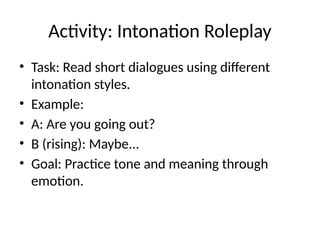
Activity: Intonation Roleplay
• Task: Read short dialogues using different
intonation styles.
• Example:
• A: Are you going out?
• B (rising): Maybe...
• Goal: Practice tone and meaning through
emotion.
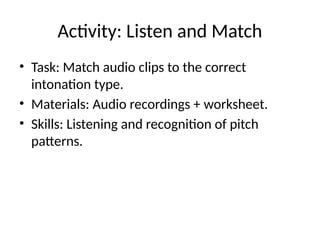
Activity: Listen and Match
• Task: Match audio clips to the correct
intonation type.
• Materials: Audio recordings + worksheet.
• Skills: Listening and recognition of pitch
patterns.
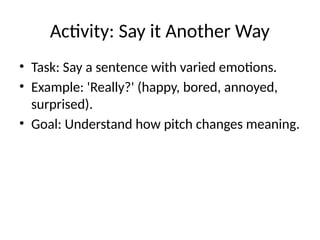
Activity: Say it Another Way
• Task: Say a sentence with varied emotions.
• Example: 'Really?' (happy, bored, annoyed,
surprised).
• Goal: Understand how pitch changes meaning.
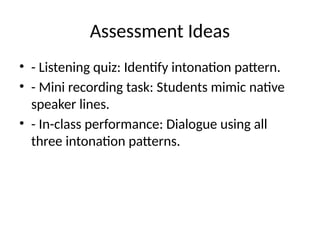
Assessment Ideas
• - Listening quiz: Identify intonation pattern.
• - Mini recording task: Students mimic native
speaker lines.
• - In-class performance: Dialogue using all
three intonation patterns.

Week_9_Intonation_and_Pitch_Presentation (a).pptx

  • 1.
    Week 9: Intonation& Pitch in English English Pronunciation Course
  • 2.
    Learning Objectives • -Define and explain pitch and intonation in English. • - Identify falling, rising, and fall-rise intonation patterns. • - Recognize how pitch expresses meaning or emotion. • - Apply intonation patterns to improve clarity and fluency.
  • 3.
    What is Pitchand Intonation? • - Pitch: The highness or lowness of the voice. • - Intonation: The variation of pitch while speaking. • - Affects meaning, emotion, and conversational flow.
  • 4.
    Types of IntonationPatterns • 1. Falling intonation – Statements, WH- questions, commands. • 2. Rising intonation – Yes/no questions, confirmations. • 3. Fall-rise intonation – Polite corrections, hesitation, uncertainty.
  • 5.
    Functions of Intonation •- Shows attitude or emotion (interest, sarcasm, surprise). • - Differentiates grammar (statement vs. question). • - Helps manage conversation (turn-taking, topic shift).
  • 6.
    Activity: Intonation Roleplay •Task: Read short dialogues using different intonation styles. • Example: • A: Are you going out? • B (rising): Maybe... • Goal: Practice tone and meaning through emotion.
  • 7.
    Activity: Listen andMatch • Task: Match audio clips to the correct intonation type. • Materials: Audio recordings + worksheet. • Skills: Listening and recognition of pitch patterns.
  • 8.
    Activity: Say itAnother Way • Task: Say a sentence with varied emotions. • Example: 'Really?' (happy, bored, annoyed, surprised). • Goal: Understand how pitch changes meaning.
  • 9.
    Assessment Ideas • -Listening quiz: Identify intonation pattern. • - Mini recording task: Students mimic native speaker lines. • - In-class performance: Dialogue using all three intonation patterns.