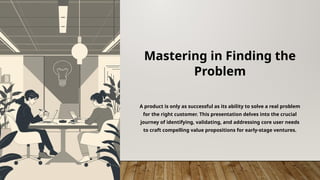
Mastering in Findingthe
Problem
A product is only as successful as its ability to solve a real problem
for the right customer. This presentation delves into the crucial
journey of identifying, validating, and addressing core user needs
to craft compelling value propositions for early-stage ventures.
2.
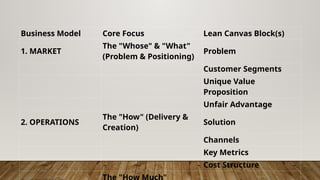
Business Model CoreFocus Lean Canvas Block(s)
1. MARKET
The "Whose" & "What"
(Problem & Positioning)
Problem
Customer Segments
Unique Value
Proposition
Unfair Advantage
2. OPERATIONS
The "How" (Delivery &
Creation)
Solution
Channels
Key Metrics
Cost Structure
The "How Much"
3.
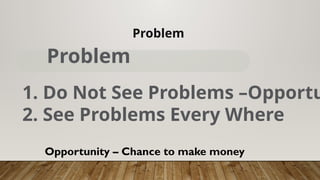
Problem
Problem
1. Do NotSee Problems –Opportu
2. See Problems Every Where
Opportunity – Chance to make money
4.
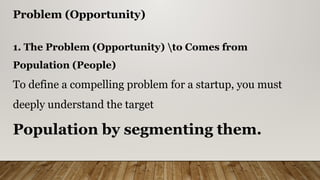
Problem (Opportunity)
1. TheProblem (Opportunity) to Comes from
Population (People)
To define a compelling problem for a startup, you must
deeply understand the target
Population by segmenting them.
5.
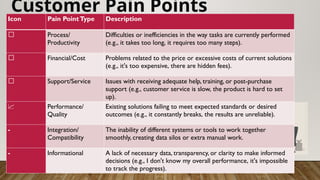
Customer Pain Points
Existingsolutions failing to meet expected standards or desired outcomes.
Icon Pain PointType Description
📅 Process/
Productivity
Difficulties or inefficiencies in the way tasks are currently performed
(e.g., it takes too long, it requires too many steps).
💡 Financial/Cost Problems related to the price or excessive costs of current solutions
(e.g., it's too expensive, there are hidden fees).
📸 Support/Service Issues with receiving adequate help, training, or post-purchase
support (e.g., customer service is slow, the product is hard to set
up).
📈 Performance/
Quality
Existing solutions failing to meet expected standards or desired
outcomes (e.g., it constantly breaks, the results are unreliable).
- Integration/
Compatibility
The inability of different systems or tools to work together
smoothly, creating data silos or extra manual work.
- Informational A lack of necessary data, transparency, or clarity to make informed
decisions (e.g., I don't know my overall performance, it's impossible
to track the progress).
6.
Problem definition iscrucial for a successful
startup, as it helps focus efforts on genuine
customer needs. The core of a strong problem
definition is understanding and addressing
the key pain points your target customers
experience.
7.
Problem Description forStartups
The way you describe the problem depends slightly on whether you are entering an existing market
or creating a new one.
1. For a New Product or Service (Entering an Existing Market)
The problem description should focus on the gaps and failures of the incumbent solutions.
Format: "[Target Customer] is struggling with [Pain Point] when trying to [Goal/Job to be Done].
Current options ([Competitor 1], [Competitor 2]) are deficient because they cause [Specific
Negative Outcome related to pain point]."
Focus: Why the existing status quo is unbearable. Highlight the friction,
cost, or poor quality customers currently have to accept.
Example: "Small business owners are frustrated by the excessive time (Process Pain Point)
and high monthly fees (Financial Pain Point) required to manage basic payroll. Existing
software is overly complex and requires hours of manual data entry per month, forcing them
to spend less time serving customers."
8.
Problem Description forStartups
The way you describe the problem depends slightly on whether you are entering an existing market or
creating a new one.
1. For a New Product or Service (Entering an Existing Market)
The problem description should focus on the gaps and failures of the incumbent solutions.
Format: "[Target Customer] is struggling with [Pain Point] when trying to [Goal/Job to be Done].
Current options ([Competitor 1], [Competitor 2]) are deficient because they cause [Specific Negative
Outcome related to pain point]."
Focus: Why the existing status quo is unbearable. Highlight the friction, cost, or poor quality
customers currently have to accept.
Example: "Small business owners are frustrated by the excessive time (Process Pain Point)
and high monthly fees (Financial Pain Point) required to manage basic payroll. Existing software
is overly complex and requires hours of manual data entry per month, forcing them to spend less
time serving customers."
9.
2. For aNew-to-the-World Product or Service (Solving an
Unrecognized Problem)
The problem description must first validate the existence of the pain point, which
customers may not yet consciously articulate as a "problem" because they don't know
a solution is possible.
Format: "[Target Customer] currently relies on [Current Behavior] to achieve [Goal].
This method leads to [Unrecognized Negative Consequence], creating a
latent/unmet need for [Solution Category]."
Focus: Shining a light on a hidden inefficiency or creating a new standard of
performance and convenience.
Example: "Users currently have to manually physically input their debit card and
PIN at every purchase. This process is inherently slow, prone to error, and carries
a security risk if the card is lost, creating a need for a contactless, secure payment
method."
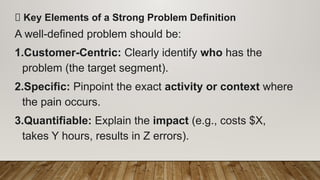
10.
✅ Key Elementsof a Strong Problem Definition
A well-defined problem should be:
1.Customer-Centric: Clearly identify who has the
problem (the target segment).
2.Specific: Pinpoint the exact activity or context where
the pain occurs.
3.Quantifiable: Explain the impact (e.g., costs $X,
takes Y hours, results in Z errors).
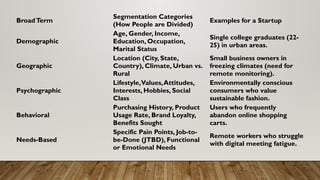
11.
BroadTerm
Segmentation Categories
(How Peopleare Divided)
Examples for a Startup
Demographic
Age, Gender, Income,
Education, Occupation,
Marital Status
Single college graduates (22-
25) in urban areas.
Geographic
Location (City, State,
Country), Climate, Urban vs.
Rural
Small business owners in
freezing climates (need for
remote monitoring).
Psychographic
Lifestyle,Values,Attitudes,
Interests, Hobbies, Social
Class
Environmentally conscious
consumers who value
sustainable fashion.
Behavioral
Purchasing History, Product
Usage Rate, Brand Loyalty,
Benefits Sought
Users who frequently
abandon online shopping
carts.
Needs-Based
Specific Pain Points, Job-to-
be-Done (JTBD), Functional
or Emotional Needs
Remote workers who struggle
with digital meeting fatigue.
12.
2. The SolutionComes from Firms
(Industry or Services)
The solution is delivered by a Firm (a startup)
which operates within a specific
Industry or Service Sector.
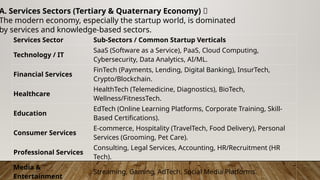
13.
Services Sector Sub-Sectors/ Common Startup Verticals
Technology / IT
SaaS (Software as a Service), PaaS, Cloud Computing,
Cybersecurity, Data Analytics, AI/ML.
Financial Services
FinTech (Payments, Lending, Digital Banking), InsurTech,
Crypto/Blockchain.
Healthcare
HealthTech (Telemedicine, Diagnostics), BioTech,
Wellness/FitnessTech.
Education
EdTech (Online Learning Platforms, Corporate Training, Skill-
Based Certifications).
Consumer Services
E-commerce, Hospitality (TravelTech, Food Delivery), Personal
Services (Grooming, Pet Care).
Professional Services
Consulting, Legal Services, Accounting, HR/Recruitment (HR
Tech).
Media &
Entertainment
Streaming, Gaming, AdTech, Social Media Platforms.
A. Services Sectors (Tertiary & Quaternary Economy) 💡
The modern economy, especially the startup world, is dominated
by services and knowledge-based sectors.
14.
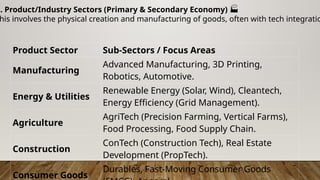
Product Sector Sub-Sectors/ Focus Areas
Manufacturing
Advanced Manufacturing, 3D Printing,
Robotics, Automotive.
Energy & Utilities
Renewable Energy (Solar, Wind), Cleantech,
Energy Efficiency (Grid Management).
Agriculture
AgriTech (Precision Farming, Vertical Farms),
Food Processing, Food Supply Chain.
Construction
ConTech (Construction Tech), Real Estate
Development (PropTech).
Consumer Goods
Durables, Fast-Moving Consumer Goods
B. Product/Industry Sectors (Primary & Secondary Economy) 🏭
his involves the physical creation and manufacturing of goods, often with tech integratio
15.
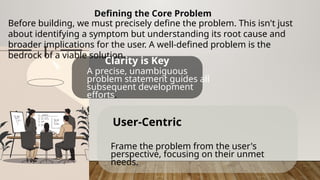
Defining the CoreProblem
Before building, we must precisely define the problem. This isn't just
about identifying a symptom but understanding its root cause and
broader implications for the user. A well-defined problem is the
bedrock of a viable solution.
Clarity is Key
A precise, unambiguous
problem statement guides all
subsequent development
efforts.
User-Centric
Frame the problem from the user's
perspective, focusing on their unmet
needs.
16.
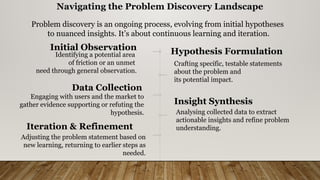
Navigating the ProblemDiscovery Landscape
Problem discovery is an ongoing process, evolving from initial hypotheses
to nuanced insights. It’s about continuous learning and iteration.
Initial Observation
Identifying a potential area
of friction or an unmet
need through general observation.
Hypothesis Formulation
Crafting specific, testable statements
about the problem and
its potential impact.
Data Collection
Engaging with users and the market to
gather evidence supporting or refuting the
hypothesis.
Insight Synthesis
Analysing collected data to extract
actionable insights and refine problem
understanding.
Iteration & Refinement
Adjusting the problem statement based on
new learning, returning to earlier steps as
needed.
17.
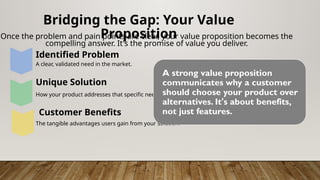
Bridging the Gap:Your Value
Proposition
Once the problem and pain points are clear, your value proposition becomes the
compelling answer. It's the promise of value you deliver.
Identified Problem
A clear, validated need in the market.
Unique Solution
How your product addresses that specific need.
Customer Benefits
The tangible advantages users gain from your solution.
A strong value proposition
communicates why a customer
should choose your product over
alternatives. It's about benefits,
not just features.
![Problem Description for Startups
The way you describe the problem depends slightly on whether you are entering an existing market
or creating a new one.
1. For a New Product or Service (Entering an Existing Market)
The problem description should focus on the gaps and failures of the incumbent solutions.
Format: "[Target Customer] is struggling with [Pain Point] when trying to [Goal/Job to be Done].
Current options ([Competitor 1], [Competitor 2]) are deficient because they cause [Specific
Negative Outcome related to pain point]."
Focus: Why the existing status quo is unbearable. Highlight the friction,
cost, or poor quality customers currently have to accept.
Example: "Small business owners are frustrated by the excessive time (Process Pain Point)
and high monthly fees (Financial Pain Point) required to manage basic payroll. Existing
software is overly complex and requires hours of manual data entry per month, forcing them
to spend less time serving customers."](https://image.slidesharecdn.com/week5theproblem-251124160300-4f30332f/85/week5_theProbleeeeeeeeeemmmmmmmmmmm-pptx-7-320.jpg)
![Problem Description for Startups
The way you describe the problem depends slightly on whether you are entering an existing market or
creating a new one.
1. For a New Product or Service (Entering an Existing Market)
The problem description should focus on the gaps and failures of the incumbent solutions.
Format: "[Target Customer] is struggling with [Pain Point] when trying to [Goal/Job to be Done].
Current options ([Competitor 1], [Competitor 2]) are deficient because they cause [Specific Negative
Outcome related to pain point]."
Focus: Why the existing status quo is unbearable. Highlight the friction, cost, or poor quality
customers currently have to accept.
Example: "Small business owners are frustrated by the excessive time (Process Pain Point)
and high monthly fees (Financial Pain Point) required to manage basic payroll. Existing software
is overly complex and requires hours of manual data entry per month, forcing them to spend less
time serving customers."](https://image.slidesharecdn.com/week5theproblem-251124160300-4f30332f/85/week5_theProbleeeeeeeeeemmmmmmmmmmm-pptx-8-320.jpg)
![2. For a New-to-the-World Product or Service (Solving an
Unrecognized Problem)
The problem description must first validate the existence of the pain point, which
customers may not yet consciously articulate as a "problem" because they don't know
a solution is possible.
Format: "[Target Customer] currently relies on [Current Behavior] to achieve [Goal].
This method leads to [Unrecognized Negative Consequence], creating a
latent/unmet need for [Solution Category]."
Focus: Shining a light on a hidden inefficiency or creating a new standard of
performance and convenience.
Example: "Users currently have to manually physically input their debit card and
PIN at every purchase. This process is inherently slow, prone to error, and carries
a security risk if the card is lost, creating a need for a contactless, secure payment
method."](https://image.slidesharecdn.com/week5theproblem-251124160300-4f30332f/85/week5_theProbleeeeeeeeeemmmmmmmmmmm-pptx-9-320.jpg)