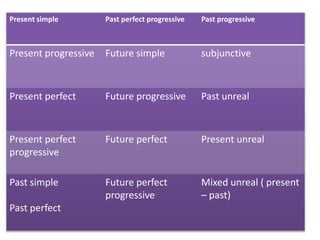
Present simple Past perfect progressive Past progressive
Present progressive Future simple subjunctive
Present perfect Future progressive Past unreal
Present perfect
progressive
Future perfect Present unreal
Past simple
Past perfect
Future perfect
progressive
Mixed unreal ( present
– past)
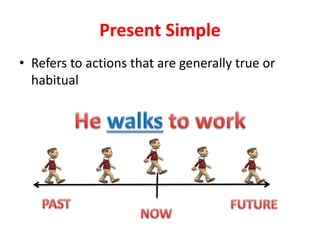
Present Simple
• Refers to actions that are generally true or
habitual
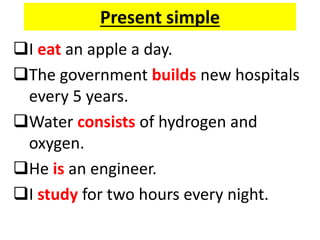
Present simple
I eat an apple a day.
The government builds new hospitals
every 5 years.
Water consists of hydrogen and
oxygen.
He is an engineer.
I study for two hours every night.
• Key time words:
• Always, often, usually, regularly, often,
everyday, rarely, scarcely, (once, twice, three
times a day, a week, a month, a year), daily,
weekly, monthly, yearly.
• General facts.
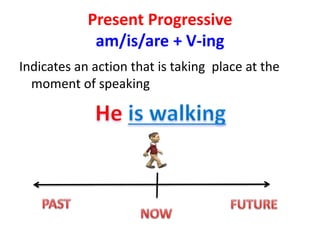
Present Progressive
am/is/are + V-ing
Indicates an action that is taking place at the
moment of speaking
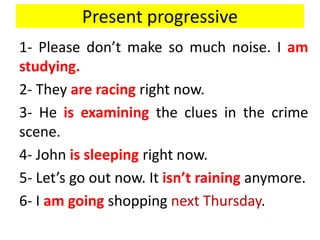
Present progressive
1- Please don’t make so much noise. I am
studying.
2- They are racing right now.
3- He is examining the clues in the crime
scene.
4- John is sleeping right now.
5- Let’s go out now. It isn’t raining anymore.
6- I am going shopping next Thursday.
Present Progressive
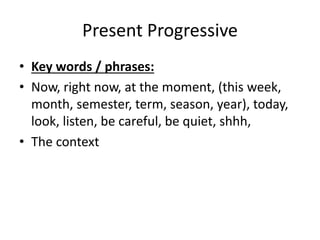
• Key words / phrases:
• Now, right now, at the moment, (this week,
month, semester, term, season, year), today,
look, listen, be careful, be quiet, shhh,
• The context
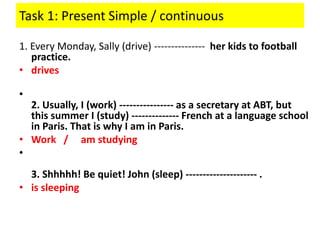
Task 1: Present Simple / continuous
1. Every Monday, Sally (drive) --------------- her kids to football
practice.
• drives
•
2. Usually, I (work) ---------------- as a secretary at ABT, but
this summer I (study) -------------- French at a language school
in Paris. That is why I am in Paris.
• Work / am studying
•
3. Shhhhh! Be quiet! John (sleep) --------------------- .
• is sleeping
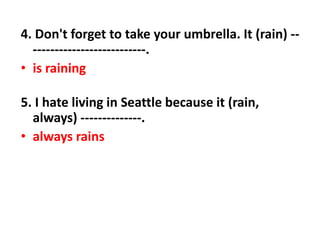
4. Don't forget to take your umbrella. It (rain) --
--------------------------.
• is raining
5. I hate living in Seattle because it (rain,
always) --------------.
• always rains
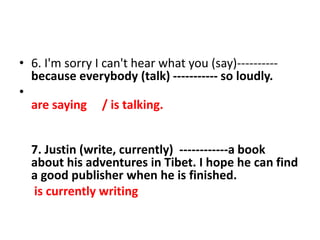
• 6. I'm sorry I can't hear what you (say)----------
because everybody (talk) ----------- so loudly.
•
are saying / is talking.
7. Justin (write, currently) ------------a book
about his adventures in Tibet. I hope he can find
a good publisher when he is finished.
is currently writing
8. Jim: Do you want to come over for dinner tonight?
Denise: Oh, I'm sorry, I can't. I (go) --------------- to a
movie tonight with some friends.
• am going
9- Listen. Some people (shout) -------------- at each
other.
• are shouting
10- Mr. Brown (donate / usually) ------------------ a lot of
money for charitable organization.
• Usually donates
Past Simple
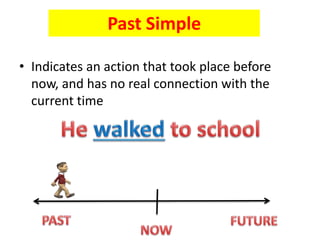
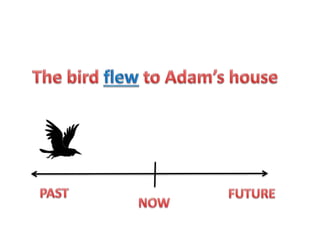
• Indicates an action that took place before
now, and has no real connection with the
current time
Past Simple
• Regular verbs:
• 1- The teacher explained the lesson yesterday.
• 2- We invited them to our party three days ago.
• 3- The police stopped me on my way last night.
• Irregular verbs:
• 1- We all left the party at 11:00.
• 3- This house cost $75,000 in 1980.
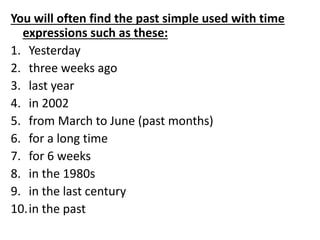
You will often find the past simple used with time
expressions such as these:
1. Yesterday
2. three weeks ago
3. last year
4. in 2002
5. from March to June (past months)
6. for a long time
7. for 6 weeks
8. in the 1980s
9. in the last century
10.in the past
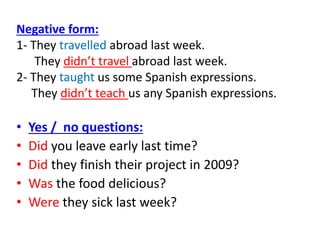
Negative form:
1- They travelled abroad last week.
They didn’t travel abroad last week.
2- They taught us some Spanish expressions.
They didn’t teach us any Spanish expressions.
• Yes / no questions:
• Did you leave early last time?
• Did they finish their project in 2009?
• Was the food delicious?
• Were they sick last week?
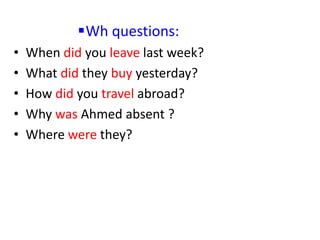
Wh questions:
• When did you leave last week?
• What did they buy yesterday?
• How did you travel abroad?
• Why was Ahmed absent ?
• Where were they?
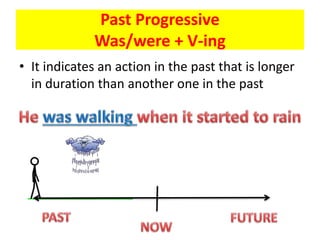
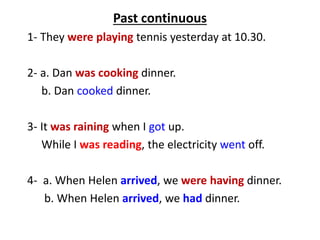
Past Progressive
Was/were + V-ing
• It indicates an action in the past that is longer
in duration than another one in the past
Past continuous
1- They were playing tennis yesterday at 10.30.
2- a. Dan was cooking dinner.
b. Dan cooked dinner.
3- It was raining when I got up.
While I was reading, the electricity went off.
4- a. When Helen arrived, we were having dinner.
b. When Helen arrived, we had dinner.
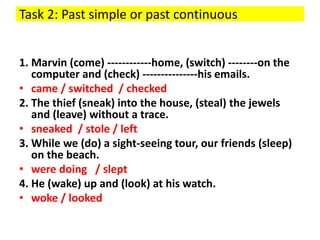
Task 2: Past simple or past continuous
1. Marvin (come) ------------home, (switch) --------on the
computer and (check) ---------------his emails.
• came / switched / checked
2. The thief (sneak) into the house, (steal) the jewels
and (leave) without a trace.
• sneaked / stole / left
3. While we (do) a sight-seeing tour, our friends (sleep)
on the beach.
• were doing / slept
4. He (wake) up and (look) at his watch.
• woke / looked
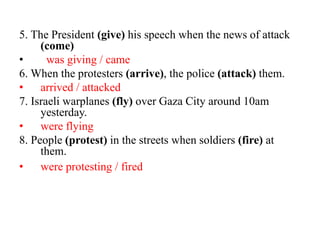
5. The President (give) his speech when the news of attack
(come)
• was giving / came
6. When the protesters (arrive), the police (attack) them.
• arrived / attacked
7. Israeli warplanes (fly) over Gaza City around 10am
yesterday.
• were flying
8. People (protest) in the streets when soldiers (fire) at
them.
• were protesting / fired
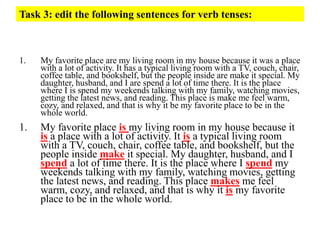
Task 3: edit the following sentences for verb tenses:
1. My favorite place are my living room in my house because it was a place
with a lot of activity. It has a typical living room with a TV, couch, chair,
coffee table, and bookshelf, but the people inside are make it special. My
daughter, husband, and I are spend a lot of time there. It is the place
where I is spend my weekends talking with my family, watching movies,
getting the latest news, and reading. This place is make me feel warm,
cozy, and relaxed, and that is why it be my favorite place to be in the
whole world.
1. My favorite place is my living room in my house because it
is a place with a lot of activity. It is a typical living room
with a TV, couch, chair, coffee table, and bookshelf, but the
people inside make it special. My daughter, husband, and I
spend a lot of time there. It is the place where I spend my
weekends talking with my family, watching movies, getting
the latest news, and reading. This place makes me feel
warm, cozy, and relaxed, and that is why it is my favorite
place to be in the whole world.
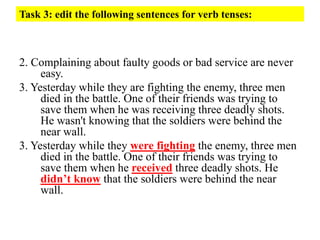
Task 3: edit the following sentences for verb tenses:
2. Complaining about faulty goods or bad service are never
easy.
3. Yesterday while they are fighting the enemy, three men
died in the battle. One of their friends was trying to
save them when he was receiving three deadly shots.
He wasn't knowing that the soldiers were behind the
near wall.
3. Yesterday while they were fighting the enemy, three men
died in the battle. One of their friends was trying to
save them when he received three deadly shots. He
didn’t know that the soldiers were behind the near
wall.
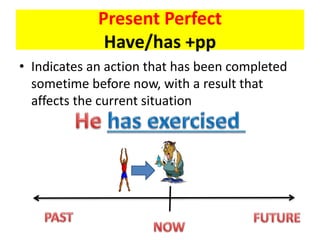
Present Perfect
Have/has +pp
• Indicates an action that has been completed
sometime before now, with a result that
affects the current situation
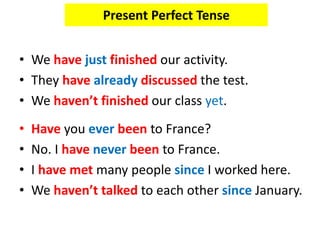
Present Perfect Tense
• We have just finished our activity.
• They have already discussed the test.
• We haven’t finished our class yet.
• Have you ever been to France?
• No. I have never been to France.
• I have met many people since I worked here.
• We haven’t talked to each other since January.
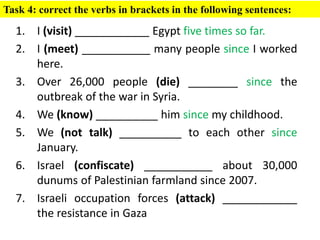
1. I (visit) ____________ Egypt five times so far.
2. I (meet) ___________ many people since I worked
here.
3. Over 26,000 people (die) ________ since the
outbreak of the war in Syria.
4. We (know) __________ him since my childhood.
5. We (not talk) __________ to each other since
January.
6. Israel (confiscate) ___________ about 30,000
dunums of Palestinian farmland since 2007.
7. Israeli occupation forces (attack) ____________
the resistance in Gaza
Task 4: correct the verbs in brackets in the following sentences:
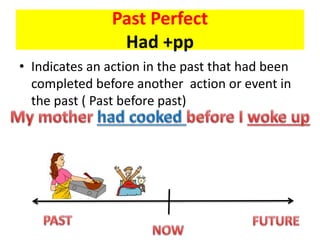
• Indicates an action in the past that had been
completed before another action or event in
the past ( Past before past)
Past Perfect
Had +pp
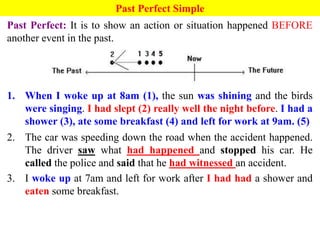
Past Perfect Simple
Past Perfect: It is to show an action or situation happened BEFORE
another event in the past.
1. When I woke up at 8am (1), the sun was shining and the birds
were singing. I had slept (2) really well the night before. I had a
shower (3), ate some breakfast (4) and left for work at 9am. (5)
2. The car was speeding down the road when the accident happened.
The driver saw what had happened and stopped his car. He
called the police and said that he had witnessed an accident.
3. I woke up at 7am and left for work after I had had a shower and
eaten some breakfast.
Past perfect (had + pp)
• She had talked to me before she left.
• She left after she had talked to me.
• When Ahmed had arrived, Jane left.
• They were angry because Tom hadn’t invited
them to the party.
• We had waited for him for two hours before he
arrived yesterday.
1. The storm destroyed the tent that we (build).
had built
2. We (sleep) for 12 hours when he woke us up.
Had slept
3. The President announced his resignation after
he (consult) with his aides.
Had consulted
4. They (be) very tired in the evening because
they had helped on the farm all day.
were
Task 5: correct the verbs in brackets in the following sentences:
5. My brother ate all of the cake that our mum
(make).
Had made
6. Thousands of people (protest) in the streets after
they had heard about the deadly attack.
protested
7. They had waited at the station for 90 minutes
when the train finally (arrive).
arrived
8. The delegation (hold) talks with the prisoners’
families before they met the President.
Had held
9. When she (go) out to play, she had already
done her homework.
 went
10. We (look for) her missing bag for two hours
and then we found it behind the table.
 had looked
Task 6: Change the verbs in brackets to the past tense: simple, continuous, or
perfect
1. While I _______________________(play) football I_______(hurt)
my leg.
2. Palestinian PM Ismail Haniya (tour) ___________ in Nuseirat camp
last week.
3. 20 people (die) _________ in the fighting between Egyptian police
and protesters since last month.
4. Israel (build) ______________ new colonial settlements in the
occupied West Bank.
5. A statement by the PLO (express) ____________ support for the
Syrian people yesterday.
6. The Saudi King returned to Saudi Arabia after he (receive)
___________ treatment in Washington.
7. Egypt (ease) _________________ travel restrictions slightly after
President's Morsi's election victory
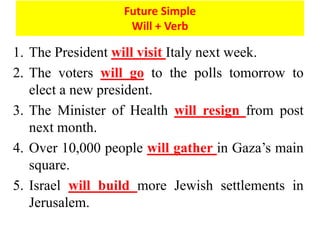
Future Simple
Will + Verb
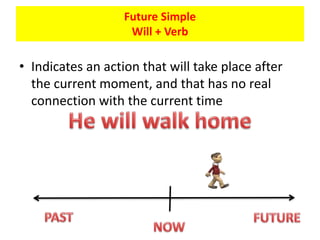
• Indicates an action that will take place after
the current moment, and that has no real
connection with the current time
1. The President will visit Italy next week.
2. The voters will go to the polls tomorrow to
elect a new president.
3. The Minister of Health will resign from post
next month.
4. Over 10,000 people will gather in Gaza’s main
square.
5. Israel will build more Jewish settlements in
Jerusalem.
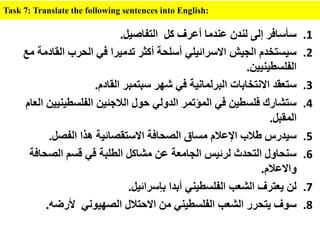
Future Simple
Will + Verb
.1
‫التفاصيل‬ ‫كل‬ ‫أعرف‬ ‫عندما‬ ‫لندن‬ ‫إلى‬ ‫سأسافر‬
.
.2
‫ال‬ ‫الحرب‬ ‫في‬ ‫تدميرا‬ ‫أكثر‬ ‫أسلحة‬ ‫االسرائيلي‬ ‫الجيش‬ ‫سيستخدم‬
‫مع‬ ‫قادمة‬
‫الفلسطينيين‬
.
.3
‫القادم‬ ‫سبتمبر‬ ‫شهر‬ ‫في‬ ‫البرلمانية‬ ‫االنتخابات‬ ‫ستعقد‬
.
.4
‫الفلسطي‬ ‫الالجئين‬ ‫حول‬ ‫الدولي‬ ‫المؤتمر‬ ‫في‬ ‫فلسطين‬ ‫ستشارك‬
‫العام‬ ‫نيين‬
‫المقبل‬
.
.5
‫الفصل‬ ‫هذا‬ ‫االستقصائية‬ ‫الصحافة‬ ‫مساق‬ ‫اإلعالم‬ ‫طالب‬ ‫سيدرس‬
.
.6
‫الص‬ ‫قسم‬ ‫في‬ ‫الطلبة‬ ‫مشاكل‬ ‫عن‬ ‫الجامعة‬ ‫لرئيس‬ ‫التحدث‬ ‫سنحاول‬
‫حافة‬
‫واالعالم‬
.
.7
‫بإسرائيل‬ ‫أبدا‬ ‫الفلسطيني‬ ‫الشعب‬ ‫يعترف‬ ‫لن‬
.
.8
‫ألرض‬ ‫الصهيوني‬ ‫االحتالل‬ ‫من‬ ‫الفلسطيني‬ ‫الشعب‬ ‫يتحرر‬ ‫سوف‬
‫ه‬
.
Task 7: Translate the following sentences into English:

Week-2-English-tenses.ppt

  • 3.
    Present simple Pastperfect progressive Past progressive Present progressive Future simple subjunctive Present perfect Future progressive Past unreal Present perfect progressive Future perfect Present unreal Past simple Past perfect Future perfect progressive Mixed unreal ( present – past)
  • 4.
    Present Simple • Refersto actions that are generally true or habitual
  • 5.
    Present simple I eatan apple a day. The government builds new hospitals every 5 years. Water consists of hydrogen and oxygen. He is an engineer. I study for two hours every night.
  • 6.
    • Key timewords: • Always, often, usually, regularly, often, everyday, rarely, scarcely, (once, twice, three times a day, a week, a month, a year), daily, weekly, monthly, yearly. • General facts.
  • 7.
    Present Progressive am/is/are +V-ing Indicates an action that is taking place at the moment of speaking
  • 8.
    Present progressive 1- Pleasedon’t make so much noise. I am studying. 2- They are racing right now. 3- He is examining the clues in the crime scene. 4- John is sleeping right now. 5- Let’s go out now. It isn’t raining anymore. 6- I am going shopping next Thursday.
  • 9.
    Present Progressive • Keywords / phrases: • Now, right now, at the moment, (this week, month, semester, term, season, year), today, look, listen, be careful, be quiet, shhh, • The context
  • 10.
    Task 1: PresentSimple / continuous 1. Every Monday, Sally (drive) --------------- her kids to football practice. • drives • 2. Usually, I (work) ---------------- as a secretary at ABT, but this summer I (study) -------------- French at a language school in Paris. That is why I am in Paris. • Work / am studying • 3. Shhhhh! Be quiet! John (sleep) --------------------- . • is sleeping
  • 11.
    4. Don't forgetto take your umbrella. It (rain) -- --------------------------. • is raining 5. I hate living in Seattle because it (rain, always) --------------. • always rains
  • 12.
    • 6. I'msorry I can't hear what you (say)---------- because everybody (talk) ----------- so loudly. • are saying / is talking. 7. Justin (write, currently) ------------a book about his adventures in Tibet. I hope he can find a good publisher when he is finished. is currently writing
  • 13.
    8. Jim: Doyou want to come over for dinner tonight? Denise: Oh, I'm sorry, I can't. I (go) --------------- to a movie tonight with some friends. • am going 9- Listen. Some people (shout) -------------- at each other. • are shouting 10- Mr. Brown (donate / usually) ------------------ a lot of money for charitable organization. • Usually donates
  • 14.
    Past Simple • Indicatesan action that took place before now, and has no real connection with the current time
  • 16.
    Past Simple • Regularverbs: • 1- The teacher explained the lesson yesterday. • 2- We invited them to our party three days ago. • 3- The police stopped me on my way last night. • Irregular verbs: • 1- We all left the party at 11:00. • 3- This house cost $75,000 in 1980.
  • 17.
    You will oftenfind the past simple used with time expressions such as these: 1. Yesterday 2. three weeks ago 3. last year 4. in 2002 5. from March to June (past months) 6. for a long time 7. for 6 weeks 8. in the 1980s 9. in the last century 10.in the past
  • 18.
    Negative form: 1- Theytravelled abroad last week. They didn’t travel abroad last week. 2- They taught us some Spanish expressions. They didn’t teach us any Spanish expressions. • Yes / no questions: • Did you leave early last time? • Did they finish their project in 2009? • Was the food delicious? • Were they sick last week?
  • 19.
    Wh questions: • Whendid you leave last week? • What did they buy yesterday? • How did you travel abroad? • Why was Ahmed absent ? • Where were they?
  • 20.
    Past Progressive Was/were +V-ing • It indicates an action in the past that is longer in duration than another one in the past
  • 21.
    Past continuous 1- Theywere playing tennis yesterday at 10.30. 2- a. Dan was cooking dinner. b. Dan cooked dinner. 3- It was raining when I got up. While I was reading, the electricity went off. 4- a. When Helen arrived, we were having dinner. b. When Helen arrived, we had dinner.
  • 22.
    Task 2: Pastsimple or past continuous 1. Marvin (come) ------------home, (switch) --------on the computer and (check) ---------------his emails. • came / switched / checked 2. The thief (sneak) into the house, (steal) the jewels and (leave) without a trace. • sneaked / stole / left 3. While we (do) a sight-seeing tour, our friends (sleep) on the beach. • were doing / slept 4. He (wake) up and (look) at his watch. • woke / looked
  • 23.
    5. The President(give) his speech when the news of attack (come) • was giving / came 6. When the protesters (arrive), the police (attack) them. • arrived / attacked 7. Israeli warplanes (fly) over Gaza City around 10am yesterday. • were flying 8. People (protest) in the streets when soldiers (fire) at them. • were protesting / fired
  • 24.
    Task 3: editthe following sentences for verb tenses: 1. My favorite place are my living room in my house because it was a place with a lot of activity. It has a typical living room with a TV, couch, chair, coffee table, and bookshelf, but the people inside are make it special. My daughter, husband, and I are spend a lot of time there. It is the place where I is spend my weekends talking with my family, watching movies, getting the latest news, and reading. This place is make me feel warm, cozy, and relaxed, and that is why it be my favorite place to be in the whole world. 1. My favorite place is my living room in my house because it is a place with a lot of activity. It is a typical living room with a TV, couch, chair, coffee table, and bookshelf, but the people inside make it special. My daughter, husband, and I spend a lot of time there. It is the place where I spend my weekends talking with my family, watching movies, getting the latest news, and reading. This place makes me feel warm, cozy, and relaxed, and that is why it is my favorite place to be in the whole world.
  • 25.
    Task 3: editthe following sentences for verb tenses: 2. Complaining about faulty goods or bad service are never easy. 3. Yesterday while they are fighting the enemy, three men died in the battle. One of their friends was trying to save them when he was receiving three deadly shots. He wasn't knowing that the soldiers were behind the near wall. 3. Yesterday while they were fighting the enemy, three men died in the battle. One of their friends was trying to save them when he received three deadly shots. He didn’t know that the soldiers were behind the near wall.
  • 26.
    Present Perfect Have/has +pp •Indicates an action that has been completed sometime before now, with a result that affects the current situation
  • 27.
    Present Perfect Tense •We have just finished our activity. • They have already discussed the test. • We haven’t finished our class yet. • Have you ever been to France? • No. I have never been to France. • I have met many people since I worked here. • We haven’t talked to each other since January.
  • 28.
    1. I (visit)____________ Egypt five times so far. 2. I (meet) ___________ many people since I worked here. 3. Over 26,000 people (die) ________ since the outbreak of the war in Syria. 4. We (know) __________ him since my childhood. 5. We (not talk) __________ to each other since January. 6. Israel (confiscate) ___________ about 30,000 dunums of Palestinian farmland since 2007. 7. Israeli occupation forces (attack) ____________ the resistance in Gaza Task 4: correct the verbs in brackets in the following sentences:
  • 29.
    • Indicates anaction in the past that had been completed before another action or event in the past ( Past before past) Past Perfect Had +pp
  • 30.
    Past Perfect Simple PastPerfect: It is to show an action or situation happened BEFORE another event in the past. 1. When I woke up at 8am (1), the sun was shining and the birds were singing. I had slept (2) really well the night before. I had a shower (3), ate some breakfast (4) and left for work at 9am. (5) 2. The car was speeding down the road when the accident happened. The driver saw what had happened and stopped his car. He called the police and said that he had witnessed an accident. 3. I woke up at 7am and left for work after I had had a shower and eaten some breakfast.
  • 31.
    Past perfect (had+ pp) • She had talked to me before she left. • She left after she had talked to me. • When Ahmed had arrived, Jane left. • They were angry because Tom hadn’t invited them to the party. • We had waited for him for two hours before he arrived yesterday.
  • 32.
    1. The stormdestroyed the tent that we (build). had built 2. We (sleep) for 12 hours when he woke us up. Had slept 3. The President announced his resignation after he (consult) with his aides. Had consulted 4. They (be) very tired in the evening because they had helped on the farm all day. were Task 5: correct the verbs in brackets in the following sentences:
  • 33.
    5. My brotherate all of the cake that our mum (make). Had made 6. Thousands of people (protest) in the streets after they had heard about the deadly attack. protested 7. They had waited at the station for 90 minutes when the train finally (arrive). arrived 8. The delegation (hold) talks with the prisoners’ families before they met the President. Had held
  • 34.
    9. When she(go) out to play, she had already done her homework.  went 10. We (look for) her missing bag for two hours and then we found it behind the table.  had looked
  • 35.
    Task 6: Changethe verbs in brackets to the past tense: simple, continuous, or perfect 1. While I _______________________(play) football I_______(hurt) my leg. 2. Palestinian PM Ismail Haniya (tour) ___________ in Nuseirat camp last week. 3. 20 people (die) _________ in the fighting between Egyptian police and protesters since last month. 4. Israel (build) ______________ new colonial settlements in the occupied West Bank. 5. A statement by the PLO (express) ____________ support for the Syrian people yesterday. 6. The Saudi King returned to Saudi Arabia after he (receive) ___________ treatment in Washington. 7. Egypt (ease) _________________ travel restrictions slightly after President's Morsi's election victory
  • 36.
    Future Simple Will +Verb • Indicates an action that will take place after the current moment, and that has no real connection with the current time
  • 37.
    1. The Presidentwill visit Italy next week. 2. The voters will go to the polls tomorrow to elect a new president. 3. The Minister of Health will resign from post next month. 4. Over 10,000 people will gather in Gaza’s main square. 5. Israel will build more Jewish settlements in Jerusalem. Future Simple Will + Verb
  • 38.
    .1 ‫التفاصيل‬ ‫كل‬ ‫أعرف‬‫عندما‬ ‫لندن‬ ‫إلى‬ ‫سأسافر‬ . .2 ‫ال‬ ‫الحرب‬ ‫في‬ ‫تدميرا‬ ‫أكثر‬ ‫أسلحة‬ ‫االسرائيلي‬ ‫الجيش‬ ‫سيستخدم‬ ‫مع‬ ‫قادمة‬ ‫الفلسطينيين‬ . .3 ‫القادم‬ ‫سبتمبر‬ ‫شهر‬ ‫في‬ ‫البرلمانية‬ ‫االنتخابات‬ ‫ستعقد‬ . .4 ‫الفلسطي‬ ‫الالجئين‬ ‫حول‬ ‫الدولي‬ ‫المؤتمر‬ ‫في‬ ‫فلسطين‬ ‫ستشارك‬ ‫العام‬ ‫نيين‬ ‫المقبل‬ . .5 ‫الفصل‬ ‫هذا‬ ‫االستقصائية‬ ‫الصحافة‬ ‫مساق‬ ‫اإلعالم‬ ‫طالب‬ ‫سيدرس‬ . .6 ‫الص‬ ‫قسم‬ ‫في‬ ‫الطلبة‬ ‫مشاكل‬ ‫عن‬ ‫الجامعة‬ ‫لرئيس‬ ‫التحدث‬ ‫سنحاول‬ ‫حافة‬ ‫واالعالم‬ . .7 ‫بإسرائيل‬ ‫أبدا‬ ‫الفلسطيني‬ ‫الشعب‬ ‫يعترف‬ ‫لن‬ . .8 ‫ألرض‬ ‫الصهيوني‬ ‫االحتالل‬ ‫من‬ ‫الفلسطيني‬ ‫الشعب‬ ‫يتحرر‬ ‫سوف‬ ‫ه‬ . Task 7: Translate the following sentences into English: