Meet the Consultants
Neurology
Introduction
• Consultant(s) background(s)
• Dr Chris Traner
• PGY4 + Neurology Chief Resident, Education
• Staying at Yale for Epilepsy Fellowship
• Dr John Picard
• PGY4 + Neurology Chief Resident, Education
• Staying at Yale for Neurocritical Care Fellowship
2
Service Structure
• Subspecialties and/or divisions within the service
• YNHH – split teams during the day to cover inpatient vs
ED consults, single resident covering for nights and
weekends
• General Adult Neurology: 24/7 in-house coverage
• Pager: 203-370-5298
• Days: Senior resident listed on Amion
• Nights: Consult resident listed on Amion
• ED: Logged into dynamic role on MHB
• Neuro-oncology: M–F 8:30-5 only
• Pager: 203-370-3609
• Exception to above:
• Patients physically located in the YNHH SICU are
covered by the Neuro ICU fellow (listed on Amion)
3
Service Structure
Pediatric Neurology
• Covered by a separate team during weekdays
• M-F 7-5:30
• Resident on call listed on Amion
• Covers both inpatient and ED pediatric consults
• Nights
• Consult resident covers both pediatric and adult
consults
• Weekends
• Contact the resident listed on Amion for new
consults
• Contact the attending for questions on old consults
4
Service Structure
• Subspecialties and/or divisions within the service
• Everywhere else
• General Neurology only, single team structure
• Locations
• SRC
• M-F 9-5: Resident listed in Amion
• Nights/weekends: Attending listed in Amion
• NO RESIDENT COVERAGE
• VA: 24/7 coverage
• Pager: 203-784-1222
• Note that we are on home call on nights and weekends for
the VA
5
What about the other Neuro
Subspecialties?
• Contact the general neurology consult service
first
• There are subspecialty fellows listed on Amion, but
for the most part all consults other than neuro-onc
should go through the consult service. We will be
happy to help put you in contact with the
subspecialists as appropriate
6
What about procedures?
• EEG
• Neurology does not need to be consulted to order an EEG
• That being said, consult service should be aware of any
patient that a continuous EEG is ordered on, particularly as it
is the consult resident who checks on EEGs overnight (not the
epilepsy fellow)
• Please note that EEG is not available overnight or on
weekends at the VA
• EMG
• Rarely indicated inpatient. Neurology consult service should
be aware of any patient that this is being ordered on to
determine if it is appropriate
• While an Epic order technically exists for this, it will not
happen without the Neurology team being contacted
7
What about procedures?
• Lumbar punctures
• As a department policy, we do not perform lumbar
punctures on patients not admitted to one of our
primary services for patient safety reasons
• I’m not signed off on LPs, what should I do?
• Weekdays: Contact the hospital procedure team
(Will Cushing)
• Nights/weekends: Reach out to the MICU
8
Service Flow
• How do I place a consult?
• YNHH/SRC – Epic order
• Please include a phone number that we can reach you at!
• VA – call pager (203-784-1222)
• Not sure you need a formal consult?
• YNHH: page 370-5298 or text resident on MHB
• SRC: text resident on MHB
• What’s the best time of day to place consults?
• Late morning/early afternoon preferred
• Non-urgent consults should ideally be minimized
overnight or on weekends
9
Service Flow
• When should teams expect to hear back and/or
see notes in Epic?
• We try our best to return all pages/texts/new consult
requests within 15-20 minutes
• Note that this may be a touch longer on nights/weekends
if the consult resident is involved in an emergency
• All consults are seen and staffed by an attending
within 24 hours
10
Stroke Codes
• When should a stroke code be called?
• Acute onset of a focal neurologic deficit
• Patient last known normal within 24 hours
• What is a focal neurologic deficit?
• FAST – face, arm, speech, time
• Aphasia: inability to speak and/or inability to follow
commands
• Unilateral weakness
• Unilateral numbness
11
Stroke Codes
• Ok, I called a stroke code. Now what?
• VA nights/weekends: page/call neurology
• SRC: nights/weekends covered by tele-stroke attending
• YNHH: we are on our way. No need to call/place an Epic
consult order
• What information should I be looking up while I’m
waiting for neurology (at YNHH)?
• Last known normal
• Medication list – notably if patient on anticoagulation,
and if so, when was their last dose (NOACs) or last INR
• Last set of labs – glucose, platelets, coags
12
Stroke Codes
• Help! I’m at the VA/SRC overnight/on a
weekend and neurology isn’t in house!
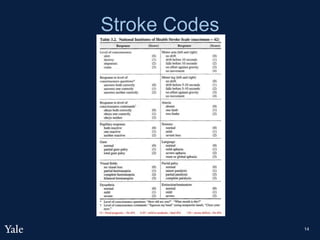
• FIRST: perform a NIHSS stroke scale
• Available in MedCalc and IV Stroke Thrombolysis
apps
• All crash carts have a set of stroke cards (the pink
ones) attached for you to use
• The neurology resident (VA) or the tele-stroke
attending (SRC) will help you with next steps
based on the story and presentation
13
Stroke Codes
14
Stroke Codes
• When shouldn’t I call a stroke code?
• Altered mental status (AMS) without any evidence
of focal deficits on exam
• Bilateral weakness or numbness w/o change in
LOC
• CT/MRI brain shows evidence of an
acute/subacute/chronic stroke with patient’s last
known normal >24 hours ago or patient
asymptomatic
• Seizure
• Desire for urgent neuro consult
15
Seizures
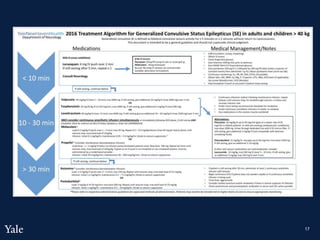
• Help! My patient is having a seizure!
• Remember your ABCs – O2, turn patient on side, move
objects away from patient
• Do not attempt to hold down patient or place anything in
patient’s mouth
• Give Ativan IV 2-4 mg IV at 2-3 minute mark
• If patient has stopped seizing by time Ativan is drawn up
and ready to give, do not give
• May repeat Ativan dose x1 if patient still seizing after an
additional 5 minutes
• Check a full set of labs, including a fingerstick
glucose
• Page/call neurology
16
17
Seizures
• Things we may ask you:
• How long did the seizure-activity last?
• What did the patient look like during the seizure?
• Eyes deviated to one side or the other?
• Head turned?
• Any evidence of tongue bite? Urinary/bowel
incontinence?
• Was the patient post-ictal after event? If so, how
long did that last?
• Any recent medication changes?
18
Seizures
• AEDs = antiepileptics
• We will help you figure out if your patient needs
AEDs
• That being said, if for some reason you can’t
get in touch with us, keppra 40-60 mg/kg (max
4.5 g) IV is a very good initial AED choice
• If your patient was on/supposed to be on AEDs
prior to seizure, PLEASE send all levels prior
to loading with an AED
19
Antiepileptics (AEDs)
• Never hold a patient’s antiepileptics
• Getting surgery? Make sure NPO order says ok for meds
• No enteral access? Talk to pharmacy and/or us
• Do not adjust patient’s antiepileptics without touching
base with us (hint: this is a great curbside question!)
• AED levels are guidelines. Some of our patients live happily at
”subtherapeutic” levels, and some we want at consistently
“supratherapeutic” levels
• We love when primary teams check levels. That being said,
please call us before you change the patient’s medications
• Medications to avoid in patients with seizures:
• Tramadol/Ultram
• Wellbutrin/bupropion
• Ciprofloxacin
20
Antiepileptics
Patient w/o enteral access
• Never hold a patient’s antiepileptics
• Speak to pharmacy and/or curbside us for help
converting PO meds to IV
• There are several AEDs that do not have an IV
equivalent
• Examples: oxcarbazepine/carbamazepine, onfi,
lamotrigine
• Call us and we will help review the patient’s chart
and see if we need to formally follow (for
complicated patients) or if there is no option but to
place an NG/NJ tube
21
Seizures
Special Circumstances
• Alcohol withdrawal seizure
• Treat the alcohol withdrawal
• There is no role for AEDs, cEEG or a neurology consult
• Seizure due to severe metabolic derangements
• Hypo/hyperglycemia, severe hypocalcemia,
hypomagnesia, hyponatremia
• No role for AEDs. Treatment is fixing underlying
condition
• PNES (formally diagnosed, not suspected)
• Do not treat seizures with Ativan/benzos/AEDs
• Call psych/BIT team for assistance with management
22
PNES/Conversion Disorder
• What is PNES?
• Psychogenic non-epileptic spells/seizures
• Diagnosed with continuous EEG monitoring –
spells/events captured without evidence of a correlate
on EEG
• Treated with cognitive behavioral therapy
• Conversion disorders
• With the exception of PNES, no definitive neurologic test
exists to confirm a diagnosis of conversion disorder
• Diagnosis based on clinical suspicion/diagnosis of
exclusion
23
Conversion Disorder
• How should I think about a patient that I suspect
has conversion disorder?
• Does the problem localize?
• I.e. Is there somewhere along the neuro-axis that could
cause these symptoms?
• Does my exam fit with what the patient is telling me?
• Give-way weakness
• Hoover sign
• Patient unable to lift legs from bed, but is able to walk
• Does the presentation make sense?
• How is my patient acting about their symptoms?
• La belle indifference
• Remember, conversion disorder ≠ malingering
24
Altered Mental Status
(AMS)
• #1 cause of AMS in hospitalized patients?
25
Altered Mental Status
(AMS)
• #1 cause of AMS in hospitalized patients?
• DELIRIUM
• #2 cause?
26
Altered Mental Status
(AMS)
• #1 cause of AMS in hospitalized patients?
• Delirium
• #2 cause?
• Toxic metabolic causes
27
Altered Mental Status
Delirium
• Who is at risk?
• Patients with pre-existing cognitive impairment
• Age >80 y/o
• Male gender
• Prolonged hospitalization
• Notably if patient was in an ICU setting at some point
during their hospitalization
• Admitted with an active infection
• Hx of EtOH/substance abuse
• Sedative/narcotic use
28
Altered Mental Status
Delirium
• Characteristics
• Waxing/waning mental status
• Reversal of sleep-wake cycle
• May be hypoactive or hyperactive
• Treatment – delirium precautions!
• Maintaining normal sleep-wake cycles
• Minimizing care/disruptions over night
• Keeping windows open during the day
• Frequent re-orientation
• Minimizing use of sedatives/narcotics/neuroleptics
• Benzodiazepines are almost never the right choice in treating
delirium!!!
29
Altered Mental Status
Delirium
• Remember that a ounce of prevention is worth
a pound of treatment!
• Melatonin
• Critical look at orders requiring care overnight
30
Altered Mental Status
Toxic metabolic causes
• Metabolic derangements
• Hypo/hyperglycemia
• Hypo/hypernatremia
• Hypercalcemia
• Hypercarbia/hypoxemia
• Hypotension
• EtOH intoxication/withdrawal
• Benzo/opiate intoxication/withdrawal
• Infections
• Fever/sepsis
• UTI – AMS/delirium is considered a symptom of a urinary tract infection
• Other
• Hyperammonemia
• Low thiamine levels (Wernicke’s encephalopathy)
• Low vitamin B12 levels
31
Altered Mental Status
Need for Neurology Consult
• Toxic metabolic causes and delirium
considered and felt to be inadequate to explain
patient’s presentation/degree of AMS
• What work-up should be done prior to calling
neurology?
• Look at patient’s medication list – anything that can
be cleaned up that may be contributing?
• TSH/T4, CMP, Ca/Mg/Phos, ammonia, vitamin B12,
thiamine level
• UA/infectious w/u, ABG in appropriate patients
32
Altered Mental Status
Need for Neurology Consult
• What information should I have when I call
neurology?
• Baseline cognitive status
• Description of current mental status
• Results of above basic serum w/u
• Should I order imaging before I call neurology?
• No (In the absence of focal neurological deficits)
• Often negative/non-contributory
• MRI in particular often difficult for altered patients to tolerate,
requiring sedation/neuroleptic medications to obtain →
worsening delirium
• We will help you decide if further neuroimaging is
indicated on a case-by-case basis
33
Migraines/HA
• Migraines: moderate to severe unilateral or
bilateral headache, throbbing vs pressure-like in
quality, accompanied by photophobia +/-
phonophobia +/- nausea/vomiting +/- aura
• Red flags on history
• Acute onset worst headache of life
• Worse with lying down or Valsalva maneuver
• New onset headaches after the age of 50
• Red flags on exam
• Decreased LOC
• Fever
• Papilledema
• Focal neurologic deficit
34
Migraines/HA
• 2SNOOP4 = acronym for secondary causes of headaches
• Systemic disease – cancer, chemo tx (PRES)
HIV/immunocompromised
• Systemic signs – fever, weight loss
• Neurological deficits beyond aura – ↓ LOC, seizures, focal deficit
• Onset <2 min - “thunderclap HA,” SAH
• Older – onset of headaches after age 50
• Papilledema
• Positional
• Worse w/ lying down = ↑ ICP (concern for mass lesion vs
hydrocephalus)
• Worse w/ standing up = ↓ ICP (concern for post-LP/low pressure HA)
• Prior HA different
• Precipitants – notably if HA only occurs w/ severe coughing or
sexual activity
35
Migraines/HA
• Inpatient consult
• Red flag signs/symptoms
• Exceptions:
• Post-LP headaches in patients not tapped by neurology
generally managed by pain service
• Clear bacterial meningitis
• Outpatient referral
• Failed trial of first line triptan (sumatriptan 50-100
mg)
• Minimum 4 headache days a month
36
Migraines/HA
• Does my headache patient need brain
imaging?
37
Migraines/HA
• Does my headache patient need brain
imaging?
• Answer is usually no
• Part of the Choosing Wisely campaign is dedicated
to reducing the use of brain imaging in migraine
When does a headache patient need imaging?
• Red flag signs/symptoms
• Onset after age 50
• Complicated migraines
• Migraines associated with focal neurologic deficits
• Headaches that consistently occur after exercise or sexual
activity
38
Migraines
• Abortive treatment algorithm
• Outpatient PO regimen: sumatriptan 50-100 mg + reglan
10 mg + NSAIDs
• Inpatient IV regimen:
• Toradol 15-30 mg IV + reglan 10 mg IV + mag sulfate 2 g IV
+ NS 500-1000 cc +/- Benadryl 25-50 mg PO/IV
• Repeat q6 hrs
• Second line: Depakote 500 mg IV
• Note: check urine pregnancy on women of child bearing age
prior to administration
• Third line: DHE
• Neurology should be consulted at this point
• Medrol dose pack or solumedrol 250-500 mg IV
inpatient can reduce the risk of migraine
recurrence
39
Migraines
• What drugs should I avoid in migraine patients?
• Fioricet or other butalbital containing medications
• Opiates
• Reglan/compazine outperformed dilaudid for tx of acute HA
• Griffin JD, Mycyk MB, Kyriacou DN. Metoclopramide versus
hydromorphone for the emergency department treatment of
migraine headache. J Pain. 2008;9(1):88-94
• Friedman BW, et al. Randomized study of IV prochlorperazine
plusdiphenhydramine vs IV hydromorphone for migraine.
Neurology. 2017;89(20): 2075-2082
• Can be considered in patients w/ subdural
hematomas/recent post-op patients, however considered
treatment of last resort
40
Vertigo/Dizziness
Approach to patient
• Characterize the symptoms
• Lightheadness/near syncope?
• Check orthostatics
• Feeling of dysequilibrium?
• Usually due to sensorimotor impairment → think
peripheral neuropathy vs cerebellar pathology
• Check finger to nose for evidence of dysmetria, watch
patient walk
• True vertigo
• Sensation of room/head spinning, often accompanied by
diplopia and nausea
41
Vertigo/Dizziness
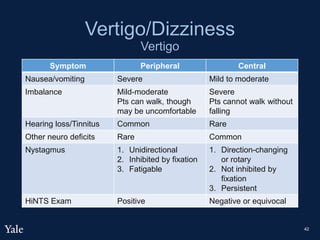
Vertigo
Symptom Peripheral Central
Nausea/vomiting Severe Mild to moderate
Imbalance Mild-moderate
Pts can walk, though
may be uncomfortable
Severe
Pts cannot walk without
falling
Hearing loss/Tinnitus Common Rare
Other neuro deficits Rare Common
Nystagmus 1. Unidirectional
2. Inhibited by fixation
3. Fatigable
1. Direction-changing
or rotary
2. Not inhibited by
fixation
3. Persistent
HiNTS Exam Positive Negative or equivocal
42
Vertigo/Dizziness
HiNTS Exam
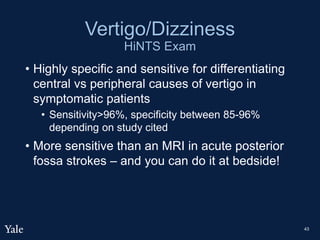
• Highly specific and sensitive for differentiating
central vs peripheral causes of vertigo in
symptomatic patients
• Sensitivity>96%, specificity between 85-96%
depending on study cited
• More sensitive than an MRI in acute posterior
fossa strokes – and you can do it at bedside!
43
Vertigo/Dizziness
HiNTS Exam
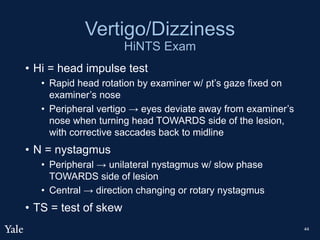
• Hi = head impulse test
• Rapid head rotation by examiner w/ pt’s gaze fixed on
examiner’s nose
• Peripheral vertigo → eyes deviate away from examiner’s
nose when turning head TOWARDS side of the lesion,
with corrective saccades back to midline
• N = nystagmus
• Peripheral → unilateral nystagmus w/ slow phase
TOWARDS side of lesion
• Central → direction changing or rotary nystagmus
• TS = test of skew
44
Vertigo/Dizziness
HiNTS Exam
• TS = test of skew
• Alternate eye cover testing
• Central → vertical misalignment of eyes on testing
• Youtube videos
• https://www.youtube.com/watch?v=VwmrjYuvqtQ
45
Vertigo/Dizziness
HiNTS Exam
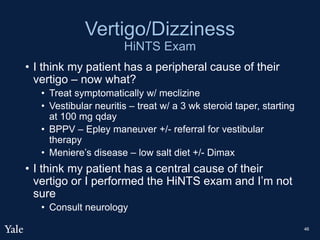
• I think my patient has a peripheral cause of their
vertigo – now what?
• Treat symptomatically w/ meclizine
• Vestibular neuritis – treat w/ a 3 wk steroid taper, starting
at 100 mg qday
• BPPV – Epley maneuver +/- referral for vestibular
therapy
• Meniere’s disease – low salt diet +/- Dimax
• I think my patient has a central cause of their
vertigo or I performed the HiNTS exam and I’m not
sure
• Consult neurology
46
Vertigo/Dizziness
Vertigo – Concern for Central Cause
• What is neurology going to ask me?
• Description of symptoms, including timing of onset
(acute vs gradual)
• Can the patient walk?
• Patients with a peripheral cause of vertigo are often
reluctant to walk because it makes them feel nauseous,
however it is incredibly important to see if they can walk!
• Please walk all patients (with precautions) before you call
neurology
• Results of HiNTS exam +/- Dix - Hallpike maneuver
47
Cardiac Arrest Patients
• Or, why won’t neurology give my patient’s
family a clear answer about long-term
prognosis?
48
Cardiac Arrest Patients
• Short answer: we usually can’t
• Neuroprognostication after cardiac arrest notoriously
difficult, with repeated studies showing
mixed/contradicting results
• Yale is part of an international research consortium attempting
to come up with better ways to answer this question
• Poor prognostic factors:
• Myoclonic status epilepticus confirmed on EEG
• Note: does not apply to patients with myoclonus on exam w/o an
EEG correlate, who can survive (Lance-Adams syndrome)
• Absent N20 on SSEPs completed >72 hrs from euthermia
• Complete/near complete loss of gray-white matter
differentiation on MRI brain completed >72 hrs from euthermia
49
Curbside Question List
• What doesn’t require a formal consult?
• Converting AEDs (anti-epileptics) from PO to IV
• First time seizure back to baseline
• Patient known to an outpatient Yale neurologist,
needs closer outpatient f/u
• How do teams reach you in these instances?
• YNHH/SRC: text resident listed in Amion on MHB
• VA: Page 203-784-1222
50
Consult List for Outpatient
• Issues that are better address in an outpatient
setting
• Normal pressure hydrocephalus (NPH)
• This is a clinical diagnosis, not a radiographic diagnosis
• Remember: “wet, wacky, wobbly”
• Dementia
• Exception: rapidly progressive dementia (precipitous
decline over <6 months w/o clear medical explanation)
• Peripheral neuropathy or other non-localizing
numbness/tingling
• Migraines without red flag symptoms
• Tremors
51
“Good” Consult Example
• What should have been assessed prior to placing a
consult?
• Please do a basic neurologic exam, including mental status
and reflexes
• For patients with AMS, basic metabolic w/u should be
completed prior to consulting neurology
• TSH/T4, ammonia, CMP, Ca/Mg/Phos, vitamin B12, thiamine, utox
• Consider ABG and UA in appropriate patients
• How should a consult be phrased?
• Clear consult question – i.e. how can we help you/what is the
primary team looking to get out of consulting us?
• Always include a current workable call-back phone
number!!
52
“Bad” Consult Example
• “AMS” with no other information and unable to
reach primary team for clarification
• Often in a patient floridly infected or with significant
metabolic derangements
• Patient/family requesting neurology
• Patient seen by neurology on an outpatient basis
• If neurologic pathology is not relevant to patient’s current
hospitalization
• Please contact primary neurologist if not in Yale system
• Alcohol withdrawal seizures/PNES
53
Summary Slide
• Key things to remember
• Stroke - acute onset of a focal deficit with last known
normal within 24 hours
• Seizure – ABCs and patient safety, Ativan 2-4 mg IV for
GTC
• AMS – metabolic/medical causes should be ruled out
prior to calling neurology. Remember that delirium is the
most common cause of AMS in hospitalized patients
• Contact information, such as pager number(s)
• YNHH: 203-370-5298
• VA: 203-784-1222
54
Summary Slide
Calling vs Texting
• CALL resident listed in Amion
• Patient actively seizing
• Not sure whether you need to call a stroke code
and in need of immediate advice
• Urgent neuro consult advice needed
• TEXT/PAGE consult pager/resident listed in
Amion
• Everything else!!
55
Questions?
56
Plug for the Neuro Consult
Service!
• Medicine residents – option to join the neuro
consult service at YNHH for 2 weeks in lieu of
doing neuro clinic at the VA
• Other residents – elective option
• Benefits?
• More direct teaching time with both the attendings
and the senior neuro residents
• See more diverse range of cases
• M-F 7-5:30 PM, no weekends!
57
Please take our survey for
Neurology!

MTC_Neuro_10.1.19_updated-QR.pptx

  • 1.
  • 2.
    Introduction • Consultant(s) background(s) •Dr Chris Traner • PGY4 + Neurology Chief Resident, Education • Staying at Yale for Epilepsy Fellowship • Dr John Picard • PGY4 + Neurology Chief Resident, Education • Staying at Yale for Neurocritical Care Fellowship 2
  • 3.
    Service Structure • Subspecialtiesand/or divisions within the service • YNHH – split teams during the day to cover inpatient vs ED consults, single resident covering for nights and weekends • General Adult Neurology: 24/7 in-house coverage • Pager: 203-370-5298 • Days: Senior resident listed on Amion • Nights: Consult resident listed on Amion • ED: Logged into dynamic role on MHB • Neuro-oncology: M–F 8:30-5 only • Pager: 203-370-3609 • Exception to above: • Patients physically located in the YNHH SICU are covered by the Neuro ICU fellow (listed on Amion) 3
  • 4.
    Service Structure Pediatric Neurology •Covered by a separate team during weekdays • M-F 7-5:30 • Resident on call listed on Amion • Covers both inpatient and ED pediatric consults • Nights • Consult resident covers both pediatric and adult consults • Weekends • Contact the resident listed on Amion for new consults • Contact the attending for questions on old consults 4
  • 5.
    Service Structure • Subspecialtiesand/or divisions within the service • Everywhere else • General Neurology only, single team structure • Locations • SRC • M-F 9-5: Resident listed in Amion • Nights/weekends: Attending listed in Amion • NO RESIDENT COVERAGE • VA: 24/7 coverage • Pager: 203-784-1222 • Note that we are on home call on nights and weekends for the VA 5
  • 6.
    What about theother Neuro Subspecialties? • Contact the general neurology consult service first • There are subspecialty fellows listed on Amion, but for the most part all consults other than neuro-onc should go through the consult service. We will be happy to help put you in contact with the subspecialists as appropriate 6
  • 7.
    What about procedures? •EEG • Neurology does not need to be consulted to order an EEG • That being said, consult service should be aware of any patient that a continuous EEG is ordered on, particularly as it is the consult resident who checks on EEGs overnight (not the epilepsy fellow) • Please note that EEG is not available overnight or on weekends at the VA • EMG • Rarely indicated inpatient. Neurology consult service should be aware of any patient that this is being ordered on to determine if it is appropriate • While an Epic order technically exists for this, it will not happen without the Neurology team being contacted 7
  • 8.
    What about procedures? •Lumbar punctures • As a department policy, we do not perform lumbar punctures on patients not admitted to one of our primary services for patient safety reasons • I’m not signed off on LPs, what should I do? • Weekdays: Contact the hospital procedure team (Will Cushing) • Nights/weekends: Reach out to the MICU 8
  • 9.
    Service Flow • Howdo I place a consult? • YNHH/SRC – Epic order • Please include a phone number that we can reach you at! • VA – call pager (203-784-1222) • Not sure you need a formal consult? • YNHH: page 370-5298 or text resident on MHB • SRC: text resident on MHB • What’s the best time of day to place consults? • Late morning/early afternoon preferred • Non-urgent consults should ideally be minimized overnight or on weekends 9
  • 10.
    Service Flow • Whenshould teams expect to hear back and/or see notes in Epic? • We try our best to return all pages/texts/new consult requests within 15-20 minutes • Note that this may be a touch longer on nights/weekends if the consult resident is involved in an emergency • All consults are seen and staffed by an attending within 24 hours 10
  • 11.
    Stroke Codes • Whenshould a stroke code be called? • Acute onset of a focal neurologic deficit • Patient last known normal within 24 hours • What is a focal neurologic deficit? • FAST – face, arm, speech, time • Aphasia: inability to speak and/or inability to follow commands • Unilateral weakness • Unilateral numbness 11
  • 12.
    Stroke Codes • Ok,I called a stroke code. Now what? • VA nights/weekends: page/call neurology • SRC: nights/weekends covered by tele-stroke attending • YNHH: we are on our way. No need to call/place an Epic consult order • What information should I be looking up while I’m waiting for neurology (at YNHH)? • Last known normal • Medication list – notably if patient on anticoagulation, and if so, when was their last dose (NOACs) or last INR • Last set of labs – glucose, platelets, coags 12
  • 13.
    Stroke Codes • Help!I’m at the VA/SRC overnight/on a weekend and neurology isn’t in house! • FIRST: perform a NIHSS stroke scale • Available in MedCalc and IV Stroke Thrombolysis apps • All crash carts have a set of stroke cards (the pink ones) attached for you to use • The neurology resident (VA) or the tele-stroke attending (SRC) will help you with next steps based on the story and presentation 13
  • 14.
  • 15.
    Stroke Codes • Whenshouldn’t I call a stroke code? • Altered mental status (AMS) without any evidence of focal deficits on exam • Bilateral weakness or numbness w/o change in LOC • CT/MRI brain shows evidence of an acute/subacute/chronic stroke with patient’s last known normal >24 hours ago or patient asymptomatic • Seizure • Desire for urgent neuro consult 15
  • 16.
    Seizures • Help! Mypatient is having a seizure! • Remember your ABCs – O2, turn patient on side, move objects away from patient • Do not attempt to hold down patient or place anything in patient’s mouth • Give Ativan IV 2-4 mg IV at 2-3 minute mark • If patient has stopped seizing by time Ativan is drawn up and ready to give, do not give • May repeat Ativan dose x1 if patient still seizing after an additional 5 minutes • Check a full set of labs, including a fingerstick glucose • Page/call neurology 16
  • 17.
  • 18.
    Seizures • Things wemay ask you: • How long did the seizure-activity last? • What did the patient look like during the seizure? • Eyes deviated to one side or the other? • Head turned? • Any evidence of tongue bite? Urinary/bowel incontinence? • Was the patient post-ictal after event? If so, how long did that last? • Any recent medication changes? 18
  • 19.
    Seizures • AEDs =antiepileptics • We will help you figure out if your patient needs AEDs • That being said, if for some reason you can’t get in touch with us, keppra 40-60 mg/kg (max 4.5 g) IV is a very good initial AED choice • If your patient was on/supposed to be on AEDs prior to seizure, PLEASE send all levels prior to loading with an AED 19
  • 20.
    Antiepileptics (AEDs) • Neverhold a patient’s antiepileptics • Getting surgery? Make sure NPO order says ok for meds • No enteral access? Talk to pharmacy and/or us • Do not adjust patient’s antiepileptics without touching base with us (hint: this is a great curbside question!) • AED levels are guidelines. Some of our patients live happily at ”subtherapeutic” levels, and some we want at consistently “supratherapeutic” levels • We love when primary teams check levels. That being said, please call us before you change the patient’s medications • Medications to avoid in patients with seizures: • Tramadol/Ultram • Wellbutrin/bupropion • Ciprofloxacin 20
  • 21.
    Antiepileptics Patient w/o enteralaccess • Never hold a patient’s antiepileptics • Speak to pharmacy and/or curbside us for help converting PO meds to IV • There are several AEDs that do not have an IV equivalent • Examples: oxcarbazepine/carbamazepine, onfi, lamotrigine • Call us and we will help review the patient’s chart and see if we need to formally follow (for complicated patients) or if there is no option but to place an NG/NJ tube 21
  • 22.
    Seizures Special Circumstances • Alcoholwithdrawal seizure • Treat the alcohol withdrawal • There is no role for AEDs, cEEG or a neurology consult • Seizure due to severe metabolic derangements • Hypo/hyperglycemia, severe hypocalcemia, hypomagnesia, hyponatremia • No role for AEDs. Treatment is fixing underlying condition • PNES (formally diagnosed, not suspected) • Do not treat seizures with Ativan/benzos/AEDs • Call psych/BIT team for assistance with management 22
  • 23.
    PNES/Conversion Disorder • Whatis PNES? • Psychogenic non-epileptic spells/seizures • Diagnosed with continuous EEG monitoring – spells/events captured without evidence of a correlate on EEG • Treated with cognitive behavioral therapy • Conversion disorders • With the exception of PNES, no definitive neurologic test exists to confirm a diagnosis of conversion disorder • Diagnosis based on clinical suspicion/diagnosis of exclusion 23
  • 24.
    Conversion Disorder • Howshould I think about a patient that I suspect has conversion disorder? • Does the problem localize? • I.e. Is there somewhere along the neuro-axis that could cause these symptoms? • Does my exam fit with what the patient is telling me? • Give-way weakness • Hoover sign • Patient unable to lift legs from bed, but is able to walk • Does the presentation make sense? • How is my patient acting about their symptoms? • La belle indifference • Remember, conversion disorder ≠ malingering 24
  • 25.
    Altered Mental Status (AMS) •#1 cause of AMS in hospitalized patients? 25
  • 26.
    Altered Mental Status (AMS) •#1 cause of AMS in hospitalized patients? • DELIRIUM • #2 cause? 26
  • 27.
    Altered Mental Status (AMS) •#1 cause of AMS in hospitalized patients? • Delirium • #2 cause? • Toxic metabolic causes 27
  • 28.
    Altered Mental Status Delirium •Who is at risk? • Patients with pre-existing cognitive impairment • Age >80 y/o • Male gender • Prolonged hospitalization • Notably if patient was in an ICU setting at some point during their hospitalization • Admitted with an active infection • Hx of EtOH/substance abuse • Sedative/narcotic use 28
  • 29.
    Altered Mental Status Delirium •Characteristics • Waxing/waning mental status • Reversal of sleep-wake cycle • May be hypoactive or hyperactive • Treatment – delirium precautions! • Maintaining normal sleep-wake cycles • Minimizing care/disruptions over night • Keeping windows open during the day • Frequent re-orientation • Minimizing use of sedatives/narcotics/neuroleptics • Benzodiazepines are almost never the right choice in treating delirium!!! 29
  • 30.
    Altered Mental Status Delirium •Remember that a ounce of prevention is worth a pound of treatment! • Melatonin • Critical look at orders requiring care overnight 30
  • 31.
    Altered Mental Status Toxicmetabolic causes • Metabolic derangements • Hypo/hyperglycemia • Hypo/hypernatremia • Hypercalcemia • Hypercarbia/hypoxemia • Hypotension • EtOH intoxication/withdrawal • Benzo/opiate intoxication/withdrawal • Infections • Fever/sepsis • UTI – AMS/delirium is considered a symptom of a urinary tract infection • Other • Hyperammonemia • Low thiamine levels (Wernicke’s encephalopathy) • Low vitamin B12 levels 31
  • 32.
    Altered Mental Status Needfor Neurology Consult • Toxic metabolic causes and delirium considered and felt to be inadequate to explain patient’s presentation/degree of AMS • What work-up should be done prior to calling neurology? • Look at patient’s medication list – anything that can be cleaned up that may be contributing? • TSH/T4, CMP, Ca/Mg/Phos, ammonia, vitamin B12, thiamine level • UA/infectious w/u, ABG in appropriate patients 32
  • 33.
    Altered Mental Status Needfor Neurology Consult • What information should I have when I call neurology? • Baseline cognitive status • Description of current mental status • Results of above basic serum w/u • Should I order imaging before I call neurology? • No (In the absence of focal neurological deficits) • Often negative/non-contributory • MRI in particular often difficult for altered patients to tolerate, requiring sedation/neuroleptic medications to obtain → worsening delirium • We will help you decide if further neuroimaging is indicated on a case-by-case basis 33
  • 34.
    Migraines/HA • Migraines: moderateto severe unilateral or bilateral headache, throbbing vs pressure-like in quality, accompanied by photophobia +/- phonophobia +/- nausea/vomiting +/- aura • Red flags on history • Acute onset worst headache of life • Worse with lying down or Valsalva maneuver • New onset headaches after the age of 50 • Red flags on exam • Decreased LOC • Fever • Papilledema • Focal neurologic deficit 34
  • 35.
    Migraines/HA • 2SNOOP4 =acronym for secondary causes of headaches • Systemic disease – cancer, chemo tx (PRES) HIV/immunocompromised • Systemic signs – fever, weight loss • Neurological deficits beyond aura – ↓ LOC, seizures, focal deficit • Onset <2 min - “thunderclap HA,” SAH • Older – onset of headaches after age 50 • Papilledema • Positional • Worse w/ lying down = ↑ ICP (concern for mass lesion vs hydrocephalus) • Worse w/ standing up = ↓ ICP (concern for post-LP/low pressure HA) • Prior HA different • Precipitants – notably if HA only occurs w/ severe coughing or sexual activity 35
  • 36.
    Migraines/HA • Inpatient consult •Red flag signs/symptoms • Exceptions: • Post-LP headaches in patients not tapped by neurology generally managed by pain service • Clear bacterial meningitis • Outpatient referral • Failed trial of first line triptan (sumatriptan 50-100 mg) • Minimum 4 headache days a month 36
  • 37.
    Migraines/HA • Does myheadache patient need brain imaging? 37
  • 38.
    Migraines/HA • Does myheadache patient need brain imaging? • Answer is usually no • Part of the Choosing Wisely campaign is dedicated to reducing the use of brain imaging in migraine When does a headache patient need imaging? • Red flag signs/symptoms • Onset after age 50 • Complicated migraines • Migraines associated with focal neurologic deficits • Headaches that consistently occur after exercise or sexual activity 38
  • 39.
    Migraines • Abortive treatmentalgorithm • Outpatient PO regimen: sumatriptan 50-100 mg + reglan 10 mg + NSAIDs • Inpatient IV regimen: • Toradol 15-30 mg IV + reglan 10 mg IV + mag sulfate 2 g IV + NS 500-1000 cc +/- Benadryl 25-50 mg PO/IV • Repeat q6 hrs • Second line: Depakote 500 mg IV • Note: check urine pregnancy on women of child bearing age prior to administration • Third line: DHE • Neurology should be consulted at this point • Medrol dose pack or solumedrol 250-500 mg IV inpatient can reduce the risk of migraine recurrence 39
  • 40.
    Migraines • What drugsshould I avoid in migraine patients? • Fioricet or other butalbital containing medications • Opiates • Reglan/compazine outperformed dilaudid for tx of acute HA • Griffin JD, Mycyk MB, Kyriacou DN. Metoclopramide versus hydromorphone for the emergency department treatment of migraine headache. J Pain. 2008;9(1):88-94 • Friedman BW, et al. Randomized study of IV prochlorperazine plusdiphenhydramine vs IV hydromorphone for migraine. Neurology. 2017;89(20): 2075-2082 • Can be considered in patients w/ subdural hematomas/recent post-op patients, however considered treatment of last resort 40
  • 41.
    Vertigo/Dizziness Approach to patient •Characterize the symptoms • Lightheadness/near syncope? • Check orthostatics • Feeling of dysequilibrium? • Usually due to sensorimotor impairment → think peripheral neuropathy vs cerebellar pathology • Check finger to nose for evidence of dysmetria, watch patient walk • True vertigo • Sensation of room/head spinning, often accompanied by diplopia and nausea 41
  • 42.
    Vertigo/Dizziness Vertigo Symptom Peripheral Central Nausea/vomitingSevere Mild to moderate Imbalance Mild-moderate Pts can walk, though may be uncomfortable Severe Pts cannot walk without falling Hearing loss/Tinnitus Common Rare Other neuro deficits Rare Common Nystagmus 1. Unidirectional 2. Inhibited by fixation 3. Fatigable 1. Direction-changing or rotary 2. Not inhibited by fixation 3. Persistent HiNTS Exam Positive Negative or equivocal 42
  • 43.
    Vertigo/Dizziness HiNTS Exam • Highlyspecific and sensitive for differentiating central vs peripheral causes of vertigo in symptomatic patients • Sensitivity>96%, specificity between 85-96% depending on study cited • More sensitive than an MRI in acute posterior fossa strokes – and you can do it at bedside! 43
  • 44.
    Vertigo/Dizziness HiNTS Exam • Hi= head impulse test • Rapid head rotation by examiner w/ pt’s gaze fixed on examiner’s nose • Peripheral vertigo → eyes deviate away from examiner’s nose when turning head TOWARDS side of the lesion, with corrective saccades back to midline • N = nystagmus • Peripheral → unilateral nystagmus w/ slow phase TOWARDS side of lesion • Central → direction changing or rotary nystagmus • TS = test of skew 44
  • 45.
    Vertigo/Dizziness HiNTS Exam • TS= test of skew • Alternate eye cover testing • Central → vertical misalignment of eyes on testing • Youtube videos • https://www.youtube.com/watch?v=VwmrjYuvqtQ 45
  • 46.
    Vertigo/Dizziness HiNTS Exam • Ithink my patient has a peripheral cause of their vertigo – now what? • Treat symptomatically w/ meclizine • Vestibular neuritis – treat w/ a 3 wk steroid taper, starting at 100 mg qday • BPPV – Epley maneuver +/- referral for vestibular therapy • Meniere’s disease – low salt diet +/- Dimax • I think my patient has a central cause of their vertigo or I performed the HiNTS exam and I’m not sure • Consult neurology 46
  • 47.
    Vertigo/Dizziness Vertigo – Concernfor Central Cause • What is neurology going to ask me? • Description of symptoms, including timing of onset (acute vs gradual) • Can the patient walk? • Patients with a peripheral cause of vertigo are often reluctant to walk because it makes them feel nauseous, however it is incredibly important to see if they can walk! • Please walk all patients (with precautions) before you call neurology • Results of HiNTS exam +/- Dix - Hallpike maneuver 47
  • 48.
    Cardiac Arrest Patients •Or, why won’t neurology give my patient’s family a clear answer about long-term prognosis? 48
  • 49.
    Cardiac Arrest Patients •Short answer: we usually can’t • Neuroprognostication after cardiac arrest notoriously difficult, with repeated studies showing mixed/contradicting results • Yale is part of an international research consortium attempting to come up with better ways to answer this question • Poor prognostic factors: • Myoclonic status epilepticus confirmed on EEG • Note: does not apply to patients with myoclonus on exam w/o an EEG correlate, who can survive (Lance-Adams syndrome) • Absent N20 on SSEPs completed >72 hrs from euthermia • Complete/near complete loss of gray-white matter differentiation on MRI brain completed >72 hrs from euthermia 49
  • 50.
    Curbside Question List •What doesn’t require a formal consult? • Converting AEDs (anti-epileptics) from PO to IV • First time seizure back to baseline • Patient known to an outpatient Yale neurologist, needs closer outpatient f/u • How do teams reach you in these instances? • YNHH/SRC: text resident listed in Amion on MHB • VA: Page 203-784-1222 50
  • 51.
    Consult List forOutpatient • Issues that are better address in an outpatient setting • Normal pressure hydrocephalus (NPH) • This is a clinical diagnosis, not a radiographic diagnosis • Remember: “wet, wacky, wobbly” • Dementia • Exception: rapidly progressive dementia (precipitous decline over <6 months w/o clear medical explanation) • Peripheral neuropathy or other non-localizing numbness/tingling • Migraines without red flag symptoms • Tremors 51
  • 52.
    “Good” Consult Example •What should have been assessed prior to placing a consult? • Please do a basic neurologic exam, including mental status and reflexes • For patients with AMS, basic metabolic w/u should be completed prior to consulting neurology • TSH/T4, ammonia, CMP, Ca/Mg/Phos, vitamin B12, thiamine, utox • Consider ABG and UA in appropriate patients • How should a consult be phrased? • Clear consult question – i.e. how can we help you/what is the primary team looking to get out of consulting us? • Always include a current workable call-back phone number!! 52
  • 53.
    “Bad” Consult Example •“AMS” with no other information and unable to reach primary team for clarification • Often in a patient floridly infected or with significant metabolic derangements • Patient/family requesting neurology • Patient seen by neurology on an outpatient basis • If neurologic pathology is not relevant to patient’s current hospitalization • Please contact primary neurologist if not in Yale system • Alcohol withdrawal seizures/PNES 53
  • 54.
    Summary Slide • Keythings to remember • Stroke - acute onset of a focal deficit with last known normal within 24 hours • Seizure – ABCs and patient safety, Ativan 2-4 mg IV for GTC • AMS – metabolic/medical causes should be ruled out prior to calling neurology. Remember that delirium is the most common cause of AMS in hospitalized patients • Contact information, such as pager number(s) • YNHH: 203-370-5298 • VA: 203-784-1222 54
  • 55.
    Summary Slide Calling vsTexting • CALL resident listed in Amion • Patient actively seizing • Not sure whether you need to call a stroke code and in need of immediate advice • Urgent neuro consult advice needed • TEXT/PAGE consult pager/resident listed in Amion • Everything else!! 55
  • 56.
  • 57.
    Plug for theNeuro Consult Service! • Medicine residents – option to join the neuro consult service at YNHH for 2 weeks in lieu of doing neuro clinic at the VA • Other residents – elective option • Benefits? • More direct teaching time with both the attendings and the senior neuro residents • See more diverse range of cases • M-F 7-5:30 PM, no weekends! 57
  • 58.
    Please take oursurvey for Neurology!