THE UNIQUENESS
AND SIMILARITIES OF
MAHAYANA AND
THERAVADA
BUDDHISM
LEARNING COMPETENCY
Explain the uniqueness and
similarities of Mahayana and
Theravada Buddhism
LEARNING OBJECTIVES
1. Define Mahayana and Theravada Buddhism;
2. State the evidences that Mahayana and
Theravada Buddhism share common roots from
India
3. Identify the uniqueness and similarities of
Mahayana and Theravada Buddhism and
4. Discuss the uniqueness and similarities of
Mahayana and Theravada Buddhism.
ORIGIN
Buddhism traces its origins in northern India around
the sixth century B.C.E. as another interpretation of
the Hindu belief.This religion is closely linked to its
founder Siddhartha Gautama who is also referred
to as the Buddha or the “Enlightened One.” A son of a
Kshatriya chief, the once affluent Siddhartha
abandoned the comfort of his palace and family as
he set to discover the remedy to universal suffering
he observed in this world.
THERAVADA AND MAHAYANA
Both schools owe their fundamental
teachings to the Buddha whose life
has become an inspiration to
millions of followers all over the
world
GREAT AND SMALL VEHICLES
“Mahayana” signifies “The Great Vehicle,”
“Hinayana (Theravada) Buddhism signifies
“The Small Vehicle.”
Vehicle = “means, way or path toward
nirvana.”
Mahayana tradition:
they believe in a bodhisattva, who postpones
his/her entry to the state of nirvana to help
others attain enlightenment.
A bodhisattva helps others to be on the same
ferryboat that he/she is riding toward nirvana.
Theravada tradition:
each enlightened person, called an arhat,
enters nirvana individually. Thus, each arhat
needs to be in just a small ferryboat,
enough to accommodate one enlightened
being (thus a “small vehicle”).
Theravada Buddhism:
dominant in Thailand, Sri Lanka,
Laos,
Cambodia, and Myanmar (formerly
Burma).
Mahayana Buddhism
dominant in China, Japan, and Korea.
MORALITY
the cycle of rebirth persists in Buddhism and
succeeding lives may be affected by the moral
laws of cause and effect or karma. Until one has
achieved enlightenment, one’s deed in the
present lifetime will affect the course of future
rebirths.
MORALITY
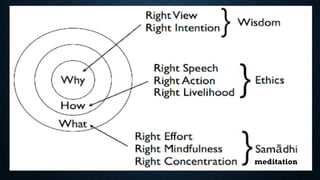
Buddhist moral thoughts and actions are
principally guided by the “Four Noble Truths”
formulated by the Buddha, along with the basic
guide called the “Eightfold Paths” that are
divided into three categories.
meditation
PURPOSE
In Buddhism, the principal purpose of
one’s life is to terminate all forms of
suffering caused by attachment to
impermanent entities, such as material
things, friends, and health. All these do
not offer enduring happiness but sorrow.
PURPOSE
When one recognizes the impermanence of all
these things, an individual begins to free one’s
self from attachment thereby reducing suffering
and ending the cycle of rebirth. Buddha’s
teachings on the “Four Noble Truths” and the
“Noble Eightfold Path” form the basic tenets of
all Buddhist sects
Theravada Buddhism
the monastic way of life ensures the path
toward enlightenment. For the Buddhist laity,
they must first be reborn as monks for them to
be eligible for enlightenment. As members of
the laity perform good deeds, positive karma
may bring forth a pleasant condition in the
next life.
Mahayana Buddhism
attracts followers because it
offers a faster route to
enlightenment than the
Theravada sect
DESTINY
In the Theravada school of Buddhism, the
trainings on the development of ethical conduct,
meditation, and insight assist in eradicating all
forms of evil to acquire goodness and purify the
mind. All worldly things are momentary and
impermanent. By following the “Middle Path” and
practicing the basic doctrines of Buddhism
DESTINY
Mahayana sect devotes much attention to
the bodhisattvas or “enlightened beings”
who delay their own enlightenment for them
to benevolently aid other beings to reach
their ultimate end. All beings can follow the
path of the bodhisattvas which is the ideal
way for all Buddhists to live.
ARHATS AND BODHISATTVAS
For Theravada Buddhism, the ideal
Buddhist is called an arhat (Sanskrit; Pali:
arahat, which means “perfect being,” “one
who is worthy” while for Mahayana
Buddhism, it is called a bodhisattva
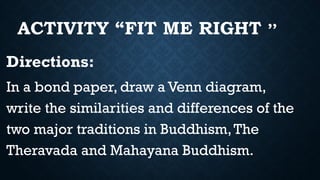
ACTIVITY “FIT ME RIGHT ’’
Directions:
In a bond paper, draw a Venn diagram,
write the similarities and differences of the
two major traditions in Buddhism,The
Theravada and Mahayana Buddhism.
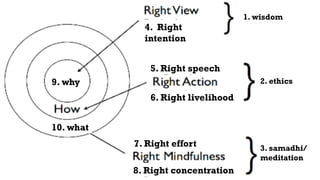
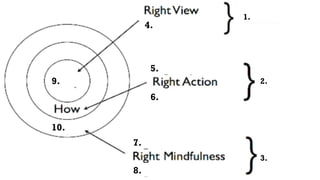
ACTIVITY 4: “FILL ME”
Directions:
Fill in the empty
circles with your
answer. Use a
separate sheet
for your answer.
Q2- SUMMATIVE TEST IN HUMANITIES
Directions: Choose the letter that best
represents your answer from the choices.
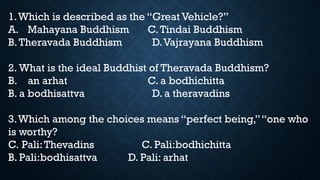
1.Which is described as the “Great Vehicle?”
A. Mahayana Buddhism C.Tindai Buddhism
B.Theravada Buddhism D.Vajrayana Buddhism
2. What is the ideal Buddhist of Theravada Buddhism?
B. an arhat C. a bodhichitta
B. a bodhisattva D. a theravadins
3.Which among the choices means “perfect being,”“one who
is worthy?
C. Pali:Thevadins C. Pali:bodhichitta
B. Pali:bodhisattva D. Pali: arhat
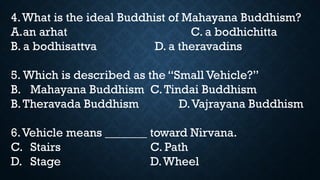
4.What is the ideal Buddhist of Mahayana Buddhism?
A.an arhat C. a bodhichitta
B. a bodhisattva D. a theravadins
5. Which is described as the “Small Vehicle?”
B. Mahayana Buddhism C.Tindai Buddhism
B.Theravada Buddhism D.Vajrayana Buddhism
6.Vehicle means _______ toward Nirvana.
C. Stairs C. Path
D. Stage D.Wheel
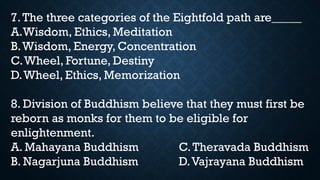
7.The three categories of the Eightfold path are_____
A.Wisdom, Ethics, Meditation
B.Wisdom, Energy, Concentration
C.Wheel, Fortune, Destiny
D.Wheel, Ethics, Memorization
8. Division of Buddhism believe that they must first be
reborn as monks for them to be eligible for
enlightenment.
A. Mahayana Buddhism C.Theravada Buddhism
B. Nagarjuna Buddhism D.Vajrayana Buddhism
9.What is called as the basic guide in Buddhism
A. Four Noble Truths
B. Eightfold Path
C.Tripitaka
D. Jewels of Buddhism
10. Mahayana Buddhism is dominant in what
countries?
A. India, Japan, Philippines C. China, Japan, and
Korea
B. China, Laos, Egypt D. Korea, USA,
Spain
Directions: Fill in the blanks before each
number with your correct answer.Write
TB for Theravada Buddhism and MB for
Mahayana Buddhism.
____11. Called “The Greater Vehicle”
____12. Bodhisattva
____13. Called “The Schools of Elders”
____14.The ideal Buddhist is called an arhat
____15. Mainly practiced in Sri Lanka
____16. Small Ferryboat
____17. Faster route to enlightenment
____18. Mainly practice in China
____19. Also called as Hinayana
____20. Postpones his/her entry to the state of nirvana
to help others attain enlightenment.
Directions: For 10 points. 21-30
1.
2.
3.
4.
5.
6.
7.
8.
9.
10.
1. A
2. A
3. D
4. B
5. B
6. C
7. A
8. C
9. B
10. C
1. MB
2. MB
3.TB
4.TB
5.TB
6.TB
7. MB
8. MB
9.TB
10. MB
1. wisdom
2. ethics
3. samadhi/
meditation
4. Right
intention
5. Right speech
6. Right livelihood
7. Right effort
8. Right concentration
9. why
10. what

LESSON 3 - UNIQUENESS AND SIMILARITIES.pptx

  • 1.
    THE UNIQUENESS AND SIMILARITIESOF MAHAYANA AND THERAVADA BUDDHISM
  • 2.
    LEARNING COMPETENCY Explain theuniqueness and similarities of Mahayana and Theravada Buddhism
  • 3.
    LEARNING OBJECTIVES 1. DefineMahayana and Theravada Buddhism; 2. State the evidences that Mahayana and Theravada Buddhism share common roots from India 3. Identify the uniqueness and similarities of Mahayana and Theravada Buddhism and 4. Discuss the uniqueness and similarities of Mahayana and Theravada Buddhism.
  • 4.
    ORIGIN Buddhism traces itsorigins in northern India around the sixth century B.C.E. as another interpretation of the Hindu belief.This religion is closely linked to its founder Siddhartha Gautama who is also referred to as the Buddha or the “Enlightened One.” A son of a Kshatriya chief, the once affluent Siddhartha abandoned the comfort of his palace and family as he set to discover the remedy to universal suffering he observed in this world.
  • 5.
    THERAVADA AND MAHAYANA Bothschools owe their fundamental teachings to the Buddha whose life has become an inspiration to millions of followers all over the world
  • 6.
    GREAT AND SMALLVEHICLES “Mahayana” signifies “The Great Vehicle,” “Hinayana (Theravada) Buddhism signifies “The Small Vehicle.” Vehicle = “means, way or path toward nirvana.”
  • 7.
    Mahayana tradition: they believein a bodhisattva, who postpones his/her entry to the state of nirvana to help others attain enlightenment. A bodhisattva helps others to be on the same ferryboat that he/she is riding toward nirvana.
  • 8.
    Theravada tradition: each enlightenedperson, called an arhat, enters nirvana individually. Thus, each arhat needs to be in just a small ferryboat, enough to accommodate one enlightened being (thus a “small vehicle”).
  • 9.
    Theravada Buddhism: dominant inThailand, Sri Lanka, Laos, Cambodia, and Myanmar (formerly Burma). Mahayana Buddhism dominant in China, Japan, and Korea.
  • 10.
    MORALITY the cycle ofrebirth persists in Buddhism and succeeding lives may be affected by the moral laws of cause and effect or karma. Until one has achieved enlightenment, one’s deed in the present lifetime will affect the course of future rebirths.
  • 11.
    MORALITY Buddhist moral thoughtsand actions are principally guided by the “Four Noble Truths” formulated by the Buddha, along with the basic guide called the “Eightfold Paths” that are divided into three categories.
  • 12.
  • 13.
    PURPOSE In Buddhism, theprincipal purpose of one’s life is to terminate all forms of suffering caused by attachment to impermanent entities, such as material things, friends, and health. All these do not offer enduring happiness but sorrow.
  • 14.
    PURPOSE When one recognizesthe impermanence of all these things, an individual begins to free one’s self from attachment thereby reducing suffering and ending the cycle of rebirth. Buddha’s teachings on the “Four Noble Truths” and the “Noble Eightfold Path” form the basic tenets of all Buddhist sects
  • 15.
    Theravada Buddhism the monasticway of life ensures the path toward enlightenment. For the Buddhist laity, they must first be reborn as monks for them to be eligible for enlightenment. As members of the laity perform good deeds, positive karma may bring forth a pleasant condition in the next life.
  • 16.
    Mahayana Buddhism attracts followersbecause it offers a faster route to enlightenment than the Theravada sect
  • 17.
    DESTINY In the Theravadaschool of Buddhism, the trainings on the development of ethical conduct, meditation, and insight assist in eradicating all forms of evil to acquire goodness and purify the mind. All worldly things are momentary and impermanent. By following the “Middle Path” and practicing the basic doctrines of Buddhism
  • 18.
    DESTINY Mahayana sect devotesmuch attention to the bodhisattvas or “enlightened beings” who delay their own enlightenment for them to benevolently aid other beings to reach their ultimate end. All beings can follow the path of the bodhisattvas which is the ideal way for all Buddhists to live.
  • 19.
    ARHATS AND BODHISATTVAS ForTheravada Buddhism, the ideal Buddhist is called an arhat (Sanskrit; Pali: arahat, which means “perfect being,” “one who is worthy” while for Mahayana Buddhism, it is called a bodhisattva
  • 20.
    ACTIVITY “FIT MERIGHT ’’ Directions: In a bond paper, draw a Venn diagram, write the similarities and differences of the two major traditions in Buddhism,The Theravada and Mahayana Buddhism.
  • 21.
    ACTIVITY 4: “FILLME” Directions: Fill in the empty circles with your answer. Use a separate sheet for your answer.
  • 27.
    Q2- SUMMATIVE TESTIN HUMANITIES
  • 28.
    Directions: Choose theletter that best represents your answer from the choices.
  • 29.
    1.Which is describedas the “Great Vehicle?” A. Mahayana Buddhism C.Tindai Buddhism B.Theravada Buddhism D.Vajrayana Buddhism 2. What is the ideal Buddhist of Theravada Buddhism? B. an arhat C. a bodhichitta B. a bodhisattva D. a theravadins 3.Which among the choices means “perfect being,”“one who is worthy? C. Pali:Thevadins C. Pali:bodhichitta B. Pali:bodhisattva D. Pali: arhat
  • 30.
    4.What is theideal Buddhist of Mahayana Buddhism? A.an arhat C. a bodhichitta B. a bodhisattva D. a theravadins 5. Which is described as the “Small Vehicle?” B. Mahayana Buddhism C.Tindai Buddhism B.Theravada Buddhism D.Vajrayana Buddhism 6.Vehicle means _______ toward Nirvana. C. Stairs C. Path D. Stage D.Wheel
  • 31.
    7.The three categoriesof the Eightfold path are_____ A.Wisdom, Ethics, Meditation B.Wisdom, Energy, Concentration C.Wheel, Fortune, Destiny D.Wheel, Ethics, Memorization 8. Division of Buddhism believe that they must first be reborn as monks for them to be eligible for enlightenment. A. Mahayana Buddhism C.Theravada Buddhism B. Nagarjuna Buddhism D.Vajrayana Buddhism
  • 32.
    9.What is calledas the basic guide in Buddhism A. Four Noble Truths B. Eightfold Path C.Tripitaka D. Jewels of Buddhism 10. Mahayana Buddhism is dominant in what countries? A. India, Japan, Philippines C. China, Japan, and Korea B. China, Laos, Egypt D. Korea, USA, Spain
  • 33.
    Directions: Fill inthe blanks before each number with your correct answer.Write TB for Theravada Buddhism and MB for Mahayana Buddhism.
  • 34.
    ____11. Called “TheGreater Vehicle” ____12. Bodhisattva ____13. Called “The Schools of Elders” ____14.The ideal Buddhist is called an arhat ____15. Mainly practiced in Sri Lanka ____16. Small Ferryboat ____17. Faster route to enlightenment ____18. Mainly practice in China ____19. Also called as Hinayana ____20. Postpones his/her entry to the state of nirvana to help others attain enlightenment.


  • 35.
    Directions: For 10points. 21-30
  • 36.
  • 37.
    1. A 2. A 3.D 4. B 5. B 6. C 7. A 8. C 9. B 10. C
  • 38.
  • 39.
    1. wisdom 2. ethics 3.samadhi/ meditation 4. Right intention 5. Right speech 6. Right livelihood 7. Right effort 8. Right concentration 9. why 10. what