WebKit and Blink: Open Development
Powering the HTML5 Revolution
Juan J. Sánchez
LinuxCon 2013, New Orleans
Myself, Igalia and WebKit

Co-founder, member of the WebKit/Blink/Browsers team
Igalia is an open source consultancy founded in 2001
Igalia is Top 5 contributor to upstream WebKit/Blink
Working with many industry actors: tablets, phones, smart
tv, set-top boxes, IVI and home automation.

WebKit and Blink

Juan J. Sánchez
Outline

The WebKit technology: goals, features, architecture, code
structure, ports, webkit2, ongoing work
The WebKit community: contributors, committers,
reviewers, tools, events
Contributing to WebKit: bugfixing, features, new ports
Blink: history, motivations for the fork, differences, status
and impact in the WebKit community

WebKit and Blink

Juan J. Sánchez
WebKit: the technology

WebKit and Blink

Juan J. Sánchez
The WebKit project

Web rendering engine (HTML, JavaScript, CSS...)
The engine is the product
Started as a fork of KHTML and KJS in 2001
Open Source since 2005
Among other things, it’s useful for:
Web browsers
Using web technologies for UI development

WebKit and Blink

Juan J. Sánchez
Goals of the project
Web Content Engine: HTML, CSS, JavaScript, DOM
Open Source: BSD-style and LGPL licenses
Compatibility: regression testing
Standards Compliance
Stability
Performance
Security
Portability: desktop, mobile, embedded...
Usability
Hackability
WebKit and Blink

Juan J. Sánchez
Goals of the project

NON-goals:
“It’s an engine, not a browser”
“It’s an engineering project not a science project”
“It’s not a bundle of maximally general and reusable code”
“It’s not the solution to every problem”
http://www.webkit.org/projects/goals.html

WebKit and Blink

Juan J. Sánchez
WebKit features
HTML and XML support
JavaScript support (ECMAScript 5.1)
CSS 2.1, CSS 3 support
SVG support
Support for Plugins (NPAPI, WebKit Plugins)
HTML5 support: multimedia, 3D graphics, advanced CSS
animations and transformations, drag’n’drop, offline &
local storage, connectivity...
Accessibility support
Q&A infrastructure: review process, continuous
integration, 30.000 regression tests, API tests...
Passing ACID3 with 100/100 tests since March 2008
WebKit and Blink

Juan J. Sánchez
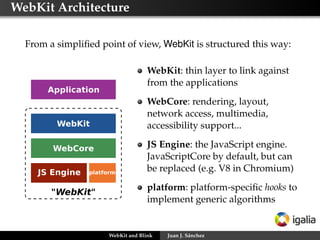
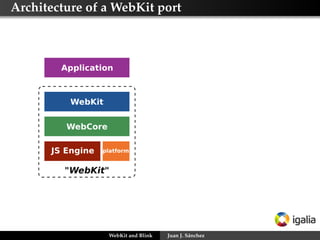
WebKit Architecture
From a simplified point of view, WebKit is structured this way:
WebKit: thin layer to link against
from the applications
WebCore: rendering, layout,
network access, multimedia,
accessibility support...
JS Engine: the JavaScript engine.
JavaScriptCore by default, but can
be replaced (e.g. V8 in Chromium)
platform: platform-specific hooks to
implement generic algorithms

WebKit and Blink

Juan J. Sánchez
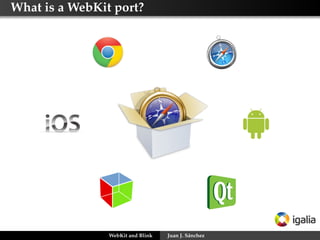
What is a WebKit port?

WebKit and Blink

Juan J. Sánchez
How many WebKit ports are there?

WebKit is available for different platforms:
Main upstream ports during the past 2 years:
Mac OS X, iOS
GTK+ based platforms (GNOME)
Qt based platforms (KDE)
Enlightenment Foundation Libraries (EFL, Tizen)
Google Chromium / Chrome
New proposal: WebKitNIX

Other ports: wxWidgets, Brew MP, Symbian devices (S60),
Win32, BlackBerry, Adobe Integrated Runtime (Adobe
AIR)

WebKit and Blink

Juan J. Sánchez
Some WebKit based browsers
Amazon Kindle

PS3 web browser

Arora

RockMelt

BOLT browser

Safari

Epiphany browser

SRWare Iron

Google Chrome

Shiira

iCab (version >= 4)

Sputnik for MorphOS

Iris Browser

Stainless

Konqueror

Steel for Android

Midori

TeaShark

Nintendo 3DS

Uzbl

OWB

Web Browser for S60 (Nokia)

OmniWeb

WebOS Browser
WebKit and Blink

Juan J. Sánchez
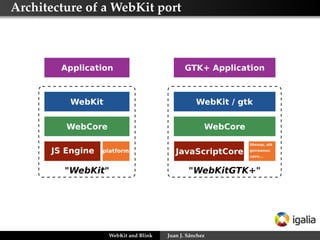
Architecture of a WebKit port

WebKit and Blink

Juan J. Sánchez
Architecture of a WebKit port

WebKit and Blink

Juan J. Sánchez
How do we use a WebKit port?
The WebView widget:
A platform-specific widget that renders web content.
It’s the main component and it’s useful for:
Loading URIs or data buffers pointing to HTML content
Go fullscreen, text/text+image zooming...
Navigate back and forward through history...

Events handling:
Allows embedders to get notified when something
important happens or when some input is needed.
Some examples of these events:
Getting notified when a load finished or failed
Asking permission for navigating to an URI
Requesting authorization for something..

WebKit and Blink

Juan J. Sánchez
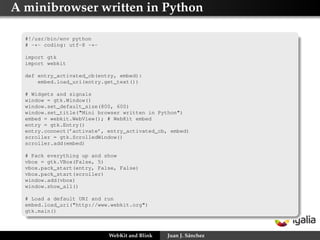
A minibrowser written in Python
#!/usr/bin/env python
# -*- coding: utf-8 -*import gtk
import webkit
def entry_activated_cb(entry, embed):
embed.load_uri(entry.get_text())
# Widgets and signals
window = gtk.Window()
window.set_default_size(800, 600)
window.set_title("Mini browser written in Python")
embed = webkit.WebView(); # WebKit embed
entry = gtk.Entry()
entry.connect(’activate’, entry_activated_cb, embed)
scroller = gtk.ScrolledWindow()
scroller.add(embed)
# Pack everything up and show
vbox = gtk.VBox(False, 5)
vbox.pack_start(entry, False, False)
vbox.pack_start(scroller)
window.add(vbox)
window.show_all()
# Load a default URI and run
embed.load_uri("http://www.webkit.org")
gtk.main()

WebKit and Blink

Juan J. Sánchez
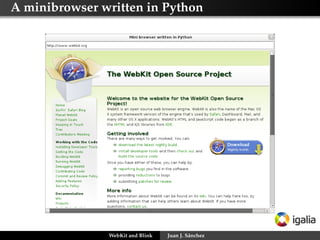
A minibrowser written in Python

WebKit and Blink

Juan J. Sánchez
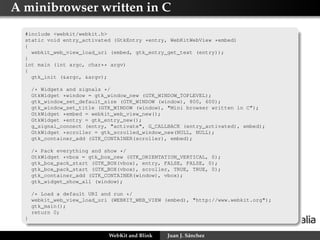
A minibrowser written in C
#include <webkit/webkit.h>
static void entry_activated (GtkEntry *entry, WebKitWebView *embed)
{
webkit_web_view_load_uri (embed, gtk_entry_get_text (entry));
}
int main (int argc, char** argv)
{
gtk_init (&argc, &argv);
/* Widgets and signals */
GtkWidget *window = gtk_window_new (GTK_WINDOW_TOPLEVEL);
gtk_window_set_default_size (GTK_WINDOW (window), 800, 600);
gtk_window_set_title (GTK_WINDOW (window), "Mini browser written in C");
GtkWidget *embed = webkit_web_view_new();
GtkWidget *entry = gtk_entry_new();
g_signal_connect (entry, "activate", G_CALLBACK (entry_activated), embed);
GtkWidget *scroller = gtk_scrolled_window_new(NULL, NULL);
gtk_container_add (GTK_CONTAINER(scroller), embed);
/* Pack everything and show */
GtkWidget *vbox = gtk_box_new (GTK_ORIENTATION_VERTICAL, 0);
gtk_box_pack_start (GTK_BOX(vbox), entry, FALSE, FALSE, 0);
gtk_box_pack_start (GTK_BOX(vbox), scroller, TRUE, TRUE, 0);
gtk_container_add (GTK_CONTAINER(window), vbox);
gtk_widget_show_all (window);
/* Load a default URI and run */
webkit_web_view_load_uri (WEBKIT_WEB_VIEW (embed), "http://www.webkit.org");
gtk_main();
return 0;
}
WebKit and Blink

Juan J. Sánchez
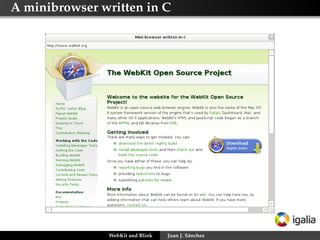
A minibrowser written in C

WebKit and Blink

Juan J. Sánchez
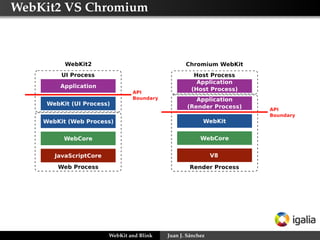
What is WebKit2?
New API layer designed to support a split process model
(First release by Apple on April 8th, 20101 ).
Different to Chromium’s multi-process implementation
It’s bundled in the framework (reusable)
Different processes take care of different tasks:
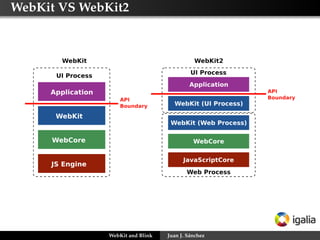
UI process: the WebView widget, application UI
Web process: loading, parsing, rendering, layout...
Plugin process: each plugin type in a process

It comes with Inter-Process Communication (IPC)
mechanisms to communicate those processes bundled-in
http://trac.webkit.org/wiki/WebKit2

WebKit and Blink

Juan J. Sánchez
WebKit VS WebKit2

WebKit and Blink

Juan J. Sánchez
WebKit2 vs WebKit1

Pros:
Isolation
Security
Performance
Stability

WebKit and Blink

Juan J. Sánchez
WebKit2 vs WebKit1

Cons:
Higher resource requirements
Multiple processes instead of just one
At the same time easier to release resources

Complexity
Coding
Debugging

WebKit1 and WebKit2 maintenance

WebKit and Blink

Juan J. Sánchez
WebKit2 VS Chromium

WebKit and Blink

Juan J. Sánchez
WebKit2: current status

Apple, Qt and GTK+ already released WebKit2 browsers
WebKit1 moving to maintenance mode for most ports
Cross-platform and non-blocking C API available
Most challenges of the split process model solved
Lots of new architectural changes about to come

WebKit and Blink

Juan J. Sánchez
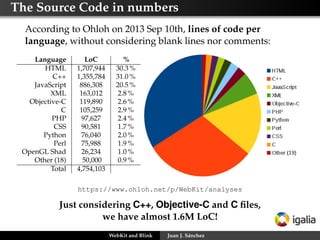
The Source Code in numbers
According to Ohloh on 2013 Sep 10th, lines of code per
language, without considering blank lines nor comments:
Language
HTML
C++
JavaScript
XML
Objective-C
C
PHP
CSS
Python
Perl
OpenGL Shad
Other (18)
Total

LoC
1,707,944
1,355,784
886,308
163,012
119,890
105,259
97,627
90,581
76,040
75,988
26,234
50,000
4,754,103

%
30.3 %
31.0 %
20.5 %
2.8 %
2.6 %
2.9 %
2.4 %
1.7 %
2.0 %
1.9 %
1.0 %
0.9 %

https://www.ohloh.net/p/WebKit/analyses

Just considering C++, Objective-C and C files,
we have almost 1.6M LoC!
WebKit and Blink

Juan J. Sánchez
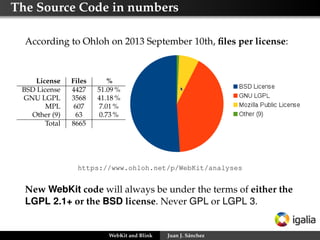
The Source Code in numbers
According to Ohloh on 2013 September 10th, files per license:

License
BSD License
GNU LGPL
MPL
Other (9)
Total

Files
4427
3568
607
63
8665

%
51.09 %
41.18 %
7.01 %
0.73 %

https://www.ohloh.net/p/WebKit/analyses

New WebKit code will always be under the terms of either the
LGPL 2.1+ or the BSD license. Never GPL or LGPL 3.

WebKit and Blink

Juan J. Sánchez
High Level source code overview
Source/: the code needed to build WebKit. That is,
WebCore, JavaScriptCore, WebKit and WebKit2
LayoutTests/: layout tests reside here (More than 30000!).
They test the correctness of WebKit features
ManualTests/: specific cases not covered by automatic
testing
PerformanceTests/: measure run-time performance and
memory usage
See perf.webkit.org for results
Tools/: tools and utilities for WebKit development.
Small test applications, tools for testing, helper scripts...
Websites/: code and pages for WebKit related sites
WebKit and Blink

Juan J. Sánchez
Tracking ongoing work in WebKit

Webkit is a big beast and a lot of organizations with
different agendas are working in different parts:
Implementing new standards (like the CSS shaders from
Adobe, or CSS3 GCPM from Apple)
Improvements in architecture, performance and internal
code (WebKit2)

On top of this there is the maintenance work (testing,
continuous integration, bugfixing)
No single centralized place to follow all the information:
blogs, mailing lists, IRC, etc.

WebKit and Blink

Juan J. Sánchez
WebKit: The community

WebKit and Blink

Juan J. Sánchez
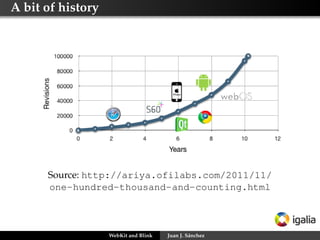
A bit of history

Source: http://ariya.ofilabs.com/2011/11/
one-hundred-thousand-and-counting.html

WebKit and Blink

Juan J. Sánchez
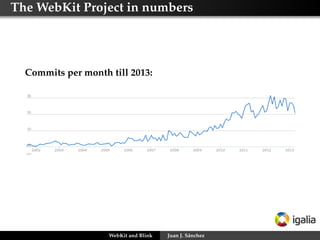
The WebKit Project in numbers

Commits per month till 2013:

WebKit and Blink

Juan J. Sánchez
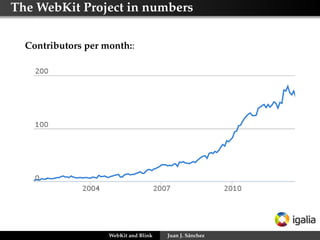
The WebKit Project in numbers
Contributors per month::

WebKit and Blink

Juan J. Sánchez
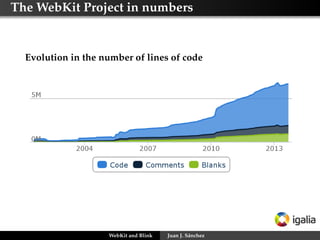
The WebKit Project in numbers

Evolution in the number of lines of code

WebKit and Blink

Juan J. Sánchez
Activity of Companies

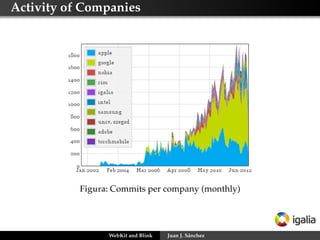
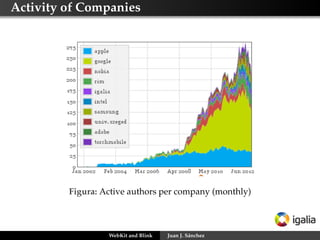
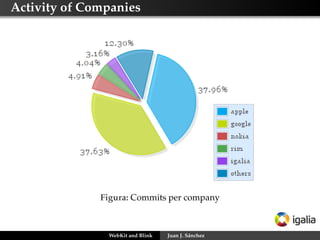
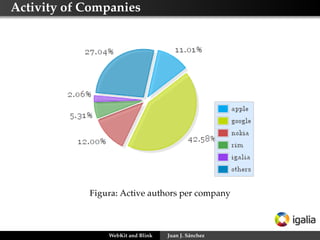
Based on Bitergia’s report2
Based on reviewed commits
“Gardening” commits filtered out
From the beginning of the project till beginning of 2013

2

http://blog.bitergia.com/2013/02/06/
report-on-the-activity-of-companies-in-the-webkit-project/
WebKit and Blink

Juan J. Sánchez
Activity of Companies

Figura: Commits per company (monthly)

WebKit and Blink

Juan J. Sánchez
Activity of Companies

Figura: Active authors per company (monthly)

WebKit and Blink

Juan J. Sánchez
Activity of Companies

Figura: Commits per company

WebKit and Blink

Juan J. Sánchez
Activity of Companies

Figura: Active authors per company

WebKit and Blink

Juan J. Sánchez
Activity of Companies

Some conclusions from the authors:
Google and Apple leading the project
The diversity of the project has been increasing
Contributions from other parties >25 % and growing
> 20 companies actively contributing to WebKit
1500-2000 commits per month
387 committers from 29 different institutions

WebKit and Blink

Juan J. Sánchez
Committers and Reviewers
WebKit Committer
A WebKit Committer should be a person we can trust to follow and
understand the project policies about checkins and other matters.
Has commit rights to the public SVN repository.

WebKit Reviewer
A WebKit Reviewer should be a person who has shown particularly
good judgment, understanding of project policies, collaboration skills,
and understanding of the code.
A WebKit Committer who can review other’s patches.

WebKit and Blink

Juan J. Sánchez
Copyright for contributions

There is no copyright transfer for the contributions
Committers sign some papers where they commit to good
behaviour

WebKit and Blink

Juan J. Sánchez
Releases

There are no releases of WebKit itself
Each port manages the release cycle, typically aligned with
the target platform schedule

WebKit and Blink

Juan J. Sánchez
Coordination and communication tools
Website: http://www.webkit.org/
Port specific Websites (e.g. http://webkitgtk.org/)
Wiki: http://trac.webkit.org/wiki
Blogs: http://planet.webkit.org/
Source Code:
SVN: http://svn.webkit.org/repository/webkit
Git mirror: git://git.webkit.org/WebKit.git

Bugzilla: https://bugs.webkit.org/
Buildbots: http://build.webkit.org/
Mailing lists: http://lists.webkit.org/mailman/listinfo.cgi
IRC (irc.freenode.net): #webkit and #webkitgtk+
WebKit and Blink

Juan J. Sánchez
The WebKit Contributors Meeting

Meeting for contributors to the WebKit project
Organized in an “unconference”-like format
Extremely useful to advance on some topics:
Implementation of new APIs, WebKit2, accelerated
compositing, helper tools, QA infrastructure...
Yearly held in Cupertino, California. Hosted by Apple

WebKit and Blink

Juan J. Sánchez
How to contribute

WebKit and Blink

Juan J. Sánchez
Types of contributions

Bugfixing and new features in:
An existent port
The core components: webcore and JSC/V8

Creation and maintenance of a new port

WebKit and Blink

Juan J. Sánchez
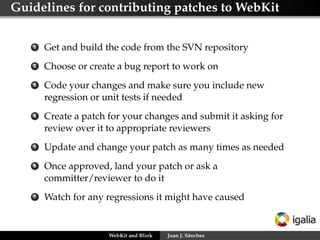
Guidelines for contributing patches to WebKit
1

Get and build the code from the SVN repository

2

Choose or create a bug report to work on

3

Code your changes and make sure you include new
regression or unit tests if needed

4

Create a patch for your changes and submit it asking for
review over it to appropriate reviewers

5

Update and change your patch as many times as needed

6

Once approved, land your patch or ask a
committer/reviewer to do it

7

Watch for any regressions it might have caused

WebKit and Blink

Juan J. Sánchez
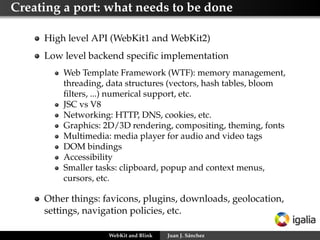
Creating a port: what needs to be done
High level API (WebKit1 and WebKit2)
Low level backend specific implementation
Web Template Framework (WTF): memory management,
threading, data structures (vectors, hash tables, bloom
filters, ...) numerical support, etc.
JSC vs V8
Networking: HTTP, DNS, cookies, etc.
Graphics: 2D/3D rendering, compositing, theming, fonts
Multimedia: media player for audio and video tags
DOM bindings
Accessibility
Smaller tasks: clipboard, popup and context menus,
cursors, etc.

Other things: favicons, plugins, downloads, geolocation,
settings, navigation policies, etc.
WebKit and Blink

Juan J. Sánchez
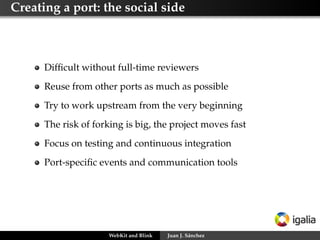
Creating a port: the social side

Difficult without full-time reviewers
Reuse from other ports as much as possible
Try to work upstream from the very beginning
The risk of forking is big, the project moves fast
Focus on testing and continuous integration
Port-specific events and communication tools

WebKit and Blink

Juan J. Sánchez
Present and future

WebKit and Blink

Juan J. Sánchez
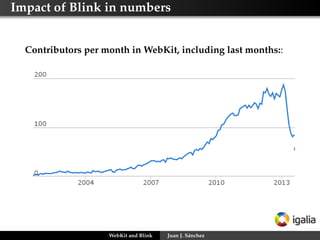
Google’s Departure. Blink

Google announced on April 3rd that they would be
forking WebKit and creating Blink
Motivations according to Google:
They were not using WebKit2 anyway
Easier to do ambitious architectural changes after the fork
Simplification of the codebase in Blink

Tension between Apple and Google before the fork
Architectural decisions: NetworkProcess
Code governance: Owners

Big shock within the WebKit community

WebKit and Blink

Juan J. Sánchez
Differences between WebKit and Blink

Removes the concept of ’port’ as it was defined in WebKit
(deep platform integration): Skia, V8 and other libraries
cannot be replaced
Still possible to use Blink in other platforms, but now
integration happens at Content level
Only the rendering engine. Multi-process architecture is
still in Chromium
Peer review process (committers, reviewers, owners) more
flexible in Blink
Many architecture changes are started to be implemented

WebKit and Blink

Juan J. Sánchez
Consequences of Blink for WebKit

Google was the main contributor by # of commits
Opera joined WebKit then moved to Blink. Other
companies and communities thinking what to do.
Apple’s position more dominant. Likely to relax Owners
policy
Several WebCore modules left orphan. Other hackers
assuming WebCore modules maintainership
WebKit developers porting patches from/to Blink
Many hacks to accomodate Chromium removed. Engines
likely start to diverge at faster pace

WebKit and Blink

Juan J. Sánchez
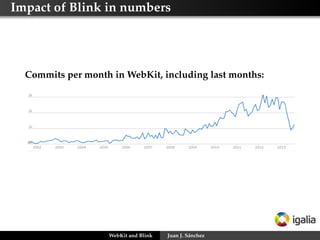
Impact of Blink in numbers

Commits per month in WebKit, including last months:

WebKit and Blink

Juan J. Sánchez
Impact of Blink in numbers
Contributors per month in WebKit, including last months::

WebKit and Blink

Juan J. Sánchez
Impact of Blink in numbers

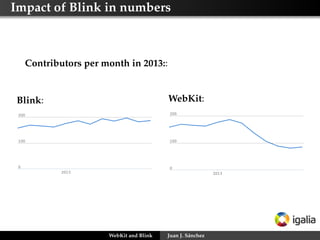
Contributors per month in 2013::

WebKit:

Blink:

WebKit and Blink

Juan J. Sánchez
Impact of Blink in numbers
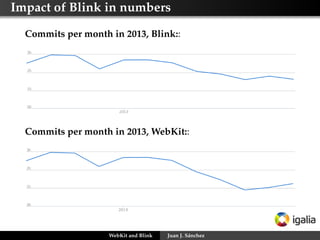
Commits per month in 2013, Blink::

Commits per month in 2013, WebKit::

WebKit and Blink

Juan J. Sánchez
The Blink community is consolidating

Dynamics of the community still being consolidated
Opera already actively contributing and using Blink
Qt recently announced that they are moving to Blink
In a few weeks/months we will know how everything
settles down
BlinkOn event, end of September at Google’s office in San
Francisco

WebKit and Blink

Juan J. Sánchez
Open questions about Blink for WebKit

How open the dynamics of each community will be?
Which project will innovate faster and keep higher quality
and performance standards?
Which option will upstream ports be based on?
Which option will companies developing platforms and
solutions use?

WebKit and Blink

Juan J. Sánchez
Conclusions
WebKit is an Open Source web engine powering lots of
applications (not only browsers!) out there
The only true Open Source alternative for embedders for
many years. Clearly defined and modular architecture.
Port friendly. Complex and fast moving project
Developed by a community of organizations and
individuals with different interests, collaborating together.
Lots of contributors. Appropriate policies in place to
handle permissions and responsibilities in the project
The recent announcement of Blink is changing the WebKit
community a lot and it is still to be seen how the situation
in terms of open source dynamics and project health and
quality will be in a few months.
WebKit and Blink

Juan J. Sánchez
Thank you!
Juan J. Sánchez
jjsanchez@igalia.com

WebKit and Blink

Juan J. Sánchez

WebKit and Blink: Open Development Powering the HTML5 Revolution (LinuxCon North America 2013)

  • 1.
    WebKit and Blink:Open Development Powering the HTML5 Revolution Juan J. Sánchez LinuxCon 2013, New Orleans
  • 2.
    Myself, Igalia andWebKit Co-founder, member of the WebKit/Blink/Browsers team Igalia is an open source consultancy founded in 2001 Igalia is Top 5 contributor to upstream WebKit/Blink Working with many industry actors: tablets, phones, smart tv, set-top boxes, IVI and home automation. WebKit and Blink Juan J. Sánchez
  • 3.
    Outline The WebKit technology:goals, features, architecture, code structure, ports, webkit2, ongoing work The WebKit community: contributors, committers, reviewers, tools, events Contributing to WebKit: bugfixing, features, new ports Blink: history, motivations for the fork, differences, status and impact in the WebKit community WebKit and Blink Juan J. Sánchez
  • 4.
    WebKit: the technology WebKitand Blink Juan J. Sánchez
  • 5.
    The WebKit project Webrendering engine (HTML, JavaScript, CSS...) The engine is the product Started as a fork of KHTML and KJS in 2001 Open Source since 2005 Among other things, it’s useful for: Web browsers Using web technologies for UI development WebKit and Blink Juan J. Sánchez
  • 6.
    Goals of theproject Web Content Engine: HTML, CSS, JavaScript, DOM Open Source: BSD-style and LGPL licenses Compatibility: regression testing Standards Compliance Stability Performance Security Portability: desktop, mobile, embedded... Usability Hackability WebKit and Blink Juan J. Sánchez
  • 7.
    Goals of theproject NON-goals: “It’s an engine, not a browser” “It’s an engineering project not a science project” “It’s not a bundle of maximally general and reusable code” “It’s not the solution to every problem” http://www.webkit.org/projects/goals.html WebKit and Blink Juan J. Sánchez
  • 8.
    WebKit features HTML andXML support JavaScript support (ECMAScript 5.1) CSS 2.1, CSS 3 support SVG support Support for Plugins (NPAPI, WebKit Plugins) HTML5 support: multimedia, 3D graphics, advanced CSS animations and transformations, drag’n’drop, offline & local storage, connectivity... Accessibility support Q&A infrastructure: review process, continuous integration, 30.000 regression tests, API tests... Passing ACID3 with 100/100 tests since March 2008 WebKit and Blink Juan J. Sánchez
  • 9.
    WebKit Architecture From asimplified point of view, WebKit is structured this way: WebKit: thin layer to link against from the applications WebCore: rendering, layout, network access, multimedia, accessibility support... JS Engine: the JavaScript engine. JavaScriptCore by default, but can be replaced (e.g. V8 in Chromium) platform: platform-specific hooks to implement generic algorithms WebKit and Blink Juan J. Sánchez
  • 10.
    What is aWebKit port? WebKit and Blink Juan J. Sánchez
  • 11.
    How many WebKitports are there? WebKit is available for different platforms: Main upstream ports during the past 2 years: Mac OS X, iOS GTK+ based platforms (GNOME) Qt based platforms (KDE) Enlightenment Foundation Libraries (EFL, Tizen) Google Chromium / Chrome New proposal: WebKitNIX Other ports: wxWidgets, Brew MP, Symbian devices (S60), Win32, BlackBerry, Adobe Integrated Runtime (Adobe AIR) WebKit and Blink Juan J. Sánchez
  • 12.
    Some WebKit basedbrowsers Amazon Kindle PS3 web browser Arora RockMelt BOLT browser Safari Epiphany browser SRWare Iron Google Chrome Shiira iCab (version >= 4) Sputnik for MorphOS Iris Browser Stainless Konqueror Steel for Android Midori TeaShark Nintendo 3DS Uzbl OWB Web Browser for S60 (Nokia) OmniWeb WebOS Browser WebKit and Blink Juan J. Sánchez
  • 13.
    Architecture of aWebKit port WebKit and Blink Juan J. Sánchez
  • 14.
    Architecture of aWebKit port WebKit and Blink Juan J. Sánchez
  • 15.
    How do weuse a WebKit port? The WebView widget: A platform-specific widget that renders web content. It’s the main component and it’s useful for: Loading URIs or data buffers pointing to HTML content Go fullscreen, text/text+image zooming... Navigate back and forward through history... Events handling: Allows embedders to get notified when something important happens or when some input is needed. Some examples of these events: Getting notified when a load finished or failed Asking permission for navigating to an URI Requesting authorization for something.. WebKit and Blink Juan J. Sánchez
  • 16.
    A minibrowser writtenin Python #!/usr/bin/env python # -*- coding: utf-8 -*import gtk import webkit def entry_activated_cb(entry, embed): embed.load_uri(entry.get_text()) # Widgets and signals window = gtk.Window() window.set_default_size(800, 600) window.set_title("Mini browser written in Python") embed = webkit.WebView(); # WebKit embed entry = gtk.Entry() entry.connect(’activate’, entry_activated_cb, embed) scroller = gtk.ScrolledWindow() scroller.add(embed) # Pack everything up and show vbox = gtk.VBox(False, 5) vbox.pack_start(entry, False, False) vbox.pack_start(scroller) window.add(vbox) window.show_all() # Load a default URI and run embed.load_uri("http://www.webkit.org") gtk.main() WebKit and Blink Juan J. Sánchez
  • 17.
    A minibrowser writtenin Python WebKit and Blink Juan J. Sánchez
  • 18.
    A minibrowser writtenin C #include <webkit/webkit.h> static void entry_activated (GtkEntry *entry, WebKitWebView *embed) { webkit_web_view_load_uri (embed, gtk_entry_get_text (entry)); } int main (int argc, char** argv) { gtk_init (&argc, &argv); /* Widgets and signals */ GtkWidget *window = gtk_window_new (GTK_WINDOW_TOPLEVEL); gtk_window_set_default_size (GTK_WINDOW (window), 800, 600); gtk_window_set_title (GTK_WINDOW (window), "Mini browser written in C"); GtkWidget *embed = webkit_web_view_new(); GtkWidget *entry = gtk_entry_new(); g_signal_connect (entry, "activate", G_CALLBACK (entry_activated), embed); GtkWidget *scroller = gtk_scrolled_window_new(NULL, NULL); gtk_container_add (GTK_CONTAINER(scroller), embed); /* Pack everything and show */ GtkWidget *vbox = gtk_box_new (GTK_ORIENTATION_VERTICAL, 0); gtk_box_pack_start (GTK_BOX(vbox), entry, FALSE, FALSE, 0); gtk_box_pack_start (GTK_BOX(vbox), scroller, TRUE, TRUE, 0); gtk_container_add (GTK_CONTAINER(window), vbox); gtk_widget_show_all (window); /* Load a default URI and run */ webkit_web_view_load_uri (WEBKIT_WEB_VIEW (embed), "http://www.webkit.org"); gtk_main(); return 0; } WebKit and Blink Juan J. Sánchez
  • 19.
    A minibrowser writtenin C WebKit and Blink Juan J. Sánchez
  • 20.
    What is WebKit2? NewAPI layer designed to support a split process model (First release by Apple on April 8th, 20101 ). Different to Chromium’s multi-process implementation It’s bundled in the framework (reusable) Different processes take care of different tasks: UI process: the WebView widget, application UI Web process: loading, parsing, rendering, layout... Plugin process: each plugin type in a process It comes with Inter-Process Communication (IPC) mechanisms to communicate those processes bundled-in http://trac.webkit.org/wiki/WebKit2 WebKit and Blink Juan J. Sánchez
  • 21.
    WebKit VS WebKit2 WebKitand Blink Juan J. Sánchez
  • 22.
  • 23.
    WebKit2 vs WebKit1 Cons: Higherresource requirements Multiple processes instead of just one At the same time easier to release resources Complexity Coding Debugging WebKit1 and WebKit2 maintenance WebKit and Blink Juan J. Sánchez
  • 24.
    WebKit2 VS Chromium WebKitand Blink Juan J. Sánchez
  • 25.
    WebKit2: current status Apple,Qt and GTK+ already released WebKit2 browsers WebKit1 moving to maintenance mode for most ports Cross-platform and non-blocking C API available Most challenges of the split process model solved Lots of new architectural changes about to come WebKit and Blink Juan J. Sánchez
  • 26.
    The Source Codein numbers According to Ohloh on 2013 Sep 10th, lines of code per language, without considering blank lines nor comments: Language HTML C++ JavaScript XML Objective-C C PHP CSS Python Perl OpenGL Shad Other (18) Total LoC 1,707,944 1,355,784 886,308 163,012 119,890 105,259 97,627 90,581 76,040 75,988 26,234 50,000 4,754,103 % 30.3 % 31.0 % 20.5 % 2.8 % 2.6 % 2.9 % 2.4 % 1.7 % 2.0 % 1.9 % 1.0 % 0.9 % https://www.ohloh.net/p/WebKit/analyses Just considering C++, Objective-C and C files, we have almost 1.6M LoC! WebKit and Blink Juan J. Sánchez
  • 27.
    The Source Codein numbers According to Ohloh on 2013 September 10th, files per license: License BSD License GNU LGPL MPL Other (9) Total Files 4427 3568 607 63 8665 % 51.09 % 41.18 % 7.01 % 0.73 % https://www.ohloh.net/p/WebKit/analyses New WebKit code will always be under the terms of either the LGPL 2.1+ or the BSD license. Never GPL or LGPL 3. WebKit and Blink Juan J. Sánchez
  • 28.
    High Level sourcecode overview Source/: the code needed to build WebKit. That is, WebCore, JavaScriptCore, WebKit and WebKit2 LayoutTests/: layout tests reside here (More than 30000!). They test the correctness of WebKit features ManualTests/: specific cases not covered by automatic testing PerformanceTests/: measure run-time performance and memory usage See perf.webkit.org for results Tools/: tools and utilities for WebKit development. Small test applications, tools for testing, helper scripts... Websites/: code and pages for WebKit related sites WebKit and Blink Juan J. Sánchez
  • 29.
    Tracking ongoing workin WebKit Webkit is a big beast and a lot of organizations with different agendas are working in different parts: Implementing new standards (like the CSS shaders from Adobe, or CSS3 GCPM from Apple) Improvements in architecture, performance and internal code (WebKit2) On top of this there is the maintenance work (testing, continuous integration, bugfixing) No single centralized place to follow all the information: blogs, mailing lists, IRC, etc. WebKit and Blink Juan J. Sánchez
  • 30.
    WebKit: The community WebKitand Blink Juan J. Sánchez
  • 31.
    A bit ofhistory Source: http://ariya.ofilabs.com/2011/11/ one-hundred-thousand-and-counting.html WebKit and Blink Juan J. Sánchez
  • 32.
    The WebKit Projectin numbers Commits per month till 2013: WebKit and Blink Juan J. Sánchez
  • 33.
    The WebKit Projectin numbers Contributors per month:: WebKit and Blink Juan J. Sánchez
  • 34.
    The WebKit Projectin numbers Evolution in the number of lines of code WebKit and Blink Juan J. Sánchez
  • 35.
    Activity of Companies Basedon Bitergia’s report2 Based on reviewed commits “Gardening” commits filtered out From the beginning of the project till beginning of 2013 2 http://blog.bitergia.com/2013/02/06/ report-on-the-activity-of-companies-in-the-webkit-project/ WebKit and Blink Juan J. Sánchez
  • 36.
    Activity of Companies Figura:Commits per company (monthly) WebKit and Blink Juan J. Sánchez
  • 37.
    Activity of Companies Figura:Active authors per company (monthly) WebKit and Blink Juan J. Sánchez
  • 38.
    Activity of Companies Figura:Commits per company WebKit and Blink Juan J. Sánchez
  • 39.
    Activity of Companies Figura:Active authors per company WebKit and Blink Juan J. Sánchez
  • 40.
    Activity of Companies Someconclusions from the authors: Google and Apple leading the project The diversity of the project has been increasing Contributions from other parties >25 % and growing > 20 companies actively contributing to WebKit 1500-2000 commits per month 387 committers from 29 different institutions WebKit and Blink Juan J. Sánchez
  • 41.
    Committers and Reviewers WebKitCommitter A WebKit Committer should be a person we can trust to follow and understand the project policies about checkins and other matters. Has commit rights to the public SVN repository. WebKit Reviewer A WebKit Reviewer should be a person who has shown particularly good judgment, understanding of project policies, collaboration skills, and understanding of the code. A WebKit Committer who can review other’s patches. WebKit and Blink Juan J. Sánchez
  • 42.
    Copyright for contributions Thereis no copyright transfer for the contributions Committers sign some papers where they commit to good behaviour WebKit and Blink Juan J. Sánchez
  • 43.
    Releases There are noreleases of WebKit itself Each port manages the release cycle, typically aligned with the target platform schedule WebKit and Blink Juan J. Sánchez
  • 44.
    Coordination and communicationtools Website: http://www.webkit.org/ Port specific Websites (e.g. http://webkitgtk.org/) Wiki: http://trac.webkit.org/wiki Blogs: http://planet.webkit.org/ Source Code: SVN: http://svn.webkit.org/repository/webkit Git mirror: git://git.webkit.org/WebKit.git Bugzilla: https://bugs.webkit.org/ Buildbots: http://build.webkit.org/ Mailing lists: http://lists.webkit.org/mailman/listinfo.cgi IRC (irc.freenode.net): #webkit and #webkitgtk+ WebKit and Blink Juan J. Sánchez
  • 45.
    The WebKit ContributorsMeeting Meeting for contributors to the WebKit project Organized in an “unconference”-like format Extremely useful to advance on some topics: Implementation of new APIs, WebKit2, accelerated compositing, helper tools, QA infrastructure... Yearly held in Cupertino, California. Hosted by Apple WebKit and Blink Juan J. Sánchez
  • 46.
    How to contribute WebKitand Blink Juan J. Sánchez
  • 47.
    Types of contributions Bugfixingand new features in: An existent port The core components: webcore and JSC/V8 Creation and maintenance of a new port WebKit and Blink Juan J. Sánchez
  • 48.
    Guidelines for contributingpatches to WebKit 1 Get and build the code from the SVN repository 2 Choose or create a bug report to work on 3 Code your changes and make sure you include new regression or unit tests if needed 4 Create a patch for your changes and submit it asking for review over it to appropriate reviewers 5 Update and change your patch as many times as needed 6 Once approved, land your patch or ask a committer/reviewer to do it 7 Watch for any regressions it might have caused WebKit and Blink Juan J. Sánchez
  • 49.
    Creating a port:what needs to be done High level API (WebKit1 and WebKit2) Low level backend specific implementation Web Template Framework (WTF): memory management, threading, data structures (vectors, hash tables, bloom filters, ...) numerical support, etc. JSC vs V8 Networking: HTTP, DNS, cookies, etc. Graphics: 2D/3D rendering, compositing, theming, fonts Multimedia: media player for audio and video tags DOM bindings Accessibility Smaller tasks: clipboard, popup and context menus, cursors, etc. Other things: favicons, plugins, downloads, geolocation, settings, navigation policies, etc. WebKit and Blink Juan J. Sánchez
  • 50.
    Creating a port:the social side Difficult without full-time reviewers Reuse from other ports as much as possible Try to work upstream from the very beginning The risk of forking is big, the project moves fast Focus on testing and continuous integration Port-specific events and communication tools WebKit and Blink Juan J. Sánchez
  • 51.
    Present and future WebKitand Blink Juan J. Sánchez
  • 52.
    Google’s Departure. Blink Googleannounced on April 3rd that they would be forking WebKit and creating Blink Motivations according to Google: They were not using WebKit2 anyway Easier to do ambitious architectural changes after the fork Simplification of the codebase in Blink Tension between Apple and Google before the fork Architectural decisions: NetworkProcess Code governance: Owners Big shock within the WebKit community WebKit and Blink Juan J. Sánchez
  • 53.
    Differences between WebKitand Blink Removes the concept of ’port’ as it was defined in WebKit (deep platform integration): Skia, V8 and other libraries cannot be replaced Still possible to use Blink in other platforms, but now integration happens at Content level Only the rendering engine. Multi-process architecture is still in Chromium Peer review process (committers, reviewers, owners) more flexible in Blink Many architecture changes are started to be implemented WebKit and Blink Juan J. Sánchez
  • 54.
    Consequences of Blinkfor WebKit Google was the main contributor by # of commits Opera joined WebKit then moved to Blink. Other companies and communities thinking what to do. Apple’s position more dominant. Likely to relax Owners policy Several WebCore modules left orphan. Other hackers assuming WebCore modules maintainership WebKit developers porting patches from/to Blink Many hacks to accomodate Chromium removed. Engines likely start to diverge at faster pace WebKit and Blink Juan J. Sánchez
  • 55.
    Impact of Blinkin numbers Commits per month in WebKit, including last months: WebKit and Blink Juan J. Sánchez
  • 56.
    Impact of Blinkin numbers Contributors per month in WebKit, including last months:: WebKit and Blink Juan J. Sánchez
  • 57.
    Impact of Blinkin numbers Contributors per month in 2013:: WebKit: Blink: WebKit and Blink Juan J. Sánchez
  • 58.
    Impact of Blinkin numbers Commits per month in 2013, Blink:: Commits per month in 2013, WebKit:: WebKit and Blink Juan J. Sánchez
  • 59.
    The Blink communityis consolidating Dynamics of the community still being consolidated Opera already actively contributing and using Blink Qt recently announced that they are moving to Blink In a few weeks/months we will know how everything settles down BlinkOn event, end of September at Google’s office in San Francisco WebKit and Blink Juan J. Sánchez
  • 60.
    Open questions aboutBlink for WebKit How open the dynamics of each community will be? Which project will innovate faster and keep higher quality and performance standards? Which option will upstream ports be based on? Which option will companies developing platforms and solutions use? WebKit and Blink Juan J. Sánchez
  • 61.
    Conclusions WebKit is anOpen Source web engine powering lots of applications (not only browsers!) out there The only true Open Source alternative for embedders for many years. Clearly defined and modular architecture. Port friendly. Complex and fast moving project Developed by a community of organizations and individuals with different interests, collaborating together. Lots of contributors. Appropriate policies in place to handle permissions and responsibilities in the project The recent announcement of Blink is changing the WebKit community a lot and it is still to be seen how the situation in terms of open source dynamics and project health and quality will be in a few months. WebKit and Blink Juan J. Sánchez
  • 62.
    Thank you! Juan J.Sánchez jjsanchez@igalia.com WebKit and Blink Juan J. Sánchez