Created 2013
Helping Individuals with
Mental Illness
to Avoid or Deal with the
Criminal Justice System
Presented by NAMI PA, Main Line,
an affiliate of the National Alliance on Mental Illness
Please view the final slide for NAMI PA, Main Line contact information
and the link to a printable document with additional information.
Information is provided in three sections:
• Preventing Arrest
• Criminal Justice System procedures and advice
• Resources for people in the Philadelphia
metropolitan area
~~~~~~~~~~~~~~~~
This information is not legal advice. A person
who is in police custody should get the
services of a criminal lawyer (see slide 9).
Preventing Arrest
• Avoid arrest by arranging for crisis
intervention, ongoing treatment, or court-
ordered emergency treatment before the
situation escalates to necessitate police
involvement.
• If you fear there may be a crisis, it is helpful to
notify the police in advance that a household
includes a person with a mental illness, so the
police can respond to an emergency in an
informed manner (see slide 13).
Preventing Arrest --Treatment
• Programs such as assertive community
treatment (PACT) can help to prevent relapse
and mental health crises and thus reduce the
risk of arrest.
• Many resources for finding treatment are
described in “How to Get Services” and
“Resources for People with Mental Illness”
available at www.NAMIpaMainLine.org
• During a mental health crisis call 911 only if
there is immediate danger of physical harm.
• Otherwise you may reduce the risk that a
crisis will result in arrest by calling the county
crisis line which has staff 24/7 who can
assess the situation, arrange for an in-person
evaluation and/or make referrals as needed.
• Crisis line phone numbers for the greater
Philadelphia area are available at:
www.namipamainline.org/crisis-numbers/
Preventing Arrest --Crisis Intervention
Preventing Arrest
-- Court-Ordered Treatment
• When an individual has a life-threatening
psychiatric emergency but is unwilling to
consent to treatment, state law authorizes
court-ordered treatment without the
individual’s consent.
– Inpatient = involuntary commitment
– Outpatient = assisted outpatient treatment
• For more information go to:
www.mces.org/PDFs/MCES_Quest_June_2003.pdf or
www.dbhmrs.org/mental-health-delegate/.
Preventing Arrest –
Mental Health Advance Directives
• An Advance Directive allows a person with mental
illness to indicate his/her treatment preferences and
designate a Power of Attorney for health care who can
be authorized to make treatment decisions on his/her
behalf in the event of a mental health crisis.
• Go to Disability Rights Network’s website at
www.drnpa.org/ to download a copy of the PA Mental
Health Advance Directive
(MH-Adv-Dir-Decl-Form.pdf).
Preventing Arrest – Finding a Missing Person
• The National Missing and Unidentified Persons
Database allows the general public to add new
missing persons, with physical and circumstantial
details, photographs, dental contacts and other
critical information. Posters can be created and
cases tracked. Go to www.findthemissing.org.
• Additional resources are available at
www.outpostforhope.org
www.nami.org
Criminal Justice System – Advice
• Get a good criminal lawyer as soon as possible. Try
to prevent the police from questioning a suspect
without a lawyer present. The police must stop
questioning anyone who asks for a lawyer. If
possible, consult with a lawyer before deciding
whether to reveal a suspect’s mental illness.
• If you cannot afford to pay the full fee for a private
lawyer, contact public defender services, court-
appointed attorneys, or local criminal defense
lawyers associations or bar associations.
(additional information in following slides)
Criminal Justice System – Advice
• If a person with mental illness has been arrested, see
the judge or call the district attorney and ask the
court to make it a condition of bail or sentencing that
the person must follow all treatment
recommendations. This often helps to increase
compliance with medications and other important
treatments.
• If a person with mental illness has been incarcerated,
contact the prison, ask for the medical department,
and give the person's treatment history (often the
place of last treatment is sufficient).
Criminal Justice System
– Procedures and Advice
• For a brief overview see Dealing with the
Criminal Justice System
http://www.nami.org/Content/ContentGroups/Helpline1/Dealing_with_th
e_Criminal_Justice_System.htm
• A Guide to Mental Illness and the Criminal
Justice System has an informative discussion
of procedures and terminology as well as
helpful advice.
http://www.nami.org/Template.cfm?Section=Issue_Spotlights&template=
/ContentManagement/ContentDisplay.cfm&ContentID=60725
Criminal Justice System
– Procedures and Advice
• When a Person with Mental Illness Goes to
Prison – How to Help (a joint project of NAMI
NY and the Urban Justice Center):
http://il.nami.org/when%20a%20person%20with%20mental
%20illness%20goes%20to%20prison.pdf
• Understanding the Criminal Justice System by
NAMI CT:
http://www.nami.org/Content/Microsites146/NAMI_of_Conn
ecticut,_Inc/Home135/Criminal_Jusitice1/mh_handbook.pdf
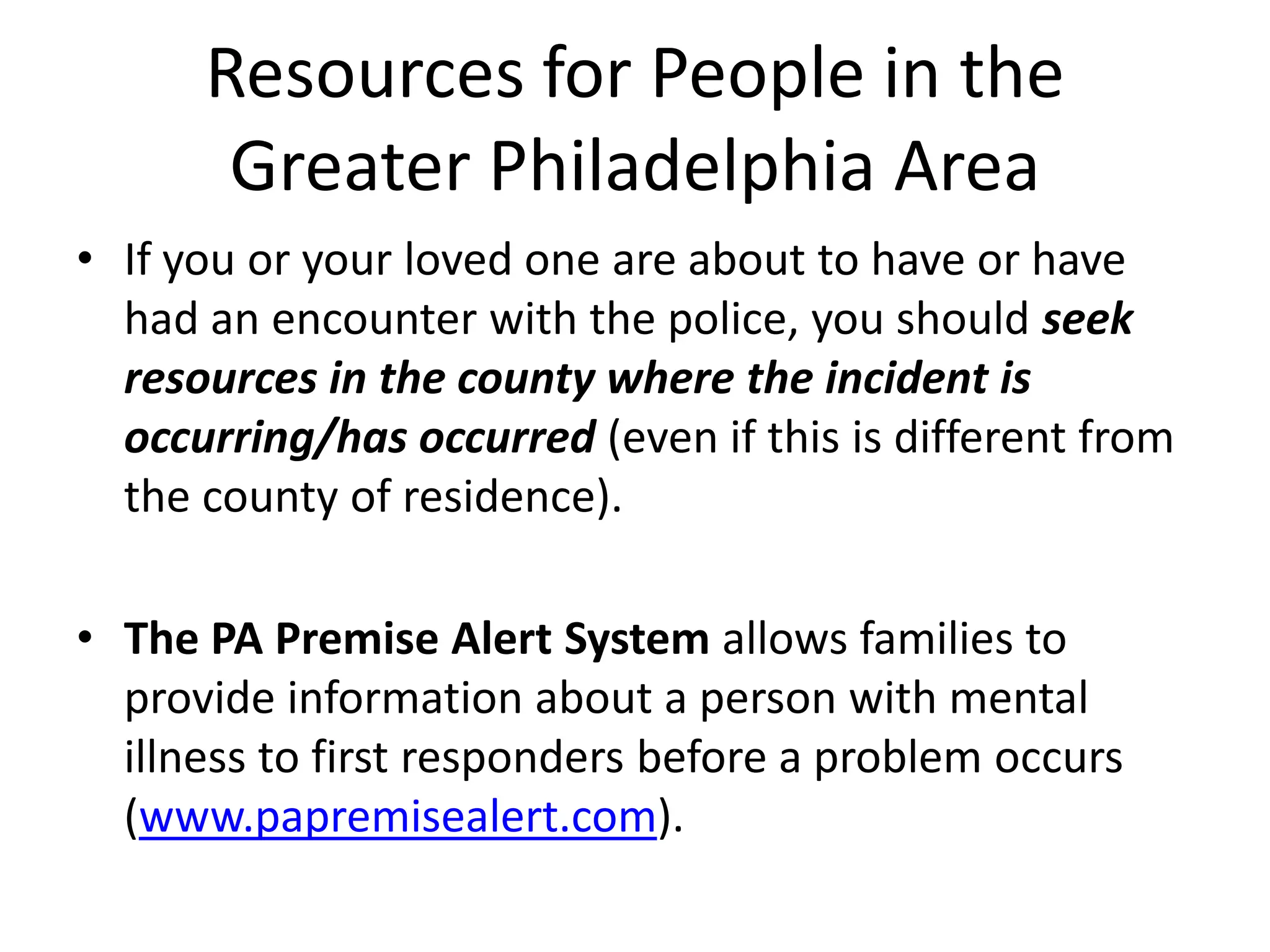
Resources for People in the
Greater Philadelphia Area
• If you or your loved one are about to have or have
had an encounter with the police, you should seek
resources in the county where the incident is
occurring/has occurred (even if this is different from
the county of residence).
• The PA Premise Alert System allows families to
provide information about a person with mental
illness to first responders before a problem occurs
(www.papremisealert.com).
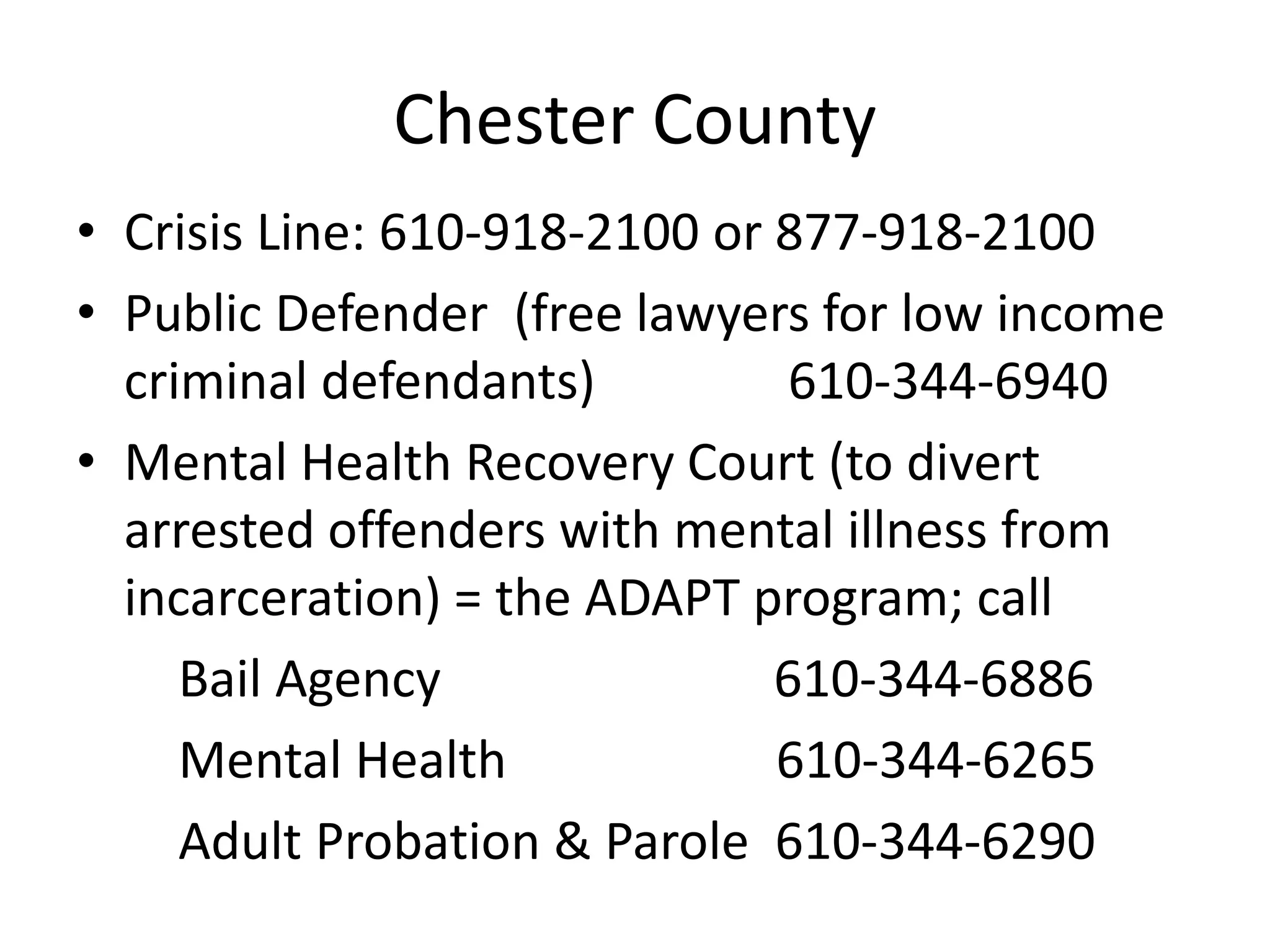
Chester County
• Crisis Line: 610-918-2100 or 877-918-2100
• Public Defender (free lawyers for low income
criminal defendants) 610-344-6940
• Mental Health Recovery Court (to divert
arrested offenders with mental illness from
incarceration) = the ADAPT program; call
Bail Agency 610-344-6886
Mental Health 610-344-6265
Adult Probation & Parole 610-344-6290
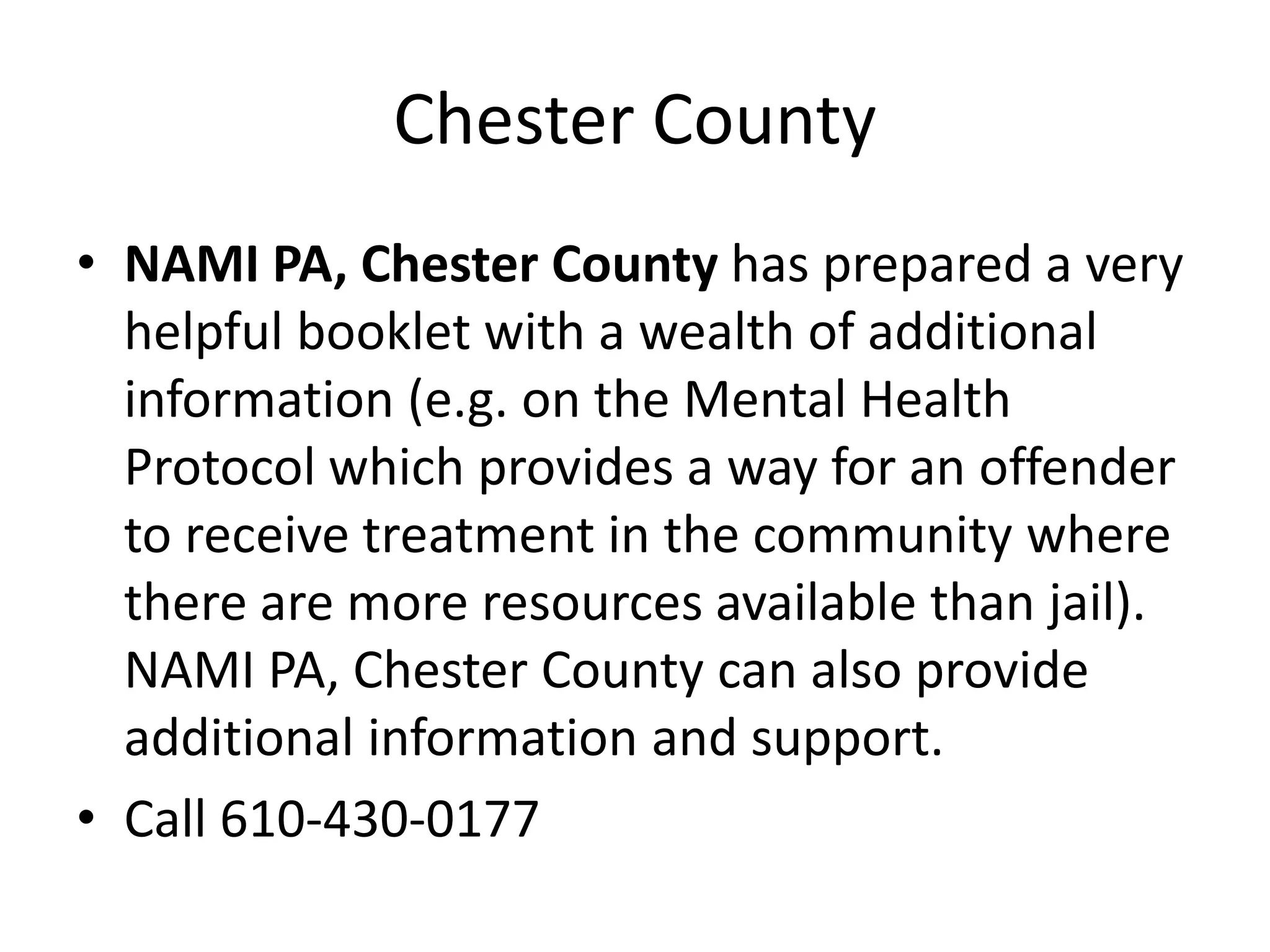
Chester County
• NAMI PA, Chester County has prepared a very
helpful booklet with a wealth of additional
information (e.g. on the Mental Health
Protocol which provides a way for an offender
to receive treatment in the community where
there are more resources available than jail).
NAMI PA, Chester County can also provide
additional information and support.
• Call 610-430-0177
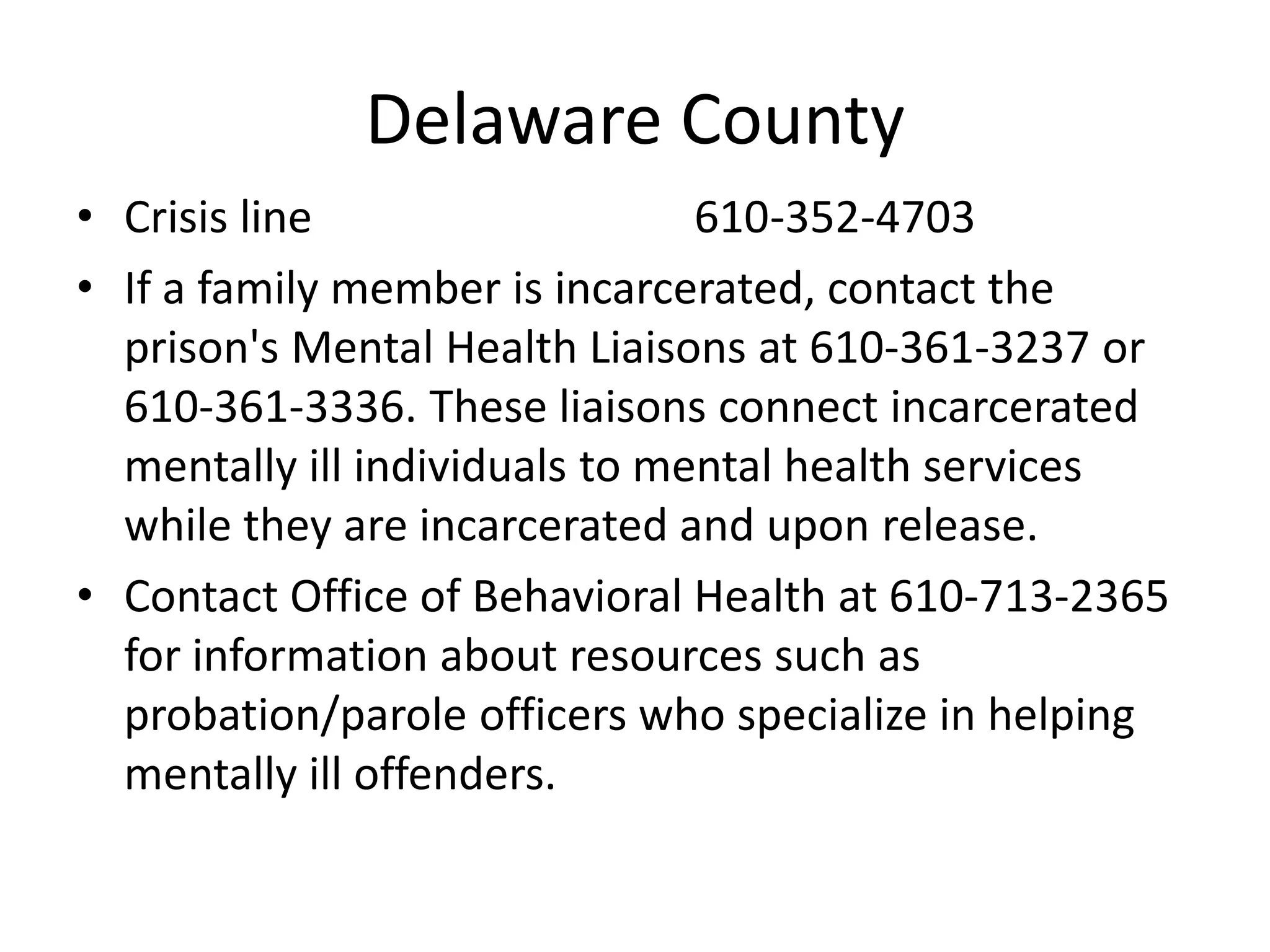
Delaware County
• Crisis line 610-352-4703
• If a family member is incarcerated, contact the
prison's Mental Health Liaisons at 610-361-3237 or
610-361-3336. These liaisons connect incarcerated
mentally ill individuals to mental health services
while they are incarcerated and upon release.
• Contact Office of Behavioral Health at 610-713-2365
for information about resources such as
probation/parole officers who specialize in helping
mentally ill offenders.
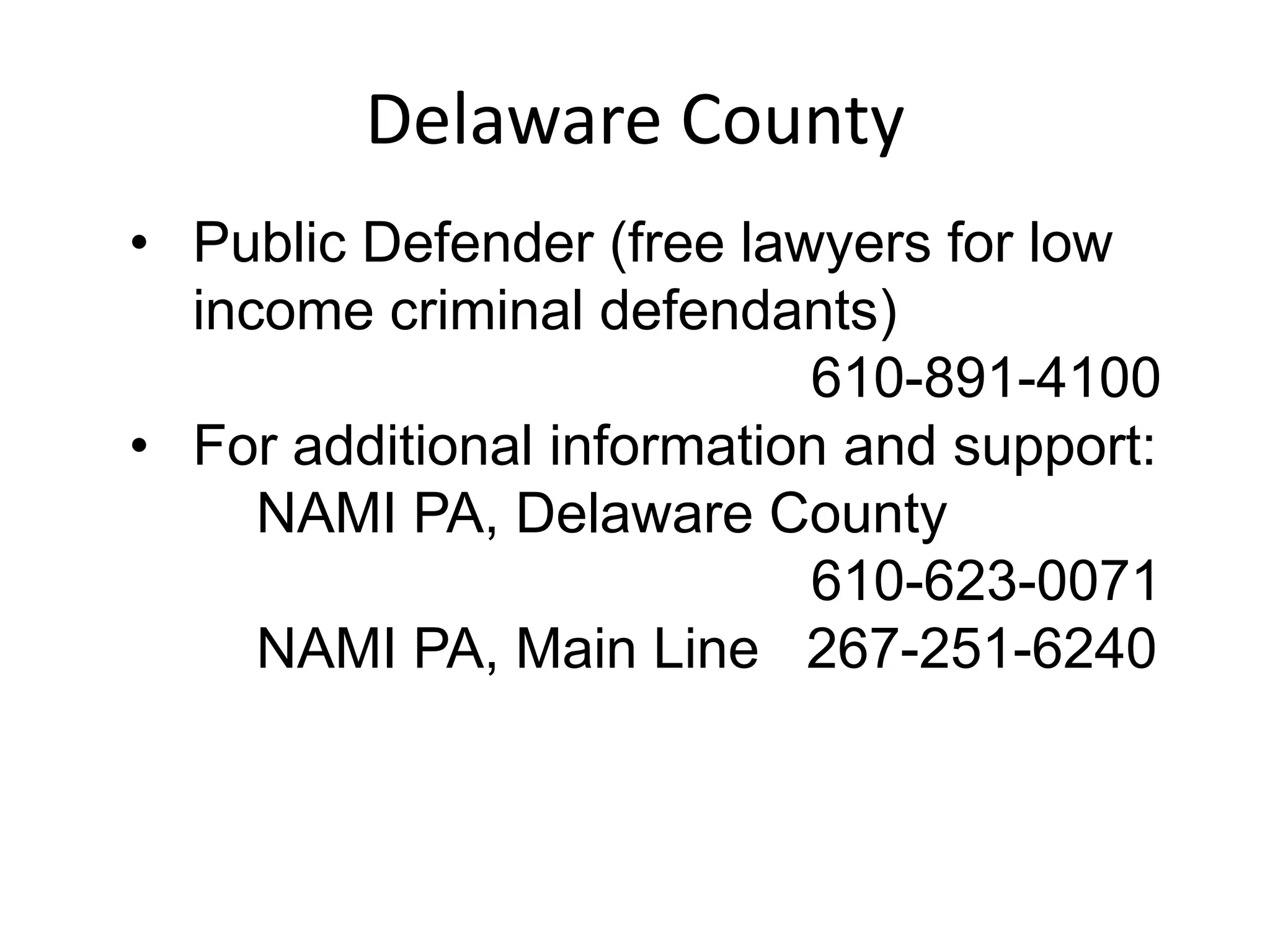
Delaware County
• Public Defender (free lawyers for low
income criminal defendants)
610-891-4100
• For additional information and support:
NAMI PA, Delaware County
610-623-0071
NAMI PA, Main Line 267-251-6240
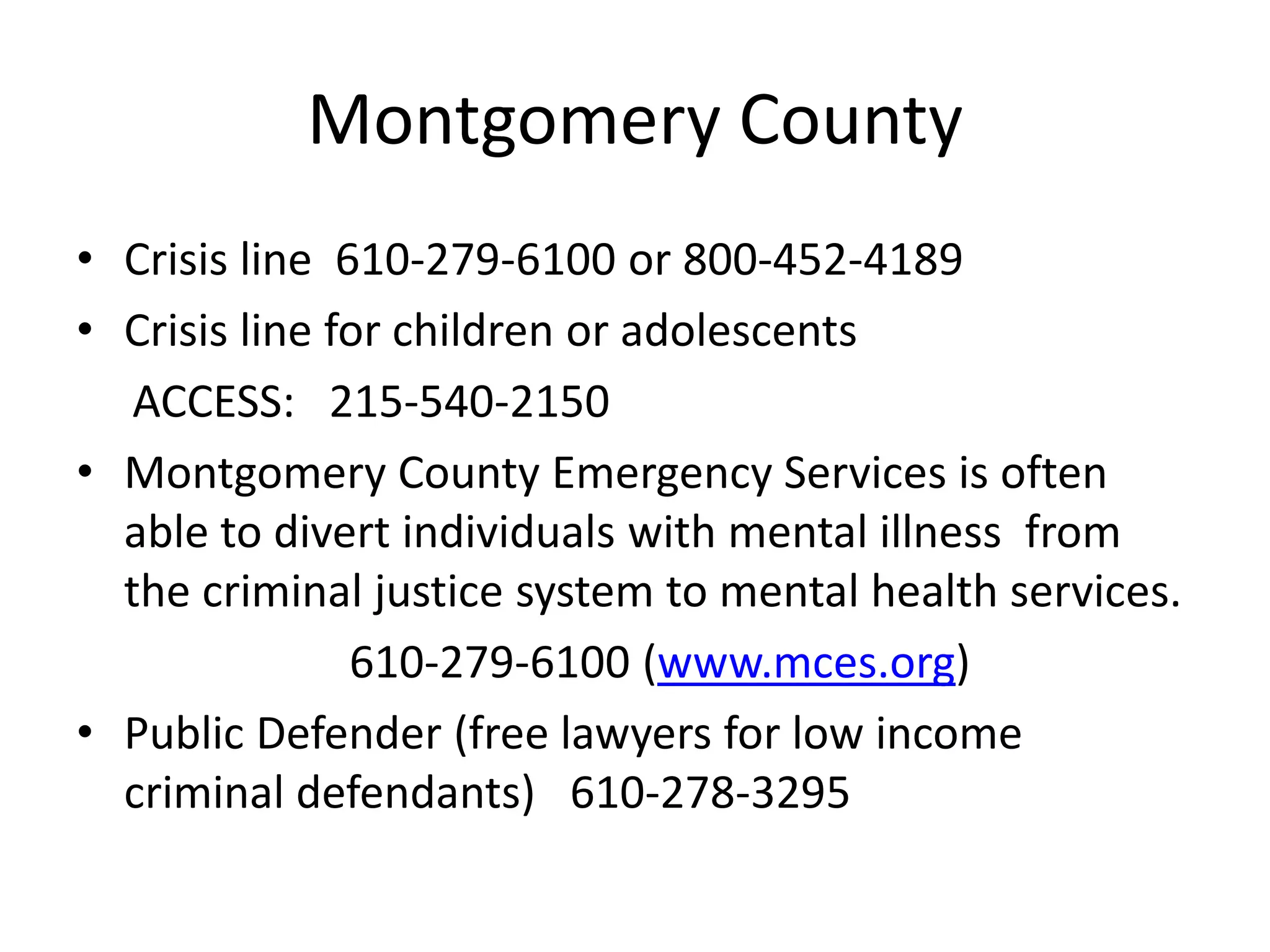
Montgomery County
• Crisis line 610-279-6100 or 800-452-4189
• Crisis line for children or adolescents
ACCESS: 215-540-2150
• Montgomery County Emergency Services is often
able to divert individuals with mental illness from
the criminal justice system to mental health services.
610-279-6100 (www.mces.org)
• Public Defender (free lawyers for low income
criminal defendants) 610-278-3295
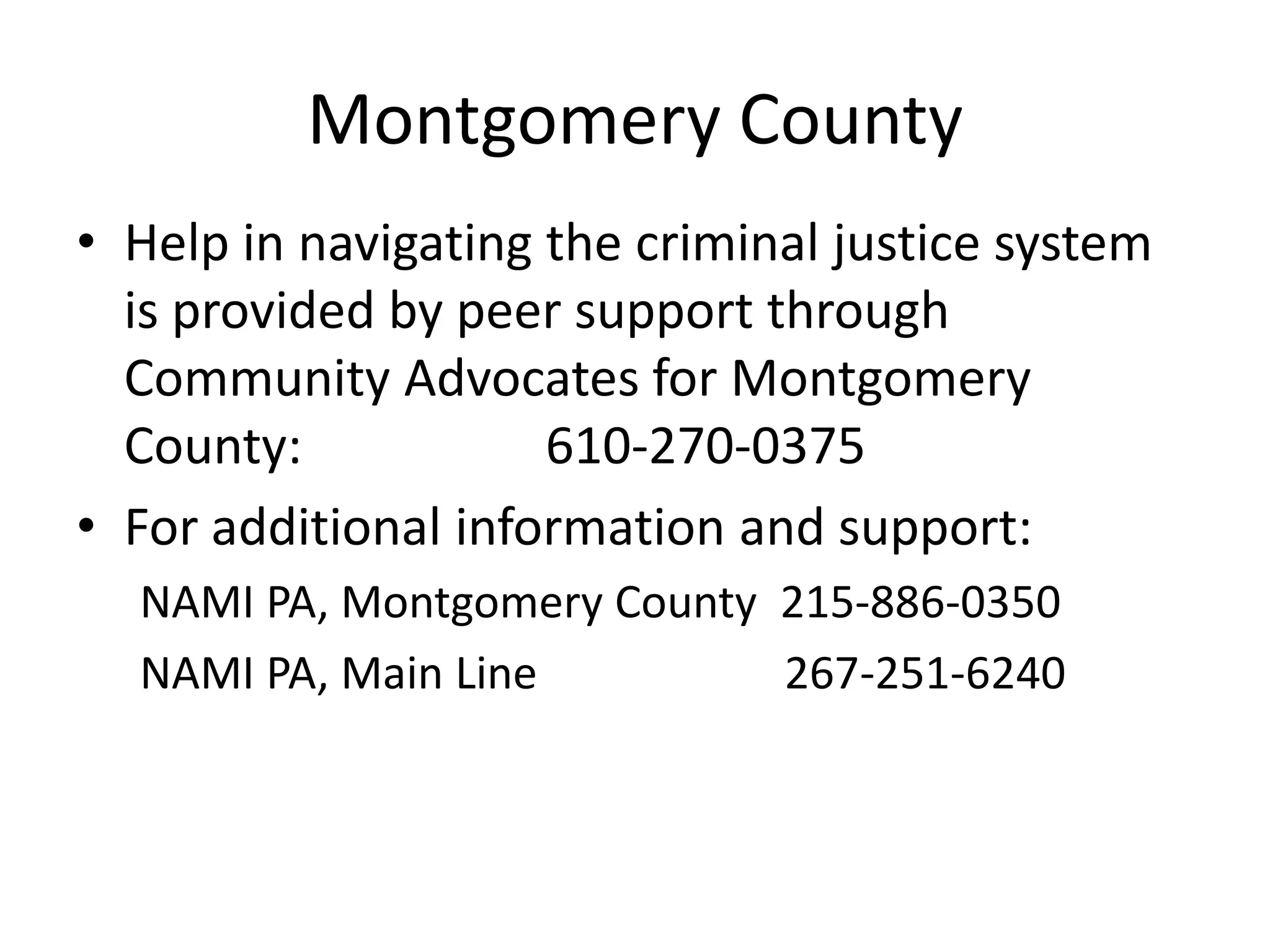
Montgomery County
• Help in navigating the criminal justice system
is provided by peer support through
Community Advocates for Montgomery
County: 610-270-0375
• For additional information and support:
NAMI PA, Montgomery County 215-886-0350
NAMI PA, Main Line 267-251-6240
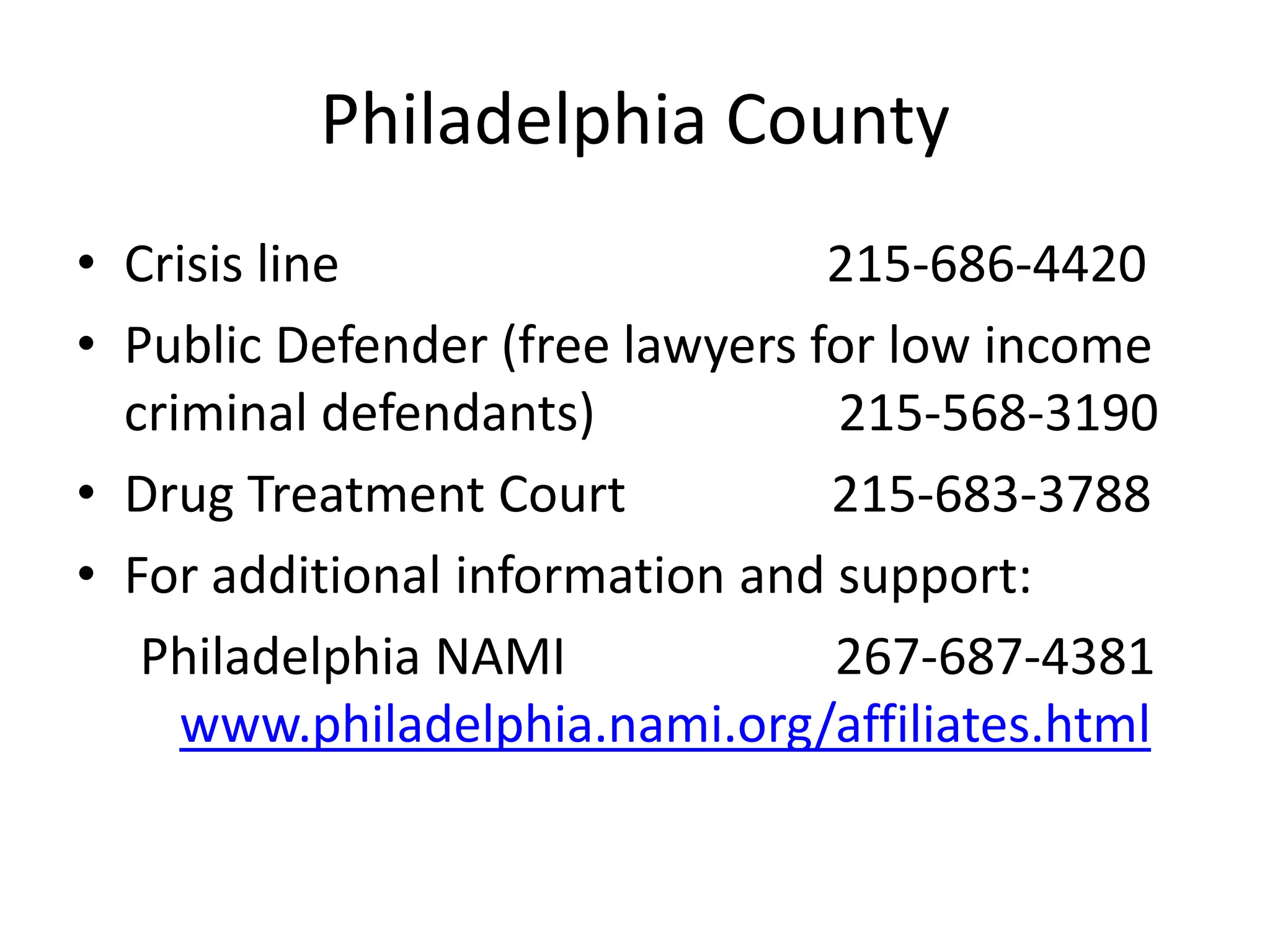
Philadelphia County
• Crisis line 215-686-4420
• Public Defender (free lawyers for low income
criminal defendants) 215-568-3190
• Drug Treatment Court 215-683-3788
• For additional information and support:
Philadelphia NAMI 267-687-4381
www.philadelphia.nami.org/affiliates.html
Created 2013
Presented by NAMI PA, Main Line
an affiliate of the National Alliance on Mental Illness
www.NAMIpaMainLine.org
info@NAMIpaMainLine.org
The complete document this presentation summarizes can be found at:
http://NAMIpaMainLine.org/info-resources/criminal-justice-resources/
All information is current as of publication date; please let us know if you encounter broken hyperlinks.

NAMI PA Main Line Criminal Justice Information

  • 1.
    Created 2013 Helping Individualswith Mental Illness to Avoid or Deal with the Criminal Justice System Presented by NAMI PA, Main Line, an affiliate of the National Alliance on Mental Illness Please view the final slide for NAMI PA, Main Line contact information and the link to a printable document with additional information.
  • 2.
    Information is providedin three sections: • Preventing Arrest • Criminal Justice System procedures and advice • Resources for people in the Philadelphia metropolitan area ~~~~~~~~~~~~~~~~ This information is not legal advice. A person who is in police custody should get the services of a criminal lawyer (see slide 9).
  • 3.
    Preventing Arrest • Avoidarrest by arranging for crisis intervention, ongoing treatment, or court- ordered emergency treatment before the situation escalates to necessitate police involvement. • If you fear there may be a crisis, it is helpful to notify the police in advance that a household includes a person with a mental illness, so the police can respond to an emergency in an informed manner (see slide 13).
  • 4.
    Preventing Arrest --Treatment •Programs such as assertive community treatment (PACT) can help to prevent relapse and mental health crises and thus reduce the risk of arrest. • Many resources for finding treatment are described in “How to Get Services” and “Resources for People with Mental Illness” available at www.NAMIpaMainLine.org
  • 5.
    • During amental health crisis call 911 only if there is immediate danger of physical harm. • Otherwise you may reduce the risk that a crisis will result in arrest by calling the county crisis line which has staff 24/7 who can assess the situation, arrange for an in-person evaluation and/or make referrals as needed. • Crisis line phone numbers for the greater Philadelphia area are available at: www.namipamainline.org/crisis-numbers/ Preventing Arrest --Crisis Intervention
  • 6.
    Preventing Arrest -- Court-OrderedTreatment • When an individual has a life-threatening psychiatric emergency but is unwilling to consent to treatment, state law authorizes court-ordered treatment without the individual’s consent. – Inpatient = involuntary commitment – Outpatient = assisted outpatient treatment • For more information go to: www.mces.org/PDFs/MCES_Quest_June_2003.pdf or www.dbhmrs.org/mental-health-delegate/.
  • 7.
    Preventing Arrest – MentalHealth Advance Directives • An Advance Directive allows a person with mental illness to indicate his/her treatment preferences and designate a Power of Attorney for health care who can be authorized to make treatment decisions on his/her behalf in the event of a mental health crisis. • Go to Disability Rights Network’s website at www.drnpa.org/ to download a copy of the PA Mental Health Advance Directive (MH-Adv-Dir-Decl-Form.pdf).
  • 8.
    Preventing Arrest –Finding a Missing Person • The National Missing and Unidentified Persons Database allows the general public to add new missing persons, with physical and circumstantial details, photographs, dental contacts and other critical information. Posters can be created and cases tracked. Go to www.findthemissing.org. • Additional resources are available at www.outpostforhope.org www.nami.org
  • 9.
    Criminal Justice System– Advice • Get a good criminal lawyer as soon as possible. Try to prevent the police from questioning a suspect without a lawyer present. The police must stop questioning anyone who asks for a lawyer. If possible, consult with a lawyer before deciding whether to reveal a suspect’s mental illness. • If you cannot afford to pay the full fee for a private lawyer, contact public defender services, court- appointed attorneys, or local criminal defense lawyers associations or bar associations. (additional information in following slides)
  • 10.
    Criminal Justice System– Advice • If a person with mental illness has been arrested, see the judge or call the district attorney and ask the court to make it a condition of bail or sentencing that the person must follow all treatment recommendations. This often helps to increase compliance with medications and other important treatments. • If a person with mental illness has been incarcerated, contact the prison, ask for the medical department, and give the person's treatment history (often the place of last treatment is sufficient).
  • 11.
    Criminal Justice System –Procedures and Advice • For a brief overview see Dealing with the Criminal Justice System http://www.nami.org/Content/ContentGroups/Helpline1/Dealing_with_th e_Criminal_Justice_System.htm • A Guide to Mental Illness and the Criminal Justice System has an informative discussion of procedures and terminology as well as helpful advice. http://www.nami.org/Template.cfm?Section=Issue_Spotlights&template= /ContentManagement/ContentDisplay.cfm&ContentID=60725
  • 12.
    Criminal Justice System –Procedures and Advice • When a Person with Mental Illness Goes to Prison – How to Help (a joint project of NAMI NY and the Urban Justice Center): http://il.nami.org/when%20a%20person%20with%20mental %20illness%20goes%20to%20prison.pdf • Understanding the Criminal Justice System by NAMI CT: http://www.nami.org/Content/Microsites146/NAMI_of_Conn ecticut,_Inc/Home135/Criminal_Jusitice1/mh_handbook.pdf
  • 13.
    Resources for Peoplein the Greater Philadelphia Area • If you or your loved one are about to have or have had an encounter with the police, you should seek resources in the county where the incident is occurring/has occurred (even if this is different from the county of residence). • The PA Premise Alert System allows families to provide information about a person with mental illness to first responders before a problem occurs (www.papremisealert.com).
  • 14.
    Chester County • CrisisLine: 610-918-2100 or 877-918-2100 • Public Defender (free lawyers for low income criminal defendants) 610-344-6940 • Mental Health Recovery Court (to divert arrested offenders with mental illness from incarceration) = the ADAPT program; call Bail Agency 610-344-6886 Mental Health 610-344-6265 Adult Probation & Parole 610-344-6290
  • 15.
    Chester County • NAMIPA, Chester County has prepared a very helpful booklet with a wealth of additional information (e.g. on the Mental Health Protocol which provides a way for an offender to receive treatment in the community where there are more resources available than jail). NAMI PA, Chester County can also provide additional information and support. • Call 610-430-0177
  • 16.
    Delaware County • Crisisline 610-352-4703 • If a family member is incarcerated, contact the prison's Mental Health Liaisons at 610-361-3237 or 610-361-3336. These liaisons connect incarcerated mentally ill individuals to mental health services while they are incarcerated and upon release. • Contact Office of Behavioral Health at 610-713-2365 for information about resources such as probation/parole officers who specialize in helping mentally ill offenders.
  • 17.
    Delaware County • PublicDefender (free lawyers for low income criminal defendants) 610-891-4100 • For additional information and support: NAMI PA, Delaware County 610-623-0071 NAMI PA, Main Line 267-251-6240
  • 18.
    Montgomery County • Crisisline 610-279-6100 or 800-452-4189 • Crisis line for children or adolescents ACCESS: 215-540-2150 • Montgomery County Emergency Services is often able to divert individuals with mental illness from the criminal justice system to mental health services. 610-279-6100 (www.mces.org) • Public Defender (free lawyers for low income criminal defendants) 610-278-3295
  • 19.
    Montgomery County • Helpin navigating the criminal justice system is provided by peer support through Community Advocates for Montgomery County: 610-270-0375 • For additional information and support: NAMI PA, Montgomery County 215-886-0350 NAMI PA, Main Line 267-251-6240
  • 20.
    Philadelphia County • Crisisline 215-686-4420 • Public Defender (free lawyers for low income criminal defendants) 215-568-3190 • Drug Treatment Court 215-683-3788 • For additional information and support: Philadelphia NAMI 267-687-4381 www.philadelphia.nami.org/affiliates.html
  • 21.
    Created 2013 Presented byNAMI PA, Main Line an affiliate of the National Alliance on Mental Illness www.NAMIpaMainLine.org info@NAMIpaMainLine.org The complete document this presentation summarizes can be found at: http://NAMIpaMainLine.org/info-resources/criminal-justice-resources/ All information is current as of publication date; please let us know if you encounter broken hyperlinks.