NAS vs. Object — Can NAS Make a Comeback
For audio playback and Q&A go to: bit.ly/NASvObject
OurSpeakers
Molly Presley,
Global Product Marketing Director
George Crump,
Founder and Lead Analyst
Unstructured Data
is Changing
● Growing in capacity
○ Growing in file count
○ Increased retention requirements
○ Increased compliance demands
● Requires rethinking how it is stored
How is
Unstructured Data
Stored Today?
● Traditional Scale-up or Scale-out NAS
● Object Storage
● Cloud Storage
● Hybrid Versions of the Above
● NAS may meet performance demands but
can handle file counts and metadata
requirements
○ Forces purchase of multiple NAS systems
● Object may meet the capacity and file
count demands but can’t handle
performance demands
○ Forces conversion to a completely new way
of storing data
State of Unstructured Data Storage
● Both lack a seamless cloud integration
● The issue is the file system not
hardware
○ Most file systems are decades old
○ Next generation file system
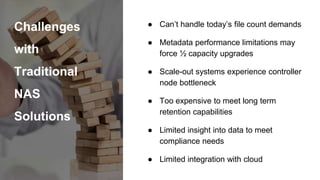
Challenges
with
Traditional
NAS
Solutions
● Can’t handle today’s file count demands
● Metadata performance limitations may
force ½ capacity upgrades
● Scale-out systems experience controller
node bottleneck
● Too expensive to meet long term
retention capabilities
● Limited insight into data to meet
compliance needs
● Limited integration with cloud
Challenge with Traditional Object Storage
● Not natively POSIX compliant
○ Applications have been slow to convert to S3
○ Requires the addition of a gateway
● Metadata Heavy
○ Can handle large amounts of rich metadata
but does so at a cost to performance
● Integrates with Cloud
○ Requires a complete handoff to cloud
storage
○ Like managing two separate object stores
Time for a Change - Next Generation NAS
● Rewritten for modern high capacity,
high file count use case
○ Simple setup - IT doesn’t have
time for an erector set
○ High performance on both small
files and large
○ Real-time visibility into capacity
and usage
○ File system is at home on-
premises and in cloud
©Qumulo
Qumulo: a different type
of storage company.
Real-time visibility, scale, and
control of your file data across
cloud and on-prem
©Qumulo
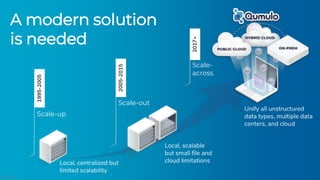
A modern solution
is needed
Scale-up
Scale-out
Scale-
across
2017+
2005-2015
1995-2005
Local, centralized but
limited scalability
Local, scalable
but small file and
cloud limitations
Unify all unstructured
data types, multiple data
centers, and cloud
Scale Across to the Public Cloud
“More than 25% of all customer
wins now cite public cloud
capability as key in their decision
to buy Qumulo.”
“[We’re] actual proof that the solution works. There’s no possible
way I could install 1,000 machines in our network here. I don’t have
the power or cooling to support them. We were able to make the
decision, and in less than 1 hour be rendering on 1,000 machines.
After the jobs finished, we simply terminated the instances. When I
think about how easy it was, it still doesn’t sound real.”
At AWS reinvent 2018, FuseFX was leveraging AWS to achieve over 15GB/sec performance running their render
farm with Qumulo on AWS
—Jason Fotter, Co-Founder/CTO of FuseFX
©Qumulo
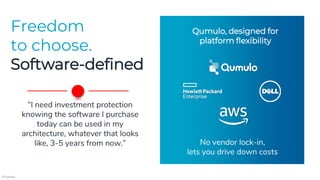
Freedom
to choose.
Software-defined
No vendor lock-in,
lets you drive down costs
Qumulo, designed for
platform flexibility
“I need investment protection
knowing the software I purchase
today can be used in my
architecture, whatever that looks
like, 3-5 years from now.”
True
enterprise
file for
mission
critical
applications
© Qumulo
Scalable ‒ on-prem to the
Cloud
Efficiency ‒ no tree/index
walks
Visibility ‒ real-time
analytics
Software-defined ‒
hardware agnostic
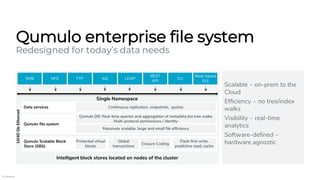
Qumulo enterprise file system
Redesigned for today’s data needs
Qumulo file system
Qumulo DB: Real-time queries and aggregation of metadata (no tree walks
Multi-protocol permissions / identity
Massively scalable, large and small file efficiency
Qumulo Scalable Block
Store (SBS)
Global
transactions
Flash first write,
predictive read, cache
Protected virtual
blocks
Data services Continuous replication, snapshots, quotas
SMB NFS FTP AD LDAP
REST
API
CLI
Web-based
GUI
10/40GbEthernet
Erasure Coding
Intelligent block stores located on nodes of the cluster
Single Namespace
© Qumulo
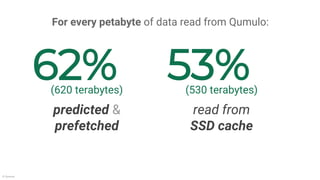
62%
For every petabyte of data read from Qumulo:
(620 terabytes)
predicted &
prefetched
53%(530 terabytes)
read from
SSD cache
Real time
visibility
through
data
awareness
Programmable
API for control
and
automation
Delightful
Customer
Experience
19
Thank you!
Storage Switzerland
www.storageswiss.com
georgeacrump@storageswiss.com
StorageSwiss on Twitter:
twitter.com/storageswiss
StorageSwiss on YouTube:
www.youtube.com/user/storageswiss
Qumulo
qumulo.com
info@qumulo.com
Qumulo on Twitter:
twitter.com/qumulo/
Qumulo on YouTube:
www.youtube.com/qumulo/
NAS vs. Object — Can NAS Make a Comeback
For complete audio and Q&A please register for
the On Demand Version: bit.ly/NASvObject

Webinar: NAS vs Object - Can NAS Make a Comeback?

  • 1.
    NAS vs. Object— Can NAS Make a Comeback For audio playback and Q&A go to: bit.ly/NASvObject
  • 2.
    OurSpeakers Molly Presley, Global ProductMarketing Director George Crump, Founder and Lead Analyst
  • 3.
    Unstructured Data is Changing ●Growing in capacity ○ Growing in file count ○ Increased retention requirements ○ Increased compliance demands ● Requires rethinking how it is stored
  • 4.
    How is Unstructured Data StoredToday? ● Traditional Scale-up or Scale-out NAS ● Object Storage ● Cloud Storage ● Hybrid Versions of the Above
  • 5.
    ● NAS maymeet performance demands but can handle file counts and metadata requirements ○ Forces purchase of multiple NAS systems ● Object may meet the capacity and file count demands but can’t handle performance demands ○ Forces conversion to a completely new way of storing data State of Unstructured Data Storage ● Both lack a seamless cloud integration ● The issue is the file system not hardware ○ Most file systems are decades old ○ Next generation file system
  • 6.
    Challenges with Traditional NAS Solutions ● Can’t handletoday’s file count demands ● Metadata performance limitations may force ½ capacity upgrades ● Scale-out systems experience controller node bottleneck ● Too expensive to meet long term retention capabilities ● Limited insight into data to meet compliance needs ● Limited integration with cloud
  • 7.
    Challenge with TraditionalObject Storage ● Not natively POSIX compliant ○ Applications have been slow to convert to S3 ○ Requires the addition of a gateway ● Metadata Heavy ○ Can handle large amounts of rich metadata but does so at a cost to performance ● Integrates with Cloud ○ Requires a complete handoff to cloud storage ○ Like managing two separate object stores
  • 8.
    Time for aChange - Next Generation NAS ● Rewritten for modern high capacity, high file count use case ○ Simple setup - IT doesn’t have time for an erector set ○ High performance on both small files and large ○ Real-time visibility into capacity and usage ○ File system is at home on- premises and in cloud
  • 9.
    ©Qumulo Qumulo: a differenttype of storage company. Real-time visibility, scale, and control of your file data across cloud and on-prem
  • 10.
    ©Qumulo A modern solution isneeded Scale-up Scale-out Scale- across 2017+ 2005-2015 1995-2005 Local, centralized but limited scalability Local, scalable but small file and cloud limitations Unify all unstructured data types, multiple data centers, and cloud
  • 11.
    Scale Across tothe Public Cloud “More than 25% of all customer wins now cite public cloud capability as key in their decision to buy Qumulo.”
  • 12.
    “[We’re] actual proofthat the solution works. There’s no possible way I could install 1,000 machines in our network here. I don’t have the power or cooling to support them. We were able to make the decision, and in less than 1 hour be rendering on 1,000 machines. After the jobs finished, we simply terminated the instances. When I think about how easy it was, it still doesn’t sound real.” At AWS reinvent 2018, FuseFX was leveraging AWS to achieve over 15GB/sec performance running their render farm with Qumulo on AWS —Jason Fotter, Co-Founder/CTO of FuseFX
  • 13.
    ©Qumulo Freedom to choose. Software-defined No vendorlock-in, lets you drive down costs Qumulo, designed for platform flexibility “I need investment protection knowing the software I purchase today can be used in my architecture, whatever that looks like, 3-5 years from now.”
  • 14.
  • 15.
    © Qumulo Scalable ‒on-prem to the Cloud Efficiency ‒ no tree/index walks Visibility ‒ real-time analytics Software-defined ‒ hardware agnostic Qumulo enterprise file system Redesigned for today’s data needs Qumulo file system Qumulo DB: Real-time queries and aggregation of metadata (no tree walks Multi-protocol permissions / identity Massively scalable, large and small file efficiency Qumulo Scalable Block Store (SBS) Global transactions Flash first write, predictive read, cache Protected virtual blocks Data services Continuous replication, snapshots, quotas SMB NFS FTP AD LDAP REST API CLI Web-based GUI 10/40GbEthernet Erasure Coding Intelligent block stores located on nodes of the cluster Single Namespace
  • 16.
    © Qumulo 62% For everypetabyte of data read from Qumulo: (620 terabytes) predicted & prefetched 53%(530 terabytes) read from SSD cache
  • 17.
  • 18.
  • 19.
  • 20.
  • 21.
    Thank you! Storage Switzerland www.storageswiss.com georgeacrump@storageswiss.com StorageSwisson Twitter: twitter.com/storageswiss StorageSwiss on YouTube: www.youtube.com/user/storageswiss Qumulo qumulo.com info@qumulo.com Qumulo on Twitter: twitter.com/qumulo/ Qumulo on YouTube: www.youtube.com/qumulo/
  • 22.
    NAS vs. Object— Can NAS Make a Comeback For complete audio and Q&A please register for the On Demand Version: bit.ly/NASvObject

Editor's Notes

  • #11 A modern solution is needed...to allow you to focus on your data, not your storage Scale up: Top of rack notes won’t scale without silos Scale out: A few racks reach their limit Now - scale across: Multiple geographies and cloud are standard
  • #15 Why are we here?
  • #16 Qumulo distributed hybrid file system includes powerful real-time analytics and capacity quotas, as well as cross-cluster replication and snapshots. Continuous replication Qumulo provides continuous replication across storage clusters, whether on premises or in the public cloud. Once a replication relationship between a source cluster and a target cluster has been established and synchronized, Qumulo automatically keeps data consistent. There’s no need to manage the complex job queues for replication associated with legacy storage appliances. Snapshots Snapshots let system administrators preserve the state of a file system or directory at a given point in time. If a file or directory is modified or deleted unintentionally, users or administrators can revert it to its saved state. Snapshots in Qumulo and have an extremely efficient and scalable implementation. A single Qumulo cluster can have a virtually unlimited number of concurrent snapshots without performance or capacity degradation. Real-time quotas Quotas allow administrators to specify how much capacity a given directory is allowed to use for files. If an administrator sees that a rogue user is causing a subdirectory to grow too quickly, the administrator can instantly limit the capacity of that user’s directory. In Qumulo distributed hybrid file system quotas are deployed immediately and do not have to be provisioned. They are enforced in real time and changes to their capacities are immediately implemented. A side benefit is that quotas assigned to directories move with them and directories themselves can be moved into and out of quota domains. Real-time analytics Qumulo distributed hybrid file system has real-time analytics that tell you what’s happening in your file system now. Analytics is a part of the Qumulo codebase; it is not an afterthought. Instead of running multiple commands, parsing through pages of log files, and running separate programs, an administrator can simply look at the GUI and understand what’s happening. For example, an administrator can immediately see if a process or user is hogging system resources and, in real-time, apply a capacity quota. The Qumulo distributed hybrid file system These features are built on the highly scalable Qumulo file system that, unlike other systems, includes integrated real-time aggregation of file metadata. Qumulo proactive cloud-based monitoring and trends service A Qumulo subscription includes cloud-based monitoring that proactively detects potential problems, such as disk failures. Administrators can also access the Qumulo trends service, which provides historical data about how the system is being used. This information can help lower costs and optimize workflows. Qumulo customer care Qumulo has industry-leading support. Many storage customers are dissatisfied with the support they receive from their vendors. They find them to be unresponsive and reactive rather than proactive. Qumulo offers responsive, personal customer support, with some of the highest Net Promoter Score (NPS) in the industry.
  • #18 Why are we here?
  • #20 Why are we here?