Welcome to our Postal Webinar Series


Use the chat window to ask questions during the presentation.
               We will answer them at the end.
               We will start in a few moments…


                                                                1
The Adaptable Post Concept

                February 28, 2013
Webinar outline


Variability in the postal network
Five concrete operational initiatives
Moving forward


                                        3
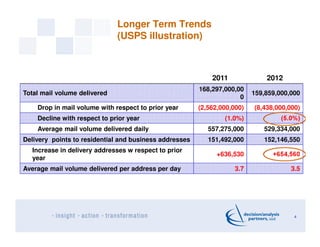
Longer Term Trends
                              (USPS illustration)


                                                            2011              2012
                                                        168,297,000,00
Total mail volume delivered                                               159,859,000,000
                                                                     0
    Drop in mail volume with respect to prior year      (2,562,000,000)   (8,438,000,000)
    Decline with respect to prior year                          (1.0%)             (5.0%)
    Average mail volume delivered daily                    557,275,000       529,334,000
Delivery points to residential and business addresses      151,492,000       152,146,550
  Increase in delivery addresses w respect to prior
                                                              +636,530          +654,560
  year
Average mail volume delivered per address per day                   3.7               3.5


                                                                                       4
Sources of Postal Traffic Variability


Long-term trends                 Mailings
   Substitution                     Large customer mailings
   Economic situation            Random failures
Seasonal variability                Transport delays
   Holidays                         Equipment failure
   Others                           Other
Day-of-the week
   Customer preferences
   Operation cycles


                                                              5
Capacity versus Variability


Typically, postal operators run a    What causes excessive costs in a
network that is seldom adjusted,     “static” network?
why?                                    Equipment: Often sized for peak
   Complex network: impacts are         capacity
   difficult to anticipate              Transport: Low utilization and/or
   Data not always available            inadequate timing
   More often: No culture of            Labour: Utilization not aligned to
   “production planning & control”      workload
   (PP&C) or analytics.                 Sort plans: Bins, trays, containers
                                        are under-utilized
                                        Too many delivery routes, poorly
                                        defined.


                                                                              6
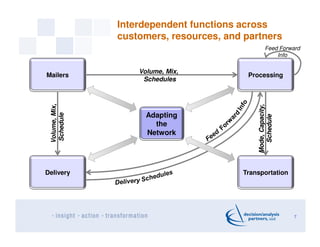
Interdependent functions across
                customers, resources, and partners
                                                    Feed Forward
                                                        Info

                    Volume, Mix,
Mailers                                    Processing
                     Schedules
 Volume, Mix,


                                              Mode, Capacity,
                      Adapting
 Schedule


                                                Schedule
                        the
                      Network


Delivery                                 Transportation


                                                                7
How can we adapt to cut costs?


Variability Type                    What can be done?
Long-term          • Facilities, equipment sizing & configuration
                   • Network, distribution, delivery, labour agreements
Seasonal           • Distribution, transport, labour, delivery
                   • Manage peaks, yield mgmt., 3rd parties
                   • Forecasting, skills & training
Day-of-the-Week    • Yield mgmt., distribution, delivery
                   • Decision support, skills & training
Mailings           • Yield mgmt., distribution
                   • Manage peaks, yield mgmt.,
                   • Decision support, skills & training
Random Failures    • Distribution, decision-support


                                                                          8
The adaptable post spans many
                           areas


Long Term          Seasonal            Day of Week            Mailings              Random


  Network          Distribution Planning                        Contingency Planning
  Modeling                          Yield Mgmt Planning
                                                              Skills and Training
                         Capacity Planning
    Business Analytics            Labour Planning and Scheduling


    Network           3rd Party                           Sort and Hold
                                                                             Maintain
 Rationalization    Collaboration                Yield Management           Situational
                                Dynamic        Labour Scheduling            Awareness
        Asset Leasing        Route Mgmt
                                             Delivery Pt Economics


                                                                                             9
Five concrete initiatives
                   to increase adaptability


Hold and sort                                    Policies
Dynamic routing
Delivery point economics
Yield management                                 Initiatives
Labour scheduling            Plan


                  Measure             Schedule
                                                   Tools


                            Execute


                                                               10
Demand – capacity imbalance


Postal networks operate in a environment
with significant variability where demand for    Demand
processing and delivery may not always be
aligned to the current capacity.
                                                Processing/
This creates an imbalance that may result in      Deliver
overtime labour, congestion or under-
utilisation, or unmet service standards.         Capacity


                                                              11
1. Hold and Sort


“Hold and Sort” deliberately takes advantage of               Demand
time
available to manage this imbalance
                                                                 Time
Leverage service standards to hold mail for as                available ?
many
hours or days necessary to:
   Increase transport effectiveness                       Cost-saving
   Optimise sort centre machine utilisation
                                                          alternatives?
   Increase the density of mail delivered to a group
   of addresses
                                                       Hold          Process


                                                                               12
1. Hold and Sort (continued)


The consequence of this initiative may be to
introduce new products, tools, and technologies
   Establish an information-rich identification scheme that
   represents critical mail piece, as well as advance ship
   notices of large mailings
   Introduce products with flexible service commitments to
   increase the density of mail delivered to a group of
   addresses (or block-face)
   Implement distribution management tools to perform the
   hold versus process decisions
   Introduce mail staging technologies that
    enables storage and retrieval


                                                              13
2. Dynamic Routing


Mail and parcel routing decisions can also be made
dynamically, to mitigate seasonality, day-of-the-week
fluctuations, or the variability due to large mailings.

Routing is performed network-wide, or within specific
regions
    Distribution programs can be adapted, driving mail
    through one facility or another
    Transport can be adjusted accordingly – perhaps
    capacity is already there

Why?
    Leverage under-utilised capacity, service time allowing
    Close a facility temporarily (day or shift, for
    maintenance)
    Consolidate mail streams to reduce costs and
    improve efficiency


                                                              14
2. Dynamic Routing (Continued)


Needs good routing tools
    Network models to balance workload
    Quickly invoke or construct and put in place
    alternative sort plans
    Ability to evaluate transport needs


Adaptability is achieved gradually, e.g., start
with seasonal, weekly plan changes and
gradually evolve to daily plan changes

Key success factors are:
    An information-rich environment, and
    A highly flexible organizational structure


                                                         15
3. Delivery Point Economics


Delivery routes can be adapted to
optimize the density of mail
delivered per address

    Hold mail for delivery when
    economically attractive
    Develop specific mail products to
    support delivery point economic


Shift the focus to ‘any-day delivery’ vs.
‘five or six day delivery’.
    Skip some delivery points while meeting
    service requirements


                                                      16
3. Delivery Point Economics
                       (Continued)


Information requirements
> medium/high
    Item level identification
    Smart network and delivery planning tools


High degree of operational flexibility
    Flexible staging of mail
    Crew-based delivery workforce


Introduces a strong information
management discipline and improves the
operational flexibility


                                                     17
4. Yield Management


Yield management is the process of
understanding, anticipating, and influencing
customer behavior to maximize yield or
profits from the processing and delivery
capacity
    Daily processing and delivery capacity are
    perishable resources to be optimized.
    Commonly used in airlines and hotels


Pricing policies for large mailings would
take into account available network
capacity based on day-of-the-week or
seasonality.


                                                 18
4. Yield Management (Continued)


Requires:
   Good costing & yield management models
   Mailing reservation/e-manifest system
   with accurate production plans
   (coupled with dynamic routing)
   Mail pickup program
   Pricing flexibility outside of USO


Information requirements > medium
   Good historical averages can be used
   Capacity and network impacts must be
   easily evaluated
   Pricing must be offered beforehand


                                                      19
5. Advanced Labour Management


Advanced labour management initiatives
will help posts be more adaptable and
transition from fixed to variable-cost
operations

Methods to aligned labour to the
variability in demand:
    Crew scheduling
    Bids of qualified workers to specific
    operations/shifts
    Variable labor assignment

Fully utilize the flexibility that exists in the
labour force


                                                        20
5. Advanced Labor Management
                       (Continued)


Requires
   Ability to affect work assignments
       Part-time workers
       Scattered shifts
   Integrated labour & operations planning system,
   and other advanced modeling techniques


Information requirements > medium to high
   Understanding
       Work rules
       Labour costs for each task
       Labour productivity functions by work center
   Projecting short to medium term volumes


                                                      21
In Summary


The commercial sector is driving cost out by being increasingly agile and
adaptable
Complexity of postal network and operations has kept them static
Significant opportunities to adapt
   Infrastructure (Long-term changes in volume/mix)
   Distribution (Medium & short term)
   Delivery (Medium & short term)
Information
   Historical: forecasting & simulation tools, business analytics
   Mailer data: advanced planning, distribution & routing tools
   Real time: Situational awareness, operations control
   Mailpiece identification: real-time decision support, business analytics


                                                                              22
Next Steps


Diagnostic
   Do you know how variable your demand and operations are?
   How adaptable is your operation?
       How often do you adapt your infrastructure?
       How often do you revise your distribution plans?
   Do you have the proper tools & methods for each type of variability?

Roadmap
  Improve understanding of levels/impacts of variability in the enterprise
  Identify and prioritise initiatives to increase adaptability
  Acquire data and tools, develop skills


                                                                             23
> insight > action > transformation


                                      24

Webinar 2013 the adaptable post

  • 1.
    Welcome to ourPostal Webinar Series Use the chat window to ask questions during the presentation. We will answer them at the end. We will start in a few moments… 1
  • 2.
    The Adaptable PostConcept February 28, 2013
  • 3.
    Webinar outline Variability inthe postal network Five concrete operational initiatives Moving forward 3
  • 4.
    Longer Term Trends (USPS illustration) 2011 2012 168,297,000,00 Total mail volume delivered 159,859,000,000 0 Drop in mail volume with respect to prior year (2,562,000,000) (8,438,000,000) Decline with respect to prior year (1.0%) (5.0%) Average mail volume delivered daily 557,275,000 529,334,000 Delivery points to residential and business addresses 151,492,000 152,146,550 Increase in delivery addresses w respect to prior +636,530 +654,560 year Average mail volume delivered per address per day 3.7 3.5 4
  • 5.
    Sources of PostalTraffic Variability Long-term trends Mailings Substitution Large customer mailings Economic situation Random failures Seasonal variability Transport delays Holidays Equipment failure Others Other Day-of-the week Customer preferences Operation cycles 5
  • 6.
    Capacity versus Variability Typically,postal operators run a What causes excessive costs in a network that is seldom adjusted, “static” network? why? Equipment: Often sized for peak Complex network: impacts are capacity difficult to anticipate Transport: Low utilization and/or Data not always available inadequate timing More often: No culture of Labour: Utilization not aligned to “production planning & control” workload (PP&C) or analytics. Sort plans: Bins, trays, containers are under-utilized Too many delivery routes, poorly defined. 6
  • 7.
    Interdependent functions across customers, resources, and partners Feed Forward Info Volume, Mix, Mailers Processing Schedules Volume, Mix, Mode, Capacity, Adapting Schedule Schedule the Network Delivery Transportation 7
  • 8.
    How can weadapt to cut costs? Variability Type What can be done? Long-term • Facilities, equipment sizing & configuration • Network, distribution, delivery, labour agreements Seasonal • Distribution, transport, labour, delivery • Manage peaks, yield mgmt., 3rd parties • Forecasting, skills & training Day-of-the-Week • Yield mgmt., distribution, delivery • Decision support, skills & training Mailings • Yield mgmt., distribution • Manage peaks, yield mgmt., • Decision support, skills & training Random Failures • Distribution, decision-support 8
  • 9.
    The adaptable postspans many areas Long Term Seasonal Day of Week Mailings Random Network Distribution Planning Contingency Planning Modeling Yield Mgmt Planning Skills and Training Capacity Planning Business Analytics Labour Planning and Scheduling Network 3rd Party Sort and Hold Maintain Rationalization Collaboration Yield Management Situational Dynamic Labour Scheduling Awareness Asset Leasing Route Mgmt Delivery Pt Economics 9
  • 10.
    Five concrete initiatives to increase adaptability Hold and sort Policies Dynamic routing Delivery point economics Yield management Initiatives Labour scheduling Plan Measure Schedule Tools Execute 10
  • 11.
    Demand – capacityimbalance Postal networks operate in a environment with significant variability where demand for Demand processing and delivery may not always be aligned to the current capacity. Processing/ This creates an imbalance that may result in Deliver overtime labour, congestion or under- utilisation, or unmet service standards. Capacity 11
  • 12.
    1. Hold andSort “Hold and Sort” deliberately takes advantage of Demand time available to manage this imbalance Time Leverage service standards to hold mail for as available ? many hours or days necessary to: Increase transport effectiveness Cost-saving Optimise sort centre machine utilisation alternatives? Increase the density of mail delivered to a group of addresses Hold Process 12
  • 13.
    1. Hold andSort (continued) The consequence of this initiative may be to introduce new products, tools, and technologies Establish an information-rich identification scheme that represents critical mail piece, as well as advance ship notices of large mailings Introduce products with flexible service commitments to increase the density of mail delivered to a group of addresses (or block-face) Implement distribution management tools to perform the hold versus process decisions Introduce mail staging technologies that enables storage and retrieval 13
  • 14.
    2. Dynamic Routing Mailand parcel routing decisions can also be made dynamically, to mitigate seasonality, day-of-the-week fluctuations, or the variability due to large mailings. Routing is performed network-wide, or within specific regions Distribution programs can be adapted, driving mail through one facility or another Transport can be adjusted accordingly – perhaps capacity is already there Why? Leverage under-utilised capacity, service time allowing Close a facility temporarily (day or shift, for maintenance) Consolidate mail streams to reduce costs and improve efficiency 14
  • 15.
    2. Dynamic Routing(Continued) Needs good routing tools Network models to balance workload Quickly invoke or construct and put in place alternative sort plans Ability to evaluate transport needs Adaptability is achieved gradually, e.g., start with seasonal, weekly plan changes and gradually evolve to daily plan changes Key success factors are: An information-rich environment, and A highly flexible organizational structure 15
  • 16.
    3. Delivery PointEconomics Delivery routes can be adapted to optimize the density of mail delivered per address Hold mail for delivery when economically attractive Develop specific mail products to support delivery point economic Shift the focus to ‘any-day delivery’ vs. ‘five or six day delivery’. Skip some delivery points while meeting service requirements 16
  • 17.
    3. Delivery PointEconomics (Continued) Information requirements > medium/high Item level identification Smart network and delivery planning tools High degree of operational flexibility Flexible staging of mail Crew-based delivery workforce Introduces a strong information management discipline and improves the operational flexibility 17
  • 18.
    4. Yield Management Yieldmanagement is the process of understanding, anticipating, and influencing customer behavior to maximize yield or profits from the processing and delivery capacity Daily processing and delivery capacity are perishable resources to be optimized. Commonly used in airlines and hotels Pricing policies for large mailings would take into account available network capacity based on day-of-the-week or seasonality. 18
  • 19.
    4. Yield Management(Continued) Requires: Good costing & yield management models Mailing reservation/e-manifest system with accurate production plans (coupled with dynamic routing) Mail pickup program Pricing flexibility outside of USO Information requirements > medium Good historical averages can be used Capacity and network impacts must be easily evaluated Pricing must be offered beforehand 19
  • 20.
    5. Advanced LabourManagement Advanced labour management initiatives will help posts be more adaptable and transition from fixed to variable-cost operations Methods to aligned labour to the variability in demand: Crew scheduling Bids of qualified workers to specific operations/shifts Variable labor assignment Fully utilize the flexibility that exists in the labour force 20
  • 21.
    5. Advanced LaborManagement (Continued) Requires Ability to affect work assignments Part-time workers Scattered shifts Integrated labour & operations planning system, and other advanced modeling techniques Information requirements > medium to high Understanding Work rules Labour costs for each task Labour productivity functions by work center Projecting short to medium term volumes 21
  • 22.
    In Summary The commercialsector is driving cost out by being increasingly agile and adaptable Complexity of postal network and operations has kept them static Significant opportunities to adapt Infrastructure (Long-term changes in volume/mix) Distribution (Medium & short term) Delivery (Medium & short term) Information Historical: forecasting & simulation tools, business analytics Mailer data: advanced planning, distribution & routing tools Real time: Situational awareness, operations control Mailpiece identification: real-time decision support, business analytics 22
  • 23.
    Next Steps Diagnostic Do you know how variable your demand and operations are? How adaptable is your operation? How often do you adapt your infrastructure? How often do you revise your distribution plans? Do you have the proper tools & methods for each type of variability? Roadmap Improve understanding of levels/impacts of variability in the enterprise Identify and prioritise initiatives to increase adaptability Acquire data and tools, develop skills 23
  • 24.
    > insight >action > transformation 24