The Adaptable Post
                                          BERNARD MARKOWICZ AND PIERRE KACHA
                                          decision/analysis partners LLC


           e are all familiar with the
           pressures facing most
W          posts in the last few years,
including a steep decline in mail vol-
ume and increased competition. In
mechanized operations, volume has
often dropped faster than machines
and labor can be taken out. Posts
need to come up with an operating
strategy that is adapted to these
new mail patterns, including new ap-
proaches to distribution and operat-
ing plans.
     Industrialized posts have devel-
oped highly automated technologies
to read addresses, and sort and se-
quence letters and even small pack-
ets. Operating plans provide the un-
derlying discipline required to
leverage the benefits of automation,
and distribute and deliver the mail
efficiently. Processing areas are de-
fined, transport schedules are estab-
lished, and deadlines for processing
mail are set. These operating
schedules are refined over time, but
they remain essentially static and
are changed infrequently. Labor
schedules are often established
based on these static operating
plans.
     Today, excess labor and infra-
structure associated with these

                                                                 Reprinted from the September 2011 Edition of the Mail & Express Review, Post & Parcel.
static plans are erasing some of
the productivity gains achieved
through automation in the last
thirty years.

Inventory is our friend
     Every day, these static operat-
ing plans push items through the
same time definite paths, consoli-
dating mail through the same
plants, using the same primary sort
programs, towards the same deliv-
ery preparation and final delivery
processes. When one examines
the mail in each stream, one often
finds faster mail, such as first class
mail in the U.S. co-mingled with
slower mail, like U.S. standard mail,
being processed in the same time
windows, and at the same speed.
The proportion of slower class mail
being hurried to its destination
faster than necessary is increasing,
as the proportion of faster first class
mail keeps dropping.
     The additional amount of time
available to deliver standard mail,
and sometimes the additional time
also available to deliver first class,
could be used to perform a number                           that can take advantage of available       • Yield management: the ability to
of cost saving actions. For instance,                       information and time and generate            work with mailers to take advan-
delivery may be avoided to certain                          more cost effective routings.                tage, like the airlines, of available
points on certain days, facilities may                           In the rest of this article, we ex-     capacity.
be bypassed on certain days, or                             amine some of these possible ac-           • Advanced labor management:
transport may be combined. Actions                          tions in the context of ‘the adaptable       crew scheduling.
may include holding and consolidat-                         post:’
ing mail, or bypassing and rerouting                        • Dynamic network management:              Dynamic network management
mail to forego processing, or trans-                           how mail flows can be managed               The main concept is to deliber-
port, and thereby create larger, more                          in near real time.                      ately take advantage of the time avail-
economical batches. The main idea                           • Delivery point economics: how            able to deliver each mail piece. This
is to use information about mail and                           delivery operations can be con-         means that the normal mail process-
its characteristics to create an                               trolled together as a function of       ing operations cycle does not apply
adaptable operations environment                               volumes and service standards.          automatically to each piece of mail,

Reprinted from the September 2011 Edition of the Mail & Express Review, Post & Parcel.
Yield management is the process of understanding, anticipating
             and influencing consumer behavior in order to maximize yield or
                                  profits from a fixed, perishable resource.

and that a piece of mail may be held        ating plans in near real time. Sort               in 1985. Yield management is the
or diverted based on a number of fac-       schemes and transport are then                    process of understanding, anticipating
tors. For instance, some mail in-           adapted based on overall processing               and influencing consumer behavior in
ducted on Monday may be held in in-         costs. The operating plans find ways              order to maximize yield or profits from
ventory along the way to form larger        to leverage network wide transport                a fixed, perishable resource. For
batches, provided that service com-         and processing capacity, aiming to                posts, the perishable resource is the
mitments are respected. Sort pro-           maximize the operating efficiency of              processing and delivery capacity of
grams on automated equipment                each plant in the network, and the                the network on a given day. On some
would adapt from one day to another,        transportation utilization on each                days of the week, during some
driving mail through one facility in-       route between plants.                             months of the year, there is additional
stead of another. Transport will also                                                         capacity because overall mail volume
be affected since mail will follow dif-     Delivery point economics                          is lower. During or prior to holidays,
ferent paths across the network on its           Delivery point economics uses                available capacity may be reduced,
way to its destination mailbox.             the same concept: short term deliv-               and operators rely on more expensive
     Different degrees of flexibility can   ery planning applications use de-                 overtime.
be built into an operating environ-         tailed information about the mail                      Using its capacity to anticipate
ment, and the system can be de-             pipeline to create opportunities to re-           mail volumes on a future given day,
signed to react at different speeds. At     duce delivery costs. Mail can be                  the postal operator would price its
first, opportunities to adapt from the      held in the network, or at delivery               available capacity to mailers accord-
daily schedule can be implemented           units, when distribution economics                ingly, and invite them to take advan-
on a repeatable weekly or monthly           suggest and service standards per-                tage of this capacity. On low volume
basis. Sort schemes and transport           mit, so that delivery routes can be               days, prices offered to mailers for
schedules can be made to change             shortened, skipped, or combined.                  advertising mail would go down to
predictably from one day to another              A similar concept is being tested            reflect the availability of processing
because of weekly or seasonal pat-          in France by La Poste, where mail                 capacity. During high volume peri-
terns. A post can then graduate to a        carriers collaborate to manage deliv-             ods, prices for advertising mail
more dynamic level of adaptation, for       ery routes on a daily basis based on              would go up to reflect the scarcity of
instance when information about             the availability of personnel and the             capacity available. Mailers could
large mailings is integrated into oper-     volume of mail to be distributed.                 reserve processing and delivery ca-
                                            Finnish Post has gone further,                    pacity ahead of time at pre-agreed
                                            emailing scans of physical mail                   prices, thus commirring to stable
                                            pieces to rural customers, then opti-             and predictable mail flows.
                                            mizing rural deliveries of the physi-
                                            cal pieces every other week. The                  Advanced labor management
                                            objective is to leverage both mail de-                Traditionally, postal operations
                                            livery capacity and the time avail-               were made predictable by setting
                                            able to deliver each piece to create              fixed labor schedules and rules that
                                            heavier delivery density and lower                enabled postal managers to line up
                                            delivery costs per piece.                         predictable human resources. To-
                                                                                              day, modern enterprises must tailor
                                            Yield management                                  their human resources more pre-
                                               The concept of yield management                cisely to the demands of their opera-
                                            was introduced by American Airlines               tions, and to assign the appropriate

                                                                Reprinted from the September 2011 Edition of the Mail & Express Review, Post & Parcel.
level of labor to meet the expected
workload.
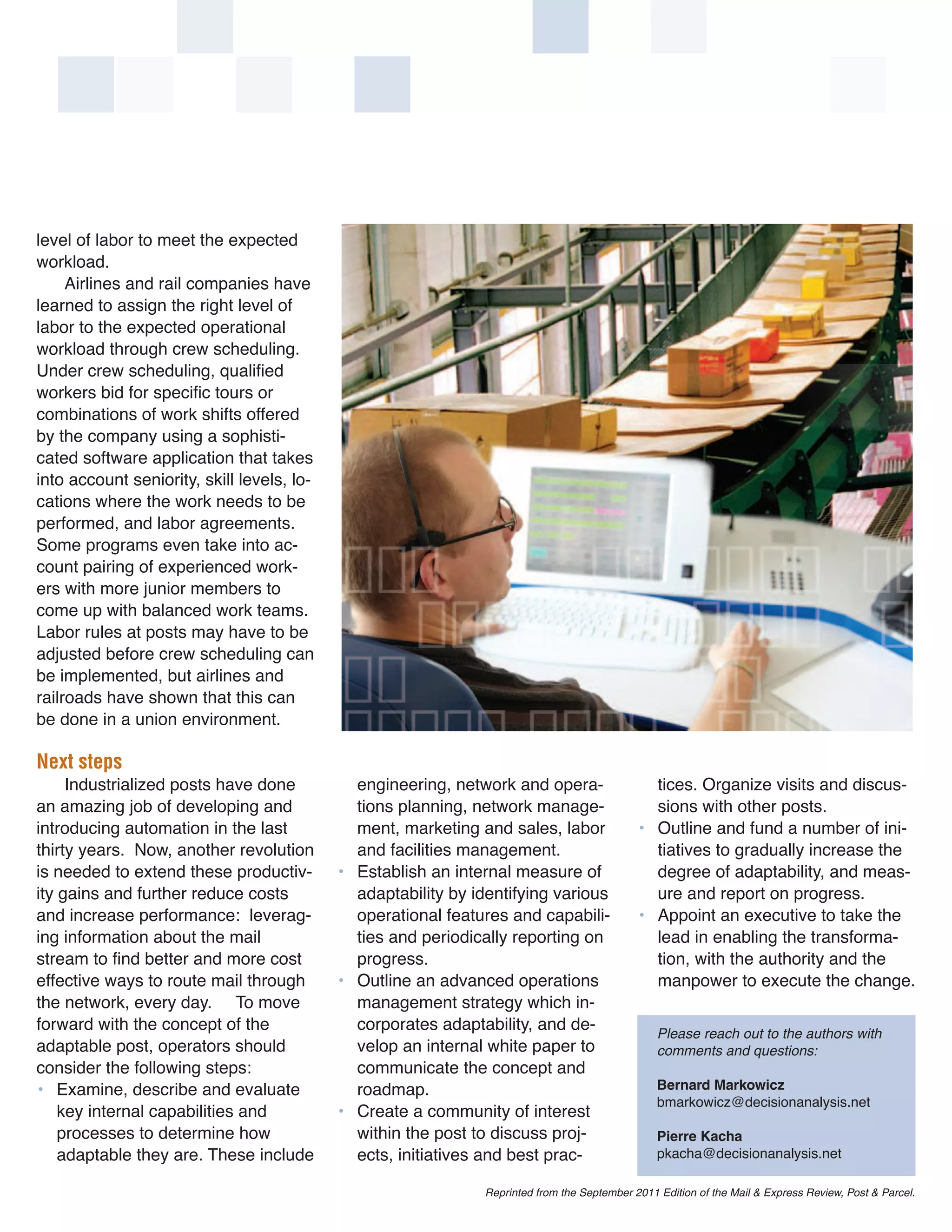
     Airlines and rail companies have
learned to assign the right level of
labor to the expected operational
workload through crew scheduling.
Under crew scheduling, qualified
workers bid for specific tours or
combinations of work shifts offered
by the company using a sophisti-
cated software application that takes
into account seniority, skill levels, lo-
cations where the work needs to be
performed, and labor agreements.
Some programs even take into ac-
count pairing of experienced work-
ers with more junior members to
come up with balanced work teams.
Labor rules at posts may have to be
adjusted before crew scheduling can
be implemented, but airlines and
railroads have shown that this can
be done in a union environment.

Next steps
     Industrialized posts have done           engineering, network and opera-                   tices. Organize visits and discus-
an amazing job of developing and              tions planning, network manage-                   sions with other posts.
introducing automation in the last            ment, marketing and sales, labor                • Outline and fund a number of ini-
thirty years. Now, another revolution         and facilities management.                        tiatives to gradually increase the
is needed to extend these productiv-        • Establish an internal measure of                  degree of adaptability, and meas-
ity gains and further reduce costs            adaptability by identifying various               ure and report on progress.
and increase performance: leverag-            operational features and capabili-              • Appoint an executive to take the
ing information about the mail                ties and periodically reporting on                lead in enabling the transforma-
stream to find better and more cost           progress.                                         tion, with the authority and the
effective ways to route mail through        • Outline an advanced operations                    manpower to execute the change.
the network, every day. To move               management strategy which in-
forward with the concept of the               corporates adaptability, and de-
adaptable post, operators should              velop an internal white paper to
                                                                                                  Please reach out to the authors with

consider the following steps:                 communicate the concept and
                                                                                                  comments and questions:

• Examine, describe and evaluate              roadmap.
                                                                                                  bmarkowicz@decisionanalysis.net
                                                                                                  Bernard Markowicz
    key internal capabilities and           • Create a community of interest
    processes to determine how                within the post to discuss proj-
    adaptable they are. These include         ects, initiatives and best prac-                    pkacha@decisionanalysis.net
                                                                                                  Pierre Kacha


                                                                Reprinted from the September 2011 Edition of the Mail & Express Review, Post & Parcel.

The Adaptable Post

  • 1.
    The Adaptable Post BERNARD MARKOWICZ AND PIERRE KACHA decision/analysis partners LLC e are all familiar with the pressures facing most W posts in the last few years, including a steep decline in mail vol- ume and increased competition. In mechanized operations, volume has often dropped faster than machines and labor can be taken out. Posts need to come up with an operating strategy that is adapted to these new mail patterns, including new ap- proaches to distribution and operat- ing plans. Industrialized posts have devel- oped highly automated technologies to read addresses, and sort and se- quence letters and even small pack- ets. Operating plans provide the un- derlying discipline required to leverage the benefits of automation, and distribute and deliver the mail efficiently. Processing areas are de- fined, transport schedules are estab- lished, and deadlines for processing mail are set. These operating schedules are refined over time, but they remain essentially static and are changed infrequently. Labor schedules are often established based on these static operating plans. Today, excess labor and infra- structure associated with these Reprinted from the September 2011 Edition of the Mail & Express Review, Post & Parcel.
  • 2.
    static plans areerasing some of the productivity gains achieved through automation in the last thirty years. Inventory is our friend Every day, these static operat- ing plans push items through the same time definite paths, consoli- dating mail through the same plants, using the same primary sort programs, towards the same deliv- ery preparation and final delivery processes. When one examines the mail in each stream, one often finds faster mail, such as first class mail in the U.S. co-mingled with slower mail, like U.S. standard mail, being processed in the same time windows, and at the same speed. The proportion of slower class mail being hurried to its destination faster than necessary is increasing, as the proportion of faster first class mail keeps dropping. The additional amount of time available to deliver standard mail, and sometimes the additional time also available to deliver first class, could be used to perform a number that can take advantage of available • Yield management: the ability to of cost saving actions. For instance, information and time and generate work with mailers to take advan- delivery may be avoided to certain more cost effective routings. tage, like the airlines, of available points on certain days, facilities may In the rest of this article, we ex- capacity. be bypassed on certain days, or amine some of these possible ac- • Advanced labor management: transport may be combined. Actions tions in the context of ‘the adaptable crew scheduling. may include holding and consolidat- post:’ ing mail, or bypassing and rerouting • Dynamic network management: Dynamic network management mail to forego processing, or trans- how mail flows can be managed The main concept is to deliber- port, and thereby create larger, more in near real time. ately take advantage of the time avail- economical batches. The main idea • Delivery point economics: how able to deliver each mail piece. This is to use information about mail and delivery operations can be con- means that the normal mail process- its characteristics to create an trolled together as a function of ing operations cycle does not apply adaptable operations environment volumes and service standards. automatically to each piece of mail, Reprinted from the September 2011 Edition of the Mail & Express Review, Post & Parcel.
  • 3.
    Yield management isthe process of understanding, anticipating and influencing consumer behavior in order to maximize yield or profits from a fixed, perishable resource. and that a piece of mail may be held ating plans in near real time. Sort in 1985. Yield management is the or diverted based on a number of fac- schemes and transport are then process of understanding, anticipating tors. For instance, some mail in- adapted based on overall processing and influencing consumer behavior in ducted on Monday may be held in in- costs. The operating plans find ways order to maximize yield or profits from ventory along the way to form larger to leverage network wide transport a fixed, perishable resource. For batches, provided that service com- and processing capacity, aiming to posts, the perishable resource is the mitments are respected. Sort pro- maximize the operating efficiency of processing and delivery capacity of grams on automated equipment each plant in the network, and the the network on a given day. On some would adapt from one day to another, transportation utilization on each days of the week, during some driving mail through one facility in- route between plants. months of the year, there is additional stead of another. Transport will also capacity because overall mail volume be affected since mail will follow dif- Delivery point economics is lower. During or prior to holidays, ferent paths across the network on its Delivery point economics uses available capacity may be reduced, way to its destination mailbox. the same concept: short term deliv- and operators rely on more expensive Different degrees of flexibility can ery planning applications use de- overtime. be built into an operating environ- tailed information about the mail Using its capacity to anticipate ment, and the system can be de- pipeline to create opportunities to re- mail volumes on a future given day, signed to react at different speeds. At duce delivery costs. Mail can be the postal operator would price its first, opportunities to adapt from the held in the network, or at delivery available capacity to mailers accord- daily schedule can be implemented units, when distribution economics ingly, and invite them to take advan- on a repeatable weekly or monthly suggest and service standards per- tage of this capacity. On low volume basis. Sort schemes and transport mit, so that delivery routes can be days, prices offered to mailers for schedules can be made to change shortened, skipped, or combined. advertising mail would go down to predictably from one day to another A similar concept is being tested reflect the availability of processing because of weekly or seasonal pat- in France by La Poste, where mail capacity. During high volume peri- terns. A post can then graduate to a carriers collaborate to manage deliv- ods, prices for advertising mail more dynamic level of adaptation, for ery routes on a daily basis based on would go up to reflect the scarcity of instance when information about the availability of personnel and the capacity available. Mailers could large mailings is integrated into oper- volume of mail to be distributed. reserve processing and delivery ca- Finnish Post has gone further, pacity ahead of time at pre-agreed emailing scans of physical mail prices, thus commirring to stable pieces to rural customers, then opti- and predictable mail flows. mizing rural deliveries of the physi- cal pieces every other week. The Advanced labor management objective is to leverage both mail de- Traditionally, postal operations livery capacity and the time avail- were made predictable by setting able to deliver each piece to create fixed labor schedules and rules that heavier delivery density and lower enabled postal managers to line up delivery costs per piece. predictable human resources. To- day, modern enterprises must tailor Yield management their human resources more pre- The concept of yield management cisely to the demands of their opera- was introduced by American Airlines tions, and to assign the appropriate Reprinted from the September 2011 Edition of the Mail & Express Review, Post & Parcel.
  • 4.
    level of laborto meet the expected workload. Airlines and rail companies have learned to assign the right level of labor to the expected operational workload through crew scheduling. Under crew scheduling, qualified workers bid for specific tours or combinations of work shifts offered by the company using a sophisti- cated software application that takes into account seniority, skill levels, lo- cations where the work needs to be performed, and labor agreements. Some programs even take into ac- count pairing of experienced work- ers with more junior members to come up with balanced work teams. Labor rules at posts may have to be adjusted before crew scheduling can be implemented, but airlines and railroads have shown that this can be done in a union environment. Next steps Industrialized posts have done engineering, network and opera- tices. Organize visits and discus- an amazing job of developing and tions planning, network manage- sions with other posts. introducing automation in the last ment, marketing and sales, labor • Outline and fund a number of ini- thirty years. Now, another revolution and facilities management. tiatives to gradually increase the is needed to extend these productiv- • Establish an internal measure of degree of adaptability, and meas- ity gains and further reduce costs adaptability by identifying various ure and report on progress. and increase performance: leverag- operational features and capabili- • Appoint an executive to take the ing information about the mail ties and periodically reporting on lead in enabling the transforma- stream to find better and more cost progress. tion, with the authority and the effective ways to route mail through • Outline an advanced operations manpower to execute the change. the network, every day. To move management strategy which in- forward with the concept of the corporates adaptability, and de- adaptable post, operators should velop an internal white paper to Please reach out to the authors with consider the following steps: communicate the concept and comments and questions: • Examine, describe and evaluate roadmap. bmarkowicz@decisionanalysis.net Bernard Markowicz key internal capabilities and • Create a community of interest processes to determine how within the post to discuss proj- adaptable they are. These include ects, initiatives and best prac- pkacha@decisionanalysis.net Pierre Kacha Reprinted from the September 2011 Edition of the Mail & Express Review, Post & Parcel.