Web Semantics. Cutting Edge and Future Directions in Healthcare Sarika Jain
Web Semantics. Cutting Edge and Future Directions in Healthcare Sarika Jain
Web Semantics. Cutting Edge and Future Directions in Healthcare Sarika Jain
Web Semantics. Cutting Edge and Future Directions in Healthcare Sarika Jain
Web Semantics. Cutting Edge and Future Directions in Healthcare Sarika Jain
1.
Visit ebookmass.com todownload the full version and
explore more ebook or textbook
Web Semantics. Cutting Edge and Future Directions
in Healthcare Sarika Jain
_____ Click the link below to download _____
https://ebookmass.com/product/web-semantics-cutting-edge-
and-future-directions-in-healthcare-sarika-jain/
Explore and download more ebook or textbook at ebookmass.com
2.
Here are somerecommended products that we believe you will be
interested in. You can click the link to download.
Cutting Edge. Starter Student's Book Sarah Cunningham
https://ebookmass.com/product/cutting-edge-starter-students-book-
sarah-cunningham/
Semantic Web for Effective Healthcare Systems Vishal Jain
https://ebookmass.com/product/semantic-web-for-effective-healthcare-
systems-vishal-jain/
Power-Sharing in Europe: Past Practice, Present Cases, and
Future Directions Soeren Keil
https://ebookmass.com/product/power-sharing-in-europe-past-practice-
present-cases-and-future-directions-soeren-keil/
Cutting Edge Intermediate Students' Book with DVD and
MyEnglishLab Pack 3rd Revised edition Edition Peter Moor
https://ebookmass.com/product/cutting-edge-intermediate-students-book-
with-dvd-and-myenglishlab-pack-3rd-revised-edition-edition-peter-moor/
3.
Human Resource InformationSystems: Basics, Applications,
and Future Directions 4th Edition, (Ebook PDF)
https://ebookmass.com/product/human-resource-information-systems-
basics-applications-and-future-directions-4th-edition-ebook-pdf/
Sports, exercise, and nutritional genomics: Current status
and future directions 1st Edition Ildus I. Ahmetov
https://ebookmass.com/product/sports-exercise-and-nutritional-
genomics-current-status-and-future-directions-1st-edition-ildus-i-
ahmetov/
Breast MRI: State of the Art and Future Directions 1st
Edition Katja Pinker (Editor)
https://ebookmass.com/product/breast-mri-state-of-the-art-and-future-
directions-1st-edition-katja-pinker-editor/
Beyond Semantics and Pragmatics Gerhard Preyer
https://ebookmass.com/product/beyond-semantics-and-pragmatics-gerhard-
preyer/
Cutting Teeth: A Novel Chandler Baker
https://ebookmass.com/product/cutting-teeth-a-novel-chandler-baker/
WEB
SEMANTICS
Cutting Edge andFuture Directions
in Healthcare
Edited by
SARIKA JAIN
Department of Computer Applications, National Institute of Technology Kurukshetra, Haryana, India
VISHAL JAIN
Department of Computer Science and Engineering, School of Engineering and Technology, Sharda University,
Greater Noida, Uttar Pradesh, India
VALENTINA EMILIA BALAS
Faculty of Engineering, Aurel Vlaicu University of Arad, Romania
Contents
List of contributorsix
Preface xi
1. Semantic intelligence - An overview
Sarika Jain
1.1 Overview 1
Section I
Representation
2. Convology: an ontology
for conversational agents in
digital health
Mauro Dragoni, Giuseppe Rizzo and Matteo A. Senese
2.1 Introduction 7
2.2 Background 9
2.3 The construction of convology 10
2.4 Inside convology 12
2.5 Availability and reusability 16
2.6 Convology in action 17
2.7 Resource sustainability and maintenance 19
2.8 Conclusions and future work 20
References 21
3. Conversion between semantic
data models: the story so far, and the
road ahead
Shripriya Dubey, Archana Patel and Sarika Jain
3.1 Introduction 23
3.2 Resource Description Framework as a semantic
data model 24
3.3 Related work 25
3.4 Conceptual evaluation 27
3.5 Findings 28
3.6 Concluding remarks 29
References 30
4. Semantic interoperability: the future of
healthcare
Rashmi Burse, Michela Bertolotto, Dympna O’Sullivan
and Gavin McArdle
4.1 Introduction 31
4.2 Semantic web technologies 32
4.3 Syntactic interoperability 37
4.4 Semantic interoperability 40
4.5 Contribution of semantic web
technology to aid healthcare
interoperability 46
4.6 Discussion and future work 49
4.7 Conclusion 51
References 51
5. A knowledge graph of medical
institutions in Korea
Haklae Kim
5.1 Introduction 55
5.2 Related work 56
5.3 Medical institutions in Korea 57
5.4 Knowledge graph of medical institutions 60
5.5 Conclusion 66
References 67
6. Resource description framework based
semantic knowledge graph for clinical
decision support systems
Ravi Lourdusamy and Xavierlal J. Mattam
6.1 Introduction 69
6.2 Knowledge representation using RDF 71
6.3 Simple knowledge organization system 75
6.4 Semantic knowledge graph 77
6.5 Semantic knowledge graph for clinical
decision support systems 81
6.6 Discussion and future possibilities 83
6.7 Conclusion 84
References 84
v
9.
7. Probabilistic, syntactic,and semantic
reasoning using MEBN, OWL, and PCFG
in healthcare
Shrinivasan Patnaikuni and Sachin R. Gengaje
7.1 Introduction 87
7.2 Multientity Bayesian networks 89
7.3 Semantic web and uncertainty 90
7.4 MEBN and ontology web language 91
7.5 MEBN and probabilistic context-free
grammar 92
7.6 Summary 93
References 93
Section II
Reasoning
8. The connected electronic health record:
a semantic-enabled, flexible, and unified
electronic health record
Salma Sassi and Richard Chbeir
8.1 Introduction 97
8.2 Motivating scenario: smart health unit 99
8.3 Literature review 100
8.4 Our connected electronic health record system
approach 105
8.5 Implementation 110
8.6 Experimental results 111
8.7 Conclusion and future works 113
References 114
9. Ontology-supported rule-based
reasoning for emergency management
Sarika Jain, Sonia Mehla and Jan Wagner
9.1 Introduction 117
9.2 Literature review 119
9.3 System framework 120
9.4 Inference of knowledge 122
9.5 Conclusion and future work 127
References 127
10. Health care cube integrator for health
care databases
Shivani A Trivedi, Monika Patel and Sikandar Patel
10.1 Introduction: state-of-the-art health care
system 129
10.2 Research methods and literature findings of
research publications 131
10.3 HCI conceptual framework and designing
framework 136
10.4 Implementation framework and experimental
setup 140
10.5 Result analysis, conclusion, and future
enhancement of work 148
Acknowledgment 149
References 149
11. Smart mental healthcare systems
Sumit Dalal and Sarika Jain
11.1 Introduction 153
11.2 Classification of mental healthcare 154
11.3 Challenges of a healthcare environment 155
11.4 Benefits of smart mental healthcare 158
11.5 Architecture 159
11.6 Conclusion 161
References 162
12. A meaning-aware information
search and retrieval framework for
healthcare
V.S. Anoop, Nikhil V. Chandran and S. Asharaf
12.1 Introduction 165
12.2 Related work 167
12.3 Semantic search and information retrieval in
healthcare 170
12.4 A framework for meaning-aware healthcare
information extraction from unstructured
text data 170
12.5 Future research dimensions 174
12.6 Conclusion 174
Key terms and definitions 174
References 175
vi Contents
10.
13. Ontology-based intelligent
decisionsupport systems:
A systematic approach
Ramesh Saha, Sayani Sen, Jayita Saha, Asmita Nandy,
Suparna Biswas and Chandreyee Chowdhury
13.1 Introduction 177
13.2 Enabling technologies to implement decision
support system 178
13.3 Role of ontology in DSS for knowledge
modeling 182
13.4 QoS and QoE parameters in decision
support systems for healthcare 187
13.5 Conclusion 190
References 191
14. Ontology-based decision-making
Mark Douglas de Azevedo Jacyntho and Matheus D. Morais
14.1 Introduction 195
14.2 Issue-Procedure Ontology 198
14.3 Issue-Procedure Ontology for Medicine 203
14.4 Conclusion 208
References 208
15. A new method for profile
identification using ontology-based
semantic similarity
Abdelhadi Daoui, Noreddine Gherabi and Abderrahim Marzouk
15.1 Introduction 211
15.2 Proposed method 212
15.3 Conclusion 218
References 218
16. Semantic similarity based descriptive
answer evaluation
Mohammad Shaharyar Shaukat, Mohammed Tanzeem,
Tameem Ahmad and Nesar Ahmad
16.1 Introduction 221
16.2 Literature survey 222
16.3 Proposed system 223
16.4 Algorithm 227
16.5 Data set 227
16.6 Results 228
16.7 Conclusion and discussion 229
Acknowledgments 230
References 230
17. Classification of genetic mutations
using ontologies from clinical documents
and deep learning
Punam Bedi, Shivani, Neha Gupta,
Priti Jagwani and Veenu Bhasin
17.1 Introduction 233
17.2 Clinical Natural Language Processing 234
17.3 Clinical Natural Language Processing
(Clinical NLP) techniques 235
17.4 Clinical Natural Language Processing and
Semantic Web 242
17.5 Case study: Classification of Genetic
Mutation using Deep Learning and Clinical
Natural Language Processing 245
17.6 Conclusion 249
References 249
Section III
Security
18. Security issues for the Semantic Web
Prashant Pranav, Sandip Dutta and Soubhik Chakraborty
18.1 Introduction 253
18.2 Related work 258
18.3 Security standards for the Semantic
Web 259
18.4 Different attacks on the Semantic Web 262
18.5 Drawbacks of the existing privacy and
security protocols in W3C social web
standards 263
18.6 Semantic attackers 264
18.7 Privacy and Semantic Web 264
18.8 Directions for future security protocols
for the Semantic Web 265
18.9 Conclusion 266
References 266
Index 269
vii
Contents
11.
List of contributors
NesarAhmad Department of Computer
Engineering, Zakir Husain College of
Engineering and Technology, Aligarh
Muslim University, Aligarh, India
Tameem Ahmad Department of Computer
Engineering, Zakir Husain College of
Engineering and Technology, Aligarh
Muslim University, Aligarh, India
V.S. Anoop Kerala Blockchain Academy,
Indian Institute of Information Technology
and Management Kerala (IIITM-K),
Thiruvananthapuram, India
S. Asharaf Indian Institute of Information
Technology and Management - Kerala
(IIITM-K), Thiruvananthapuram, India
Punam Bedi Department of Computer Science,
University of Delhi, Delhi, India
Michela Bertolotto School of Computer Science,
University College Dublin, Dublin, Ireland
Veenu Bhasin P.G.D.A.V. College, University
of Delhi, Delhi, India
Suparna Biswas Department of Computer
Science & Engineering, Maulana Abul Kalam
Azad University of Technology, Kolkata, India
Rashmi Burse School of Computer Science,
University College Dublin, Dublin, Ireland
Soubhik Chakraborty Department of
Mathematics, Birla Institute of Technology,
Mesra, Ranchi, India
Nikhil V. Chandran Data Engineering Lab,
Indian Institute of Information Technology
and Management - Kerala (IIITM-K),
Thiruvananthapuram, India
Richard Chbeir Univ Pau & Pays Adour, E2S/
UPPA, LIUPPA, EA3000, Anglet, France
Chandreyee Chowdhury Department of
Computer Science & Engineering, Jadavpur
University, Kolkata, India
Sumit Dalal National Institute of Technology
Kurukshetra, Haryana, India
Abdelhadi Daoui Department of Mathematics
and Computer Science, Hassan 1st
University, FST, Settat, Morocco
Matheus D. Morais Coordination of
Informatics, Fluminense Federal Institute,
Campos dos Goytacazes, Rio de Janeiro,
Brazil
Mark Douglas de Azevedo Jacyntho
Coordination of Informatics, Fluminense
Federal Institute, Campos dos Goytacazes,
Rio de Janeiro, Brazil
Mauro Dragoni Fondazione Bruno Kessler,
Trento, Italy
Shripriya Dubey Department of Computer
Applications, National Institute of
Technology Kurukshetra, Haryana, India
Sandip Dutta Department of Computer
Science and Engineering, Birla Institute of
Technology, Mesra, Ranchi, India
Sachin R. Gengaje Department of Computer
Science and Engineering, Walchand Institute
of Technology, Solapur, Maharashtra, India
Noreddine Gherabi Sultan Moulay Slimane
University, ENSAK, LASTI Laboratory,
Khouribga, Morocco
Neha Gupta Department of Computer Science,
University of Delhi, Delhi, India
Priti Jagwani Aryabhatta College, University
of Delhi, Delhi, India
Sarika Jain Department of Computer
Applications, National Institute of
Technology Kurukshetra, Haryana, India
Haklae Kim Chung-Ang University, Seoul,
South Korea
Ravi Lourdusamy Sacred Heart College
(Autonomous), Tirupattur, India
ix
12.
Abderrahim Marzouk Departmentof
Mathematics and Computer Science,
Hassan 1st University, FST, Settat, Morocco
Xavierlal J. Mattam Sacred Heart College
(Autonomous), Tirupattur, India
Gavin McArdle School of Computer Science,
University College Dublin, Dublin, Ireland
Sonia Mehla National Institute of Technology
Kurukshetra, Haryana, India
Asmita Nandy Department of Computer
Science & Engineering, Jadavpur University,
Kolkata, India
Dympna O’Sullivan School of Computer
Science, Technological University Dublin,
Dublin, Ireland
Archana Patel Institute of Computer Science,
Freie Universität, Berlin, Germany
Monika Patel S.K. Patel Institute of Management
and Computer Studies-MCA, Kadi Sarva
Vishwavidyalaya, India
Sikandar Patel National Forensic Sciences
University, Gandhinagar, India
Shrinivasan Patnaikuni Department of
Computer Science and Engineering,
Walchand Institute of Technology, Solapur,
Maharashtra, India
Prashant Pranav Department of Computer
Science and Engineering, Birla Institute of
Technology, Mesra, Ranchi, India
Giuseppe Rizzo LINKS Foundation, Torino,
Italy
Jayita Saha Department of Artificial Intelligence
and Data Science, Koneru Lakshmaiah
Education Foundation Deemed to be
University, Hyderabad, India
Ramesh Saha Department of Information
Technology, Gauhati University, Guwahati,
Assam, India
Salma Sassi VPNC Lab., FSJEGJ, University of
Jendouba, Jendouba, Tunisia
Sayani Sen Department of Computer
Application, Sarojini Naidu College for
Women, Kolkata, India
Matteo A. Senese LINKS Foundation, Torino,
Italy
Mohammad Shaharyar Shaukat Technical
University of Munich, Germany
Shivani Department of Computer Science,
University of Delhi, Delhi, India
Mohammed Tanzeem Adobe, India
Shivani A Trivedi S.K. Patel Institute of
Management and Computer Studies-MCA,
Kadi Sarva Vishwavidyalaya, India
Jan Wagner RheinMain University of Applied
Sciences, Germany
x List of contributors
13.
Preface
Over the lastdecade, we have witnessed
an increasing use of Web Semantics as a
vital and ever-growing field. It incorporates
various subject areas contributing to the
development of a knowledge-intensive data
web. In parallel to the movement of con-
cept from data to knowledge, we are now
also experiencing the movement of web
from document model to data model where
the main focus is on data compared to the
process. The underlying idea is making the
data machine understandable and process-
able. In light of these trends, conciliation of
Semantic and the Web is of paramount
importance for further progress in the area.
The 17 chapters in this volume, authored
by key scientists in the field are preceded
by an introduction written by one of the
volume editors, making a total of 18 chap-
ters. Chapter 1, Introduction, by Sarika Jain
provides an overview of technological
trends and perspectives in Web Semantics,
defines Semantic Intelligence, and discusses
the technologies encompassing the same in
view of their application within enterprises
as well as in web. In all, 76 chapter propo-
sals were submitted for this volume mak-
ing a 22% acceptance rate. The chapters
have been divided into three sections as
Representation, Reasoning, and Security.
• Representation: The semantics have to be
encoded with data by virtue of
technologies that formally represent
metadata. When semantics are
embedded in data, it offers significant
advantages for reasoning and
interoperability.
• Reasoning: When “Semantic Web” will
finally happen, machine will be able to
talk to machines materializing the so-
called “intelligent agents.” The services
offered will be useful for web as well as
for the management of knowledge
within an organization.
• Security: In this new setting, traditional
security measures will not be
suitable anymore; and the focus will
move to trust and provenance. The
semantic security issues are required to
be addressed by the security
professionals and the semantic
technologists.
This book will help the instructors and
students taking courses of Semantic Web
getting abreast of cutting edge and future
directions of semantic web, hence provid-
ing a synergy between healthcare processes
and semantic web technologies. Many
books are available in this field with two
major problems. Either they are very
advanced and lack providing a sufficiently
detailed explanation of the approaches, or
they are based on a specific theme with
limited scope, hence not providing details
on crosscutting areas applied in the web
semantic. This book covers the research
and practical issues and challenges, and
Semantic Web applications in specific con-
texts (in this case, healthcare). This book
has varied audience and spans industrial
professionals, researchers, and academi-
cians working in the field of Web
Semantics. Researchers and academicians
will find a comprehensive study of the state
xi
14.
of the artand an outlook into research chal-
lenges and future perspectives. The industry
professionals and software developers will
find available tools and technologies to use,
algorithms, pseudocodes, and implementa-
tion solutions. The administrators will find a
comprehensive spectrum of the latest view-
point in different areas of Web Semantics.
Finally, lecturers and students require all of
the above, so they will gain an interesting
insight into the field. They can benefit in
preparing their problem statements and
finding ways to tackle them.
The book is structured into three sections
that group chapters into three otherwise
related disections:
Representation
The first section on Representation com-
prises six chapters that specifically focus on
the problem of choosing a data model for
representing and storage of data for the Web.
Chapter 2, Convology: an ontology for con-
versational agents in digital health by
Dragoni et al. propose an ontology, namely,
Convology, aiming to describe conversational
scenarios with the scope of providing a tool
that, once deployed into a real-world applica-
tion, allows to ease the management and
understanding of the entire dialog workflow
between users, physicians, and systems. The
authors have integrated Convology into a liv-
ing lab concerning the adoption of conversa-
tional agents for supporting the self-
management of patients affected by asthma.
Dubey et al. in Chapter 3, Conversion
between semantic data models: the story so
far, and the road ahead, provide the trends in
converting between various semantic data
models and reviews the state of the art of the
same. In Chapter 4, Semantic interoperability:
the future of healthcare Burse et al. have
beautifully elaborated the syntactic and
semantic interoperability issues in healthcare.
They have reviewed the various healthcare
standards in an attempt to solve the interop-
erability problem at a syntactic level and then
moves on to examine medical ontologies
developed to solve the problem at a semantic
level. The chapter explains the features of
semantic web technology that can be lever-
aged at each level. A literature survey is car-
ried out to gage the current contribution of
semantic web technologies in this area along
with an analysis of how semantic web tech-
nologies can be improved to better suit the
health-informatics domain and solve the
healthcare interoperability challenge. Haklae
Kim in his Chapter 5, A knowledge graph of
medical institutions in Korea, has proposed a
knowledge model for representing medical
institutions and their characteristics based on
related laws. The author also constructs a
knowledge graph that includes all medical
institutions in Korea with an aim to enable
users to identify appropriate hospitals or
other institutions according to their require-
ments. Chapter 6, Resource description
framework based semantic knowledge graph
for clinical decision support systems, by
Lourdusamy and Mattam advocates the use
of Semantic Knowledge Graphs as the repre-
sentation structure for Clinical Decision
Support Systems. Patnaikuni and Gengaje in
Chapter 7, Probabilistic, syntactic, and seman-
tic reasoning using MEBN, OWL, and PCFG
in healthcare, exploit the key concepts and
terminologies used for representing and rea-
soning uncertainties structurally and semanti-
cally with a case study of COVID-19 Corona
Virus. The key technologies are Bayesian net-
works, Multi-Entity Bayesian Networks,
Probabilistic Ontology Web Language, and
probabilistic context-free grammars.
xii Preface
15.
Visit https://ebookmass.com todayto explore
a vast collection of ebooks across various
genres, available in popular formats like
PDF, EPUB, and MOBI, fully compatible with
all devices. Enjoy a seamless reading
experience and effortlessly download high-
quality materials in just a few simple steps.
Plus, don’t miss out on exciting offers that
let you access a wealth of knowledge at the
best prices!
16.
Reasoning
At the scaleof www, logic-based reason-
ing is not appropriate and poses numerous
challenges. As already stated in different
chapters of Section 1, RDF provides a
machine-processable syntax to the data on
the web. Reasoning on Semantic Web
involves deriving facts and relationships
that are not explicit in the knowledge base.
This section groups 10 contributions based
on reasoning within the knowledge bases.
There is an absence of a reference model
for describing the health data and their
sources and linking these data with their
contexts. Chapter 8, The connected elec-
tronic health record: a semantic-enabled,
flexible, and unified electronic health
record, by Sassi and Chbeir addresses this
problem and introduces a semantic-
enabled, flexible, and unified electronic
health record (EHR) for patient monitoring
and diagnosis with Medical Devices. The
approach exploits semantic web technolo-
gies and the HL7 FHIR standard to provide
semantic connected EHR that will facilitate
data interoperability, integration, informa-
tion search and retrieval, and automatic
inference and adaptation in real-time. Jain
et al. in Chapter 9, Ontology-supported
rule-based reasoning for emergency man-
agement, have proposed an ontology-
supported rule-based reasoning approach
to automate the process of decision support
and recommending actions faster than a
human being and at any time. Chapter 10,
Healthcare-Cube Integrator for Healthcare
Databases by Trivedi et al. proposes the
Healthcare-cube integrator as a knowledge
base that is storing health records collected
from various healthcare databases. They
also propose a processing tool to extract
data from assorted databases. Chapter 11,
Smart mental healthcare systems, by Dalal
and Jain provides an architecture for a
smart mental healthcare system along with
the challenges and benefits incurred.
Chapter 12, A meaning-aware information
search and retrieval framework for health-
care, by Anoop et al. discusses a frame-
work for building a meaning-aware
information extraction from unstructured
EHRs. The proposed framework uses medi-
cal ontologies, a medical catalog-based ter-
minology extractor and a semantic
reasoner to build the medical knowledge
base that is used for enabling a semantic
information search and retrieval experience
in the healthcare domain. In Chapter 13,
Ontology-based intelligent decision sup-
port systems: a systematic approach, Saha
et al. emphasize several machine learning
algorithms and semantic technologies to
design and implement intelligent decision
support system for effective healthcare
support satisfying quality of service and
quality of experience requirements.
Jacyntho and Morais in Chapter 14,
Ontology-based decision-making, have
described the architecture and strengths of
knowledge-based decision support sys-
tems. They have defined a method for the
creation of ontology-based knowledge
bases and a corresponding fictitious health
care case study but with real-world chal-
lenges. As the data are exploding over the
web, Daoui et al. in Chapter 15, A new
method for profile identification using
ontology-based semantic similarity, aim to
treat and cover a new system in the
domain of tourism in order to offer users
of the system a set of interesting places
and tourist sites according to their prefer-
ences. The authors focus on the design of a
new profile identification method by defin-
ing a semantic correspondence between
xiii
Preface
17.
keywords and theconcepts of an ontology
using an external resource WordNet.
Compared to the objective type assessment,
the descriptive assessment has been found
to be more uniform and at a higher level of
Bloom’s taxonomy. In Chapter 16, Semantic
similarity-based descriptive answer evalua-
tion, Shaukat et al. have put in efforts to
deal with the problem of automated com-
puter assessment in the descriptive exami-
nation. Lastly in this section, Chapter 17,
Classification of genetic mutations using
ontologies from clinical documents and
deep learning, by Bedi et al. have pre-
sented a framework for classifying cancer-
ous genetic mutation reported in EHRs.
They have utilized clinical NLP, Ontologies
and Deep Learning for the same over
Catalog of Somatic Mutations in Cancer
Mutation data and Kaggle’s cancer-
diagnosis dataset.
Security
Though posed as the future of web, is
semantic web secure? In the semantic web set-
ting, traditional security measures are no
more suitable. This section closes the book by
providing Chapter 18, Security issues for the
semantic web, by Pranav et al. providing the
security issues in the semantic web. This chap-
ter also suggested ways of potentially aligning
the protocols so as to make them more robust
to be used for semantic web services.
As the above summary shows, this book
summarizes the trends and current research
advances in web semantics, emphasizing
the existing tools and techniques, methodol-
ogies, and research solutions.
Sarika Jain (India)
Vishal Jain (India)
Valentina Emilia Balas (Romania)
xiv Preface
important ingredient inbuilding artificially intelligent knowledge-based systems as they
aid machines in integrating and processing resources contextually and intelligently.
This book describes the three major compartments of the study of Web Semantics, namely
representation, reasoning, and security. It also covers the issues related to the successful deploy-
ment of semantic web. This chapter addresses the key knowledge and information needs of the
audience of this book. It provides easily comprehensible information on Web Semantics includ-
ing semantics for data and semantics for services. Further, an effort has been made to cover the
innovative application areas semantic web goes hand in hand with a focus on Health Care.
1.2 Semantic Intelligence
Semantic Intelligence refers to filling the semantic gap between the understanding of
humans and machines by making a machine look at everything in terms of object-oriented
concepts as a human look at it. Semantic Intelligence helps us make sense of the most vital
resource, that is, data; by virtue of making it interpretable and meaningful. The focus is on
information as compared to the process. To whatever application, the data will be put to; it is
to be represented in a manner that is machine-understandable and hence human-usable. All
the important relationships (including who, what, when, where, how, and why) in the
required data from any heterogeneous data source are required to be made explicit.
The primary technology standards of the SITs are RDF (Resource Description
Framework) and SPARQL (SPARQL Protocol and RDF Query Language). RDF is the data
model/format/serialization used to store data. SPARQL is the query language designed to
query, retrieve, and process data stored as RDF across various systems and databases.
Both of these technologies are open-ended making them a natural fit for iterative, flexible,
and adaptable software development in a dynamic environment; hence suitable for a myr-
iad of open-ended problems majorly including unstructured information. It is even benefi-
cial to wrap up the existing relational data stores with the SPARQL end points to integrate
them with any intelligent application. This all is possible because semantic web operates
on the principle of Open World Assumption; wherein all the facts are not anticipated in
the beginning; and in the absence of some fact, it cannot be assumed false.
Semantics is no more than discovering “relationships between things.” These relation-
ships when discovered and represented explicitly help manage the data more efficiently
by making sense of it. In addition to storing and retrieving information, semantic intelli-
gence provides a flexible model by acting as an enabler for machines to infer new facts
and derive new information from existing facts and data. In all such systems with a large
amount of unstructured and unpredictable data, SITs prove to be less cost-intensive and
maintainable. By virtue of being able to interpret all the data, machines are able to perform
sophisticated tasks for the mankind. In today’s world SITs are serving a very broad range
of applications, across multiple domains, within enterprises, and on the web. A full-
fledged industry in its own sense has emerged in the last 20 years when these technologies
were merely drafts. In addition to publishing and consuming data on the web, SITs are
being used in enterprises for various purposes.
2 1. Semantic intelligence: An overview
Web Semantics
20.
1.2.1 Publishing andconsuming data on the web
Publishing data on the web involves deciding upon the format and the schema to use.
Best practices exist to publish, disseminate, use, and perform reasoning on high-quality
data over the web. RDF data can be published in different ways including the linked data
(DBPedia), SPARQL endpoint, metadata in HTML (SlideShare, LinkedIn, YouTube,
Facebook), feeds, GRDDL, and more. Semantic interlinked data is being published on the
web in all the domains including e-commerce, social data, and scientific data. People are
consuming this data through search engines and specific applications. Publishing semantic
web data about the web pages, an organization ensures that the search results now also
include related information like reviews, ratings, and pricing for the products. This added
information in search results does not increase ranking of a web page but significantly
increases the number of clicks this web page can get. Here are some popular domains
where data is published and consumed on the semantic web.
• E-commerce: The Schema.org and the GoodRelations vocabulary are global schema for
commerce data on the web. They are industry-neutral, syntax-neutral, and valid across
different stages of value chain.
• Health care and life sciences: HealthCare is a novel application domain of semantic web
that is of prime importance to human civilization as a whole. It has been predicted as
the next big thing in personal health monitoring by the government. Big pharma
companies and various scientific projects have published a significant amount of life
sciences and health care data on the web.
• Media and publishing: The BBC, The FT, SpringerNature, and many other media and
publishing sector companies are benefitting their customers by providing an ecosystem
of connected content to provide more meaningful navigation paths across the web.
• Social data: A social network is a two-way social structure made up of individuals
(persons, products, or anything) and their relationships. The Facebook’s “social graph”
represents connections between people. Social networking data using friend-of-a-friend
as vocabulary make up a significant portion of all data on the web.
• Linked Open Data: A powerful data integration technology is the practical side of
semantic web. DBPedia is a very large-linked dataset making the content of Wikipedia
available to the public as RDF. It incorporates links to various other datasets as
Geonames; thus allowing applications to exploit the extra and more precise knowledge
from other datasets. In this manner, applications can provide a high user experience by
integrating data from multiple linked datasets.
• Government data: For the overall development of the society, the governments around
the world have taken initiatives for publishing nonpersonal data on the web making the
government services transparent to the public.
1.2.2 Semantic Intelligence technologies applied within enterprises
Enterprise information systems comprise complex, distributed, heterogeneous, and
voluminous data sources. Enterprises are leveraging SITs to achieve interoperability and
implement solutions and applications. All documents are required to be semantically
tagged with the associated metadata.
3
1.1 Overview
Web Semantics
21.
• Information classification:The knowledge bases as are used by the giants Facebook,
Google, and Amazon today are said to shape up and classify data and information in
the same manner as the human brain does. Along with data, a knowledge base also
contains expert knowledge in the form of rules transforming this data and information
into knowledge. Various organizations represent their information by combining the
expressivity of ontologies with the inference support.
• Content management and situation awareness: The organizations reuse the available
taxonomic structures to leverage their expressiveness to enable more scalable
approaches to achieve interoperability of content.
• Efficient data integration and knowledge discovery: The data is scaling up in size
giving rise to heterogeneous datasets as data silos. The semantic data integration allows
the data silos to be represented, stored, and accessed using the same data model; hence
all speaking the same universal language, that is, SITs. The value of data explodes
when it is linked with other data providing more flexibility compared to the traditional
data integration approaches.
1.3 About the book
This book contains the latest cutting-edge advances and future directions in the field of
Web Semantics, addressing both original algorithm development and new applications of
semantic web. It presents a comprehensive up-to-date research employing semantic web
and its health care applications, providing a critical analysis of the relative merit, and
potential pitfalls of the technique as well as its future outlook.
This book focuses on a core area of growing interest, which is not specifically or com-
prehensively covered by other books. This book describes the three major compartments
of the study of Web Semantics, namely Representation, Reasoning, and security. It covers
the issues related to the successful deployment of semantic web. Further, an effort has
been made to cover the innovative application areas semantic web goes hand in hand with
focus on HealthCare by providing a separate section in every chapter for the case study of
health care, if not explicitly mentioned. The book will help the instructors and students
taking courses of semantic web getting abreast of cutting edge and future directions of
semantic web, hence providing a synergy between health care processes and semantic
web technologies.
4 1. Semantic intelligence: An overview
Web Semantics
While this istrue for most of the current conversational agents, the one made by
Google seems to be more aware of the possibility of multiturn conversation. In fact, in
some particular situations, it is capable of carry a context between one user question
and the following ones. An example could be asking “Who is the current US president?”
and then “Where he lives?;” in this particular case, the agent resolves the “he” pronoun
carrying the context of the previous step. Anyway this behavior is not general and is
exploited only in some common situations and for a limited amount of steps. An
evidence of this is the limit of the DialogFlow platform (a rapid prototyping platform for
creating conversational agents based on the Google Assistant intelligence) to maintain
context from one step to another (the maximum number of context it can carry is 5).
While this mechanism could appear among sentences belonging to the same conversa-
tion, it is not true among different conversations, what we noticed is that each conversa-
tion is for sure independent from the previous ones. Hence, the agent does not own a
story of the entire dialog. Additionally, the assistant does not seem to be conscious
about the actual status of the conversation; this marks the impossibility for it to be
an effective tool to achieve a complex goal (differently from single interactions like
“turning on the light”).
This situation strongly limits the capability of these systems of being employed into more
complex scenarios where it is necessary to address the following challenges: (1) to manage
long conversations possibly having a high number of interactions, (2) to keep track of users’
status in order to send proper requests or feedback based on the whole context, (3) to exploit
background knowledge in order to have at any time all information about the domain in
which the conversational agent has been deployed, and (4) to plan dialogs able to dynami-
cally evolve based on the information that have been already acquired and on the long-term
goals associated with users. To address these challenges it is necessary to sustain NLU strat-
egies with knowledge-based solutions able to reason over the information provided by users
in order to understand her status at any time and to interact with her properly.
Conversational agents integrating this knowledge-based paradigm go one step beyond
state-of-the-art systems that limit their interactions with users to a single-turn mode.
In this chapter, we present Convology (CONVersational ontOLOGY), a top-level
ontology aiming to model the conversation scenario for supporting the development of
conversational knowledge-based systems. Convology defines concepts enabling the
description of dialog flows, users’ information, dialogs and users events, and the real-time
statuses of both dialogs and users. Hence, systems integrating Convology are able to man-
age multiturn conversations. We present the TBox, and we show how it can be instantiated
into a real-world scenario.
The chapter is structured as follows. In Section 2.2, we discuss the main types of
conversation tools by highlighting how none of them is equipped with facilities for man-
aging multiturn conversations. Then, in Sections 2.3 and 2.4, we present the methodology
used for creating Convology and we explain the meaning of the concepts defined.
Section 2.5 shows how to get and to reuse the ontology, whereas Section 2.6 presents an
application integrating Convology together with examples of future projects that will inte-
grate it. Section 2.7 discusses the sustainability and maintenance aspects, and, finally,
Section 2.8 concludes the chapter.
8 2. Convology: an ontology for conversational agents in digital health
I. Representation
24.
2.2 Background
Conversational agents,in their larger definition, are software agents with which it is
possible to carry a conversation. Researchers discussed largely on structuring the terminol-
ogy around conversational agents. In this chapter, we decide to adhere to Franklin and
Graesser (1997) that segments conversational agents according to both learned and
indexed content and approaches for understanding and establishing a dialog. The evolu-
tion of conversational agents proposed three different software types: generic chit-chat
(i.e., tools for maintaining a general conversation with the user), goal-oriented tools that
usually rely on a large amount of prebuilt answers (i.e., tools that provide language inter-
faces for digging into a specific domain), and the recently investigated knowledge-based
agents that aim to reason over a semantic representation of a dataset to extend the intent
classification capabilities of goal-oriented agents.
The first chit-chat tool, named ELIZA (Weizenbaum, 1966), was built in 1966. It was cre-
ated mainly to demonstrate the superficiality of communications and the illusion to be
understood by a system that is simply applying a set of pattern-matching rules and a substi-
tution methodology. ELIZA simulates a psychotherapist and, thanks to the trick of present-
ing again to the interlocutor some contents that have been previously mentioned, it keeps
the conversation without having an understanding of what really is said. At the time when
ELIZA came out, some people even attributed human-like feelings to the agent. A lot of
other computer programs have been inspired by ELIZA and AIML—markup language for
artificial intelligence—has been created to express the rules that drive the conversation. So
far, this was an attempt to encode knowledge for handling a full conversation in a set of
predefined linguistic rules.
Domain-specific tools were designed to allow an individual to search conversationally
into a restricted domain, for instance simulating the interaction with a customer service of
a given company. A further generalization of this typology was introduced by knowledge-
based tools able to index a generic (wider) knowledge base and provides answers pertain-
ing a given topic. These two are the largest utilized types of conversational agents
(Ramesh et al., 2017). The understanding of the interactions is usually performed using
machine learning, in fact recent approaches have abandoned handcrafted rules utilized in
ELIZA toward an automatic learning from a dialog corpus. In other words, the under-
standing task is related to turning natural language sentences into something that can be
understood by a machine: its output is translated into an intent and a set of entities. The
response generation can be fully governed by handcrafted rules (e.g., if a set of conditions
apply, say that) or decide the template response from a finite set using statistical
approaches [using some distance measures like TF-IDF, Word2Vec, Skip-Thoughts (Kiros
et al., 2015)]. In this chapter, we focus on the understanding part of the conversation.
While machine learning offers statistical support to infer the relationship between sen-
tences and classes, one pillar of these approaches is the knowledge about the classes of
these requests. In fact, popular devices such as Amazon Echo and Google Home require,
whether configured, to list the intents of the discussion. However, those devices hardly
cope with a full dialog, multiturn, as the intents are either considered in isolation or con-
textualized within strict boundaries. Previous research attempts investigated the
I. Representation
9
2.2 Background
25.
multiturn aspect withneural networks (Mensio et al., 2018). The conversation was fully
understood statistically, that is, through statistical inference of intents sequentially, with-
out a proper reasoning about the topics and actors of the conversation. Other research
attempts exploited the concept of ontology for modeling a dialog stating that a semantic
ontology for dialog needs to provide the following: first, a theory of events/situations;
second, a theory of abstract entities, including an explication of what propositions and
questions are; and third, an account of Grounding/Clarification (Ginzburg, 2012). An
ontology is thus utilized to also order questions maximizing coherence (Milward, 2004).
Despite the research findings on this theme and the trajectory that shows a neat interac-
tion between statistical inference approaches and ontologies for modeling the entire dia-
log (Flycht-Eriksson and Jönsson, 2003), there is a lack of a shared ontology. In this
chapter, we aim to fill this gap by presenting Convology.
2.3 The construction of convology
The development of Convology followed the need of providing a metamodel able
not only to provide a representation of the conversational domain but also to support
the development of smart applications enabling the access to knowledge bases
through a conversational paradigm. Such applications aim to reduce users’ effort
in obtaining required information. For this reason, the proposed ontology has
been modeled by taking into account how it can be extended for being integrated into
real-world applications.
The process for building Convology followed the METHONTOLOGY (Fernández-
López et al., 1997) methodology. This approach is composed by seven stages:
Specification, Knowledge Acquisition, Conceptualization, Integration, Implementation,
Evaluation, and Documentation. For brevity, we report only the first five steps since
they are the most relevant ones concerning the design and development of the ontol-
ogy. The overall process involved four knowledge engineers and two domain experts
from the Trentino Healthcare Department. More precisely, three knowledge engineers
and one domain experts participated to the ontology modeling stages (hereafter, the
modeling team). While, the remaining knowledge engineer and domain expert were in
charge of evaluating the ontology (hereafter, the evaluators). The role of the domain
experts was to supervise the psychological perspective of the ontology concerning the
definition of proper concepts and relationships supporting the definition of empathetic
dialogs.
The choice of METHONTOLOGY was driven by the necessity of adopting a life-cycle
split in well-defined steps. The development of Convology requires the involvement of
the experts in situ. Thus the adoption of a methodology having a clear definition of the
tasks to perform was preferred. Other methodologies, like DILIGENT (Pinto et al., 2004)
and NeOn (Suárez-Figueroa, 2012), were considered before starting the construction of
the Convology ontology. However, the characteristics of such methodologies, like the
emphasis on the decentralized engineering, did not fit our scenario well.
10 2. Convology: an ontology for conversational agents in digital health
I. Representation
26.
Visit https://ebookmass.com todayto explore
a vast collection of ebooks across various
genres, available in popular formats like
PDF, EPUB, and MOBI, fully compatible with
all devices. Enjoy a seamless reading
experience and effortlessly download high-
quality materials in just a few simple steps.
Plus, don’t miss out on exciting offers that
let you access a wealth of knowledge at the
best prices!
people that hemeant fairly by them. Even Moret’s policy of conciliation is
taken by the masses to indicate fear of the Jesuits, rather than as a
calculated avoidance of action which might lead to disturbances.
The constant commendation given by the Conservative and even by the
Liberal Press of England to the strength and unity of the “Conservative”
party under Señor Maura, and their adverse comments on the dissensions in
the Liberal camp, have materially added to the difficulties, already serious
enough, which block the path of Moret and those of his creed, and have
strengthened the party of clerical reaction and absolutism.
The Heraldo, in an article on the benefits to the nation to be expected
from Moret’s support of Canalejas’ Government, spoke as follows of the
influence of England upon Spanish affairs:
“It now appears probable that the democratic Government will be
consolidated by the disappearance of the danger to which we have referred
[the split with Moret’s party]. If this proves the case, all Europe will
recognise with satisfaction how the personal convictions of the monarch,
strengthened perhaps by the healthy influence of his illustrious connections
by marriage, are leading Spain along the paths of prosperity and gradually
relieving us of the nightmare of reaction which has weighed so heavily
upon our nation during the minority of Don Alfonso and the early years of
his manhood.”
Centuries of government by the rich for the rich, and by the Church for
the Church, have contributed to make reform exceedingly difficult, but at
length the issues between political morality and the maintenance of the old
abuses have been clearly set before the nation, in the struggle which ended
with the dismissal of Señor Moret. He determined to have the country freed
from the tyranny of the Cacique. His opponents desired to maintain the
system. That was the whole point at issue.
At the moment it seemed as if those interested in the maintenance of a
corrupt system had won a signal victory, and the men who are working for
the moralising of political life would have been more than human had they
spoken no word of the bitterness they felt at seeing, as it seemed, their work
undone and their hopes frustrated. But there are apparent defeats which
mark a stage on the road to final victory, and such a stage was marked, for
the people of Spain, by the fall of Moret in February, 1910.
29.
Turning to theother main body of political opinion, the Liberal party,
with its offshoot, the Republicans, it is worth noting that many of these,
including several of their most prominent and influential leaders, although
professing republican opinions, are in reality staunch upholders of the
constitutional Monarchy, their republicanism being more in the nature of a
political counsel of perfection than a policy that they are actively
forwarding. Thus Montero Rios, the leader of the Radical wing of the
Liberals, who, if not avowedly a Republican, is closely allied to that party,
recently said, à propos of the split in the Liberal camp which seemed
imminent after the resignation of Moret, “I have always urged that our
group should submit to the leadership of Moret, because he alone can hold
the party together.” Melquiades Alvarez, one of the acknowledged leaders
of the Republicans, made in October, 1909, an important speech in which
he offered “a final truce” with the Monarchy, and Republican support to a
programme of liberty of worship, restriction of the power of the Religious
Orders, neutral schools, and social reform. “With the adoption of this
programme permanent stability would be afforded to the Throne on the
model of the English dynasty—a crowned Republic.” And Soriano, another
prominent man in that party, said about the same time “The Republican
revolution should be spiritual, not material. We do not desire to overthrow
the Monarchy, but to implant education and progress” (italics mine). The
term “Republican,” as used by the men of this school of thought, seems to
connote a social and political Utopia rather than a particular form of
government, and “republican” principles are quite compatible with an
undeviating support of the Constitutional Monarchy.
These “idealist” Republicans would not thus group their party with the
supporters of the Monarchy if they believed that the existence of the Throne
were prejudicial to the nation. Nor would the Liberal-Monarchists accept
without protest such an association with themselves, did they believe that
these men were working to overthrow the Monarchy.
The truth is that all Spanish politicians who have the good of their
country at heart recognise, even though they may disapprove, the traditional
respect for the kingly office which is implanted in the mind of most peoples
who have lived from childhood under the Monarchical system. In Spain,
where the King who united Castile with Leon and expelled the Moslems
from nearly the whole of the South is venerated as a saint, the tradition
exists more strongly and has greater weight in determining the action of the
30.
masses at anygiven moment than in any other country except perhaps
Russia.
CHAPTER XIV
EDUCATION
Of themany evils that afflict Spain, one of the gravest, for it lies at the root
of most of the others, is the deplorably backward state of education. It is
commonly said that 75 per cent. of the population cannot read or write. This
figure may or may not be exaggerated, but it is certainly the exception to
find a member of the working classes who can do either. And this ignorance
is not confined to the working classes, but extends, in a relative degree,
throughout all social ranks. People of good position, presumably educated,
frequently cannot write and spell their own language correctly. I have even
been told as a fact that there are, or were until quite recently, grandees of
Spain who could not sign their names. And ignorance of the commonest
facts of geography and history is astonishingly prevalent even in the middle
classes. It would not in the least surprise any one who knows Spanish
society to be asked whether Germany lies to the south of Switzerland, or if
Berlin is the capital of London. Even in the universities things are no better.
The course of study in any subject consists in the scholar getting up a
textbook written ad hoc by the professor of that subject, in which alone he
is examined for his certificate or diploma, and outside of which he is not
expected to travel. Indeed, in some of the universities the students are
actively discouraged from reading anything except the prescribed textbook
of the subject they are studying, and the natural consequence is that a young
man who has passed through the University with credit may be, and often is
in fact, quite illiterate.
The administrative educational system in Spain is as follows:
At the head is the Minister of Public Instruction, assisted by a
consultative Council, which includes the Rectors of the universities. Certain
of the functions of the Minister are delegated to the sub-secretary, who is
the second authority in the department.
The local administration is complicated. The whole country is divided
into ten university districts, at the head of each of which is the Rector of the
university. He, inter alia, exercises a general supervision over all the
schools in his district, appoints teachers whose salary is below 1,000
33.
pesetas per annum,and proposes to the Minister of Education the
appointment of those of higher grade or salary. He is assisted by a
consultative Council. The teachers are appointed after some sort of
competitive examination.
The Civil Governor of each province is responsible for the fulfilment of
all the obligations imposed by the law, but has no voice in the internal
management, teaching, &c., of the schools and colleges. He, too, is assisted
by a provincial consultative Council. Lastly, in the municipality, the
Alcalde, the President of the Ayuntamiento, has the same functions in his
district as those of the Civil Governor in the province.[23] The Alcalde also
has his local consultative committee, whose functions are not unlike those
of school managers in England.
The inspection of all schools except the elementary is the duty of the
Rector of the university. The inspection of elementary schools is committed
to an Inspector-General, under the immediate orders of the sub-Secretary of
State, and forty-nine inspectors, one for each province.
Elementary education in Spain has been compulsory since 1857, and
free, since 1901, to children whose parents “are unable to pay.” The
compulsory school age is from 6 to 12. The provision of schools and the
upkeep of the buildings is the duty of the Ayuntamiento, and a small sum is
set aside in the annual Budget of the kingdom for grants in aid to poor
districts.
The system under which the teachers are paid is peculiar. The locality
finds the money and hands it to the Ministry of Education, which pays the
salaries. The reason for this arrangement is characteristic. It was made
because of the irregularities in the payment of the teachers which frequently
occurred when the local authority administered the funds. The salaries of
the teachers in the Elementary schools are from 500 to 3,000 pesetas—say
£20 to £120 a year, with a house, and they are entitled after twenty years’
service or upwards, to a pension of from 50 to 80 per cent. of their salary.
They also have a right to the fees of “children who can pay them.”
It is easy to see that this system of overlapping authorities and divided
responsibility must necessarily lead to waste of time and general
inefficiency, even assuming that every one concerned is genuinely anxious
to do his duty and to work for the good of education, an assumption which
it would be very rash to make.
34.
The teachers inthe Government schools have to hold a Government
certificate, which is obtained after a two years’ course in a normal school.
In the higher-grade schools a superior certificate is required, involving an
additional two years’ training. Private schools are reckoned as part of the
school supply, in a proportion to the total which varies with the population
of the school district. The school supply is calculated, not on the basis of
school places but of teachers; roughly speaking, one master and one
mistress are allowed to each thousand of population. The total number of
qualified teachers of both sexes is eventually to be brought up to 30,000.
The private schools have to satisfy the inspector as to sanitary requirements
only: no control seems to be exercised over the instruction, nor is any
certificate of competence demanded of the teacher.
In addition to the elementary schools, the law provides for the
establishment of infant and night schools, schools for the deaf and dumb,
and all the machinery of a complete and comprehensive system of
secondary and higher education.
So much for the theory: the practice is another matter.
In the universities all the elements of university education are lacking.
The professors in many cases are ignorant and incompetent, and those who
are properly qualified for their work—and some of them are men of
scholastic and scientific attainments of no mean order, often acquired
abroad—are isolated, working in unsympathetic and even hostile
surroundings, and their knowledge is almost useless in the lecture-room,
owing to the fact that the students are absolutely destitute of the grounding
necessary in order to benefit by proper teaching. When by chance a group
of professors with real knowledge and enthusiasm happens to be formed in
an university, the results are surprising. This has occurred at Oviedo, where,
thanks to the existence of such a teaching staff, an educational atmosphere
was formed, the students were educated and not merely crammed with a
few useless facts, and extension lectures were established with
extraordinary success, especially among the working classes.
In addition to a body of competent professors, the universities, if they
are to fulfil their function, need (a) a certain amount of autonomy—at
present they are merely bureaus for conducting examinations and issuing
diplomas; (b) reorganisation of studies, with some liberty of choice to the
student; (c) reform of the examination system in the direction of
35.
substituting for thepresent examination by subjects either a certificate
based on attendance and general proficiency or a final examination on
leaving; (d) in scientific subjects, a good deal more practical work; and in
all branches of study the abolition of the textbook, the committing of which
to memory is now the sole demand made on the candidate for examination.
A professor at one of the universities has summed up to me the present
state of these centres of learning in the following words:
“There is an absolute lack of any educational spirit, of any contact
between teachers and pupils, of any feeling of solidarity among the
students, of any organisation of games, excursions, &c., of any artistic
refinement, and of any organised effort to raise the moral standard, to-day
perhaps the most degraded in the world.”
When we turn to the administration of the elementary schools, the part of
the educational system which more directly and immediately affects the
working classes, we find the same general state of inefficiency and neglect.
A volume of school statistics was officially issued not long ago, of which
a useful summary was published in the Heraldo de Madrid in November,
1909.
From this it appears that while four provinces have the full complement
of Elementary schools required by the law, the supply in all the remaining
45 is deficient, the shortage per province being from 772 schools
downwards, and the total deficiency amounting to 9,505 schools. The total
increase of school supply between 1870 and 1908 is 2,150 schools, or an
average of about 56 schools per year. At this rate it would take over 150
years to catch up even to the school provision required by the school law of
1857, without allowing for any increase of population.
But in another way, about two-thirds of the school districts of Spain, or
some thirty thousand towns and villages, have no Government school. In
Madrid about half the schools required by law are wanting. Barcelona has a
somewhat similar deficiency. And be it remembered that the school supply
is calculated in accordance with the law of 1857, the requirements of which
are far below those which obtain in any other country in Europe, so that
even in the very few districts where there is nominally sufficient school
accommodation there is actually a serious deficiency according to modern
standards of what is necessary. The consequence, as the Heraldo observes,
is that some 12,000,000 of the population do not know their letters.
36.
But the townswhere there is a school are not really much better off,
educationally, than those that have none. Save in very exceptional cases, no
attempt is made to enforce school attendance, and though some of the
parents send their children to school, the careless and indifferent do not.
The Alcalde, whose business it is to see that the law is carried out, probably
is—except in the larger towns—entirely uneducated himself, and is not
going to stir up possible ill-feeling by enforcing a law which does not
benefit him personally, and of which he does not see the necessity. The
Civil Governor, who is over the Alcalde, and whose duty it is to see that the
education laws are carried out, probably is equally indifferent, and in any
case has not the time to supervise all the Alcaldes of the scores of towns and
villages in his province. The schoolmaster naturally does not trouble
himself; his salary does not depend on the number of his pupils, but on the
population of the school district. And, lastly, any attempt to enforce the
attendance required by law, were it made, must necessarily fail, simply for
lack of school accommodation, for already most if not all of the elementary
schools have many more children on the register than there is room for.
Thus school attendance, although nominally compulsory, is in fact purely
voluntary, with the usual results.
The supply of school material is the duty of the Central Government, as
already stated. This duty the Government delegates, not to the local
authority, but to the schoolmaster, who receives, in addition to his salary, an
allowance to scale for providing books, &c. The natural result is that he
looks on this allowance as an augmentation of salary, and reduces the
supply of books to the barest minimum, or to zero. It is not to be expected
that the schools should be liberally or even decently supplied with these
necessaries when every penny that can be saved on them is so much clear
profit to the teacher. The consequence—seeing that books cannot be
altogether dispensed with—is that the children have to pay for them, and
the intention of the law, that schooling should be free to the poor, is
frustrated.
The working classes, who, as has been said, honestly desire that their
children may receive some rudiments of education, do not as a rule like the
Government schools, because, they say, nothing is taught in them. It is not
at all uncommon for the teacher to absent himself altogether from school
during school hours. He may or may not set the children some lesson—for
instance, a passage to repeat over and over again—and he may or may not
37.
lock the doorafter him when he goes away, but very often the children are
left entirely alone during the hours when the school is open and they are
supposed to be receiving instruction. Parents say, and no doubt with truth,
that the moral consequences of this lack of supervision are exceedingly bad,
and that a great deal of harm is done to the majority by uncontrolled
association with a few demoralised children. A working man in a small
provincial town complained to me that a whole school had been corrupted
by the evil influence of one boy older than the rest.
It will naturally be asked why such a state of things is tolerated. The
answer is easy. It is the duty of the Alcalde to see that the schoolmaster does
his work and does not absent himself without leave. But the Alcalde may be
a friend or relative of the schoolmaster, or may have other reasons for not
worrying him by pedantically insisting that he do his duty. Besides which, it
is quite probable that the schoolmaster is not being paid. His salary may not
have been sent to the Ayuntamiento, or if sent may not have reached him.
According to the article in the Heraldo above referred to, the Ayuntamientos
are now in debt to the school teachers for arrears of salary amounting to
7,000,000 pesetas—say £280,000. Therefore the negligent schoolmaster is
not unlikely to have a conclusive answer to any remonstrance that the
Alcalde might be inclined to make: “Pay me my wages and I’ll do my
work.”
The parents dare not complain. The Alcalde or the teacher, or both of
them, would make things unpleasant for the audacious parent who hinted
that either of them was not doing all he should, and there is further the
tradition of hopeless submission to misrule of all kinds, from long
experience of the uselessness and danger of protesting, which in itself
makes the working man reluctant to take any steps against those in
authority.
As far as can be gathered, the working classes seem on the whole to
prefer the private schools, in spite of the fee charged, on the ground that in
these schools the children are under some sort of supervision and do learn
something, if only, a little. But the fee, even where quite low, is a serious
obstacle to a labourer with a large family, who is only earning some ten or
twelve pesetas a week, and, as has been already said, it often happens that
only one child can be sent, who in the evenings passes on what he has learnt
to the rest of the family. But in these schools it is the custom for the
children to bring presents to the master on certain occasions, and it is said
38.
that a childwho does not bring his present is neglected. “Only the children
of those who have money get any teaching,” the parents say.
In many towns most of the private schools are kept by nuns. These
schools, generally speaking, have not a good name. It is said that the
children who attend them are taught nothing but catechism and needlework,
and that the punishments given are often cruel and sometimes disgusting.
There was a great scandal lately in a town in the south, on account of a
punishment of a nature impossible to describe, inflicted on a little girl in
one of these schools. The father took steps to bring an action against the
convent in question, but the Civil Governor interfered, and compensation
was paid in order to have the matter hushed up.
There are schools, both public and private, where a better state of things
prevails, where the master is more or less of an enthusiast, and where in
consequence the children get decent elementary teaching; indeed, in one
village I was told that “the master of the Government school taught very
well, when he was sober.” Nevertheless it is a fact that most of those few of
the working classes who can read and write do so badly; indeed, to decipher
a letter, say from a domestic servant, or a workman or small tradesman, is a
labour of great difficulty, not only owing to the bad writing, but to the
extraordinary spelling, although Spanish is the easiest of languages to spell
correctly.
Still, in spite of all the obstacles created by administrative incompetence,
neglect, and corruption, some progress is being made—enough at least to
prove that the people would take immediate advantage of a decently
efficient school system. If any members of a family can read, it is usually
the children. I have often seen little groups of older people seated round
some child who reads the paper to them.
The desire of the working classes for education has brought about a
remarkable change in their attitude towards the conscription. This change is
the growth of recent years, and is the result of personal efforts on the part of
certain distinguished officers. Their feeling in the matter may be summed
up in the words of Colonel Ibañez Marin, who met his death in the early
days of the Melilla War: “My ambition is that no conscript shall return to
his home, after serving his first three years, without being able at least to
read and write.”
39.
I am continuallyasked about the education of the working classes in
England.
“They say that in your country every one is taught to read. Is it possible
that that is true? But you have a different kind of Government from ours.
Over there it seems that they attend to the interests of the poor. Here you
must be able to pay if you wish to learn anything.
“England must do something for us now that our King has married your
King’s daughter. If things here were conducted as they are over there, Spain
would be the happiest country in the world. But England will take our part
in everything now, so matters will improve.”
If the connection between King Edward and the Queen of Spain is
explained, and it is observed that one nation cannot interfere with the
internal affairs of another on the sole ground of relationship between their
respective rulers, the speaker will reply:
“You say that because Governments talk in that way, but we know better.
Are not kings human beings like ourselves? And if the Spanish Government
knows that Don Alfonso asks the King of England for advice, will they not
have to respect the advice he gives? It is not possible that England should
take no interest in our affairs when our Queen is your King’s niece.”
Perhaps one ought to explain that the only influence that England could
exert in their favour is that of public opinion, and that England is too busy
with her own affairs to have time to form an opinion about those of Spain,
far less to express it in a convincing manner. But it would be cruel to
deprive these people of the gleam of hope which has come to them through
the King’s marriage, so perhaps I say, “In the meantime here are a few little
reals for teaching,” and get the reply: “May God repay you! My second boy
can go to the night school for a month for seven reals.”
A movement which has in it great promise for the future was started a
few years ago by certain able young university professors, who fully realise
how much of the backwardness of their country is due to lack of education,
with its resultant narrowness of mind and outlook, and ignorance of the
modes of life and thought of other nations.
The fundamental idea of this movement, as described to me by its
originator, is to create an organic body, independent of political changes,
which shall endeavour little by little to promote contact between the
teachers of all grades in Spain and their foreign colleagues, and to form
40.
within the countrysmall nuclei of workers to diffuse in Spain the ideas
brought from abroad, and to create an atmosphere of sympathy and
enthusiasm, without which scientific work cannot flourish. On these lines
two Committees were formed by Royal Decree in January, 1907. One of
these was charged with reforms in elementary teaching, to be carried out by
the establishment of classes for teachers, by school inspection on modern
lines, by sending selected teachers abroad (the Government gives a grant
for this purpose, the administration of which was entrusted to the
committee) and by grouping and grading the schools, and encouraging and
supervising holiday resorts for teachers, school games, &c.—the whole of
the reforms to be introduced gradually, as circumstances might permit. To
the other body then created, a “Committee for the development of studies
and scientific research,” was entrusted the gradual formation of a staff of
competent teachers and professors for higher education generally and for
scientific studies.
But the work of these Committees, which, if steadily pursued, offers the
best hope for the intellectual regeneration of Spain, was paralysed in the
first year by Government interference. Between the formation of the
Committees and the issue of their first Annual Report a change of
Government took place, and the Ministry of Señor Maura, true to the
traditions of Clericalism, did their best to bring all effective work to an end.
They suppressed altogether the Committee charged with reforms in
elementary education, and set up in its place a mere official bureau,
powerless and useless. And though they did not actually abolish the
Committee for Higher Education, they succeeded in putting an end to all
effective work, by overriding its statutory constitution and curtailing its
freedom of action, by stopping supplies, and by delaying or refusing the
necessary official consent to measures proposed by the Committee. For
instance, whereas the Committee had made arrangements with the French
Ministry of Public Instruction for the disposal of the teachers who held
grants for study abroad, the Government refused to recognise these
arrangements unless they were made officially through the ambassadors,
with the result that in the year 1908 none of these teachers were sent
abroad. In the Budget for that year the sum set aside for foreign study was
reduced by 110,000 pesetas (about £4,400), although in the previous year a
quite exceptional number of applicants for these grants had come forward.
These instances are sufficient to show the attitude of the Clericalists
41.
towards education, butthe whole Report of the Committee shows how at
every turn their work was checked and hampered after Señor Maura took
office. With the return of a Liberal Ministry to power it is hoped that the
work will be once more effectively taken up.
Since the above chapter was written a Report on the present condition of
education, addressed to the Cortes, has been prepared by the Minister of
Education, and summarised in the Spanish Press. The following quotations
from this summary throw a lurid light on the actual state of affairs.
“More than 10,000 schools are on hired premises, and many of these are
absolutely destitute of hygienic conditions. There are schools mixed up with
hospitals, with cemeteries, with slaughterhouses, with stables. One school
forms the entrance to a cemetery, and the corpses are placed on the master’s
table while the last responses are being said. There is a school into which
the children cannot enter until the animals have been taken out and sent to
pasture. Some are so small that as soon as the warm weather begins the
boys faint for want of air and ventilation. One school is a manure-heap in
process of fermentation, (sic) and one of the local authorities has said that
in this way the children are warmer in the winter. One school in Cataluña
adjoins the prison. Another, in Andalusia, is turned into an enclosure for the
bulls when there is a bullfight in the town.
“The school premises are bad, but most of the Town Councils do not pay
the rent, for which reason the proprietors refuse to let their houses. Ninety
per cent. of the buildings in which the schools are held are the worst
dwellings in the town.
“In Lucena the salary of a mistress is held back because she guaranteed
the school rent. The Municipality did not pay it, the school was going to be
evicted and the teaching to be interrupted, and that mistress, in order to
prevent this, pledged her miserable pay.”
Comment is needless: the facts, vouched for by the Minister of
Education, speak for themselves.
CHAPTER XV
TAXATION
Among thesources of the national revenue of Spain there are several which
more especially affect the poorer portion of the community, or, by
hampering trade and manufactures, put obstacles in the way of the national
prosperity. Among these may be especially mentioned the Customs duties,
the tax on trades, business, and professions (contribucion industrial) the
octroi, or consumo, the creation and sale of monopolies, and the national
lottery. The total taxation of the country is absolutely crushing, and makes
Spain one of the dearest places of residence in Europe.
The Customs are excessively high, especially for a country that has
comparatively few manufactures of its own to protect. To take a few
instances at random from the Tariff: Straw hats pay about 20 pesetas per
kilogramme; preserves, 3 pesetas per kilogramme; typewriters, 8 pesetas
per kilogramme; timber in boards, 6 pesetas per cubic metre; materials of
silk and velvet, from 30 pesetas per kilogramme; woollen materials, from
13 pesetas per kilogramme; drugs at various rates from 36 pesetas per
kilogramme downwards, and so forth. The consequence is seen in the prices
charged in the shops for ordinary commodities. Thus Danish tinned butter
costs pesetas 2.75 per lb.; tapioca, 1 peseta per packet of about ¼ lb.;
coffee, pesetas 2.50 to 3 per lb.; Keiller’s marmalade, 3 to 4 pesetas the 1
lb. pot; Burroughs & Welcome’s tabloids, pesetas 2.50 the small bottle of
25; and most other things in about the same proportion.[24] The Customs
receipts form, with the exception of the tax on real estate, the largest single
item in the Budget. For the year 1909 they were estimated at pesetas
153,600,000 (£6,144,000).
The Contribucion industrial is a tax upon every imaginable trade,
profession, and industry that can be exercised: on merchants,
manufacturers, shopkeepers, professional men of all sorts, on means of
transit, on public entertainments, on schools, newspapers—in short, it is
almost impossible to find any kind of business or occupation that is not
taxed.
44.
The amount ofthe tax varies with the population, a scale of ten different
rates being drawn up according to the size of the town. Bankers pay from
about £300 a year downwards, according to the place of residence;
merchants from £200; shopkeepers from £70; hotels from £60; contractors
6 per mil. on their contracts; railways £10 per kilometre constructed, and a
tax on their receipts; brokers from £80; newspapers from £35; publishers
from £25; private schools from £10; and so on. It is tedious and
unnecessary to accumulate instances.[25]
That such a burdensome tax as this necessarily hampers trade and goes
to prevent commercial and industrial development needs no demonstration:
the thing is self-evident. The compiler of the manual of this law says in his
Introduction, with perfect truth, that it has the radical defect of making
heavier demands as the trader’s profits fall, and that the framers of the law,
so far from attempting to harmonise the interests of the Treasury with those
of the taxpayer, thought only how to squeeze him, so that the tax nips in the
bud whatever might aid in the increase of prosperity or open new fields for
the productiveness of the nation.
This tax immediately affects the professional and commercial classes:
the poor, such as street hawkers, journeymen labourers, fishermen, &c., are
exempt; but indirectly they too suffer, as naturally it helps to increase the
price of necessaries.
The greatest burden on the working classes—and it is a very grievous
one—is the octroi, or consumo, a heavy tax on nearly every kind of food,
drink, and fuel, and on timber, stone, lime, &c.; in short, on nearly
everything that is consumed in use. The fisherman has to pay consumo on
his catch before he can sell it; the farmer on his dead meat, poultry, and
eggs brought to market; the charcoal-burner on his charcoal; and so on. The
tax, varying in details, is levied in every town and village, and thus may be,
and often is, paid twice over by the same goods, if they happen to be
conveyed from one town to another.
It is obvious that such a tax on the necessaries of life presses with
exceptional severity on the poor, and it is, moreover, steadily rising, while
wages remain stationary. It is usually farmed out to syndicates which are
said, and no doubt with truth, to be making enormous profits out of it.
These syndicates are believed by the people to consist in many cases of
persons who
45.
A SELLER OFPALM-LEAF BRUSHES
AND FANS.
[To face page 289.
represent the Jesuits, and the oppressiveness of the tax and the steady rise in
its amount form another count in the heavy indictment of the poor against
the Religious Orders. The estimated receipts from this tax in the Budget for
1909 were pesetas 58,000,000 (about £3,520,000).
“Everything in the country is dying of the consumos,” said a working
woman of about sixty years of age, who remembers with regret how much
easier the life of the poor was in the days of Isabel II. “Every four years the
contract for the consumos in our province is put up to auction, and every
time they are sold the price is raised four or five thousand duros,[26] and we
have to pay the difference. Yesterday Manolo paid four duros consumo for
the fish he sold in the market, and all he had for himself after twenty-four
46.
hours’ work wasten reals. The man who rents the consumos from the
Government is rotten with money (podrido de dinero): millions and
millions of pesetas he has, all wrung from the necessities of the poor. Don
Alfonso does not like it; every one knows that. If he had his own way there
would be no consumo for the poor. Already since he came into power we
have been relieved of the consumo on wine, green vegetables, and potatoes,
and they say that two years hence, when the contract runs out, he wishes
that it shall not be renewed. But that would not suit the Government nor the
Jesuits, who are mixed up in this business. They would lose too much
which they now are able to put into their own pockets. So they would like
to make another revolution to get rid of Don Alfonso, as they got rid of his
grandmother, before their contract comes to an end. In her time bread cost
just half what it does now, twenty-five eggs cost five reals (pesetas 1.25)
instead of two pesetas a dozen, and for four cuartos we could buy a piece of
pork as big as we get now for two reals.[27] Salt was free of consumo, so
was oil, so was cheese, and shell-fish and chestnuts sold in the street were
not taxed, so that they could be bought for much less than now, and the
whole reason is because the Government lets the taxes instead of taking the
trouble to collect them as was done in the time of Queen Isabella.”
Whether this good lady, whose words I have translated literally from
notes made at the time, was right or wrong in her supposition as to the
interest of the Jesuits in this tax, and as to the quadrennial increase in the
amount paid for it by the syndicate of farmers who exploit it, I cannot say. I
quote her words as an instance of what is said on all sides by her class
whenever the subject is mentioned, and as far as I can learn she is quite
correct in her comparison of the prices of food now with those of forty
years or so ago.
Tobacco and sugar are Government monopolies, farmed out to
companies, which also are popularly believed to be under the control of the
Jesuits. I have never seen any accounts of the profits of the Tobacco
Company, but their shares are quoted at about 390 to 400, which speaks for
itself. The tobacco they supply is very bad, and outrageously dear. The
estimated receipts from this source were pesetas 140,400,000 (£5,616,000).
The sugar trust was created comparatively recently. A short account of
the last annual meeting of the shareholders was published by the Press in
November, 1909, from which it appears that the trust made a profit in the
47.
year, in roundfigures, of pesetas 8,400,000 on a gross income of pesetas
14,600,000 (say £336,000 on £584,000), and pays a dividend of 8 per cent.
And during the past twelve months the price of sugar has been rising, and
now stands at about 7d. per lb. Figures like these, relating to a necessary of
life which is the one luxury of the poor, do not require comment, especially
in view of the fact that enough cane and beetroot sugar for the entire needs
of the population could be produced in the country, where both soil and
climate are suitable in a great part of the southern provinces. But one
company after another has been crushed out of existence, and only ruined
factories remain to remind the traveller of what ought to be prosperous
undertakings, beneficial to the whole nation. From this source the State gets
pesetas 31,600,000 (£1,264,000).
Matches are another monopoly, also farmed out. They are of course bad
and very dear—½d. or 1d. for fifty matches, according to quality. The
conditions under which the operatives work are, I am told on good
authority, simply deplorable, and growing worse instead of better. The
estimated receipts are pesetas 10,000,000 (£400,000).
A tax which combines a maximum of irritation with a minimum of profit
is one which is levied on the business books of persons engaged in
commerce. Every page of the ledger, cash book, press copy book, &c., has
to be officially stamped at a charge of so much per page: the total charge for
a complete set of commercial books sometimes amounting to 500 pesetas
(£20), and not only so, but the Government—presumably in order to get
more out of the tax—prescribes the method by which the merchant must
keep his books. I was told by the manager of a large foreign industrial
concern that he has to employ twice as many clerks as he needs, solely
because the authorities insist on a cumbrous and obsolete system of book-
keeping.
The law enacts that pious foundations which offer their manufactures for
public sale are liable to taxation. It is currently said that this obligation is
evaded. Whether this is the case or not I cannot say from personal
knowledge, but certainly any visitor can purchase sweets or needlework
made in the convents. Indeed, some of them are celebrated for their
confectionery, which is always sold a trifle under the cost of similar goods
made by a lay tradesman.
48.
If the taxeswere fairly and honestly collected, their amount could be
materially reduced. But as a matter of fact many are not collected at all
from the persons most able to pay. The tax-collector is usually willing, for a
consideration, to play the part of the unjust steward, and take less than the
proper amount. It is sometimes said that only fools and foreigners pay the
taxes, and cases have occurred in my own knowledge where bribery in the
proper quarter has effected a substantial reduction in the amount accepted.
Every resident in Spain knows of such instances: the thing is notorious, is
talked of quite openly, and is done with hardly any attempt at concealment.
It is impossible to conjecture what proportion of the total taxes due is thus
informally remitted, but it must be something considerable.
Complaints about evasions of taxation frequently appear in the papers:
thus it was stated as a fact in the Liberal in February, 1910, that about 45
per cent, of those liable for Contribution industrial evade payment. In the
same newspaper, in the same month, appeared a long statement, signed by
the officials of the Guild of Cab Proprietors in one of the large towns,
accusing certain owners of livery stables, who let smart carriages for hire,
of defrauding the municipality of some 50,000 pesetas (about £2,000) a
year by falsifying the declarations on which they take out their licences, and
no attempt was made to show that the accusation was unfounded.
Complaints about evasion of taxation by large landowners also are of
frequent occurrence.
Quite recently the Government has seriously taken up this question of
falsified returns, especially in the case of real estate, and is making a
systematic inspection of the properties liable for taxation. An immense
amount of fraud has already been discovered in the towns, and the case of
the rural estates is probably worse. I was lately told of an instance where, to
my informant’s knowledge, an estate which adjoins his own has been
paying 60 pesetas a year, whereas it should have paid about 2,000. In some
parts of the country the large landowners are doing their utmost to oppose
the carrying on of the Ordnance Survey, because the effect of it would be to
define and make public the extent of their property.
An ingenious mode of defrauding the exchequer of succession duties is
practised on a gigantic scale. This consists in depositing personal property
in the banks in the joint names of all concerned, actual holders and heirs
apparent, to the order of any one of them. Thus on the death of the father,
the owner of the personal estate, it passes to his son without any legal
49.
intervention, and theTreasury is powerless to collect the succession duties.
Under the Spanish law as it now stands, if one of the owners of such a joint
deposit dies, the deposit pays a proportion of the duties corresponding to the
number of names in which it stands: a half if there are two, a third if there
are three, and so on. In January, 1910, there were “undefined deposits”
(depósitos indistintos) as they are called amounting to nearly 519,700,000
pesetas (about £20,788,000) in the Bank of Spain alone, and Alvarado,
Moret’s Minister of Finance, obtained a Royal Decree dealing with these
deposits. His plan was simple: merely to make the joint deposit liable for
the whole duty on the death of any one of those interested. As this would
oblige the owner to pay if the heir died first, it is obvious that the practice of
depositing in joint names would at once come to an end. But Cobian,
Alvarado’s successor in Canalejas’ Ministry, suspended the decree, a
proceeding inexplicable in a Minister whose Chief loudly proclaims his
democratic principles. Meanwhile the depositors took immediate advantage
of the respite afforded them by the suspension of the decree to transfer
some 200,000,000 pesetas (about £8,000,000) to banks abroad, and most
probably a good deal more will go the same way. The Religious Orders are
fighting the decree tooth and nail, because while legally formed
associations, who do not desire to conceal their capital, do not object to the
decree, illegal associations, who have reasons for secrecy as to their affairs,
find in the system of joint deposits an easy way of escaping their liabilities.
It must be remembered that most of the Religious Orders now established in
Spain are illegal, the Concordat only allowing of two, together with a third
not yet named.
It is always assumed, as a matter of course, that the whole administration
of the country is corrupt. When an unexpected deficit appears in public
accounts, governmental or municipal, when a sum of money voted for a
certain purpose has evidently not been spent as intended, when, as
frequently happens, money owing by the State or the Municipality is not
paid—in short, whenever there is anything in the national or local
administration of the public funds which calls for explanation, it is taken for
granted that some one in office has been stealing. Whether this assumption
is justified or not I do not pretend to say. All I know is that it is universally
made.
I asked a Spaniard on one occasion why a certain public building had
never been finished. “No doubt the Alcalde uses the money to keep up his
50.
Welcome to ourwebsite – the ideal destination for book lovers and
knowledge seekers. With a mission to inspire endlessly, we offer a
vast collection of books, ranging from classic literary works to
specialized publications, self-development books, and children's
literature. Each book is a new journey of discovery, expanding
knowledge and enriching the soul of the reade
Our website is not just a platform for buying books, but a bridge
connecting readers to the timeless values of culture and wisdom. With
an elegant, user-friendly interface and an intelligent search system,
we are committed to providing a quick and convenient shopping
experience. Additionally, our special promotions and home delivery
services ensure that you save time and fully enjoy the joy of reading.
Let us accompany you on the journey of exploring knowledge and
personal growth!
ebookmass.com



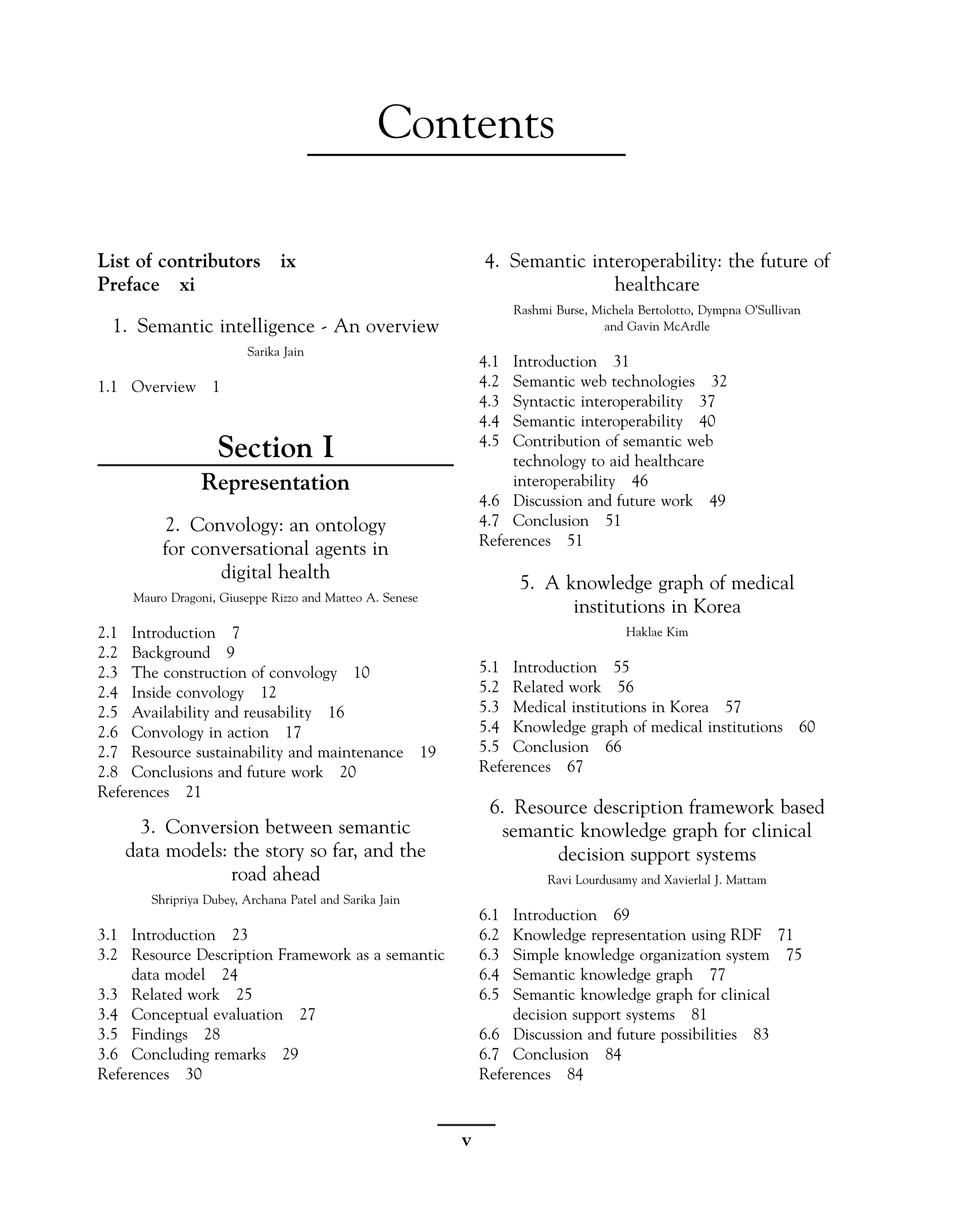
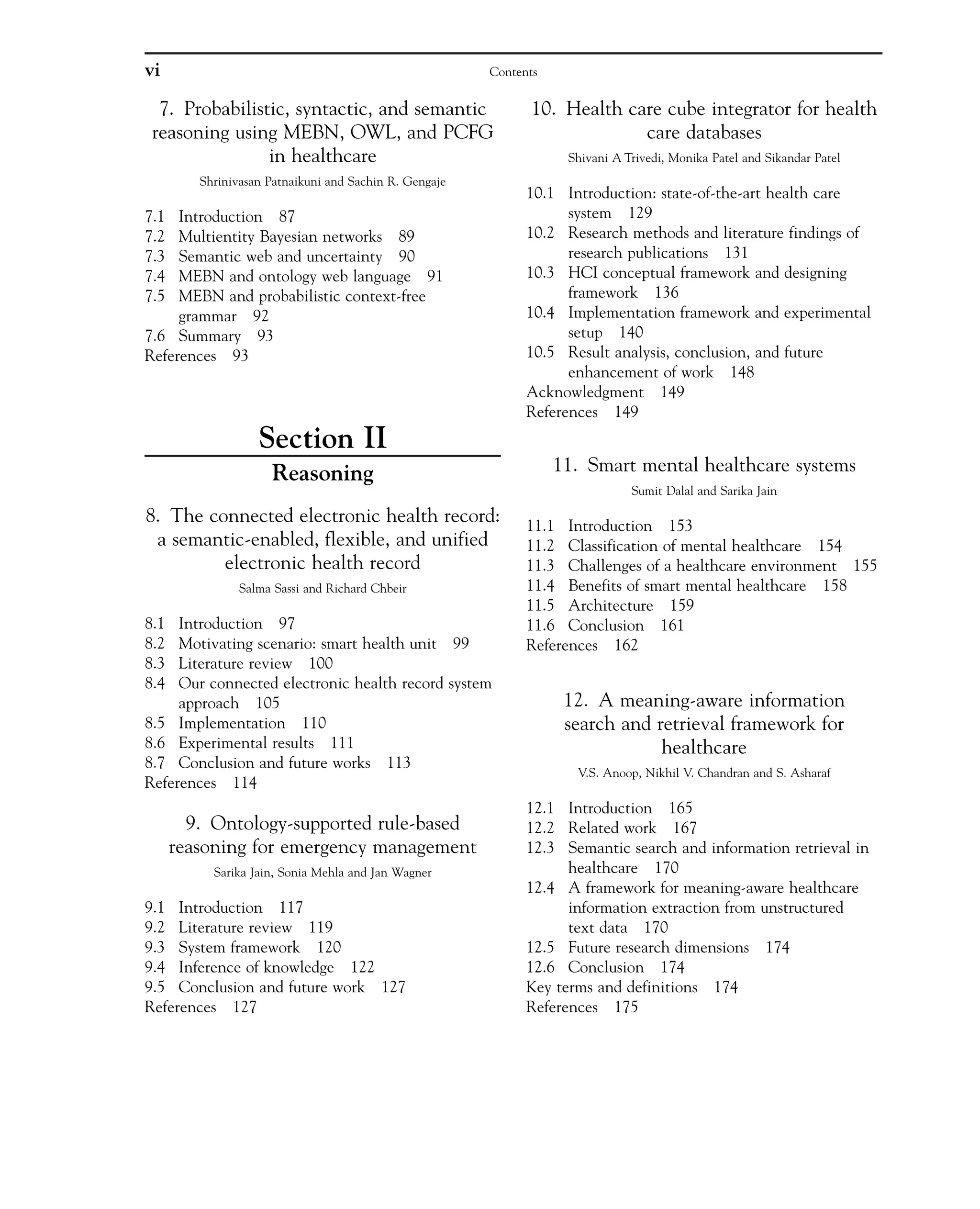
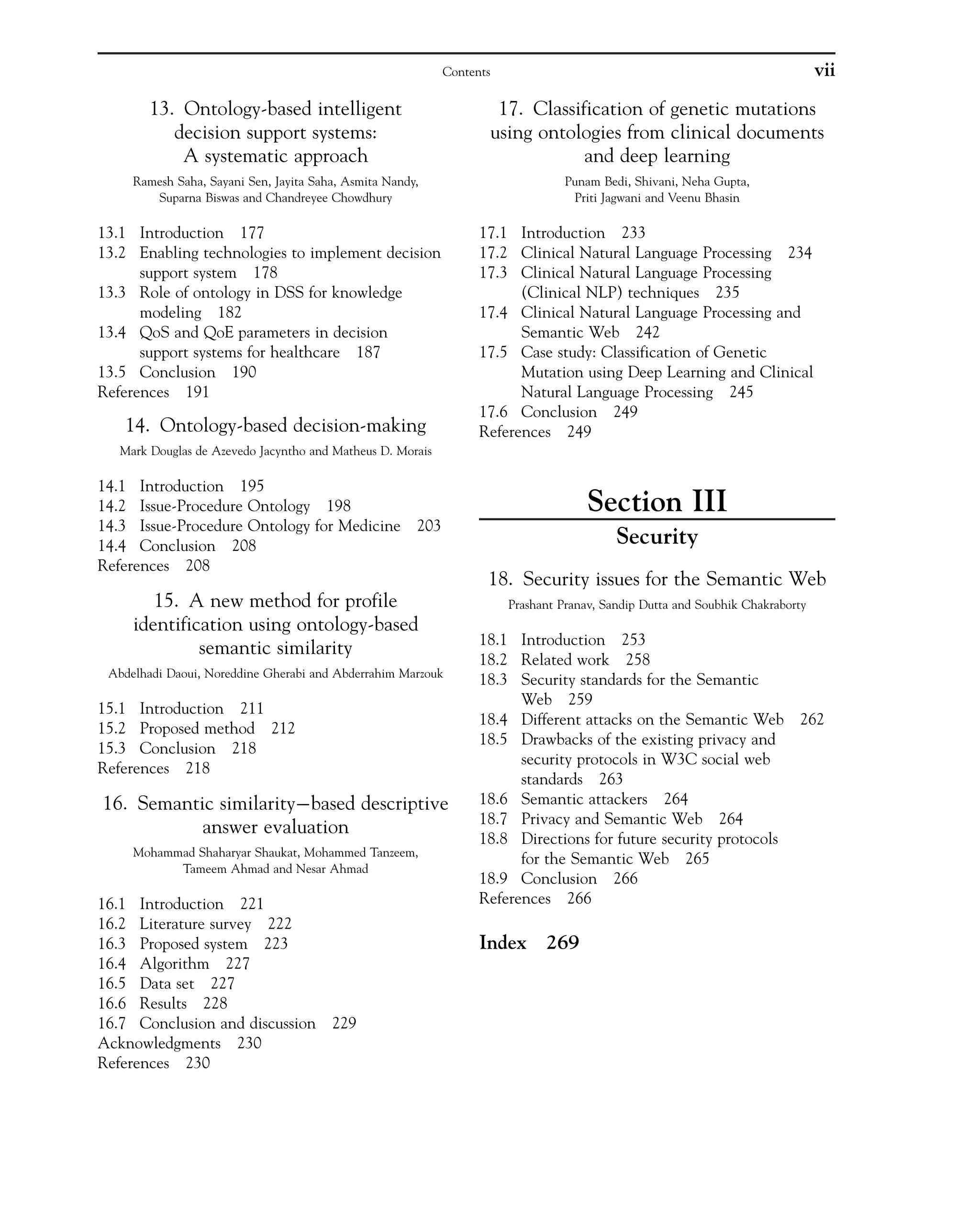
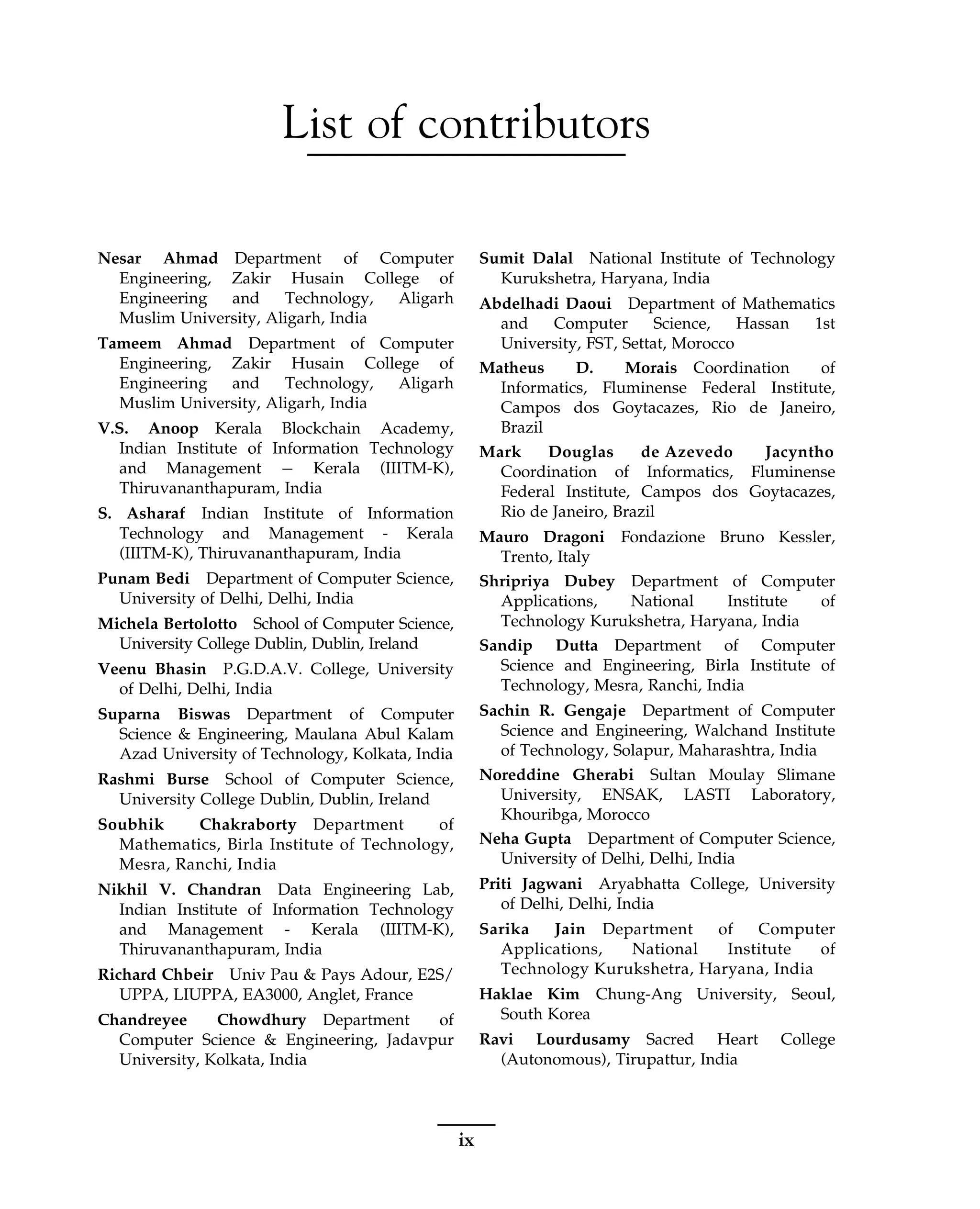
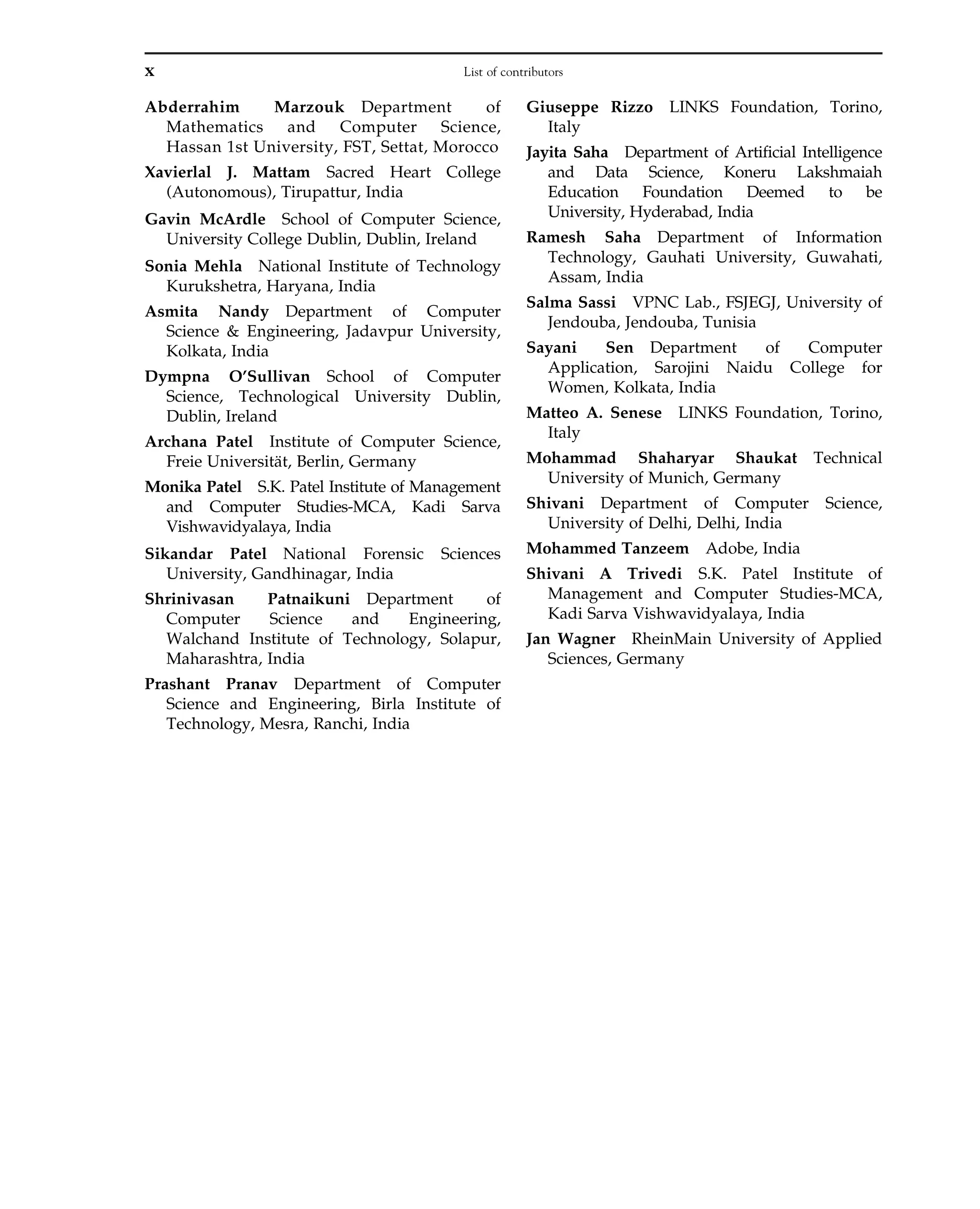

![2.2 Background
Conversational agents, in their larger definition, are software agents with which it is
possible to carry a conversation. Researchers discussed largely on structuring the terminol-
ogy around conversational agents. In this chapter, we decide to adhere to Franklin and
Graesser (1997) that segments conversational agents according to both learned and
indexed content and approaches for understanding and establishing a dialog. The evolu-
tion of conversational agents proposed three different software types: generic chit-chat
(i.e., tools for maintaining a general conversation with the user), goal-oriented tools that
usually rely on a large amount of prebuilt answers (i.e., tools that provide language inter-
faces for digging into a specific domain), and the recently investigated knowledge-based
agents that aim to reason over a semantic representation of a dataset to extend the intent
classification capabilities of goal-oriented agents.
The first chit-chat tool, named ELIZA (Weizenbaum, 1966), was built in 1966. It was cre-
ated mainly to demonstrate the superficiality of communications and the illusion to be
understood by a system that is simply applying a set of pattern-matching rules and a substi-
tution methodology. ELIZA simulates a psychotherapist and, thanks to the trick of present-
ing again to the interlocutor some contents that have been previously mentioned, it keeps
the conversation without having an understanding of what really is said. At the time when
ELIZA came out, some people even attributed human-like feelings to the agent. A lot of
other computer programs have been inspired by ELIZA and AIML—markup language for
artificial intelligence—has been created to express the rules that drive the conversation. So
far, this was an attempt to encode knowledge for handling a full conversation in a set of
predefined linguistic rules.
Domain-specific tools were designed to allow an individual to search conversationally
into a restricted domain, for instance simulating the interaction with a customer service of
a given company. A further generalization of this typology was introduced by knowledge-
based tools able to index a generic (wider) knowledge base and provides answers pertain-
ing a given topic. These two are the largest utilized types of conversational agents
(Ramesh et al., 2017). The understanding of the interactions is usually performed using
machine learning, in fact recent approaches have abandoned handcrafted rules utilized in
ELIZA toward an automatic learning from a dialog corpus. In other words, the under-
standing task is related to turning natural language sentences into something that can be
understood by a machine: its output is translated into an intent and a set of entities. The
response generation can be fully governed by handcrafted rules (e.g., if a set of conditions
apply, say that) or decide the template response from a finite set using statistical
approaches [using some distance measures like TF-IDF, Word2Vec, Skip-Thoughts (Kiros
et al., 2015)]. In this chapter, we focus on the understanding part of the conversation.
While machine learning offers statistical support to infer the relationship between sen-
tences and classes, one pillar of these approaches is the knowledge about the classes of
these requests. In fact, popular devices such as Amazon Echo and Google Home require,
whether configured, to list the intents of the discussion. However, those devices hardly
cope with a full dialog, multiturn, as the intents are either considered in isolation or con-
textualized within strict boundaries. Previous research attempts investigated the
I. Representation
9
2.2 Background](https://image.slidesharecdn.com/32049-250228225420-d7f8910e/75/Web-Semantics-Cutting-Edge-and-Future-Directions-in-Healthcare-Sarika-Jain-24-2048.jpg)


![people that he meant fairly by them. Even Moret’s policy of conciliation is
taken by the masses to indicate fear of the Jesuits, rather than as a
calculated avoidance of action which might lead to disturbances.
The constant commendation given by the Conservative and even by the
Liberal Press of England to the strength and unity of the “Conservative”
party under Señor Maura, and their adverse comments on the dissensions in
the Liberal camp, have materially added to the difficulties, already serious
enough, which block the path of Moret and those of his creed, and have
strengthened the party of clerical reaction and absolutism.
The Heraldo, in an article on the benefits to the nation to be expected
from Moret’s support of Canalejas’ Government, spoke as follows of the
influence of England upon Spanish affairs:
“It now appears probable that the democratic Government will be
consolidated by the disappearance of the danger to which we have referred
[the split with Moret’s party]. If this proves the case, all Europe will
recognise with satisfaction how the personal convictions of the monarch,
strengthened perhaps by the healthy influence of his illustrious connections
by marriage, are leading Spain along the paths of prosperity and gradually
relieving us of the nightmare of reaction which has weighed so heavily
upon our nation during the minority of Don Alfonso and the early years of
his manhood.”
Centuries of government by the rich for the rich, and by the Church for
the Church, have contributed to make reform exceedingly difficult, but at
length the issues between political morality and the maintenance of the old
abuses have been clearly set before the nation, in the struggle which ended
with the dismissal of Señor Moret. He determined to have the country freed
from the tyranny of the Cacique. His opponents desired to maintain the
system. That was the whole point at issue.
At the moment it seemed as if those interested in the maintenance of a
corrupt system had won a signal victory, and the men who are working for
the moralising of political life would have been more than human had they
spoken no word of the bitterness they felt at seeing, as it seemed, their work
undone and their hopes frustrated. But there are apparent defeats which
mark a stage on the road to final victory, and such a stage was marked, for
the people of Spain, by the fall of Moret in February, 1910.](https://image.slidesharecdn.com/32049-250228225420-d7f8910e/75/Web-Semantics-Cutting-Edge-and-Future-Directions-in-Healthcare-Sarika-Jain-28-2048.jpg)

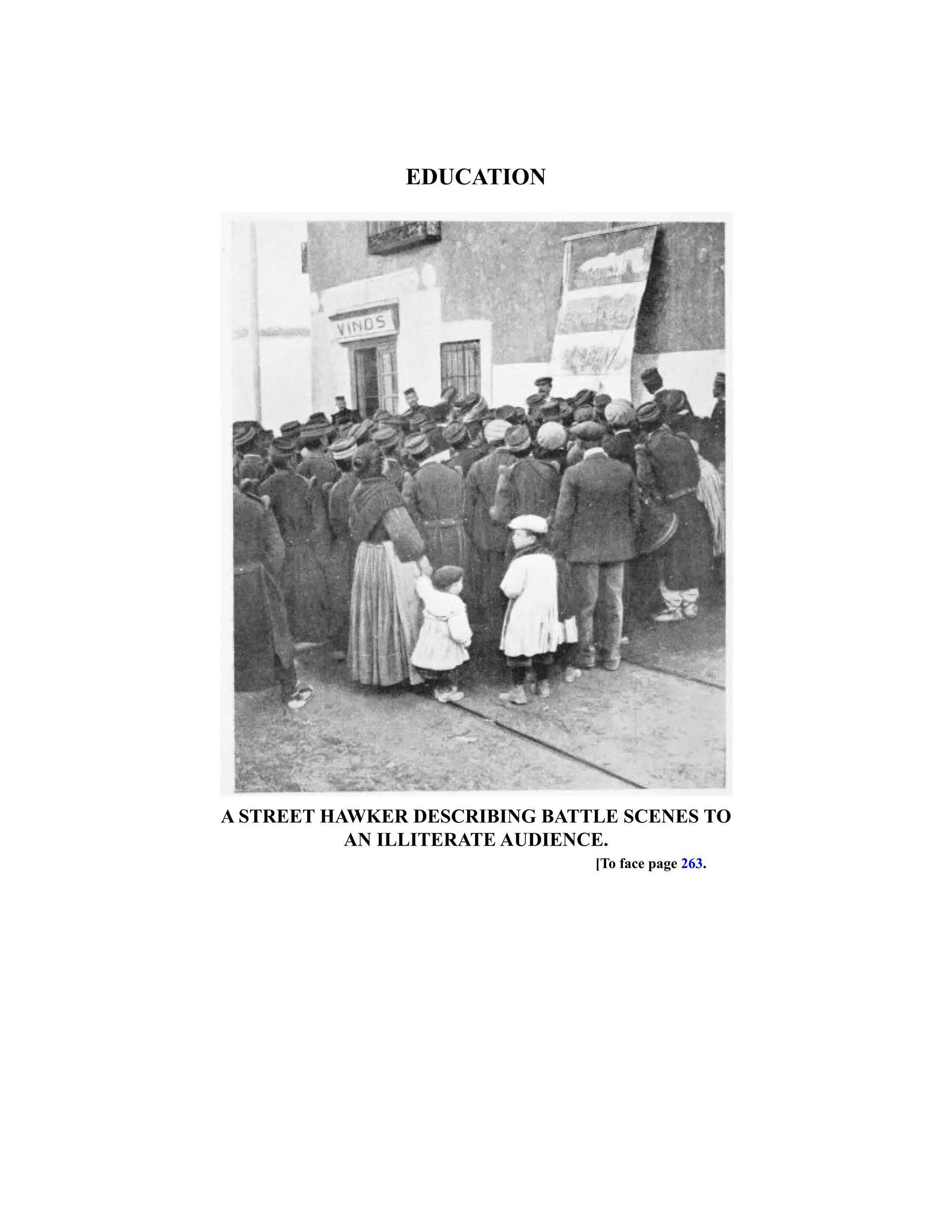
![pesetas per annum, and proposes to the Minister of Education the
appointment of those of higher grade or salary. He is assisted by a
consultative Council. The teachers are appointed after some sort of
competitive examination.
The Civil Governor of each province is responsible for the fulfilment of
all the obligations imposed by the law, but has no voice in the internal
management, teaching, &c., of the schools and colleges. He, too, is assisted
by a provincial consultative Council. Lastly, in the municipality, the
Alcalde, the President of the Ayuntamiento, has the same functions in his
district as those of the Civil Governor in the province.[23] The Alcalde also
has his local consultative committee, whose functions are not unlike those
of school managers in England.
The inspection of all schools except the elementary is the duty of the
Rector of the university. The inspection of elementary schools is committed
to an Inspector-General, under the immediate orders of the sub-Secretary of
State, and forty-nine inspectors, one for each province.
Elementary education in Spain has been compulsory since 1857, and
free, since 1901, to children whose parents “are unable to pay.” The
compulsory school age is from 6 to 12. The provision of schools and the
upkeep of the buildings is the duty of the Ayuntamiento, and a small sum is
set aside in the annual Budget of the kingdom for grants in aid to poor
districts.
The system under which the teachers are paid is peculiar. The locality
finds the money and hands it to the Ministry of Education, which pays the
salaries. The reason for this arrangement is characteristic. It was made
because of the irregularities in the payment of the teachers which frequently
occurred when the local authority administered the funds. The salaries of
the teachers in the Elementary schools are from 500 to 3,000 pesetas—say
£20 to £120 a year, with a house, and they are entitled after twenty years’
service or upwards, to a pension of from 50 to 80 per cent. of their salary.
They also have a right to the fees of “children who can pay them.”
It is easy to see that this system of overlapping authorities and divided
responsibility must necessarily lead to waste of time and general
inefficiency, even assuming that every one concerned is genuinely anxious
to do his duty and to work for the good of education, an assumption which
it would be very rash to make.](https://image.slidesharecdn.com/32049-250228225420-d7f8910e/75/Web-Semantics-Cutting-Edge-and-Future-Directions-in-Healthcare-Sarika-Jain-33-2048.jpg)



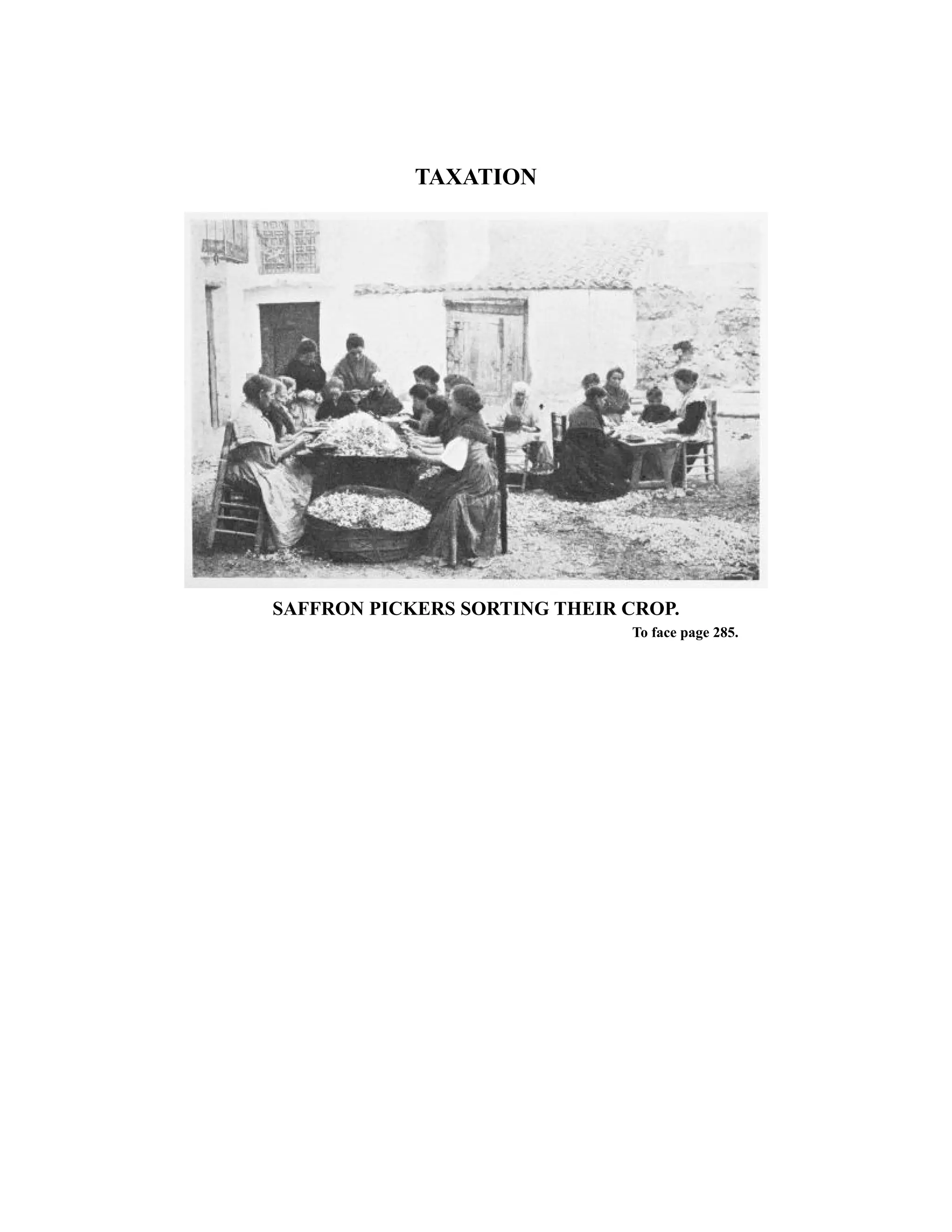
![CHAPTER XV
TAXATION
Among the sources of the national revenue of Spain there are several which
more especially affect the poorer portion of the community, or, by
hampering trade and manufactures, put obstacles in the way of the national
prosperity. Among these may be especially mentioned the Customs duties,
the tax on trades, business, and professions (contribucion industrial) the
octroi, or consumo, the creation and sale of monopolies, and the national
lottery. The total taxation of the country is absolutely crushing, and makes
Spain one of the dearest places of residence in Europe.
The Customs are excessively high, especially for a country that has
comparatively few manufactures of its own to protect. To take a few
instances at random from the Tariff: Straw hats pay about 20 pesetas per
kilogramme; preserves, 3 pesetas per kilogramme; typewriters, 8 pesetas
per kilogramme; timber in boards, 6 pesetas per cubic metre; materials of
silk and velvet, from 30 pesetas per kilogramme; woollen materials, from
13 pesetas per kilogramme; drugs at various rates from 36 pesetas per
kilogramme downwards, and so forth. The consequence is seen in the prices
charged in the shops for ordinary commodities. Thus Danish tinned butter
costs pesetas 2.75 per lb.; tapioca, 1 peseta per packet of about ¼ lb.;
coffee, pesetas 2.50 to 3 per lb.; Keiller’s marmalade, 3 to 4 pesetas the 1
lb. pot; Burroughs & Welcome’s tabloids, pesetas 2.50 the small bottle of
25; and most other things in about the same proportion.[24] The Customs
receipts form, with the exception of the tax on real estate, the largest single
item in the Budget. For the year 1909 they were estimated at pesetas
153,600,000 (£6,144,000).
The Contribucion industrial is a tax upon every imaginable trade,
profession, and industry that can be exercised: on merchants,
manufacturers, shopkeepers, professional men of all sorts, on means of
transit, on public entertainments, on schools, newspapers—in short, it is
almost impossible to find any kind of business or occupation that is not
taxed.](https://image.slidesharecdn.com/32049-250228225420-d7f8910e/75/Web-Semantics-Cutting-Edge-and-Future-Directions-in-Healthcare-Sarika-Jain-43-2048.jpg)
![The amount of the tax varies with the population, a scale of ten different
rates being drawn up according to the size of the town. Bankers pay from
about £300 a year downwards, according to the place of residence;
merchants from £200; shopkeepers from £70; hotels from £60; contractors
6 per mil. on their contracts; railways £10 per kilometre constructed, and a
tax on their receipts; brokers from £80; newspapers from £35; publishers
from £25; private schools from £10; and so on. It is tedious and
unnecessary to accumulate instances.[25]
That such a burdensome tax as this necessarily hampers trade and goes
to prevent commercial and industrial development needs no demonstration:
the thing is self-evident. The compiler of the manual of this law says in his
Introduction, with perfect truth, that it has the radical defect of making
heavier demands as the trader’s profits fall, and that the framers of the law,
so far from attempting to harmonise the interests of the Treasury with those
of the taxpayer, thought only how to squeeze him, so that the tax nips in the
bud whatever might aid in the increase of prosperity or open new fields for
the productiveness of the nation.
This tax immediately affects the professional and commercial classes:
the poor, such as street hawkers, journeymen labourers, fishermen, &c., are
exempt; but indirectly they too suffer, as naturally it helps to increase the
price of necessaries.
The greatest burden on the working classes—and it is a very grievous
one—is the octroi, or consumo, a heavy tax on nearly every kind of food,
drink, and fuel, and on timber, stone, lime, &c.; in short, on nearly
everything that is consumed in use. The fisherman has to pay consumo on
his catch before he can sell it; the farmer on his dead meat, poultry, and
eggs brought to market; the charcoal-burner on his charcoal; and so on. The
tax, varying in details, is levied in every town and village, and thus may be,
and often is, paid twice over by the same goods, if they happen to be
conveyed from one town to another.
It is obvious that such a tax on the necessaries of life presses with
exceptional severity on the poor, and it is, moreover, steadily rising, while
wages remain stationary. It is usually farmed out to syndicates which are
said, and no doubt with truth, to be making enormous profits out of it.
These syndicates are believed by the people to consist in many cases of
persons who](https://image.slidesharecdn.com/32049-250228225420-d7f8910e/75/Web-Semantics-Cutting-Edge-and-Future-Directions-in-Healthcare-Sarika-Jain-44-2048.jpg)
![A SELLER OF PALM-LEAF BRUSHES
AND FANS.
[To face page 289.
represent the Jesuits, and the oppressiveness of the tax and the steady rise in
its amount form another count in the heavy indictment of the poor against
the Religious Orders. The estimated receipts from this tax in the Budget for
1909 were pesetas 58,000,000 (about £3,520,000).
“Everything in the country is dying of the consumos,” said a working
woman of about sixty years of age, who remembers with regret how much
easier the life of the poor was in the days of Isabel II. “Every four years the
contract for the consumos in our province is put up to auction, and every
time they are sold the price is raised four or five thousand duros,[26] and we
have to pay the difference. Yesterday Manolo paid four duros consumo for
the fish he sold in the market, and all he had for himself after twenty-four](https://image.slidesharecdn.com/32049-250228225420-d7f8910e/75/Web-Semantics-Cutting-Edge-and-Future-Directions-in-Healthcare-Sarika-Jain-45-2048.jpg)
![hours’ work was ten reals. The man who rents the consumos from the
Government is rotten with money (podrido de dinero): millions and
millions of pesetas he has, all wrung from the necessities of the poor. Don
Alfonso does not like it; every one knows that. If he had his own way there
would be no consumo for the poor. Already since he came into power we
have been relieved of the consumo on wine, green vegetables, and potatoes,
and they say that two years hence, when the contract runs out, he wishes
that it shall not be renewed. But that would not suit the Government nor the
Jesuits, who are mixed up in this business. They would lose too much
which they now are able to put into their own pockets. So they would like
to make another revolution to get rid of Don Alfonso, as they got rid of his
grandmother, before their contract comes to an end. In her time bread cost
just half what it does now, twenty-five eggs cost five reals (pesetas 1.25)
instead of two pesetas a dozen, and for four cuartos we could buy a piece of
pork as big as we get now for two reals.[27] Salt was free of consumo, so
was oil, so was cheese, and shell-fish and chestnuts sold in the street were
not taxed, so that they could be bought for much less than now, and the
whole reason is because the Government lets the taxes instead of taking the
trouble to collect them as was done in the time of Queen Isabella.”
Whether this good lady, whose words I have translated literally from
notes made at the time, was right or wrong in her supposition as to the
interest of the Jesuits in this tax, and as to the quadrennial increase in the
amount paid for it by the syndicate of farmers who exploit it, I cannot say. I
quote her words as an instance of what is said on all sides by her class
whenever the subject is mentioned, and as far as I can learn she is quite
correct in her comparison of the prices of food now with those of forty
years or so ago.
Tobacco and sugar are Government monopolies, farmed out to
companies, which also are popularly believed to be under the control of the
Jesuits. I have never seen any accounts of the profits of the Tobacco
Company, but their shares are quoted at about 390 to 400, which speaks for
itself. The tobacco they supply is very bad, and outrageously dear. The
estimated receipts from this source were pesetas 140,400,000 (£5,616,000).
The sugar trust was created comparatively recently. A short account of
the last annual meeting of the shareholders was published by the Press in
November, 1909, from which it appears that the trust made a profit in the](https://image.slidesharecdn.com/32049-250228225420-d7f8910e/75/Web-Semantics-Cutting-Edge-and-Future-Directions-in-Healthcare-Sarika-Jain-46-2048.jpg)



![[PDF Download] Web Semantics: Cutting Edge and Future Directions in Healthcar...](https://cdn.slidesharecdn.com/ss_thumbnails/107043-240805203721-c4d1d052-thumbnail.jpg?width=640&height=640&fit=bounds)


