

Web Pages Classification using
     Concept Analysis

                Porfirio Tramontana
                Anna Rita Fasolino
          Dipartimento di Informatica e Sistemistica
             University of Naples Federico II, Italy


               Giuseppe A. Di Lucca
      RCOST – Research Centre on Software Technology
           University of Sannio, Benevento, Italy


                                                       1
The Context

    With the diffusion of new paradigms and technological
     solutions for the Web (RIA and Ajax, SOA, …), existing
     Web Applications are rapidly become legacy

    A strategic objective: integrating that existing
     applications with the new platforms

    An open issue: defining effective approaches for
     analysing and classifying the Web Applications User
     Interface


                                                                                  2
Web Pages Classification using Concept Analysis - ICSM 2007 – Paris – 4/10/2007
Automatic Web Pages Classification
     Web Applications interact with users by means of Client
      Pages that are dynamically generated

     Given a classification of Built Client pages in a set of
      equivalent classes
          … classes may correspond to the different reached Web
           Application scenarios
          … classes may correspond to the different results of the
           execution of test cases

     The problem:
          To propose a technique for the automatic identification of the
           equivalence class a Web page belongs to

                                                                                  3
Web Pages Classification using Concept Analysis - ICSM 2007 – Paris – 4/10/2007
A possible application scenario
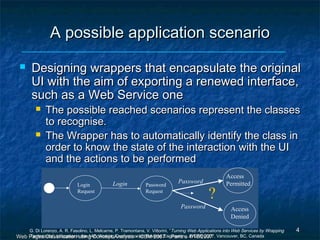
      Designing wrappers that encapsulate the original
       UI with the aim of exporting a renewed interface,
       such as a Web Service one
             The possible reached scenarios represent the classes
              to recognise.
             The Wrapper has to automatically identify the class in
              order to know the state of the interaction with the UI
              and the actions to be performed
                                                                                                       Access
                                               Login                           Password                Permitted
                              Login                            Password
                              Request                          Request
                                                                                              ?
                                                                                 Password                Access
                                                                                                         Denied

    G. Di Lorenzo, A. R. Fasolino, L. Melcarne, P. Tramontana, V. Vittorini, “Turning Web Applications into Web Services by Wrapping   4
    Techniques”, to appear using Concept Conference on Reverse Engineering, WCRE 2007,
Web Pages Classificationin the 14th WorkingAnalysis - ICSM 2007 – Paris – 4/10/2007 Vancouver, BC, Canada
The proposed solution
     To find, for any class, a combination of Web
      page features for any class that are satisfied just
      by pages belonging to that class (Classification
      model)

     We are interested to a solution that is:
          Accurate
                 The classification approach should be very reliable, in order
                  to support automatic tasks
          Efficient
                 The classification approach should support a fast
                  classification of dynamic built client pages
                                                                                  5
Web Pages Classification using Concept Analysis - ICSM 2007 – Paris – 4/10/2007
The proposed approach

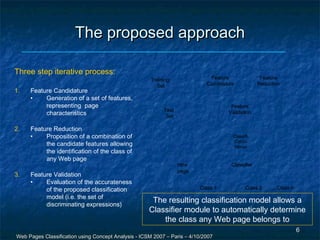
Three step iterative process:
                                                      Training               Feature               Feature
                                                        Set                 Candidature           Reduction
1.   Feature Candidature
     •    Generation of a set of features,
          representing page                                                          Feature
                                                           Test
          characteristics                                   Set
                                                                                    Validation


2.   Feature Reduction
     •    Proposition of a combination of                                             Classifi-
                                                                                      Cation
          the candidate features allowing                                              Model
          the identification of the class of
          any Web page
                                                                  Html               Classifier
                                                                  page
3.   Feature Validation
     •    Evaluation of the accurateness
          of the proposed classification                                 Class 1            Class 2   …. Class n
          model (i.e. the set of
          discriminating expressions)
                                                      The resulting classification model allows a
                                                     Classifier module to automatically determine
                                                         the class any Web page belongs to
                                                                                                                   6
Web Pages Classification using Concept Analysis - ICSM 2007 – Paris – 4/10/2007
1 - Feature Candidature
                                                             //a/text()=“Activities”                   //h1/img
      A feature is a characteristic
       retrievable in a Web page
       interface
           It is retrievable by analysing its
            HTML code
                  A feature can be associated to a
                   XPath query (if the HTML code is
                   XHTML-compatible)


      A set of features that
       could be useful for
       discriminating a class are
       proposed
           Ideally    speaking,     we
            search for features that are
            retrievable just in the
                                                                                      /html/body/div[4]/form
            pages belonging to a class
                                                                                                               7
    Web Pages Classification using Concept Analysis - ICSM 2007 – Paris – 4/10/2007
2 - Feature Reduction
     The goal of the Feature Reduction step is to
      obtain a Discriminating Expression for each
      class, i.e. a combination of features that is true
      for each Web page belonging to the class, false
      elsewhere

     The Feature Reduction is executed on the set of
      candidate features
          A training set of pre-classified pages is adopted


                                                                                  8
Web Pages Classification using Concept Analysis - ICSM 2007 – Paris – 4/10/2007
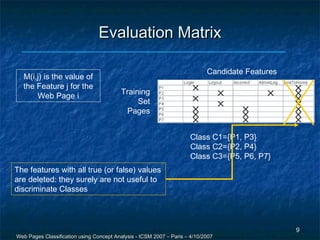
Evaluation Matrix

                                                                            Candidate Features
  M(i,j) is the value of
  the Feature j for the
                                          Training
      Web Page i
                                               Set
                                           Pages


                                                                     Class C1={P1, P3}
                                                                     Class C2={P2, P4}
                                                                     Class C3={P5, P6, P7}
The features with all true (or false) values
are deleted: they surely are not useful to
discriminate Classes


                                                                                                 9
Web Pages Classification using Concept Analysis - ICSM 2007 – Paris – 4/10/2007
Concept Analysis


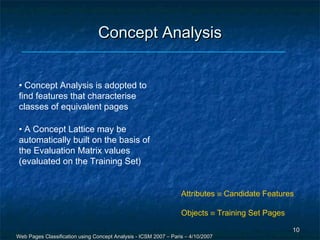
 • Concept Analysis is adopted to
 find features that characterise
 classes of equivalent pages

 • A Concept Lattice may be
 automatically built on the basis of
 the Evaluation Matrix values
 (evaluated on the Training Set)


                                                                  Attributes ≡ Candidate Features

                                                                  Objects ≡ Training Set Pages

                                                                                                 10
Web Pages Classification using Concept Analysis - ICSM 2007 – Paris – 4/10/2007
Feature Classification
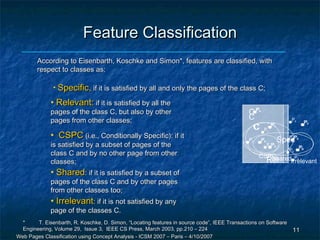
        According to Eisenbarth, Koschke and Simon*, features are classified, with
        respect to classes as:

              • Specific, if it is satisfied by all and only the pages of the class C;

             • Relevant: if it is satisfied by all the
             pages of the class C, but also by other                                          CPP  44


             pages from other classes;                                                        C                      P4
                                                                                                                              P77
                                                                                                                              P
                                                                                                             P11
                                                                                                             P
                                                                                               C        P1
             • CSPC (i.e., Conditionally Specific): if it                                     P2    P22
                                                                                                    P
                                                                                                                  P P
                                                                                                               SpecP 5    5
                                                                                                                          5

             is satisfied by a subset of pages of the                                                     P3 P
                                                                                                             P 33
                                                                                                                          P66
                                                                                                                          P
                                                                                                                    P5
             class C and by no other page from other                                               CSPC       P6
                                                                                                      SharedIrrelevant
                                                                                                     Rel
             classes;
             • Shared: if it is satisfied by a subset of
             pages of the class C and by other pages
             from other classes too;
             • Irrelevant: if it is not satisfied by any
             page of the classes C.
  *     T. Eisenbarth, R. Koschke, D. Simon, “Locating features in source code”, IEEE Transactions on Software
  Engineering, Volume 29, Issue 3, IEEE CS Press, March 2003, pp.210 – 224                                           11
Web Pages Classification using Concept Analysis - ICSM 2007 – Paris – 4/10/2007
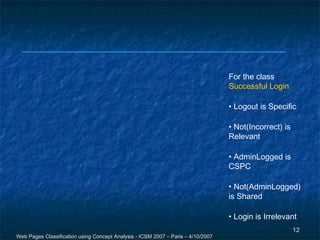
For the class
                                                                                  Successful Login

                                                                                  • Logout is Specific

                                                                                  • Not(Incorrect) is
                                                                                  Relevant

                                                                                  • AdminLogged is
                                                                                  CSPC

                                                                                  • Not(AdminLogged)
                                                                                  is Shared

                                                                                  • Login is Irrelevant
                                                                                                        12
Web Pages Classification using Concept Analysis - ICSM 2007 – Paris – 4/10/2007
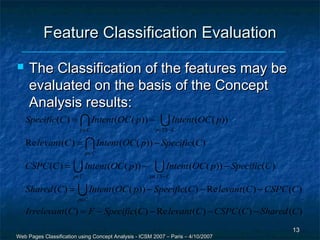
Feature Classification Evaluation

    The Classification of the features may be
     evaluated on the basis of the Concept
     Analysis results:
    Specific(C ) =  Intent (OC ( p )) −  Intent (OC ( p ))
                         p∈C                           p∈TS −C

    Re levant (C ) =  Intent (OC ( p )) − Specific(C )
                            p∈C

    CSPC (C ) =  Intent (OC ( p )) −                   Intent (OC ( p)) − Specific(C )
                      p∈C                            p∈TS −C

    Shared (C ) =  Intent (OC ( p )) − Specific(C ) − Re levant (C ) − CSPC (C )
                        p∈C

    Irrelevant (C ) = F − Specific (C ) − Re levant (C ) − CSPC (C ) − Shared (C )
                                                                                           13
Web Pages Classification using Concept Analysis - ICSM 2007 – Paris – 4/10/2007
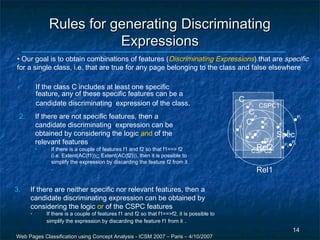
Rules for generating Discriminating
                          Expressions
• Our goal is to obtain combinations of features (Discriminating Expressions) that are specific
for a single class, i.e. that are true for any page belonging to the class and false elsewhere

1.        If the class C includes at least one specific
          feature, any of these specific features can be a
          candidate discriminating expression of the class.
                                                                                              C    P4        CSPC1
                                                                                                   C
 2.       If there are not specific features, then a                                                 P   1
                                                                                                              P1
                                                                                                                                       P7
          candidate discriminating expression can be                                               C          P1    P5
                                                                                              P2
          obtained by considering the logic and of the                                                 P
                                                                                                   P2 P2 3
                                                                                                                      P
                                                                                                                    Spec      5


          relevant features                                                                                   PP3
                                                                                                               3
                                                                                                                         P6
                                                                                                                                  P6
          •     If there is a couple of features f1 and f2 so that f1==> f2                             Rel2
                                                                                                    CSPC2
                (i.e. Extent(AC(f1))⊆ Extent(AC(f2))), then it is possible to
                simplify the expression by discarding the feature f2 from it
                .                                                                                       Rel1

3.    If there are neither specific nor relevant features, then a
      candidate discriminating expression can be obtained by
      considering the logic or of the CSPC features
      •       If there is a couple of features f1 and f2 so that f1==>f2, it is possible to
              simplify the expression by discarding the feature f1 from it .
                                                                                                                                  14
Web Pages Classification using Concept Analysis - ICSM 2007 – Paris – 4/10/2007
3 - Discriminating Expression
                              Validation

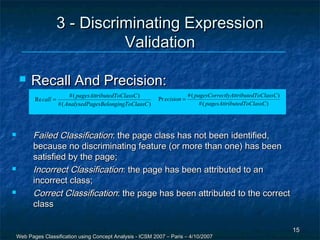
       Recall And Precision:
                         # ( pagesAttributedToClassC )                    # ( pagesCorrectlyAttributedToClassC )
        Re call =                                          Pr ecision =
                    # ( AnalysedPagesBelongingToClassC )                        # ( pagesAttributedToClassC )


       Failed Classification: the page class has not been identified,
        because no discriminating feature (or more than one) has been
        satisfied by the page;
       Incorrect Classification: the page has been attributed to an
        incorrect class;
       Correct Classification: the page has been attributed to the correct
        class

                                                                                                                   15
Web Pages Classification using Concept Analysis - ICSM 2007 – Paris – 4/10/2007
A Classification Example

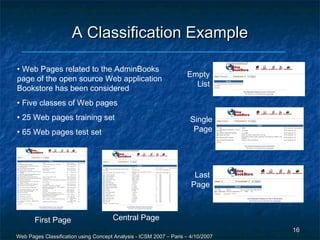
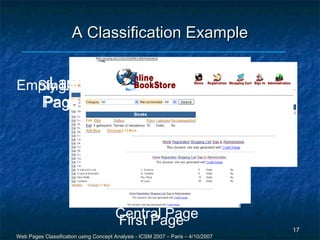
• Web Pages related to the AdminBooks
                                                                    Empty
page of the open source Web application
                                                                      List
Bookstore has been considered
• Five classes of Web pages
• 25 Web pages training set                                          Single
• 65 Web pages test set                                               Page


                                                                       Last
                                                                      Page


       First Page                     Central Page
                                                                                  16
Web Pages Classification using Concept Analysis - ICSM 2007 – Paris – 4/10/2007
A Classification Example


    Last
Empty List
  Single
   Page
   Page


                                       Central Page
                                       First Page
                                                                                  17
Web Pages Classification using Concept Analysis - ICSM 2007 – Paris – 4/10/2007
Candidate features
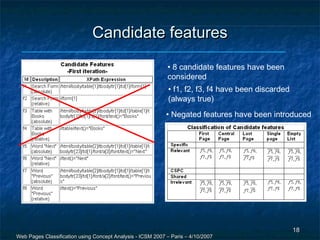
                                                            • 8 candidate features have been
                                                            considered
                                                             • f1, f2, f3, f4 have been discarded
                                                             (always true)
                                                            • Negated features have been introduced


                                                                                                    18
Web Pages Classification using Concept Analysis - ICSM 2007 – Paris – 4/10/2007
Discriminating Expressions – First iteration

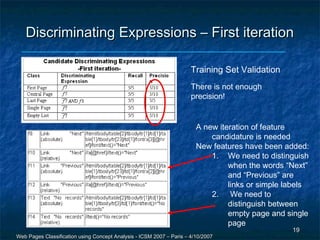
                                                                      Training Set Validation
                                                                      There is not enough
                                                                      precision!


                                                                        A new iteration of feature
                                                                            candidature is needed
                                                                        New features have been added:
                                                                            1. We need to distinguish
                                                                                 when the words “Next”
                                                                                 and “Previous” are
                                                                                 links or simple labels
                                                                            2. We need to
                                                                                 distinguish between
                                                                                 empty page and single
                                                                                 page
                                                                                                  19
Web Pages Classification using Concept Analysis - ICSM 2007 – Paris – 4/10/2007
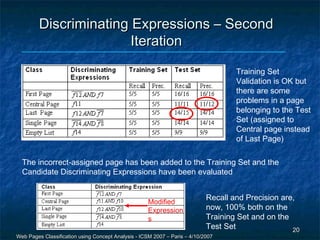
Discriminating Expressions – Second
                        Iteration

                                                                                    Training Set
                                                                                    Validation is OK but
                                                                                    there are some
                                                                                    problems in a page
                                                                                    belonging to the Test
                                                                                    Set (assigned to
                                                                                    Central page instead
                                                                                    of Last Page)

  The incorrect-assigned page has been added to the Training Set and the
  Candidate Discriminating Expressions have been evaluated


                                                                            Recall and Precision are,
                                                    Modified
                                                    Expression              now, 100% both on the
                                                    s                       Training Set and on the
                                                                            Test Set                20
Web Pages Classification using Concept Analysis - ICSM 2007 – Paris – 4/10/2007
Discussion
    Process Effort
         In the case study, about 100 minutes were needed to
          obtain the classification model
         The activities requiring human intervention was the
          most critical
                Training and Test Set Collection step
                      The reliability of the classification model depends on the
                       representativeness of the Training and Test Sets
                      Web pages resulting from the execution of a Test Suite may be
                       good candidates to fill in the Training and the Test Set
                Feature Candidature step
                      Heuristic techniques allowing a semi-automatic generation of
                       features are currently under experimentation


                                                                                      21
Web Pages Classification using Concept Analysis - ICSM 2007 – Paris – 4/10/2007
Further application scenarios

    Support to testing automation
          The possible reached pages are arranged in a set of
           equivalence classes, corresponding to different test results
          The proposed discriminating expressions make it possible the
           automatic evaluation of the testing results

    Support to dynamic analysis
          The recognition of the reached interaction scenarios makes it
           possible the automatic collection of logs of the visited use cases
           and scenarios, providing also useful information for user profiling


                                                                                  22
Web Pages Classification using Concept Analysis - ICSM 2007 – Paris – 4/10/2007
Conclusions and Future Works

    A process for the definition of a classification model
     allowing the automatic identification of classes of Built
     Client pages has been defined and validated
    The classification model allows the run-time identification
     of the classification of a Built Client page, with short
     response time and high precision

    Future Works:
          We are working for the process improvement, in order to reduce
           the effort needed to human made tasks
          Further experimentation will be carried out in order to assess the
           scalability of the approach


                                                                                  23
Web Pages Classification using Concept Analysis - ICSM 2007 – Paris – 4/10/2007
24
Web Pages Classification using Concept Analysis - ICSM 2007 – Paris – 4/10/2007

Web Pages Classification using Concept Analysis

  • 1.
    Web Pages Classificationusing Concept Analysis Porfirio Tramontana Anna Rita Fasolino Dipartimento di Informatica e Sistemistica University of Naples Federico II, Italy Giuseppe A. Di Lucca RCOST – Research Centre on Software Technology University of Sannio, Benevento, Italy 1
  • 2.
    The Context  With the diffusion of new paradigms and technological solutions for the Web (RIA and Ajax, SOA, …), existing Web Applications are rapidly become legacy  A strategic objective: integrating that existing applications with the new platforms  An open issue: defining effective approaches for analysing and classifying the Web Applications User Interface 2 Web Pages Classification using Concept Analysis - ICSM 2007 – Paris – 4/10/2007
  • 3.
    Automatic Web PagesClassification  Web Applications interact with users by means of Client Pages that are dynamically generated  Given a classification of Built Client pages in a set of equivalent classes  … classes may correspond to the different reached Web Application scenarios  … classes may correspond to the different results of the execution of test cases  The problem:  To propose a technique for the automatic identification of the equivalence class a Web page belongs to 3 Web Pages Classification using Concept Analysis - ICSM 2007 – Paris – 4/10/2007
  • 4.
    A possible applicationscenario  Designing wrappers that encapsulate the original UI with the aim of exporting a renewed interface, such as a Web Service one  The possible reached scenarios represent the classes to recognise.  The Wrapper has to automatically identify the class in order to know the state of the interaction with the UI and the actions to be performed Access Login Password Permitted Login Password Request Request ? Password Access Denied G. Di Lorenzo, A. R. Fasolino, L. Melcarne, P. Tramontana, V. Vittorini, “Turning Web Applications into Web Services by Wrapping 4 Techniques”, to appear using Concept Conference on Reverse Engineering, WCRE 2007, Web Pages Classificationin the 14th WorkingAnalysis - ICSM 2007 – Paris – 4/10/2007 Vancouver, BC, Canada
  • 5.
    The proposed solution  To find, for any class, a combination of Web page features for any class that are satisfied just by pages belonging to that class (Classification model)  We are interested to a solution that is:  Accurate  The classification approach should be very reliable, in order to support automatic tasks  Efficient  The classification approach should support a fast classification of dynamic built client pages 5 Web Pages Classification using Concept Analysis - ICSM 2007 – Paris – 4/10/2007
  • 6.
    The proposed approach Threestep iterative process: Training Feature Feature Set Candidature Reduction 1. Feature Candidature • Generation of a set of features, representing page Feature Test characteristics Set Validation 2. Feature Reduction • Proposition of a combination of Classifi- Cation the candidate features allowing Model the identification of the class of any Web page Html Classifier page 3. Feature Validation • Evaluation of the accurateness of the proposed classification Class 1 Class 2 …. Class n model (i.e. the set of discriminating expressions) The resulting classification model allows a Classifier module to automatically determine the class any Web page belongs to 6 Web Pages Classification using Concept Analysis - ICSM 2007 – Paris – 4/10/2007
  • 7.
    1 - FeatureCandidature //a/text()=“Activities” //h1/img  A feature is a characteristic retrievable in a Web page interface  It is retrievable by analysing its HTML code  A feature can be associated to a XPath query (if the HTML code is XHTML-compatible)  A set of features that could be useful for discriminating a class are proposed  Ideally speaking, we search for features that are retrievable just in the /html/body/div[4]/form pages belonging to a class 7 Web Pages Classification using Concept Analysis - ICSM 2007 – Paris – 4/10/2007
  • 8.
    2 - FeatureReduction  The goal of the Feature Reduction step is to obtain a Discriminating Expression for each class, i.e. a combination of features that is true for each Web page belonging to the class, false elsewhere  The Feature Reduction is executed on the set of candidate features  A training set of pre-classified pages is adopted 8 Web Pages Classification using Concept Analysis - ICSM 2007 – Paris – 4/10/2007
  • 9.
    Evaluation Matrix Candidate Features M(i,j) is the value of the Feature j for the Training Web Page i Set Pages Class C1={P1, P3} Class C2={P2, P4} Class C3={P5, P6, P7} The features with all true (or false) values are deleted: they surely are not useful to discriminate Classes 9 Web Pages Classification using Concept Analysis - ICSM 2007 – Paris – 4/10/2007
  • 10.
    Concept Analysis •Concept Analysis is adopted to find features that characterise classes of equivalent pages • A Concept Lattice may be automatically built on the basis of the Evaluation Matrix values (evaluated on the Training Set) Attributes ≡ Candidate Features Objects ≡ Training Set Pages 10 Web Pages Classification using Concept Analysis - ICSM 2007 – Paris – 4/10/2007
  • 11.
    Feature Classification According to Eisenbarth, Koschke and Simon*, features are classified, with respect to classes as: • Specific, if it is satisfied by all and only the pages of the class C; • Relevant: if it is satisfied by all the pages of the class C, but also by other CPP 44 pages from other classes; C P4 P77 P P11 P C P1 • CSPC (i.e., Conditionally Specific): if it P2 P22 P P P SpecP 5 5 5 is satisfied by a subset of pages of the P3 P P 33 P66 P P5 class C and by no other page from other CSPC P6 SharedIrrelevant Rel classes; • Shared: if it is satisfied by a subset of pages of the class C and by other pages from other classes too; • Irrelevant: if it is not satisfied by any page of the classes C. * T. Eisenbarth, R. Koschke, D. Simon, “Locating features in source code”, IEEE Transactions on Software Engineering, Volume 29, Issue 3, IEEE CS Press, March 2003, pp.210 – 224 11 Web Pages Classification using Concept Analysis - ICSM 2007 – Paris – 4/10/2007
  • 12.
    For the class Successful Login • Logout is Specific • Not(Incorrect) is Relevant • AdminLogged is CSPC • Not(AdminLogged) is Shared • Login is Irrelevant 12 Web Pages Classification using Concept Analysis - ICSM 2007 – Paris – 4/10/2007
  • 13.
    Feature Classification Evaluation  The Classification of the features may be evaluated on the basis of the Concept Analysis results: Specific(C ) =  Intent (OC ( p )) −  Intent (OC ( p )) p∈C p∈TS −C Re levant (C ) =  Intent (OC ( p )) − Specific(C ) p∈C CSPC (C ) =  Intent (OC ( p )) −  Intent (OC ( p)) − Specific(C ) p∈C p∈TS −C Shared (C ) =  Intent (OC ( p )) − Specific(C ) − Re levant (C ) − CSPC (C ) p∈C Irrelevant (C ) = F − Specific (C ) − Re levant (C ) − CSPC (C ) − Shared (C ) 13 Web Pages Classification using Concept Analysis - ICSM 2007 – Paris – 4/10/2007
  • 14.
    Rules for generatingDiscriminating Expressions • Our goal is to obtain combinations of features (Discriminating Expressions) that are specific for a single class, i.e. that are true for any page belonging to the class and false elsewhere 1. If the class C includes at least one specific feature, any of these specific features can be a candidate discriminating expression of the class. C P4 CSPC1 C 2. If there are not specific features, then a P 1 P1 P7 candidate discriminating expression can be C P1 P5 P2 obtained by considering the logic and of the P P2 P2 3 P Spec 5 relevant features PP3 3 P6 P6 • If there is a couple of features f1 and f2 so that f1==> f2 Rel2 CSPC2 (i.e. Extent(AC(f1))⊆ Extent(AC(f2))), then it is possible to simplify the expression by discarding the feature f2 from it . Rel1 3. If there are neither specific nor relevant features, then a candidate discriminating expression can be obtained by considering the logic or of the CSPC features • If there is a couple of features f1 and f2 so that f1==>f2, it is possible to simplify the expression by discarding the feature f1 from it . 14 Web Pages Classification using Concept Analysis - ICSM 2007 – Paris – 4/10/2007
  • 15.
    3 - DiscriminatingExpression Validation  Recall And Precision: # ( pagesAttributedToClassC ) # ( pagesCorrectlyAttributedToClassC ) Re call = Pr ecision = # ( AnalysedPagesBelongingToClassC ) # ( pagesAttributedToClassC )  Failed Classification: the page class has not been identified, because no discriminating feature (or more than one) has been satisfied by the page;  Incorrect Classification: the page has been attributed to an incorrect class;  Correct Classification: the page has been attributed to the correct class 15 Web Pages Classification using Concept Analysis - ICSM 2007 – Paris – 4/10/2007
  • 16.
    A Classification Example •Web Pages related to the AdminBooks Empty page of the open source Web application List Bookstore has been considered • Five classes of Web pages • 25 Web pages training set Single • 65 Web pages test set Page Last Page First Page Central Page 16 Web Pages Classification using Concept Analysis - ICSM 2007 – Paris – 4/10/2007
  • 17.
    A Classification Example Last Empty List Single Page Page Central Page First Page 17 Web Pages Classification using Concept Analysis - ICSM 2007 – Paris – 4/10/2007
  • 18.
    Candidate features • 8 candidate features have been considered • f1, f2, f3, f4 have been discarded (always true) • Negated features have been introduced 18 Web Pages Classification using Concept Analysis - ICSM 2007 – Paris – 4/10/2007
  • 19.
    Discriminating Expressions –First iteration Training Set Validation There is not enough precision! A new iteration of feature candidature is needed New features have been added: 1. We need to distinguish when the words “Next” and “Previous” are links or simple labels 2. We need to distinguish between empty page and single page 19 Web Pages Classification using Concept Analysis - ICSM 2007 – Paris – 4/10/2007
  • 20.
    Discriminating Expressions –Second Iteration Training Set Validation is OK but there are some problems in a page belonging to the Test Set (assigned to Central page instead of Last Page) The incorrect-assigned page has been added to the Training Set and the Candidate Discriminating Expressions have been evaluated Recall and Precision are, Modified Expression now, 100% both on the s Training Set and on the Test Set 20 Web Pages Classification using Concept Analysis - ICSM 2007 – Paris – 4/10/2007
  • 21.
    Discussion  Process Effort  In the case study, about 100 minutes were needed to obtain the classification model  The activities requiring human intervention was the most critical  Training and Test Set Collection step  The reliability of the classification model depends on the representativeness of the Training and Test Sets  Web pages resulting from the execution of a Test Suite may be good candidates to fill in the Training and the Test Set  Feature Candidature step  Heuristic techniques allowing a semi-automatic generation of features are currently under experimentation 21 Web Pages Classification using Concept Analysis - ICSM 2007 – Paris – 4/10/2007
  • 22.
    Further application scenarios  Support to testing automation  The possible reached pages are arranged in a set of equivalence classes, corresponding to different test results  The proposed discriminating expressions make it possible the automatic evaluation of the testing results  Support to dynamic analysis  The recognition of the reached interaction scenarios makes it possible the automatic collection of logs of the visited use cases and scenarios, providing also useful information for user profiling 22 Web Pages Classification using Concept Analysis - ICSM 2007 – Paris – 4/10/2007
  • 23.
    Conclusions and FutureWorks  A process for the definition of a classification model allowing the automatic identification of classes of Built Client pages has been defined and validated  The classification model allows the run-time identification of the classification of a Built Client page, with short response time and high precision  Future Works:  We are working for the process improvement, in order to reduce the effort needed to human made tasks  Further experimentation will be carried out in order to assess the scalability of the approach 23 Web Pages Classification using Concept Analysis - ICSM 2007 – Paris – 4/10/2007
  • 24.
    24 Web Pages Classificationusing Concept Analysis - ICSM 2007 – Paris – 4/10/2007

Editor's Notes

  • #4 In example the ones generated by a single server page
  • #14 Intent and Object Concept are evaluated on the Concept Lattice
  • #22 Comparison with other techniques There are a number of other techniques in literature that address similar problems Tecniques based on clone analysis Tecniques based on artificial intelligence Our technique is characterised by very high reliability and a sustainable effort for the execution of the