Knowledge Sharing Session - MEAN architecture 
LAMP is so yesterday - 
MEAN is so tomorrow 
Web-Architecture with client- and server-side JavaScript 
and noSQL 
1
Knowledge Sharing Session - MEAN architecture 
Agenda 
 Who am I and what am I doing here? 
 What is LAMP? 
 Requirements for a modern web 
 Architecture 
 What is MEAN? 
 So why MEAN? 
 What is Angular JS? 
 What is Node.JS? 
 What is Express? 
 What is MongoDB? 
 MEAN security 
 What’s bad about this approach? 
 Any Questions? 
2
Knowledge Sharing Session - MEAN architecture 
Who am I and what am I doing here? 
 Sascha Sambale, 33 years old, Stuttgart (Twitter: @mastixmc) 
– Follow me for latest news about RWD and Web Performance 
 Before: EX IBMer (Dev @ IBM Web Content Manager, IBM WS Portal, BPM) 
 Today: Project Lead & Architect for Mobile & Web Development @ BOSCH 
 Lecturer @ Heilbronn University (Java Development) 
 Geek 
 Writes code in his spare-time 
 Frontend and backend 
 Languages 
 German/English/Français (un petit peu) 
 Java 
 JavaScript 
 Scala 
 PHP 
 CSS, SASS, LESS 
 And some unimportant ones like CoffeeScript, Delphi, Basic…  
 Specialized in 
 Application Development 
 Web Development/Architecture 
 Mobile Development 
3
Knowledge Sharing Session - MEAN architecture 
The history of LAMP 
 LAMP gained power in 1998 (until 2010) 
 Everybody hated JS (disabled in Browser; until jQuery became famous) 
 Browser wasn’t that powerful as it is today 
 Thin Client & Fat Server was the way to go 
 There was no HTML5 and no node.JS!  
 In 1998 a lot of developers called HTML a development language 
 And have used JavaScript only in a (very) basic way 
 Remember DHTML? Got some nice effects though…  
 What else happened in 1998? 
 Microsoft launches Windows 98 
 Google is founded 
 Paypal is founded 
 AOL bought Netscape for $4.2 billion -> LOL 
 Monica Lewinski got “famous” 
A lot has happened since then!  
4
Knowledge Sharing Session - MEAN architecture 
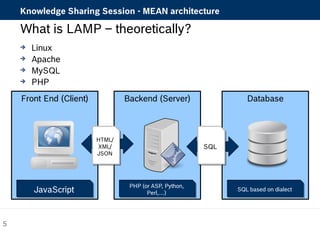
What is LAMP – theoretically? 
 Linux 
 Apache 
 MySQL 
 PHP 
Front End (Client) Backend (Server) Database 
HTML/ 
XML/ 
JSON 
HTML/ 
XML/ 
JSON 
PHP (or ASP, Python, 
JJaavvaaSSccrriipptt PHP (or ASP, Python, 
Perl,…) SSQQLL bbaasseedd oonn ddiiaalleecctt 
Perl,…) 
SSQQLL 
5
Knowledge Sharing Session - MEAN architecture 
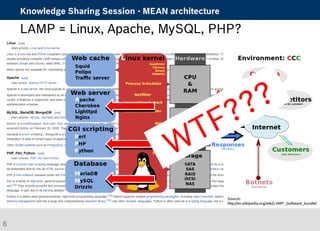
LAMP = Linux, Apache, MySQL, PHP? 
Source: 
http://en.wikipedia.org/wiki/LAMP_(software_bundle) 
6 
WTF???
Knowledge Sharing Session - MEAN architecture 
Problems with LAMP? 
 Important: There’s no problem with Linux!  
 What’s LAMP if every component can be replaced? 
 Apache is not the fastest web server around 
 PHP is ugly (even uglier with its bolted-on OO paradigm) 
 PHP needs to be integrated into Apache to run 
 Ever switched from PHP to ASP or Python based backend? 
 It’s hard to write good-to-read, reusable and fast PHP code 
 Frontend works with other languages than the backend 
 Too many conversions (XML to PHP to HTML, model to SQL) 
 There is no separated server-side and client-side development 
 LAMP is cheap, but has not been built for performance 
 mySQL is now owned by Oracle! ;) 
7
Knowledge Sharing Session - MEAN architecture 
To put it together – Web Technologies nowadays 
 So what are you currently using when building a web 
application with a LAMP approach? 
 Server-side language: PHP, ASP, JSP,… 
 Server-side container: Tomcat, Jboss, Jetty, Apache,… 
 Server-side templating: HAML, Moustache,… 
 Server-side MVC framework: Spring, Struts,… 
 Client-side JavaScript: jQuery, AngularJS, BackboneJS 
 > 5 different technologies/languages 
8
Knowledge Sharing Session - MEAN architecture 
Requirements for a modern web? 
 Customers want fast web sites/fast response times 
 No page reloads (that’s so 2010) 
 Enterprises want to go virtual 
 One box + Several virtual images => Shared Hardware 
 System with minimal memory footprint/overhead needed 
 As many concurrent requests as possible 
 Only load resources when needed (conditional loading) 
 Most of the data must come from a slim REST-API 
 Mobile/Responsive UIs 
 Automated build for backend AND frontend 
 Including check for coding conventions, testing,… 
 Integration in company’s continuos integration platform 
 For JS see Grunt or Gulp 
9
Knowledge Sharing Session - MEAN architecture 
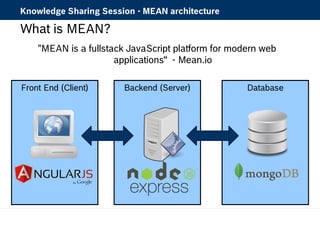
What is MEAN? 
"MEAN is a fullstack JavaScript platform for modern web 
applications“ - Mean.io 
Front End (Client) Backend (Server) Database
Knowledge Sharing Session - MEAN architecture 
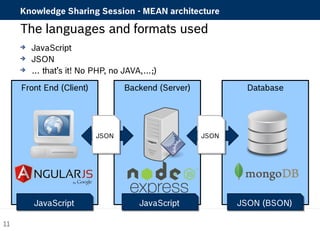
The languages and formats used 
 JavaScript 
 JSON 
 … that’s it! No PHP, no JAVA,…;) 
Front End (Client) Backend (Server) Database 
JJSSOONN JJSSOONN 
JJaavvaaSSccrriipptt JJaavvaaSSccrriipptt 
11 
JJSSOONN ((BBSSOONN))
Knowledge Sharing Session - MEAN architecture 
So why MEAN? 
 100% free 
 100% Open Source 
 100% Java Script (+JSON and HTML) 
 100% Web Standards 
 Huge community 
 Consistent Models from the backend to the frontend and back 
 Use a uniform language throughout your stack 
 JavaScript (the language of the web) 
 JSON (the data format of the web) 
 No conversion needed for the database 
 Use JavaScript with a great framework (compared to jQuery) 
 Allows to start with the complete frontend development first 
 Very low memory footprint/overhead 
12
Knowledge Sharing Session - MEAN architecture 
Mean – The future? 
Source: http://blog.stackoverflow.com/2014/02/2013-stack-overflow-user-survey-results/ 
13
Knowledge Sharing Session - MEAN architecture 
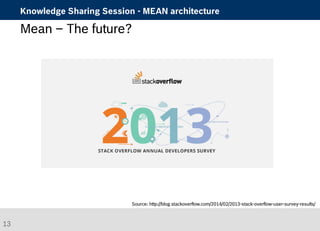
Mean – The future? 
Source: http://blog.stackoverflow.com/2014/02/2013-stack-overflow-user-survey-results/ 
14
Knowledge Sharing Session - MEAN architecture 
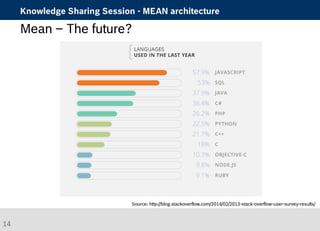
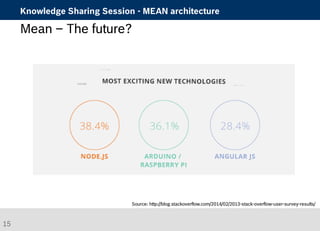
Mean – The future? 
Source: http://blog.stackoverflow.com/2014/02/2013-stack-overflow-user-survey-results/ 
15
Knowledge Sharing Session - MEAN architecture 
Angular JS – What is it? 
 JavaScript framework developed by Google 
 Development started in 2009 (Open Source) 
 Based on Model-View-* Pattern (client-side) 
 MVC/MVP/MVVM 
 Bi-Directional Data Binding 
 Declarative Programming (focus on what – not the how!) 
 Directives are integrated in HTML directly 
 DOM Manipulations completely hidden 
 Great for Frontend development 
 Great for SPA (Single Page Applications) 
 Great for CRUD applications (e.g. offers factories) 
 Great for mobile apps 
 Very modular and extensible 
 Makes testing an ease 
 Great Browser support (> IE8) 
 Well documented 
 Less custom code than good old jQuery (which is not needed here!) 
16
Knowledge Sharing Session - MEAN architecture 
Angular JS – Differences to jQuery 
 Angular JS is a framework – jQuery is not! 
 Angular CAN USE jQuery as well! 
 With jQuery you build your design and change it with DOM 
manipulations later 
 With Angular JS the view is the master and DOM changes are 
part of the design 
 Angular JS gives developers a guideline to develop an 
application in a common way 
 jQuery does not have any guidelines integrated, which can be 
hard for other developers if they need to extend the 
functionalities 
 There are best practices though 
17
Knowledge Sharing Session - MEAN architecture 
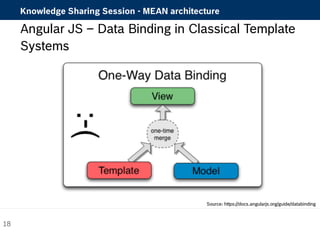
Angular JS – Data Binding in Classical Template 
Systems 
Source: https://docs.angularjs.org/guide/databinding 
18
Knowledge Sharing Session - MEAN architecture 
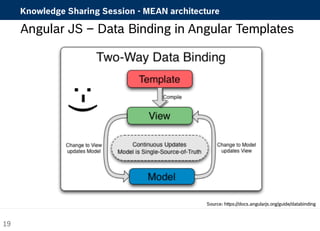
Angular JS – Data Binding in Angular Templates 
Source: https://docs.angularjs.org/guide/databinding 
19
Knowledge Sharing Session - MEAN architecture 
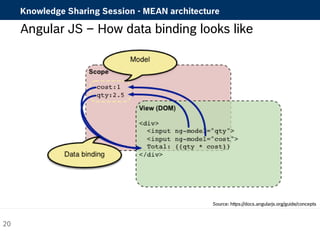
Angular JS – How data binding looks like 
Source: https://docs.angularjs.org/guide/concepts 
20
Knowledge Sharing Session - MEAN architecture 
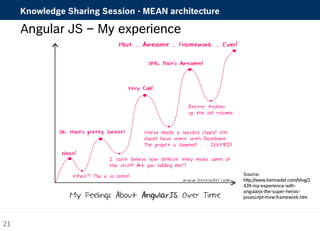
Angular JS – My experience 
Source: 
http://www.bennadel.com/blog/2 
439-my-experience-with-angularjs- 
the-super-heroic-javascript- 
mvw-framework.htm 
21
Knowledge Sharing Session - MEAN architecture 
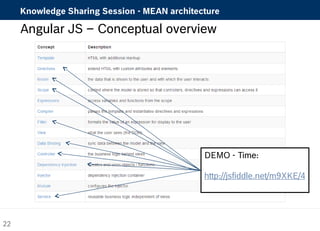
Angular JS – Conceptual overview 
DEMO - Time: 
http://jsfiddle.net/m9XKE/4 
22
Knowledge Sharing Session - MEAN architecture 
Node JS – What is it? 
Node.js is a platform built on Chrome's JavaScript runtime for 
easily building fast, scalable network applications. Node.js 
uses an event-driven, non-blocking I/O model that makes it 
lightweight and efficient, perfect for data-intensive real-time 
applications that run across distributed devices. 
(Source: http://www.nodejs.org) 
23
Knowledge Sharing Session - MEAN architecture 
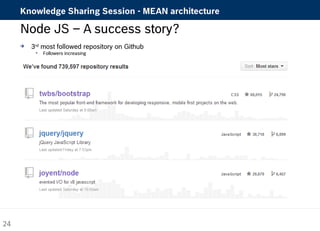
Node JS – A success story? 
 3rd most followed repository on Github 
 Followers increasing 
24
Knowledge Sharing Session - MEAN architecture 
Node JS – What is it? 
 Released in 2009 by Ryan Dahl (working for Joyent) 
 Written in C/C++ 
 Can also use C libraries 
 Built on top of Chrome’s V8 engine – so pure JavaScript!  
 Therefore based on latest ECMAScript 5 
 Framework to build asynchronous I/O applications 
 Single Threaded – no concurrency bugs – no deadlocks! 
 Not internally though – but we’ll get to that 
 One node process = one CPU Core 
 Can easily handle 10k concurrent connections 
 Doesn’t have any problems with concurrency 
 Doesn’t create much overhead (CPU/Memory) 
 Easily scalable (just create a cluster) 
 Very fast (well, it’s mostly C code) 
 Great community and well-maintained 
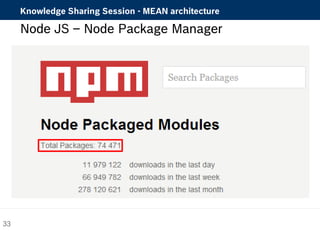
 Extensible with a looooot of modules (> 15.000!) 
 Installation and first server start within less than 5 minutes 
 REST-API that replies to GET requests can be implemented in less than 5 minutes as well! 
 Careful: It’s not a web framework! 
25
Knowledge Sharing Session - MEAN architecture 
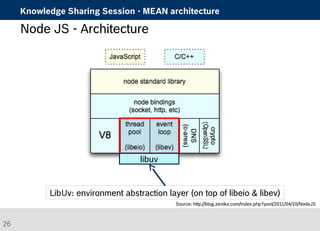
Node JS - Architecture 
LibUv: environment abstraction layer (on top of libeio & libev) 
Source: http://blog.zenika.com/index.php?post/2011/04/10/NodeJS 
libuv 
26
Knowledge Sharing Session - MEAN architecture 
Node JS – What’s this “non-blocking”? 
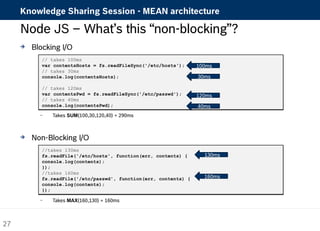
 Blocking I/O 
// takes 100ms 
var contentsHosts = fs.readFileSync('/etc/hosts'); 
// takes 30ms 
console.log(contentsHosts); 
// takes 120ms 
var contentsPwd = fs.readFileSync('/etc/passwd'); 
// takes 40ms 
console.log(contentsPwd); 
– Takes SUM(100,30,120,40) = 290ms 
 Non-Blocking I/O 
//takes 130ms 
fs.readFile('/etc/hosts', function(err, contents) { 
console.log(contents); 
}); 
//takes 160ms 
fs.readFile('/etc/passwd', function(err, contents) { 
console.log(contents); 
}); 
– Takes MAX(160,130) = 160ms 
100ms 
30ms 
120ms 
40ms 
130ms 
160ms 
27
Knowledge Sharing Session - MEAN architecture 
Node JS – Callbacks 
myCoolFunction(myArguments, function (err, 
data) { 
if (err) { 
// Handle Error 
} 
// Do something with the result (data). 
}); 
var userQuery = 'SELECT * FROM users WHERE id = ?'; 
var activityQuery = 'SELECT * FROM activities ORDER BY timestamp 
LIMIT 50'; 
var leaderBoardQuery = 'SELECT count(points) as total, user_id FROM 
activities LIMIT 50'; 
db.query(userQuery, [id], function (userErr, userResults) { 
db.query(activityQuery, function (activityErr, activityResults) { 
db.query(leaderBoardQuery, X function (leaderBoardErr, 
leaderBoardResults) { 
// Do something here 
! 
}); 
}); 
}); 28 Avoid callback hell
Knowledge Sharing Session - MEAN architecture 
Node JS – Event-Driven? Single-Threaded? 
[…] 
var http = require('http'); 
http.createServer(function (req, res) { 
res.writeHead(200, {'Content-Type': 'text/plain'}); 
res.end(myJavascriptObject.getSomeStatusInfo()); 
}).listen(1337, "127.0.0.1"); 
Source: http://www.aaronstannard.com/post/2011/12/14/Intro-to-NodeJS-for-NET-Developers.aspx 
29
Knowledge Sharing Session - MEAN architecture 
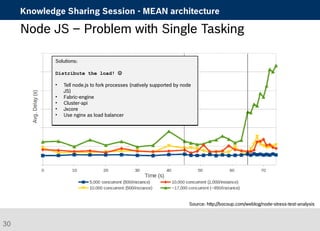
Node JS – Problem with Single Tasking 
Source: http://bocoup.com/weblog/node-stress-test-analysis 
Solutions: 
Distribute the load!  
• Tell node.js to fork processes (natively supported by node 
JS) 
• Fabric-engine 
• Cluster-api 
• Jxcore 
• Use nginx as load balancer 
30
Knowledge Sharing Session - MEAN architecture 
Node JS – Production example @ Paypal 
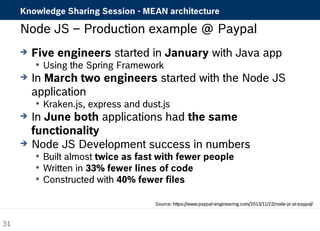
 Five engineers started in January with Java app 
 Using the Spring Framework 
 In March two engineers started with the Node JS 
application 
 Kraken.js, express and dust.js 
 In June both applications had the same 
functionality 
 Node JS Development success in numbers 
 Built almost twice as fast with fewer people 
 Written in 33% fewer lines of code 
 Constructed with 40% fewer files 
Source: https://www.paypal-engineering.com/2013/11/22/node-js-at-paypal/ 
31
Knowledge Sharing Session - MEAN architecture 
Node JS – Production example @ Paypal 
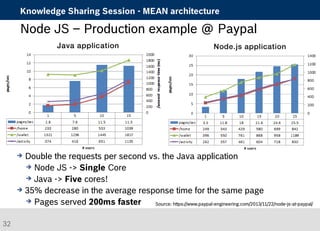
 Double the requests per second vs. the Java application 
Source: https://www.paypal-engineering.com/2013/11/22/node-js-at-paypal/ 
 Node JS -> Single Core 
 Java -> Five cores! 
 35% decrease in the average response time for the same page 
 Pages served 200ms faster 
32
Knowledge Sharing Session - MEAN architecture 
Node JS – Node Package Manager 
33
Knowledge Sharing Session - MEAN architecture 
Node JS – Node Package Manager 
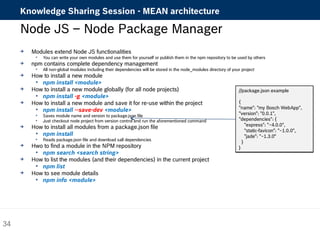
 Modules extend Node JS functionalities 
 You can write your own modules and use them for yourself or publish them in the npm repository to be used by others 
 npm contains complete dependency management 
 All non-global modules including their dependencies will be stored in the node_modules directory of your project 
 How to install a new module 
 npm install <module> 
 How to install a new module globally (for all node projects) 
 npm install -g <module> 
 How to install a new module and save it for re-use within the project 
 npm install --save-dev <module> 
 Saves module name and version to package.json file 
 Just checkout node project from version control and run the aforementioned command 
 How to install all modules from a package.json file 
 npm install 
 Reads package.json file and download sall dependencies 
 Hwo to find a module in the NPM repository 
 npm search <search string> 
 How to list the modules (and their dependencies) in the current project 
 npm list 
 How to see module details 
 npm info <module> 
//package.json example 
{ 
"name": "my Bosch WebApp", 
"version": "0.0.1", 
"dependencies": { 
"express": "~4.0.0", 
"static-favicon": "~1.0.0", 
"jade": "~1.3.0“ 
} 
} 
34
Knowledge Sharing Session - MEAN architecture 
Node JS – 3 Minutes REST Service example 
 Setup a full-blown, fast, headless & lightweight REST Service in less than 3 minutes 
 Prereq: Download and install Node.js 
$>mkdir bosch-rest & cd $_ 
$ bosch-rest> npm install restify 
npm http GET https://registry.npmjs.org/restify 
npm http 200 https://registry.npmjs.org/restify 
npm http GET https://registry.npmjs.org/restify/-/restify-2.8.1.tgz 
[...] 
$ bosch-rest>vi rest.js 
var restify = require('restify'); 
function respond(req, res, next) { 
res.send('hello ' + req.params.name); 
next(); 
} 
var server = restify.createServer(); 
server.get('/hello/:name', respond); 
server.listen(8080, function() { 
console.log('%s listening at %s', server.name, server.url); 
}); 
$ bosch-rest>node rest 
restify listening at http://0.0.0.0:8080 
35
Knowledge Sharing Session - MEAN architecture 
Express – What is it? 
Express is a minimal and flexible node.js 
web application framework, providing a 
robust set of features for building single and 
multi-page, and hybrid web applications. 
36
Knowledge Sharing Session - MEAN architecture 
Express – What is it? 
 Node JS based web framework 
 Inspired by Sinatra (Ruby) 
 Based on connect middleware 
 Makes usage of Node JS even easier 
 Easy to implement REST API 
 use restify if you don't need anything else! 
 Easy to implement session management 
 Supports several template rendering engines (Jade, EJS) 
 Supports partials -> so you can split your HTML in fragments 
 Asynchronous (of course!) 
 Implements MVC pattern 
 Good documentation 
 Lots of examples 
 Many extensions with a nice community 
37
Knowledge Sharing Session - MEAN architecture 
Express –How to get started 
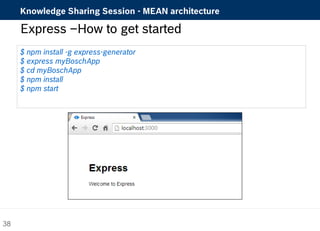
$ npm install -g express-generator 
$ express myBoschApp 
$ cd myBoschApp 
$ npm install 
$ npm start 
38
Knowledge Sharing Session - MEAN architecture 
Express – How does it look like app-wise? 
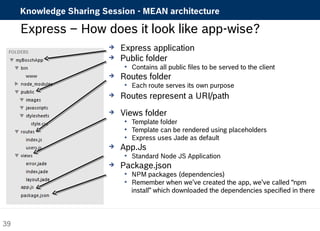
 Express application 
 Public folder 
 Contains all public files to be served to the client 
 Routes folder 
 Each route serves its own purpose 
 Routes represent a URI/path 
 Views folder 
 Template folder 
 Template can be rendered using placeholders 
 Express uses Jade as default 
 App.Js 
 Standard Node JS Application 
 Package.json 
 NPM packages (dependencies) 
 Remember when we’ve created the app, we’ve called “npm 
install” which downloaded the dependencies specified in there 
39
Knowledge Sharing Session - MEAN architecture 
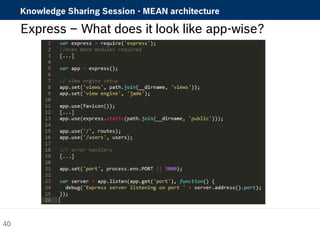
Express – What does it look like app-wise? 
40
Knowledge Sharing Session - MEAN architecture 
Express – Routes (Index) 
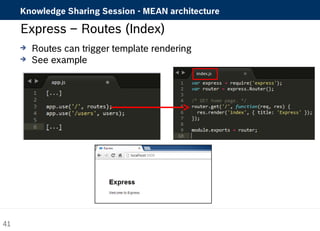
 Routes can trigger template rendering 
 See example 
41
Knowledge Sharing Session - MEAN architecture 
Express – Routes (Users) 
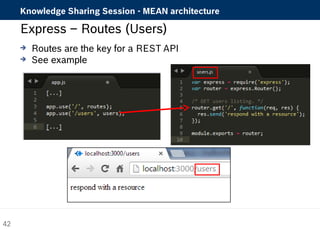
 Routes are the key for a REST API 
 See example 
42
Knowledge Sharing Session - MEAN architecture 
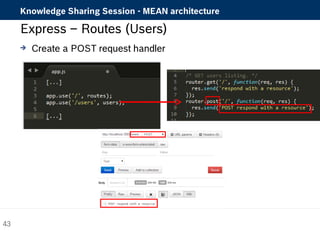
Express – Routes (Users) 
 Create a POST request handler 
43
Knowledge Sharing Session - MEAN architecture 
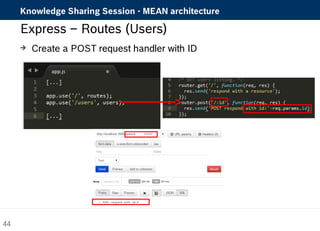
Express – Routes (Users) 
 Create a POST request handler with ID 
44
Knowledge Sharing Session - MEAN architecture 
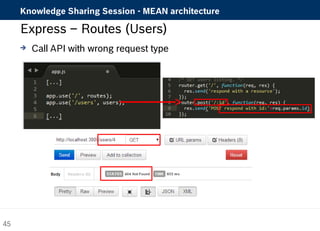
Express – Routes (Users) 
 Call API with wrong request type 
45
Knowledge Sharing Session - MEAN architecture 
MongoDB – What is it? 
MongoDB (from "humongous") is a cross-platform 
document-oriented database - classified as a 
NoSQL database which eschews the traditional 
table-based relational database structure in favor of 
JSON-like documents with dynamic schemas 
46
Knowledge Sharing Session - MEAN architecture 
MongoDB – What is it? 
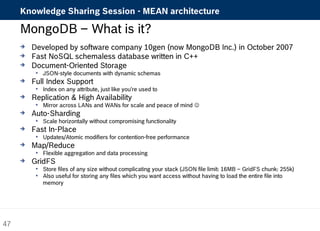
 Developed by software company 10gen (now MongoDB Inc.) in October 2007 
 Fast NoSQL schemaless database written in C++ 
 Document-Oriented Storage 
 JSON-style documents with dynamic schemas 
 Full Index Support 
 Index on any attribute, just like you're used to 
 Replication & High Availability 
 Mirror across LANs and WANs for scale and peace of mind  
 Auto-Sharding 
 Scale horizontally without compromising functionality 
 Fast In-Place 
 Updates/Atomic modifiers for contention-free performance 
 Map/Reduce 
 Flexible aggregation and data processing 
 GridFS 
 Store files of any size without complicating your stack (JSON file limit: 16MB – GridFS chunk: 255k) 
 Also useful for storing any files which you want access without having to load the entire file into 
memory 
47
Knowledge Sharing Session - MEAN architecture 
48 
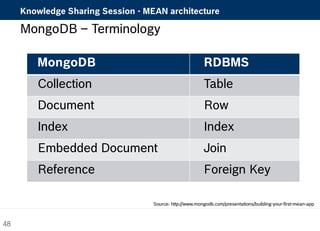
MongoDB – Terminology 
MongoDB RDBMS 
Collection Table 
Document Row 
Index Index 
Embedded Document Join 
Reference Foreign Key 
Source: http://www.mongodb.com/presentations/building-your-first-mean-app
Knowledge Sharing Session - MEAN architecture 
49 
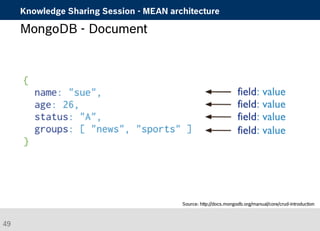
MongoDB - Document 
Source: http://docs.mongodb.org/manual/core/crud-introduction
Knowledge Sharing Session - MEAN architecture 
MongoDB – Rich Documents - BSON 
String 
Number 
Geo- 
Coordinates 
Source: http://www.mongodb.com/presentations/building-your-first-mean-app 
50 
{ 
first_name: ‘Paul’, 
surname: ‘Miller’, 
cell: ‘+447557505611’ 
city: ‘London’, 
location: [45.123,47.232], 
Profession: [banking, finance, trader], 
cars: [ 
{ model: ‘Bentley’, 
year: 1973, 
value: 100000, … }, 
{ model: ‘Rolls Royce’, 
year: 1965, 
value: 330000, … } 
} 
} 
Fields can contain an 
array of sub-documents 
Fields 
Typed field 
values 
Fields 
can 
contain 
arrays
Knowledge Sharing Session - MEAN architecture 
51 
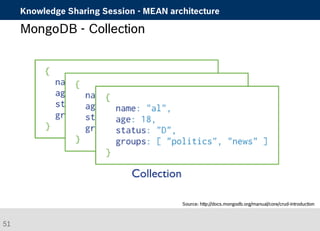
MongoDB - Collection 
Source: http://docs.mongodb.org/manual/core/crud-introduction
Knowledge Sharing Session - MEAN architecture 
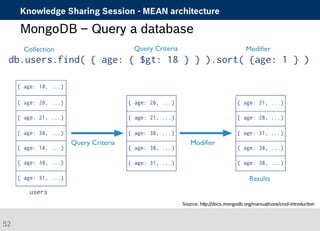
MongoDB – Query a database 
Source: http://docs.mongodb.org/manual/core/crud-introduction 
52
Knowledge Sharing Session - MEAN architecture 
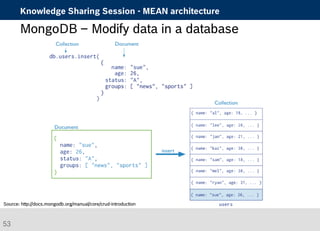
MongoDB – Modify data in a database 
Source: http://docs.mongodb.org/manual/core/crud-introduction 
53
Knowledge Sharing Session - MEAN architecture 
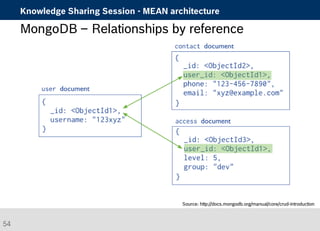
MongoDB – Relationships by reference 
Source: http://docs.mongodb.org/manual/core/crud-introduction 
54
Knowledge Sharing Session - MEAN architecture 
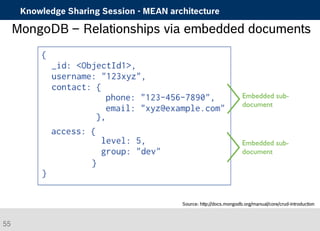
MongoDB – Relationships via embedded documents 
Source: http://docs.mongodb.org/manual/core/crud-introduction 
55
Knowledge Sharing Session - MEAN architecture 
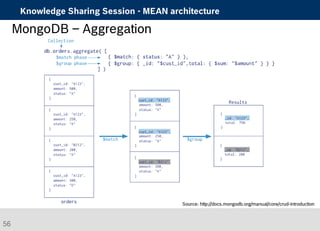
MongoDB – Aggregation 
Source: http://docs.mongodb.org/manual/core/crud-introduction 
56
Knowledge Sharing Session - MEAN architecture 
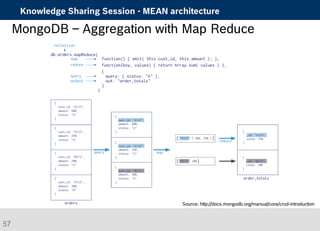
MongoDB – Aggregation with Map Reduce 
Source: http://docs.mongodb.org/manual/core/crud-introduction 
57
Knowledge Sharing Session - MEAN architecture 
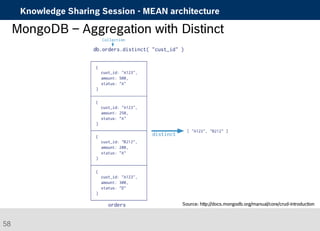
MongoDB – Aggregation with Distinct 
Source: http://docs.mongodb.org/manual/core/crud-introduction 
58
Knowledge Sharing Session - MEAN architecture 
59 
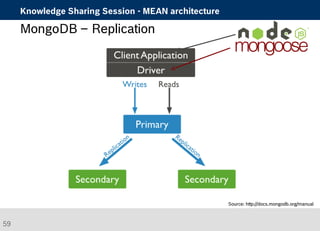
MongoDB – Replication 
Source: http://docs.mongodb.org/manual
Knowledge Sharing Session - MEAN architecture 
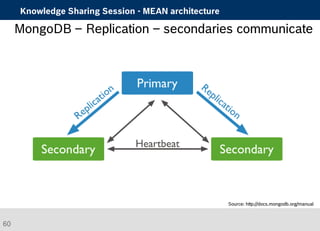
MongoDB – Replication – secondaries communicate 
Source: http://docs.mongodb.org/manual 
60
Knowledge Sharing Session - MEAN architecture 
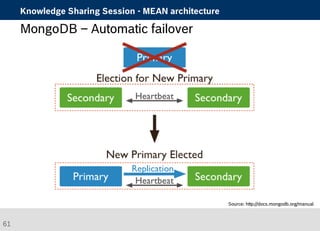
MongoDB – Automatic failover 
Source: http://docs.mongodb.org/manual 
61
Knowledge Sharing Session - MEAN architecture 
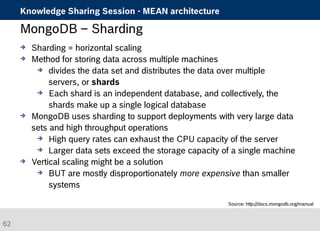
MongoDB – Sharding 
Source: http://docs.mongodb.org/manual 
62 
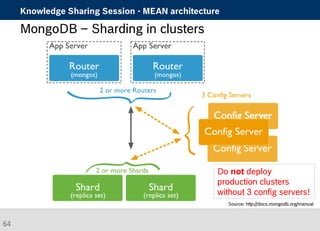
 Sharding = horizontal scaling 
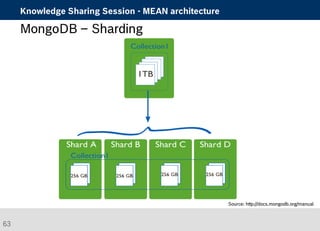
 Method for storing data across multiple machines 
 divides the data set and distributes the data over multiple 
servers, or shards 
 Each shard is an independent database, and collectively, the 
shards make up a single logical database 
 MongoDB uses sharding to support deployments with very large data 
sets and high throughput operations 
 High query rates can exhaust the CPU capacity of the server 
 Larger data sets exceed the storage capacity of a single machine 
 Vertical scaling might be a solution 
 BUT are mostly disproportionately more expensive than smaller 
systems
Knowledge Sharing Session - MEAN architecture 
MongoDB – Sharding 
Source: http://docs.mongodb.org/manual 
63
Knowledge Sharing Session - MEAN architecture 
MongoDB – Sharding in clusters 
Source: http://docs.mongodb.org/manual 
64 
Do not deploy 
production clusters 
without 3 config servers!
Knowledge Sharing Session - MEAN architecture 
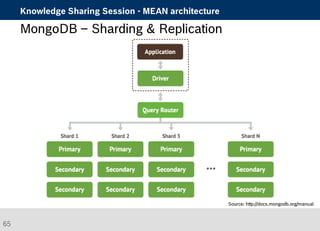
MongoDB – Sharding & Replication 
Source: http://docs.mongodb.org/manual 
65
Knowledge Sharing Session - MEAN architecture 
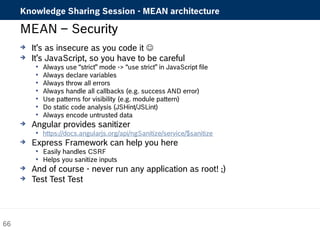
MEAN – Security 
 It’s as insecure as you code it  
 It’s JavaScript, so you have to be careful 
 Always use “strict” mode -> “use strict” in JavaScript file 
 Always declare variables 
 Always throw all errors 
 Always handle all callbacks (e.g. success AND error) 
 Use patterns for visibility (e.g. module pattern) 
 Do static code analysis (JSHint/JSLint) 
 Always encode untrusted data 
 Angular provides sanitizer 
 https://docs.angularjs.org/api/ngSanitize/service/$sanitize 
 Express Framework can help you here 
 Easily handles CSRF 
 Helps you sanitize inputs 
 And of course - never run any application as root! ;) 
 Test Test Test 
66
Knowledge Sharing Session - MEAN architecture 
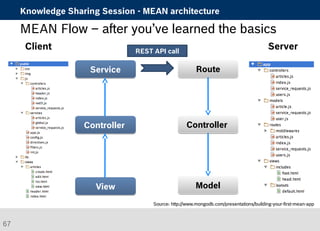
MEAN Flow – after you’ve learned the basics 
Client Server 
SSeerrvviiccee RRoouuttee 
CCoonnttrroolllleerr 
VViieeww 
CCoonnttrroolllleerr 
MMooddeell 
REST API call 
Source: http://www.mongodb.com/presentations/building-your-first-mean-app 
67
Knowledge Sharing Session - MEAN architecture 
What’s bad about this “mean” approach? 
 For those who don’t like JavaScript – it’s going to be killing you!  
 There are still no general JS coding guidelines 
 SPAs need a new way of thinking(!) 
 The browser is your platform! 
 MongoDB is not as robust as an SQL server 
 This security is what they sacrifice to gain speed 
 You need to take care of rollbacks yourself (2-Phase-Commit) 
 ACID => Possible – but part of the driver/client application 
 It’s hard to find specialists that are no hipsters 
 and have the big picture/architecture for enterprise solutions in mind 
 It makes sense to also have a look at Grunt, Yeoman and Bower in 
order to create a good developer experience 
 A lot of new areas have to be discovered – but it’s worth it!  
 Once you’ve created the first site with this technology, it’s hard to go 
back to the old approach 
68
Knowledge Sharing Session - MEAN architecture 
Sources 
 Mean.io 
 http://www.mean.io 
 AngularJS 
 https://angularjs.org 
 MongoDB 
 http://mongodb.org 
 NodeJS 
 https://nodejs.org 
 Express 
 http://expressjs.com 
 The MEAN Stack: MongoDB, ExpressJS, AngularJS and Node.js 
 http://blog.mongodb.org/post/49262866911/the-mean-stack-mongo 
db-expressjs-angularjs-and 
69
Knowledge Sharing Session - MEAN architecture 
Questions? 
70

LAMP is so yesterday, MEAN is so tomorrow! :)

  • 1.
    Knowledge Sharing Session- MEAN architecture LAMP is so yesterday - MEAN is so tomorrow Web-Architecture with client- and server-side JavaScript and noSQL 1
  • 2.
    Knowledge Sharing Session- MEAN architecture Agenda  Who am I and what am I doing here?  What is LAMP?  Requirements for a modern web  Architecture  What is MEAN?  So why MEAN?  What is Angular JS?  What is Node.JS?  What is Express?  What is MongoDB?  MEAN security  What’s bad about this approach?  Any Questions? 2
  • 3.
    Knowledge Sharing Session- MEAN architecture Who am I and what am I doing here?  Sascha Sambale, 33 years old, Stuttgart (Twitter: @mastixmc) – Follow me for latest news about RWD and Web Performance  Before: EX IBMer (Dev @ IBM Web Content Manager, IBM WS Portal, BPM)  Today: Project Lead & Architect for Mobile & Web Development @ BOSCH  Lecturer @ Heilbronn University (Java Development)  Geek  Writes code in his spare-time  Frontend and backend  Languages  German/English/Français (un petit peu)  Java  JavaScript  Scala  PHP  CSS, SASS, LESS  And some unimportant ones like CoffeeScript, Delphi, Basic…   Specialized in  Application Development  Web Development/Architecture  Mobile Development 3
  • 4.
    Knowledge Sharing Session- MEAN architecture The history of LAMP  LAMP gained power in 1998 (until 2010)  Everybody hated JS (disabled in Browser; until jQuery became famous)  Browser wasn’t that powerful as it is today  Thin Client & Fat Server was the way to go  There was no HTML5 and no node.JS!   In 1998 a lot of developers called HTML a development language  And have used JavaScript only in a (very) basic way  Remember DHTML? Got some nice effects though…   What else happened in 1998?  Microsoft launches Windows 98  Google is founded  Paypal is founded  AOL bought Netscape for $4.2 billion -> LOL  Monica Lewinski got “famous” A lot has happened since then!  4
  • 5.
    Knowledge Sharing Session- MEAN architecture What is LAMP – theoretically?  Linux  Apache  MySQL  PHP Front End (Client) Backend (Server) Database HTML/ XML/ JSON HTML/ XML/ JSON PHP (or ASP, Python, JJaavvaaSSccrriipptt PHP (or ASP, Python, Perl,…) SSQQLL bbaasseedd oonn ddiiaalleecctt Perl,…) SSQQLL 5
  • 6.
    Knowledge Sharing Session- MEAN architecture LAMP = Linux, Apache, MySQL, PHP? Source: http://en.wikipedia.org/wiki/LAMP_(software_bundle) 6 WTF???
  • 7.
    Knowledge Sharing Session- MEAN architecture Problems with LAMP?  Important: There’s no problem with Linux!   What’s LAMP if every component can be replaced?  Apache is not the fastest web server around  PHP is ugly (even uglier with its bolted-on OO paradigm)  PHP needs to be integrated into Apache to run  Ever switched from PHP to ASP or Python based backend?  It’s hard to write good-to-read, reusable and fast PHP code  Frontend works with other languages than the backend  Too many conversions (XML to PHP to HTML, model to SQL)  There is no separated server-side and client-side development  LAMP is cheap, but has not been built for performance  mySQL is now owned by Oracle! ;) 7
  • 8.
    Knowledge Sharing Session- MEAN architecture To put it together – Web Technologies nowadays  So what are you currently using when building a web application with a LAMP approach?  Server-side language: PHP, ASP, JSP,…  Server-side container: Tomcat, Jboss, Jetty, Apache,…  Server-side templating: HAML, Moustache,…  Server-side MVC framework: Spring, Struts,…  Client-side JavaScript: jQuery, AngularJS, BackboneJS  > 5 different technologies/languages 8
  • 9.
    Knowledge Sharing Session- MEAN architecture Requirements for a modern web?  Customers want fast web sites/fast response times  No page reloads (that’s so 2010)  Enterprises want to go virtual  One box + Several virtual images => Shared Hardware  System with minimal memory footprint/overhead needed  As many concurrent requests as possible  Only load resources when needed (conditional loading)  Most of the data must come from a slim REST-API  Mobile/Responsive UIs  Automated build for backend AND frontend  Including check for coding conventions, testing,…  Integration in company’s continuos integration platform  For JS see Grunt or Gulp 9
  • 10.
    Knowledge Sharing Session- MEAN architecture What is MEAN? "MEAN is a fullstack JavaScript platform for modern web applications“ - Mean.io Front End (Client) Backend (Server) Database
  • 11.
    Knowledge Sharing Session- MEAN architecture The languages and formats used  JavaScript  JSON  … that’s it! No PHP, no JAVA,…;) Front End (Client) Backend (Server) Database JJSSOONN JJSSOONN JJaavvaaSSccrriipptt JJaavvaaSSccrriipptt 11 JJSSOONN ((BBSSOONN))
  • 12.
    Knowledge Sharing Session- MEAN architecture So why MEAN?  100% free  100% Open Source  100% Java Script (+JSON and HTML)  100% Web Standards  Huge community  Consistent Models from the backend to the frontend and back  Use a uniform language throughout your stack  JavaScript (the language of the web)  JSON (the data format of the web)  No conversion needed for the database  Use JavaScript with a great framework (compared to jQuery)  Allows to start with the complete frontend development first  Very low memory footprint/overhead 12
  • 13.
    Knowledge Sharing Session- MEAN architecture Mean – The future? Source: http://blog.stackoverflow.com/2014/02/2013-stack-overflow-user-survey-results/ 13
  • 14.
    Knowledge Sharing Session- MEAN architecture Mean – The future? Source: http://blog.stackoverflow.com/2014/02/2013-stack-overflow-user-survey-results/ 14
  • 15.
    Knowledge Sharing Session- MEAN architecture Mean – The future? Source: http://blog.stackoverflow.com/2014/02/2013-stack-overflow-user-survey-results/ 15
  • 16.
    Knowledge Sharing Session- MEAN architecture Angular JS – What is it?  JavaScript framework developed by Google  Development started in 2009 (Open Source)  Based on Model-View-* Pattern (client-side)  MVC/MVP/MVVM  Bi-Directional Data Binding  Declarative Programming (focus on what – not the how!)  Directives are integrated in HTML directly  DOM Manipulations completely hidden  Great for Frontend development  Great for SPA (Single Page Applications)  Great for CRUD applications (e.g. offers factories)  Great for mobile apps  Very modular and extensible  Makes testing an ease  Great Browser support (> IE8)  Well documented  Less custom code than good old jQuery (which is not needed here!) 16
  • 17.
    Knowledge Sharing Session- MEAN architecture Angular JS – Differences to jQuery  Angular JS is a framework – jQuery is not!  Angular CAN USE jQuery as well!  With jQuery you build your design and change it with DOM manipulations later  With Angular JS the view is the master and DOM changes are part of the design  Angular JS gives developers a guideline to develop an application in a common way  jQuery does not have any guidelines integrated, which can be hard for other developers if they need to extend the functionalities  There are best practices though 17
  • 18.
    Knowledge Sharing Session- MEAN architecture Angular JS – Data Binding in Classical Template Systems Source: https://docs.angularjs.org/guide/databinding 18
  • 19.
    Knowledge Sharing Session- MEAN architecture Angular JS – Data Binding in Angular Templates Source: https://docs.angularjs.org/guide/databinding 19
  • 20.
    Knowledge Sharing Session- MEAN architecture Angular JS – How data binding looks like Source: https://docs.angularjs.org/guide/concepts 20
  • 21.
    Knowledge Sharing Session- MEAN architecture Angular JS – My experience Source: http://www.bennadel.com/blog/2 439-my-experience-with-angularjs- the-super-heroic-javascript- mvw-framework.htm 21
  • 22.
    Knowledge Sharing Session- MEAN architecture Angular JS – Conceptual overview DEMO - Time: http://jsfiddle.net/m9XKE/4 22
  • 23.
    Knowledge Sharing Session- MEAN architecture Node JS – What is it? Node.js is a platform built on Chrome's JavaScript runtime for easily building fast, scalable network applications. Node.js uses an event-driven, non-blocking I/O model that makes it lightweight and efficient, perfect for data-intensive real-time applications that run across distributed devices. (Source: http://www.nodejs.org) 23
  • 24.
    Knowledge Sharing Session- MEAN architecture Node JS – A success story?  3rd most followed repository on Github  Followers increasing 24
  • 25.
    Knowledge Sharing Session- MEAN architecture Node JS – What is it?  Released in 2009 by Ryan Dahl (working for Joyent)  Written in C/C++  Can also use C libraries  Built on top of Chrome’s V8 engine – so pure JavaScript!   Therefore based on latest ECMAScript 5  Framework to build asynchronous I/O applications  Single Threaded – no concurrency bugs – no deadlocks!  Not internally though – but we’ll get to that  One node process = one CPU Core  Can easily handle 10k concurrent connections  Doesn’t have any problems with concurrency  Doesn’t create much overhead (CPU/Memory)  Easily scalable (just create a cluster)  Very fast (well, it’s mostly C code)  Great community and well-maintained  Extensible with a looooot of modules (> 15.000!)  Installation and first server start within less than 5 minutes  REST-API that replies to GET requests can be implemented in less than 5 minutes as well!  Careful: It’s not a web framework! 25
  • 26.
    Knowledge Sharing Session- MEAN architecture Node JS - Architecture LibUv: environment abstraction layer (on top of libeio & libev) Source: http://blog.zenika.com/index.php?post/2011/04/10/NodeJS libuv 26
  • 27.
    Knowledge Sharing Session- MEAN architecture Node JS – What’s this “non-blocking”?  Blocking I/O // takes 100ms var contentsHosts = fs.readFileSync('/etc/hosts'); // takes 30ms console.log(contentsHosts); // takes 120ms var contentsPwd = fs.readFileSync('/etc/passwd'); // takes 40ms console.log(contentsPwd); – Takes SUM(100,30,120,40) = 290ms  Non-Blocking I/O //takes 130ms fs.readFile('/etc/hosts', function(err, contents) { console.log(contents); }); //takes 160ms fs.readFile('/etc/passwd', function(err, contents) { console.log(contents); }); – Takes MAX(160,130) = 160ms 100ms 30ms 120ms 40ms 130ms 160ms 27
  • 28.
    Knowledge Sharing Session- MEAN architecture Node JS – Callbacks myCoolFunction(myArguments, function (err, data) { if (err) { // Handle Error } // Do something with the result (data). }); var userQuery = 'SELECT * FROM users WHERE id = ?'; var activityQuery = 'SELECT * FROM activities ORDER BY timestamp LIMIT 50'; var leaderBoardQuery = 'SELECT count(points) as total, user_id FROM activities LIMIT 50'; db.query(userQuery, [id], function (userErr, userResults) { db.query(activityQuery, function (activityErr, activityResults) { db.query(leaderBoardQuery, X function (leaderBoardErr, leaderBoardResults) { // Do something here ! }); }); }); 28 Avoid callback hell
  • 29.
    Knowledge Sharing Session- MEAN architecture Node JS – Event-Driven? Single-Threaded? […] var http = require('http'); http.createServer(function (req, res) { res.writeHead(200, {'Content-Type': 'text/plain'}); res.end(myJavascriptObject.getSomeStatusInfo()); }).listen(1337, "127.0.0.1"); Source: http://www.aaronstannard.com/post/2011/12/14/Intro-to-NodeJS-for-NET-Developers.aspx 29
  • 30.
    Knowledge Sharing Session- MEAN architecture Node JS – Problem with Single Tasking Source: http://bocoup.com/weblog/node-stress-test-analysis Solutions: Distribute the load!  • Tell node.js to fork processes (natively supported by node JS) • Fabric-engine • Cluster-api • Jxcore • Use nginx as load balancer 30
  • 31.
    Knowledge Sharing Session- MEAN architecture Node JS – Production example @ Paypal  Five engineers started in January with Java app  Using the Spring Framework  In March two engineers started with the Node JS application  Kraken.js, express and dust.js  In June both applications had the same functionality  Node JS Development success in numbers  Built almost twice as fast with fewer people  Written in 33% fewer lines of code  Constructed with 40% fewer files Source: https://www.paypal-engineering.com/2013/11/22/node-js-at-paypal/ 31
  • 32.
    Knowledge Sharing Session- MEAN architecture Node JS – Production example @ Paypal  Double the requests per second vs. the Java application Source: https://www.paypal-engineering.com/2013/11/22/node-js-at-paypal/  Node JS -> Single Core  Java -> Five cores!  35% decrease in the average response time for the same page  Pages served 200ms faster 32
  • 33.
    Knowledge Sharing Session- MEAN architecture Node JS – Node Package Manager 33
  • 34.
    Knowledge Sharing Session- MEAN architecture Node JS – Node Package Manager  Modules extend Node JS functionalities  You can write your own modules and use them for yourself or publish them in the npm repository to be used by others  npm contains complete dependency management  All non-global modules including their dependencies will be stored in the node_modules directory of your project  How to install a new module  npm install <module>  How to install a new module globally (for all node projects)  npm install -g <module>  How to install a new module and save it for re-use within the project  npm install --save-dev <module>  Saves module name and version to package.json file  Just checkout node project from version control and run the aforementioned command  How to install all modules from a package.json file  npm install  Reads package.json file and download sall dependencies  Hwo to find a module in the NPM repository  npm search <search string>  How to list the modules (and their dependencies) in the current project  npm list  How to see module details  npm info <module> //package.json example { "name": "my Bosch WebApp", "version": "0.0.1", "dependencies": { "express": "~4.0.0", "static-favicon": "~1.0.0", "jade": "~1.3.0“ } } 34
  • 35.
    Knowledge Sharing Session- MEAN architecture Node JS – 3 Minutes REST Service example  Setup a full-blown, fast, headless & lightweight REST Service in less than 3 minutes  Prereq: Download and install Node.js $>mkdir bosch-rest & cd $_ $ bosch-rest> npm install restify npm http GET https://registry.npmjs.org/restify npm http 200 https://registry.npmjs.org/restify npm http GET https://registry.npmjs.org/restify/-/restify-2.8.1.tgz [...] $ bosch-rest>vi rest.js var restify = require('restify'); function respond(req, res, next) { res.send('hello ' + req.params.name); next(); } var server = restify.createServer(); server.get('/hello/:name', respond); server.listen(8080, function() { console.log('%s listening at %s', server.name, server.url); }); $ bosch-rest>node rest restify listening at http://0.0.0.0:8080 35
  • 36.
    Knowledge Sharing Session- MEAN architecture Express – What is it? Express is a minimal and flexible node.js web application framework, providing a robust set of features for building single and multi-page, and hybrid web applications. 36
  • 37.
    Knowledge Sharing Session- MEAN architecture Express – What is it?  Node JS based web framework  Inspired by Sinatra (Ruby)  Based on connect middleware  Makes usage of Node JS even easier  Easy to implement REST API  use restify if you don't need anything else!  Easy to implement session management  Supports several template rendering engines (Jade, EJS)  Supports partials -> so you can split your HTML in fragments  Asynchronous (of course!)  Implements MVC pattern  Good documentation  Lots of examples  Many extensions with a nice community 37
  • 38.
    Knowledge Sharing Session- MEAN architecture Express –How to get started $ npm install -g express-generator $ express myBoschApp $ cd myBoschApp $ npm install $ npm start 38
  • 39.
    Knowledge Sharing Session- MEAN architecture Express – How does it look like app-wise?  Express application  Public folder  Contains all public files to be served to the client  Routes folder  Each route serves its own purpose  Routes represent a URI/path  Views folder  Template folder  Template can be rendered using placeholders  Express uses Jade as default  App.Js  Standard Node JS Application  Package.json  NPM packages (dependencies)  Remember when we’ve created the app, we’ve called “npm install” which downloaded the dependencies specified in there 39
  • 40.
    Knowledge Sharing Session- MEAN architecture Express – What does it look like app-wise? 40
  • 41.
    Knowledge Sharing Session- MEAN architecture Express – Routes (Index)  Routes can trigger template rendering  See example 41
  • 42.
    Knowledge Sharing Session- MEAN architecture Express – Routes (Users)  Routes are the key for a REST API  See example 42
  • 43.
    Knowledge Sharing Session- MEAN architecture Express – Routes (Users)  Create a POST request handler 43
  • 44.
    Knowledge Sharing Session- MEAN architecture Express – Routes (Users)  Create a POST request handler with ID 44
  • 45.
    Knowledge Sharing Session- MEAN architecture Express – Routes (Users)  Call API with wrong request type 45
  • 46.
    Knowledge Sharing Session- MEAN architecture MongoDB – What is it? MongoDB (from "humongous") is a cross-platform document-oriented database - classified as a NoSQL database which eschews the traditional table-based relational database structure in favor of JSON-like documents with dynamic schemas 46
  • 47.
    Knowledge Sharing Session- MEAN architecture MongoDB – What is it?  Developed by software company 10gen (now MongoDB Inc.) in October 2007  Fast NoSQL schemaless database written in C++  Document-Oriented Storage  JSON-style documents with dynamic schemas  Full Index Support  Index on any attribute, just like you're used to  Replication & High Availability  Mirror across LANs and WANs for scale and peace of mind   Auto-Sharding  Scale horizontally without compromising functionality  Fast In-Place  Updates/Atomic modifiers for contention-free performance  Map/Reduce  Flexible aggregation and data processing  GridFS  Store files of any size without complicating your stack (JSON file limit: 16MB – GridFS chunk: 255k)  Also useful for storing any files which you want access without having to load the entire file into memory 47
  • 48.
    Knowledge Sharing Session- MEAN architecture 48 MongoDB – Terminology MongoDB RDBMS Collection Table Document Row Index Index Embedded Document Join Reference Foreign Key Source: http://www.mongodb.com/presentations/building-your-first-mean-app
  • 49.
    Knowledge Sharing Session- MEAN architecture 49 MongoDB - Document Source: http://docs.mongodb.org/manual/core/crud-introduction
  • 50.
    Knowledge Sharing Session- MEAN architecture MongoDB – Rich Documents - BSON String Number Geo- Coordinates Source: http://www.mongodb.com/presentations/building-your-first-mean-app 50 { first_name: ‘Paul’, surname: ‘Miller’, cell: ‘+447557505611’ city: ‘London’, location: [45.123,47.232], Profession: [banking, finance, trader], cars: [ { model: ‘Bentley’, year: 1973, value: 100000, … }, { model: ‘Rolls Royce’, year: 1965, value: 330000, … } } } Fields can contain an array of sub-documents Fields Typed field values Fields can contain arrays
  • 51.
    Knowledge Sharing Session- MEAN architecture 51 MongoDB - Collection Source: http://docs.mongodb.org/manual/core/crud-introduction
  • 52.
    Knowledge Sharing Session- MEAN architecture MongoDB – Query a database Source: http://docs.mongodb.org/manual/core/crud-introduction 52
  • 53.
    Knowledge Sharing Session- MEAN architecture MongoDB – Modify data in a database Source: http://docs.mongodb.org/manual/core/crud-introduction 53
  • 54.
    Knowledge Sharing Session- MEAN architecture MongoDB – Relationships by reference Source: http://docs.mongodb.org/manual/core/crud-introduction 54
  • 55.
    Knowledge Sharing Session- MEAN architecture MongoDB – Relationships via embedded documents Source: http://docs.mongodb.org/manual/core/crud-introduction 55
  • 56.
    Knowledge Sharing Session- MEAN architecture MongoDB – Aggregation Source: http://docs.mongodb.org/manual/core/crud-introduction 56
  • 57.
    Knowledge Sharing Session- MEAN architecture MongoDB – Aggregation with Map Reduce Source: http://docs.mongodb.org/manual/core/crud-introduction 57
  • 58.
    Knowledge Sharing Session- MEAN architecture MongoDB – Aggregation with Distinct Source: http://docs.mongodb.org/manual/core/crud-introduction 58
  • 59.
    Knowledge Sharing Session- MEAN architecture 59 MongoDB – Replication Source: http://docs.mongodb.org/manual
  • 60.
    Knowledge Sharing Session- MEAN architecture MongoDB – Replication – secondaries communicate Source: http://docs.mongodb.org/manual 60
  • 61.
    Knowledge Sharing Session- MEAN architecture MongoDB – Automatic failover Source: http://docs.mongodb.org/manual 61
  • 62.
    Knowledge Sharing Session- MEAN architecture MongoDB – Sharding Source: http://docs.mongodb.org/manual 62  Sharding = horizontal scaling  Method for storing data across multiple machines  divides the data set and distributes the data over multiple servers, or shards  Each shard is an independent database, and collectively, the shards make up a single logical database  MongoDB uses sharding to support deployments with very large data sets and high throughput operations  High query rates can exhaust the CPU capacity of the server  Larger data sets exceed the storage capacity of a single machine  Vertical scaling might be a solution  BUT are mostly disproportionately more expensive than smaller systems
  • 63.
    Knowledge Sharing Session- MEAN architecture MongoDB – Sharding Source: http://docs.mongodb.org/manual 63
  • 64.
    Knowledge Sharing Session- MEAN architecture MongoDB – Sharding in clusters Source: http://docs.mongodb.org/manual 64 Do not deploy production clusters without 3 config servers!
  • 65.
    Knowledge Sharing Session- MEAN architecture MongoDB – Sharding & Replication Source: http://docs.mongodb.org/manual 65
  • 66.
    Knowledge Sharing Session- MEAN architecture MEAN – Security  It’s as insecure as you code it   It’s JavaScript, so you have to be careful  Always use “strict” mode -> “use strict” in JavaScript file  Always declare variables  Always throw all errors  Always handle all callbacks (e.g. success AND error)  Use patterns for visibility (e.g. module pattern)  Do static code analysis (JSHint/JSLint)  Always encode untrusted data  Angular provides sanitizer  https://docs.angularjs.org/api/ngSanitize/service/$sanitize  Express Framework can help you here  Easily handles CSRF  Helps you sanitize inputs  And of course - never run any application as root! ;)  Test Test Test 66
  • 67.
    Knowledge Sharing Session- MEAN architecture MEAN Flow – after you’ve learned the basics Client Server SSeerrvviiccee RRoouuttee CCoonnttrroolllleerr VViieeww CCoonnttrroolllleerr MMooddeell REST API call Source: http://www.mongodb.com/presentations/building-your-first-mean-app 67
  • 68.
    Knowledge Sharing Session- MEAN architecture What’s bad about this “mean” approach?  For those who don’t like JavaScript – it’s going to be killing you!   There are still no general JS coding guidelines  SPAs need a new way of thinking(!)  The browser is your platform!  MongoDB is not as robust as an SQL server  This security is what they sacrifice to gain speed  You need to take care of rollbacks yourself (2-Phase-Commit)  ACID => Possible – but part of the driver/client application  It’s hard to find specialists that are no hipsters  and have the big picture/architecture for enterprise solutions in mind  It makes sense to also have a look at Grunt, Yeoman and Bower in order to create a good developer experience  A lot of new areas have to be discovered – but it’s worth it!   Once you’ve created the first site with this technology, it’s hard to go back to the old approach 68
  • 69.
    Knowledge Sharing Session- MEAN architecture Sources  Mean.io  http://www.mean.io  AngularJS  https://angularjs.org  MongoDB  http://mongodb.org  NodeJS  https://nodejs.org  Express  http://expressjs.com  The MEAN Stack: MongoDB, ExpressJS, AngularJS and Node.js  http://blog.mongodb.org/post/49262866911/the-mean-stack-mongo db-expressjs-angularjs-and 69
  • 70.
    Knowledge Sharing Session- MEAN architecture Questions? 70