Web Services
Submited By:
Miss.Rachna Kamalia
Prepared By:
Miss.Nilam Radadiya(Roll
No:33)
&
Miss.Kinjal Kapadiya(Roll No:16)

1
Web Services

What is Web Services?
 How it Works.
 Why use Web Services.
 Web Services Components
 Web Service Model
 Advantages
 Disadvantages
 Conclusion
 References


Nilam & Kinjal

2
Web Services

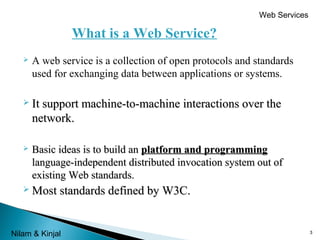
What is a Web Service?


A web service is a collection of open protocols and standards
used for exchanging data between applications or systems.

 It support

machine-to-machine interactions over the

network.


Basic ideas is to build an platform and programming
language-independent distributed invocation system out of
existing Web standards.

 Most standards

Nilam & Kinjal

defined by W3C.

3
Web Services



Very loosely defined, when compared to CORBA(Common
object request broker architecture).

Inherit both good and bad of the web services.
◦ Scalable, simple, distributed
◦ But no centralized management system is inefficient, must be
tolerant of failures.


Nilam & Kinjal

4
Web Services

How does a web services work?
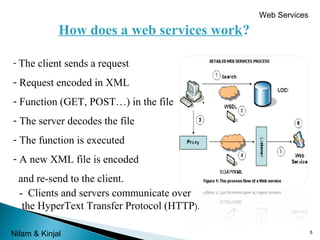
- The client sends a request

- Request encoded in XML
- Function (GET, POST…) in the file
- The server decodes the file
- The function is executed
- A new XML file is encoded
and re-send to the client.
- Clients and servers communicate over
the HyperText Transfer Protocol (HTTP).
Nilam & Kinjal

5
Web Services

Why use web Services?


Web services provide a clean separation between a capability
and its user interface.



This allows a company (Google) with a sophisticated
capability and amounts of data to make that capability
available to its partners.

Nilam & Kinjal

6
Web Services

Nilam & Kinjal

7
Web Services

XML Concept


XML stands for EXtensible Markup Language.



XML is a markup language much like HTML.



XML was designed to describe data.



XML tags are not predefined. You must define your own
tags.



The prefect choice for enabling cross-platform data
communication in Web Services.

Nilam & Kinjal

8
Web Services

Web Services Description
Language(WSDL)
Defines what your service does and
how it is invoked.

Nilam & Kinjal

9
Web Services

WSDL overview


WSDL stands for Web Services Description Language



WSDL is an XML based protocol for information exchange
in
decentralized and distributed environments.



WSDL is the standard format for describing a web service.



WSDL definition describes how to access a web service and
what operations it will perform.



WSDL is a language for describing how to interface with
XML-based services.

Nilam & Kinjal

10
Web Services

WSDL( Continue…)


WSDL is an integral part of UDDI, an XML-based worldwide
business registry.



WSDL is the language that UDDI uses.



WSDL was developed by Microsoft and IBM.
Elements of WSDL:

<types>

A container for data type definitions used by the web
service

Nilam & Kinjal

11
Web Services

WSDL( Continue…)
<message>
A typed definition of the data being communicated.
<port Type>
A set of operations supported by one or more
endpoints.
<binding>
A protocol and data format specification for a
particular port type
Nilam & Kinjal

12
Web Services

Simple Object Access
Protocol(SOAP)
A message format for exchanging
structured, typed information

Nilam & Kinjal

13
Web Services

SOAP
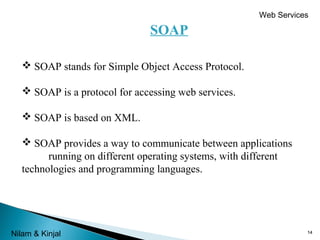
 SOAP stands for Simple Object Access Protocol.
 SOAP is a protocol for accessing web services.
 SOAP is based on XML.
 SOAP provides a way to communicate between applications
running on different operating systems, with different
technologies and programming languages.

Nilam & Kinjal

14
Web Services

SOAP Charactristics


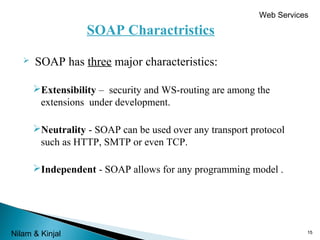
SOAP has three major characteristics:
Extensibility – security and WS-routing are among the
extensions under development.
Neutrality - SOAP can be used over any transport protocol
such as HTTP, SMTP or even TCP.
Independent - SOAP allows for any programming model .

Nilam & Kinjal

15
Web Services

UDDI Overview
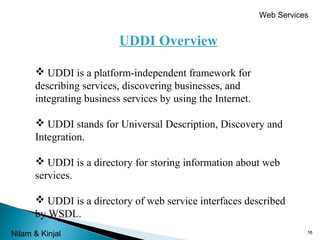
 UDDI is a platform-independent framework for
describing services, discovering businesses, and
integrating business services by using the Internet.
 UDDI stands for Universal Description, Discovery and
Integration.
 UDDI is a directory for storing information about web
services.
 UDDI is a directory of web service interfaces described
by WSDL.
Nilam & Kinjal

16
Web Services

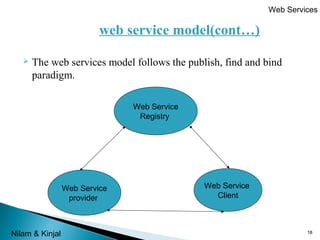
Web service model


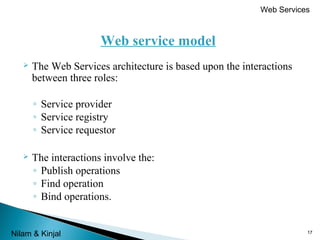
The Web Services architecture is based upon the interactions
between three roles:
◦ Service provider
◦ Service registry
◦ Service requestor



The interactions involve the:
◦ Publish operations
◦ Find operation
◦ Bind operations.

Nilam & Kinjal

17
Web Services

web service model(cont…)


The web services model follows the publish, find and bind
paradigm.
Web Service
Registry

Web Service
provider

Nilam & Kinjal

Web Service
Client

18
Web Services

Advantages


Interoperability - This is the most important benefit of Web
Services. Web Services typically work outside of private
networks.



usability - This gives your applications the freedom to chose
the Web Services that they need. This allows you to develop
services and/or client-side code using the languages and tools
that you want.

Nilam & Kinjal

19
Web Services

Advantages(cont…)


Reusability - Web Services provide not a component-based
model of application development, but the closest thing
possible to zero-coding deployment of such services.



Deployability - Web Services are deployed over standard
Internet technologies.

Nilam & Kinjal

20
Web Services

Disadvantages


Distributed transactions:
if the environment requires distributed transactions with
resources, it should be studied and tested with standard
solutions based on BTP, WS-Transactions, and WSCoordination.



Quality of Service (QoS):In case of a mission-critical
solution, the service providers must examine the reliability
and performance of the service in uncertain conditions for
high availability.

Nilam & Kinjal

21
Web Services

Disadvantages(cont…)


Security: Web services are exposed to the public using httpbased protocols.



As Web services is publicly available, it must be
implemented using authentication and authorization
mechanisms and using SSL-enabling encryption of the
messages for securing the usage.

Nilam & Kinjal

22
Web Services

Conclusion


This aimed to give an overview of recent progress in
automatic Web services composition.



At first, we propose a three-step model for Web services
composition process.


The composition model consists of service
presentation,translation,process generation, evaluation and
execution. Each step requires
different languages, platforms and methods.

 
Nilam & Kinjal

23
References
www.w3school.com
www.webservices.org

Nilam & Kinjal

24
25

Web final

  • 1.
    Web Services Submited By: Miss.RachnaKamalia Prepared By: Miss.Nilam Radadiya(Roll No:33) & Miss.Kinjal Kapadiya(Roll No:16) 1
  • 2.
    Web Services What isWeb Services?  How it Works.  Why use Web Services.  Web Services Components  Web Service Model  Advantages  Disadvantages  Conclusion  References  Nilam & Kinjal 2
  • 3.
    Web Services What isa Web Service?  A web service is a collection of open protocols and standards used for exchanging data between applications or systems.  It support machine-to-machine interactions over the network.  Basic ideas is to build an platform and programming language-independent distributed invocation system out of existing Web standards.  Most standards Nilam & Kinjal defined by W3C. 3
  • 4.
    Web Services  Very looselydefined, when compared to CORBA(Common object request broker architecture). Inherit both good and bad of the web services. ◦ Scalable, simple, distributed ◦ But no centralized management system is inefficient, must be tolerant of failures.  Nilam & Kinjal 4
  • 5.
    Web Services How doesa web services work? - The client sends a request - Request encoded in XML - Function (GET, POST…) in the file - The server decodes the file - The function is executed - A new XML file is encoded and re-send to the client. - Clients and servers communicate over the HyperText Transfer Protocol (HTTP). Nilam & Kinjal 5
  • 6.
    Web Services Why useweb Services?  Web services provide a clean separation between a capability and its user interface.  This allows a company (Google) with a sophisticated capability and amounts of data to make that capability available to its partners. Nilam & Kinjal 6
  • 7.
  • 8.
    Web Services XML Concept  XMLstands for EXtensible Markup Language.  XML is a markup language much like HTML.  XML was designed to describe data.  XML tags are not predefined. You must define your own tags.  The prefect choice for enabling cross-platform data communication in Web Services. Nilam & Kinjal 8
  • 9.
    Web Services Web ServicesDescription Language(WSDL) Defines what your service does and how it is invoked. Nilam & Kinjal 9
  • 10.
    Web Services WSDL overview  WSDLstands for Web Services Description Language  WSDL is an XML based protocol for information exchange in decentralized and distributed environments.  WSDL is the standard format for describing a web service.  WSDL definition describes how to access a web service and what operations it will perform.  WSDL is a language for describing how to interface with XML-based services. Nilam & Kinjal 10
  • 11.
    Web Services WSDL( Continue…)  WSDLis an integral part of UDDI, an XML-based worldwide business registry.  WSDL is the language that UDDI uses.  WSDL was developed by Microsoft and IBM. Elements of WSDL: <types>  A container for data type definitions used by the web service Nilam & Kinjal 11
  • 12.
    Web Services WSDL( Continue…) <message> Atyped definition of the data being communicated. <port Type> A set of operations supported by one or more endpoints. <binding> A protocol and data format specification for a particular port type Nilam & Kinjal 12
  • 13.
    Web Services Simple ObjectAccess Protocol(SOAP) A message format for exchanging structured, typed information Nilam & Kinjal 13
  • 14.
    Web Services SOAP  SOAPstands for Simple Object Access Protocol.  SOAP is a protocol for accessing web services.  SOAP is based on XML.  SOAP provides a way to communicate between applications running on different operating systems, with different technologies and programming languages. Nilam & Kinjal 14
  • 15.
    Web Services SOAP Charactristics  SOAPhas three major characteristics: Extensibility – security and WS-routing are among the extensions under development. Neutrality - SOAP can be used over any transport protocol such as HTTP, SMTP or even TCP. Independent - SOAP allows for any programming model . Nilam & Kinjal 15
  • 16.
    Web Services UDDI Overview UDDI is a platform-independent framework for describing services, discovering businesses, and integrating business services by using the Internet.  UDDI stands for Universal Description, Discovery and Integration.  UDDI is a directory for storing information about web services.  UDDI is a directory of web service interfaces described by WSDL. Nilam & Kinjal 16
  • 17.
    Web Services Web servicemodel  The Web Services architecture is based upon the interactions between three roles: ◦ Service provider ◦ Service registry ◦ Service requestor  The interactions involve the: ◦ Publish operations ◦ Find operation ◦ Bind operations. Nilam & Kinjal 17
  • 18.
    Web Services web servicemodel(cont…)  The web services model follows the publish, find and bind paradigm. Web Service Registry Web Service provider Nilam & Kinjal Web Service Client 18
  • 19.
    Web Services Advantages  Interoperability -This is the most important benefit of Web Services. Web Services typically work outside of private networks.  usability - This gives your applications the freedom to chose the Web Services that they need. This allows you to develop services and/or client-side code using the languages and tools that you want. Nilam & Kinjal 19
  • 20.
    Web Services Advantages(cont…)  Reusability -Web Services provide not a component-based model of application development, but the closest thing possible to zero-coding deployment of such services.  Deployability - Web Services are deployed over standard Internet technologies. Nilam & Kinjal 20
  • 21.
    Web Services Disadvantages  Distributed transactions: ifthe environment requires distributed transactions with resources, it should be studied and tested with standard solutions based on BTP, WS-Transactions, and WSCoordination.  Quality of Service (QoS):In case of a mission-critical solution, the service providers must examine the reliability and performance of the service in uncertain conditions for high availability. Nilam & Kinjal 21
  • 22.
    Web Services Disadvantages(cont…)  Security: Webservices are exposed to the public using httpbased protocols.  As Web services is publicly available, it must be implemented using authentication and authorization mechanisms and using SSL-enabling encryption of the messages for securing the usage. Nilam & Kinjal 22
  • 23.
    Web Services Conclusion  This aimedto give an overview of recent progress in automatic Web services composition.  At first, we propose a three-step model for Web services composition process.  The composition model consists of service presentation,translation,process generation, evaluation and execution. Each step requires different languages, platforms and methods.   Nilam & Kinjal 23
  • 24.
  • 25.