Web Development  BY :  KARTIK    :  http://www.kar2905.wordpress.com PRATIK  :  http://pratik3d.blogspot.com SAURABH  : saurabh-suman@hotmail.com
<html> <body> <ul> <li>HTML ( A Fast run through) </li> <li>MYSQL </li> <li>PHP </li> <li>Login Script Demonstration </li> </ul> </body> </html>
HYPER TEXT MARKUP LANGAUGE
DEVELOPED BY  : World Wide Web Consortium & WHATWG
Type code : TEXT
Extended from :  SGML
Extended to :  XHTML
Standard(s)  :  W3C HTML 4.01   W3C HTML 3.2
In short it is the language used to design Web Pages
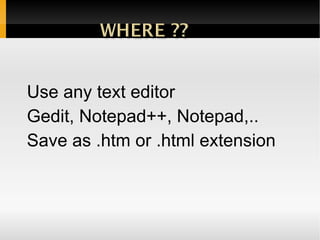
Use any text editor
Gedit, Notepad++, Notepad,..
Save as .htm or .html extension
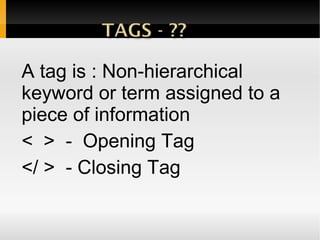
A tag is : Non-hierarchical keyword or term assigned to a piece of information
<  >  -  Opening Tag
</ >  - Closing Tag
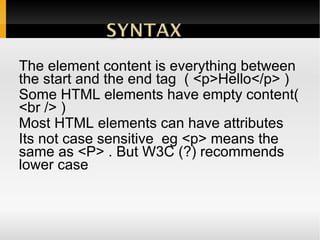
The element content is everything between the start and the end tag  ( <p>Hello</p> )
Some HTML elements have empty content( <br /> )
Most HTML elements can have attributes
Its not case sensitive  eg <p> means the same as <P> . But W3C (?) recommends lower case
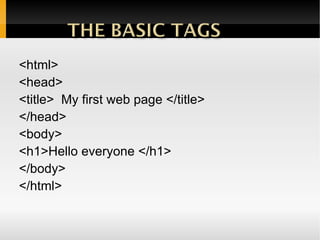
<html>
<head>
<title>  My first web page </title>
</head>
<body>
<h1>Hello everyone </h1>
</body>
</html>
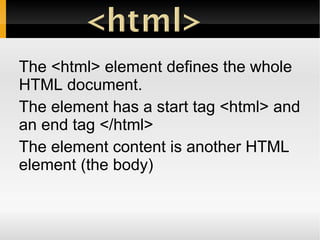
The <html> element defines the whole HTML document.
The element has a start tag <html> and an end tag </html>
The element content is another HTML element (the body)
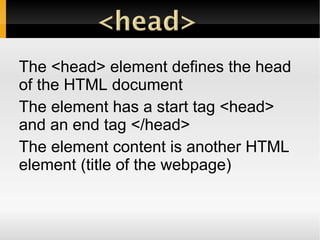
The <head> element defines the head of the HTML document
The element has a start tag <head> and an end tag </head>
The element content is another HTML element (title of the webpage)
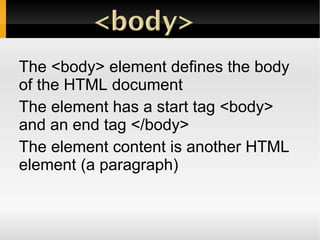
The <body> element defines the body of the HTML document
The element has a start tag <body> and an end tag </body>
The element content is another HTML element (a paragraph)
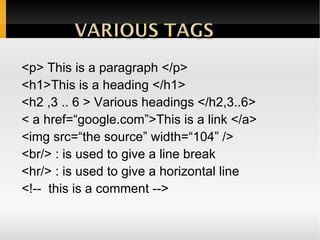
<p> This is a paragraph </p>
<h1>This is a heading </h1>
<h2 ,3 .. 6 > Various headings </h2,3..6>
< a href=“google.com”>This is a link </a>
<img src=“the source” width=“104” />
<br/> : is used to give a line break
<hr/> : is used to give a horizontal line
<!--  this is a comment -->
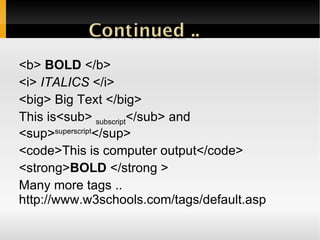
<b>  BOLD  </b>
<i>  ITALICS  </i>
<big> Big Text </big>
This is<sub>  subscript </sub> and <sup> superscript </sup>
<code>This is computer output</code>
<strong> BOLD  </strong >
Many more tags .. http://www.w3schools.com/tags/default.asp
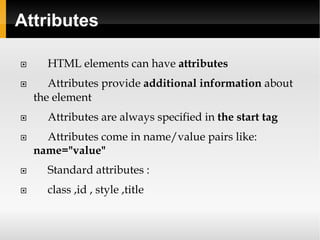
 HTML elements can have  attributes  Attributes provide  additional information  about the element  Attributes are always specified in  the start tag  Attributes come in name/value pairs like:  name=&quot;value&quot;  Standard attributes :   class ,id , style ,title Attributes
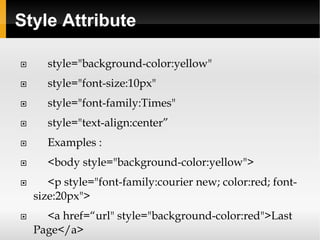
 style=&quot;background-color:yellow&quot;  style=&quot;font-size:10px&quot;  style=&quot;font-family:Times&quot;  style=&quot;text-align:center”  Examples :   <body style=&quot;background-color:yellow&quot;>  <p style=&quot;font-family:courier new; color:red; font-size:20px&quot;>  <a href=“url&quot; style=&quot;background-color:red&quot;>Last Page</a>  Style Attribute
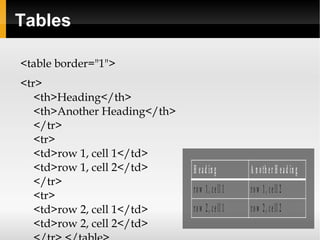
<table border=&quot;1&quot;> <tr> <th>Heading</th> <th>Another Heading</th> </tr> <tr> <td>row 1, cell 1</td> <td>row 1, cell 2</td> </tr> <tr> <td>row 2, cell 1</td> <td>row 2, cell 2</td> </tr> </table>  Tables
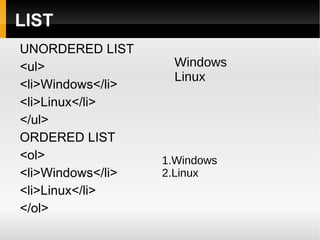
UNORDERED LIST <ul> <li>Windows</li> <li>Linux</li> </ul>  ORDERED LIST  <ol> <li>Windows</li> <li>Linux</li> </ol>  LIST Windows
Linux 1.Windows 2.Linux
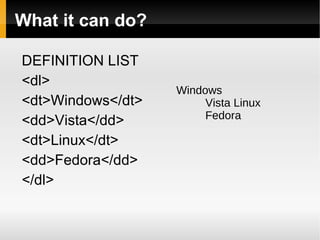
DEFINITION LIST <dl> <dt>Windows</dt> <dd>Vista</dd> <dt>Linux</dt> <dd>Fedora</dd> </dl>  What it can do? Windows  Vista Linux  Fedora
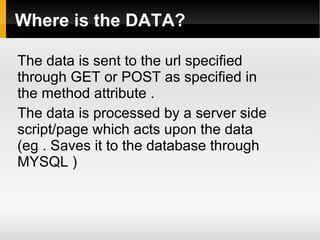
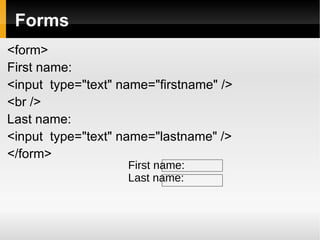
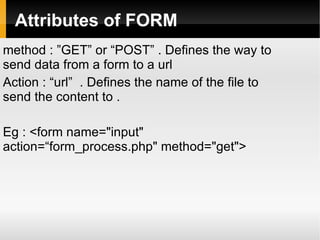
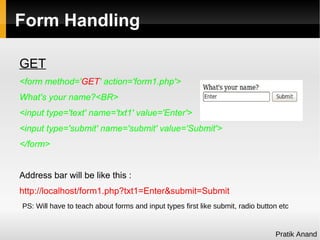
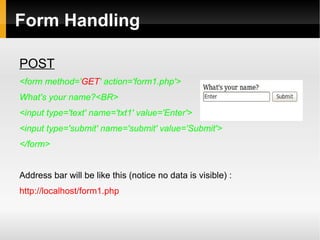
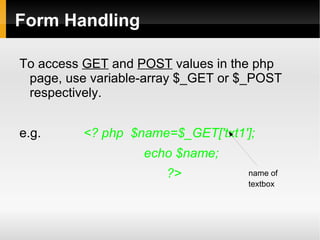
The data is sent to the url specified through GET or POST as specified in the method attribute .
The data is processed by a server side script/page which acts upon the data (eg . Saves it to the database through MYSQL )  Where is the DATA?
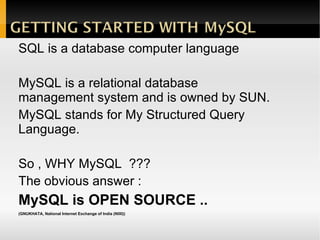
SQL is a database computer language
MySQL is a relational database management system and is owned by SUN.
MySQL stands for My Structured Query Language.
So , WHY MySQL  ???
The obvious answer :
MySQL is OPEN SOURCE ..
(GNUKHATA, National Internet Exchange of India (NIXI))
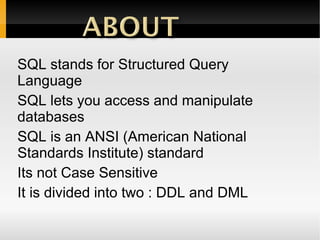
SQL stands for Structured Query Language
SQL lets you access and manipulate databases
SQL is an ANSI (American National Standards Institute) standard
Its not Case Sensitive
It is divided into two : DDL and DML
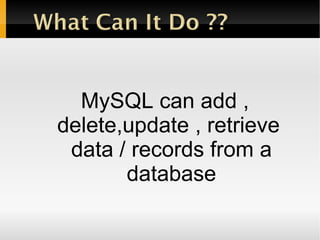
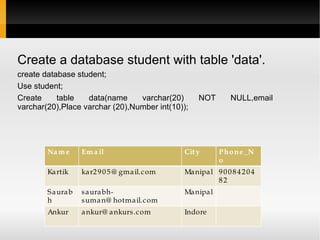
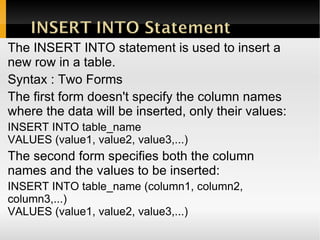
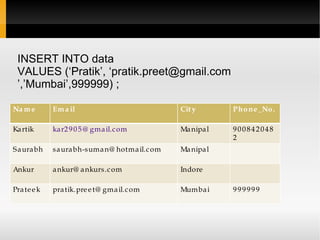
MySQL can add , delete,update , retrieve  data / records from a database
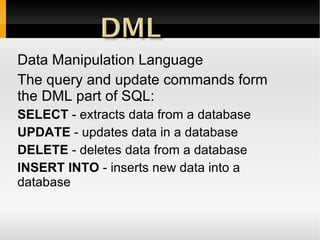
Data Manipulation Language
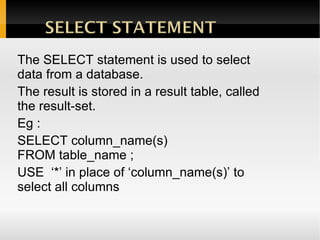
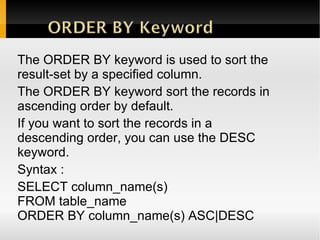
The query and update commands form the DML part of SQL: SELECT  - extracts data from a database
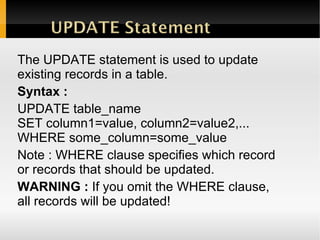
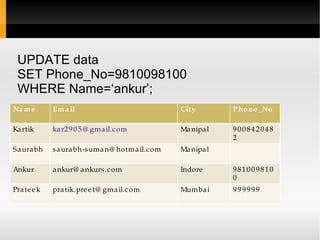
UPDATE  - updates data in a database
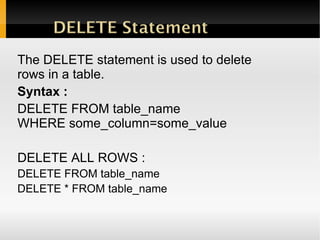
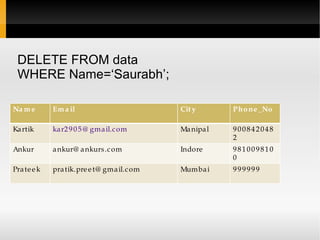
DELETE  - deletes data from a database

Web Developement Workshop (Oct 2009) Slides