WEB
DATABAS
ES
Name- Sayan Ghosh
Roll-14400120032
Dept.-CSE
Year-2020-24
⦁ What is Web Database?
⦁ Why Web Database?
⦁ Client/server architecture
⦁ Web interface to database
⦁ Communication protocol and web address
⦁ Database driven web architecture
⦁ Advantage and disadvantages of web DB
⦁ Web Aplications
⦁ Future of web DB
⦁ A web database is a system for storing and
displaying information that is accessible from
the Internet / web.
⦁ A web database is a system for storing
information that can then be accessed via a
website.
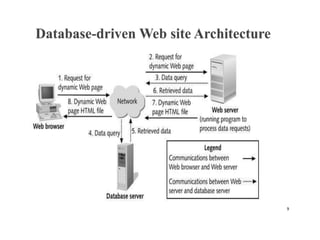
⦁ A web database is a database that can be queried
and/or updated through the World Wide Web
(WWW). As web technologies are evolving, the
WWW turned out to be the preferred medium for
many applications, e.g., e-commerce and digital
libraries. These applications use information that
is stored in huge databases and can only be
retrieved by issuing direct queries to the back-
end databases. Database-driven web sites have
their own interfaces and access forms that create
HTML pages on-the-fly. Web database
technologies define the way that these forms can
connect to and retrieve data from database
servers.
⦁ Large businesses rely on databases to store
customer information. Because this
information is accessible wherever Internet
access is available, customers don't have to
go to a local banking branch, for example, to
access their account information.
6
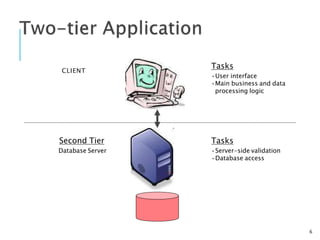
CLIENT
Second Tier
Database Server
Tasks
•User interface
•Main business and data
processing logic
Tasks
•Server-side validation
•Database access
7
8
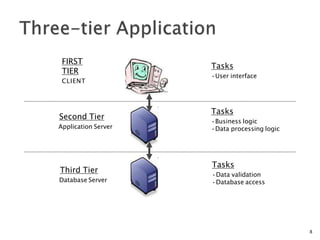
FIRST
TIER
CLIENT
Second Tier
Application Server
Tasks
•User interface
Tasks
•Business logic
•Data processing logic
Third Tier
Database Server
Tasks
•Data validation
•Database access
9
WEB INTERFACE PROVIDES ATTRACTIVE, EVEN
FOR DATABASE APPLICATIONS THAT ARE
USED ONLY WITH A SINGLE ORGANIZATION.
THE HYPERTEXT MARKUP LANGUAGE(HTML)
STANDARD ALLOWS TEXT TO BE NEATLY
FORMATTED , WITH IMPORTANT
INFORMATION HIGHLIGHTED.
Hyperlinks which are links to other
documents.Clicking the Hyperlink fetches and
displays the linked document.
10
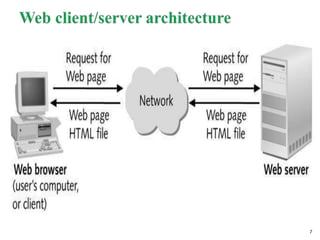
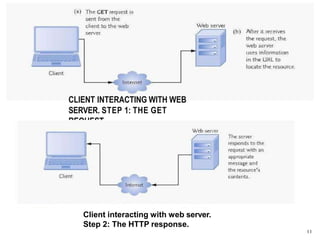
CLIENT INTERACTING WITH WEB
SERVER. STEP 1: THE GET
REQUEST.
11
Client interacting with web server.
Step 2: The HTTP response.
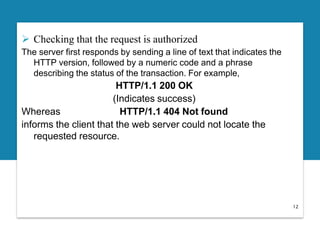
 Checking that the request is authorized
The server first responds by sending a line of text that indicates the
HTTP version, followed by a numeric code and a phrase
describing the status of the transaction. For example,
HTTP/1.1 200 OK
(Indicates success)
Whereas HTTP/1.1 404 Not found
informs the client that the web server could not locate the
requested resource.
12
⦁ Simplicity
⦁ Platform Independence
⦁ GUI
⦁ Standardization
⦁ Cross-Platform Support
13
⦁ Reliability
⦁ Security
⦁ Cost – commercial web site
⦁ Scalability
14
⦁ MySql
⦁ Microsoft Access
⦁ Oracle
⦁ DB2
⦁ Banking System:
⦁ Education sector:
⦁ Online shopping:
⦁ Industry
Two new scale-out technologies are leading
the newest database revolution
⦁ NoSQL,
⦁ Hadoop
⦁ UNIVERSAL MEMORY
⦁ BLOCKCHAIN
⦁ QUANTUM COMPUTING
⦁ A web database is a wide term for managing
data online.
⦁ A web database gives us the ability to build
our own databases/data storage without
being a database guru or even a technical
person.
⦁ www.wikipedia.com/database
⦁ http://www.formlogix.com/Help/Glossary/W
eb-Database.aspx
⦁ www.google.com?=web_db
⦁ www.stackoverflow.com
⦁ www.tutorialspoint.com
⦁ www.w3schools.com
Web Database.pptx

Web Database.pptx

  • 1.
  • 2.
    ⦁ What isWeb Database? ⦁ Why Web Database? ⦁ Client/server architecture ⦁ Web interface to database ⦁ Communication protocol and web address ⦁ Database driven web architecture ⦁ Advantage and disadvantages of web DB ⦁ Web Aplications ⦁ Future of web DB
  • 3.
    ⦁ A webdatabase is a system for storing and displaying information that is accessible from the Internet / web. ⦁ A web database is a system for storing information that can then be accessed via a website.
  • 4.
    ⦁ A webdatabase is a database that can be queried and/or updated through the World Wide Web (WWW). As web technologies are evolving, the WWW turned out to be the preferred medium for many applications, e.g., e-commerce and digital libraries. These applications use information that is stored in huge databases and can only be retrieved by issuing direct queries to the back- end databases. Database-driven web sites have their own interfaces and access forms that create HTML pages on-the-fly. Web database technologies define the way that these forms can connect to and retrieve data from database servers.
  • 5.
    ⦁ Large businessesrely on databases to store customer information. Because this information is accessible wherever Internet access is available, customers don't have to go to a local banking branch, for example, to access their account information.
  • 6.
    6 CLIENT Second Tier Database Server Tasks •Userinterface •Main business and data processing logic Tasks •Server-side validation •Database access
  • 7.
  • 8.
    8 FIRST TIER CLIENT Second Tier Application Server Tasks •Userinterface Tasks •Business logic •Data processing logic Third Tier Database Server Tasks •Data validation •Database access
  • 9.
  • 10.
    WEB INTERFACE PROVIDESATTRACTIVE, EVEN FOR DATABASE APPLICATIONS THAT ARE USED ONLY WITH A SINGLE ORGANIZATION. THE HYPERTEXT MARKUP LANGUAGE(HTML) STANDARD ALLOWS TEXT TO BE NEATLY FORMATTED , WITH IMPORTANT INFORMATION HIGHLIGHTED. Hyperlinks which are links to other documents.Clicking the Hyperlink fetches and displays the linked document. 10
  • 11.
    CLIENT INTERACTING WITHWEB SERVER. STEP 1: THE GET REQUEST. 11 Client interacting with web server. Step 2: The HTTP response.
  • 12.
     Checking thatthe request is authorized The server first responds by sending a line of text that indicates the HTTP version, followed by a numeric code and a phrase describing the status of the transaction. For example, HTTP/1.1 200 OK (Indicates success) Whereas HTTP/1.1 404 Not found informs the client that the web server could not locate the requested resource. 12
  • 13.
    ⦁ Simplicity ⦁ PlatformIndependence ⦁ GUI ⦁ Standardization ⦁ Cross-Platform Support 13
  • 14.
    ⦁ Reliability ⦁ Security ⦁Cost – commercial web site ⦁ Scalability 14
  • 15.
    ⦁ MySql ⦁ MicrosoftAccess ⦁ Oracle ⦁ DB2
  • 16.
    ⦁ Banking System: ⦁Education sector: ⦁ Online shopping: ⦁ Industry
  • 17.
    Two new scale-outtechnologies are leading the newest database revolution ⦁ NoSQL, ⦁ Hadoop
  • 18.
    ⦁ UNIVERSAL MEMORY ⦁BLOCKCHAIN ⦁ QUANTUM COMPUTING
  • 19.
    ⦁ A webdatabase is a wide term for managing data online. ⦁ A web database gives us the ability to build our own databases/data storage without being a database guru or even a technical person.
  • 20.
    ⦁ www.wikipedia.com/database ⦁ http://www.formlogix.com/Help/Glossary/W eb-Database.aspx ⦁www.google.com?=web_db ⦁ www.stackoverflow.com ⦁ www.tutorialspoint.com ⦁ www.w3schools.com