WEB CLUSTERING
ENGINES
ARUN TR
14
12130413
S7CS,CEA
Search Engine?
• Search engines are an invaluable tool for
retrieving information from the Web.
In response to a user query, they return a
list of results ranked in order of relevance
to the query.
• Eg: Google,Yahoo,Credo,Grokker etc.
Arun TR
14,S7CS
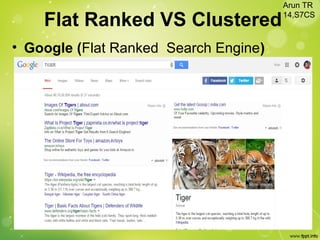
• Google (Flat Ranked Search Engine)
Arun TR
14,S7CS
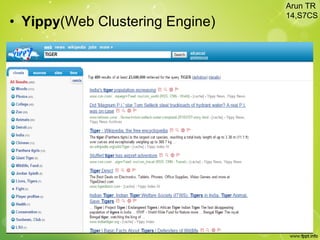
Flat Ranked VS Clustered
• Yippy(Web Clustering Engine)
Arun TR
14,S7CS
Why Web Clustering
Engines?
• Conventional Engines are not much
efficient in ‘Ambiguous’ queries.
• The search results returned by
conventional search engines on query will
be mixed together in the list,irrelevant
items occurs.
In this context clustering of search results
come in to picture!!
Arun TR
14,S7CS
• Search engine
• Clustering is the act of grouping similar
object into sets.
• The distance between the objects in the
same cluster(inter-cluster variations)
should be minimum
• The distance between objects in different
clusters(intra-cluster variations) should be
maximum.
Web Clustering Engines?
Arun TR
14,S7CS
• This systems group the results returned by
a search engine into a hierarchy of labeled
clusters (also called categories).
Web clustering engines:
1. Northern Light - predefined set of clusters
2. Vivısimo - cluster labels were dynamically generated
3. Clusty,
4. Grokker,
5. KartOO,
6. Lingo3G,
7. CREDO,etc
Arun TR
14,S7CS
Main advantages of the
cluster hierarchy
• It makes for shortcuts to the items that relate to
the same meaning.
• It allows better topic understanding.
• It favors systematic exploration of search
results.
Arun TR
14,S7CS
• Short input data description.
• Meaningful labels.
• Selection of similarity measure.
• Grouping of objects into clusters.
• Computational efficiency.
• Unknown number of clusters.
Issues in Implementation Of
clusters
Arun TR
14,S7CS
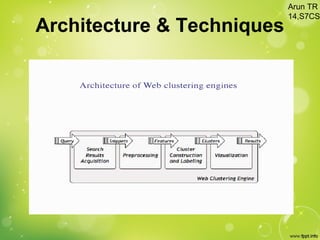
Architecture & Techniques
Arun TR
14,S7CS
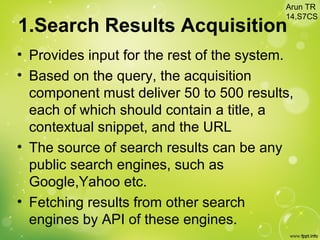
1.Search Results Acquisition
• Provides input for the rest of the system.
• Based on the query, the acquisition
component must deliver 50 to 500 results,
each of which should contain a title, a
contextual snippet, and the URL
• The source of search results can be any
public search engines, such as
Google,Yahoo etc.
• Fetching results from other search
engines by API of these engines.
Arun TR
14,S7CS
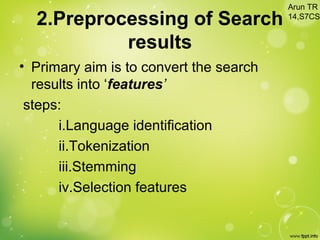
2.Preprocessing of Search
results
• Primary aim is to convert the search
results into ‘features’
steps:
i.Language identification
ii.Tokenization
iii.Stemming
iv.Selection features
Arun TR
14,S7CS
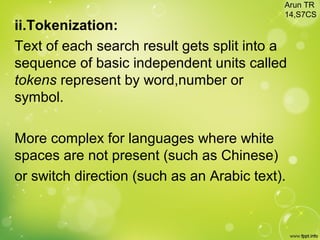
ii.Tokenization:
Text of each search result gets split into a
sequence of basic independent units called
tokens represent by word,number or
symbol.
More complex for languages where white
spaces are not present (such as Chinese)
or switch direction (such as an Arabic text).
Arun TR
14,S7CS
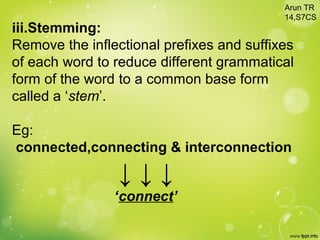
iii.Stemming:
Remove the inflectional prefixes and suffixes
of each word to reduce different grammatical
form of the word to a common base form
called a ‘stem’.
Eg:
connected,connecting & interconnection
↓ ↓ ↓
‘connect’
Arun TR
14,S7CS
iv.Selection features:
•Extract features for each search result
present in the input.
•Features are atomic entities by which we
can describe an object and represent its
most important characteristic to an
algorithm.
•Features vary from single word to tuples of
word.
Arun TR
14,S7CS
How can represent a feature/text?
• Vector Space Model(VSM)
• Document d is represented in the VSM as a
vector [wt0 , wt1 , . . .wtn]
where t0, t1, . . . tn is a set of words/features
and wti is the weight/importance of feature ti
Eg:
d→“Polly had a dog and the dog had Polly”
vsm representation
Arun TR
14,S7CS
3.Cluster Construction &
Labelling
• The set of search results along with their
features are input to the clustering algorithm,
for building the clusters and labeling.
Two types of Algorithms:
→Data centric clustering algorithm
→Description aware –STC related
• Created cluster should be aptly labled.
i.Unique ii.Unambiguous iii.Comprehensive
iv.Sensible to the content
Arun TR
14,S7CS
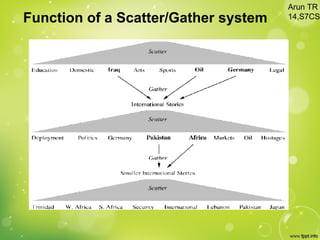
Data Centric Clustering Algorithm
• Similar to Agglomerative Hierarchical
Clustering (AHC) with an average-link
merge criterion.
• It has initial clustering of a collection of
documents in a set of k clusters(scatter)
• At Query time the user selected clusters of
interest(gather) and the system re-
clustered those documents.
• Process repeats until a small cluster with
relevant documents is found
Arun TR
14,S7CS
Function of a Scatter/Gather system
Arun TR
14,S7CS
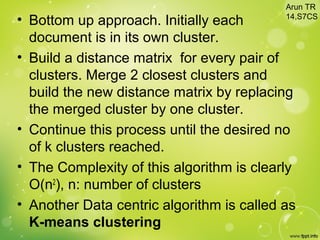
• Bottom up approach. Initially each
document is in its own cluster.
• Build a distance matrix for every pair of
clusters. Merge 2 closest clusters and
build the new distance matrix by replacing
the merged cluster by one cluster.
• Continue this process until the desired no
of k clusters reached.
• The Complexity of this algorithm is clearly
O(n2
), n: number of clusters
• Another Data centric algorithm is called as
K-means clustering
Arun TR
14,S7CS
Difficulties in Data centric
algorithms
• All these algorithms are not incremental in
nature - each document arrives from the
web,we “clean” it and add it to the
available model.
• Missing of meaningful labels.
Arun TR
14,S7CS
4.Visualization of Clustered
Results
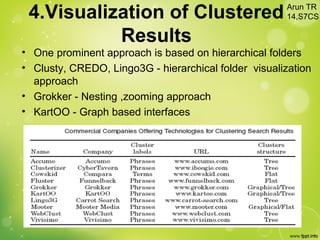
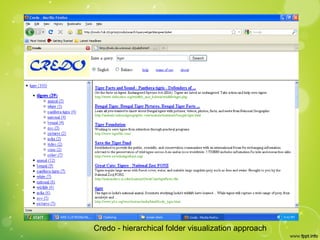
• One prominent approach is based on hierarchical folders
• Clusty, CREDO, Lingo3G - hierarchical folder visualization
approach
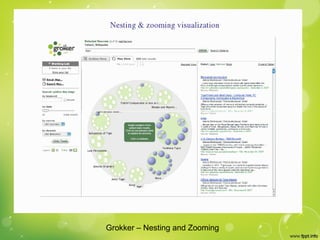
• Grokker - Nesting ,zooming approach
• KartOO - Graph based interfaces
Arun TR
14,S7CS
Credo - hierarchical folder visualization approach
Grokker – Nesting and Zooming
Improve Efficiency of
Clustering
• Client side processing:High query rate
periods the response times can significantly
increase. Some processes using the client
side resources
• Incremental processing:As each
document arrives from the web, we “clean”
it and add it to the available model.
• Pretokenized documents:Clustering
engines can use tokens that already used
by the conventional search engines.
Arun TR
14,S7CS
Conclusion
Web clustering engines organize search results by
topic, thus offering a complementary view to the
flat-ranked list returned by conventional search
engines. A number of advances must be made to
improve the cluster labels, coherence of cluster
structure, performance evaluation studies,advanced
visualization techniques. Then Web Clustering
Engines entirely fulfills the promise of being the
PageRank of the future.
Due to the lack of an efficient method for the
performance evaluation of clustering engines they
are still not seeking the attention of people.
Arun TR
14,S7CS
References
• http://clusty.com
• http://credo.fub.it
• http://www2.parc.com/istl/projects/ia/sg-
example1.html
• http://credino.dimi.uniud.it
• http://google.com
• C.J.Van Rijsbergen , Information
Retrieval, Butterworth
Arun TR
14,S7CS
THANK YOU
QUESTIONS?

web clustering engines

  • 1.
  • 2.
    Search Engine? • Searchengines are an invaluable tool for retrieving information from the Web. In response to a user query, they return a list of results ranked in order of relevance to the query. • Eg: Google,Yahoo,Credo,Grokker etc. Arun TR 14,S7CS
  • 3.
    • Google (FlatRanked Search Engine) Arun TR 14,S7CS Flat Ranked VS Clustered
  • 4.
    • Yippy(Web ClusteringEngine) Arun TR 14,S7CS
  • 5.
    Why Web Clustering Engines? •Conventional Engines are not much efficient in ‘Ambiguous’ queries. • The search results returned by conventional search engines on query will be mixed together in the list,irrelevant items occurs. In this context clustering of search results come in to picture!! Arun TR 14,S7CS
  • 6.
    • Search engine •Clustering is the act of grouping similar object into sets. • The distance between the objects in the same cluster(inter-cluster variations) should be minimum • The distance between objects in different clusters(intra-cluster variations) should be maximum. Web Clustering Engines? Arun TR 14,S7CS
  • 7.
    • This systemsgroup the results returned by a search engine into a hierarchy of labeled clusters (also called categories). Web clustering engines: 1. Northern Light - predefined set of clusters 2. Vivısimo - cluster labels were dynamically generated 3. Clusty, 4. Grokker, 5. KartOO, 6. Lingo3G, 7. CREDO,etc Arun TR 14,S7CS
  • 8.
    Main advantages ofthe cluster hierarchy • It makes for shortcuts to the items that relate to the same meaning. • It allows better topic understanding. • It favors systematic exploration of search results. Arun TR 14,S7CS
  • 9.
    • Short inputdata description. • Meaningful labels. • Selection of similarity measure. • Grouping of objects into clusters. • Computational efficiency. • Unknown number of clusters. Issues in Implementation Of clusters Arun TR 14,S7CS
  • 10.
  • 11.
    1.Search Results Acquisition •Provides input for the rest of the system. • Based on the query, the acquisition component must deliver 50 to 500 results, each of which should contain a title, a contextual snippet, and the URL • The source of search results can be any public search engines, such as Google,Yahoo etc. • Fetching results from other search engines by API of these engines. Arun TR 14,S7CS
  • 12.
    2.Preprocessing of Search results •Primary aim is to convert the search results into ‘features’ steps: i.Language identification ii.Tokenization iii.Stemming iv.Selection features Arun TR 14,S7CS
  • 13.
    ii.Tokenization: Text of eachsearch result gets split into a sequence of basic independent units called tokens represent by word,number or symbol. More complex for languages where white spaces are not present (such as Chinese) or switch direction (such as an Arabic text). Arun TR 14,S7CS
  • 14.
    iii.Stemming: Remove the inflectionalprefixes and suffixes of each word to reduce different grammatical form of the word to a common base form called a ‘stem’. Eg: connected,connecting & interconnection ↓ ↓ ↓ ‘connect’ Arun TR 14,S7CS
  • 15.
    iv.Selection features: •Extract featuresfor each search result present in the input. •Features are atomic entities by which we can describe an object and represent its most important characteristic to an algorithm. •Features vary from single word to tuples of word. Arun TR 14,S7CS
  • 16.
    How can representa feature/text? • Vector Space Model(VSM) • Document d is represented in the VSM as a vector [wt0 , wt1 , . . .wtn] where t0, t1, . . . tn is a set of words/features and wti is the weight/importance of feature ti Eg: d→“Polly had a dog and the dog had Polly” vsm representation Arun TR 14,S7CS
  • 17.
    3.Cluster Construction & Labelling •The set of search results along with their features are input to the clustering algorithm, for building the clusters and labeling. Two types of Algorithms: →Data centric clustering algorithm →Description aware –STC related • Created cluster should be aptly labled. i.Unique ii.Unambiguous iii.Comprehensive iv.Sensible to the content Arun TR 14,S7CS
  • 18.
    Data Centric ClusteringAlgorithm • Similar to Agglomerative Hierarchical Clustering (AHC) with an average-link merge criterion. • It has initial clustering of a collection of documents in a set of k clusters(scatter) • At Query time the user selected clusters of interest(gather) and the system re- clustered those documents. • Process repeats until a small cluster with relevant documents is found Arun TR 14,S7CS
  • 19.
    Function of aScatter/Gather system Arun TR 14,S7CS
  • 20.
    • Bottom upapproach. Initially each document is in its own cluster. • Build a distance matrix for every pair of clusters. Merge 2 closest clusters and build the new distance matrix by replacing the merged cluster by one cluster. • Continue this process until the desired no of k clusters reached. • The Complexity of this algorithm is clearly O(n2 ), n: number of clusters • Another Data centric algorithm is called as K-means clustering Arun TR 14,S7CS
  • 21.
    Difficulties in Datacentric algorithms • All these algorithms are not incremental in nature - each document arrives from the web,we “clean” it and add it to the available model. • Missing of meaningful labels. Arun TR 14,S7CS
  • 22.
    4.Visualization of Clustered Results •One prominent approach is based on hierarchical folders • Clusty, CREDO, Lingo3G - hierarchical folder visualization approach • Grokker - Nesting ,zooming approach • KartOO - Graph based interfaces Arun TR 14,S7CS
  • 23.
    Credo - hierarchicalfolder visualization approach
  • 24.
  • 25.
    Improve Efficiency of Clustering •Client side processing:High query rate periods the response times can significantly increase. Some processes using the client side resources • Incremental processing:As each document arrives from the web, we “clean” it and add it to the available model. • Pretokenized documents:Clustering engines can use tokens that already used by the conventional search engines. Arun TR 14,S7CS
  • 26.
    Conclusion Web clustering enginesorganize search results by topic, thus offering a complementary view to the flat-ranked list returned by conventional search engines. A number of advances must be made to improve the cluster labels, coherence of cluster structure, performance evaluation studies,advanced visualization techniques. Then Web Clustering Engines entirely fulfills the promise of being the PageRank of the future. Due to the lack of an efficient method for the performance evaluation of clustering engines they are still not seeking the attention of people. Arun TR 14,S7CS
  • 27.
    References • http://clusty.com • http://credo.fub.it •http://www2.parc.com/istl/projects/ia/sg- example1.html • http://credino.dimi.uniud.it • http://google.com • C.J.Van Rijsbergen , Information Retrieval, Butterworth Arun TR 14,S7CS
  • 28.
  • 29.