Annual Report 2014/15
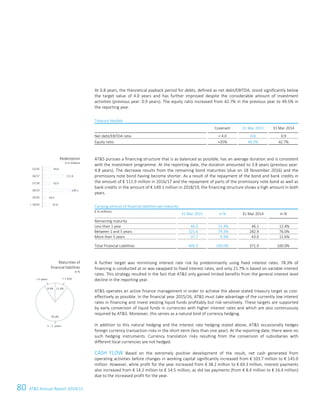
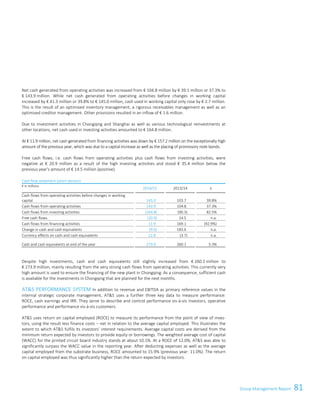
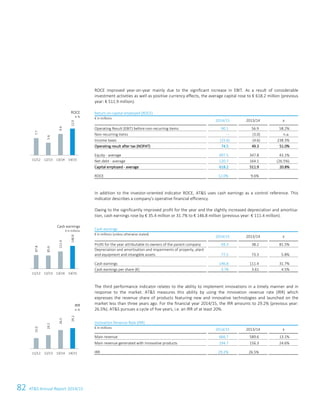
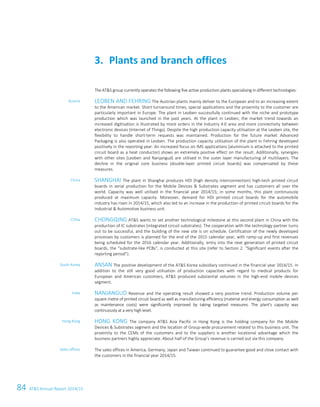
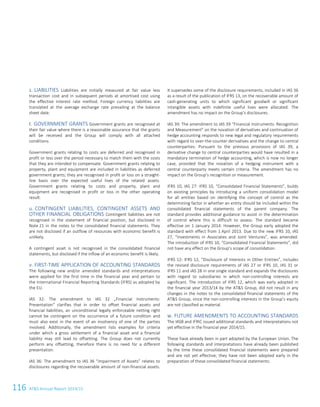
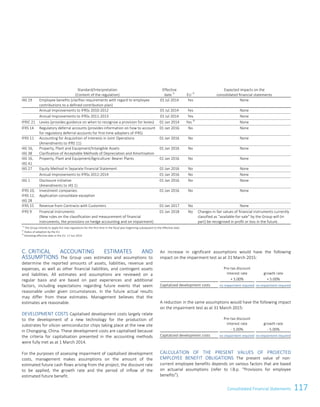
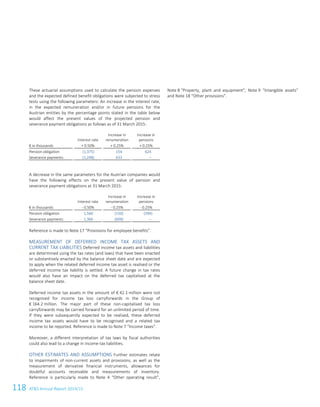
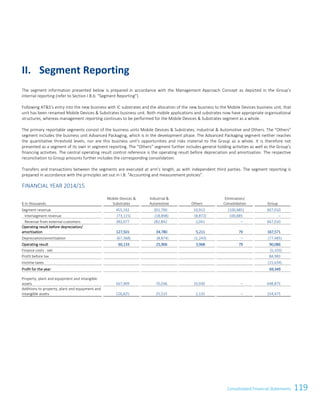
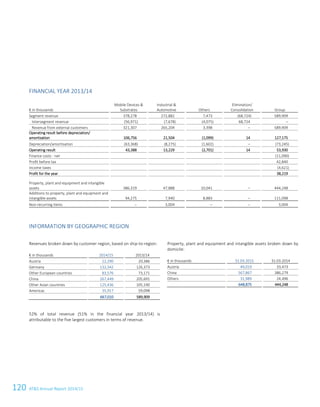
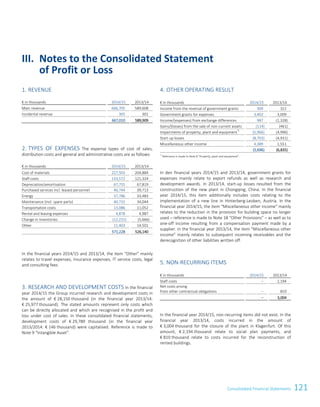
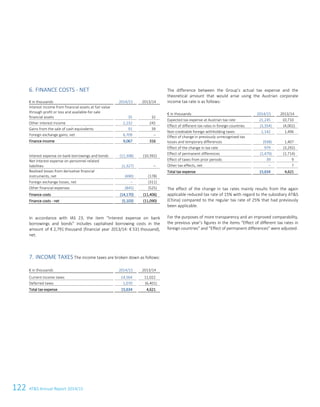
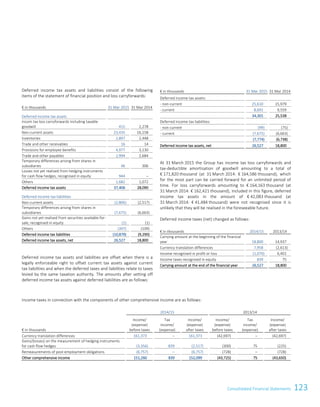
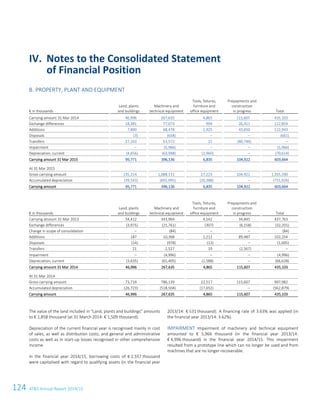
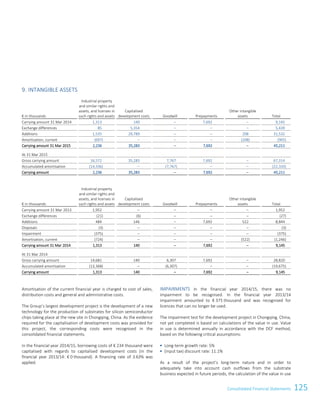
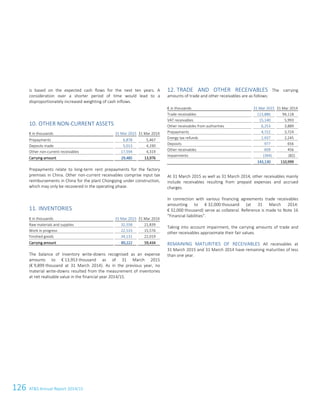
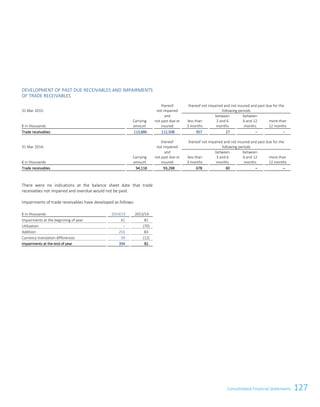
The future raises
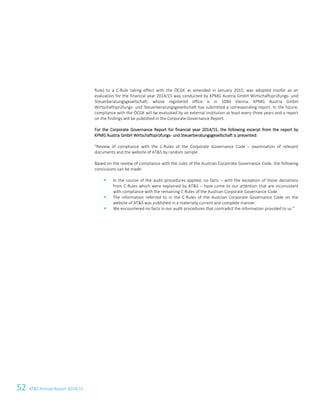
many big questions.
And our answers
keep getting smaller.
1
IFRS Unit 2011/12 2012/13 1)
2013/14 2014/15
Change
in %
EARNINGS DATA AND GENERAL INFORMATION
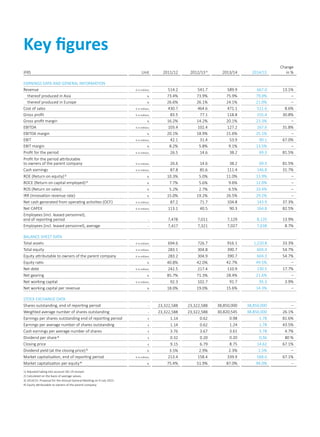
Revenue € in millions 514.2 541.7 589.9 667.0 13.1%
	 thereof produced in Asia % 73.4% 73.9% 75.9% 79.0% –
	 thereof produced in Europe % 26.6% 26.1% 24.1% 21.0% –
Cost of sales € in millions 430.7 464.6 471.1 511.6 8.6%
Gross profit € in millions 83.5 77.1 118.8 155.4 30.8%
Gross profit margin % 16.2% 14.2% 20.1% 23.3% –
EBITDA € in millions 103.4 102.4 127.2 167.6 31.8%
EBITDA margin % 20.1% 18.9% 21.6% 25.1% –
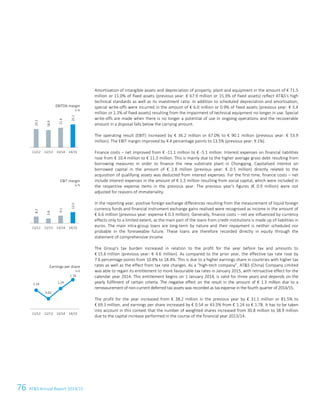
EBIT € in millions 42.1 31.4 53.9 90.1 67.0%
EBIT margin % 8.2% 5.8% 9.1% 13.5% –
Profit for the period € in millions 26.5 14.6 38.2 69.3 81.5%
Profit for the period attributable
to owners of the parent company € in millions 26.6 14.6 38.2 69.3 81.5%
Cash earnings € in millions 87.8 85.6 111.4 146.8 31.7%
ROE (Return on equity) 2)
% 10.3% 5.0% 11.0% 13.9% –
ROCE (Return on capital employed) 2)
% 7.7% 5.6% 9.6% 12.0% –
ROS (Return on sales) % 5.2% 2.7% 6.5% 10.4% –
IRR (Innovation revenue rate) % 15.0% 19.2% 26.5% 29.2% –
Net cash generated from operating activities (OCF) € in millions 87.2 71.7 104.8 143.9 37.3%
Net CAPEX € in millions 113.1 40.5 90.3 164.8 82.5%
Employees (incl. leased personnel),
end of reporting period – 7,478 7,011 7,129 8,120 13.9%
Employees (incl. leased personnel), average – 7,417 7,321 7,027 7,638 8.7%
BALANCE SHEET DATA
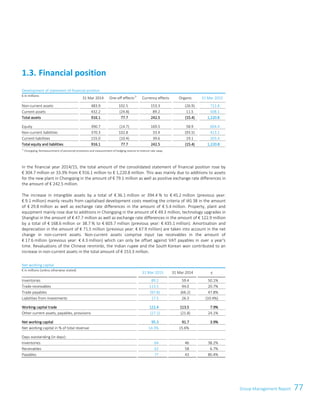
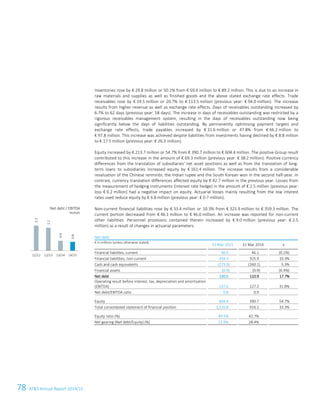
Total assets € in millions 694.6 726.7 916.1 1,220.8 33.3%
Total equity € in millions 283.1 304.8 390.7 604.4 54.7%
Equity attributable to owners of the parent company € in millions 283.2 304.9 390.7 604.3 54.7%
Equity ratio % 40.8% 42.0% 42.7% 49.5% –
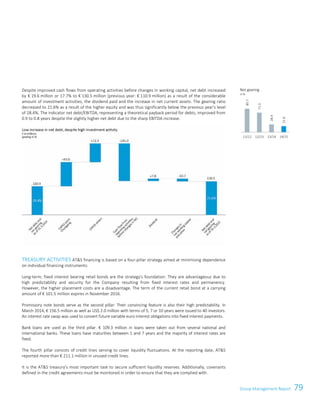
Net debt € in millions 242.5 217.4 110.9 130.5 17.7%
Net gearing % 85.7% 71.3% 28.4% 21.6% –
Net working capital € in millions 92.3 102.7 91.7 95.3 3.9%
Net working capital per revenue % 18.0% 19.0% 15.6% 14.3% –
STOCK EXCHANGE DATA
Shares outstanding, end of reporting period – 23,322,588 23,322,588 38,850,000 38,850,000 –
Weighted average number of shares outstanding – 23,322,588 23,322,588 30,820,545 38,850,000 26.1%
Earnings per shares outstanding end of reporting period € 1.14 0.62 0.98 1.78 81.6%
Earnings per average number of shares outstanding € 1.14 0.62 1.24 1.78 43.5%
Cash earnings per average number of shares € 3.76 3.67 3.61 3.78 4.7%
Dividend per share 3)
€ 0.32 0.20 0.20 0,36 80 %
Closing price € 9.15 6.79 8.75 14.62 67.1%
Dividend yield (at the closing price) 3)
% 3.5% 2.9% 2.3% 2.5% –
Market capitalisation, end of reporting period € in millions 213.4 158.4 339.9 568.0 67.1%
Market capitalisation per equity 4)
% 75.4% 51.9% 87.0% 94.0% –
1) Adjusted taking into account IAS 19 revised.
2) Calculated on the basis of average values.
3) 2014/15: Proposal for the Annual General Meeting on 9 July 2015.
4) Equity attributable to owners of the parent company.
Key figures
2011/12 2012/13 2013/14 2014/15 2011/12 2012/13 2013/14 2014/15 2011/12 2012/13 2013/14 2014/15
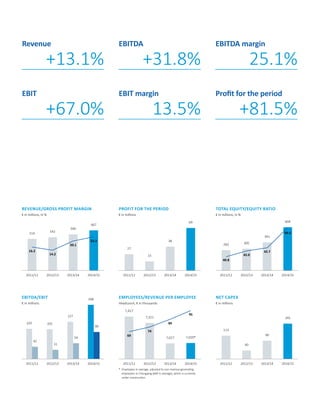
514 542
590
667
27
15
38
69
283 305
391
604
2011/12 2012/13 2013/14 2014/15
113
40
90
165
2011/12 2012/13 2013/14 2014/15
69
74
84
95
2011/12 2012/13 2013/14 2014/15
103
42
102
31
127
54
168
90
+31.8% 25.1%+13.1%
EBITDA EBITDA marginRevenue
13.5% +81.5%+67.0%
EBIT margin Profit for the periodEBIT
Revenue/Gross profit margin
€ in millions, in %
Employees/REVENUE PER EMPLOYEE
Headcount, € in thousands
NET CAPEX
€ in millions
16.2
7,417
14.2
7,321
20.1
7,027
23.3
7,029*
profit for the period
€ in millions
EBITDA/EBIT
€ in millions
total equity/equity ratio
€ in millions, in %
40.8
42.0
42.7
49.5
*	 Employees in average, adjusted to non revenue generating
employees in Chongqing (609 in average), which is currently
under construction.
2
2011/12 2012/13 2013/14 2014/15 2011/12 2012/13 2013/14 2014/15
700
600
500
400
300
200
100
0
2011/12 2012/13 2013/14 2014/15
AT&S Annual Report 2014/15
»2014/15 was an exceptionally
strong year for AT&S, with notable
results in all business areas.«
Andreas Gerstenmayer,
Chairman of the Management Board of AT&S
Investments in the
future growth of
AT&S
§	 Construction of the new plant
in Chongqing, China, with a
total investment volume of
€ 480 million by mid-2017 on
schedule.
§	 Further financing secured
through strong cash flow, a
conservative dividend policy
and credit facilities.
Record highs for revenue and earnings
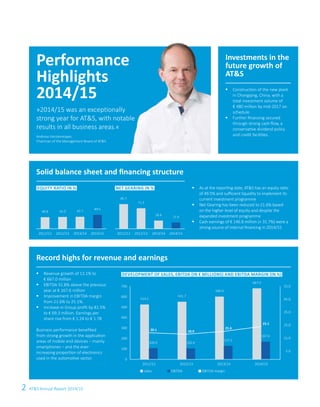
§	 Revenue growth of 13.1% to
€ 667.0 million
§	 EBITDA 31.8% above the previous
year at € 167.6 million
§	 Improvement in EBITDA margin
from 21.6% to 25.1%.
§	 Increase in Group profit by 81.5%
to € 69.3 million. Earnings per
share rise from € 1.24 to € 1.78
Business performance benefited
from strong growth in the application
areas of mobile end devices – mainly
smartphones – and the ever-
increasing proportion of electronics
used in the automotive sector.
Solid balance sheet and financing structure
§	 As at the reporting date, AT&S has an equity ratio
of 49.5% and sufficient liquidity to implement its
current investment programme
§	 Net Gearing has been reduced to 21.6% based
on the higher level of equity and despite the
expanded investment programme
§	 Cash earnings of € 146.8 million (+ 31.7%) were a
strong source of internal financing in 2014/15
EQUITY RATIO IN % Net GEARING IN %
40.8 42.0
49.5
42.7
21.6
28.4
71.3
85.7
DEVELOPMENT OF SALES, EBITDA (in € millions) AND EBITDA MARGIN (in %)
55.0
45.0
35.0
25.0
15.0
5.0
514.2
103.4
541.7
102.4
589.9
127.2
667.0
167.6
20.1 18.9
21.6
25.1
n Sales	 n EBITDA	 n EBITDA margin
Performance
Highlights
2014/15
3Table of Contents
Table of Contents
Management Statement   4
Group profile and locations   14
Product portfolio and applications   16
Value creation chain   18
ATS Employees   20
Markets, customers and opportunities   34
Trends and technologies   36
Influences and success factors   38
Business strategy   39
Report of the Supervisory Board   42
Investor Relations   44
Corporate Governance Report   48
Group Management Report 2014/15   68
Consolidated Financial Statements   104
Statement of all Legal Representatives   153
Auditor’s Report   154
Glossary   155
4 ATS Annual Report 2014/15
Dear shareholders,
customers and partners of ATS,
This little anecdote might make you
smile. After all, it was said by none other
than Marty Cooper, inventor of the first
mobile telephone. But for us, forming
opinions on the market viability of a new
technology is one of the most important
factors for success. In this respect,
Mr Cooper can be assured our sympathy
for his misjudgement. By the way, we at
ATS bear some of the blame for the fact
that his prediction did not come true. We
played a significant role in shaping and
advancing the technological developments
needed and we profited accordingly from
the boom in mobile communication.
Today, when you walk down a busy street,
what do you see? People using a mobile
phone. People at a pavement cafe reading
emails, newspapers or whole novels on
a tablet. Or using their mobile device to
take a nice photo. Thanks to navigation
systems, what we do not see as often today
are irritated drivers. Whether backing
into a parking space with a parking-assist
system or taking a daily jog through the
park – precisely analysed by a device
measuring pulse, speed and distance –
whether with data glasses or a smartwatch:
never before in history have so many
new technologies been a normal part of
everyday life.
We provide a critical component for this
explosive growth of useful technology
in daily life: the printed circuit board.
Understanding our business requires
an understanding of our products and
their special characteristics. Allow me
then to take a brief look at the past.
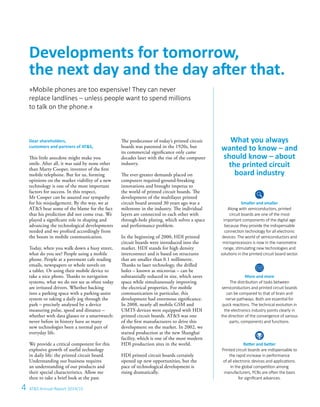
Developments for tomorrow,
the next day and the day after that.
»Mobile phones are too expensive! They can never
replace landlines – unless people want to spend millions
to talk on the phone.«
What you always
wanted to know – and
should know – about
the printed circuit
board industry
Smaller and smaller
Along with semiconductors, printed
circuit boards are one of the most
important components of the digital age
because they provide the indispensable
connection technology for all electronic
devices. The world of semiconductors and
microprocessors is now in the nanometre
range, stimulating new technologies and
solutions in the printed circuit board sector.
More and more
The distribution of tasks between
semiconductors and printed circuit boards
can be compared to that of brain and
nerve pathways. Both are essential for
quick reactions. The technical evolution in
the electronics industry points clearly in
the direction of the convergence of various
parts, components and functions.
Better and better
Printed circuit boards are indispensable to
the rapid increase in performance
of all electronic devices and applications.
In the global competition among
manufacturers, PCBs are often the basis
for significant advances.
The predecessor of today’s printed circuit
boards was patented in the 1920s, but
its commercial significance only came
decades later with the rise of the computer
industry.
The ever-greater demands placed on
computers required ground-breaking
innovations and brought impetus to
the world of printed circuit boards. The
development of the multilayer printed
circuit board around 30 years ago was a
milestone in the industry. The individual
layers are connected to each other with
through-hole plating, which solves a space
and performance problem.
In the beginning of 2000, HDI printed
circuit boards were introduced into the
market. HDI stands for high density
interconnect and is based on structures
that are smaller than 0.1 millimetre.
Thanks to laser technology, the drilled
holes – known as microvias – can be
substantially reduced in size, which saves
space while simultaneously improving
the electrical properties. For mobile
communication in particular, this
development had enormous significance.
In 2008, nearly all mobile GSM and
UMTS devices were equipped with HDI
printed circuit boards. ATS was one
of the first manufacturers to drive this
development on the market. In 2002, we
started production at the new Shanghai
facility, which is one of the most modern
HDI production sites in the world.
HDI printed circuit boards certainly
opened up new opportunities, but the
pace of technological development is
rising dramatically.
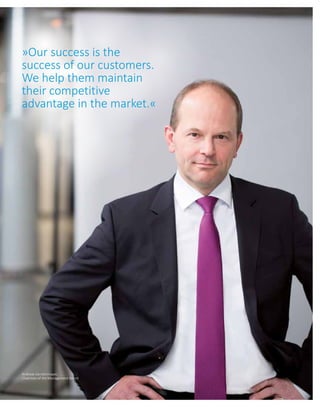
»Our success is the
success of our customers.
We help them maintain
their competitive
advantage in the market.«
Andreas Gerstenmayer,
Chairman of the Management Board
6 ATS Annual Report 2014/15
To understand us, one has to understand
this enormous dynamism. Electronic
devices are becoming smaller and
smaller – with ever-higher demand for
functionality and performance capacity.
Do you still remember your first mobile
phone? If you compare its performance
capacity to that of a modern smartphone,
you can see that it has literally exploded
within just a few years. And the potential
for development has not reached its limits
by far.
The enormous speed of technological
change requires that we have a clear
understanding of where this technological
change is going. This is because our
success is the success of our customers.
We help them maintain their competitive
advantage in the market.
In order to assess what a leading global
manufacturer of computers or mobile
devices will need in a few years, very
specific conditions in the organisation and
corporate culture are required.
For this highly sensitive area, which is
related to communication, my colleague
Heinz Moitzi has found an expression
that is both elegant and understandable.
We do manufacturing for today, and
development for tomorrow, the next
day and the day after that. Said simply,
this captures it rather precisely. This
disciplined view into the immediate
future and beyond is also another of our
critical success factors. It has enabled
us to intelligently take advantage of the
boom in numerous electronics industries
in recent years. This is demonstrated not
least by the positive trend in our figures.
During the last five years, we have been
able to increase total sales by nearly 37%
to around € 667 million and EBITDA
by 75% to € 168 million. Comparing the
growth of both of these key figures shows
that we have focused on the right market
segments with successful customers.
Only by doing this have we been able to
increase earnings at twice the rate we have
grown sales – the result of a clear strategy
and the exceptional commitment of our
employees.
I would now like to describe our success
factors in more detail since they are the
DNA of ATS.
»HDI printed circuit
boards certainly
opened up new
opportunities, but the
pace of technological
development is rising
rapidly. To under­
stand us, one has
to understand this
enormous dynamism.«
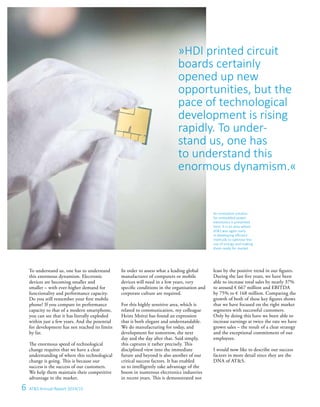
An innovative solution
for embedded power
electronics is presented
here. It is an area where
ATS was again early
in developing efficient
methods to optimise the
use of energy and making
them ready for market.
»During the last five years, we have been able
to increase total sales by almost 37% to around
€ 667 million and EBITDA by 75% to € 168 million.«
Success factor customer focus.
As I mentioned above, we need to
anticipate the needs of our customers in
all areas of business. To do this, we analyse
the trends in the electronics industry very
meticulously and develop the connection
technologies needed for it early and in
response to the market. Only through
this are we able to ensure timely, large-
scale production, and thereby also create
an important competitive advantage
for our customers. Our European
engineering tradition of creative tinkering
and testing is absolutely essential for
this type of technological development.
This understanding of ourselves clearly
differentiates us from numerous compe­
titors and defines our most important
factor for success: proximity to our
customers. As a result of our high-end
positioning, we have been associated
with the market leaders in the widest
variety of sectors for many years. This is
only possible through our technological
leadership and sound knowledge of the
market.
Success factor global presence.
Our global presence proves that customer
focus at ATS is not just lip service. The
vast majority of our production can be
found where the value-creation chain of
our customers is located. 79% of all of
our value creation takes place in Asia, and
59% of our total revenue is generated by
customers or suppliers located there. If
ATS had not dared the step towards
Asia around 15 years ago, the company
would no longer exist – of this I am firmly
convinced. Today, we benefit from a good
balance of high-tech production with high
volumes over a limited product mix in
Asia and a diverse product mix with lower
volumes in Europe.
Success factor highest standards.
ATS sets the highest standards in our
industry for quality and technology.
Needless to say, we rely on sophisticated
technologies, for which we make massive
investments in research and development.
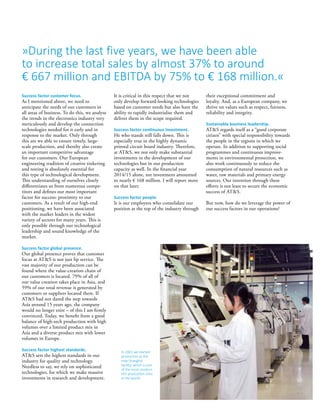
In 2002 we started
production at the
new Shanghai
facility, which is one
of the most modern
HDI production sites
in the world.
It is critical in this respect that we not
only develop forward-looking technologies
based on customer needs but also have the
ability to rapidly industrialise them and
deliver them in the scope required.
Success factor continuous investment.
He who stands still falls down. This is
especially true in the highly dynamic
printed circuit board industry. Therefore,
at ATS, we not only make substantial
investments in the development of our
technologies but in our production
capacity as well. In the financial year
2014/15 alone, net investment amounted
to nearly € 168 million. I will report more
on that later.
Success factor people.
It is our employees who consolidate our
position at the top of the industry through
their exceptional commitment and
loyalty. And, as a European company, we
thrive on values such as respect, fairness,
reliability and integrity.
Sustainable business leadership.
ATS regards itself as a “good corporate
citizen” with special responsibility towards
the people in the regions in which we
operate. In addition to supporting social
programmes and continuous improve­
ments in environmental protec­tion, we
also work continuously to reduce the
consumption of natural resources such as
water, raw materials and primary energy
sources. Our intention through these
efforts is not least to secure the economic
success of ATS.
But now, how do we leverage the power of
our success factors in our operations?
8 ATS Annual Report 2014/15
»The success and effectiveness
of our strategy, however, are
difficult to judge in the results of
a single year viewed in isolation.
Our strategic decisions are too
long-term for such assessment.«
We divide our operations into the
segments Mobile Devices  Substrates
and Industrial  Automotive incl.
Medical. These two areas have sharp
differences with respect to their dynamics
and customer demands. The segment
Mobile Devices with applications for
smartphones, tablets, notebooks, PCs
and digital cameras is the clear driver
of technology: constant innovations
that expand functionality and enhance
performance capacity are the absolute
determinants of success. At the same
time, this sector is characterised by
relatively short product life cycles, which
do not usually last for more than 12 to
18 months. Order quantities are generally
fixed for only two months in advance.
The segment Industrial  Automotive
incl. Medical is shaped by two important
factors. First, in this segment we can
deploy the technologies originally
developed for the Mobile Devices 
Substrates area to profitably extend the
useful life of our production equipment.
Second, at up to seven years, the life
cycle is significantly longer, which
makes midterm sales planning easier
and stabilises capacity utilisation. The
technological demands vary by application
area. In the automotive sector, demand is
currently supported by a rising proportion
of electronic components – for example,
for high-end systems such as lane-change
assistants and automatic vehicle distance
measurement. Up to 200 printed circuited
boards are used in premium vehicles –
from gearbox control and automatically
adjustable LED illumination to
entertainment systems. Industrial
production without robots and sensors
would be unimaginable today – and high-
performance printed circuit boards are
hidden behind these as well. In medical
technology, therapeutic applications such
as hearing aids and diagnostic applications
such as MRT require sophisticated and
reliable solutions. In this area too, ATS
has been able to secure a leading position
in recent years.
Our strategy was successfully confirmed in
the financial year 2014/15. Based on our
successful positioning in highly profitable
niches, we notably increased sales – and,
more importantly, earnings – in both
segments. The success and effectiveness of
our strategy, however, are difficult to judge
from the results of a single year viewed
in isolation. Our strategic decisions are
too long-term for such assessment. Our
strategy includes collaborating with
customers who set the tone for their
sector, thereby safeguarding their own
long-term success. It includes constant
improvements in operational efficiency
and all processes. And, naturally, it also
includes timely development of the right
technologies and their compatibility with
industrial manufacturing.
The often-cited “Internet of Things”
or “Internet of Everything” points to
a number of trends that will continue
to shape the future of the electronics
industry. The key issue, however, is
which applications will also prevail in
the professional arena: for example, data
glasses for maintenance work, wearable
devices – applications worn on the body –
that can also be used in the medical field.
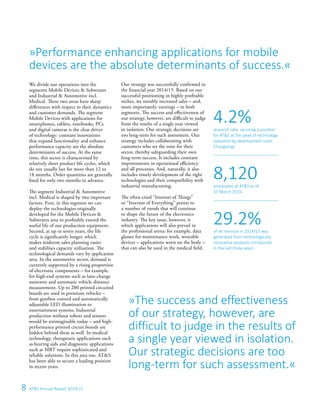
»Performance enhancing applications for mobile
devices are the absolute determinants of success.«
research rate, securing a position
for ATS at the peak of technology
(adjusted by development costs
Chongqing)
4.2%
employees at ATS as of
31 March 2015
of all revenue in 2014/15 was
generated from technologically
innovative products introduced
in the last three years
8,120
29.2%
9
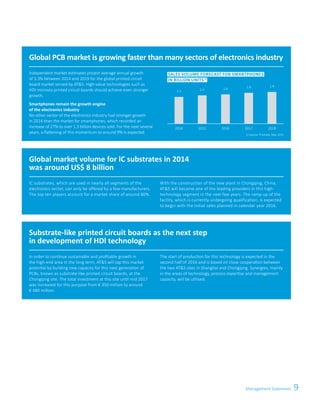
2014 2015 2016 2017 2018
Management Statement
1) Source: Prismark, May 2015
Global PCB market is growing faster than many sectors of electronics industry
Independent market estimates project average annual growth
of 3.3% between 2014 and 2019 for the global printed circuit
board market served by ATS. High-value technologies such as
HDI microvia printed circuit boards should achieve even stronger
growth.
Smartphones remain the growth engine
of the electronics industry
No other sector of the electronics industry had stronger growth
in 2014 than the market for smartphones, which recorded an
increase of 27% to over 1.3 billion devices sold. For the next several
years, a flattening of this momentum to around 9% is expected.
SALES VOLUME FORECAST FOR SMARTPHONES
IN BILLION UNITS1)
IC substrates, which are used in nearly all segments of the
electronics sector, can only be offered by a few manufacturers.
The top ten players account for a market share of around 80%.
With the construction of the new plant in Chongqing, China,
ATS will become one of the leading providers in this high-
technology segment in the next few years. The ramp-up of the
facility, which is currently undergoing qualification, is expected
to begin with the initial sales planned in calendar year 2016.
Global market volume for lC substrates in 2014
was around US$ 8 billion
Substrate-like printed circuit boards as the next step
in development of HDl technology
In order to continue sustainable and profitable growth in
the high-end area in the long term, ATS will tap this market
potential by building new capacity for this next generation of
PCBs, known as substrate-like printed circuit boards, at the
Chongqing site. The total investment at this site until mid 2017
was increased for this purpose from € 350 million to around
€ 480 million.
The start of production for this technology is expected in the
second half of 2016 and is based on close cooperation between
the two ATS sites in Shanghai and Chongqing. Synergies, mainly
in the areas of technology, process expertise and management
capacity, will be utilised.
1.3
1.8 1.9
1.61.5
10 ATS Annual Report 2014/15
On sales and earnings performance
and how it will continue:
2014/15 was a very successful year for us.
We were once again able to further improve
our very good sales and earnings figures of
the past year with a significant increase to
€ 667.0 ­million and record-breaking results.
The sales increase was mainly due to the
rise in demand in both the Mobile Devices 
Substrates segment and the lndustrial 
Automotive segment. For the financial year
2015/16, we again expect revenue to be
at the high level we have now achieved,
assuming the same average exchange rates.
The increase in the operating result for
financial year 2014/15 to € 90.1 ­million is
mainly due to improved capacity utilization
and continuous improvements of our cost
base and efficiency. Positive foreign exchange
effects in the financial result and capitalised
interest costs additionally contributed to the
improvement in the Group annual ­result. For
2015/16, we expect an EBITDA margin from
the production and sale of printed circuit
boards to be at a comparably high level to
financial year 2014/15. Taking into account
the start-up costs in Chongqing, we expect an
EBITDA margin at consolidated Group level of
18-20% for the financial year 2015/16.
Key earnings opportunities:
In the long term, we must continue to focus
on the right areas of application and, most
importantly, on the right customers who will
enable us to continue to develop in terms
of both volume and technology. This is the
only way to ensure our high earnings level. In
the next two financial years, our main focus
will be on the successful start of production
in Chongqing and, with that, our entry into
the IC substrate and substrate-like PCB
business. From a strategic perspective, this
step represents an extraordinary opportunity
for our development. Operationally we will
continue the focus on improvements of
processes and procedures as well as the
optimization of IT and procurement costs of
materials and services.
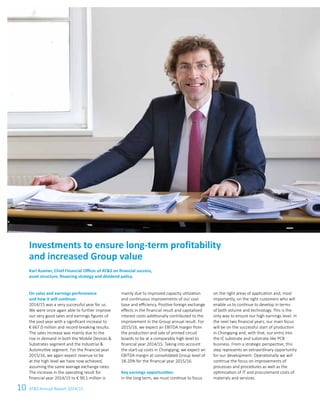
Investments to ensure long-term profitability
and increased Group value
Karl Asamer, Chief Financial Officer of ATS on financial success,
asset structure, financing strategy and dividend policy.
11Management Statement
keep the ratio of net debt to EBITDA below
3.5 and to keep our equity ratio above 35%.
Long-term, optimised financing structure:
In the financial year 2014/15, we were
able to increase net cash generated
from operating activities by almost
37% to over € 143.9 million. Our most
important financial source in financial year
2015/16 will remain cash flow generated
from income. In parallel, we use bank
loans as financing source, promissory
note loans and corporate bonds. To
mitigate fluctuation in liquidity, we have
also secured credit facilities of over
€ 200 million. The average debt maturity
as at the reporting date was 3.8 years.
We will continue to take steps to optimise
the debt maturity and take advantage of
financing at an interest rate that is lower
than the previous years. ATS has a very
good credit rating. We therefore have
the ability to obtain new financing over
five years at interest rates below 2%. In
choosing our financing partners, we place
great emphasis on competitiveness, long-
term partnerships and a presence in the
countries in which we operate.
What can ATS shareholders expect in
terms of dividends?
With the start of the IC substrates
investment project in Chongqing, the
previous dividend policy was temporarily
suspended and replaced by a fixed amount
of € 0.20 per share for the financial years
2012/13 and 2013/14. At this time of high
capital expenditure, the Management
Board will aim for a conservative dividend
policy for the financial year just ended and
for the next few years.
»ATS has a very good credit
rating. We therefore have the
ability to obtain new financing
over five years at interest rates
below 2%.«
Solid balance sheet and cash flow:
In 2014/15, the equity ratio increased to
49.5% and the ratio of net debt to EBlTDA
was reduced to 0.8. At the reporting date,
ATS had cash and cash equivalents of
€ 273.9 million. The gearing ratio was
reduced to 21.6%. We have therefore
created a solid base for financing the
remaining investments in Chongqing of
over € 300 million by mid 2017 and the
investments needed for technological
improvements and replacements. These
investments in growth will increase our
net debt and reduce our equity ratio. Our
goal over the next two years, which are
characterised by high investments, is to
»We see
numerous trends
today. But the key
question is, which
applications will
really prevail?«
I believe that anyone who thinks about
the future of our industry is firmly
convinced that the “Internet of Things”
will significantly change our daily lives
once again. Devices and functionality
will connect and communicate with
each other via the Internet. This will also
include intelligent controls for energy
systems, smart homes, and the further
automation of industrial processes.
Revolutionary innovation can likewise be
expected in the automotive area. From a
technological point of view, self-driving
cars that can manage without any driver
at all are already possible today. In mobile
communication, we are looking at the
question of whether, or rather how,
the smartphone will be replaced. Will
the smart watch prevail, or will it be
something entirely new?
We see a continuation in the trend of
miniaturisation. Printed circuit boards
will become even smaller, take on more
functions, and integrate components.
Along with this, the trend towards
modularisation will continue. What
this means is a substantial improvement
in electronic systems that can only be
achieved if their individual components
are ideally matched to one another and
based on a modular structure. This goal
will also bring significant change to our
industry.
12 ATS Annual Report 2014/15
Our world is becoming very small
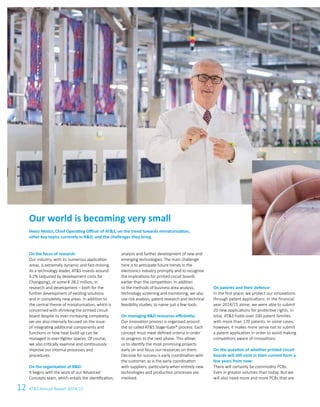
Heinz Moitzi, Chief Operating Officer of ATS, on the trend towards miniaturisation,
other key topics currently in RD, and the challenges they bring.
On the focus of research:
Our industry, with its numerous application
areas, is extremely dynamic and fast-moving.
As a technology leader, ATS invests around
4.2% (adjusted by development costs for
Chongqing), or some € 28.2 million, in
research and development – both for the
further development of existing solutions
and in completely new areas. In addition to
the central theme of miniaturisation, which is
concerned with shrinking the printed circuit
board despite its ever-increasing complexity,
we are also intensely focused on the issue
of integrating additional components and
functions or how heat build-up can be
managed in ever-tighter spaces. Of course,
we also critically examine and continuously
improve our internal processes and
procedures.
On the organisation of RD:
It begins with the work of our Advanced
Concepts team, which entails the identi­fication,
analysis and further development of new and
emerging technologies. The main challenge
here is to anticipate future trends in the
electronics industry promptly and to recognise
the implications for printed circuit boards
earlier than the competition. In addition
to the methods of business area analysis,
technology screening and monitoring, we also
use risk analysis, patent research and technical
feasibility studies, to name just a few tools.
On managing RD resources efficiently:
Our innovation process is organised around
the so called ATS Stage-Gate® process. Each
concept must meet defined criteria in order
to progress to the next phase. This allows
us to identify the most promising projects
early on and focus our resources on them.
Decisive for success is early coordination with
the customer, as is the early coordination
with suppliers, particularly when entirely new
technologies and production processes are
involved.
On patents and their defence:
In the first place, we protect our innovations
through patent applications. In the financial
year 2014/15 alone, we were able to submit
20 new applications for protective rights. In
total, ATS holds over 100 patent families
with more than 170 patents. In some cases,
however, it makes more sense not to submit
a patent application in order to avoid making
competitors aware of innovations.
On the question of whether printed circuit
boards will still exist in their current form a
few years from now:
There will certainly be commodity PCBs.
Even in greater volumes than today. But we
will also need more and more PCBs that are
13Management Statement
It is one of the strengths of ATS that
it not only takes timely account of
these trends but also reflects them in
appropriate technologies – and faster
than the competition can. For example,
we have already been working intensively
for many years to set new benchmarks
and standards for miniaturisation. The
development of our ECP® technology
(Embedded Component Packaging
technology) is a result of this work. What
can this technology do? It allows active
and passive components to be installed
within the printed circuit board, which
allows additional space for components
on the surface. Also, with the construction
of a new plant for IC substrates at the
Chongqing site in China, we have created
the conditions for future success. IC
substrates are multi-layered, electrically
conducting circuit substrates for silicon
semiconductors (integrated circuits/ICs)
and serve as the connection between the
structures in the nano range of chips and
the structures in the micrometre range of
the printed circuit board. Through the use
of ever more powerful microprocessors in
computers, notebooks, smartphones and
tablets, IC substrates are an important
component of connection technology.
By means of this plant, we are positioning
ATS as one of the leading providers
of high-end IC substrate technology. In
anticipation of the future trends, we have
raised the volume of our investment to date
in the Chongqing site from € 350 million
to € 480 million. We are investing in the
next generation of technology in our core
business and in the further development
of HDI technology at the same time.
Investing in the “tomorrow”, to stay with
the expression coined by my colleague
Heinz Moitzi.
We are therefore facing another quantum
leap in the history of our company. In
doing this, we are holding firm to the
proven strengths and unique characteristics
that have distinguished ATS for years. In
addition to our capacity to set standards in
technology and quality, it is also our sound
judgment about what our customers might
one day use and even need that plays a
role. Furthermore, we have strong, proven
suppliers and research partners joining us
on our path to the next level.
From a technological perspective and
with respect to the new business areas
described, ATS is currently in a process
of transformation with far-reaching impact
on the future. The process is being driven
by our core team, which works with extra­
ordinary dedication every day – across all
cultures – for the continuing success of
ATS.
The success of ATS thus far clearly shows
that the strategic decisions of the past were
correctly made and properly implemented.
We base everything we do each day on con­
tinuing this path in the future: recognising
and anticipating the key trends, further
improving our operations, bringing our
investment projects to fruition on time
and on a sound technical footing. This is
how we will continue to write the ATS
success story – in the interests and for the
benefit of our shareholders, customers
and employees. An exciting future lies
ahead of us, with interesting prospects
for development for which I hope to have
made a little clearer for you here.
If this effort has been successful, I cordially
invite you to join us on our path. Taking an
analytical look back, you will see that it is a
path of successful growth. For us, looking
at the past is admittedly less exciting than
looking to the future. That is when we will
make our business more interesting than
ever.
Sincerely, Andreas Gerstenmayer,
Chairman of the Management Board
different from today’s in terms of their
complexity, that are smaller and able to
take on more and more functionality.
Fifteen years ago, a telecommunications
module was used only in mobile phones.
Today, we also find them in intelligent
refrigerators, coffee vending machines,
medical devices and industrial machines.
The technological possibilities for this
have not at all reached their limits. In
my estimation, the coming years will be
extremely exciting for our industry. ATS
is well prepared for this in every respect.
Further information on RD can be found
in the Management Report starting on
page 94.
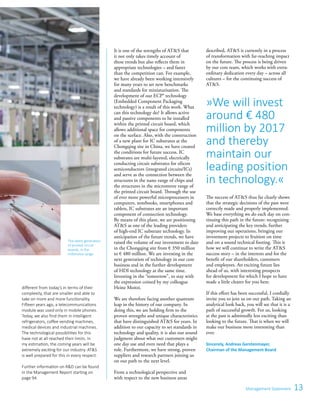
The latest generation
of printed circuit
boards, in the
millimetre range.
»We will invest
around € 480
million by 2017
and thereby
maintain our
leading position
in technology.«
14 ATS Annual Report 2014/15
ATS – First choice for
advanced applications
With this vision – to be the first choice for advanced applications – ATS has successfully established its position
in the highly dynamic global market for printed circuit boards. ATS is now the largest manufacturer of printed
circuit boards in Europe and one of the world‘s leading producers of high-value printed circuit boards. ATS
concentrates on high-end technologies used in attractive and profitable applications over the long term for
mobile devices, medical technology and in the automotive and industrial sectors. ATS shares have been listed
since 2008 on the Vienna Stock Exchange (previously, on the Frankfurt Stock Exchange since 1999). The majority
of shares, at 65.9%, are in free float.
As at 31 March 2015, ATS has over 8,100 employees who generated revenue of € 667.0 million in the financial
year 2014/15.
The ATS Mission
§	 We set the highest quality standards in our industry
§	 We industrialize leading-edge technology
§	 We care about people
§	 We reduce our ecological footprint
§	 We create value
ATS employs over 8,100
people worldwide.
Milestones in the Group’s history
1987
Founding of the Group,
emerging from several
companies owned by the
Austrian State Owned
Industries
1994
Privatisation and
acquisition by
Messrs Androsch,
Dörflinger, Zoidl
1999
Initial public offering on Frankfurt Stock
Exchange („Neuer Markt“). Acquisition
of Indal Electronics Ltd., largest Indian
printed circuit board plant (Nanjangud) –
today, ATS India Private Limited
2002
Start of production at
new Shanghai facility –
one of the leading
HDI production sites
in the world
2006
Acquisition of Korean
flexible printed circuit
board manufacturer,
Tofic Co. Ltd. – today,
ATS Korea Co., Ltd.
2009
New production direction: Austrian
plants produce for high-value niches
in the automotive and industrial
segment; Shanghai focuses on the
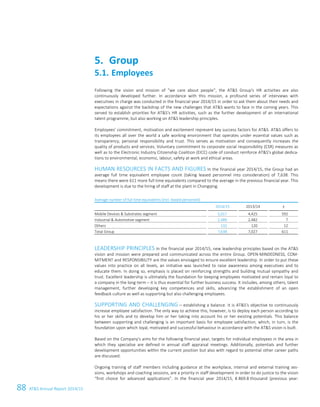
high-end mobile devices segment
2010
Start of production
at plant II in India
2011
§	 Construction starts on new
plant in Chongqing, China
§	 Capacity increase in
Shanghai by 30%
2013
ATS enters the IC substrate market in cooperation
with a leading manufacturer of semiconductors
2015
ATS again achieves record-
high sales and earnings
for financial year 2014/15
and decides to increase
the investment program in
Chongqing from € 350 million
to € 480 million
2008
ATS change
to Vienna Stock
Exchange
15
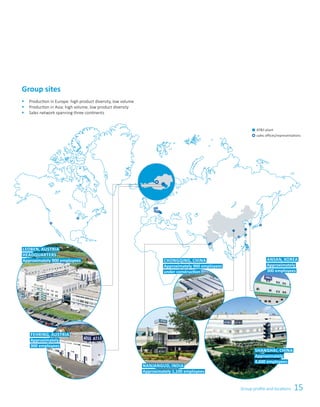
Group sites
§	 Production in Europe: high product diversity, low volume
§	 Production in Asia: high volume, low product diversity
§	 Sales network spanning three continents
	ATS plant
	sales offices/representations
Nanjangud, India
Approximately 1,100 employees
Leoben, Austria
Headquarters
Approximately 900 employees
Shanghai, China
Approximately
4,600 employees
Ansan, Korea
Approximately
300 employees
Chongqing, China
Approximately 900 employees
under construction
Fehring, Austria
Approximately
300 employees
Group profile and locations
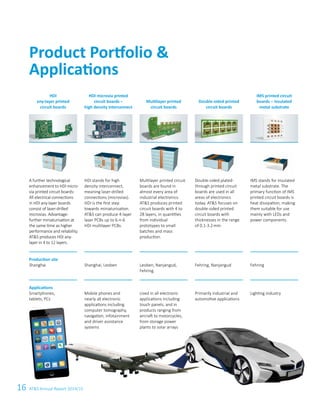
16 ATS Annual Report 2014/15
Product Portfolio 
Applications
HDI microvia printed
circuit boards –
high density interconnect
HDI
any-layer printed
circuit boards
Multilayer printed
circuit boards
IMS printed circuit
boards – insulated
metal substrate
Double-sided printed
circuit boards
HDI stands for high
density interconnect,
meaning laser-drilled
connections (microvias).
HDI is the first step
towards miniaturisation.
ATS can produce 4-layer
laser PCBs up to 6-n-6
HDI multilayer PCBs.
A further technological
­enhancement to HDI micro-
via printed circuit boards:
All electrical ­connections
in HDI any-layer boards
consist of laser-drilled
­microvias. Advantage:
further mini­aturisation at
the same time as higher
­performance and reliability.
ATS ­produces HDI any-­
layer in 4 to 12 layers.
Multilayer printed circuit
boards are found in
almost every area of
industrial electronics.
ATS produces printed
circuit boards with 4 to
28 layers, in quantities
from individual
prototypes to small
batches and mass
production.
IMS stands for insulated
metal substrate. The
primary function of IMS
printed circuit boards is
heat dissipation, making
them suitable for use
mainly with LEDs and
power components.
Double-sided plated-
through printed circuit
boards are used in all
areas of electronics
today. ATS focuses on
double-sided printed
circuit boards with
thicknesses in the range
of 0.1-3.2 mm.
Shanghai, Leoben
Production site
Shanghai Leoben, Nanjangud,
Fehring
FehringFehring, Nanjangud
Mobile phones and
nearly all electronic
applications including
computer tomography,
navigation, infotainment
and driver assistance
systems
Applications
Smartphones,
tablets, PCs
Used in all electronic
applications including
touch panels, and in
products ranging from
aircraft to motorcycles,
from storage power
plants to solar arrays
Lighting industryPrimarily industrial and
automotive applications
17
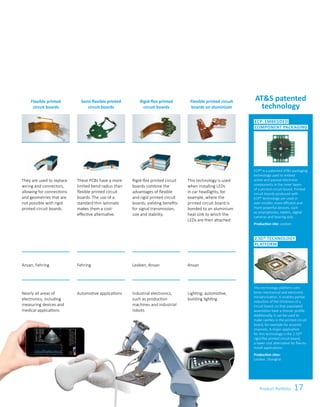
Flexible printed circuit
boards on aluminium
Rigid-flex printed
circuit boards
Flexible printed
circuit boards
Semi-flexible printed
circuit boards
This technology is used
when installing LEDs
in car headlights, for
example, where the
printed circuit board is
bonded to an aluminium
heat sink to which the
LEDs are then attached.
Rigid-flex printed circuit
boards combine the
advantages of flexible
and rigid printed circuit
boards, yielding benefits
for signal transmission,
size and stability.
They are used to replace
wiring and connectors,
allowing for connections
and geometries that are
not possible with rigid
printed circuit boards.
These PCBs have a more
limited bend radius than
flexible printed circuit
boards. The use of a
standard thin laminate
makes them a cost-
effective alternative.
AnsanLeoben, AnsanAnsan, Fehring Fehring
Nearly all areas of
electronics, including
measuring devices and
medical applications
Automotive applications Lighting, automotive,
building lighting
Industrial electronics,
such as production
machines and industrial
robots
ATS patented
technology
ECP: Embedded
Component Packaging
ECP® is a patented ATS packaging
technology used to embed
active and passive electronic
components in the inner layers
of a printed circuit board. Printed
circuit boards produced with
ECP® technology are used in
ever smaller, more efficient and
more powerful devices, such
as smartphones, tablets, digital
cameras and hearing aids.
Production site: Leoben
2.5D® technology
platform
This technology platform com-
bines mechanical and electronic
miniaturisation. It enables partial
reduction of the thickness of a
circuit board, so that populated
assemblies have a thinner profile.
Additionally, it can be used to
make cavities in the printed circuit
board, for example for acoustic
channels. A major application
for this technology is the 2.5D®
rigid-flex printed circuit board,
a lower cost alternative for flex-to-
install applications.
Production sites:
Leoben, Shanghai
Product Portfolio
18 ATS Annual Report 2014/15
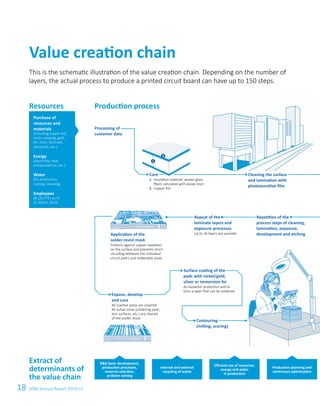
Value creation chain
This is the schematic illustration of the value creation chain. Depending on the number of
layers, the actual process to produce a printed circuit board can have up to 150 steps.
Resources Production process
Purchase of
resources and
materials
(including copper foil,
cores, prepreg, gold,
tin, silver, laminate,
chemicals, etc.)
Energy
(electricity, heat,
compressed air, etc.)
Water
(for production,
cooling, cleaning)
Employees
(8,120 FTEs as of
31 March 2015)
Extract of
determinants of
the value chain
Processing of
customer data
Core
1.	Insulation material: woven glass
fibers saturated with epoxy resin
2.	Copper foil
Repeat of the
laminate layers and
exposure processes
Up to 26 layers are possibleApplication of the
solder-resist mask
Protects against copper oxidation
on the surface and prevents short-
circuiting between the individual
circuit paths and solderable areas
Expose, develop
and cure
All inactive areas are covered.
All active areas (soldering pads,
test surfaces, etc.) are cleared
of the solder resist
Contouring
(milling, scoring)
Production planning and
continuous optimisation
RD basic development,
production processes,
material selection,
problem solving
Internal and external
recycling of waste
Efficient use of resources,
energy and water
in production
Repetition of the
process steps of cleaning,
lamination, exposure,
development and etching
Surface coating of the
pads with nickel/gold,
silver or immersion tin
As oxidation protection and to
form a layer that can be soldered
Cleaning the surface
and lamination with
photosensitive film
19Value creation chain
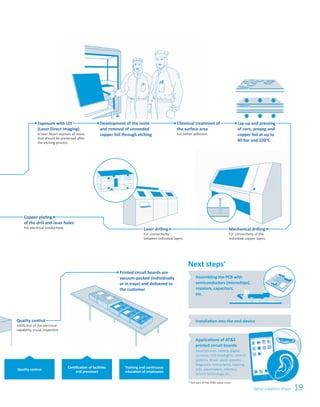
Installation into the end device
Applications of ATS
printed circuit boards
Smartphones, tablets, digital
cameras, LED headlights, control
systems, driver assist systems,
diagnostic instruments, hearing
aids, pacemakers, robotics,
sensor technology, etc.
Development of the resist
and removal of unneeded
copper foil through etching
Chemical treatment of
the surface area
For better adhesion
Exposure with LDI
(Laser Direct Imaging)
A laser beam exposes all ­areas
that should be preserved after
the etching process
Lay-up and pressing
of core, prepeg and
copper foil at up to
40 bar and 220°C
Mechanical drilling
For connectivity of the
individual copper layers
Quality control
100% test of the electrical
capability, visual inspection
Quality control
Certification of facilities
and processes
Training and continuous
education of employees
Laser drilling
For connectivitiy
between individual layers
Copper plating
of the drill and laser holes
For electrical conductivity
Assembling the PCB with
semiconductors (microchips),
resistors, capacitors,
etc.
Printed circuit boards are
vacuum-packed (individually
or in trays) and delivered to
the customer
Next steps*
* Not part of the ATS value chain
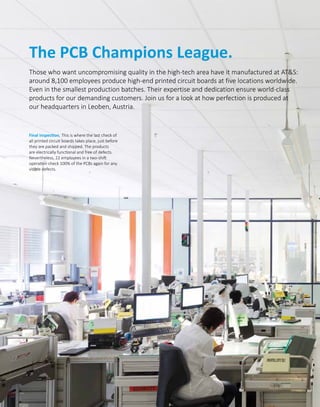
The PCB Champions League.
Those who want uncompromising quality in the high-tech area have it manufactured at ATS:
around 8,100 employees produce high-end printed circuit boards at five locations worldwide.
Even in the smallest production batches. Their expertise and dedication ensure world-class
products for our demanding customers. Join us for a look at how perfection is produced at
our headquarters in Leoben, Austria.
Final inspection. This is where the last check of
all printed circuit boards takes place, just before
they are packed and shipped. The products
are electrically functional and free of defects.
Nevertheless, 22 employees in a two-shift
operation check 100% of the PCBs again for any
visible defects.
22 ATS Annual Report 2014/15
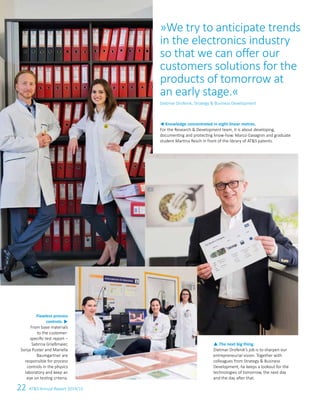
Flawless process
controls. u
From base materials
to the customer-
specific test report –
Sabrina Grießmaier,
Sonja Puster and Mariella
Baumgartner are
responsible for process
controls in the physics
laboratory and keep an
eye on testing criteria.
p The next big thing.
Dietmar Drofenik’s job is to sharpen our
entrepreneurial vision. Together with
colleagues from Strategy  Business
Development, he keeps a lookout for the
technologies of tomorrow, the next day
and the day after that.
t Knowledge concentrated in eight linear metres.
For the Research  Development team, it is about developing,
documenting and protecting know-how. Marco Gavagnin and graduate
student Martina Resch in front of the library of ATS patents.
»We try to anticipate trends
in the electronics industry
so that we can offer our
customers solutions for the
products of tomorrow at
an early stage.«
Dietmar Drofenik, Strategy  Business Development
23
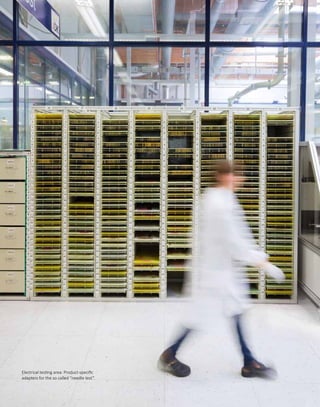
Electrical testing area: Product-specific
adapters for the so called “needle test”.
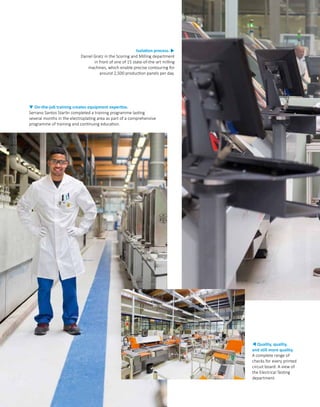
Isolation process. u
Daniel Gratz in the Scoring and Milling department
in front of one of 15 state-of-the-art milling
machines, which enable precise contouring for
around 2,500 production panels per day.
▼ On-the-job training creates equipment expertise.
Serrano Santos Starlin completed a training programme lasting
several months in the electroplating area as part of a comprehensive
programme of training and continuing education.
t Quality, quality,
and still more quality.
A complete range of
checks for every printed
circuit board. A view of
the Electrical Testing
department.
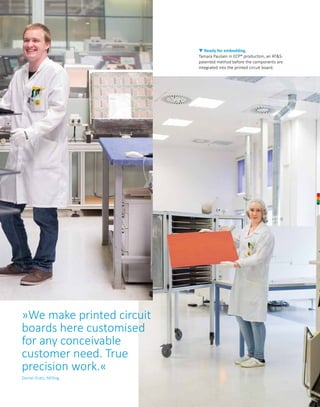
»We make printed circuit
boards here customised
for any conceivable
customer need. True
precision work.«
Daniel Gratz, Milling
▼ Ready for embedding.
Tamara Paulsen in ECP® production, an ATS-
patented method before the components are
integrated into the printed circuit board.
26 ATS Annual Report 2014/15
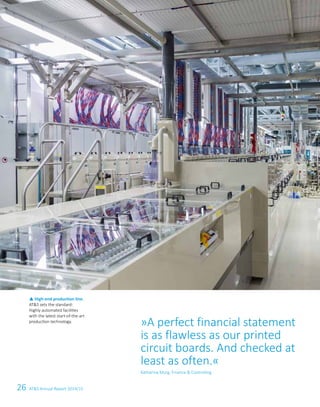
p High-end production line.
ATS sets the standard:
Highly automated facilities
with the latest start-of-the-art
production technology.
»A perfect financial statement
is as flawless as our printed
circuit boards. And checked at
least as often.«
Katharina Murg, Finance  Controlling
27ATS Employees
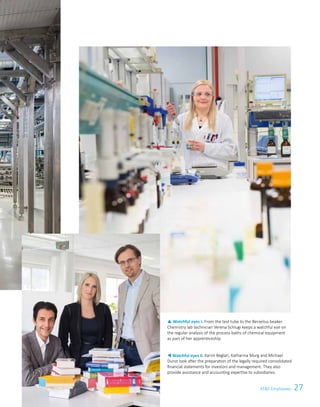
t Watchful eyes II. Karim Beglari, Katharina Murg and Michael
Dunst look after the preparation of the legally required consolidated
financial statements for investors and management. They also
provide assistance and accounting expertise to subsidiaries.
p Watchful eyes I. From the test tube to the Berzelius beaker.
Chemistry lab technician Verena Schlugi keeps a watchful eye on
the regular analysis of the process baths of chemical equipment
as part of her apprenticeship.
28 ATS Annual Report 2014/15
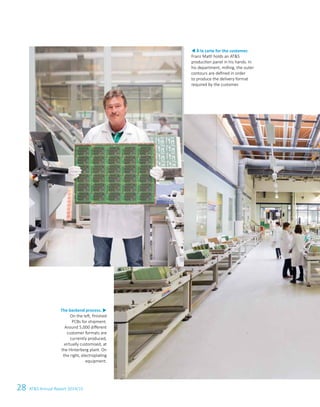
t À la carte for the customer.
Franz Mattl holds an ATS
production panel in his hands. In
his department, milling, the outer
contours are defined in order
to produce the delivery format
required by the customer.
The backend process. u
On the left, finished
PCBs for shipment.
Around 5,000 different
customer formats are
currently produced,
virtually customised, at
the Hinterberg plant. On
the right, electroplating
equipment.
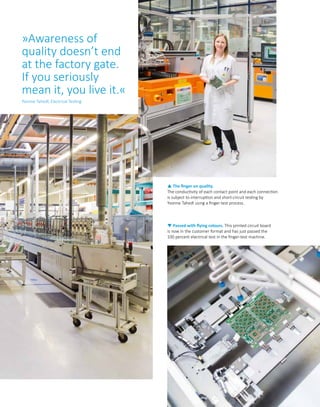
p The finger on quality.
The conductivity of each contact point and each connection
is subject to interruption and short-circuit testing by
Yvonne Tahedl using a finger-test process.
q Passed with flying colours. This printed circuit board
is now in the customer format and has just passed the
100 percent electrical test in the finger-test machine.
»Awareness of
quality doesn’t end
at the factory gate.
If you seriously
mean it, you live it.«
Yvonne Tahedl, Electrical Testing
30
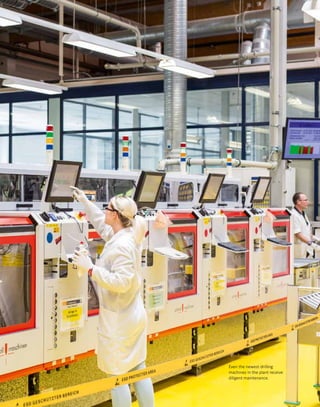
Even the newest drilling
machines in the plant receive
diligent maintenance.
31ATS Employees
t Without interruption.
Manfred Ofner and his team –
pictured: Marion Burghauser
and Mithun Palai – take care of
smooth IT infrastructure and
-systems.
p A secret of success.
The critical eye of a woman.
Sandra Weissensteiner
performing the final inspection.
Final inspection. u
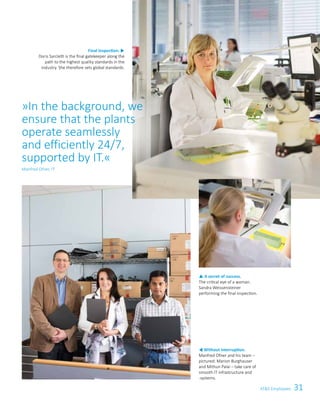
Doris Sarcletti is the final gatekeeper along the
path to the highest quality standards in the
industry. She therefore sets global standards.
»In the background, we
ensure that the plants
operate seamlessly
and efficiently 24/7,
supported by IT.«
Manfred Ofner, IT
32 ATS Annual Report 2014/15
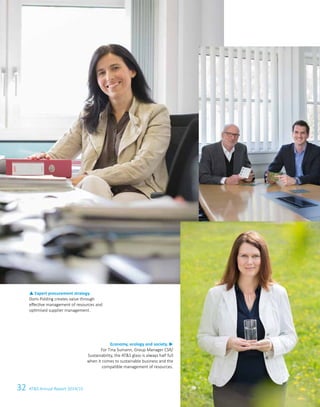
Economy, ecology and society. u
For Tina Sumann, Group Manager CSR/
Sustainability, the ATS glass is always half full
when it comes to sustainable business and the
compatible management of resources.
p Expert procurement strategy.
Doris Polding creates value through
effective management of resources and
optimised supplier management.
We as HR team care about people.
Whether blue collar, white collar
or management – the intercultural
HR team cares about people
globally by promoting respect,
engagement and trust.
(Nadja Noormofidi, Simona Rakusa,
Monika Stoisser-Göhring)
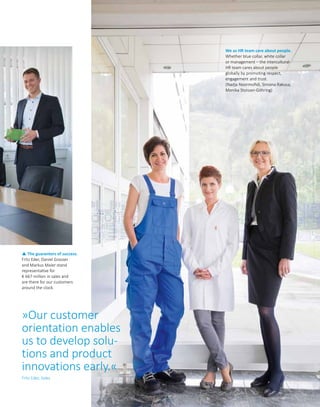
p The guarantors of success.
Fritz Eder, Daniel Grosser
and Markus Maier stand
representative for
€ 667 million in sales and
are there for our customers
around the clock.
»Our customer
orientation enables
us to develop solu­
tions and product
innovations early.«
Fritz Eder, Sales
34
	2003/2004	 2013	 2016	 2024
?
ATS Annual Report 2014/15
The global market for printed circuit boards is heavily influenced by the highly dynamic electronics industry and
specifically by the customer needs behind it. In the past years, one „big thing“ has followed the next – from
desktop and notebook computers, MP3 players and digital cameras, flat-screen devices and mobile phones
through to the latest generation of smartphones und tablets.
Recently, it is primarily smartphones and tablets that have been able to achieve above-average growth,
significantly impacting the development of the associated electronic components, such as semiconductors and
connection technologies for substrate and printed circuit boards. In early 2000, a mobile phone could generally
be used „only“ as a telephone. Today’s smartphones are high-end computers with more processing power than
NASA had for the first moon landing in 1967.
Hidden behind this rapid development and increase in performance is continuous miniaturisation in the
semiconductor industry. According to Moore’s law, the complexity of integrated circuits doubles every twelve to
twenty-four months. The increase in power density and simultaneous reduction in the size of semiconductors
has also driven the miniaturisation of printed circuit boards, the increase in complexity of layer structure,
and the rapid growth of HDI and microvia technology in all market segments. Today, high-end printed circuit
boards are increasingly used in the areas of automotive electronics (navigation, multimedia, camera systems)
and industrial applications (machine-to-machine communication, industrial computers), as well as medical
electronics (MRT, pacemakers, hearing aids) and consumer products (digital cameras, high-end televisions,
smart watches).
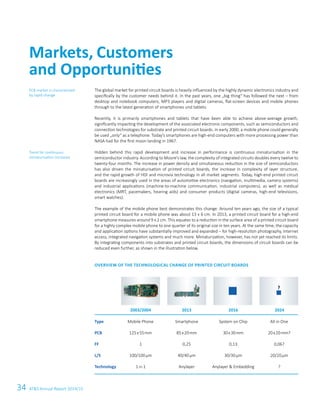
The example of the mobile phone best demonstrates this change. Around ten years ago, the size of a typical
printed circuit board for a mobile phone was about 13 x 6 cm. In 2013, a printed circuit board for a high-end
smartphone measures around 9 x 2 cm. This equates to a reduction in the surface area of a printed circuit board
for a highly complex mobile phone to one quarter of its original size in ten years. At the same time, the capacity
and application options have substantially improved and expanded – for high-resolution photography, Internet
access, integrated navigation systems and much more. Miniaturization, however, has not yet reached its limits.
By integrating components into substrates and printed circuit boards, the dimensions of circuit boards can be
reduced even further, as shown in the illustration below.
Overview of the technological change of printed circuit boards
PCB market is characterised
by rapid change
Trend for continuous
miniaturisation increases
Markets, Customers
and Opportunities
	 Mobile Phone	 Smartphone	 System on Chip	 All in One
	 125 x 55 mm	 85 x 20 mm	 30 x 30 mm	 20 x 20 mm?
	1	 0,25	 0,13	 0,06?
	 100/100 μm	 40/40 μm	 30/30 μm	 20/20 μm
	 1-n-1	 Anylayer	 Anylayer  Embedding	 ?
Type
PCB
FF
L/S
Technology
35
2014 2015 2016 2017 2018
Markets, customers and opportunities
For ATS, therefore, the integration of components into the printed circuit board (chip embedding) opens up
entirely new opportunities and potential for growth. Currently, the market for the assembly services for printed
circuit boards is dominated by contract electronics manufacturers (CEMs) and the market for embedding
components (packaging) is dominated by the semiconductor industry. With an overall global volume of around
US$ 1,300 billion, this market is many times larger than that of „unassembled“ printed circuit boards.
The value chain of the electronics industry faces fundamental change due to the entry of combined PCB and
substrate manufacturers into the world of assembly.
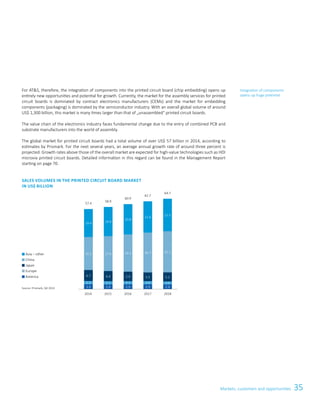
The global market for printed circuit boards had a total volume of over US$ 57 billion in 2014, according to
estimates by Prismark. For the next several years, an average annual growth rate of around three percent is
projected. Growth rates above those of the overall market are expected for high-value technologies such as HDI
microvia printed circuit boards. Detailed information in this regard can be found in the Management Report
starting on page 70.
Sales volumes in the printed circuit board market
in US$ billion
Integration of components
opens up huge potential
Source: Prismark, Q4 2014
n Asia – other
n China
n Japan
n Europe
n America
19.4
26.1
6.7
2.2
3.0
57.4
19.9
27.6
6.4
2.1
2.9
58.9
20.8
29.2
5.9
2.1
2.9
60.9
21.6
30.7
5.5
2.0
2.9
62.7
22.5
32.1
5.2
2.0
2.9
64.7
36 ATS Annual Report 2014/15
“Fixed” Computing
(You go to the device)
Mobility/BYOD
(The devices goes with you)
Internet of Things
(Age of Devices)
Internet of Everything
(People, Process, Data, Things)
Doubled every
1.3 years
Doubled every
1.4 years
Doubled every
? years
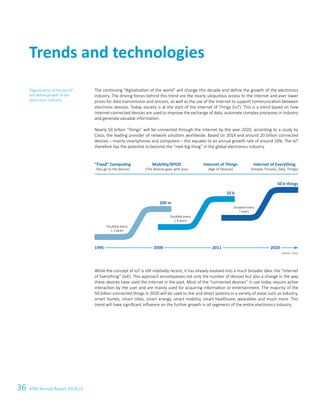
50 b things
Trends and technologies
The continuing “digitalisation of the world” will change this decade and define the growth of the electronics
industry. The driving forces behind this trend are the nearly ubiquitous access to the Internet and ever lower
prices for data transmission and sensors, as well as the use of the Internet to support communication between
electronic devices. Today, society is at the start of the Internet of Things (IoT). This is a trend based on how
Internet-connected devices are used to improve the exchange of data, automate complex processes in industry
and generate valuable information.
Nearly 50 billion “things” will be connected through the Internet by the year 2020, according to a study by
Cisco, the leading provider of network solutions worldwide. Based on 2014 and around 20 billion connected
devices – mainly smartphones and computers – this equates to an annual growth rate of around 16%. The IoT
therefore has the potential to become the “next big thing” in the global electronics industry.
“Digitalisation of the world”
will define growth of the
electronics industry
While the concept of IoT is still relatively recent, it has already evolved into a much broader idea: the “Internet
of Everything” (IoE). This approach encompasses not only the number of devices but also a change in the way
these devices have used the Internet in the past. Most of the “connected devices” in use today require active
interaction by the user and are mainly used for acquiring information or entertainment. The majority of the
50 billion connected things in 2020 will be used to link and direct systems in a variety of areas such as industry,
smart homes, smart cities, smart energy, smart mobility, smart healthcare, wearables and much more. This
trend will have significant influence on the further growth in all segments of the entire electronics industry.
Source: Cisco
1995 2000 2011 2020
200 m
10 b
37
2014 2015 2016 2017 2018 2019
140
104
180
211
166
569
502
134
100
170
201
160
552
492482
535
154
191
160
96
128
160
117
215
246
185
624
534
153
112
203
234
178
605
523
146
108
191
222
172
587
513
Trends and technologies
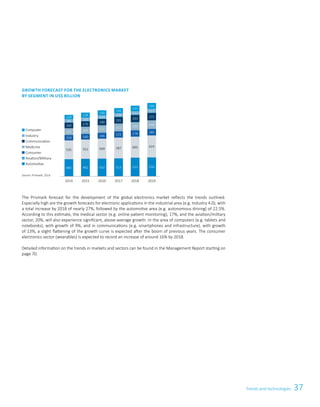
Growth forecast for the electronics market
by segment in US$ billion
The Prismark forecast for the development of the global electronics market reflects the trends outlined.
Especially high are the growth forecasts for electronic applications in the industrial area (e.g. Industry 4.0), with
a total increase by 2018 of nearly 27%, followed by the automotive area (e.g. autonomous driving) of 22.5%.
According to this estimate, the medical sector (e.g. online patient monitoring), 17%, and the aviation/military
sector, 20%, will also experience significant, above-average growth. In the area of computers (e.g. tablets and
notebooks), with growth of 9%, and in communications (e.g. smartphones and infrastructure), with growth
of 13%, a slight flattening of the growth curve is expected after the boom of previous years. The consumer
electronics sector (wearables) is expected to record an increase of around 16% by 2018.
Detailed information on the trends in markets and sectors can be found in the Management Report starting on
page 70.
Source: Prismark, 2014
n Computer
n Industry
n Communication
n Medicine
n Consumer
n Aviation/Military
n Automotive
38 ATS Annual Report 2014/15
Influences and success factors
In addition to the changes outlined above with respect to technologies and areas of application, a number of
influences and success factors will determine the course of business for ATS. The global electronics ­industry
is highly dynamic and is itself influenced by general economic conditions, the willingness of companies to
­invest and consumer sentiment. In addition to these general influences, the printed circuit board industry is
­characterised by intensive competition with approximately 2,800 producers worldwide. ATS has thus been
focused for many years on the technologically high-end area, in which the number of relevant competitors, at
around 10 to 15, is significantly lower.
In this continuously changing environment, ATS has defined critical factors for sustainable success:
§	 Clear focus in the product and technology portfolio
§	 Long-term strategy with sufficient flexibility to be able to anticipate market developments and respond to
market changes
§	 Maximum proximity to customers and a high level of internal market intelligence to detect the trends that
will define the electronics and PCB industries
§	 A diversified and balanced portfolio of customers, applications and technologies in order to take
advantage of the varying seasonality and volatilities in the individual market segments
§	 Rapid implementation of new high-end technologies and processes in the required volume
§	 Operational excellence to ensure high quality and production standards
§	 Competitive site selection
39Business strategy
Business strategy
Taking into account the market potential outlined above and the influences and success factors, the business
strategy of ATS is aimed at a sustainable increase in enterprise value in the interests of all relevant stakeholders.
The following themes are the key cornerstones of this strategy:
§	 Extending technological leadership
- by concentrating on the high-end printed circuit board segment	
-	 by industrialising leading-edge technologies
§	 Long-term, profitable growth
- by concentrating on application areas with attractive growth potential and long-term profitability
- through operational excellence in terms of quality, efficiency, and productivity
§	 Forward-looking human resources strategy
- new capabilities for new technologies: find and retain the best employees through
global prospects for development and outstanding training and continuing education programmes	
-	 diversity as future opportunity
§	 Sustainable business leadership	
-	 through European standards at all sites
- through ambitious key performance indicators for resource consumption and emissions
- through clear commitment to being a good corporate citizen
40
IC Substrate
7/7 μm L/S
ECP/SAP
25/25 μm L/S
Next gen.
­Anylayer+
Substrate
like PCB
30/30 μm L/S
Interposer
40/40 μm L/S
Anylayer
40/40 μm L/S
Microvia/HDI
60/60 μm L/S
Multilayer
100/100 μm L/S
PTH
250/250 μm L/S
ATS Annual Report 2014/15
Rigid Cavity Rigid-Flex Thermal
Manage-
ment
HF Passives
Actives
Sensors
MEMS
Power
Supply
Energy
Harvester
Casing 3D PCB
Diversification:
Additional Functionalities
Com
bing M
iniaturisation and SiB: High Value M
odules
Electrical
Interconnection
Miniaturisation
Roadmap
Functional Modules:
System-in-board (SiB)
System-in-package (SiP)
Miniaturisation
In order to secure and expand our market
position as a leading producer of high-end
printed circuit boards over the long term,
ATS pursues a clear technology strategy. In
this strategy, the central starting point is the
continuing advancement of miniaturisation
through the implementation of finer
structures, the processing of thinner
materials, and the integration of additional
functionality such as thermal solutions,
energy production and the embedding of
passive and active components.
The embedding technology, in particular,
requires a readjustment of the current
business model, in which value is added
through component procurement and
embedding.
The combination of these technological
developments – miniaturisation at the
level of the printed circuit board and IC
substrates – and the implementation of
system-in-board and system-in-package
applications will subsequently enable the
full integration of high-end HDI microvia
technology and embedded component
packaging, leading to highly complex all-in-
one modules. In the illustration below, the
left-hand scale shows the development of
miniaturisation with respect to the density
and intervals of the circuit paths. The
horizontal axis indicates the development
of the “functional integration”. The
combination of these two aspects will lead
to the all-in-one modules mentioned above.
With the entry into IC substrate technology
and the expansion of the Group’s site in
Chongqing through the implementation
of a new level of technology for so-called
substrate-like PCBs, ATS is one of the
first companies globally to establish
the foundation for merging the two
worlds of the printed circuit board and
semiconductor industries within a
competitive environment. In addition to
these aspects, ATS is also involved with
numerous other matters of technology
which, for competitive reasons, are not
be described in detail here. Further
information on research and development
activities can be found in the Management
Report starting on page 94.
Technical evolution and impact on the ATS product portfolio
Future: all-in-one-modules
Modularisation
Technology strategy
41
At ATS, sustainability does not only mean being a good
corporate citizen. Sustainability at ATS is also a profitability
consideration. ATS has therefore introduced European
standards in many areas of environmental protection and
resource consumption at all its locations. These are clearly
shown in key performance indicators: ATS has set as its goal
a reduction in total carbon footprint in kg of CO2 per m2 of
printed circuit board by five percent per year and a reduction
in fresh water consumption per m2 of printed circuit board
by three percent per year. Social responsibility is practised
individually at the sites in the form of numerous projects,
primarily in the area of training based on the strategy „think
global, act local“. Uniting economic, environmental and social
responsibility for the benefit of all stakeholders is the objective
of the ATS sustainability strategy. All action areas, measures
and goals were documented in the first ATS Sustainability
Report in financial year 2013/14. The next Sustainability
Report will be issued in July 2015. Detailed information can
also be found in the Management Report starting on page 91.
ATS as a global technology business in an environment
of constant and significant change, ATS needs the best
educated, most flexible and highly motivated employees for
long-term success. To ensure and continue to develop its
expertise, ATS relies on a training and continuous education
offensive with funding that is steadily being increased.
Specialists are trained and further their education primarily
through internal programmes due to a lack of general
education paths for the PCB industry. Through international
talent programmes, ATS intends to recruit young, mobile
and top-level university graduates as the next generation of
leadership. Reinforcing the common, positive and distinctive
corporate culture (basis: internal survey, February 2015) with
a clear vision and mission, success-oriented management
principles, and an environment of open feedback is just as
much a success factor for ATS as an attractive and excellent
employer as the further promotion of diversity of gender and
culture.
Detailed information on these topics can be found in the
Management Report starting on page 88.
ATS is among the most profitable
companies in the industry and has
distinguished itself for years with a
high EBITDA margin above the industry
average for printed circuit boards and
strong operative cash flow generation. In
order to ensure this profitability in the
future, in combination with sustained
growth, ATS continues to focus on
profitable market segments with
sound prospects for growth and high
technological requirements. An important
milestone in this respect will be the start
of production, in 2016, of IC substrates
and substrate-like PCBs at the site in
Chongqing, China.
The ongoing improvement of the product
mix and optimal management and
balancing of available capacity at all sites
are further important parameters for
the sustainable profitability of ATS. The
site plan plays an important role in this:
ATS will continue to rely on high-volume
production with a limited product mix
in Asia for the relevant cost advantages
and on low-volume production with high
product diversity in Europe. Exceptional
process expertise is the basis for the
quality leadership of ATS: low internal
scrap rates influence EBITDA margins,
and the ratio of employee headcount
– which is rising at a slower pace – to
revenue growth is an expression of high
productivity, among other things.
Key data for management
of the Group:
ATS measures its ability to implement
innovation promptly and in response
to the market using the key indicator
Innovation Revenue Rate (IRR). IRR
represents the share of total revenue
generated from products that have been
introduced in the past three years and
which are distinguished by a high
degree of innovation. Target figure:
IRR above 20%.
For the two additional performance
indicators, ROCE and Cash Earnings, ATS
does not set precise target figures at
present due to the expansion phase for
the two new plants in Chongqing, China.
Using the return on capital employed
(ROCE), ATS measures its yield on the
use of capital: earnings adjusted for the
financial result in relation to the average
interest-bearing capital employed. ROCE
should be clearly above WACC, however,
which averages around 10% in the
industry.
To assess operational and financial
performance, ATS uses the key
figure Cash Earnings, which includes
Group earnings for the year excluding
consideration of depreciation.
Business strategy
Forward-looking human
resources strategy
Sustainable
business leadership
Long-term, profitable growth
42 ATS Annual Report 2014/152 ATS – First choice for advanced applications
Dear shareholders,
The financial year 2014/15 was enormously successful for ATS. In a market environment of strong growth for
ATS customers, and as a result of clear strategic direction combined with operational excellence, ATS was able to
increase all of its key success indicators and not only to maintain the growth trajectory of the previous years but
sharply accelerate it as well. This growth and technological leadership in a competitive environment dominated by
Asian companies is expected to continue with the start of production for the new “IC substrate” technology and
expansion of the production facility in Chongqing, China, for the next generation of printed circuit boards – the
substrate-like printed circuit board.
Setting the strategic direction for development in Chongqing and the specific steps, capital expenditures and financ-
ing issues associated with it was a key focus of the advice provided and decisions made by the Supervisory Board in
the financial year 2014/15. One of these meetings was held at the site of the plant under construction in Chongqing,
which gave all members of the Supervisory Board present an overview of the progress of the project.
Again in the past financial year, the Supervisory Board diligently executed its tasks and duties as required by law, the
Articles of Association, the Austrian Corporate Governance Code (ÖCGK) and its rules of procedure. In the financial
year from 1 April 2014 to 31 March 2015, the Supervisory Board was regularly informed by the Management Board
through an open exchange of information and opinions, as well as comprehensive oral and written reports about
the market situation, strategy, operating and financial position of the Group, its investments in other companies,
staff situation and planned capital expenditure. The Supervisory Board took the respective decisions accordingly.
The Supervisory Board was able to confirm a functioning Issuer Compliance system.
Between meetings of the Supervisory Board, the Chairman of the Supervisory Board was regularly informed by the
Management Board of business developments.
The Supervisory Board met six times during the 2014/15 financial year, with the participation of the Management
Board. Franz Katzbeck was excused from two Supervisory Board meetings; Regina Prehofer, Karin Schaupp and Karl
Fink were each excused from one. During the financial year 2014/15, there were no changes in personnel on the
Supervisory Board. At the 20th Annual General Meeting of ATS on 3 July 2014, there was one re-election in the
course of which Gerhard Pichler was again elected to the Supervisory Board of the Company.
SUPERVISORY BOARD COMMITTEES The Supervisory Board has established an Audit Committee and a
Nomination and Remuneration Committee as standing committees. In the 2014/15 financial year the Supervisory
Board also established a Project Committee to address matters related to debt financing. Each established commit-
tee attended to its individual area in detail and reported accordingly to the Supervisory Board.
The Audit Committee, consisting of Regina Prehofer (Chairwoman), Gerhard Pichler (finance expert), Georg Riedl,
Wolfgang Fleck and Günther Wölfler, focused primarily on the review of the annual and consolidated annual finan-
cial statements for the year ended 31 March 2014 and planning and preparation for the audit of the annual and
consolidated annual financial statements for the financial year 2014/15. Through discussions with the Auditor,
inspection of relevant documents and discussions with the Management Board, it obtained a true and fair view. The
Audit Committee also monitors the effectiveness of the group-wide internal control system and the Group's internal
audit and risk management systems. The Audit Committee reported to the plenary Supervisory Board with respect
to this monitoring and found no deficiencies. The Audit Committee convened twice in the past financial year. The
meetings were chaired by Regina Prehofer, who was regularly involved in quarterly reporting in this capacity and
reported on these matters to the Supervisory Board.
A significant focus of the Supervisory Board with respect to remuneration was the introduction in the financial year
2014/15 of a long-term incentive programme for the Management Board and key staff based on stock appreciation
rights (“SAR”). The programme is a replacement for the stock option scheme that expired with its last distribution
on 1 April 2012. The Nomination and Remuneration Committee comprises the following members:
Report of the Supervisory
Board
43ATS – First choice for advanced applications 3
Hannes Androsch (Chairman), Karl Fink, Albert Hochleitner, Wolfgang Fleck and Günther Wölfler. The Nomination
and Remuneration Committee met three times.
On 19 March 2015 the Supervisory Board resolved to create a Project Committee to oversee further progress with
respect to the implementation of various measures for debt financing, including providing approval for implementa-
tion of the relevant transactions.
The Project Committee consists of Hannes Androsch (Chairman), Willibald Dörflinger, Regina Prehofer, Wolfgang
Fleck and Günther Wölfler. As the Project Committee was formed on 19 March 2015, and thus at the end of the
financial year, it did not meet during the financial year 2014/15. However, it will be ongoing after 31 March 2015
until its dissolution.
SELF-EVALUATION OF THE SUPERVISORY BOARD The Supervisory Board performs an annual self-
evaluation, as it did again in the financial year 2014/15 to ensure the continuing improvement of its working prac-
tices and the fulfilment of its responsibilities to the shareholders and other stakeholders. The annual evaluation
carried out by the Supervisory Board confirmed that its regular practices meet the requirements of the Austrian
Stock Corporation Act and the Austrian Corporate Governance Code (ÖCGK), and that its organisation, work prac-
tices and orientation in the interest of the shareholders and all other stakeholders are effective. The self-evaluation
will continue to constitute an important component of critical review by the Supervisory Board of its own activities.
ANNUAL AND CONSOLIDATED FINANCIAL STATEMENTS The Supervisory Board of ATS pro-
posed that PwC Wirtschaftsprüfung GmbH, Vienna be appointed Company and Group auditors for the financial year
2014/15. The proposal was approved by the Annual General Meeting of 3 July 2014.
The annual financial statements of ATS and the consolidated financial statements for the year ended 31 March
2015 were both audited by PwC Wirtschaftsprüfung GmbH, Vienna, and awarded an unqualified audit report. The
management report and the Group management report for the financial year 2014/15 were consistent with the
annual financial statements and the consolidated financial statements. Based on the prior discussions of the Audit
Committee, and after its own detailed discussions and examination, the Supervisory Board approved the Company's
annual financial statements for the year ended 31 March 2015 in accordance with section 96(4) Austrian Stock
Corporation Act (AktG). Also based on the prior discussions of the Audit Committee, and after its own detailed
consideration and examination, it approved the consolidated financial statements drawn up in accordance with
section 245a Austrian Commercial Code (UGB) and with IFRS, as well as the management report, the consolidated
management report and the corporate governance report. The Supervisory Board review, which included extensive
discussions with the auditors, did not give rise to any objections. Pursuant to the recommendation of the Audit
Committee, the Supervisory Board of ATS will propose to the 21st Annual General Meeting that PwC
Wirtschaftsprüfung GmbH, Vienna be appointed Company and Group auditors for the financial year 2015/16.
The Supervisory Board adopts the Management Board's recommendation for the allocation of profits. Accordingly,
13,986,000.00 € should be distributed as dividends from the reported net profit as at 31 March 2015 amounting to
36,874,815.29 € (whereof distributable: 24,502,815.29 €), which corresponds to 0.36 € per share. The remaining
amount of 22,888,815.29 € should be carried forward.
THANKS TO THE MANAGEMENT BOARD AND ALL ATS EMPLOYEES Finally, the Supervisory
Board would like to express its gratitude and acknowledgement to the entire Management Board and all employees
for their particular achievements and commitments in the past financial year.
On behalf of the Supervisory Board
Leoben-Hinterberg, 8 June 2015
Hannes Androsch
Chairman of the Supervisory Board
Report of the Supervisory Board
44 ATS Annual Report 2014/15
2 ATS – First choice for advanced applications
THE ATS INVESTMENT STORY
Four reasons to invest in ATS:
Sustainable profitability
 One of the most profitable printed circuit board manufacturers in the world through concentration
on the high-end segment
 Strong operative cash flow generation
Unique market position
 Largest European PCB producer
 Technology and quality leader in an environment dominated by competition from Asia
 Balanced industry portfolio
 Global blue chip customers
Long term attractive growth
 Global megatrends in the electronics industry offer enormous potential for ATS (e.g. the Internet
of Things)
 The ATS technology portfolio positions it in market and end-user segments that consistently rec-
ord solid growth
 Entering a new high-end business segment by 2016 (IC Substrates)
Compelling cost advantages
 Ideal production footprint: Asia for high volume and low product mix;
Europe for high product mix and low volumes
 High productivity and efficiency resulting from exceptional process expertise
 Cost structure continuously improved
Investor Relations
FINANCIAL CALENDAR
21st Annual General Meeting
9 July 2015
1st quarter 2015/16
28 July 2015
Ex-dividend date and Dividend
payment date
30 July 2015
2nd quarter 2015/16
27 October 2015
3rd quarter 2015/16
28 January 2016
Annual results 2015/16
10 May 2016
2 ATS – First choice for advanced applications
THE ATS INVESTMENT STORY
Four reasons to invest in ATS:
Sustainable profitability
 One of the most profitable printed circuit board manufacturers in the world through concentration
on the high-end segment
 Strong operative cash flow generation
Unique market position
 Largest European PCB producer
 Technology and quality leader in an environment dominated by competition from Asia
 Balanced industry portfolio
 Global blue chip customers
Long term attractive growth
 Global megatrends in the electronics industry offer enormous potential for ATS (e.g. the Internet
of Things)
 The ATS technology portfolio positions it in market and end-user segments that consistently rec-
ord solid growth
 Entering a new high-end business segment by 2016 (IC Substrates)
Compelling cost advantages
 Ideal production footprint: Asia for high volume and low product mix;
Europe for high product mix and low volumes
 High productivity and efficiency resulting from exceptional process expertise
 Cost structure continuously improved
Investor Relations
FINANCIAL CALENDAR
21st Annual General Meeting
9 July 2015
1st quarter 2015/16
28 July 2015
Ex-dividend date and Dividend
payment date
30 July 2015
2nd quarter 2015/16
27 October 2015
3rd quarter 2015/16
28 January 2016
Annual results 2015/16
10 May 2016
THE ATS INVESTMENT STORY
Four reasons to invest in ATS:
Sustainable profitability
 One of the most profitable printed circuit board manufacturers in the world through concentration
on the high-end segment
 Strong operative cash flow generation
Unique market position
 Largest European PCB producer
 Technology and quality leader in an environment dominated by competition from Asia
 Balanced industry portfolio
 Global blue chip customers
Long term attractive growth
 Global megatrends in the electronics industry offer enormous potential for ATS (e.g. the Internet
of Things)
 The ATS technology portfolio positions it in market and end-user segments that consistently rec-
ord solid growth
 Entering a new high-end business segment by 2016 (IC Substrates)
Compelling cost advantages
 Ideal production footprint: Asia for high volume and low product mix;
Europe for high product mix and low volumes
 High productivity and efficiency resulting from exceptional process expertise
 Cost structure continuously improved
Investor Relations
FINANCIAL CALENDAR
21st Annual General Meeting
9 July 2015
1st quarter 2015/16
28 July 2015
Ex-dividend date and Dividend
payment date
30 July 2015
2nd quarter 2015/16
27 October 2015
3rd quarter 2015/16
28 January 2016
Annual results 2015/16
10 May 2016
45ATS – First choice for advanced applications 3
DEVELOPMENTS IN THE CAPITAL MARKET The financial year 2014/15 was marked by uneven global
economic performance, uncertainty regarding future central bank policies and a series of geopolitical crises.
The original forecasts for growth in Europe were not met – not least due to the Ukraine-Russia crisis. Perfor-
mance on the international stock exchanges, above all in the USA, was shaped by the sustained low interest
rates in the most important national economies. Fears that the US central bank would abandon its expan-
sionary policy caused temporary market corrections, but these did not materialise in the end. The Dow Jones
Industrial (DJI) stock index in the US showed positive performance again in 2014, rising by 7.5% and continu-
ing this trend into the first quarter of 2015 as well. The NASDAQ 100 recorded an increase of 23% between
April 2014 and March 2015 due to strong demand for leading global technology shares. Despite the disap-
pointing economic data, European shares recorded gains during the year, which were encouraged by the
prospect of quantitative easing by the European Central Bank through purchases of government and corpo-
rate bonds. The leading German index, the DAX, broke the 10,000-point mark for the first time in June 2014,
but lost as the year progressed and closed with a gain of 2.7% at year-end. During the first quarter of 2015,
the DAX reached new highs, rising to over 12,000 points. The share index for Europe as a whole, the Euro-
stoxx 50, was unable to fully recover from its low point in October 2014 by the end of the year, resulting in a
gain of 1.2%. For the first quarter of 2015, however, it recorded a gain of 18.6%. The Viennese benchmark
index, the ATX, lost 15.2% in 2014 due to the crisis in Ukraine and the related exposure of numerous issuers –
of financial and real estate shares in particular – to Eastern Europe. Weak economic data also contributed to
the loss. The broader ATX Prime lost 13.5%. However, both indices more than compensated for these losses
in the first quarter of 2015.
CAPITAL MARKET COMMUNICATION The ATS investor relations team is committed to transparent,
proactive and continuous communication with all capital market participants on an equal basis. The aim is to
reinforce confidence in ATS in the long term through comprehensive dialogue and information that is timely
and relevant. The focus is on transparent communication of the corporate strategy, growth path, the associ-
ated opportunities and risks, and current business development. The information available is regularly updat-
ed on our website at www.ats.net/investors/, which has also been optimised for mobile applications. The
ATS Twitter and YouTube channels (@ATS_IR_PR and ATundS, respectively) are also available as a source of
information. In the interest of transparency and equal treatment of all shareholders, ATS broadcasts its
Annual General Meeting and twice-yearly press conferences on the Internet. It is our goal to continuously
improve the dialogue. We look forward to your questions and feedback on our shareholders’ hotline (see
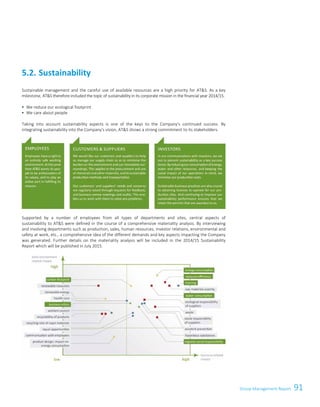
Contact). All shareholders are cordially invited to attend the next Annual General Meeting on 9 July 2015.
Current and complete information in this regard can be found on the website. You can also find the resolu-
tions on the website, as well as information and documents from the last Annual General Meeting.
ATS SHARE PERFORMANCE AND LIQUIDITY The ATS share began the financial year 2014/15 at a
price of € 8.70. It rose to € 10.21 by July, followed by a correction in line with key indices to € 8.60. Subse-
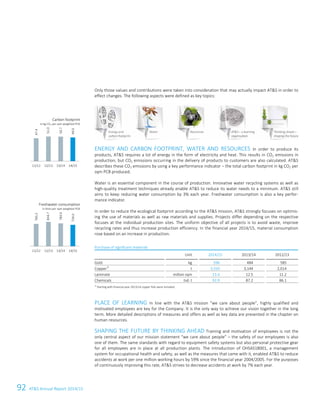
quent performance through to the end of the calendar year 2014 continued to be uneven. Based on the very
good results for the first three quarters of 2014/15, a sharp and sustained upward trend began in late January
2015. The ATS share reached its high for the reporting period of € 15.55 on 17 March 2015, accompanied
by high turnover. It then declined as part of the overall correction to international technology stocks, closing
on 31 March 2015 with a price of € 14.62. This represents a gain of 67.1% compared to the closing price of €
8.76 for 2013/14. The ATS share was thus among those posting the strongest gains in the ATX Prime Index
of the Vienna Stock Exchange. In parallel with this positive share price performance, the number of shares
traded on the exchange also rose significantly. While liquidity for the financial year 2013/14 was still around
50,000 shares per day (single-counted), average daily turnover at the end of the financial year 2014/15 was
67,000 shares (single-counted). ATS shares were traded for a total value of € 171.2 million in the reporting
year, resulting in an average daily turnover of € 693,255.
ATS´ share at a glance
Initial listing
16 July 1999
Frankfurt, “Neuer Markt”
starting 20 May 2008
Vienna, Prime Market
Number of ordinary shares
38,850,000
Securities Identification No.
969985
ISIN-Code
AT0000969985
Ticker symbol
ATS
Reuters
ATS.VI
Bloomberg
ATS AV
Indices
ATSPrime, WBI SME
ATS – First choice for advanced applications 3
DEVELOPMENTS IN THE CAPITAL MARKET The financial year 2014/15 was marked by uneven global
economic performance, uncertainty regarding future central bank policies and a series of geopolitical crises.
The original forecasts for growth in Europe were not met – not least due to the Ukraine-Russia crisis. Perfor-
mance on the international stock exchanges, above all in the USA, was shaped by the sustained low interest
rates in the most important national economies. Fears that the US central bank would abandon its expan-
sionary policy caused temporary market corrections, but these did not materialise in the end. The Dow Jones
Industrial (DJI) stock index in the US showed positive performance again in 2014, rising by 7.5% and continu-
ing this trend into the first quarter of 2015 as well. The NASDAQ 100 recorded an increase of 23% between
April 2014 and March 2015 due to strong demand for leading global technology shares. Despite the disap-
pointing economic data, European shares recorded gains during the year, which were encouraged by the
prospect of quantitative easing by the European Central Bank through purchases of government and corpo-
rate bonds. The leading German index, the DAX, broke the 10,000-point mark for the first time in June 2014,
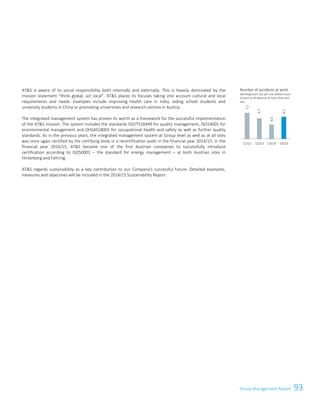
but lost as the year progressed and closed with a gain of 2.7% at year-end. During the first quarter of 2015,
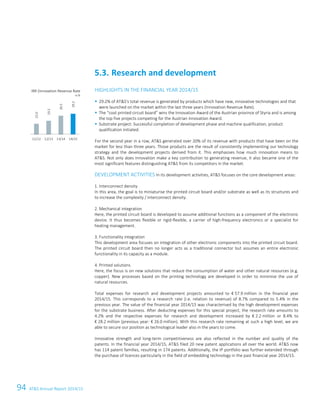
the DAX reached new highs, rising to over 12,000 points. The share index for Europe as a whole, the Euro-
stoxx 50, was unable to fully recover from its low point in October 2014 by the end of the year, resulting in a
gain of 1.2%. For the first quarter of 2015, however, it recorded a gain of 18.6%. The Viennese benchmark
index, the ATX, lost 15.2% in 2014 due to the crisis in Ukraine and the related exposure of numerous issuers –
of financial and real estate shares in particular – to Eastern Europe. Weak economic data also contributed to
the loss. The broader ATX Prime lost 13.5%. However, both indices more than compensated for these losses
in the first quarter of 2015.
CAPITAL MARKET COMMUNICATION The ATS investor relations team is committed to transparent,
proactive and continuous communication with all capital market participants on an equal basis. The aim is to
reinforce confidence in ATS in the long term through comprehensive dialogue and information that is timely
and relevant. The focus is on transparent communication of the corporate strategy, growth path, the associ-
ated opportunities and risks, and current business development. The information available is regularly updat-
ed on our website at www.ats.net/investors/, which has also been optimised for mobile applications. The
ATS Twitter and YouTube channels (@ATS_IR_PR and ATundS, respectively) are also available as a source of
information. In the interest of transparency and equal treatment of all shareholders, ATS broadcasts its
Annual General Meeting and twice-yearly press conferences on the Internet. It is our goal to continuously
improve the dialogue. We look forward to your questions and feedback on our shareholders’ hotline (see
Contact). All shareholders are cordially invited to attend the next Annual General Meeting on 9 July 2015.
Current and complete information in this regard can be found on the website. You can also find the resolu-
tions on the website, as well as information and documents from the last Annual General Meeting.
ATS SHARE PERFORMANCE AND LIQUIDITY The ATS share began the financial year 2014/15 at a
price of € 8.70. It rose to € 10.21 by July, followed by a correction in line with key indices to € 8.60. Subse-
quent performance through to the end of the calendar year 2014 continued to be uneven. Based on the very
good results for the first three quarters of 2014/15, a sharp and sustained upward trend began in late January
2015. The ATS share reached its high for the reporting period of € 15.55 on 17 March 2015, accompanied
by high turnover. It then declined as part of the overall correction to international technology stocks, closing
on 31 March 2015 with a price of € 14.62. This represents a gain of 67.1% compared to the closing price of €
8.76 for 2013/14. The ATS share was thus among those posting the strongest gains in the ATX Prime Index
of the Vienna Stock Exchange. In parallel with this positive share price performance, the number of shares
traded on the exchange also rose significantly. While liquidity for the financial year 2013/14 was still around
50,000 shares per day (single-counted), average daily turnover at the end of the financial year 2014/15 was
67,000 shares (single-counted). ATS shares were traded for a total value of € 171.2 million in the reporting
year, resulting in an average daily turnover of € 693,255.
ATS´ share at a glance
Initial listing
16 July 1999
Frankfurt, “Neuer Markt”
starting 20 May 2008
Vienna, Prime Market
Number of ordinary shares
38,850,000
Securities Identification No.
969985
ISIN-Code
AT0000969985
Ticker symbol
ATS
Reuters
ATS.VI
Bloomberg
ATS AV
Indices
ATSPrime, WBI SME
Investor Relations
46 ATS Annual Report 2014/15
Key Stock figures Unit 2014/15 2013/14 2012/13
Close € 14.62 8.75 6.79
High € 15.55 9.12 9.60
Low € 7.68 6.15 6.25
Market capitalisation, end of reporting period € in millions 568.0 339.9 158.4
Average share turnover per day € in thousands 693.3 496.6 177.3
Average number of shares traded per day - 67,000 50,200 22,600
Dividend per share 1)
€ 0.36 0.20 0.20
Dividend yield (at the closing price) % 2.5% 2.3% 2.9%
Earnings per share € 1.78 1.24 0.62
Carrying value per share € 15.56 10.06 13.07
Price-Earnings ratio per share - 8.21 7.06 10.95
1)
2014/15: Proposal for the Annual General Meeting on 9 July 2015.
DIVIDEND POLICY Through to the financial year 2011/12, the amount of the ATS dividend was tied to
the cash earnings key figure. On average, approximately 10% of cash earnings was distributed as dividends.
With the start of the IC substrates investment project in Chongqing, this dividend policy was temporarily
suspended and replaced by a fixed amount of € 0.20 per share for the financial years 2012/13 and 2013/14.
The Management Board of ATS will propose a dividend of € 0.36 amount for the financial year 2014/15 to
the Annual General Meeting on 9 July 2015.A change to this distribution policy will be considered upon com-
pletion of the Chongqing project at the soonest.
4 ATS – First choice for advanced applications
47ATS – First choice for advanced applications 5
ANALYSIS OF THE ATS SHARE As at 31 March 2015, performance of the ATS share was analysed by
nine investment banks:
 Berenberg Bank
 Deutsche Bank
 Erste Group
 Hauck  Aufhäuser
 HSBC
 Kepler Cheuvreux
 Oddo Seydler Research
 Raiffeisen Centrobank
 Wood  Company
Three investment companies initiated coverage of the ATS share in 2014/15. Both Wood  Company and
Oddo Seydler Research as well as HSBC rate the share as a buy in their initial recommendation. In total, six
analysts gave the ATS share a buy recommendation and three gave a hold rating. The names of the
analysts are available on the website www.ats.net/investors/. In a peer group dominated by Asian companies,
ATS has the third largest number of analysts on coverage.
ROAD SHOWS In the financial year 2014/15, ATS provided information to existing and potential inves-
tors, both private and institutional, as well as analysts as part of 18 road shows, investor conferences and
capital market events across all capital market centres in Europe, Asia and the USA. In addition, the Manage-
ment Board and Investor Relations team sought dialogue with institutional investors and analysts through
numerous one-on-one meetings and teleconferences. Discussed in these meetings were current trends in the
markets and technology, the development of customer segments, performance in core businesses, and pro-
gress in the new business area, IC substrates. The increased visibility among potential and existing investors
will continue to expand understanding of the ATS business model and future strategy, and ultimately facili-
tate a realistic reflection of its business success in the performance of its share price.
CONTACT/SHAREHOLDER HOTLINE
Elke Koch
Phone.: + 43 (0) 38 42 / 200 - 5925
E-Mail: ir@ats.net
Investor Relations
4848 ATS Annual Report 2014/15
Corporate Governance Report
ATS Annual Report 2014/15
49Corporate Governance Report
Principles and Corporate Governance Declaration   50
ATS AG Management Board   53
ATS AG Supervisory Board   55
	 Composition   55
	 Independence of Supervisory Board members   58
	Diversity   58
	 Agreements requiring approval   59
	 Committees   59
Remuneration report: Management and Supervisory Boards   61
Directors’ Holdings  Dealings   65
Other codes of conduct   66
	 Increasing the representation of women in senior management   66
	 ATS Code of Business Ethics and Conduct   66
	 ATS Compliance Code   66
Table of contents
50 ATS Annual Report 2014/154 Corporate Governance Report
AT  S Austria Technologie  Systemtechnik AG (ATS) declares its compliance with the Austrian Corporate
Governance Code (ÖCGK) as amended in January 2015, and submits this corporate governance report in
accordance with section 243b Austrian Commercial Code (UGB). This report also forms part of the Annual
Report for the financial year 2014/15.
CORPORATE GOVERNANCE CODE In Austria, the Corporate Governance Code drawn up by the
Working Group for Corporate Governance under the guidance of the government authorities responsible for
the Austrian capital markets has been in force since 1 October 2002. Since then it has been reviewed annually
in light of national and international developments, and amended where necessary. Such amendment
occurred most recently in order to implement the recommendation of the EU Commission of 9 April 2014 on
the quality of corporate governance reporting ('comply or explain') and to take account of the new position
taken by the Austrian Financial Reporting and Auditing Committee (AFRAC) with respect to the preparation
and review of corporate governance reports pursuant to section 243b UGB. The amended Code is applicable
to financial years starting after 31 December 2014.
The objective of the ÖCGK is responsible management and control of companies and groups for the purpose
of creating sustainable, long-term value with a high level of transparency for all stakeholders of the business.
The basis of the Code is provided by the provisions of Austrian company, stock exchange and capital markets
legislation, the EU recommendations concerning the responsibilities of supervisory board members and the
remuneration of directors, and the principles of the OECD guidelines for corporate governance.
The rules of the ÖCGK are divided into three categories:
 L-Rules (legal requirements): rules based on mandatory statutory requirements
 C-Rules (comply or explain): rules from which any deviation must be explained
 R-Rules (recommendations): rules in the nature of recommendations, where non-compliance requires
neither disclosure nor explanation.
The version of the Code currently in force can be downloaded from the Working Group's website at
www.corporate-governance.at. An English translation of the Code and interpretations of the Code prepared
by the Working Group are also available there.
ATS shares have been listed on the Vienna Stock Exchange since 20 May 2008. In order to qualify for
inclusion in the Prime Market, companies must submit a declaration of commitment to comply with the
ÖCGK. ATS has therefore expressly subscribed to the ÖCGK since its shares were listed.
As of 31 March 2015, ATS complies with all required provisions of the Code as amended in January 2015
with the following explanations:
C-RULE 18A Internal Audit conducts regular group-wide reviews based on an audit plan approved by the
Audit Committee, which includes measures to fight corruption in the Group. It reports to the Audit
Committee on this matter regularly and also if warranted by particular events.
C-RULES 27–28A AND ALL RELATED PROVISIONS These rules were amended as part of the revision
to the ÖCGK in December 2009 and came into force on 1 January 2010. Rules 27, 27a and 28 contained in the
version of January 2010 apply only to contracts concluded after 31 December 2009. C-Rules 27-28a were
therefore not applicable with respect to the original agreement appointing Mr Moitzi to the Management
Board and were also not applied in full when the same agreement was extended in 2013. Due to the short
period between the most recent revision of the Austrian Corporate Governance Code and the appointment
of Mr Gerstenmayer as Chairman of the Management Board of ATS in mid-December 2009, and in order to
Principles and
Corporate Governance
Declaration
Principles and
Corporate Governance Declaration
51Corporate Governance Report
avoid any departure from the remuneration arrangements applicable to the appointment of Mr Moitzi, the
new rules were not taken into account when the agreement with Mr Gerstenmayer was signed in January
2010 nor when his Management Board contract was extended in 2013. This was not considered necessary
because the Group’s stock option scheme had already expired (see below). Furthermore, the Management
Board and Supervisory Board work closely together on the long-term development of the Group, and the
Supervisory Board and Nomination and Remuneration Committee regularly analyse the broader long-term
orientation of Management Board remuneration. The following deviations from the rules currently require
explanation:
The Group's now-expired stock option scheme did not require the beneficiaries to hold shares in the Group,
and provided only for a vesting period of two years before a part of the options acquired could be exercised.
This stock option scheme has expired, with the last allocation being made on 1 April 2012. Options granted
under this scheme may still be exercised until 31 March 2017.
After extensive planning, a long-term incentive (LTI) programme for the Management Board and key staff
was implemented by resolution of the Supervisory Board on 3 July 2014 as a replacement for the stock option
scheme that expired with the last distribution on 1 April 2012. The new programme is based on stock
appreciation rights (SAR). The Management Board and Supervisory Board also work continuously to raise
the performance of ATS Group still further with respect to non-financial targets. However, in order to
maintain the transparency and measurability of target achievement as it relates to variable long-term
remuneration, no fixed non-financial criteria for remuneration under the long-term incentive programme are
stipulated. Details of this long-term incentive programme can be found in the section on Management Board
remuneration.
The portion of variable remuneration of the Management Board not in the form of stock options or SARs, but
based instead on the results of the financial year, requires achievement of three near-term performance
measures defined in the budget for the applicable financial year: return on capital employed (ROCE), cash
earnings (CE), each with a 45% weighting, and the innovation revenue rate (IRR), with a 10% weighting. The
basic prerequisite for awarding this variable remuneration is positive EBIT for the Group as a whole for the
financial year and attainment of the target EBIT for the Group as a whole by at least 70% (the hurdle rate).
In the event that the targets for ROCE, CE and IRR are exceeded, bonuses are restricted to a maximum of
200% of the annual bonus set out in the contract of employment. The inclusion of IRR is of major importance
in giving variable remuneration a long-term focus because innovative strength – the development of new
technologies, products or product types – is a crucial factor for the future business success of the Group. It
can also be reliably measured: IRR represents the share of total revenue generated from products introduced
in the past three years. The three-year reference period provides a long-term component of variable
remuneration.
Management Board members are entitled to termination benefits in accordance with the Salaried Employees
Act (AngG), applied mutatis mutandis (“old system for severance pay”), if their appointments are terminated.
In the event of premature termination initiated by a Management Board member for reasonable cause, or if
the function is eliminated for legal reasons, remuneration is payable until the end of the appointment
contract, and not necessarily for a maximum of two years. Where a Management Board member resigns or is
removed from office for severe breach of duty, and in the case of death, payment of salary ceases at the end
of the applicable month. Compensation payments in cases of early termination of Management Board
appointments, even without good cause, could exceed more than two years' total remuneration in
exceptional cases subject to termination provisions under the Salaried Employees Act.
C-RULE 62 In derogation of C-Rule 62, ATS has not commissioned an evaluation by an external institution
of its compliance with the ÖCGK at least every three years nor published a report on the findings in the
Corporate Governance Report. This C-Rule of the Code as amended in January 2015 applies to financial years
starting after 31 December 2014. However, this provision, which was changed from a recommendation (R-
Corporate Governance Report 5
52 ATS Annual Report 2014/15
Rule) to a C-Rule taking effect with the ÖCGK as amended in January 2015, was adopted insofar as an
evaluation for the financial year 2014/15 was conducted by KPMG Austria GmbH Wirtschaftsprüfungs- und
Steuerberatungsgesellschaft, whose registered office is in 1090 Vienna. KPMG Austria GmbH
Wirtschaftsprüfungs- und Steuerberatungsgesellschaft has submitted a corresponding report. In the future,
compliance with the ÖCGK will be evaluated by an external institution at least every three years and a report
on the findings will be published in the Corporate Governance Report.
For the Corporate Governance Report for financial year 2014/15, the following excerpt from the report by
KPMG Austria GmbH Wirtschaftsprüfungs- und Steuerberatungsgesellschaft is presented:
Review of compliance with the C-Rules of the Corporate Governance Code – examination of relevant
documents and the website of ATS by random sample
Based on the review of compliance with the rules of the Austrian Corporate Governance Code, the following
conclusions can be made:
 In the course of the audit procedures applied, no facts – with the exception of those deviations
from C-Rules which were explained by ATS – have come to our attention that are inconsistent
with compliance with the remaining C-Rules of the Austrian Corporate Governance Code.
 The information referred to in the C-Rules of the Austrian Corporate Governance Code on the
website of ATS was published in a materially current and complete manner.
 We encountered no facts in our audit procedures that contradict the information provided to us.
6 Corporate Governance Report
53Corporate Governance Report
The Management Board is the collective executive body responsible for the management of the Group. Each
member of the Management Board is also responsible for defined areas of the business in addition to their
collective responsibility. Management Board members have a duty to keep each other informed of all
important business events and transactions. Fundamental issues of business policy and major decisions
require the joint decision of all Management Board members. Meetings of the Management Board are
characterised by a culture of open discussion. If unanimous agreement is not reached on such decisions, the
Chairman of the Supervisory Board must be informed without delay. The Supervisory Board must also be
informed of all proposed decisions with far-reaching consequences. The Management Board is required to
obtain the prior consent of the Supervisory Board for business transactions as stipulated by law and the
Articles of Association or rules and procedure issued by the Supervisory Board to the Management Board.
Additionally, Internal Audit reports directly to the Management Board. The audit plan and any material
outcomes must be reported to the Audit Committee at least once a year. The rules and procedures of ATS's
Management Board require the Board to meet at least once a month. In the past financial year there were a
total of 21 Management Board meetings. Written minutes of all Management Board meetings and decisions
are required.
As at 31 March 2015 and for the entire reporting period, the Management Board of ATS was composed of
Andreas Gerstenmayer as Chairman (CEO), Karl Asamer as Chief Financial Officer (CFO) and Heinz Moitzi as
Chief Operating Officer (COO).
In addition to the statutory collective responsibility, functional responsibility is allocated to the members of
the Management Board as follows:
a) Andreas Gerstenmayer is Chairman of the Management Board (CEO) and responsible for:
 Sales and Marketing
 Human Resources
 Investor Relations, Public Relations and Internal
Communications
 Business Development and Strategy
 Compliance
 CSR and Sustainability
b) Karl Asamer is Deputy Chairman of the Management Board with responsibility as CFO for:
 Finance and Accounting
 Group Accounting
 Tax
 Treasury
 Controlling
 Legal affairs, Risk Management and Internal Audit
 IT
 Procurement
c) Heinz Moitzi is COO, with responsibility for:
 Research and Development (RD)
 Operations
 Quality Management
 Business Process Excellence
 Environment
 Safety
ATS AG Management Board
54 ATS Annual Report 2014/15
Mr Gerstenmayer was born on 18 February 1965 and is a German citizen. He is a graduate of the Production
Engineering programme at Rosenheim University of Applied Sciences. In 1990, he joined Siemens in
Germany, working first in lighting and then holding various management positions in the Siemens Group. In
2003, he was appointed Managing Director of Siemens Transportation Systems GmbH Austria and CEO of
Business Unit Bogies Graz (world headquarters). He was first appointed to the Management Board on
1 February 2010 and his current term ends on 31 January 2018. Mr Gerstenmayer holds no supervisory board
memberships or similar positions in other companies in Austria or abroad that are not included in the
consolidated financial statements. On 26 January 2012, the Provincial Government of Styria passed a
resolution appointing Mr Gerstenmayer to the advisory committee of the Styrian Research Council
(Forschungsrat Steiermark).
Mr Asamer was born on 19 January 1970. He has a degree in business administration from Johannes Kepler
University in Linz. Before joining ATS, he worked for the Geka Group in Bechhofen, Germany, where he was
managing partner. Prior to that, his responsibilities included financial management at Sell GmbH, the leading
manufacturer of aircraft galleys for wide-body aircraft, and Magna Closures Europe, a division of automotive
components supplier Magna. Mr Asamer is managing partner of Asamer GmbH, located in Ansbach, Germany.
He became a member of the Management Board of ATS on 1 April 2014. His current term ends on
31 March 2017. Mr Asamer holds no supervisory board memberships or similar positions in other companies
in Austria or abroad that are not included in the consolidated financial statements.
Mr Moitzi, born on 5 July 1956, studied electrical installation with Stadtwerke Judenburg (Judenburg municipal
utility company) from 1971 to 1975. From 1976 to 1981 he attended the Austrian higher technical college
(HTBL), where he completed his certificate in electrical engineering. In 1981 he was a measurement
engineer at the Leoben University of Mining and Metallurgy. Mr Moitzi has been with ATS since 1981, first
as head of the mechanics and electroplating department, then as production and plant manager at Leoben-
Hinterberg. From 2001 to 2004 he was project leader and COO of ATS in Shanghai. Upon his return he
assumed the position of Vice President of Production. He was first appointed to the Management Board on
1 April 2005, and his current term ends on 31 March 2018. Mr Moitzi holds no supervisory board
memberships or similar positions in other companies in Austria or abroad that are not included in the
consolidated financial statements.
55Corporate Governance Report
ATS AG Supervisory Board
Date of birth Date of first appointment End of current appointment
Independent
according to
OECKG rule
Hannes Androsch 18.04.1938 30.09.19951)
21st AGM 20151)
-
Willibald Dörflinger 20.05.1950 05.07.2005 21st AGM 2015 53, 54
Regina Prehofer 02.08.1956 07.07.2011 22nd AGM 2016 53, 54
Karl Fink 22.08.1945 05.07.2005 21st AGM 2015 53, 54
Albert Hochleitner 04.07.1940 05.07.2005 21st AGM 2015 53, 54
Gerhard Pichler 30.05.1948 02.07.2009 25th AGM 2019 53
Georg Riedl 30.10.1959 28.05.1999 22nd AGM 2016 53
Karin Schaupp 23.01.1950 07.07.2011 22nd AGM 2016 53, 54
Wolfgang Fleck 15.06.1962 03.09.20082)
n.a.
Sabine Fussi 12.10.1969 14.09.20112)
n.a.
Franz Katzbeck 11.02.1964 15.10.20132)
n.a.
Günther Wölfler 21.10.1960 10.06.20092)
n.a.
1)
ATS was originally established as a private limited company (GmbH). The shareholders' meeting of 23 June 1995 passed a resolution to change the company into
a public limited company (AG) and appointed Supervisory Board members including Hannes Androsch. The AG was registered in the Register of Companies on 30
September 1995.
2)
Appointed by the Works Council; date of first appointment in this case is either the date of the first Supervisory Board meeting attended or the date of notification
to the Supervisory Board of the appointment.
The Supervisory Board monitors and supervises Management, and is responsible for decisions that are of
fundamental importance to, or involve the strategic focus of, the Group.
Throughout the financial year ended 31 March 2015, the Supervisory Board received written and oral reports
from the Management Board on the Group's policies and performance, and was closely involved in all
business issues. The Supervisory Board met six times during the financial year 2014/15, with the participation
of the Management Board. One of these meetings was held at the site of the production facility under
construction in Chongqing (China), giving all members of the Supervisory Board a first-hand view of the
project's progress.
In these meetings, the Management Board and the Supervisory Board discussed the economic position of
ATS Group in depth. As part of the Group's ongoing reporting process and at all board meetings, the
Management Board gave the Supervisory Board comprehensive reports on the Group's operating and
financial position, and on its investments in other companies, staff situation and planned capital expenditure.
In-depth discussions focused primarily on the strategic entry into the IC substrate market as part of a
partnership with a leading semiconductor manufacturer and on the broader direction of the new production
facility in Chongqing, China.
ATS's commitment to the principles of good governance is reflected in the open discussions that take place
within and between the Management Board and the Supervisory Board.
COMPOSITION
SHAREHOLDER REPRESENTATIVES
Hannes Androsch, Chairman of the Supervisory Board, was first appointed on 30 September 1995. His current
appointment runs until the 21st Annual General Meeting in 2015.
He is an industrialist who, from 1970 to 1981, was Austrian Federal Minister of Finance. Between 1976 and
1981, he was also Vice Chancellor of the Republic of Austria. From July 1981 until 1988 he was Managing
ATS AG Supervisory Board
Date of birth Date of first appointment End of current appointment
Independent
according to
OECKG rule
Hannes Androsch 18.04.1938 30.09.19951)
21st AGM 20151)
-
Willibald Dörflinger 20.05.1950 05.07.2005 21st AGM 2015 53, 54
Regina Prehofer 02.08.1956 07.07.2011 22nd AGM 2016 53, 54
Karl Fink 22.08.1945 05.07.2005 21st AGM 2015 53, 54
Albert Hochleitner 04.07.1940 05.07.2005 21st AGM 2015 53, 54
Gerhard Pichler 30.05.1948 02.07.2009 25th AGM 2019 53
Georg Riedl 30.10.1959 28.05.1999 22nd AGM 2016 53
Karin Schaupp 23.01.1950 07.07.2011 22nd AGM 2016 53, 54
Wolfgang Fleck 15.06.1962 03.09.20082)
n.a.
Sabine Fussi 12.10.1969 14.09.20112)
n.a.
Franz Katzbeck 11.02.1964 15.10.20132)
n.a.
Günther Wölfler 21.10.1960 10.06.20092)
n.a.
1)
ATS was originally established as a private limited company (GmbH). The shareholders' meeting of 23 June 1995 passed a resolution to change the company into
a public limited company (AG) and appointed Supervisory Board members including Hannes Androsch. The AG was registered in the Register of Companies on
30 September 1995.
2)
Appointed by the Works Council; date of first appointment in this case is either the date of the first Supervisory Board meeting attended or the date of notification
to the Supervisory Board of the appointment.
The Supervisory Board monitors and supervises Management, and is responsible for decisions that are of
fundamental importance to, or involve the strategic focus of, the Group.
Throughout the financial year ended 31 March 2015, the Supervisory Board received written and oral reports
from the Management Board on the Group's policies and performance, and was closely involved in all
business issues. The Supervisory Board met six times during the financial year 2014/15, with the participation
of the Management Board. One of these meetings was held at the site of the production facility under
construction in Chongqing (China), giving all members of the Supervisory Board a first-hand view of the
project's progress.
In these meetings, the Management Board and the Supervisory Board discussed the economic position of
ATS Group in depth. As part of the Group's ongoing reporting process and at all board meetings, the
Management Board gave the Supervisory Board comprehensive reports on the Group's operating and
financial position, and on its investments in other companies, staff situation and planned capital expenditure.
In-depth discussions focused primarily on the strategic entry into the IC substrate market as part of a
partnership with a leading semiconductor manufacturer and on the broader direction of the new production
facility in Chongqing, China.
ATS's commitment to the principles of good governance is reflected in the open discussions that take place
within and between the Management Board and the Supervisory Board.
COMPOSITION
SHAREHOLDER REPRESENTATIVES
Hannes Androsch, Chairman of the Supervisory Board, was first appointed on 30 September 1995. His
current appointment runs until the 21st Annual General Meeting in 2015.
He is an industrialist who, from 1970 to 1981, was Austrian Federal Minister of Finance. Between 1976 and
1981, he was also Vice Chancellor of the Republic of Austria. From July 1981 until 1988 he was Managing
ATS AG Supervisory Board
56 ATS Annual Report 2014/15
Director of Creditanstalt-Bankverein. In 1994, together with Willibald Dörflinger and Helmut Zoidl, he carried
out a management buyout of ATS. Hannes Androsch holds interests in a number of well-known Austrian
businesses.
Willibald Dörflinger, First Deputy Chairman of the Supervisory Board, was initially appointed to the Board on
5 July 2005. His current appointment runs until the 21st Annual General Meeting in 2015.
He began his professional career in 1972 at M. Schmid  Söhne, before moving to Honesta, Holz- und
Kunststoffwarenindustrie in 1974. In 1978 he became head of technical procurement at EUMIG Elektrizitäts-
und Metallwaren Industrie GesmbH; from 1980 he was head of the department for circuit boards and surface
technology, and Managing Director from 1986 to 1990. From 1990 to 1994 Mr Dörflinger was a member of
the ATS Management Board as well as Managing Director of EUMIG Fohnsdorf Industrie GmbH. In 1994 he
joined Hannes Androsch and Helmut Zoidl in the management buyout of ATS. Until 2005, he served first as
Managing Director, then became a member and finally Chairman of the Management Board. In 2005 he
joined ATS's Supervisory Board.
Other supervisory board or similar positions held by Mr Dörflinger at listed companies:
 HWA AG
Regina Prehofer, Second Deputy Chairwoman of the Supervisory Board, was first appointed to the Board on
7 July 2011. Her current appointment runs until the 22nd Annual General Meeting in 2016.
Regina Prehofer studied commerce and law in Vienna. She started her career in 1981 at Oesterreichische
Kontrollbank. In 1987 she joined Creditanstalt, where she held various managerial positions in the bank's
corporate customer segment. In 2003 she was appointed to the Management Board of Bank Austria
Creditanstalt AG, where she was responsible for corporate customers and Eastern European markets. From
2006 to 2008 she was CEO of UniCredit Global Leasing, in addition to her Management Board responsibilities
in Austria. This appointment gave her overall responsibility for UniCredit Group's leasing operations. In
September 2008 she moved to the Management Board of BAWAG P.S.K. where she headed the bank's retail
and corporate customer activities. In May 2011 she was appointed Vice Rector with responsibility for
infrastructure at the Vienna University of Economics and Business Administration. In October 2011 she was
also appointed Vice Rector with responsibility for finance.
Other supervisory board or similar positions held by Regina Prehofer at listed companies:
 Wienerberger AG (Chairwoman of Supervisory Board since December 2013)
Karl Fink was first appointed on 5 July 2005. His current appointment runs until the 21st Annual General
Meeting in 2015.
He graduated in business studies from the Vienna University of Economics and Business in 1971. From 1971
to 1975 he worked for Marubeni Corporation in international commodities trading, before moving to Wiener
Städtische Wechselseitige Versicherungsanstalt in Vienna. Between 1979 and 1987 he was Chairman of the
Management Board of Interrisk - Internationale Versicherungs-Aktiengesellschaft. In 1987 he became a
member of the Management Board of Wiener Städtische Allgemeine Versicherungs AG and Deputy Managing
Director in July 2004. In October 2007 he was appointed Managing Director of Wiener Städtische
Versicherung AG, Vienna Insurance Group. Mr Fink retired from the Vienna Insurance Group's Managing
Board on 30 September 2009. He is a member of the Management Board of Wiener Städtische
Versicherungsverein, the principal shareholder in Vienna Insurance Group, and holds a number of supervisory
and consultative positions within that Group. He is also honorary consul of Montenegro.
Other supervisory board or similar positions held by Mr Fink at listed companies:
 Wienerberger AG
57Corporate Governance Report
Albert Hochleitner was first appointed on 5 July 2005. His current appointment runs until the 21st Annual
General Meeting in 2015.
Mr Hochleitner completed his studies in engineering physics at Vienna University of Technology in 1965. In
the same year he joined the Siemens Group's low voltage works in Vienna. In 1984 he was appointed
Chairman of the Management Board of Uher AG. In 1988 he joined Siemens AG, where he was head of the
electric motors business in the automotive technology sector based in Wurzburg. In October 1992 he became
a member of the Management Board of Siemens AG Austria. From 1994 he was Chairman of the
Management Board, before becoming a member of the Supervisory Board of Siemens AG in 2005, which he
left 2010 because of reaching the applicable age limit for members of the Supervisory Board.
Gerhard Pichler was first appointed on 2 July 2009. His current appointment runs until the 25th Annual
General Meeting in 2019.
He studied business administration at the Vienna University of Economics and Business. A certified auditor
and tax adviser, he has been Managing Director of CONSULTATIO Wirtschaftsprüfungsgesellschaft m.b.H.
since 1986, and Managing Partner of the group since 1995.
Georg Riedl was first appointed on 28 May 1999. His current appointment runs until the 22nd Annual General
Meeting in 2016.
Georg Riedl acquired his doctorate in law in 1984 from the University of Vienna. In 1991 he commenced
independent practice at Riedl  Ringhofer. He has been in independent practice since 2013 at the law office
of Frotz Riedl Rechtsanwälte. He specialises in business, commercial, corporate, foundation and tax law,
mergers and acquisitions, and contract law.
Other supervisory board or similar positions held by Mr Riedl at listed companies:
 Bwin.Party Digital Entertainment Plc
 Vienna Insurance Group AG
Karin Schaupp was first appointed on 7 July 2011. Her current appointment runs until the 22nd Annual
General Meeting in 2016.
Karin Schaupp earned her doctorate at the Karl Franzens Universitat Graz in 1978 and began her career as a
university research assistant at the Institute of Pharmaceutical Chemistry. In 1980 she started her career in
industry as Head of Analytics at Leopold Pharma GmbH. After holding various research, development and
product management posts in the international pharmaceuticals industry, she was appointed CEO of
Fresenius Kabi Austria GmbH in 1997. In 1999 she became regional manager for Austria and Southeastern
Europe. In 2000 she was appointed to the management board of Fresenius Kabi AG, Bad Homburg, with
responsibility for worldwide operations. She has been an independent consultant since 2003, with a focus on
strategic business development and innovation transfer.
Other supervisory board or similar positions held by Ms Schaupp at listed companies:
 BDI - BioEnergy International AG
EMPLOYEE REPRESENTATIVES
Employee participation on supervisory boards and their committees is mandated by law and forms part of the
Austrian corporate governance system. Employee representatives are entitled to appoint from among
themselves one Supervisory Board member for every two Supervisory Board members elected by the General
Meeting. If there is an odd number of shareholders' representatives, the number of employee
representatives is rounded up. This one-third representation also applies to all Supervisory Board
58 ATS Annual Report 2014/15
committees, with the exception of meetings and votes concerning the relationship between the company
and its management board members. Resolutions appointing or dismissing a management board member
and the granting of stock options in the company are also excepted. The Group Works Council meets
regularly with the Management Board. These meetings facilitate the exchange of information on
developments in the Group which have a direct bearing on employees.
Wolfgang Fleck, Sabine Fussi, Franz Katzbeck and Günther Wölfler have been appointed to the Supervisory
Board by the Works Council (as at 31 March 2015).
Additional information on the Supervisory Board and its composition is available online at
www.ats.net/company/supervisory-board/.
INDEPENDENCE OF SUPERVISORY BOARD MEMBERS The ÖCGK specifies that the majority of
Supervisory Board members representing the shareholders must be independent. In accordance with C-Rule
53, the Supervisory Board has established the following criteria to be used in determining the independence
of its members. Supervisory Board members are to be regarded as independent if they have no business or
personal relationships with the Group or its Management Board which could be cause for material conflicts of
interest and therefore liable to influence the behaviour of the member in question. The following criteria are
applied in determining the independence of Supervisory Board members:
 The Supervisory Board member was neither a member of the Management Board nor a senior manager of
the Group or one of its subsidiaries in the past five years.
 The Supervisory Board member neither had during the last financial year nor currently has a business
relationship with the Group or any of its subsidiaries of material significance to that member. This also
applies to business relationships between ATS Group and enterprises in which the Supervisory Board
member has a significant economic interest.
 During the last three years, the Supervisory Board member was neither a statutory auditor of the Group,
nor a person with an interest in the audit firm, nor an employee of any such firm.
 The Supervisory Board member is not a member of a management board of another company in which a
member of ATS's Management Board is a member of that company's supervisory board.
 The Supervisory Board member has not been a member of the Supervisory Board for longer than 15 years.
This does not apply to Supervisory Board members who are shareholders with entrepreneurial interests in
the Group, or who represent the interests of such shareholders.
 The Supervisory Board member is not a close family relative (direct descendant, spouse, life partner,
parent, uncle, aunt, sibling, nephew or niece) of a Management Board member or of any person in a
position described in the foregoing points.
In the meeting of 19 March 2015, the members of the Supervisory Board representing shareholder interests
each declared whether they were independent as determined by the above criteria. Seven of the eight
members of the ATS AG Supervisory Board representing shareholder interests declared that they were
independent. Hannes Androsch declared that he was not independent.
C-Rule 54 specifies that, for companies with a free float in excess of 50%, at least two Supervisory Board
members who are independent under C–Rule 53 should also not be shareholders with interests in excess of
10%, or representatives of such interests. Five of the eight Supervisory Board members representing the
shareholders – Regina Prehofer, Karin Schaupp, Willibald Dörflinger, Karl Fink and Albert Hochleitner –
declared themselves independent within the meaning of C-Rule 54.
DIVERSITY Expertise and management experience are vital considerations when selecting members of the
Supervisory Board. Diversity is also a consideration in its composition. Three members of the Supervisory
Board are women, representing a proportion of female members of 25% – significantly above the Austrian
59Corporate Governance Report
average. The age of Supervisory Board members ranges from 45 to 77. All members of the Supervisory Board
representing shareholder interests have extensive experience in international business.
AGREEMENTS REQUIRING APPROVAL In connection with various projects, the Group obtained
the services from consulting companies where the Chairman of the Supervisory Board Hannes Androsch as
member of the management board has full authority to act on behalf of the company (AIC Androsch
International Management Consulting GmbH) and where the First Deputy Chairman of the Supervisory Board
Willibald Dörflinger as member of the management board has full authority to act on behalf of the company
(Dörflinger Management  Beteiligungs GmbH) or by Supervisory Board members (Dörflinger Management 
Beteiligungs GmbH). The Group optained legal services from Frotz Riedl Rechtsanwälte, where Member of
the Supervisory Board Georg Riedl works as attoreney:
in Tsd. € 2014/15 2013/14
AIC Androsch International Management Consulting GmbH 380 387
Dörflinger Management  Beteiligungs GmbH 8 5
Frotz Riedl Rechtsanwälte 3 6
391 398
COMMITTEES In order to provide effective support and to properly address complex technical matters,
the Supervisory Board has established two committees for in-depth focus on particular issues and regular
reporting to the Supervisory Board. In the financial year 2014/15 the Supervisory Board also established a
Project Committee to review matters related to debt financing.
AUDIT COMMITTEE In the financial year under review, the Audit Committee comprised:
 Regina Prehofer (Chairwoman)
 Gerhard Pichler (finance expert)
 Georg Riedl
 Wolfgang Fleck
 Günther Wölfler
The Audit Committee monitors the accounting process and the work of the statutory auditor. It monitors and
reviews the statutory auditor's independence, reviews and prepares the adoption of the annual financial
statements, and reviews the proposed distribution of profits, the management report and the corporate
governance report. The Committee is responsible for reporting on the results of its reviews to the Supervisory
Board. The Audit Committee also carries out preparatory work for the Supervisory Board on all issues in
connection with the audit of the consolidated financial statements, consolidated management report and the
consolidated accounting process. It also submits a proposal for the appointment of the statutory auditor and
reports on this matter to the Supervisory Board. The Audit Committee is responsible for monitoring the
effectiveness of the group-wide internal control system and, where appropriate, the Group's internal audit
and risk management systems. The Audit Committee convened twice in the last financial year. Its activities
focused primarily on the discussion and review of the annual and consolidated annual financial statements
for the year ended 31 March 2014, the planning and preparation for the audit of the annual and consolidated
annual financial statements for the financial year 2014/15, and the discussion of the risk management,
internal control and internal audit systems. The chairwoman of the Audit Committee was also involved in the
quarterly reporting in the financial year 2014/15.
60 ATS Annual Report 2014/15
NOMINATION AND REMUNERATION COMMITTEE The Nomination and Remuneration Committee
comprised:
 Hannes Androsch (Chairman)
 Karl Fink
 Albert Hochleitner
 Wolfgang Fleck
 Günther Wölfler
The Nomination and Remuneration Committee submits proposals to the Supervisory Board for appointments
to fill vacancies on the Management Board whenever necessary. It deals with succession planning issues and
the remuneration of Management Board members. The committee met three times for these purposes in the
financial year 2014/15.
The Nomination and Remuneration Committee is authorised to make decisions in urgent cases. All of the
committee members representing shareholders are former management board chairmen or managing
directors with knowledge and experience of remuneration policies.
PROJECT COMMITTEE On 19 March 2015 the Supervisory Board – in connection with a policy resolution
of the same date concerning the implementation of various measures for debt financing – resolved under
Article 17 of the Articles of Association to create a Project Committee made up of Supervisory Board
members to oversee further progress, including giving approval for implementation of the relevant
transactions. The Project Committee comprises the following members:
 Hannes Androsch (Chairman)
 Willibald Dörflinger
 Regina Prehofer
 Wolfgang Fleck
 Günther Wölfler
The Project Committee was authorised by the Supervisory Board to provide all further approvals required for
issuing bonds, or assuming another form of debt, and the precise terms and conditions with respect to this.
As the Project Committee was formed on 19 March 2015, and thus at the end of the financial year, it did not
meet during the financial year 2014/15. However, it will be ongoing after 31 March 2015 until its dissolution.
61Corporate Governance ReportCorporate Governance Report 15
The following report presents the remuneration of ATS's Management and Supervisory Board members. It
should be read in conjunction with the explanations in the notes to the 2014/15 annual and consolidated
financial statements.
MANAGEMENT BOARD REMUNERATION Total remuneration paid to members of the Management Board
in the financial year:
Financial year 2014/15 Financial year 2013/14
€ in thousands Fixed Variable Total Fixed Variable Total
Andreas Gerstenmayer 429 506 935 428 373 801
Karl Asamer 361 301 662 – – –
Heinz Moitzi 359 361 720 357 424 781
Total 1,149 1,168 2,317 785 797 1,582
The fixed element represented 45.88% of Mr Gerstenmayer's total remuneration and the variable element
54.12%. The fixed element represented 54.53% of Mr Asamer's total remuneration, and the variable element
45.47%. The fixed element represented 49.86% of Mr Moitzi's total remuneration, and the variable element
50.14%. For the Management Board as a whole, the fixed element represented 49.59% of total
remuneration, and the variable element 50.41% in the financial year 2014/15.
The stock-option-based system of Management Board remuneration at ATS is based on the Stock Option
Scheme 2009-2012, which ran from 1 April 2009 to 1 April 2012. The number of stock options allocated to
members of the Management Board was as follows:
Allocated on 1 April of every year
Total 2012 2011 2010 2009
Andreas Gerstenmayer 120,000 40,000 40,000 40,000 –
Heinz Moitzi 120,000 30,000 30,000 30,000 30,000
Exercise Price (€) 9.86 16.60 7.45 3.86
The options granted may be exercised in tranches: up to 20% after two years, up to 30% after three years,
and up to 50% after four years (from the allotment date). Stock options may be exercised in whole or in part
after completion of the vesting period, although not during a restricted period. Allotted options not exercised
within five years of the date of granting expire without compensation. If the end of the five-year period falls
within a restricted period, however, the restricted period will interrupt that five-year period. Options can be
exercised again after the restricted period for the length of time the interruption occurred. The five-year
period is thus extended by this amount of time. Options not exercised by the end of any five-year period
extended in this manner become invalid and lapse without compensation. The stock option scheme in
question has ended with the last allotment made on 1 April 2012. Options allotted on 1 April 2012 and not
yet exercised (see Directors' holdings and dealings, including changes in the financial year 2014/15) may still
be exercised until 31 March 2017.
After extensive planning, a long-term incentive programme for the Management Board and executive
employees was implemented by resolution of the Supervisory Board on 3 July 2014 as a replacement for the
stock option scheme that expired with the last distribution on 1 April 2012. The new programme is based on
stock appreciation rights (SAR). SARs are rights to appreciation in value based on share performance over a
defined period of time. As with stock options, but without a granting of actual shares or an option for such
granting, the recipient receives financial remuneration only if the performance of the share price is positive.
Remuneration report:
Management
and Supervisory Boards
Remuneration report:
Management and Supervisory Boards
62 ATS Annual Report 2014/1516 Corporate Governance Report
In particular, the conditions include long-term and multiple-year performance criteria, a minimum vesting
period of three years (with a subsequent exercise period of no more than two years), a minimum own
investment by the recipient, and an upper limit on the potential financial benefits.
 Earnings per share (EPS) determines how many of the SARs allotted may actually be exercised once the
vesting period ends. The EPS established by the medium-term plan for the reporting date of the third year
following the allotment applies as the target. If, at the end of the vesting period, less than 50% of the EPS
target has been achieved, the allotted SARs are forfeited. If 100% or more of the EPS target has been
achieved at the end of the vesting period, all of the allotted SARs may be exercised. If achievement of the
target is between 50% and 100%, the allotted SARs may be exercised in linear proportion to the
percentage achieved.
 Own investment is a mandatory prerequisite for exercising SARs. The own investment is made by
purchasing shares corresponding to 20% of the total allotment amount in SARs for a given year (e.g. for an
allotment of 5,000 SARs, the own investment is 1,000 shares). If the own investment has not been made in
full by the end of the vesting period (after three years), SARs are forfeited in a corresponding amount. The
own investment must be held for the entire period of participation in the LTI programme.
 The exercise price is determined on the allotment date and is equal to the average closing price of ATS
shares on the Vienna Stock Exchange during the six months preceding the respective allotment date.
 The performance of the share price determines the amount of the LTI awarded to the recipient: The
difference between the exercise price of the relevant virtual allotment and the closing price of the ATS
share on the Vienna Stock Exchange on the exercise date is multiplied by the number of SARs. There are no
premiums on the exercise price and payouts are made in cash. In the event of extraordinary positive
performance, the payout amount per SAR is limited to the amount represented by 200% of the respective
exercise price. (Example: For an exercise price of €8.00, the maximum value per SAR is €16.00, which
means that any share closing price above €24.00 produces no associated increase in the value per SAR.)
In this LTI Programme for 2014 – 2016, three allotment tranches are possible, which will occur between
1 April 2014 and 1 April 2016. To date, the following number of SARs has been allotted to members of the
Management Board at the exercise price indicated:
Allocation on 1 April 2014
Total 2014
Andreas Gerstenmayer 40,000 40,000
Karl Asamer 30,000 30,000
Heinz Moitzi 30,000 30,000
Exercise Price (€) 7.68
The variable remuneration of the Management Board in the financial year 2014/15 (not in the form of stock
options and SARs) was dependent on the achievement of three performance measures defined in the budget
for the financial year in question: return on capital employed (ROCE), cash earnings (CE), each with a 45%
weighting, and the innovation revenue rate (IRR), with a 10% weighting. The basic prerequisite for awarding
this variable remuneration is positive EBIT for the Group as a whole for the financial year and attainment of
the target EBIT for the Group as a whole by at least 70% (the hurdle rate). In the event that the targets for
ROCE, CE and IRR are exceeded, bonuses are restricted to a maximum of 200% of the annual bonus set out in
the contract of employment. The inclusion of IRR is of major importance in giving variable remuneration a
long-term focus given that innovative strength – the development of new technologies, products or product
types – is a crucial factor for the future business success of the Group. It can also be reliably measured: IRR
represents the share of total revenue generated from products introduced in the past three years which are
technical innovative. The three-year reference period provides a long-term component of variable
63Corporate Governance Report
remuneration. Management Board members are entitled to termination benefits in accordance with the
Salaried Employees Act (AngG), applied mutatis mutandis (“old system for severance pay”), if their
appointments are terminated. In the event of premature termination initiated by a Management Board
member for reasonable cause, or if the function is eliminated for legal reasons, remuneration is payable until
the end of the appointment contract. Where a Management Board member resigns or is removed from office
for severe breach of duty, and in the case of death, payment of salary ceases at the end of the applicable
month. There are no other rights or entitlements arising from the termination of appointments.
Management Board pension entitlements are defined benefit or defined contribution plans agreed
individually. Mr Moitzi's pension entitlement is 1.2% of his most recent salary for each year of service, up to a
maximum of 40%. For Andreas Gerstenmayer a contribution of 10% of monthly gross salary is paid into a
pension fund. The amount of the occupational pension is based on the capital accumulated in the pension
fund; the annualisation is determined by the pension fund's rules.
Members of the Management Board are entitled to a company car (the respective non-monetary
remuneration is included under fixed remuneration), and are covered by accident insurance. Health
insurance is limited to what is provided under the Austrian statutory social security system.
SUPERVISORY BOARD REMUNERATION
SUPERVISORY BOARD REMUNERATION Remuneration for the members of the Supervisory Board is
determined retrospectively for the past financial year by means of a resolution at the Annual General
Meeting. Remuneration paid to members of the Supervisory Board in the financial year 2014/15 for the
previous financial year was in accordance with the resolution passed at the 20th Annual General Meeting of
3 July 2014.
in €
Member Fixed fee
Committee
fee
Variable
remuneration Attendance fees Total
Hannes Androsch 30,000 3,000 17,700 2,000 52,700
Willibald Dörflinger 25,000 – 8,850 1,600 35,450
Regina Prehofer 20,000 3,000 8,850 2,000 33,850
Karl Fink 20,000 2,000 8,850 1,600 32,450
Albert Hochleitner 20,000 2,000 8,850 1,600 32,450
Gerhard Pichler 20,000 2,000 8,850 2,000 32,850
Georg Riedl 20,000 2,000 8,850 2,000 32,850
Karin Schaupp 20,000 – 8,850 2,000 30,850
Total 175,000 14,000 79,650 14,800 283,450
The Chairman of the Supervisory Board receives fixed remuneration of €30,000 per financial year, the First
Deputy Chairman €25,000 and all other elected members €20,000. Chairmanship of a standing committee
(Nomination and Remuneration Committee, Audit Committee) is remunerated with a fixed amount of €3,000
per financial year, and membership of a standing committee with €2,000. The attendance fee is €400 per
Supervisory Board meeting, and all cash expenses are reimbursed. Members of the Supervisory Board also
receive variable remuneration based on targeted cash earnings (CE) and return on capital employed (ROCE)
for each financial year. If the targets are 100% achieved, the Chairman receives €10,000 and other members
€5,000. The targets receive equal weighting. Members of the Supervisory Board do not receive stock options
in the Group. As resolved by the 20th Annual General Meeting of 3 July 2014, variable remuneration was paid
to Supervisory Board members in the financial year 2014/15 in respect of the financial year 2013/14, since
the targets established for variable remuneration in the budget for the financial year 2013/14 were achieved.
Corporate Governance Report 17
remuneration. Management Board members are entitled to termination benefits in accordance with the
Salaried Employees Act (AngG), applied mutatis mutandis (“old system for severance pay”), if their
appointments are terminated. In the event of premature termination initiated by a Management Board
member for reasonable cause, or if the function is eliminated for legal reasons, remuneration is payable until
the end of the appointment contract. Where a Management Board member resigns or is removed from office
for severe breach of duty, and in the case of death, payment of salary ceases at the end of the applicable
month. There are no other rights or entitlements arising from the termination of appointments.
Management Board pension entitlements are defined benefit or defined contribution plans agreed
individually. Mr Moitzi's pension entitlement is 1.2% of his most recent salary for each year of service, up to a
maximum of 40%. For Andreas Gerstenmayer a contribution of 10% of monthly gross salary is paid into a
pension fund. The amount of the occupational pension is based on the capital accumulated in the pension
fund; the annualisation is determined by the pension fund's rules.
Members of the Management Board are entitled to a company car (the respective non-monetary
remuneration is included under fixed remuneration), and are covered by accident insurance. Health
insurance is limited to what is provided under the Austrian statutory social security system.
SUPERVISORY BOARD REMUNERATION
SUPERVISORY BOARD REMUNERATION Remuneration for the members of the Supervisory Board is
determined retrospectively for the past financial year by means of a resolution at the Annual General
Meeting. Remuneration paid to members of the Supervisory Board in the financial year 2014/15 for the
previous financial year was in accordance with the resolution passed at the 20th Annual General Meeting of
3 July 2014.
in €
Member Fixed fee
Committee
fee
Variable
remuneration Attendance fees Total
Hannes Androsch 30,000 3,000 17,700 2,000 52,700
Willibald Dörflinger 25,000 – 8,850 1,600 35,450
Regina Prehofer 20,000 3,000 8,850 2,000 33,850
Karl Fink 20,000 2,000 8,850 1,600 32,450
Albert Hochleitner 20,000 2,000 8,850 1,600 32,450
Gerhard Pichler 20,000 2,000 8,850 2,000 32,850
Georg Riedl 20,000 2,000 8,850 2,000 32,850
Karin Schaupp 20,000 – 8,850 2,000 30,850
Total 175,000 14,000 79,650 14,800 283,450
The Chairman of the Supervisory Board receives fixed remuneration of €30,000 per financial year, the First
Deputy Chairman €25,000 and all other elected members €20,000. Chairmanship of a standing committee
(Nomination and Remuneration Committee, Audit Committee) is remunerated with a fixed amount of €3,000
per financial year, and membership of a standing committee with €2,000. The attendance fee is €400 per
Supervisory Board meeting, and all cash expenses are reimbursed. Members of the Supervisory Board also
receive variable remuneration based on targeted cash earnings (CE) and return on capital employed (ROCE)
for each financial year. If the targets are 100% achieved, the Chairman receives €10,000 and other members
€5,000. The targets receive equal weighting. Members of the Supervisory Board do not receive stock options
in the Group. As resolved by the 20th Annual General Meeting of 3 July 2014, variable remuneration was paid
to Supervisory Board members in the financial year 2014/15 in respect of the financial year 2013/14, since
the targets established for variable remuneration in the budget for the financial year 2013/14 were achieved.
Corporate Governance Report 17
64 ATS Annual Report 2014/15
The employee representatives perform their duties on the Supervisory Board voluntarily and therefore
receive no separate remuneration for their position.
DIRECTORS AND OFFICERS LIABILITY INSURANCE (DO INSURANCE) The DO insurance at ATS
covers all past, present and future members of the Group's and its subsidiaries' managing and supervisory
bodies. The insurance covers court and all other costs of defence against unwarranted claims, together with
the satisfaction of warranted claims for pure financial loss arising from breaches of duty by the insured in
their managerial or supervisory activities. The insurance provides global cover and the annual premium is
paid by ATS.
18 Corporate Governance Report
65Corporate Governance ReportCorporate Governance Report 19
The members of the Supervisory Board and the Management Board have voluntarily undertaken to publicly
disclose the number of shares in AT  S Austria Technologie  Systemtechnik Aktiengesellschaft held by
them. The holdings of individuals with close personal relationships with members of the Supervisory Board or
Management Board are not disclosed.
Shares Options (Stock Option Scheme)
As of
31 Mar 2014 Change
As of
31 Mar 2015 % capital*)
As of
31 Mar 2014 Exercised/lapsed
As of
31 Mar 2015
Andreas Gerstenmayer – 10,000 10,000 0.03 % 120,000 40,000 80,000
Karl Asamer – 4,000 4,000 0.01 % – – –
Heinz Moitzi 2,786 – 2,786 0.01 % 90,000 30,000 60,000
Hannes Androsch 599,699 – 599,699 1.54 % – – –
Androsch Privatstiftung 6,339,896 – 6,339,896 16.32 % – – –
Willibald Dörflinger – – – – – – –
Dörflinger Privatstiftung 6,902,380 – 6,902,380 17.77 % – – –
Karl Fink – – – – – – –
Albert Hochleitner – – – – – – –
Gerhard Pichler 26,768 – 26,768 0.07 % – – –
Regina Prehofer – – – – – – –
Georg Riedl 15,482 – 15,482 0.04 % – – –
Karin Schaupp – – – – – – –
Wolfgang Fleck – – – – – – –
Sabine Fussi – – – – – – –
Franz Katzbeck – – – – – – –
Günther Wölfler – – – – – – –
*)
The indicated number of shares held in AT  S Austria Technologie  Systemtechnik Aktiengesellschaft includes all direct and indirect
investments. Thus, for the Androsch Private Foundation, this information also includes those shares held by AIC Androsch International
Management Consulting GmbH, which is owned by the Androsch Private Foundation. For the Dörflinger Private Foundation, it also includes
those shares held by Dörflinger Management  Beteiligungs GmbH, whose majority owner is the Dörflinger Private Foundation. Transactions
between the Androsch Private Foundation and AIC Androsch International Management Consulting GmbH, which is owned by the Androsch
Private Foundation, are therefore offsetting and not separately presented here.
The individual directors' dealings notifications can be viewed in and downloaded from the FMA Directors'
Dealings Database, at https://www.fma.gv.at/en/companies/issuers/directors-dealings/directorsdealings-
database.html.
Directors’ Holdings  Dealings
66 ATS Annual Report 2014/15
INCREASING THE REPRESENTATION OF WOMEN IN SENIOR MANAGEMENT ATS has no explicitly
formulated plan for increasing the number of women on the Management or Supervisory Boards or in senior
management positions in the Group or its subsidiaries. The selection of candidates to fill open positions is
based on the principle of the best possible person for the job, regardless of gender, age, religion or ethnic
origin.
There are women in various senior management positions at ATS and its subsidiaries. Although no women
are represented on the Management Board of ATS, two of the eight members of the ATS Supervisory
Board representing shareholder interests and one of the employee representatives are women. At 25%, the
proportion of female Supervisory Board members is above the average for Austrian companies. Of the senior
management positions at the first level directly below the Management Board, 16% are held by women.
Around 34% of the Group's employees are female. Within ATS, the ratio of women in Europe and the USA
at 40% continues to be significantly higher than that in Asia, where the ratio is 33%. The Group continues to
make every effort to increase the representation of women at senior management level. Proactive efforts are
made, particularly when staff return from maternity leave, to ensure that careers and family life are
compatible.
ATS CODE OF BUSINESS ETHICS AND CONDUCT As a supplement to the ÖCGK, ATS has established its
own code of ethics and conduct, which describes how ATS conducts its business in an ethical and socially
responsible way. The guidelines apply to all ATS's activities worldwide, and all ATS employees without
exception are expected to abide by the Code in their business and professional activities and their daily work.
Stricter or more detailed guidelines may be established for specific regions, countries or functions, but they
must be consistent with this corporate policy. Under one of the main provisions of the Code, ATS is
committed to avoiding any form of discrimination on the basis of race, religion, political affiliation or gender
in activities such as recruitment, remuneration and promotion. Performance is the decisive factor.
ATS COMPLIANCE CODE ATS supports the aim of the ÖCGK to raise Austrian and foreign investors'
confidence in the Austrian financial market by enhancing transparency and introducing universal principles.
ATS attaches great importance to the equal treatment of all investors and the provision of comprehensive
information. For the purpose of preventing insider trading and ensuring compliance with other relevant
capital market regulations, the Group has adopted a Compliance Code (Group Guidelines on Issuer
Compliance) that applies, including all Supervisory Board members. The Group Guidelines on Issuer
Compliance were amended in the financial year 2012/13 and entered into force on 1 December 2012 to
reflect the changes in the Issuer Compliance Order (Federal Law Gazette BGBl. II No. 213/2007 as amended
by BGBl. II No. 30/2012) issued by the Austrian Finance Market Authority.
Management Board
Andreas Gerstenmayer Karl Asamer Heinz Moitzi
Other codes of conduct
20 Corporate Governance Report
6868 ATS Annual Report 2014/15ATS Annual Report 2014/15
Group Management Report
2014/15
69Group Management Report
1.	Business development   70
	 1.1. Market and industry   70
	 1.2. Profit situation   74
	 1.3. Financial position   77
2.	Significant events after the reporting period   83
3.	Plants and branch offices   84
4.	Business development by segments   85
5.	Group   88
	 5.1. Employees   88
	 5.2. Sustainability   91
	 5.3. Research and development   94
6.	Risk and opportunities management   96
7.	Internal Control and Risk Management System with regard to accounting   99
8.	Shareholding structure and disclosures on capital
	 (disclosures according to § 243a Austrian Commercial Code)   100
9.	Outlook   102
Table of contents
70 ATS Annual Report 2014/15
A printed circuit board (PCB) is a connection platform for electrical, electronic and mechanical components.
It enables the mechanical mounting as well as the electrical connection of resistors, capacitors,
microprocessors, memory components, sensors, connectors and many other components required for fully
functioning electronic systems. Since almost every electronic device includes one or more printed circuit
boards, they are an essential part of our everyday lives.
Printed circuit boards consist of electrically insulating carrier material (usually fibreglass mats saturated in
epoxy resin) and conductive connections attached to them (normally made of etched copper layers). There
are countless types of printed circuit boards, ranging from single-layer to highly complex multilayer models.
The complexity of printed circuit boards and the related requirements for the different production processes
are determined by several factors. These factors are the number of layers, the vertical connection of the
individual layers and their minimum hole diameter, line width and spacing as well as the surface finish.
Progressive miniaturisation of electronic components in end devices while simultaneously increasing power
density increases the requirements for and the complexity of printed circuit boards. For many years, ATS
has placed its focus on the production of highly complex printed circuit boards for the most sophisticated
applications. Over 75% of revenue are now achieved in this top category of technology.
IC substrates represent cutting edge technology for connection platforms. The most important difference
from printed circuit boards are the achievable structures – a minimum of less than 10µm is possible. Unlike in
the production of printed circuit boards, however, the cleanroom requirements to be met are far more
complex, and alternative plating processes are required to form vertical connections. Other than traditional
printed circuit boards, IC substrates may also consist of ceramic or glass materials.
INTERNATIONAL MARKET DEVELOPMENT The global printed circuit board market is strongly
influenced by the highly developed but unpredictable electronics industry. As a result of rapidly changing
customer needs and the shifting global economic climate, the markets for end devices and semiconductors
are subject to greater and greater fluctuations. The printed circuit board industry is also subject to these
macro trends determining the demand for electronic devices and systems. Additionally, the imbalance
between supply and demand, the progressing geographic migration, the price decline and the fierce
competition exert an influence over this highly fragmented market, which has become even more dynamic
and more difficult to predict as a result. On a global scale, about 2,800 producers existed in 2013 (source: NTI,
Aug. 2014). The top 30 entities hold a global market share of about 55% (source: Prismark, Q4 2014).
Independent market analysts predict an average annual growth of about 3% for the global printed circuit
board market until 2019 (source: Prismark, Q4 2014), expecting above average growth rates for more ad-
vanced technologies such as HDI Microvia PCBs.
In 2014, global demand for printed circuit boards was at US$ 57.4 billion (source: Prismark, Q4 2014),
meaning an increase of 2.3% on the previous year. The chart shows the different developments in the various
regions. While the American, European and Japanese markets are becoming less and less important, Asia
(excluding Japan) will claim a share of about 85% in the global production of printed circuit boards by 2019.
Business development1.
1.1. Market and industry
PCB market
US$ in billions
Source: Prismark, Q4 2014
3.0 2.9 2.9 2.9 2.9
2.2 2.1 2.1 2.0 2.0
6.7 6.4 5.9 5.5 5.2
26.1 27.6 29.2 30.7 32.1
19.4 19.9 20.8 21.6 22.5
57.4 58.9
60.9
62.7 64.7
2014 2015 2016 2017 2018
Asia - other
China
Japan
Europe
Americas
4 Group Management Report 2014/15
71Group Management Report
SMARTPHONES REMAIN GROWTH DRIVERS IN THE ELECTRONICS INDUSTRY With
about 1.3 billion devices sold, the smartphone market was by far the largest segment of the global electronics
industry in 2014, and also the fastest growing (27% growth) year-on-year. Even if independent market
analysts predict significantly lower average growth rates of about 9% for the coming years (source: IDC,
March 2015), smartphones will remain one of the most important growth drivers in the future. Contrary to
initial forecasts, which predicted an average annual growth of 13% (source: IDC, January 2014), the tablet PC
market with its 4.5% growth was significantly less dynamic in January 2014 (source: IDC, March 2015) than in
2013. For the upcoming years, an average growth of about 3% p.a. is now expected (source: IDC, March
2015).
In addition to the devices stated above, PCs, notebooks, server/memory computers, communication
infrastructure devices and consumer products such as digital cameras and TV sets are key components of the
market segments Computer, Communication and Consumer. ATS management sees considerable market
potential in wearable devices such as, e.g., smart watches, which require printed circuit board technologies of
a similarly high quality as smartphones.
These market segments are largely driven by the mega trend “connectivity”. To connect individual devices –
such as smartphones, tablets, computers, so-called smart devices such as smart watches, fitness trackers but
also TVs and a variety of future everyday electrical devices – over the internet opens up new areas for
growth, which will define the developments in these segments in the coming years under the keyword
“Internet of Things”.
ABOVE-AVERAGE GROWTH IN AUTOMOBILE ELECTRONICS THROUGH NEW DE-
VICES For the global automotive market, independent market analysts predict an average annual growth of
about 5% until 2018. The share in electronics systems will show an annual growth of 5.5% over the same
period (source: Prismark, Q4, 2014). With regard to printed circuit board demand for automobile electronics,
an average annual growth of 4% is predicted (source: Prismark, Q4, 2014). The growth rates both for
electronics systems and for printed circuit boards significantly exceed the average totals of the global
electronics industry, which are forecast to grow 3,5% for electronics systems and 3,1% for printed circuit
boards (source: Prismark, Q4 2014).
The automotive sector focuses on safety, information, reduced consumption and reduced emissions.
Resilience, duration and temperature resistance thus define the high demands imposed on printed circuit
boards in use. Applications in the fields of safety and information largely drive the demand for and the usage
of HDI and Microvia printed circuit boards in this segment. Devices now using HDI and Microvia printed circuit
boards range from navigation, multimedia and infotainment systems as well as emergency call and camera
systems to electronic transmission control.
In the future, the subject of “autonomous driving” will require the development of new central systems for
collecting information and data provided by camera systems, radar and ultrasound sensors, as well as for
analysing them and subsequently triggering the respective actuators for the braking, stability and steering
systems. Due to the large data volume and the fast transmission rates needed, these new central computers
also require HDI technology.
In the automobile electronics segment, ATS is among the top ten printed circuit board suppliers in the world
in terms of revenue (source: NTI, March 2014).
Smartphones and tablet PCs
as growth drivers
Units sold in billions
Source: IDC, March 2015
Sales volume of automotive
market
Vehicles sold in millions
Source: KPMG, LMC Sep. 2013
1.3
1.5 1.6
1.8 1.9
0.2 0.2 0.2 0.2 0.3
2014 2015 2016 2017 2018
Smartphones
Tablets
89 96 102 107 111
2014 2015 2016 2017 2018
Group Management Report 2014/15 5
72 ATS Annual Report 2014/15
STABLE GROWTH IN INDUSTRIAL ELECTRONICS Independent market analysts expect a growth
of about 5% for 2015 in the industrial electronics systems market (source: Prismark, March 2015). The
correlating growth in printed circuit boards for this segment is predicted to be about 3% for the same period
(source: Prismark, March 2015).
The market for industrial electronics is highly fragmented and, as a result of the wide range of applications,
marked by a wide variety of customers having quite sophisticated demands as regards the printed circuit
board technologies used. The technology range in demand ranges from single and double sided PCBs,
multilayer PCBs with a large number of layers as well as an increasing amount of HDI and Microvia PCBs to all
types of flexible and rigid-flexible PCBs. In order to meet the resulting requirements – which are determined
by area of application and the various product specifications – key success factors for printed circuit board
producers are proximity to the customer, high flexibility and short delivery periods.
The industrial electronics segment is still very much shaped by applications in the areas of measurement and
control technology, power electronics, lighting systems as well as diagnostic instruments, RFID readers but
also railway technology. In the future, M2M (machine-to-machine and machine-to-man) communication
modules driven by Industry 4.0 activities will enable further growth in this segment. ATS is working together
with several industry leaders in this new field of operations and is fully prepared to fulfil the new applications'
requirements.
THE MARKET FOR MEDICAL ELECTRONICS The global market for medical electronics systems
obtained a value of US$ 96 billion in 2014 (source: Prismark Discovery Series, March 2015), meaning a
stagnation year-on-year. Predictions by other analysts show significant deviations in market sizes. IC-Insight
expected a total systems market of US$ 50.9 billion e.g. for 2014 (source: IC-Insight, December 2013). These
deviations illustrate this market's complexity with regard to applications such as diagnostic and imaging
devices, therapy applications, patient monitoring. Further areas of applications are surgical lighting,
sterilisation systems, analytical instruments and molecular diagnostics. The deviating predictions with regard
to the actual market volume of medical electronics are to be interpreted depending on the allocation of the
above stated applications to the individual segments of the global electronics industry. Prices for medical
technology, devices and systems range from low two-digit US$ amounts for fitness trackers to several
100,000 US$ for a computer tomography system.
Growth forecasts differ to the same extent as the different market volume assessments. Prismark, for
example, expects an average annual growth of about 4% for the coming years, while IC-Insight assumes that
the market for medical electronics will increase by 7%.
Medical technology applications demand the highest standard of reliability with regard to the devices and, as
a result, the printed circuit boards used in them. Additionally, miniaturisation and weight reduction are of
utmost importance, particularly with regard to applications such as cardiac pacemakers, hearing aid devices
or other mobile systems. The many years of experience gained in the development and miniaturisation of
high quality printed circuit boards for the smartphone industry, combined with the fulfilment of this
technology's highest quality requirements in the automotive segment, enable ATS to acquire more and
more customers in this market and to meet their demands in the best possible way.
Sales volume of industrial
electronics systems market
US$ in billions
Source: Prismark Discovery Series,
March 2015
Sales volume of medical
electronics systems market
US$ in billions
Source: Prismark Discovery Series,
March 2015
129 135 143 150 159
2014 2015 2016 2017 2018
96 99 104 108 112
2014 2015 2016 2017 2018
6 Group Management Report 2014/15
73Group Management Report
THE MARKET FOR IC SUBSTRATES Independent market analysts originally predicted a volume of
US$ 8.9 billion for 2013, and a growth of 4% for 2014 (source: JMS, second half-year 2012). Due to the global
decline of the computer market for desktop PCs resulting from the tablet growth, most recent analyses show
a significantly lower market volume for so-called BGA substrates, but instead a stronger growth for CSP
substrates. The total IC substrate market thus achieved a value of US$ 7.6 billion in 2013 (source: JMS,
June 2014). A total market volume of US$ 8.0 billion was predicted for 2014, and an average annual growth of
about 4.7% for the coming years. For BGA substrates, a market volume of US$ 3.6 billion was stated for 2014,
and an average annual decline in demand by about 1.4% for the period from 2014 to 2018. For
CSP substrates, a market volume of US$ 4.4 billion was calculated for 2014, and an average annual growth of
about 9% for the years from 2014 to 2018 (source: JMS, June 2014).
IC substrates are used in all segments of the electronics industry, with more than 80% of this technology
being installed in smartphones, desktop computers, notebooks, tablets, servers and memory systems
(source: Prismark, July 2014). Contrary to the great number of printed circuit board producers, there are only
a few producers of IC substrates, with the top ten players having a market share of more than 80% between
them (source: Prismark, July 2014). This environment enables ATS to establish itself as one of the leading
market suppliers in this high-tech segment in the coming years.
MINIATURISATION, FUNCTIONAL INTEGRATION AND MODULARISATION DETER-
MINE THE MARKET FOR EMBEDDED COMPONENT PACKAGING (ECP) AND
EMBEDDED DIE PACKAGING The embedded die packaging technology is currently being introduced
to the market. Yole analysts estimate the total market volume for 2014 to be US$ 14 million and predict a
market increase until 2018, reaching a total volume of about US$ 142 million. This corresponds to an average
annual growth of about 78%. There are currently about a dozen suppliers for embedding technologies, with
ATS currently in a clear leading position in this new market, having a market share of 75% (source: Yole,
March 2015).
Paramount to ECP technology is miniaturisation by integrating components and thus functionality into the
printed circuit board, as well as an improved reliability of the connector technology between components
and printed circuit board. Further challenges include increasing mechanical stability and improving thermal
and electrical properties for applications in the high frequency area, for power electronics but also for audio
applications and high-speed data transfer.
ECP technology focuses on two different areas. So-called packages or system-in-package (SiP) modules currently
represent the largest part. Typical examples for application include power modules, MOSFET and IGBT
applications, MEMS modules, sensor and camera modules, audio and radio modules as well as DC/DC
converters.
The second area relates to motherboards (main boards), including applications such as highly reliable printed
circuit boards for rough environmental conditions (e.g. motor control in the automotive sector), notebooks,
mobile internet devices, smartphones, hearing aid devices and RFID solutions.
Sales volume of IC substrates
market for BGA and CSP
technology
US$ in billions
Source: JMS, June 2014
Sales volume of Embedded Die
packaging market
US$ in millions
Source: Yole, March 2015
4.4
4.9
5.4
5.9
6.3
3.6 3.4 3.4 3.4 3.3
2014 2015 2016 2017 2018
CSP Substrates
BGA Substrates
14
27
52
90
142
2014 2015 2016 2017 2018
Group Management Report 2014/15 7
74 ATS Annual Report 2014/15
ATS was able to improve the previous year's extraordinarily positive business development in the financial
year 2014/15 and achieved record results both in terms of revenue and profit. In the first quarter (typically
the weakest quarter in the industry), revenue declined by € 1.2 million or 0.9% to € 141.3 million (previous
year: € 142.5 million). The second and third quarters usually are the strongest quarters in terms of revenue
for ATS. In the second quarter of 2014/15, ATS was able to increase its revenue by € 3.4 million or 2.1% to
€ 160.8 million (previous year: € 157.4 million), owing mainly to the strong demand in the Industrial 
Automotive segment. This trend continued in the third quarter of 2014/15, leading to a sharp increase in
revenue by € 36.3 million or 24.1% to € 187.3 million (previous year: € 151.0 million). The increase in demand
was supported by a number of product launches and the ongoing successful positioning in the mobile
communication high-end segment. Furthermore, ATS was able to further increase production volumes due
to optimised processes. Owing to the Chinese New Year and the associated production break, the fourth
quarter is traditionally weaker than the second and third quarters. As a result of the continuously positive
development in the Mobile Devices  Substrates segment, demand in the fourth quarter considerably
exceeded expectations. Revenue rose by € 38.6 million or 27.8% to € 177.6 million (previous year: € 139.0
million). Revenue thus surpassed the already strong second quarter.
Result key data
€ in millions (unless otherwise stated)
2014/15 2013/14 ±
Revenue 667.0 589.9 13.1%
Operating result before interest, tax, depreciation and amortisation
(EBITDA) 167.6 127.2 31.8%
EBITDA margin (%) 25.1% 21.6%
Operating result (EBIT) 90.1 53.9 67.0%
EBIT margin (%) 13.5% 9.1%
Profit for the year 69.3 38.2 81.5%
Earnings per share (€) 1.78 1.24 43.5%
Investments 154.5 111.1 39.0%
Average number of staff (incl. leased personnel) 7,638 7,027 8.7%
In the reporting year 2014/15, ATS achieved a total increase in Group revenue by € 77.1 million or 13.1% to
€ 667.0 million (previous year: € 589.9 million). A very high capacity utilisation in all business units made this
positive development possible. In addition to its strong organic growth, ATS also benefited from currency
effects in the reporting year. About 65.1% of the 2014/15 revenue was invoiced in foreign currencies. The
share in revenue of products manufactured in Asia rose from 75.9% in the previous year to 79.0% in the
financial year. The regional revenue structure based on the entry point of delivery shows a share of 58.9% for
Asia, after 52.7% in the previous year. The revenue share of the remaining regions showed a downward
trend.
The Group's EBITDA at an amount € 167.6 million was up by € 40.4 million or 31.8 % on the previous year
(€ 127.2 million). Currency effects from the Chinese renminbi, the Indian rupee, the Hong Kong dollar as well
as the South Korean won increased the EBITDA by € 5.6 million or 4.4%. Non-capitalisable start-up costs for
the new substrate plant in Chongqing impact the EBITDA at € 4.7 million (previous year: € 4.9 million) in the
reporting year. The amount in the previous year included costs relating to the closure of the plant in
Klagenfurt in the amount of € 3.0 million. Furthermore, the result was positively influenced by a supplier's
compensation payment.
In the Mobile Devices  Substrates segment, ATS achieved a revenue of € 455.2 million in the reporting
year, meaning an increase by € 76.9 million or 20.3% as compared to the previous year (€ 378.3 million). The
segment benefited from a strong demand in the ultimate two quarters of the reporting year, from the
1.2. Profit situation
Development of revenue
€ in millions
Revenue per quarter
€ in millions
Development of EBITDA
€ in millions
EBITDA per quarter
€ in million
514.2
541.7
589.9
667.0
11/12 12/13 13/14 14/15
142.5
157.4
151.0
139.0
141.3
160.8
187.3
177.6
Q1 Q2 Q3 Q4
2013/14 2014/15
103.4
102.4
127.2
167.6
11/12 12/13 13/14 14/15
28.1
37.3
34.7
27.1
29.1
43.2
55.0
40.3
Q1 Q2 Q3 Q4
2013/14 2014/15
8 Group Management Report 2014/15
75Group Management Report
successful launch of new products and from positive currency effects. Additionally, the impact of the plant
holidays due to the Chinese New Year in the fourth quarter was minimised. The segment's EBITDA was
improved by € 20.7 million or 19.4% to € 127.5 million (previous year: € 106.8 million). Non-capitalisable
start-up costs for the new substrate plant in Chongqing affect EBITDA and stood at € 4.7 million (previous
year: € 4.9 million).
The Industrial  Automotive segment was able to increase its revenue by € 28.9 million or 10.6% to
€ 301.8 million in 2014/15 (previous year: € 272.9 million). Important drivers of this development were the
trend towards more electronics in motor vehicles, the development towards Industry 4.0 and the stronger
demand for mobile applications in the patient monitoring segment. The segment's EBITDA was increased by €
13.3 million or 61.8% to € 34.8 million (previous year: € 21.5 million). The increase still amounts to a notable
41.9% even after deducting the costs related to the closure of the plant in Klagenfurt (€ 3.0 million) from the
previous year.
Development of profit
€ in millions
2013/14 One-off effects1)
Currency effects2)
Organic 2014/15
Revenue 589.9 – 21.4 55.7 667.0
Cost of sales (471.1) – (18.1) (22.4) (511.6)
Gross profit 118.8 – 3.3 33.3 155.4
Distribution costs (30.9) – (0.7) (0.0) (31.6)
General and administrative costs (24.1) – (0.4) (3.5) (28.0)
Other operating result (6.9) (0.5) 0.2 1.5 (5.7)
Non-recurring items (3.0) 3.0 – – –
Operating result before
depreciation and amortisation
(EBITDA) 127.2 3.2 5.6 31.6 167.6
Operating result (EBIT) 53.9 2.5 2.4 31.3 90.1
Finance costs - net (11.1) 0.2 6.6 (0.8) (5.1)
Profit before tax 42.8 2.7 9.0 30.5 85.0
Income taxes (4.6) 0.0 (0.8) (10.2) (15.6)
Profit for the year (result after
tax) 38.2 2.7 8.2 20.2 69.3
1)
Plant construction Chongqing, Klagenfurt closure
2)
Translation and valuation effects included in the consolidated financial statements
As compared to the previous year, the EBITDA margin increased by 3.5 percentage points from 21.6% to
25.1%. After deducting one-off effects (Chongqing start-up costs and Klagenfurt closure), the increase
amounts to 2.9 percentage points, from 22.9% in the previous year to 25.8% in the reporting year. On the
one hand, the improvement results from the degression of fixed costs due to the good capacity utilisation
and from the improved product mix. Furthermore, by taking optimisation measures, cost of materials was
decreased from a 34.7% ratio of revenue in the previous year to 34.1% in the reporting year. The ratio of staff
costs to revenue amounted to 20.0% and thus improved slightly (previous year: 20.6%). This development
also affects administrative and distribution costs, which increased below trend due to economies of scale. As
compared to the previous year, interest on social capital in the amount of € 1.3 million was recorded in
finance costs – net. The previous year's figures were not adjusted (expenses 2013/14: € 0.9 million) for
reasons of immateriality. Furthermore, positive currency differences resulting from the measurement of
foreign currency receivables and liabilities in the amount of € 0.7 million were recognised in profit or loss
(previous year: expenses € 1.3 million).
Revenue from external
customers by segment
in %
2014/15
2013/14
Revenue by regions
in %
F
E
D
C
B
A
2013/14 2014/15
A - Austria
B - Germany
C - Other European countries
D - China
E - Other Asian countries
F - Americas
3.5%
21.4%
12.4%
34.9%
17.8%
10.0%
3.3%
19.8%
12.5%
40.1%
18.8%
5.4%
Group Management Report 2014/15 9
successful launch of new products and from positive currency effects. Additionally, the impact of the plant
holidays due to the Chinese New Year in the fourth quarter was minimised. The segment's EBITDA was
improved by € 20.7 million or 19.4% to € 127.5 million (previous year: € 106.8 million). Non-capitalisable
start-up costs for the new substrate plant in Chongqing affect EBITDA and stood at € 4.7 million (previous
year: € 4.9 million).
The Industrial  Automotive segment was able to increase its revenue by € 28.9 million or 10.6% to
€ 301.8 million in 2014/15 (previous year: € 272.9 million). Important drivers of this development were the
trend towards more electronics in motor vehicles, the development towards Industry 4.0 and the stronger
demand for mobile applications in the patient monitoring segment. The segment's EBITDA was increased by
€ 13.3 million or 61.8% to € 34.8 million (previous year: € 21.5 million). The increase still amounts to a
notable 41.9% even after deducting the costs related to the closure of the plant in Klagenfurt (€ 3.0 million)
from the previous year.
Development of profit
€ in millions
2013/14 One-off effects1)
Currency effects2)
Organic 2014/15
Revenue 589.9 – 21.4 55.7 667.0
Cost of sales (471.1) – (18.1) (22.4) (511.6)
Gross profit 118.8 – 3.3 33.3 155.4
Distribution costs (30.9) – (0.7) (0.0) (31.6)
General and administrative costs (24.1) – (0.4) (3.5) (28.0)
Other operating result (6.9) (0.5) 0.2 1.5 (5.7)
Non-recurring items (3.0) 3.0 – – –
Operating result before
depreciation and amortisation
(EBITDA) 127.2 3.2 5.6 31.6 167.6
Operating result (EBIT) 53.9 2.5 2.4 31.3 90.1
Finance costs - net (11.1) 0.2 6.6 (0.8) (5.1)
Profit before tax 42.8 2.7 9.0 30.5 85.0
Income taxes (4.6) 0.0 (0.8) (10.2) (15.6)
Profit for the year (result after
tax) 38.2 2.7 8.2 20.2 69.3
1)
Plant construction Chongqing, Klagenfurt closure
2)
Translation and valuation effects included in the consolidated financial statements
As compared to the previous year, the EBITDA margin increased by 3.5 percentage points from 21.6% to
25.1%. After deducting one-off effects (Chongqing start-up costs and Klagenfurt closure), the increase
amounts to 2.9 percentage points, from 22.9% in the previous year to 25.8% in the reporting year. On the
one hand, the improvement results from the degression of fixed costs due to the good capacity utilisation
and from the improved product mix. Furthermore, by taking optimisation measures, cost of materials was
decreased from a 34.7% ratio of revenue in the previous year to 34.1% in the reporting year. The ratio of staff
costs to revenue amounted to 20.0% and thus improved slightly (previous year: 20.6%). This development
also affects administrative and distribution costs, which increased below trend due to economies of scale. As
compared to the previous year, interest on social capital in the amount of € 1.3 million was recorded in
finance costs – net. The previous year's figures were not adjusted (expenses 2013/14: € 0.9 million) for
reasons of immateriality. Furthermore, positive currency differences resulting from the measurement of
foreign currency receivables and liabilities in the amount of € 0.7 million were recognised in profit or loss
(previous year: expenses € 1.3 million).
Revenue from external
customers by segment
in %
2014/15
2013/14
Revenue by regions
in %
F
E
D
C
B
A
2013/14 2014/15
A - Austria
B - Germany
C - Other European countries
D - China
E - Other Asian countries
F - Americas
3.5%
21.4%
12.4%
34.9%
17.8%
10.0%
3.3%
19.8%
12.5%
40.1%
18.8%
5.4%
Group Management Report 2014/15 9
0.3%
57.3%
54.5%
42.4%
0.5%
45.0%
76 ATS Annual Report 2014/15
Amortisation of intangible assets and depreciation of property, plant and equipment in the amount of € 71.5
million or 11.0% of fixed assets (previous year: € 67.9 million or 15.3% of fixed assets) reflect ATS's high
technical standards as well as its investment ratio. In addition to scheduled depreciation and amortisation,
special write-offs were incurred in the amount of € 6.0 million or 0.9% of fixed assets (previous year: € 5.4
million or 1.2% of fixed assets) resulting from the impairment of technical equipment no longer in use. Special
write-offs are made when there is no longer a potential of use in ongoing operations and the recoverable
amount in a disposal falls below the carrying amount.
The operating result (EBIT) increased by € 36.2 million or 67.0% to € 90.1 million (previous year: € 53.9
million). The EBIT margin improved by 4.4 percentage points to 13.5% (previous year: 9.1%).
Finance costs – net improved from € -11.1 million to € -5.1 million. Interest expenses on financial liabilities
rose from € 10.4 million to € 11.3 million. This is mainly due to the higher average gross debt resulting from
borrowing measures in order to finance the new substrate plant in Chongqing. Capitalised interest on
borrowed capital in the amount of € 2.8 million (previous year: € 0.5 million) directly related to the
acquisition of qualifying assets was deducted from interest expenses. For the first time, finance costs – net
include interest expenses in the amount of € 1.3 million resulting from social capital, which were included in
the respective expense items in the previous year. The previous year's figures (€ 0.9 million) were not
adjusted for reasons of immateriality.
In the reporting year, positive foreign exchange differences resulting from the measurement of liquid foreign
currency funds and financial instrument exchange gains realised were recognised as income in the amount of
€ 6.6 million (previous year: expense € 0.3 million). Generally, finance costs – net are influenced by currency
effects only to a limited extent, as the main part of the loans from credit institutions is made up of liabilities in
euros. The main intra-group loans are long-term by nature and their repayment is neither scheduled nor
probable in the foreseeable future. These loans are therefore recorded directly in equity through the
statement of comprehensive income.
The Group's tax burden increased in relation to the profit for the year before tax and amounts to
€ 15.6 million (previous year: € 4.6 million). As compared to the prior year, the effective tax rate rose by
7.6 percentage points from 10.8% to 18.4%. This is due to a higher earnings share in countries with higher tax
rates as well as the effect from tax rate changes. As a “high-tech company”, ATS (China) Company Limited
was able to regain its entitlement to more favourable tax rates in January 2015, with retroactive effect for the
calendar year 2014. This entitlement begins on 1 January 2014, is valid for three years and depends on the
yearly fulfilment of certain criteria. The negative effect on the result in the amount of € 1.3 million due to a
remeasurement of non-current deferred tax assets was recorded as tax expense in the fourth quarter of 2014/15.
The profit for the year increased from € 38.2 million in the previous year by € 31.1 million or 81.5% to
€ 69.3 million, and earnings per share increased by € 0.54 or 43.5% from € 1.24 to € 1.78. It has to be taken
into account in this context that the number of weighted shares increased from 30.8 million to 38.9 million
due to the capital increase performed in the course of the financial year 2013/14.
EBITDA margin
in %
EBIT margin
in %
Earnings per share
in €
20.1
18.9
21.6
25.1
11/12 12/13 13/14 14/15
8.2
5.8
9.1
13.5
11/12 12/13 13/14 14/15
1.14
0.62
1.24
1.78
11/12 12/13 13/14 14/15
10 Group Management Report 2014/15
77Group Management Report
Development of statement of financial position
€ in millions
31 Mar 2014 One-off effects1)
Currency effects Organic 31 Mar 2015
Non-current assets 483.9 102.5 153.3 (26.9) 712.8
Current assets 432.2 (24.8) 89.2 11.5 508.1
Total assets 916.1 77.7 242.5 (15.4) 1,220.8
Equity 390.7 (14.7) 169.5 58.9 604.4
Non-current liabilities 370.3 102.8 33.4 (93.5) 413.1
Current liabilities 155.0 (10.4) 39.6 19.1 203.4
Total equity and liabilities 916.1 77.7 242.5 (15.4) 1,220.8
1)
Chongqing, Remeasurement of personnel provisions and measurement of hedging reserve to interest rate swap
In the financial year 2014/15, the total amount of the consolidated statement of financial position rose by
€ 304.7 million or 33.3% from € 916.1 million to € 1,220.8 million. This was mainly due to additions to assets
for the new plant in Chongqing in the amount of € 79.1 million as well as positive exchange rate differences in
the amount of € 242.5 million.
The increase in intangible assets by a total of € 36.1 million or 394.4 % to € 45.2 million (previous year:
€ 9.1 million) mainly results from capitalised development costs meeting the criteria of IAS 38 in the amount
of € 29.8 million as well as exchange rate differences in the amount of € 5.4 million. Property, plant and
equipment mainly rose due to additions in Chongqing in the amount of € 49.3 million, technology upgrades in
Shanghai in the amount of € 47.7 million as well as exchange rate differences in the amount of € 122.9 million
by a total of € 168.6 million or 38.7 % to € 603.7 million (previous year: € 435.1 million). Amortisation and
depreciation in the amount of € 71.5 million (previous year: € 67.9 million) are taken into account in the net
change in non-current assets. Non-current assets comprise input tax receivables in the amount of
€ 17.6 million (previous year: € 4.3 million) which can only be offset against VAT payables in over a year's
time. Revaluations of the Chinese renminbi, the Indian rupee and the South Korean won contributed to an
increase in non-current assets in the total amount of € 153.3 million.
Net working capital
€ in millions (unless otherwise stated)
31 Mar 2015 31 Mar 2014 ±
Inventories 89.2 59.4 50.1%
Trade receivables 113.5 94.0 20.7%
Trade payables (97.8) (66.2) 47.8%
Liabilities from investments 17.5 26.3 (33.4%)
Working capital trade 122.4 113.5 7.9%
Other current assets, payables, provisions (27.1) (21.8) 24.1%
Net working capital 95.3 91.7 3.9%
Net working capital in % of total revenue 14.3% 15.6%
Days outstanding (in days):
Inventories 64 46 38.2%
Receivables 62 58 6.7%
Payables 77 43 80.4%
1.3. Financial position
Group Management Report 2014/15 11
78 ATS Annual Report 2014/15
Inventories rose by € 29.8 million or 50.1% from € 59.4 million to € 89.2 million. This is due to an increase in
raw materials and supplies as well as finished goods and the above stated exchange rate effects. Trade
receivables rose by € 19.5 million or 20.7% to € 113.5 million (previous year: € 94.0 million). The increase
results from higher revenue as well as exchange rate effects. Days of receivables outstanding increased by
6.7% to 62 days (previous year: 58 days). The increase in days of receivables outstanding was restricted by a
rigorous receivables management system, resulting in the days of receivables outstanding now being
significantly below the days of liabilities outstanding. By permanently optimising payment targets and
exchange rate effects, trade payables increased by € 31.6 million or 47.8% from € 66.2 million to
€ 97.8 million. This increase was achieved despite liabilities from investments having declined by € 8.8 million
to € 17.5 million (previous year: € 26.3 million).
Equity increased by € 213.7 million or 54.7% from € 390.7 million to € 604.4 million. The positive Group result
contributed to this increase in the amount of € 69.3 million (previous year: € 38.2 million). Positive currency
differences from the translation of subsidiaries' net asset positions as well as from the translation of long-
term loans to subsidiaries increased equity by € 161.4 million. The increase results from a considerable
revaluation of the Chinese renminbi, the Indian rupee and the South Korean won in the second half-year. In
contrast, currency translation differences affected equity by € 42.7 million in the previous year. Losses from
the measurement of hedging instruments (interest rate hedge) in the amount of € 2.5 million (previous year:
loss € 0.2 million) had a negative impact on equity. Actuarial losses mainly resulting from the low interest
rates used reduce equity by € 6.8 million (previous year: € 0.7 million).
Non-current financial liabilities rose by € 33.4 million or 10.3% from € 325.9 million to € 359.3 million. The
current portion decreased from € 46.1 million to € 46.0 million. An increase was reported for non-current
other liabilities. Personnel provisions contained therein increased by € 9.0 million (previous year: € 2.5
million) as a result of changes in actuarial parameters.
Net debt
€ in millions (unless otherwise stated)
31 Mar 2015 31 Mar 2014 ±
Financial liabilites, current 46.0 46.1 (0.1%)
Financial liabilities, non-current 359.3 325.9 10.3%
Cash and cash equivalents (273.9) (260.1) 5.3%
Financial assets (0.9) (0.9) (6.4%)
Net debt 130.5 110.9 17.7%
Operating result before interest, tax, depreciation and amortisation
(EBITDA) 167.6 127.2 31.8%
Net debt/EBITDA ratio 0.8 0.9
Equity 604.4 390.7 54.7%
Total consolidated statement of financial position 1,220.8 916.1 33.3%
Equity ratio (%) 49.5% 42.7%
Net gearing (Net debt/Equity) (%) 21.6% 28.4%
Net debt / EBITDA
Multiple
2.3
2.1
0.9
0.8
11/12 12/13 13/14 14/15
12 Group Management Report 2014/15
79Group Management Report
Despite improved cash flows from operating activities before changes in working capital, net debt increased
by € 19.6 million or 17.7% to € 130.5 million (previous year: € 110.9 million) as a result of the considerable
amount of investment activities, the dividend paid and the increase in net current assets. The gearing ratio
decreased to 21.6% as a result of the higher equity and was thus significantly below the previous year's level
of 28.4%. The indicator net debt/EBITDA, representing a theoretical payback period for debts, improved from
0.9 to 0.8 years despite the slightly higher net debt due to the sharp EBITDA increase.
TREASURY ACTIVITIES ATS financing is based on a four-pillar strategy aimed at minimising dependence
on individual financing instruments:
Long-term, fixed interest bearing retail bonds are the strategy's foundation: They are advantageous due to
high predictability and security for the Company resulting from fixed interest rates and permanency.
However, the higher placement costs are a disadvantage. The term of the current retail bond at a carrying
amount of € 101.5 million expires in November 2016.
Promissory note bonds serve as the second pillar: Their convincing feature is also their high predictability. In
March 2014, € 156.5 million as well as US$ 2.0 million with terms of 5, 7 or 10 years were issued to 40 investors.
An interest rate swap was used to convert future variable euro interest obligations into fixed interest payments.
Bank loans are used as the third pillar. € 109.3 million in loans were taken out from several national and
international banks. These loans have maturities between 1 and 7 years and the majority of interest rates are
fixed.
The fourth pillar consists of credit lines serving to cover liquidity fluctuations. At the reporting date, ATS
reported more than € 211.1 million in unused credit lines.
It is the ATS treasury's most important task to secure sufficient liquidity reserves. Additionally, covenants
defined in the credit agreements must be monitored in order to ensure that they are complied with.
Net gearing
in %
85.7
71.3
28.4
21.6
11/12 12/13 13/14 14/15
Group Management Report 2014/15 13
80 ATS Annual Report 2014/15
At 0.8 years, the theoretical payback period for debts, defined as net debt/EBITDA, stood significantly below
the target value of 4.0 years and has further improved despite the considerable amount of investment
activities (previous year: 0.9 years). The equity ratio increased from 42.7% in the previous year to 49.5% in
the reporting year.
Treasury keydata
Covenant 31 Mar 2015 31 Mar 2014
Net debt/EBITDA ratio  4.0 0.8 0.9
Equity ratio 35% 49.5% 42.7%
ATS pursues a financing structure that is as balanced as possible, has an average duration and is consistent
with the investment programme. At the reporting date, the duration amounted to 3.8 years (previous year:
4.8 years). The decrease results from the remaining bond maturities (due on 18 November 2016) and the
promissory note bond having become shorter. As a result of the repayment of the bond and bank credits in
the amount of € 111.9 million in 2016/17 and the repayment of parts of the promissory note bond as well as
bank credits in the amount of € 149.1 million in 2018/19, the financing structure shows a high amount in both
years.
Carrying amount of financial liabilities per maturity
€ in millions
31 Mar 2015 in % 31 Mar 2014 in %
Remaining maturity
Less than 1 year 46.0 11.4% 46.1 12.4%
Between 1 and 5 years 321.6 79.3% 282.9 76.0%
More than 5 years 37.7 9.3% 43.0 11.6%
Total Financial Liabilities 405.3 100.0% 371.9 100.0%
A further target was minimising interest rate risk by predominantly using fixed interest rates. 78.3% of
financing is conducted at or was swapped to fixed interest rates, and only 21.7% is based on variable interest
rates. This strategy resulted in the fact that ATS only gained limited benefits from the general interest level
decline in the reporting year.
ATS operates an active finance management in order to achieve the above stated treasury target as cost-
effectively as possible. In the financial year 2015/16, ATS must take advantage of the currently low interest
rates in financing and invest existing liquid funds profitably but risk-sensitively. These targets are supported
by early conversion of liquid funds in currencies with higher interest rates and which are also continuously
required by ATS. Moreover, this serves as a natural kind of currency hedging.
In addition to this natural hedging and the interest rate hedging stated above, ATS occasionally hedges
foreign currency transaction risks in the short-term (less than one year). At the reporting date, there were no
such hedging instruments. Currency translation risks resulting from the conversion of subsidiaries with
different local currencies are not hedged.
CASH FLOW Based on the extremely positive development of the result, net cash generated from
operating activities before changes in working capital significantly increased from € 103.7 million to € 145.0
million. However, while profit for the year increased from € 38.2 million to € 69.3 million, interest payments
also increased from € 14.2 million to € 14.5 million, as did tax payments (from € 8.4 million to € 16.4 million)
due to the increased profit for the year.
Redemption
€ in millions
Maturities of
financial liabilities
in %
37.9
18.4
149.1
43.0
111.9
43.6
 19/20
19/20
18/19
17/18
16/17
15/16
 5 years  1 year
1 – 5 years
79.3%
9.3% 11.4%
14 Group Management Report 2014/15
81Group Management Report
Net cash generated from operating activities was increased from € 104.8 million by € 39.1 million or 37.3% to
€ 143.9 million. While net cash generated from operating activities before changes in working capital
increased by € 41.3 million or 39.8% to € 145.0 million, cash used in working capital only rose by € 2.7 million.
This is the result of an optimised inventory management, a rigorous receivables management as well as an
optimised creditor management. Other provisions resulted in an inflow of € 1.6 million.
Due to investment activities in Chongqing and Shanghai as well as various technological reinvestments at
other locations, net cash used in investing activities amounted to € 164.8 million.
At € 11.9 million, net cash generated from financing activities was down by € 157.2 million on the exceptionally high
amount of the previous year, which was due to a capital increase as well as the placing of promissory note bonds.
Free cash flows, i.e. cash flows from operating activities plus cash flows from investing activities, were
negative at € 20.9 million as a result of the high investing activities and stood € 35.4 million below the
previous year's amount of € 14.5 million (positive).
Cash flow statement (short version)
€ in millions
2014/15 2013/14 ±
Cash flows from operating activities before changes in working
capital 145.0 103.7 39.8%
Cash flows from operating activities 143.9 104.8 37.3%
Cash flows from investing activities (164.8) (90.3) 82.5%
Free cash flows (20.9) 14.5 n.a.
Cash flows from financing activities 11.9 169.1 (92.9%)
Change in cash and cash equivalents (9.0) 183.6 n.a.
Currency effects on cash and cash equivalents 22.8 (3.7) n.a.
Cash and cash equivalents at end of the year 273.9 260.1 5.3%
Despite high investments, cash and cash equivalents still slightly increased from € 260.1 million to
€ 273.9 million, mainly resulting from the very strong cash flows from operating activities. This currently very
high amount is used to ensure the financing of the new plant in Chongqing. As a consequence, sufficient cash
is available for the investments in Chongqing that are planned for the next months.
ATS PERFORMANCE SYSTEM In addition to revenue and EBITDA as primary reference values in the
internal strategic corporate management, ATS uses a further three key data to measure performance:
ROCE, cash earnings and IRR. They serve to describe and control performance vis-à-vis investors, operative
performance and performance vis-à-vis customers.
ATS uses return on capital employed (ROCE) to measure its performance from the point of view of inves-
tors, using the result less finance costs – net in relation to the average capital employed. This illustrates the
extent to which ATS fulfils its investors' interest requirements. Average capital costs are derived from the
minimum return expected by investors to provide equity or borrowings. The weighted average cost of capital
(WACC) for the printed circuit board industry stands at about 10.1%. At a ROCE of 12.0%, ATS was able to
significantly surpass the WACC value in the reporting year. After deducting expenses as well as the average
capital employed from the substrate business, ROCE amounted to 15.9% (previous year: 11.0%). The return
on capital employed was thus significantly higher than the return expected by investors.
Group Management Report 2014/15 15
82 ATS Annual Report 2014/15
ROCE improved year-on-year mainly due to the significant increase in EBIT. As a result of considerable
investment activities as well as positive currency effects, the average capital rose to € 618.2 million (previous
year: € 511.9 million).
Return on capital employed (ROCE)
€ in millions
2014/15 2013/14 ±
Operating Result (EBIT) before non-recurring items 90.1 56.9 58.2%
Non-recurring items – (3.0) n.a.
Income taxes (15.6) (4.6) 238.3%
Operating result after tax (NOPAT) 74.5 49.3 51.0%
Equity - average 497.5 347.8 43.1%
Net debt - average 120.7 164.1 (26.5%)
Capital employed - average 618.2 511.9 20.8%
ROCE 12.0% 9.6%
In addition to the investor-oriented indicator ROCE, ATS uses cash earnings as a control reference. This
indicator describes a company's operative financial efficiency.
Owing to the significantly improved profit for the year and the slightly increased depreciation and amortisa-
tion, cash earnings rose by € 35.4 million or 31.7% to € 146.8 million (previous year: € 111.4 million).
Cash earnings
€ in millions (unless otherwise stated)
2014/15 2013/14 ±
Profit for the year attributable to owners of the parent company 69.3 38.2 81.5%
Depreciation and amortisation and impairments of property, plant
and equipment and intangible assets 77.5 73.3 5.8%
Cash earnings 146.8 111.4 31.7%
Cash earnings per share (€) 3.78 3.61 4.5%
The third performance indicator relates to the ability to implement innovations in a timely manner and in
response to the market. ATS measures this ability by using the innovation revenue rate (IRR) which
expresses the revenue share of products featuring new and innovative technologies and launched on the
market less than three years ago. For the financial year 2014/15, the IRR amounts to 29.2% (previous year:
26.5%). ATS pursues a cycle of five years, i.e. an IRR of at least 20%.
Innovation Revenue Rate (IRR)
€ in millions
2014/15 2013/14 ±
Main revenue 666.7 589.6 13.1%
Main revenue generated with innovative products 194.7 156.3 24.6%
IRR 29.2% 26.5%
ROCE
in %
Cash earnings
€ in millions
IRR
in %
7.7
5.6
9.6
12.0
11/12 12/13 13/14 14/15
87.8
85.6
111.4
146.8
11/12 12/13 13/14 14/15
15.0
19.2
26.5
29.2
11/12 12/13 13/14 14/15
16 Group Management Report 2014/15
83Group Management Report
On 28 April 2015, ATS announced its entry into a new generation of printed circuit boards, the so-called
“substrate-like PCB”. This is achieved by expanding its capacities at the Chongqing site. As a consequence, the
investment volume planned for this site until mid-2017 increased from the original amount of € 350 million to
€ 480 million.
Other than that, until 5 May 2015 no events or developments came to ATS's attention that would have
resulted in significant changes in the disclosure or measurement of the individual asset and liability items as
at 31 March 2015.
Significant events after the reporting2.
period
Group Management Report 2014/15 17
84 ATS Annual Report 2014/15
The ATS group currently operates the following five active production plants specialising in different technologies:
LEOBEN AND FEHRING The Austrian plants mainly deliver to the European and to an increasing extent
to the American market. Short turnaround times, special applications and the proximity to the customer are
particularly important in Europe. The plant in Leoben successfully continued with the niche and prototype
production which was launched in the past years. At the plant in Leoben, the market trend towards an
increased digitisation is illustrated by more orders in the Industry 4.0 area and more connectivity between
electronic devices (Internet of Things). Despite the high production capacity utilisation at the Leoben site, the
flexibility to handle short-term requests was maintained. Production for the future market Advanced
Packaging is also operated in Leoben. The production capacity utilisation of the plant in Fehring developed
positively in the reporting year. An increased focus on IMS applications (aluminium is attached to the printed
circuit board as a heat conductor) shows an extremely positive effect on the result. Additionally, synergies
with other sites (Leoben and Nanjangud) are utilised in the outer layer manufacturing of multilayers. The
decline in the original core business (double-layer printed circuit boards) was compensated by these
measures.
SHANGHAI The plant in Shanghai produces HDI (high density interconnection) high-tech printed circuit
boards in serial production for the Mobile Devices  Substrates segment and has customers all over the
world. Capacity was well utilised in the financial year 2014/15; in some months, this plant continuously
produced at maximum capacity. Moreover, demand for HDI printed circuit boards for the automobile
industry has risen in 2014/15, which also led to an increase in the production of printed circuit boards for the
Industrial  Automotive business unit.
CHONGQING ATS wants to set another technological milestone at this second plant in China with the
production of IC substrates (integrated circuit substrates). The cooperation with the technology partner turns
out to be successful, and the building of the new site is on schedule. Certification of the newly developed
processes by customers is planned for the end of the 2015 calendar year, with ramp-up and first revenues
being scheduled for the 2016 calendar year. Additionally, entry into the next generation of printed circuit
boards, the “substrate-like PCBs”, is conducted at this site (refer to Section 2. “Significant events after the
reporting period”).
ANSAN The positive development of the ATS Korea subsidiary continued in the financial year 2014/15. In
addition to the still very good utilisation of production capacities with regard to medical products for
European and American customers, ATS produced substantial volumes in the high-end mobile devices
segment.
NANJANGUD Revenue and the operating result showed a very positive trend. Production volume per
square metre of printed circuit board as well as manufacturing efficiency (material and energy consumption as well
as maintenance costs) were significantly improved by taking targeted measures. The plant's capacity was
continuously at a very high level.
HONG KONG The company ATS Asia Pacific in Hong Kong is the holding company for the Mobile
Devices  Substrates segment and the location of Group-wide procurement related to this business unit. The
proximity to the CEMs of the customers and to the suppliers is another locational advantage which the
business partners highly appreciate. About half of the Group’s revenue is carried out via this company.
The sales offices in America, Germany, Japan and Taiwan continued to guarantee good and close contact with
the customers in the financial year 2014/15.
Plants and branch offices3.
Austria
China
China
South Korea
India
Hong Kong
Sales offices
18 Group Management Report 2014/15
85Group Management Report
The ATS Group breaks its operating activities down into three business units: Mobile Devices  Substrates,
Industrial  Automotive and Others. The Mobile Devices  Substrates segment mainly covers the
smartphone, tablet and digital camera applications. The Industrial  Automotive segment includes the
industrial electronics, automotive, aviation  security and medical applications. The Others segment covers
the activities of the Advanced Packaging segment (which is in the development phase) as well as higher-level
Group activities. The Advanced Packaging segment neither reaches the quantitative thresholds, nor are this
business unit's opportunities and risks material to the Group as a whole. It is therefore not presented as a
segment of its own in segment reporting.
Demand for HDI printed circuit boards in the automobile industry continued to increase in 2014/15. This is
shown in the significantly increased inter-segment revenue that rose from € 68.7 million to € 100.9 million
and is to be eliminated in calculating Group revenue.
MOBILE DEVICES  SUBSTRATES SEGMENT The applications of the Mobile Devices  Substrates
segment require technologically sophisticated printed circuit boards and permanent process and product
innovations. The strong growth in demand for smartphones all over the world is the key growth driver. The
ever greater performance of these devices would not be possible without HDI (high density interconnection)
printed circuit boards. ATS is one of the leading suppliers of HDI technology around the world and ranked
third in 2013 (source: Prismark: August 2014). With a share in revenue of 57.3% (previous year 54.5%), the
Mobile Devices  Substrates segment still remains the largest segment of the ATS Group.
Mobile Devices  Substrates segment – overview
€ in millions (unless otherwise stated)
2014/15 2013/14 ±
Segment revenue 455.2 378.3 20.3%
Revenue from external customers 382.1 321.3 18.9%
Operating result before depreciation and amortisation (EBITDA) 127.5 106.8 19.4%
EBITDA margin (%) 28.0% 28.2%
Operating result (EBIT) 60.1 43.4 38.6%
EBIT margin (%) 13.2% 11.5%
Investments 126.8 94.3 34.5%
Employees (incl. leased personnel), average 5,017 4,425 13.4%
At € 455.2 million, revenue generated exceeded the previous year's figure of € 378.3 million by € 76.9 million
or 20.3%. Also the first three quarters of 2014/15 showed the industry-specific seasonality with a weaker first
quarter. After the increase in demand expected for the summer due to product launches in the mobile
industry, demand rose again in autumn. Capacity was very high in these two quarters. However, the fourth
quarter, which is usually weaker as a result of plant closures due to the Chinese New Year, continued to show
a strong demand in the past financial year and exceeded the second quarter. ATS minimised closure days in
order to make use of the high demand's momentum and to meet its customers' demands. In terms of
geography, more and more revenue is generated in Asia as in the previous year, because the majority of the
big CEMs (contract electronic manufacturers) is located in Asia. Revenue development was also affected by
positive exchange rate effects.
The segment's EBITDA at an amount of € 127.5 million was up by € 20.7 million or 19.4% on the previous year
(€ 106.8 million). This was due to higher revenue, a better product mix, plants working at their capacity limits,
positive exchange rate effects as well as efficiency-enhancing measures so as to compensate for the negative
effects from start-up losses in Chongqing. At 28.0%, the Mobile Devices  Substrates segment's EBITDA
margin was down by 0.2 percentage points on the previous year (28.2%).
Business development by segments4.
Mobile Devices  Substrates
Development of revenue
€ in millions
Mobile Devices  Substrates
Revenue from external
customers by quarters
€ in millions
Mobile Devices  Substrates
EBITDA Development
€ in millions
Mobile Devices  Substrates
EBITDA by quarters
€ in millions
320.4
334.7
378.3
455.2
11/12 12/13 13/14 14/15
74.5
90.1
87.7
69.0
68.0
88.7
120.9
104.5
Q1 Q2 Q3 Q4
2013/14 2014/15
95.8
82.0
106.8
127.5
11/12 12/13 13/14 14/15
25.0
32.4
30.5
18.9
21.5
30.5
43.9
31.6
Q1 Q2 Q3 Q4
2013/14 2014/15
Group Management Report 2014/15 19
86 ATS Annual Report 2014/15
The operating result (EBIT) increased by € 16.7 million or 38.6% to € 60.1 million (previous year: € 43.4
million). Compared to the previous year, special write-offs of technologies no longer in use increased by € 1.0
million to € 6.0 million (previous year: € 5.0 million).
The EBIT margin improved by 1.7 percentage points to 13.2% (previous year: 11.5%) because the total
amount of depreciation and amortisation increased below trend.
Additions to assets rose by € 32.5 million or 34.5% to € 126.8 million (previous year: € 94.3 million). Aside
from additions in the amount of € 47.7 million resulting from ongoing technology upgrades of the plant in
Shanghai, non-current assets increased by € 79.1 million at the new site in Chongqing. The implementation of
the first production line is still on schedule, and the first revenue is expected in the calendar year 2016.
INDUSTRIAL  AUTOMOTIVE SEGMENT With a growth in revenue by € 28.9 million to € 301.8
million (previous year: € 272.9 million), the Industrial  Automotive segment generated an increase of 10.6%.
The positive development was caused on the one hand by a still increasing demand in the automotive segment
(the share in electronic components in vehicles for e.g. advanced driver assistance systems is continuously
increasing) and on the other hand by a stronger demand in the industrial and medical technology segments.
Industrial  Automotive segment – overview
€ in millions (unless otherwise stated)
2014/15 2013/14 ±
Segment revenue 301.8 272.9 10.6%
Revenue from external customers 282.9 265.2 6.7%
Operating result before depreciation and amortisation (EBITDA) 34.8 21.5 61.8%
EBITDA margin (%) 11.5% 7.9%
Operating result (EBIT) 25.9 13.2 95.8%
EBIT margin (%) 8.6% 4.8%
Investments 25.5 7.9 221.4%
Employees (incl. leased personnel), average 2,489 2,482 0.3%
Regarding the development of the Leoben, Fehring, Ansan and Nanjangud sites allocated to the Industrial 
Automotive segment, refer to Section 3 of the Group Management Report. In general, the financial year
2014/15 was characterised by an once again improved capacity utilisation, further efficiency-enhancing
measures and the elimination of one-off effects due to the closure of the Klagenfurt site in the amount of
€ 3.0 million. The segment result was, however, affected by negative exchange rate effects in the financial
year 2014/15. In total, this resulted in an increase of EBITDA by € 13.3 million or 61.8% to € 34.8 million
(previous year: € 21.5 million).
The EBITDA margin increased by 3.6 percentage points to an amount of 11.5% (previous year: 7.9%). After
deducting closure costs relating to Klagenfurt, the previous year's amount is 9.0% and the increase 2.5%.
The operating result (EBIT) increased by € 12.7 million or 95.8% to € 25.9 million (previous year: € 13.2
million). At 8.6%, the Industrial  Automotive segment's EBIT margin significantly surpassed the previous
year's amount of 4.8% due to the above stated effects.
Additions to assets rose by € 17.6 million or 221.4% to € 25.5 million (previous year: € 7.9 million). The main
reason for the increase were the additions in Austria. Additionally, there were additions resulting from in-
sourcing and efficiency-enhancing measures as well as for technological production upgrades at other sites.
Industrial  Automotive
Development of revenue
€ in millions
Industrial  Automotive
Revenue from external
customers by quarters
€ in millions
Industrial  Automotive
EBITDA Development
€ in millions
Industrial  Automotive
EBITDA by quarters
€ in millions
215.7
243.7
272.9
301.8
11/12 12/13 13/14 14/15
66.4
66.3
62.9
69.7
72.6
71.7
65.9
72.6
Q1 Q2 Q3 Q4
2013/14 2014/15
19.2
20.1
21.5
34.8
11/12 12/13 13/14 14/15
2.5
5.9
5.3
7.8
8.4
9.4
9.4
7.6
Q1 Q2 Q3 Q4
2013/14 2014/15
20 Group Management Report 2014/15
87Group Management Report
OTHERS SEGMENT Aside from general holding activities, the Others segment also includes the Ad-
vanced Packaging business unit which is in the development phase. This business unit deals with embedding
active and passive electronic components in printed circuit boards by using the ECP® technology patented by
ATS. The objective is to further miniaturise the printed circuit boards while improving heat distribution,
electrical performance and service life at the same time. The business unit continued to significantly increase
its revenues in the financial year 2014/15, more and more establishing itself as a development partner for its
customers. Due to the business unit still being small in size, it is still not reported to be a segment of its own.
Others segment – overview
€ in millions (unless otherwise stated)
2014/15 2013/14 ±
Segment revenue 10.9 7.5 46.1%
Revenue from external customers 2.0 3.4 (40.0%)
Operating result before depreciation and amortisation (EBITDA) 5.2 (1.1) n.a.
EBITDA margin (%) 47.8% (14.7%)
Operating result (EBIT) 4.0 (2.7) n.a.
EBIT margin (%) 36.4% (36.1%)
Investments 2.1 8.9 (75.9%)
Employees (incl. leased personnel), average 132 120 9.9%
Group Management Report 2014/15 21
88 ATS Annual Report 2014/15
Following the vision and mission of “we care about people”, the ATS Group's HR activities are also
continuously developed further. In accordance with this mission, a profound series of interviews with
executives in charge was conducted in the financial year 2014/15 in order to ask them about their needs and
expectations against the backdrop of the new challenges that ATS wants to face in the coming years. This
served to establish priorities for ATS's HR activities, such as the further development of an international
talent programme, but also working on ATS leadership principles.
Employees' commitment, motivation and excitement represent key success factors for ATS. ATS offers to
its employees all over the world a safe working environment that operates under essential values such as
transparency, personal responsibility and trust. This serves as motivation and consequently increases the
quality of products and services. Voluntary commitment to corporate social responsibility (CSR) measures as
well as to the Electronic Industry Citizenship Coalition (EICC) code of conduct reinforce ATS's global dedica-
tions to environmental, economic, labour, safety at work and ethical areas.
HUMAN RESOURCES IN FACTS AND FIGURES In the financial year 2014/15, the Group had an
average full time equivalent employee count (taking leased personnel into consideration) of 7,638. This
means there were 611 more full time equivalents compared to the average in the previous financial year. This
development is due to the hiring of staff at the plant in Chongqing.
Average number of full time equivalents (incl. leased personnel)
2014/15 2013/14 ±
Mobile Devices  Substrates segment 5,017 4,425 592
Industrial  Automotive segment 2,489 2,482 7
Others 132 120 12
Total Group 7,638 7,027 611
LEADERSHIP PRINCIPLES In the financial year 2014/15, new leadership principles based on the ATS
vision and mission were prepared and communicated across the entire Group. OPEN-MINDEDNESS, COM-
MITMENT and RESPONSIBILITY are the values envisaged to ensure excellent leadership. In order to put these
values into practice on all levels, an initiative was launched to raise awareness among executives and to
educate them. In doing so, emphasis is placed on reinforcing strengths and building mutual sympathy and
trust. Excellent leadership is ultimately the foundation for keeping employees motivated and remain loyal to
a company in the long-term – it is thus essential for further business success. It includes, among others, talent
management, further developing key competences and skills, advancing the establishment of an open
feedback culture as well as supporting but also challenging employees.
SUPPORTING AND CHALLENGING – establishing a balance. It is ATS's objective to continuously
increase employee satisfaction. The only way to achieve this, however, is to deploy each person according to
his or her skills and to develop him or her taking into account his or her existing potentials. This balance
between supporting and challenging is an important basis for employee satisfaction, which, in turn, is the
foundation upon which loyal, motivated and successful behaviour in accordance with the ATS vision is built.
Based on the Company's aims for the following financial year, targets for individual employees in the area in
which they specialise are defined in annual staff appraisal meetings. Additionally, potentials and further
development opportunities within the current position but also with regard to potential other career paths
are discussed.
Ongoing training of staff members including guidance at the workplace, internal and external training ses-
sions, workshops and coaching sessions, are a priority in staff development in order to do justice to the vision
“first choice for advanced applications”. In the financial year 2014/15, € 869.8 thousand (previous year:
Group5.
5.1. Employees
22 Group Management Report 2014/15
89Group Management Report
€ 452.3 thousand) was invested in external training sessions alone. Group-wide training costs therefore
increased by 92.3% as compared to the previous year. This increase mainly resulted from higher staff
development costs related to the entry into new technological fields. Furthermore, ATS offers standard
training to new employees so that they can familiarise themselves with the production process of printed
circuit boards, the organisational structure and processes of ATS as well as the Company's values. Multi-
functional, international as well as intercultural training are also available in order to facilitate networking,
ensure effective processes and an ongoing transfer of knowledge, and avoid the creation of cultural barriers.
Training sessions especially developed for management, which are in line with ATS's vision, mission and
strategy, range from the essentials of leadership as well as carrying out appraisal meetings with employees to
change management and strategy development.
ATS attaches great importance to talent development, among other things in the area of apprentices in
order to ensure that there will be young skilled staff in the future. At the end of the financial year, 599
apprentices were employed across the Group, 571 of which in India passing a training scheme of several
years, 27 in Austria and 1 in Germany. By offering High Technology Experience tours as well as 'come and see'
days and holiday internships, ATS strives to give young people an idea of how exciting it would be to work
for ATS and to convince them of the benefits of technology professions. In cooperation with universities,
practice-oriented Bachelor and Master degree dissertations are assigned in order to position ATS as an
appealing employer also among graduates. In the course of the so-called “International Talent Program”,
talented graduates from different countries undergo a multi-level selection procedure and can then
participate in an 18 to 24 month trainee programme where they gain extensive insights in theory and practice
in the field of printed circuit board technology and production and are introduced to all production and
development areas of ATS. Not only specific knowledge, but also methodological and social skills are
furthered, and what has been learned is put into practice.
Expenditure on external training sessions
€ in thousands 2014/15 2013/14 ±
Mobile Devices  Substrates segment 383.8 179.4 113.9%
Industrial  Automotive segment 283.5 210.2 34.9%
Others 202.5 62.7 223.0%
Total Group 869.8 452.3 92.3%
DIVERSITY  MOBILITY ATS unconditionally respects equal opportunities in relation to career paths
and remuneration or training, irrespective of age, sex, background, religion, sexual orientation, ethnicity,
disability, religious or political belief. Especially for an international company such as ATS, a high level of
diversity is a key to future success. At the end of the financial year, the proportion of female employees at
ATS amounted to 34%. At 40%, the female proportion in Europe and the United States is still significantly
higher than in Asia. The female proportion in top management rose from 11% in the previous year to 16%.
With regard to diversity and successfully assembled teams, ATS is committed to further increase the
number of female employees, particularly in executive positions.
At all its sites across the world, ATS employed people with 34 different nationalities. In its capacity as a
globally operating company, ATS offers a variety of career options at an international level. Aside from the
“international talent program”, ATS fosters international cooperation as well as professional mobility,
primarily with regard to its employees but also in relation to external applicants. ATS additionally offers
intercultural training sessions, promotes language skills and places value in virtual cooperation in order to
ensure the best possible communication and the highest possible efficiency. This also contributes to learning
from one another and to uphold the principle of 'open-mindedness'.
Proportion of
female employees
in %
34%
33%
40%
C
B
A
A - Europe and USA
B - Asia
C - Total
Group Management Report 2014/15 23
90 ATS Annual Report 2014/15
At 30 years, the average age is relatively low as compared to the general demographic development,
primarily resulting from the many young employees in China. Average age in Asia is 28.4 years and thus
considerably lower than the average age in the United States and in Europe (39.1 years). The Group-wide
average term of service (incl. leased personnel) stands at 5.4 years, with average term of service in the United
States and Europe amounting to 11.9 and in Asia to 4.0 years. This mainly results from the fact that the
company in Chongqing has only been established two years ago and has since been undergoing continuous
development.
ATS places a strong emphasis on sustainable corporate development, using measures aimed at motivating
employees as well as recruiting new talent and encouraging their long-term loyalty.
Alongside competitive levels of remuneration ATS also firmly believes in giving its staff the chance to be
able to share in the financial success of the Company: this is important both for the motivation of staff
members as well as for recruiting and retaining new talent. The global bonus system takes this core principle
into account, with individually and collectively agreed bonus payments being distributed whenever specific
hurdle rates are achieved. The first hurdle rate consists of positive EBIT for the overall Group, with the
second one being linked to the attainment of particular EBIT and/or gross profit margins in relation to
budgeted targets in the respective area of responsibility.
The extent of the amount distributed will depend on ROCE, cash earnings, the innovation revenue rate as
well as the individual performance of each member of staff. The bonus system also specifies that in more
challenging economic times in which set targets cannot be achieved, distribution of bonuses will be either
reduced or entirely suspended. Details on how ROCE, cash earnings and the innovation revenue rate are
determined can be found in Section 1.3. “Financial position” in the Group Management Report.
OUTLOOK Based on the mission statement “we care about people”, it is the objective of ATS's HR
programme to support ATS's executive employees in the strategic positioning of the Group and to establish
an ATS knowledge society involving all staff members. Leverage of a successful management is considerable
and ensures a sustainable corporate success. Management and knowledge interact successfully if all staff
members identify with the corporate objectives, commit to achieve these objectives through their dedication
and motivation, and are ready to contribute a high performance level.
24 Group Management Report 2014/15
91Group Management Report
Sustainable management and the careful use of available resources are a high priority for ATS. As a key
milestone, ATS therefore included the topic of sustainability in its corporate mission in the financial year 2014/15.
 We reduce our ecological footprint
 We care about people
Taking into account sustainability aspects is one of the keys to the Company's continued success. By
integrating sustainability into the Company's vision, ATS shows a strong commitment to its stakeholders.
Supported by a number of employees from all types of departments and sites, central aspects of
sustainability to ATS were defined in the course of a comprehensive materiality analysis. By interviewing
and involving departments such as production, sales, human resources, investor relations, environmental and
safety at work, etc., a comprehensive idea of the different demands and key aspects impacting the Company
was generated. Further details on the materiality analysis will be included in the 2014/15 Sustainability
Report which will be published in July 2015.
5.2. Sustainability
Group Management Report 2014/15 25
92 ATS Annual Report 2014/15
Only those values and contributions were taken into consideration that may actually impact ATS in order to
effect changes. The following aspects were defined as key topics:
ENERGY AND CARBON FOOTPRINT, WATER AND RESOURCES In order to produce its
products, ATS requires a lot of energy in the form of electricity and heat. This results in CO2 emissions in
production, but CO2 emissions occurring in the delivery of products to customers are also calculated. ATS
describes these CO2 emissions by using a key performance indicator – the total carbon footprint in kg CO2 per
sqm PCB produced.
Water is an essential component in the course of production. Innovative water recycling systems as well as
high-quality treatment techniques already enable ATS to reduce its water needs to a minimum. ATS still
aims to keep reducing water consumption by 3% each year. Freshwater consumption is also a key perfor-
mance indicator.
In order to reduce the ecological footprint according to the ATS mission, ATS strongly focuses on optimis-
ing the use of materials as well as raw materials and supplies. Projects differ depending on the respective
focuses at the individual production sites. The uniform objective of all projects is to avoid waste, improve
recycling rates and thus increase production efficiency. In the financial year 2014/15, material consumption
rose based on an increase in production.
Purchase of significant materials
Unit 2014/15 2013/14 2012/13
Gold kg 596 484 585
Copper1)
t 3,550 3,144 2,014
Laminate million sqm 13.4 12.5 11.2
Chemicals tsd. t 92.9 87.2 86.1
1)
Starting with financial year 2013/14 copper foils were included.
PLACE OF LEARNING In line with the ATS mission “we care about people”, highly qualified and
motivated employees are key for the Company. It is the only way to achieve our vision together in the long
term. More detailed descriptions of measures and offers as well as key data are presented in the chapter on
human resources.
SHAPING THE FUTURE BY THINKING AHEAD Training and motivation of employees is not the
only central aspect of our mission statement “we care about people” – the safety of our employees is also
one of them. The same standards with regard to equipment safety systems but also personal protective gear
for all employees are in place at all production plants. The introduction of OHSAS18001, a management
system for occupational health and safety, as well as the measures that came with it, enabled ATS to reduce
accidents at work per one million working hours by 59% since the financial year 2004/2005. For the purposes
of continuously improving this rate, ATS strives to decrease accidents at work by 7% each year.
Carbon footprint
in kg CO2 per sqm weighted PCB
Freshwater consumption
in litres per sqm weighted PCB
47.4
51.0
50.7
49.0
11/12 12/13 13/14 14/15
765.2
834.7
783.9
734.0
11/12 12/13 13/14 14/15
26 Group Management Report 2014/15
93Group Management Report
ATS is aware of its social responsibility both internally and externally. This is heavily dominated by the
mission statement “think global, act local”. ATS places its focuses taking into account cultural and local
requirements and needs. Examples include improving health care in India, aiding school students and
university students in China or promoting universities and research centres in Austria.
The integrated management system has proven its worth as a framework for the successful implementation
of the ATS mission. The system includes the standards ISO/TS16949 for quality management, ISO14001 for
environmental management and OHSAS18001 for occupational health and safety as well as further quality
standards. As in the previous years, the integrated management system at Group level as well as at all sites
was once again certified by the certifying body in a recertification audit in the financial year 2014/15. In the
financial year 2014/15, ATS became one of the first Austrian companies to successfully introduce
certification according to ISO50001 – the standard for energy management – at both Austrian sites in
Hinterberg and Fehring.
ATS regards sustainability as a key contribution to our Company's successful future. Detailed examples,
measures and objectives will be included in the 2014/15 Sustainability Report.
Number of accidents at work
Working hours lost per one million hours
of work as of absence of more than one
day
7.2
5.7
4.0
6.1
11/12 12/13 13/14 14/15
Group Management Report 2014/15 27
94 ATS Annual Report 2014/15
HIGHLIGHTS IN THE FINANCIAL YEAR 2014/15
29.2% of ATS's total revenue is generated by products which have new, innovative technologies and that
were launched on the market within the last three years (Innovation Revenue Rate).
The “cool printed circuit board” wins the Innovation Award of the Austrian province of Styria and is among
the top five projects competing for the Austrian Innovation Award.
Substrate project: Successful completion of development phase and machine qualification, product
qualification initiated.
For the second year in a row, ATS generated over 20% of its revenue with products that have been on the
market for less than three years. Those products are the result of consistently implementing our technology
strategy and the development projects derived from it. This emphasises how much innovation means to
ATS. Not only does innovation make a key contribution to generating revenue, it also became one of the
most significant features distinguishing ATS from its competitors in the market.
DEVELOPMENT ACTIVITIES In its development activities, ATS focuses on the core development areas:
1. Interconnect density
In this area, the goal is to miniaturise the printed circuit board and/or substrate as well as its structures and
to increase the complexity / interconnect density.
2. Mechanical integration
Here, the printed circuit board is developed to assume additional functions as a component of the electronic
device. It thus becomes flexible or rigid-flexible, a carrier of high-frequency electronics or a specialist for
heating management.
3. Functionality integration
This development area focuses on integration of other electronic components into the printed circuit board.
The printed circuit board then no longer acts as a traditional connector but assumes an entire electronic
functionality in its capacity as a module.
4. Printed solutions
Here, the focus is on new solutions that reduce the consumption of water and other natural resources (e.g.
copper). New processes based on the printing technology are developed in order to minimise the use of
natural resources.
Total expenses for research and development projects amounted to € 57.9 million in the financial year
2014/15. This corresponds to a research rate (i.e. relation to revenue) of 8.7% compared to 5.4% in the
previous year. The value of the financial year 2014/15 was characterised by the high development expenses
for the substrate business. After deducting expenses for this special project, the research rate amounts to
4.2% and the respective expenses for research and development increased by € 2.2 million or 8.4% to
€ 28.2 million (previous year: € 26.0 million). With this research rate remaining at such a high level, we are
able to secure our position as technological leader also in the years to come.
Innovative strength and long-term competitiveness are also reflected in the number and quality of the
patents. In the financial year 2014/15, ATS filed 20 new patent applications all over the world. ATS now
has 114 patent families, resulting in 174 patents. Additionally, the IP portfolio was further extended through
the purchase of licences particularly in the field of embedding technology in the past financial year 2014/15.
5.3. Research and development
IRR (Innovation Revenue Rate
in %
15.0
19.2
26.5
29.2
11/12 12/13 13/14 14/15
28 Group Management Report 2014/15
95Group Management Report
Development efficiency is ensured by closely and globally cooperating with customers, suppliers and research
institutions. Key RD partners with whom ATS continuously initiates and carries out projects are, for
example, the Fraunhofer Institute in Berlin, the Vienna University of Technology, Joanneum Research in Graz,
the Christian Doppler Laboratories in Graz, the Montanuniversität Leoben and the Fudan University in
Shanghai. ATS internally performs a two-stage innovation process. Development activities in the fields of
materials, processes and applications are carried out at the research institutions at Leoben-Hinterberg
headquarter to the point where the basic technological feasibility has been reached. This area thus covers
applied research and technology evaluation. After that, it is the responsibility of the local departments for
technology development and implementation situated at the plants of ATS to continue the experimental
development of products and processes and to integrate these products and processes into existing
production operations.
OUTLINES OF CURRENT RESEARCH AND DEVELOPMENT PROJECTS In the IC substrates project
– the Group's largest development project – development phase and machine qualification were completed
successfully. First line facilities have been installed and production of qualification lots was initiated. This
qualification phase will determine the exact process parameters for mass production that will be used to
produce at high yield and high volume. The qualification lots serve to evaluate the final product characteris-
tics and long-term reliability. The findings established in the process help to further optimise the products.
Certification by the customer is planned by the end of the calendar year 2015. With regard to interconnect
density, qualification for product types completely new at ATS constitutes a quantum leap in comparison to
ATS's existing product portfolio. After completing certification, the start-up phase and subsequent volume
production is scheduled to take place in the fourth quarter of 2015/16.
The power module product portfolio, including embedded components, is continuously expanded towards
higher performance categories. The development project EmPower focuses on highly efficient and miniatur-
ised components in the area of electromobility. In the past year, functional high power packages were real-
ised and are subsequently planned to be industrialised. Moreover, conceptual development for Hybrid Elec-
trical Vehicles (HEV) was transferred to product development.
Also regarding the miniaturisation of printed circuit boards in mobile end devices, the development of a new
technological leap was completed. Modified manufacturing processes are now available, fulfilling product
requirements with regard to a higher interconnect density for the next generation. The first products in high-
volume production are expected in the financial year 2015/16.
The trend towards miniaturisation while simultaneously increasing performance in electronic devices repre-
sents a great challenge to the manufacturers of the respective components. Part of this challenge is heat
development in a narrower and narrower space. No matter if smartphones, lighting technology or electric
cars are concerned: Innovations serving to counter overheating represent an important field of activity. After
all, more than half of all product defects are caused by temperature having risen too high. Our new thermal
solutions counteracting this issue resulted in winning the Innovation Award of the Austrian province of Styria
and being nominated for the Austrian Innovation Award in the past financial year.
A first batch of products in a newly developing and technically very sophisticated league of printed circuit
board production with regard to process control – printed circuit boards for high-frequency applications –
was also launched in the past financial year. Printed circuit boards for high-frequency applications represent a
fast-growing market because these products are required for contactless communication between people
and devices, fields such as information, automobile, industry and medical technology as well as radar
applications such as those already in use in state-of-the-art vehicles. In the future they will be a basic
requirement for driverless cars and tools.
ATS patents
Quantity
101
124
153
174
11/12 12/13 13/14 14/15
Group Management Report 2014/15 29
96 ATS Annual Report 2014/15
PRINCIPLES, STRUCTURES AND PROCESSES Risk and opportunities management is a
fundamental part of the way in which the ATS Group does its business. The quest to increase enterprise
value involves not just opportunities but also the taking of risks. In order to identify risks at an early stage and
deal with them in a pro-active manner, ATS operates a group-wide Risk Management and Internal Control
System as well as Internal Revision, as in accordance with Austrian Code of Corporate Governance (ÖCGK)
requirements.
From an organisational perspective, the Risk Management, Internal Control System and Internal Revision
functions come within the responsibility of the CFO. The overall board receives monthly updates from the
Group Risk Manager and/or the internal auditor in the course of the Management Board meeting. The
Supervisory Board is involved in audit committee meetings taking place twice a year. The proper functioning
of the risk management system is also assessed once a year by the auditor in the course of the annual audit
of financial statements pursuant to Rule 83 ÖCGK.
Operative risk management consists of a process for the purpose of risk identification and assessment which
is to be carried out at least twice a year. Risks which comply with the criteria as set out in the risk strategy are
aggregated taking into consideration various scenarios in relation to the overall risk position of the Group and
recorded in the risk report sent to the Management Board and Supervisory Board, which is updated on a six-
monthly basis. Risk controlling activities are achieved through measures aimed at minimising their effects and
likelihood by those responsible.
The risks, uncertainties and opportunities facing the Group are generally based on worldwide developments
on the printed circuit board and substrate market and can be summarised as follows:
INVESTMENTS In order to make the most of growth potential and remain competitive, the Group
undertakes major investments in new forms of technology as well as in the further development and capacity
expansion of already existing technologies. There are particular opportunities to be gained from – but also
risks to be taken into account in association with – entering into the substrates business (characterised
through potentially attractive margins, entrance barriers and only a handful of competitors) through a
strategic partnership with a world leading semiconductor manufacturer. Furthermore, the location at
Chongqing in China offers competitive advantages over the largely Japanese dominated competition. The first
revenues for the IC substrates segment can be anticipated in the calendar year 2016.
Risks in the field of investment, particularly with regard to entering the substrate business, and in general for
the business activities of ATS exist in the form of unrecognised or wrongly anticipated technological
developments or changes in demand which could bear negatively on investment value.
COMPETITION The intensive focus on the high-tech segment coupled with the highest quality standards
and consistently carried out cost controls meant that the Group was able to achieve a competitive advantage
over a majority of its competitors in the HDI segment and thus effectively counter the intensive competition
and the permanent ‘commodification’ (with a corresponding margin reduction). This strategy is also
supported by the growth in the number of end products relevant to ATS's HDI product range, from
smartphones and other mobile applications as well as the automotive segment.
The opportunities related to Austrian ATS plants exist due to high flexibility, high quality standards and the
ability to react very quickly to changing specifications and technologies, as is required on the industrial
market through various technological demands on the part of a number of customers. New forms of
technology and projects are constantly being pushed in close cooperation with various different customers.
Advanced Packaging, a form of technology which ATS made ready for the market under the ECP® brand
name, also offers considerable potential in itself, and the segment was further expanded in the course of the
previous financial year.
Risk and opportunities management6.
Strategy
30 Group Management Report 2014/15
97Group Management Report
Competitor risks arise through potential quality improvements and technological developments in countries
with low production costs. This could mean that the activities of the Group especially in Austria and possibly
also at other manufacturing locations like those in China might become less competitive.
CUSTOMER BASE With the help of advanced production technologies and high quality standards, the
ATS Group has managed – largely due to its capacities in Asia – to establish itself as a reliable provider for
some of the world’s most renowned players in the electronics industry. The revenue generated with the five
largest among these customers accounts for 52% of total revenue. The good business relations with these
customers also offer excellent opportunities for the future.
However, a customer concentration of this kind also brings risks with it, for example in case there is a
significant reduction in business with this customer. This therefore means that both the maintenance of
ATS’s competitiveness as well as the continued broadening of its customer base and the development of
new product segments to quickly increase compensation levels in case of a reduced quantity of sales with any
of the individual main customers is of considerable importance.
ECONOMIC DEVELOPMENT Economic cycles and fluctuations when it comes to product demand in
the industry for mobile end products, the automobile sector and the industry in general could have a
negative effect on the Group's results, just as of course any upward trend in the economy can also lead to
increased business opportunities. The wide-ranging positioning throughout the Mobile Devices  Substrates
and Industrial  Automotive product segments enables the partial reduction of risks due to the different
production cycles.
COMMODITY PRICES Energy as well as raw material (gold, copper, laminate) price fluctuations can in
the short-term have both a positive as well as a negative impact on achievable margins.
SUPPLIER BASE The strategy of the Group consistently focuses on a wide and diversified base of carefully
selected suppliers with a view to reducing any dependencies on individual suppliers. There are therefore –
with a few exceptions – alternative supplier options so as to respond to supply risks. The Group enjoys
longstanding and stable customer-supplier relations with its main key suppliers with particular expertise and
competitive standings.
INTELLECTUAL PROPERTY The ATS Group endeavours to utilise any opportunities for obtaining
intellectual property as well as gaining access to promising patents through the development of own projects,
cooperation schemes with partners and investments. Risks arise if the Group fails to protect its intellectual
property, thus enabling the competition to utilise these technologies. Legal disputes on intellectual property
might keep the Group from utilising or selling any technologies in dispute, and legal disputes on the misuse of
third party intellectual property might result in substantial financial burdens. The new IC substrates segment
in particular bears risks in this regard, with one of the reasons being the fact that ATS needs to further
augment its corresponding expertise in this field.
COMPLIANCE Any amendments to regulatory requirements, such as the prohibition of specific processes
or materials, might lead to a rise in production costs. The Group might be subject to substantial penalties
should any customer requirements on confidentiality or statutory provisions be violated. ATS has
implemented organisational measures aimed at preventing or minimising the occurrence of compliance risks.
The expansion of such measures is ongoing.
LOCATION SPECIFIC RISKS A major part of the Group is located outside of Austria, particularly in Asia.
This means that the Group might be subject to potential legal uncertainties, state intervention, trade
restrictions or political unrest. Irrespective of the above, any production site of the Group may furthermore
be exposed to fire, natural disasters, acts of war, shortages of supply or other events. The termination of land
Market development
Procurement
Business environment
Group Management Report 2014/15 31
98 ATS Annual Report 2014/15
use rights, permits or lease contracts of specific plants might also have a negative impact on the production
output of the Group.
The Group actively protects itself against such risks by weighing the risks and associated costs and has
concluded insurance contracts to the extent customary for a company of this size if such contracts are
available at costs which are reasonable in relation to the impending risks.
PRODUCT QUALITY As previously, it will be the high quality of products, adherence to delivery
deadlines and service quality which will offer the Group a chance to differentiate itself from the competition
and utilise growth opportunities in the future. Any technical defects, quality deficiencies or difficulties in
delivering products may expose the Group to warranty claims, claims for damages and contractual penalties,
resulting in product recalls and the loss of customers. ATS has in place a corresponding quality management
system designed to rule out deficiencies in product quality and their negative consequences as far as
possible. Furthermore, the Group is insured against major risks by virtue of an (extended) product liability
insurance policy.
TECHNOLOGY AND PROJECT DEVELOPMENT The Group’s know-how regarding project and
technology development, particularly in China, makes it possible for the Group to utilise further promising
growth opportunities, such as in particular the development of the IC Substrates business. At the same time,
however, this entails special risks, also in view of the substantial volume of investment made at the
Chongqing site. Complications in the further technological development and project development might
result in major burdens for business development as well as the financial and administrative resources.
EMPLOYEES The collective industry experience and management expertise of the employees of the ATS
Group form the basis for the utilisation of future opportunities. The business of the Group might suffer if
employees in leading positions were to terminate their employment relations with the Group or if the Group
was unable to continue to recruit and retain highly qualified engineers or sales personnel. ATS continuously
develops strategies for retaining key employees, recruiting valuable personnel and further expanding the
skills of its staff members.
WAGE COSTS A substantial increase in wage costs, particularly at the production sites in China, might
have a negative impact on the competitiveness of the Group.
FINANCIAL RISK For more information on financial, liquidity, credit and foreign exchange risks, please
refer to Note 20 “Additional disclosures on financial instruments” in the notes to the consolidated financial
statements.
TAX RISK The Company is active on a global basis and thus confronted with different tax systems. Unless
the requirements for the formation of a provision or liability are met, both national and international tax risks
are incorporated within financial risks and monitored accordingly. At present, the material tax risks are in
relation to the company in India.
Operating business
Organisation
Financial risks
32 Group Management Report 2014/15
99Group Management Report
The accounting-related Internal Control and Risk Management system is an integral part of the Group-wide
risk management system. According to the framework concept of COSO (The Committee of Sponsoring
Organization of the Treadway Commission), under the concept of Company-wide risk management, the
actual risk management as well as the Internal Control System (ICS) are subsumed. The main criteria of the
Risk Management, the Internal Control System and Internal Revision of ATS are specified in a Group-wide
risk management and audit manual.
The documentation of the internal controls (business processes, risks, control measures and those responsi-
ble) is made principally in the form of control matrices, which are archived in a central management data-
base. The accounting-related Internal Control System includes principles, procedures and measures to ensure
the compliance of accounting in terms of the control targets described for financial reporting.
The accounting procedures are documented in separate process instructions. As far as possible, these pro-
cesses are standardised across the Group and are presented in a standardised documentation format.
Additional requirements for accounting procedures result from specific local regulations. The basic principles
of accounting and reporting are documented in the process descriptions and also in detailed process
instructions, which are also filed in the central management manual. In addition, guidelines on measurement
procedures and organisational requirements in connection with the processes of accounting and preparing
the financial statements are compiled and updated on a regular basis. Dates are set in accordance with Group
requirements.
The internal financial reporting is done on a monthly basis as part of the Group reporting, with the financial
information being reviewed and analysed by the Group Accounting department (part of Group Finance 
Controlling). The monthly budget/actual variance with corresponding comments on the results of the seg-
ments, of the plants as well as of the Company is reported internally to the executives and to the members of
the Supervisory Board.
The annual preparation of the budget is carried out by the Group Controlling department (as part of Group
Finance  Controlling). Quarterly forecasts are drawn up during the year for the remaining financial year
based on the quarterly results and current planning information. The forecasts with comments on the budget
comparison and presentations on the impact of opportunities and risks up to the end of the financial year are
reported to the Supervisory Board. In addition to regular reporting, multiple-year planning, project-related
financial information or calculations on investment projects are prepared and submitted to the Supervisory
Board.
Internal Control and Risk Management7.
System with regard to accounting
Group Management Report 2014/15 33
100 ATS Annual Report 2014/15
CAPITAL SHARE STRUCTURE AND DISCLOSURE OF SHAREHOLDER RIGHTS As of the
reporting date at 31 March 2015, the Company's ordinary shares amount to € 42,735,000 and are made up of
38,850,000 no-par value shares with a notional value of € 1.1 per share. The voting right at the Annual
General Meeting is exercised according to no-par value shares, with each no-par value share equalling one
voting right. All shares are bearer shares.
Significant direct and indirect shareholdings in the group parent AT  S Austria Technologie  Systemtechnik
Aktiengesellschaft (AT  S AG), which at the reporting date amount to at least 10%, are presented below:
Shares % capital % voting rights
Dörflinger-Privatstiftung:
Karl-Waldbrunner-Platz 1, A-1210 Vienna 6,902,380 17.77% 17.77%
Androsch Privatstiftung:
Schottengasse 10, A-1010 Vienna 6,339,896 16.32% 16.32%
At the reporting date 31 March 2015, about 65.91% of the shares were in free float. With the exception of
the shareholdings stated above, no other shareholder existed holding more than 10% of the voting rights in
ATS AG. No shares with special control rights exist. The exercise of the voting right by employees who hold
shares in the Company is not subject to any limitations.
No special provisions exist on the appointment and dismissal of members of the Management Board and the
Supervisory Board.
No compensation agreements are in place between ATS AG and its Management Board and Supervisory
Board members or employees that would become effective in the case of a public takeover bid.
By resolution passed at the 20th Annual General Meeting on 3 July 2014, the Management Board was
authorised until 2 July 2019 to increase the Company's ordinary shares, subject to approval by the
Supervisory Board, by up to € 21,367,500.00 by way of issuing up to 19,425,000 new no-par value bearer
shares against contribution in cash or in kind, in one or several tranches, also by way of indirect rights offering
after having been taken over by one or more credit institutions in accordance with § 153 (6) Austrian Stock
Corporation Act (AktG). In doing so, the Management Board was authorised to determine, subject to
approval by the Supervisory Board, the detailed conditions for such issuance (in particular the issue amount,
what the contribution in kind entails, the content of the share rights, the exclusion of subscription rights, etc.)
(approved capital). The Supervisory Board was authorised to adopt amendments to the articles of association
resulting from the issuance of shares from the approved capital. The Annual General Meeting also passed the
resolution to amend § 4 of the articles of association (ordinary shares) in accordance with this resolution.
Furthermore, by resolution of the 20th Annual General Meeting on 3 July 2014, the authorisation to issue
convertible bonds as resolved in the Annual General Meeting on 7 July 2010 was revoked and simultaneously,
the Management Board was authorised until 2 July 2019, subject to approval by the Supervisory Board, to
issue one or several convertible bearer bonds at a total nominal amount of up to € 150,000,000.00 and to
grant to bearers of convertible bonds subscription rights and/or conversion rights for up to 19,425,000 new
no-par value bearer shares of the Company in accordance with the convertible bond conditions to be defined
by the Management Board. In doing so, the Company's ordinary shares were conditionally increased by up to
€ 21,367,500.00 by way of issuance of up to 19,425,000 new no-par value bearer shares in accordance with §
159 (2) No. 1 AktG. This conditional capital increase is only carried out insofar as the bearers of convertible
bonds issued based on the authorisation resolution passed at the Annual General Meeting on 3 July 2014
claim the right to conversion and/or subscription granted to them with regard to the Company's shares.
Furthermore, the Management Board was authorised to determine, subject to approval by the Supervisory
Shareholding structure and disclosures8.
on capital (disclosures according to
§ 243a UGB)
34 Group Management Report 2014/15
101Group Management Report
Board, the further details of carrying out the conditional capital increase (particularly the issue amount and
the content of the share rights).
With regard to increasing the approved capital and/or the conditional capital increase, the following defini-
tion of amount in accordance with the resolutions passed at the 20th Annual General Meeting on 3 July 2014
is to be observed: The sum of (i) the number of shares currently issued or potentially to be issued from
conditional capital in accordance with the convertible bond conditions and (ii) the number of shares issued
from approved capital shall not exceed the total amount of 19,425,000 (definition of amount of
authorisations).
TREASURY SHARES By a resolution passed at the 19th Annual General Meeting on 4 July 2013, the
Management Board was again authorised to acquire and to withdraw – within 30 months as from the
resolution date – treasury shares to the maximum extent of up to 10% of the ordinary shares of the
Company. Furthermore, the Management Board was authorised, for a period of five years as of the date the
resolution was passed, i.e. up to and including 3 July 2018, upon approval by the Supervisory Board, to sell
treasury shares also in a different way than via the stock exchange or by public offer, most notably to serve
employee stock options, convertible bonds or to use such shares as a consideration for the acquisition of
entities or other assets and for any other legal purpose.
As of 31 March 2015, the Group does not hold any treasury shares.
There are no off-balance sheet transactions between ATS AG and its subsidiaries.
ATS AG neither has granted any loans nor has it assumed any liabilities in favour of board members.
For further information, reference is made to the Notes in the notes to the consolidated financial statements
(Note 22 “Share capital” as well as Note 16 “Financial liabilities”).
The Company's Corporate Governance Report pursuant to § 243b UGB is available at
http://www.ats.net/de/unternehmen/corporate-governance/berichte/.
Group Management Report 2014/15 35
102 ATS Annual Report 2014/15
The ever increasing demand for electronic end devices, the generally rising proportion of electronics in
various applications as well as the interlinking of various electronic applications in both private and
professional environments constitute mega trends in the years to come and will continue to result in an
increase in demand for printed circuit boards. In order to counter the increasing price pressure in the
industry, the focus will remain on the further development of the core business with high-tech products also
in the financial year 2015/16. Against this backdrop, the development of innovative products and
technologies remains a top priority for ATS. In order to hedge this strategy, investments in technological
upgrades at existing production plants are being continued in addition to research and development
activities.
The entry into the IC substrate market segment constitutes a development of the current high-tech market of
HDI printed circuit boards for ATS. From a strategic perspective, this step represents an extraordinary
opportunity for the development of the Group. After the construction of the building and the installation of
the first line at the Chongqing site in the financial year 2014/15, the facilities will be certified in the financial
year 2015/16. Ramp-up will be initiated in the calendar year 2016, and the first revenues are also expected to
be achieved in the calendar year 2016. In parallel to this, the second line will be installed. As a result of the
plant's ramp-up phase, ATS expects start-up costs affecting the Group's profit for the year.
At the end of April, an expansion of the originally budgeted investments in the site until mid-2017 from
€ 350 million to € 480 million was announced: ATS is positioning itself for the next printed circuit board
technology generation and will, in addition to IC substrates, also produce substrate-like printed circuit boards
in Chongqing from 2016. In doing so, ATS wants to tap into the potential resulting from progressive
miniaturisation and increasing modularisation, thus ensuring long-term and sustainably profitable growth in
the high-end segment.
ATS will make continuous investments in the new site in Chongqing also in 2015/16 and additionally make
investments in further technology upgrades at existing sites. In these times which are characterised by high
capital expenditure, management intends to pursue a cautious dividend policy in the following years.
Provided that the macroeconomic environment remains stable and customer demand remains strong,
management assumes that capacity utilisation in the coming financial year will remain on a high level. Based
on limited available capacities, revenue development is predicted to be similar to the financial year 2014/15.
Based on the burden expected with regard to the Chongqing start-up, the EBITDA margin will stand between
18% and 20%, with the EBITDA margin in the core business remaining at more or less the level of the financial
year 2014/15.
Leoben-Hinterberg, 5 May 2015
The Management Board
Andreas Gerstenmayer m.p. Karl Asamer m.p. Heinz Moitzi m.p.
Outlook9.
36 Group Management Report 2014/15
104 ATS Annual Report 2014/15
Consolidated Financial Statements
as of 31 March 2015
ATS Annual Report 2014/15
105Consolidated Financial Statements
Consolidated Statement of Profit or Loss   106
Consolidated Statement of Comprehensive Income   106
Consolidated Statement of Financial Position   107
Consolidated Statement of Cash Flows   108
Consolidated Statement of Changes in Equity   109
Notes to the Consolidated Financial Statements   110
Table of contents
106 ATS Annual Report 2014/15
€ in thousands Note 2014/15 2013/14
Revenue 1 667,010 589,909
Cost of sales 2 (511,628) (471,096)
Gross profit 155,382 118,813
Distribution costs 2 (31,595) (30,901)
General and administrative costs 2 (28,005) (24,143)
Other operating result 4 (5,696) (6,835)
Non-recurring items 5 – (3,004)
Operating result 90,086 53,930
Finance income 6 9,067 316
Finance costs 6 (14,170) (11,406)
Finance costs - net (5,103) (11,090)
Profit before tax 84,983 42,840
Income taxes 7 (15,634) (4,621)
Profit for the year 69,349 38,219
Attributable to owners of the parent company 69,279 38,168
Attributable to non-controlling interests 70 51
Earnings per share attributable to equity holders
of the parent company (in € per share): 24
- basic 1.78 1.24
- diluted 1.78 1.21
Consolidated Statement
of Comprehensive Income
€ in thousands 2014/15 2013/14
Profit for the year 69,349 38,219
Items to be reclassified:
Currency translation differences 161,373 (42,697)
(Losses) from the fair value measurement of hedging instruments for
cash flow hedges, net of tax (2,517) (225)
Items not to be reclassified: -6757 -728
Remeasurement of post-employment obligations (6,757) (728)
Other comprehensive income for the year 152,099 (43,650)
Total comprehensive income for the year 221,448 (5,431)
Attributable to owners of the parent company 221,350 (5,480)
Attributable to non-controlling interests 98 49
Consolidated Statement
of Profit or Loss
4 Consolidated Financial Statements as of 31 March 2015
107Consolidated Financial Statements
€ in thousands Note 31 Mar 2015 31 Mar 2014
ASSETS
Property, plant and equipment 8 603,664 435,103
Intangible assets 9 45,211 9,145
Financial assets 13 96 96
Deferred tax assets 7 34,301 25,538
Other non-current assets 10 29,485 13,976
Non-current assets 712,757 483,858
Inventories 11 89,222 59,434
Trade and other receivables 12 143,130 110,999
Financial assets 13 780 836
Current income tax receivables 1,004 799
Cash and cash equivalents 14 273,919 260,133
Current assets 508,055 432,201
Total assets 1,220,812 916,059
EQUITY
Share capital 22 141,846 141,846
Other reserves 23 150,774 (1,297)
Retained earnings 311,642 250,133
Equity attributable to owners of the parent company 604,262 390,682
Non-controlling interests 96 (2)
Total equity 604,358 390,680
LIABILITIES
Financial liabilities 16 359,268 325,863
Provisions for employee benefits 17 33,726 24,755
Other provisions 18 7,545 9,736
Deferred tax liabilities 7 7,774 6,738
Other liabilities 15 4,757 3,244
Non-current liabilities 413,070 370,336
Trade and other payables 15 149,409 101,908
Financial liabilities 16 46,037 46,076
Current income tax payables 2,823 3,986
Other provisions 18 5,115 3,073
Current liabilities 203,384 155,043
Total liabilities 616,454 525,379
Total equity and liabilities 1,220,812 916,059
Consolidated Statement
of Financial Position
Consolidated Financial Statements as of 31 March 2015 5
108 ATS Annual Report 2014/15
€ in thousands 2014/15 2013/14
Cash flows from operating activities
Profit for the year 69,349 38,219
Depreciation, amortisation and impairment of property, plant and equipment and intangible assets 77,485 73,245
Changes in non-current provisions 6,079 1,917
Income taxes 15,634 4,621
Finance costs/income 5,103 11,090
Gains/losses from the sale of fixed assets 114 461
Release of government grants (1,189) (1,153)
Other non-cash expense/(income), net 1,010 (2,485)
Interest paid (14,460) (14,153)
Interest and dividends received 2,267 278
Income taxes paid (16,436) (8,380)
Net cash generated from operating activities before changes in working capital 144,956 103,660
Inventories (16,011) (474)
Trade and other receivables (23,612) (9,766)
Trade and other payables 36,926 9,828
Other provisions 1,611 1,511
Net cash generated from operating activities 143,870 104,759
Cash flows from investing activities
Capital expenditure for property, plant and equipment and intangible assets (165,318) (90,906)
Proceeds from the sale of property, plant and equipment and intangible assets 539 630
Capital expenditure for financial assets – (12)
Net cash used in investing activities (164,779) (90,288)
Cash flows from financing activities
Proceeds from borrowings 34,623 261,982
Repayments of borrowings (16,249) (185,450)
Proceeds from government grants 1,339 1,345
Dividends paid (7,770) (4,665)
Proceeds from capital increase – 79,179
Sale of treasury shares – 16,753
Net cash generated from financing activities 11,943 169,144
Net increase/(decrease) in cash and cash equivalents (8,966) 183,615
Cash and cash equivalents at beginning of the year 260,133 80,226
Exchange gains/(losses) on cash and cash equivalents 22,752 (3,708)
Cash and cash equivalents at 31 Mar 273,919 260,133
Consolidated Statement
of Cash Flows
6 Consolidated Financial Statements as of 31 March 2015
109Consolidated Financial Statements
€ in thousands
Share
capital
Other
reserves
Retained
earnings
Equity
attributable
to owners
of the parent
company
Non-
controlling
interests
Total
equity
31 Mar 2013
*)
45,914 42,351 216,630 304,895 (51) 304,844
Profit for the year – – 38,168 38,168 51 38,219
Other comprehensive income for the year – (43,648) – (43,648) (2) (43,650)
thereof currency translation differences – (42,695) – (42,695) (2) (42,697)
thereof remeasurement of post-employment obligations (728) – (728) – (728)
thereof change in hedging instruments for cash flow hedges,
net of tax – (225) – (225) – (225)
Total comprehensive income for the year 2013/14 – (43,648) 38,168 (5,480) 49 (5,431)
Dividends paid relating to 2012/13 – – (4,665) (4,665) – (4,665)
Change in treasury shares, net of tax 16,753 – – 16,753 – 16,753
Proceeds of share issue 79,179 – – 79,179 – 79,179
31 Mar 2014 141,846 (1,297) 250,133 390,682 (2) 390,680
Profit for the year – – 69,279 69,279 70 69,349
Other comprehensive income for the year – 152,071 – 152,071 28 152,099
thereof currency translation differences – 161,339 – 161,339 34 161,373
thereof remeasurement of post-employment obligations – (6,751) – (6,751) (6) (6,757)
thereof change in hedging instruments for cash flow hedges,
net of tax – (2,517) – (2,517) – (2,517)
Total comprehensive income for the year 2014/15 – 152,071 69,279 221,350 98 221,448
Dividends paid relating to 2013/14 – – (7,770) (7,770) – (7,770)
31 Mar 2015 141,846 150,774 311,642 604,262 96 604,358
*)
Adjusted taking into account IAS 19 revised.
Consolidated Statement
of Changes in Equity
Consolidated Financial Statements as of 31 March 2015 7
110 ATS Annual Report 2014/15
GENERAL AT  S Austria Technologie  Systemtechnik Aktien-A.
gesellschaft (hereinafter referred to as “the Company”, and with its
subsidiaries referred to as “the Group”) was incorporated in Austria.
The Company is headquartered in Austria, Fabriksgasse 13, 8700
Leoben-Hinterberg.
The Group manufactures and distributes printed circuit boards and
provides related services primarily in the segments Mobile Devices 
Substrates, Industrial  Automotive, and Advanced Packaging. The
products are manufactured in the European and Asian market and are
directly distributed to original equipment manufacturers (OEM) as
well as to contract electronic manufacturers (CEM).
Since 20 May 2008 the Company has been listed in the Prime Market
segment of the Vienna Stock Exchange, Austria, and, after a period of
double listing on the previous exchange in Frankfurt am Main,
Germany, has been traded exclusively at the Vienna Stock Exchange
since 15 September 2008. Prior to changing the stock exchange, the
Company had been listed at the Frankfurt Stock Exchange since 16
July 1999.
According to § 245a of the Austrian Commercial Code (UGB) the
consolidated financial statements were prepared in accordance with
the International Financial Reporting Standards (IFRS and IAS) and
interpretations (IFRIC and SIC) as adopted by the European Union
(EU), set by the International Accounting Standards Board (IASB).
ACCOUNTING AND MEASUREMENT POLICIES TheB.
consolidated financial statements have been prepared under the
historical cost convention, except for securities and derivative
financial instruments, which are measured at their fair values.
a. CONSOLIDATION PRINCIPLES The balance sheet date for all
consolidated companies is 31 March 2015 with the following
exceptions: Due to the legal situation in China, the financial year of
ATS (China) Company Limited and ATS (Chongqing) Company
Limited corresponds to the calendar year (balance sheet date: 31
December 2014), meaning that they were consolidated on the basis of
the interim financial statements as of 31 March 2015.
The consolidated financial statements were approved for issue by the
Management Board on 5 May 2015. The separate financial statements
of the Company, which are included in the consolidation after
adoption of the applicable accounting standards, will be presented for
approval to the Supervisory Board on 8 June 2015. The separate
financial statements of the Company can be modified by the
Supervisory Board and, in case of presentation to the Annual General
Meeting, by the Company’s shareholders in a way that might also
affect the presentation of the consolidated financial statements.
GROUP OF CONSOLIDATED ENTITIES The Company controls an
entity when the Group is exposed to, or has rights to, variable returns
from its involvement with the entity and has the ability to affect those
returns through its power over the entity. In addition to the Company
itself, the consolidated financial statements comprise the following
fully consolidated subsidiaries
 ATS Asia Pacific Limited, Hong Kong (hereinafter referred to as
ATS Asia Pacific), share 100%
 ATS (China) Company Limited, China (hereinafter referred to as
ATS China), 100% subsidiary of ATS Asia Pacific
 ATS (Chongqing) Company Limited, China (hereinafter referred to
as ATS Chongqing), 100% subsidiary of ATS Asia Pacific
 ATS Japan K.K., Japan, 100% subsidiary of ATS Asia Pacific
 ATS (Taiwan) Co., Ltd., Taiwan (hereinafter referred to as ATS
Taiwan), 100% subsidiary of ATS Asia Pacific
 ATS India Private Limited, India (hereinafter referred to as ATS
India), share 100%
 ATS Korea Co., Ltd., South Korea (hereinafter referred to as ATS
Korea), share 98.76%
 ATS Americas LLC, USA (hereinafter referred to as ATS
Americas), share 100%
 ATS Deutschland GmbH, Germany, share 100%
 AT  S Klagenfurt Leiterplatten GmbH in Liqu., Austria, share 100%
The subsidiary AT  S Klagenfurt Leiterplatten GmbH in Liqu. is in
liquidation at the balance sheet date.
The Group applies the acquisition method to account for business
combinations. The consideration transferred for the acquisition of a
subsidiary is the fair values of the assets transferred, the equity
interests issued and the liabilities incurred and/or assumed at the
acquisition date. The consideration transferred also includes the fair
value of any asset or liability resulting from a contingent consideration
arrangement. Acquisition-related costs are expensed as incurred.
Identifiable assets acquired and liabilities and contingent liabilities
assumed in a business combination are measured initially at their fair
values at the acquisition date.
The excess of the consideration transferred, any non-controlling
interest in the acquiree and the acquisition-date fair value of any
previous equity interests in the acquiree over the fair value of the
Group’s share of the identifiable net assets acquired is recorded as
goodwill. For each business combination, the Group measures any
non-controlling interest in the acquiree either at fair value or at the
non-controlling interest’s proportionate share of the acquiree’s
identifiable net assets and, accordingly, recognises the full or
proportional goodwill. If the consideration transferred is less than the
fair value of the net assets of the subsidiary acquired, the difference is
recognised directly in profit or loss.
Notes to the Consolidated
Financial Statements
I. General Information
8 Consolidated Financial Statements as of 31 March 2015
111Consolidated Financial Statements
When the Group ceases to have control or significant influence over a
company, any retained interest in the entity is remeasured to its fair
value, with the change in carrying amount recognised in profit or loss.
The fair value is the fair value determined at initial recognition of an
associate, joint venture or financial asset. In addition, any amounts
recognised in other comprehensive income in respect of that entity
are accounted for as if the parent company had directly disposed of
the related assets or liabilities. This means that a profit or loss
previously recognised in other comprehensive income is reclassified
from equity to profit or loss.
METHODS OF CONSOLIDATION All significant intercompany
balances and transactions have been eliminated so that the
consolidated financial statements present the accounting information
of the Group as if it was one single company.
Capital consolidation is made in accordance with IFRS 10
“Consolidated Financial Statements”. Intercompany accounts
receivable and payable as well as expenses and income are
eliminated. Unless immaterial, intercompany results in non-current
assets and inventories are eliminated. Furthermore, uniform
accounting and measurement methods are applied to all consolidated
subsidiaries.
The Group considers transactions with non-controlling interests as
transactions with equity holders of the Group. When non-controlling
interests are acquired, the difference between the acquisition costs
and the attributable share of net assets acquired in the subsidiary is
deducted from equity. Gains or losses on the sale of non-controlling
interests are also recognised in equity.
b. SEGMENT REPORTING An operating segment is a component
of an entity that engages in business activities and whose operating
results are reviewed regularly by the entity’s chief operating decision-
maker. Business activities involve earning revenues and incurring
expenses, and these may also relate to business transactions with
other operating segments of the entity. Separate financial information
is available for the individual operating segments.
In the financial year 2011/12 the Management Board – with the
Supervisory Board’s approval – decided to improve the Group’s
organisational structure with the aim of adapting its operational
processes even more effectively to its customers’ needs. Three
business units were created: Mobile Devices, Industrial  Automotive,
and Advanced Packaging.
Following ATS’s entry into IC substrate manufacturing and allocation
of the new business to the Mobile Devices Business Unit, that unit has
been renamed as the Mobile Devices  Substrates Business Unit. Both
mobile applications and substrates have an appropriate organisational
structure, the management reporting, however, continues to be
performed for the Mobile Devices  Substrates segment as a whole.
The business unit Mobile Devices  Substrates is responsible for the
production of printed circuit boards for mobile end-user devices such
as smartphones, tablets, digital cameras and portable media players.
The printed circuit boards for these applications are largely produced
in our Shanghai (ATS China) facility. The production of IC substrates
is planned to take place at the plant in Chongqing (ATS Chongqing)
which is currently under construction.
The business unit Industrial  Automotive supplies customers in the
fields of automotive supplies, industrial applications, medical
technology, aerospace and other sectors. Production for this business
segment takes place at our plants in India, Korea and Austria.
The business unit Advanced Packaging specialises in new,
technologically highly advanced applications. A variety of components
are integrated directly into printed circuit boards in order to enable
further reductions in the size of end-user devices while also enhancing
the functionality. This new technology is useful in a wide range of
applications. This business unit is still under development and is
therefore not yet shown separately, but is included in “Others”.
c. FOREIGN CURRENCIES The Group’s presentation currency is
the euro (€). The functional currency of the foreign subsidiaries is the
respective local currency.
FOREIGN SUBSIDIARIES With the exception of equity positions
(historical exchange rate), the balance sheets of ATS India, ATS
China, ATS Asia Pacific, ATS Japan K.K., ATS Korea, ATS
Americas, ATS Chongqing and ATS Taiwan are translated at the
exchange rates on the balance sheet date. The profit and loss
statements are translated at the average exchange rates of the
financial year. The effect of changes in the exchange rate with regard
to the foreign subsidiaries’ net assets is recognised directly in equity.
FOREIGN CURRENCY TRANSACTIONS In the financial statements of
each of the Group’s entities foreign currency items are translated at
the exchange rates prevailing on the day of the transaction. Monetary
items are translated at the respective exchange rate ruling at the
balance sheet date; non-monetary items which were recognised
according to the historical cost principle are carried at the rate of their
initial recognition. Translation adjustments from monetary items, with
the exception of “available-for-sale financial assets”, are recognised in
profit or loss. Translation differences from “available-for-sale financial
assets” are recognised directly in equity.
Consolidated Financial Statements as of 31 March 2015 9
112 ATS Annual Report 2014/15
d. REVENUE RECOGNITION Revenue comprises the fair value of
considerations received in the course of the Group‘s ordinary
activities. Revenue is recognised net of VAT, discounts and price
reductions, and after elimination of intercompany sales. Revenue is
realised as follows:
REVENUE FROM PRODUCT SALES Revenue from product sales is
recognised when significant risks and rewards associated with the
goods sold are transferred to the buyer. This is usually the case when
the ownership is transferred.
INTEREST AND DIVIDEND INCOME Interest income is recognised
on a pro rata temporis basis, taking into account the effective interest
rate of the asset. Dividend income from financial assets is recognised
in profit or loss when the Group’s right to receive payments is
established.
e. INCOME TAXES The income tax burden is based on the profit
for the year and accounts for deferred income taxes.
The Group provides for deferred income taxes using the balance-
sheet oriented method. Under this method, the expected tax effect
on differences arising between the carrying amounts in the
consolidated financial statements and the taxable carrying amounts
are taken into account by recognising deferred tax assets and tax
liabilities. These differences will be reversed in the future. Deferred
income tax is determined using tax rates (and laws) that have been
enacted or substantively enacted by the balance sheet date and are
expected to apply when the related deferred income tax asset is
realised or the deferred income tax liability is settled. A future change
in tax rates would also have an impact on the deferred tax assets
capitalised at the current balance sheet date.
Deferred income taxes and liabilities arise from the measurement of
specific assets and liabilities, as well as tax loss carryforwards and
amortisation of goodwill.
Deferred taxes on not yet realised profits/losses of available-for-sale
financial assets and on not yet realised profits/losses from hedging
instruments for cash flow hedges that are recognised in equity are
also directly recognised in equity.
In accordance with IFRS, deferred income tax assets on loss
carryforwards have to be recognised to the extent that it is probable
that they will be utilised against future taxable profits.
Deferred taxes are not recognized for temporary differences in
connection with holdings in subsidiaries provided that the Group is
able to control the timing of the reversal of the temporary differences
and it is likely that the temporary differences will not be reversed in
the foreseeable future.
f. PROPERTY, PLANT AND EQUIPMENT Items of property,
plant and equipment are measured at cost. Expenditure directly
attributable to the acquisition and subsequent expenditure are
capitalised, repairs and maintenance costs, however, are expensed as
incurred.
Borrowing costs directly attributable to the acquisition, construction
or production of a qualifying asset are capitalised as part of the
acquisition or production costs of this asset according to IAS 23.
From the time of their availability for use, the assets are depreciated
on a straight-line basis over their expected useful lives. Depreciation is
charged on a pro rata temporis basis. Land is not subject to
depreciation.
Scheduled depreciation is based on the following useful lives
applicable throughout the Group:
Plants and buildings 10–50 years
Machinery and technical equipment 4–15 years
Tools, fixtures, furniture and
office equipment 3–15 years
Depreciation periods and methods are reviewed annually at the end
of the financial year.
Expected costs for dismantling and removing assets at the end of their
useful lives are capitalised as part of acquisition costs and accounted
for by a provision, provided that there is a legal or factual obligation
against third parties and that a reasonable estimate can be made.
In accordance with IAS 17 “Leases”, leased property, plant and
equipment for which the Group bears substantially all the risks and
rewards of ownership and which in economic terms constitute asset
purchases with long-term financing are capitalised at their fair value
or the lower present value of the minimum lease payments.
Scheduled depreciation is effected over the useful life of the asset. If
at the beginning of the lease it is not sufficiently certain that the title
will pass to the lessee, the leased asset will be depreciated over the
shorter of the two periods, the lease term or useful life. Financial
obligations resulting from future lease payments are discounted and
carried as liability. Current lease payments are split into repayment
and financing costs.
Leased assets under all other lease and rental agreements are
classified as operating leases and attributed to the lessor. Lease
payments are recognised as an expense.
Profits or losses resulting from the closure or retirement of non-
current assets, which arise from the difference between the net
realisable value and the carrying amounts, are recognised in profit or
loss.
10 Consolidated Financial Statements as of 31 March 2015
113Consolidated Financial Statements
g. INTANGIBLE ASSETS
PATENTS, TRADEMARKS AND LICENSES Expenditure on acquired
patents, trademarks and licenses is capitalised at cost, including
incidental acquisition expenses, and amortised on a straight-line basis
over their useful lives, generally between two and ten years.
Amortisation terms and methods are reviewed annually at the end of
the financial year.
RESEARCH AND DEVELOPMENT COSTS Research costs are
expensed as incurred and charged to cost of sales. Development costs
are also expensed as incurred.
An intangible asset arising from development is recognised if, and only
if, an entity can demonstrate all of the following:
 The technical feasibility of completing the intangible asset so that it
will be available for use or sale.
 Its intention to complete the intangible asset and use or sell it.
 Its ability to use or sell the intangible asset.
 How the intangible asset will generate probable future economic
benefits is verifiable.
 The availability of adequate technical, financial and other resources
to complete the development and to use or sell the intangible asset.
 Its ability to reliably measure the expenditure attributable to the
intangible asset during its development.
h. IMPAIRMENT LOSSES AND WRITE-UPS OF PROPERTY,
PLANT AND EQUIPMENT, INTANGIBLE ASSETS AND NON-
CURRENT ASSETS HELD FOR SALE The Group regularly reviews
property, plant and equipment and intangible assets for possible
impairment. If evidence for impairment exists, an impairment test is
carried out without delay. Property, plant and equipment in progress
and intangible assets in the development phase are tested annually
for impairment. If the recoverable amount of the respective asset is
below its carrying amount, an impairment loss amounting to the
difference is recognised. The recoverable amount is the higher of an
asset’s fair value less costs to sell and value in use. The value in use
corresponds to the estimated future cash flows expected from the
continued use of the asset and its disposal at the end of its useful life.
The discount rates applied correspond to the weighted cost of capital
based on externally available capital market data that are typical in
the industry and have been adapted to the specific risks.
Goodwill is tested annually for impairment. If events during the
financial year or changes in circumstances indicate that goodwill
might be impaired, an impairment test will be carried out
immediately. Goodwill is allocated to cash-generating units for the
purpose of impairment testing.
Non-current assets are classified as held for sale and measured at the
lower of their carrying amounts or fair values less costs to sell if their
carrying amount will be largely recovered by sale rather than by
continuing use in the business.
If the reason for the impairment recognised in the past no longer
exists, with the exception of goodwill, a reversal of impairment up to
amortised cost is made.
i. INVENTORIES Inventories are stated at the lower of cost or net
realisable value. Net realisable value is the estimated selling price in
the ordinary course of business, less variable costs necessary to make
the sale. Cost is determined by the first-in, first-out (FIFO) method.
The cost of finished goods and work in progress comprises raw
materials, direct labour, other direct costs and related production
overheads. Interest is not recognised.
j. TRADE AND OTHER RECEIVABLES Receivables are reported
at nominal values, less any allowances for doubtful accounts. Foreign
currency receivables are translated at the average exchange rate
prevailing at the balance sheet date. Risk management provides for all
recognisable credit and country-specific risks.
k. FINANCIAL ASSETS Financial assets are recognised and
derecognised using settlement date accounting. The fair values
recognised in the statement of financial position generally correspond
to market prices of financial assets. Except for financial assets at fair
value through profit or loss they are recognised initially including
transaction costs.
Financial assets are divided into categories explained below. The
classification depends on the respective purpose of the financial asset
and is reviewed annually.
FINANCIAL ASSETS AT FAIR VALUE THROUGH PROFIT OR LOSS
Financial instruments acquired primarily for the purpose of earning a
profit from short-term fluctuations of prices or trader margins are
classified as financial assets at fair value through profit or loss. At the
time of their acquisition they are stated at fair value, excluding
transaction costs, in subsequent periods at their respective fair values.
Realised and unrealised gains and losses are recognised in profit or
loss in “Finance costs - net”. This relates primarily to securities held
for trading. Derivative financial instruments also fall into this category,
unless hedge accounting is applied (refer to l. Derivative financial
instruments).
SECURITIES HELD TO MATURITY Securities held to maturity are
recognised at amortised cost using the effective interest rate method.
Any impairment is recognised in profit or loss.
Consolidated Financial Statements as of 31 March 2015 11
114 ATS Annual Report 2014/15
LOANS AND RECEIVABLES Loans and receivables are non-derivative
financial assets with fixed or determinable payments that are not
quoted in an active market. In the statement of financial position the
respective assets are recognised under the item “Trade and other
receivables”.
AVAILABLE-FOR-SALE FINANCIAL ASSETS Available-for-sale
financial assets relate to securities available-for-sale. Securities
available-for-sale are instruments which management intends to sell
as a reaction to expected liquidity requirements or expected changes in
interest rates, exchange rates or share prices. Their classification as non-
current or current assets depends on the time they are expected to be
held.
At the time of acquisition they are stated at cost, including transaction
costs, in subsequent periods at their respective fair values. Unrealised
gains and losses, net of income tax, are recognised in other
comprehensive income and not taken through profit or loss until they
are sold or considered as impaired.
Interest income and dividends from available-for-sale securities are
recognised in profit or loss under “Finance costs - net”.
When a security available-for-sale is sold, the accumulated unrealised
gain or loss previously recognised in equity is included in profit or loss
in “Finance costs - net” in the reporting period.
When an available-for-sale security is considered impaired, the
accumulated unrealised loss previously recognised in equity is
recognised in profit or loss in “Finance costs - net”. An asset is
impaired, if there are indications that the recoverable value is below
its carrying amount. In particular, this is the case if the decrease in fair
value is of such extent that the acquisition cost is unlikely to be
recovered in the foreseeable future. Recoverability is reviewed
annually at every balance sheet date.
Furthermore, those financial assets are recognised under available-
for-sale financial assets that have not been allocated to any of the
other categories described. If the fair value of non-listed equity
instruments cannot be determined reliably, these financial assets will
be measured at cost. Impairment losses, if any, are recognised in
profit or loss, and the respective impairment losses are not reversed.
l. DERIVATIVE FINANCIAL INSTRUMENTS The Group enters, if
possible, into derivative financial instruments to hedge against foreign
currency fluctuations related to transactions in foreign currencies – in
particular the US dollar. These instruments mainly include forward
contracts, foreign currency options and foreign exchange swap
contracts. They are entered into in order to protect the Group against
exchange rate fluctuations by fixing future exchange rates for foreign
currency assets and liabilities.
Further, the Group manages its interest rate risk by using interest rate
swaps.
The Group does not hold any financial instruments for speculative
purposes.
The first-time recognition at the conclusion of the contract and the
subsequent measurement of derivative financial instruments is made
at their fair values. “Hedge accounting” in accordance with IAS 39
“Financial Instruments: Recognition and Measurement”, according to
which changes in fair values of hedging instruments are recognised in
equity, is applied when there is an effective hedging relationship
pursuant to IAS 39 for hedging instruments for cash flow hedges. The
assessment of whether the derivative financial instruments used in
the hedging relationship are highly effective in offsetting the changes
in cash flows of the hedged item is documented at the inception of
the hedging relationship and on an ongoing basis. When “hedge
accounting” in equity is not applicable, unrealised gains and losses
from derivative financial instruments are recognised in profit or loss in
“Finance costs – net”.
m. CASH AND CASH EQUIVALENTS Cash and cash equivalents
comprise cash, time deposits, deposits held at call with banks and
short-term, highly liquid investments with an original maturity of up to
three months or less (commercial papers and money market funds).
n. NON-CONTROLLING INTERESTS Non-controlling interests
relate to 1.24% of equity interest in ATS Korea.
The profit for the year and other comprehensive income are
attributed to the owners of the parent company and the non-
controlling interests. The allocation to the non-controlling interests is
made even if this results in a negative balance of the non-controlling
interests.
o. PROVISIONS Provisions are recognised if the Group has a legal or
constructive obligation to third parties, which is based on past events,
it is probable that this will result in an outflow of resources, and the
amount can be estimated reliably. The provisions are remeasured at
each balance sheet date and their amounts adjusted accordingly.
Non-current provisions are reported at the discounted amount to be
paid at each balance sheet date if the interest effect resulting from
the discounting is material.
12 Consolidated Financial Statements as of 31 March 2015
115Consolidated Financial Statements
p. PROVISIONS FOR EMPLOYEE BENEFITS
PENSION OBLIGATIONS The Group operates various defined
contribution and defined benefit pension schemes.
A defined contribution plan is a pension plan under which the Group
pays fixed contributions into a special purpose entity (fund). These
contributions are charged to staff costs. No provision has to be set up,
as there are no additional obligations beyond the fixed amounts.
For individual members of the Management Board and certain
executive employees, the Group has defined benefit plans that are
measured by qualified and independent actuaries at each balance
sheet date. The Group’s obligation is to fulfil the benefits committed
to current and former members of the Management Board and
executive employees as well as their dependents. The pension
obligation calculated according to the projected unit credit method is
reduced by the plan assets of the fund in case of a funded pension
scheme. The present value of the future pension benefit is
determined on the basis of years of service, expected remuneration
and pension adjustments.
To the extent that the plan assets of the fund do not cover the
obligation, the net liability is accrued under pension provisions. If the
net assets exceed the pension obligation, the exceeding amount is
capitalised under “Overfunded pension benefits”.
Staff costs recognised in the respective financial year are based on
expected values and include the service costs. The net debt’s net
interest is recognised in “Finance costs - net”. Remeasurements of the
net debt are recognised in other comprehensive income and comprise
gains and losses arising from the remeasurement of post-employment
obligations.
PROVISIONS FOR SEVERANCE PAYMENTS Pursuant to Austrian
labour regulations, severance payments have to be paid primarily on
termination of employment by the employer or on the retirement of
an employee. At each balance sheet date the liabilities are measured
by qualified and independent actuaries.
For employees who joined Austrian companies up to and including
2002 direct obligations of the Company exist, which account for the
major part of the Group’s severance payment obligations. In
accordance with IAS 19 these liabilities are calculated using the
projected unit credit method as described above and represent
severance payment obligations not covered by plan assets. For
employees who joined the Company as on or after of 1 January 2003,
the severance payment obligation is fulfilled by regular contributions
to a staff provision fund (“Mitarbeitervorsorgekasse”). These
contributions are included in staff costs. The Company has no further
payment obligations once the contributions have been paid.
For employees of the company in India obligations for severance
payments are covered by life insurances. Furthermore, severance
payment obligations exist for employees in South Korea and China.
These obligations are measured in accordance with IAS 19 using the
projected unit credit method as described above and represent
severance payment obligations not covered by plan assets.
OTHER EMPLOYEE BENEFITS Other employee benefits include
provisions for anniversary bonuses and relate to employees in Austria
and China.
Anniversary bonuses are special one-off payments stipulated in the
Collective Agreement which are dependent on remuneration and
years of service. Eligibility is determined by a certain uninterrupted
number of service years. The respective liability is calculated in
accordance with the projected unit credit method based on the same
parameters used for severance payments.
Staff costs recognised in the respective financial year include
entitlements acquired and the actuarial results. Interest component is
recognised in “Finance costs - net”. At each balance sheet date the
liabilities are measured by qualified and independent actuaries.
q. STOCK OPTION PLANS The Group has issued stock option
plans that are settled either in cash or in treasury shares, with the
choice of settlement being with the entitled employees. These stock
option plans are accounted for in accordance with IFRS 2 “Share-
based Payment”.
The share-based payments are structured in a way that both
settlement alternatives have the same fair value. The fair value of the
employee services received in exchange for the grant of the options is
recognised as an expense. Liabilities arising from stock option plans
are recognised initially and at each balance sheet date until
settlement at fair value using an option price model and are
recognised in profit or loss. Reference is made to Note 15 “Trade and
other payables”.
r. STOCK APPRECIATION RIGHTS The Group introduced a long-
term incentive programme based on stock appreciation rights (SAR).
Stock appreciation rights relate to value increase in share prices based
on the development of the share price. These rights are accounted for
in accordance with IFRS 2 “Share-based Payment”.
The fair value of the employee services rendered as consideration for
the granting of SAR is recognised as an expense. Upon initial
recognition and at every balance sheet date until the liabilities are
settled, SAR liabilities are measured at fair value through profit or
loss, applying the option price model. Reference is made to Note 15
“Trade and other payables”.
Consolidated Financial Statements as of 31 March 2015 13
116 ATS Annual Report 2014/15
s. LIABILITIES Liabilities are initially measured at fair value less
transaction cost and in subsequent periods at amortised cost using
the effective interest rate method. Foreign currency liabilities are
translated at the average exchange rate prevailing at the balance
sheet date.
t. GOVERNMENT GRANTS Government grants are recognised at
their fair value where there is a reasonable assurance that the grants
will be received and the Group will comply with all attached
conditions.
Government grants relating to costs are deferred and recognised in
profit or loss over the period necessary to match them with the costs
that they are intended to compensate. Government grants relating to
property, plant and equipment are included in liabilities as deferred
government grants; they are recognised in profit or loss on a straight-
line basis over the expected useful lives of the related assets.
Government grants relating to costs and property, plant and
equipment are recognised in profit or loss in the other operating
result.
u. CONTINGENT LIABILITIES, CONTINGENT ASSETS AND
OTHER FINANCIAL OBLIGATIONS Contingent liabilities are not
recognised in the statement of financial position, but disclosed in
Note 21 in the notes to the consolidated financial statements. They
are not disclosed if an outflow of resources with economic benefit is
unlikely.
A contingent asset is not recognised in the consolidated financial
statements, but disclosed if the inflow of an economic benefit is likely.
v. FIRST-TIME APPLICATION OF ACCOUNTING STANDARDS
The following new and/or amended standards and interpretations
were applied for the first time in the financial year and pertain to
the International Financial Reporting Standards (IFRS) as adopted by
the EU.
IAS 32: The amendment to IAS 32 „Financial Instruments:
Presentation“ clarifies that in order to offset financial assets and
financial liabilities, an unconditional legally enforceable netting right
cannot be contingent on the occurrence of a future condition and
must also exist in the event of an insolvency of one of the parties
involved. Additionally, the amendment lists examples for criteria
under which a gross settlement of a financial asset and a financial
liability may still lead to offsetting. The Group does not currently
perform any offsetting, therefore there is no need for a different
presentation.
IAS 36: The amendment to IAS 36 “Impairment of Assets” relates to
disclosures regarding the recoverable amount of non-financial assets.
It supersedes some of the disclosure requirements, included in IAS 36
as a result of the publication of IFRS 13, on the recoverable amount of
cash-generating units to which significant goodwill or significant
intangible assets with indefinite useful lives were allocated. The
amendment has no impact on the Group’s disclosures.
IAS 39: The amendment to IAS 39 “Financial Instruments: Recognition
and Measurement” on the novation of derivatives and continuation of
hedge accounting responds to new legal and regulatory requirements
with regard to over-the-counter derivatives and the change to central
counterparties. Pursuant to the previous provisions of IAS 39, a
derivative change to central counterparties would have resulted in a
mandatory termination of hedge accounting, which is now no longer
case, provided that the novation of a hedging instrument with a
central counterparty meets certain criteria. The amendment has no
impact on the Group’s recognition or measurement.
IFRS 10, IAS 27: IFRS 10, “Consolidated Financial Statements”, builds
on existing principles by introducing a uniform consolidation model
for all entities based on identifying the concept of control as the
determining factor in whether an entity should be included within the
consolidated financial statements of the parent company. The
standard provides additional guidance to assist in the determination
of control where this is difficult to assess. The standard became
effective on 1 January 2014. However, the Group early adopted the
standard with effect from 1 April 2013. Due to the new IFRS 10, IAS
27, “Investments in Associates and Joint Ventures”, was amended.
The introduction of IFRS 10, “Consolidated Financial Statements”, did
not have any effect on the Group’s scope of consolidation.
IFRS 12: IFRS 12, “Disclosure of Interests in Other Entities”, includes
the revised disclosure requirements of IAS 27 or IFRS 10, IAS 31 or
IFRS 11 and IAS 28 in one single standard and expands the disclosures
with regard to subsidiaries in which non-controlling interests are
significant. The introduction of IFRS 12, which was early adopted in
the financial year 2013/14 by the ATS Group, did not result in any
changes in the notes to the consolidated financial statements of the
ATS Group, since the non-controlling interests in the Group’s equity
are not classified as material.
w. FUTURE AMENDMENTS TO ACCOUNTING STANDARDS
The IASB and IFRIC issued additional standards and interpretations not
yet effective in the financial year 2014/15.
These have already been in part adopted by the European Union. The
following standards and interpretations have already been published
by the time these consolidated financial statements were prepared
and are not yet effective; they have not been adopted early in the
preparation of these consolidated financial statements:
14 Consolidated Financial Statements as of 31 March 2015
117Consolidated Financial Statements
Standard/Interpretation
(Content of the regulation)
Effective
date
1)
EU
2)
Expected impacts on the
consolidated financial statements
IAS 19 Employee benefits (clarifies requirements with regard to employee
contributions to a defined contribution plan)
01 Jul 2014 Yes None
Annual Improvements to IFRSs 2010-2012 01 Jul 2014 Yes None
Annual Improvements to IFRSs 2011-2013 01 Jul 2014 Yes None
IFRIC 21 Levies (provides guidance on when to recognise a provision for levies) 01 Jan 2014 Yes
3)
None
IFRS 14 Regulatory deferral accounts (provides information on how to account
for regulatory deferral accounts for first-time adopters of IFRS)
01 Jan 2016 No None
IFRS 11 Accounting for Acquisition of Interests in Joint Operations
(Amendments to IFRS 11)
01 Jan 2016 No None
IAS 16,
IAS 38
Property, Plant and Equipment/Intangible Assets
Clarification of Acceptable Methods of Depreciation and Amortisation
01 Jan 2016 No None
IAS 16,
IAS 41
Property, Plant and Equipment/Agriculture: Bearer Plants 01 Jan 2016 No None
IAS 27 Equity Method in Separate Financial Statement 01 Jan 2016 No None
Annual Improvements to IFRSs 2012-2014 01 Jan 2016 No None
IAS 1 Disclosure initiative
(Amendments to IAS 1)
01 Jan 2016 No None
IFRS 10,
IFRS 12,
IAS 28
Investment companies:
Application consolidate exception
01 Jan 2016 No None
IFRS 15 Revenue from Contracts with Customers 01 Jan 2017 No None
IFRS 9 Financial instruments
(New rules on the classification and measurement of financial
instruments, the provisions on hedge accounting and on impairment)
01 Jan 2018 No Changes in fair values of financial instruments currently
classified as “available-for-sale” by the Group will (in
part) be recognised in profit or loss in the future.
1)
The Group intends to apply the new regulations for the first time in the fiscal year beginning subsequent to the effective date.
2)
Status of adoption by the EU.
3)
Deviating effective date in the EU: 17 Jun 2014
CRITICAL ACCOUNTING ESTIMATES ANDC.
ASSUMPTIONS The Group uses estimates and assumptions to
determine the reported amounts of assets, liabilities, revenue and
expenses, as well as other financial liabilities, and contingent assets
and liabilities. All estimates and assumptions are reviewed on a
regular basis and are based on past experiences and additional
factors, including expectations regarding future events that seem
reasonable under given circumstances. In the future actual results
may differ from these estimates. Management believes that the
estimates are reasonable.
DEVELOPMENT COSTS Capitalised development costs largely relate
to the development of a new technology for the production of
substrates for silicon semiconductor chips taking place at the new site
in Chongqing, China. These development costs are capitalised because
the criteria for capitalisation presented in the accounting methods
were fully met as at 1 March 2014.
For the purposes of assessing impairment of capitalised development
costs, management makes assumptions on the amount of the
estimated future cash flows arising from the project, the discount rate
to be applied, the growth rate and the period of inflow of the
estimated future benefit.
An increase in significant assumptions would have the following
impact on the impairment test as at 31 March 2015:
Pre-tax discount
Interest rate growth rate
+ 5.00% + 5.00%
Capitalized development costs no impairment required no impairment required
A reduction in the same assumptions would have the following impact
on the impairment test as at 31 March 2015:
Pre-tax discount
Interest rate growth rate
- 5.00% - 5.00%
Capitalized development costs no impairment required no impairment required
CALCULATION OF THE PRESENT VALUES OF PROJECTED
EMPLOYEE BENEFIT OBLIGATIONS The present value of non-
current employee benefits depends on various factors that are based
on actuarial assumptions (refer to I.B.p. “Provisions for employee
benefits”).
Consolidated Financial Statements as of 31 March 2015 15
118 ATS Annual Report 2014/15
These actuarial assumptions used to calculate the pension expenses
and the expected defined benefit obligations were subjected to stress
tests using the following parameters: An increase in the interest rate,
in the expected remuneration and/or in future pensions for the
Austrian entities by the percentage points stated in the table below
would affect the present values of the projected pension and
severance payment obligations as follows as of 31 March 2015:
Interest rate
Increase in
renumeration
Increase in
pensions
€ in thousands + 0.50% + 0.25% + 0.25%
Pension obligation (1,375) 154 624
Severance payments (1,248) 633 –
A decrease in the same parameters for the Austrian companies would
have the following effects on the present value of pension and
severance payment obligations at 31 March 2015:
Interest rate
Increase in
renumeration
Increase in
pensions
€ in thousands - 0.50% - 0.25% - 0.25%
Pension obligation 1,560 (150) (594)
Severance payments 1,366 (609) –
Reference is made to Note 17 “Provisions for employee benefits”.
MEASUREMENT OF DEFERRED INCOME TAX ASSETS AND
CURRENT TAX LIABILITIES Deferred income tax assets and liabilities
are determined using the tax rates (and laws) that have been enacted
or substantively enacted by the balance sheet date and are expected
to apply when the related deferred income tax asset is realised or the
deferred income tax liability is settled. A future change in tax rates
would also have an impact on the deferred tax capitalised at the
balance sheet date.
Deferred income tax assets in the amount of € 42.1 million were not
recognised for income tax loss carryforwards in the Group of
€ 164.2 million. The major part of these non-capitalised tax loss
carryforwards may be carried forward for an unlimited period of time.
If they were subsequently expected to be realised, these deferred
income tax assets would have to be recognised and a related tax
income to be reported. Reference is made to Note 7 “Income taxes”.
Moreover, a different interpretation of tax laws by fiscal authorities
could also lead to a change in income tax liabilities.
OTHER ESTIMATES AND ASSUMPTIONS Further estimates relate
to impairments of non-current assets and provisions, as well as the
measurement of derivative financial instruments, allowances for
doubtful accounts receivable and measurements of inventory.
Reference is particularly made to Note 4 “Other operating result”,
Note 8 “Property, plant and equipment”, Note 9 “Intangible assets”
and Note 18 “Other provisions”.
16 Consolidated Financial Statements as of 31 March 2015
119Consolidated Financial Statements
The segment information presented below is prepared in accordance with the Management Approach Concept as depicted in the Group’s
internal reporting (refer to Section I.B.b. “Segment Reporting”).
Following ATS’s entry into the new business with IC substrates and the allocation of the new business to the Mobile Devices business unit, that
unit has been renamed Mobile Devices  Substrates business unit. Both mobile applications and substrates now have appropriate organisational
structures, whereas management reporting continues to be performed for the Mobile Devices  Substrates segment as a whole.
The primary reportable segments consist of the business units Mobile Devices  Substrates, Industrial  Automotive and Others. The “Others”
segment includes the business unit Advanced Packaging, which is in the development phase. The Advanced Packaging segment neither reaches
the quantitative threshold levels, nor are this business unit's opportunities and risks material to the Group as a whole. It is therefore not
presented as a segment of its own in segment reporting. The “Others” segment further includes general holding activities as well as the Group’s
financing activities. The central operating result control reference is the operating result before depreciation and amortisation. The respective
reconciliation to Group amounts further includes the corresponding consolidation.
Transfers and transactions between the segments are executed at arm’s length, as with independent third parties. The segment reporting is
prepared in accordance with the principles set out in I.B. “Accounting and measurement policies”.
FINANCIAL YEAR 2014/15
€ in thousands
Mobile Devices 
Substrates
Industrial 
Automotive Others
Elimination/
Consolidation Group
Segment revenue 455,192 301,790 10,913 (100,885) 667,010
Intersegment revenue (73,115) (18,898) (8,872) 100,885 –
Revenue from external customers 382,077 282,892 2,041 – 667,010
Operating result before depreciation/
amortisation 127,501 34,780 5,211 79 167,571
Depreciation/amortisation (67,368) (8,874) (1,243) – (77,485)
Operating result 60,133 25,906 3,968 79 90,086
Finance costs - net (5,103)
Profit before tax 84,983
Income taxes (15,634)
Profit for the year 69,349
Property, plant and equipment and intangible
assets 567,909 70,036 10,930 – 648,875
Additions to property, plant and equipment and
intangible assets 126,825 25,515 2,135 – 154,475
II. Segment Reporting
Consolidated Financial Statements as of 31 March 2015 17
120 ATS Annual Report 2014/15
FINANCIAL YEAR 2013/14
€ in thousands
Mobile Devices 
Substrates
Industrial 
Automotive Others
Elimination/
Consolidation Group
Segment revenue 378,278 272,882 7,473 (68,724) 589,909
Intersegment revenue (56,971) (7,678) (4,075) 68,724 –
Revenue from external customers 321,307 265,204 3,398 – 589,909
Operating result before depreciation/
amortisation 106,756 21,504 (1,099) 14 127,175
Depreciation/amortisation (63,368) (8,275) (1,602) – (73,245)
Operating result 43,388 13,229 (2,701) 14 53,930
Finance costs - net (11,090)
Profit before tax 42,840
Income taxes (4,621)
Profit for the year 38,219
Property, plant and equipment and intangible
assets 386,319 47,888 10,041 – 444,248
Additions to property, plant and equipment and
intangible assets 94,275 7,940 8,883 – 111,098
Non-recurring items – 3,004 – – 3,004
INFORMATION BY GEOGRAPHIC REGION
Revenues broken down by customer region, based on ship-to-region:
€ in thousands 2014/15 2013/14
Austria 22,290 20,386
Germany 132,342 126,373
Other European countries 83,576 73,171
China 267,449 205,691
Other Asian countries 125,436 105,190
Americas 35,917 59,098
667,010 589,909
52% of total revenue (51% in the financial year 2013/14) is
attributable to the five largest customers in terms of revenue.
Property, plant and equipment and intangible assets broken down by
domicile:
€ in thousands 31.03.2015 31.03.2014
Austria 49,019 33,473
China 567,867 386,279
Others 31,989 24,496
648,875 444,248
18 Consolidated Financial Statements as of 31 March 2015
121Consolidated Financial Statements
1. REVENUE
€ in thousands 2014/15 2013/14
Main revenue 666,705 589,608
Incidental revenue 305 301
667,010 589,909
2. TYPES OF EXPENSES The expense types of cost of sales,
distribution costs and general and administrative costs are as follows:
€ in thousands 2014/15 2013/14
Cost of materials 227,503 204,884
Staff costs 133,572 121,324
Depreciation/amortisation 67,755 67,819
Purchased services incl. leased personnel 46,744 39,713
Energy 37,786 33,483
Maintenance (incl. spare parts) 40,732 34,044
Transportation costs 13,086 11,052
Rental and leasing expenses 4,878 4,987
Change in Inventories (12,231) (5,666)
Other 11,403 14,501
571,228 526,140
In the financial years 2014/15 and 2013/14, the item “Other” mainly
relates to travel expenses, insurance expenses, IT service costs, legal
and consulting fees.
3. RESEARCH AND DEVELOPMENT COSTS In the financial
year 2014/15 the Group incurred research and development costs in
the amount of € 28,150 thousand (in the financial year 2013/14:
€ 25,977 thousand). The stated amounts represent only costs which
can be directly allocated and which are recognised in the profit and
loss under cost of sales. In these consolidated financial statements,
development costs of € 29,789 thousand (in the financial year
2013/2014: € 146 thousand) were capitalised. Reference is made to
Note 9 “Intangible Asset”.
4. OTHER OPERATING RESULT
€ in thousands 2014/15 2013/14
Income from the reversal of government grants 309 321
Government grants for expenses 3,402 3,009
Income/(expenses) from exchange differences 987 (1,328)
Gains/(losses) from the sale of non-current assets (114) (461)
Impairments of property, plant and equipment
*)
(5,966) (4,996)
Start-up losses (8,703) (4,931)
Miscellaneous other income 4,389 1,551
(5,696) (6,835)
*)
Reference is made to Note 8 Property, plant and equipment.
In den financial years 2014/15 and 2013/14, government grants for
expenses mainly relate to export refunds as well as research and
development awards. In 2013/14, start-up losses resulted from the
construction of the new plant in Chongqing, China. In the financial
year 2014/15, this item additionally includes costs relating to the
implementation of a new line in Hinterberg-Leoben, Austria. In the
financial year 2014/15, the item “Miscellaneous other income” mainly
relates to the reduction in the provision for building space no longer
used – reference is made to Note 18 “Other Provisions” – as well as to
one-off income resulting from a compensation payment made by a
supplier. In the financial year 2013/14, the item “Miscellaneous other
income” mainly relates to subsequent incoming receivables and the
derecognition of other liabilities written off.
5. NON-RECURRING ITEMS
€ in thousands 2014/15 2013/14
Staff costs – 2,194
Net costs arising
from other contractual obligations – 810
– 3,004
In the financial year 2014/15, non-recurring items did not exist. In the
financial year 2013/14, costs incurred in the amount of
€ 3,004 thousand for the closure of the plant in Klagenfurt. Of this
amount, € 2,194 thousand relate to social plan payments, and
€ 810 thousand relate to costs incurred for the reconstruction of
rented buildings.
III. Notes to the Consolidated Statement
of Profit or Loss
Consolidated Financial Statements as of 31 March 2015 19
122 ATS Annual Report 2014/15
6. FINANCE COSTS - NET
€ in thousands 2014/15 2013/14
Interest income from financial assets at fair value
through profit or loss and available-for-sale
financial assets 35 32
Other interest income 2,232 245
Gains from the sale of cash equivalents 91 39
Foreign exchange gains, net 6,709 –
Finance income 9,067 316
Interest expense on bank borrowings and bonds (11,308) (10,392)
Net interest expense on personnel-related
liabilities (1,327) –
Realised losses from derivative financial
instruments, net (690) (178)
Foreign exchange losses, net – (311)
Other financial expenses (845) (525)
Finance costs (14,170) (11,406)
Finance costs - net (5,103) (11,090)
In accordance with IAS 23, the item “Interest expense on bank
borrowings and bonds” includes capitalised borrowing costs in the
amount of € 2,791 thousand (financial year 2013/14: € 531 thousand),
net.
7. INCOME TAXES The income taxes are broken down as follows:
€ in thousands 2014/15 2013/14
Current income taxes 14,564 11,022
Deferred taxes 1,070 (6,401)
Total tax expense 15,634 4,621
The difference between the Group’s actual tax expense and the
theoretical amount that would arise using the Austrian corporate
income tax rate is as follows:
€ in thousands 2014/15 2013/14
Expected tax expense at Austrian tax rate 21,245 10,710
Effect of different tax rates in foreign countries (5,354) (4,002)
Non-creditable foreign withholding taxes 1,142 1,496
Effect of change in previously unrecognised tax
losses and temporary differences (938) 1,407
Effect of the change in tax rate 979 (3,292)
Effect of permanent differences (1,479) (1,714)
Effect of taxes from prior periods 39 9
Other tax effects, net – 7
Total tax expense 15,634 4,621
The effect of the change in tax rates mainly results from the again
applicable reduced tax rate of 15% with regard to the subsidiary ATS
(China) compared to the regular tax rate of 25% that had previously
been applicable.
For the purposes of more transparency and an improved comparability,
the previous year’s figures in the items “Effect of different tax rates in
foreign countries” and “Effect of permanent differences” were adjusted.
20 Consolidated Financial Statements as of 31 March 2015
123Consolidated Financial Statements
Deferred income tax assets and liabilities consist of the following
items of the statement of financial position and loss carryforwards:
€ in thousands 31 Mar 2015 31 Mar 2014
Deferred income tax assets
Incom tax loss carryforwards including taxable
goodwill 415 2,278
Non-current assets 23,435 16,158
Inventories 2,897 2,448
Trade and other receivables 16 14
Provisions for employee benefits 4,977 3,130
Trade and other payables 2,994 2,684
Temporary differences arising from shares in
subsidiaries 46 306
Losses not yet realised from hedging instruments
for cash flow hedges, recognised in equity 944 –
Others 1,682 1,072
Deferred income tax assets 37,406 28,090
Deferred income tax liabilities
Non-current assets (2,806) (2,517)
Temporary differences arising from shares in
subsidiaries (7,675) (6,663)
Gains not yet realised from securities available-for-
sale, recognised in equity (1) (1)
Others (397) (109)
Deferred income tax liabilities (10,879) (9,290)
Deferred income tax assets, net 26,527 18,800
Deferred income tax assets and liabilities are offset when there is a
legally enforceable right to offset current tax assets against current
tax liabilities and when the deferred taxes and liabilities relate to taxes
levied by the same taxation authority. The amounts after setting off
deferred income tax assets against deferred liabilities are as follows:
€ in thousands 31 Mar 2015 31 Mar 2014
Deferred income tax assets:
- non-current 25,610 15,979
- current 8,691 9,559
34,301 25,538
Deferred income tax liabilities:
- non-current (99) (75)
- current (7,675) (6,663)
(7,774) (6,738)
Deferred income tax assets, net 26,527 18,800
At 31 March 2015 the Group has income tax loss carryforwards and
tax-deductible amortisation of goodwill amounting to a total of
€ 171,820 thousand (at 31 March 2014: € 164,586 thousand), which
for the most part can be carried forward for an unlimited period of
time. For loss carryforwards amounting to € 164,163 thousand (at
31 March 2014: € 162,421 thousand), included in this figure, deferred
income tax assets in the amount of € 42,083 thousand (at
31 March 2014: € 41,484 thousand) were not recognised since it is
unlikely that they will be realised in the foreseeable future.
Deferred income taxes (net) changed as follows:
€ in thousands 2014/15 2013/14
Carrying amount at the beginning of the financial
year 18,800 14,937
Currency translation differences 7,958 (2,613)
Income recognised in profit or loss (1,070) 6,401
Income taxes recognised in equity 839 75
Carrying amount at the end of the financial year 26,527 18,800
Income taxes in connection with the components of other comprehensive income are as follows:
2014/15 2013/14
€ in thousands
Income/
(expense)
before taxes
Tax
income/
(expense)
Income/
(expense)
after taxes
Income/
(expense)
before taxes
Tax
income/
(expense)
Income/
(expense)
after taxes
Currency translation differences 161,373 – 161,373 (42,697) – (42,697)
Gains/(losses) on the measurement of hedging instruments
for cash flow hedges (3,356) 839 (2,517) (300) 75 (225)
Remeasurements of post-employment obligations (6,757) – (6,757) (728) – (728)
Other comprehensive income 151,260 839 152,099 (43,725) 75 (43,650)
Consolidated Financial Statements as of 31 March 2015 21
124 ATS Annual Report 2014/15
8. PROPERTY, PLANT AND EQUIPMENT
€ in thousands
Land, plants
and buildings
Machinery and
technical equipment
Tools, fixtures,
furniture and
office equipment
Prepayments and
construction
in progress Total
Carrying amount 31 Mar 2014 46,996 267,635 4,865 115,607 435,103
Exchange differences 18,381 77,073 994 26,411 122,859
Additions 7,890 68,478 2,925 43,650 122,943
Disposals (3) (658) ‒ ‒ (661)
Transfers 27,163 53,572 11 (80,746) ‒
Impairment ‒ (5,966) ‒ ‒ (5,966)
Depreciation, current (4,656) (63,998) (1,960) ‒ (70,614)
Carrying amount 31 Mar 2015 95,771 396,136 6,835 104,922 603,664
At 31 Mar 2015
Gross carrying amount 135,314 1,088,131 27,223 104,922 1,355,590
Accumulated depreciation (39,543) (691,995) (20,388) ‒ (751,926)
Carrying amount 95,771 396,136 6,835 104,922 603,664
€ in thousands
Land, plants
and buildings
Machinery and
technical equipment
Tools, fixtures,
furniture and
office equipment
Prepayments and
construction
in progress Total
Carrying amount 31 Mar 2013 54,412 343,964 4,542 34,845 437,763
Exchange differences (3,975) (21,761) (307) (6,158) (32,201)
Change in scope of consolidation ‒ (84) ‒ ‒ (84)
Additions 187 10,368 2,212 89,487 102,254
Disposals (14) (978) (13) ‒ (1,005)
Transfers 21 2,527 19 (2,567) ‒
Impairment ‒ (4,996) ‒ ‒ (4,996)
Depreciation, current (3,635) (61,405) (1,588) ‒ (66,628)
Carrying amount 31 Mar 2014 46,996 267,635 4,865 115,607 435,103
At 31 Mar 2014
Gross carrying amount 73,719 786,139 22,517 115,607 997,982
Accumulated depreciation (26,723) (518,504) (17,652) ‒ (562,879)
Carrying amount 46,996 267,635 4,865 115,607 435,103
The value of the land included in “Land, plants and buildings” amounts
to € 1,858 thousand (at 31 March 2014: € 1,509 thousand).
Depreciation of the current financial year is recognised mainly in cost
of sales, as well as distribution costs, and general and administrative
costs as well as in start-up losses recognised in other comprehensive
income.
In the financial year 2014/15, borrowing costs of € 2,557 thousand
were capitalised with regard to qualifying assets (in the financial year
2013/14: € 531 thousand). A financing rate of 3.63% was applied (in
the financial year 2013/14: 3.62%).
IMPAIRMENT Impairment of machinery and technical equipment
amounted to € 5,966 thousand (in the financial year 2013/14:
€ 4,996 thousand) in the financial year 2014/15. This impairment
resulted from a prototype line which can no longer be used and from
machines that are no longer recoverable.
IV. Notes to the Consolidated Statement
of Financial Position
22 Consolidated Financial Statements as of 31 March 2015
125Consolidated Financial Statements
9. INTANGIBLE ASSETS
€ in thousands
Industrial property
and similar rights and
assets, and licenses in
such rights and assets
Capitalised
development costs Goodwill Prepayments
Other intangible
assets Total
Carrying amount 31 Mar 2014 1,313 140 ‒ 7,692 ‒ 9,145
Exchange differences 85 5,354 ‒ ‒ ‒ 5,439
Additions 1,535 29,789 ‒ ‒ 208 31,532
Amortisation, current (697) ‒ ‒ ‒ (208) (905)
Carrying amount 31 Mar 2015 2,236 35,283 ‒ 7,692 ‒ 45,211
At 31 Mar 2015
Gross carrying amount 16,572 35,283 7,767 7,692 ‒ 67,314
Accumulated amortisation (14,336) ‒ (7,767) ‒ ‒ (22,103)
Carrying amount 2,236 35,283 ‒ 7,692 ‒ 45,211
€ in thousands
Industrial property
and similar rights and
assets, and licenses in
such rights and assets
Capitalised
development costs Goodwill Prepayments
Other intangible
assets Total
Carrying amount 31 Mar 2013 1,952 ‒ ‒ ‒ ‒ 1,952
Exchange differences (21) (6) ‒ ‒ ‒ (27)
Additions 484 146 ‒ 7,692 522 8,844
Disposals (3) ‒ ‒ ‒ ‒ (3)
Impairment (375) ‒ ‒ ‒ ‒ (375)
Amortisation, current (724) ‒ ‒ ‒ (522) (1,246)
Carrying amount 31 Mar 2014 1,313 140 ‒ 7,692 ‒ 9,145
At 31 Mar 2014
Gross carrying amount 14,681 140 6,307 7,692 ‒ 28,820
Accumulated amortisation (13,368) ‒ (6,307) ‒ ‒ (19,675)
Carrying amount 1,313 140 ‒ 7,692 ‒ 9,145
Amortisation of the current financial year is charged to cost of sales,
distribution costs and general and administrative costs.
The Group’s largest development project is the development of a new
technology for the production of substrates for silicon semiconductor
chips taking place at the new site in Chongqing, China. As the evidence
required for the capitalisation of development costs was provided for
this project, the corresponding costs were recognised in the
consolidated financial statements.
In the financial year 2014/15, borrowing costs of € 234 thousand were
capitalised with regards to capitalised development costs (in the
financial year 2013/14: € 0 thousand). A financing rate of 3.63% was
applied.
IMPAIRMENTS In the financial year 2014/15, there was no
impairment to be recognised. In the financial year 2013/14
impairment amounted to € 375 thousand and was recognised for
licences that can no longer be used.
The impairment test for the development project in Chongqing, China,
not yet completed is based on calculations of the value in use. Value
in use is determined annually in accordance with the DCF method,
based on the following critical assumptions:
 Long-term growth rate: 5%
 (input tax) discount rate: 11.1%
As a result of the project’s long-term nature and in order to
adequately take into account cash outflows from the substrate
business expected in future periods, the calculation of the value in use
Consolidated Financial Statements as of 31 March 2015 23
126 ATS Annual Report 2014/15
is based on the expected cash flows for the next ten years. A
consideration over a shorter period of time would lead to a
disproportionately increased weighting of cash inflows.
10. OTHER NON-CURRENT ASSETS
€ in thousands 31 Mar 2015 31 Mar 2014
Prepayments 6,878 5,467
Deposits made 5,013 4,190
Other non-current receivables 17,594 4,319
Carrying amount 29,485 13,976
Prepayments relate to long-term rent prepayments for the factory
premises in China. Other non-current receivables comprise input tax
reimbursements in China for the plant Chongqing under construction,
which may only be recovered in the operating phase.
11. INVENTORIES
€ in thousands 31 Mar 2015 31 Mar 2014
Raw materials and supplies 32,558 21,839
Work in progress 22,533 15,576
Finished goods 34,131 22,019
Carrying amount 89,222 59,434
The balance of inventory write-downs recognised as an expense
amounts to € 13,953 thousand as of 31 March 2015
(€ 9,899 thousand at 31 March 2014). As in the previous year, no
material write-downs resulted from the measurement of inventories
at net realisable value in the financial year 2014/15.
12. TRADE AND OTHER RECEIVABLES The carrying
amounts of trade and other receivables are as follows:
€ in thousands 31 Mar 2015 31 Mar 2014
Trade receivables 113,886 94,118
VAT receivables 15,140 5,993
Other receivables from authorities 6,253 3,889
Prepayments 4,722 3,724
Energy tax refunds 1,937 2,245
Deposits 977 656
Other receivables 609 456
Impairments (394) (82)
143,130 110,999
At 31 March 2015 as well as 31 March 2014, other receivables mainly
include receivables resulting from prepaid expenses and accrued
charges.
In connection with various financing agreements trade receivables
amounting to € 32,000 thousand (at 31 March 2014:
€ 32,000 thousand) serve as collateral. Reference is made to Note 16
“Financial liabilities”.
Taking into account impairment, the carrying amounts of trade and
other receivables approximate their fair values.
REMAINING MATURITIES OF RECEIVABLES All receivables at
31 March 2015 and 31 March 2014 have remaining maturities of less
than one year.
24 Consolidated Financial Statements as of 31 March 2015
127Consolidated Financial Statements
DEVELOPMENT OF PAST DUE RECEIVABLES AND IMPAIRMENTS
OF TRADE RECEIVABLES
31 Mar 2015:
thereof
not impaired
thereof not impaired and not insured and past due for the
following periods
€ in thousands
Carrying
amount
and
not past due or
insured
less than
3 months
between
3 and 6
months
between
6 and 12
months
more than
12 months
Trade receivables 113,886 112,508 957 27 – –
31 Mar 2014:
thereof
not impaired
thereof not impaired and not insured and past due for the
following periods
€ in thousands
Carrying
amount
and
not past due or
insured
less than
3 months
between
3 and 6
months
between
6 and 12
months
more than
12 months
Trade receivables 94,118 93,298 678 60 – –
There were no indications at the balance sheet date that trade
receivables not impaired and overdue would not be paid.
Impairments of trade receivables have developed as follows:
€ in thousands 2014/15 2013/14
Impairments at the beginning of year 82 81
Utilisation – (70)
Addition 253 83
Currency translation differences 59 (12)
Impairments at the end of year 394 82
Consolidated Financial Statements as of 31 March 2015 25
128 ATS Annual Report 2014/15
13. FINANCIAL ASSETS The carrying amounts of the financial
assets are as follows:
€ in thousands 31 Mar 2015
thereof
non-current
thereof
current
Financial assets at fair value
through profit or loss 780 – 780
Available-for-sale financial
assets 96 96 –
876 96 780
€ in thousands 31 Mar 2014
thereof
non-current
thereof
current
Financial assets at fair value
through profit or loss 836 – 836
Available-for-sale financial
assets 96 96 –
932 96 836
FINANCIAL ASSETS AT FAIR VALUE THROUGH PROFIT OR LOSS
€ in thousands 31 Mar 2015 31 Mar 2014
Bonds 780 836
All bonds are denominated in euro (nominal currency).
AVAILABLE-FOR-SALE FINANCIAL ASSETS
€ in thousands 2014/15 2013/14
Carrying amount at the beginning of year 96 96
Disposals – –
Realised gains/(losses) from the current period,
removed from equity – –
Exchange differences – –
Carrying amount at the end of year 96 96
All available-for-sale financial assets are denominated in euro.
14. CASH AND CASH EQUIVALENTS
€ in thousands 31 Mar 2015 31 Mar 2014
Bank balances and
cash on hand 273,919 260,132
Restricted cash – 1
Carrying amount 273,919 260,133
At 31 March 2014 restricted cash relates to ATS India.
The reported carrying amounts correspond to the respective fair
values.
26 Consolidated Financial Statements as of 31 March 2015
129Consolidated Financial Statements
15. TRADE AND OTHER PAYABLES
Remaining maturity
€ in thousands 31 Mar 2015 Less than 1 year
Between
1 and 5 years More than 5 years
Trade payables 97,785 97,785 ‒ ‒
Government grants 4,265 311 3,868 86
Liabilities to fiscal authorities and other state authorities 5,853 5,853 ‒ ‒
Liabilities to social security authorities 2,523 2,523 ‒ ‒
Liabilities from unconsumed vacations 5,303 5,303 ‒ ‒
Liabilities from stock options 418 54 364 ‒
Liabilities from stock appreciation rights 397 ‒ 397 ‒
Liabilities to employees 29,133 29,133 ‒ ‒
Other liabilities 8,489 8,447 42 ‒
Carrying amount 154,166 149,409 4,671 86
Remaining maturity
€ in thousands 31 Mar 2014 Less than 1 year
Between
1 and 5 years More than 5 years
Trade payables 66,184 66,184 ‒ ‒
Government grants 3,457 312 2,981 164
Liabilities to fiscal authorities and other state authorities 3,195 3,195 ‒ ‒
Liabilities to social security authorities 1,912 1,912 ‒ ‒
Liabilities from unconsumed vacations 3,875 3,875 ‒ ‒
Liabilities from stock options 195 130 65 ‒
Liabilities to employees 19,697 19,697 ‒ ‒
Other liabilities 6,637 6,603 34 ‒
Carrying amount 105,152 101,908 3,080 164
The carrying amounts of the reported liabilities approximate the
respective fair values.
GOVERNMENT GRANTS Government grants mainly relate to grants
for land-use rights and property, plant and equipment and are
released to profit or loss according to the useful life of the related
property, plant and equipment.
Furthermore, the Group received grants for project costs for several
research projects which are recognised in income on a pro rata basis
according to the costs incurred and the grant ratio. Associated
deferred amounts are included in government grants.
LIABILITIES FROM STOCK OPTIONS Due to the expiry of the stock
option plan (2005 to 2008), the 1
st
meeting of the Nomination and
Remuneration Committee of the Supervisory Board on 17 March 2009
passed a resolution to implement another stock option plan (SOP
2009 from 2009 to 2012) after it had been submitted for appraisal in
the 55
th
meeting of the Supervisory Board on 16 December 2008.
Granting of stock options was possible in the period between
1 April 2009 and 1 April 2012.
Each of these options entitles the holder to the right to either:
 purchase a share (equity-settled share-based payment transactions) or
 be settled in cash (cash-settled share-based payment transactions) at
the remaining amount between exercise price and the closing rate of
ATS shares at the stock exchange with the main quotation of ATS
shares at the date the option is exercised by the beneficiary.
The exercise price is determined at the respective date of grant,
representing the average ATS share price over a period of six
calendar months prior to the date of grant plus 10%. The exercise
price, however, corresponds at least to the nominal value of a share of
the Company.
Granted options vest gradually with 20% of the options after two
years, 30% of the options after three years and 50% of the options
after four years. The stock options may be exercised in full or in part
Consolidated Financial Statements as of 31 March 2015 27
130 ATS Annual Report 2014/15
after completion of the vesting period, not however during a
restricted period. Options not exercised can be exercised after the
expiration of the subsequent waiting period. Options not exercised
within five years after the grant date become invalid and forfeit
without compensation. In the event that a restricted period comprises
the end of this five-year period, this restricted period will interrupt the
five-year period concerned. After the end of the restricted period,
stock options may still be exercised for a period corresponding to the
interruption. Stock options not exercised by the end of this five-year
period (extended as stated above if need be) become invalid and forfeit
without compensation.
The stock options may be granted in the period between 1 April 2009
and 1 April 2012. A new stock option plan starting on 1 April 2013 was
not completed.
The following table shows the development of the stock options in the financial years 2014/15 and 2013/14.
Date of grant
1 April 2012 1 April 2011 1 April 2010 1 April 2009
Exercise price (in €) 9.86 16.60 7.45 3.86
31 Mar 2013 88,500 88,500 88,500 40,400
Number of options exercised – – – 39,200
Number of options expired – – – 1,200
31 Mar 2014 88,500 88,500 88,500 –
Number of options exercised – – 84,000 –
Number of options expired 1,500 1,500 1,500 –
31 Mar 2015 87,000 87,000 3,000 –
Remaining contract period of stock options 2 years 1 year 3 months –
Fair value of granted stock options at the balance sheet date (in €
thousands)
31 Mar 2014 94 13 130 –
31 Mar 2015 417 32 21 –
Reference is made to Note 26 “Related party transactions”.
The weighted average share price on the day of execution of all
options executed in the financial year 2014/15 is € 9.93 (in the
financial year 2013/14: € 8.45).
These stock options are measured at fair value at the respective
balance sheet date using the Monte Carlo method and based on
model assumptions and valuation parameters stated below. These
may differ from the values realised on the market for all stock options
granted as of 1 April 2010, 1 April 2011 and 1 April 2012.
Risk-free interest rate -0.19 to -0.24%
Volatility 30.16 to 30.97%
Volatility is calculated based on the daily share prices from
2 September 2013 until the balance sheet date.
The fair value of the stock options granted is recognised as expense
over their term.
At 31 March 2015 the stock options’ exercisable intrinsic value is
€ 104 thousand (at 31 March 2014: € 59 thousand).
At 31 March 2015, 3,000 stock options are exercisable from the grant
of 1 April 2010, and 17,400 stock options are exercisable from the
grant of 1 April 2012. At 31 March 2014, 45,000 stock options are
exercisable from the grant of 1 April 2010.
LIABILITIES FROM STOCK APPRECIATION RIGHTS Due to the
expiry of the stock option plan (2009 to 2012), the 81
st
Supervisory
Board meeting on 3 July 2014 passed a resolution to introduce a long-
term incentive programme based on stock appreciation rights (SAR).
SAR relate to the value increase in share prices based on the
development of the share price. SAR may be granted in the period
between 1 April 2014 and 1 April 2016.
28 Consolidated Financial Statements as of 31 March 2015
131Consolidated Financial Statements
Each SAR entitles the holder to the right to a cash settlement at the
remaining amount between the exercise price and the closing rate of
the ATS share at the stock exchange with the main quotation
(currently Vienna Stock Exchange) at the date the subscription right is
exercised.
The exercise price of SAR is determined at the respective date of
grant, corresponding to the average closing rate of the ATS share at
the Vienna Stock Exchange or at the stock exchange with the main
quotation of the ATS shares over a period of six calendar months
immediately preceding the date of grant.
SAR may be exercised in full or in part after the respective completion
of a three-year period following the date of grant, not however during
a restricted period. Granted stock appreciation rights not exercised
within five years after the grant date become invalid and forfeit
without compensation.
SAR may only be exercised by the beneficiaries if the following
requirements are met at the date of exercise:
 The beneficiary’s employment contract with a company pertaining
to the ATS Group remains valid. Subject to certain conditions,
rights may also be exercised within a year after termination of the
employment contract.
 The required personal investment in the amount of 20% of the first
amount granted (in SAR) in ATS shares is held. If the personal
investment is not fully established by the end of the three-year
waiting period, the previously granted SAR become forfeit in full.
The established personal investment is required to be held over the
complete period of participation in the programme and will also
apply to the granting in the subsequent years. The personal
investment may only be wound down when exercise is no longer
possible.
 The earnings per share (EPS) performance target was met. The level
of attainment of the earnings per share performance indicator
determines how many of the SAR granted may actually be
exercised. The target value is the EPS value determined in the mid-
term plan for the balance sheet date of the third year after the
grant date. If the EPS target is attained at 100% or surpassed, the
SAR granted may be exercised in full. If attainment is between 50%
and 100%, the SAR granted may be exercised on a pro rata basis. If
the EPS value attained is below 50%, the SAR granted become
forfeit in full.
Number and allocation of SAR granted:
Date of grant
1 April 2014
Exercise price (in €) 7.68
31 Mar 2014 –
Number of stock appreciation rights granted 230,000
31 Mar 2015 230,000
Remaining contract period of stock appreciation rights 4 years
Fair value of granted stock appreciation rights at the
balance sheet date (in € thousands)
31 Mar 2014 –
31 Mar 2015 1,192
SAR are measured at fair value at the respective balance sheet date
using the Monte Carlo method and based on model assumptions and
valuation parameters stated below. These may differ from the values
later realised on the market.
Risk-free interest rate -0.19 to -0.24%
Volatility 34.39%
Volatility is calculated based on the daily share prices from
1 September 2011 until the balance sheet date.
The fair value of the SAR granted is recognised as expense over their term.
OTHER LIABILITIES Other liabilities mainly include debtors with
credit balances, accrued legal, audit and consulting fees, as well as
other accruals.
Consolidated Financial Statements as of 31 March 2015 29
132 ATS Annual Report 2014/15
16. FINANCIAL LIABILITIES
Remaining maturity
€ in thousands 31 Mar 2015 Less than 1 year
Between 1 and 5
years More than 5 years Interest rate in %
Bonds 101,505 1,822 99,683 – 5.00
Export loans 32,000 32,000 – – 0.49
Loans from state authorities 508 – 508 – 0.75-2.00
Other bank borrowings 267,515 12,215 219,116 36,184 1.15-5.76
Derivative financial instruments 1)
3,777 – 2,266 1,511
Carrying amount 405,305 46,037 321,573 37,695
Remaining maturity
€ in thousands 31 Mar 2014 Less than 1 year
Between 1 and 5
years More than 5 years Interest rate in %
Bonds 101,305 1,822 99,483 – 5.00
Export loans 32,000 32,000 – – 0.74
Loans from state authorities 510 177 333 – 0.75-2.00
Other bank borrowings 237,704 12,077 182,830 42,797 1.50-6.40
Derivative financial instruments 1)
420 – 241 179
Carrying amount 371,939 46,076 282,887 42,976
1)
Reference is made to Note 19 “Derivative financial instruments”.
The bond with a total nominal amount of EUR 100 million was placed
by the Company on 18 November 2011 with a term to maturity of five
years and is listed on the Second Regulated Market of the Vienna
Stock Exchange. The bond has a denomination of € 1,000 and the
annual fixed interest in the amount of 5.00% of the nominal value is
payable on 18 November of each year in arrears.
The bond is subject to the following terms and conditions:
The bondholders do not have an ordinary cancellation right. An
extraordinary cancellation right has been agreed in case of the
following events occurring at the Company or one of its main
subsidiaries:
 Cessation of payments or announcement of insolvency or over-
indebtedness,
 Bankruptcy or other insolvency proceedings (exception: court
settlement) or liquidation,
 Significant deterioration of the financial position and performance
due to the discontinuation of the major part of operations, sale of
major parts of assets or non-arm’s length transactions with related
parties
 Change of control as stipulated in the Austrian Takeover Act
(Übernahmegesetz), if this significantly affects the ability to meet
the bond obligations.
Other bank borrowings include long-term financing in addition to the
current liquidity needs.
In order to refinance the capital need for the plant in Chongqing, a
long-term loan was raised under an OeKB equity financing program in
the financial year 2012/13. The loan will be repaid in semi-annual
instalments between September 2014 and February 2020. 80% of the
loan carries a fixed interest rate and 20% a variable interest rate, with
the variable portion scheduled to be repaid first. The main contract
terms are as follows:
 Net debt/EBITDA max. 4
 Equity ratio at least 30%
 Change of control
In order to secure planned investments in Chongqing and to further
optimise the funding of the Group, a promissory note loan was suc-
cessfully placed in the total amount of € 158 million in February 2014.
The loan comprises several tranches with terms to maturity of five,
seven and ten years carrying variable and fixed interest rates. The loan
was entered into in euros and US dollars. The variable interest rate
denominated in euros was hedged in full by interest rate swaps.
The main contract terms are as follows:
 Equity ratio at least 35%
 Net Debt/EBITDA 3 (step-up covenant)
 Change of control within the meaning of the Austrian Takeover Act
if this change of control significantly affects the ability to meet the
loan obligations.
30 Consolidated Financial Statements as of 31 March 2015
133Consolidated Financial Statements
If the step-up covenant is exceeded, the margin increases by 75 basis points. The promissory note bond is recognised in other bank borrowings.
The contractually agreed (undiscounted) interest and redemption payments of the financial liabilities at 31 March 2015 in consideration of
interest rate hedging are as follows in the next financial years:
€ in thousands Bonds Export loans
Loans from state
authorities
Other bank
borrowings
Derivative
financial
instruments
2015/16
Redemption – 32,000 – 11,611 –
Fixed interest 5,000 – 6 4,121 –
Variable interest – 159 – 3,910 –
2016/17
Redemption 100,000 – 213 11,679 –
Fixed interest 5,000 – 6 3,748 –
Variable interest – – – 4,373 –
2017/18
Redemption – – 251 42,764 –
Fixed interest – – 1 3,334 –
Variable interest – – – 4,516 –
2018/19
Redemption – – 150 148,907 –
Fixed interest – – 1 2,920 –
Variable interest – – – 2,744 –
2019/20
Redemption – – 44 16,068 2,266
Fixed interest – – – 693 –
Variable interest – – – 853 –
after 2019/20
Redemption – – – 36,360 1,511
Fixed interest – – – 1,122 –
Variable interest – – – 740 –
With the exception of the export loan, which will probably be prolongated again, no significant deviations from the agreed interest and
redemption payments are expected regarding term or amount.
Consolidated Financial Statements as of 31 March 2015 31
134 ATS Annual Report 2014/15
At the prior-year balance sheet date 31 March 2014 the contractually agreed (undiscounted) interest and redemption payments of the financial
liabilities in consideration of interest rate hedging were as follows for the next financial years:
€ in thousands Bonds Export loans
Loans from state
authorities
Other bank
borrowings
Derivative
financial
instruments
2014/15
Redemption – 32,000 177 11,504 –
Fixed interest 5,000 – 5 4,183 –
Variable interest – 240 – 3,134 –
2015/16
Redemption – – – 11,500 –
Fixed interest 5,000 – 5 4,121 –
Variable interest – – – 2,985 –
2016/17
Redemption 100,000 – 184 11,500 –
Fixed interest 5,000 – 5 3,748 –
Variable interest – – – 2,967 –
2017/18
Redemption – – 150 22,462 –
Fixed interest – – – 3,334 –
Variable interest – – – 2,967 –
2018/19
Redemption – – – 138,076 241
Fixed interest – – – 2,920 –
Variable interest – – – 2,530 –
after 2018/19
Redemption – – – 43,000 179
Fixed interest – – – 1,832 –
Variable interest – – – 1,319 –
The bonds, export loans, loans from state authorities and other bank
borrowings in part carry interest rates that differ from market interest
rates. For this reason differences between their fair values and
carrying amounts can arise.
Carrying amounts Fair values
€ in thousands 31 Mar 2015 31 Mar 2014 31 Mar 2015 31 Mar 2014
Bonds 101,505 101,305 105,000 106,000
Export loans 32,000 32,000 32,000 32,000
Loans from state authorities 508 510 520 516
Other bank borrowings 267,515 237,704 270,801 239,037
Derivative financial instruments 3,777 420 3,777 420
405,305 371,939 412,098 377,973
The calculation of the fair values is based on the discounted value of
future payments using current market interest rates, or the fair values
are determined based on quoted prices.
32 Consolidated Financial Statements as of 31 March 2015
135Consolidated Financial Statements
The carrying amounts of financial liabilities according to currencies are
as follows:
€ in thousands 31 Mar 2015 31 Mar 2014
Euro 351,610 359,401
US Dollar 53,534 10,016
Chinese Renminbi Yuan 161 2,522
405,305 371,939
Bank borrowings are secured by trade receivables amounting to
€ 32,000 thousand (at 31 March 2014: € 32,000 thousand). Reference
is made to Note 12 “Trade and other receivables”.
The Group’s unused credit lines are as follows:
€ in thousands 31 Mar 2015 31 Mar 2014
Export credit lines -
secured 8,000 8,000
Other credit lines -
secured 203,068 230,510
Credit lines -
unsecured – 20,000
211,068 258,510
LEASES Total future minimum lease payments recognised from non-
cancellable operating leases and rental expenses are as follows:
€ in thousands 31 Mar 2015 31 Mar 2014
Less than 1 year 2,113 2,102
Between 1 and 5 years 7,133 7,350
More than 5 years 2,709 4,228
11,955 13,680
The Group entered into various operating lease agreements for the
rental of office space, properties and production facilities, as well as
factory and office equipment and technical equipment.
The obligations from operating leases mainly include by a sale and
lease back transaction concluded in the financial year 2006/07 for the
properties and buildings in Leoben-Hinterberg and Fehring, Austria,
with a non-cancellable lease period until December 2021. The stated
amounts also include € 4,219 thousand at 31 March 2015 (at
31 March 2014: € 5,967 thousand) attributable to minimum lease
payments from the operating lease for no longer used building spaces
in Leoben-Hinterberg, which has already been included in the
statement of financial position as other provisions. Reference is made
to Note 18 “Other provisions”.
The payments recognised as expense for non-cancellable lease and
rental expenses in the financial year are as follows:
€ in thousands 2014/15 2013/14
Leasing and rental expenses 3,551 3,123
Consolidated Financial Statements as of 31 March 2015 33
136 ATS Annual Report 2014/15
17. PROVISIONS FOR EMPLOYEE BENEFITS The
provisions for employee benefits relate to pension commitments,
severance payments and other employee benefits.
DEFINED CONTRIBUTION PLANS The majority of the Group’s
employees in Austria and part of its employees in India are covered by
defined contribution plans that have been transferred to a pension
fund. For employees in Austria, the pension plans are supplemented
by death and endowment insurances. Employer contributions are
determined on the basis of a certain percentage of current
renumeration. Employer contributions under these plans amounted
to € 472 thousand in the financial year 2014/15 and to
€ 475 thousand in the financial year 2013/14.
DEFINED BENEFIT PLANS The Group operates defined benefit plans
for several members of the management board and other executive
employees with no employee contribution required. The board
members’ and other executive employees’ plans are partially funded
through assets in pension funds and partially unfunded. Pension
benefits of board members and executive employees are based on
their salaries and years of service. Essentially, the Group is exposed to
risks arising from these obligations as the Group cannot reliably
establish future salary and pension benefits increases owing to
longevity and inflation.
FUNDED SEVERANCE PAYMENTS The employees in India are
entitled to severance payments upon retirement or, under certain
circumstances, upon leaving the company, the amount of which
depends on years of service and the remuneration received by the
respective member of staff. The severance payments range between
half of a monthly remuneration per year of service and a fixed
maximum. Severance payment obligations are covered by a life
insurance. Essentially, the Group is exposed to risks arising from these
obligations as the Group cannot reliably establish future remuneration
increases owing to inflation.
UNFUNDED SEVERANCE PAYMENTS Employees in Austria, South
Korea and China are entitled to receive severance payments, which
are based upon years of service and remuneration received by the
respective member of staff and are generally payable upon retirement
and, under certain circumstances, upon leaving the Company. For
staff members having joined the company before 1 January 2003, the
severance payments in Austria range from two to twelve months of
final monthly salary, with staff members in South Korea and China also
entitled to a fixed amount depending on years of service and salary.
Essentially, the Group is exposed to risks arising from these obligations
as the Group cannot reliably establish future remuneration increases
owing to inflation.
For employees who joined on or after 1 January 2003 in Austria,
regular contributions are paid to a staff provision fund
(“Mitarbeitervorsorgekasse”) without any further obligations on part
of the Group. The contributions for the financial year 2014/15
amounted to € 288 thousand and for the financial year 2013/14 to
€ 267 thousand.
OTHER EMPLOYEE BENEFITS The employees of the companies in
Austria and in China are entitled to anniversary bonuses for long-term
service, the eligibility to and amount of which in Austria are stipulated
in the Collective Agreement.
EXPENSES for (defined benefit) pension obligations, severance payments and other employee benefits consist of the following:
Retirement benefits Severance payments
Other
employee benefits
€ in thousands 2014/15 2013/14 2014/15 2013/14 2014/15 2013/14
Current service cost 98 91 1,366 1,497 261 1,060
Interest expense 136 138 549 524 149 144
Remeasurement of obligations from other employee benefits – – – – 1,121 152
Expenses recognised in profit for the period 234 229 1,915 2,021 1,531 1,356
Remeasurement of obligations from post-employment benefits 2,551 472 4,206 255 – –
Expenses recognised in other comprehensive income 2,551 472 4,206 255 – –
Total 2,785 701 6,121 2,276 1,531 1,356
Expenses for retirement, severance payments and other employee
benefits are recognised in profit and loss under cost of sales,
distribution costs and general and administrative costs. In the financial
year 2014/15, net interest expense on personnel-related liabilities is
presented in “finance costs – net” for the first time.
34 Consolidated Financial Statements as of 31 March 2015
137Consolidated Financial Statements
Amounts accrued in the STATEMENT OF FINANCIAL POSITION are:
€ in thousands 31 Mar 2015 31 Mar 2014
Funded pension benefits 5,546 3,091
Unfunded pension benefits 1,493 1,226
Unfunded severance payments 22,284 16,505
Fundend serverance payments 202 66
Other employee benefits 4,201 3,867
Provisions for employee benefits 33,726 24,755
Pension obligations and severance payments are as follows:
Retirement benefits Severance payments
€ in thousands 31 Mar 2015 31 Mar 2014 31 Mar 2015 31 Mar 2014
Present value of funded obligations 15,862 13,010 1,014 674
Fair value of plan assets (10,316) (9,919) (812) (608)
Funded status funded obligations 5,546 3,091 202 66
Present value of unfunded obligations 1,493 1,226 22,284 16,505
Provisions recognised in the statement of financial position 7,039 4,317 22,486 16,571
The present value of projected pension benefits, the movement in plan assets (held to cover the pension benefits) and funded status are as follows:
Funded
retirement benefits
Unfunded
retirement benefits
€ in thousands 2014/15 2013/14 2014/15 2013/14
Present value of pension obligation
Present value at beginning of year 13,010 11,949 1,226 1,175
Current service cost 98 91 – –
Interest expense 424 444 39 43
Remeasurement from the change in financial assumptions 3,604 898 269 64
Remeasurement from adjustments based on past experience (1,132) (238) 21 5
Benefits paid (142) (134) (62) (61)
Present value at end of year 15,862 13,010 1,493 1,226
Fair value of plan assets
Fair value at beginning of year 9,919 9,404
Contributions – 42
Investment result 211 257
Interest income 327 350
Benefits paid (141) (134)
Fair value at end of year 10,316 9,919
Funded status funded pension benefits 5,546 3,091
At 31 March 2015, the average maturity of funded pension benefits is 17 years and of unfunded pension benefits 13 years.
Consolidated Financial Statements as of 31 March 2015 35
138 ATS Annual Report 2014/15
Plan assets held to cover the pension obligations have been transferred to pension funds. The diversification of the portfolio is as follows:
in % 31 Mar 2015 31 Mar 2014
Debt securities 39% 34%
Equity securities 45% 44%
Real estate 4% 5%
Cash and cash equivalents 12% 17%
100% 100%
A significant portion of plan assets is traded in an active market.
The aggregate movement in funded and unfunded severance payments is as follows:
Funded
severance payments
Unfunded
severance payments
€ in thousands 2014/15 2013/14 2014/15 2013/14
Present value of severance payment obligation
Present value at beginning of year 674 723 16,505 14,657
Exchange differences 181 (116) 354 (23)
Service cost 50 45 1,316 1,452
Interest cost 64 49 544 519
Remeasurement from the change in demographic assumptions – (2) (369) (528)
Remeasurement from the change in financial assumptions 59 (64) 3,820 889
Remeasurement from adjustments based on past experience 12 55 680 (88)
Benefits paid (26) (16) (566) (373)
Present value at end of year 1,014 674 22,284 16,505
Fair value of plan assets
Fair value at beginning of year 608 616
Exchange differences 149 (100)
Contributions 26 57
Investment result (4) 7
Interest income 59 44
Benefits paid (26) (16)
Fair value at end of year 812 608
Funded status funded severance payments 202 66
At 31 March 2015, the average maturity of unfunded severance payments is 13 years.
36 Consolidated Financial Statements as of 31 March 2015
139Consolidated Financial Statements
The aggregate movement in other employee benefits (anniversary bonuses) is as follows:
€ in thousands 2014/15 2013/14
Present value at beginning of year 3,867 3,793
Exchange differences 305 (96)
Service cost 261 1,060
Interest expense 149 144
Remeasurement from the change in demographic assumptions (286) (53)
Remeasurement from the change in financial assumptions 493 49
Remeasurement from adjustments based on past experience 914 155
Benefits paid (1,502) (1,185)
Present value at end of year 4,201 3,867
At 31 March 2015, the average maturity of other employee benefits is 11 years.
The following weighted actuarial parameters were used for the measurement at the balance sheet date:
Retirement benefits Severance payments
Other employee benefits
(anniversary bonuses)
31 Mar 2015 31 Mar 2014 31 Mar 2015 31 Mar 2014 31 Mar 2015 31 Mar 2014
Discount rate 1.70 % 3.30 % 2.10 % 3.57 % 2.15 % 3.40 %
Expected rate of renumeration
increase 2.25 % 2.25 % 3.40 % 3.32 % 5.00 % 5.38 %
Expected rate of pension increase 2.00 % 2.00 % – – – –
Retirement age 65 65 *) *) – –
*)
individual according to respective local legislation
Consolidated Financial Statements as of 31 March 2015 37
140 ATS Annual Report 2014/15
18. OTHER PROVISIONS
€ in thousands Total Warranty Restructuring Others
Carrying amount 31 Mar 2014 12,809 893 10,816 1,100
Utilisation (1,970) (240) (1,030) (700)
Reversal (2,578) (530) (1,612) (436)
Addition 3,978 2,005 – 1,973
Interest effect (21) – (21) –
Exchange differences 442 387 – 55
Carrying amount 31 Mar 2015 12,660 2,515 8,153 1,992
€ in thousands Total Warranty Restructuring Others
Carrying amount 31 Mar 2013 12,059 405 11,210 444
Utilisation (4,535) (471) (3,444) (620)
Reversal – – – –
Addition 5,302 995 3,004 1,303
Interest effect 46 – 46 –
Exchange differences (63) (36) – (27)
Carrying amount 31 Mar 2014 12,809 893 10,816 1,100
€ in thousands 31 Mar 2015 31 Mar 2014
thereof non-current 7,545 9,736
thereof current 5,115 3,073
Carrying amount 12,660 12,809
WARRANTY PROVISION This item relates to the costs for already
existing and expected complaints about products still under warranty.
The accrued amount is the best estimate of these costs based on past
experience and actual facts, which due to the uncertainty as to
amount and timing are not yet recognised as liabilities. The amount of
expected costs includes amounts taken over from product liability
insurance.
PROVISION FOR THE RESTRUCTURING This provision relates to
future vacancy costs for no longer used building space based on the
non-cancellable property lease obligation as well as to a potential loss
from the utilisation of the property by the lessor which is to be borne
by the lessee. The value was adjusted due to the reduction in unused
building space. The provision was largely recognised in the amount of
the present value of the expenses expected to be incurred until the
end of the non-cancellable property lease obligation in
December 2021. Moreover, a provision for the closure of the plant in
Klagenfurt recognised in the financial year 2013/14 was utilised in the
financial year 2014/15.
OTHERS The item “Others” relates to provisions for risks from
pending losses on onerous contracts as well as to provisions for the
risk associated with pension scheme premiums in Asia resulting from
the uncertain legal situation there.
19. DERIVATIVE FINANCIAL INSTRUMENTS The derivative financial instruments mainly relate to foreign exchange swap contracts
and interest rate swaps. Hedged items are primarily trade receivables and payables, as well as payments in connection with loans.
The carrying amounts of the Group’s derivative financial instruments correspond to their fair values. The fair value corresponds to the amount
that would be incurred or earned if the transaction was settled at the balance sheet date.
38 Consolidated Financial Statements as of 31 March 2015
141Consolidated Financial Statements
The fair values of the derivative financial instruments are as follows at the balance sheet date:
31 Mar 2015 31 Mar 2014
€ in thousands Assets Liabilities Assets Liabilities
Interest rate swaps at fair value – 3,777 – 420
Total market values – 3,777 – 420
Current portion – – – –
Non-current portion – 3,777 – 420
The nominal amounts and the fair values of derivative financial instruments relating to hedges against interest rate fluctuations are as follows at
the balance sheet date, presented by currency:
31 Mar 2015 31 Mar 2014
Currency
Nominal amount
in 1,000 local currency
Market value
€ in thousands
Nominal amount
in 1,000 local currency
Market value
€ in thousands
Euro 92,000 (3,777) 92,000 (420)
The remaining terms of derivative financial instruments are as follows at the balance sheet date:
in months 31 Mar 2015 31 Mar 2014
Interest rate swaps 47 - 71 59 - 83
At 31 March 2015, the fixed interest rates for interest rate swaps are 1.01% and 1.405%, the variable interest rate is based on the 6-month
EURIBOR.
Based on the various scenarios, the Group manages its cash flow interest rate risk by using interest rate swaps. Such interest rate swaps have the
economic effect of converting loans from floating rates to fixed rates. If the Group takes out loans at floating rates, it swaps such loans into fixed
rate loans. Under the interest rate swaps, the Group agrees with other parties to exchange, at specified intervals, the difference between the
fixed contract rates and floating-rate interest amounts calculated by reference to the agreed notional amounts. Gains or losses from the
measurement of interest rate swaps are recognised in equity. Associated interest expenses were recognised in profit or loss under “finance
costs”.
Consolidated Financial Statements as of 31 March 2015 39
142 ATS Annual Report 2014/15
20. ADDITIONAL DISCLOSURES ON FINANCIAL INSTRUMENTS
CARRYING AMOUNTS AND FAIR VALUES BY MEASUREMENT CATEGORY The carrying amounts and fair values of financial instruments
included in several items in the statement of financial position by measurement category are as follows at the balance sheet date. Unless
otherwise stated, carrying amounts correspond approximately to the fair values:
31 Mar 2015
€ in thousands
Measurement
categories in
accordance with IAS 39
or measurement in
accordance with other
IFRSs Level Carrying amount Fair value
Assets
Non-current assets
Financial assets AFSFA 2 96 96
Current assets
Trade receivables less impairments LAR 113,492 113,492
Other receivables LAR 609 609
Other receivables – 29,029 29,029
Trade and other receivables 143,130 143,130
Financial assets FAAFVPL 1 780 780
Cash and cash equivalents LAR 273,919 273,919
Cash and cash equivalents 273,919 273,919
Liabilities
Bonds FLAAC 1 101,505 105,000
Other financial liabilities FLAAC 2 300,023 303,321
Derivative financial instruments DHI 2 3,777 3,777
Non-current and current financial liabilities 405,305 412,098
Trade payables FLAAC 97,785 97,785
Other payables FLAAC 29,133 29,133
Other payables – 27,248 27,248
Trade and other non-current and current payables 154,166 154,166
Aggregated by measurement categories
Assets
Loans and receivables LAR
1)
388,020
Available-for-sale financial assets AFSFA
2)
96
Financial assets at fair value through profit or loss FAAFVPL
3)
780
Liabilities
Financial liabilities at amortised costs FLAAC
4)
528,446
Derivatives as hedging instruments DHI
5)
3,777
40 Consolidated Financial Statements as of 31 March 2015
143Consolidated Financial Statements
31 Mar 2014
€ in thousands
Measurement
categories in
accordance with IAS 39
or measurement in
accordance with other
IFRSs Level Carrying amount Fair value
Assets
Non-current assets
Financial assets AFSFA 2 96 96
Current assets
Trade receivables less impairments LAR 94,036 94,036
Other receivables LAR 456 456
Other receivables – 16,507 16,507
Trade and other receivables 110,999 110,999
Financial assets FAAFVPL 1 836 836
Cash and cash equivalents LAR 1 15,321 15,321
Cash and cash equivalents LAR 244,812 244,812
Cash and cash equivalents 260,133 260,133
Liabilities
Bonds FLAAC 1 101,305 106,000
Other financial liabilities FLAAC 2 270,214 271,553
Derivative financial instruments DHI 2 420 420
Non-current and current financial liabilities 371,939 377,973
Trade payables FLAAC 66,184 66,184
Other payables FLAAC 19,697 19,697
Other payables – 19,271 19,271
Trade and other non-current and current payables 105,152 105,152
Aggregated by measurement categories
Assets
Loans and receivables LAR
1)
354,625
Available-for-sale financial assets AFSFA
2)
96
Financial assets at fair value through profit or loss FAAFVPL
3)
836
Liabilities
Financial liabilities at amortised costs FLAAC
4)
457,400
Derivatives as hedging instruments DHI
5)
420
1)
Loans and receivables
2)
Available-for-sale financial assets
3)
Financial assets at fair value through profit or loss
4)
Financial liabilities at amortised cost
5)
Derivatives as hedging instruments
Three valuation hierarchies have to be distinguished in the fair value
measurement.
 Level 1: The fair values are determined based on quoted market
prices in an active market for identical financial instruments.
 Level 2: If quoted market prices in active markets are not available,
the fair values are determined based on the results of a
measurement method that is based to the greatest possible extent
on market prices.
 Level 3: In this case, the fair values are determined using
measurement models which are not based on observable market
data.
Consolidated Financial Statements as of 31 March 2015 41
144 ATS Annual Report 2014/15
NET RESULTS RELATING TO FINANCIAL INSTRUMENTS BY
MEASUREMENT CATEGORY Net gains or net losses relating to
financial assets and liabilities by measurement category are as follows:
€ in thousands 2014/15 2013/14
Loans and receivables 6,815 (2,065)
Financial assets at fair value through
profit or loss (29) (87)
Available-for-sale financial assets 8 8
Financial liabilities at amortised cost (8,712) (9,768)
(1,918) (11,912)
The net results relating to financial instruments include dividend
income, interest income and expenses, foreign exchange gains and
losses, realised gains and losses on the disposal and sale, as well as
income and expenses recognised in profit or loss from the
measurement of financial instruments.
€ 427 thousand in net income (in 2013/14: € -1,420 thousand in net
expense) of the total net result from financial instruments is included
in the operating result, and € -2,345 thousand (in 2013/14:
€ -10,492 thousand in net expense) in “Finance costs – net”.
FINANCIAL RISKS
In the following, the financial risks, which comprise the financing risk,
the liquidity risk, the credit risk, and the foreign exchange risk, are
addressed. In the Group Management Report, further risk categories
and the related processes and measures are outlined.
Risk management of financial risks is carried out by the central
treasury department (Group Treasury) under policies approved by the
Management Board. Responsibilities, authorisations and limits are
governed by these internal guidelines. Group Treasury identifies,
evaluates and hedges financial risks in close cooperation with the
Group’s operating units.
FINANCING RISK The financing risk relates to securing the long-
term funding of the Group and to fluctuations in the value of financial
instruments.
On the asset side, the Group is exposed to low interest rate risks with
regard to its securities portfolio. Other liquid funds are mainly
invested short-term, and the entire securities portfolio is available for
sale. Reference is made to Note 13 “Financial assets” and Note 14
“Cash and cash equivalents”.
On the liabilities side, 78% (in the previous year 84%) of the total
bonds and bank borrowings are subject to fixed interest rates, taking
into account interest rate hedging instruments. Reference is made to
Note 16 “Financial liabilities”.
The financial liabilities of the Group are linked with loan commitments
that are customary in the market. These commitments are reviewed
on a quarterly basis. In the case of non-compliance with the
commitment, the lenders have a right of notice.
LIQUIDITY RISK In the Group, liquidity risk refers to the
circumstance of insolvency. Therefore, sufficient liquidity shall be
available at all times to be able to meet the current payment
obligations on time.
At 31 March 2015 the Group has liquidity reserves in the amount of
€ 485.9 million (at 31 March 2014: € 519.6 million), € 274.8 million (at
31 March 2014: € 261.1 million) of which is accounted for by cash
(equivalents) and securities held for trading and available-for-sale
securities, and € 211.1 million (at 31 March 2014: € 258.5 million) by
available unused credit facilities. Thus, the liquidity reserves
decreased by € 33.7 million year-on-year, with € 131.7 million (at 31
March 2014: € 180.2 million) included in the current reserves, which
relate to ATS in China and are subject to specific liquidity
requirements.
The Group has a clearly positive operating cash flow. The net cash
flow from operating activities for the financial year 2014/15 amounts
to € 143.9 million (in 2013/14: € 104.8 million). Thus, the investments
made in the reporting year could be financed mainly from the
operating cash flow.
CREDIT RISK In the Group, credit risk refers to the potential
payment default by customers. The Group always managed to
establish strong partnerships with its largest customers. 52% of the
Group’s total revenue was attributable to its five largest customers.
The share in trade receivables outstanding at the balance sheet date
roughly corresponds to the shares in revenue of the individual
customers. The credit risk is kept at a minimum, on the one hand, by
regular billing of delivered products and, on the other hand, by credit
assessments and credit insurances. In case of identifiable financial
difficulties, deliveries would only be made against advance payment.
Reference is made to the detailed disclosures in Note 12 “Trade and
other receivables”.
FOREIGN EXCHANGE RISK As a globally operating entity, the
ATS Group is exposed to foreign exchange risk. “Natural hedges”
exist in part through local added value created at the various plants. In
the Group transaction risks are initially managed by closing positions
(netting). Open positions are continuously analysed and hedged by
using different hedging instruments such as forward contracts,
currency options and currency swaps.
42 Consolidated Financial Statements as of 31 March 2015
145Consolidated Financial Statements
Sensitivity analyses are performed to assess the foreign exchange risk,
with – all else being equal – the effects of percentage changes of
foreign exchange rates being simulated against each other.
FINANCIAL MARKET RISKS Detailed information on financial
market risks and derivative financial instruments is contained in Note
I.B.l. “Accounting and measurement policies: Derivative financial
instruments” and in Note 19 “Derivative financial instruments”. The
Group uses derivative financial instruments, such as forward
contracts, options and swaps, exclusively for hedging purposes.
EVALUATION OF FINANCIAL MARKET RISKS BY SENSITIVITY
ANALYSES The Group applies sensitivity analyses to quantify the
interest rate and currency risks. In so-called GAP analyses the
potential change in profit/loss resulting from a 1% change in price
(exchange rate or interest rate) with regard to the foreign currency or
interest net position is determined. Correlations between different
risk elements are not accounted for in these analyses. The impact on
profit/loss is determined taking into account income tax effects on the
profit for the year after tax.
If the interest rates at the balance sheet date had been 100 basis
points higher (or lower, respectively), based on the financing structure
at the balance sheet date the profit for the year would have been
€ 0.9 million lower (or higher, respectively) (in 2013/14: € 0.6 million),
provided all other variables had remained constant. This would have
mainly been due to higher (or lower, respectively) interest expenses
for variable interest financial liabilities. The result of this interest rate
sensitivity analysis is based on the assumption that the interest rates
would deviate during an entire financial year by 100 basis points and
the new interest rates would have to be applied to the amount of
equity and liabilities at the balance sheet date.
A change in the euro exchange rate of 1% against the US dollar would
have had an impact on the profit for the year in the amount of
€ 0.6 million (in 2013/14: € 1.1 million). This effect would have been
due to the measurement of trade receivables and payables as well as
financial balances and derivative financial instruments measured at
fair value based on US dollars.
Furthermore, reference is made to the detailed disclosures in Note 12
“Trade and other receivables”.
CAPITAL RISK MANAGEMENT The objectives of the Group
with respect to capital management, on the one hand, include
securing the going concern in order to be able to continue providing the
equity holders with dividends and the other stakeholders with
appropriate services, and on the other hand, maintaining an appropriate
capital structure in order to optimise capital costs. Therefore, the
amount of the dividend payments is adjusted to the respective
requirements, capital is repaid to equity owners (withdrawal of treasury
shares), new shares are issued or the portfolio of other assets is
changed.
Based on the covenants defined in the credit agreements, the Group
monitors its capital based on the equity ratio as well as the ratio of net
debt to EBITDA (theoretical payback period for debts).
The Group’s strategy is not to fall below an equity ratio of 40% and
not to exceed a theoretical payback period for debts of 3.0 years,
creating sufficient leeway to cushion the occurrence of adverse
business developments and to ensure the Company’s going concern
also in times of crisis. It is acceptable if the values are temporarily
exceeded.
At the balance sheet date, the equity ratio was 49.5% and thus
significantly surpassed the previous year’s figure of 42.7%. At 0.8
years, the theoretical payback period for debts was below the already
low previous year’s figure of 0.9 years.
The net gearing performance indicator used up until the previous year
is no longer used as a central control reference as it is not directly
reflected in the credit agreements.
Consolidated Financial Statements as of 31 March 2015 43
146 ATS Annual Report 2014/15
21. CONTINGENT LIABILITIES AND OTHER FINANCIAL COMMITMENTS Regarding non-cancellable leasing and rental
agreements, reference is made to Note 16 “Financial liabilities”. At 31 March 2015 the Group has other financial commitments amounting to
€ 32,857 thousand (at 31 March 2014: € 59,548 thousand) in connection with contractually binding investment projects. Furthermore, at the
balance sheet date the Group has contingent liabilities from bank guarantees in the amount of € 51 thousand (at 31 March 2014:
€ 703 thousand). Other guarantees or contingencies relating to the ordinary business operations do not exist at the balance sheet date.
22. SHARE CAPITAL
Outstanding shares
in thousand shares
Ordinary shares
€ in thousands
Share premium
€ in thousands
Treasury shares,
net of tax
€ in thousands
Share capital
€ in thousands
31 Mar 2013 23,323 28,490 63,542 (46,118) 45,914
Change in treasury shares, net of tax 2,577 – (29,365) 46,118 16,753
Proceeds of share issue 12,950 14,245 64,934 – 79,179
31 Mar 2014 38,850 42,735 99,111 – 141,846
31 Mar 2015 38,850 42,735 99,111 – 141,846
ORDINARY SHARES After increasing the Company’s ordinary
shares in the financial year 2013/14 by € 14,245 thousand by way of
issuing 12,950,000 no-par value bearer shares, the ordinary shares as
of 31 March 2015 amount to € 42,735 thousand (previous year:
€ 42,735 thousand) and are made up of 38,850,000 (previous year:
38,850,000) no-par value shares with a notional value of € 1.10 each.
APPROVED CAPITAL AND CONDITIONAL CAPITAL
INCREASE By resolution passed at the 20th Annual General Meeting
on 3 July 2014, the Management Board was authorised until 2 July
2019 to increase the Company's ordinary shares, subject to approval
by the Supervisory Board, by up to € 21,367.5 thousand by way of
issuing up to 19,425,000 new no-par value bearer shares against
contribution in cash or in kind, in one or several tranches, also by way
of indirect rights offering after having been taken over by one or more
credit institutions in accordance with § 153 (6) Austrian Stock
Corporation Act (AktG). In doing so, the Management Board was
authorised, subject to approval by the Supervisory Board, to fully or
partially exclude the shareholders’s subscription right as well as to
determine the detailed conditions for such issuance (in particular the
issue amount, what the contribution in kind entails, the content of the
share rights, the exclusion of subscription rights, etc.) (approved capital).
The Supervisory Board was authorised to adopt amendments to the
articles of association resulting from the issuance of shares from the
approved capital.
Furthermore, by resolution of the 20th Annual General Meeting on
3 July 2014, the authorisation to issue convertible bonds as resolved
in the Annual General Meeting on 7 July 2010 was revoked and
simultaneously, the Management Board was authorised until
2 July 2019, subject to approval by the Supervisory Board, to issue one
or several convertible bearer bonds at a total nominal amount of up
to € 150,000.0 thousand and to grant to bearers of convertible bonds
subscription rights and/or conversion rights for up to 19,425,000 new
no-par value bearer shares of the Company in accordance with the
convertible bond conditions to be defined by the Management Board
and subject to approval by the Supervisory Board. The Management
Board was authorised to fully or partially exclude the shareholders’
subscription right to convertible bonds. Convertible bonds may also be
issued by a directly or indirectly 100%-owned company of AT  S
Austria Technologie  Systemtechnik Aktiengesellschaft. In such a
case, the Management Board was authorised, subject to approval by
the Supervisory Board, to assume a guarantee for the convertible
bonds on behalf of the issuing company and to grant conversion
and/or subscription rights with regard to shares of AT  S Austria
Technologie  Systemtechnik Aktiengesellschaft to the bearers of the
convertible bonds.
Furthermore, in doing so, the Company’s ordinary shares were
conditionally increased by up to € 21,367.5 thousand by way of
issuance of up to 19,425,000 new no-par value bearer shares in
accordance with § 159 (2) No. 1 Austrian Stock Corporation Act
(AktG). This conditional capital increase is only carried out insofar as
the bearers of convertible bonds issued based on the authorisation
resolution passed at the Annual General Meeting on 3 July 2014 claim
the right to conversion and/or subscription granted to them with
regard to the Company's shares. Furthermore, the Management
Board was authorised to determine, subject to approval by the
Supervisory Board, the further details of carrying out the conditional
capital increase (particularly the issue amount and the content of the
share rights). The Supervisory Board was authorised to adopt
44 Consolidated Financial Statements as of 31 March 2015
147Consolidated Financial Statements
amendments to the articles of association resulting from the issuance
of shares from the conditional capital.
With regard to increasing the approved capital and/or the conditional
capital increase, the following definition of amount in accordance with
the resolutions passed at the 20th Annual General Meeting on
3 July 2014 is to be observed: The sum of (i) the number of shares
currently issued or potentially to be issued from conditional capital in
accordance with the convertible bond conditions and (ii) the number
of shares issued from approved capital shall not exceed the total
amount of 19,425,000.
OUTSTANDING SHARES The number of shares issued amounts to
38,850,000 at 31 March 2015 (38,850,000 at 31 March 2014).
TREASURY SHARES By a resolution passed at the 19th Annual
General Meeting on 4 July 2013, the Management Board was again
authorised (pursuant to § 65 (1) No. 8 of the Austrian Stock
Corporation Act (AktG)) to acquire - within 30 months as from the
resolution date - treasury shares to the maximum extent of up to 10%
of the ordinary shares of the Company at a lowest price that may be
no more than 30% lower than the average unweighted closing rate of
the last 10 trading days and at a highest price per share of a maximum
of up to 30% above the average unweighted closing rate of the last
10 trading days. The authorisation also includes the acquisition of
shares of subsidiaries (§ 66 AktG). The acquisition may be carried out
via the stock exchange, by means of a public offering or in any other
legal way and for any legal purpose. The Management Board was also
authorised to withdraw repurchased treasury shares as well as
treasury shares already held by the Company without any other
resolution of the Annual General Meeting. This authorisation may be
exercised in full, in part or in several tranches. The Supervisory Board
is authorised to resolve amendments to the articles of association that
may result from the withdrawal of shares.
Since 15 May 2006, the Group has purchased a total of 2,632,432
treasury shares at the prevailing market price amounting to a total of
€ 47,484.0 thousand. In the financial year 2013/14, 2,577,412 treasury
shares were sold in the course of the capital increase. At
31 March 2015, the Group no longer holds any treasury shares.
At the 19th Annual General Meeting on 4 July 2013, the Management
Board in accordance with § 65 (1b) AktG was authorised again, for a
period of five years as of the date the resolution was passed, i.e. up to
and including 3 July 2018, upon approval by the Supervisory Board
and without any further resolution of the Annual General Meeting, to
sell or use the repurchased treasury shares or treasury shares already
held by the Company also in a different way than via the stock
exchange or by public offer, most notably to use treasury shares for
the following purposes:
 Issuance to employees, executive employees and members of the
Management Board of the Company or to an affiliated company,
including the servicing of stock transfer programmes (particularly
with regard to stock options, long-term incentive plans or other
employee stock option plans),
 To serve issued convertible bonds, if any,
 As consideration for the acquisition of entities, investments or other
assets, and
 For any other legal purpose,
and by doing so, to exclude the general purchase option of shareholders
(subscription right exclusion). The authorisation may be exercised in full,
in part and also in several tranches and may serve multiple purposes.
DIVIDEND PER SHARE In the financial year 2014/15 a dividend of
€ 0.20 was paid per share (in 2013/14: € 0.20).
Consolidated Financial Statements as of 31 March 2015 45
148 ATS Annual Report 2014/15
23. OTHER RESERVES The reclassification adjustments of the other comprehensive income realised in the profit for the year and the
movement in other reserves are as follows:
€ in thousands
Currency translation
differences
Available-for-sale
financial assets
Hedging
instruments for
cash flow hedges
Remeasurement of
obligations from
post-employment
benefits
Other
reserves
Carrying amount as of 31 Mar 2013
*)
44,963 3 (89) (2,526) 42,351
Balance of unrealised changes before
reclassification, net of tax (42,695) – (314) – (43,009)
Transfer of realised changes recognised in the
profit for the year, net of tax – – 89 – 89
Remeasurement of obligations from post-
employment benefits – – – (728) (728)
Carrying amount as of 31 Mar 2014 2,268 3 (314) (3,254) (1,297)
Balance of unrealised changes before
reclassification, net of tax 161,339 – (2,517) – 158,822
Remeasurement of obligations from post-
employment benefits – – – (6,751) (6,751)
Carrying amount as of 31 Mar 2015 163,607 3 (2,831) (10,005) 150,774
*)
Adjusted taking into account IAS 19 revised.
With regard to the presentation of income taxes attributable to the individual components of the other comprehensive income, including
reclassification adjustments, reference is made to Note 7 “Income taxes”.
46 Consolidated Financial Statements as of 31. March 2015
149Consolidated Financial Statements
24. EARNINGS PER SHARE Earnings per share is calculated in
accordance with IAS 33 „Earnings Per Share“.
WEIGHTED AVERAGE OF OUTSTANDING SHARES The number of
shares issued is 38,850,000. At 31 March 2015 no treasury shares are
held, which would have had to be deducted in the calculation of
earnings per share.
The weighted average number of outstanding shares for the basic
earnings per share calculation amounts to 38,850 thousand in the
financial year 2014/15 and to 30,821 thousand in the financial year
2013/14.
The weighted average number of outstanding shares for the diluted
earnings per share calculation amounts to 38,850 thousand in the
financial year 2014/15 and to 31,618 thousand in the financial year
2013/14.
The following table shows the composition of the diluted weighted
average number of outstanding shares in the respective periods:
in thousands 2014/15 2013/14
Weighted average number of shares
outstanding – basic 38,850 30,821
Diluting effect – 797
Weighted average number
of shares outstanding – diluted 38,850 31,618
BASIC EARNINGS PER SHARE Basic earnings per share are
calculated by dividing the profit for the period attributed to the equity
holders of the Company by the weighted average number of
outstanding ordinary shares of the same period.
2014/15 2013/14
Profit for the year (€ in thousands) 69,279 38,168
Weighted average number of shares
outstanding – basic (in thousands) 38,850 30,821
Basic earnings per share (in €) 1.78 1.24
DILUTED EARNINGS PER SHARE Diluted earnings per share are
calculated by dividing the profit for the period attributed to the equity
holders of the Company by the weighted average number of
outstanding shares including the number of potentially outstanding
ordinary shares of the same period. The potentially outstanding
ordinary shares comprise the additional shares to be issued for
exercisable options or subscription rights and are included in diluted
earnings per share.
2014/15 2013/14
Profit for the year (€ in thousands) 69,279 38,168
Weighted average number of shares
outstanding – diluted (in thousands) 38,850 31,618
Diluted earnings per share (in €) 1.78 1.21
25. MATERIAL EVENTS AFTER THE BALANCE SHEET
DATE On 28 April 2015, ATS announced its entry into a new
generation of printed circuit boards, the so-called “substrate-like
PCB”. This is achieved by expanding its capacities at the Chongqing
site. As a consequence, the investment volume planned for this site
until mid-2017 increased from the original amount of € 350 million to
€ 480 million.
Other than that, until 5 May 2015 no events or developments came to
ATS's attention that would have resulted in significant changes in the
disclosure or measurement of the individual asset and liability items
as at 31 March 2015.
V. Other Disclosures
Consolidated Financial Statements as of 31 March 2015 47
150 ATS Annual Report 2014/15
26. RELATED PARTY TRANSACTIONS In connection with various projects, the Group received consulting services from companies
where Supervisory Board chairman Mr. Androsch (AIC Androsch International Management Consulting GmbH) and Supervisory Board deputy
chairman Mr. Dörflinger (Dörflinger Managmeent  Beteiligungs GmbH) are managing directors with the power of sole representation. The
Group also received legal advice from Frotz Riedl Rechtsanwälte, where Supervisory Board member Mr. Riedl works as an independent lawyer.
€ in thousands 2014/15 2013/14
AIC Androsch International Management Consulting GmbH 380 387
Dörflinger Management  Beteiligungs GmbH 8 5
Frotz Riedl Rechtsanwälte 3 6
391 398
At the balance sheet date, there are no outstanding balances or obligations to the above mentioned legal and consulting companies.
MEMBERS OF THE MANAGEMENT BOARD AND THE SUPERVISORY BOARD In the financial year 2014/15 and until the date of
issuance of these consolidated financial statements the following persons served on the MANAGEMENT BOARD:
 Andreas Gerstenmayer (Chairman)
 Karl Asamer (Deputy Chairman)
 Heinz Moitzi
In the financial year 2014/15 the following persons were elected members of the SUPERVISORY BOARD:
 Hannes Androsch (Chairman)
 Willibald Dörflinger (First Deputy Chairman)
 Regina Prehofer (Second Deputy Chairman)
 Karl Fink
 Albert Hochleitner
 Gerhard Pichler
 Georg Riedl
 Karin Schaupp
Delegated by the Works Council:
 Wolfgang Fleck
 Sabine Fussi
 Franz Katzbeck
 Günther Wölfler
The number of outstanding stock options and staff costs from stock options granted are as follows:
Number of outstanding stock options
Staff costs
(€ in thousands)
31 Mar 2015 31 Mar 2014 2014/15 2013/14
Andreas Gerstenmayer 80,000 120,000 218 60
Heinz Moitzi 60,000 90,000 114 89
Total Management Board 140,000 210,000 332 149
Total other executive employees 37,000 55,500 99 46
177,000 265,500 431 195
48 Consolidated Financial Statements as of 31 March 2015
151Consolidated Financial Statements
The number of outstanding stock appreciation rights and staff costs from stock appreciation rights granted are as follows:
Number of outstanding stock
appreciation rights
Staff costs
(€ in thousands)
31 Mar 2015 2014/15
Andreas Gerstenmayer 40,000 69
Karl Asamer 30,000 52
Heinz Moitzi 30,000 52
Total Management Board 100,000 173
Total other executive employees 130,000 224
230,000 397
Reference is made to the comments on the stock option plans under Note 15 “Trade and other payables”.
Total remuneration paid to the members of the Management Board and to executive employees in the financial year in accordance with IAS 24:
2014/15 2013/14
€ in thousands Fixed Variable Total Fixed Variable Total
Andreas Gerstenmayer 429 506 935 428 373 801
Karl Asamer 361 301 662 – – –
Heinz Moitzi 359 361 720 357 424 781
Executive employees 4,134 1,996 6,130 3,898 1,598 5,496
8,447 7,078
IAS 24 includes key management personnel having authority and responsibility for directly or indirectly planning, directing and controlling the
activities of the entity, including any managing director of that entity.
Expenses for severance payments and retirement benefits for members of the Management Board and executive employees are as follows:
Severance payments
Financial year
Pensions
Financial year
€ in thousands 2014/15 2013/14 2014/15 2013/14
Expenses recognised in profit for the period 165 136 328 322
Remeasurement recognised in other comprehensive income 381 2 2,550 472
Total remuneration for services rendered personally by members of the Supervisory Board attributable to the financial year and proposed to the
Annual General Meeting:
2014/15 2013/14
€ in thousands Fixed Variable Total Fixed Variable Total
Hannes Androsch 35 19 54 35 18 53
Willibald Dörflinger 28 9 37 26 9 35
Regina Prehofer 25 9 34 25 9 34
Karl Fink 24 9 33 23 9 32
Albert Hochleitner 25 9 34 23 9 32
Gerhard Pichler 25 9 34 24 9 33
Georg Riedl 25 9 34 24 9 33
Karin Schaupp 22 9 31 22 9 31
209 82 291 202 81 283
Consolidated Financial Statements as of 31 March 2015 49
152 ATS Annual Report 2014/15
Shareholdings and stock options of members of the Management Board and the Supervisory Board as of 31 March 2015:
Shares Stock options
Total shares and stock
options % capital
Management Board members 16,786 140,000 156,786 0.40
Supervisory Board members:
Hannes Androsch 599,699 – 599,699 1.54
Other members of the Supervisory Board 42,250 – 42,250 0.11
Total Supervisory Board members 641,949 – 641,949 1.65
Private foundations:
Androsch Privatstiftung 6,339,896 – 6,339,896 16.32
Dörflinger Privatstiftung 6,902,380 – 6,902,380 17.77
Total private foundations 13,242,276 – 13,242,276 34.09
13,901,011 140,000 14,041,011 36.14
27. EXPENSES FOR THE GROUP AUDITOR The expenses
of the financial year for the group auditor are as follows:
€ in thousands 2014/15 2013/14
Audit of consolidated and separate financial
statements 124 125
Other assurance services 2 101
Other services 48 52
174 278
This item does not include expenses for other network members of
the group auditor, e.g. for the audit of financial statements of
subsidiaries or tax consulting services.
28. NUMBER OF STAFF The average numbers of staff in the
financial year are as follows:
2014/15 2013/14
Waged workers 5,924 5,488
Salaried employees 1,714 1,539
7,638 7,027
The calculation of the number of staff includes an average of 3,264
leased personnel for the financial year 2014/15 and an average of
3,045 for the financial year 2013/14.
Leoben-Hinterberg, 5 May 2015
The Management Board
Andreas Gerstenmayer m.p. Karl Asamer m.p. Heinz Moitzi m.p.
50 Consolidated Financial Statements as of 31 March 2015
153Statement of all Legal Representatives
We confirm to the best of our knowledge that the consolidated
financial statements give a true and fair view of the assets, liabilities,
financial position and profit or loss of the Group as required by the
applicable accounting standards and that the Group Management
report gives a true and fair view of the development and performance
of the business and the position of the Group, together with a
description of the principal risks and uncertainties the Group faces.
Leoben-Hinterberg, 5 May 2015
The Management Board
Andreas Gerstenmayer
Chairman of the Board
Karl Asamer
Member of the Board
Heinz Moitzi
Member of the Board
Statement of
all Legal Representatives
Statement of all Legal Representatives 51
154 ATS Annual Report 2014/15
REPORT ON THE CONSOLIDATED FINANCIAL STATEMENTS
We have audited the accompanying consolidated financial statements
of AT  S Austria Technologie  Systemtechnik Aktiengesellschaft,
Leoben-Hinterberg, for the fiscal year from 1 April 2014 to
31 March 2015. These consolidated financial statements comprise the
consolidated statement of financial position as of 31 March 2015, the
consolidated statement of profit or loss, the consolidated statement
of comprehensive income, the consolidated statement of cash flows
and the consolidated statement of changes in equity for the fiscal year
ended 31 March 2015, and the notes to the consolidated financial
statements.
MANAGEMENT’S RESPONSIBILITY FOR THE CONSOLIDATED
FINANCIAL STATEMENTS AND FOR THE ACCOUNTING SYSTEM
The Company’s management is responsible for the group accounting
system and for the preparation and fair presentation of the
consolidated financial statements in accordance with International
Financial Reporting Standards (IFRS) as adopted by the EU, and the
additional requirements under Section 245a UGB. This responsibility
includes: designing, implementing and maintaining internal control
relevant to the preparation and fair presentation of consolidated
financial statements that are free from material misstatement,
whether due to fraud or error; selecting and applying appropriate
accounting policies; making accounting estimates that are reasonable
in the circumstances.
AUDITOR’S RESPONSIBILITY AND DESCRIPTION OF TYPE AND
SCOPE OF THE STATUTORY AUDIT Our responsibility is to express
an opinion on these consolidated financial statements based on our
audit. We conducted our audit in accordance with laws and
regulations applicable in Austria and Austrian Standards on Auditing as
well as in accordance with International Standards on Auditing (ISA)
issued by the International Auditing and Assurance Standards Board
(IAASB) of the International Federation of Accountants (IFAC). Those
standards require that we comply with professional guidelines and
that we plan and perform the audit to obtain reasonable assurance
whether the consolidated financial statements are free from material
misstatement.
An audit involves performing procedures to obtain audit evidence
about the amounts and disclosures in the consolidated financial
statements. The procedures selected depend on the auditor’s
judgment, including the assessment of the risks of material
misstatement of the consolidated financial statements, whether due
to fraud or error. In making those risk assessments, the auditor
considers internal control relevant to the Group’s preparation and fair
presentation of the consolidated financial statements in order to
design audit procedures that are appropriate in the circumstances,
but not for the purpose of expressing an opinion on the effectiveness
of the Group’s internal control. An audit also includes evaluating the
appropriateness of accounting policies used and the reasonableness
of accounting estimates made by management, as well as evaluating
the overall presentation of the consolidated financial statements.
We believe that the audit evidence we have obtained is sufficient and
appropriate to provide a reasonable basis for our audit opinion.
OPINION Our audit did not give rise to any objections. In our opinion,
which is based on the results of our audit, the consolidated financial
statements comply with legal requirements and give a true and fair
view of the financial position of the Group as of 31 March 2015 and of
its financial performance and its cash flows for the fiscal year from
1 April 2014 to 31 March 2015 in accordance with International
Financial Reporting Standards (IFRS) as adopted by the EU.
COMMENTS ON THE MANAGEMENT REPORT FOR THE
GROUP Pursuant to statutory provisions, the management report for
the Group is to be audited as to whether it is consistent with the
consolidated financial statements and as to whether the other
disclosures are not misleading with respect to the Company’s position.
The auditor’s report also has to contain a statement as to whether the
management report for the Group is consistent with the consolidated
financial statements and whether the disclosures pursuant to Section
243a UGB (Austrian Commercial Code) are appropriate.
In our opinion, the management report for the Group is consistent
with the consolidated financial statements. The disclosures pursuant
to Section 243a UGB (Austrian Commercial Code) are appropriate.
Vienna, 5 May 2015
PwC Wirtschaftsprüfung GmbH
Wirtschaftsprüfungs- und
Steuerberatungsgesellschaft
signed:
Christian Neuherz
Austrian Certified Public Accountant
We draw attention to the fact that the English translation of this auditor’s report according to Section 274 of the Austrian Commercial Code (UGB) is presented for the convenience of the reader only and that the
German wording is the only legally binding version.
Disclosure, publication and duplication of the Consolidated Financial Statements together with the auditor’s report according to Section 281 (2) UGB in a form not in accordance with statutory requirements and
differing from the version audited by us is not permitted. Reference to our audit may not be made without prior written permission from us.
Auditor’s Report
52 Auditor’s Report
155GlossaryGlossary 1
Advanced Concepts team
Team composed of Technology Early Detection and Business Development, primarily focused on identifying
and developing new technologies and products for ATS.
Assembly service
Assembling of components on (or inside of) the printed circuit board
ATX Global Players
A free float weighted price index made up of all stocks traded on the Vienna Stock Exchange and listed in the
Prime Market, which generate at least 20 percent of sales outside of Europe.
ATX Prime
A Vienna Stock Exchange capital-weighted index comprising all securities traded in the Prime Market seg-
ment. It is a broadly-based index for all stocks that meet the minimum capitalisation requirements and satisfy
the stricter disclosure and reporting obligations.
BGA substrates
Ball Grid Array substrate. This substrate is at least 1.2 times as large as the chip placed on it.
CAPEX
CAPEX refers to the cash investments in property, plant and equipment and intangible assets, meaning that
the asset acquisition is adjusted to exclude non-cash effects.
Cash earnings
Calculation see the Group Management Report
Corporate citizenship
Civic engagement in and by companies that follow a mid- and long-term corporate strategy based on respon-
sible business operations and, as a good citizen, are actively engaged even beyond their business activities
in the local society, for example, in environmental or cultural pursuits.
Corporate Governance Code
A set of rules for the responsible management and control of business enterprises. Companies voluntarily
undertake to comply with the principles of the Code.
Corporate social responsibility (CSR)
The contribution of a business enterprise to sustainable development, beyond the statutory requirements.
CSR should promote responsible corporate behaviour in business activities - with respect to the environment,
relationships with staff (the workplace), and the dialogue with other stakeholders and interest groups.
Covenants (financial)
A covenant is an obligation of a borrower to the creditor not to exceed or fall below certain criteria. The most
common covenants are the equity ratio and net debt/EBITDA.
Coverage
Company analysis with assessment by financial analysts
CSP substrates
Chip Scale Packaging Substrate; this substrate is no more than 1.2 times as large as the chip placed on it.
Glossary
156 ATS Annual Report 2014/152 Glossary
Duration
The average repayment time for financial liabilities
EBIT
Operating result = earnings before net finance costs and taxes (Earnings Before Interest and Taxes)
EBIT margin
EBIT as a percentage of total revenue
EBITDA
Operating result before depreciation and amortisation (Earnings Before Interest, Taxes, Depreciation and
Amortisation)
EBITDA margin
EBITDA as a percentage of total revenue
ECP® technology
Embedded component packaging technology developed by ATS in order to embed active and/or passive
components inside printed circuit boards (® registered trademark AT 255868)
Embedding
Integrating active and/or passive electronic components inside printed circuit boards
EN9100
Aerospace quality management standard
EN ISO 13485
EN ISO 13485 is an internationally recognised standard that defines the requirements for the quality man-
agement systems used by companies which develop, manufacture, install or maintain medical products.
RD
Research  Development
FF
Form factor
Flex-to-install
Printed circuit boards that can be bent for the purpose of a space efficient installation (e. g. in a casing)
HDI printed circuit boards
Printed circuit boards with structures smaller than 100 micrometres (0.1 mm) - high density interconnection.
Hedging
Financial transactions providing protection against risks such as exchange rate or interest fluctuations.
High-end segment
Technologically demanding market segment on which ATS focuses as a technology leader
IC substrates
IC substrates are multi-layered, electrically conducting circuit substrates for silicon semiconductors also
known as chips or integrated circuits/ICs and serve as the connection between the chip(s) and the main
printed circuit board.
157Glossary 3
IFRS
International Financial Reporting Standards are the international accounting rules, which are mandatory for
ATS as an exchange-listed company.
Internet of Things
A trend based on how Internet-connected devices are used to improve the exchange of data, automate com-
plex processes in industry and generate valuable information.
Internet of Everything
Most of the connected devices in use today require active interaction by the user and are mainly used for
acquiring information or entertainment. The majority of the 50 billion connected things in 2020 will be used
to link and direct systems in a variety of areas such as industry, smart homes, smart cities, smart energy,
smart healthcare, wearables and much more.
IRR
The Innovation Revenue Rate represents the share of total revenue generated from products that feature
new, innovative technologies and have been introduced in the past three years.
ISIN
Alpha-numerical securities identification number (International Securities Identification Number)
ISO
International Organisation for Standardisation
ISO 14001
Environmental management standard
ISO 9001
Quality management standard
ISO/TS 16949
ISO technical specification reflecting the requirements of international automotive manufacturers
Solder-resist mask
Finish that protects the surface of the printed circuit board
L/S
Line/space: line width and spacing of circuit paths
LTI
Long-term incentive: long-term-oriented bonus system
MEMS
Microelectromechanical system
Microvia
Microvias are minute holes drilled by a laser to generate the electrical connection between the layers in a
multilayer circuit board.
Miniaturisation
Trend towards even more dense printed circuit board structures on ever smaller surfaces
Glossary
158 ATS Annual Report 2014/154 Glossary
Modularisation
Individual components packaged into modules
Multilayer
Multilayer printed circuit board
Net CAPEX
Capital expenditure net of receipts from the disposal of property, plant and equipment and intangible assets
Net debt
Calucation see key data section in the Group Management Report
NOPAT
Net operating profit after tax represents annual profit adjusted to exclude net finance costs. Calculation see
the Group Management Report.
OHSAS 18001
Occupational Health and Safety Assessment Series
One-stop shop
Enabling customers to source multiple solutions from one location
OCGK
Austrian Corporate Governance Code (Österreichischer Corporate Governance Kodex)
Prime Market
Stocks admitted to trading on the Vienna Stock Exchange on the Official Market or Second Regulated Market
and subject to additional, more stringent requirements
PTH
Plated through-hole
Ramp-up
Start-up of a manufacturing plant
Retail bonds
Corporate bonds whose subscribers can be either private or institutional investors
Rigid-flex printed circuit boards
See the ATS product portfolio section
ROCE
Return on capital employed measures how effectively a company generates returns from the capital it uses.
Calculation see the Group Management Report.
Sale-and-lease-back
Special form of leasing: an enterprise sells property or moveable assets to a leasing company and leases it
back for use in the business
Promissory note loan
A large bond-like loan with a medium to long term. The lenders are usually banks or insurance companies.
The loan is certified with the borrower's promissory note.
159Glossary 5
Stock options
Options to buy or sell particular stocks
Swap
A swap is a derivative financial instrument under which future payment streams are exchanged. Typically,
currencies (currency swap) or fixed and variable interest payments (interest swap) are exchanged.
System in Board (SiB)
When passive and/or active components are embedded inside printed circuit boards
System in Package (SiP)
Consists of one or more semiconductors and passive components that form a system or a functional block
Net gearing
Calculation see the Group Management Report.
WACC
Weighted Average Cost of Capital represents the average cost that a company hast to pay to obtain equity or
debt capital.
Wearable devices
Electronic devices that can be worn
Glossary
160 ATS Annual Report 2014/15
Contact/Imprint
AT  S Austria Technologie  Systemtechnik Aktiengesellschaft
Fabriksgasse 13
8700 Leoben
Austria
Phone +43 (0)3842 200-0
ir@ats.net
www.ats.net
Published by and responsible for content
AT  S Austria Technologie  Systemtechnik Aktiengesellschaft
Fabriksgasse 13
8700 Leoben
Austria
Concept and design (general section)
Mensalia Unternehmensberatungs GmbH, Vienna
Photos
Klaus Vyhnalek Fotografie, Vienna
Daniel Novotny: page 42
Werbeagentur DMP: pages 15, 16, 17
Illustrations
Stefanie Hilgarth/carolineseidler.com: pages 18, 19
Werbeagentur DMP: pages 16, 17, 46, 47, 79, 91, 92
Disclaimer
This report contains forward-looking statements which were made on the basis of the information available
at the time of publication. These can be identified by the use of such expressions as “expects”, “plans”,
“anticipates”, “intends”, “could”, “will”, “aim” and “estimation” or other similar words. These statements are
based on current expectations and assumptions. Such statements are by their very nature subject to known
and unknown risks and uncertainties. As a result, actual developments may vary significantly from the forward-
looking statements made in this report. Recipients of this report are expressly cautioned not to place undue
reliance on such statements. Neither ATS nor any other entity accept any responsibility for the correctness
and completeness of the forward-looking statements contained in this report. ATS undertakes no obligation to
update or revise any forward-looking statements, whether as a result of changed assumptions or expectations,
new information or future events.
Percentages and individual items presented in this report are rounded which may result in rounding differences.
Formulations attributable to people are to be understood as gender-neutral.
This report in no way represents an invitation or recommendation to buy or sell shares in ATS.
The report is published in German and English. In case of doubt, the German version is binding.
No responsibility accepted for errors or omissions.
Published on 17 June 2015
Web ats gb2015_englisch_

Web ats gb2015_englisch_

  • 1.
    Annual Report 2014/15 Thefuture raises many big questions.
  • 2.
    And our answers keepgetting smaller.
  • 3.
  • 4.
    IFRS Unit 2011/122012/13 1) 2013/14 2014/15 Change in % EARNINGS DATA AND GENERAL INFORMATION Revenue € in millions 514.2 541.7 589.9 667.0 13.1% thereof produced in Asia % 73.4% 73.9% 75.9% 79.0% – thereof produced in Europe % 26.6% 26.1% 24.1% 21.0% – Cost of sales € in millions 430.7 464.6 471.1 511.6 8.6% Gross profit € in millions 83.5 77.1 118.8 155.4 30.8% Gross profit margin % 16.2% 14.2% 20.1% 23.3% – EBITDA € in millions 103.4 102.4 127.2 167.6 31.8% EBITDA margin % 20.1% 18.9% 21.6% 25.1% – EBIT € in millions 42.1 31.4 53.9 90.1 67.0% EBIT margin % 8.2% 5.8% 9.1% 13.5% – Profit for the period € in millions 26.5 14.6 38.2 69.3 81.5% Profit for the period attributable to owners of the parent company € in millions 26.6 14.6 38.2 69.3 81.5% Cash earnings € in millions 87.8 85.6 111.4 146.8 31.7% ROE (Return on equity) 2) % 10.3% 5.0% 11.0% 13.9% – ROCE (Return on capital employed) 2) % 7.7% 5.6% 9.6% 12.0% – ROS (Return on sales) % 5.2% 2.7% 6.5% 10.4% – IRR (Innovation revenue rate) % 15.0% 19.2% 26.5% 29.2% – Net cash generated from operating activities (OCF) € in millions 87.2 71.7 104.8 143.9 37.3% Net CAPEX € in millions 113.1 40.5 90.3 164.8 82.5% Employees (incl. leased personnel), end of reporting period – 7,478 7,011 7,129 8,120 13.9% Employees (incl. leased personnel), average – 7,417 7,321 7,027 7,638 8.7% BALANCE SHEET DATA Total assets € in millions 694.6 726.7 916.1 1,220.8 33.3% Total equity € in millions 283.1 304.8 390.7 604.4 54.7% Equity attributable to owners of the parent company € in millions 283.2 304.9 390.7 604.3 54.7% Equity ratio % 40.8% 42.0% 42.7% 49.5% – Net debt € in millions 242.5 217.4 110.9 130.5 17.7% Net gearing % 85.7% 71.3% 28.4% 21.6% – Net working capital € in millions 92.3 102.7 91.7 95.3 3.9% Net working capital per revenue % 18.0% 19.0% 15.6% 14.3% – STOCK EXCHANGE DATA Shares outstanding, end of reporting period – 23,322,588 23,322,588 38,850,000 38,850,000 – Weighted average number of shares outstanding – 23,322,588 23,322,588 30,820,545 38,850,000 26.1% Earnings per shares outstanding end of reporting period € 1.14 0.62 0.98 1.78 81.6% Earnings per average number of shares outstanding € 1.14 0.62 1.24 1.78 43.5% Cash earnings per average number of shares € 3.76 3.67 3.61 3.78 4.7% Dividend per share 3) € 0.32 0.20 0.20 0,36 80 % Closing price € 9.15 6.79 8.75 14.62 67.1% Dividend yield (at the closing price) 3) % 3.5% 2.9% 2.3% 2.5% – Market capitalisation, end of reporting period € in millions 213.4 158.4 339.9 568.0 67.1% Market capitalisation per equity 4) % 75.4% 51.9% 87.0% 94.0% – 1) Adjusted taking into account IAS 19 revised. 2) Calculated on the basis of average values. 3) 2014/15: Proposal for the Annual General Meeting on 9 July 2015. 4) Equity attributable to owners of the parent company. Key figures
  • 5.
    2011/12 2012/13 2013/142014/15 2011/12 2012/13 2013/14 2014/15 2011/12 2012/13 2013/14 2014/15 514 542 590 667 27 15 38 69 283 305 391 604 2011/12 2012/13 2013/14 2014/15 113 40 90 165 2011/12 2012/13 2013/14 2014/15 69 74 84 95 2011/12 2012/13 2013/14 2014/15 103 42 102 31 127 54 168 90 +31.8% 25.1%+13.1% EBITDA EBITDA marginRevenue 13.5% +81.5%+67.0% EBIT margin Profit for the periodEBIT Revenue/Gross profit margin € in millions, in % Employees/REVENUE PER EMPLOYEE Headcount, € in thousands NET CAPEX € in millions 16.2 7,417 14.2 7,321 20.1 7,027 23.3 7,029* profit for the period € in millions EBITDA/EBIT € in millions total equity/equity ratio € in millions, in % 40.8 42.0 42.7 49.5 * Employees in average, adjusted to non revenue generating employees in Chongqing (609 in average), which is currently under construction.
  • 6.
    2 2011/12 2012/13 2013/142014/15 2011/12 2012/13 2013/14 2014/15 700 600 500 400 300 200 100 0 2011/12 2012/13 2013/14 2014/15 AT&S Annual Report 2014/15 »2014/15 was an exceptionally strong year for AT&S, with notable results in all business areas.« Andreas Gerstenmayer, Chairman of the Management Board of AT&S Investments in the future growth of AT&S § Construction of the new plant in Chongqing, China, with a total investment volume of € 480 million by mid-2017 on schedule. § Further financing secured through strong cash flow, a conservative dividend policy and credit facilities. Record highs for revenue and earnings § Revenue growth of 13.1% to € 667.0 million § EBITDA 31.8% above the previous year at € 167.6 million § Improvement in EBITDA margin from 21.6% to 25.1%. § Increase in Group profit by 81.5% to € 69.3 million. Earnings per share rise from € 1.24 to € 1.78 Business performance benefited from strong growth in the application areas of mobile end devices – mainly smartphones – and the ever- increasing proportion of electronics used in the automotive sector. Solid balance sheet and financing structure § As at the reporting date, AT&S has an equity ratio of 49.5% and sufficient liquidity to implement its current investment programme § Net Gearing has been reduced to 21.6% based on the higher level of equity and despite the expanded investment programme § Cash earnings of € 146.8 million (+ 31.7%) were a strong source of internal financing in 2014/15 EQUITY RATIO IN % Net GEARING IN % 40.8 42.0 49.5 42.7 21.6 28.4 71.3 85.7 DEVELOPMENT OF SALES, EBITDA (in € millions) AND EBITDA MARGIN (in %) 55.0 45.0 35.0 25.0 15.0 5.0 514.2 103.4 541.7 102.4 589.9 127.2 667.0 167.6 20.1 18.9 21.6 25.1 n Sales n EBITDA n EBITDA margin Performance Highlights 2014/15
  • 7.
    3Table of Contents Tableof Contents Management Statement   4 Group profile and locations   14 Product portfolio and applications   16 Value creation chain   18 ATS Employees   20 Markets, customers and opportunities   34 Trends and technologies   36 Influences and success factors   38 Business strategy   39 Report of the Supervisory Board   42 Investor Relations   44 Corporate Governance Report   48 Group Management Report 2014/15   68 Consolidated Financial Statements   104 Statement of all Legal Representatives   153 Auditor’s Report   154 Glossary   155
  • 8.
    4 ATS AnnualReport 2014/15 Dear shareholders, customers and partners of ATS, This little anecdote might make you smile. After all, it was said by none other than Marty Cooper, inventor of the first mobile telephone. But for us, forming opinions on the market viability of a new technology is one of the most important factors for success. In this respect, Mr Cooper can be assured our sympathy for his misjudgement. By the way, we at ATS bear some of the blame for the fact that his prediction did not come true. We played a significant role in shaping and advancing the technological developments needed and we profited accordingly from the boom in mobile communication. Today, when you walk down a busy street, what do you see? People using a mobile phone. People at a pavement cafe reading emails, newspapers or whole novels on a tablet. Or using their mobile device to take a nice photo. Thanks to navigation systems, what we do not see as often today are irritated drivers. Whether backing into a parking space with a parking-assist system or taking a daily jog through the park – precisely analysed by a device measuring pulse, speed and distance – whether with data glasses or a smartwatch: never before in history have so many new technologies been a normal part of everyday life. We provide a critical component for this explosive growth of useful technology in daily life: the printed circuit board. Understanding our business requires an understanding of our products and their special characteristics. Allow me then to take a brief look at the past. Developments for tomorrow, the next day and the day after that. »Mobile phones are too expensive! They can never replace landlines – unless people want to spend millions to talk on the phone.« What you always wanted to know – and should know – about the printed circuit board industry Smaller and smaller Along with semiconductors, printed circuit boards are one of the most important components of the digital age because they provide the indispensable connection technology for all electronic devices. The world of semiconductors and microprocessors is now in the nanometre range, stimulating new technologies and solutions in the printed circuit board sector. More and more The distribution of tasks between semiconductors and printed circuit boards can be compared to that of brain and nerve pathways. Both are essential for quick reactions. The technical evolution in the electronics industry points clearly in the direction of the convergence of various parts, components and functions. Better and better Printed circuit boards are indispensable to the rapid increase in performance of all electronic devices and applications. In the global competition among manufacturers, PCBs are often the basis for significant advances. The predecessor of today’s printed circuit boards was patented in the 1920s, but its commercial significance only came decades later with the rise of the computer industry. The ever-greater demands placed on computers required ground-breaking innovations and brought impetus to the world of printed circuit boards. The development of the multilayer printed circuit board around 30 years ago was a milestone in the industry. The individual layers are connected to each other with through-hole plating, which solves a space and performance problem. In the beginning of 2000, HDI printed circuit boards were introduced into the market. HDI stands for high density interconnect and is based on structures that are smaller than 0.1 millimetre. Thanks to laser technology, the drilled holes – known as microvias – can be substantially reduced in size, which saves space while simultaneously improving the electrical properties. For mobile communication in particular, this development had enormous significance. In 2008, nearly all mobile GSM and UMTS devices were equipped with HDI printed circuit boards. ATS was one of the first manufacturers to drive this development on the market. In 2002, we started production at the new Shanghai facility, which is one of the most modern HDI production sites in the world. HDI printed circuit boards certainly opened up new opportunities, but the pace of technological development is rising dramatically.
  • 9.
    »Our success isthe success of our customers. We help them maintain their competitive advantage in the market.« Andreas Gerstenmayer, Chairman of the Management Board
  • 10.
    6 ATS AnnualReport 2014/15 To understand us, one has to understand this enormous dynamism. Electronic devices are becoming smaller and smaller – with ever-higher demand for functionality and performance capacity. Do you still remember your first mobile phone? If you compare its performance capacity to that of a modern smartphone, you can see that it has literally exploded within just a few years. And the potential for development has not reached its limits by far. The enormous speed of technological change requires that we have a clear understanding of where this technological change is going. This is because our success is the success of our customers. We help them maintain their competitive advantage in the market. In order to assess what a leading global manufacturer of computers or mobile devices will need in a few years, very specific conditions in the organisation and corporate culture are required. For this highly sensitive area, which is related to communication, my colleague Heinz Moitzi has found an expression that is both elegant and understandable. We do manufacturing for today, and development for tomorrow, the next day and the day after that. Said simply, this captures it rather precisely. This disciplined view into the immediate future and beyond is also another of our critical success factors. It has enabled us to intelligently take advantage of the boom in numerous electronics industries in recent years. This is demonstrated not least by the positive trend in our figures. During the last five years, we have been able to increase total sales by nearly 37% to around € 667 million and EBITDA by 75% to € 168 million. Comparing the growth of both of these key figures shows that we have focused on the right market segments with successful customers. Only by doing this have we been able to increase earnings at twice the rate we have grown sales – the result of a clear strategy and the exceptional commitment of our employees. I would now like to describe our success factors in more detail since they are the DNA of ATS. »HDI printed circuit boards certainly opened up new opportunities, but the pace of technological development is rising rapidly. To under­ stand us, one has to understand this enormous dynamism.« An innovative solution for embedded power electronics is presented here. It is an area where ATS was again early in developing efficient methods to optimise the use of energy and making them ready for market.
  • 11.
    »During the lastfive years, we have been able to increase total sales by almost 37% to around € 667 million and EBITDA by 75% to € 168 million.« Success factor customer focus. As I mentioned above, we need to anticipate the needs of our customers in all areas of business. To do this, we analyse the trends in the electronics industry very meticulously and develop the connection technologies needed for it early and in response to the market. Only through this are we able to ensure timely, large- scale production, and thereby also create an important competitive advantage for our customers. Our European engineering tradition of creative tinkering and testing is absolutely essential for this type of technological development. This understanding of ourselves clearly differentiates us from numerous compe­ titors and defines our most important factor for success: proximity to our customers. As a result of our high-end positioning, we have been associated with the market leaders in the widest variety of sectors for many years. This is only possible through our technological leadership and sound knowledge of the market. Success factor global presence. Our global presence proves that customer focus at ATS is not just lip service. The vast majority of our production can be found where the value-creation chain of our customers is located. 79% of all of our value creation takes place in Asia, and 59% of our total revenue is generated by customers or suppliers located there. If ATS had not dared the step towards Asia around 15 years ago, the company would no longer exist – of this I am firmly convinced. Today, we benefit from a good balance of high-tech production with high volumes over a limited product mix in Asia and a diverse product mix with lower volumes in Europe. Success factor highest standards. ATS sets the highest standards in our industry for quality and technology. Needless to say, we rely on sophisticated technologies, for which we make massive investments in research and development. In 2002 we started production at the new Shanghai facility, which is one of the most modern HDI production sites in the world. It is critical in this respect that we not only develop forward-looking technologies based on customer needs but also have the ability to rapidly industrialise them and deliver them in the scope required. Success factor continuous investment. He who stands still falls down. This is especially true in the highly dynamic printed circuit board industry. Therefore, at ATS, we not only make substantial investments in the development of our technologies but in our production capacity as well. In the financial year 2014/15 alone, net investment amounted to nearly € 168 million. I will report more on that later. Success factor people. It is our employees who consolidate our position at the top of the industry through their exceptional commitment and loyalty. And, as a European company, we thrive on values such as respect, fairness, reliability and integrity. Sustainable business leadership. ATS regards itself as a “good corporate citizen” with special responsibility towards the people in the regions in which we operate. In addition to supporting social programmes and continuous improve­ ments in environmental protec­tion, we also work continuously to reduce the consumption of natural resources such as water, raw materials and primary energy sources. Our intention through these efforts is not least to secure the economic success of ATS. But now, how do we leverage the power of our success factors in our operations?
  • 12.
    8 ATS AnnualReport 2014/15 »The success and effectiveness of our strategy, however, are difficult to judge in the results of a single year viewed in isolation. Our strategic decisions are too long-term for such assessment.« We divide our operations into the segments Mobile Devices Substrates and Industrial Automotive incl. Medical. These two areas have sharp differences with respect to their dynamics and customer demands. The segment Mobile Devices with applications for smartphones, tablets, notebooks, PCs and digital cameras is the clear driver of technology: constant innovations that expand functionality and enhance performance capacity are the absolute determinants of success. At the same time, this sector is characterised by relatively short product life cycles, which do not usually last for more than 12 to 18 months. Order quantities are generally fixed for only two months in advance. The segment Industrial Automotive incl. Medical is shaped by two important factors. First, in this segment we can deploy the technologies originally developed for the Mobile Devices Substrates area to profitably extend the useful life of our production equipment. Second, at up to seven years, the life cycle is significantly longer, which makes midterm sales planning easier and stabilises capacity utilisation. The technological demands vary by application area. In the automotive sector, demand is currently supported by a rising proportion of electronic components – for example, for high-end systems such as lane-change assistants and automatic vehicle distance measurement. Up to 200 printed circuited boards are used in premium vehicles – from gearbox control and automatically adjustable LED illumination to entertainment systems. Industrial production without robots and sensors would be unimaginable today – and high- performance printed circuit boards are hidden behind these as well. In medical technology, therapeutic applications such as hearing aids and diagnostic applications such as MRT require sophisticated and reliable solutions. In this area too, ATS has been able to secure a leading position in recent years. Our strategy was successfully confirmed in the financial year 2014/15. Based on our successful positioning in highly profitable niches, we notably increased sales – and, more importantly, earnings – in both segments. The success and effectiveness of our strategy, however, are difficult to judge from the results of a single year viewed in isolation. Our strategic decisions are too long-term for such assessment. Our strategy includes collaborating with customers who set the tone for their sector, thereby safeguarding their own long-term success. It includes constant improvements in operational efficiency and all processes. And, naturally, it also includes timely development of the right technologies and their compatibility with industrial manufacturing. The often-cited “Internet of Things” or “Internet of Everything” points to a number of trends that will continue to shape the future of the electronics industry. The key issue, however, is which applications will also prevail in the professional arena: for example, data glasses for maintenance work, wearable devices – applications worn on the body – that can also be used in the medical field. »Performance enhancing applications for mobile devices are the absolute determinants of success.« research rate, securing a position for ATS at the peak of technology (adjusted by development costs Chongqing) 4.2% employees at ATS as of 31 March 2015 of all revenue in 2014/15 was generated from technologically innovative products introduced in the last three years 8,120 29.2%
  • 13.
    9 2014 2015 20162017 2018 Management Statement 1) Source: Prismark, May 2015 Global PCB market is growing faster than many sectors of electronics industry Independent market estimates project average annual growth of 3.3% between 2014 and 2019 for the global printed circuit board market served by ATS. High-value technologies such as HDI microvia printed circuit boards should achieve even stronger growth. Smartphones remain the growth engine of the electronics industry No other sector of the electronics industry had stronger growth in 2014 than the market for smartphones, which recorded an increase of 27% to over 1.3 billion devices sold. For the next several years, a flattening of this momentum to around 9% is expected. SALES VOLUME FORECAST FOR SMARTPHONES IN BILLION UNITS1) IC substrates, which are used in nearly all segments of the electronics sector, can only be offered by a few manufacturers. The top ten players account for a market share of around 80%. With the construction of the new plant in Chongqing, China, ATS will become one of the leading providers in this high- technology segment in the next few years. The ramp-up of the facility, which is currently undergoing qualification, is expected to begin with the initial sales planned in calendar year 2016. Global market volume for lC substrates in 2014 was around US$ 8 billion Substrate-like printed circuit boards as the next step in development of HDl technology In order to continue sustainable and profitable growth in the high-end area in the long term, ATS will tap this market potential by building new capacity for this next generation of PCBs, known as substrate-like printed circuit boards, at the Chongqing site. The total investment at this site until mid 2017 was increased for this purpose from € 350 million to around € 480 million. The start of production for this technology is expected in the second half of 2016 and is based on close cooperation between the two ATS sites in Shanghai and Chongqing. Synergies, mainly in the areas of technology, process expertise and management capacity, will be utilised. 1.3 1.8 1.9 1.61.5
  • 14.
    10 ATS AnnualReport 2014/15 On sales and earnings performance and how it will continue: 2014/15 was a very successful year for us. We were once again able to further improve our very good sales and earnings figures of the past year with a significant increase to € 667.0 ­million and record-breaking results. The sales increase was mainly due to the rise in demand in both the Mobile Devices  Substrates segment and the lndustrial Automotive segment. For the financial year 2015/16, we again expect revenue to be at the high level we have now achieved, assuming the same average exchange rates. The increase in the operating result for financial year 2014/15 to € 90.1 ­million is mainly due to improved capacity utilization and continuous improvements of our cost base and efficiency. Positive foreign exchange effects in the financial result and capitalised interest costs additionally contributed to the improvement in the Group annual ­result. For 2015/16, we expect an EBITDA margin from the production and sale of printed circuit boards to be at a comparably high level to financial year 2014/15. Taking into account the start-up costs in Chongqing, we expect an EBITDA margin at consolidated Group level of 18-20% for the financial year 2015/16. Key earnings opportunities: In the long term, we must continue to focus on the right areas of application and, most importantly, on the right customers who will enable us to continue to develop in terms of both volume and technology. This is the only way to ensure our high earnings level. In the next two financial years, our main focus will be on the successful start of production in Chongqing and, with that, our entry into the IC substrate and substrate-like PCB business. From a strategic perspective, this step represents an extraordinary opportunity for our development. Operationally we will continue the focus on improvements of processes and procedures as well as the optimization of IT and procurement costs of materials and services. Investments to ensure long-term profitability and increased Group value Karl Asamer, Chief Financial Officer of ATS on financial success, asset structure, financing strategy and dividend policy.
  • 15.
    11Management Statement keep theratio of net debt to EBITDA below 3.5 and to keep our equity ratio above 35%. Long-term, optimised financing structure: In the financial year 2014/15, we were able to increase net cash generated from operating activities by almost 37% to over € 143.9 million. Our most important financial source in financial year 2015/16 will remain cash flow generated from income. In parallel, we use bank loans as financing source, promissory note loans and corporate bonds. To mitigate fluctuation in liquidity, we have also secured credit facilities of over € 200 million. The average debt maturity as at the reporting date was 3.8 years. We will continue to take steps to optimise the debt maturity and take advantage of financing at an interest rate that is lower than the previous years. ATS has a very good credit rating. We therefore have the ability to obtain new financing over five years at interest rates below 2%. In choosing our financing partners, we place great emphasis on competitiveness, long- term partnerships and a presence in the countries in which we operate. What can ATS shareholders expect in terms of dividends? With the start of the IC substrates investment project in Chongqing, the previous dividend policy was temporarily suspended and replaced by a fixed amount of € 0.20 per share for the financial years 2012/13 and 2013/14. At this time of high capital expenditure, the Management Board will aim for a conservative dividend policy for the financial year just ended and for the next few years. »ATS has a very good credit rating. We therefore have the ability to obtain new financing over five years at interest rates below 2%.« Solid balance sheet and cash flow: In 2014/15, the equity ratio increased to 49.5% and the ratio of net debt to EBlTDA was reduced to 0.8. At the reporting date, ATS had cash and cash equivalents of € 273.9 million. The gearing ratio was reduced to 21.6%. We have therefore created a solid base for financing the remaining investments in Chongqing of over € 300 million by mid 2017 and the investments needed for technological improvements and replacements. These investments in growth will increase our net debt and reduce our equity ratio. Our goal over the next two years, which are characterised by high investments, is to »We see numerous trends today. But the key question is, which applications will really prevail?« I believe that anyone who thinks about the future of our industry is firmly convinced that the “Internet of Things” will significantly change our daily lives once again. Devices and functionality will connect and communicate with each other via the Internet. This will also include intelligent controls for energy systems, smart homes, and the further automation of industrial processes. Revolutionary innovation can likewise be expected in the automotive area. From a technological point of view, self-driving cars that can manage without any driver at all are already possible today. In mobile communication, we are looking at the question of whether, or rather how, the smartphone will be replaced. Will the smart watch prevail, or will it be something entirely new? We see a continuation in the trend of miniaturisation. Printed circuit boards will become even smaller, take on more functions, and integrate components. Along with this, the trend towards modularisation will continue. What this means is a substantial improvement in electronic systems that can only be achieved if their individual components are ideally matched to one another and based on a modular structure. This goal will also bring significant change to our industry.
  • 16.
    12 ATS AnnualReport 2014/15 Our world is becoming very small Heinz Moitzi, Chief Operating Officer of ATS, on the trend towards miniaturisation, other key topics currently in RD, and the challenges they bring. On the focus of research: Our industry, with its numerous application areas, is extremely dynamic and fast-moving. As a technology leader, ATS invests around 4.2% (adjusted by development costs for Chongqing), or some € 28.2 million, in research and development – both for the further development of existing solutions and in completely new areas. In addition to the central theme of miniaturisation, which is concerned with shrinking the printed circuit board despite its ever-increasing complexity, we are also intensely focused on the issue of integrating additional components and functions or how heat build-up can be managed in ever-tighter spaces. Of course, we also critically examine and continuously improve our internal processes and procedures. On the organisation of RD: It begins with the work of our Advanced Concepts team, which entails the identi­fication, analysis and further development of new and emerging technologies. The main challenge here is to anticipate future trends in the electronics industry promptly and to recognise the implications for printed circuit boards earlier than the competition. In addition to the methods of business area analysis, technology screening and monitoring, we also use risk analysis, patent research and technical feasibility studies, to name just a few tools. On managing RD resources efficiently: Our innovation process is organised around the so called ATS Stage-Gate® process. Each concept must meet defined criteria in order to progress to the next phase. This allows us to identify the most promising projects early on and focus our resources on them. Decisive for success is early coordination with the customer, as is the early coordination with suppliers, particularly when entirely new technologies and production processes are involved. On patents and their defence: In the first place, we protect our innovations through patent applications. In the financial year 2014/15 alone, we were able to submit 20 new applications for protective rights. In total, ATS holds over 100 patent families with more than 170 patents. In some cases, however, it makes more sense not to submit a patent application in order to avoid making competitors aware of innovations. On the question of whether printed circuit boards will still exist in their current form a few years from now: There will certainly be commodity PCBs. Even in greater volumes than today. But we will also need more and more PCBs that are
  • 17.
    13Management Statement It isone of the strengths of ATS that it not only takes timely account of these trends but also reflects them in appropriate technologies – and faster than the competition can. For example, we have already been working intensively for many years to set new benchmarks and standards for miniaturisation. The development of our ECP® technology (Embedded Component Packaging technology) is a result of this work. What can this technology do? It allows active and passive components to be installed within the printed circuit board, which allows additional space for components on the surface. Also, with the construction of a new plant for IC substrates at the Chongqing site in China, we have created the conditions for future success. IC substrates are multi-layered, electrically conducting circuit substrates for silicon semiconductors (integrated circuits/ICs) and serve as the connection between the structures in the nano range of chips and the structures in the micrometre range of the printed circuit board. Through the use of ever more powerful microprocessors in computers, notebooks, smartphones and tablets, IC substrates are an important component of connection technology. By means of this plant, we are positioning ATS as one of the leading providers of high-end IC substrate technology. In anticipation of the future trends, we have raised the volume of our investment to date in the Chongqing site from € 350 million to € 480 million. We are investing in the next generation of technology in our core business and in the further development of HDI technology at the same time. Investing in the “tomorrow”, to stay with the expression coined by my colleague Heinz Moitzi. We are therefore facing another quantum leap in the history of our company. In doing this, we are holding firm to the proven strengths and unique characteristics that have distinguished ATS for years. In addition to our capacity to set standards in technology and quality, it is also our sound judgment about what our customers might one day use and even need that plays a role. Furthermore, we have strong, proven suppliers and research partners joining us on our path to the next level. From a technological perspective and with respect to the new business areas described, ATS is currently in a process of transformation with far-reaching impact on the future. The process is being driven by our core team, which works with extra­ ordinary dedication every day – across all cultures – for the continuing success of ATS. The success of ATS thus far clearly shows that the strategic decisions of the past were correctly made and properly implemented. We base everything we do each day on con­ tinuing this path in the future: recognising and anticipating the key trends, further improving our operations, bringing our investment projects to fruition on time and on a sound technical footing. This is how we will continue to write the ATS success story – in the interests and for the benefit of our shareholders, customers and employees. An exciting future lies ahead of us, with interesting prospects for development for which I hope to have made a little clearer for you here. If this effort has been successful, I cordially invite you to join us on our path. Taking an analytical look back, you will see that it is a path of successful growth. For us, looking at the past is admittedly less exciting than looking to the future. That is when we will make our business more interesting than ever. Sincerely, Andreas Gerstenmayer, Chairman of the Management Board different from today’s in terms of their complexity, that are smaller and able to take on more and more functionality. Fifteen years ago, a telecommunications module was used only in mobile phones. Today, we also find them in intelligent refrigerators, coffee vending machines, medical devices and industrial machines. The technological possibilities for this have not at all reached their limits. In my estimation, the coming years will be extremely exciting for our industry. ATS is well prepared for this in every respect. Further information on RD can be found in the Management Report starting on page 94. The latest generation of printed circuit boards, in the millimetre range. »We will invest around € 480 million by 2017 and thereby maintain our leading position in technology.«
  • 18.
    14 ATS AnnualReport 2014/15 ATS – First choice for advanced applications With this vision – to be the first choice for advanced applications – ATS has successfully established its position in the highly dynamic global market for printed circuit boards. ATS is now the largest manufacturer of printed circuit boards in Europe and one of the world‘s leading producers of high-value printed circuit boards. ATS concentrates on high-end technologies used in attractive and profitable applications over the long term for mobile devices, medical technology and in the automotive and industrial sectors. ATS shares have been listed since 2008 on the Vienna Stock Exchange (previously, on the Frankfurt Stock Exchange since 1999). The majority of shares, at 65.9%, are in free float. As at 31 March 2015, ATS has over 8,100 employees who generated revenue of € 667.0 million in the financial year 2014/15. The ATS Mission § We set the highest quality standards in our industry § We industrialize leading-edge technology § We care about people § We reduce our ecological footprint § We create value ATS employs over 8,100 people worldwide. Milestones in the Group’s history 1987 Founding of the Group, emerging from several companies owned by the Austrian State Owned Industries 1994 Privatisation and acquisition by Messrs Androsch, Dörflinger, Zoidl 1999 Initial public offering on Frankfurt Stock Exchange („Neuer Markt“). Acquisition of Indal Electronics Ltd., largest Indian printed circuit board plant (Nanjangud) – today, ATS India Private Limited 2002 Start of production at new Shanghai facility – one of the leading HDI production sites in the world 2006 Acquisition of Korean flexible printed circuit board manufacturer, Tofic Co. Ltd. – today, ATS Korea Co., Ltd. 2009 New production direction: Austrian plants produce for high-value niches in the automotive and industrial segment; Shanghai focuses on the high-end mobile devices segment 2010 Start of production at plant II in India 2011 § Construction starts on new plant in Chongqing, China § Capacity increase in Shanghai by 30% 2013 ATS enters the IC substrate market in cooperation with a leading manufacturer of semiconductors 2015 ATS again achieves record- high sales and earnings for financial year 2014/15 and decides to increase the investment program in Chongqing from € 350 million to € 480 million 2008 ATS change to Vienna Stock Exchange
  • 19.
    15 Group sites § Productionin Europe: high product diversity, low volume § Production in Asia: high volume, low product diversity § Sales network spanning three continents ATS plant sales offices/representations Nanjangud, India Approximately 1,100 employees Leoben, Austria Headquarters Approximately 900 employees Shanghai, China Approximately 4,600 employees Ansan, Korea Approximately 300 employees Chongqing, China Approximately 900 employees under construction Fehring, Austria Approximately 300 employees Group profile and locations
  • 20.
    16 ATS AnnualReport 2014/15 Product Portfolio Applications HDI microvia printed circuit boards – high density interconnect HDI any-layer printed circuit boards Multilayer printed circuit boards IMS printed circuit boards – insulated metal substrate Double-sided printed circuit boards HDI stands for high density interconnect, meaning laser-drilled connections (microvias). HDI is the first step towards miniaturisation. ATS can produce 4-layer laser PCBs up to 6-n-6 HDI multilayer PCBs. A further technological ­enhancement to HDI micro- via printed circuit boards: All electrical ­connections in HDI any-layer boards consist of laser-drilled ­microvias. Advantage: further mini­aturisation at the same time as higher ­performance and reliability. ATS ­produces HDI any-­ layer in 4 to 12 layers. Multilayer printed circuit boards are found in almost every area of industrial electronics. ATS produces printed circuit boards with 4 to 28 layers, in quantities from individual prototypes to small batches and mass production. IMS stands for insulated metal substrate. The primary function of IMS printed circuit boards is heat dissipation, making them suitable for use mainly with LEDs and power components. Double-sided plated- through printed circuit boards are used in all areas of electronics today. ATS focuses on double-sided printed circuit boards with thicknesses in the range of 0.1-3.2 mm. Shanghai, Leoben Production site Shanghai Leoben, Nanjangud, Fehring FehringFehring, Nanjangud Mobile phones and nearly all electronic applications including computer tomography, navigation, infotainment and driver assistance systems Applications Smartphones, tablets, PCs Used in all electronic applications including touch panels, and in products ranging from aircraft to motorcycles, from storage power plants to solar arrays Lighting industryPrimarily industrial and automotive applications
  • 21.
    17 Flexible printed circuit boardson aluminium Rigid-flex printed circuit boards Flexible printed circuit boards Semi-flexible printed circuit boards This technology is used when installing LEDs in car headlights, for example, where the printed circuit board is bonded to an aluminium heat sink to which the LEDs are then attached. Rigid-flex printed circuit boards combine the advantages of flexible and rigid printed circuit boards, yielding benefits for signal transmission, size and stability. They are used to replace wiring and connectors, allowing for connections and geometries that are not possible with rigid printed circuit boards. These PCBs have a more limited bend radius than flexible printed circuit boards. The use of a standard thin laminate makes them a cost- effective alternative. AnsanLeoben, AnsanAnsan, Fehring Fehring Nearly all areas of electronics, including measuring devices and medical applications Automotive applications Lighting, automotive, building lighting Industrial electronics, such as production machines and industrial robots ATS patented technology ECP: Embedded Component Packaging ECP® is a patented ATS packaging technology used to embed active and passive electronic components in the inner layers of a printed circuit board. Printed circuit boards produced with ECP® technology are used in ever smaller, more efficient and more powerful devices, such as smartphones, tablets, digital cameras and hearing aids. Production site: Leoben 2.5D® technology platform This technology platform com- bines mechanical and electronic miniaturisation. It enables partial reduction of the thickness of a circuit board, so that populated assemblies have a thinner profile. Additionally, it can be used to make cavities in the printed circuit board, for example for acoustic channels. A major application for this technology is the 2.5D® rigid-flex printed circuit board, a lower cost alternative for flex-to- install applications. Production sites: Leoben, Shanghai Product Portfolio
  • 22.
    18 ATS AnnualReport 2014/15 Value creation chain This is the schematic illustration of the value creation chain. Depending on the number of layers, the actual process to produce a printed circuit board can have up to 150 steps. Resources Production process Purchase of resources and materials (including copper foil, cores, prepreg, gold, tin, silver, laminate, chemicals, etc.) Energy (electricity, heat, compressed air, etc.) Water (for production, cooling, cleaning) Employees (8,120 FTEs as of 31 March 2015) Extract of determinants of the value chain Processing of customer data Core 1. Insulation material: woven glass fibers saturated with epoxy resin 2. Copper foil Repeat of the laminate layers and exposure processes Up to 26 layers are possibleApplication of the solder-resist mask Protects against copper oxidation on the surface and prevents short- circuiting between the individual circuit paths and solderable areas Expose, develop and cure All inactive areas are covered. All active areas (soldering pads, test surfaces, etc.) are cleared of the solder resist Contouring (milling, scoring) Production planning and continuous optimisation RD basic development, production processes, material selection, problem solving Internal and external recycling of waste Efficient use of resources, energy and water in production Repetition of the process steps of cleaning, lamination, exposure, development and etching Surface coating of the pads with nickel/gold, silver or immersion tin As oxidation protection and to form a layer that can be soldered Cleaning the surface and lamination with photosensitive film
  • 23.
    19Value creation chain Installationinto the end device Applications of ATS printed circuit boards Smartphones, tablets, digital cameras, LED headlights, control systems, driver assist systems, diagnostic instruments, hearing aids, pacemakers, robotics, sensor technology, etc. Development of the resist and removal of unneeded copper foil through etching Chemical treatment of the surface area For better adhesion Exposure with LDI (Laser Direct Imaging) A laser beam exposes all ­areas that should be preserved after the etching process Lay-up and pressing of core, prepeg and copper foil at up to 40 bar and 220°C Mechanical drilling For connectivity of the individual copper layers Quality control 100% test of the electrical capability, visual inspection Quality control Certification of facilities and processes Training and continuous education of employees Laser drilling For connectivitiy between individual layers Copper plating of the drill and laser holes For electrical conductivity Assembling the PCB with semiconductors (microchips), resistors, capacitors, etc. Printed circuit boards are vacuum-packed (individually or in trays) and delivered to the customer Next steps* * Not part of the ATS value chain
  • 24.
    The PCB ChampionsLeague. Those who want uncompromising quality in the high-tech area have it manufactured at ATS: around 8,100 employees produce high-end printed circuit boards at five locations worldwide. Even in the smallest production batches. Their expertise and dedication ensure world-class products for our demanding customers. Join us for a look at how perfection is produced at our headquarters in Leoben, Austria. Final inspection. This is where the last check of all printed circuit boards takes place, just before they are packed and shipped. The products are electrically functional and free of defects. Nevertheless, 22 employees in a two-shift operation check 100% of the PCBs again for any visible defects.
  • 26.
    22 ATS AnnualReport 2014/15 Flawless process controls. u From base materials to the customer- specific test report – Sabrina Grießmaier, Sonja Puster and Mariella Baumgartner are responsible for process controls in the physics laboratory and keep an eye on testing criteria. p The next big thing. Dietmar Drofenik’s job is to sharpen our entrepreneurial vision. Together with colleagues from Strategy Business Development, he keeps a lookout for the technologies of tomorrow, the next day and the day after that. t Knowledge concentrated in eight linear metres. For the Research Development team, it is about developing, documenting and protecting know-how. Marco Gavagnin and graduate student Martina Resch in front of the library of ATS patents. »We try to anticipate trends in the electronics industry so that we can offer our customers solutions for the products of tomorrow at an early stage.« Dietmar Drofenik, Strategy Business Development
  • 27.
    23 Electrical testing area:Product-specific adapters for the so called “needle test”.
  • 28.
    Isolation process. u DanielGratz in the Scoring and Milling department in front of one of 15 state-of-the-art milling machines, which enable precise contouring for around 2,500 production panels per day. ▼ On-the-job training creates equipment expertise. Serrano Santos Starlin completed a training programme lasting several months in the electroplating area as part of a comprehensive programme of training and continuing education. t Quality, quality, and still more quality. A complete range of checks for every printed circuit board. A view of the Electrical Testing department.
  • 29.
    »We make printedcircuit boards here customised for any conceivable customer need. True precision work.« Daniel Gratz, Milling ▼ Ready for embedding. Tamara Paulsen in ECP® production, an ATS- patented method before the components are integrated into the printed circuit board.
  • 30.
    26 ATS AnnualReport 2014/15 p High-end production line. ATS sets the standard: Highly automated facilities with the latest start-of-the-art production technology. »A perfect financial statement is as flawless as our printed circuit boards. And checked at least as often.« Katharina Murg, Finance Controlling
  • 31.
    27ATS Employees t Watchfuleyes II. Karim Beglari, Katharina Murg and Michael Dunst look after the preparation of the legally required consolidated financial statements for investors and management. They also provide assistance and accounting expertise to subsidiaries. p Watchful eyes I. From the test tube to the Berzelius beaker. Chemistry lab technician Verena Schlugi keeps a watchful eye on the regular analysis of the process baths of chemical equipment as part of her apprenticeship.
  • 32.
    28 ATS AnnualReport 2014/15 t À la carte for the customer. Franz Mattl holds an ATS production panel in his hands. In his department, milling, the outer contours are defined in order to produce the delivery format required by the customer. The backend process. u On the left, finished PCBs for shipment. Around 5,000 different customer formats are currently produced, virtually customised, at the Hinterberg plant. On the right, electroplating equipment.
  • 33.
    p The fingeron quality. The conductivity of each contact point and each connection is subject to interruption and short-circuit testing by Yvonne Tahedl using a finger-test process. q Passed with flying colours. This printed circuit board is now in the customer format and has just passed the 100 percent electrical test in the finger-test machine. »Awareness of quality doesn’t end at the factory gate. If you seriously mean it, you live it.« Yvonne Tahedl, Electrical Testing
  • 34.
    30 Even the newestdrilling machines in the plant receive diligent maintenance.
  • 35.
    31ATS Employees t Withoutinterruption. Manfred Ofner and his team – pictured: Marion Burghauser and Mithun Palai – take care of smooth IT infrastructure and -systems. p A secret of success. The critical eye of a woman. Sandra Weissensteiner performing the final inspection. Final inspection. u Doris Sarcletti is the final gatekeeper along the path to the highest quality standards in the industry. She therefore sets global standards. »In the background, we ensure that the plants operate seamlessly and efficiently 24/7, supported by IT.« Manfred Ofner, IT
  • 36.
    32 ATS AnnualReport 2014/15 Economy, ecology and society. u For Tina Sumann, Group Manager CSR/ Sustainability, the ATS glass is always half full when it comes to sustainable business and the compatible management of resources. p Expert procurement strategy. Doris Polding creates value through effective management of resources and optimised supplier management.
  • 37.
    We as HRteam care about people. Whether blue collar, white collar or management – the intercultural HR team cares about people globally by promoting respect, engagement and trust. (Nadja Noormofidi, Simona Rakusa, Monika Stoisser-Göhring) p The guarantors of success. Fritz Eder, Daniel Grosser and Markus Maier stand representative for € 667 million in sales and are there for our customers around the clock. »Our customer orientation enables us to develop solu­ tions and product innovations early.« Fritz Eder, Sales
  • 38.
    34 2003/2004 2013 2016 2024 ? ATS Annual Report 2014/15 The global market for printed circuit boards is heavily influenced by the highly dynamic electronics industry and specifically by the customer needs behind it. In the past years, one „big thing“ has followed the next – from desktop and notebook computers, MP3 players and digital cameras, flat-screen devices and mobile phones through to the latest generation of smartphones und tablets. Recently, it is primarily smartphones and tablets that have been able to achieve above-average growth, significantly impacting the development of the associated electronic components, such as semiconductors and connection technologies for substrate and printed circuit boards. In early 2000, a mobile phone could generally be used „only“ as a telephone. Today’s smartphones are high-end computers with more processing power than NASA had for the first moon landing in 1967. Hidden behind this rapid development and increase in performance is continuous miniaturisation in the semiconductor industry. According to Moore’s law, the complexity of integrated circuits doubles every twelve to twenty-four months. The increase in power density and simultaneous reduction in the size of semiconductors has also driven the miniaturisation of printed circuit boards, the increase in complexity of layer structure, and the rapid growth of HDI and microvia technology in all market segments. Today, high-end printed circuit boards are increasingly used in the areas of automotive electronics (navigation, multimedia, camera systems) and industrial applications (machine-to-machine communication, industrial computers), as well as medical electronics (MRT, pacemakers, hearing aids) and consumer products (digital cameras, high-end televisions, smart watches). The example of the mobile phone best demonstrates this change. Around ten years ago, the size of a typical printed circuit board for a mobile phone was about 13 x 6 cm. In 2013, a printed circuit board for a high-end smartphone measures around 9 x 2 cm. This equates to a reduction in the surface area of a printed circuit board for a highly complex mobile phone to one quarter of its original size in ten years. At the same time, the capacity and application options have substantially improved and expanded – for high-resolution photography, Internet access, integrated navigation systems and much more. Miniaturization, however, has not yet reached its limits. By integrating components into substrates and printed circuit boards, the dimensions of circuit boards can be reduced even further, as shown in the illustration below. Overview of the technological change of printed circuit boards PCB market is characterised by rapid change Trend for continuous miniaturisation increases Markets, Customers and Opportunities Mobile Phone Smartphone System on Chip All in One 125 x 55 mm 85 x 20 mm 30 x 30 mm 20 x 20 mm? 1 0,25 0,13 0,06? 100/100 μm 40/40 μm 30/30 μm 20/20 μm 1-n-1 Anylayer Anylayer Embedding ? Type PCB FF L/S Technology
  • 39.
    35 2014 2015 20162017 2018 Markets, customers and opportunities For ATS, therefore, the integration of components into the printed circuit board (chip embedding) opens up entirely new opportunities and potential for growth. Currently, the market for the assembly services for printed circuit boards is dominated by contract electronics manufacturers (CEMs) and the market for embedding components (packaging) is dominated by the semiconductor industry. With an overall global volume of around US$ 1,300 billion, this market is many times larger than that of „unassembled“ printed circuit boards. The value chain of the electronics industry faces fundamental change due to the entry of combined PCB and substrate manufacturers into the world of assembly. The global market for printed circuit boards had a total volume of over US$ 57 billion in 2014, according to estimates by Prismark. For the next several years, an average annual growth rate of around three percent is projected. Growth rates above those of the overall market are expected for high-value technologies such as HDI microvia printed circuit boards. Detailed information in this regard can be found in the Management Report starting on page 70. Sales volumes in the printed circuit board market in US$ billion Integration of components opens up huge potential Source: Prismark, Q4 2014 n Asia – other n China n Japan n Europe n America 19.4 26.1 6.7 2.2 3.0 57.4 19.9 27.6 6.4 2.1 2.9 58.9 20.8 29.2 5.9 2.1 2.9 60.9 21.6 30.7 5.5 2.0 2.9 62.7 22.5 32.1 5.2 2.0 2.9 64.7
  • 40.
    36 ATS AnnualReport 2014/15 “Fixed” Computing (You go to the device) Mobility/BYOD (The devices goes with you) Internet of Things (Age of Devices) Internet of Everything (People, Process, Data, Things) Doubled every 1.3 years Doubled every 1.4 years Doubled every ? years 50 b things Trends and technologies The continuing “digitalisation of the world” will change this decade and define the growth of the electronics industry. The driving forces behind this trend are the nearly ubiquitous access to the Internet and ever lower prices for data transmission and sensors, as well as the use of the Internet to support communication between electronic devices. Today, society is at the start of the Internet of Things (IoT). This is a trend based on how Internet-connected devices are used to improve the exchange of data, automate complex processes in industry and generate valuable information. Nearly 50 billion “things” will be connected through the Internet by the year 2020, according to a study by Cisco, the leading provider of network solutions worldwide. Based on 2014 and around 20 billion connected devices – mainly smartphones and computers – this equates to an annual growth rate of around 16%. The IoT therefore has the potential to become the “next big thing” in the global electronics industry. “Digitalisation of the world” will define growth of the electronics industry While the concept of IoT is still relatively recent, it has already evolved into a much broader idea: the “Internet of Everything” (IoE). This approach encompasses not only the number of devices but also a change in the way these devices have used the Internet in the past. Most of the “connected devices” in use today require active interaction by the user and are mainly used for acquiring information or entertainment. The majority of the 50 billion connected things in 2020 will be used to link and direct systems in a variety of areas such as industry, smart homes, smart cities, smart energy, smart mobility, smart healthcare, wearables and much more. This trend will have significant influence on the further growth in all segments of the entire electronics industry. Source: Cisco 1995 2000 2011 2020 200 m 10 b
  • 41.
    37 2014 2015 20162017 2018 2019 140 104 180 211 166 569 502 134 100 170 201 160 552 492482 535 154 191 160 96 128 160 117 215 246 185 624 534 153 112 203 234 178 605 523 146 108 191 222 172 587 513 Trends and technologies Growth forecast for the electronics market by segment in US$ billion The Prismark forecast for the development of the global electronics market reflects the trends outlined. Especially high are the growth forecasts for electronic applications in the industrial area (e.g. Industry 4.0), with a total increase by 2018 of nearly 27%, followed by the automotive area (e.g. autonomous driving) of 22.5%. According to this estimate, the medical sector (e.g. online patient monitoring), 17%, and the aviation/military sector, 20%, will also experience significant, above-average growth. In the area of computers (e.g. tablets and notebooks), with growth of 9%, and in communications (e.g. smartphones and infrastructure), with growth of 13%, a slight flattening of the growth curve is expected after the boom of previous years. The consumer electronics sector (wearables) is expected to record an increase of around 16% by 2018. Detailed information on the trends in markets and sectors can be found in the Management Report starting on page 70. Source: Prismark, 2014 n Computer n Industry n Communication n Medicine n Consumer n Aviation/Military n Automotive
  • 42.
    38 ATS AnnualReport 2014/15 Influences and success factors In addition to the changes outlined above with respect to technologies and areas of application, a number of influences and success factors will determine the course of business for ATS. The global electronics ­industry is highly dynamic and is itself influenced by general economic conditions, the willingness of companies to ­invest and consumer sentiment. In addition to these general influences, the printed circuit board industry is ­characterised by intensive competition with approximately 2,800 producers worldwide. ATS has thus been focused for many years on the technologically high-end area, in which the number of relevant competitors, at around 10 to 15, is significantly lower. In this continuously changing environment, ATS has defined critical factors for sustainable success: § Clear focus in the product and technology portfolio § Long-term strategy with sufficient flexibility to be able to anticipate market developments and respond to market changes § Maximum proximity to customers and a high level of internal market intelligence to detect the trends that will define the electronics and PCB industries § A diversified and balanced portfolio of customers, applications and technologies in order to take advantage of the varying seasonality and volatilities in the individual market segments § Rapid implementation of new high-end technologies and processes in the required volume § Operational excellence to ensure high quality and production standards § Competitive site selection
  • 43.
    39Business strategy Business strategy Takinginto account the market potential outlined above and the influences and success factors, the business strategy of ATS is aimed at a sustainable increase in enterprise value in the interests of all relevant stakeholders. The following themes are the key cornerstones of this strategy: § Extending technological leadership - by concentrating on the high-end printed circuit board segment - by industrialising leading-edge technologies § Long-term, profitable growth - by concentrating on application areas with attractive growth potential and long-term profitability - through operational excellence in terms of quality, efficiency, and productivity § Forward-looking human resources strategy - new capabilities for new technologies: find and retain the best employees through global prospects for development and outstanding training and continuing education programmes - diversity as future opportunity § Sustainable business leadership - through European standards at all sites - through ambitious key performance indicators for resource consumption and emissions - through clear commitment to being a good corporate citizen
  • 44.
    40 IC Substrate 7/7 μm L/S ECP/SAP 25/25 μmL/S Next gen. ­Anylayer+ Substrate like PCB 30/30 μm L/S Interposer 40/40 μm L/S Anylayer 40/40 μm L/S Microvia/HDI 60/60 μm L/S Multilayer 100/100 μm L/S PTH 250/250 μm L/S ATS Annual Report 2014/15 Rigid Cavity Rigid-Flex Thermal Manage- ment HF Passives Actives Sensors MEMS Power Supply Energy Harvester Casing 3D PCB Diversification: Additional Functionalities Com bing M iniaturisation and SiB: High Value M odules Electrical Interconnection Miniaturisation Roadmap Functional Modules: System-in-board (SiB) System-in-package (SiP) Miniaturisation In order to secure and expand our market position as a leading producer of high-end printed circuit boards over the long term, ATS pursues a clear technology strategy. In this strategy, the central starting point is the continuing advancement of miniaturisation through the implementation of finer structures, the processing of thinner materials, and the integration of additional functionality such as thermal solutions, energy production and the embedding of passive and active components. The embedding technology, in particular, requires a readjustment of the current business model, in which value is added through component procurement and embedding. The combination of these technological developments – miniaturisation at the level of the printed circuit board and IC substrates – and the implementation of system-in-board and system-in-package applications will subsequently enable the full integration of high-end HDI microvia technology and embedded component packaging, leading to highly complex all-in- one modules. In the illustration below, the left-hand scale shows the development of miniaturisation with respect to the density and intervals of the circuit paths. The horizontal axis indicates the development of the “functional integration”. The combination of these two aspects will lead to the all-in-one modules mentioned above. With the entry into IC substrate technology and the expansion of the Group’s site in Chongqing through the implementation of a new level of technology for so-called substrate-like PCBs, ATS is one of the first companies globally to establish the foundation for merging the two worlds of the printed circuit board and semiconductor industries within a competitive environment. In addition to these aspects, ATS is also involved with numerous other matters of technology which, for competitive reasons, are not be described in detail here. Further information on research and development activities can be found in the Management Report starting on page 94. Technical evolution and impact on the ATS product portfolio Future: all-in-one-modules Modularisation Technology strategy
  • 45.
    41 At ATS, sustainabilitydoes not only mean being a good corporate citizen. Sustainability at ATS is also a profitability consideration. ATS has therefore introduced European standards in many areas of environmental protection and resource consumption at all its locations. These are clearly shown in key performance indicators: ATS has set as its goal a reduction in total carbon footprint in kg of CO2 per m2 of printed circuit board by five percent per year and a reduction in fresh water consumption per m2 of printed circuit board by three percent per year. Social responsibility is practised individually at the sites in the form of numerous projects, primarily in the area of training based on the strategy „think global, act local“. Uniting economic, environmental and social responsibility for the benefit of all stakeholders is the objective of the ATS sustainability strategy. All action areas, measures and goals were documented in the first ATS Sustainability Report in financial year 2013/14. The next Sustainability Report will be issued in July 2015. Detailed information can also be found in the Management Report starting on page 91. ATS as a global technology business in an environment of constant and significant change, ATS needs the best educated, most flexible and highly motivated employees for long-term success. To ensure and continue to develop its expertise, ATS relies on a training and continuous education offensive with funding that is steadily being increased. Specialists are trained and further their education primarily through internal programmes due to a lack of general education paths for the PCB industry. Through international talent programmes, ATS intends to recruit young, mobile and top-level university graduates as the next generation of leadership. Reinforcing the common, positive and distinctive corporate culture (basis: internal survey, February 2015) with a clear vision and mission, success-oriented management principles, and an environment of open feedback is just as much a success factor for ATS as an attractive and excellent employer as the further promotion of diversity of gender and culture. Detailed information on these topics can be found in the Management Report starting on page 88. ATS is among the most profitable companies in the industry and has distinguished itself for years with a high EBITDA margin above the industry average for printed circuit boards and strong operative cash flow generation. In order to ensure this profitability in the future, in combination with sustained growth, ATS continues to focus on profitable market segments with sound prospects for growth and high technological requirements. An important milestone in this respect will be the start of production, in 2016, of IC substrates and substrate-like PCBs at the site in Chongqing, China. The ongoing improvement of the product mix and optimal management and balancing of available capacity at all sites are further important parameters for the sustainable profitability of ATS. The site plan plays an important role in this: ATS will continue to rely on high-volume production with a limited product mix in Asia for the relevant cost advantages and on low-volume production with high product diversity in Europe. Exceptional process expertise is the basis for the quality leadership of ATS: low internal scrap rates influence EBITDA margins, and the ratio of employee headcount – which is rising at a slower pace – to revenue growth is an expression of high productivity, among other things. Key data for management of the Group: ATS measures its ability to implement innovation promptly and in response to the market using the key indicator Innovation Revenue Rate (IRR). IRR represents the share of total revenue generated from products that have been introduced in the past three years and which are distinguished by a high degree of innovation. Target figure: IRR above 20%. For the two additional performance indicators, ROCE and Cash Earnings, ATS does not set precise target figures at present due to the expansion phase for the two new plants in Chongqing, China. Using the return on capital employed (ROCE), ATS measures its yield on the use of capital: earnings adjusted for the financial result in relation to the average interest-bearing capital employed. ROCE should be clearly above WACC, however, which averages around 10% in the industry. To assess operational and financial performance, ATS uses the key figure Cash Earnings, which includes Group earnings for the year excluding consideration of depreciation. Business strategy Forward-looking human resources strategy Sustainable business leadership Long-term, profitable growth
  • 46.
    42 ATS AnnualReport 2014/152 ATS – First choice for advanced applications Dear shareholders, The financial year 2014/15 was enormously successful for ATS. In a market environment of strong growth for ATS customers, and as a result of clear strategic direction combined with operational excellence, ATS was able to increase all of its key success indicators and not only to maintain the growth trajectory of the previous years but sharply accelerate it as well. This growth and technological leadership in a competitive environment dominated by Asian companies is expected to continue with the start of production for the new “IC substrate” technology and expansion of the production facility in Chongqing, China, for the next generation of printed circuit boards – the substrate-like printed circuit board. Setting the strategic direction for development in Chongqing and the specific steps, capital expenditures and financ- ing issues associated with it was a key focus of the advice provided and decisions made by the Supervisory Board in the financial year 2014/15. One of these meetings was held at the site of the plant under construction in Chongqing, which gave all members of the Supervisory Board present an overview of the progress of the project. Again in the past financial year, the Supervisory Board diligently executed its tasks and duties as required by law, the Articles of Association, the Austrian Corporate Governance Code (ÖCGK) and its rules of procedure. In the financial year from 1 April 2014 to 31 March 2015, the Supervisory Board was regularly informed by the Management Board through an open exchange of information and opinions, as well as comprehensive oral and written reports about the market situation, strategy, operating and financial position of the Group, its investments in other companies, staff situation and planned capital expenditure. The Supervisory Board took the respective decisions accordingly. The Supervisory Board was able to confirm a functioning Issuer Compliance system. Between meetings of the Supervisory Board, the Chairman of the Supervisory Board was regularly informed by the Management Board of business developments. The Supervisory Board met six times during the 2014/15 financial year, with the participation of the Management Board. Franz Katzbeck was excused from two Supervisory Board meetings; Regina Prehofer, Karin Schaupp and Karl Fink were each excused from one. During the financial year 2014/15, there were no changes in personnel on the Supervisory Board. At the 20th Annual General Meeting of ATS on 3 July 2014, there was one re-election in the course of which Gerhard Pichler was again elected to the Supervisory Board of the Company. SUPERVISORY BOARD COMMITTEES The Supervisory Board has established an Audit Committee and a Nomination and Remuneration Committee as standing committees. In the 2014/15 financial year the Supervisory Board also established a Project Committee to address matters related to debt financing. Each established commit- tee attended to its individual area in detail and reported accordingly to the Supervisory Board. The Audit Committee, consisting of Regina Prehofer (Chairwoman), Gerhard Pichler (finance expert), Georg Riedl, Wolfgang Fleck and Günther Wölfler, focused primarily on the review of the annual and consolidated annual finan- cial statements for the year ended 31 March 2014 and planning and preparation for the audit of the annual and consolidated annual financial statements for the financial year 2014/15. Through discussions with the Auditor, inspection of relevant documents and discussions with the Management Board, it obtained a true and fair view. The Audit Committee also monitors the effectiveness of the group-wide internal control system and the Group's internal audit and risk management systems. The Audit Committee reported to the plenary Supervisory Board with respect to this monitoring and found no deficiencies. The Audit Committee convened twice in the past financial year. The meetings were chaired by Regina Prehofer, who was regularly involved in quarterly reporting in this capacity and reported on these matters to the Supervisory Board. A significant focus of the Supervisory Board with respect to remuneration was the introduction in the financial year 2014/15 of a long-term incentive programme for the Management Board and key staff based on stock appreciation rights (“SAR”). The programme is a replacement for the stock option scheme that expired with its last distribution on 1 April 2012. The Nomination and Remuneration Committee comprises the following members: Report of the Supervisory Board
  • 47.
    43ATS – Firstchoice for advanced applications 3 Hannes Androsch (Chairman), Karl Fink, Albert Hochleitner, Wolfgang Fleck and Günther Wölfler. The Nomination and Remuneration Committee met three times. On 19 March 2015 the Supervisory Board resolved to create a Project Committee to oversee further progress with respect to the implementation of various measures for debt financing, including providing approval for implementa- tion of the relevant transactions. The Project Committee consists of Hannes Androsch (Chairman), Willibald Dörflinger, Regina Prehofer, Wolfgang Fleck and Günther Wölfler. As the Project Committee was formed on 19 March 2015, and thus at the end of the financial year, it did not meet during the financial year 2014/15. However, it will be ongoing after 31 March 2015 until its dissolution. SELF-EVALUATION OF THE SUPERVISORY BOARD The Supervisory Board performs an annual self- evaluation, as it did again in the financial year 2014/15 to ensure the continuing improvement of its working prac- tices and the fulfilment of its responsibilities to the shareholders and other stakeholders. The annual evaluation carried out by the Supervisory Board confirmed that its regular practices meet the requirements of the Austrian Stock Corporation Act and the Austrian Corporate Governance Code (ÖCGK), and that its organisation, work prac- tices and orientation in the interest of the shareholders and all other stakeholders are effective. The self-evaluation will continue to constitute an important component of critical review by the Supervisory Board of its own activities. ANNUAL AND CONSOLIDATED FINANCIAL STATEMENTS The Supervisory Board of ATS pro- posed that PwC Wirtschaftsprüfung GmbH, Vienna be appointed Company and Group auditors for the financial year 2014/15. The proposal was approved by the Annual General Meeting of 3 July 2014. The annual financial statements of ATS and the consolidated financial statements for the year ended 31 March 2015 were both audited by PwC Wirtschaftsprüfung GmbH, Vienna, and awarded an unqualified audit report. The management report and the Group management report for the financial year 2014/15 were consistent with the annual financial statements and the consolidated financial statements. Based on the prior discussions of the Audit Committee, and after its own detailed discussions and examination, the Supervisory Board approved the Company's annual financial statements for the year ended 31 March 2015 in accordance with section 96(4) Austrian Stock Corporation Act (AktG). Also based on the prior discussions of the Audit Committee, and after its own detailed consideration and examination, it approved the consolidated financial statements drawn up in accordance with section 245a Austrian Commercial Code (UGB) and with IFRS, as well as the management report, the consolidated management report and the corporate governance report. The Supervisory Board review, which included extensive discussions with the auditors, did not give rise to any objections. Pursuant to the recommendation of the Audit Committee, the Supervisory Board of ATS will propose to the 21st Annual General Meeting that PwC Wirtschaftsprüfung GmbH, Vienna be appointed Company and Group auditors for the financial year 2015/16. The Supervisory Board adopts the Management Board's recommendation for the allocation of profits. Accordingly, 13,986,000.00 € should be distributed as dividends from the reported net profit as at 31 March 2015 amounting to 36,874,815.29 € (whereof distributable: 24,502,815.29 €), which corresponds to 0.36 € per share. The remaining amount of 22,888,815.29 € should be carried forward. THANKS TO THE MANAGEMENT BOARD AND ALL ATS EMPLOYEES Finally, the Supervisory Board would like to express its gratitude and acknowledgement to the entire Management Board and all employees for their particular achievements and commitments in the past financial year. On behalf of the Supervisory Board Leoben-Hinterberg, 8 June 2015 Hannes Androsch Chairman of the Supervisory Board Report of the Supervisory Board
  • 48.
    44 ATS AnnualReport 2014/15 2 ATS – First choice for advanced applications THE ATS INVESTMENT STORY Four reasons to invest in ATS: Sustainable profitability  One of the most profitable printed circuit board manufacturers in the world through concentration on the high-end segment  Strong operative cash flow generation Unique market position  Largest European PCB producer  Technology and quality leader in an environment dominated by competition from Asia  Balanced industry portfolio  Global blue chip customers Long term attractive growth  Global megatrends in the electronics industry offer enormous potential for ATS (e.g. the Internet of Things)  The ATS technology portfolio positions it in market and end-user segments that consistently rec- ord solid growth  Entering a new high-end business segment by 2016 (IC Substrates) Compelling cost advantages  Ideal production footprint: Asia for high volume and low product mix; Europe for high product mix and low volumes  High productivity and efficiency resulting from exceptional process expertise  Cost structure continuously improved Investor Relations FINANCIAL CALENDAR 21st Annual General Meeting 9 July 2015 1st quarter 2015/16 28 July 2015 Ex-dividend date and Dividend payment date 30 July 2015 2nd quarter 2015/16 27 October 2015 3rd quarter 2015/16 28 January 2016 Annual results 2015/16 10 May 2016 2 ATS – First choice for advanced applications THE ATS INVESTMENT STORY Four reasons to invest in ATS: Sustainable profitability  One of the most profitable printed circuit board manufacturers in the world through concentration on the high-end segment  Strong operative cash flow generation Unique market position  Largest European PCB producer  Technology and quality leader in an environment dominated by competition from Asia  Balanced industry portfolio  Global blue chip customers Long term attractive growth  Global megatrends in the electronics industry offer enormous potential for ATS (e.g. the Internet of Things)  The ATS technology portfolio positions it in market and end-user segments that consistently rec- ord solid growth  Entering a new high-end business segment by 2016 (IC Substrates) Compelling cost advantages  Ideal production footprint: Asia for high volume and low product mix; Europe for high product mix and low volumes  High productivity and efficiency resulting from exceptional process expertise  Cost structure continuously improved Investor Relations FINANCIAL CALENDAR 21st Annual General Meeting 9 July 2015 1st quarter 2015/16 28 July 2015 Ex-dividend date and Dividend payment date 30 July 2015 2nd quarter 2015/16 27 October 2015 3rd quarter 2015/16 28 January 2016 Annual results 2015/16 10 May 2016 THE ATS INVESTMENT STORY Four reasons to invest in ATS: Sustainable profitability  One of the most profitable printed circuit board manufacturers in the world through concentration on the high-end segment  Strong operative cash flow generation Unique market position  Largest European PCB producer  Technology and quality leader in an environment dominated by competition from Asia  Balanced industry portfolio  Global blue chip customers Long term attractive growth  Global megatrends in the electronics industry offer enormous potential for ATS (e.g. the Internet of Things)  The ATS technology portfolio positions it in market and end-user segments that consistently rec- ord solid growth  Entering a new high-end business segment by 2016 (IC Substrates) Compelling cost advantages  Ideal production footprint: Asia for high volume and low product mix; Europe for high product mix and low volumes  High productivity and efficiency resulting from exceptional process expertise  Cost structure continuously improved Investor Relations FINANCIAL CALENDAR 21st Annual General Meeting 9 July 2015 1st quarter 2015/16 28 July 2015 Ex-dividend date and Dividend payment date 30 July 2015 2nd quarter 2015/16 27 October 2015 3rd quarter 2015/16 28 January 2016 Annual results 2015/16 10 May 2016
  • 49.
    45ATS – Firstchoice for advanced applications 3 DEVELOPMENTS IN THE CAPITAL MARKET The financial year 2014/15 was marked by uneven global economic performance, uncertainty regarding future central bank policies and a series of geopolitical crises. The original forecasts for growth in Europe were not met – not least due to the Ukraine-Russia crisis. Perfor- mance on the international stock exchanges, above all in the USA, was shaped by the sustained low interest rates in the most important national economies. Fears that the US central bank would abandon its expan- sionary policy caused temporary market corrections, but these did not materialise in the end. The Dow Jones Industrial (DJI) stock index in the US showed positive performance again in 2014, rising by 7.5% and continu- ing this trend into the first quarter of 2015 as well. The NASDAQ 100 recorded an increase of 23% between April 2014 and March 2015 due to strong demand for leading global technology shares. Despite the disap- pointing economic data, European shares recorded gains during the year, which were encouraged by the prospect of quantitative easing by the European Central Bank through purchases of government and corpo- rate bonds. The leading German index, the DAX, broke the 10,000-point mark for the first time in June 2014, but lost as the year progressed and closed with a gain of 2.7% at year-end. During the first quarter of 2015, the DAX reached new highs, rising to over 12,000 points. The share index for Europe as a whole, the Euro- stoxx 50, was unable to fully recover from its low point in October 2014 by the end of the year, resulting in a gain of 1.2%. For the first quarter of 2015, however, it recorded a gain of 18.6%. The Viennese benchmark index, the ATX, lost 15.2% in 2014 due to the crisis in Ukraine and the related exposure of numerous issuers – of financial and real estate shares in particular – to Eastern Europe. Weak economic data also contributed to the loss. The broader ATX Prime lost 13.5%. However, both indices more than compensated for these losses in the first quarter of 2015. CAPITAL MARKET COMMUNICATION The ATS investor relations team is committed to transparent, proactive and continuous communication with all capital market participants on an equal basis. The aim is to reinforce confidence in ATS in the long term through comprehensive dialogue and information that is timely and relevant. The focus is on transparent communication of the corporate strategy, growth path, the associ- ated opportunities and risks, and current business development. The information available is regularly updat- ed on our website at www.ats.net/investors/, which has also been optimised for mobile applications. The ATS Twitter and YouTube channels (@ATS_IR_PR and ATundS, respectively) are also available as a source of information. In the interest of transparency and equal treatment of all shareholders, ATS broadcasts its Annual General Meeting and twice-yearly press conferences on the Internet. It is our goal to continuously improve the dialogue. We look forward to your questions and feedback on our shareholders’ hotline (see Contact). All shareholders are cordially invited to attend the next Annual General Meeting on 9 July 2015. Current and complete information in this regard can be found on the website. You can also find the resolu- tions on the website, as well as information and documents from the last Annual General Meeting. ATS SHARE PERFORMANCE AND LIQUIDITY The ATS share began the financial year 2014/15 at a price of € 8.70. It rose to € 10.21 by July, followed by a correction in line with key indices to € 8.60. Subse- quent performance through to the end of the calendar year 2014 continued to be uneven. Based on the very good results for the first three quarters of 2014/15, a sharp and sustained upward trend began in late January 2015. The ATS share reached its high for the reporting period of € 15.55 on 17 March 2015, accompanied by high turnover. It then declined as part of the overall correction to international technology stocks, closing on 31 March 2015 with a price of € 14.62. This represents a gain of 67.1% compared to the closing price of € 8.76 for 2013/14. The ATS share was thus among those posting the strongest gains in the ATX Prime Index of the Vienna Stock Exchange. In parallel with this positive share price performance, the number of shares traded on the exchange also rose significantly. While liquidity for the financial year 2013/14 was still around 50,000 shares per day (single-counted), average daily turnover at the end of the financial year 2014/15 was 67,000 shares (single-counted). ATS shares were traded for a total value of € 171.2 million in the reporting year, resulting in an average daily turnover of € 693,255. ATS´ share at a glance Initial listing 16 July 1999 Frankfurt, “Neuer Markt” starting 20 May 2008 Vienna, Prime Market Number of ordinary shares 38,850,000 Securities Identification No. 969985 ISIN-Code AT0000969985 Ticker symbol ATS Reuters ATS.VI Bloomberg ATS AV Indices ATSPrime, WBI SME ATS – First choice for advanced applications 3 DEVELOPMENTS IN THE CAPITAL MARKET The financial year 2014/15 was marked by uneven global economic performance, uncertainty regarding future central bank policies and a series of geopolitical crises. The original forecasts for growth in Europe were not met – not least due to the Ukraine-Russia crisis. Perfor- mance on the international stock exchanges, above all in the USA, was shaped by the sustained low interest rates in the most important national economies. Fears that the US central bank would abandon its expan- sionary policy caused temporary market corrections, but these did not materialise in the end. The Dow Jones Industrial (DJI) stock index in the US showed positive performance again in 2014, rising by 7.5% and continu- ing this trend into the first quarter of 2015 as well. The NASDAQ 100 recorded an increase of 23% between April 2014 and March 2015 due to strong demand for leading global technology shares. Despite the disap- pointing economic data, European shares recorded gains during the year, which were encouraged by the prospect of quantitative easing by the European Central Bank through purchases of government and corpo- rate bonds. The leading German index, the DAX, broke the 10,000-point mark for the first time in June 2014, but lost as the year progressed and closed with a gain of 2.7% at year-end. During the first quarter of 2015, the DAX reached new highs, rising to over 12,000 points. The share index for Europe as a whole, the Euro- stoxx 50, was unable to fully recover from its low point in October 2014 by the end of the year, resulting in a gain of 1.2%. For the first quarter of 2015, however, it recorded a gain of 18.6%. The Viennese benchmark index, the ATX, lost 15.2% in 2014 due to the crisis in Ukraine and the related exposure of numerous issuers – of financial and real estate shares in particular – to Eastern Europe. Weak economic data also contributed to the loss. The broader ATX Prime lost 13.5%. However, both indices more than compensated for these losses in the first quarter of 2015. CAPITAL MARKET COMMUNICATION The ATS investor relations team is committed to transparent, proactive and continuous communication with all capital market participants on an equal basis. The aim is to reinforce confidence in ATS in the long term through comprehensive dialogue and information that is timely and relevant. The focus is on transparent communication of the corporate strategy, growth path, the associ- ated opportunities and risks, and current business development. The information available is regularly updat- ed on our website at www.ats.net/investors/, which has also been optimised for mobile applications. The ATS Twitter and YouTube channels (@ATS_IR_PR and ATundS, respectively) are also available as a source of information. In the interest of transparency and equal treatment of all shareholders, ATS broadcasts its Annual General Meeting and twice-yearly press conferences on the Internet. It is our goal to continuously improve the dialogue. We look forward to your questions and feedback on our shareholders’ hotline (see Contact). All shareholders are cordially invited to attend the next Annual General Meeting on 9 July 2015. Current and complete information in this regard can be found on the website. You can also find the resolu- tions on the website, as well as information and documents from the last Annual General Meeting. ATS SHARE PERFORMANCE AND LIQUIDITY The ATS share began the financial year 2014/15 at a price of € 8.70. It rose to € 10.21 by July, followed by a correction in line with key indices to € 8.60. Subse- quent performance through to the end of the calendar year 2014 continued to be uneven. Based on the very good results for the first three quarters of 2014/15, a sharp and sustained upward trend began in late January 2015. The ATS share reached its high for the reporting period of € 15.55 on 17 March 2015, accompanied by high turnover. It then declined as part of the overall correction to international technology stocks, closing on 31 March 2015 with a price of € 14.62. This represents a gain of 67.1% compared to the closing price of € 8.76 for 2013/14. The ATS share was thus among those posting the strongest gains in the ATX Prime Index of the Vienna Stock Exchange. In parallel with this positive share price performance, the number of shares traded on the exchange also rose significantly. While liquidity for the financial year 2013/14 was still around 50,000 shares per day (single-counted), average daily turnover at the end of the financial year 2014/15 was 67,000 shares (single-counted). ATS shares were traded for a total value of € 171.2 million in the reporting year, resulting in an average daily turnover of € 693,255. ATS´ share at a glance Initial listing 16 July 1999 Frankfurt, “Neuer Markt” starting 20 May 2008 Vienna, Prime Market Number of ordinary shares 38,850,000 Securities Identification No. 969985 ISIN-Code AT0000969985 Ticker symbol ATS Reuters ATS.VI Bloomberg ATS AV Indices ATSPrime, WBI SME Investor Relations
  • 50.
    46 ATS AnnualReport 2014/15 Key Stock figures Unit 2014/15 2013/14 2012/13 Close € 14.62 8.75 6.79 High € 15.55 9.12 9.60 Low € 7.68 6.15 6.25 Market capitalisation, end of reporting period € in millions 568.0 339.9 158.4 Average share turnover per day € in thousands 693.3 496.6 177.3 Average number of shares traded per day - 67,000 50,200 22,600 Dividend per share 1) € 0.36 0.20 0.20 Dividend yield (at the closing price) % 2.5% 2.3% 2.9% Earnings per share € 1.78 1.24 0.62 Carrying value per share € 15.56 10.06 13.07 Price-Earnings ratio per share - 8.21 7.06 10.95 1) 2014/15: Proposal for the Annual General Meeting on 9 July 2015. DIVIDEND POLICY Through to the financial year 2011/12, the amount of the ATS dividend was tied to the cash earnings key figure. On average, approximately 10% of cash earnings was distributed as dividends. With the start of the IC substrates investment project in Chongqing, this dividend policy was temporarily suspended and replaced by a fixed amount of € 0.20 per share for the financial years 2012/13 and 2013/14. The Management Board of ATS will propose a dividend of € 0.36 amount for the financial year 2014/15 to the Annual General Meeting on 9 July 2015.A change to this distribution policy will be considered upon com- pletion of the Chongqing project at the soonest. 4 ATS – First choice for advanced applications
  • 51.
    47ATS – Firstchoice for advanced applications 5 ANALYSIS OF THE ATS SHARE As at 31 March 2015, performance of the ATS share was analysed by nine investment banks:  Berenberg Bank  Deutsche Bank  Erste Group  Hauck Aufhäuser  HSBC  Kepler Cheuvreux  Oddo Seydler Research  Raiffeisen Centrobank  Wood Company Three investment companies initiated coverage of the ATS share in 2014/15. Both Wood Company and Oddo Seydler Research as well as HSBC rate the share as a buy in their initial recommendation. In total, six analysts gave the ATS share a buy recommendation and three gave a hold rating. The names of the analysts are available on the website www.ats.net/investors/. In a peer group dominated by Asian companies, ATS has the third largest number of analysts on coverage. ROAD SHOWS In the financial year 2014/15, ATS provided information to existing and potential inves- tors, both private and institutional, as well as analysts as part of 18 road shows, investor conferences and capital market events across all capital market centres in Europe, Asia and the USA. In addition, the Manage- ment Board and Investor Relations team sought dialogue with institutional investors and analysts through numerous one-on-one meetings and teleconferences. Discussed in these meetings were current trends in the markets and technology, the development of customer segments, performance in core businesses, and pro- gress in the new business area, IC substrates. The increased visibility among potential and existing investors will continue to expand understanding of the ATS business model and future strategy, and ultimately facili- tate a realistic reflection of its business success in the performance of its share price. CONTACT/SHAREHOLDER HOTLINE Elke Koch Phone.: + 43 (0) 38 42 / 200 - 5925 E-Mail: ir@ats.net Investor Relations
  • 52.
    4848 ATS AnnualReport 2014/15 Corporate Governance Report ATS Annual Report 2014/15
  • 53.
    49Corporate Governance Report Principlesand Corporate Governance Declaration   50 ATS AG Management Board   53 ATS AG Supervisory Board   55 Composition   55 Independence of Supervisory Board members   58 Diversity   58 Agreements requiring approval   59 Committees   59 Remuneration report: Management and Supervisory Boards   61 Directors’ Holdings Dealings   65 Other codes of conduct   66 Increasing the representation of women in senior management   66 ATS Code of Business Ethics and Conduct   66 ATS Compliance Code   66 Table of contents
  • 54.
    50 ATS AnnualReport 2014/154 Corporate Governance Report AT S Austria Technologie Systemtechnik AG (ATS) declares its compliance with the Austrian Corporate Governance Code (ÖCGK) as amended in January 2015, and submits this corporate governance report in accordance with section 243b Austrian Commercial Code (UGB). This report also forms part of the Annual Report for the financial year 2014/15. CORPORATE GOVERNANCE CODE In Austria, the Corporate Governance Code drawn up by the Working Group for Corporate Governance under the guidance of the government authorities responsible for the Austrian capital markets has been in force since 1 October 2002. Since then it has been reviewed annually in light of national and international developments, and amended where necessary. Such amendment occurred most recently in order to implement the recommendation of the EU Commission of 9 April 2014 on the quality of corporate governance reporting ('comply or explain') and to take account of the new position taken by the Austrian Financial Reporting and Auditing Committee (AFRAC) with respect to the preparation and review of corporate governance reports pursuant to section 243b UGB. The amended Code is applicable to financial years starting after 31 December 2014. The objective of the ÖCGK is responsible management and control of companies and groups for the purpose of creating sustainable, long-term value with a high level of transparency for all stakeholders of the business. The basis of the Code is provided by the provisions of Austrian company, stock exchange and capital markets legislation, the EU recommendations concerning the responsibilities of supervisory board members and the remuneration of directors, and the principles of the OECD guidelines for corporate governance. The rules of the ÖCGK are divided into three categories:  L-Rules (legal requirements): rules based on mandatory statutory requirements  C-Rules (comply or explain): rules from which any deviation must be explained  R-Rules (recommendations): rules in the nature of recommendations, where non-compliance requires neither disclosure nor explanation. The version of the Code currently in force can be downloaded from the Working Group's website at www.corporate-governance.at. An English translation of the Code and interpretations of the Code prepared by the Working Group are also available there. ATS shares have been listed on the Vienna Stock Exchange since 20 May 2008. In order to qualify for inclusion in the Prime Market, companies must submit a declaration of commitment to comply with the ÖCGK. ATS has therefore expressly subscribed to the ÖCGK since its shares were listed. As of 31 March 2015, ATS complies with all required provisions of the Code as amended in January 2015 with the following explanations: C-RULE 18A Internal Audit conducts regular group-wide reviews based on an audit plan approved by the Audit Committee, which includes measures to fight corruption in the Group. It reports to the Audit Committee on this matter regularly and also if warranted by particular events. C-RULES 27–28A AND ALL RELATED PROVISIONS These rules were amended as part of the revision to the ÖCGK in December 2009 and came into force on 1 January 2010. Rules 27, 27a and 28 contained in the version of January 2010 apply only to contracts concluded after 31 December 2009. C-Rules 27-28a were therefore not applicable with respect to the original agreement appointing Mr Moitzi to the Management Board and were also not applied in full when the same agreement was extended in 2013. Due to the short period between the most recent revision of the Austrian Corporate Governance Code and the appointment of Mr Gerstenmayer as Chairman of the Management Board of ATS in mid-December 2009, and in order to Principles and Corporate Governance Declaration Principles and Corporate Governance Declaration
  • 55.
    51Corporate Governance Report avoidany departure from the remuneration arrangements applicable to the appointment of Mr Moitzi, the new rules were not taken into account when the agreement with Mr Gerstenmayer was signed in January 2010 nor when his Management Board contract was extended in 2013. This was not considered necessary because the Group’s stock option scheme had already expired (see below). Furthermore, the Management Board and Supervisory Board work closely together on the long-term development of the Group, and the Supervisory Board and Nomination and Remuneration Committee regularly analyse the broader long-term orientation of Management Board remuneration. The following deviations from the rules currently require explanation: The Group's now-expired stock option scheme did not require the beneficiaries to hold shares in the Group, and provided only for a vesting period of two years before a part of the options acquired could be exercised. This stock option scheme has expired, with the last allocation being made on 1 April 2012. Options granted under this scheme may still be exercised until 31 March 2017. After extensive planning, a long-term incentive (LTI) programme for the Management Board and key staff was implemented by resolution of the Supervisory Board on 3 July 2014 as a replacement for the stock option scheme that expired with the last distribution on 1 April 2012. The new programme is based on stock appreciation rights (SAR). The Management Board and Supervisory Board also work continuously to raise the performance of ATS Group still further with respect to non-financial targets. However, in order to maintain the transparency and measurability of target achievement as it relates to variable long-term remuneration, no fixed non-financial criteria for remuneration under the long-term incentive programme are stipulated. Details of this long-term incentive programme can be found in the section on Management Board remuneration. The portion of variable remuneration of the Management Board not in the form of stock options or SARs, but based instead on the results of the financial year, requires achievement of three near-term performance measures defined in the budget for the applicable financial year: return on capital employed (ROCE), cash earnings (CE), each with a 45% weighting, and the innovation revenue rate (IRR), with a 10% weighting. The basic prerequisite for awarding this variable remuneration is positive EBIT for the Group as a whole for the financial year and attainment of the target EBIT for the Group as a whole by at least 70% (the hurdle rate). In the event that the targets for ROCE, CE and IRR are exceeded, bonuses are restricted to a maximum of 200% of the annual bonus set out in the contract of employment. The inclusion of IRR is of major importance in giving variable remuneration a long-term focus because innovative strength – the development of new technologies, products or product types – is a crucial factor for the future business success of the Group. It can also be reliably measured: IRR represents the share of total revenue generated from products introduced in the past three years. The three-year reference period provides a long-term component of variable remuneration. Management Board members are entitled to termination benefits in accordance with the Salaried Employees Act (AngG), applied mutatis mutandis (“old system for severance pay”), if their appointments are terminated. In the event of premature termination initiated by a Management Board member for reasonable cause, or if the function is eliminated for legal reasons, remuneration is payable until the end of the appointment contract, and not necessarily for a maximum of two years. Where a Management Board member resigns or is removed from office for severe breach of duty, and in the case of death, payment of salary ceases at the end of the applicable month. Compensation payments in cases of early termination of Management Board appointments, even without good cause, could exceed more than two years' total remuneration in exceptional cases subject to termination provisions under the Salaried Employees Act. C-RULE 62 In derogation of C-Rule 62, ATS has not commissioned an evaluation by an external institution of its compliance with the ÖCGK at least every three years nor published a report on the findings in the Corporate Governance Report. This C-Rule of the Code as amended in January 2015 applies to financial years starting after 31 December 2014. However, this provision, which was changed from a recommendation (R- Corporate Governance Report 5
  • 56.
    52 ATS AnnualReport 2014/15 Rule) to a C-Rule taking effect with the ÖCGK as amended in January 2015, was adopted insofar as an evaluation for the financial year 2014/15 was conducted by KPMG Austria GmbH Wirtschaftsprüfungs- und Steuerberatungsgesellschaft, whose registered office is in 1090 Vienna. KPMG Austria GmbH Wirtschaftsprüfungs- und Steuerberatungsgesellschaft has submitted a corresponding report. In the future, compliance with the ÖCGK will be evaluated by an external institution at least every three years and a report on the findings will be published in the Corporate Governance Report. For the Corporate Governance Report for financial year 2014/15, the following excerpt from the report by KPMG Austria GmbH Wirtschaftsprüfungs- und Steuerberatungsgesellschaft is presented: Review of compliance with the C-Rules of the Corporate Governance Code – examination of relevant documents and the website of ATS by random sample Based on the review of compliance with the rules of the Austrian Corporate Governance Code, the following conclusions can be made:  In the course of the audit procedures applied, no facts – with the exception of those deviations from C-Rules which were explained by ATS – have come to our attention that are inconsistent with compliance with the remaining C-Rules of the Austrian Corporate Governance Code.  The information referred to in the C-Rules of the Austrian Corporate Governance Code on the website of ATS was published in a materially current and complete manner.  We encountered no facts in our audit procedures that contradict the information provided to us. 6 Corporate Governance Report
  • 57.
    53Corporate Governance Report TheManagement Board is the collective executive body responsible for the management of the Group. Each member of the Management Board is also responsible for defined areas of the business in addition to their collective responsibility. Management Board members have a duty to keep each other informed of all important business events and transactions. Fundamental issues of business policy and major decisions require the joint decision of all Management Board members. Meetings of the Management Board are characterised by a culture of open discussion. If unanimous agreement is not reached on such decisions, the Chairman of the Supervisory Board must be informed without delay. The Supervisory Board must also be informed of all proposed decisions with far-reaching consequences. The Management Board is required to obtain the prior consent of the Supervisory Board for business transactions as stipulated by law and the Articles of Association or rules and procedure issued by the Supervisory Board to the Management Board. Additionally, Internal Audit reports directly to the Management Board. The audit plan and any material outcomes must be reported to the Audit Committee at least once a year. The rules and procedures of ATS's Management Board require the Board to meet at least once a month. In the past financial year there were a total of 21 Management Board meetings. Written minutes of all Management Board meetings and decisions are required. As at 31 March 2015 and for the entire reporting period, the Management Board of ATS was composed of Andreas Gerstenmayer as Chairman (CEO), Karl Asamer as Chief Financial Officer (CFO) and Heinz Moitzi as Chief Operating Officer (COO). In addition to the statutory collective responsibility, functional responsibility is allocated to the members of the Management Board as follows: a) Andreas Gerstenmayer is Chairman of the Management Board (CEO) and responsible for:  Sales and Marketing  Human Resources  Investor Relations, Public Relations and Internal Communications  Business Development and Strategy  Compliance  CSR and Sustainability b) Karl Asamer is Deputy Chairman of the Management Board with responsibility as CFO for:  Finance and Accounting  Group Accounting  Tax  Treasury  Controlling  Legal affairs, Risk Management and Internal Audit  IT  Procurement c) Heinz Moitzi is COO, with responsibility for:  Research and Development (RD)  Operations  Quality Management  Business Process Excellence  Environment  Safety ATS AG Management Board
  • 58.
    54 ATS AnnualReport 2014/15 Mr Gerstenmayer was born on 18 February 1965 and is a German citizen. He is a graduate of the Production Engineering programme at Rosenheim University of Applied Sciences. In 1990, he joined Siemens in Germany, working first in lighting and then holding various management positions in the Siemens Group. In 2003, he was appointed Managing Director of Siemens Transportation Systems GmbH Austria and CEO of Business Unit Bogies Graz (world headquarters). He was first appointed to the Management Board on 1 February 2010 and his current term ends on 31 January 2018. Mr Gerstenmayer holds no supervisory board memberships or similar positions in other companies in Austria or abroad that are not included in the consolidated financial statements. On 26 January 2012, the Provincial Government of Styria passed a resolution appointing Mr Gerstenmayer to the advisory committee of the Styrian Research Council (Forschungsrat Steiermark). Mr Asamer was born on 19 January 1970. He has a degree in business administration from Johannes Kepler University in Linz. Before joining ATS, he worked for the Geka Group in Bechhofen, Germany, where he was managing partner. Prior to that, his responsibilities included financial management at Sell GmbH, the leading manufacturer of aircraft galleys for wide-body aircraft, and Magna Closures Europe, a division of automotive components supplier Magna. Mr Asamer is managing partner of Asamer GmbH, located in Ansbach, Germany. He became a member of the Management Board of ATS on 1 April 2014. His current term ends on 31 March 2017. Mr Asamer holds no supervisory board memberships or similar positions in other companies in Austria or abroad that are not included in the consolidated financial statements. Mr Moitzi, born on 5 July 1956, studied electrical installation with Stadtwerke Judenburg (Judenburg municipal utility company) from 1971 to 1975. From 1976 to 1981 he attended the Austrian higher technical college (HTBL), where he completed his certificate in electrical engineering. In 1981 he was a measurement engineer at the Leoben University of Mining and Metallurgy. Mr Moitzi has been with ATS since 1981, first as head of the mechanics and electroplating department, then as production and plant manager at Leoben- Hinterberg. From 2001 to 2004 he was project leader and COO of ATS in Shanghai. Upon his return he assumed the position of Vice President of Production. He was first appointed to the Management Board on 1 April 2005, and his current term ends on 31 March 2018. Mr Moitzi holds no supervisory board memberships or similar positions in other companies in Austria or abroad that are not included in the consolidated financial statements.
  • 59.
    55Corporate Governance Report ATSAG Supervisory Board Date of birth Date of first appointment End of current appointment Independent according to OECKG rule Hannes Androsch 18.04.1938 30.09.19951) 21st AGM 20151) - Willibald Dörflinger 20.05.1950 05.07.2005 21st AGM 2015 53, 54 Regina Prehofer 02.08.1956 07.07.2011 22nd AGM 2016 53, 54 Karl Fink 22.08.1945 05.07.2005 21st AGM 2015 53, 54 Albert Hochleitner 04.07.1940 05.07.2005 21st AGM 2015 53, 54 Gerhard Pichler 30.05.1948 02.07.2009 25th AGM 2019 53 Georg Riedl 30.10.1959 28.05.1999 22nd AGM 2016 53 Karin Schaupp 23.01.1950 07.07.2011 22nd AGM 2016 53, 54 Wolfgang Fleck 15.06.1962 03.09.20082) n.a. Sabine Fussi 12.10.1969 14.09.20112) n.a. Franz Katzbeck 11.02.1964 15.10.20132) n.a. Günther Wölfler 21.10.1960 10.06.20092) n.a. 1) ATS was originally established as a private limited company (GmbH). The shareholders' meeting of 23 June 1995 passed a resolution to change the company into a public limited company (AG) and appointed Supervisory Board members including Hannes Androsch. The AG was registered in the Register of Companies on 30 September 1995. 2) Appointed by the Works Council; date of first appointment in this case is either the date of the first Supervisory Board meeting attended or the date of notification to the Supervisory Board of the appointment. The Supervisory Board monitors and supervises Management, and is responsible for decisions that are of fundamental importance to, or involve the strategic focus of, the Group. Throughout the financial year ended 31 March 2015, the Supervisory Board received written and oral reports from the Management Board on the Group's policies and performance, and was closely involved in all business issues. The Supervisory Board met six times during the financial year 2014/15, with the participation of the Management Board. One of these meetings was held at the site of the production facility under construction in Chongqing (China), giving all members of the Supervisory Board a first-hand view of the project's progress. In these meetings, the Management Board and the Supervisory Board discussed the economic position of ATS Group in depth. As part of the Group's ongoing reporting process and at all board meetings, the Management Board gave the Supervisory Board comprehensive reports on the Group's operating and financial position, and on its investments in other companies, staff situation and planned capital expenditure. In-depth discussions focused primarily on the strategic entry into the IC substrate market as part of a partnership with a leading semiconductor manufacturer and on the broader direction of the new production facility in Chongqing, China. ATS's commitment to the principles of good governance is reflected in the open discussions that take place within and between the Management Board and the Supervisory Board. COMPOSITION SHAREHOLDER REPRESENTATIVES Hannes Androsch, Chairman of the Supervisory Board, was first appointed on 30 September 1995. His current appointment runs until the 21st Annual General Meeting in 2015. He is an industrialist who, from 1970 to 1981, was Austrian Federal Minister of Finance. Between 1976 and 1981, he was also Vice Chancellor of the Republic of Austria. From July 1981 until 1988 he was Managing ATS AG Supervisory Board ATS AG Supervisory Board Date of birth Date of first appointment End of current appointment Independent according to OECKG rule Hannes Androsch 18.04.1938 30.09.19951) 21st AGM 20151) - Willibald Dörflinger 20.05.1950 05.07.2005 21st AGM 2015 53, 54 Regina Prehofer 02.08.1956 07.07.2011 22nd AGM 2016 53, 54 Karl Fink 22.08.1945 05.07.2005 21st AGM 2015 53, 54 Albert Hochleitner 04.07.1940 05.07.2005 21st AGM 2015 53, 54 Gerhard Pichler 30.05.1948 02.07.2009 25th AGM 2019 53 Georg Riedl 30.10.1959 28.05.1999 22nd AGM 2016 53 Karin Schaupp 23.01.1950 07.07.2011 22nd AGM 2016 53, 54 Wolfgang Fleck 15.06.1962 03.09.20082) n.a. Sabine Fussi 12.10.1969 14.09.20112) n.a. Franz Katzbeck 11.02.1964 15.10.20132) n.a. Günther Wölfler 21.10.1960 10.06.20092) n.a. 1) ATS was originally established as a private limited company (GmbH). The shareholders' meeting of 23 June 1995 passed a resolution to change the company into a public limited company (AG) and appointed Supervisory Board members including Hannes Androsch. The AG was registered in the Register of Companies on 30 September 1995. 2) Appointed by the Works Council; date of first appointment in this case is either the date of the first Supervisory Board meeting attended or the date of notification to the Supervisory Board of the appointment. The Supervisory Board monitors and supervises Management, and is responsible for decisions that are of fundamental importance to, or involve the strategic focus of, the Group. Throughout the financial year ended 31 March 2015, the Supervisory Board received written and oral reports from the Management Board on the Group's policies and performance, and was closely involved in all business issues. The Supervisory Board met six times during the financial year 2014/15, with the participation of the Management Board. One of these meetings was held at the site of the production facility under construction in Chongqing (China), giving all members of the Supervisory Board a first-hand view of the project's progress. In these meetings, the Management Board and the Supervisory Board discussed the economic position of ATS Group in depth. As part of the Group's ongoing reporting process and at all board meetings, the Management Board gave the Supervisory Board comprehensive reports on the Group's operating and financial position, and on its investments in other companies, staff situation and planned capital expenditure. In-depth discussions focused primarily on the strategic entry into the IC substrate market as part of a partnership with a leading semiconductor manufacturer and on the broader direction of the new production facility in Chongqing, China. ATS's commitment to the principles of good governance is reflected in the open discussions that take place within and between the Management Board and the Supervisory Board. COMPOSITION SHAREHOLDER REPRESENTATIVES Hannes Androsch, Chairman of the Supervisory Board, was first appointed on 30 September 1995. His current appointment runs until the 21st Annual General Meeting in 2015. He is an industrialist who, from 1970 to 1981, was Austrian Federal Minister of Finance. Between 1976 and 1981, he was also Vice Chancellor of the Republic of Austria. From July 1981 until 1988 he was Managing ATS AG Supervisory Board
  • 60.
    56 ATS AnnualReport 2014/15 Director of Creditanstalt-Bankverein. In 1994, together with Willibald Dörflinger and Helmut Zoidl, he carried out a management buyout of ATS. Hannes Androsch holds interests in a number of well-known Austrian businesses. Willibald Dörflinger, First Deputy Chairman of the Supervisory Board, was initially appointed to the Board on 5 July 2005. His current appointment runs until the 21st Annual General Meeting in 2015. He began his professional career in 1972 at M. Schmid Söhne, before moving to Honesta, Holz- und Kunststoffwarenindustrie in 1974. In 1978 he became head of technical procurement at EUMIG Elektrizitäts- und Metallwaren Industrie GesmbH; from 1980 he was head of the department for circuit boards and surface technology, and Managing Director from 1986 to 1990. From 1990 to 1994 Mr Dörflinger was a member of the ATS Management Board as well as Managing Director of EUMIG Fohnsdorf Industrie GmbH. In 1994 he joined Hannes Androsch and Helmut Zoidl in the management buyout of ATS. Until 2005, he served first as Managing Director, then became a member and finally Chairman of the Management Board. In 2005 he joined ATS's Supervisory Board. Other supervisory board or similar positions held by Mr Dörflinger at listed companies:  HWA AG Regina Prehofer, Second Deputy Chairwoman of the Supervisory Board, was first appointed to the Board on 7 July 2011. Her current appointment runs until the 22nd Annual General Meeting in 2016. Regina Prehofer studied commerce and law in Vienna. She started her career in 1981 at Oesterreichische Kontrollbank. In 1987 she joined Creditanstalt, where she held various managerial positions in the bank's corporate customer segment. In 2003 she was appointed to the Management Board of Bank Austria Creditanstalt AG, where she was responsible for corporate customers and Eastern European markets. From 2006 to 2008 she was CEO of UniCredit Global Leasing, in addition to her Management Board responsibilities in Austria. This appointment gave her overall responsibility for UniCredit Group's leasing operations. In September 2008 she moved to the Management Board of BAWAG P.S.K. where she headed the bank's retail and corporate customer activities. In May 2011 she was appointed Vice Rector with responsibility for infrastructure at the Vienna University of Economics and Business Administration. In October 2011 she was also appointed Vice Rector with responsibility for finance. Other supervisory board or similar positions held by Regina Prehofer at listed companies:  Wienerberger AG (Chairwoman of Supervisory Board since December 2013) Karl Fink was first appointed on 5 July 2005. His current appointment runs until the 21st Annual General Meeting in 2015. He graduated in business studies from the Vienna University of Economics and Business in 1971. From 1971 to 1975 he worked for Marubeni Corporation in international commodities trading, before moving to Wiener Städtische Wechselseitige Versicherungsanstalt in Vienna. Between 1979 and 1987 he was Chairman of the Management Board of Interrisk - Internationale Versicherungs-Aktiengesellschaft. In 1987 he became a member of the Management Board of Wiener Städtische Allgemeine Versicherungs AG and Deputy Managing Director in July 2004. In October 2007 he was appointed Managing Director of Wiener Städtische Versicherung AG, Vienna Insurance Group. Mr Fink retired from the Vienna Insurance Group's Managing Board on 30 September 2009. He is a member of the Management Board of Wiener Städtische Versicherungsverein, the principal shareholder in Vienna Insurance Group, and holds a number of supervisory and consultative positions within that Group. He is also honorary consul of Montenegro. Other supervisory board or similar positions held by Mr Fink at listed companies:  Wienerberger AG
  • 61.
    57Corporate Governance Report AlbertHochleitner was first appointed on 5 July 2005. His current appointment runs until the 21st Annual General Meeting in 2015. Mr Hochleitner completed his studies in engineering physics at Vienna University of Technology in 1965. In the same year he joined the Siemens Group's low voltage works in Vienna. In 1984 he was appointed Chairman of the Management Board of Uher AG. In 1988 he joined Siemens AG, where he was head of the electric motors business in the automotive technology sector based in Wurzburg. In October 1992 he became a member of the Management Board of Siemens AG Austria. From 1994 he was Chairman of the Management Board, before becoming a member of the Supervisory Board of Siemens AG in 2005, which he left 2010 because of reaching the applicable age limit for members of the Supervisory Board. Gerhard Pichler was first appointed on 2 July 2009. His current appointment runs until the 25th Annual General Meeting in 2019. He studied business administration at the Vienna University of Economics and Business. A certified auditor and tax adviser, he has been Managing Director of CONSULTATIO Wirtschaftsprüfungsgesellschaft m.b.H. since 1986, and Managing Partner of the group since 1995. Georg Riedl was first appointed on 28 May 1999. His current appointment runs until the 22nd Annual General Meeting in 2016. Georg Riedl acquired his doctorate in law in 1984 from the University of Vienna. In 1991 he commenced independent practice at Riedl Ringhofer. He has been in independent practice since 2013 at the law office of Frotz Riedl Rechtsanwälte. He specialises in business, commercial, corporate, foundation and tax law, mergers and acquisitions, and contract law. Other supervisory board or similar positions held by Mr Riedl at listed companies:  Bwin.Party Digital Entertainment Plc  Vienna Insurance Group AG Karin Schaupp was first appointed on 7 July 2011. Her current appointment runs until the 22nd Annual General Meeting in 2016. Karin Schaupp earned her doctorate at the Karl Franzens Universitat Graz in 1978 and began her career as a university research assistant at the Institute of Pharmaceutical Chemistry. In 1980 she started her career in industry as Head of Analytics at Leopold Pharma GmbH. After holding various research, development and product management posts in the international pharmaceuticals industry, she was appointed CEO of Fresenius Kabi Austria GmbH in 1997. In 1999 she became regional manager for Austria and Southeastern Europe. In 2000 she was appointed to the management board of Fresenius Kabi AG, Bad Homburg, with responsibility for worldwide operations. She has been an independent consultant since 2003, with a focus on strategic business development and innovation transfer. Other supervisory board or similar positions held by Ms Schaupp at listed companies:  BDI - BioEnergy International AG EMPLOYEE REPRESENTATIVES Employee participation on supervisory boards and their committees is mandated by law and forms part of the Austrian corporate governance system. Employee representatives are entitled to appoint from among themselves one Supervisory Board member for every two Supervisory Board members elected by the General Meeting. If there is an odd number of shareholders' representatives, the number of employee representatives is rounded up. This one-third representation also applies to all Supervisory Board
  • 62.
    58 ATS AnnualReport 2014/15 committees, with the exception of meetings and votes concerning the relationship between the company and its management board members. Resolutions appointing or dismissing a management board member and the granting of stock options in the company are also excepted. The Group Works Council meets regularly with the Management Board. These meetings facilitate the exchange of information on developments in the Group which have a direct bearing on employees. Wolfgang Fleck, Sabine Fussi, Franz Katzbeck and Günther Wölfler have been appointed to the Supervisory Board by the Works Council (as at 31 March 2015). Additional information on the Supervisory Board and its composition is available online at www.ats.net/company/supervisory-board/. INDEPENDENCE OF SUPERVISORY BOARD MEMBERS The ÖCGK specifies that the majority of Supervisory Board members representing the shareholders must be independent. In accordance with C-Rule 53, the Supervisory Board has established the following criteria to be used in determining the independence of its members. Supervisory Board members are to be regarded as independent if they have no business or personal relationships with the Group or its Management Board which could be cause for material conflicts of interest and therefore liable to influence the behaviour of the member in question. The following criteria are applied in determining the independence of Supervisory Board members:  The Supervisory Board member was neither a member of the Management Board nor a senior manager of the Group or one of its subsidiaries in the past five years.  The Supervisory Board member neither had during the last financial year nor currently has a business relationship with the Group or any of its subsidiaries of material significance to that member. This also applies to business relationships between ATS Group and enterprises in which the Supervisory Board member has a significant economic interest.  During the last three years, the Supervisory Board member was neither a statutory auditor of the Group, nor a person with an interest in the audit firm, nor an employee of any such firm.  The Supervisory Board member is not a member of a management board of another company in which a member of ATS's Management Board is a member of that company's supervisory board.  The Supervisory Board member has not been a member of the Supervisory Board for longer than 15 years. This does not apply to Supervisory Board members who are shareholders with entrepreneurial interests in the Group, or who represent the interests of such shareholders.  The Supervisory Board member is not a close family relative (direct descendant, spouse, life partner, parent, uncle, aunt, sibling, nephew or niece) of a Management Board member or of any person in a position described in the foregoing points. In the meeting of 19 March 2015, the members of the Supervisory Board representing shareholder interests each declared whether they were independent as determined by the above criteria. Seven of the eight members of the ATS AG Supervisory Board representing shareholder interests declared that they were independent. Hannes Androsch declared that he was not independent. C-Rule 54 specifies that, for companies with a free float in excess of 50%, at least two Supervisory Board members who are independent under C–Rule 53 should also not be shareholders with interests in excess of 10%, or representatives of such interests. Five of the eight Supervisory Board members representing the shareholders – Regina Prehofer, Karin Schaupp, Willibald Dörflinger, Karl Fink and Albert Hochleitner – declared themselves independent within the meaning of C-Rule 54. DIVERSITY Expertise and management experience are vital considerations when selecting members of the Supervisory Board. Diversity is also a consideration in its composition. Three members of the Supervisory Board are women, representing a proportion of female members of 25% – significantly above the Austrian
  • 63.
    59Corporate Governance Report average.The age of Supervisory Board members ranges from 45 to 77. All members of the Supervisory Board representing shareholder interests have extensive experience in international business. AGREEMENTS REQUIRING APPROVAL In connection with various projects, the Group obtained the services from consulting companies where the Chairman of the Supervisory Board Hannes Androsch as member of the management board has full authority to act on behalf of the company (AIC Androsch International Management Consulting GmbH) and where the First Deputy Chairman of the Supervisory Board Willibald Dörflinger as member of the management board has full authority to act on behalf of the company (Dörflinger Management Beteiligungs GmbH) or by Supervisory Board members (Dörflinger Management Beteiligungs GmbH). The Group optained legal services from Frotz Riedl Rechtsanwälte, where Member of the Supervisory Board Georg Riedl works as attoreney: in Tsd. € 2014/15 2013/14 AIC Androsch International Management Consulting GmbH 380 387 Dörflinger Management Beteiligungs GmbH 8 5 Frotz Riedl Rechtsanwälte 3 6 391 398 COMMITTEES In order to provide effective support and to properly address complex technical matters, the Supervisory Board has established two committees for in-depth focus on particular issues and regular reporting to the Supervisory Board. In the financial year 2014/15 the Supervisory Board also established a Project Committee to review matters related to debt financing. AUDIT COMMITTEE In the financial year under review, the Audit Committee comprised:  Regina Prehofer (Chairwoman)  Gerhard Pichler (finance expert)  Georg Riedl  Wolfgang Fleck  Günther Wölfler The Audit Committee monitors the accounting process and the work of the statutory auditor. It monitors and reviews the statutory auditor's independence, reviews and prepares the adoption of the annual financial statements, and reviews the proposed distribution of profits, the management report and the corporate governance report. The Committee is responsible for reporting on the results of its reviews to the Supervisory Board. The Audit Committee also carries out preparatory work for the Supervisory Board on all issues in connection with the audit of the consolidated financial statements, consolidated management report and the consolidated accounting process. It also submits a proposal for the appointment of the statutory auditor and reports on this matter to the Supervisory Board. The Audit Committee is responsible for monitoring the effectiveness of the group-wide internal control system and, where appropriate, the Group's internal audit and risk management systems. The Audit Committee convened twice in the last financial year. Its activities focused primarily on the discussion and review of the annual and consolidated annual financial statements for the year ended 31 March 2014, the planning and preparation for the audit of the annual and consolidated annual financial statements for the financial year 2014/15, and the discussion of the risk management, internal control and internal audit systems. The chairwoman of the Audit Committee was also involved in the quarterly reporting in the financial year 2014/15.
  • 64.
    60 ATS AnnualReport 2014/15 NOMINATION AND REMUNERATION COMMITTEE The Nomination and Remuneration Committee comprised:  Hannes Androsch (Chairman)  Karl Fink  Albert Hochleitner  Wolfgang Fleck  Günther Wölfler The Nomination and Remuneration Committee submits proposals to the Supervisory Board for appointments to fill vacancies on the Management Board whenever necessary. It deals with succession planning issues and the remuneration of Management Board members. The committee met three times for these purposes in the financial year 2014/15. The Nomination and Remuneration Committee is authorised to make decisions in urgent cases. All of the committee members representing shareholders are former management board chairmen or managing directors with knowledge and experience of remuneration policies. PROJECT COMMITTEE On 19 March 2015 the Supervisory Board – in connection with a policy resolution of the same date concerning the implementation of various measures for debt financing – resolved under Article 17 of the Articles of Association to create a Project Committee made up of Supervisory Board members to oversee further progress, including giving approval for implementation of the relevant transactions. The Project Committee comprises the following members:  Hannes Androsch (Chairman)  Willibald Dörflinger  Regina Prehofer  Wolfgang Fleck  Günther Wölfler The Project Committee was authorised by the Supervisory Board to provide all further approvals required for issuing bonds, or assuming another form of debt, and the precise terms and conditions with respect to this. As the Project Committee was formed on 19 March 2015, and thus at the end of the financial year, it did not meet during the financial year 2014/15. However, it will be ongoing after 31 March 2015 until its dissolution.
  • 65.
    61Corporate Governance ReportCorporateGovernance Report 15 The following report presents the remuneration of ATS's Management and Supervisory Board members. It should be read in conjunction with the explanations in the notes to the 2014/15 annual and consolidated financial statements. MANAGEMENT BOARD REMUNERATION Total remuneration paid to members of the Management Board in the financial year: Financial year 2014/15 Financial year 2013/14 € in thousands Fixed Variable Total Fixed Variable Total Andreas Gerstenmayer 429 506 935 428 373 801 Karl Asamer 361 301 662 – – – Heinz Moitzi 359 361 720 357 424 781 Total 1,149 1,168 2,317 785 797 1,582 The fixed element represented 45.88% of Mr Gerstenmayer's total remuneration and the variable element 54.12%. The fixed element represented 54.53% of Mr Asamer's total remuneration, and the variable element 45.47%. The fixed element represented 49.86% of Mr Moitzi's total remuneration, and the variable element 50.14%. For the Management Board as a whole, the fixed element represented 49.59% of total remuneration, and the variable element 50.41% in the financial year 2014/15. The stock-option-based system of Management Board remuneration at ATS is based on the Stock Option Scheme 2009-2012, which ran from 1 April 2009 to 1 April 2012. The number of stock options allocated to members of the Management Board was as follows: Allocated on 1 April of every year Total 2012 2011 2010 2009 Andreas Gerstenmayer 120,000 40,000 40,000 40,000 – Heinz Moitzi 120,000 30,000 30,000 30,000 30,000 Exercise Price (€) 9.86 16.60 7.45 3.86 The options granted may be exercised in tranches: up to 20% after two years, up to 30% after three years, and up to 50% after four years (from the allotment date). Stock options may be exercised in whole or in part after completion of the vesting period, although not during a restricted period. Allotted options not exercised within five years of the date of granting expire without compensation. If the end of the five-year period falls within a restricted period, however, the restricted period will interrupt that five-year period. Options can be exercised again after the restricted period for the length of time the interruption occurred. The five-year period is thus extended by this amount of time. Options not exercised by the end of any five-year period extended in this manner become invalid and lapse without compensation. The stock option scheme in question has ended with the last allotment made on 1 April 2012. Options allotted on 1 April 2012 and not yet exercised (see Directors' holdings and dealings, including changes in the financial year 2014/15) may still be exercised until 31 March 2017. After extensive planning, a long-term incentive programme for the Management Board and executive employees was implemented by resolution of the Supervisory Board on 3 July 2014 as a replacement for the stock option scheme that expired with the last distribution on 1 April 2012. The new programme is based on stock appreciation rights (SAR). SARs are rights to appreciation in value based on share performance over a defined period of time. As with stock options, but without a granting of actual shares or an option for such granting, the recipient receives financial remuneration only if the performance of the share price is positive. Remuneration report: Management and Supervisory Boards Remuneration report: Management and Supervisory Boards
  • 66.
    62 ATS AnnualReport 2014/1516 Corporate Governance Report In particular, the conditions include long-term and multiple-year performance criteria, a minimum vesting period of three years (with a subsequent exercise period of no more than two years), a minimum own investment by the recipient, and an upper limit on the potential financial benefits.  Earnings per share (EPS) determines how many of the SARs allotted may actually be exercised once the vesting period ends. The EPS established by the medium-term plan for the reporting date of the third year following the allotment applies as the target. If, at the end of the vesting period, less than 50% of the EPS target has been achieved, the allotted SARs are forfeited. If 100% or more of the EPS target has been achieved at the end of the vesting period, all of the allotted SARs may be exercised. If achievement of the target is between 50% and 100%, the allotted SARs may be exercised in linear proportion to the percentage achieved.  Own investment is a mandatory prerequisite for exercising SARs. The own investment is made by purchasing shares corresponding to 20% of the total allotment amount in SARs for a given year (e.g. for an allotment of 5,000 SARs, the own investment is 1,000 shares). If the own investment has not been made in full by the end of the vesting period (after three years), SARs are forfeited in a corresponding amount. The own investment must be held for the entire period of participation in the LTI programme.  The exercise price is determined on the allotment date and is equal to the average closing price of ATS shares on the Vienna Stock Exchange during the six months preceding the respective allotment date.  The performance of the share price determines the amount of the LTI awarded to the recipient: The difference between the exercise price of the relevant virtual allotment and the closing price of the ATS share on the Vienna Stock Exchange on the exercise date is multiplied by the number of SARs. There are no premiums on the exercise price and payouts are made in cash. In the event of extraordinary positive performance, the payout amount per SAR is limited to the amount represented by 200% of the respective exercise price. (Example: For an exercise price of €8.00, the maximum value per SAR is €16.00, which means that any share closing price above €24.00 produces no associated increase in the value per SAR.) In this LTI Programme for 2014 – 2016, three allotment tranches are possible, which will occur between 1 April 2014 and 1 April 2016. To date, the following number of SARs has been allotted to members of the Management Board at the exercise price indicated: Allocation on 1 April 2014 Total 2014 Andreas Gerstenmayer 40,000 40,000 Karl Asamer 30,000 30,000 Heinz Moitzi 30,000 30,000 Exercise Price (€) 7.68 The variable remuneration of the Management Board in the financial year 2014/15 (not in the form of stock options and SARs) was dependent on the achievement of three performance measures defined in the budget for the financial year in question: return on capital employed (ROCE), cash earnings (CE), each with a 45% weighting, and the innovation revenue rate (IRR), with a 10% weighting. The basic prerequisite for awarding this variable remuneration is positive EBIT for the Group as a whole for the financial year and attainment of the target EBIT for the Group as a whole by at least 70% (the hurdle rate). In the event that the targets for ROCE, CE and IRR are exceeded, bonuses are restricted to a maximum of 200% of the annual bonus set out in the contract of employment. The inclusion of IRR is of major importance in giving variable remuneration a long-term focus given that innovative strength – the development of new technologies, products or product types – is a crucial factor for the future business success of the Group. It can also be reliably measured: IRR represents the share of total revenue generated from products introduced in the past three years which are technical innovative. The three-year reference period provides a long-term component of variable
  • 67.
    63Corporate Governance Report remuneration.Management Board members are entitled to termination benefits in accordance with the Salaried Employees Act (AngG), applied mutatis mutandis (“old system for severance pay”), if their appointments are terminated. In the event of premature termination initiated by a Management Board member for reasonable cause, or if the function is eliminated for legal reasons, remuneration is payable until the end of the appointment contract. Where a Management Board member resigns or is removed from office for severe breach of duty, and in the case of death, payment of salary ceases at the end of the applicable month. There are no other rights or entitlements arising from the termination of appointments. Management Board pension entitlements are defined benefit or defined contribution plans agreed individually. Mr Moitzi's pension entitlement is 1.2% of his most recent salary for each year of service, up to a maximum of 40%. For Andreas Gerstenmayer a contribution of 10% of monthly gross salary is paid into a pension fund. The amount of the occupational pension is based on the capital accumulated in the pension fund; the annualisation is determined by the pension fund's rules. Members of the Management Board are entitled to a company car (the respective non-monetary remuneration is included under fixed remuneration), and are covered by accident insurance. Health insurance is limited to what is provided under the Austrian statutory social security system. SUPERVISORY BOARD REMUNERATION SUPERVISORY BOARD REMUNERATION Remuneration for the members of the Supervisory Board is determined retrospectively for the past financial year by means of a resolution at the Annual General Meeting. Remuneration paid to members of the Supervisory Board in the financial year 2014/15 for the previous financial year was in accordance with the resolution passed at the 20th Annual General Meeting of 3 July 2014. in € Member Fixed fee Committee fee Variable remuneration Attendance fees Total Hannes Androsch 30,000 3,000 17,700 2,000 52,700 Willibald Dörflinger 25,000 – 8,850 1,600 35,450 Regina Prehofer 20,000 3,000 8,850 2,000 33,850 Karl Fink 20,000 2,000 8,850 1,600 32,450 Albert Hochleitner 20,000 2,000 8,850 1,600 32,450 Gerhard Pichler 20,000 2,000 8,850 2,000 32,850 Georg Riedl 20,000 2,000 8,850 2,000 32,850 Karin Schaupp 20,000 – 8,850 2,000 30,850 Total 175,000 14,000 79,650 14,800 283,450 The Chairman of the Supervisory Board receives fixed remuneration of €30,000 per financial year, the First Deputy Chairman €25,000 and all other elected members €20,000. Chairmanship of a standing committee (Nomination and Remuneration Committee, Audit Committee) is remunerated with a fixed amount of €3,000 per financial year, and membership of a standing committee with €2,000. The attendance fee is €400 per Supervisory Board meeting, and all cash expenses are reimbursed. Members of the Supervisory Board also receive variable remuneration based on targeted cash earnings (CE) and return on capital employed (ROCE) for each financial year. If the targets are 100% achieved, the Chairman receives €10,000 and other members €5,000. The targets receive equal weighting. Members of the Supervisory Board do not receive stock options in the Group. As resolved by the 20th Annual General Meeting of 3 July 2014, variable remuneration was paid to Supervisory Board members in the financial year 2014/15 in respect of the financial year 2013/14, since the targets established for variable remuneration in the budget for the financial year 2013/14 were achieved. Corporate Governance Report 17 remuneration. Management Board members are entitled to termination benefits in accordance with the Salaried Employees Act (AngG), applied mutatis mutandis (“old system for severance pay”), if their appointments are terminated. In the event of premature termination initiated by a Management Board member for reasonable cause, or if the function is eliminated for legal reasons, remuneration is payable until the end of the appointment contract. Where a Management Board member resigns or is removed from office for severe breach of duty, and in the case of death, payment of salary ceases at the end of the applicable month. There are no other rights or entitlements arising from the termination of appointments. Management Board pension entitlements are defined benefit or defined contribution plans agreed individually. Mr Moitzi's pension entitlement is 1.2% of his most recent salary for each year of service, up to a maximum of 40%. For Andreas Gerstenmayer a contribution of 10% of monthly gross salary is paid into a pension fund. The amount of the occupational pension is based on the capital accumulated in the pension fund; the annualisation is determined by the pension fund's rules. Members of the Management Board are entitled to a company car (the respective non-monetary remuneration is included under fixed remuneration), and are covered by accident insurance. Health insurance is limited to what is provided under the Austrian statutory social security system. SUPERVISORY BOARD REMUNERATION SUPERVISORY BOARD REMUNERATION Remuneration for the members of the Supervisory Board is determined retrospectively for the past financial year by means of a resolution at the Annual General Meeting. Remuneration paid to members of the Supervisory Board in the financial year 2014/15 for the previous financial year was in accordance with the resolution passed at the 20th Annual General Meeting of 3 July 2014. in € Member Fixed fee Committee fee Variable remuneration Attendance fees Total Hannes Androsch 30,000 3,000 17,700 2,000 52,700 Willibald Dörflinger 25,000 – 8,850 1,600 35,450 Regina Prehofer 20,000 3,000 8,850 2,000 33,850 Karl Fink 20,000 2,000 8,850 1,600 32,450 Albert Hochleitner 20,000 2,000 8,850 1,600 32,450 Gerhard Pichler 20,000 2,000 8,850 2,000 32,850 Georg Riedl 20,000 2,000 8,850 2,000 32,850 Karin Schaupp 20,000 – 8,850 2,000 30,850 Total 175,000 14,000 79,650 14,800 283,450 The Chairman of the Supervisory Board receives fixed remuneration of €30,000 per financial year, the First Deputy Chairman €25,000 and all other elected members €20,000. Chairmanship of a standing committee (Nomination and Remuneration Committee, Audit Committee) is remunerated with a fixed amount of €3,000 per financial year, and membership of a standing committee with €2,000. The attendance fee is €400 per Supervisory Board meeting, and all cash expenses are reimbursed. Members of the Supervisory Board also receive variable remuneration based on targeted cash earnings (CE) and return on capital employed (ROCE) for each financial year. If the targets are 100% achieved, the Chairman receives €10,000 and other members €5,000. The targets receive equal weighting. Members of the Supervisory Board do not receive stock options in the Group. As resolved by the 20th Annual General Meeting of 3 July 2014, variable remuneration was paid to Supervisory Board members in the financial year 2014/15 in respect of the financial year 2013/14, since the targets established for variable remuneration in the budget for the financial year 2013/14 were achieved. Corporate Governance Report 17
  • 68.
    64 ATS AnnualReport 2014/15 The employee representatives perform their duties on the Supervisory Board voluntarily and therefore receive no separate remuneration for their position. DIRECTORS AND OFFICERS LIABILITY INSURANCE (DO INSURANCE) The DO insurance at ATS covers all past, present and future members of the Group's and its subsidiaries' managing and supervisory bodies. The insurance covers court and all other costs of defence against unwarranted claims, together with the satisfaction of warranted claims for pure financial loss arising from breaches of duty by the insured in their managerial or supervisory activities. The insurance provides global cover and the annual premium is paid by ATS. 18 Corporate Governance Report
  • 69.
    65Corporate Governance ReportCorporateGovernance Report 19 The members of the Supervisory Board and the Management Board have voluntarily undertaken to publicly disclose the number of shares in AT S Austria Technologie Systemtechnik Aktiengesellschaft held by them. The holdings of individuals with close personal relationships with members of the Supervisory Board or Management Board are not disclosed. Shares Options (Stock Option Scheme) As of 31 Mar 2014 Change As of 31 Mar 2015 % capital*) As of 31 Mar 2014 Exercised/lapsed As of 31 Mar 2015 Andreas Gerstenmayer – 10,000 10,000 0.03 % 120,000 40,000 80,000 Karl Asamer – 4,000 4,000 0.01 % – – – Heinz Moitzi 2,786 – 2,786 0.01 % 90,000 30,000 60,000 Hannes Androsch 599,699 – 599,699 1.54 % – – – Androsch Privatstiftung 6,339,896 – 6,339,896 16.32 % – – – Willibald Dörflinger – – – – – – – Dörflinger Privatstiftung 6,902,380 – 6,902,380 17.77 % – – – Karl Fink – – – – – – – Albert Hochleitner – – – – – – – Gerhard Pichler 26,768 – 26,768 0.07 % – – – Regina Prehofer – – – – – – – Georg Riedl 15,482 – 15,482 0.04 % – – – Karin Schaupp – – – – – – – Wolfgang Fleck – – – – – – – Sabine Fussi – – – – – – – Franz Katzbeck – – – – – – – Günther Wölfler – – – – – – – *) The indicated number of shares held in AT S Austria Technologie Systemtechnik Aktiengesellschaft includes all direct and indirect investments. Thus, for the Androsch Private Foundation, this information also includes those shares held by AIC Androsch International Management Consulting GmbH, which is owned by the Androsch Private Foundation. For the Dörflinger Private Foundation, it also includes those shares held by Dörflinger Management Beteiligungs GmbH, whose majority owner is the Dörflinger Private Foundation. Transactions between the Androsch Private Foundation and AIC Androsch International Management Consulting GmbH, which is owned by the Androsch Private Foundation, are therefore offsetting and not separately presented here. The individual directors' dealings notifications can be viewed in and downloaded from the FMA Directors' Dealings Database, at https://www.fma.gv.at/en/companies/issuers/directors-dealings/directorsdealings- database.html. Directors’ Holdings Dealings
  • 70.
    66 ATS AnnualReport 2014/15 INCREASING THE REPRESENTATION OF WOMEN IN SENIOR MANAGEMENT ATS has no explicitly formulated plan for increasing the number of women on the Management or Supervisory Boards or in senior management positions in the Group or its subsidiaries. The selection of candidates to fill open positions is based on the principle of the best possible person for the job, regardless of gender, age, religion or ethnic origin. There are women in various senior management positions at ATS and its subsidiaries. Although no women are represented on the Management Board of ATS, two of the eight members of the ATS Supervisory Board representing shareholder interests and one of the employee representatives are women. At 25%, the proportion of female Supervisory Board members is above the average for Austrian companies. Of the senior management positions at the first level directly below the Management Board, 16% are held by women. Around 34% of the Group's employees are female. Within ATS, the ratio of women in Europe and the USA at 40% continues to be significantly higher than that in Asia, where the ratio is 33%. The Group continues to make every effort to increase the representation of women at senior management level. Proactive efforts are made, particularly when staff return from maternity leave, to ensure that careers and family life are compatible. ATS CODE OF BUSINESS ETHICS AND CONDUCT As a supplement to the ÖCGK, ATS has established its own code of ethics and conduct, which describes how ATS conducts its business in an ethical and socially responsible way. The guidelines apply to all ATS's activities worldwide, and all ATS employees without exception are expected to abide by the Code in their business and professional activities and their daily work. Stricter or more detailed guidelines may be established for specific regions, countries or functions, but they must be consistent with this corporate policy. Under one of the main provisions of the Code, ATS is committed to avoiding any form of discrimination on the basis of race, religion, political affiliation or gender in activities such as recruitment, remuneration and promotion. Performance is the decisive factor. ATS COMPLIANCE CODE ATS supports the aim of the ÖCGK to raise Austrian and foreign investors' confidence in the Austrian financial market by enhancing transparency and introducing universal principles. ATS attaches great importance to the equal treatment of all investors and the provision of comprehensive information. For the purpose of preventing insider trading and ensuring compliance with other relevant capital market regulations, the Group has adopted a Compliance Code (Group Guidelines on Issuer Compliance) that applies, including all Supervisory Board members. The Group Guidelines on Issuer Compliance were amended in the financial year 2012/13 and entered into force on 1 December 2012 to reflect the changes in the Issuer Compliance Order (Federal Law Gazette BGBl. II No. 213/2007 as amended by BGBl. II No. 30/2012) issued by the Austrian Finance Market Authority. Management Board Andreas Gerstenmayer Karl Asamer Heinz Moitzi Other codes of conduct 20 Corporate Governance Report
  • 72.
    6868 ATS AnnualReport 2014/15ATS Annual Report 2014/15 Group Management Report 2014/15
  • 73.
    69Group Management Report 1. Businessdevelopment   70 1.1. Market and industry   70 1.2. Profit situation   74 1.3. Financial position   77 2. Significant events after the reporting period   83 3. Plants and branch offices   84 4. Business development by segments   85 5. Group   88 5.1. Employees   88 5.2. Sustainability   91 5.3. Research and development   94 6. Risk and opportunities management   96 7. Internal Control and Risk Management System with regard to accounting   99 8. Shareholding structure and disclosures on capital (disclosures according to § 243a Austrian Commercial Code)   100 9. Outlook   102 Table of contents
  • 74.
    70 ATS AnnualReport 2014/15 A printed circuit board (PCB) is a connection platform for electrical, electronic and mechanical components. It enables the mechanical mounting as well as the electrical connection of resistors, capacitors, microprocessors, memory components, sensors, connectors and many other components required for fully functioning electronic systems. Since almost every electronic device includes one or more printed circuit boards, they are an essential part of our everyday lives. Printed circuit boards consist of electrically insulating carrier material (usually fibreglass mats saturated in epoxy resin) and conductive connections attached to them (normally made of etched copper layers). There are countless types of printed circuit boards, ranging from single-layer to highly complex multilayer models. The complexity of printed circuit boards and the related requirements for the different production processes are determined by several factors. These factors are the number of layers, the vertical connection of the individual layers and their minimum hole diameter, line width and spacing as well as the surface finish. Progressive miniaturisation of electronic components in end devices while simultaneously increasing power density increases the requirements for and the complexity of printed circuit boards. For many years, ATS has placed its focus on the production of highly complex printed circuit boards for the most sophisticated applications. Over 75% of revenue are now achieved in this top category of technology. IC substrates represent cutting edge technology for connection platforms. The most important difference from printed circuit boards are the achievable structures – a minimum of less than 10µm is possible. Unlike in the production of printed circuit boards, however, the cleanroom requirements to be met are far more complex, and alternative plating processes are required to form vertical connections. Other than traditional printed circuit boards, IC substrates may also consist of ceramic or glass materials. INTERNATIONAL MARKET DEVELOPMENT The global printed circuit board market is strongly influenced by the highly developed but unpredictable electronics industry. As a result of rapidly changing customer needs and the shifting global economic climate, the markets for end devices and semiconductors are subject to greater and greater fluctuations. The printed circuit board industry is also subject to these macro trends determining the demand for electronic devices and systems. Additionally, the imbalance between supply and demand, the progressing geographic migration, the price decline and the fierce competition exert an influence over this highly fragmented market, which has become even more dynamic and more difficult to predict as a result. On a global scale, about 2,800 producers existed in 2013 (source: NTI, Aug. 2014). The top 30 entities hold a global market share of about 55% (source: Prismark, Q4 2014). Independent market analysts predict an average annual growth of about 3% for the global printed circuit board market until 2019 (source: Prismark, Q4 2014), expecting above average growth rates for more ad- vanced technologies such as HDI Microvia PCBs. In 2014, global demand for printed circuit boards was at US$ 57.4 billion (source: Prismark, Q4 2014), meaning an increase of 2.3% on the previous year. The chart shows the different developments in the various regions. While the American, European and Japanese markets are becoming less and less important, Asia (excluding Japan) will claim a share of about 85% in the global production of printed circuit boards by 2019. Business development1. 1.1. Market and industry PCB market US$ in billions Source: Prismark, Q4 2014 3.0 2.9 2.9 2.9 2.9 2.2 2.1 2.1 2.0 2.0 6.7 6.4 5.9 5.5 5.2 26.1 27.6 29.2 30.7 32.1 19.4 19.9 20.8 21.6 22.5 57.4 58.9 60.9 62.7 64.7 2014 2015 2016 2017 2018 Asia - other China Japan Europe Americas 4 Group Management Report 2014/15
  • 75.
    71Group Management Report SMARTPHONESREMAIN GROWTH DRIVERS IN THE ELECTRONICS INDUSTRY With about 1.3 billion devices sold, the smartphone market was by far the largest segment of the global electronics industry in 2014, and also the fastest growing (27% growth) year-on-year. Even if independent market analysts predict significantly lower average growth rates of about 9% for the coming years (source: IDC, March 2015), smartphones will remain one of the most important growth drivers in the future. Contrary to initial forecasts, which predicted an average annual growth of 13% (source: IDC, January 2014), the tablet PC market with its 4.5% growth was significantly less dynamic in January 2014 (source: IDC, March 2015) than in 2013. For the upcoming years, an average growth of about 3% p.a. is now expected (source: IDC, March 2015). In addition to the devices stated above, PCs, notebooks, server/memory computers, communication infrastructure devices and consumer products such as digital cameras and TV sets are key components of the market segments Computer, Communication and Consumer. ATS management sees considerable market potential in wearable devices such as, e.g., smart watches, which require printed circuit board technologies of a similarly high quality as smartphones. These market segments are largely driven by the mega trend “connectivity”. To connect individual devices – such as smartphones, tablets, computers, so-called smart devices such as smart watches, fitness trackers but also TVs and a variety of future everyday electrical devices – over the internet opens up new areas for growth, which will define the developments in these segments in the coming years under the keyword “Internet of Things”. ABOVE-AVERAGE GROWTH IN AUTOMOBILE ELECTRONICS THROUGH NEW DE- VICES For the global automotive market, independent market analysts predict an average annual growth of about 5% until 2018. The share in electronics systems will show an annual growth of 5.5% over the same period (source: Prismark, Q4, 2014). With regard to printed circuit board demand for automobile electronics, an average annual growth of 4% is predicted (source: Prismark, Q4, 2014). The growth rates both for electronics systems and for printed circuit boards significantly exceed the average totals of the global electronics industry, which are forecast to grow 3,5% for electronics systems and 3,1% for printed circuit boards (source: Prismark, Q4 2014). The automotive sector focuses on safety, information, reduced consumption and reduced emissions. Resilience, duration and temperature resistance thus define the high demands imposed on printed circuit boards in use. Applications in the fields of safety and information largely drive the demand for and the usage of HDI and Microvia printed circuit boards in this segment. Devices now using HDI and Microvia printed circuit boards range from navigation, multimedia and infotainment systems as well as emergency call and camera systems to electronic transmission control. In the future, the subject of “autonomous driving” will require the development of new central systems for collecting information and data provided by camera systems, radar and ultrasound sensors, as well as for analysing them and subsequently triggering the respective actuators for the braking, stability and steering systems. Due to the large data volume and the fast transmission rates needed, these new central computers also require HDI technology. In the automobile electronics segment, ATS is among the top ten printed circuit board suppliers in the world in terms of revenue (source: NTI, March 2014). Smartphones and tablet PCs as growth drivers Units sold in billions Source: IDC, March 2015 Sales volume of automotive market Vehicles sold in millions Source: KPMG, LMC Sep. 2013 1.3 1.5 1.6 1.8 1.9 0.2 0.2 0.2 0.2 0.3 2014 2015 2016 2017 2018 Smartphones Tablets 89 96 102 107 111 2014 2015 2016 2017 2018 Group Management Report 2014/15 5
  • 76.
    72 ATS AnnualReport 2014/15 STABLE GROWTH IN INDUSTRIAL ELECTRONICS Independent market analysts expect a growth of about 5% for 2015 in the industrial electronics systems market (source: Prismark, March 2015). The correlating growth in printed circuit boards for this segment is predicted to be about 3% for the same period (source: Prismark, March 2015). The market for industrial electronics is highly fragmented and, as a result of the wide range of applications, marked by a wide variety of customers having quite sophisticated demands as regards the printed circuit board technologies used. The technology range in demand ranges from single and double sided PCBs, multilayer PCBs with a large number of layers as well as an increasing amount of HDI and Microvia PCBs to all types of flexible and rigid-flexible PCBs. In order to meet the resulting requirements – which are determined by area of application and the various product specifications – key success factors for printed circuit board producers are proximity to the customer, high flexibility and short delivery periods. The industrial electronics segment is still very much shaped by applications in the areas of measurement and control technology, power electronics, lighting systems as well as diagnostic instruments, RFID readers but also railway technology. In the future, M2M (machine-to-machine and machine-to-man) communication modules driven by Industry 4.0 activities will enable further growth in this segment. ATS is working together with several industry leaders in this new field of operations and is fully prepared to fulfil the new applications' requirements. THE MARKET FOR MEDICAL ELECTRONICS The global market for medical electronics systems obtained a value of US$ 96 billion in 2014 (source: Prismark Discovery Series, March 2015), meaning a stagnation year-on-year. Predictions by other analysts show significant deviations in market sizes. IC-Insight expected a total systems market of US$ 50.9 billion e.g. for 2014 (source: IC-Insight, December 2013). These deviations illustrate this market's complexity with regard to applications such as diagnostic and imaging devices, therapy applications, patient monitoring. Further areas of applications are surgical lighting, sterilisation systems, analytical instruments and molecular diagnostics. The deviating predictions with regard to the actual market volume of medical electronics are to be interpreted depending on the allocation of the above stated applications to the individual segments of the global electronics industry. Prices for medical technology, devices and systems range from low two-digit US$ amounts for fitness trackers to several 100,000 US$ for a computer tomography system. Growth forecasts differ to the same extent as the different market volume assessments. Prismark, for example, expects an average annual growth of about 4% for the coming years, while IC-Insight assumes that the market for medical electronics will increase by 7%. Medical technology applications demand the highest standard of reliability with regard to the devices and, as a result, the printed circuit boards used in them. Additionally, miniaturisation and weight reduction are of utmost importance, particularly with regard to applications such as cardiac pacemakers, hearing aid devices or other mobile systems. The many years of experience gained in the development and miniaturisation of high quality printed circuit boards for the smartphone industry, combined with the fulfilment of this technology's highest quality requirements in the automotive segment, enable ATS to acquire more and more customers in this market and to meet their demands in the best possible way. Sales volume of industrial electronics systems market US$ in billions Source: Prismark Discovery Series, March 2015 Sales volume of medical electronics systems market US$ in billions Source: Prismark Discovery Series, March 2015 129 135 143 150 159 2014 2015 2016 2017 2018 96 99 104 108 112 2014 2015 2016 2017 2018 6 Group Management Report 2014/15
  • 77.
    73Group Management Report THEMARKET FOR IC SUBSTRATES Independent market analysts originally predicted a volume of US$ 8.9 billion for 2013, and a growth of 4% for 2014 (source: JMS, second half-year 2012). Due to the global decline of the computer market for desktop PCs resulting from the tablet growth, most recent analyses show a significantly lower market volume for so-called BGA substrates, but instead a stronger growth for CSP substrates. The total IC substrate market thus achieved a value of US$ 7.6 billion in 2013 (source: JMS, June 2014). A total market volume of US$ 8.0 billion was predicted for 2014, and an average annual growth of about 4.7% for the coming years. For BGA substrates, a market volume of US$ 3.6 billion was stated for 2014, and an average annual decline in demand by about 1.4% for the period from 2014 to 2018. For CSP substrates, a market volume of US$ 4.4 billion was calculated for 2014, and an average annual growth of about 9% for the years from 2014 to 2018 (source: JMS, June 2014). IC substrates are used in all segments of the electronics industry, with more than 80% of this technology being installed in smartphones, desktop computers, notebooks, tablets, servers and memory systems (source: Prismark, July 2014). Contrary to the great number of printed circuit board producers, there are only a few producers of IC substrates, with the top ten players having a market share of more than 80% between them (source: Prismark, July 2014). This environment enables ATS to establish itself as one of the leading market suppliers in this high-tech segment in the coming years. MINIATURISATION, FUNCTIONAL INTEGRATION AND MODULARISATION DETER- MINE THE MARKET FOR EMBEDDED COMPONENT PACKAGING (ECP) AND EMBEDDED DIE PACKAGING The embedded die packaging technology is currently being introduced to the market. Yole analysts estimate the total market volume for 2014 to be US$ 14 million and predict a market increase until 2018, reaching a total volume of about US$ 142 million. This corresponds to an average annual growth of about 78%. There are currently about a dozen suppliers for embedding technologies, with ATS currently in a clear leading position in this new market, having a market share of 75% (source: Yole, March 2015). Paramount to ECP technology is miniaturisation by integrating components and thus functionality into the printed circuit board, as well as an improved reliability of the connector technology between components and printed circuit board. Further challenges include increasing mechanical stability and improving thermal and electrical properties for applications in the high frequency area, for power electronics but also for audio applications and high-speed data transfer. ECP technology focuses on two different areas. So-called packages or system-in-package (SiP) modules currently represent the largest part. Typical examples for application include power modules, MOSFET and IGBT applications, MEMS modules, sensor and camera modules, audio and radio modules as well as DC/DC converters. The second area relates to motherboards (main boards), including applications such as highly reliable printed circuit boards for rough environmental conditions (e.g. motor control in the automotive sector), notebooks, mobile internet devices, smartphones, hearing aid devices and RFID solutions. Sales volume of IC substrates market for BGA and CSP technology US$ in billions Source: JMS, June 2014 Sales volume of Embedded Die packaging market US$ in millions Source: Yole, March 2015 4.4 4.9 5.4 5.9 6.3 3.6 3.4 3.4 3.4 3.3 2014 2015 2016 2017 2018 CSP Substrates BGA Substrates 14 27 52 90 142 2014 2015 2016 2017 2018 Group Management Report 2014/15 7
  • 78.
    74 ATS AnnualReport 2014/15 ATS was able to improve the previous year's extraordinarily positive business development in the financial year 2014/15 and achieved record results both in terms of revenue and profit. In the first quarter (typically the weakest quarter in the industry), revenue declined by € 1.2 million or 0.9% to € 141.3 million (previous year: € 142.5 million). The second and third quarters usually are the strongest quarters in terms of revenue for ATS. In the second quarter of 2014/15, ATS was able to increase its revenue by € 3.4 million or 2.1% to € 160.8 million (previous year: € 157.4 million), owing mainly to the strong demand in the Industrial Automotive segment. This trend continued in the third quarter of 2014/15, leading to a sharp increase in revenue by € 36.3 million or 24.1% to € 187.3 million (previous year: € 151.0 million). The increase in demand was supported by a number of product launches and the ongoing successful positioning in the mobile communication high-end segment. Furthermore, ATS was able to further increase production volumes due to optimised processes. Owing to the Chinese New Year and the associated production break, the fourth quarter is traditionally weaker than the second and third quarters. As a result of the continuously positive development in the Mobile Devices Substrates segment, demand in the fourth quarter considerably exceeded expectations. Revenue rose by € 38.6 million or 27.8% to € 177.6 million (previous year: € 139.0 million). Revenue thus surpassed the already strong second quarter. Result key data € in millions (unless otherwise stated) 2014/15 2013/14 ± Revenue 667.0 589.9 13.1% Operating result before interest, tax, depreciation and amortisation (EBITDA) 167.6 127.2 31.8% EBITDA margin (%) 25.1% 21.6% Operating result (EBIT) 90.1 53.9 67.0% EBIT margin (%) 13.5% 9.1% Profit for the year 69.3 38.2 81.5% Earnings per share (€) 1.78 1.24 43.5% Investments 154.5 111.1 39.0% Average number of staff (incl. leased personnel) 7,638 7,027 8.7% In the reporting year 2014/15, ATS achieved a total increase in Group revenue by € 77.1 million or 13.1% to € 667.0 million (previous year: € 589.9 million). A very high capacity utilisation in all business units made this positive development possible. In addition to its strong organic growth, ATS also benefited from currency effects in the reporting year. About 65.1% of the 2014/15 revenue was invoiced in foreign currencies. The share in revenue of products manufactured in Asia rose from 75.9% in the previous year to 79.0% in the financial year. The regional revenue structure based on the entry point of delivery shows a share of 58.9% for Asia, after 52.7% in the previous year. The revenue share of the remaining regions showed a downward trend. The Group's EBITDA at an amount € 167.6 million was up by € 40.4 million or 31.8 % on the previous year (€ 127.2 million). Currency effects from the Chinese renminbi, the Indian rupee, the Hong Kong dollar as well as the South Korean won increased the EBITDA by € 5.6 million or 4.4%. Non-capitalisable start-up costs for the new substrate plant in Chongqing impact the EBITDA at € 4.7 million (previous year: € 4.9 million) in the reporting year. The amount in the previous year included costs relating to the closure of the plant in Klagenfurt in the amount of € 3.0 million. Furthermore, the result was positively influenced by a supplier's compensation payment. In the Mobile Devices Substrates segment, ATS achieved a revenue of € 455.2 million in the reporting year, meaning an increase by € 76.9 million or 20.3% as compared to the previous year (€ 378.3 million). The segment benefited from a strong demand in the ultimate two quarters of the reporting year, from the 1.2. Profit situation Development of revenue € in millions Revenue per quarter € in millions Development of EBITDA € in millions EBITDA per quarter € in million 514.2 541.7 589.9 667.0 11/12 12/13 13/14 14/15 142.5 157.4 151.0 139.0 141.3 160.8 187.3 177.6 Q1 Q2 Q3 Q4 2013/14 2014/15 103.4 102.4 127.2 167.6 11/12 12/13 13/14 14/15 28.1 37.3 34.7 27.1 29.1 43.2 55.0 40.3 Q1 Q2 Q3 Q4 2013/14 2014/15 8 Group Management Report 2014/15
  • 79.
    75Group Management Report successfullaunch of new products and from positive currency effects. Additionally, the impact of the plant holidays due to the Chinese New Year in the fourth quarter was minimised. The segment's EBITDA was improved by € 20.7 million or 19.4% to € 127.5 million (previous year: € 106.8 million). Non-capitalisable start-up costs for the new substrate plant in Chongqing affect EBITDA and stood at € 4.7 million (previous year: € 4.9 million). The Industrial Automotive segment was able to increase its revenue by € 28.9 million or 10.6% to € 301.8 million in 2014/15 (previous year: € 272.9 million). Important drivers of this development were the trend towards more electronics in motor vehicles, the development towards Industry 4.0 and the stronger demand for mobile applications in the patient monitoring segment. The segment's EBITDA was increased by € 13.3 million or 61.8% to € 34.8 million (previous year: € 21.5 million). The increase still amounts to a notable 41.9% even after deducting the costs related to the closure of the plant in Klagenfurt (€ 3.0 million) from the previous year. Development of profit € in millions 2013/14 One-off effects1) Currency effects2) Organic 2014/15 Revenue 589.9 – 21.4 55.7 667.0 Cost of sales (471.1) – (18.1) (22.4) (511.6) Gross profit 118.8 – 3.3 33.3 155.4 Distribution costs (30.9) – (0.7) (0.0) (31.6) General and administrative costs (24.1) – (0.4) (3.5) (28.0) Other operating result (6.9) (0.5) 0.2 1.5 (5.7) Non-recurring items (3.0) 3.0 – – – Operating result before depreciation and amortisation (EBITDA) 127.2 3.2 5.6 31.6 167.6 Operating result (EBIT) 53.9 2.5 2.4 31.3 90.1 Finance costs - net (11.1) 0.2 6.6 (0.8) (5.1) Profit before tax 42.8 2.7 9.0 30.5 85.0 Income taxes (4.6) 0.0 (0.8) (10.2) (15.6) Profit for the year (result after tax) 38.2 2.7 8.2 20.2 69.3 1) Plant construction Chongqing, Klagenfurt closure 2) Translation and valuation effects included in the consolidated financial statements As compared to the previous year, the EBITDA margin increased by 3.5 percentage points from 21.6% to 25.1%. After deducting one-off effects (Chongqing start-up costs and Klagenfurt closure), the increase amounts to 2.9 percentage points, from 22.9% in the previous year to 25.8% in the reporting year. On the one hand, the improvement results from the degression of fixed costs due to the good capacity utilisation and from the improved product mix. Furthermore, by taking optimisation measures, cost of materials was decreased from a 34.7% ratio of revenue in the previous year to 34.1% in the reporting year. The ratio of staff costs to revenue amounted to 20.0% and thus improved slightly (previous year: 20.6%). This development also affects administrative and distribution costs, which increased below trend due to economies of scale. As compared to the previous year, interest on social capital in the amount of € 1.3 million was recorded in finance costs – net. The previous year's figures were not adjusted (expenses 2013/14: € 0.9 million) for reasons of immateriality. Furthermore, positive currency differences resulting from the measurement of foreign currency receivables and liabilities in the amount of € 0.7 million were recognised in profit or loss (previous year: expenses € 1.3 million). Revenue from external customers by segment in % 2014/15 2013/14 Revenue by regions in % F E D C B A 2013/14 2014/15 A - Austria B - Germany C - Other European countries D - China E - Other Asian countries F - Americas 3.5% 21.4% 12.4% 34.9% 17.8% 10.0% 3.3% 19.8% 12.5% 40.1% 18.8% 5.4% Group Management Report 2014/15 9 successful launch of new products and from positive currency effects. Additionally, the impact of the plant holidays due to the Chinese New Year in the fourth quarter was minimised. The segment's EBITDA was improved by € 20.7 million or 19.4% to € 127.5 million (previous year: € 106.8 million). Non-capitalisable start-up costs for the new substrate plant in Chongqing affect EBITDA and stood at € 4.7 million (previous year: € 4.9 million). The Industrial Automotive segment was able to increase its revenue by € 28.9 million or 10.6% to € 301.8 million in 2014/15 (previous year: € 272.9 million). Important drivers of this development were the trend towards more electronics in motor vehicles, the development towards Industry 4.0 and the stronger demand for mobile applications in the patient monitoring segment. The segment's EBITDA was increased by € 13.3 million or 61.8% to € 34.8 million (previous year: € 21.5 million). The increase still amounts to a notable 41.9% even after deducting the costs related to the closure of the plant in Klagenfurt (€ 3.0 million) from the previous year. Development of profit € in millions 2013/14 One-off effects1) Currency effects2) Organic 2014/15 Revenue 589.9 – 21.4 55.7 667.0 Cost of sales (471.1) – (18.1) (22.4) (511.6) Gross profit 118.8 – 3.3 33.3 155.4 Distribution costs (30.9) – (0.7) (0.0) (31.6) General and administrative costs (24.1) – (0.4) (3.5) (28.0) Other operating result (6.9) (0.5) 0.2 1.5 (5.7) Non-recurring items (3.0) 3.0 – – – Operating result before depreciation and amortisation (EBITDA) 127.2 3.2 5.6 31.6 167.6 Operating result (EBIT) 53.9 2.5 2.4 31.3 90.1 Finance costs - net (11.1) 0.2 6.6 (0.8) (5.1) Profit before tax 42.8 2.7 9.0 30.5 85.0 Income taxes (4.6) 0.0 (0.8) (10.2) (15.6) Profit for the year (result after tax) 38.2 2.7 8.2 20.2 69.3 1) Plant construction Chongqing, Klagenfurt closure 2) Translation and valuation effects included in the consolidated financial statements As compared to the previous year, the EBITDA margin increased by 3.5 percentage points from 21.6% to 25.1%. After deducting one-off effects (Chongqing start-up costs and Klagenfurt closure), the increase amounts to 2.9 percentage points, from 22.9% in the previous year to 25.8% in the reporting year. On the one hand, the improvement results from the degression of fixed costs due to the good capacity utilisation and from the improved product mix. Furthermore, by taking optimisation measures, cost of materials was decreased from a 34.7% ratio of revenue in the previous year to 34.1% in the reporting year. The ratio of staff costs to revenue amounted to 20.0% and thus improved slightly (previous year: 20.6%). This development also affects administrative and distribution costs, which increased below trend due to economies of scale. As compared to the previous year, interest on social capital in the amount of € 1.3 million was recorded in finance costs – net. The previous year's figures were not adjusted (expenses 2013/14: € 0.9 million) for reasons of immateriality. Furthermore, positive currency differences resulting from the measurement of foreign currency receivables and liabilities in the amount of € 0.7 million were recognised in profit or loss (previous year: expenses € 1.3 million). Revenue from external customers by segment in % 2014/15 2013/14 Revenue by regions in % F E D C B A 2013/14 2014/15 A - Austria B - Germany C - Other European countries D - China E - Other Asian countries F - Americas 3.5% 21.4% 12.4% 34.9% 17.8% 10.0% 3.3% 19.8% 12.5% 40.1% 18.8% 5.4% Group Management Report 2014/15 9 0.3% 57.3% 54.5% 42.4% 0.5% 45.0%
  • 80.
    76 ATS AnnualReport 2014/15 Amortisation of intangible assets and depreciation of property, plant and equipment in the amount of € 71.5 million or 11.0% of fixed assets (previous year: € 67.9 million or 15.3% of fixed assets) reflect ATS's high technical standards as well as its investment ratio. In addition to scheduled depreciation and amortisation, special write-offs were incurred in the amount of € 6.0 million or 0.9% of fixed assets (previous year: € 5.4 million or 1.2% of fixed assets) resulting from the impairment of technical equipment no longer in use. Special write-offs are made when there is no longer a potential of use in ongoing operations and the recoverable amount in a disposal falls below the carrying amount. The operating result (EBIT) increased by € 36.2 million or 67.0% to € 90.1 million (previous year: € 53.9 million). The EBIT margin improved by 4.4 percentage points to 13.5% (previous year: 9.1%). Finance costs – net improved from € -11.1 million to € -5.1 million. Interest expenses on financial liabilities rose from € 10.4 million to € 11.3 million. This is mainly due to the higher average gross debt resulting from borrowing measures in order to finance the new substrate plant in Chongqing. Capitalised interest on borrowed capital in the amount of € 2.8 million (previous year: € 0.5 million) directly related to the acquisition of qualifying assets was deducted from interest expenses. For the first time, finance costs – net include interest expenses in the amount of € 1.3 million resulting from social capital, which were included in the respective expense items in the previous year. The previous year's figures (€ 0.9 million) were not adjusted for reasons of immateriality. In the reporting year, positive foreign exchange differences resulting from the measurement of liquid foreign currency funds and financial instrument exchange gains realised were recognised as income in the amount of € 6.6 million (previous year: expense € 0.3 million). Generally, finance costs – net are influenced by currency effects only to a limited extent, as the main part of the loans from credit institutions is made up of liabilities in euros. The main intra-group loans are long-term by nature and their repayment is neither scheduled nor probable in the foreseeable future. These loans are therefore recorded directly in equity through the statement of comprehensive income. The Group's tax burden increased in relation to the profit for the year before tax and amounts to € 15.6 million (previous year: € 4.6 million). As compared to the prior year, the effective tax rate rose by 7.6 percentage points from 10.8% to 18.4%. This is due to a higher earnings share in countries with higher tax rates as well as the effect from tax rate changes. As a “high-tech company”, ATS (China) Company Limited was able to regain its entitlement to more favourable tax rates in January 2015, with retroactive effect for the calendar year 2014. This entitlement begins on 1 January 2014, is valid for three years and depends on the yearly fulfilment of certain criteria. The negative effect on the result in the amount of € 1.3 million due to a remeasurement of non-current deferred tax assets was recorded as tax expense in the fourth quarter of 2014/15. The profit for the year increased from € 38.2 million in the previous year by € 31.1 million or 81.5% to € 69.3 million, and earnings per share increased by € 0.54 or 43.5% from € 1.24 to € 1.78. It has to be taken into account in this context that the number of weighted shares increased from 30.8 million to 38.9 million due to the capital increase performed in the course of the financial year 2013/14. EBITDA margin in % EBIT margin in % Earnings per share in € 20.1 18.9 21.6 25.1 11/12 12/13 13/14 14/15 8.2 5.8 9.1 13.5 11/12 12/13 13/14 14/15 1.14 0.62 1.24 1.78 11/12 12/13 13/14 14/15 10 Group Management Report 2014/15
  • 81.
    77Group Management Report Developmentof statement of financial position € in millions 31 Mar 2014 One-off effects1) Currency effects Organic 31 Mar 2015 Non-current assets 483.9 102.5 153.3 (26.9) 712.8 Current assets 432.2 (24.8) 89.2 11.5 508.1 Total assets 916.1 77.7 242.5 (15.4) 1,220.8 Equity 390.7 (14.7) 169.5 58.9 604.4 Non-current liabilities 370.3 102.8 33.4 (93.5) 413.1 Current liabilities 155.0 (10.4) 39.6 19.1 203.4 Total equity and liabilities 916.1 77.7 242.5 (15.4) 1,220.8 1) Chongqing, Remeasurement of personnel provisions and measurement of hedging reserve to interest rate swap In the financial year 2014/15, the total amount of the consolidated statement of financial position rose by € 304.7 million or 33.3% from € 916.1 million to € 1,220.8 million. This was mainly due to additions to assets for the new plant in Chongqing in the amount of € 79.1 million as well as positive exchange rate differences in the amount of € 242.5 million. The increase in intangible assets by a total of € 36.1 million or 394.4 % to € 45.2 million (previous year: € 9.1 million) mainly results from capitalised development costs meeting the criteria of IAS 38 in the amount of € 29.8 million as well as exchange rate differences in the amount of € 5.4 million. Property, plant and equipment mainly rose due to additions in Chongqing in the amount of € 49.3 million, technology upgrades in Shanghai in the amount of € 47.7 million as well as exchange rate differences in the amount of € 122.9 million by a total of € 168.6 million or 38.7 % to € 603.7 million (previous year: € 435.1 million). Amortisation and depreciation in the amount of € 71.5 million (previous year: € 67.9 million) are taken into account in the net change in non-current assets. Non-current assets comprise input tax receivables in the amount of € 17.6 million (previous year: € 4.3 million) which can only be offset against VAT payables in over a year's time. Revaluations of the Chinese renminbi, the Indian rupee and the South Korean won contributed to an increase in non-current assets in the total amount of € 153.3 million. Net working capital € in millions (unless otherwise stated) 31 Mar 2015 31 Mar 2014 ± Inventories 89.2 59.4 50.1% Trade receivables 113.5 94.0 20.7% Trade payables (97.8) (66.2) 47.8% Liabilities from investments 17.5 26.3 (33.4%) Working capital trade 122.4 113.5 7.9% Other current assets, payables, provisions (27.1) (21.8) 24.1% Net working capital 95.3 91.7 3.9% Net working capital in % of total revenue 14.3% 15.6% Days outstanding (in days): Inventories 64 46 38.2% Receivables 62 58 6.7% Payables 77 43 80.4% 1.3. Financial position Group Management Report 2014/15 11
  • 82.
    78 ATS AnnualReport 2014/15 Inventories rose by € 29.8 million or 50.1% from € 59.4 million to € 89.2 million. This is due to an increase in raw materials and supplies as well as finished goods and the above stated exchange rate effects. Trade receivables rose by € 19.5 million or 20.7% to € 113.5 million (previous year: € 94.0 million). The increase results from higher revenue as well as exchange rate effects. Days of receivables outstanding increased by 6.7% to 62 days (previous year: 58 days). The increase in days of receivables outstanding was restricted by a rigorous receivables management system, resulting in the days of receivables outstanding now being significantly below the days of liabilities outstanding. By permanently optimising payment targets and exchange rate effects, trade payables increased by € 31.6 million or 47.8% from € 66.2 million to € 97.8 million. This increase was achieved despite liabilities from investments having declined by € 8.8 million to € 17.5 million (previous year: € 26.3 million). Equity increased by € 213.7 million or 54.7% from € 390.7 million to € 604.4 million. The positive Group result contributed to this increase in the amount of € 69.3 million (previous year: € 38.2 million). Positive currency differences from the translation of subsidiaries' net asset positions as well as from the translation of long- term loans to subsidiaries increased equity by € 161.4 million. The increase results from a considerable revaluation of the Chinese renminbi, the Indian rupee and the South Korean won in the second half-year. In contrast, currency translation differences affected equity by € 42.7 million in the previous year. Losses from the measurement of hedging instruments (interest rate hedge) in the amount of € 2.5 million (previous year: loss € 0.2 million) had a negative impact on equity. Actuarial losses mainly resulting from the low interest rates used reduce equity by € 6.8 million (previous year: € 0.7 million). Non-current financial liabilities rose by € 33.4 million or 10.3% from € 325.9 million to € 359.3 million. The current portion decreased from € 46.1 million to € 46.0 million. An increase was reported for non-current other liabilities. Personnel provisions contained therein increased by € 9.0 million (previous year: € 2.5 million) as a result of changes in actuarial parameters. Net debt € in millions (unless otherwise stated) 31 Mar 2015 31 Mar 2014 ± Financial liabilites, current 46.0 46.1 (0.1%) Financial liabilities, non-current 359.3 325.9 10.3% Cash and cash equivalents (273.9) (260.1) 5.3% Financial assets (0.9) (0.9) (6.4%) Net debt 130.5 110.9 17.7% Operating result before interest, tax, depreciation and amortisation (EBITDA) 167.6 127.2 31.8% Net debt/EBITDA ratio 0.8 0.9 Equity 604.4 390.7 54.7% Total consolidated statement of financial position 1,220.8 916.1 33.3% Equity ratio (%) 49.5% 42.7% Net gearing (Net debt/Equity) (%) 21.6% 28.4% Net debt / EBITDA Multiple 2.3 2.1 0.9 0.8 11/12 12/13 13/14 14/15 12 Group Management Report 2014/15
  • 83.
    79Group Management Report Despiteimproved cash flows from operating activities before changes in working capital, net debt increased by € 19.6 million or 17.7% to € 130.5 million (previous year: € 110.9 million) as a result of the considerable amount of investment activities, the dividend paid and the increase in net current assets. The gearing ratio decreased to 21.6% as a result of the higher equity and was thus significantly below the previous year's level of 28.4%. The indicator net debt/EBITDA, representing a theoretical payback period for debts, improved from 0.9 to 0.8 years despite the slightly higher net debt due to the sharp EBITDA increase. TREASURY ACTIVITIES ATS financing is based on a four-pillar strategy aimed at minimising dependence on individual financing instruments: Long-term, fixed interest bearing retail bonds are the strategy's foundation: They are advantageous due to high predictability and security for the Company resulting from fixed interest rates and permanency. However, the higher placement costs are a disadvantage. The term of the current retail bond at a carrying amount of € 101.5 million expires in November 2016. Promissory note bonds serve as the second pillar: Their convincing feature is also their high predictability. In March 2014, € 156.5 million as well as US$ 2.0 million with terms of 5, 7 or 10 years were issued to 40 investors. An interest rate swap was used to convert future variable euro interest obligations into fixed interest payments. Bank loans are used as the third pillar. € 109.3 million in loans were taken out from several national and international banks. These loans have maturities between 1 and 7 years and the majority of interest rates are fixed. The fourth pillar consists of credit lines serving to cover liquidity fluctuations. At the reporting date, ATS reported more than € 211.1 million in unused credit lines. It is the ATS treasury's most important task to secure sufficient liquidity reserves. Additionally, covenants defined in the credit agreements must be monitored in order to ensure that they are complied with. Net gearing in % 85.7 71.3 28.4 21.6 11/12 12/13 13/14 14/15 Group Management Report 2014/15 13
  • 84.
    80 ATS AnnualReport 2014/15 At 0.8 years, the theoretical payback period for debts, defined as net debt/EBITDA, stood significantly below the target value of 4.0 years and has further improved despite the considerable amount of investment activities (previous year: 0.9 years). The equity ratio increased from 42.7% in the previous year to 49.5% in the reporting year. Treasury keydata Covenant 31 Mar 2015 31 Mar 2014 Net debt/EBITDA ratio 4.0 0.8 0.9 Equity ratio 35% 49.5% 42.7% ATS pursues a financing structure that is as balanced as possible, has an average duration and is consistent with the investment programme. At the reporting date, the duration amounted to 3.8 years (previous year: 4.8 years). The decrease results from the remaining bond maturities (due on 18 November 2016) and the promissory note bond having become shorter. As a result of the repayment of the bond and bank credits in the amount of € 111.9 million in 2016/17 and the repayment of parts of the promissory note bond as well as bank credits in the amount of € 149.1 million in 2018/19, the financing structure shows a high amount in both years. Carrying amount of financial liabilities per maturity € in millions 31 Mar 2015 in % 31 Mar 2014 in % Remaining maturity Less than 1 year 46.0 11.4% 46.1 12.4% Between 1 and 5 years 321.6 79.3% 282.9 76.0% More than 5 years 37.7 9.3% 43.0 11.6% Total Financial Liabilities 405.3 100.0% 371.9 100.0% A further target was minimising interest rate risk by predominantly using fixed interest rates. 78.3% of financing is conducted at or was swapped to fixed interest rates, and only 21.7% is based on variable interest rates. This strategy resulted in the fact that ATS only gained limited benefits from the general interest level decline in the reporting year. ATS operates an active finance management in order to achieve the above stated treasury target as cost- effectively as possible. In the financial year 2015/16, ATS must take advantage of the currently low interest rates in financing and invest existing liquid funds profitably but risk-sensitively. These targets are supported by early conversion of liquid funds in currencies with higher interest rates and which are also continuously required by ATS. Moreover, this serves as a natural kind of currency hedging. In addition to this natural hedging and the interest rate hedging stated above, ATS occasionally hedges foreign currency transaction risks in the short-term (less than one year). At the reporting date, there were no such hedging instruments. Currency translation risks resulting from the conversion of subsidiaries with different local currencies are not hedged. CASH FLOW Based on the extremely positive development of the result, net cash generated from operating activities before changes in working capital significantly increased from € 103.7 million to € 145.0 million. However, while profit for the year increased from € 38.2 million to € 69.3 million, interest payments also increased from € 14.2 million to € 14.5 million, as did tax payments (from € 8.4 million to € 16.4 million) due to the increased profit for the year. Redemption € in millions Maturities of financial liabilities in % 37.9 18.4 149.1 43.0 111.9 43.6 19/20 19/20 18/19 17/18 16/17 15/16 5 years 1 year 1 – 5 years 79.3% 9.3% 11.4% 14 Group Management Report 2014/15
  • 85.
    81Group Management Report Netcash generated from operating activities was increased from € 104.8 million by € 39.1 million or 37.3% to € 143.9 million. While net cash generated from operating activities before changes in working capital increased by € 41.3 million or 39.8% to € 145.0 million, cash used in working capital only rose by € 2.7 million. This is the result of an optimised inventory management, a rigorous receivables management as well as an optimised creditor management. Other provisions resulted in an inflow of € 1.6 million. Due to investment activities in Chongqing and Shanghai as well as various technological reinvestments at other locations, net cash used in investing activities amounted to € 164.8 million. At € 11.9 million, net cash generated from financing activities was down by € 157.2 million on the exceptionally high amount of the previous year, which was due to a capital increase as well as the placing of promissory note bonds. Free cash flows, i.e. cash flows from operating activities plus cash flows from investing activities, were negative at € 20.9 million as a result of the high investing activities and stood € 35.4 million below the previous year's amount of € 14.5 million (positive). Cash flow statement (short version) € in millions 2014/15 2013/14 ± Cash flows from operating activities before changes in working capital 145.0 103.7 39.8% Cash flows from operating activities 143.9 104.8 37.3% Cash flows from investing activities (164.8) (90.3) 82.5% Free cash flows (20.9) 14.5 n.a. Cash flows from financing activities 11.9 169.1 (92.9%) Change in cash and cash equivalents (9.0) 183.6 n.a. Currency effects on cash and cash equivalents 22.8 (3.7) n.a. Cash and cash equivalents at end of the year 273.9 260.1 5.3% Despite high investments, cash and cash equivalents still slightly increased from € 260.1 million to € 273.9 million, mainly resulting from the very strong cash flows from operating activities. This currently very high amount is used to ensure the financing of the new plant in Chongqing. As a consequence, sufficient cash is available for the investments in Chongqing that are planned for the next months. ATS PERFORMANCE SYSTEM In addition to revenue and EBITDA as primary reference values in the internal strategic corporate management, ATS uses a further three key data to measure performance: ROCE, cash earnings and IRR. They serve to describe and control performance vis-à-vis investors, operative performance and performance vis-à-vis customers. ATS uses return on capital employed (ROCE) to measure its performance from the point of view of inves- tors, using the result less finance costs – net in relation to the average capital employed. This illustrates the extent to which ATS fulfils its investors' interest requirements. Average capital costs are derived from the minimum return expected by investors to provide equity or borrowings. The weighted average cost of capital (WACC) for the printed circuit board industry stands at about 10.1%. At a ROCE of 12.0%, ATS was able to significantly surpass the WACC value in the reporting year. After deducting expenses as well as the average capital employed from the substrate business, ROCE amounted to 15.9% (previous year: 11.0%). The return on capital employed was thus significantly higher than the return expected by investors. Group Management Report 2014/15 15
  • 86.
    82 ATS AnnualReport 2014/15 ROCE improved year-on-year mainly due to the significant increase in EBIT. As a result of considerable investment activities as well as positive currency effects, the average capital rose to € 618.2 million (previous year: € 511.9 million). Return on capital employed (ROCE) € in millions 2014/15 2013/14 ± Operating Result (EBIT) before non-recurring items 90.1 56.9 58.2% Non-recurring items – (3.0) n.a. Income taxes (15.6) (4.6) 238.3% Operating result after tax (NOPAT) 74.5 49.3 51.0% Equity - average 497.5 347.8 43.1% Net debt - average 120.7 164.1 (26.5%) Capital employed - average 618.2 511.9 20.8% ROCE 12.0% 9.6% In addition to the investor-oriented indicator ROCE, ATS uses cash earnings as a control reference. This indicator describes a company's operative financial efficiency. Owing to the significantly improved profit for the year and the slightly increased depreciation and amortisa- tion, cash earnings rose by € 35.4 million or 31.7% to € 146.8 million (previous year: € 111.4 million). Cash earnings € in millions (unless otherwise stated) 2014/15 2013/14 ± Profit for the year attributable to owners of the parent company 69.3 38.2 81.5% Depreciation and amortisation and impairments of property, plant and equipment and intangible assets 77.5 73.3 5.8% Cash earnings 146.8 111.4 31.7% Cash earnings per share (€) 3.78 3.61 4.5% The third performance indicator relates to the ability to implement innovations in a timely manner and in response to the market. ATS measures this ability by using the innovation revenue rate (IRR) which expresses the revenue share of products featuring new and innovative technologies and launched on the market less than three years ago. For the financial year 2014/15, the IRR amounts to 29.2% (previous year: 26.5%). ATS pursues a cycle of five years, i.e. an IRR of at least 20%. Innovation Revenue Rate (IRR) € in millions 2014/15 2013/14 ± Main revenue 666.7 589.6 13.1% Main revenue generated with innovative products 194.7 156.3 24.6% IRR 29.2% 26.5% ROCE in % Cash earnings € in millions IRR in % 7.7 5.6 9.6 12.0 11/12 12/13 13/14 14/15 87.8 85.6 111.4 146.8 11/12 12/13 13/14 14/15 15.0 19.2 26.5 29.2 11/12 12/13 13/14 14/15 16 Group Management Report 2014/15
  • 87.
    83Group Management Report On28 April 2015, ATS announced its entry into a new generation of printed circuit boards, the so-called “substrate-like PCB”. This is achieved by expanding its capacities at the Chongqing site. As a consequence, the investment volume planned for this site until mid-2017 increased from the original amount of € 350 million to € 480 million. Other than that, until 5 May 2015 no events or developments came to ATS's attention that would have resulted in significant changes in the disclosure or measurement of the individual asset and liability items as at 31 March 2015. Significant events after the reporting2. period Group Management Report 2014/15 17
  • 88.
    84 ATS AnnualReport 2014/15 The ATS group currently operates the following five active production plants specialising in different technologies: LEOBEN AND FEHRING The Austrian plants mainly deliver to the European and to an increasing extent to the American market. Short turnaround times, special applications and the proximity to the customer are particularly important in Europe. The plant in Leoben successfully continued with the niche and prototype production which was launched in the past years. At the plant in Leoben, the market trend towards an increased digitisation is illustrated by more orders in the Industry 4.0 area and more connectivity between electronic devices (Internet of Things). Despite the high production capacity utilisation at the Leoben site, the flexibility to handle short-term requests was maintained. Production for the future market Advanced Packaging is also operated in Leoben. The production capacity utilisation of the plant in Fehring developed positively in the reporting year. An increased focus on IMS applications (aluminium is attached to the printed circuit board as a heat conductor) shows an extremely positive effect on the result. Additionally, synergies with other sites (Leoben and Nanjangud) are utilised in the outer layer manufacturing of multilayers. The decline in the original core business (double-layer printed circuit boards) was compensated by these measures. SHANGHAI The plant in Shanghai produces HDI (high density interconnection) high-tech printed circuit boards in serial production for the Mobile Devices Substrates segment and has customers all over the world. Capacity was well utilised in the financial year 2014/15; in some months, this plant continuously produced at maximum capacity. Moreover, demand for HDI printed circuit boards for the automobile industry has risen in 2014/15, which also led to an increase in the production of printed circuit boards for the Industrial Automotive business unit. CHONGQING ATS wants to set another technological milestone at this second plant in China with the production of IC substrates (integrated circuit substrates). The cooperation with the technology partner turns out to be successful, and the building of the new site is on schedule. Certification of the newly developed processes by customers is planned for the end of the 2015 calendar year, with ramp-up and first revenues being scheduled for the 2016 calendar year. Additionally, entry into the next generation of printed circuit boards, the “substrate-like PCBs”, is conducted at this site (refer to Section 2. “Significant events after the reporting period”). ANSAN The positive development of the ATS Korea subsidiary continued in the financial year 2014/15. In addition to the still very good utilisation of production capacities with regard to medical products for European and American customers, ATS produced substantial volumes in the high-end mobile devices segment. NANJANGUD Revenue and the operating result showed a very positive trend. Production volume per square metre of printed circuit board as well as manufacturing efficiency (material and energy consumption as well as maintenance costs) were significantly improved by taking targeted measures. The plant's capacity was continuously at a very high level. HONG KONG The company ATS Asia Pacific in Hong Kong is the holding company for the Mobile Devices Substrates segment and the location of Group-wide procurement related to this business unit. The proximity to the CEMs of the customers and to the suppliers is another locational advantage which the business partners highly appreciate. About half of the Group’s revenue is carried out via this company. The sales offices in America, Germany, Japan and Taiwan continued to guarantee good and close contact with the customers in the financial year 2014/15. Plants and branch offices3. Austria China China South Korea India Hong Kong Sales offices 18 Group Management Report 2014/15
  • 89.
    85Group Management Report TheATS Group breaks its operating activities down into three business units: Mobile Devices Substrates, Industrial Automotive and Others. The Mobile Devices Substrates segment mainly covers the smartphone, tablet and digital camera applications. The Industrial Automotive segment includes the industrial electronics, automotive, aviation security and medical applications. The Others segment covers the activities of the Advanced Packaging segment (which is in the development phase) as well as higher-level Group activities. The Advanced Packaging segment neither reaches the quantitative thresholds, nor are this business unit's opportunities and risks material to the Group as a whole. It is therefore not presented as a segment of its own in segment reporting. Demand for HDI printed circuit boards in the automobile industry continued to increase in 2014/15. This is shown in the significantly increased inter-segment revenue that rose from € 68.7 million to € 100.9 million and is to be eliminated in calculating Group revenue. MOBILE DEVICES SUBSTRATES SEGMENT The applications of the Mobile Devices Substrates segment require technologically sophisticated printed circuit boards and permanent process and product innovations. The strong growth in demand for smartphones all over the world is the key growth driver. The ever greater performance of these devices would not be possible without HDI (high density interconnection) printed circuit boards. ATS is one of the leading suppliers of HDI technology around the world and ranked third in 2013 (source: Prismark: August 2014). With a share in revenue of 57.3% (previous year 54.5%), the Mobile Devices Substrates segment still remains the largest segment of the ATS Group. Mobile Devices Substrates segment – overview € in millions (unless otherwise stated) 2014/15 2013/14 ± Segment revenue 455.2 378.3 20.3% Revenue from external customers 382.1 321.3 18.9% Operating result before depreciation and amortisation (EBITDA) 127.5 106.8 19.4% EBITDA margin (%) 28.0% 28.2% Operating result (EBIT) 60.1 43.4 38.6% EBIT margin (%) 13.2% 11.5% Investments 126.8 94.3 34.5% Employees (incl. leased personnel), average 5,017 4,425 13.4% At € 455.2 million, revenue generated exceeded the previous year's figure of € 378.3 million by € 76.9 million or 20.3%. Also the first three quarters of 2014/15 showed the industry-specific seasonality with a weaker first quarter. After the increase in demand expected for the summer due to product launches in the mobile industry, demand rose again in autumn. Capacity was very high in these two quarters. However, the fourth quarter, which is usually weaker as a result of plant closures due to the Chinese New Year, continued to show a strong demand in the past financial year and exceeded the second quarter. ATS minimised closure days in order to make use of the high demand's momentum and to meet its customers' demands. In terms of geography, more and more revenue is generated in Asia as in the previous year, because the majority of the big CEMs (contract electronic manufacturers) is located in Asia. Revenue development was also affected by positive exchange rate effects. The segment's EBITDA at an amount of € 127.5 million was up by € 20.7 million or 19.4% on the previous year (€ 106.8 million). This was due to higher revenue, a better product mix, plants working at their capacity limits, positive exchange rate effects as well as efficiency-enhancing measures so as to compensate for the negative effects from start-up losses in Chongqing. At 28.0%, the Mobile Devices Substrates segment's EBITDA margin was down by 0.2 percentage points on the previous year (28.2%). Business development by segments4. Mobile Devices Substrates Development of revenue € in millions Mobile Devices Substrates Revenue from external customers by quarters € in millions Mobile Devices Substrates EBITDA Development € in millions Mobile Devices Substrates EBITDA by quarters € in millions 320.4 334.7 378.3 455.2 11/12 12/13 13/14 14/15 74.5 90.1 87.7 69.0 68.0 88.7 120.9 104.5 Q1 Q2 Q3 Q4 2013/14 2014/15 95.8 82.0 106.8 127.5 11/12 12/13 13/14 14/15 25.0 32.4 30.5 18.9 21.5 30.5 43.9 31.6 Q1 Q2 Q3 Q4 2013/14 2014/15 Group Management Report 2014/15 19
  • 90.
    86 ATS AnnualReport 2014/15 The operating result (EBIT) increased by € 16.7 million or 38.6% to € 60.1 million (previous year: € 43.4 million). Compared to the previous year, special write-offs of technologies no longer in use increased by € 1.0 million to € 6.0 million (previous year: € 5.0 million). The EBIT margin improved by 1.7 percentage points to 13.2% (previous year: 11.5%) because the total amount of depreciation and amortisation increased below trend. Additions to assets rose by € 32.5 million or 34.5% to € 126.8 million (previous year: € 94.3 million). Aside from additions in the amount of € 47.7 million resulting from ongoing technology upgrades of the plant in Shanghai, non-current assets increased by € 79.1 million at the new site in Chongqing. The implementation of the first production line is still on schedule, and the first revenue is expected in the calendar year 2016. INDUSTRIAL AUTOMOTIVE SEGMENT With a growth in revenue by € 28.9 million to € 301.8 million (previous year: € 272.9 million), the Industrial Automotive segment generated an increase of 10.6%. The positive development was caused on the one hand by a still increasing demand in the automotive segment (the share in electronic components in vehicles for e.g. advanced driver assistance systems is continuously increasing) and on the other hand by a stronger demand in the industrial and medical technology segments. Industrial Automotive segment – overview € in millions (unless otherwise stated) 2014/15 2013/14 ± Segment revenue 301.8 272.9 10.6% Revenue from external customers 282.9 265.2 6.7% Operating result before depreciation and amortisation (EBITDA) 34.8 21.5 61.8% EBITDA margin (%) 11.5% 7.9% Operating result (EBIT) 25.9 13.2 95.8% EBIT margin (%) 8.6% 4.8% Investments 25.5 7.9 221.4% Employees (incl. leased personnel), average 2,489 2,482 0.3% Regarding the development of the Leoben, Fehring, Ansan and Nanjangud sites allocated to the Industrial Automotive segment, refer to Section 3 of the Group Management Report. In general, the financial year 2014/15 was characterised by an once again improved capacity utilisation, further efficiency-enhancing measures and the elimination of one-off effects due to the closure of the Klagenfurt site in the amount of € 3.0 million. The segment result was, however, affected by negative exchange rate effects in the financial year 2014/15. In total, this resulted in an increase of EBITDA by € 13.3 million or 61.8% to € 34.8 million (previous year: € 21.5 million). The EBITDA margin increased by 3.6 percentage points to an amount of 11.5% (previous year: 7.9%). After deducting closure costs relating to Klagenfurt, the previous year's amount is 9.0% and the increase 2.5%. The operating result (EBIT) increased by € 12.7 million or 95.8% to € 25.9 million (previous year: € 13.2 million). At 8.6%, the Industrial Automotive segment's EBIT margin significantly surpassed the previous year's amount of 4.8% due to the above stated effects. Additions to assets rose by € 17.6 million or 221.4% to € 25.5 million (previous year: € 7.9 million). The main reason for the increase were the additions in Austria. Additionally, there were additions resulting from in- sourcing and efficiency-enhancing measures as well as for technological production upgrades at other sites. Industrial Automotive Development of revenue € in millions Industrial Automotive Revenue from external customers by quarters € in millions Industrial Automotive EBITDA Development € in millions Industrial Automotive EBITDA by quarters € in millions 215.7 243.7 272.9 301.8 11/12 12/13 13/14 14/15 66.4 66.3 62.9 69.7 72.6 71.7 65.9 72.6 Q1 Q2 Q3 Q4 2013/14 2014/15 19.2 20.1 21.5 34.8 11/12 12/13 13/14 14/15 2.5 5.9 5.3 7.8 8.4 9.4 9.4 7.6 Q1 Q2 Q3 Q4 2013/14 2014/15 20 Group Management Report 2014/15
  • 91.
    87Group Management Report OTHERSSEGMENT Aside from general holding activities, the Others segment also includes the Ad- vanced Packaging business unit which is in the development phase. This business unit deals with embedding active and passive electronic components in printed circuit boards by using the ECP® technology patented by ATS. The objective is to further miniaturise the printed circuit boards while improving heat distribution, electrical performance and service life at the same time. The business unit continued to significantly increase its revenues in the financial year 2014/15, more and more establishing itself as a development partner for its customers. Due to the business unit still being small in size, it is still not reported to be a segment of its own. Others segment – overview € in millions (unless otherwise stated) 2014/15 2013/14 ± Segment revenue 10.9 7.5 46.1% Revenue from external customers 2.0 3.4 (40.0%) Operating result before depreciation and amortisation (EBITDA) 5.2 (1.1) n.a. EBITDA margin (%) 47.8% (14.7%) Operating result (EBIT) 4.0 (2.7) n.a. EBIT margin (%) 36.4% (36.1%) Investments 2.1 8.9 (75.9%) Employees (incl. leased personnel), average 132 120 9.9% Group Management Report 2014/15 21
  • 92.
    88 ATS AnnualReport 2014/15 Following the vision and mission of “we care about people”, the ATS Group's HR activities are also continuously developed further. In accordance with this mission, a profound series of interviews with executives in charge was conducted in the financial year 2014/15 in order to ask them about their needs and expectations against the backdrop of the new challenges that ATS wants to face in the coming years. This served to establish priorities for ATS's HR activities, such as the further development of an international talent programme, but also working on ATS leadership principles. Employees' commitment, motivation and excitement represent key success factors for ATS. ATS offers to its employees all over the world a safe working environment that operates under essential values such as transparency, personal responsibility and trust. This serves as motivation and consequently increases the quality of products and services. Voluntary commitment to corporate social responsibility (CSR) measures as well as to the Electronic Industry Citizenship Coalition (EICC) code of conduct reinforce ATS's global dedica- tions to environmental, economic, labour, safety at work and ethical areas. HUMAN RESOURCES IN FACTS AND FIGURES In the financial year 2014/15, the Group had an average full time equivalent employee count (taking leased personnel into consideration) of 7,638. This means there were 611 more full time equivalents compared to the average in the previous financial year. This development is due to the hiring of staff at the plant in Chongqing. Average number of full time equivalents (incl. leased personnel) 2014/15 2013/14 ± Mobile Devices Substrates segment 5,017 4,425 592 Industrial Automotive segment 2,489 2,482 7 Others 132 120 12 Total Group 7,638 7,027 611 LEADERSHIP PRINCIPLES In the financial year 2014/15, new leadership principles based on the ATS vision and mission were prepared and communicated across the entire Group. OPEN-MINDEDNESS, COM- MITMENT and RESPONSIBILITY are the values envisaged to ensure excellent leadership. In order to put these values into practice on all levels, an initiative was launched to raise awareness among executives and to educate them. In doing so, emphasis is placed on reinforcing strengths and building mutual sympathy and trust. Excellent leadership is ultimately the foundation for keeping employees motivated and remain loyal to a company in the long-term – it is thus essential for further business success. It includes, among others, talent management, further developing key competences and skills, advancing the establishment of an open feedback culture as well as supporting but also challenging employees. SUPPORTING AND CHALLENGING – establishing a balance. It is ATS's objective to continuously increase employee satisfaction. The only way to achieve this, however, is to deploy each person according to his or her skills and to develop him or her taking into account his or her existing potentials. This balance between supporting and challenging is an important basis for employee satisfaction, which, in turn, is the foundation upon which loyal, motivated and successful behaviour in accordance with the ATS vision is built. Based on the Company's aims for the following financial year, targets for individual employees in the area in which they specialise are defined in annual staff appraisal meetings. Additionally, potentials and further development opportunities within the current position but also with regard to potential other career paths are discussed. Ongoing training of staff members including guidance at the workplace, internal and external training ses- sions, workshops and coaching sessions, are a priority in staff development in order to do justice to the vision “first choice for advanced applications”. In the financial year 2014/15, € 869.8 thousand (previous year: Group5. 5.1. Employees 22 Group Management Report 2014/15
  • 93.
    89Group Management Report €452.3 thousand) was invested in external training sessions alone. Group-wide training costs therefore increased by 92.3% as compared to the previous year. This increase mainly resulted from higher staff development costs related to the entry into new technological fields. Furthermore, ATS offers standard training to new employees so that they can familiarise themselves with the production process of printed circuit boards, the organisational structure and processes of ATS as well as the Company's values. Multi- functional, international as well as intercultural training are also available in order to facilitate networking, ensure effective processes and an ongoing transfer of knowledge, and avoid the creation of cultural barriers. Training sessions especially developed for management, which are in line with ATS's vision, mission and strategy, range from the essentials of leadership as well as carrying out appraisal meetings with employees to change management and strategy development. ATS attaches great importance to talent development, among other things in the area of apprentices in order to ensure that there will be young skilled staff in the future. At the end of the financial year, 599 apprentices were employed across the Group, 571 of which in India passing a training scheme of several years, 27 in Austria and 1 in Germany. By offering High Technology Experience tours as well as 'come and see' days and holiday internships, ATS strives to give young people an idea of how exciting it would be to work for ATS and to convince them of the benefits of technology professions. In cooperation with universities, practice-oriented Bachelor and Master degree dissertations are assigned in order to position ATS as an appealing employer also among graduates. In the course of the so-called “International Talent Program”, talented graduates from different countries undergo a multi-level selection procedure and can then participate in an 18 to 24 month trainee programme where they gain extensive insights in theory and practice in the field of printed circuit board technology and production and are introduced to all production and development areas of ATS. Not only specific knowledge, but also methodological and social skills are furthered, and what has been learned is put into practice. Expenditure on external training sessions € in thousands 2014/15 2013/14 ± Mobile Devices Substrates segment 383.8 179.4 113.9% Industrial Automotive segment 283.5 210.2 34.9% Others 202.5 62.7 223.0% Total Group 869.8 452.3 92.3% DIVERSITY MOBILITY ATS unconditionally respects equal opportunities in relation to career paths and remuneration or training, irrespective of age, sex, background, religion, sexual orientation, ethnicity, disability, religious or political belief. Especially for an international company such as ATS, a high level of diversity is a key to future success. At the end of the financial year, the proportion of female employees at ATS amounted to 34%. At 40%, the female proportion in Europe and the United States is still significantly higher than in Asia. The female proportion in top management rose from 11% in the previous year to 16%. With regard to diversity and successfully assembled teams, ATS is committed to further increase the number of female employees, particularly in executive positions. At all its sites across the world, ATS employed people with 34 different nationalities. In its capacity as a globally operating company, ATS offers a variety of career options at an international level. Aside from the “international talent program”, ATS fosters international cooperation as well as professional mobility, primarily with regard to its employees but also in relation to external applicants. ATS additionally offers intercultural training sessions, promotes language skills and places value in virtual cooperation in order to ensure the best possible communication and the highest possible efficiency. This also contributes to learning from one another and to uphold the principle of 'open-mindedness'. Proportion of female employees in % 34% 33% 40% C B A A - Europe and USA B - Asia C - Total Group Management Report 2014/15 23
  • 94.
    90 ATS AnnualReport 2014/15 At 30 years, the average age is relatively low as compared to the general demographic development, primarily resulting from the many young employees in China. Average age in Asia is 28.4 years and thus considerably lower than the average age in the United States and in Europe (39.1 years). The Group-wide average term of service (incl. leased personnel) stands at 5.4 years, with average term of service in the United States and Europe amounting to 11.9 and in Asia to 4.0 years. This mainly results from the fact that the company in Chongqing has only been established two years ago and has since been undergoing continuous development. ATS places a strong emphasis on sustainable corporate development, using measures aimed at motivating employees as well as recruiting new talent and encouraging their long-term loyalty. Alongside competitive levels of remuneration ATS also firmly believes in giving its staff the chance to be able to share in the financial success of the Company: this is important both for the motivation of staff members as well as for recruiting and retaining new talent. The global bonus system takes this core principle into account, with individually and collectively agreed bonus payments being distributed whenever specific hurdle rates are achieved. The first hurdle rate consists of positive EBIT for the overall Group, with the second one being linked to the attainment of particular EBIT and/or gross profit margins in relation to budgeted targets in the respective area of responsibility. The extent of the amount distributed will depend on ROCE, cash earnings, the innovation revenue rate as well as the individual performance of each member of staff. The bonus system also specifies that in more challenging economic times in which set targets cannot be achieved, distribution of bonuses will be either reduced or entirely suspended. Details on how ROCE, cash earnings and the innovation revenue rate are determined can be found in Section 1.3. “Financial position” in the Group Management Report. OUTLOOK Based on the mission statement “we care about people”, it is the objective of ATS's HR programme to support ATS's executive employees in the strategic positioning of the Group and to establish an ATS knowledge society involving all staff members. Leverage of a successful management is considerable and ensures a sustainable corporate success. Management and knowledge interact successfully if all staff members identify with the corporate objectives, commit to achieve these objectives through their dedication and motivation, and are ready to contribute a high performance level. 24 Group Management Report 2014/15
  • 95.
    91Group Management Report Sustainablemanagement and the careful use of available resources are a high priority for ATS. As a key milestone, ATS therefore included the topic of sustainability in its corporate mission in the financial year 2014/15.  We reduce our ecological footprint  We care about people Taking into account sustainability aspects is one of the keys to the Company's continued success. By integrating sustainability into the Company's vision, ATS shows a strong commitment to its stakeholders. Supported by a number of employees from all types of departments and sites, central aspects of sustainability to ATS were defined in the course of a comprehensive materiality analysis. By interviewing and involving departments such as production, sales, human resources, investor relations, environmental and safety at work, etc., a comprehensive idea of the different demands and key aspects impacting the Company was generated. Further details on the materiality analysis will be included in the 2014/15 Sustainability Report which will be published in July 2015. 5.2. Sustainability Group Management Report 2014/15 25
  • 96.
    92 ATS AnnualReport 2014/15 Only those values and contributions were taken into consideration that may actually impact ATS in order to effect changes. The following aspects were defined as key topics: ENERGY AND CARBON FOOTPRINT, WATER AND RESOURCES In order to produce its products, ATS requires a lot of energy in the form of electricity and heat. This results in CO2 emissions in production, but CO2 emissions occurring in the delivery of products to customers are also calculated. ATS describes these CO2 emissions by using a key performance indicator – the total carbon footprint in kg CO2 per sqm PCB produced. Water is an essential component in the course of production. Innovative water recycling systems as well as high-quality treatment techniques already enable ATS to reduce its water needs to a minimum. ATS still aims to keep reducing water consumption by 3% each year. Freshwater consumption is also a key perfor- mance indicator. In order to reduce the ecological footprint according to the ATS mission, ATS strongly focuses on optimis- ing the use of materials as well as raw materials and supplies. Projects differ depending on the respective focuses at the individual production sites. The uniform objective of all projects is to avoid waste, improve recycling rates and thus increase production efficiency. In the financial year 2014/15, material consumption rose based on an increase in production. Purchase of significant materials Unit 2014/15 2013/14 2012/13 Gold kg 596 484 585 Copper1) t 3,550 3,144 2,014 Laminate million sqm 13.4 12.5 11.2 Chemicals tsd. t 92.9 87.2 86.1 1) Starting with financial year 2013/14 copper foils were included. PLACE OF LEARNING In line with the ATS mission “we care about people”, highly qualified and motivated employees are key for the Company. It is the only way to achieve our vision together in the long term. More detailed descriptions of measures and offers as well as key data are presented in the chapter on human resources. SHAPING THE FUTURE BY THINKING AHEAD Training and motivation of employees is not the only central aspect of our mission statement “we care about people” – the safety of our employees is also one of them. The same standards with regard to equipment safety systems but also personal protective gear for all employees are in place at all production plants. The introduction of OHSAS18001, a management system for occupational health and safety, as well as the measures that came with it, enabled ATS to reduce accidents at work per one million working hours by 59% since the financial year 2004/2005. For the purposes of continuously improving this rate, ATS strives to decrease accidents at work by 7% each year. Carbon footprint in kg CO2 per sqm weighted PCB Freshwater consumption in litres per sqm weighted PCB 47.4 51.0 50.7 49.0 11/12 12/13 13/14 14/15 765.2 834.7 783.9 734.0 11/12 12/13 13/14 14/15 26 Group Management Report 2014/15
  • 97.
    93Group Management Report ATSis aware of its social responsibility both internally and externally. This is heavily dominated by the mission statement “think global, act local”. ATS places its focuses taking into account cultural and local requirements and needs. Examples include improving health care in India, aiding school students and university students in China or promoting universities and research centres in Austria. The integrated management system has proven its worth as a framework for the successful implementation of the ATS mission. The system includes the standards ISO/TS16949 for quality management, ISO14001 for environmental management and OHSAS18001 for occupational health and safety as well as further quality standards. As in the previous years, the integrated management system at Group level as well as at all sites was once again certified by the certifying body in a recertification audit in the financial year 2014/15. In the financial year 2014/15, ATS became one of the first Austrian companies to successfully introduce certification according to ISO50001 – the standard for energy management – at both Austrian sites in Hinterberg and Fehring. ATS regards sustainability as a key contribution to our Company's successful future. Detailed examples, measures and objectives will be included in the 2014/15 Sustainability Report. Number of accidents at work Working hours lost per one million hours of work as of absence of more than one day 7.2 5.7 4.0 6.1 11/12 12/13 13/14 14/15 Group Management Report 2014/15 27
  • 98.
    94 ATS AnnualReport 2014/15 HIGHLIGHTS IN THE FINANCIAL YEAR 2014/15 29.2% of ATS's total revenue is generated by products which have new, innovative technologies and that were launched on the market within the last three years (Innovation Revenue Rate). The “cool printed circuit board” wins the Innovation Award of the Austrian province of Styria and is among the top five projects competing for the Austrian Innovation Award. Substrate project: Successful completion of development phase and machine qualification, product qualification initiated. For the second year in a row, ATS generated over 20% of its revenue with products that have been on the market for less than three years. Those products are the result of consistently implementing our technology strategy and the development projects derived from it. This emphasises how much innovation means to ATS. Not only does innovation make a key contribution to generating revenue, it also became one of the most significant features distinguishing ATS from its competitors in the market. DEVELOPMENT ACTIVITIES In its development activities, ATS focuses on the core development areas: 1. Interconnect density In this area, the goal is to miniaturise the printed circuit board and/or substrate as well as its structures and to increase the complexity / interconnect density. 2. Mechanical integration Here, the printed circuit board is developed to assume additional functions as a component of the electronic device. It thus becomes flexible or rigid-flexible, a carrier of high-frequency electronics or a specialist for heating management. 3. Functionality integration This development area focuses on integration of other electronic components into the printed circuit board. The printed circuit board then no longer acts as a traditional connector but assumes an entire electronic functionality in its capacity as a module. 4. Printed solutions Here, the focus is on new solutions that reduce the consumption of water and other natural resources (e.g. copper). New processes based on the printing technology are developed in order to minimise the use of natural resources. Total expenses for research and development projects amounted to € 57.9 million in the financial year 2014/15. This corresponds to a research rate (i.e. relation to revenue) of 8.7% compared to 5.4% in the previous year. The value of the financial year 2014/15 was characterised by the high development expenses for the substrate business. After deducting expenses for this special project, the research rate amounts to 4.2% and the respective expenses for research and development increased by € 2.2 million or 8.4% to € 28.2 million (previous year: € 26.0 million). With this research rate remaining at such a high level, we are able to secure our position as technological leader also in the years to come. Innovative strength and long-term competitiveness are also reflected in the number and quality of the patents. In the financial year 2014/15, ATS filed 20 new patent applications all over the world. ATS now has 114 patent families, resulting in 174 patents. Additionally, the IP portfolio was further extended through the purchase of licences particularly in the field of embedding technology in the past financial year 2014/15. 5.3. Research and development IRR (Innovation Revenue Rate in % 15.0 19.2 26.5 29.2 11/12 12/13 13/14 14/15 28 Group Management Report 2014/15
  • 99.
    95Group Management Report Developmentefficiency is ensured by closely and globally cooperating with customers, suppliers and research institutions. Key RD partners with whom ATS continuously initiates and carries out projects are, for example, the Fraunhofer Institute in Berlin, the Vienna University of Technology, Joanneum Research in Graz, the Christian Doppler Laboratories in Graz, the Montanuniversität Leoben and the Fudan University in Shanghai. ATS internally performs a two-stage innovation process. Development activities in the fields of materials, processes and applications are carried out at the research institutions at Leoben-Hinterberg headquarter to the point where the basic technological feasibility has been reached. This area thus covers applied research and technology evaluation. After that, it is the responsibility of the local departments for technology development and implementation situated at the plants of ATS to continue the experimental development of products and processes and to integrate these products and processes into existing production operations. OUTLINES OF CURRENT RESEARCH AND DEVELOPMENT PROJECTS In the IC substrates project – the Group's largest development project – development phase and machine qualification were completed successfully. First line facilities have been installed and production of qualification lots was initiated. This qualification phase will determine the exact process parameters for mass production that will be used to produce at high yield and high volume. The qualification lots serve to evaluate the final product characteris- tics and long-term reliability. The findings established in the process help to further optimise the products. Certification by the customer is planned by the end of the calendar year 2015. With regard to interconnect density, qualification for product types completely new at ATS constitutes a quantum leap in comparison to ATS's existing product portfolio. After completing certification, the start-up phase and subsequent volume production is scheduled to take place in the fourth quarter of 2015/16. The power module product portfolio, including embedded components, is continuously expanded towards higher performance categories. The development project EmPower focuses on highly efficient and miniatur- ised components in the area of electromobility. In the past year, functional high power packages were real- ised and are subsequently planned to be industrialised. Moreover, conceptual development for Hybrid Elec- trical Vehicles (HEV) was transferred to product development. Also regarding the miniaturisation of printed circuit boards in mobile end devices, the development of a new technological leap was completed. Modified manufacturing processes are now available, fulfilling product requirements with regard to a higher interconnect density for the next generation. The first products in high- volume production are expected in the financial year 2015/16. The trend towards miniaturisation while simultaneously increasing performance in electronic devices repre- sents a great challenge to the manufacturers of the respective components. Part of this challenge is heat development in a narrower and narrower space. No matter if smartphones, lighting technology or electric cars are concerned: Innovations serving to counter overheating represent an important field of activity. After all, more than half of all product defects are caused by temperature having risen too high. Our new thermal solutions counteracting this issue resulted in winning the Innovation Award of the Austrian province of Styria and being nominated for the Austrian Innovation Award in the past financial year. A first batch of products in a newly developing and technically very sophisticated league of printed circuit board production with regard to process control – printed circuit boards for high-frequency applications – was also launched in the past financial year. Printed circuit boards for high-frequency applications represent a fast-growing market because these products are required for contactless communication between people and devices, fields such as information, automobile, industry and medical technology as well as radar applications such as those already in use in state-of-the-art vehicles. In the future they will be a basic requirement for driverless cars and tools. ATS patents Quantity 101 124 153 174 11/12 12/13 13/14 14/15 Group Management Report 2014/15 29
  • 100.
    96 ATS AnnualReport 2014/15 PRINCIPLES, STRUCTURES AND PROCESSES Risk and opportunities management is a fundamental part of the way in which the ATS Group does its business. The quest to increase enterprise value involves not just opportunities but also the taking of risks. In order to identify risks at an early stage and deal with them in a pro-active manner, ATS operates a group-wide Risk Management and Internal Control System as well as Internal Revision, as in accordance with Austrian Code of Corporate Governance (ÖCGK) requirements. From an organisational perspective, the Risk Management, Internal Control System and Internal Revision functions come within the responsibility of the CFO. The overall board receives monthly updates from the Group Risk Manager and/or the internal auditor in the course of the Management Board meeting. The Supervisory Board is involved in audit committee meetings taking place twice a year. The proper functioning of the risk management system is also assessed once a year by the auditor in the course of the annual audit of financial statements pursuant to Rule 83 ÖCGK. Operative risk management consists of a process for the purpose of risk identification and assessment which is to be carried out at least twice a year. Risks which comply with the criteria as set out in the risk strategy are aggregated taking into consideration various scenarios in relation to the overall risk position of the Group and recorded in the risk report sent to the Management Board and Supervisory Board, which is updated on a six- monthly basis. Risk controlling activities are achieved through measures aimed at minimising their effects and likelihood by those responsible. The risks, uncertainties and opportunities facing the Group are generally based on worldwide developments on the printed circuit board and substrate market and can be summarised as follows: INVESTMENTS In order to make the most of growth potential and remain competitive, the Group undertakes major investments in new forms of technology as well as in the further development and capacity expansion of already existing technologies. There are particular opportunities to be gained from – but also risks to be taken into account in association with – entering into the substrates business (characterised through potentially attractive margins, entrance barriers and only a handful of competitors) through a strategic partnership with a world leading semiconductor manufacturer. Furthermore, the location at Chongqing in China offers competitive advantages over the largely Japanese dominated competition. The first revenues for the IC substrates segment can be anticipated in the calendar year 2016. Risks in the field of investment, particularly with regard to entering the substrate business, and in general for the business activities of ATS exist in the form of unrecognised or wrongly anticipated technological developments or changes in demand which could bear negatively on investment value. COMPETITION The intensive focus on the high-tech segment coupled with the highest quality standards and consistently carried out cost controls meant that the Group was able to achieve a competitive advantage over a majority of its competitors in the HDI segment and thus effectively counter the intensive competition and the permanent ‘commodification’ (with a corresponding margin reduction). This strategy is also supported by the growth in the number of end products relevant to ATS's HDI product range, from smartphones and other mobile applications as well as the automotive segment. The opportunities related to Austrian ATS plants exist due to high flexibility, high quality standards and the ability to react very quickly to changing specifications and technologies, as is required on the industrial market through various technological demands on the part of a number of customers. New forms of technology and projects are constantly being pushed in close cooperation with various different customers. Advanced Packaging, a form of technology which ATS made ready for the market under the ECP® brand name, also offers considerable potential in itself, and the segment was further expanded in the course of the previous financial year. Risk and opportunities management6. Strategy 30 Group Management Report 2014/15
  • 101.
    97Group Management Report Competitorrisks arise through potential quality improvements and technological developments in countries with low production costs. This could mean that the activities of the Group especially in Austria and possibly also at other manufacturing locations like those in China might become less competitive. CUSTOMER BASE With the help of advanced production technologies and high quality standards, the ATS Group has managed – largely due to its capacities in Asia – to establish itself as a reliable provider for some of the world’s most renowned players in the electronics industry. The revenue generated with the five largest among these customers accounts for 52% of total revenue. The good business relations with these customers also offer excellent opportunities for the future. However, a customer concentration of this kind also brings risks with it, for example in case there is a significant reduction in business with this customer. This therefore means that both the maintenance of ATS’s competitiveness as well as the continued broadening of its customer base and the development of new product segments to quickly increase compensation levels in case of a reduced quantity of sales with any of the individual main customers is of considerable importance. ECONOMIC DEVELOPMENT Economic cycles and fluctuations when it comes to product demand in the industry for mobile end products, the automobile sector and the industry in general could have a negative effect on the Group's results, just as of course any upward trend in the economy can also lead to increased business opportunities. The wide-ranging positioning throughout the Mobile Devices Substrates and Industrial Automotive product segments enables the partial reduction of risks due to the different production cycles. COMMODITY PRICES Energy as well as raw material (gold, copper, laminate) price fluctuations can in the short-term have both a positive as well as a negative impact on achievable margins. SUPPLIER BASE The strategy of the Group consistently focuses on a wide and diversified base of carefully selected suppliers with a view to reducing any dependencies on individual suppliers. There are therefore – with a few exceptions – alternative supplier options so as to respond to supply risks. The Group enjoys longstanding and stable customer-supplier relations with its main key suppliers with particular expertise and competitive standings. INTELLECTUAL PROPERTY The ATS Group endeavours to utilise any opportunities for obtaining intellectual property as well as gaining access to promising patents through the development of own projects, cooperation schemes with partners and investments. Risks arise if the Group fails to protect its intellectual property, thus enabling the competition to utilise these technologies. Legal disputes on intellectual property might keep the Group from utilising or selling any technologies in dispute, and legal disputes on the misuse of third party intellectual property might result in substantial financial burdens. The new IC substrates segment in particular bears risks in this regard, with one of the reasons being the fact that ATS needs to further augment its corresponding expertise in this field. COMPLIANCE Any amendments to regulatory requirements, such as the prohibition of specific processes or materials, might lead to a rise in production costs. The Group might be subject to substantial penalties should any customer requirements on confidentiality or statutory provisions be violated. ATS has implemented organisational measures aimed at preventing or minimising the occurrence of compliance risks. The expansion of such measures is ongoing. LOCATION SPECIFIC RISKS A major part of the Group is located outside of Austria, particularly in Asia. This means that the Group might be subject to potential legal uncertainties, state intervention, trade restrictions or political unrest. Irrespective of the above, any production site of the Group may furthermore be exposed to fire, natural disasters, acts of war, shortages of supply or other events. The termination of land Market development Procurement Business environment Group Management Report 2014/15 31
  • 102.
    98 ATS AnnualReport 2014/15 use rights, permits or lease contracts of specific plants might also have a negative impact on the production output of the Group. The Group actively protects itself against such risks by weighing the risks and associated costs and has concluded insurance contracts to the extent customary for a company of this size if such contracts are available at costs which are reasonable in relation to the impending risks. PRODUCT QUALITY As previously, it will be the high quality of products, adherence to delivery deadlines and service quality which will offer the Group a chance to differentiate itself from the competition and utilise growth opportunities in the future. Any technical defects, quality deficiencies or difficulties in delivering products may expose the Group to warranty claims, claims for damages and contractual penalties, resulting in product recalls and the loss of customers. ATS has in place a corresponding quality management system designed to rule out deficiencies in product quality and their negative consequences as far as possible. Furthermore, the Group is insured against major risks by virtue of an (extended) product liability insurance policy. TECHNOLOGY AND PROJECT DEVELOPMENT The Group’s know-how regarding project and technology development, particularly in China, makes it possible for the Group to utilise further promising growth opportunities, such as in particular the development of the IC Substrates business. At the same time, however, this entails special risks, also in view of the substantial volume of investment made at the Chongqing site. Complications in the further technological development and project development might result in major burdens for business development as well as the financial and administrative resources. EMPLOYEES The collective industry experience and management expertise of the employees of the ATS Group form the basis for the utilisation of future opportunities. The business of the Group might suffer if employees in leading positions were to terminate their employment relations with the Group or if the Group was unable to continue to recruit and retain highly qualified engineers or sales personnel. ATS continuously develops strategies for retaining key employees, recruiting valuable personnel and further expanding the skills of its staff members. WAGE COSTS A substantial increase in wage costs, particularly at the production sites in China, might have a negative impact on the competitiveness of the Group. FINANCIAL RISK For more information on financial, liquidity, credit and foreign exchange risks, please refer to Note 20 “Additional disclosures on financial instruments” in the notes to the consolidated financial statements. TAX RISK The Company is active on a global basis and thus confronted with different tax systems. Unless the requirements for the formation of a provision or liability are met, both national and international tax risks are incorporated within financial risks and monitored accordingly. At present, the material tax risks are in relation to the company in India. Operating business Organisation Financial risks 32 Group Management Report 2014/15
  • 103.
    99Group Management Report Theaccounting-related Internal Control and Risk Management system is an integral part of the Group-wide risk management system. According to the framework concept of COSO (The Committee of Sponsoring Organization of the Treadway Commission), under the concept of Company-wide risk management, the actual risk management as well as the Internal Control System (ICS) are subsumed. The main criteria of the Risk Management, the Internal Control System and Internal Revision of ATS are specified in a Group-wide risk management and audit manual. The documentation of the internal controls (business processes, risks, control measures and those responsi- ble) is made principally in the form of control matrices, which are archived in a central management data- base. The accounting-related Internal Control System includes principles, procedures and measures to ensure the compliance of accounting in terms of the control targets described for financial reporting. The accounting procedures are documented in separate process instructions. As far as possible, these pro- cesses are standardised across the Group and are presented in a standardised documentation format. Additional requirements for accounting procedures result from specific local regulations. The basic principles of accounting and reporting are documented in the process descriptions and also in detailed process instructions, which are also filed in the central management manual. In addition, guidelines on measurement procedures and organisational requirements in connection with the processes of accounting and preparing the financial statements are compiled and updated on a regular basis. Dates are set in accordance with Group requirements. The internal financial reporting is done on a monthly basis as part of the Group reporting, with the financial information being reviewed and analysed by the Group Accounting department (part of Group Finance Controlling). The monthly budget/actual variance with corresponding comments on the results of the seg- ments, of the plants as well as of the Company is reported internally to the executives and to the members of the Supervisory Board. The annual preparation of the budget is carried out by the Group Controlling department (as part of Group Finance Controlling). Quarterly forecasts are drawn up during the year for the remaining financial year based on the quarterly results and current planning information. The forecasts with comments on the budget comparison and presentations on the impact of opportunities and risks up to the end of the financial year are reported to the Supervisory Board. In addition to regular reporting, multiple-year planning, project-related financial information or calculations on investment projects are prepared and submitted to the Supervisory Board. Internal Control and Risk Management7. System with regard to accounting Group Management Report 2014/15 33
  • 104.
    100 ATS AnnualReport 2014/15 CAPITAL SHARE STRUCTURE AND DISCLOSURE OF SHAREHOLDER RIGHTS As of the reporting date at 31 March 2015, the Company's ordinary shares amount to € 42,735,000 and are made up of 38,850,000 no-par value shares with a notional value of € 1.1 per share. The voting right at the Annual General Meeting is exercised according to no-par value shares, with each no-par value share equalling one voting right. All shares are bearer shares. Significant direct and indirect shareholdings in the group parent AT S Austria Technologie Systemtechnik Aktiengesellschaft (AT S AG), which at the reporting date amount to at least 10%, are presented below: Shares % capital % voting rights Dörflinger-Privatstiftung: Karl-Waldbrunner-Platz 1, A-1210 Vienna 6,902,380 17.77% 17.77% Androsch Privatstiftung: Schottengasse 10, A-1010 Vienna 6,339,896 16.32% 16.32% At the reporting date 31 March 2015, about 65.91% of the shares were in free float. With the exception of the shareholdings stated above, no other shareholder existed holding more than 10% of the voting rights in ATS AG. No shares with special control rights exist. The exercise of the voting right by employees who hold shares in the Company is not subject to any limitations. No special provisions exist on the appointment and dismissal of members of the Management Board and the Supervisory Board. No compensation agreements are in place between ATS AG and its Management Board and Supervisory Board members or employees that would become effective in the case of a public takeover bid. By resolution passed at the 20th Annual General Meeting on 3 July 2014, the Management Board was authorised until 2 July 2019 to increase the Company's ordinary shares, subject to approval by the Supervisory Board, by up to € 21,367,500.00 by way of issuing up to 19,425,000 new no-par value bearer shares against contribution in cash or in kind, in one or several tranches, also by way of indirect rights offering after having been taken over by one or more credit institutions in accordance with § 153 (6) Austrian Stock Corporation Act (AktG). In doing so, the Management Board was authorised to determine, subject to approval by the Supervisory Board, the detailed conditions for such issuance (in particular the issue amount, what the contribution in kind entails, the content of the share rights, the exclusion of subscription rights, etc.) (approved capital). The Supervisory Board was authorised to adopt amendments to the articles of association resulting from the issuance of shares from the approved capital. The Annual General Meeting also passed the resolution to amend § 4 of the articles of association (ordinary shares) in accordance with this resolution. Furthermore, by resolution of the 20th Annual General Meeting on 3 July 2014, the authorisation to issue convertible bonds as resolved in the Annual General Meeting on 7 July 2010 was revoked and simultaneously, the Management Board was authorised until 2 July 2019, subject to approval by the Supervisory Board, to issue one or several convertible bearer bonds at a total nominal amount of up to € 150,000,000.00 and to grant to bearers of convertible bonds subscription rights and/or conversion rights for up to 19,425,000 new no-par value bearer shares of the Company in accordance with the convertible bond conditions to be defined by the Management Board. In doing so, the Company's ordinary shares were conditionally increased by up to € 21,367,500.00 by way of issuance of up to 19,425,000 new no-par value bearer shares in accordance with § 159 (2) No. 1 AktG. This conditional capital increase is only carried out insofar as the bearers of convertible bonds issued based on the authorisation resolution passed at the Annual General Meeting on 3 July 2014 claim the right to conversion and/or subscription granted to them with regard to the Company's shares. Furthermore, the Management Board was authorised to determine, subject to approval by the Supervisory Shareholding structure and disclosures8. on capital (disclosures according to § 243a UGB) 34 Group Management Report 2014/15
  • 105.
    101Group Management Report Board,the further details of carrying out the conditional capital increase (particularly the issue amount and the content of the share rights). With regard to increasing the approved capital and/or the conditional capital increase, the following defini- tion of amount in accordance with the resolutions passed at the 20th Annual General Meeting on 3 July 2014 is to be observed: The sum of (i) the number of shares currently issued or potentially to be issued from conditional capital in accordance with the convertible bond conditions and (ii) the number of shares issued from approved capital shall not exceed the total amount of 19,425,000 (definition of amount of authorisations). TREASURY SHARES By a resolution passed at the 19th Annual General Meeting on 4 July 2013, the Management Board was again authorised to acquire and to withdraw – within 30 months as from the resolution date – treasury shares to the maximum extent of up to 10% of the ordinary shares of the Company. Furthermore, the Management Board was authorised, for a period of five years as of the date the resolution was passed, i.e. up to and including 3 July 2018, upon approval by the Supervisory Board, to sell treasury shares also in a different way than via the stock exchange or by public offer, most notably to serve employee stock options, convertible bonds or to use such shares as a consideration for the acquisition of entities or other assets and for any other legal purpose. As of 31 March 2015, the Group does not hold any treasury shares. There are no off-balance sheet transactions between ATS AG and its subsidiaries. ATS AG neither has granted any loans nor has it assumed any liabilities in favour of board members. For further information, reference is made to the Notes in the notes to the consolidated financial statements (Note 22 “Share capital” as well as Note 16 “Financial liabilities”). The Company's Corporate Governance Report pursuant to § 243b UGB is available at http://www.ats.net/de/unternehmen/corporate-governance/berichte/. Group Management Report 2014/15 35
  • 106.
    102 ATS AnnualReport 2014/15 The ever increasing demand for electronic end devices, the generally rising proportion of electronics in various applications as well as the interlinking of various electronic applications in both private and professional environments constitute mega trends in the years to come and will continue to result in an increase in demand for printed circuit boards. In order to counter the increasing price pressure in the industry, the focus will remain on the further development of the core business with high-tech products also in the financial year 2015/16. Against this backdrop, the development of innovative products and technologies remains a top priority for ATS. In order to hedge this strategy, investments in technological upgrades at existing production plants are being continued in addition to research and development activities. The entry into the IC substrate market segment constitutes a development of the current high-tech market of HDI printed circuit boards for ATS. From a strategic perspective, this step represents an extraordinary opportunity for the development of the Group. After the construction of the building and the installation of the first line at the Chongqing site in the financial year 2014/15, the facilities will be certified in the financial year 2015/16. Ramp-up will be initiated in the calendar year 2016, and the first revenues are also expected to be achieved in the calendar year 2016. In parallel to this, the second line will be installed. As a result of the plant's ramp-up phase, ATS expects start-up costs affecting the Group's profit for the year. At the end of April, an expansion of the originally budgeted investments in the site until mid-2017 from € 350 million to € 480 million was announced: ATS is positioning itself for the next printed circuit board technology generation and will, in addition to IC substrates, also produce substrate-like printed circuit boards in Chongqing from 2016. In doing so, ATS wants to tap into the potential resulting from progressive miniaturisation and increasing modularisation, thus ensuring long-term and sustainably profitable growth in the high-end segment. ATS will make continuous investments in the new site in Chongqing also in 2015/16 and additionally make investments in further technology upgrades at existing sites. In these times which are characterised by high capital expenditure, management intends to pursue a cautious dividend policy in the following years. Provided that the macroeconomic environment remains stable and customer demand remains strong, management assumes that capacity utilisation in the coming financial year will remain on a high level. Based on limited available capacities, revenue development is predicted to be similar to the financial year 2014/15. Based on the burden expected with regard to the Chongqing start-up, the EBITDA margin will stand between 18% and 20%, with the EBITDA margin in the core business remaining at more or less the level of the financial year 2014/15. Leoben-Hinterberg, 5 May 2015 The Management Board Andreas Gerstenmayer m.p. Karl Asamer m.p. Heinz Moitzi m.p. Outlook9. 36 Group Management Report 2014/15
  • 108.
    104 ATS AnnualReport 2014/15 Consolidated Financial Statements as of 31 March 2015 ATS Annual Report 2014/15
  • 109.
    105Consolidated Financial Statements ConsolidatedStatement of Profit or Loss   106 Consolidated Statement of Comprehensive Income   106 Consolidated Statement of Financial Position   107 Consolidated Statement of Cash Flows   108 Consolidated Statement of Changes in Equity   109 Notes to the Consolidated Financial Statements   110 Table of contents
  • 110.
    106 ATS AnnualReport 2014/15 € in thousands Note 2014/15 2013/14 Revenue 1 667,010 589,909 Cost of sales 2 (511,628) (471,096) Gross profit 155,382 118,813 Distribution costs 2 (31,595) (30,901) General and administrative costs 2 (28,005) (24,143) Other operating result 4 (5,696) (6,835) Non-recurring items 5 – (3,004) Operating result 90,086 53,930 Finance income 6 9,067 316 Finance costs 6 (14,170) (11,406) Finance costs - net (5,103) (11,090) Profit before tax 84,983 42,840 Income taxes 7 (15,634) (4,621) Profit for the year 69,349 38,219 Attributable to owners of the parent company 69,279 38,168 Attributable to non-controlling interests 70 51 Earnings per share attributable to equity holders of the parent company (in € per share): 24 - basic 1.78 1.24 - diluted 1.78 1.21 Consolidated Statement of Comprehensive Income € in thousands 2014/15 2013/14 Profit for the year 69,349 38,219 Items to be reclassified: Currency translation differences 161,373 (42,697) (Losses) from the fair value measurement of hedging instruments for cash flow hedges, net of tax (2,517) (225) Items not to be reclassified: -6757 -728 Remeasurement of post-employment obligations (6,757) (728) Other comprehensive income for the year 152,099 (43,650) Total comprehensive income for the year 221,448 (5,431) Attributable to owners of the parent company 221,350 (5,480) Attributable to non-controlling interests 98 49 Consolidated Statement of Profit or Loss 4 Consolidated Financial Statements as of 31 March 2015
  • 111.
    107Consolidated Financial Statements €in thousands Note 31 Mar 2015 31 Mar 2014 ASSETS Property, plant and equipment 8 603,664 435,103 Intangible assets 9 45,211 9,145 Financial assets 13 96 96 Deferred tax assets 7 34,301 25,538 Other non-current assets 10 29,485 13,976 Non-current assets 712,757 483,858 Inventories 11 89,222 59,434 Trade and other receivables 12 143,130 110,999 Financial assets 13 780 836 Current income tax receivables 1,004 799 Cash and cash equivalents 14 273,919 260,133 Current assets 508,055 432,201 Total assets 1,220,812 916,059 EQUITY Share capital 22 141,846 141,846 Other reserves 23 150,774 (1,297) Retained earnings 311,642 250,133 Equity attributable to owners of the parent company 604,262 390,682 Non-controlling interests 96 (2) Total equity 604,358 390,680 LIABILITIES Financial liabilities 16 359,268 325,863 Provisions for employee benefits 17 33,726 24,755 Other provisions 18 7,545 9,736 Deferred tax liabilities 7 7,774 6,738 Other liabilities 15 4,757 3,244 Non-current liabilities 413,070 370,336 Trade and other payables 15 149,409 101,908 Financial liabilities 16 46,037 46,076 Current income tax payables 2,823 3,986 Other provisions 18 5,115 3,073 Current liabilities 203,384 155,043 Total liabilities 616,454 525,379 Total equity and liabilities 1,220,812 916,059 Consolidated Statement of Financial Position Consolidated Financial Statements as of 31 March 2015 5
  • 112.
    108 ATS AnnualReport 2014/15 € in thousands 2014/15 2013/14 Cash flows from operating activities Profit for the year 69,349 38,219 Depreciation, amortisation and impairment of property, plant and equipment and intangible assets 77,485 73,245 Changes in non-current provisions 6,079 1,917 Income taxes 15,634 4,621 Finance costs/income 5,103 11,090 Gains/losses from the sale of fixed assets 114 461 Release of government grants (1,189) (1,153) Other non-cash expense/(income), net 1,010 (2,485) Interest paid (14,460) (14,153) Interest and dividends received 2,267 278 Income taxes paid (16,436) (8,380) Net cash generated from operating activities before changes in working capital 144,956 103,660 Inventories (16,011) (474) Trade and other receivables (23,612) (9,766) Trade and other payables 36,926 9,828 Other provisions 1,611 1,511 Net cash generated from operating activities 143,870 104,759 Cash flows from investing activities Capital expenditure for property, plant and equipment and intangible assets (165,318) (90,906) Proceeds from the sale of property, plant and equipment and intangible assets 539 630 Capital expenditure for financial assets – (12) Net cash used in investing activities (164,779) (90,288) Cash flows from financing activities Proceeds from borrowings 34,623 261,982 Repayments of borrowings (16,249) (185,450) Proceeds from government grants 1,339 1,345 Dividends paid (7,770) (4,665) Proceeds from capital increase – 79,179 Sale of treasury shares – 16,753 Net cash generated from financing activities 11,943 169,144 Net increase/(decrease) in cash and cash equivalents (8,966) 183,615 Cash and cash equivalents at beginning of the year 260,133 80,226 Exchange gains/(losses) on cash and cash equivalents 22,752 (3,708) Cash and cash equivalents at 31 Mar 273,919 260,133 Consolidated Statement of Cash Flows 6 Consolidated Financial Statements as of 31 March 2015
  • 113.
    109Consolidated Financial Statements €in thousands Share capital Other reserves Retained earnings Equity attributable to owners of the parent company Non- controlling interests Total equity 31 Mar 2013 *) 45,914 42,351 216,630 304,895 (51) 304,844 Profit for the year – – 38,168 38,168 51 38,219 Other comprehensive income for the year – (43,648) – (43,648) (2) (43,650) thereof currency translation differences – (42,695) – (42,695) (2) (42,697) thereof remeasurement of post-employment obligations (728) – (728) – (728) thereof change in hedging instruments for cash flow hedges, net of tax – (225) – (225) – (225) Total comprehensive income for the year 2013/14 – (43,648) 38,168 (5,480) 49 (5,431) Dividends paid relating to 2012/13 – – (4,665) (4,665) – (4,665) Change in treasury shares, net of tax 16,753 – – 16,753 – 16,753 Proceeds of share issue 79,179 – – 79,179 – 79,179 31 Mar 2014 141,846 (1,297) 250,133 390,682 (2) 390,680 Profit for the year – – 69,279 69,279 70 69,349 Other comprehensive income for the year – 152,071 – 152,071 28 152,099 thereof currency translation differences – 161,339 – 161,339 34 161,373 thereof remeasurement of post-employment obligations – (6,751) – (6,751) (6) (6,757) thereof change in hedging instruments for cash flow hedges, net of tax – (2,517) – (2,517) – (2,517) Total comprehensive income for the year 2014/15 – 152,071 69,279 221,350 98 221,448 Dividends paid relating to 2013/14 – – (7,770) (7,770) – (7,770) 31 Mar 2015 141,846 150,774 311,642 604,262 96 604,358 *) Adjusted taking into account IAS 19 revised. Consolidated Statement of Changes in Equity Consolidated Financial Statements as of 31 March 2015 7
  • 114.
    110 ATS AnnualReport 2014/15 GENERAL AT S Austria Technologie Systemtechnik Aktien-A. gesellschaft (hereinafter referred to as “the Company”, and with its subsidiaries referred to as “the Group”) was incorporated in Austria. The Company is headquartered in Austria, Fabriksgasse 13, 8700 Leoben-Hinterberg. The Group manufactures and distributes printed circuit boards and provides related services primarily in the segments Mobile Devices Substrates, Industrial Automotive, and Advanced Packaging. The products are manufactured in the European and Asian market and are directly distributed to original equipment manufacturers (OEM) as well as to contract electronic manufacturers (CEM). Since 20 May 2008 the Company has been listed in the Prime Market segment of the Vienna Stock Exchange, Austria, and, after a period of double listing on the previous exchange in Frankfurt am Main, Germany, has been traded exclusively at the Vienna Stock Exchange since 15 September 2008. Prior to changing the stock exchange, the Company had been listed at the Frankfurt Stock Exchange since 16 July 1999. According to § 245a of the Austrian Commercial Code (UGB) the consolidated financial statements were prepared in accordance with the International Financial Reporting Standards (IFRS and IAS) and interpretations (IFRIC and SIC) as adopted by the European Union (EU), set by the International Accounting Standards Board (IASB). ACCOUNTING AND MEASUREMENT POLICIES TheB. consolidated financial statements have been prepared under the historical cost convention, except for securities and derivative financial instruments, which are measured at their fair values. a. CONSOLIDATION PRINCIPLES The balance sheet date for all consolidated companies is 31 March 2015 with the following exceptions: Due to the legal situation in China, the financial year of ATS (China) Company Limited and ATS (Chongqing) Company Limited corresponds to the calendar year (balance sheet date: 31 December 2014), meaning that they were consolidated on the basis of the interim financial statements as of 31 March 2015. The consolidated financial statements were approved for issue by the Management Board on 5 May 2015. The separate financial statements of the Company, which are included in the consolidation after adoption of the applicable accounting standards, will be presented for approval to the Supervisory Board on 8 June 2015. The separate financial statements of the Company can be modified by the Supervisory Board and, in case of presentation to the Annual General Meeting, by the Company’s shareholders in a way that might also affect the presentation of the consolidated financial statements. GROUP OF CONSOLIDATED ENTITIES The Company controls an entity when the Group is exposed to, or has rights to, variable returns from its involvement with the entity and has the ability to affect those returns through its power over the entity. In addition to the Company itself, the consolidated financial statements comprise the following fully consolidated subsidiaries  ATS Asia Pacific Limited, Hong Kong (hereinafter referred to as ATS Asia Pacific), share 100%  ATS (China) Company Limited, China (hereinafter referred to as ATS China), 100% subsidiary of ATS Asia Pacific  ATS (Chongqing) Company Limited, China (hereinafter referred to as ATS Chongqing), 100% subsidiary of ATS Asia Pacific  ATS Japan K.K., Japan, 100% subsidiary of ATS Asia Pacific  ATS (Taiwan) Co., Ltd., Taiwan (hereinafter referred to as ATS Taiwan), 100% subsidiary of ATS Asia Pacific  ATS India Private Limited, India (hereinafter referred to as ATS India), share 100%  ATS Korea Co., Ltd., South Korea (hereinafter referred to as ATS Korea), share 98.76%  ATS Americas LLC, USA (hereinafter referred to as ATS Americas), share 100%  ATS Deutschland GmbH, Germany, share 100%  AT S Klagenfurt Leiterplatten GmbH in Liqu., Austria, share 100% The subsidiary AT S Klagenfurt Leiterplatten GmbH in Liqu. is in liquidation at the balance sheet date. The Group applies the acquisition method to account for business combinations. The consideration transferred for the acquisition of a subsidiary is the fair values of the assets transferred, the equity interests issued and the liabilities incurred and/or assumed at the acquisition date. The consideration transferred also includes the fair value of any asset or liability resulting from a contingent consideration arrangement. Acquisition-related costs are expensed as incurred. Identifiable assets acquired and liabilities and contingent liabilities assumed in a business combination are measured initially at their fair values at the acquisition date. The excess of the consideration transferred, any non-controlling interest in the acquiree and the acquisition-date fair value of any previous equity interests in the acquiree over the fair value of the Group’s share of the identifiable net assets acquired is recorded as goodwill. For each business combination, the Group measures any non-controlling interest in the acquiree either at fair value or at the non-controlling interest’s proportionate share of the acquiree’s identifiable net assets and, accordingly, recognises the full or proportional goodwill. If the consideration transferred is less than the fair value of the net assets of the subsidiary acquired, the difference is recognised directly in profit or loss. Notes to the Consolidated Financial Statements I. General Information 8 Consolidated Financial Statements as of 31 March 2015
  • 115.
    111Consolidated Financial Statements Whenthe Group ceases to have control or significant influence over a company, any retained interest in the entity is remeasured to its fair value, with the change in carrying amount recognised in profit or loss. The fair value is the fair value determined at initial recognition of an associate, joint venture or financial asset. In addition, any amounts recognised in other comprehensive income in respect of that entity are accounted for as if the parent company had directly disposed of the related assets or liabilities. This means that a profit or loss previously recognised in other comprehensive income is reclassified from equity to profit or loss. METHODS OF CONSOLIDATION All significant intercompany balances and transactions have been eliminated so that the consolidated financial statements present the accounting information of the Group as if it was one single company. Capital consolidation is made in accordance with IFRS 10 “Consolidated Financial Statements”. Intercompany accounts receivable and payable as well as expenses and income are eliminated. Unless immaterial, intercompany results in non-current assets and inventories are eliminated. Furthermore, uniform accounting and measurement methods are applied to all consolidated subsidiaries. The Group considers transactions with non-controlling interests as transactions with equity holders of the Group. When non-controlling interests are acquired, the difference between the acquisition costs and the attributable share of net assets acquired in the subsidiary is deducted from equity. Gains or losses on the sale of non-controlling interests are also recognised in equity. b. SEGMENT REPORTING An operating segment is a component of an entity that engages in business activities and whose operating results are reviewed regularly by the entity’s chief operating decision- maker. Business activities involve earning revenues and incurring expenses, and these may also relate to business transactions with other operating segments of the entity. Separate financial information is available for the individual operating segments. In the financial year 2011/12 the Management Board – with the Supervisory Board’s approval – decided to improve the Group’s organisational structure with the aim of adapting its operational processes even more effectively to its customers’ needs. Three business units were created: Mobile Devices, Industrial Automotive, and Advanced Packaging. Following ATS’s entry into IC substrate manufacturing and allocation of the new business to the Mobile Devices Business Unit, that unit has been renamed as the Mobile Devices Substrates Business Unit. Both mobile applications and substrates have an appropriate organisational structure, the management reporting, however, continues to be performed for the Mobile Devices Substrates segment as a whole. The business unit Mobile Devices Substrates is responsible for the production of printed circuit boards for mobile end-user devices such as smartphones, tablets, digital cameras and portable media players. The printed circuit boards for these applications are largely produced in our Shanghai (ATS China) facility. The production of IC substrates is planned to take place at the plant in Chongqing (ATS Chongqing) which is currently under construction. The business unit Industrial Automotive supplies customers in the fields of automotive supplies, industrial applications, medical technology, aerospace and other sectors. Production for this business segment takes place at our plants in India, Korea and Austria. The business unit Advanced Packaging specialises in new, technologically highly advanced applications. A variety of components are integrated directly into printed circuit boards in order to enable further reductions in the size of end-user devices while also enhancing the functionality. This new technology is useful in a wide range of applications. This business unit is still under development and is therefore not yet shown separately, but is included in “Others”. c. FOREIGN CURRENCIES The Group’s presentation currency is the euro (€). The functional currency of the foreign subsidiaries is the respective local currency. FOREIGN SUBSIDIARIES With the exception of equity positions (historical exchange rate), the balance sheets of ATS India, ATS China, ATS Asia Pacific, ATS Japan K.K., ATS Korea, ATS Americas, ATS Chongqing and ATS Taiwan are translated at the exchange rates on the balance sheet date. The profit and loss statements are translated at the average exchange rates of the financial year. The effect of changes in the exchange rate with regard to the foreign subsidiaries’ net assets is recognised directly in equity. FOREIGN CURRENCY TRANSACTIONS In the financial statements of each of the Group’s entities foreign currency items are translated at the exchange rates prevailing on the day of the transaction. Monetary items are translated at the respective exchange rate ruling at the balance sheet date; non-monetary items which were recognised according to the historical cost principle are carried at the rate of their initial recognition. Translation adjustments from monetary items, with the exception of “available-for-sale financial assets”, are recognised in profit or loss. Translation differences from “available-for-sale financial assets” are recognised directly in equity. Consolidated Financial Statements as of 31 March 2015 9
  • 116.
    112 ATS AnnualReport 2014/15 d. REVENUE RECOGNITION Revenue comprises the fair value of considerations received in the course of the Group‘s ordinary activities. Revenue is recognised net of VAT, discounts and price reductions, and after elimination of intercompany sales. Revenue is realised as follows: REVENUE FROM PRODUCT SALES Revenue from product sales is recognised when significant risks and rewards associated with the goods sold are transferred to the buyer. This is usually the case when the ownership is transferred. INTEREST AND DIVIDEND INCOME Interest income is recognised on a pro rata temporis basis, taking into account the effective interest rate of the asset. Dividend income from financial assets is recognised in profit or loss when the Group’s right to receive payments is established. e. INCOME TAXES The income tax burden is based on the profit for the year and accounts for deferred income taxes. The Group provides for deferred income taxes using the balance- sheet oriented method. Under this method, the expected tax effect on differences arising between the carrying amounts in the consolidated financial statements and the taxable carrying amounts are taken into account by recognising deferred tax assets and tax liabilities. These differences will be reversed in the future. Deferred income tax is determined using tax rates (and laws) that have been enacted or substantively enacted by the balance sheet date and are expected to apply when the related deferred income tax asset is realised or the deferred income tax liability is settled. A future change in tax rates would also have an impact on the deferred tax assets capitalised at the current balance sheet date. Deferred income taxes and liabilities arise from the measurement of specific assets and liabilities, as well as tax loss carryforwards and amortisation of goodwill. Deferred taxes on not yet realised profits/losses of available-for-sale financial assets and on not yet realised profits/losses from hedging instruments for cash flow hedges that are recognised in equity are also directly recognised in equity. In accordance with IFRS, deferred income tax assets on loss carryforwards have to be recognised to the extent that it is probable that they will be utilised against future taxable profits. Deferred taxes are not recognized for temporary differences in connection with holdings in subsidiaries provided that the Group is able to control the timing of the reversal of the temporary differences and it is likely that the temporary differences will not be reversed in the foreseeable future. f. PROPERTY, PLANT AND EQUIPMENT Items of property, plant and equipment are measured at cost. Expenditure directly attributable to the acquisition and subsequent expenditure are capitalised, repairs and maintenance costs, however, are expensed as incurred. Borrowing costs directly attributable to the acquisition, construction or production of a qualifying asset are capitalised as part of the acquisition or production costs of this asset according to IAS 23. From the time of their availability for use, the assets are depreciated on a straight-line basis over their expected useful lives. Depreciation is charged on a pro rata temporis basis. Land is not subject to depreciation. Scheduled depreciation is based on the following useful lives applicable throughout the Group: Plants and buildings 10–50 years Machinery and technical equipment 4–15 years Tools, fixtures, furniture and office equipment 3–15 years Depreciation periods and methods are reviewed annually at the end of the financial year. Expected costs for dismantling and removing assets at the end of their useful lives are capitalised as part of acquisition costs and accounted for by a provision, provided that there is a legal or factual obligation against third parties and that a reasonable estimate can be made. In accordance with IAS 17 “Leases”, leased property, plant and equipment for which the Group bears substantially all the risks and rewards of ownership and which in economic terms constitute asset purchases with long-term financing are capitalised at their fair value or the lower present value of the minimum lease payments. Scheduled depreciation is effected over the useful life of the asset. If at the beginning of the lease it is not sufficiently certain that the title will pass to the lessee, the leased asset will be depreciated over the shorter of the two periods, the lease term or useful life. Financial obligations resulting from future lease payments are discounted and carried as liability. Current lease payments are split into repayment and financing costs. Leased assets under all other lease and rental agreements are classified as operating leases and attributed to the lessor. Lease payments are recognised as an expense. Profits or losses resulting from the closure or retirement of non- current assets, which arise from the difference between the net realisable value and the carrying amounts, are recognised in profit or loss. 10 Consolidated Financial Statements as of 31 March 2015
  • 117.
    113Consolidated Financial Statements g.INTANGIBLE ASSETS PATENTS, TRADEMARKS AND LICENSES Expenditure on acquired patents, trademarks and licenses is capitalised at cost, including incidental acquisition expenses, and amortised on a straight-line basis over their useful lives, generally between two and ten years. Amortisation terms and methods are reviewed annually at the end of the financial year. RESEARCH AND DEVELOPMENT COSTS Research costs are expensed as incurred and charged to cost of sales. Development costs are also expensed as incurred. An intangible asset arising from development is recognised if, and only if, an entity can demonstrate all of the following:  The technical feasibility of completing the intangible asset so that it will be available for use or sale.  Its intention to complete the intangible asset and use or sell it.  Its ability to use or sell the intangible asset.  How the intangible asset will generate probable future economic benefits is verifiable.  The availability of adequate technical, financial and other resources to complete the development and to use or sell the intangible asset.  Its ability to reliably measure the expenditure attributable to the intangible asset during its development. h. IMPAIRMENT LOSSES AND WRITE-UPS OF PROPERTY, PLANT AND EQUIPMENT, INTANGIBLE ASSETS AND NON- CURRENT ASSETS HELD FOR SALE The Group regularly reviews property, plant and equipment and intangible assets for possible impairment. If evidence for impairment exists, an impairment test is carried out without delay. Property, plant and equipment in progress and intangible assets in the development phase are tested annually for impairment. If the recoverable amount of the respective asset is below its carrying amount, an impairment loss amounting to the difference is recognised. The recoverable amount is the higher of an asset’s fair value less costs to sell and value in use. The value in use corresponds to the estimated future cash flows expected from the continued use of the asset and its disposal at the end of its useful life. The discount rates applied correspond to the weighted cost of capital based on externally available capital market data that are typical in the industry and have been adapted to the specific risks. Goodwill is tested annually for impairment. If events during the financial year or changes in circumstances indicate that goodwill might be impaired, an impairment test will be carried out immediately. Goodwill is allocated to cash-generating units for the purpose of impairment testing. Non-current assets are classified as held for sale and measured at the lower of their carrying amounts or fair values less costs to sell if their carrying amount will be largely recovered by sale rather than by continuing use in the business. If the reason for the impairment recognised in the past no longer exists, with the exception of goodwill, a reversal of impairment up to amortised cost is made. i. INVENTORIES Inventories are stated at the lower of cost or net realisable value. Net realisable value is the estimated selling price in the ordinary course of business, less variable costs necessary to make the sale. Cost is determined by the first-in, first-out (FIFO) method. The cost of finished goods and work in progress comprises raw materials, direct labour, other direct costs and related production overheads. Interest is not recognised. j. TRADE AND OTHER RECEIVABLES Receivables are reported at nominal values, less any allowances for doubtful accounts. Foreign currency receivables are translated at the average exchange rate prevailing at the balance sheet date. Risk management provides for all recognisable credit and country-specific risks. k. FINANCIAL ASSETS Financial assets are recognised and derecognised using settlement date accounting. The fair values recognised in the statement of financial position generally correspond to market prices of financial assets. Except for financial assets at fair value through profit or loss they are recognised initially including transaction costs. Financial assets are divided into categories explained below. The classification depends on the respective purpose of the financial asset and is reviewed annually. FINANCIAL ASSETS AT FAIR VALUE THROUGH PROFIT OR LOSS Financial instruments acquired primarily for the purpose of earning a profit from short-term fluctuations of prices or trader margins are classified as financial assets at fair value through profit or loss. At the time of their acquisition they are stated at fair value, excluding transaction costs, in subsequent periods at their respective fair values. Realised and unrealised gains and losses are recognised in profit or loss in “Finance costs - net”. This relates primarily to securities held for trading. Derivative financial instruments also fall into this category, unless hedge accounting is applied (refer to l. Derivative financial instruments). SECURITIES HELD TO MATURITY Securities held to maturity are recognised at amortised cost using the effective interest rate method. Any impairment is recognised in profit or loss. Consolidated Financial Statements as of 31 March 2015 11
  • 118.
    114 ATS AnnualReport 2014/15 LOANS AND RECEIVABLES Loans and receivables are non-derivative financial assets with fixed or determinable payments that are not quoted in an active market. In the statement of financial position the respective assets are recognised under the item “Trade and other receivables”. AVAILABLE-FOR-SALE FINANCIAL ASSETS Available-for-sale financial assets relate to securities available-for-sale. Securities available-for-sale are instruments which management intends to sell as a reaction to expected liquidity requirements or expected changes in interest rates, exchange rates or share prices. Their classification as non- current or current assets depends on the time they are expected to be held. At the time of acquisition they are stated at cost, including transaction costs, in subsequent periods at their respective fair values. Unrealised gains and losses, net of income tax, are recognised in other comprehensive income and not taken through profit or loss until they are sold or considered as impaired. Interest income and dividends from available-for-sale securities are recognised in profit or loss under “Finance costs - net”. When a security available-for-sale is sold, the accumulated unrealised gain or loss previously recognised in equity is included in profit or loss in “Finance costs - net” in the reporting period. When an available-for-sale security is considered impaired, the accumulated unrealised loss previously recognised in equity is recognised in profit or loss in “Finance costs - net”. An asset is impaired, if there are indications that the recoverable value is below its carrying amount. In particular, this is the case if the decrease in fair value is of such extent that the acquisition cost is unlikely to be recovered in the foreseeable future. Recoverability is reviewed annually at every balance sheet date. Furthermore, those financial assets are recognised under available- for-sale financial assets that have not been allocated to any of the other categories described. If the fair value of non-listed equity instruments cannot be determined reliably, these financial assets will be measured at cost. Impairment losses, if any, are recognised in profit or loss, and the respective impairment losses are not reversed. l. DERIVATIVE FINANCIAL INSTRUMENTS The Group enters, if possible, into derivative financial instruments to hedge against foreign currency fluctuations related to transactions in foreign currencies – in particular the US dollar. These instruments mainly include forward contracts, foreign currency options and foreign exchange swap contracts. They are entered into in order to protect the Group against exchange rate fluctuations by fixing future exchange rates for foreign currency assets and liabilities. Further, the Group manages its interest rate risk by using interest rate swaps. The Group does not hold any financial instruments for speculative purposes. The first-time recognition at the conclusion of the contract and the subsequent measurement of derivative financial instruments is made at their fair values. “Hedge accounting” in accordance with IAS 39 “Financial Instruments: Recognition and Measurement”, according to which changes in fair values of hedging instruments are recognised in equity, is applied when there is an effective hedging relationship pursuant to IAS 39 for hedging instruments for cash flow hedges. The assessment of whether the derivative financial instruments used in the hedging relationship are highly effective in offsetting the changes in cash flows of the hedged item is documented at the inception of the hedging relationship and on an ongoing basis. When “hedge accounting” in equity is not applicable, unrealised gains and losses from derivative financial instruments are recognised in profit or loss in “Finance costs – net”. m. CASH AND CASH EQUIVALENTS Cash and cash equivalents comprise cash, time deposits, deposits held at call with banks and short-term, highly liquid investments with an original maturity of up to three months or less (commercial papers and money market funds). n. NON-CONTROLLING INTERESTS Non-controlling interests relate to 1.24% of equity interest in ATS Korea. The profit for the year and other comprehensive income are attributed to the owners of the parent company and the non- controlling interests. The allocation to the non-controlling interests is made even if this results in a negative balance of the non-controlling interests. o. PROVISIONS Provisions are recognised if the Group has a legal or constructive obligation to third parties, which is based on past events, it is probable that this will result in an outflow of resources, and the amount can be estimated reliably. The provisions are remeasured at each balance sheet date and their amounts adjusted accordingly. Non-current provisions are reported at the discounted amount to be paid at each balance sheet date if the interest effect resulting from the discounting is material. 12 Consolidated Financial Statements as of 31 March 2015
  • 119.
    115Consolidated Financial Statements p.PROVISIONS FOR EMPLOYEE BENEFITS PENSION OBLIGATIONS The Group operates various defined contribution and defined benefit pension schemes. A defined contribution plan is a pension plan under which the Group pays fixed contributions into a special purpose entity (fund). These contributions are charged to staff costs. No provision has to be set up, as there are no additional obligations beyond the fixed amounts. For individual members of the Management Board and certain executive employees, the Group has defined benefit plans that are measured by qualified and independent actuaries at each balance sheet date. The Group’s obligation is to fulfil the benefits committed to current and former members of the Management Board and executive employees as well as their dependents. The pension obligation calculated according to the projected unit credit method is reduced by the plan assets of the fund in case of a funded pension scheme. The present value of the future pension benefit is determined on the basis of years of service, expected remuneration and pension adjustments. To the extent that the plan assets of the fund do not cover the obligation, the net liability is accrued under pension provisions. If the net assets exceed the pension obligation, the exceeding amount is capitalised under “Overfunded pension benefits”. Staff costs recognised in the respective financial year are based on expected values and include the service costs. The net debt’s net interest is recognised in “Finance costs - net”. Remeasurements of the net debt are recognised in other comprehensive income and comprise gains and losses arising from the remeasurement of post-employment obligations. PROVISIONS FOR SEVERANCE PAYMENTS Pursuant to Austrian labour regulations, severance payments have to be paid primarily on termination of employment by the employer or on the retirement of an employee. At each balance sheet date the liabilities are measured by qualified and independent actuaries. For employees who joined Austrian companies up to and including 2002 direct obligations of the Company exist, which account for the major part of the Group’s severance payment obligations. In accordance with IAS 19 these liabilities are calculated using the projected unit credit method as described above and represent severance payment obligations not covered by plan assets. For employees who joined the Company as on or after of 1 January 2003, the severance payment obligation is fulfilled by regular contributions to a staff provision fund (“Mitarbeitervorsorgekasse”). These contributions are included in staff costs. The Company has no further payment obligations once the contributions have been paid. For employees of the company in India obligations for severance payments are covered by life insurances. Furthermore, severance payment obligations exist for employees in South Korea and China. These obligations are measured in accordance with IAS 19 using the projected unit credit method as described above and represent severance payment obligations not covered by plan assets. OTHER EMPLOYEE BENEFITS Other employee benefits include provisions for anniversary bonuses and relate to employees in Austria and China. Anniversary bonuses are special one-off payments stipulated in the Collective Agreement which are dependent on remuneration and years of service. Eligibility is determined by a certain uninterrupted number of service years. The respective liability is calculated in accordance with the projected unit credit method based on the same parameters used for severance payments. Staff costs recognised in the respective financial year include entitlements acquired and the actuarial results. Interest component is recognised in “Finance costs - net”. At each balance sheet date the liabilities are measured by qualified and independent actuaries. q. STOCK OPTION PLANS The Group has issued stock option plans that are settled either in cash or in treasury shares, with the choice of settlement being with the entitled employees. These stock option plans are accounted for in accordance with IFRS 2 “Share- based Payment”. The share-based payments are structured in a way that both settlement alternatives have the same fair value. The fair value of the employee services received in exchange for the grant of the options is recognised as an expense. Liabilities arising from stock option plans are recognised initially and at each balance sheet date until settlement at fair value using an option price model and are recognised in profit or loss. Reference is made to Note 15 “Trade and other payables”. r. STOCK APPRECIATION RIGHTS The Group introduced a long- term incentive programme based on stock appreciation rights (SAR). Stock appreciation rights relate to value increase in share prices based on the development of the share price. These rights are accounted for in accordance with IFRS 2 “Share-based Payment”. The fair value of the employee services rendered as consideration for the granting of SAR is recognised as an expense. Upon initial recognition and at every balance sheet date until the liabilities are settled, SAR liabilities are measured at fair value through profit or loss, applying the option price model. Reference is made to Note 15 “Trade and other payables”. Consolidated Financial Statements as of 31 March 2015 13
  • 120.
    116 ATS AnnualReport 2014/15 s. LIABILITIES Liabilities are initially measured at fair value less transaction cost and in subsequent periods at amortised cost using the effective interest rate method. Foreign currency liabilities are translated at the average exchange rate prevailing at the balance sheet date. t. GOVERNMENT GRANTS Government grants are recognised at their fair value where there is a reasonable assurance that the grants will be received and the Group will comply with all attached conditions. Government grants relating to costs are deferred and recognised in profit or loss over the period necessary to match them with the costs that they are intended to compensate. Government grants relating to property, plant and equipment are included in liabilities as deferred government grants; they are recognised in profit or loss on a straight- line basis over the expected useful lives of the related assets. Government grants relating to costs and property, plant and equipment are recognised in profit or loss in the other operating result. u. CONTINGENT LIABILITIES, CONTINGENT ASSETS AND OTHER FINANCIAL OBLIGATIONS Contingent liabilities are not recognised in the statement of financial position, but disclosed in Note 21 in the notes to the consolidated financial statements. They are not disclosed if an outflow of resources with economic benefit is unlikely. A contingent asset is not recognised in the consolidated financial statements, but disclosed if the inflow of an economic benefit is likely. v. FIRST-TIME APPLICATION OF ACCOUNTING STANDARDS The following new and/or amended standards and interpretations were applied for the first time in the financial year and pertain to the International Financial Reporting Standards (IFRS) as adopted by the EU. IAS 32: The amendment to IAS 32 „Financial Instruments: Presentation“ clarifies that in order to offset financial assets and financial liabilities, an unconditional legally enforceable netting right cannot be contingent on the occurrence of a future condition and must also exist in the event of an insolvency of one of the parties involved. Additionally, the amendment lists examples for criteria under which a gross settlement of a financial asset and a financial liability may still lead to offsetting. The Group does not currently perform any offsetting, therefore there is no need for a different presentation. IAS 36: The amendment to IAS 36 “Impairment of Assets” relates to disclosures regarding the recoverable amount of non-financial assets. It supersedes some of the disclosure requirements, included in IAS 36 as a result of the publication of IFRS 13, on the recoverable amount of cash-generating units to which significant goodwill or significant intangible assets with indefinite useful lives were allocated. The amendment has no impact on the Group’s disclosures. IAS 39: The amendment to IAS 39 “Financial Instruments: Recognition and Measurement” on the novation of derivatives and continuation of hedge accounting responds to new legal and regulatory requirements with regard to over-the-counter derivatives and the change to central counterparties. Pursuant to the previous provisions of IAS 39, a derivative change to central counterparties would have resulted in a mandatory termination of hedge accounting, which is now no longer case, provided that the novation of a hedging instrument with a central counterparty meets certain criteria. The amendment has no impact on the Group’s recognition or measurement. IFRS 10, IAS 27: IFRS 10, “Consolidated Financial Statements”, builds on existing principles by introducing a uniform consolidation model for all entities based on identifying the concept of control as the determining factor in whether an entity should be included within the consolidated financial statements of the parent company. The standard provides additional guidance to assist in the determination of control where this is difficult to assess. The standard became effective on 1 January 2014. However, the Group early adopted the standard with effect from 1 April 2013. Due to the new IFRS 10, IAS 27, “Investments in Associates and Joint Ventures”, was amended. The introduction of IFRS 10, “Consolidated Financial Statements”, did not have any effect on the Group’s scope of consolidation. IFRS 12: IFRS 12, “Disclosure of Interests in Other Entities”, includes the revised disclosure requirements of IAS 27 or IFRS 10, IAS 31 or IFRS 11 and IAS 28 in one single standard and expands the disclosures with regard to subsidiaries in which non-controlling interests are significant. The introduction of IFRS 12, which was early adopted in the financial year 2013/14 by the ATS Group, did not result in any changes in the notes to the consolidated financial statements of the ATS Group, since the non-controlling interests in the Group’s equity are not classified as material. w. FUTURE AMENDMENTS TO ACCOUNTING STANDARDS The IASB and IFRIC issued additional standards and interpretations not yet effective in the financial year 2014/15. These have already been in part adopted by the European Union. The following standards and interpretations have already been published by the time these consolidated financial statements were prepared and are not yet effective; they have not been adopted early in the preparation of these consolidated financial statements: 14 Consolidated Financial Statements as of 31 March 2015
  • 121.
    117Consolidated Financial Statements Standard/Interpretation (Contentof the regulation) Effective date 1) EU 2) Expected impacts on the consolidated financial statements IAS 19 Employee benefits (clarifies requirements with regard to employee contributions to a defined contribution plan) 01 Jul 2014 Yes None Annual Improvements to IFRSs 2010-2012 01 Jul 2014 Yes None Annual Improvements to IFRSs 2011-2013 01 Jul 2014 Yes None IFRIC 21 Levies (provides guidance on when to recognise a provision for levies) 01 Jan 2014 Yes 3) None IFRS 14 Regulatory deferral accounts (provides information on how to account for regulatory deferral accounts for first-time adopters of IFRS) 01 Jan 2016 No None IFRS 11 Accounting for Acquisition of Interests in Joint Operations (Amendments to IFRS 11) 01 Jan 2016 No None IAS 16, IAS 38 Property, Plant and Equipment/Intangible Assets Clarification of Acceptable Methods of Depreciation and Amortisation 01 Jan 2016 No None IAS 16, IAS 41 Property, Plant and Equipment/Agriculture: Bearer Plants 01 Jan 2016 No None IAS 27 Equity Method in Separate Financial Statement 01 Jan 2016 No None Annual Improvements to IFRSs 2012-2014 01 Jan 2016 No None IAS 1 Disclosure initiative (Amendments to IAS 1) 01 Jan 2016 No None IFRS 10, IFRS 12, IAS 28 Investment companies: Application consolidate exception 01 Jan 2016 No None IFRS 15 Revenue from Contracts with Customers 01 Jan 2017 No None IFRS 9 Financial instruments (New rules on the classification and measurement of financial instruments, the provisions on hedge accounting and on impairment) 01 Jan 2018 No Changes in fair values of financial instruments currently classified as “available-for-sale” by the Group will (in part) be recognised in profit or loss in the future. 1) The Group intends to apply the new regulations for the first time in the fiscal year beginning subsequent to the effective date. 2) Status of adoption by the EU. 3) Deviating effective date in the EU: 17 Jun 2014 CRITICAL ACCOUNTING ESTIMATES ANDC. ASSUMPTIONS The Group uses estimates and assumptions to determine the reported amounts of assets, liabilities, revenue and expenses, as well as other financial liabilities, and contingent assets and liabilities. All estimates and assumptions are reviewed on a regular basis and are based on past experiences and additional factors, including expectations regarding future events that seem reasonable under given circumstances. In the future actual results may differ from these estimates. Management believes that the estimates are reasonable. DEVELOPMENT COSTS Capitalised development costs largely relate to the development of a new technology for the production of substrates for silicon semiconductor chips taking place at the new site in Chongqing, China. These development costs are capitalised because the criteria for capitalisation presented in the accounting methods were fully met as at 1 March 2014. For the purposes of assessing impairment of capitalised development costs, management makes assumptions on the amount of the estimated future cash flows arising from the project, the discount rate to be applied, the growth rate and the period of inflow of the estimated future benefit. An increase in significant assumptions would have the following impact on the impairment test as at 31 March 2015: Pre-tax discount Interest rate growth rate + 5.00% + 5.00% Capitalized development costs no impairment required no impairment required A reduction in the same assumptions would have the following impact on the impairment test as at 31 March 2015: Pre-tax discount Interest rate growth rate - 5.00% - 5.00% Capitalized development costs no impairment required no impairment required CALCULATION OF THE PRESENT VALUES OF PROJECTED EMPLOYEE BENEFIT OBLIGATIONS The present value of non- current employee benefits depends on various factors that are based on actuarial assumptions (refer to I.B.p. “Provisions for employee benefits”). Consolidated Financial Statements as of 31 March 2015 15
  • 122.
    118 ATS AnnualReport 2014/15 These actuarial assumptions used to calculate the pension expenses and the expected defined benefit obligations were subjected to stress tests using the following parameters: An increase in the interest rate, in the expected remuneration and/or in future pensions for the Austrian entities by the percentage points stated in the table below would affect the present values of the projected pension and severance payment obligations as follows as of 31 March 2015: Interest rate Increase in renumeration Increase in pensions € in thousands + 0.50% + 0.25% + 0.25% Pension obligation (1,375) 154 624 Severance payments (1,248) 633 – A decrease in the same parameters for the Austrian companies would have the following effects on the present value of pension and severance payment obligations at 31 March 2015: Interest rate Increase in renumeration Increase in pensions € in thousands - 0.50% - 0.25% - 0.25% Pension obligation 1,560 (150) (594) Severance payments 1,366 (609) – Reference is made to Note 17 “Provisions for employee benefits”. MEASUREMENT OF DEFERRED INCOME TAX ASSETS AND CURRENT TAX LIABILITIES Deferred income tax assets and liabilities are determined using the tax rates (and laws) that have been enacted or substantively enacted by the balance sheet date and are expected to apply when the related deferred income tax asset is realised or the deferred income tax liability is settled. A future change in tax rates would also have an impact on the deferred tax capitalised at the balance sheet date. Deferred income tax assets in the amount of € 42.1 million were not recognised for income tax loss carryforwards in the Group of € 164.2 million. The major part of these non-capitalised tax loss carryforwards may be carried forward for an unlimited period of time. If they were subsequently expected to be realised, these deferred income tax assets would have to be recognised and a related tax income to be reported. Reference is made to Note 7 “Income taxes”. Moreover, a different interpretation of tax laws by fiscal authorities could also lead to a change in income tax liabilities. OTHER ESTIMATES AND ASSUMPTIONS Further estimates relate to impairments of non-current assets and provisions, as well as the measurement of derivative financial instruments, allowances for doubtful accounts receivable and measurements of inventory. Reference is particularly made to Note 4 “Other operating result”, Note 8 “Property, plant and equipment”, Note 9 “Intangible assets” and Note 18 “Other provisions”. 16 Consolidated Financial Statements as of 31 March 2015
  • 123.
    119Consolidated Financial Statements Thesegment information presented below is prepared in accordance with the Management Approach Concept as depicted in the Group’s internal reporting (refer to Section I.B.b. “Segment Reporting”). Following ATS’s entry into the new business with IC substrates and the allocation of the new business to the Mobile Devices business unit, that unit has been renamed Mobile Devices Substrates business unit. Both mobile applications and substrates now have appropriate organisational structures, whereas management reporting continues to be performed for the Mobile Devices Substrates segment as a whole. The primary reportable segments consist of the business units Mobile Devices Substrates, Industrial Automotive and Others. The “Others” segment includes the business unit Advanced Packaging, which is in the development phase. The Advanced Packaging segment neither reaches the quantitative threshold levels, nor are this business unit's opportunities and risks material to the Group as a whole. It is therefore not presented as a segment of its own in segment reporting. The “Others” segment further includes general holding activities as well as the Group’s financing activities. The central operating result control reference is the operating result before depreciation and amortisation. The respective reconciliation to Group amounts further includes the corresponding consolidation. Transfers and transactions between the segments are executed at arm’s length, as with independent third parties. The segment reporting is prepared in accordance with the principles set out in I.B. “Accounting and measurement policies”. FINANCIAL YEAR 2014/15 € in thousands Mobile Devices Substrates Industrial Automotive Others Elimination/ Consolidation Group Segment revenue 455,192 301,790 10,913 (100,885) 667,010 Intersegment revenue (73,115) (18,898) (8,872) 100,885 – Revenue from external customers 382,077 282,892 2,041 – 667,010 Operating result before depreciation/ amortisation 127,501 34,780 5,211 79 167,571 Depreciation/amortisation (67,368) (8,874) (1,243) – (77,485) Operating result 60,133 25,906 3,968 79 90,086 Finance costs - net (5,103) Profit before tax 84,983 Income taxes (15,634) Profit for the year 69,349 Property, plant and equipment and intangible assets 567,909 70,036 10,930 – 648,875 Additions to property, plant and equipment and intangible assets 126,825 25,515 2,135 – 154,475 II. Segment Reporting Consolidated Financial Statements as of 31 March 2015 17
  • 124.
    120 ATS AnnualReport 2014/15 FINANCIAL YEAR 2013/14 € in thousands Mobile Devices Substrates Industrial Automotive Others Elimination/ Consolidation Group Segment revenue 378,278 272,882 7,473 (68,724) 589,909 Intersegment revenue (56,971) (7,678) (4,075) 68,724 – Revenue from external customers 321,307 265,204 3,398 – 589,909 Operating result before depreciation/ amortisation 106,756 21,504 (1,099) 14 127,175 Depreciation/amortisation (63,368) (8,275) (1,602) – (73,245) Operating result 43,388 13,229 (2,701) 14 53,930 Finance costs - net (11,090) Profit before tax 42,840 Income taxes (4,621) Profit for the year 38,219 Property, plant and equipment and intangible assets 386,319 47,888 10,041 – 444,248 Additions to property, plant and equipment and intangible assets 94,275 7,940 8,883 – 111,098 Non-recurring items – 3,004 – – 3,004 INFORMATION BY GEOGRAPHIC REGION Revenues broken down by customer region, based on ship-to-region: € in thousands 2014/15 2013/14 Austria 22,290 20,386 Germany 132,342 126,373 Other European countries 83,576 73,171 China 267,449 205,691 Other Asian countries 125,436 105,190 Americas 35,917 59,098 667,010 589,909 52% of total revenue (51% in the financial year 2013/14) is attributable to the five largest customers in terms of revenue. Property, plant and equipment and intangible assets broken down by domicile: € in thousands 31.03.2015 31.03.2014 Austria 49,019 33,473 China 567,867 386,279 Others 31,989 24,496 648,875 444,248 18 Consolidated Financial Statements as of 31 March 2015
  • 125.
    121Consolidated Financial Statements 1.REVENUE € in thousands 2014/15 2013/14 Main revenue 666,705 589,608 Incidental revenue 305 301 667,010 589,909 2. TYPES OF EXPENSES The expense types of cost of sales, distribution costs and general and administrative costs are as follows: € in thousands 2014/15 2013/14 Cost of materials 227,503 204,884 Staff costs 133,572 121,324 Depreciation/amortisation 67,755 67,819 Purchased services incl. leased personnel 46,744 39,713 Energy 37,786 33,483 Maintenance (incl. spare parts) 40,732 34,044 Transportation costs 13,086 11,052 Rental and leasing expenses 4,878 4,987 Change in Inventories (12,231) (5,666) Other 11,403 14,501 571,228 526,140 In the financial years 2014/15 and 2013/14, the item “Other” mainly relates to travel expenses, insurance expenses, IT service costs, legal and consulting fees. 3. RESEARCH AND DEVELOPMENT COSTS In the financial year 2014/15 the Group incurred research and development costs in the amount of € 28,150 thousand (in the financial year 2013/14: € 25,977 thousand). The stated amounts represent only costs which can be directly allocated and which are recognised in the profit and loss under cost of sales. In these consolidated financial statements, development costs of € 29,789 thousand (in the financial year 2013/2014: € 146 thousand) were capitalised. Reference is made to Note 9 “Intangible Asset”. 4. OTHER OPERATING RESULT € in thousands 2014/15 2013/14 Income from the reversal of government grants 309 321 Government grants for expenses 3,402 3,009 Income/(expenses) from exchange differences 987 (1,328) Gains/(losses) from the sale of non-current assets (114) (461) Impairments of property, plant and equipment *) (5,966) (4,996) Start-up losses (8,703) (4,931) Miscellaneous other income 4,389 1,551 (5,696) (6,835) *) Reference is made to Note 8 Property, plant and equipment. In den financial years 2014/15 and 2013/14, government grants for expenses mainly relate to export refunds as well as research and development awards. In 2013/14, start-up losses resulted from the construction of the new plant in Chongqing, China. In the financial year 2014/15, this item additionally includes costs relating to the implementation of a new line in Hinterberg-Leoben, Austria. In the financial year 2014/15, the item “Miscellaneous other income” mainly relates to the reduction in the provision for building space no longer used – reference is made to Note 18 “Other Provisions” – as well as to one-off income resulting from a compensation payment made by a supplier. In the financial year 2013/14, the item “Miscellaneous other income” mainly relates to subsequent incoming receivables and the derecognition of other liabilities written off. 5. NON-RECURRING ITEMS € in thousands 2014/15 2013/14 Staff costs – 2,194 Net costs arising from other contractual obligations – 810 – 3,004 In the financial year 2014/15, non-recurring items did not exist. In the financial year 2013/14, costs incurred in the amount of € 3,004 thousand for the closure of the plant in Klagenfurt. Of this amount, € 2,194 thousand relate to social plan payments, and € 810 thousand relate to costs incurred for the reconstruction of rented buildings. III. Notes to the Consolidated Statement of Profit or Loss Consolidated Financial Statements as of 31 March 2015 19
  • 126.
    122 ATS AnnualReport 2014/15 6. FINANCE COSTS - NET € in thousands 2014/15 2013/14 Interest income from financial assets at fair value through profit or loss and available-for-sale financial assets 35 32 Other interest income 2,232 245 Gains from the sale of cash equivalents 91 39 Foreign exchange gains, net 6,709 – Finance income 9,067 316 Interest expense on bank borrowings and bonds (11,308) (10,392) Net interest expense on personnel-related liabilities (1,327) – Realised losses from derivative financial instruments, net (690) (178) Foreign exchange losses, net – (311) Other financial expenses (845) (525) Finance costs (14,170) (11,406) Finance costs - net (5,103) (11,090) In accordance with IAS 23, the item “Interest expense on bank borrowings and bonds” includes capitalised borrowing costs in the amount of € 2,791 thousand (financial year 2013/14: € 531 thousand), net. 7. INCOME TAXES The income taxes are broken down as follows: € in thousands 2014/15 2013/14 Current income taxes 14,564 11,022 Deferred taxes 1,070 (6,401) Total tax expense 15,634 4,621 The difference between the Group’s actual tax expense and the theoretical amount that would arise using the Austrian corporate income tax rate is as follows: € in thousands 2014/15 2013/14 Expected tax expense at Austrian tax rate 21,245 10,710 Effect of different tax rates in foreign countries (5,354) (4,002) Non-creditable foreign withholding taxes 1,142 1,496 Effect of change in previously unrecognised tax losses and temporary differences (938) 1,407 Effect of the change in tax rate 979 (3,292) Effect of permanent differences (1,479) (1,714) Effect of taxes from prior periods 39 9 Other tax effects, net – 7 Total tax expense 15,634 4,621 The effect of the change in tax rates mainly results from the again applicable reduced tax rate of 15% with regard to the subsidiary ATS (China) compared to the regular tax rate of 25% that had previously been applicable. For the purposes of more transparency and an improved comparability, the previous year’s figures in the items “Effect of different tax rates in foreign countries” and “Effect of permanent differences” were adjusted. 20 Consolidated Financial Statements as of 31 March 2015
  • 127.
    123Consolidated Financial Statements Deferredincome tax assets and liabilities consist of the following items of the statement of financial position and loss carryforwards: € in thousands 31 Mar 2015 31 Mar 2014 Deferred income tax assets Incom tax loss carryforwards including taxable goodwill 415 2,278 Non-current assets 23,435 16,158 Inventories 2,897 2,448 Trade and other receivables 16 14 Provisions for employee benefits 4,977 3,130 Trade and other payables 2,994 2,684 Temporary differences arising from shares in subsidiaries 46 306 Losses not yet realised from hedging instruments for cash flow hedges, recognised in equity 944 – Others 1,682 1,072 Deferred income tax assets 37,406 28,090 Deferred income tax liabilities Non-current assets (2,806) (2,517) Temporary differences arising from shares in subsidiaries (7,675) (6,663) Gains not yet realised from securities available-for- sale, recognised in equity (1) (1) Others (397) (109) Deferred income tax liabilities (10,879) (9,290) Deferred income tax assets, net 26,527 18,800 Deferred income tax assets and liabilities are offset when there is a legally enforceable right to offset current tax assets against current tax liabilities and when the deferred taxes and liabilities relate to taxes levied by the same taxation authority. The amounts after setting off deferred income tax assets against deferred liabilities are as follows: € in thousands 31 Mar 2015 31 Mar 2014 Deferred income tax assets: - non-current 25,610 15,979 - current 8,691 9,559 34,301 25,538 Deferred income tax liabilities: - non-current (99) (75) - current (7,675) (6,663) (7,774) (6,738) Deferred income tax assets, net 26,527 18,800 At 31 March 2015 the Group has income tax loss carryforwards and tax-deductible amortisation of goodwill amounting to a total of € 171,820 thousand (at 31 March 2014: € 164,586 thousand), which for the most part can be carried forward for an unlimited period of time. For loss carryforwards amounting to € 164,163 thousand (at 31 March 2014: € 162,421 thousand), included in this figure, deferred income tax assets in the amount of € 42,083 thousand (at 31 March 2014: € 41,484 thousand) were not recognised since it is unlikely that they will be realised in the foreseeable future. Deferred income taxes (net) changed as follows: € in thousands 2014/15 2013/14 Carrying amount at the beginning of the financial year 18,800 14,937 Currency translation differences 7,958 (2,613) Income recognised in profit or loss (1,070) 6,401 Income taxes recognised in equity 839 75 Carrying amount at the end of the financial year 26,527 18,800 Income taxes in connection with the components of other comprehensive income are as follows: 2014/15 2013/14 € in thousands Income/ (expense) before taxes Tax income/ (expense) Income/ (expense) after taxes Income/ (expense) before taxes Tax income/ (expense) Income/ (expense) after taxes Currency translation differences 161,373 – 161,373 (42,697) – (42,697) Gains/(losses) on the measurement of hedging instruments for cash flow hedges (3,356) 839 (2,517) (300) 75 (225) Remeasurements of post-employment obligations (6,757) – (6,757) (728) – (728) Other comprehensive income 151,260 839 152,099 (43,725) 75 (43,650) Consolidated Financial Statements as of 31 March 2015 21
  • 128.
    124 ATS AnnualReport 2014/15 8. PROPERTY, PLANT AND EQUIPMENT € in thousands Land, plants and buildings Machinery and technical equipment Tools, fixtures, furniture and office equipment Prepayments and construction in progress Total Carrying amount 31 Mar 2014 46,996 267,635 4,865 115,607 435,103 Exchange differences 18,381 77,073 994 26,411 122,859 Additions 7,890 68,478 2,925 43,650 122,943 Disposals (3) (658) ‒ ‒ (661) Transfers 27,163 53,572 11 (80,746) ‒ Impairment ‒ (5,966) ‒ ‒ (5,966) Depreciation, current (4,656) (63,998) (1,960) ‒ (70,614) Carrying amount 31 Mar 2015 95,771 396,136 6,835 104,922 603,664 At 31 Mar 2015 Gross carrying amount 135,314 1,088,131 27,223 104,922 1,355,590 Accumulated depreciation (39,543) (691,995) (20,388) ‒ (751,926) Carrying amount 95,771 396,136 6,835 104,922 603,664 € in thousands Land, plants and buildings Machinery and technical equipment Tools, fixtures, furniture and office equipment Prepayments and construction in progress Total Carrying amount 31 Mar 2013 54,412 343,964 4,542 34,845 437,763 Exchange differences (3,975) (21,761) (307) (6,158) (32,201) Change in scope of consolidation ‒ (84) ‒ ‒ (84) Additions 187 10,368 2,212 89,487 102,254 Disposals (14) (978) (13) ‒ (1,005) Transfers 21 2,527 19 (2,567) ‒ Impairment ‒ (4,996) ‒ ‒ (4,996) Depreciation, current (3,635) (61,405) (1,588) ‒ (66,628) Carrying amount 31 Mar 2014 46,996 267,635 4,865 115,607 435,103 At 31 Mar 2014 Gross carrying amount 73,719 786,139 22,517 115,607 997,982 Accumulated depreciation (26,723) (518,504) (17,652) ‒ (562,879) Carrying amount 46,996 267,635 4,865 115,607 435,103 The value of the land included in “Land, plants and buildings” amounts to € 1,858 thousand (at 31 March 2014: € 1,509 thousand). Depreciation of the current financial year is recognised mainly in cost of sales, as well as distribution costs, and general and administrative costs as well as in start-up losses recognised in other comprehensive income. In the financial year 2014/15, borrowing costs of € 2,557 thousand were capitalised with regard to qualifying assets (in the financial year 2013/14: € 531 thousand). A financing rate of 3.63% was applied (in the financial year 2013/14: 3.62%). IMPAIRMENT Impairment of machinery and technical equipment amounted to € 5,966 thousand (in the financial year 2013/14: € 4,996 thousand) in the financial year 2014/15. This impairment resulted from a prototype line which can no longer be used and from machines that are no longer recoverable. IV. Notes to the Consolidated Statement of Financial Position 22 Consolidated Financial Statements as of 31 March 2015
  • 129.
    125Consolidated Financial Statements 9.INTANGIBLE ASSETS € in thousands Industrial property and similar rights and assets, and licenses in such rights and assets Capitalised development costs Goodwill Prepayments Other intangible assets Total Carrying amount 31 Mar 2014 1,313 140 ‒ 7,692 ‒ 9,145 Exchange differences 85 5,354 ‒ ‒ ‒ 5,439 Additions 1,535 29,789 ‒ ‒ 208 31,532 Amortisation, current (697) ‒ ‒ ‒ (208) (905) Carrying amount 31 Mar 2015 2,236 35,283 ‒ 7,692 ‒ 45,211 At 31 Mar 2015 Gross carrying amount 16,572 35,283 7,767 7,692 ‒ 67,314 Accumulated amortisation (14,336) ‒ (7,767) ‒ ‒ (22,103) Carrying amount 2,236 35,283 ‒ 7,692 ‒ 45,211 € in thousands Industrial property and similar rights and assets, and licenses in such rights and assets Capitalised development costs Goodwill Prepayments Other intangible assets Total Carrying amount 31 Mar 2013 1,952 ‒ ‒ ‒ ‒ 1,952 Exchange differences (21) (6) ‒ ‒ ‒ (27) Additions 484 146 ‒ 7,692 522 8,844 Disposals (3) ‒ ‒ ‒ ‒ (3) Impairment (375) ‒ ‒ ‒ ‒ (375) Amortisation, current (724) ‒ ‒ ‒ (522) (1,246) Carrying amount 31 Mar 2014 1,313 140 ‒ 7,692 ‒ 9,145 At 31 Mar 2014 Gross carrying amount 14,681 140 6,307 7,692 ‒ 28,820 Accumulated amortisation (13,368) ‒ (6,307) ‒ ‒ (19,675) Carrying amount 1,313 140 ‒ 7,692 ‒ 9,145 Amortisation of the current financial year is charged to cost of sales, distribution costs and general and administrative costs. The Group’s largest development project is the development of a new technology for the production of substrates for silicon semiconductor chips taking place at the new site in Chongqing, China. As the evidence required for the capitalisation of development costs was provided for this project, the corresponding costs were recognised in the consolidated financial statements. In the financial year 2014/15, borrowing costs of € 234 thousand were capitalised with regards to capitalised development costs (in the financial year 2013/14: € 0 thousand). A financing rate of 3.63% was applied. IMPAIRMENTS In the financial year 2014/15, there was no impairment to be recognised. In the financial year 2013/14 impairment amounted to € 375 thousand and was recognised for licences that can no longer be used. The impairment test for the development project in Chongqing, China, not yet completed is based on calculations of the value in use. Value in use is determined annually in accordance with the DCF method, based on the following critical assumptions:  Long-term growth rate: 5%  (input tax) discount rate: 11.1% As a result of the project’s long-term nature and in order to adequately take into account cash outflows from the substrate business expected in future periods, the calculation of the value in use Consolidated Financial Statements as of 31 March 2015 23
  • 130.
    126 ATS AnnualReport 2014/15 is based on the expected cash flows for the next ten years. A consideration over a shorter period of time would lead to a disproportionately increased weighting of cash inflows. 10. OTHER NON-CURRENT ASSETS € in thousands 31 Mar 2015 31 Mar 2014 Prepayments 6,878 5,467 Deposits made 5,013 4,190 Other non-current receivables 17,594 4,319 Carrying amount 29,485 13,976 Prepayments relate to long-term rent prepayments for the factory premises in China. Other non-current receivables comprise input tax reimbursements in China for the plant Chongqing under construction, which may only be recovered in the operating phase. 11. INVENTORIES € in thousands 31 Mar 2015 31 Mar 2014 Raw materials and supplies 32,558 21,839 Work in progress 22,533 15,576 Finished goods 34,131 22,019 Carrying amount 89,222 59,434 The balance of inventory write-downs recognised as an expense amounts to € 13,953 thousand as of 31 March 2015 (€ 9,899 thousand at 31 March 2014). As in the previous year, no material write-downs resulted from the measurement of inventories at net realisable value in the financial year 2014/15. 12. TRADE AND OTHER RECEIVABLES The carrying amounts of trade and other receivables are as follows: € in thousands 31 Mar 2015 31 Mar 2014 Trade receivables 113,886 94,118 VAT receivables 15,140 5,993 Other receivables from authorities 6,253 3,889 Prepayments 4,722 3,724 Energy tax refunds 1,937 2,245 Deposits 977 656 Other receivables 609 456 Impairments (394) (82) 143,130 110,999 At 31 March 2015 as well as 31 March 2014, other receivables mainly include receivables resulting from prepaid expenses and accrued charges. In connection with various financing agreements trade receivables amounting to € 32,000 thousand (at 31 March 2014: € 32,000 thousand) serve as collateral. Reference is made to Note 16 “Financial liabilities”. Taking into account impairment, the carrying amounts of trade and other receivables approximate their fair values. REMAINING MATURITIES OF RECEIVABLES All receivables at 31 March 2015 and 31 March 2014 have remaining maturities of less than one year. 24 Consolidated Financial Statements as of 31 March 2015
  • 131.
    127Consolidated Financial Statements DEVELOPMENTOF PAST DUE RECEIVABLES AND IMPAIRMENTS OF TRADE RECEIVABLES 31 Mar 2015: thereof not impaired thereof not impaired and not insured and past due for the following periods € in thousands Carrying amount and not past due or insured less than 3 months between 3 and 6 months between 6 and 12 months more than 12 months Trade receivables 113,886 112,508 957 27 – – 31 Mar 2014: thereof not impaired thereof not impaired and not insured and past due for the following periods € in thousands Carrying amount and not past due or insured less than 3 months between 3 and 6 months between 6 and 12 months more than 12 months Trade receivables 94,118 93,298 678 60 – – There were no indications at the balance sheet date that trade receivables not impaired and overdue would not be paid. Impairments of trade receivables have developed as follows: € in thousands 2014/15 2013/14 Impairments at the beginning of year 82 81 Utilisation – (70) Addition 253 83 Currency translation differences 59 (12) Impairments at the end of year 394 82 Consolidated Financial Statements as of 31 March 2015 25
  • 132.
    128 ATS AnnualReport 2014/15 13. FINANCIAL ASSETS The carrying amounts of the financial assets are as follows: € in thousands 31 Mar 2015 thereof non-current thereof current Financial assets at fair value through profit or loss 780 – 780 Available-for-sale financial assets 96 96 – 876 96 780 € in thousands 31 Mar 2014 thereof non-current thereof current Financial assets at fair value through profit or loss 836 – 836 Available-for-sale financial assets 96 96 – 932 96 836 FINANCIAL ASSETS AT FAIR VALUE THROUGH PROFIT OR LOSS € in thousands 31 Mar 2015 31 Mar 2014 Bonds 780 836 All bonds are denominated in euro (nominal currency). AVAILABLE-FOR-SALE FINANCIAL ASSETS € in thousands 2014/15 2013/14 Carrying amount at the beginning of year 96 96 Disposals – – Realised gains/(losses) from the current period, removed from equity – – Exchange differences – – Carrying amount at the end of year 96 96 All available-for-sale financial assets are denominated in euro. 14. CASH AND CASH EQUIVALENTS € in thousands 31 Mar 2015 31 Mar 2014 Bank balances and cash on hand 273,919 260,132 Restricted cash – 1 Carrying amount 273,919 260,133 At 31 March 2014 restricted cash relates to ATS India. The reported carrying amounts correspond to the respective fair values. 26 Consolidated Financial Statements as of 31 March 2015
  • 133.
    129Consolidated Financial Statements 15.TRADE AND OTHER PAYABLES Remaining maturity € in thousands 31 Mar 2015 Less than 1 year Between 1 and 5 years More than 5 years Trade payables 97,785 97,785 ‒ ‒ Government grants 4,265 311 3,868 86 Liabilities to fiscal authorities and other state authorities 5,853 5,853 ‒ ‒ Liabilities to social security authorities 2,523 2,523 ‒ ‒ Liabilities from unconsumed vacations 5,303 5,303 ‒ ‒ Liabilities from stock options 418 54 364 ‒ Liabilities from stock appreciation rights 397 ‒ 397 ‒ Liabilities to employees 29,133 29,133 ‒ ‒ Other liabilities 8,489 8,447 42 ‒ Carrying amount 154,166 149,409 4,671 86 Remaining maturity € in thousands 31 Mar 2014 Less than 1 year Between 1 and 5 years More than 5 years Trade payables 66,184 66,184 ‒ ‒ Government grants 3,457 312 2,981 164 Liabilities to fiscal authorities and other state authorities 3,195 3,195 ‒ ‒ Liabilities to social security authorities 1,912 1,912 ‒ ‒ Liabilities from unconsumed vacations 3,875 3,875 ‒ ‒ Liabilities from stock options 195 130 65 ‒ Liabilities to employees 19,697 19,697 ‒ ‒ Other liabilities 6,637 6,603 34 ‒ Carrying amount 105,152 101,908 3,080 164 The carrying amounts of the reported liabilities approximate the respective fair values. GOVERNMENT GRANTS Government grants mainly relate to grants for land-use rights and property, plant and equipment and are released to profit or loss according to the useful life of the related property, plant and equipment. Furthermore, the Group received grants for project costs for several research projects which are recognised in income on a pro rata basis according to the costs incurred and the grant ratio. Associated deferred amounts are included in government grants. LIABILITIES FROM STOCK OPTIONS Due to the expiry of the stock option plan (2005 to 2008), the 1 st meeting of the Nomination and Remuneration Committee of the Supervisory Board on 17 March 2009 passed a resolution to implement another stock option plan (SOP 2009 from 2009 to 2012) after it had been submitted for appraisal in the 55 th meeting of the Supervisory Board on 16 December 2008. Granting of stock options was possible in the period between 1 April 2009 and 1 April 2012. Each of these options entitles the holder to the right to either:  purchase a share (equity-settled share-based payment transactions) or  be settled in cash (cash-settled share-based payment transactions) at the remaining amount between exercise price and the closing rate of ATS shares at the stock exchange with the main quotation of ATS shares at the date the option is exercised by the beneficiary. The exercise price is determined at the respective date of grant, representing the average ATS share price over a period of six calendar months prior to the date of grant plus 10%. The exercise price, however, corresponds at least to the nominal value of a share of the Company. Granted options vest gradually with 20% of the options after two years, 30% of the options after three years and 50% of the options after four years. The stock options may be exercised in full or in part Consolidated Financial Statements as of 31 March 2015 27
  • 134.
    130 ATS AnnualReport 2014/15 after completion of the vesting period, not however during a restricted period. Options not exercised can be exercised after the expiration of the subsequent waiting period. Options not exercised within five years after the grant date become invalid and forfeit without compensation. In the event that a restricted period comprises the end of this five-year period, this restricted period will interrupt the five-year period concerned. After the end of the restricted period, stock options may still be exercised for a period corresponding to the interruption. Stock options not exercised by the end of this five-year period (extended as stated above if need be) become invalid and forfeit without compensation. The stock options may be granted in the period between 1 April 2009 and 1 April 2012. A new stock option plan starting on 1 April 2013 was not completed. The following table shows the development of the stock options in the financial years 2014/15 and 2013/14. Date of grant 1 April 2012 1 April 2011 1 April 2010 1 April 2009 Exercise price (in €) 9.86 16.60 7.45 3.86 31 Mar 2013 88,500 88,500 88,500 40,400 Number of options exercised – – – 39,200 Number of options expired – – – 1,200 31 Mar 2014 88,500 88,500 88,500 – Number of options exercised – – 84,000 – Number of options expired 1,500 1,500 1,500 – 31 Mar 2015 87,000 87,000 3,000 – Remaining contract period of stock options 2 years 1 year 3 months – Fair value of granted stock options at the balance sheet date (in € thousands) 31 Mar 2014 94 13 130 – 31 Mar 2015 417 32 21 – Reference is made to Note 26 “Related party transactions”. The weighted average share price on the day of execution of all options executed in the financial year 2014/15 is € 9.93 (in the financial year 2013/14: € 8.45). These stock options are measured at fair value at the respective balance sheet date using the Monte Carlo method and based on model assumptions and valuation parameters stated below. These may differ from the values realised on the market for all stock options granted as of 1 April 2010, 1 April 2011 and 1 April 2012. Risk-free interest rate -0.19 to -0.24% Volatility 30.16 to 30.97% Volatility is calculated based on the daily share prices from 2 September 2013 until the balance sheet date. The fair value of the stock options granted is recognised as expense over their term. At 31 March 2015 the stock options’ exercisable intrinsic value is € 104 thousand (at 31 March 2014: € 59 thousand). At 31 March 2015, 3,000 stock options are exercisable from the grant of 1 April 2010, and 17,400 stock options are exercisable from the grant of 1 April 2012. At 31 March 2014, 45,000 stock options are exercisable from the grant of 1 April 2010. LIABILITIES FROM STOCK APPRECIATION RIGHTS Due to the expiry of the stock option plan (2009 to 2012), the 81 st Supervisory Board meeting on 3 July 2014 passed a resolution to introduce a long- term incentive programme based on stock appreciation rights (SAR). SAR relate to the value increase in share prices based on the development of the share price. SAR may be granted in the period between 1 April 2014 and 1 April 2016. 28 Consolidated Financial Statements as of 31 March 2015
  • 135.
    131Consolidated Financial Statements EachSAR entitles the holder to the right to a cash settlement at the remaining amount between the exercise price and the closing rate of the ATS share at the stock exchange with the main quotation (currently Vienna Stock Exchange) at the date the subscription right is exercised. The exercise price of SAR is determined at the respective date of grant, corresponding to the average closing rate of the ATS share at the Vienna Stock Exchange or at the stock exchange with the main quotation of the ATS shares over a period of six calendar months immediately preceding the date of grant. SAR may be exercised in full or in part after the respective completion of a three-year period following the date of grant, not however during a restricted period. Granted stock appreciation rights not exercised within five years after the grant date become invalid and forfeit without compensation. SAR may only be exercised by the beneficiaries if the following requirements are met at the date of exercise:  The beneficiary’s employment contract with a company pertaining to the ATS Group remains valid. Subject to certain conditions, rights may also be exercised within a year after termination of the employment contract.  The required personal investment in the amount of 20% of the first amount granted (in SAR) in ATS shares is held. If the personal investment is not fully established by the end of the three-year waiting period, the previously granted SAR become forfeit in full. The established personal investment is required to be held over the complete period of participation in the programme and will also apply to the granting in the subsequent years. The personal investment may only be wound down when exercise is no longer possible.  The earnings per share (EPS) performance target was met. The level of attainment of the earnings per share performance indicator determines how many of the SAR granted may actually be exercised. The target value is the EPS value determined in the mid- term plan for the balance sheet date of the third year after the grant date. If the EPS target is attained at 100% or surpassed, the SAR granted may be exercised in full. If attainment is between 50% and 100%, the SAR granted may be exercised on a pro rata basis. If the EPS value attained is below 50%, the SAR granted become forfeit in full. Number and allocation of SAR granted: Date of grant 1 April 2014 Exercise price (in €) 7.68 31 Mar 2014 – Number of stock appreciation rights granted 230,000 31 Mar 2015 230,000 Remaining contract period of stock appreciation rights 4 years Fair value of granted stock appreciation rights at the balance sheet date (in € thousands) 31 Mar 2014 – 31 Mar 2015 1,192 SAR are measured at fair value at the respective balance sheet date using the Monte Carlo method and based on model assumptions and valuation parameters stated below. These may differ from the values later realised on the market. Risk-free interest rate -0.19 to -0.24% Volatility 34.39% Volatility is calculated based on the daily share prices from 1 September 2011 until the balance sheet date. The fair value of the SAR granted is recognised as expense over their term. OTHER LIABILITIES Other liabilities mainly include debtors with credit balances, accrued legal, audit and consulting fees, as well as other accruals. Consolidated Financial Statements as of 31 March 2015 29
  • 136.
    132 ATS AnnualReport 2014/15 16. FINANCIAL LIABILITIES Remaining maturity € in thousands 31 Mar 2015 Less than 1 year Between 1 and 5 years More than 5 years Interest rate in % Bonds 101,505 1,822 99,683 – 5.00 Export loans 32,000 32,000 – – 0.49 Loans from state authorities 508 – 508 – 0.75-2.00 Other bank borrowings 267,515 12,215 219,116 36,184 1.15-5.76 Derivative financial instruments 1) 3,777 – 2,266 1,511 Carrying amount 405,305 46,037 321,573 37,695 Remaining maturity € in thousands 31 Mar 2014 Less than 1 year Between 1 and 5 years More than 5 years Interest rate in % Bonds 101,305 1,822 99,483 – 5.00 Export loans 32,000 32,000 – – 0.74 Loans from state authorities 510 177 333 – 0.75-2.00 Other bank borrowings 237,704 12,077 182,830 42,797 1.50-6.40 Derivative financial instruments 1) 420 – 241 179 Carrying amount 371,939 46,076 282,887 42,976 1) Reference is made to Note 19 “Derivative financial instruments”. The bond with a total nominal amount of EUR 100 million was placed by the Company on 18 November 2011 with a term to maturity of five years and is listed on the Second Regulated Market of the Vienna Stock Exchange. The bond has a denomination of € 1,000 and the annual fixed interest in the amount of 5.00% of the nominal value is payable on 18 November of each year in arrears. The bond is subject to the following terms and conditions: The bondholders do not have an ordinary cancellation right. An extraordinary cancellation right has been agreed in case of the following events occurring at the Company or one of its main subsidiaries:  Cessation of payments or announcement of insolvency or over- indebtedness,  Bankruptcy or other insolvency proceedings (exception: court settlement) or liquidation,  Significant deterioration of the financial position and performance due to the discontinuation of the major part of operations, sale of major parts of assets or non-arm’s length transactions with related parties  Change of control as stipulated in the Austrian Takeover Act (Übernahmegesetz), if this significantly affects the ability to meet the bond obligations. Other bank borrowings include long-term financing in addition to the current liquidity needs. In order to refinance the capital need for the plant in Chongqing, a long-term loan was raised under an OeKB equity financing program in the financial year 2012/13. The loan will be repaid in semi-annual instalments between September 2014 and February 2020. 80% of the loan carries a fixed interest rate and 20% a variable interest rate, with the variable portion scheduled to be repaid first. The main contract terms are as follows:  Net debt/EBITDA max. 4  Equity ratio at least 30%  Change of control In order to secure planned investments in Chongqing and to further optimise the funding of the Group, a promissory note loan was suc- cessfully placed in the total amount of € 158 million in February 2014. The loan comprises several tranches with terms to maturity of five, seven and ten years carrying variable and fixed interest rates. The loan was entered into in euros and US dollars. The variable interest rate denominated in euros was hedged in full by interest rate swaps. The main contract terms are as follows:  Equity ratio at least 35%  Net Debt/EBITDA 3 (step-up covenant)  Change of control within the meaning of the Austrian Takeover Act if this change of control significantly affects the ability to meet the loan obligations. 30 Consolidated Financial Statements as of 31 March 2015
  • 137.
    133Consolidated Financial Statements Ifthe step-up covenant is exceeded, the margin increases by 75 basis points. The promissory note bond is recognised in other bank borrowings. The contractually agreed (undiscounted) interest and redemption payments of the financial liabilities at 31 March 2015 in consideration of interest rate hedging are as follows in the next financial years: € in thousands Bonds Export loans Loans from state authorities Other bank borrowings Derivative financial instruments 2015/16 Redemption – 32,000 – 11,611 – Fixed interest 5,000 – 6 4,121 – Variable interest – 159 – 3,910 – 2016/17 Redemption 100,000 – 213 11,679 – Fixed interest 5,000 – 6 3,748 – Variable interest – – – 4,373 – 2017/18 Redemption – – 251 42,764 – Fixed interest – – 1 3,334 – Variable interest – – – 4,516 – 2018/19 Redemption – – 150 148,907 – Fixed interest – – 1 2,920 – Variable interest – – – 2,744 – 2019/20 Redemption – – 44 16,068 2,266 Fixed interest – – – 693 – Variable interest – – – 853 – after 2019/20 Redemption – – – 36,360 1,511 Fixed interest – – – 1,122 – Variable interest – – – 740 – With the exception of the export loan, which will probably be prolongated again, no significant deviations from the agreed interest and redemption payments are expected regarding term or amount. Consolidated Financial Statements as of 31 March 2015 31
  • 138.
    134 ATS AnnualReport 2014/15 At the prior-year balance sheet date 31 March 2014 the contractually agreed (undiscounted) interest and redemption payments of the financial liabilities in consideration of interest rate hedging were as follows for the next financial years: € in thousands Bonds Export loans Loans from state authorities Other bank borrowings Derivative financial instruments 2014/15 Redemption – 32,000 177 11,504 – Fixed interest 5,000 – 5 4,183 – Variable interest – 240 – 3,134 – 2015/16 Redemption – – – 11,500 – Fixed interest 5,000 – 5 4,121 – Variable interest – – – 2,985 – 2016/17 Redemption 100,000 – 184 11,500 – Fixed interest 5,000 – 5 3,748 – Variable interest – – – 2,967 – 2017/18 Redemption – – 150 22,462 – Fixed interest – – – 3,334 – Variable interest – – – 2,967 – 2018/19 Redemption – – – 138,076 241 Fixed interest – – – 2,920 – Variable interest – – – 2,530 – after 2018/19 Redemption – – – 43,000 179 Fixed interest – – – 1,832 – Variable interest – – – 1,319 – The bonds, export loans, loans from state authorities and other bank borrowings in part carry interest rates that differ from market interest rates. For this reason differences between their fair values and carrying amounts can arise. Carrying amounts Fair values € in thousands 31 Mar 2015 31 Mar 2014 31 Mar 2015 31 Mar 2014 Bonds 101,505 101,305 105,000 106,000 Export loans 32,000 32,000 32,000 32,000 Loans from state authorities 508 510 520 516 Other bank borrowings 267,515 237,704 270,801 239,037 Derivative financial instruments 3,777 420 3,777 420 405,305 371,939 412,098 377,973 The calculation of the fair values is based on the discounted value of future payments using current market interest rates, or the fair values are determined based on quoted prices. 32 Consolidated Financial Statements as of 31 March 2015
  • 139.
    135Consolidated Financial Statements Thecarrying amounts of financial liabilities according to currencies are as follows: € in thousands 31 Mar 2015 31 Mar 2014 Euro 351,610 359,401 US Dollar 53,534 10,016 Chinese Renminbi Yuan 161 2,522 405,305 371,939 Bank borrowings are secured by trade receivables amounting to € 32,000 thousand (at 31 March 2014: € 32,000 thousand). Reference is made to Note 12 “Trade and other receivables”. The Group’s unused credit lines are as follows: € in thousands 31 Mar 2015 31 Mar 2014 Export credit lines - secured 8,000 8,000 Other credit lines - secured 203,068 230,510 Credit lines - unsecured – 20,000 211,068 258,510 LEASES Total future minimum lease payments recognised from non- cancellable operating leases and rental expenses are as follows: € in thousands 31 Mar 2015 31 Mar 2014 Less than 1 year 2,113 2,102 Between 1 and 5 years 7,133 7,350 More than 5 years 2,709 4,228 11,955 13,680 The Group entered into various operating lease agreements for the rental of office space, properties and production facilities, as well as factory and office equipment and technical equipment. The obligations from operating leases mainly include by a sale and lease back transaction concluded in the financial year 2006/07 for the properties and buildings in Leoben-Hinterberg and Fehring, Austria, with a non-cancellable lease period until December 2021. The stated amounts also include € 4,219 thousand at 31 March 2015 (at 31 March 2014: € 5,967 thousand) attributable to minimum lease payments from the operating lease for no longer used building spaces in Leoben-Hinterberg, which has already been included in the statement of financial position as other provisions. Reference is made to Note 18 “Other provisions”. The payments recognised as expense for non-cancellable lease and rental expenses in the financial year are as follows: € in thousands 2014/15 2013/14 Leasing and rental expenses 3,551 3,123 Consolidated Financial Statements as of 31 March 2015 33
  • 140.
    136 ATS AnnualReport 2014/15 17. PROVISIONS FOR EMPLOYEE BENEFITS The provisions for employee benefits relate to pension commitments, severance payments and other employee benefits. DEFINED CONTRIBUTION PLANS The majority of the Group’s employees in Austria and part of its employees in India are covered by defined contribution plans that have been transferred to a pension fund. For employees in Austria, the pension plans are supplemented by death and endowment insurances. Employer contributions are determined on the basis of a certain percentage of current renumeration. Employer contributions under these plans amounted to € 472 thousand in the financial year 2014/15 and to € 475 thousand in the financial year 2013/14. DEFINED BENEFIT PLANS The Group operates defined benefit plans for several members of the management board and other executive employees with no employee contribution required. The board members’ and other executive employees’ plans are partially funded through assets in pension funds and partially unfunded. Pension benefits of board members and executive employees are based on their salaries and years of service. Essentially, the Group is exposed to risks arising from these obligations as the Group cannot reliably establish future salary and pension benefits increases owing to longevity and inflation. FUNDED SEVERANCE PAYMENTS The employees in India are entitled to severance payments upon retirement or, under certain circumstances, upon leaving the company, the amount of which depends on years of service and the remuneration received by the respective member of staff. The severance payments range between half of a monthly remuneration per year of service and a fixed maximum. Severance payment obligations are covered by a life insurance. Essentially, the Group is exposed to risks arising from these obligations as the Group cannot reliably establish future remuneration increases owing to inflation. UNFUNDED SEVERANCE PAYMENTS Employees in Austria, South Korea and China are entitled to receive severance payments, which are based upon years of service and remuneration received by the respective member of staff and are generally payable upon retirement and, under certain circumstances, upon leaving the Company. For staff members having joined the company before 1 January 2003, the severance payments in Austria range from two to twelve months of final monthly salary, with staff members in South Korea and China also entitled to a fixed amount depending on years of service and salary. Essentially, the Group is exposed to risks arising from these obligations as the Group cannot reliably establish future remuneration increases owing to inflation. For employees who joined on or after 1 January 2003 in Austria, regular contributions are paid to a staff provision fund (“Mitarbeitervorsorgekasse”) without any further obligations on part of the Group. The contributions for the financial year 2014/15 amounted to € 288 thousand and for the financial year 2013/14 to € 267 thousand. OTHER EMPLOYEE BENEFITS The employees of the companies in Austria and in China are entitled to anniversary bonuses for long-term service, the eligibility to and amount of which in Austria are stipulated in the Collective Agreement. EXPENSES for (defined benefit) pension obligations, severance payments and other employee benefits consist of the following: Retirement benefits Severance payments Other employee benefits € in thousands 2014/15 2013/14 2014/15 2013/14 2014/15 2013/14 Current service cost 98 91 1,366 1,497 261 1,060 Interest expense 136 138 549 524 149 144 Remeasurement of obligations from other employee benefits – – – – 1,121 152 Expenses recognised in profit for the period 234 229 1,915 2,021 1,531 1,356 Remeasurement of obligations from post-employment benefits 2,551 472 4,206 255 – – Expenses recognised in other comprehensive income 2,551 472 4,206 255 – – Total 2,785 701 6,121 2,276 1,531 1,356 Expenses for retirement, severance payments and other employee benefits are recognised in profit and loss under cost of sales, distribution costs and general and administrative costs. In the financial year 2014/15, net interest expense on personnel-related liabilities is presented in “finance costs – net” for the first time. 34 Consolidated Financial Statements as of 31 March 2015
  • 141.
    137Consolidated Financial Statements Amountsaccrued in the STATEMENT OF FINANCIAL POSITION are: € in thousands 31 Mar 2015 31 Mar 2014 Funded pension benefits 5,546 3,091 Unfunded pension benefits 1,493 1,226 Unfunded severance payments 22,284 16,505 Fundend serverance payments 202 66 Other employee benefits 4,201 3,867 Provisions for employee benefits 33,726 24,755 Pension obligations and severance payments are as follows: Retirement benefits Severance payments € in thousands 31 Mar 2015 31 Mar 2014 31 Mar 2015 31 Mar 2014 Present value of funded obligations 15,862 13,010 1,014 674 Fair value of plan assets (10,316) (9,919) (812) (608) Funded status funded obligations 5,546 3,091 202 66 Present value of unfunded obligations 1,493 1,226 22,284 16,505 Provisions recognised in the statement of financial position 7,039 4,317 22,486 16,571 The present value of projected pension benefits, the movement in plan assets (held to cover the pension benefits) and funded status are as follows: Funded retirement benefits Unfunded retirement benefits € in thousands 2014/15 2013/14 2014/15 2013/14 Present value of pension obligation Present value at beginning of year 13,010 11,949 1,226 1,175 Current service cost 98 91 – – Interest expense 424 444 39 43 Remeasurement from the change in financial assumptions 3,604 898 269 64 Remeasurement from adjustments based on past experience (1,132) (238) 21 5 Benefits paid (142) (134) (62) (61) Present value at end of year 15,862 13,010 1,493 1,226 Fair value of plan assets Fair value at beginning of year 9,919 9,404 Contributions – 42 Investment result 211 257 Interest income 327 350 Benefits paid (141) (134) Fair value at end of year 10,316 9,919 Funded status funded pension benefits 5,546 3,091 At 31 March 2015, the average maturity of funded pension benefits is 17 years and of unfunded pension benefits 13 years. Consolidated Financial Statements as of 31 March 2015 35
  • 142.
    138 ATS AnnualReport 2014/15 Plan assets held to cover the pension obligations have been transferred to pension funds. The diversification of the portfolio is as follows: in % 31 Mar 2015 31 Mar 2014 Debt securities 39% 34% Equity securities 45% 44% Real estate 4% 5% Cash and cash equivalents 12% 17% 100% 100% A significant portion of plan assets is traded in an active market. The aggregate movement in funded and unfunded severance payments is as follows: Funded severance payments Unfunded severance payments € in thousands 2014/15 2013/14 2014/15 2013/14 Present value of severance payment obligation Present value at beginning of year 674 723 16,505 14,657 Exchange differences 181 (116) 354 (23) Service cost 50 45 1,316 1,452 Interest cost 64 49 544 519 Remeasurement from the change in demographic assumptions – (2) (369) (528) Remeasurement from the change in financial assumptions 59 (64) 3,820 889 Remeasurement from adjustments based on past experience 12 55 680 (88) Benefits paid (26) (16) (566) (373) Present value at end of year 1,014 674 22,284 16,505 Fair value of plan assets Fair value at beginning of year 608 616 Exchange differences 149 (100) Contributions 26 57 Investment result (4) 7 Interest income 59 44 Benefits paid (26) (16) Fair value at end of year 812 608 Funded status funded severance payments 202 66 At 31 March 2015, the average maturity of unfunded severance payments is 13 years. 36 Consolidated Financial Statements as of 31 March 2015
  • 143.
    139Consolidated Financial Statements Theaggregate movement in other employee benefits (anniversary bonuses) is as follows: € in thousands 2014/15 2013/14 Present value at beginning of year 3,867 3,793 Exchange differences 305 (96) Service cost 261 1,060 Interest expense 149 144 Remeasurement from the change in demographic assumptions (286) (53) Remeasurement from the change in financial assumptions 493 49 Remeasurement from adjustments based on past experience 914 155 Benefits paid (1,502) (1,185) Present value at end of year 4,201 3,867 At 31 March 2015, the average maturity of other employee benefits is 11 years. The following weighted actuarial parameters were used for the measurement at the balance sheet date: Retirement benefits Severance payments Other employee benefits (anniversary bonuses) 31 Mar 2015 31 Mar 2014 31 Mar 2015 31 Mar 2014 31 Mar 2015 31 Mar 2014 Discount rate 1.70 % 3.30 % 2.10 % 3.57 % 2.15 % 3.40 % Expected rate of renumeration increase 2.25 % 2.25 % 3.40 % 3.32 % 5.00 % 5.38 % Expected rate of pension increase 2.00 % 2.00 % – – – – Retirement age 65 65 *) *) – – *) individual according to respective local legislation Consolidated Financial Statements as of 31 March 2015 37
  • 144.
    140 ATS AnnualReport 2014/15 18. OTHER PROVISIONS € in thousands Total Warranty Restructuring Others Carrying amount 31 Mar 2014 12,809 893 10,816 1,100 Utilisation (1,970) (240) (1,030) (700) Reversal (2,578) (530) (1,612) (436) Addition 3,978 2,005 – 1,973 Interest effect (21) – (21) – Exchange differences 442 387 – 55 Carrying amount 31 Mar 2015 12,660 2,515 8,153 1,992 € in thousands Total Warranty Restructuring Others Carrying amount 31 Mar 2013 12,059 405 11,210 444 Utilisation (4,535) (471) (3,444) (620) Reversal – – – – Addition 5,302 995 3,004 1,303 Interest effect 46 – 46 – Exchange differences (63) (36) – (27) Carrying amount 31 Mar 2014 12,809 893 10,816 1,100 € in thousands 31 Mar 2015 31 Mar 2014 thereof non-current 7,545 9,736 thereof current 5,115 3,073 Carrying amount 12,660 12,809 WARRANTY PROVISION This item relates to the costs for already existing and expected complaints about products still under warranty. The accrued amount is the best estimate of these costs based on past experience and actual facts, which due to the uncertainty as to amount and timing are not yet recognised as liabilities. The amount of expected costs includes amounts taken over from product liability insurance. PROVISION FOR THE RESTRUCTURING This provision relates to future vacancy costs for no longer used building space based on the non-cancellable property lease obligation as well as to a potential loss from the utilisation of the property by the lessor which is to be borne by the lessee. The value was adjusted due to the reduction in unused building space. The provision was largely recognised in the amount of the present value of the expenses expected to be incurred until the end of the non-cancellable property lease obligation in December 2021. Moreover, a provision for the closure of the plant in Klagenfurt recognised in the financial year 2013/14 was utilised in the financial year 2014/15. OTHERS The item “Others” relates to provisions for risks from pending losses on onerous contracts as well as to provisions for the risk associated with pension scheme premiums in Asia resulting from the uncertain legal situation there. 19. DERIVATIVE FINANCIAL INSTRUMENTS The derivative financial instruments mainly relate to foreign exchange swap contracts and interest rate swaps. Hedged items are primarily trade receivables and payables, as well as payments in connection with loans. The carrying amounts of the Group’s derivative financial instruments correspond to their fair values. The fair value corresponds to the amount that would be incurred or earned if the transaction was settled at the balance sheet date. 38 Consolidated Financial Statements as of 31 March 2015
  • 145.
    141Consolidated Financial Statements Thefair values of the derivative financial instruments are as follows at the balance sheet date: 31 Mar 2015 31 Mar 2014 € in thousands Assets Liabilities Assets Liabilities Interest rate swaps at fair value – 3,777 – 420 Total market values – 3,777 – 420 Current portion – – – – Non-current portion – 3,777 – 420 The nominal amounts and the fair values of derivative financial instruments relating to hedges against interest rate fluctuations are as follows at the balance sheet date, presented by currency: 31 Mar 2015 31 Mar 2014 Currency Nominal amount in 1,000 local currency Market value € in thousands Nominal amount in 1,000 local currency Market value € in thousands Euro 92,000 (3,777) 92,000 (420) The remaining terms of derivative financial instruments are as follows at the balance sheet date: in months 31 Mar 2015 31 Mar 2014 Interest rate swaps 47 - 71 59 - 83 At 31 March 2015, the fixed interest rates for interest rate swaps are 1.01% and 1.405%, the variable interest rate is based on the 6-month EURIBOR. Based on the various scenarios, the Group manages its cash flow interest rate risk by using interest rate swaps. Such interest rate swaps have the economic effect of converting loans from floating rates to fixed rates. If the Group takes out loans at floating rates, it swaps such loans into fixed rate loans. Under the interest rate swaps, the Group agrees with other parties to exchange, at specified intervals, the difference between the fixed contract rates and floating-rate interest amounts calculated by reference to the agreed notional amounts. Gains or losses from the measurement of interest rate swaps are recognised in equity. Associated interest expenses were recognised in profit or loss under “finance costs”. Consolidated Financial Statements as of 31 March 2015 39
  • 146.
    142 ATS AnnualReport 2014/15 20. ADDITIONAL DISCLOSURES ON FINANCIAL INSTRUMENTS CARRYING AMOUNTS AND FAIR VALUES BY MEASUREMENT CATEGORY The carrying amounts and fair values of financial instruments included in several items in the statement of financial position by measurement category are as follows at the balance sheet date. Unless otherwise stated, carrying amounts correspond approximately to the fair values: 31 Mar 2015 € in thousands Measurement categories in accordance with IAS 39 or measurement in accordance with other IFRSs Level Carrying amount Fair value Assets Non-current assets Financial assets AFSFA 2 96 96 Current assets Trade receivables less impairments LAR 113,492 113,492 Other receivables LAR 609 609 Other receivables – 29,029 29,029 Trade and other receivables 143,130 143,130 Financial assets FAAFVPL 1 780 780 Cash and cash equivalents LAR 273,919 273,919 Cash and cash equivalents 273,919 273,919 Liabilities Bonds FLAAC 1 101,505 105,000 Other financial liabilities FLAAC 2 300,023 303,321 Derivative financial instruments DHI 2 3,777 3,777 Non-current and current financial liabilities 405,305 412,098 Trade payables FLAAC 97,785 97,785 Other payables FLAAC 29,133 29,133 Other payables – 27,248 27,248 Trade and other non-current and current payables 154,166 154,166 Aggregated by measurement categories Assets Loans and receivables LAR 1) 388,020 Available-for-sale financial assets AFSFA 2) 96 Financial assets at fair value through profit or loss FAAFVPL 3) 780 Liabilities Financial liabilities at amortised costs FLAAC 4) 528,446 Derivatives as hedging instruments DHI 5) 3,777 40 Consolidated Financial Statements as of 31 March 2015
  • 147.
    143Consolidated Financial Statements 31Mar 2014 € in thousands Measurement categories in accordance with IAS 39 or measurement in accordance with other IFRSs Level Carrying amount Fair value Assets Non-current assets Financial assets AFSFA 2 96 96 Current assets Trade receivables less impairments LAR 94,036 94,036 Other receivables LAR 456 456 Other receivables – 16,507 16,507 Trade and other receivables 110,999 110,999 Financial assets FAAFVPL 1 836 836 Cash and cash equivalents LAR 1 15,321 15,321 Cash and cash equivalents LAR 244,812 244,812 Cash and cash equivalents 260,133 260,133 Liabilities Bonds FLAAC 1 101,305 106,000 Other financial liabilities FLAAC 2 270,214 271,553 Derivative financial instruments DHI 2 420 420 Non-current and current financial liabilities 371,939 377,973 Trade payables FLAAC 66,184 66,184 Other payables FLAAC 19,697 19,697 Other payables – 19,271 19,271 Trade and other non-current and current payables 105,152 105,152 Aggregated by measurement categories Assets Loans and receivables LAR 1) 354,625 Available-for-sale financial assets AFSFA 2) 96 Financial assets at fair value through profit or loss FAAFVPL 3) 836 Liabilities Financial liabilities at amortised costs FLAAC 4) 457,400 Derivatives as hedging instruments DHI 5) 420 1) Loans and receivables 2) Available-for-sale financial assets 3) Financial assets at fair value through profit or loss 4) Financial liabilities at amortised cost 5) Derivatives as hedging instruments Three valuation hierarchies have to be distinguished in the fair value measurement.  Level 1: The fair values are determined based on quoted market prices in an active market for identical financial instruments.  Level 2: If quoted market prices in active markets are not available, the fair values are determined based on the results of a measurement method that is based to the greatest possible extent on market prices.  Level 3: In this case, the fair values are determined using measurement models which are not based on observable market data. Consolidated Financial Statements as of 31 March 2015 41
  • 148.
    144 ATS AnnualReport 2014/15 NET RESULTS RELATING TO FINANCIAL INSTRUMENTS BY MEASUREMENT CATEGORY Net gains or net losses relating to financial assets and liabilities by measurement category are as follows: € in thousands 2014/15 2013/14 Loans and receivables 6,815 (2,065) Financial assets at fair value through profit or loss (29) (87) Available-for-sale financial assets 8 8 Financial liabilities at amortised cost (8,712) (9,768) (1,918) (11,912) The net results relating to financial instruments include dividend income, interest income and expenses, foreign exchange gains and losses, realised gains and losses on the disposal and sale, as well as income and expenses recognised in profit or loss from the measurement of financial instruments. € 427 thousand in net income (in 2013/14: € -1,420 thousand in net expense) of the total net result from financial instruments is included in the operating result, and € -2,345 thousand (in 2013/14: € -10,492 thousand in net expense) in “Finance costs – net”. FINANCIAL RISKS In the following, the financial risks, which comprise the financing risk, the liquidity risk, the credit risk, and the foreign exchange risk, are addressed. In the Group Management Report, further risk categories and the related processes and measures are outlined. Risk management of financial risks is carried out by the central treasury department (Group Treasury) under policies approved by the Management Board. Responsibilities, authorisations and limits are governed by these internal guidelines. Group Treasury identifies, evaluates and hedges financial risks in close cooperation with the Group’s operating units. FINANCING RISK The financing risk relates to securing the long- term funding of the Group and to fluctuations in the value of financial instruments. On the asset side, the Group is exposed to low interest rate risks with regard to its securities portfolio. Other liquid funds are mainly invested short-term, and the entire securities portfolio is available for sale. Reference is made to Note 13 “Financial assets” and Note 14 “Cash and cash equivalents”. On the liabilities side, 78% (in the previous year 84%) of the total bonds and bank borrowings are subject to fixed interest rates, taking into account interest rate hedging instruments. Reference is made to Note 16 “Financial liabilities”. The financial liabilities of the Group are linked with loan commitments that are customary in the market. These commitments are reviewed on a quarterly basis. In the case of non-compliance with the commitment, the lenders have a right of notice. LIQUIDITY RISK In the Group, liquidity risk refers to the circumstance of insolvency. Therefore, sufficient liquidity shall be available at all times to be able to meet the current payment obligations on time. At 31 March 2015 the Group has liquidity reserves in the amount of € 485.9 million (at 31 March 2014: € 519.6 million), € 274.8 million (at 31 March 2014: € 261.1 million) of which is accounted for by cash (equivalents) and securities held for trading and available-for-sale securities, and € 211.1 million (at 31 March 2014: € 258.5 million) by available unused credit facilities. Thus, the liquidity reserves decreased by € 33.7 million year-on-year, with € 131.7 million (at 31 March 2014: € 180.2 million) included in the current reserves, which relate to ATS in China and are subject to specific liquidity requirements. The Group has a clearly positive operating cash flow. The net cash flow from operating activities for the financial year 2014/15 amounts to € 143.9 million (in 2013/14: € 104.8 million). Thus, the investments made in the reporting year could be financed mainly from the operating cash flow. CREDIT RISK In the Group, credit risk refers to the potential payment default by customers. The Group always managed to establish strong partnerships with its largest customers. 52% of the Group’s total revenue was attributable to its five largest customers. The share in trade receivables outstanding at the balance sheet date roughly corresponds to the shares in revenue of the individual customers. The credit risk is kept at a minimum, on the one hand, by regular billing of delivered products and, on the other hand, by credit assessments and credit insurances. In case of identifiable financial difficulties, deliveries would only be made against advance payment. Reference is made to the detailed disclosures in Note 12 “Trade and other receivables”. FOREIGN EXCHANGE RISK As a globally operating entity, the ATS Group is exposed to foreign exchange risk. “Natural hedges” exist in part through local added value created at the various plants. In the Group transaction risks are initially managed by closing positions (netting). Open positions are continuously analysed and hedged by using different hedging instruments such as forward contracts, currency options and currency swaps. 42 Consolidated Financial Statements as of 31 March 2015
  • 149.
    145Consolidated Financial Statements Sensitivityanalyses are performed to assess the foreign exchange risk, with – all else being equal – the effects of percentage changes of foreign exchange rates being simulated against each other. FINANCIAL MARKET RISKS Detailed information on financial market risks and derivative financial instruments is contained in Note I.B.l. “Accounting and measurement policies: Derivative financial instruments” and in Note 19 “Derivative financial instruments”. The Group uses derivative financial instruments, such as forward contracts, options and swaps, exclusively for hedging purposes. EVALUATION OF FINANCIAL MARKET RISKS BY SENSITIVITY ANALYSES The Group applies sensitivity analyses to quantify the interest rate and currency risks. In so-called GAP analyses the potential change in profit/loss resulting from a 1% change in price (exchange rate or interest rate) with regard to the foreign currency or interest net position is determined. Correlations between different risk elements are not accounted for in these analyses. The impact on profit/loss is determined taking into account income tax effects on the profit for the year after tax. If the interest rates at the balance sheet date had been 100 basis points higher (or lower, respectively), based on the financing structure at the balance sheet date the profit for the year would have been € 0.9 million lower (or higher, respectively) (in 2013/14: € 0.6 million), provided all other variables had remained constant. This would have mainly been due to higher (or lower, respectively) interest expenses for variable interest financial liabilities. The result of this interest rate sensitivity analysis is based on the assumption that the interest rates would deviate during an entire financial year by 100 basis points and the new interest rates would have to be applied to the amount of equity and liabilities at the balance sheet date. A change in the euro exchange rate of 1% against the US dollar would have had an impact on the profit for the year in the amount of € 0.6 million (in 2013/14: € 1.1 million). This effect would have been due to the measurement of trade receivables and payables as well as financial balances and derivative financial instruments measured at fair value based on US dollars. Furthermore, reference is made to the detailed disclosures in Note 12 “Trade and other receivables”. CAPITAL RISK MANAGEMENT The objectives of the Group with respect to capital management, on the one hand, include securing the going concern in order to be able to continue providing the equity holders with dividends and the other stakeholders with appropriate services, and on the other hand, maintaining an appropriate capital structure in order to optimise capital costs. Therefore, the amount of the dividend payments is adjusted to the respective requirements, capital is repaid to equity owners (withdrawal of treasury shares), new shares are issued or the portfolio of other assets is changed. Based on the covenants defined in the credit agreements, the Group monitors its capital based on the equity ratio as well as the ratio of net debt to EBITDA (theoretical payback period for debts). The Group’s strategy is not to fall below an equity ratio of 40% and not to exceed a theoretical payback period for debts of 3.0 years, creating sufficient leeway to cushion the occurrence of adverse business developments and to ensure the Company’s going concern also in times of crisis. It is acceptable if the values are temporarily exceeded. At the balance sheet date, the equity ratio was 49.5% and thus significantly surpassed the previous year’s figure of 42.7%. At 0.8 years, the theoretical payback period for debts was below the already low previous year’s figure of 0.9 years. The net gearing performance indicator used up until the previous year is no longer used as a central control reference as it is not directly reflected in the credit agreements. Consolidated Financial Statements as of 31 March 2015 43
  • 150.
    146 ATS AnnualReport 2014/15 21. CONTINGENT LIABILITIES AND OTHER FINANCIAL COMMITMENTS Regarding non-cancellable leasing and rental agreements, reference is made to Note 16 “Financial liabilities”. At 31 March 2015 the Group has other financial commitments amounting to € 32,857 thousand (at 31 March 2014: € 59,548 thousand) in connection with contractually binding investment projects. Furthermore, at the balance sheet date the Group has contingent liabilities from bank guarantees in the amount of € 51 thousand (at 31 March 2014: € 703 thousand). Other guarantees or contingencies relating to the ordinary business operations do not exist at the balance sheet date. 22. SHARE CAPITAL Outstanding shares in thousand shares Ordinary shares € in thousands Share premium € in thousands Treasury shares, net of tax € in thousands Share capital € in thousands 31 Mar 2013 23,323 28,490 63,542 (46,118) 45,914 Change in treasury shares, net of tax 2,577 – (29,365) 46,118 16,753 Proceeds of share issue 12,950 14,245 64,934 – 79,179 31 Mar 2014 38,850 42,735 99,111 – 141,846 31 Mar 2015 38,850 42,735 99,111 – 141,846 ORDINARY SHARES After increasing the Company’s ordinary shares in the financial year 2013/14 by € 14,245 thousand by way of issuing 12,950,000 no-par value bearer shares, the ordinary shares as of 31 March 2015 amount to € 42,735 thousand (previous year: € 42,735 thousand) and are made up of 38,850,000 (previous year: 38,850,000) no-par value shares with a notional value of € 1.10 each. APPROVED CAPITAL AND CONDITIONAL CAPITAL INCREASE By resolution passed at the 20th Annual General Meeting on 3 July 2014, the Management Board was authorised until 2 July 2019 to increase the Company's ordinary shares, subject to approval by the Supervisory Board, by up to € 21,367.5 thousand by way of issuing up to 19,425,000 new no-par value bearer shares against contribution in cash or in kind, in one or several tranches, also by way of indirect rights offering after having been taken over by one or more credit institutions in accordance with § 153 (6) Austrian Stock Corporation Act (AktG). In doing so, the Management Board was authorised, subject to approval by the Supervisory Board, to fully or partially exclude the shareholders’s subscription right as well as to determine the detailed conditions for such issuance (in particular the issue amount, what the contribution in kind entails, the content of the share rights, the exclusion of subscription rights, etc.) (approved capital). The Supervisory Board was authorised to adopt amendments to the articles of association resulting from the issuance of shares from the approved capital. Furthermore, by resolution of the 20th Annual General Meeting on 3 July 2014, the authorisation to issue convertible bonds as resolved in the Annual General Meeting on 7 July 2010 was revoked and simultaneously, the Management Board was authorised until 2 July 2019, subject to approval by the Supervisory Board, to issue one or several convertible bearer bonds at a total nominal amount of up to € 150,000.0 thousand and to grant to bearers of convertible bonds subscription rights and/or conversion rights for up to 19,425,000 new no-par value bearer shares of the Company in accordance with the convertible bond conditions to be defined by the Management Board and subject to approval by the Supervisory Board. The Management Board was authorised to fully or partially exclude the shareholders’ subscription right to convertible bonds. Convertible bonds may also be issued by a directly or indirectly 100%-owned company of AT S Austria Technologie Systemtechnik Aktiengesellschaft. In such a case, the Management Board was authorised, subject to approval by the Supervisory Board, to assume a guarantee for the convertible bonds on behalf of the issuing company and to grant conversion and/or subscription rights with regard to shares of AT S Austria Technologie Systemtechnik Aktiengesellschaft to the bearers of the convertible bonds. Furthermore, in doing so, the Company’s ordinary shares were conditionally increased by up to € 21,367.5 thousand by way of issuance of up to 19,425,000 new no-par value bearer shares in accordance with § 159 (2) No. 1 Austrian Stock Corporation Act (AktG). This conditional capital increase is only carried out insofar as the bearers of convertible bonds issued based on the authorisation resolution passed at the Annual General Meeting on 3 July 2014 claim the right to conversion and/or subscription granted to them with regard to the Company's shares. Furthermore, the Management Board was authorised to determine, subject to approval by the Supervisory Board, the further details of carrying out the conditional capital increase (particularly the issue amount and the content of the share rights). The Supervisory Board was authorised to adopt 44 Consolidated Financial Statements as of 31 March 2015
  • 151.
    147Consolidated Financial Statements amendmentsto the articles of association resulting from the issuance of shares from the conditional capital. With regard to increasing the approved capital and/or the conditional capital increase, the following definition of amount in accordance with the resolutions passed at the 20th Annual General Meeting on 3 July 2014 is to be observed: The sum of (i) the number of shares currently issued or potentially to be issued from conditional capital in accordance with the convertible bond conditions and (ii) the number of shares issued from approved capital shall not exceed the total amount of 19,425,000. OUTSTANDING SHARES The number of shares issued amounts to 38,850,000 at 31 March 2015 (38,850,000 at 31 March 2014). TREASURY SHARES By a resolution passed at the 19th Annual General Meeting on 4 July 2013, the Management Board was again authorised (pursuant to § 65 (1) No. 8 of the Austrian Stock Corporation Act (AktG)) to acquire - within 30 months as from the resolution date - treasury shares to the maximum extent of up to 10% of the ordinary shares of the Company at a lowest price that may be no more than 30% lower than the average unweighted closing rate of the last 10 trading days and at a highest price per share of a maximum of up to 30% above the average unweighted closing rate of the last 10 trading days. The authorisation also includes the acquisition of shares of subsidiaries (§ 66 AktG). The acquisition may be carried out via the stock exchange, by means of a public offering or in any other legal way and for any legal purpose. The Management Board was also authorised to withdraw repurchased treasury shares as well as treasury shares already held by the Company without any other resolution of the Annual General Meeting. This authorisation may be exercised in full, in part or in several tranches. The Supervisory Board is authorised to resolve amendments to the articles of association that may result from the withdrawal of shares. Since 15 May 2006, the Group has purchased a total of 2,632,432 treasury shares at the prevailing market price amounting to a total of € 47,484.0 thousand. In the financial year 2013/14, 2,577,412 treasury shares were sold in the course of the capital increase. At 31 March 2015, the Group no longer holds any treasury shares. At the 19th Annual General Meeting on 4 July 2013, the Management Board in accordance with § 65 (1b) AktG was authorised again, for a period of five years as of the date the resolution was passed, i.e. up to and including 3 July 2018, upon approval by the Supervisory Board and without any further resolution of the Annual General Meeting, to sell or use the repurchased treasury shares or treasury shares already held by the Company also in a different way than via the stock exchange or by public offer, most notably to use treasury shares for the following purposes:  Issuance to employees, executive employees and members of the Management Board of the Company or to an affiliated company, including the servicing of stock transfer programmes (particularly with regard to stock options, long-term incentive plans or other employee stock option plans),  To serve issued convertible bonds, if any,  As consideration for the acquisition of entities, investments or other assets, and  For any other legal purpose, and by doing so, to exclude the general purchase option of shareholders (subscription right exclusion). The authorisation may be exercised in full, in part and also in several tranches and may serve multiple purposes. DIVIDEND PER SHARE In the financial year 2014/15 a dividend of € 0.20 was paid per share (in 2013/14: € 0.20). Consolidated Financial Statements as of 31 March 2015 45
  • 152.
    148 ATS AnnualReport 2014/15 23. OTHER RESERVES The reclassification adjustments of the other comprehensive income realised in the profit for the year and the movement in other reserves are as follows: € in thousands Currency translation differences Available-for-sale financial assets Hedging instruments for cash flow hedges Remeasurement of obligations from post-employment benefits Other reserves Carrying amount as of 31 Mar 2013 *) 44,963 3 (89) (2,526) 42,351 Balance of unrealised changes before reclassification, net of tax (42,695) – (314) – (43,009) Transfer of realised changes recognised in the profit for the year, net of tax – – 89 – 89 Remeasurement of obligations from post- employment benefits – – – (728) (728) Carrying amount as of 31 Mar 2014 2,268 3 (314) (3,254) (1,297) Balance of unrealised changes before reclassification, net of tax 161,339 – (2,517) – 158,822 Remeasurement of obligations from post- employment benefits – – – (6,751) (6,751) Carrying amount as of 31 Mar 2015 163,607 3 (2,831) (10,005) 150,774 *) Adjusted taking into account IAS 19 revised. With regard to the presentation of income taxes attributable to the individual components of the other comprehensive income, including reclassification adjustments, reference is made to Note 7 “Income taxes”. 46 Consolidated Financial Statements as of 31. March 2015
  • 153.
    149Consolidated Financial Statements 24.EARNINGS PER SHARE Earnings per share is calculated in accordance with IAS 33 „Earnings Per Share“. WEIGHTED AVERAGE OF OUTSTANDING SHARES The number of shares issued is 38,850,000. At 31 March 2015 no treasury shares are held, which would have had to be deducted in the calculation of earnings per share. The weighted average number of outstanding shares for the basic earnings per share calculation amounts to 38,850 thousand in the financial year 2014/15 and to 30,821 thousand in the financial year 2013/14. The weighted average number of outstanding shares for the diluted earnings per share calculation amounts to 38,850 thousand in the financial year 2014/15 and to 31,618 thousand in the financial year 2013/14. The following table shows the composition of the diluted weighted average number of outstanding shares in the respective periods: in thousands 2014/15 2013/14 Weighted average number of shares outstanding – basic 38,850 30,821 Diluting effect – 797 Weighted average number of shares outstanding – diluted 38,850 31,618 BASIC EARNINGS PER SHARE Basic earnings per share are calculated by dividing the profit for the period attributed to the equity holders of the Company by the weighted average number of outstanding ordinary shares of the same period. 2014/15 2013/14 Profit for the year (€ in thousands) 69,279 38,168 Weighted average number of shares outstanding – basic (in thousands) 38,850 30,821 Basic earnings per share (in €) 1.78 1.24 DILUTED EARNINGS PER SHARE Diluted earnings per share are calculated by dividing the profit for the period attributed to the equity holders of the Company by the weighted average number of outstanding shares including the number of potentially outstanding ordinary shares of the same period. The potentially outstanding ordinary shares comprise the additional shares to be issued for exercisable options or subscription rights and are included in diluted earnings per share. 2014/15 2013/14 Profit for the year (€ in thousands) 69,279 38,168 Weighted average number of shares outstanding – diluted (in thousands) 38,850 31,618 Diluted earnings per share (in €) 1.78 1.21 25. MATERIAL EVENTS AFTER THE BALANCE SHEET DATE On 28 April 2015, ATS announced its entry into a new generation of printed circuit boards, the so-called “substrate-like PCB”. This is achieved by expanding its capacities at the Chongqing site. As a consequence, the investment volume planned for this site until mid-2017 increased from the original amount of € 350 million to € 480 million. Other than that, until 5 May 2015 no events or developments came to ATS's attention that would have resulted in significant changes in the disclosure or measurement of the individual asset and liability items as at 31 March 2015. V. Other Disclosures Consolidated Financial Statements as of 31 March 2015 47
  • 154.
    150 ATS AnnualReport 2014/15 26. RELATED PARTY TRANSACTIONS In connection with various projects, the Group received consulting services from companies where Supervisory Board chairman Mr. Androsch (AIC Androsch International Management Consulting GmbH) and Supervisory Board deputy chairman Mr. Dörflinger (Dörflinger Managmeent Beteiligungs GmbH) are managing directors with the power of sole representation. The Group also received legal advice from Frotz Riedl Rechtsanwälte, where Supervisory Board member Mr. Riedl works as an independent lawyer. € in thousands 2014/15 2013/14 AIC Androsch International Management Consulting GmbH 380 387 Dörflinger Management Beteiligungs GmbH 8 5 Frotz Riedl Rechtsanwälte 3 6 391 398 At the balance sheet date, there are no outstanding balances or obligations to the above mentioned legal and consulting companies. MEMBERS OF THE MANAGEMENT BOARD AND THE SUPERVISORY BOARD In the financial year 2014/15 and until the date of issuance of these consolidated financial statements the following persons served on the MANAGEMENT BOARD:  Andreas Gerstenmayer (Chairman)  Karl Asamer (Deputy Chairman)  Heinz Moitzi In the financial year 2014/15 the following persons were elected members of the SUPERVISORY BOARD:  Hannes Androsch (Chairman)  Willibald Dörflinger (First Deputy Chairman)  Regina Prehofer (Second Deputy Chairman)  Karl Fink  Albert Hochleitner  Gerhard Pichler  Georg Riedl  Karin Schaupp Delegated by the Works Council:  Wolfgang Fleck  Sabine Fussi  Franz Katzbeck  Günther Wölfler The number of outstanding stock options and staff costs from stock options granted are as follows: Number of outstanding stock options Staff costs (€ in thousands) 31 Mar 2015 31 Mar 2014 2014/15 2013/14 Andreas Gerstenmayer 80,000 120,000 218 60 Heinz Moitzi 60,000 90,000 114 89 Total Management Board 140,000 210,000 332 149 Total other executive employees 37,000 55,500 99 46 177,000 265,500 431 195 48 Consolidated Financial Statements as of 31 March 2015
  • 155.
    151Consolidated Financial Statements Thenumber of outstanding stock appreciation rights and staff costs from stock appreciation rights granted are as follows: Number of outstanding stock appreciation rights Staff costs (€ in thousands) 31 Mar 2015 2014/15 Andreas Gerstenmayer 40,000 69 Karl Asamer 30,000 52 Heinz Moitzi 30,000 52 Total Management Board 100,000 173 Total other executive employees 130,000 224 230,000 397 Reference is made to the comments on the stock option plans under Note 15 “Trade and other payables”. Total remuneration paid to the members of the Management Board and to executive employees in the financial year in accordance with IAS 24: 2014/15 2013/14 € in thousands Fixed Variable Total Fixed Variable Total Andreas Gerstenmayer 429 506 935 428 373 801 Karl Asamer 361 301 662 – – – Heinz Moitzi 359 361 720 357 424 781 Executive employees 4,134 1,996 6,130 3,898 1,598 5,496 8,447 7,078 IAS 24 includes key management personnel having authority and responsibility for directly or indirectly planning, directing and controlling the activities of the entity, including any managing director of that entity. Expenses for severance payments and retirement benefits for members of the Management Board and executive employees are as follows: Severance payments Financial year Pensions Financial year € in thousands 2014/15 2013/14 2014/15 2013/14 Expenses recognised in profit for the period 165 136 328 322 Remeasurement recognised in other comprehensive income 381 2 2,550 472 Total remuneration for services rendered personally by members of the Supervisory Board attributable to the financial year and proposed to the Annual General Meeting: 2014/15 2013/14 € in thousands Fixed Variable Total Fixed Variable Total Hannes Androsch 35 19 54 35 18 53 Willibald Dörflinger 28 9 37 26 9 35 Regina Prehofer 25 9 34 25 9 34 Karl Fink 24 9 33 23 9 32 Albert Hochleitner 25 9 34 23 9 32 Gerhard Pichler 25 9 34 24 9 33 Georg Riedl 25 9 34 24 9 33 Karin Schaupp 22 9 31 22 9 31 209 82 291 202 81 283 Consolidated Financial Statements as of 31 March 2015 49
  • 156.
    152 ATS AnnualReport 2014/15 Shareholdings and stock options of members of the Management Board and the Supervisory Board as of 31 March 2015: Shares Stock options Total shares and stock options % capital Management Board members 16,786 140,000 156,786 0.40 Supervisory Board members: Hannes Androsch 599,699 – 599,699 1.54 Other members of the Supervisory Board 42,250 – 42,250 0.11 Total Supervisory Board members 641,949 – 641,949 1.65 Private foundations: Androsch Privatstiftung 6,339,896 – 6,339,896 16.32 Dörflinger Privatstiftung 6,902,380 – 6,902,380 17.77 Total private foundations 13,242,276 – 13,242,276 34.09 13,901,011 140,000 14,041,011 36.14 27. EXPENSES FOR THE GROUP AUDITOR The expenses of the financial year for the group auditor are as follows: € in thousands 2014/15 2013/14 Audit of consolidated and separate financial statements 124 125 Other assurance services 2 101 Other services 48 52 174 278 This item does not include expenses for other network members of the group auditor, e.g. for the audit of financial statements of subsidiaries or tax consulting services. 28. NUMBER OF STAFF The average numbers of staff in the financial year are as follows: 2014/15 2013/14 Waged workers 5,924 5,488 Salaried employees 1,714 1,539 7,638 7,027 The calculation of the number of staff includes an average of 3,264 leased personnel for the financial year 2014/15 and an average of 3,045 for the financial year 2013/14. Leoben-Hinterberg, 5 May 2015 The Management Board Andreas Gerstenmayer m.p. Karl Asamer m.p. Heinz Moitzi m.p. 50 Consolidated Financial Statements as of 31 March 2015
  • 157.
    153Statement of allLegal Representatives We confirm to the best of our knowledge that the consolidated financial statements give a true and fair view of the assets, liabilities, financial position and profit or loss of the Group as required by the applicable accounting standards and that the Group Management report gives a true and fair view of the development and performance of the business and the position of the Group, together with a description of the principal risks and uncertainties the Group faces. Leoben-Hinterberg, 5 May 2015 The Management Board Andreas Gerstenmayer Chairman of the Board Karl Asamer Member of the Board Heinz Moitzi Member of the Board Statement of all Legal Representatives Statement of all Legal Representatives 51
  • 158.
    154 ATS AnnualReport 2014/15 REPORT ON THE CONSOLIDATED FINANCIAL STATEMENTS We have audited the accompanying consolidated financial statements of AT S Austria Technologie Systemtechnik Aktiengesellschaft, Leoben-Hinterberg, for the fiscal year from 1 April 2014 to 31 March 2015. These consolidated financial statements comprise the consolidated statement of financial position as of 31 March 2015, the consolidated statement of profit or loss, the consolidated statement of comprehensive income, the consolidated statement of cash flows and the consolidated statement of changes in equity for the fiscal year ended 31 March 2015, and the notes to the consolidated financial statements. MANAGEMENT’S RESPONSIBILITY FOR THE CONSOLIDATED FINANCIAL STATEMENTS AND FOR THE ACCOUNTING SYSTEM The Company’s management is responsible for the group accounting system and for the preparation and fair presentation of the consolidated financial statements in accordance with International Financial Reporting Standards (IFRS) as adopted by the EU, and the additional requirements under Section 245a UGB. This responsibility includes: designing, implementing and maintaining internal control relevant to the preparation and fair presentation of consolidated financial statements that are free from material misstatement, whether due to fraud or error; selecting and applying appropriate accounting policies; making accounting estimates that are reasonable in the circumstances. AUDITOR’S RESPONSIBILITY AND DESCRIPTION OF TYPE AND SCOPE OF THE STATUTORY AUDIT Our responsibility is to express an opinion on these consolidated financial statements based on our audit. We conducted our audit in accordance with laws and regulations applicable in Austria and Austrian Standards on Auditing as well as in accordance with International Standards on Auditing (ISA) issued by the International Auditing and Assurance Standards Board (IAASB) of the International Federation of Accountants (IFAC). Those standards require that we comply with professional guidelines and that we plan and perform the audit to obtain reasonable assurance whether the consolidated financial statements are free from material misstatement. An audit involves performing procedures to obtain audit evidence about the amounts and disclosures in the consolidated financial statements. The procedures selected depend on the auditor’s judgment, including the assessment of the risks of material misstatement of the consolidated financial statements, whether due to fraud or error. In making those risk assessments, the auditor considers internal control relevant to the Group’s preparation and fair presentation of the consolidated financial statements in order to design audit procedures that are appropriate in the circumstances, but not for the purpose of expressing an opinion on the effectiveness of the Group’s internal control. An audit also includes evaluating the appropriateness of accounting policies used and the reasonableness of accounting estimates made by management, as well as evaluating the overall presentation of the consolidated financial statements. We believe that the audit evidence we have obtained is sufficient and appropriate to provide a reasonable basis for our audit opinion. OPINION Our audit did not give rise to any objections. In our opinion, which is based on the results of our audit, the consolidated financial statements comply with legal requirements and give a true and fair view of the financial position of the Group as of 31 March 2015 and of its financial performance and its cash flows for the fiscal year from 1 April 2014 to 31 March 2015 in accordance with International Financial Reporting Standards (IFRS) as adopted by the EU. COMMENTS ON THE MANAGEMENT REPORT FOR THE GROUP Pursuant to statutory provisions, the management report for the Group is to be audited as to whether it is consistent with the consolidated financial statements and as to whether the other disclosures are not misleading with respect to the Company’s position. The auditor’s report also has to contain a statement as to whether the management report for the Group is consistent with the consolidated financial statements and whether the disclosures pursuant to Section 243a UGB (Austrian Commercial Code) are appropriate. In our opinion, the management report for the Group is consistent with the consolidated financial statements. The disclosures pursuant to Section 243a UGB (Austrian Commercial Code) are appropriate. Vienna, 5 May 2015 PwC Wirtschaftsprüfung GmbH Wirtschaftsprüfungs- und Steuerberatungsgesellschaft signed: Christian Neuherz Austrian Certified Public Accountant We draw attention to the fact that the English translation of this auditor’s report according to Section 274 of the Austrian Commercial Code (UGB) is presented for the convenience of the reader only and that the German wording is the only legally binding version. Disclosure, publication and duplication of the Consolidated Financial Statements together with the auditor’s report according to Section 281 (2) UGB in a form not in accordance with statutory requirements and differing from the version audited by us is not permitted. Reference to our audit may not be made without prior written permission from us. Auditor’s Report 52 Auditor’s Report
  • 159.
    155GlossaryGlossary 1 Advanced Conceptsteam Team composed of Technology Early Detection and Business Development, primarily focused on identifying and developing new technologies and products for ATS. Assembly service Assembling of components on (or inside of) the printed circuit board ATX Global Players A free float weighted price index made up of all stocks traded on the Vienna Stock Exchange and listed in the Prime Market, which generate at least 20 percent of sales outside of Europe. ATX Prime A Vienna Stock Exchange capital-weighted index comprising all securities traded in the Prime Market seg- ment. It is a broadly-based index for all stocks that meet the minimum capitalisation requirements and satisfy the stricter disclosure and reporting obligations. BGA substrates Ball Grid Array substrate. This substrate is at least 1.2 times as large as the chip placed on it. CAPEX CAPEX refers to the cash investments in property, plant and equipment and intangible assets, meaning that the asset acquisition is adjusted to exclude non-cash effects. Cash earnings Calculation see the Group Management Report Corporate citizenship Civic engagement in and by companies that follow a mid- and long-term corporate strategy based on respon- sible business operations and, as a good citizen, are actively engaged even beyond their business activities in the local society, for example, in environmental or cultural pursuits. Corporate Governance Code A set of rules for the responsible management and control of business enterprises. Companies voluntarily undertake to comply with the principles of the Code. Corporate social responsibility (CSR) The contribution of a business enterprise to sustainable development, beyond the statutory requirements. CSR should promote responsible corporate behaviour in business activities - with respect to the environment, relationships with staff (the workplace), and the dialogue with other stakeholders and interest groups. Covenants (financial) A covenant is an obligation of a borrower to the creditor not to exceed or fall below certain criteria. The most common covenants are the equity ratio and net debt/EBITDA. Coverage Company analysis with assessment by financial analysts CSP substrates Chip Scale Packaging Substrate; this substrate is no more than 1.2 times as large as the chip placed on it. Glossary
  • 160.
    156 ATS AnnualReport 2014/152 Glossary Duration The average repayment time for financial liabilities EBIT Operating result = earnings before net finance costs and taxes (Earnings Before Interest and Taxes) EBIT margin EBIT as a percentage of total revenue EBITDA Operating result before depreciation and amortisation (Earnings Before Interest, Taxes, Depreciation and Amortisation) EBITDA margin EBITDA as a percentage of total revenue ECP® technology Embedded component packaging technology developed by ATS in order to embed active and/or passive components inside printed circuit boards (® registered trademark AT 255868) Embedding Integrating active and/or passive electronic components inside printed circuit boards EN9100 Aerospace quality management standard EN ISO 13485 EN ISO 13485 is an internationally recognised standard that defines the requirements for the quality man- agement systems used by companies which develop, manufacture, install or maintain medical products. RD Research Development FF Form factor Flex-to-install Printed circuit boards that can be bent for the purpose of a space efficient installation (e. g. in a casing) HDI printed circuit boards Printed circuit boards with structures smaller than 100 micrometres (0.1 mm) - high density interconnection. Hedging Financial transactions providing protection against risks such as exchange rate or interest fluctuations. High-end segment Technologically demanding market segment on which ATS focuses as a technology leader IC substrates IC substrates are multi-layered, electrically conducting circuit substrates for silicon semiconductors also known as chips or integrated circuits/ICs and serve as the connection between the chip(s) and the main printed circuit board.
  • 161.
    157Glossary 3 IFRS International FinancialReporting Standards are the international accounting rules, which are mandatory for ATS as an exchange-listed company. Internet of Things A trend based on how Internet-connected devices are used to improve the exchange of data, automate com- plex processes in industry and generate valuable information. Internet of Everything Most of the connected devices in use today require active interaction by the user and are mainly used for acquiring information or entertainment. The majority of the 50 billion connected things in 2020 will be used to link and direct systems in a variety of areas such as industry, smart homes, smart cities, smart energy, smart healthcare, wearables and much more. IRR The Innovation Revenue Rate represents the share of total revenue generated from products that feature new, innovative technologies and have been introduced in the past three years. ISIN Alpha-numerical securities identification number (International Securities Identification Number) ISO International Organisation for Standardisation ISO 14001 Environmental management standard ISO 9001 Quality management standard ISO/TS 16949 ISO technical specification reflecting the requirements of international automotive manufacturers Solder-resist mask Finish that protects the surface of the printed circuit board L/S Line/space: line width and spacing of circuit paths LTI Long-term incentive: long-term-oriented bonus system MEMS Microelectromechanical system Microvia Microvias are minute holes drilled by a laser to generate the electrical connection between the layers in a multilayer circuit board. Miniaturisation Trend towards even more dense printed circuit board structures on ever smaller surfaces Glossary
  • 162.
    158 ATS AnnualReport 2014/154 Glossary Modularisation Individual components packaged into modules Multilayer Multilayer printed circuit board Net CAPEX Capital expenditure net of receipts from the disposal of property, plant and equipment and intangible assets Net debt Calucation see key data section in the Group Management Report NOPAT Net operating profit after tax represents annual profit adjusted to exclude net finance costs. Calculation see the Group Management Report. OHSAS 18001 Occupational Health and Safety Assessment Series One-stop shop Enabling customers to source multiple solutions from one location OCGK Austrian Corporate Governance Code (Österreichischer Corporate Governance Kodex) Prime Market Stocks admitted to trading on the Vienna Stock Exchange on the Official Market or Second Regulated Market and subject to additional, more stringent requirements PTH Plated through-hole Ramp-up Start-up of a manufacturing plant Retail bonds Corporate bonds whose subscribers can be either private or institutional investors Rigid-flex printed circuit boards See the ATS product portfolio section ROCE Return on capital employed measures how effectively a company generates returns from the capital it uses. Calculation see the Group Management Report. Sale-and-lease-back Special form of leasing: an enterprise sells property or moveable assets to a leasing company and leases it back for use in the business Promissory note loan A large bond-like loan with a medium to long term. The lenders are usually banks or insurance companies. The loan is certified with the borrower's promissory note.
  • 163.
    159Glossary 5 Stock options Optionsto buy or sell particular stocks Swap A swap is a derivative financial instrument under which future payment streams are exchanged. Typically, currencies (currency swap) or fixed and variable interest payments (interest swap) are exchanged. System in Board (SiB) When passive and/or active components are embedded inside printed circuit boards System in Package (SiP) Consists of one or more semiconductors and passive components that form a system or a functional block Net gearing Calculation see the Group Management Report. WACC Weighted Average Cost of Capital represents the average cost that a company hast to pay to obtain equity or debt capital. Wearable devices Electronic devices that can be worn Glossary
  • 164.
    160 ATS AnnualReport 2014/15
  • 165.
    Contact/Imprint AT SAustria Technologie Systemtechnik Aktiengesellschaft Fabriksgasse 13 8700 Leoben Austria Phone +43 (0)3842 200-0 ir@ats.net www.ats.net Published by and responsible for content AT S Austria Technologie Systemtechnik Aktiengesellschaft Fabriksgasse 13 8700 Leoben Austria Concept and design (general section) Mensalia Unternehmensberatungs GmbH, Vienna Photos Klaus Vyhnalek Fotografie, Vienna Daniel Novotny: page 42 Werbeagentur DMP: pages 15, 16, 17 Illustrations Stefanie Hilgarth/carolineseidler.com: pages 18, 19 Werbeagentur DMP: pages 16, 17, 46, 47, 79, 91, 92 Disclaimer This report contains forward-looking statements which were made on the basis of the information available at the time of publication. These can be identified by the use of such expressions as “expects”, “plans”, “anticipates”, “intends”, “could”, “will”, “aim” and “estimation” or other similar words. These statements are based on current expectations and assumptions. Such statements are by their very nature subject to known and unknown risks and uncertainties. As a result, actual developments may vary significantly from the forward- looking statements made in this report. Recipients of this report are expressly cautioned not to place undue reliance on such statements. Neither ATS nor any other entity accept any responsibility for the correctness and completeness of the forward-looking statements contained in this report. ATS undertakes no obligation to update or revise any forward-looking statements, whether as a result of changed assumptions or expectations, new information or future events. Percentages and individual items presented in this report are rounded which may result in rounding differences. Formulations attributable to people are to be understood as gender-neutral. This report in no way represents an invitation or recommendation to buy or sell shares in ATS. The report is published in German and English. In case of doubt, the German version is binding. No responsibility accepted for errors or omissions. Published on 17 June 2015