Web application development using Play
Framework (with Java)
Tehran JUG meeting February-2015
By: Saeed Zarinfam
History
 Play 1 Created By Guillaume Bort at Zengularity SA
in 2007
 Play 2 release in 2012 by Typesafe (rewrite using
Scala)
 Play 1 vs Play 2
 Part of Typesafe Activator
Introduction
• Inspired by Ruby on Rails and Django
• Run on JVM (use java library)
• MVC
• Stateless
• Hot code reloading (in development)
• Convention over configuration
• Lightweight
• Asynchronous and Non-blocking I/O
• Java 8 support
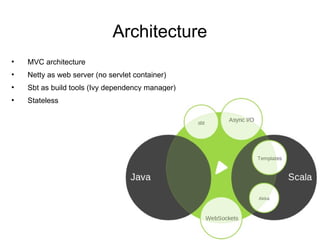
Architecture
• MVC architecture
• Netty as web server (no servlet container)
• Sbt as build tools (Ivy dependency manager)
• Stateless
Requirements
 Install Typesafe Activator (or sbt)

JDK 6 or later

activator new my-first-app play-java
 Open project in IDE (Eclipse and Intellij)

Run using
– command line (activator run)
– Activator console (activator)
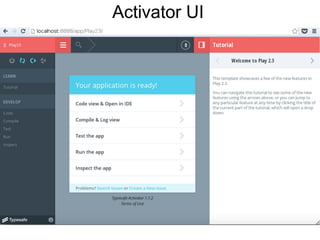
– Activator UI (activator ui)
– Interactive Console (Only in Scala)
Activator UI
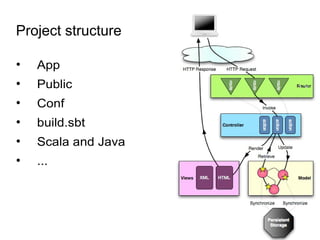
Project structure
• App
• Public
• Conf
• build.sbt
• Scala and Java
• ...
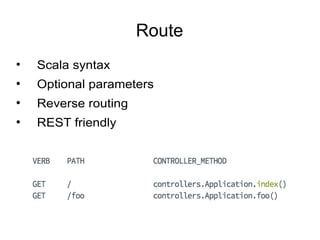
Route
• Scala syntax
• Optional parameters
• Reverse routing
• REST friendly
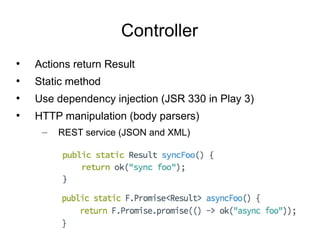
Controller
• Actions return Result
• Static method
• Use dependency injection (JSR 330 in Play 3)
• HTTP manipulation (body parsers)
– REST service (JSON and XML)
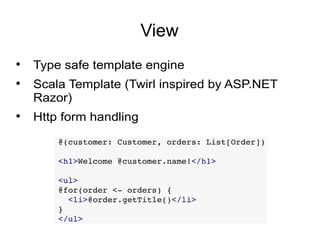
View
 Type safe template engine
 Scala Template (Twirl inspired by ASP.NET
Razor)
 Http form handling
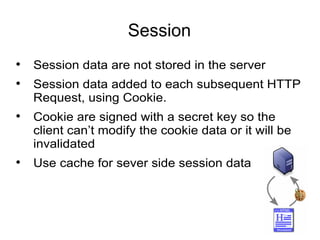
Session
 Session data are not stored in the server
 Session data added to each subsequent HTTP
Request, using Cookie.
 Cookie are signed with a secret key so the
client can’t modify the cookie data or it will be
invalidated
 Use cache for sever side session data
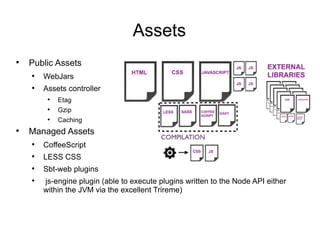
Assets
 Public Assets
 WebJars
 Assets controller
 Etag

Gzip
 Caching
 Managed Assets
 CoffeeScript
 LESS CSS

Sbt-web plugins

js-engine plugin (able to execute plugins written to the Node API either
within the JVM via the excellent Trireme)
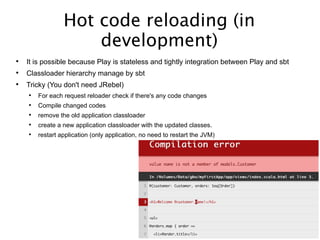
Hot code reloading (in
development)
 It is possible because Play is stateless and tightly integration between Play and sbt
 Classloader hierarchy manage by sbt

Tricky (You don't need JRebel)
 For each request reloader check if there's any code changes
 Compile changed codes
 remove the old application classloader
 create a new application classloader with the updated classes.
 restart application (only application, no need to restart the JVM)
Accessing Database
 JDBC
 JPA (2.0)
 Ebeans (default ORM)
 Database evolutions
 Connection Pool
 Transaction
 In-memory H2 database
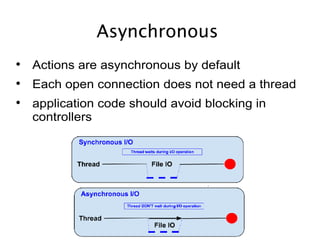
Asynchronous
 Actions are asynchronous by default
 Each open connection does not need a thread
 application code should avoid blocking in
controllers
Other APIs

Integration with Akka

WebSockets and Comet sockets

Cache API

Internationalization

Interceptors

Filters(only in Scala)

JSON API (jackson)

XML API

Job scheduling (Using Akka)

Logging API (Logback)
Testing

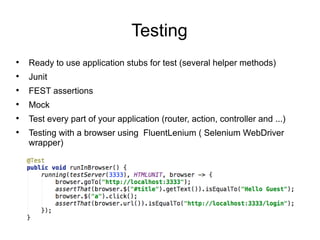
Ready to use application stubs for test (several helper methods)

Junit

FEST assertions

Mock

Test every part of your application (router, action, controller and ...)

Testing with a browser using FluentLenium ( Selenium WebDriver
wrapper)
Plugins
 Several plugins
– Mail
– Open ID
– CRUD
– Security
Deployment
 Compile all class and assets in application
 Activator start
 Activator stage (without any dependency on Play)
 Activator dist (produces a ZIP file without any
dependency on Play)
 SBT Native Packager plugin(activator universal:package-
bin)
– MSI, OS X disk image, RPM, DEB and …
 Publishing to a Maven (or Ivy) repository
Scaleability
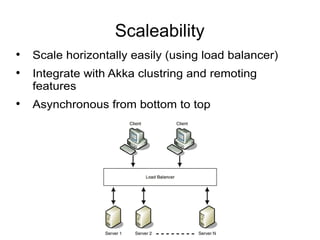
 Scale horizontally easily (using load balancer)
 Integrate with Akka clustring and remoting
features
 Asynchronous from bottom to top
Reactive

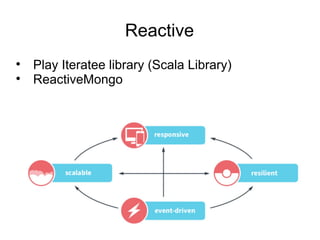
Play Iteratee library (Scala Library)

ReactiveMongo
Non-blocking
 ReturnPromise<Result>Promise<Result>
 Intensive computation will just be run on another thread
(thread pool in separate execution context ).
 The web client will be blocked while waiting for the
response, but nothing will be blocked on the server
‫تشکر‬
zarinfam.s@gmail.com
http://javabyab.com

Web application development using Play Framework (with Java)

  • 1.
    Web application developmentusing Play Framework (with Java) Tehran JUG meeting February-2015 By: Saeed Zarinfam
  • 2.
    History  Play 1Created By Guillaume Bort at Zengularity SA in 2007  Play 2 release in 2012 by Typesafe (rewrite using Scala)  Play 1 vs Play 2  Part of Typesafe Activator
  • 3.
    Introduction • Inspired byRuby on Rails and Django • Run on JVM (use java library) • MVC • Stateless • Hot code reloading (in development) • Convention over configuration • Lightweight • Asynchronous and Non-blocking I/O • Java 8 support
  • 4.
    Architecture • MVC architecture •Netty as web server (no servlet container) • Sbt as build tools (Ivy dependency manager) • Stateless
  • 5.
    Requirements  Install TypesafeActivator (or sbt)  JDK 6 or later  activator new my-first-app play-java  Open project in IDE (Eclipse and Intellij)  Run using – command line (activator run) – Activator console (activator) – Activator UI (activator ui) – Interactive Console (Only in Scala)
  • 6.
  • 7.
    Project structure • App •Public • Conf • build.sbt • Scala and Java • ...
  • 8.
    Route • Scala syntax •Optional parameters • Reverse routing • REST friendly
  • 9.
    Controller • Actions returnResult • Static method • Use dependency injection (JSR 330 in Play 3) • HTTP manipulation (body parsers) – REST service (JSON and XML)
  • 10.
    View  Type safetemplate engine  Scala Template (Twirl inspired by ASP.NET Razor)  Http form handling
  • 11.
    Session  Session dataare not stored in the server  Session data added to each subsequent HTTP Request, using Cookie.  Cookie are signed with a secret key so the client can’t modify the cookie data or it will be invalidated  Use cache for sever side session data
  • 12.
    Assets  Public Assets WebJars  Assets controller  Etag  Gzip  Caching  Managed Assets  CoffeeScript  LESS CSS  Sbt-web plugins  js-engine plugin (able to execute plugins written to the Node API either within the JVM via the excellent Trireme)
  • 13.
    Hot code reloading(in development)  It is possible because Play is stateless and tightly integration between Play and sbt  Classloader hierarchy manage by sbt  Tricky (You don't need JRebel)  For each request reloader check if there's any code changes  Compile changed codes  remove the old application classloader  create a new application classloader with the updated classes.  restart application (only application, no need to restart the JVM)
  • 14.
    Accessing Database  JDBC JPA (2.0)  Ebeans (default ORM)  Database evolutions  Connection Pool  Transaction  In-memory H2 database
  • 15.
    Asynchronous  Actions areasynchronous by default  Each open connection does not need a thread  application code should avoid blocking in controllers
  • 16.
    Other APIs  Integration withAkka  WebSockets and Comet sockets  Cache API  Internationalization  Interceptors  Filters(only in Scala)  JSON API (jackson)  XML API  Job scheduling (Using Akka)  Logging API (Logback)
  • 17.
    Testing  Ready to useapplication stubs for test (several helper methods)  Junit  FEST assertions  Mock  Test every part of your application (router, action, controller and ...)  Testing with a browser using FluentLenium ( Selenium WebDriver wrapper)
  • 18.
    Plugins  Several plugins –Mail – Open ID – CRUD – Security
  • 19.
    Deployment  Compile allclass and assets in application  Activator start  Activator stage (without any dependency on Play)  Activator dist (produces a ZIP file without any dependency on Play)  SBT Native Packager plugin(activator universal:package- bin) – MSI, OS X disk image, RPM, DEB and …  Publishing to a Maven (or Ivy) repository
  • 20.
    Scaleability  Scale horizontallyeasily (using load balancer)  Integrate with Akka clustring and remoting features  Asynchronous from bottom to top
  • 21.
    Reactive  Play Iteratee library(Scala Library)  ReactiveMongo
  • 22.
    Non-blocking  ReturnPromise<Result>Promise<Result>  Intensivecomputation will just be run on another thread (thread pool in separate execution context ).  The web client will be blocked while waiting for the response, but nothing will be blocked on the server
  • 23.