Research Cluster Opportunities and Challenges in the Digital Economy: an Agenda for the Next-generation Internet
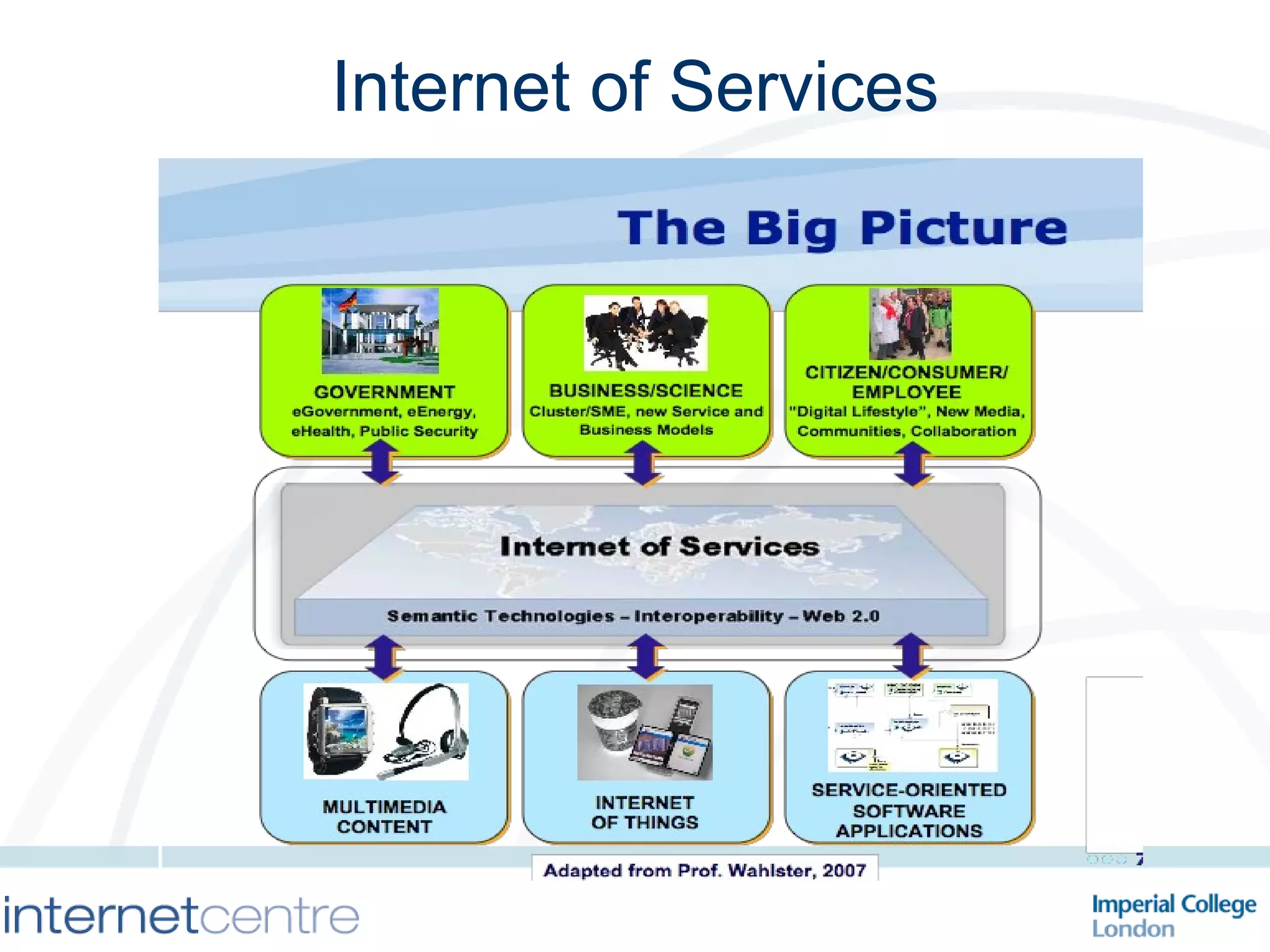
Internet of Services
The Internet is Great  but … Not all things are right, the future is not guaranteed What needs fixing? What needs doing? What needs leaving alone? Next-generation Internet
Identity, Anonymity and Trust
Internet is a social system The NGI consists of people, not machines People are the nodes and active agents. Web2.0    every consumer is a producer. If we can’t safeguard the identity of users, the whole thing falls apart. Dig Econ principle: Participation is proportional to trust. Economy:money::Internet:identity_token
Two Priorities Enabling Identity Guarantee that you are who or what you claim to be. Enabling Anonymity Guarantee that no more than the minimum info required is revealed. Trust is the measure of both What am I prepared to reveal to this resource? What I need to reveal to this resource?
Solutions No intervention, Free market BUT:  Lose the integration possibilities, i.e. no NGI Do we allow the majors (inc. government) to take over? Data and Identity Management The BBC solution The distributed solution
Technologies
Headlines Pervasive connectivity Not just higher bandwidth to the few, but some bandwidth to the many Web as an applications infrastructure Cloud Computing Resource Oriented Architectures Data liberated from application silos Linked data Obama announcement Co-evolution with society Web 2.0 is about people Web Science
Pervasive Connectivity Two distinct effects: Greater bandwidth – affords new capability Greater connectivity – more people more often The increasing participation in the digital world is the single most powerful new effect in distributed systems  Our students don’t remember life without the Web / without Google – what will the next generation bring ?
Web - an applications infrastructure Shift away from desktop applications installed locally by user or system administrator Shift toward browser-based apps which don’t make your disk dirty, and apps on mobile devices Perpetual beta web sites are agile Ease of use and ease of development The SOA versus ROA debate – the Web is simply the most scalable most usable distributed system ever Access cloud resources Beware that cloud is not a silver bullet, we are in an evolving ecosystem
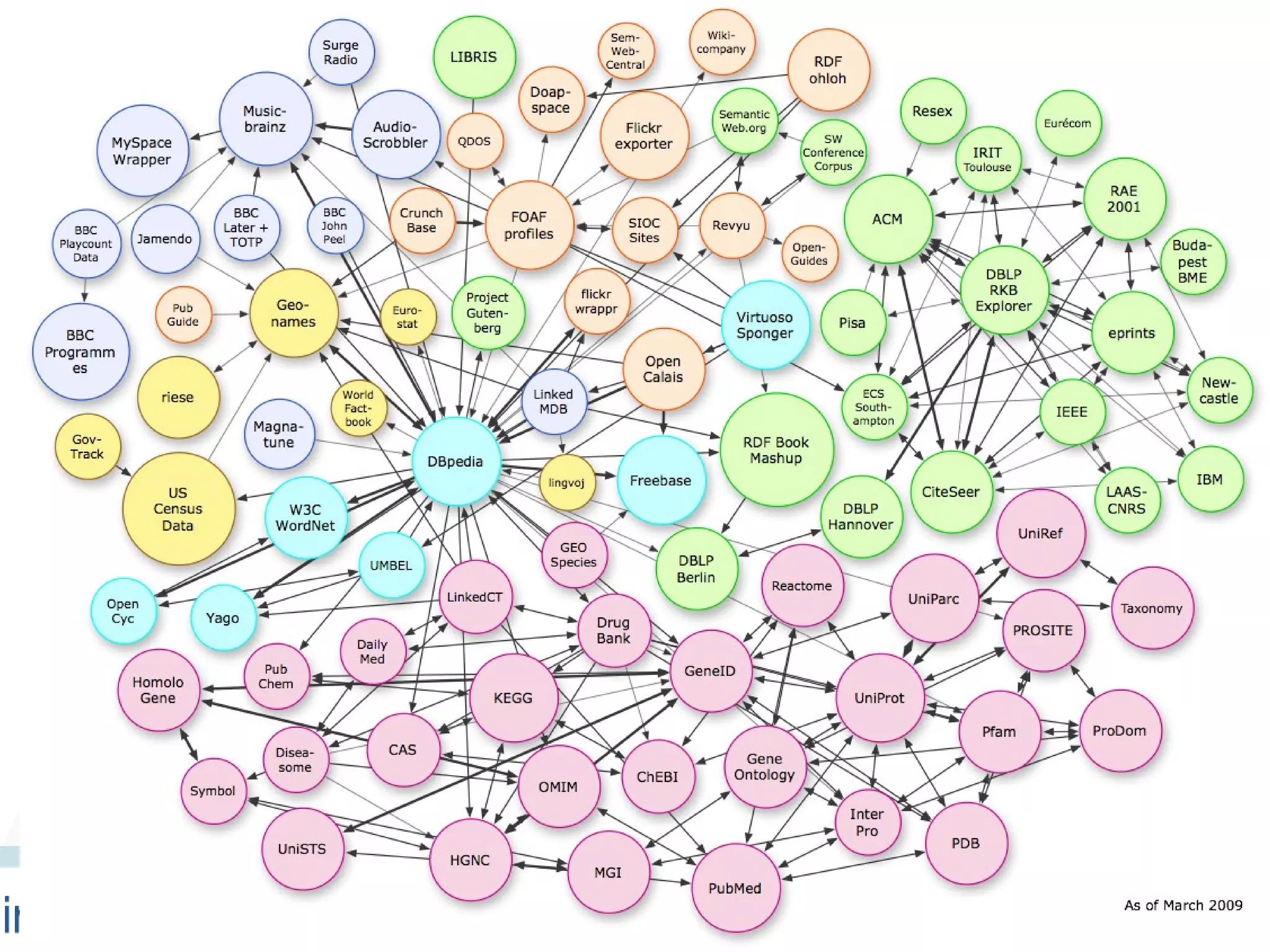
Data liberated from application silos Linked Data guidelines make data more reusable – a Web of Data, not just a Web of documents Data providers are beginning to publish in Semantic Web format (RDF) See linked data cloud picture (next slide) e.g. Obama’s use of Semantic Web
 
Co-evolution with society Don’t just think technology drivers, infrastructure or service provision The Web (infrastructure, content and applications) is an evolving organism and it is co-evolving with society that uses it Compare with Web 2.0 – not a new architecture but a set of observations on how the Web is actually used Need to look at micro and macro effects e.g. Social network analysis and theories This is the new discipline of  Web Science
Economics
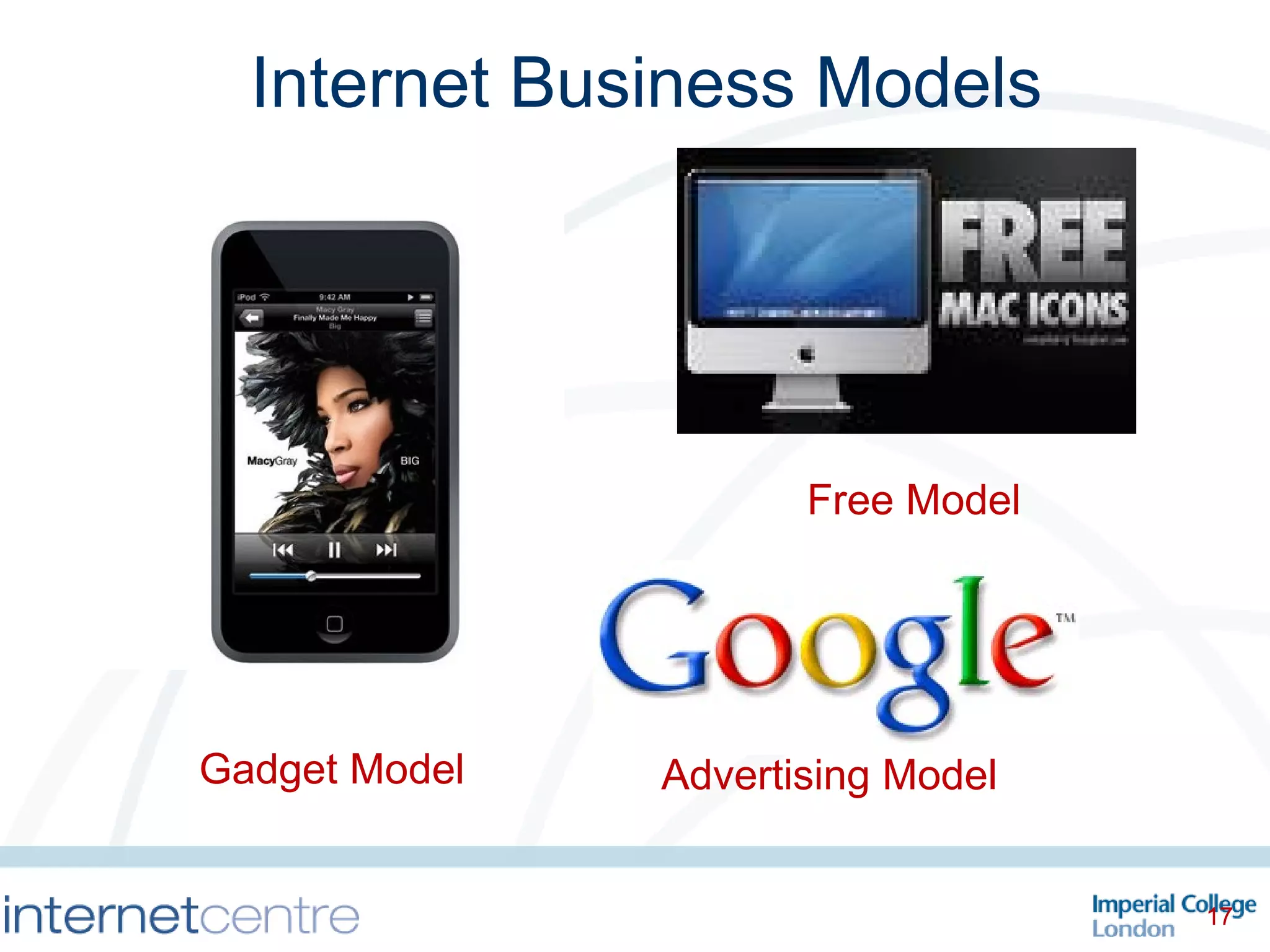
Internet Business Models Free Model Gadget Model Advertising Model
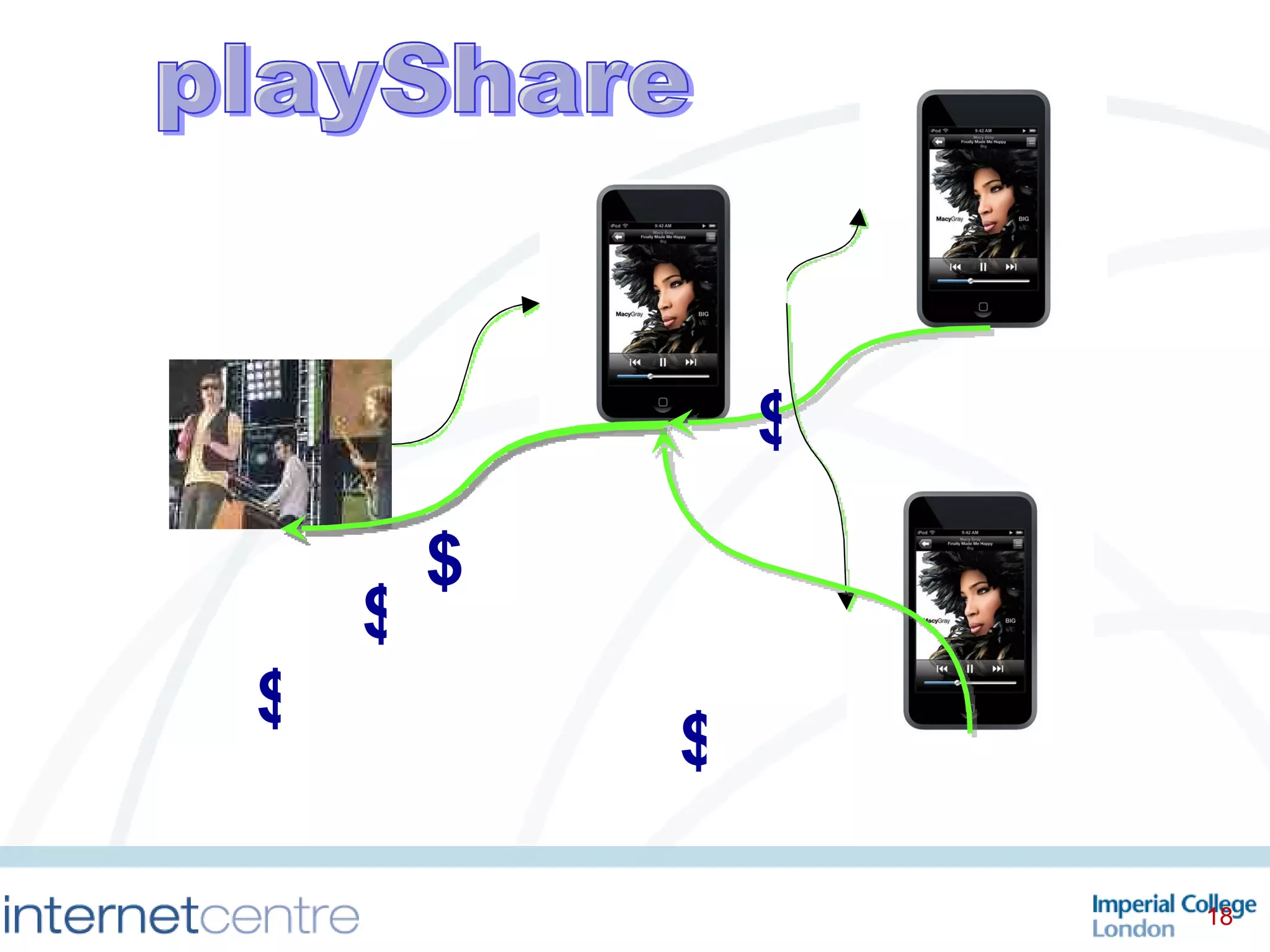
playShare $ $ $ $ $
Applications/Services
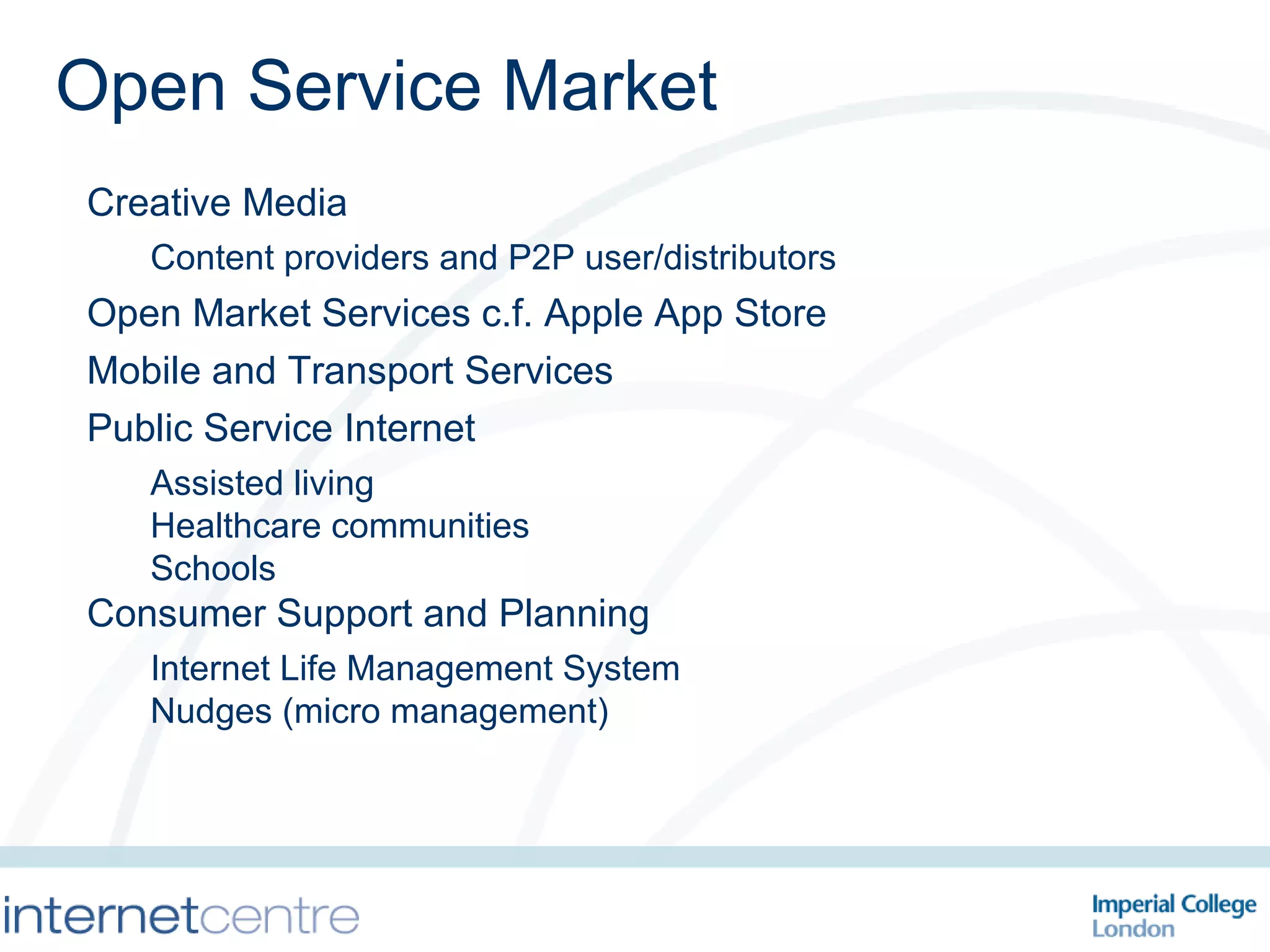
Creative Media Content providers and P2P user/distributors Open Market Services c.f. Apple App Store Mobile and Transport Services Public Service Internet Assisted living Healthcare communities Schools Consumer Support and Planning Internet Life Management System Nudges (micro management) Open Service Market
Thank You!

Wealth of Networks II

  • 1.
  • 2.
    Research Cluster Opportunitiesand Challenges in the Digital Economy: an Agenda for the Next-generation Internet
  • 3.
  • 4.
    The Internet isGreat but … Not all things are right, the future is not guaranteed What needs fixing? What needs doing? What needs leaving alone? Next-generation Internet
  • 5.
  • 6.
    Internet is asocial system The NGI consists of people, not machines People are the nodes and active agents. Web2.0  every consumer is a producer. If we can’t safeguard the identity of users, the whole thing falls apart. Dig Econ principle: Participation is proportional to trust. Economy:money::Internet:identity_token
  • 7.
    Two Priorities EnablingIdentity Guarantee that you are who or what you claim to be. Enabling Anonymity Guarantee that no more than the minimum info required is revealed. Trust is the measure of both What am I prepared to reveal to this resource? What I need to reveal to this resource?
  • 8.
    Solutions No intervention,Free market BUT: Lose the integration possibilities, i.e. no NGI Do we allow the majors (inc. government) to take over? Data and Identity Management The BBC solution The distributed solution
  • 9.
  • 10.
    Headlines Pervasive connectivityNot just higher bandwidth to the few, but some bandwidth to the many Web as an applications infrastructure Cloud Computing Resource Oriented Architectures Data liberated from application silos Linked data Obama announcement Co-evolution with society Web 2.0 is about people Web Science
  • 11.
    Pervasive Connectivity Twodistinct effects: Greater bandwidth – affords new capability Greater connectivity – more people more often The increasing participation in the digital world is the single most powerful new effect in distributed systems Our students don’t remember life without the Web / without Google – what will the next generation bring ?
  • 12.
    Web - anapplications infrastructure Shift away from desktop applications installed locally by user or system administrator Shift toward browser-based apps which don’t make your disk dirty, and apps on mobile devices Perpetual beta web sites are agile Ease of use and ease of development The SOA versus ROA debate – the Web is simply the most scalable most usable distributed system ever Access cloud resources Beware that cloud is not a silver bullet, we are in an evolving ecosystem
  • 13.
    Data liberated fromapplication silos Linked Data guidelines make data more reusable – a Web of Data, not just a Web of documents Data providers are beginning to publish in Semantic Web format (RDF) See linked data cloud picture (next slide) e.g. Obama’s use of Semantic Web
  • 14.
  • 15.
    Co-evolution with societyDon’t just think technology drivers, infrastructure or service provision The Web (infrastructure, content and applications) is an evolving organism and it is co-evolving with society that uses it Compare with Web 2.0 – not a new architecture but a set of observations on how the Web is actually used Need to look at micro and macro effects e.g. Social network analysis and theories This is the new discipline of Web Science
  • 16.
  • 17.
    Internet Business ModelsFree Model Gadget Model Advertising Model
  • 18.
  • 19.
  • 20.
    Creative Media Contentproviders and P2P user/distributors Open Market Services c.f. Apple App Store Mobile and Transport Services Public Service Internet Assisted living Healthcare communities Schools Consumer Support and Planning Internet Life Management System Nudges (micro management) Open Service Market
  • 21.