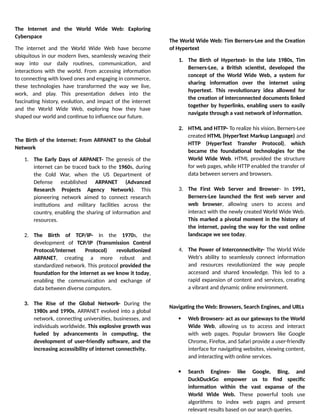
The Internet and the World Wide Web: Exploring
Cyberspace
The internet and the World Wide Web have become
ubiquitous in our modern lives, seamlessly weaving their
way into our daily routines, communication, and
interactions with the world. From accessing information
to connecting with loved ones and engaging in commerce,
these technologies have transformed the way we live,
work, and play. This presentation delves into the
fascinating history, evolution, and impact of the internet
and the World Wide Web, exploring how they have
shaped our world and continue to influence our future.
The Birth of the Internet: From ARPANET to the Global
Network
1. The Early Days of ARPANET- The genesis of the
internet can be traced back to the 1960s, during
the Cold War, when the US Department of
Defense established ARPANET (Advanced
Research Projects Agency Network). This
pioneering network aimed to connect research
institutions and military facilities across the
country, enabling the sharing of information and
resources.
2. The Birth of TCP/IP- In the 1970s, the
development of TCP/IP (Transmission Control
Protocol/Internet Protocol) revolutionized
ARPANET, creating a more robust and
standardized network. This protocol provided the
foundation for the internet as we know it today,
enabling the communication and exchange of
data between diverse computers.
3. The Rise of the Global Network- During the
1980s and 1990s, ARPANET evolved into a global
network, connecting universities, businesses, and
individuals worldwide. This explosive growth was
fueled by advancements in computing, the
development of user-friendly software, and the
increasing accessibility of internet connectivity.
The World Wide Web: Tim Berners-Lee and the Creation
of Hypertext
1. The Birth of Hypertext- In the late 1980s, Tim
Berners-Lee, a British scientist, developed the
concept of the World Wide Web, a system for
sharing information over the internet using
hypertext. This revolutionary idea allowed for
the creation of interconnected documents linked
together by hyperlinks, enabling users to easily
navigate through a vast network of information.
2. HTML and HTTP- To realize his vision, Berners-Lee
created HTML (HyperText Markup Language) and
HTTP (HyperText Transfer Protocol), which
became the foundational technologies for the
World Wide Web. HTML provided the structure
for web pages, while HTTP enabled the transfer of
data between servers and browsers.
3. The First Web Server and Browser- In 1991,
Berners-Lee launched the first web server and
web browser, allowing users to access and
interact with the newly created World Wide Web.
This marked a pivotal moment in the history of
the internet, paving the way for the vast online
landscape we see today.
4. The Power of Interconnectivity- The World Wide
Web's ability to seamlessly connect information
and resources revolutionized the way people
accessed and shared knowledge. This led to a
rapid expansion of content and services, creating
a vibrant and dynamic online environment.
Navigating the Web: Browsers, Search Engines, and URLs
 Web Browsers- act as our gateways to the World
Wide Web, allowing us to access and interact
with web pages. Popular browsers like Google
Chrome, Firefox, and Safari provide a user-friendly
interface for navigating websites, viewing content,
and interacting with online services.
 Search Engines- like Google, Bing, and
DuckDuckGo empower us to find specific
information within the vast expanse of the
World Wide Web. These powerful tools use
algorithms to index web pages and present
relevant results based on our search queries.
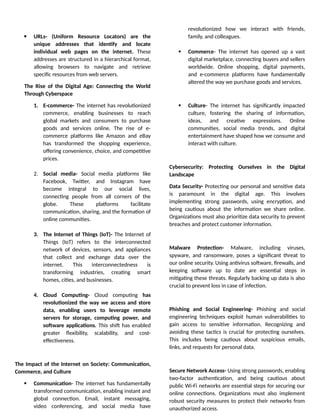
 URLs- (Uniform Resource Locators) are the
unique addresses that identify and locate
individual web pages on the internet. These
addresses are structured in a hierarchical format,
allowing browsers to navigate and retrieve
specific resources from web servers.
The Rise of the Digital Age: Connecting the World
Through Cyberspace
1. E-commerce- The internet has revolutionized
commerce, enabling businesses to reach
global markets and consumers to purchase
goods and services online. The rise of e-
commerce platforms like Amazon and eBay
has transformed the shopping experience,
offering convenience, choice, and competitive
prices.
2. Social media- Social media platforms like
Facebook, Twitter, and Instagram have
become integral to our social lives,
connecting people from all corners of the
globe. These platforms facilitate
communication, sharing, and the formation of
online communities.
3. The Internet of Things (IoT)- The Internet of
Things (IoT) refers to the interconnected
network of devices, sensors, and appliances
that collect and exchange data over the
internet. This interconnectedness is
transforming industries, creating smart
homes, cities, and businesses.
4. Cloud Computing- Cloud computing has
revolutionized the way we access and store
data, enabling users to leverage remote
servers for storage, computing power, and
software applications. This shift has enabled
greater flexibility, scalability, and cost-
effectiveness.
The Impact of the Internet on Society: Communication,
Commerce, and Culture
 Communication- The internet has fundamentally
transformed communication, enabling instant and
global connection. Email, instant messaging,
video conferencing, and social media have
revolutionized how we interact with friends,
family, and colleagues.
 Commerce- The internet has opened up a vast
digital marketplace, connecting buyers and sellers
worldwide. Online shopping, digital payments,
and e-commerce platforms have fundamentally
altered the way we purchase goods and services.
 Culture- The internet has significantly impacted
culture, fostering the sharing of information,
ideas, and creative expressions. Online
communities, social media trends, and digital
entertainment have shaped how we consume and
interact with culture.
Cybersecurity: Protecting Ourselves in the Digital
Landscape
Data Security- Protecting our personal and sensitive data
is paramount in the digital age. This involves
implementing strong passwords, using encryption, and
being cautious about the information we share online.
Organizations must also prioritize data security to prevent
breaches and protect customer information.
Malware Protection- Malware, including viruses,
spyware, and ransomware, poses a significant threat to
our online security. Using antivirus software, firewalls, and
keeping software up to date are essential steps in
mitigating these threats. Regularly backing up data is also
crucial to prevent loss in case of infection.
Phishing and Social Engineering- Phishing and social
engineering techniques exploit human vulnerabilities to
gain access to sensitive information. Recognizing and
avoiding these tactics is crucial for protecting ourselves.
This includes being cautious about suspicious emails,
links, and requests for personal data.
Secure Network Access- Using strong passwords, enabling
two-factor authentication, and being cautious about
public Wi-Fi networks are essential steps for securing our
online connections. Organizations must also implement
robust security measures to protect their networks from
unauthorized access.
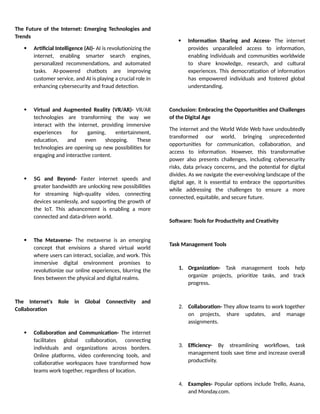
The Future of the Internet: Emerging Technologies and
Trends
 Artificial Intelligence (AI)- AI is revolutionizing the
internet, enabling smarter search engines,
personalized recommendations, and automated
tasks. AI-powered chatbots are improving
customer service, and AI is playing a crucial role in
enhancing cybersecurity and fraud detection.
 Virtual and Augmented Reality (VR/AR)- VR/AR
technologies are transforming the way we
interact with the internet, providing immersive
experiences for gaming, entertainment,
education, and even shopping. These
technologies are opening up new possibilities for
engaging and interactive content.
 5G and Beyond- Faster internet speeds and
greater bandwidth are unlocking new possibilities
for streaming high-quality video, connecting
devices seamlessly, and supporting the growth of
the IoT. This advancement is enabling a more
connected and data-driven world.
 The Metaverse- The metaverse is an emerging
concept that envisions a shared virtual world
where users can interact, socialize, and work. This
immersive digital environment promises to
revolutionize our online experiences, blurring the
lines between the physical and digital realms.
The Internet's Role in Global Connectivity and
Collaboration
 Collaboration and Communication- The internet
facilitates global collaboration, connecting
individuals and organizations across borders.
Online platforms, video conferencing tools, and
collaborative workspaces have transformed how
teams work together, regardless of location.
 Information Sharing and Access- The internet
provides unparalleled access to information,
enabling individuals and communities worldwide
to share knowledge, research, and cultural
experiences. This democratization of information
has empowered individuals and fostered global
understanding.
Conclusion: Embracing the Opportunities and Challenges
of the Digital Age
The internet and the World Wide Web have undoubtedly
transformed our world, bringing unprecedented
opportunities for communication, collaboration, and
access to information. However, this transformative
power also presents challenges, including cybersecurity
risks, data privacy concerns, and the potential for digital
divides. As we navigate the ever-evolving landscape of the
digital age, it is essential to embrace the opportunities
while addressing the challenges to ensure a more
connected, equitable, and secure future.
Software: Tools for Productivity and Creativity
Task Management Tools
1. Organization- Task management tools help
organize projects, prioritize tasks, and track
progress.
2. Collaboration- They allow teams to work together
on projects, share updates, and manage
assignments.
3. Efficiency- By streamlining workflows, task
management tools save time and increase overall
productivity.
4. Examples- Popular options include Trello, Asana,
and Monday.com.
Note-Taking and Organization Apps
Capture Ideas- Note-taking apps allow you to quickly
capture ideas, thoughts, and research.
Organize Information- They provide features for
structuring notes, creating lists, and organizing
information.
Collaborate- Some apps offer collaborative features for
sharing notes and working together on projects.
Examples- Popular options include Evernote, Notion, and
Google Keep.
Collaborative Platforms
Communication- Collaborative platforms facilitate
communication and information sharing among team
members.
• Instant messaging
• Video conferencing
• File sharing
Project Management- These platforms provide tools for
planning, tracking, and managing projects.
• Task assignments
• Collaboration features
• Progress tracking
Examples- Popular options include Slack, Microsoft
Teams, and Zoom.
• Integrations with other tools
• Workflow automation
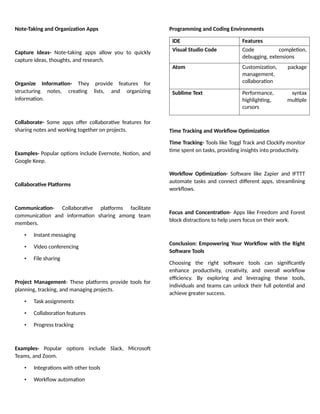
Programming and Coding Environments
IDE Features
Visual Studio Code Code completion,
debugging, extensions
Atom Customization, package
management,
collaboration
Sublime Text Performance, syntax
highlighting, multiple
cursors
Time Tracking and Workflow Optimization
Time Tracking- Tools like Toggl Track and Clockify monitor
time spent on tasks, providing insights into productivity.
Workflow Optimization- Software like Zapier and IFTTT
automate tasks and connect different apps, streamlining
workflows.
Focus and Concentration- Apps like Freedom and Forest
block distractions to help users focus on their work.
Conclusion: Empowering Your Workflow with the Right
Software Tools
Choosing the right software tools can significantly
enhance productivity, creativity, and overall workflow
efficiency. By exploring and leveraging these tools,
individuals and teams can unlock their full potential and
achieve greater success.
introduction to computing reviewer lesson about arpanet.docx

introduction to computing reviewer lesson about arpanet.docx

  • 1.
    The Internet andthe World Wide Web: Exploring Cyberspace The internet and the World Wide Web have become ubiquitous in our modern lives, seamlessly weaving their way into our daily routines, communication, and interactions with the world. From accessing information to connecting with loved ones and engaging in commerce, these technologies have transformed the way we live, work, and play. This presentation delves into the fascinating history, evolution, and impact of the internet and the World Wide Web, exploring how they have shaped our world and continue to influence our future. The Birth of the Internet: From ARPANET to the Global Network 1. The Early Days of ARPANET- The genesis of the internet can be traced back to the 1960s, during the Cold War, when the US Department of Defense established ARPANET (Advanced Research Projects Agency Network). This pioneering network aimed to connect research institutions and military facilities across the country, enabling the sharing of information and resources. 2. The Birth of TCP/IP- In the 1970s, the development of TCP/IP (Transmission Control Protocol/Internet Protocol) revolutionized ARPANET, creating a more robust and standardized network. This protocol provided the foundation for the internet as we know it today, enabling the communication and exchange of data between diverse computers. 3. The Rise of the Global Network- During the 1980s and 1990s, ARPANET evolved into a global network, connecting universities, businesses, and individuals worldwide. This explosive growth was fueled by advancements in computing, the development of user-friendly software, and the increasing accessibility of internet connectivity. The World Wide Web: Tim Berners-Lee and the Creation of Hypertext 1. The Birth of Hypertext- In the late 1980s, Tim Berners-Lee, a British scientist, developed the concept of the World Wide Web, a system for sharing information over the internet using hypertext. This revolutionary idea allowed for the creation of interconnected documents linked together by hyperlinks, enabling users to easily navigate through a vast network of information. 2. HTML and HTTP- To realize his vision, Berners-Lee created HTML (HyperText Markup Language) and HTTP (HyperText Transfer Protocol), which became the foundational technologies for the World Wide Web. HTML provided the structure for web pages, while HTTP enabled the transfer of data between servers and browsers. 3. The First Web Server and Browser- In 1991, Berners-Lee launched the first web server and web browser, allowing users to access and interact with the newly created World Wide Web. This marked a pivotal moment in the history of the internet, paving the way for the vast online landscape we see today. 4. The Power of Interconnectivity- The World Wide Web's ability to seamlessly connect information and resources revolutionized the way people accessed and shared knowledge. This led to a rapid expansion of content and services, creating a vibrant and dynamic online environment. Navigating the Web: Browsers, Search Engines, and URLs  Web Browsers- act as our gateways to the World Wide Web, allowing us to access and interact with web pages. Popular browsers like Google Chrome, Firefox, and Safari provide a user-friendly interface for navigating websites, viewing content, and interacting with online services.  Search Engines- like Google, Bing, and DuckDuckGo empower us to find specific information within the vast expanse of the World Wide Web. These powerful tools use algorithms to index web pages and present relevant results based on our search queries.
  • 2.
     URLs- (UniformResource Locators) are the unique addresses that identify and locate individual web pages on the internet. These addresses are structured in a hierarchical format, allowing browsers to navigate and retrieve specific resources from web servers. The Rise of the Digital Age: Connecting the World Through Cyberspace 1. E-commerce- The internet has revolutionized commerce, enabling businesses to reach global markets and consumers to purchase goods and services online. The rise of e- commerce platforms like Amazon and eBay has transformed the shopping experience, offering convenience, choice, and competitive prices. 2. Social media- Social media platforms like Facebook, Twitter, and Instagram have become integral to our social lives, connecting people from all corners of the globe. These platforms facilitate communication, sharing, and the formation of online communities. 3. The Internet of Things (IoT)- The Internet of Things (IoT) refers to the interconnected network of devices, sensors, and appliances that collect and exchange data over the internet. This interconnectedness is transforming industries, creating smart homes, cities, and businesses. 4. Cloud Computing- Cloud computing has revolutionized the way we access and store data, enabling users to leverage remote servers for storage, computing power, and software applications. This shift has enabled greater flexibility, scalability, and cost- effectiveness. The Impact of the Internet on Society: Communication, Commerce, and Culture  Communication- The internet has fundamentally transformed communication, enabling instant and global connection. Email, instant messaging, video conferencing, and social media have revolutionized how we interact with friends, family, and colleagues.  Commerce- The internet has opened up a vast digital marketplace, connecting buyers and sellers worldwide. Online shopping, digital payments, and e-commerce platforms have fundamentally altered the way we purchase goods and services.  Culture- The internet has significantly impacted culture, fostering the sharing of information, ideas, and creative expressions. Online communities, social media trends, and digital entertainment have shaped how we consume and interact with culture. Cybersecurity: Protecting Ourselves in the Digital Landscape Data Security- Protecting our personal and sensitive data is paramount in the digital age. This involves implementing strong passwords, using encryption, and being cautious about the information we share online. Organizations must also prioritize data security to prevent breaches and protect customer information. Malware Protection- Malware, including viruses, spyware, and ransomware, poses a significant threat to our online security. Using antivirus software, firewalls, and keeping software up to date are essential steps in mitigating these threats. Regularly backing up data is also crucial to prevent loss in case of infection. Phishing and Social Engineering- Phishing and social engineering techniques exploit human vulnerabilities to gain access to sensitive information. Recognizing and avoiding these tactics is crucial for protecting ourselves. This includes being cautious about suspicious emails, links, and requests for personal data. Secure Network Access- Using strong passwords, enabling two-factor authentication, and being cautious about public Wi-Fi networks are essential steps for securing our online connections. Organizations must also implement robust security measures to protect their networks from unauthorized access.
  • 3.
    The Future ofthe Internet: Emerging Technologies and Trends  Artificial Intelligence (AI)- AI is revolutionizing the internet, enabling smarter search engines, personalized recommendations, and automated tasks. AI-powered chatbots are improving customer service, and AI is playing a crucial role in enhancing cybersecurity and fraud detection.  Virtual and Augmented Reality (VR/AR)- VR/AR technologies are transforming the way we interact with the internet, providing immersive experiences for gaming, entertainment, education, and even shopping. These technologies are opening up new possibilities for engaging and interactive content.  5G and Beyond- Faster internet speeds and greater bandwidth are unlocking new possibilities for streaming high-quality video, connecting devices seamlessly, and supporting the growth of the IoT. This advancement is enabling a more connected and data-driven world.  The Metaverse- The metaverse is an emerging concept that envisions a shared virtual world where users can interact, socialize, and work. This immersive digital environment promises to revolutionize our online experiences, blurring the lines between the physical and digital realms. The Internet's Role in Global Connectivity and Collaboration  Collaboration and Communication- The internet facilitates global collaboration, connecting individuals and organizations across borders. Online platforms, video conferencing tools, and collaborative workspaces have transformed how teams work together, regardless of location.  Information Sharing and Access- The internet provides unparalleled access to information, enabling individuals and communities worldwide to share knowledge, research, and cultural experiences. This democratization of information has empowered individuals and fostered global understanding. Conclusion: Embracing the Opportunities and Challenges of the Digital Age The internet and the World Wide Web have undoubtedly transformed our world, bringing unprecedented opportunities for communication, collaboration, and access to information. However, this transformative power also presents challenges, including cybersecurity risks, data privacy concerns, and the potential for digital divides. As we navigate the ever-evolving landscape of the digital age, it is essential to embrace the opportunities while addressing the challenges to ensure a more connected, equitable, and secure future. Software: Tools for Productivity and Creativity Task Management Tools 1. Organization- Task management tools help organize projects, prioritize tasks, and track progress. 2. Collaboration- They allow teams to work together on projects, share updates, and manage assignments. 3. Efficiency- By streamlining workflows, task management tools save time and increase overall productivity. 4. Examples- Popular options include Trello, Asana, and Monday.com.
  • 4.
    Note-Taking and OrganizationApps Capture Ideas- Note-taking apps allow you to quickly capture ideas, thoughts, and research. Organize Information- They provide features for structuring notes, creating lists, and organizing information. Collaborate- Some apps offer collaborative features for sharing notes and working together on projects. Examples- Popular options include Evernote, Notion, and Google Keep. Collaborative Platforms Communication- Collaborative platforms facilitate communication and information sharing among team members. • Instant messaging • Video conferencing • File sharing Project Management- These platforms provide tools for planning, tracking, and managing projects. • Task assignments • Collaboration features • Progress tracking Examples- Popular options include Slack, Microsoft Teams, and Zoom. • Integrations with other tools • Workflow automation Programming and Coding Environments IDE Features Visual Studio Code Code completion, debugging, extensions Atom Customization, package management, collaboration Sublime Text Performance, syntax highlighting, multiple cursors Time Tracking and Workflow Optimization Time Tracking- Tools like Toggl Track and Clockify monitor time spent on tasks, providing insights into productivity. Workflow Optimization- Software like Zapier and IFTTT automate tasks and connect different apps, streamlining workflows. Focus and Concentration- Apps like Freedom and Forest block distractions to help users focus on their work. Conclusion: Empowering Your Workflow with the Right Software Tools Choosing the right software tools can significantly enhance productivity, creativity, and overall workflow efficiency. By exploring and leveraging these tools, individuals and teams can unlock their full potential and achieve greater success.