J. L. Cuevas-Ruíz J.A. Delgado-Penín WCNC2004 Atlanta USA 1
“A Statistical switched broadband channel
model for a HAPS links”
José Luis Cuevas-Ruíz José A. Delgado-Penín
Presented by J.A. Delgado-Penín
Department of Signal Theory and Communications
Universitat Politècnica de Catalunya
Barcelona, Spain
J. L. Cuevas-Ruíz J.A. Delgado-Penín WCNC2004 Atlanta USA 2
Objective
To propose a new statistical switched
broadband channel model in L band for HAPS links
using three kinds of propagation modes (three
states).
J. L. Cuevas-Ruíz J.A. Delgado-Penín WCNC2004 Atlanta USA 3
Outline
• Overview.
• What the HAPS systems are?
• HAPS vs Terrestrial Systems
• Features
• Switched channel model.
• Three states Markov chain.
• Three states semi-Markov chain.
• Data from ITU-R (681-6).
J. L. Cuevas-Ruíz J.A. Delgado-Penín WCNC2004 Atlanta USA 4
Outline
• Broadband channels models.
• Bello´s model.
• Switched broadband channel.
• Two states.
• Three states
• Simulation results.
• Conclusions.
J. L. Cuevas-Ruíz J.A. Delgado-Penín WCNC2004 Atlanta USA 5
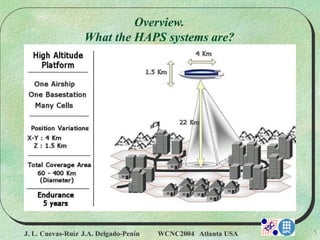
Overview.
What the HAPS systems are?
J. L. Cuevas-Ruíz J.A. Delgado-Penín WCNC2004 Atlanta USA 6
HAPS Advantages :
Serve a large number of people from a
distance –Less obstructions.
Provide Line of Sight Communications –
Higher Frequencies – Higher Data Rates
Portable – Can be re-positioned at any time.
Affordable – Cheaper than the terrestrial and
Satellite infrastructure.
HAPS Disadvantages :
Station Keeping – Need to make sure
that users can maintain tracking.
Clouds and Rain can significantly
attenuate the signal.
Overview.
HAPS vs Terrestrial Systems
J. L. Cuevas-Ruíz J.A. Delgado-Penín WCNC2004 Atlanta USA 7
Coverage areas
Semi-urban Urban Rural
HAP
h=21-25 km
Area
Angle of
Elevación
Coverage (radio. km)
h=21 km h=25 km
Urban 90-30 0-36 0-43
Semi-urban 30-15 36-76.5 43-90.5
Rural 15-5 76.5-203 90.5-
Features.
Coverage.
J. L. Cuevas-Ruíz J.A. Delgado-Penín WCNC2004 Atlanta USA 8
h
SPP
θ
receiver
d
shadowing
Multipath
Features.
Propagation effects.
LOS
J. L. Cuevas-Ruíz J.A. Delgado-Penín WCNC2004 Atlanta USA 9
• Height of the ship ( 21-25 km).
• Angle of reception (θ) .
• Distance of SPP (d). }
•The shadowing level is a function of the angle of
reception and the distance of the receiver to the SPP.
• Inside the urban area a LOS condition can be supposed
(a Rice constant, K, with a high value).
• If the angle of reception diminishes then the multipath
effect increase (diminishes K value) [1].
COVERAGE
AREA{Geometrical
characteristics
Features.
J. L. Cuevas-Ruíz J.A. Delgado-Penín WCNC2004 Atlanta USA 10
Switched Channel Model.
Markov Chain
As the environmental properties change, the received
signal cannot be represented by a model with constant
parameters. This dynamic behavior was implemented in
the model using a Markov chain.
A state B state
C state
P BA
P CB
P BC
P AC
P CA
P AB
A state B state
C state
P BA
P CB
P BC
P AC
P CA
A state B state
C stateC state
P BA
P CB
P BC
P AC
P CA
P AB
P BCP BCP BC
PCC
PBB
PAA
J. L. Cuevas-Ruíz J.A. Delgado-Penín WCNC2004 Atlanta USA 11
The transitions between states are determined by a
matrix P, where each element Pij represent the
probability that the channel changes from the i to the j
state. For the channel model with three states A, B and
C, is defined the transitions matrix P
Switched Channel Model.
Markov Chain
J. L. Cuevas-Ruíz J.A. Delgado-Penín WCNC2004 Atlanta USA 12
A stationary state vector π is calculated, using the
properties of the Markov processes expressed by
where I is the identity matrix, P is the transition
matrix and e= [1 1 ….]T [7]. Each element πi represent
the percentage of the total time that the processes
remains in the i state.
π (I-P) = 0
π e = 1
π = ( πA πB πC )
Switched Channel Model.
Markov Chain
J. L. Cuevas-Ruíz J.A. Delgado-Penín WCNC2004 Atlanta USA 13
A semi-Markov process is a Markov chain where the time
between changes of states are random and defined for
some kind of distribution. From the Markov process, a
new semi-Markovian process is defined. This process will
be described by a new transition matrix r, which is
calculated using
Switched Channel Model.
Semi-Markov Chain
J. L. Cuevas-Ruíz J.A. Delgado-Penín WCNC2004 Atlanta USA 14
Semi-Markovian Processes
Some distributions are described for fade
duration in the ITU-R Recommendation P.681-6
[8]. In this Recommendation are defined three types
of channel:
A state. LOS condition.
B state. Slight shadowing.
C state. Total obstruction.
A s t a t e B s t a t e
C s t a t e
P B A
P C B
P B C
P A C
P C A
P A B
A s t a t e B s t a t e
C s t a t e
P B A
P C B
P B C
P A C
P C A
A s t a t e B s t a t e
C s t a t eC s t a t e
P B A
P C B
P B C
P A C
P C A
P A B
Switched Channel Model.
Markov Chain
J. L. Cuevas-Ruíz J.A. Delgado-Penín WCNC2004 Atlanta USA 15
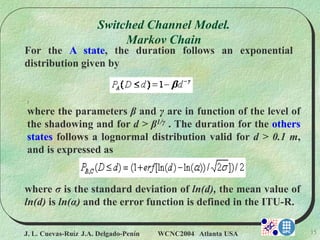
For the A state, the duration follows an exponential
distribution given by
)
where the parameters β and γ are in function of the level of
the shadowing and for d > β1/γ . The duration for the others
states follows a lognormal distribution valid for d > 0.1 m,
and is expressed as
where σ is the standard deviation of ln(d), the mean value of
ln(d) is ln(α) and the error function is defined in the ITU-R.
Switched Channel Model.
Markov Chain
J. L. Cuevas-Ruíz J.A. Delgado-Penín WCNC2004 Atlanta USA 16
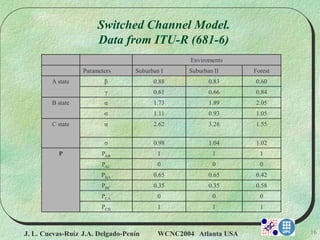
Enviroments
Parameters Suburban I Suburban II Forest
A state β 0.88 0.83 0.60
γ 0.61 0.66 0.84
B state α 1.73 1.89 2.05
σ 1.11 0.93 1.05
C state α 2.62 3.28 1.55
σ 0.98 1.04 1.02
P PAB 1 1 1
PAC 0 0 0
PBA 0.65 0.65 0.42
PBC 0.35 0.35 0.58
PCA 0 0 0
PCB 1 1 1
Switched Channel Model.
Data from ITU-R (681-6)
J. L. Cuevas-Ruíz J.A. Delgado-Penín WCNC2004 Atlanta USA 17
Broadband channel model.
Bello`s Model
τi
τi τi
A
Σ
x(t )
y(t )
a(t) a(t ) a(t ) a(t )
τ1
τ2 τn
A0
Σ
x(t )
y(t )
a(t) a(t ) a(t ) a(t )
A1 A2 An
J. L. Cuevas-Ruíz J.A. Delgado-Penín WCNC2004 Atlanta USA 18
Switched Broadband channel model.
Two states
Semi -Markov
process
Rayleigh Ray-Ln
Rayleigh Ray-Ln
A1
An
y(t)
x(t)
bad state
good state
Lognormal
bad state
good state
τ1
τn
Σ
An-1
tn-1
Semi -Markov
process
Semi -Markov
process
Semi -Markov
process
Rayleigh Ray-LN-
Rayleigh Ray-LN
A1
An
y(t)
x(t)
bad state
good state
LN
bad state
good state
τ1
τn
Σ
An-1
tn-1
Semi -Markov
process
Semi -Markov
process
J. L. Cuevas-Ruíz J.A. Delgado-Penín WCNC2004 Atlanta USA 19
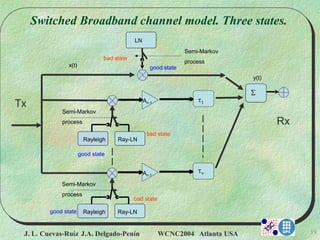
x(t)
bad state
good state
LN
Semi-Markov
process
Tx
Rx
y(t)
good state
Σ
An-1
Rayleigh Ray-LN
Semi-Markov
process
τ1
bad state
good state
An-1
Rayleigh Ray-LN
Semi-Markov
process
τν
bad state
Switched Broadband channel model. Three states.
J. L. Cuevas-Ruíz J.A. Delgado-Penín WCNC2004 Atlanta USA 20
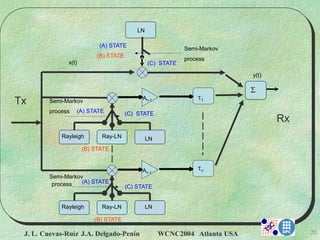
x(t)
LN
Semi-Markov
process
Tx
Rx
y(t)
Σ
An-1
Rayleigh Ray-LN
Semi-Markov
process
τ1
An-1
Semi-Markov
process
τν
Rayleigh Ray-LN LN
(A) STATE
(A) STATE
(A) STATE
(B) STATE
(B) STATE
(B) STATE
(C) STATE
(C) STATE
(C) STATE
(C) STATE
LN
J. L. Cuevas-Ruíz J.A. Delgado-Penín WCNC2004 Atlanta USA 21
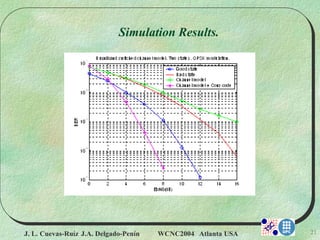
Simulation Results.
J. L. Cuevas-Ruíz J.A. Delgado-Penín WCNC2004 Atlanta USA 22
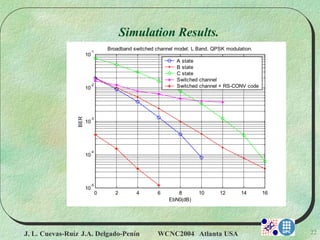
0 2 4 6 8 10 12 14 16
10
-5
10
-4
10
-3
10
-2
10
-1
Broadband switched channel model. L Band. QPSK modulation.
EbN0(dB)
BER
A state
B state
C state
Switched channel
Switched channel + RS-CONV code
Simulation Results.
J. L. Cuevas-Ruíz J.A. Delgado-Penín WCNC2004 Atlanta USA 23
Conclusions.
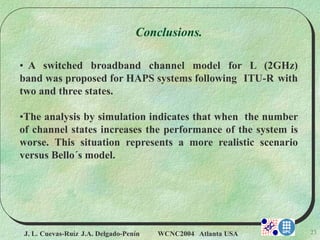
• A switched broadband channel model for L (2GHz)
band was proposed for HAPS systems following ITU-R with
two and three states.
•The analysis by simulation indicates that when the number
of channel states increases the performance of the system is
worse. This situation represents a more realistic scenario
versus Bello´s model.
J. L. Cuevas-Ruíz J.A. Delgado-Penín WCNC2004 Atlanta USA 24
Thanks for your attention.
Questions!!

WCNC.2004 atlanta(usa)

  • 1.
    J. L. Cuevas-RuízJ.A. Delgado-Penín WCNC2004 Atlanta USA 1 “A Statistical switched broadband channel model for a HAPS links” José Luis Cuevas-Ruíz José A. Delgado-Penín Presented by J.A. Delgado-Penín Department of Signal Theory and Communications Universitat Politècnica de Catalunya Barcelona, Spain
  • 2.
    J. L. Cuevas-RuízJ.A. Delgado-Penín WCNC2004 Atlanta USA 2 Objective To propose a new statistical switched broadband channel model in L band for HAPS links using three kinds of propagation modes (three states).
  • 3.
    J. L. Cuevas-RuízJ.A. Delgado-Penín WCNC2004 Atlanta USA 3 Outline • Overview. • What the HAPS systems are? • HAPS vs Terrestrial Systems • Features • Switched channel model. • Three states Markov chain. • Three states semi-Markov chain. • Data from ITU-R (681-6).
  • 4.
    J. L. Cuevas-RuízJ.A. Delgado-Penín WCNC2004 Atlanta USA 4 Outline • Broadband channels models. • Bello´s model. • Switched broadband channel. • Two states. • Three states • Simulation results. • Conclusions.
  • 5.
    J. L. Cuevas-RuízJ.A. Delgado-Penín WCNC2004 Atlanta USA 5 Overview. What the HAPS systems are?
  • 6.
    J. L. Cuevas-RuízJ.A. Delgado-Penín WCNC2004 Atlanta USA 6 HAPS Advantages : Serve a large number of people from a distance –Less obstructions. Provide Line of Sight Communications – Higher Frequencies – Higher Data Rates Portable – Can be re-positioned at any time. Affordable – Cheaper than the terrestrial and Satellite infrastructure. HAPS Disadvantages : Station Keeping – Need to make sure that users can maintain tracking. Clouds and Rain can significantly attenuate the signal. Overview. HAPS vs Terrestrial Systems
  • 7.
    J. L. Cuevas-RuízJ.A. Delgado-Penín WCNC2004 Atlanta USA 7 Coverage areas Semi-urban Urban Rural HAP h=21-25 km Area Angle of Elevación Coverage (radio. km) h=21 km h=25 km Urban 90-30 0-36 0-43 Semi-urban 30-15 36-76.5 43-90.5 Rural 15-5 76.5-203 90.5- Features. Coverage.
  • 8.
    J. L. Cuevas-RuízJ.A. Delgado-Penín WCNC2004 Atlanta USA 8 h SPP θ receiver d shadowing Multipath Features. Propagation effects. LOS
  • 9.
    J. L. Cuevas-RuízJ.A. Delgado-Penín WCNC2004 Atlanta USA 9 • Height of the ship ( 21-25 km). • Angle of reception (θ) . • Distance of SPP (d). } •The shadowing level is a function of the angle of reception and the distance of the receiver to the SPP. • Inside the urban area a LOS condition can be supposed (a Rice constant, K, with a high value). • If the angle of reception diminishes then the multipath effect increase (diminishes K value) [1]. COVERAGE AREA{Geometrical characteristics Features.
  • 10.
    J. L. Cuevas-RuízJ.A. Delgado-Penín WCNC2004 Atlanta USA 10 Switched Channel Model. Markov Chain As the environmental properties change, the received signal cannot be represented by a model with constant parameters. This dynamic behavior was implemented in the model using a Markov chain. A state B state C state P BA P CB P BC P AC P CA P AB A state B state C state P BA P CB P BC P AC P CA A state B state C stateC state P BA P CB P BC P AC P CA P AB P BCP BCP BC PCC PBB PAA
  • 11.
    J. L. Cuevas-RuízJ.A. Delgado-Penín WCNC2004 Atlanta USA 11 The transitions between states are determined by a matrix P, where each element Pij represent the probability that the channel changes from the i to the j state. For the channel model with three states A, B and C, is defined the transitions matrix P Switched Channel Model. Markov Chain
  • 12.
    J. L. Cuevas-RuízJ.A. Delgado-Penín WCNC2004 Atlanta USA 12 A stationary state vector π is calculated, using the properties of the Markov processes expressed by where I is the identity matrix, P is the transition matrix and e= [1 1 ….]T [7]. Each element πi represent the percentage of the total time that the processes remains in the i state. π (I-P) = 0 π e = 1 π = ( πA πB πC ) Switched Channel Model. Markov Chain
  • 13.
    J. L. Cuevas-RuízJ.A. Delgado-Penín WCNC2004 Atlanta USA 13 A semi-Markov process is a Markov chain where the time between changes of states are random and defined for some kind of distribution. From the Markov process, a new semi-Markovian process is defined. This process will be described by a new transition matrix r, which is calculated using Switched Channel Model. Semi-Markov Chain
  • 14.
    J. L. Cuevas-RuízJ.A. Delgado-Penín WCNC2004 Atlanta USA 14 Semi-Markovian Processes Some distributions are described for fade duration in the ITU-R Recommendation P.681-6 [8]. In this Recommendation are defined three types of channel: A state. LOS condition. B state. Slight shadowing. C state. Total obstruction. A s t a t e B s t a t e C s t a t e P B A P C B P B C P A C P C A P A B A s t a t e B s t a t e C s t a t e P B A P C B P B C P A C P C A A s t a t e B s t a t e C s t a t eC s t a t e P B A P C B P B C P A C P C A P A B Switched Channel Model. Markov Chain
  • 15.
    J. L. Cuevas-RuízJ.A. Delgado-Penín WCNC2004 Atlanta USA 15 For the A state, the duration follows an exponential distribution given by ) where the parameters β and γ are in function of the level of the shadowing and for d > β1/γ . The duration for the others states follows a lognormal distribution valid for d > 0.1 m, and is expressed as where σ is the standard deviation of ln(d), the mean value of ln(d) is ln(α) and the error function is defined in the ITU-R. Switched Channel Model. Markov Chain
  • 16.
    J. L. Cuevas-RuízJ.A. Delgado-Penín WCNC2004 Atlanta USA 16 Enviroments Parameters Suburban I Suburban II Forest A state β 0.88 0.83 0.60 γ 0.61 0.66 0.84 B state α 1.73 1.89 2.05 σ 1.11 0.93 1.05 C state α 2.62 3.28 1.55 σ 0.98 1.04 1.02 P PAB 1 1 1 PAC 0 0 0 PBA 0.65 0.65 0.42 PBC 0.35 0.35 0.58 PCA 0 0 0 PCB 1 1 1 Switched Channel Model. Data from ITU-R (681-6)
  • 17.
    J. L. Cuevas-RuízJ.A. Delgado-Penín WCNC2004 Atlanta USA 17 Broadband channel model. Bello`s Model τi τi τi A Σ x(t ) y(t ) a(t) a(t ) a(t ) a(t ) τ1 τ2 τn A0 Σ x(t ) y(t ) a(t) a(t ) a(t ) a(t ) A1 A2 An
  • 18.
    J. L. Cuevas-RuízJ.A. Delgado-Penín WCNC2004 Atlanta USA 18 Switched Broadband channel model. Two states Semi -Markov process Rayleigh Ray-Ln Rayleigh Ray-Ln A1 An y(t) x(t) bad state good state Lognormal bad state good state τ1 τn Σ An-1 tn-1 Semi -Markov process Semi -Markov process Semi -Markov process Rayleigh Ray-LN- Rayleigh Ray-LN A1 An y(t) x(t) bad state good state LN bad state good state τ1 τn Σ An-1 tn-1 Semi -Markov process Semi -Markov process
  • 19.
    J. L. Cuevas-RuízJ.A. Delgado-Penín WCNC2004 Atlanta USA 19 x(t) bad state good state LN Semi-Markov process Tx Rx y(t) good state Σ An-1 Rayleigh Ray-LN Semi-Markov process τ1 bad state good state An-1 Rayleigh Ray-LN Semi-Markov process τν bad state Switched Broadband channel model. Three states.
  • 20.
    J. L. Cuevas-RuízJ.A. Delgado-Penín WCNC2004 Atlanta USA 20 x(t) LN Semi-Markov process Tx Rx y(t) Σ An-1 Rayleigh Ray-LN Semi-Markov process τ1 An-1 Semi-Markov process τν Rayleigh Ray-LN LN (A) STATE (A) STATE (A) STATE (B) STATE (B) STATE (B) STATE (C) STATE (C) STATE (C) STATE (C) STATE LN
  • 21.
    J. L. Cuevas-RuízJ.A. Delgado-Penín WCNC2004 Atlanta USA 21 Simulation Results.
  • 22.
    J. L. Cuevas-RuízJ.A. Delgado-Penín WCNC2004 Atlanta USA 22 0 2 4 6 8 10 12 14 16 10 -5 10 -4 10 -3 10 -2 10 -1 Broadband switched channel model. L Band. QPSK modulation. EbN0(dB) BER A state B state C state Switched channel Switched channel + RS-CONV code Simulation Results.
  • 23.
    J. L. Cuevas-RuízJ.A. Delgado-Penín WCNC2004 Atlanta USA 23 Conclusions. • A switched broadband channel model for L (2GHz) band was proposed for HAPS systems following ITU-R with two and three states. •The analysis by simulation indicates that when the number of channel states increases the performance of the system is worse. This situation represents a more realistic scenario versus Bello´s model.
  • 24.
    J. L. Cuevas-RuízJ.A. Delgado-Penín WCNC2004 Atlanta USA 24 Thanks for your attention. Questions!!