Waves
What is a wave? Disturbance that travels from one location to another location Wiggle in time Transfer of energy from one place to another Excitement of molecules in which particle move, but are not transported You make up your own……
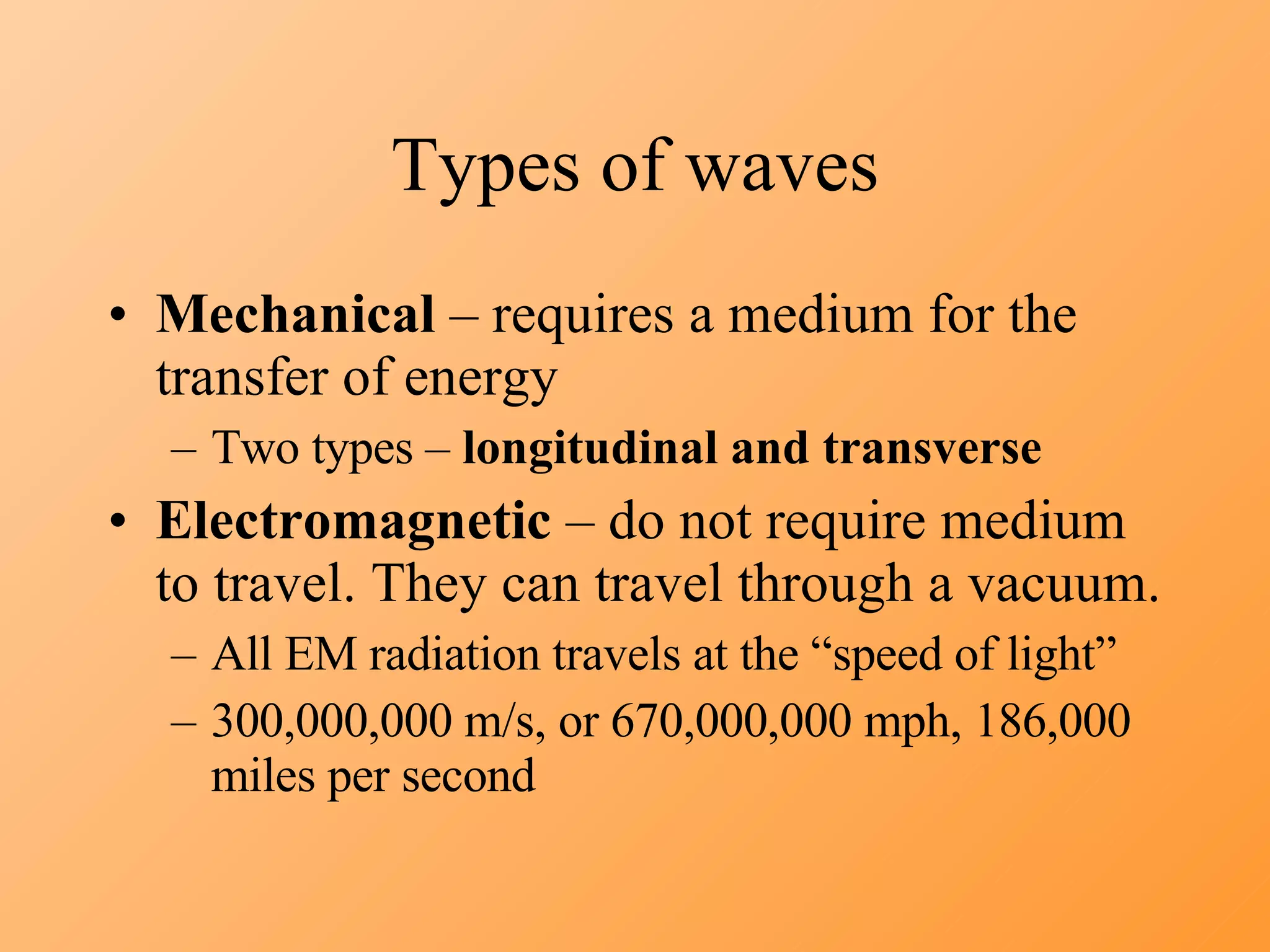
Types of waves Mechanical  – requires a medium for the transfer of energy Two types –  longitudinal and transverse Electromagnetic  – do not require medium to travel. They can travel through a vacuum. All EM radiation travels at the “speed of light”  300,000,000 m/s, or 670,000,000 mph, 186,000 miles per second
Wave Words Medium  –  substance or material which carries the wave Medium will affect the speed of the wave Air, water, land, rock, string, metal Speed of sound in: air 343 m/s, water 1482 m/s steel 5960 m/s
More Wave Words Crest  – section of the wave that rises above the undisturbed position Trough  – section of the waves that dips below the undisturbed position Amplitude  – maximum displacement of medium above the undisturbed position Wavelength  – distance between two adjacent corresponding location on the wave  (measure in meters)
Even more Wave Words Frequency  – the number of waves which pass by in a given amount of time  (measured in Hertz, cycles per second) Period  – amount of time it takes for one wave to pass  (measure in seconds)
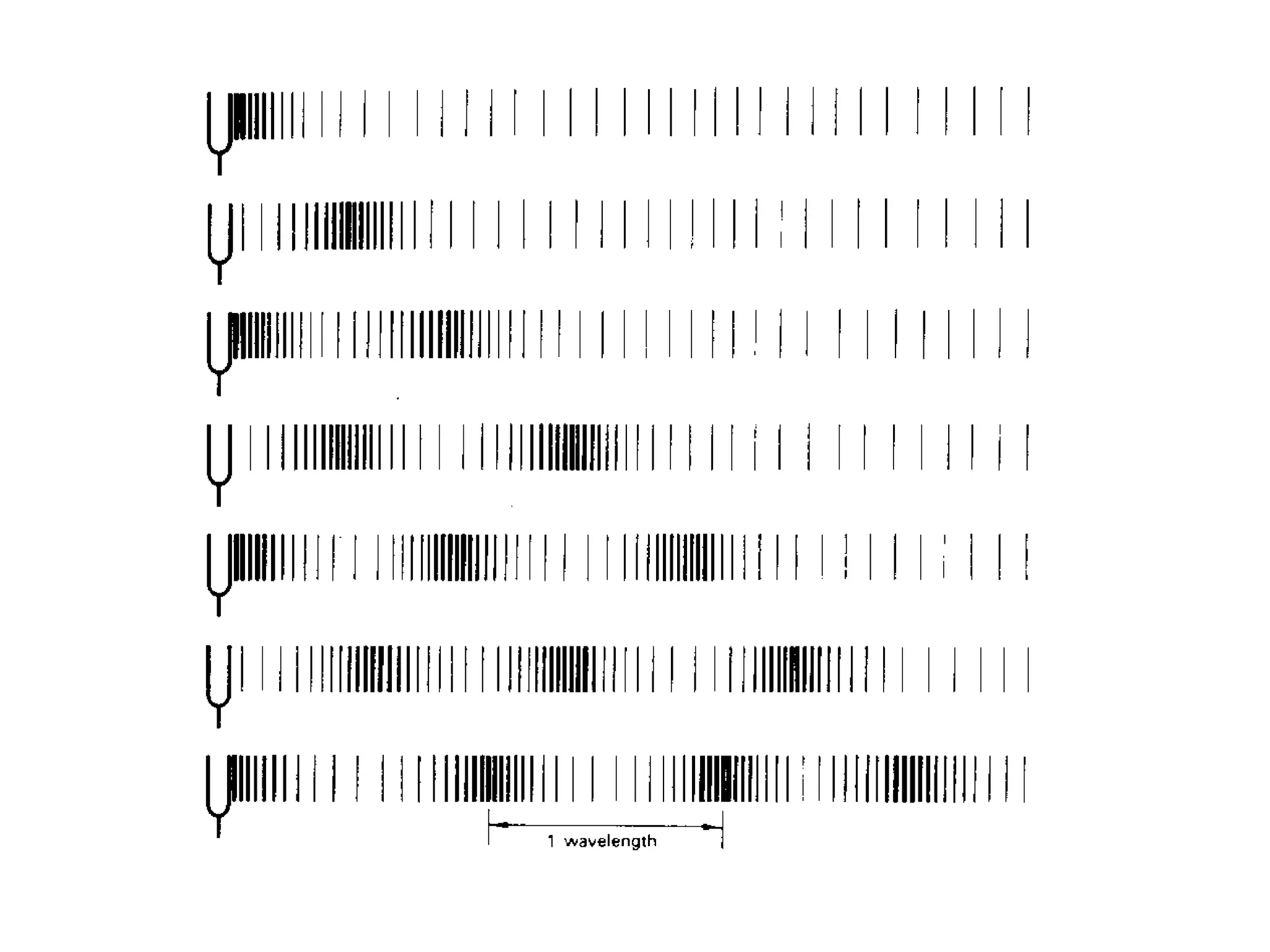
Still more Wave Words Rarefaction  – area of low pressure in a longitudinal wave When molecules are most spread out Compression  – area of high pressure in a longitudinal wave When molecules are packed close together
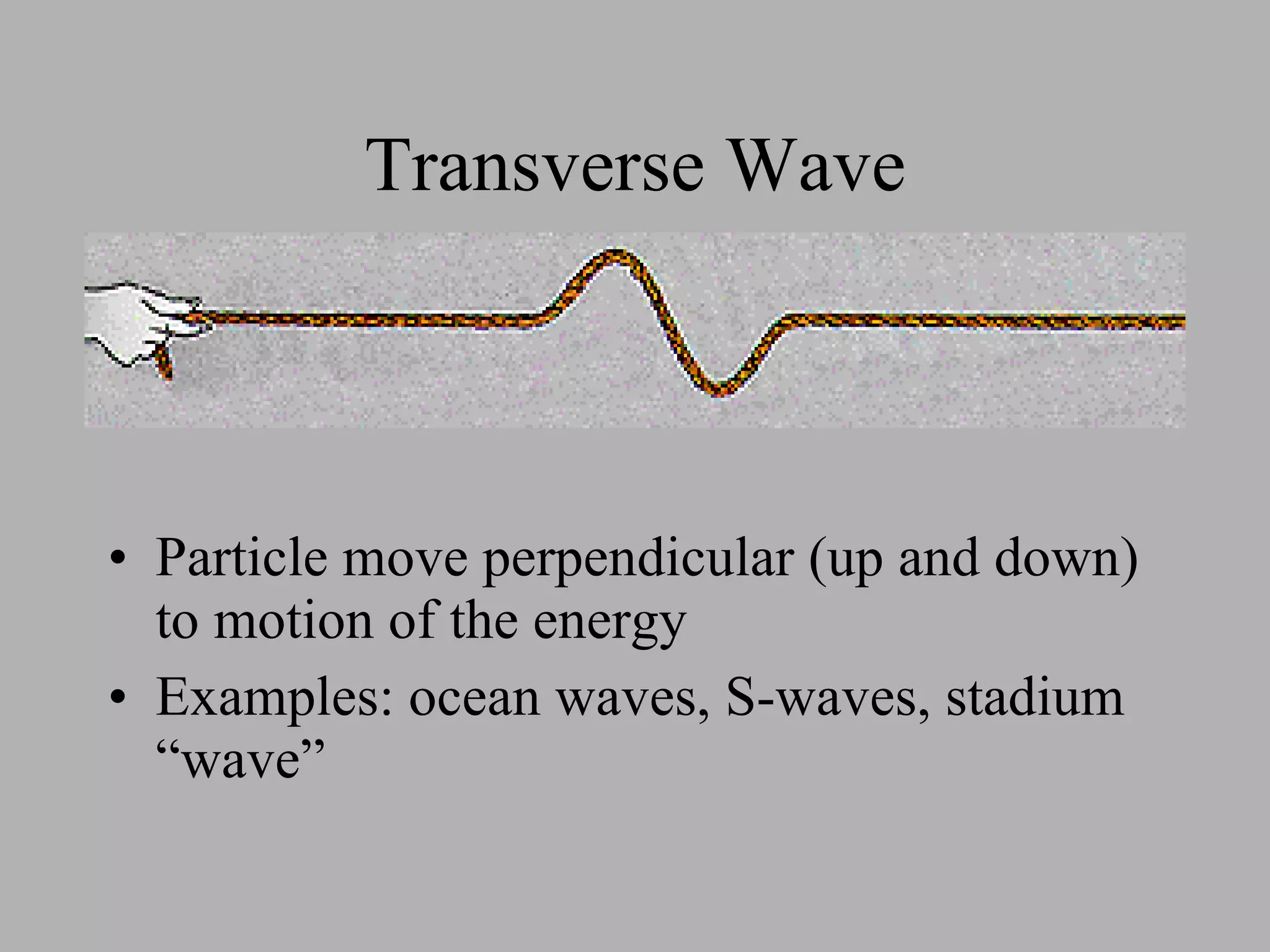
Transverse Wave Particle move perpendicular (up and down) to motion of the energy Examples: ocean waves, S-waves, stadium “wave”
Parts of a Transverse Wave
 
San Andreas Fault
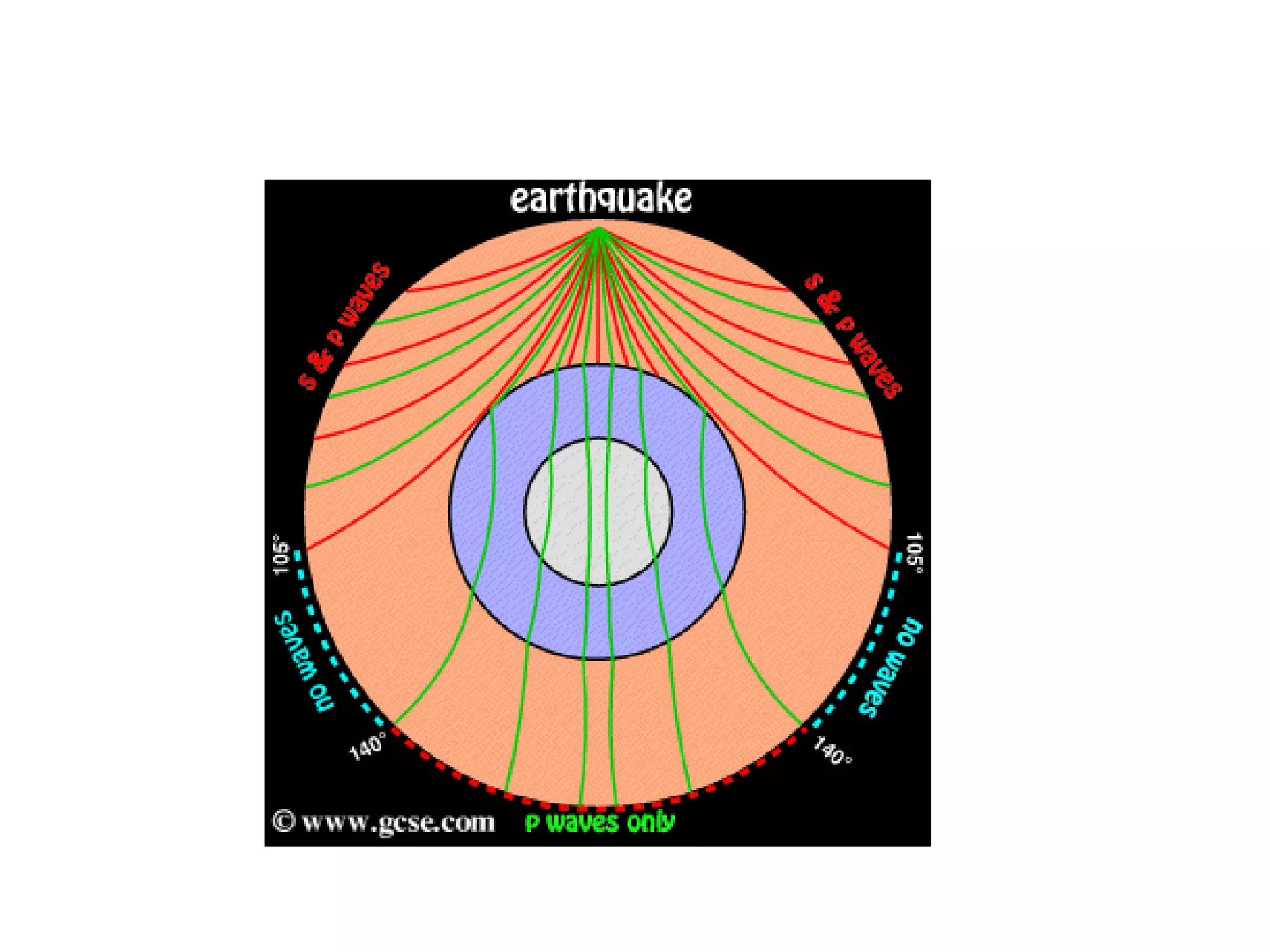
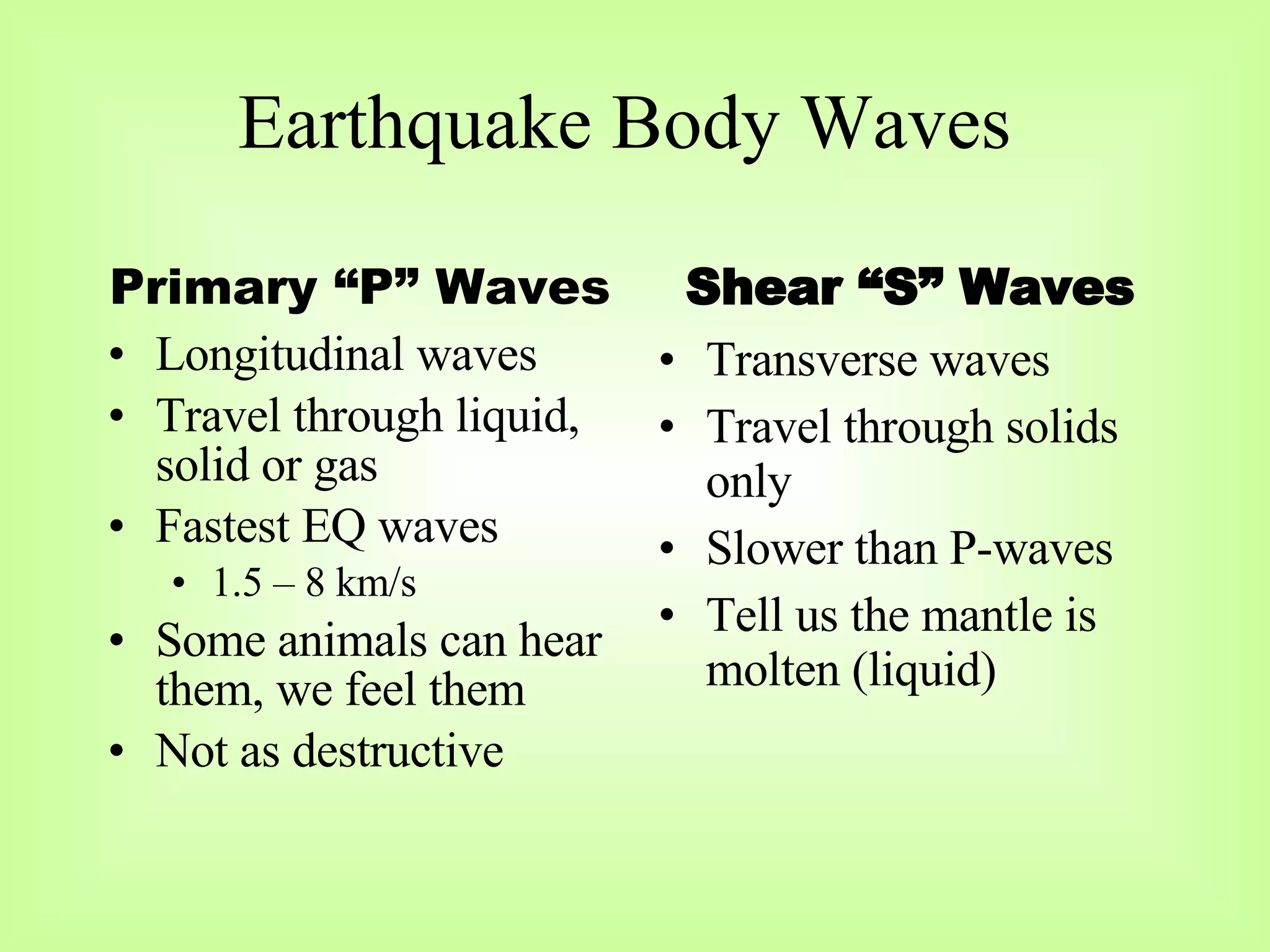
Earthquake Body Waves Primary “P” Waves Longitudinal waves Travel through liquid, solid or gas Fastest EQ waves 1.5 – 8 km/s Some animals can hear them, we feel them Not as destructive Shear “S” Waves Transverse waves Travel through solids only Slower than P-waves Tell us the mantle is molten (liquid)
Seismograph  –instrument which records the magnitude of an earthquake Seismogram  - – data or graph collected by the seismograph [seismograph (graph) and seismometer (instrument) are also used and becomng the norm]
Logarithmic scale used to measure the magnitude of an earthquake 4.0 is 10x stronger than 3.0 Microquake – less than 2.0, undetected by humans Moderate quakes are less than 6.0 Greatest recorded earthquake was 8.9 12/26/2004 Richter Scale
 
1990 – 6.2 on Ritcher Scale Occurred at subduction zone Sound is speeded up 50x  Actual earthquake was 20 seconds  Hear sharp P-waves first followed by louder S-waves Hear an Earthquake in New Zealand
Longitudinal Waves Particle movement is parallel (back and forth) compared to direction of energy motion Examples: Sound waves, P - waves


Compare types of waves http://www.gmi.edu/~drussell/Demos/waves/wavemotion.html Play with frequency, amplitude  http://surendranath.tripod.com/Applets/Waves/Twave01/Twave01Applet.html
 

Waves

  • 1.
  • 2.
    What is awave? Disturbance that travels from one location to another location Wiggle in time Transfer of energy from one place to another Excitement of molecules in which particle move, but are not transported You make up your own……
  • 3.
    Types of wavesMechanical – requires a medium for the transfer of energy Two types – longitudinal and transverse Electromagnetic – do not require medium to travel. They can travel through a vacuum. All EM radiation travels at the “speed of light” 300,000,000 m/s, or 670,000,000 mph, 186,000 miles per second
  • 4.
    Wave Words Medium – substance or material which carries the wave Medium will affect the speed of the wave Air, water, land, rock, string, metal Speed of sound in: air 343 m/s, water 1482 m/s steel 5960 m/s
  • 5.
    More Wave WordsCrest – section of the wave that rises above the undisturbed position Trough – section of the waves that dips below the undisturbed position Amplitude – maximum displacement of medium above the undisturbed position Wavelength – distance between two adjacent corresponding location on the wave (measure in meters)
  • 6.
    Even more WaveWords Frequency – the number of waves which pass by in a given amount of time (measured in Hertz, cycles per second) Period – amount of time it takes for one wave to pass (measure in seconds)
  • 7.
    Still more WaveWords Rarefaction – area of low pressure in a longitudinal wave When molecules are most spread out Compression – area of high pressure in a longitudinal wave When molecules are packed close together
  • 8.
    Transverse Wave Particlemove perpendicular (up and down) to motion of the energy Examples: ocean waves, S-waves, stadium “wave”
  • 9.
    Parts of aTransverse Wave
  • 10.
  • 11.
  • 12.
    Earthquake Body WavesPrimary “P” Waves Longitudinal waves Travel through liquid, solid or gas Fastest EQ waves 1.5 – 8 km/s Some animals can hear them, we feel them Not as destructive Shear “S” Waves Transverse waves Travel through solids only Slower than P-waves Tell us the mantle is molten (liquid)
  • 13.
    Seismograph –instrumentwhich records the magnitude of an earthquake Seismogram - – data or graph collected by the seismograph [seismograph (graph) and seismometer (instrument) are also used and becomng the norm]
  • 14.
    Logarithmic scale usedto measure the magnitude of an earthquake 4.0 is 10x stronger than 3.0 Microquake – less than 2.0, undetected by humans Moderate quakes are less than 6.0 Greatest recorded earthquake was 8.9 12/26/2004 Richter Scale
  • 15.
  • 16.
    1990 – 6.2on Ritcher Scale Occurred at subduction zone Sound is speeded up 50x Actual earthquake was 20 seconds Hear sharp P-waves first followed by louder S-waves Hear an Earthquake in New Zealand
  • 17.
    Longitudinal Waves Particlemovement is parallel (back and forth) compared to direction of energy motion Examples: Sound waves, P - waves
  • 18.
  • 19.
  • 20.
  • 21.
  • 22.
  • 23.
    Compare types ofwaves http://www.gmi.edu/~drussell/Demos/waves/wavemotion.html Play with frequency, amplitude http://surendranath.tripod.com/Applets/Waves/Twave01/Twave01Applet.html
  • 24.