Water claims to be an important resource. An
important use of water in our country is for irrigation.
Besides, water is also required in large amounts for
industrial and domestic consumption.
USES
 Is essential for all forms of life.
 Many uses of water include agricultural, industrial,
household, recreational and environmental activities.
Virtually, all of these human uses, require fresh water.
 No plant or animal species can survive without water.
If water in our body drops by 1% we feel thirst, if it
drops by 10% we face death.
HYDROLOGICAL CYCLE:
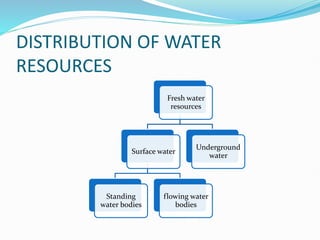
DISTRIBUTION OF WATER
RESOURCES
Fresh water
resources
Surface water
Standing
water bodies
flowing water
bodies
Underground
water
UNDERGROUND WATER
 Aquifer: Layers of highly permeable rock
that can store water is called an aquifer.
Layer of sand and gravels are good aquifers.
Clay and crystalline rocks are not good
aquifers.
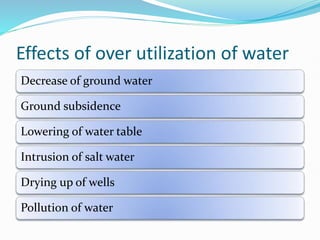
Effects of over utilization of water
Decrease of ground water
Ground subsidence
Lowering of water table
Intrusion of salt water
Drying up of wells
Pollution of water
REASONS FOR DECLINE OF
GROUND WATER
Population explosion
Overutilization of Surface and Groundwater
Deforestation
Hydropower generation
Dams
Rain fall
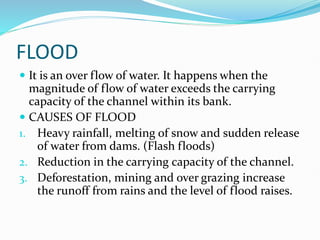
FLOOD
 It is an over flow of water. It happens when the
magnitude of flow of water exceeds the carrying
capacity of the channel within its bank.
 CAUSES OF FLOOD
1. Heavy rainfall, melting of snow and sudden release
of water from dams. (Flash floods)
2. Reduction in the carrying capacity of the channel.
3. Deforestation, mining and over grazing increase
the runoff from rains and the level of flood raises.
EFFECT OF FLOOD
 Water spreads in the surrounding area and submerges
them.
 Cultivated land gets affected.
 Extinction of civilization.
FLOOD MANAGEMENT
1. Floods can be controlled by dams.
2. Channel management control flood.
3. Flood hazards reduced by forecasting or flood
warning.
4. Flood may also be reduced by reduction of run off
by increasing infiltration through appropriate
afforestation in the catchment area
DROUGHT
 Drought is nothing but scarcity of water, which occurs
due to
1. Inadequate rain fall
2. Late arrival of rain fall
3. Excessive withdrawal of ground water.
Lack of water for the needs of agriculture, livestock,
industry or human population may be termed as a
drought. Drought causes serious damages to plants,
animals and human life.
CAUSES OF DROUGHT
 When annual rain fall is below normal and less than
evaporation, drought is created.
 High population.
 Intensive cropping pattern
Ex: Maharashtra - There has been no recovery from
drought for the last 30 years due to over exploitation of
water by sugarcane crop.
EFFECTS OF DROUGHT
 Drought causes hunger, malnutrition and scarcity of
drinking water an also changes the quality of water.
 Drought causes widespread crop failure leading to acute
shortage of food and adversely affects human and live stock
population.
 Worst situation of drought causes desertification.
 Raw materials of agro based industries are critically
affected during drought time, hence industrial and
commercial growth decreases.
 Drought increases the degradation of natural resources.
 Drought causes large migration of people and
urbanization
DROUGHT MANAGEMENT
 Indigenous knowledge is essential.
 Rain water harvesting system.
 Construction of reservoirs to improve ground water
level.
 Modern irrigation technology (drip irrigation) very
useful to conserve water.
 Afforestration activities also improve the potential of
water in the drought area.
 Crop mixing and dry farming are the suitable methods
which minimize the risk of crop failures in dry area.
SUSTAINABLE WATER MANAGEMENT
 Building several small reservoirs instead of few mega
projects
 Protecting wetlands
 Recharging of underground aquifer
 Effective rainwater harvesting
 Develop systematic water management and adopt
strict water auditing
 “Save water Campaigns” for public awareness on water
scarcity
MINERAL RESOURCES
 Naturally occurring inorganic crystalline solids with uniform chemical
composition are called as minerals.
 USES AND EXPLOITATION OF MINERALS
1. Development of industrial plants and machinery. - Fe, Al & Cu
2. Construction work – Fe, Al &Ni
3. Generation of energy - coal, lignite, uranium
4. Designing defense equipments like weapons and ornaments
5. Agricultural purposes – fertilizers and fungicides – Zn & Mn
6. Jewellery –Au, Ag & Pt
7. Making alloys for various purposes
8. Communication purposes – telephone, wires, cables and electronic
devices
9. Medicinal purposes, particularly in ayurvedic system
EFFECTS OF OVER EXPLOITATION OF MINERALS
 Rapid depletion of mineral deposits
 Wastage
 Environmental pollution
 Needs heavy energy requirements.
MANAGEMENT OF MINERAL RESOURCES
1. The efficient use and protection of mineral resources.
2. Modernization of mining industries
3. Search for new deposit
4. Reuse and recycling of the metals.
5. Environmental impacts can be minimized by adopting eco
friendly mining technology.
FOOD RESOURCES
 Food is an essential requirement for survival of life.
Main components are carbohydrates, fats, proteins,
minerals and vitamins.
 TYPES OF FOOD SUPPLY
1. Crop plants: Grains mostly constitute about 76% of
the world’s food. Ex: Rice, Wheat and Maize
2. Range lands: Produces 17% of world’s food from trees
and grazing animals. Ex: Fruits, milk and meat
3. Ocean: Fisheries – 7% of world’s food
TYPES OF NUTRITION
 Nutritious nutrition
 Under nutrition
 Mal nutrition
AGRICULTURE
 Agriculture is an art, science and industry of managing the
growth of plants animals for human use. It includes
cultivation of the soil, growing and harvesting crops,
breeding and raising livestock, dairying and forestry.
 TYPES OF AGRICULTURE
1. Traditional agriculture Small plot, simple tools, surface
water, organic fertilizer and a mixture of crops constitute
traditional agriculture. They produce enough food to
feed their family and to sell it for their income.
2. Modern agriculture Hybrid seeds of single crop variety,
high tech equipments, lot of fertilizers, pesticides and
water to produce large amount of single crops.
EFFECTS OF MODERN AGRICULTURE
1. Problems in using fertilizers
a. Excess of fertilizers causes micronutrient imbalance.
(e.g) Punjab and Haryana deficiency of nutrient zinc in
the soil affect the productivity of the soil.
b. Blue baby syndrome (nitrate pollution): Nitrate present
in the fertilizer causes blue baby syndrome, when the
amount exceeds the limit leads to death.
c. Eutrophication: Nitrogen and phosphorus in the crop
fields washed out by runoff water in the water bodies,
which increases the nourishment of the lakes called
eutrophication. Hence algal species increases rapidly. Life
time of the species is less and they decompose easily and
pollute the water which affects the aquatic life.
EFFECTS OF MODERN AGRICULTURE
 2. Problems in using pesticides
1. Death of non target organism.
2. Producing new pest – super pest
3. Bio magnification – Most of the pesticides are non bio degradable, keep
on concentrating in the food chain and it is harmful to human beings.
4. Risk of cancer:
a. It directly acts as carcinogen
b. It indirectly supports immune system.
 3. Water logging: Land where water stand for most of the year. Causes
of water logging:
1. Excessive water supply
2. Heavy rain
3. Poor drainage
Remedy:
1. Preventing excessive irrigation
2. Subsurface drainage technology
3. Bio drainage like trees like Eucalyptus
ENERGY RESOURCES
 TYPES OF ENERGY RESOURCES:
1. Renewable energy resource (or)Non conventional energy
resources
2. Non renewable energy resources (or) Conventional energy
resources
RENEWABLE ENERGY SOURCES: Energy which can be
regenerated.
Merits of renewable energy resources
1. Unlimited supply
2. Provides energy security.
3. Fits into sustainable development concept.
4. Reliable and the devices are modular in size.
5. Decentralized energy production.
Types of renewable energy resources
 Solar energy: Nuclear fusion reaction of sun produces enormous
amount of energy. Several techniques are available for collecting,
storing and using solar energy.
 Wind energy: Moving air is called wind. The energy recovered from
the force of the wind is called wind energy It’s speed is high.
 Ocean energy
Tidal energy (or) Tidal power: Ocean tides are due to gravitational force
of sun and moon which produce enormous amount of energy.
Ocean thermal energy: Temperature difference between surface water
and deeper level water in ocean generates electricity.
 Geo thermal energy: Temperature of the earth increases at a of 20 –
750C per/km when we move down the earth. The energy utilised from
the high temperature present inside the earth is called geothermal
energy.
 Bio mass energy: Bio mass: Organic matter produced by plants or
animals used as source of energy
NON RENEWABLE ENERGY SOURCES:
 Energy which cannot be regenerated is called as non-
renewable.
 1. Coal: It is a solid fossil fuel.
Disadvantages:
1. When coal is burnt large amount of CO2 is released
which causes global warming.
2. S, N produces toxic gases during burning.
 2. Petroleum: Crude oil is a liquid consists of more than
hundreds of hydrocarbons and small amount of
impurities. The petroleum can be refined by fractional
distillation. In the world level 25% of oil reserves are in
Saudi Arabia. At present rate of usage, the world crude oil
reserves are expected to get exhausted in just 40 years.
NON RENEWABLE ENERGY SOURCES:
 3. Liquefied petroleum gas (LPG): Petroleum gases obtained during FD
and cracking can be easily converted into liquid under high pressure as
LPG. It is colorless and odorless gas, but during cylindering mercaptans
are added to detect leakage.
 4. Natural gas: These are found above oil in oil wells. It is a mixture of
methane and other hydrocarbons. Calorific value is high. There are two
types. Dry gas and wet gas.
 5. Nuclear energy: Dr.H.Bhabha is a father of nuclear power
development in India. 10 nuclear reactors are present in India. It
produces 2% of India’s electricity. Nuclear energy can be produced by
two types of reactions. Nuclear fission and nuclear fusion.
Nuclear fission; It is a nuclear change in which heavier nucleus split into
lighter nuclei on bombardment of fast moving neutrons. Large amount
of energy is released through chain reaction.
Ex: Uranium with fast moving neutron gives barium and krypton in
addition to three neutrons; in the second stage it gives nine neutrons
and so on. This process of propagation of the reaction by
multiplication is called chain reaction

Water Resources_Environmental studies.pptx

  • 1.
    Water claims tobe an important resource. An important use of water in our country is for irrigation. Besides, water is also required in large amounts for industrial and domestic consumption.
  • 2.
    USES  Is essentialfor all forms of life.  Many uses of water include agricultural, industrial, household, recreational and environmental activities. Virtually, all of these human uses, require fresh water.  No plant or animal species can survive without water. If water in our body drops by 1% we feel thirst, if it drops by 10% we face death.
  • 3.
  • 4.
    DISTRIBUTION OF WATER RESOURCES Freshwater resources Surface water Standing water bodies flowing water bodies Underground water
  • 5.
    UNDERGROUND WATER  Aquifer:Layers of highly permeable rock that can store water is called an aquifer. Layer of sand and gravels are good aquifers. Clay and crystalline rocks are not good aquifers.
  • 6.
    Effects of overutilization of water Decrease of ground water Ground subsidence Lowering of water table Intrusion of salt water Drying up of wells Pollution of water
  • 7.
    REASONS FOR DECLINEOF GROUND WATER Population explosion Overutilization of Surface and Groundwater Deforestation Hydropower generation Dams Rain fall
  • 8.
    FLOOD  It isan over flow of water. It happens when the magnitude of flow of water exceeds the carrying capacity of the channel within its bank.  CAUSES OF FLOOD 1. Heavy rainfall, melting of snow and sudden release of water from dams. (Flash floods) 2. Reduction in the carrying capacity of the channel. 3. Deforestation, mining and over grazing increase the runoff from rains and the level of flood raises.
  • 9.
    EFFECT OF FLOOD Water spreads in the surrounding area and submerges them.  Cultivated land gets affected.  Extinction of civilization. FLOOD MANAGEMENT 1. Floods can be controlled by dams. 2. Channel management control flood. 3. Flood hazards reduced by forecasting or flood warning. 4. Flood may also be reduced by reduction of run off by increasing infiltration through appropriate afforestation in the catchment area
  • 10.
    DROUGHT  Drought isnothing but scarcity of water, which occurs due to 1. Inadequate rain fall 2. Late arrival of rain fall 3. Excessive withdrawal of ground water. Lack of water for the needs of agriculture, livestock, industry or human population may be termed as a drought. Drought causes serious damages to plants, animals and human life.
  • 11.
    CAUSES OF DROUGHT When annual rain fall is below normal and less than evaporation, drought is created.  High population.  Intensive cropping pattern Ex: Maharashtra - There has been no recovery from drought for the last 30 years due to over exploitation of water by sugarcane crop.
  • 12.
    EFFECTS OF DROUGHT Drought causes hunger, malnutrition and scarcity of drinking water an also changes the quality of water.  Drought causes widespread crop failure leading to acute shortage of food and adversely affects human and live stock population.  Worst situation of drought causes desertification.  Raw materials of agro based industries are critically affected during drought time, hence industrial and commercial growth decreases.  Drought increases the degradation of natural resources.  Drought causes large migration of people and urbanization
  • 13.
    DROUGHT MANAGEMENT  Indigenousknowledge is essential.  Rain water harvesting system.  Construction of reservoirs to improve ground water level.  Modern irrigation technology (drip irrigation) very useful to conserve water.  Afforestration activities also improve the potential of water in the drought area.  Crop mixing and dry farming are the suitable methods which minimize the risk of crop failures in dry area.
  • 14.
    SUSTAINABLE WATER MANAGEMENT Building several small reservoirs instead of few mega projects  Protecting wetlands  Recharging of underground aquifer  Effective rainwater harvesting  Develop systematic water management and adopt strict water auditing  “Save water Campaigns” for public awareness on water scarcity
  • 15.
    MINERAL RESOURCES  Naturallyoccurring inorganic crystalline solids with uniform chemical composition are called as minerals.  USES AND EXPLOITATION OF MINERALS 1. Development of industrial plants and machinery. - Fe, Al & Cu 2. Construction work – Fe, Al &Ni 3. Generation of energy - coal, lignite, uranium 4. Designing defense equipments like weapons and ornaments 5. Agricultural purposes – fertilizers and fungicides – Zn & Mn 6. Jewellery –Au, Ag & Pt 7. Making alloys for various purposes 8. Communication purposes – telephone, wires, cables and electronic devices 9. Medicinal purposes, particularly in ayurvedic system
  • 16.
    EFFECTS OF OVEREXPLOITATION OF MINERALS  Rapid depletion of mineral deposits  Wastage  Environmental pollution  Needs heavy energy requirements. MANAGEMENT OF MINERAL RESOURCES 1. The efficient use and protection of mineral resources. 2. Modernization of mining industries 3. Search for new deposit 4. Reuse and recycling of the metals. 5. Environmental impacts can be minimized by adopting eco friendly mining technology.
  • 17.
    FOOD RESOURCES  Foodis an essential requirement for survival of life. Main components are carbohydrates, fats, proteins, minerals and vitamins.  TYPES OF FOOD SUPPLY 1. Crop plants: Grains mostly constitute about 76% of the world’s food. Ex: Rice, Wheat and Maize 2. Range lands: Produces 17% of world’s food from trees and grazing animals. Ex: Fruits, milk and meat 3. Ocean: Fisheries – 7% of world’s food
  • 18.
    TYPES OF NUTRITION Nutritious nutrition  Under nutrition  Mal nutrition
  • 19.
    AGRICULTURE  Agriculture isan art, science and industry of managing the growth of plants animals for human use. It includes cultivation of the soil, growing and harvesting crops, breeding and raising livestock, dairying and forestry.  TYPES OF AGRICULTURE 1. Traditional agriculture Small plot, simple tools, surface water, organic fertilizer and a mixture of crops constitute traditional agriculture. They produce enough food to feed their family and to sell it for their income. 2. Modern agriculture Hybrid seeds of single crop variety, high tech equipments, lot of fertilizers, pesticides and water to produce large amount of single crops.
  • 20.
    EFFECTS OF MODERNAGRICULTURE 1. Problems in using fertilizers a. Excess of fertilizers causes micronutrient imbalance. (e.g) Punjab and Haryana deficiency of nutrient zinc in the soil affect the productivity of the soil. b. Blue baby syndrome (nitrate pollution): Nitrate present in the fertilizer causes blue baby syndrome, when the amount exceeds the limit leads to death. c. Eutrophication: Nitrogen and phosphorus in the crop fields washed out by runoff water in the water bodies, which increases the nourishment of the lakes called eutrophication. Hence algal species increases rapidly. Life time of the species is less and they decompose easily and pollute the water which affects the aquatic life.
  • 21.
    EFFECTS OF MODERNAGRICULTURE  2. Problems in using pesticides 1. Death of non target organism. 2. Producing new pest – super pest 3. Bio magnification – Most of the pesticides are non bio degradable, keep on concentrating in the food chain and it is harmful to human beings. 4. Risk of cancer: a. It directly acts as carcinogen b. It indirectly supports immune system.  3. Water logging: Land where water stand for most of the year. Causes of water logging: 1. Excessive water supply 2. Heavy rain 3. Poor drainage Remedy: 1. Preventing excessive irrigation 2. Subsurface drainage technology 3. Bio drainage like trees like Eucalyptus
  • 22.
    ENERGY RESOURCES  TYPESOF ENERGY RESOURCES: 1. Renewable energy resource (or)Non conventional energy resources 2. Non renewable energy resources (or) Conventional energy resources RENEWABLE ENERGY SOURCES: Energy which can be regenerated. Merits of renewable energy resources 1. Unlimited supply 2. Provides energy security. 3. Fits into sustainable development concept. 4. Reliable and the devices are modular in size. 5. Decentralized energy production.
  • 23.
    Types of renewableenergy resources  Solar energy: Nuclear fusion reaction of sun produces enormous amount of energy. Several techniques are available for collecting, storing and using solar energy.  Wind energy: Moving air is called wind. The energy recovered from the force of the wind is called wind energy It’s speed is high.  Ocean energy Tidal energy (or) Tidal power: Ocean tides are due to gravitational force of sun and moon which produce enormous amount of energy. Ocean thermal energy: Temperature difference between surface water and deeper level water in ocean generates electricity.  Geo thermal energy: Temperature of the earth increases at a of 20 – 750C per/km when we move down the earth. The energy utilised from the high temperature present inside the earth is called geothermal energy.  Bio mass energy: Bio mass: Organic matter produced by plants or animals used as source of energy
  • 24.
    NON RENEWABLE ENERGYSOURCES:  Energy which cannot be regenerated is called as non- renewable.  1. Coal: It is a solid fossil fuel. Disadvantages: 1. When coal is burnt large amount of CO2 is released which causes global warming. 2. S, N produces toxic gases during burning.  2. Petroleum: Crude oil is a liquid consists of more than hundreds of hydrocarbons and small amount of impurities. The petroleum can be refined by fractional distillation. In the world level 25% of oil reserves are in Saudi Arabia. At present rate of usage, the world crude oil reserves are expected to get exhausted in just 40 years.
  • 25.
    NON RENEWABLE ENERGYSOURCES:  3. Liquefied petroleum gas (LPG): Petroleum gases obtained during FD and cracking can be easily converted into liquid under high pressure as LPG. It is colorless and odorless gas, but during cylindering mercaptans are added to detect leakage.  4. Natural gas: These are found above oil in oil wells. It is a mixture of methane and other hydrocarbons. Calorific value is high. There are two types. Dry gas and wet gas.  5. Nuclear energy: Dr.H.Bhabha is a father of nuclear power development in India. 10 nuclear reactors are present in India. It produces 2% of India’s electricity. Nuclear energy can be produced by two types of reactions. Nuclear fission and nuclear fusion. Nuclear fission; It is a nuclear change in which heavier nucleus split into lighter nuclei on bombardment of fast moving neutrons. Large amount of energy is released through chain reaction. Ex: Uranium with fast moving neutron gives barium and krypton in addition to three neutrons; in the second stage it gives nine neutrons and so on. This process of propagation of the reaction by multiplication is called chain reaction