Water purification system in an industry
H.G.A.S.Samarasinghe
What is purification:
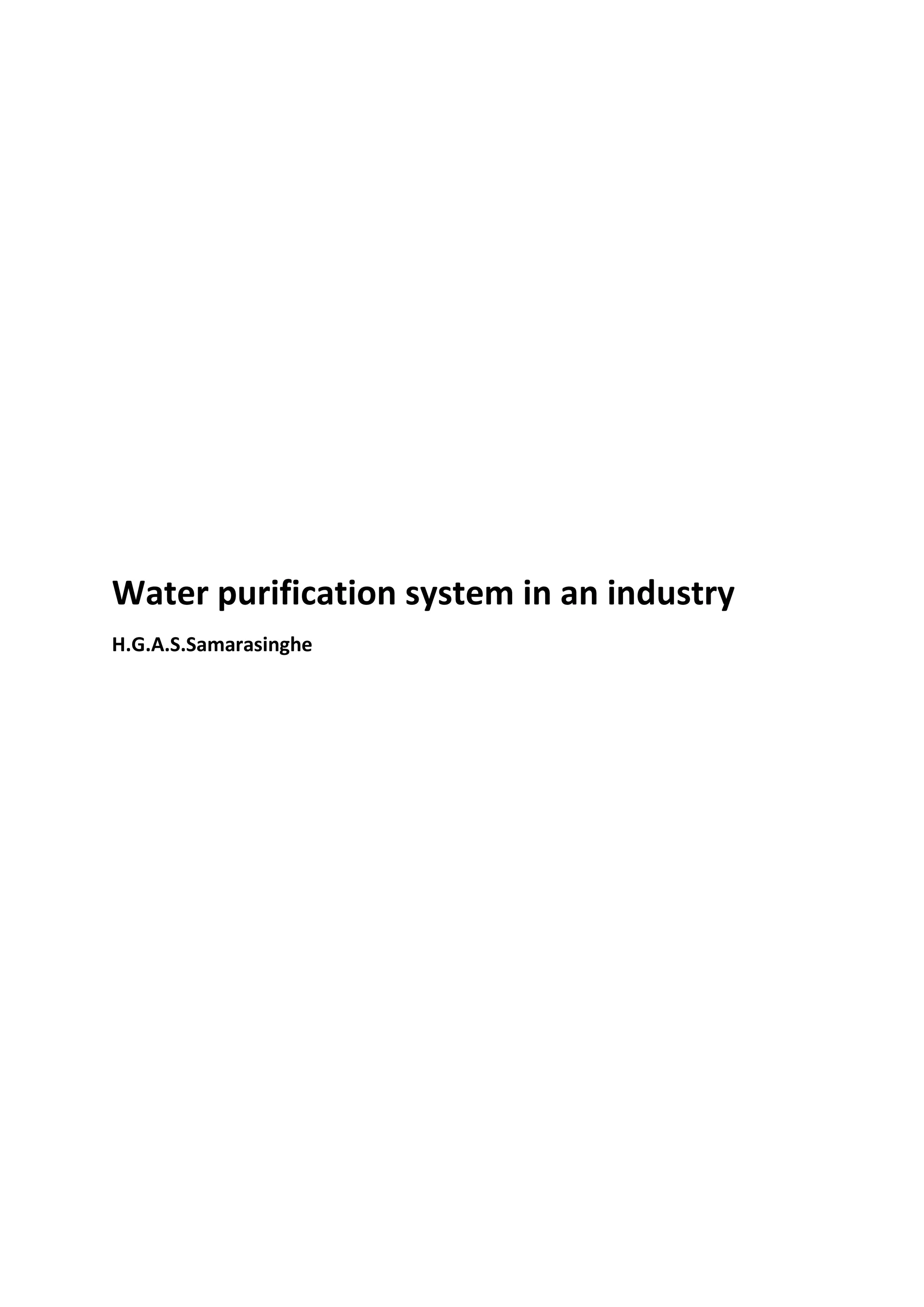
The process of removing undesirable chemicals, biological contaminants, suspended solids
and gases from water. The goal is to produce water fit for a specific purpose.
The standards for drinking water quality are typically set by governments or by international
standards. These standards usually include minimum and maximum concentrations of
contaminants, depending on the intended purpose of water use.
Deep well water
• Deep ground water is generally of very high bacteriological quality
• Pathogenic bacteria or protozoa are typically
Absent.
• May be rich in dissolved solids,
Ex:- carbonates
sulfates of calcium
magnesium
• This depends on the strata through which the water has flowed.
• Other ions may also be present.
Ex:- chloride
bicarbonate
• There may be a requirement to reduce the iron or manganese content of this water
to make it acceptable for drinking and washing purposes.
Pumping of water
• The stainless steels are used in pipes and strength of stainless steel allows the use
of higher water velocities that can help to minimize the growth of biofilm
• The water must be pumped from its source or directed into holding tanks through
pipes.
• To avoid adding contaminants to the water, this physical infrastructure must be
made from appropriate materials and constructed so that accidental contamination
does not occur
Was
Storage
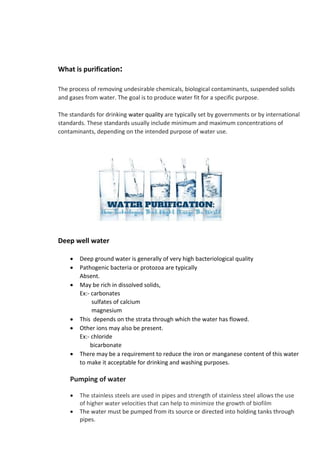
• Water from the deep water wells are stored in stored in 5000 l tanks. The tanks
should be air proofed.
• AS/NZS 4766:2006 Polyethylene Storage Tanks for Water and AS/NZS ISO 9001:2008
Quality Management System are available.
Sand filters
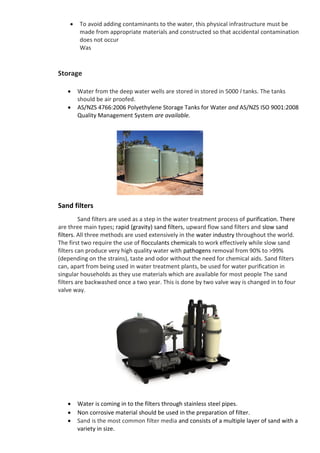
Sand filters are used as a step in the water treatment process of purification. There
are three main types; rapid (gravity) sand filters, upward flow sand filters and slow sand
filters. All three methods are used extensively in the water industry throughout the world.
The first two require the use of flocculants chemicals to work effectively while slow sand
filters can produce very high quality water with pathogens removal from 90% to >99%
(depending on the strains), taste and odor without the need for chemical aids. Sand filters
can, apart from being used in water treatment plants, be used for water purification in
singular households as they use materials which are available for most people The sand
filters are backwashed once a two year. This is done by two valve way is changed in to four
valve way.
• Water is coming in to the filters through stainless steel pipes.
• Non corrosive material should be used in the preparation of filter.
• Sand is the most common filter media and consists of a multiple layer of sand with a
variety in size.
• Generally, fine mesh sand is coupled with a coarse grain support bed to remove
suspended solids and turbidity.
• Fully automatically operated and filtering is taken place under gravity.
Carbon filter System
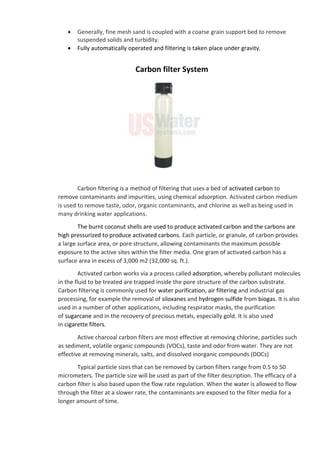
Carbon filtering is a method of filtering that uses a bed of activated carbon to
remove contaminants and impurities, using chemical adsorption. Activated carbon medium
is used to remove taste, odor, organic contaminants, and chlorine as well as being used in
many drinking water applications.
The burnt coconut shells are used to produce activated carbon and the carbons are
high pressurized to produce activated carbons. Each particle, or granule, of carbon provides
a large surface area, or pore structure, allowing contaminants the maximum possible
exposure to the active sites within the filter media. One gram of activated carbon has a
surface area in excess of 3,000 m2 (32,000 sq. ft.).
Activated carbon works via a process called adsorption, whereby pollutant molecules
in the fluid to be treated are trapped inside the pore structure of the carbon substrate.
Carbon filtering is commonly used for water purification, air filtering and industrial gas
processing, for example the removal of siloxanes and hydrogen sulfide from biogas. It is also
used in a number of other applications, including respirator masks, the purification
of sugarcane and in the recovery of precious metals, especially gold. It is also used
in cigarette filters.
Active charcoal carbon filters are most effective at removing chlorine, particles such
as sediment, volatile organic compounds (VOCs), taste and odor from water. They are not
effective at removing minerals, salts, and dissolved inorganic compounds (DOCs)
Typical particle sizes that can be removed by carbon filters range from 0.5 to 50
micrometers. The particle size will be used as part of the filter description. The efficacy of a
carbon filter is also based upon the flow rate regulation. When the water is allowed to flow
through the filter at a slower rate, the contaminants are exposed to the filter media for a
longer amount of time.
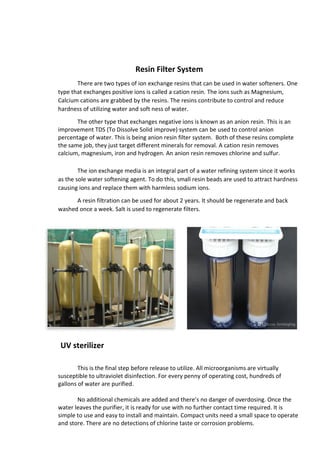
Resin Filter System
There are two types of ion exchange resins that can be used in water softeners. One
type that exchanges positive ions is called a cation resin. The ions such as Magnesium,
Calcium cations are grabbed by the resins. The resins contribute to control and reduce
hardness of utilizing water and soft ness of water.
The other type that exchanges negative ions is known as an anion resin. This is an
improvement TDS (To Dissolve Solid improve) system can be used to control anion
percentage of water. This is being anion resin filter system. Both of these resins complete
the same job, they just target different minerals for removal. A cation resin removes
calcium, magnesium, iron and hydrogen. An anion resin removes chlorine and sulfur.
The ion exchange media is an integral part of a water refining system since it works
as the sole water softening agent. To do this, small resin beads are used to attract hardness
causing ions and replace them with harmless sodium ions.
A resin filtration can be used for about 2 years. It should be regenerate and back
washed once a week. Salt is used to regenerate filters.
•
o
•
UV sterilizer
This is the final step before release to utilize. All microorganisms are virtually
susceptible to ultraviolet disinfection. For every penny of operating cost, hundreds of
gallons of water are purified.
No additional chemicals are added and there’s no danger of overdosing. Once the
water leaves the purifier, it is ready for use with no further contact time required. It is
simple to use and easy to install and maintain. Compact units need a small space to operate
and store. There are no detections of chlorine taste or corrosion problems.
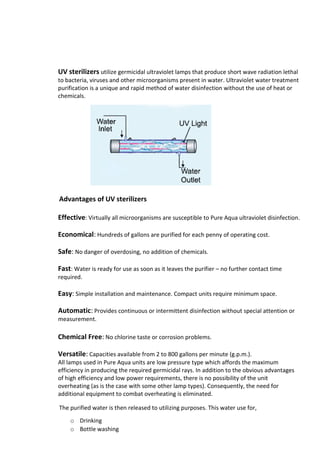
UV sterilizers utilize germicidal ultraviolet lamps that produce short wave radiation lethal
to bacteria, viruses and other microorganisms present in water. Ultraviolet water treatment
purification is a unique and rapid method of water disinfection without the use of heat or
chemicals.
Advantages of UV sterilizers
Effective: Virtually all microorganisms are susceptible to Pure Aqua ultraviolet disinfection.
Economical: Hundreds of gallons are purified for each penny of operating cost.
Safe: No danger of overdosing, no addition of chemicals.
Fast: Water is ready for use as soon as it leaves the purifier – no further contact time
required.
Easy: Simple installation and maintenance. Compact units require minimum space.
Automatic: Provides continuous or intermittent disinfection without special attention or
measurement.
Chemical Free: No chlorine taste or corrosion problems.
Versatile: Capacities available from 2 to 800 gallons per minute (g.p.m.).
All lamps used in Pure Aqua units are low pressure type which affords the maximum
efficiency in producing the required germicidal rays. In addition to the obvious advantages
of high efficiency and low power requirements, there is no possibility of the unit
overheating (as is the case with some other lamp types). Consequently, the need for
additional equipment to combat overheating is eliminated.
The purified water is then released to utilizing purposes. This water use for,
o Drinking
o Bottle washing
o Washing and Cleaning purposes
o For boiler

Water purification system in an industry

  • 1.
    Water purification systemin an industry H.G.A.S.Samarasinghe
  • 2.
    What is purification: Theprocess of removing undesirable chemicals, biological contaminants, suspended solids and gases from water. The goal is to produce water fit for a specific purpose. The standards for drinking water quality are typically set by governments or by international standards. These standards usually include minimum and maximum concentrations of contaminants, depending on the intended purpose of water use. Deep well water • Deep ground water is generally of very high bacteriological quality • Pathogenic bacteria or protozoa are typically Absent. • May be rich in dissolved solids, Ex:- carbonates sulfates of calcium magnesium • This depends on the strata through which the water has flowed. • Other ions may also be present. Ex:- chloride bicarbonate • There may be a requirement to reduce the iron or manganese content of this water to make it acceptable for drinking and washing purposes. Pumping of water • The stainless steels are used in pipes and strength of stainless steel allows the use of higher water velocities that can help to minimize the growth of biofilm • The water must be pumped from its source or directed into holding tanks through pipes.
  • 3.
    • To avoidadding contaminants to the water, this physical infrastructure must be made from appropriate materials and constructed so that accidental contamination does not occur Was Storage • Water from the deep water wells are stored in stored in 5000 l tanks. The tanks should be air proofed. • AS/NZS 4766:2006 Polyethylene Storage Tanks for Water and AS/NZS ISO 9001:2008 Quality Management System are available. Sand filters Sand filters are used as a step in the water treatment process of purification. There are three main types; rapid (gravity) sand filters, upward flow sand filters and slow sand filters. All three methods are used extensively in the water industry throughout the world. The first two require the use of flocculants chemicals to work effectively while slow sand filters can produce very high quality water with pathogens removal from 90% to >99% (depending on the strains), taste and odor without the need for chemical aids. Sand filters can, apart from being used in water treatment plants, be used for water purification in singular households as they use materials which are available for most people The sand filters are backwashed once a two year. This is done by two valve way is changed in to four valve way. • Water is coming in to the filters through stainless steel pipes. • Non corrosive material should be used in the preparation of filter. • Sand is the most common filter media and consists of a multiple layer of sand with a variety in size.
  • 4.
    • Generally, finemesh sand is coupled with a coarse grain support bed to remove suspended solids and turbidity. • Fully automatically operated and filtering is taken place under gravity. Carbon filter System Carbon filtering is a method of filtering that uses a bed of activated carbon to remove contaminants and impurities, using chemical adsorption. Activated carbon medium is used to remove taste, odor, organic contaminants, and chlorine as well as being used in many drinking water applications. The burnt coconut shells are used to produce activated carbon and the carbons are high pressurized to produce activated carbons. Each particle, or granule, of carbon provides a large surface area, or pore structure, allowing contaminants the maximum possible exposure to the active sites within the filter media. One gram of activated carbon has a surface area in excess of 3,000 m2 (32,000 sq. ft.). Activated carbon works via a process called adsorption, whereby pollutant molecules in the fluid to be treated are trapped inside the pore structure of the carbon substrate. Carbon filtering is commonly used for water purification, air filtering and industrial gas processing, for example the removal of siloxanes and hydrogen sulfide from biogas. It is also used in a number of other applications, including respirator masks, the purification of sugarcane and in the recovery of precious metals, especially gold. It is also used in cigarette filters. Active charcoal carbon filters are most effective at removing chlorine, particles such as sediment, volatile organic compounds (VOCs), taste and odor from water. They are not effective at removing minerals, salts, and dissolved inorganic compounds (DOCs) Typical particle sizes that can be removed by carbon filters range from 0.5 to 50 micrometers. The particle size will be used as part of the filter description. The efficacy of a carbon filter is also based upon the flow rate regulation. When the water is allowed to flow through the filter at a slower rate, the contaminants are exposed to the filter media for a longer amount of time.
  • 5.
    Resin Filter System Thereare two types of ion exchange resins that can be used in water softeners. One type that exchanges positive ions is called a cation resin. The ions such as Magnesium, Calcium cations are grabbed by the resins. The resins contribute to control and reduce hardness of utilizing water and soft ness of water. The other type that exchanges negative ions is known as an anion resin. This is an improvement TDS (To Dissolve Solid improve) system can be used to control anion percentage of water. This is being anion resin filter system. Both of these resins complete the same job, they just target different minerals for removal. A cation resin removes calcium, magnesium, iron and hydrogen. An anion resin removes chlorine and sulfur. The ion exchange media is an integral part of a water refining system since it works as the sole water softening agent. To do this, small resin beads are used to attract hardness causing ions and replace them with harmless sodium ions. A resin filtration can be used for about 2 years. It should be regenerate and back washed once a week. Salt is used to regenerate filters. • o • UV sterilizer This is the final step before release to utilize. All microorganisms are virtually susceptible to ultraviolet disinfection. For every penny of operating cost, hundreds of gallons of water are purified. No additional chemicals are added and there’s no danger of overdosing. Once the water leaves the purifier, it is ready for use with no further contact time required. It is simple to use and easy to install and maintain. Compact units need a small space to operate and store. There are no detections of chlorine taste or corrosion problems.
  • 6.
    UV sterilizers utilizegermicidal ultraviolet lamps that produce short wave radiation lethal to bacteria, viruses and other microorganisms present in water. Ultraviolet water treatment purification is a unique and rapid method of water disinfection without the use of heat or chemicals. Advantages of UV sterilizers Effective: Virtually all microorganisms are susceptible to Pure Aqua ultraviolet disinfection. Economical: Hundreds of gallons are purified for each penny of operating cost. Safe: No danger of overdosing, no addition of chemicals. Fast: Water is ready for use as soon as it leaves the purifier – no further contact time required. Easy: Simple installation and maintenance. Compact units require minimum space. Automatic: Provides continuous or intermittent disinfection without special attention or measurement. Chemical Free: No chlorine taste or corrosion problems. Versatile: Capacities available from 2 to 800 gallons per minute (g.p.m.). All lamps used in Pure Aqua units are low pressure type which affords the maximum efficiency in producing the required germicidal rays. In addition to the obvious advantages of high efficiency and low power requirements, there is no possibility of the unit overheating (as is the case with some other lamp types). Consequently, the need for additional equipment to combat overheating is eliminated. The purified water is then released to utilizing purposes. This water use for, o Drinking o Bottle washing
  • 7.
    o Washing andCleaning purposes o For boiler