UNIVERSITY OF AGRICULTURAL
SCIENCES, RAICHUR
COLLEGE OF AGRICULTURE, RAICHUR
Water potential and its importance.
Presented by :
Saisumanth Hugar
PG23AGR15030
PP- 504
Physiological and molecular responses of
plants to abiotic stresses
HOW ?????
According to principles of thermodynamics, every
components of system is having definite amount of
free energy which is measure of potential work
which the system can do.
spontaneous movement of water from one region to
another is in terms of the difference of free energy
of water between two regions (from higher free
energy level to lower free energy level).
WHAT MAKES WATER MOVE ?
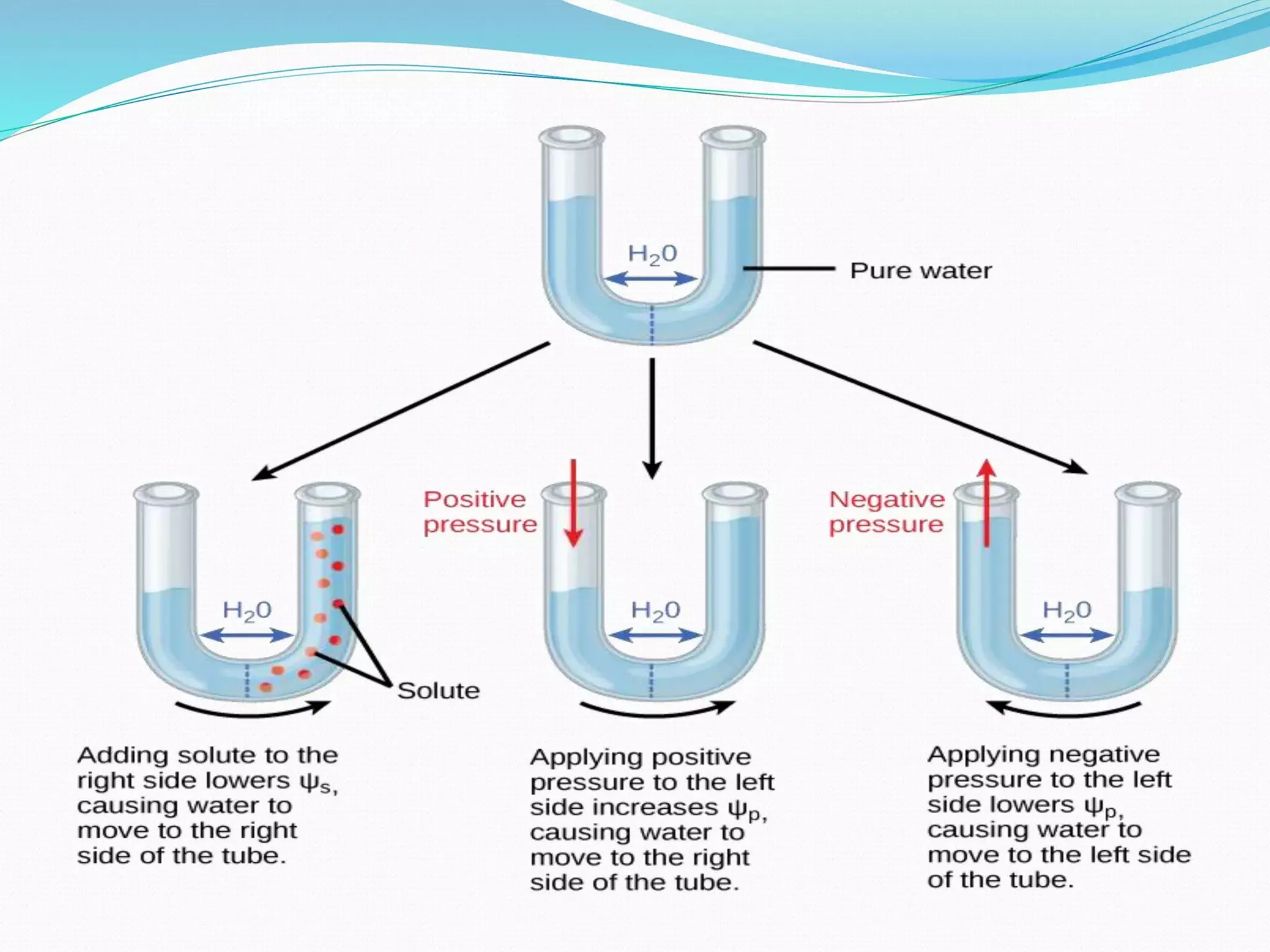
 Water Potential is the difference in the free energy
or chemical potential per unit molar volume of water
in system and that of pure water at the same
temperature and pressure.
 It is represented by Greek letter “ψ” (psi).
 The value is measured in bars, pascals or
atmospheres.
 Water always moves from the area of high water
potential to the area of low water potential.
Water potential of pure water at normal temperature
and pressure is zero. This value is considered to be the
highest.
The presence of solid particles reduces the free energy
of water and decreases the water potential. Therefore,
water potential of a solution is always less than zero or
it has negative value.
When such a cell is subjected to the movement
of water then many factors begin to operate
which ultimately determine the water potential
of cell sap
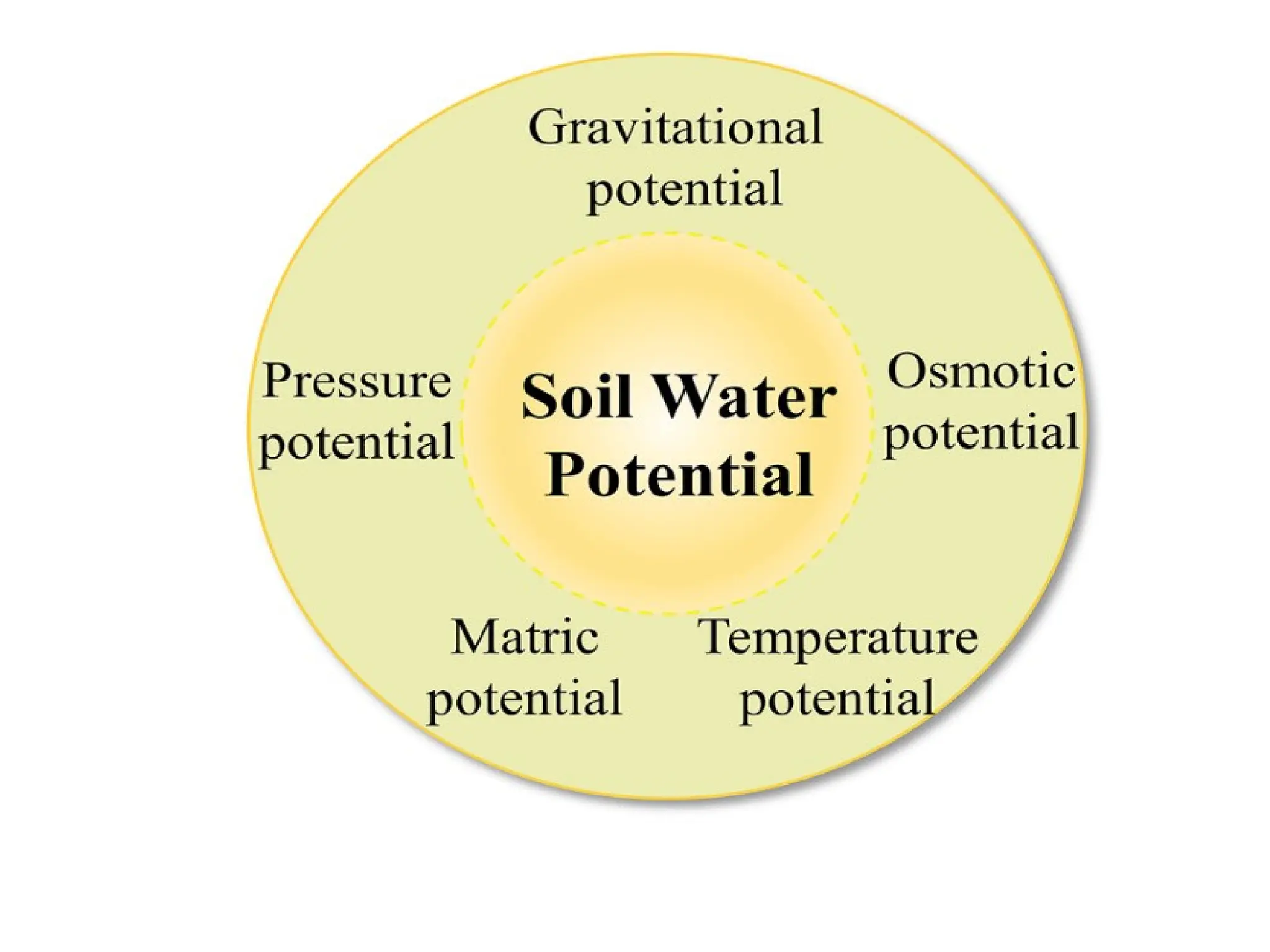
COMPONENTS
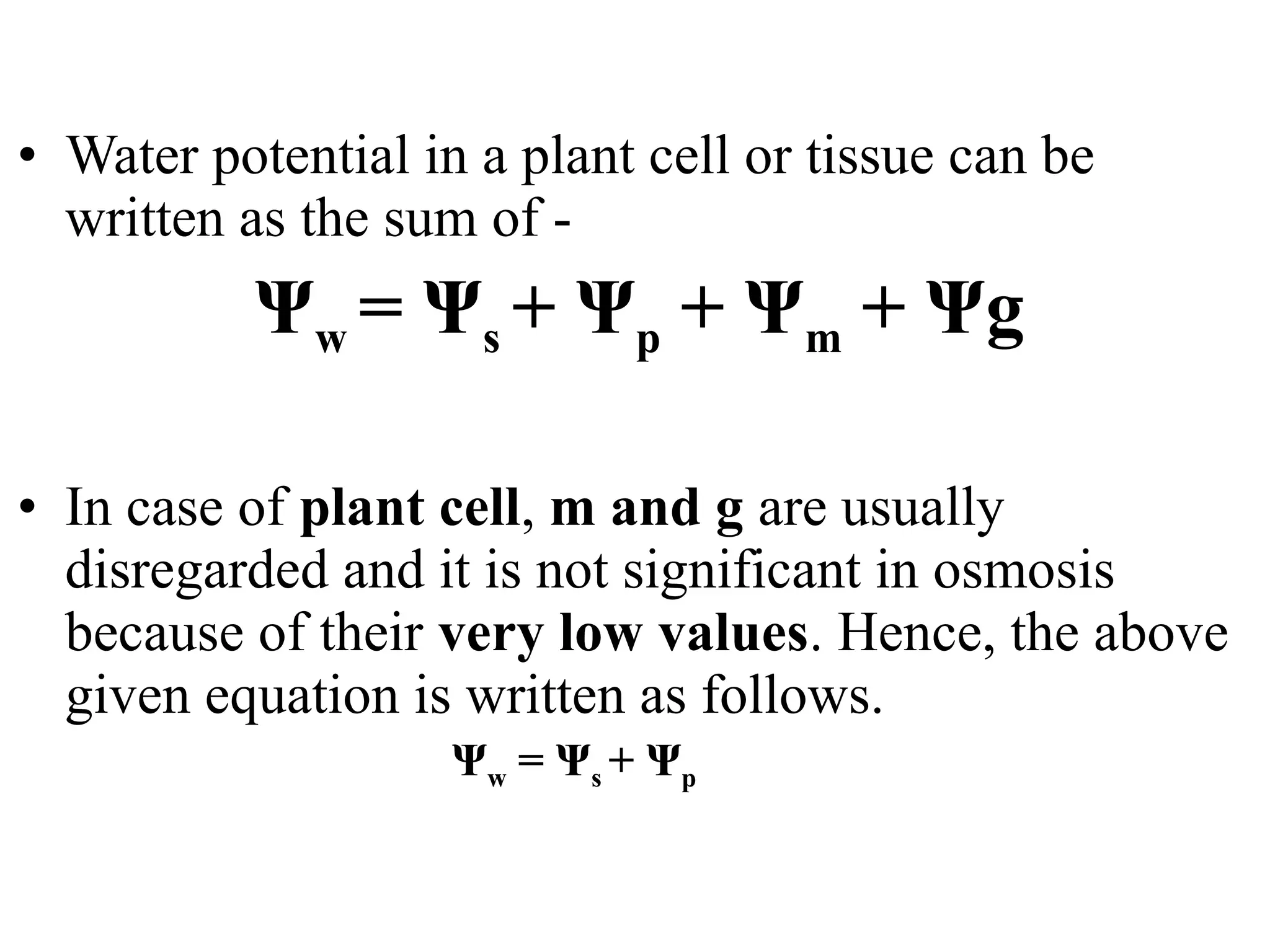
• Water potential in a plant cell or tissue can be
written as the sum of -
Ψw = Ψs + Ψp + Ψm + Ψg
• In case of plant cell, m and g are usually
disregarded and it is not significant in osmosis
because of their very low values. Hence, the above
given equation is written as follows.
Ψw = Ψs + Ψp
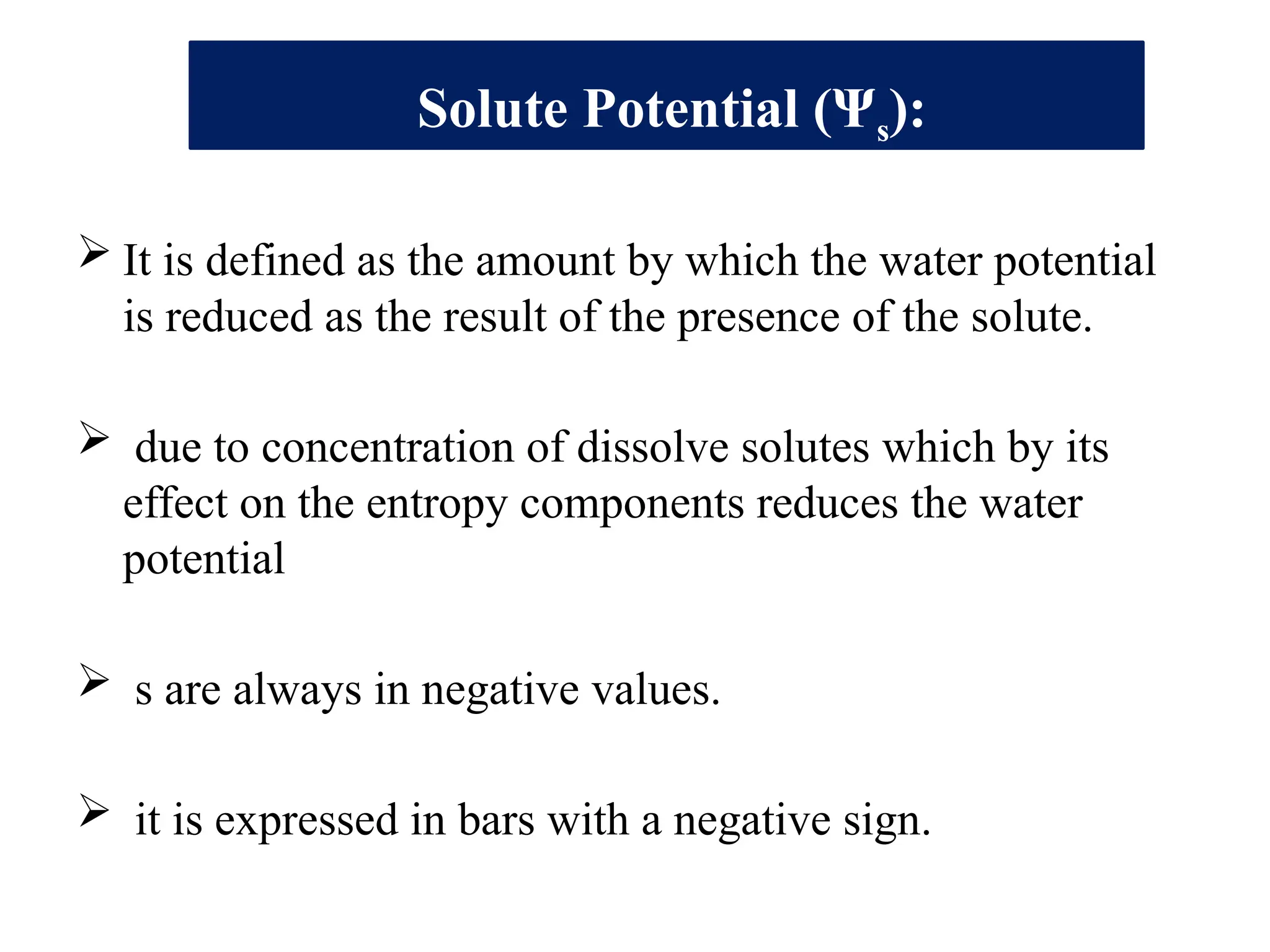
Solute Potential (Ψs):
 It is defined as the amount by which the water potential
is reduced as the result of the presence of the solute.
 due to concentration of dissolve solutes which by its
effect on the entropy components reduces the water
potential
 s are always in negative values.
 it is expressed in bars with a negative sign.
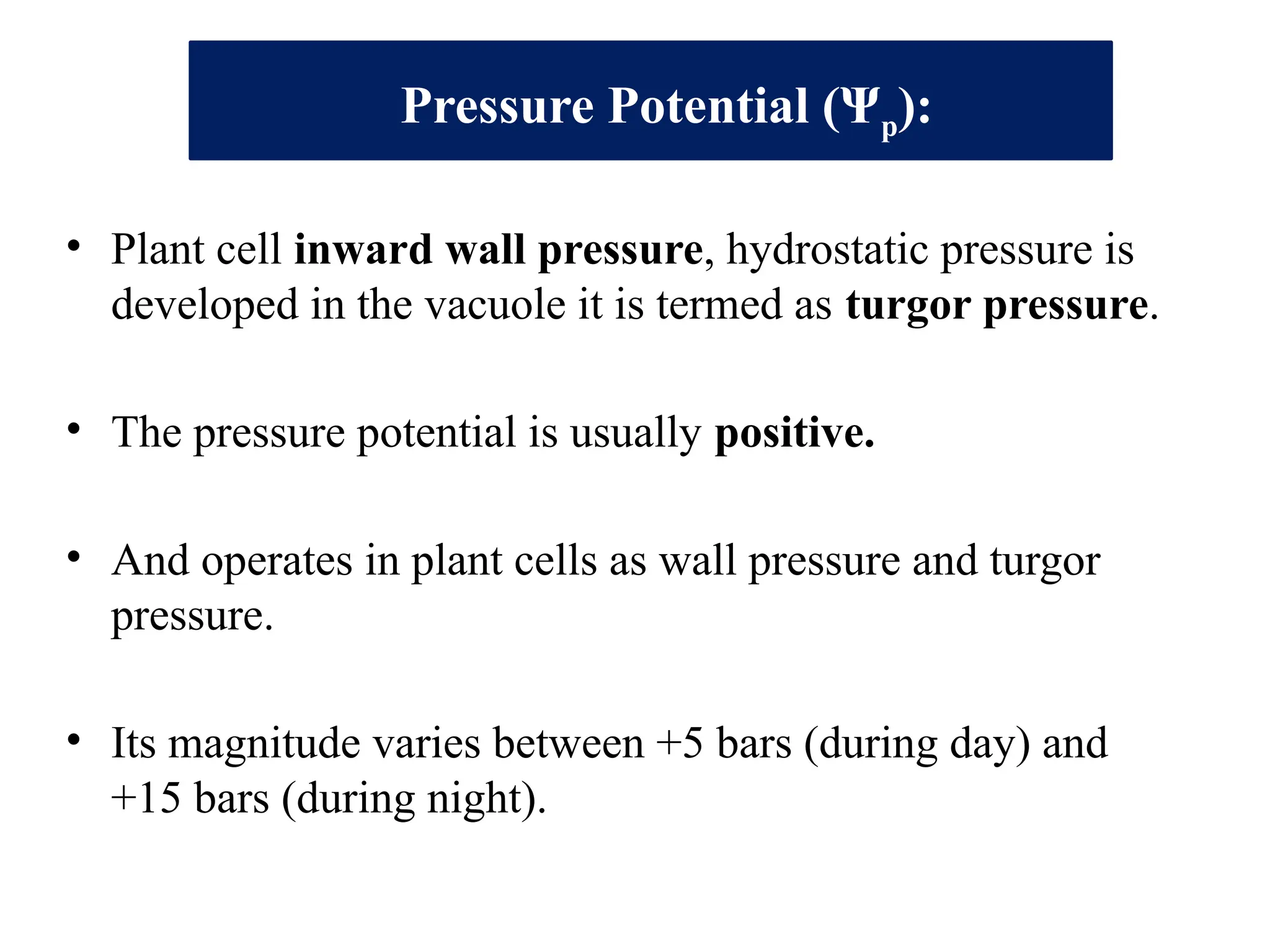
Pressure Potential (Ψp):
• Plant cell inward wall pressure, hydrostatic pressure is
developed in the vacuole it is termed as turgor pressure.
• The pressure potential is usually positive.
• And operates in plant cells as wall pressure and turgor
pressure.
• Its magnitude varies between +5 bars (during day) and
+15 bars (during night).
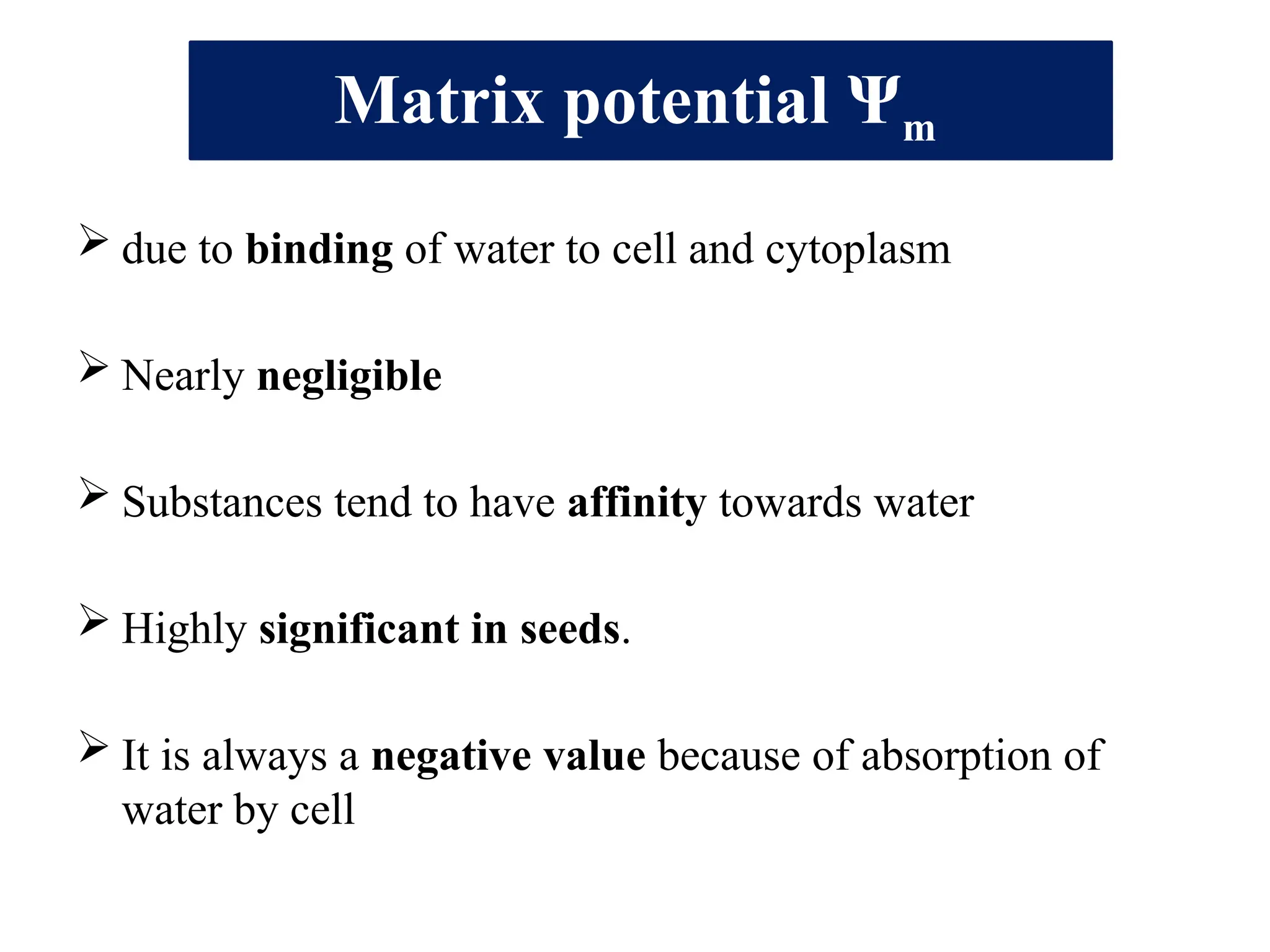
Matrix potential Ψm
 due to binding of water to cell and cytoplasm
 Nearly negligible
 Substances tend to have affinity towards water
 Highly significant in seeds.
 It is always a negative value because of absorption of
water by cell
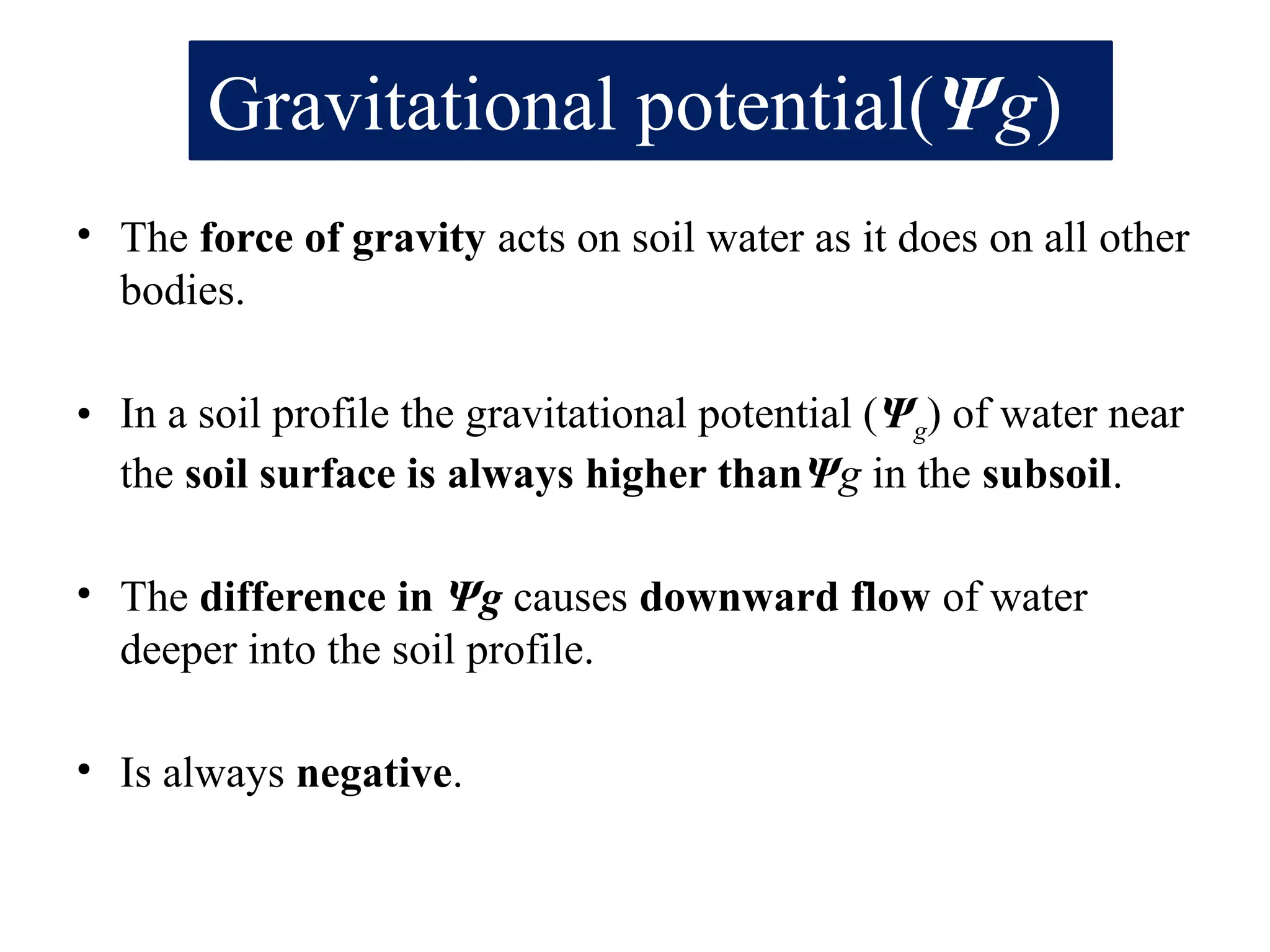
Gravitational potential(Ψg)
• The force of gravity acts on soil water as it does on all other
bodies.
• In a soil profile the gravitational potential (Ψg) of water near
the soil surface is always higher thanΨg in the subsoil.
• The difference in Ψg causes downward flow of water
deeper into the soil profile.
• Is always negative.
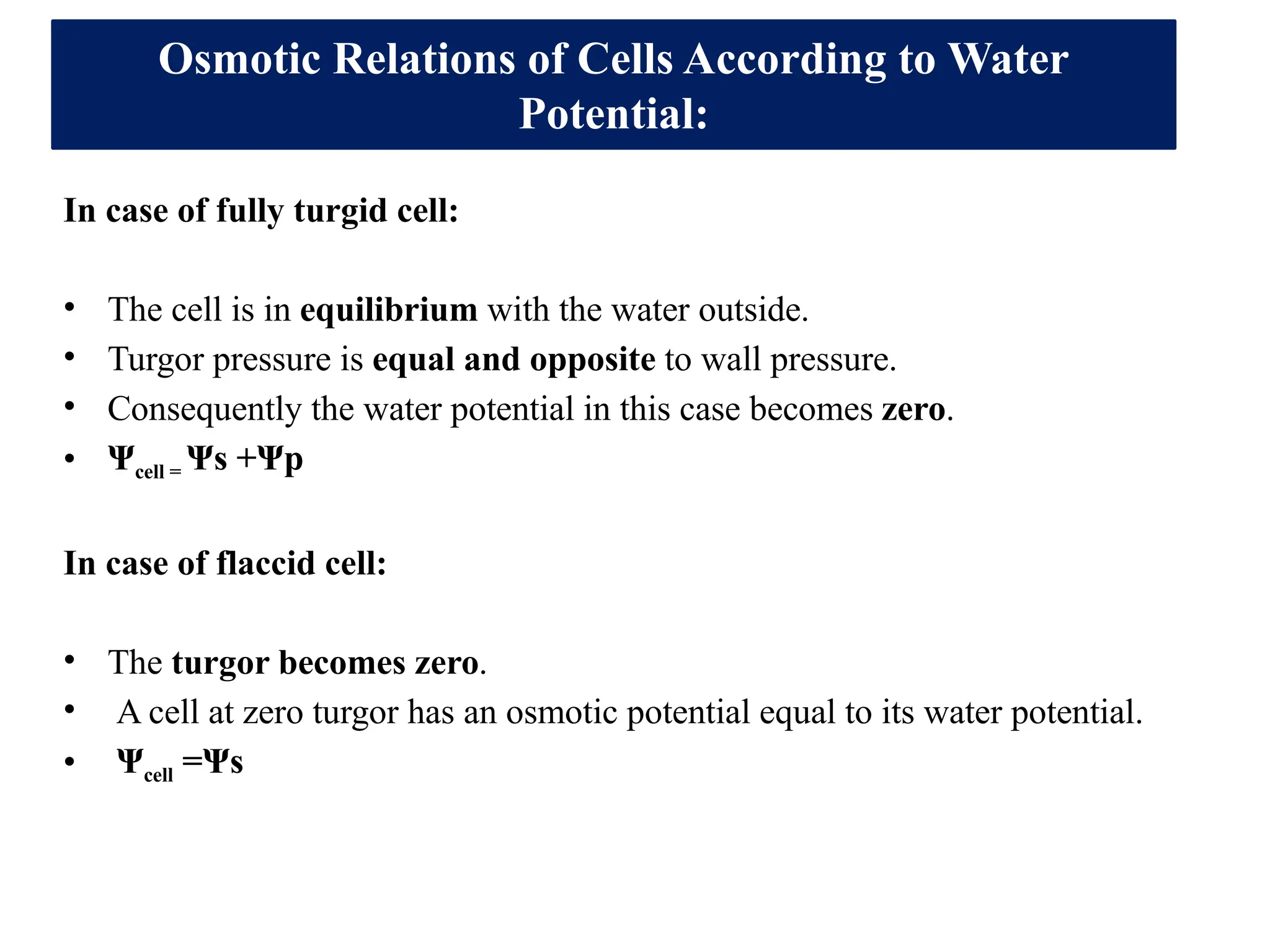
In case of fully turgid cell:
• The cell is in equilibrium with the water outside.
• Turgor pressure is equal and opposite to wall pressure.
• Consequently the water potential in this case becomes zero.
• Ψcell = Ψs +Ψp
In case of flaccid cell:
• The turgor becomes zero.
• A cell at zero turgor has an osmotic potential equal to its water potential.
• Ψcell =Ψs
Osmotic Relations of Cells According to Water
Potential:
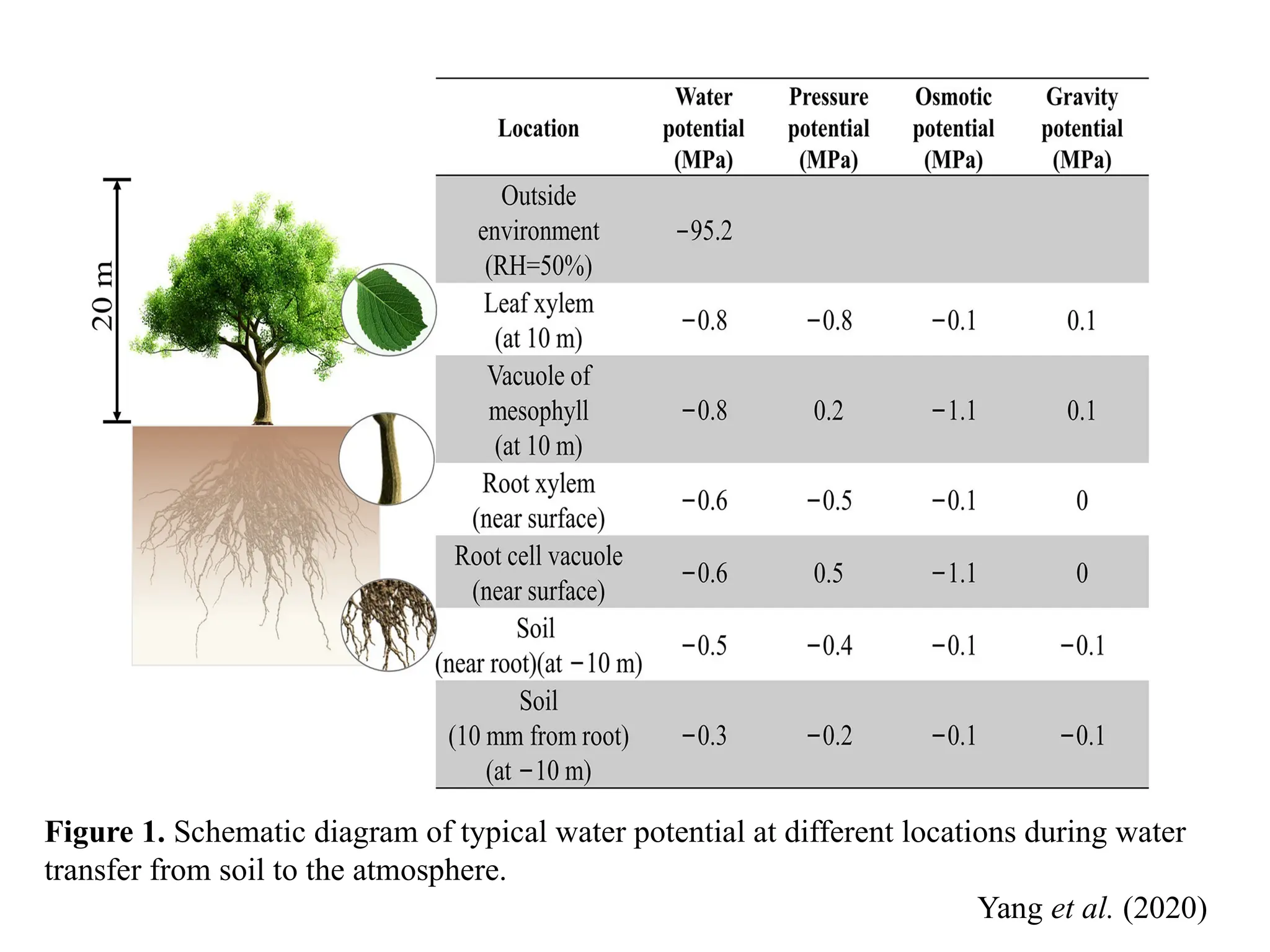
Figure 1. Schematic diagram of typical water potential at different locations during water
transfer from soil to the atmosphere.
Yang et al. (2020)
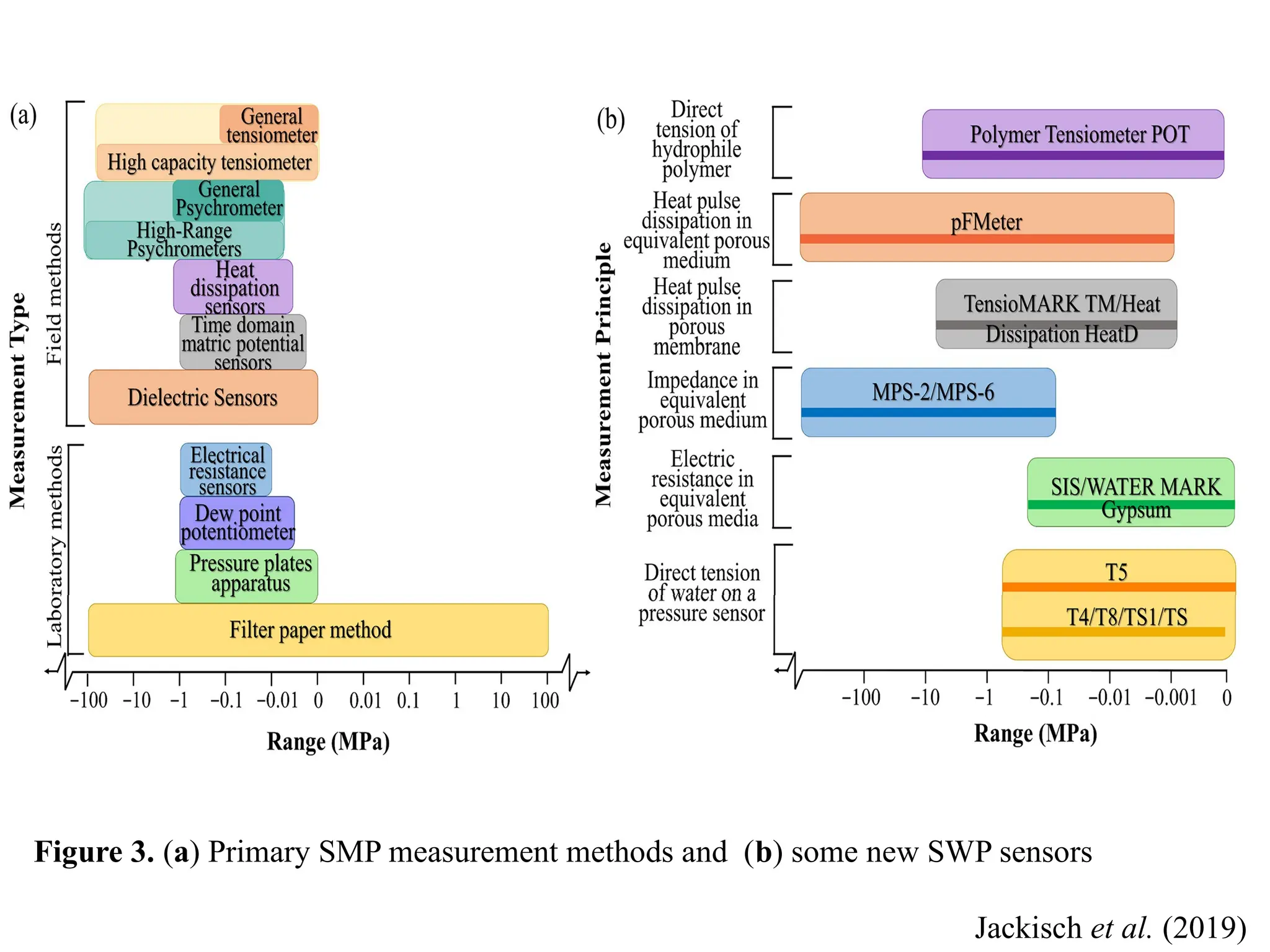
Figure 3. (a) Primary SMP measurement methods and (b) some new SWP sensors
Jackisch et al. (2019)
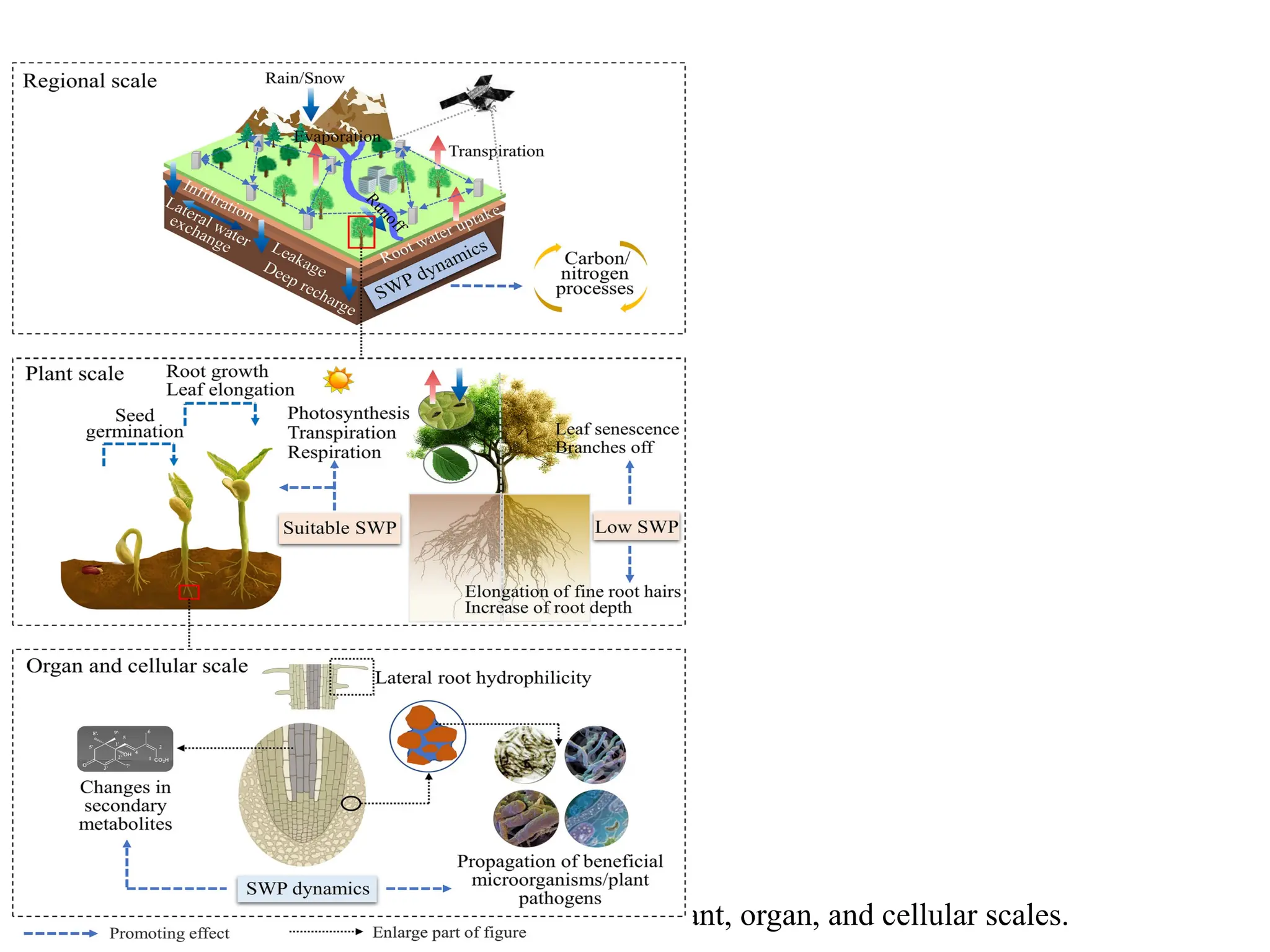
Figure 4. Effects of SWP at the landscape, plant, organ, and cellular scales.
APPLICATIONS
Crop
Irrigation
Treatment
Leaf Water Potential
(LWP)
Yield
Eggplant
FI, DI-80, DI-60,
DI-40 and DI-20.
No significant difference in
LWP among FI, DI-80 and
DI-60; and among DI-60,
DI-40 and DI-20
No significant difference in yield between
(FI and DI-80); and between (DI-40 and DI-
20)
Potato
FI, DI-50 and
PRD-50
LWP decreased significantly
in PRD-50 and was similar
between FI and DI-50
Significantly higher yield in FI and was
similar between DI-50 and PRD-50
Tomato
FI, DI-70 and
PRD-70
Significantly higher LWP in
FI than in DI. LWP was
similar between DI and PRD
Total dry biomass decreased significantly in
DI-70 and PRD-70
Cauliflower
FI, DI-50 and DI-
0
LWP was similar between FI
and DI-50 while it decreased
in DI-0 compared to FI.
–
Eggplant FI and PRD-60
Significant decrease in LWP
in PRD-60
Yield decreased significantly in PRD-60
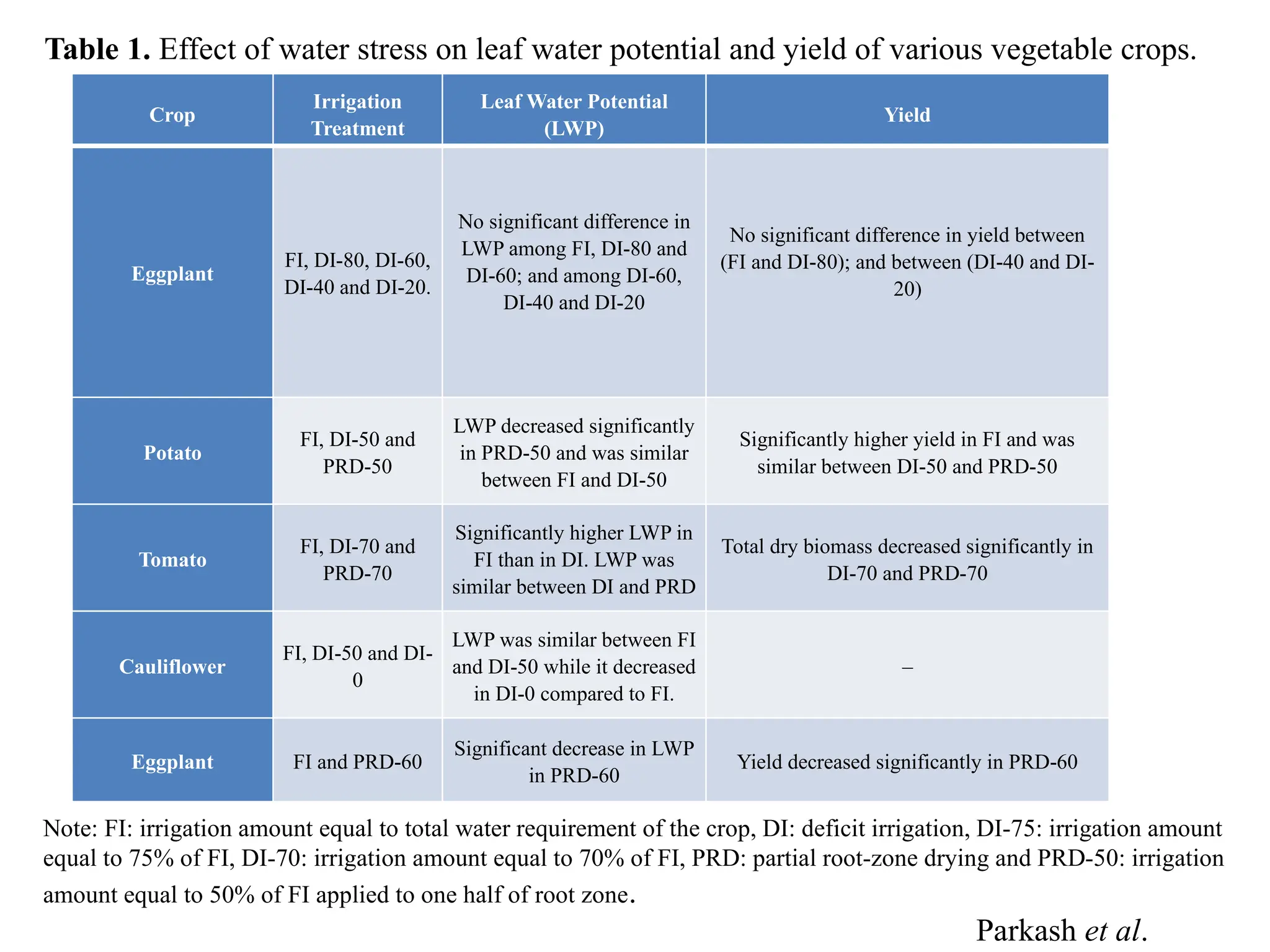
Table 1. Effect of water stress on leaf water potential and yield of various vegetable crops.
Note: FI: irrigation amount equal to total water requirement of the crop, DI: deficit irrigation, DI-75: irrigation amount
equal to 75% of FI, DI-70: irrigation amount equal to 70% of FI, PRD: partial root-zone drying and PRD-50: irrigation
amount equal to 50% of FI applied to one half of root zone.
Parkash et al.
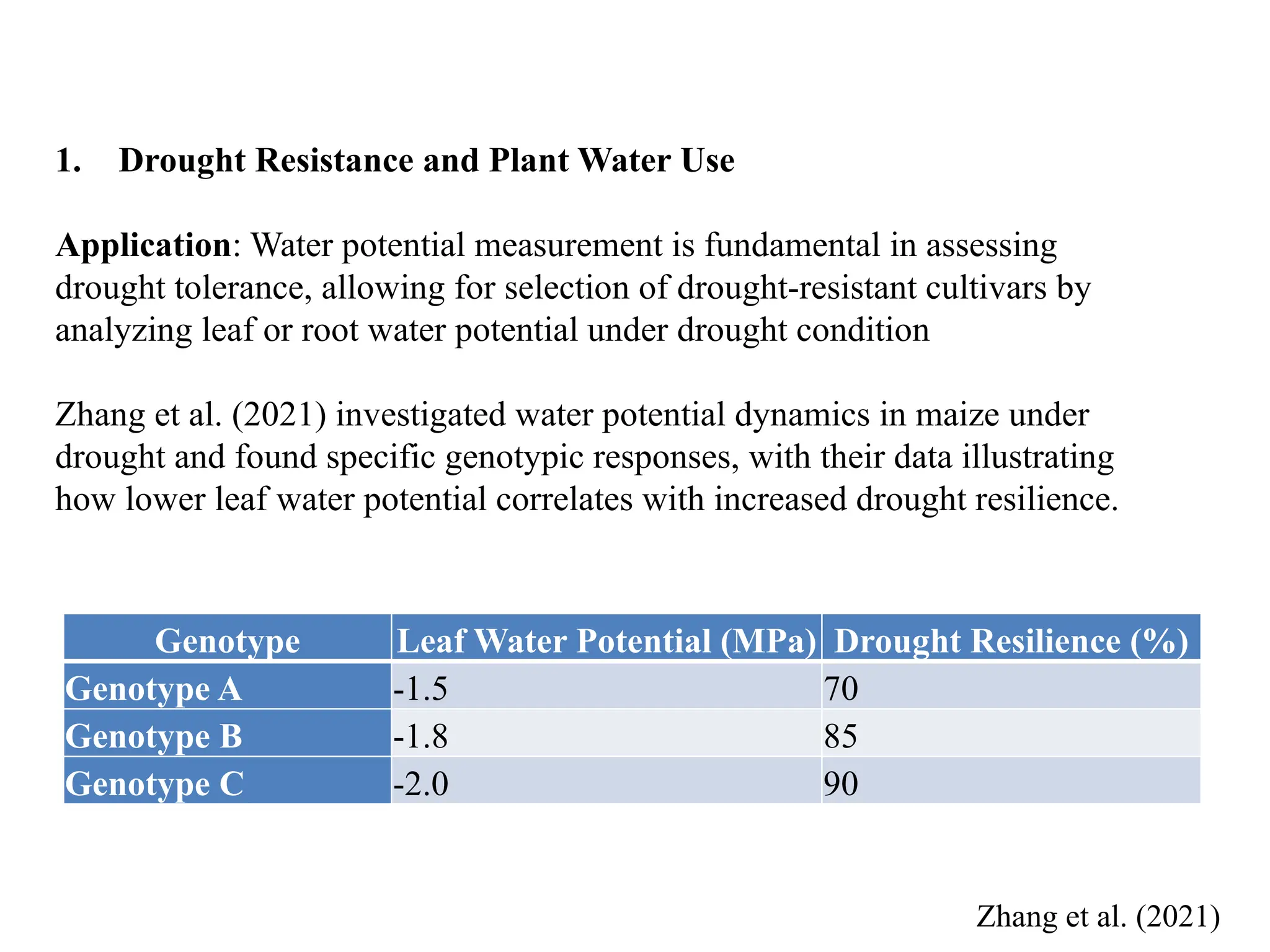
Genotype Leaf Water Potential (MPa) Drought Resilience (%)
Genotype A -1.5 70
Genotype B -1.8 85
Genotype C -2.0 90
1. Drought Resistance and Plant Water Use
Application: Water potential measurement is fundamental in assessing
drought tolerance, allowing for selection of drought-resistant cultivars by
analyzing leaf or root water potential under drought condition
Zhang et al. (2021) investigated water potential dynamics in maize under
drought and found specific genotypic responses, with their data illustrating
how lower leaf water potential correlates with increased drought resilience.
Zhang et al. (2021)
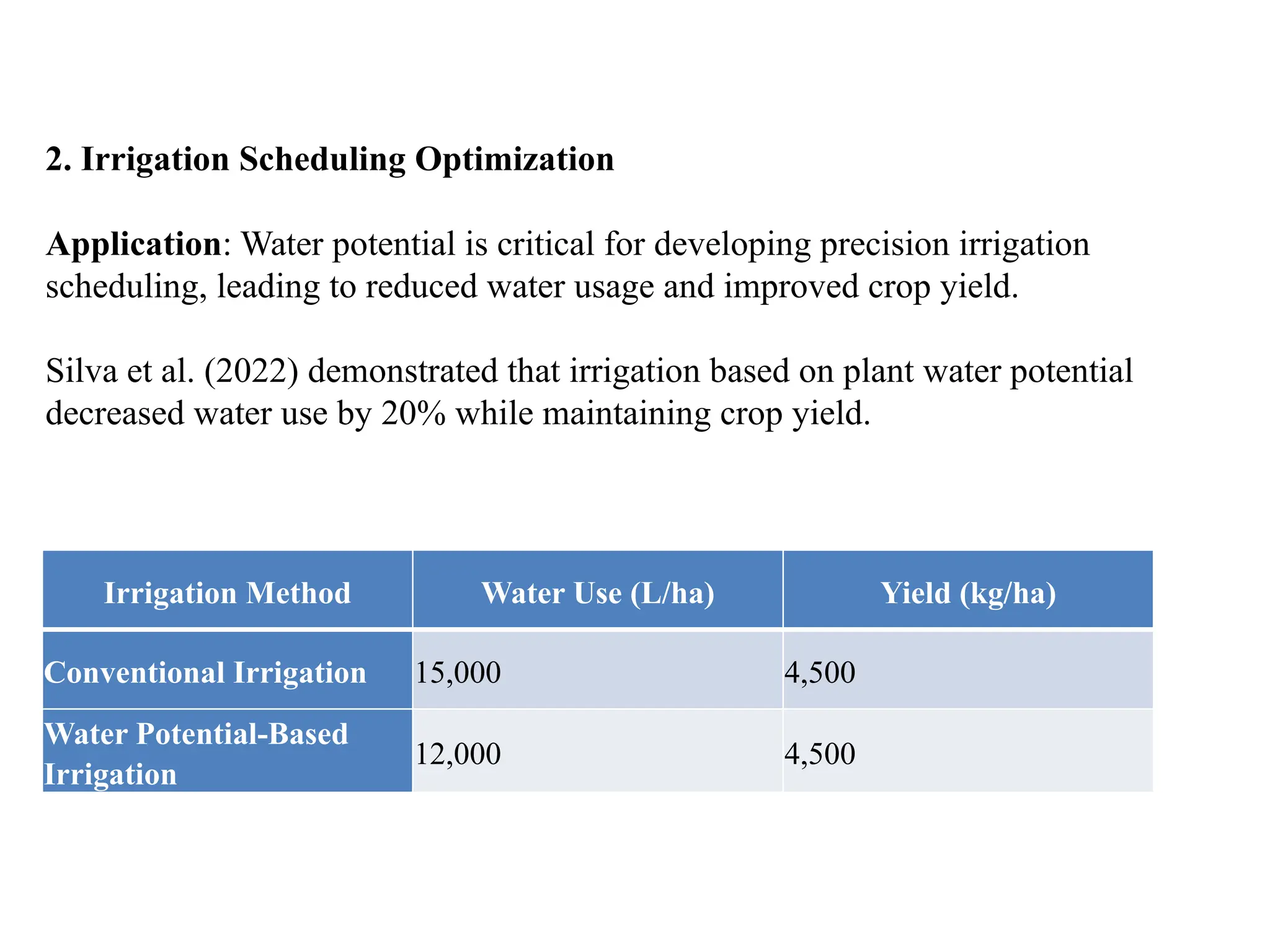
Irrigation Method Water Use (L/ha) Yield (kg/ha)
Conventional Irrigation 15,000 4,500
Water Potential-Based
Irrigation
12,000 4,500
2. Irrigation Scheduling Optimization
Application: Water potential is critical for developing precision irrigation
scheduling, leading to reduced water usage and improved crop yield.
Silva et al. (2022) demonstrated that irrigation based on plant water potential
decreased water use by 20% while maintaining crop yield.
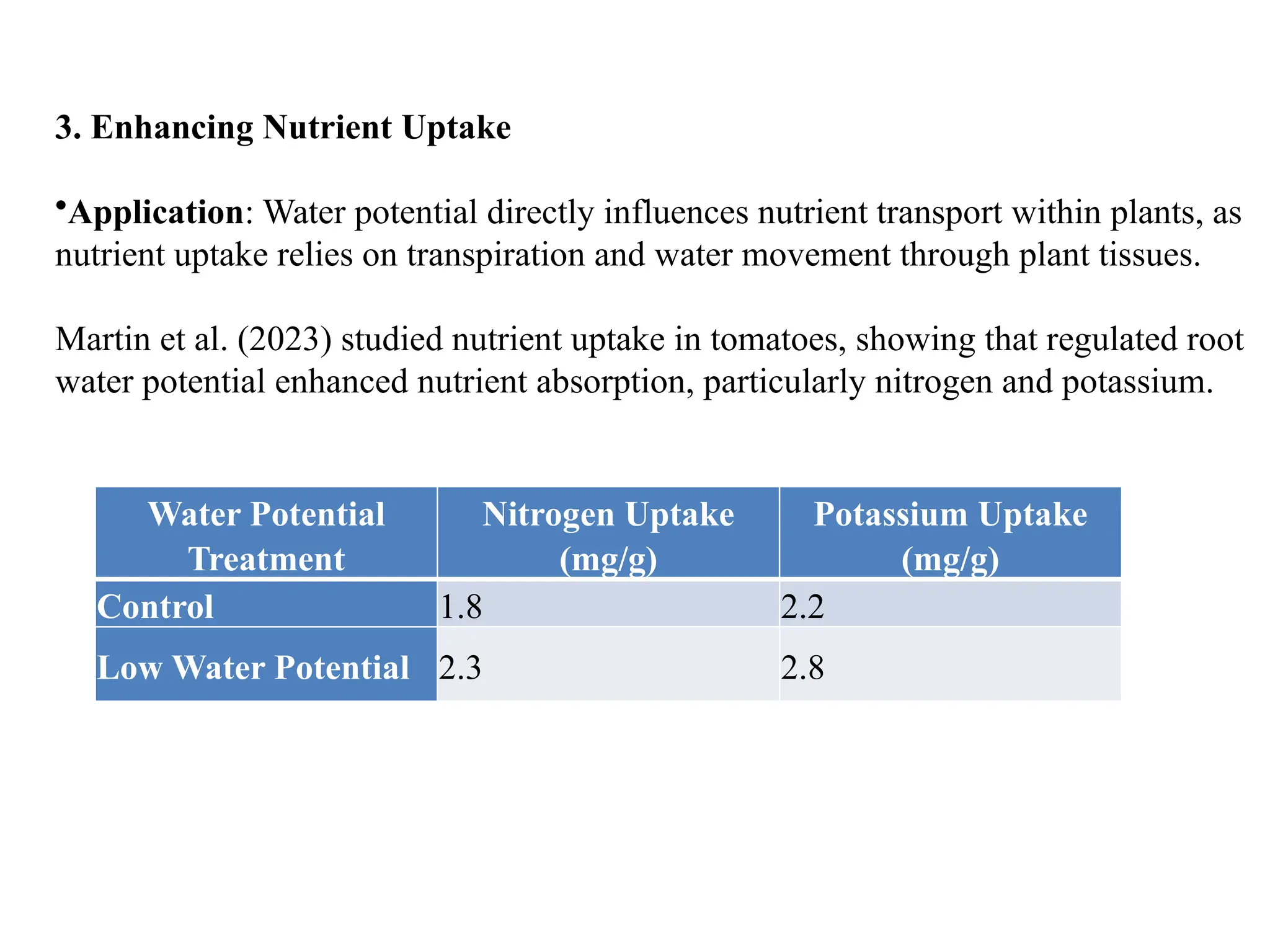
Water Potential
Treatment
Nitrogen Uptake
(mg/g)
Potassium Uptake
(mg/g)
Control 1.8 2.2
Low Water Potential 2.3 2.8
3. Enhancing Nutrient Uptake
•Application: Water potential directly influences nutrient transport within plants, as
nutrient uptake relies on transpiration and water movement through plant tissues.
Martin et al. (2023) studied nutrient uptake in tomatoes, showing that regulated root
water potential enhanced nutrient absorption, particularly nitrogen and potassium.
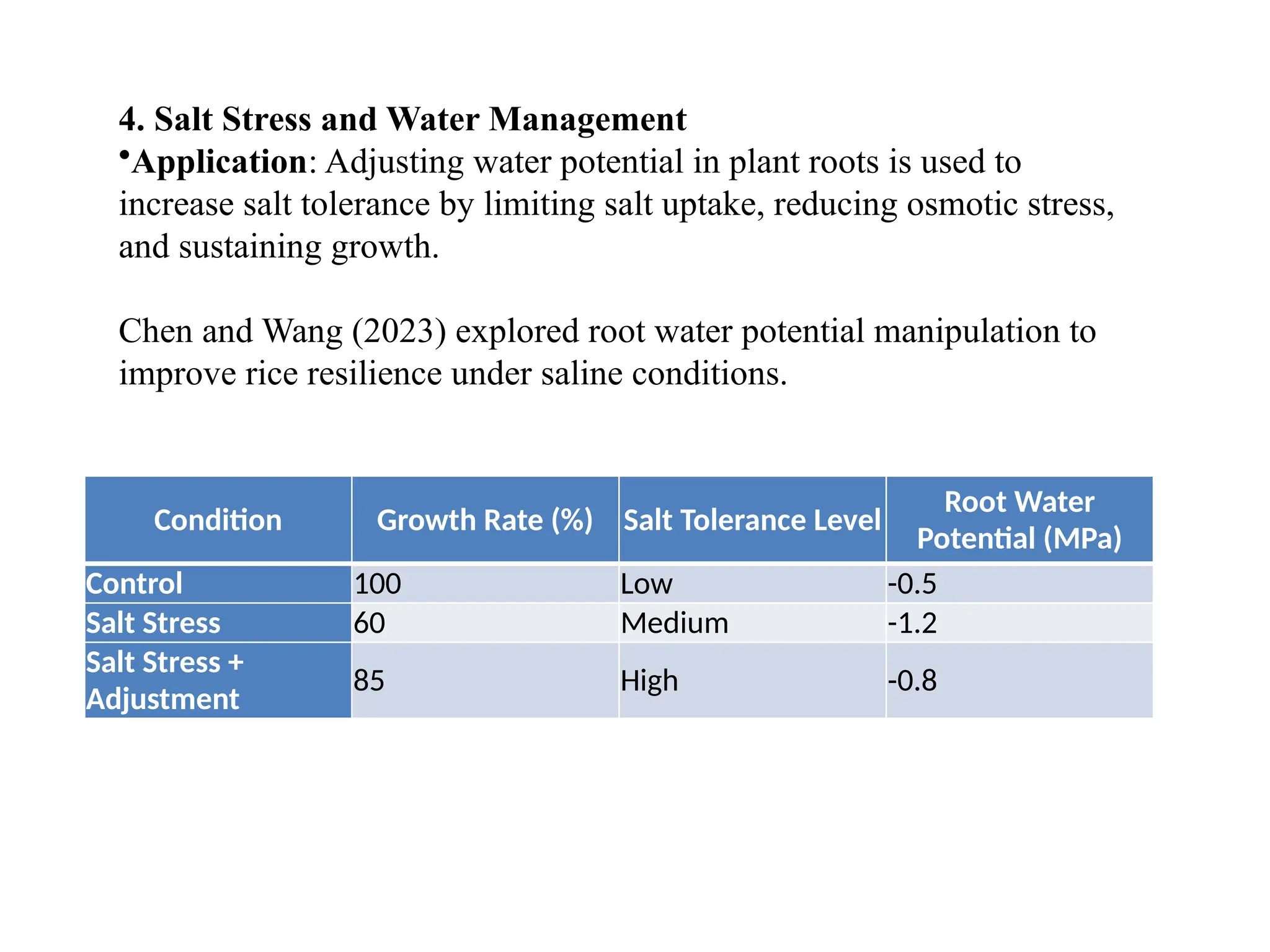
Condition Growth Rate (%) Salt Tolerance Level
Root Water
Potential (MPa)
Control 100 Low -0.5
Salt Stress 60 Medium -1.2
Salt Stress +
Adjustment
85 High -0.8
4. Salt Stress and Water Management
•Application: Adjusting water potential in plant roots is used to
increase salt tolerance by limiting salt uptake, reducing osmotic stress,
and sustaining growth.
Chen and Wang (2023) explored root water potential manipulation to
improve rice resilience under saline conditions.
Chen, Y., & Wang, T. (2023). Enhancing salt tolerance in rice by manipulating root
water potential. Agricultural Water Management, 268: 507-567.
Martin, S., et al. (2023). The role of root water potential in optimizing nutrient
uptake in tomato plants. Journal of Plant Physiology, 280 (3): 1537.
Parkash, V. and Singh, S., (2020). A review on potential plant-based water stress
indicators for vegetable crops. Sustainability, 12(10) : 394.
Silva, R. D., et al. (2022). Impact of water potential-based irrigation scheduling on
water use efficiency in soybean. Field Crops Research, 246: 108-613.
Zhang, Q., Li, X., & He, X. (2021). Genotypic variation in leaf water potential and
drought resistance in maize. Journal of Agronomy and Crop Science, 207(5):892-899
REFERENCES
water potential, application  and its components

water potential, application and its components

  • 1.
    UNIVERSITY OF AGRICULTURAL SCIENCES,RAICHUR COLLEGE OF AGRICULTURE, RAICHUR Water potential and its importance. Presented by : Saisumanth Hugar PG23AGR15030 PP- 504 Physiological and molecular responses of plants to abiotic stresses
  • 2.
  • 3.
    According to principlesof thermodynamics, every components of system is having definite amount of free energy which is measure of potential work which the system can do. spontaneous movement of water from one region to another is in terms of the difference of free energy of water between two regions (from higher free energy level to lower free energy level). WHAT MAKES WATER MOVE ?
  • 4.
     Water Potentialis the difference in the free energy or chemical potential per unit molar volume of water in system and that of pure water at the same temperature and pressure.  It is represented by Greek letter “ψ” (psi).  The value is measured in bars, pascals or atmospheres.  Water always moves from the area of high water potential to the area of low water potential.
  • 5.
    Water potential ofpure water at normal temperature and pressure is zero. This value is considered to be the highest. The presence of solid particles reduces the free energy of water and decreases the water potential. Therefore, water potential of a solution is always less than zero or it has negative value.
  • 6.
    When such acell is subjected to the movement of water then many factors begin to operate which ultimately determine the water potential of cell sap COMPONENTS
  • 7.
    • Water potentialin a plant cell or tissue can be written as the sum of - Ψw = Ψs + Ψp + Ψm + Ψg • In case of plant cell, m and g are usually disregarded and it is not significant in osmosis because of their very low values. Hence, the above given equation is written as follows. Ψw = Ψs + Ψp
  • 8.
    Solute Potential (Ψs): It is defined as the amount by which the water potential is reduced as the result of the presence of the solute.  due to concentration of dissolve solutes which by its effect on the entropy components reduces the water potential  s are always in negative values.  it is expressed in bars with a negative sign.
  • 9.
    Pressure Potential (Ψp): •Plant cell inward wall pressure, hydrostatic pressure is developed in the vacuole it is termed as turgor pressure. • The pressure potential is usually positive. • And operates in plant cells as wall pressure and turgor pressure. • Its magnitude varies between +5 bars (during day) and +15 bars (during night).
  • 10.
    Matrix potential Ψm due to binding of water to cell and cytoplasm  Nearly negligible  Substances tend to have affinity towards water  Highly significant in seeds.  It is always a negative value because of absorption of water by cell
  • 11.
    Gravitational potential(Ψg) • Theforce of gravity acts on soil water as it does on all other bodies. • In a soil profile the gravitational potential (Ψg) of water near the soil surface is always higher thanΨg in the subsoil. • The difference in Ψg causes downward flow of water deeper into the soil profile. • Is always negative.
  • 13.
    In case offully turgid cell: • The cell is in equilibrium with the water outside. • Turgor pressure is equal and opposite to wall pressure. • Consequently the water potential in this case becomes zero. • Ψcell = Ψs +Ψp In case of flaccid cell: • The turgor becomes zero. • A cell at zero turgor has an osmotic potential equal to its water potential. • Ψcell =Ψs Osmotic Relations of Cells According to Water Potential:
  • 14.
    Figure 1. Schematicdiagram of typical water potential at different locations during water transfer from soil to the atmosphere. Yang et al. (2020)
  • 15.
    Figure 3. (a)Primary SMP measurement methods and (b) some new SWP sensors Jackisch et al. (2019)
  • 16.
    Figure 4. Effectsof SWP at the landscape, plant, organ, and cellular scales.
  • 17.
  • 18.
    Crop Irrigation Treatment Leaf Water Potential (LWP) Yield Eggplant FI,DI-80, DI-60, DI-40 and DI-20. No significant difference in LWP among FI, DI-80 and DI-60; and among DI-60, DI-40 and DI-20 No significant difference in yield between (FI and DI-80); and between (DI-40 and DI- 20) Potato FI, DI-50 and PRD-50 LWP decreased significantly in PRD-50 and was similar between FI and DI-50 Significantly higher yield in FI and was similar between DI-50 and PRD-50 Tomato FI, DI-70 and PRD-70 Significantly higher LWP in FI than in DI. LWP was similar between DI and PRD Total dry biomass decreased significantly in DI-70 and PRD-70 Cauliflower FI, DI-50 and DI- 0 LWP was similar between FI and DI-50 while it decreased in DI-0 compared to FI. – Eggplant FI and PRD-60 Significant decrease in LWP in PRD-60 Yield decreased significantly in PRD-60 Table 1. Effect of water stress on leaf water potential and yield of various vegetable crops. Note: FI: irrigation amount equal to total water requirement of the crop, DI: deficit irrigation, DI-75: irrigation amount equal to 75% of FI, DI-70: irrigation amount equal to 70% of FI, PRD: partial root-zone drying and PRD-50: irrigation amount equal to 50% of FI applied to one half of root zone. Parkash et al.
  • 19.
    Genotype Leaf WaterPotential (MPa) Drought Resilience (%) Genotype A -1.5 70 Genotype B -1.8 85 Genotype C -2.0 90 1. Drought Resistance and Plant Water Use Application: Water potential measurement is fundamental in assessing drought tolerance, allowing for selection of drought-resistant cultivars by analyzing leaf or root water potential under drought condition Zhang et al. (2021) investigated water potential dynamics in maize under drought and found specific genotypic responses, with their data illustrating how lower leaf water potential correlates with increased drought resilience. Zhang et al. (2021)
  • 20.
    Irrigation Method WaterUse (L/ha) Yield (kg/ha) Conventional Irrigation 15,000 4,500 Water Potential-Based Irrigation 12,000 4,500 2. Irrigation Scheduling Optimization Application: Water potential is critical for developing precision irrigation scheduling, leading to reduced water usage and improved crop yield. Silva et al. (2022) demonstrated that irrigation based on plant water potential decreased water use by 20% while maintaining crop yield.
  • 21.
    Water Potential Treatment Nitrogen Uptake (mg/g) PotassiumUptake (mg/g) Control 1.8 2.2 Low Water Potential 2.3 2.8 3. Enhancing Nutrient Uptake •Application: Water potential directly influences nutrient transport within plants, as nutrient uptake relies on transpiration and water movement through plant tissues. Martin et al. (2023) studied nutrient uptake in tomatoes, showing that regulated root water potential enhanced nutrient absorption, particularly nitrogen and potassium.
  • 22.
    Condition Growth Rate(%) Salt Tolerance Level Root Water Potential (MPa) Control 100 Low -0.5 Salt Stress 60 Medium -1.2 Salt Stress + Adjustment 85 High -0.8 4. Salt Stress and Water Management •Application: Adjusting water potential in plant roots is used to increase salt tolerance by limiting salt uptake, reducing osmotic stress, and sustaining growth. Chen and Wang (2023) explored root water potential manipulation to improve rice resilience under saline conditions.
  • 23.
    Chen, Y., &Wang, T. (2023). Enhancing salt tolerance in rice by manipulating root water potential. Agricultural Water Management, 268: 507-567. Martin, S., et al. (2023). The role of root water potential in optimizing nutrient uptake in tomato plants. Journal of Plant Physiology, 280 (3): 1537. Parkash, V. and Singh, S., (2020). A review on potential plant-based water stress indicators for vegetable crops. Sustainability, 12(10) : 394. Silva, R. D., et al. (2022). Impact of water potential-based irrigation scheduling on water use efficiency in soybean. Field Crops Research, 246: 108-613. Zhang, Q., Li, X., & He, X. (2021). Genotypic variation in leaf water potential and drought resistance in maize. Journal of Agronomy and Crop Science, 207(5):892-899 REFERENCES