Audit of Water and Water issues
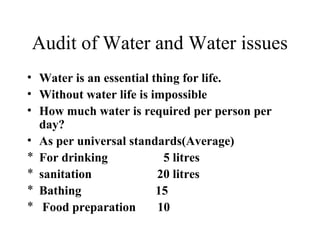
• Water is an essential thing for life.
• Without water life is impossible
• How much water is required per person per
day?
• As per universal standards(Average)
* For drinking
5 litres
* sanitation
20 litres
* Bathing
15
* Food preparation
10
Geography of water
• Major Stocks of Water

Volume:
(1000km)

%of

1,338000

96.54

12,870

0.93

water
• Salt water:
• Oceans
• saline/backish Gr. Water
• salt water lakes

85

0.016
Fresh Water
•
•
•
•
•
•
•
•
•

Glaciers, permt. Gr. Water
Fresh ground water
Ground ice, permafrost
Fresh water lakes
Soil moisture
Atmosph. Water vapor
Marshes wet lands
Rivers
Incorporated in biota

24,064
68.7
10,530
30.6
300
0.86
91
0.26
16.5 0.05
12.9 0.04
11.5 0.03
2.12 0.006
1.12 0.003
Some facts on fresh water
 Only 2.5 % of the total water on earth is fresh water: the usable
portion is only 1 %
 About one third of the world’s population lives in countries where
water stress persists
 About 80 countries –40% of the world’s population suffering from
water shortages
 By 2025 two thirds of the world population may suffer from serious
water problems
 Still, I.I billion people lack access to safe drinking water and 2.4
billion lack access to proper sanitation
 Agriculture accounts for more than 70% of the fresh water
 In return they give back 40% of the world’s food production
Contd…
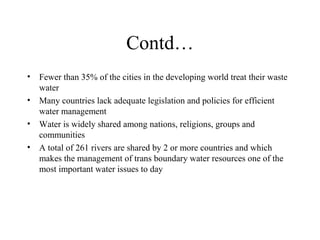
• Fewer than 35% of the cities in the developing world treat their waste
water
• Many countries lack adequate legislation and policies for efficient
water management
• Water is widely shared among nations, religions, groups and
communities
• A total of 261 rivers are shared by 2 or more countries and which
makes the management of trans boundary water resources one of the
most important water issues to day
Water management problems
• There is sufficient water in the world.
• It is not managed well
• Water security was a subject to all the world
countries during the World summit, 2002
• Water policy is required by all the nations
• SAIs can play a pro active role in auditing the
policy.
• But SAIs shy away from this because they do not
want to comment on the water policy.
Water policy
• Salient features of water policy
 Water pricing
 Water legislation
 Permits
 Inspection and enforcement
 Investment in infrastructure
 Scientific research
 Providing information to public
 Monitoring and evaluation
Water-International issues
• No. of International Agreements—
• Subject

No.

 Water Resources and Conservation Management
 Desertification

20
6

 Sea Water quality and Pollution
 Marine resources conservation and management
 Fishing management and the use of harvestable fish

91
32
54
Audit issues of water
•
•
•
•
•
•
•

SAIs Audit Reports cover:
Water quality
Rivers & Lakes,
Flooding,
Drinking water &Sanitation,
Water in relation to nature & biodiversity,
Marine environment
Water Quality
• Related with financial issues as well as
water issues.
• Absence of policy for clean water to the
people
• Environmental programmes for
implementation
Types of Audit
• Many laws are existing for water pollution
• Laws are made to comply with International
accords
• Audit of such compliance will be one method
• Performance appraisal of water management
programmes
• Regularity audit and Performance audit can be the
methods of audits.
•
Absence of policy
• Absence of reliable and sufficient policy for
water issues is another area of audit
• The type of audit would be compliance in
nature
• The environmental degradation due to
absence of proper policy will be highlighted
Rivers and lakes
• Rivers and lakes provide a wide variety of
environmental problems
• Pollution of the rivers and the lakes poses risk to
the lives of the fauna/flora in the lakes and the
rivers
• It also gives risk to the area or the river banks due
to contact of the polluted water.
• The plants and the agriculture on the rivers and
river banks get affected by the polluted water that
flows.
Floodings
• This is another environmental issue of
water.
• Flood protection system, flood prevention
etc are matters of financial concerns
• Programme evaluation of the flood control
and emergency plans etc. will be a subject
matter for Performance type off audit.
Drinking water and sanitation
• This is the most common factor and most
important one.
• Lot of world population is devoid of access to
clean drinking water
• Masses from the rural areas lack facility for
potable water for household purposes.
• The massive amount required to be spent to
bring water to the population is some times
criticized by the SAIs
Sanitation
• Sanitation and environment are connected
problems
• Un hygienic conditions in the environment
create environmental problems
• Sanitation is also a matter which will
require lot of funds for implementation.
• It is therefore, both performance audit as
well as regularity Audit.
Marine environment
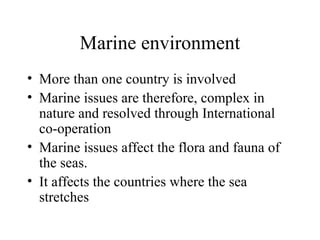
• More than one country is involved
• Marine issues are therefore, complex in
nature and resolved through International
co-operation
• Marine issues affect the flora and fauna of
the seas.
• It affects the countries where the sea
stretches
Marine water audits
• As the subject the audit is also complex.
• Therefore, more than 1 SAI is engaged in
the audits of marine issues.
• Joint audits of water issues
• Audits relate to compliance, financial and
Performance
Audit of water- Indian
perspective
• The audit of water issues in India is done as
per the provisions of various Acts and rules
passed by the Legislatures and the
Parliament
• Legislative compliance is itself an audit.
• The Water(Prevention and Control of
Pollution) Act, 1974 is the first Act to
address the issues regarding water in India.
Section 3 of the Act
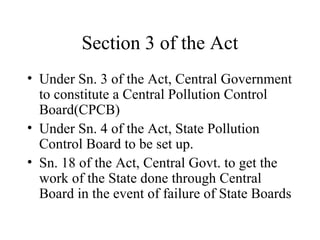
• Under Sn. 3 of the Act, Central Government
to constitute a Central Pollution Control
Board(CPCB)
• Under Sn. 4 of the Act, State Pollution
Control Board to be set up.
• Sn. 18 of the Act, Central Govt. to get the
work of the State done through Central
Board in the event of failure of State Boards
Functions of the Central/State
Boards
• Planning comprehensive programmes for
prevention,control,abatement of pollution of
streams and wells in the States
• Collection and dissemination of information
relating to water pollution and prevention
• Inspection of sewage/trade effluents
• Laying down standards for treatment of
sewage and trade effluents
Audit issues in water
management
• SPCBs are required to issue consent letter to
polluting industries for commencement and
continuance of operations
• They are required to take effective action against
the industries which do not install control
mechanisms for prevention of pollution
• They are required to inspect the polluting
industries regularly. Targets are fixed by the
MOEF
Contd…
• Drinking water supply to have certain
parameters: SPCBS are to check this.
• Proper sewage system in cities is an
environmental issue. The boards to ensure this
• Untreated effluent not to mix with the water
bodies.
• Domestic sewage from Municipal areas also
not to mix
Funds for implementation of
programmes
• Environmental programmes are budgeted
and the funds are drawn by the Boards for
implementation of various programmes
• Amounts unspent becomes less
implementation of environmental
programmes.
• Audit to verify the budget and actual
expenditure for any gap
Monitoring
• Environmental activities have to be
monitored by the Government for proper
implementation.
• Such a monitoring is absent in many of the
State Govts.
• Absence of MIS on Environmental issues
will give thrust to the Audit coverage and
conclusions.
Some facts about the
Environmental Auditing in India.
• In the AR 2001 of the MOEF, audit reported that:
 Only a meagre amount of Rs.3 crore was spent
against a provision of Rs.12.75 cr.
 As of April 2000 Rs.145.95 cr.was lying unspent
with SPCBs
 Absence of mechanism to ensure that Industrial
units operate after getting consent letters from
SPCBs
 SPCBs failed to take action against faulting
industries which did not install ETPs
Contd…
 Non achieving of targets of inspection
 Drinking water not meeting the requisite
quality
 Inadequate sewerage facilities resulted in
pollution of water and discharge of untreated
water in the water bodies posing health hazards
 Dumping of Municipal waste resulted in
polluting the area and air
 Major failures in complying with the Water
Act, 1974
Water –Audit Checks
• Audit of water issues to be conducted through
PCBs
• PCBs are the regulating authorities.
• PCBs have to visit industries/factories to
ascertain proper implementation of provisions
of Water Act
• They have to issue consent to commence
industries,
• They have to issue consent letter to continue
Water quality
• Water quality of the various uses has to be
regularised
• Water has to be wholesome
• Drinking water has to be clear, free from
contamination
• Industrial water has also be of certain
quality
Contd…
• Depending up on the quality of water the uses
have to be fixed
• Drinking water has to be of certain quality in
terms of contamination and pH value
• Even the industrial water has to be of certain
standard.
• If the water used in industries is not of the
quality the plant and machinery may get
affected.They may get corrosion
Contd..
• This applies to the water pipe line that
brings water to the plant and the house
holds.
• If the water is having high or low pH value
it may become acidic or alkaline.
• The water piping system therefore, gets
corroded and water will be lost in transit
causing losses.
How the quality is assured
• PCBs test the water quality frequently to
ascertain the quality
• In industries, the water is tested at definite
intervals
• The water that is being discharged to the
water system is also tested.
• Water quality is maintained by constructing
ETPs
Contd..
• The PCBs check the quality of water that is
discharged
• If the quality is not as per standard the water
has to be treated before it is discharged into the
water system so that no further epidemic like
problems are not there.
• If chemicals are discharged before treating they
affect the system and the land, flora/fuana of
the river, lakes etc also get affected
Contd…
• Water from the factories are tested at the
end to see if it is fit to be discharged
• Otherwise, the water has to be treated
before it is discharged.
• ETPS are used to purify the mixed water so
that treated water is recycled for either
industrial use or for gardening use etc.
• SOP concept also helps reduce the wastage
Water recycle
• Water is drawn from water system for
drinking
• Water is treated for drinking purposes
• Local bodies assures the quality
• The water is treated with disinfectants
• PCBs have to see whether the
measurements of the chemicals used is as
per standards fixed or not
Audit of quality
• Audit has to verify whether the required
quality is maintained or not
• pH value is maintained or not
• Wholesome water pH is 5.5
• Lesser than 5.5 acidic
• PCBs ascertain the pH value and grade
• Drinking water of acidic nature if allowed
affects human health, corrosion of piping and
the storage system
OTHER AUDIT ISSUES
• To ascertain whether the country has any
obligation under the International Accords.
• Whether the PCB has fixed the toxic level of
ground water/River water/Lakes etc.
• Whether the country/State has adequate
arrangement for the supply of Drinking water,
Industrial water, etc.
• Whether water recycling is resorted to or not
AUDIT ISSUES (Cont…)
• What is marine degradation of water?
• How does it affect the mankind and marine
life?
• How are the water issues solved by the
country?
• What are the Legislative measures to address
the water issues?
• What are the methods to finance water projects
in the country?
• How are they collected? How are they spent?
AUDIT ISSUES (Cont…)
• How is ground water protected/de-polluted?
• Water policy-whether existing in a particular
state/Region or not?
• Whether the country has evolved a water policy
for the country? If so, what are the key factors?
• What are the methods of water pricing?
• What are the pollution control rules in force in
the country/region and local area level?
AUDIT ISSUES (Cont…)
• What are the problems associated with river
pollution?
• Whether the entity/country has any disaster
recovery programme for drought/flood? If so,
have they been documented, declared?
• Who are the key players in the water issues ?
Are they been regulated?
• What are the problems associated with marine
water?
AUDIT ISSUES (Cont…)
• How water is shared among various states,
and what are the policies?
• What are the policies for irrigation?
• How water distribution is regulated at the
programme level?
AUDIT SPECIFIC ISSUES
• For the access of safe water and sanitation is
necessary infrastructure in poison and
efficiently working particularly in urban and
rural areas?
• What are the machinery to ensure the efficient
and equitable allocation of water resources?
• Do these machinery have a clear cut agenda
and the time frame to implement the
programmes?
• Have they been declared and documented
AUDIT SPECIFIC
ISSUES(Cont…)
• What are the machinery in position to
ensure protection of water resources from
depletion, pollution and degradation by
promoting low cost, upgradable
technologies for sanitary waste; recycling
and reuse of industrial and domestic waste
water and solid waste; protection of existing
watersheds?
AUDIT SPECIFIC
ISSUES(Cont…)
• What are the agencies, their mechanisms and
efficiency in the control of water associated
diseases?
• What are the action plans for improving water
supply for irrigation, livestock water supply,
inland fisheries and agro forestry?
• Are these managed efficiently for conservation
and scientific distribution and management?
AUDIT SPECIFIC
ISSUES(Cont…)

• Have the water preservation techniques been
perfected and the population educated? What
are the plans in this regard and are these
efficiently implemented?
• Have the problems involved in water pollution
been studied in depth, systems and polluting
agents identified for addressing them in various
manners?
• Whether action like legal remedy, imposition of
fine or cancellation of licenses, criminal action,
social education, roping of social organizations
or NGO’s etc. thought of and properly
integrated in the policy paper?
AUDIT SPECIFIC
ISSUES(Cont…)
• Is there any provision for the research in
control, measures in various matters
concerning water pollution control, how are
the research agencies selected, funds
provided, programmes monitored, results
utilized, and patents obtained where
feasible.
WATER AUDIT
CHECKPOINTS
• Collect the various policy declarations of the
Government as to its strategy to deal with
water pollution, sustenance of water resources,
water sharing, water pricing etc, to frame the
audit approach.
• Get the detailed actions plans and programmes
prepared and proposed for implementation.
• Conduct the usual regularity, financial
propriety and Performance audit of these
programmes.
WATER AUDIT
CHECKPOINTS(Cont…)
Examine the various statues to identify the
objectives, responsibilities and mandates of the
Governments, CPCB, SPCBs, etc particularly
the following acts and programmes
 River Boards Act, 1956
 Inter State Water Disputes Act, 1956
 Irrigation Commissions (1901, 1972)
 Accelerated Rural Water Supply Programme
(1972 – 73)
 Drought Prone Area Programme (1973)
WATER AUDIT
CHECKPOINTS(Cont…)
 The water (Prevention and Control of
Pollution Act) 1974
 Command Area Development Programme
1974 – 75
 The Water Cess Act, 1977
 Setting up of National Water Resources
Council 1983
 Centrally Sponsored Rural Sanitation
Programme 1986
 Environmental Protection Act 1986
WATER AUDIT
CHECKPOINTS(Cont…)
 73rd and 74th amendments to the Constitution
of India 1992, 1993
 National Lake Conservation Plan 1993
 Setting up of National River Conservation
Directorate 1995
 Accelerated Irrigation Benefits Programme
1996
 National Water Policy 2002
WATER AUDIT
CHECKPOINTS(Cont…)
• Go though the various Audit Reports of Union
Government as well as the State Governments
to see the reviews as well as the Draft paras
dealing with Environment issues, the PAC
reports and recommendations and use them as
guidelines for audit particularly for reviews.
• Collect the various publications of the Ministry
of Environment and Forests to gather data
useful for audit approach and audit analysis.
WATER AUDIT
CHECKPOINTS(Cont…)
• See the cases of funding of specific projects or
programmes, the conditions, monitoring
mechanisms evaluation, analysis of results etc.
• See the commitments made as per the
international Accords and see the various
reports, data and progress reports to evaluate
the impact as well as adherence to the
commitments.
• See the research programmes undertaken,
funding arrangements, mile stones of research,
results of research, publications, scope for
patents on certain techniques developed,
commercialization of viable research out come,
Thanks

Water issues

  • 1.
    Audit of Waterand Water issues • Water is an essential thing for life. • Without water life is impossible • How much water is required per person per day? • As per universal standards(Average) * For drinking 5 litres * sanitation 20 litres * Bathing 15 * Food preparation 10
  • 2.
    Geography of water •Major Stocks of Water Volume: (1000km) %of 1,338000 96.54 12,870 0.93 water • Salt water: • Oceans • saline/backish Gr. Water • salt water lakes 85 0.016
  • 3.
    Fresh Water • • • • • • • • • Glaciers, permt.Gr. Water Fresh ground water Ground ice, permafrost Fresh water lakes Soil moisture Atmosph. Water vapor Marshes wet lands Rivers Incorporated in biota 24,064 68.7 10,530 30.6 300 0.86 91 0.26 16.5 0.05 12.9 0.04 11.5 0.03 2.12 0.006 1.12 0.003
  • 4.
    Some facts onfresh water  Only 2.5 % of the total water on earth is fresh water: the usable portion is only 1 %  About one third of the world’s population lives in countries where water stress persists  About 80 countries –40% of the world’s population suffering from water shortages  By 2025 two thirds of the world population may suffer from serious water problems  Still, I.I billion people lack access to safe drinking water and 2.4 billion lack access to proper sanitation  Agriculture accounts for more than 70% of the fresh water  In return they give back 40% of the world’s food production
  • 5.
    Contd… • Fewer than35% of the cities in the developing world treat their waste water • Many countries lack adequate legislation and policies for efficient water management • Water is widely shared among nations, religions, groups and communities • A total of 261 rivers are shared by 2 or more countries and which makes the management of trans boundary water resources one of the most important water issues to day
  • 6.
    Water management problems •There is sufficient water in the world. • It is not managed well • Water security was a subject to all the world countries during the World summit, 2002 • Water policy is required by all the nations • SAIs can play a pro active role in auditing the policy. • But SAIs shy away from this because they do not want to comment on the water policy.
  • 7.
    Water policy • Salientfeatures of water policy  Water pricing  Water legislation  Permits  Inspection and enforcement  Investment in infrastructure  Scientific research  Providing information to public  Monitoring and evaluation
  • 8.
    Water-International issues • No.of International Agreements— • Subject No.  Water Resources and Conservation Management  Desertification 20 6  Sea Water quality and Pollution  Marine resources conservation and management  Fishing management and the use of harvestable fish 91 32 54
  • 9.
    Audit issues ofwater • • • • • • • SAIs Audit Reports cover: Water quality Rivers & Lakes, Flooding, Drinking water &Sanitation, Water in relation to nature & biodiversity, Marine environment
  • 10.
    Water Quality • Relatedwith financial issues as well as water issues. • Absence of policy for clean water to the people • Environmental programmes for implementation
  • 11.
    Types of Audit •Many laws are existing for water pollution • Laws are made to comply with International accords • Audit of such compliance will be one method • Performance appraisal of water management programmes • Regularity audit and Performance audit can be the methods of audits. •
  • 12.
    Absence of policy •Absence of reliable and sufficient policy for water issues is another area of audit • The type of audit would be compliance in nature • The environmental degradation due to absence of proper policy will be highlighted
  • 13.
    Rivers and lakes •Rivers and lakes provide a wide variety of environmental problems • Pollution of the rivers and the lakes poses risk to the lives of the fauna/flora in the lakes and the rivers • It also gives risk to the area or the river banks due to contact of the polluted water. • The plants and the agriculture on the rivers and river banks get affected by the polluted water that flows.
  • 14.
    Floodings • This isanother environmental issue of water. • Flood protection system, flood prevention etc are matters of financial concerns • Programme evaluation of the flood control and emergency plans etc. will be a subject matter for Performance type off audit.
  • 15.
    Drinking water andsanitation • This is the most common factor and most important one. • Lot of world population is devoid of access to clean drinking water • Masses from the rural areas lack facility for potable water for household purposes. • The massive amount required to be spent to bring water to the population is some times criticized by the SAIs
  • 16.
    Sanitation • Sanitation andenvironment are connected problems • Un hygienic conditions in the environment create environmental problems • Sanitation is also a matter which will require lot of funds for implementation. • It is therefore, both performance audit as well as regularity Audit.
  • 17.
    Marine environment • Morethan one country is involved • Marine issues are therefore, complex in nature and resolved through International co-operation • Marine issues affect the flora and fauna of the seas. • It affects the countries where the sea stretches
  • 18.
    Marine water audits •As the subject the audit is also complex. • Therefore, more than 1 SAI is engaged in the audits of marine issues. • Joint audits of water issues • Audits relate to compliance, financial and Performance
  • 19.
    Audit of water-Indian perspective • The audit of water issues in India is done as per the provisions of various Acts and rules passed by the Legislatures and the Parliament • Legislative compliance is itself an audit. • The Water(Prevention and Control of Pollution) Act, 1974 is the first Act to address the issues regarding water in India.
  • 20.
    Section 3 ofthe Act • Under Sn. 3 of the Act, Central Government to constitute a Central Pollution Control Board(CPCB) • Under Sn. 4 of the Act, State Pollution Control Board to be set up. • Sn. 18 of the Act, Central Govt. to get the work of the State done through Central Board in the event of failure of State Boards
  • 21.
    Functions of theCentral/State Boards • Planning comprehensive programmes for prevention,control,abatement of pollution of streams and wells in the States • Collection and dissemination of information relating to water pollution and prevention • Inspection of sewage/trade effluents • Laying down standards for treatment of sewage and trade effluents
  • 22.
    Audit issues inwater management • SPCBs are required to issue consent letter to polluting industries for commencement and continuance of operations • They are required to take effective action against the industries which do not install control mechanisms for prevention of pollution • They are required to inspect the polluting industries regularly. Targets are fixed by the MOEF
  • 23.
    Contd… • Drinking watersupply to have certain parameters: SPCBS are to check this. • Proper sewage system in cities is an environmental issue. The boards to ensure this • Untreated effluent not to mix with the water bodies. • Domestic sewage from Municipal areas also not to mix
  • 24.
    Funds for implementationof programmes • Environmental programmes are budgeted and the funds are drawn by the Boards for implementation of various programmes • Amounts unspent becomes less implementation of environmental programmes. • Audit to verify the budget and actual expenditure for any gap
  • 25.
    Monitoring • Environmental activitieshave to be monitored by the Government for proper implementation. • Such a monitoring is absent in many of the State Govts. • Absence of MIS on Environmental issues will give thrust to the Audit coverage and conclusions.
  • 26.
    Some facts aboutthe Environmental Auditing in India. • In the AR 2001 of the MOEF, audit reported that:  Only a meagre amount of Rs.3 crore was spent against a provision of Rs.12.75 cr.  As of April 2000 Rs.145.95 cr.was lying unspent with SPCBs  Absence of mechanism to ensure that Industrial units operate after getting consent letters from SPCBs  SPCBs failed to take action against faulting industries which did not install ETPs
  • 27.
    Contd…  Non achievingof targets of inspection  Drinking water not meeting the requisite quality  Inadequate sewerage facilities resulted in pollution of water and discharge of untreated water in the water bodies posing health hazards  Dumping of Municipal waste resulted in polluting the area and air  Major failures in complying with the Water Act, 1974
  • 28.
    Water –Audit Checks •Audit of water issues to be conducted through PCBs • PCBs are the regulating authorities. • PCBs have to visit industries/factories to ascertain proper implementation of provisions of Water Act • They have to issue consent to commence industries, • They have to issue consent letter to continue
  • 29.
    Water quality • Waterquality of the various uses has to be regularised • Water has to be wholesome • Drinking water has to be clear, free from contamination • Industrial water has also be of certain quality
  • 30.
    Contd… • Depending upon the quality of water the uses have to be fixed • Drinking water has to be of certain quality in terms of contamination and pH value • Even the industrial water has to be of certain standard. • If the water used in industries is not of the quality the plant and machinery may get affected.They may get corrosion
  • 31.
    Contd.. • This appliesto the water pipe line that brings water to the plant and the house holds. • If the water is having high or low pH value it may become acidic or alkaline. • The water piping system therefore, gets corroded and water will be lost in transit causing losses.
  • 32.
    How the qualityis assured • PCBs test the water quality frequently to ascertain the quality • In industries, the water is tested at definite intervals • The water that is being discharged to the water system is also tested. • Water quality is maintained by constructing ETPs
  • 33.
    Contd.. • The PCBscheck the quality of water that is discharged • If the quality is not as per standard the water has to be treated before it is discharged into the water system so that no further epidemic like problems are not there. • If chemicals are discharged before treating they affect the system and the land, flora/fuana of the river, lakes etc also get affected
  • 34.
    Contd… • Water fromthe factories are tested at the end to see if it is fit to be discharged • Otherwise, the water has to be treated before it is discharged. • ETPS are used to purify the mixed water so that treated water is recycled for either industrial use or for gardening use etc. • SOP concept also helps reduce the wastage
  • 35.
    Water recycle • Wateris drawn from water system for drinking • Water is treated for drinking purposes • Local bodies assures the quality • The water is treated with disinfectants • PCBs have to see whether the measurements of the chemicals used is as per standards fixed or not
  • 36.
    Audit of quality •Audit has to verify whether the required quality is maintained or not • pH value is maintained or not • Wholesome water pH is 5.5 • Lesser than 5.5 acidic • PCBs ascertain the pH value and grade • Drinking water of acidic nature if allowed affects human health, corrosion of piping and the storage system
  • 37.
    OTHER AUDIT ISSUES •To ascertain whether the country has any obligation under the International Accords. • Whether the PCB has fixed the toxic level of ground water/River water/Lakes etc. • Whether the country/State has adequate arrangement for the supply of Drinking water, Industrial water, etc. • Whether water recycling is resorted to or not
  • 38.
    AUDIT ISSUES (Cont…) •What is marine degradation of water? • How does it affect the mankind and marine life? • How are the water issues solved by the country? • What are the Legislative measures to address the water issues? • What are the methods to finance water projects in the country? • How are they collected? How are they spent?
  • 39.
    AUDIT ISSUES (Cont…) •How is ground water protected/de-polluted? • Water policy-whether existing in a particular state/Region or not? • Whether the country has evolved a water policy for the country? If so, what are the key factors? • What are the methods of water pricing? • What are the pollution control rules in force in the country/region and local area level?
  • 40.
    AUDIT ISSUES (Cont…) •What are the problems associated with river pollution? • Whether the entity/country has any disaster recovery programme for drought/flood? If so, have they been documented, declared? • Who are the key players in the water issues ? Are they been regulated? • What are the problems associated with marine water?
  • 41.
    AUDIT ISSUES (Cont…) •How water is shared among various states, and what are the policies? • What are the policies for irrigation? • How water distribution is regulated at the programme level?
  • 42.
    AUDIT SPECIFIC ISSUES •For the access of safe water and sanitation is necessary infrastructure in poison and efficiently working particularly in urban and rural areas? • What are the machinery to ensure the efficient and equitable allocation of water resources? • Do these machinery have a clear cut agenda and the time frame to implement the programmes? • Have they been declared and documented
  • 43.
    AUDIT SPECIFIC ISSUES(Cont…) • Whatare the machinery in position to ensure protection of water resources from depletion, pollution and degradation by promoting low cost, upgradable technologies for sanitary waste; recycling and reuse of industrial and domestic waste water and solid waste; protection of existing watersheds?
  • 44.
    AUDIT SPECIFIC ISSUES(Cont…) • Whatare the agencies, their mechanisms and efficiency in the control of water associated diseases? • What are the action plans for improving water supply for irrigation, livestock water supply, inland fisheries and agro forestry? • Are these managed efficiently for conservation and scientific distribution and management?
  • 45.
    AUDIT SPECIFIC ISSUES(Cont…) • Havethe water preservation techniques been perfected and the population educated? What are the plans in this regard and are these efficiently implemented? • Have the problems involved in water pollution been studied in depth, systems and polluting agents identified for addressing them in various manners? • Whether action like legal remedy, imposition of fine or cancellation of licenses, criminal action, social education, roping of social organizations or NGO’s etc. thought of and properly integrated in the policy paper?
  • 46.
    AUDIT SPECIFIC ISSUES(Cont…) • Isthere any provision for the research in control, measures in various matters concerning water pollution control, how are the research agencies selected, funds provided, programmes monitored, results utilized, and patents obtained where feasible.
  • 47.
    WATER AUDIT CHECKPOINTS • Collectthe various policy declarations of the Government as to its strategy to deal with water pollution, sustenance of water resources, water sharing, water pricing etc, to frame the audit approach. • Get the detailed actions plans and programmes prepared and proposed for implementation. • Conduct the usual regularity, financial propriety and Performance audit of these programmes.
  • 48.
    WATER AUDIT CHECKPOINTS(Cont…) Examine thevarious statues to identify the objectives, responsibilities and mandates of the Governments, CPCB, SPCBs, etc particularly the following acts and programmes  River Boards Act, 1956  Inter State Water Disputes Act, 1956  Irrigation Commissions (1901, 1972)  Accelerated Rural Water Supply Programme (1972 – 73)  Drought Prone Area Programme (1973)
  • 49.
    WATER AUDIT CHECKPOINTS(Cont…)  Thewater (Prevention and Control of Pollution Act) 1974  Command Area Development Programme 1974 – 75  The Water Cess Act, 1977  Setting up of National Water Resources Council 1983  Centrally Sponsored Rural Sanitation Programme 1986  Environmental Protection Act 1986
  • 50.
    WATER AUDIT CHECKPOINTS(Cont…)  73rdand 74th amendments to the Constitution of India 1992, 1993  National Lake Conservation Plan 1993  Setting up of National River Conservation Directorate 1995  Accelerated Irrigation Benefits Programme 1996  National Water Policy 2002
  • 51.
    WATER AUDIT CHECKPOINTS(Cont…) • Gothough the various Audit Reports of Union Government as well as the State Governments to see the reviews as well as the Draft paras dealing with Environment issues, the PAC reports and recommendations and use them as guidelines for audit particularly for reviews. • Collect the various publications of the Ministry of Environment and Forests to gather data useful for audit approach and audit analysis.
  • 52.
    WATER AUDIT CHECKPOINTS(Cont…) • Seethe cases of funding of specific projects or programmes, the conditions, monitoring mechanisms evaluation, analysis of results etc. • See the commitments made as per the international Accords and see the various reports, data and progress reports to evaluate the impact as well as adherence to the commitments. • See the research programmes undertaken, funding arrangements, mile stones of research, results of research, publications, scope for patents on certain techniques developed, commercialization of viable research out come,
  • 53.