Waste to Energy Conversion
Presented by:
Rishi Singh
(M.Tech – 2020013215)
(Environmental Engineering)
Under Supervision of:
Asso. Prof. S.N. Chaudhary
(ASSOCIATE PROFESSOR)
(Department of Civil Engineering)
Madan Mohan Malaviya University of Technology
Content
 Introduction
 Need for Waste to Energy
 Important Quality Parameters
 Wastes suitable for energy production
 Solid wastes and their classification
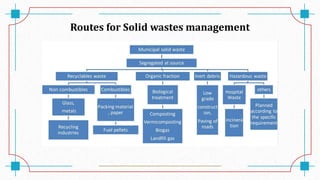
 Routes for Solid wastes management
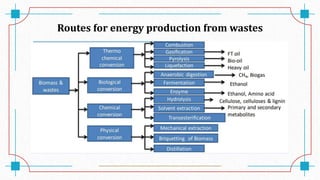
 Routes for energy production from wastes
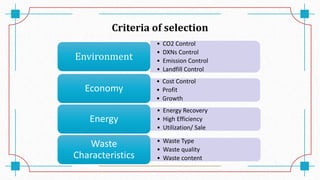
 Criteria of selection
 Incineration, Gasification, Pyrolysis
 Anaerobic digestion, Fermentation, Transesterification
 Conclusion and Suggestion
Introduction
Waste-to-energy (WtE) is the process of generating energy in the form of electricity and/or
heat from the primary treatment of waste, or the processing of waste into a fuel source. WtE is a
form of energy recovery. Most WtE processes generate electricity and/or heat directly through
combustion, or produce a combustible fuel commodity, such as methane, methanol, ethanol or
synthetic fuels.
Using waste for energy production becomes increasingly interesting seen both from a waste
management and an energy supply perspective.
• Waste management perspective
• Waste amounts are increasing and thereby increasing amounts need to be treated.
• Reduce waste & increased use of land due to decrease in land fills.
• Improved city sanitation
• Control of emission of toxic gasses and particulates in atmosphere.
• Energy supply perspective
• The use of waste will increase the level of renewable energy & decrease CO2 emissions.
• Used to produce bio-fuel for transport sector supplied with sustainable fuels.
• Energy price on par with conventional sources.
Need for Waste to Energy
• Limited Natural Resources (Petroleum: 40years, Natural gas: 58years, Copper: 28years)
• 1/3 reduction in fresh water supply per capita in 25 years. Shortage of agricultural water
• 5-20% decline in global GDP per annum with the existing industrial structure.
• 50% increase in global energy consumption by 2030.
• Exhaustion of Natural Resources.
• Water Shortage Problem.
• Increasing GHG Emissions.
• Increase of Energy Consumption.
• Increase in rate of Energy.
• Increase in health related problem like breathing infection, bacterial infection etc
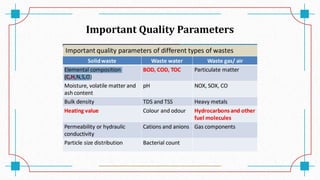
Important Quality Parameters
Wastes suitable for energy production
Wastes which can be used for energy production are:
• Solid wastes with high carbon content and heating value
• Waste water with high BOD and COD value
• Waste gases with high heating value (However, in practice this option is not normally used).
(We will concentrate on solid wastes and wastewater for further discussion)
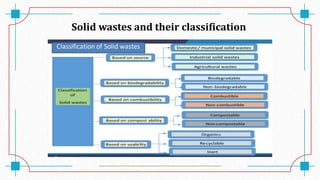
Solid wastes and their classification
Routes for Solid wastes management
Routes for energy production from wastes
Criteria of selection
• CO2 Control
• DXNs Control
• Emission Control
• Landfill Control
Environment
• Cost Control
• Profit
• Growth
Economy
• Energy Recovery
• High Efficiency
• Utilization/ Sale
Energy
• Waste Type
• Waste quality
• Waste content
Waste
Characteristics
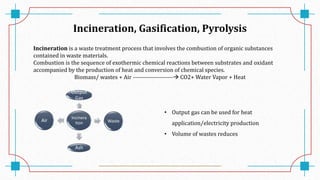
Incineration, Gasification, Pyrolysis
Incineration is a waste treatment process that involves the combustion of organic substances
contained in waste materials.
Combustion is the sequence of exothermic chemical reactions between substrates and oxidant
accompanied by the production of heat and conversion of chemical species.
Biomass/ wastes + Air -------------------- CO2+ Water Vapor + Heat
Incinera
tion
Output
Gas
Waste
Ash
Air
• Output gas can be used for heat
application/electricity production
• Volume of wastes reduces
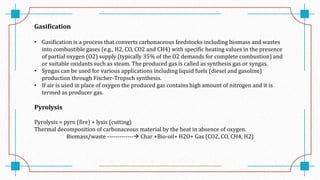
Gasification
• Gasification is a process that converts carbonaceous feedstocks including biomass and wastes
into combustible gases (e.g., H2, CO, CO2 and CH4) with specific heating values in the presence
of partial oxygen (O2) supply (typically 35% of the O2 demands for complete combustion) and
or suitable oxidants such as steam. The produced gas is called as synthesis gas or syngas.
• Syngas can be used for various applications including liquid fuels (diesel and gasoline)
production through Fischer-Tropsch synthesis.
• If air is used in place of oxygen the produced gas contains high amount of nitrogen and it is
termed as producer gas.
Pyrolysis
Pyrolysis = pyro (fire) + lysis (cutting)
Thermal decomposition of carbonaceous material by the heat in absence of oxygen.
Biomass/waste ------------- Char +Bio-oil+ H2O+ Gas (CO2, CO, CH4, H2)
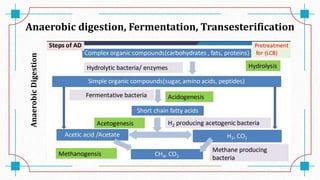
Anaerobic digestion, Fermentation, Transesterification
Anaerobic
Digestion
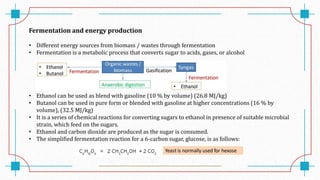
Fermentation and energy production
• Different energy sources from biomass / wastes through fermentation
• Fermentation is a metabolic process that converts sugar to acids, gases, or alcohol
• Ethanol can be used as blend with gasoline (10 % by volume) (26.8 MJ/kg)
• Butanol can be used in pure form or blended with gasoline at higher concentrations (16 % by
volume), (32.5 MJ/kg)
• It is a series of chemical reactions for converting sugars to ethanol in presence of suitable microbial
strain, which feed on the sugars.
• Ethanol and carbon dioxide are produced as the sugar is consumed.
• The simplified fermentation reaction for a 6-carbon sugar, glucose, is as follows:
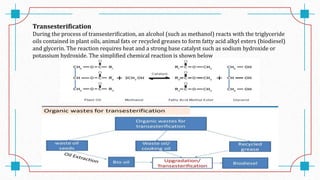
Transesterification
During the process of transesterification, an alcohol (such as methanol) reacts with the triglyceride
oils contained in plant oils, animal fats or recycled greases to form fatty acid alkyl esters (biodiesel)
and glycerin. The reaction requires heat and a strong base catalyst such as sodium hydroxide or
potassium hydroxide. The simplified chemical reaction is shown below
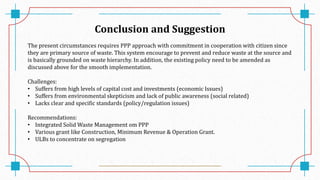
Conclusion and Suggestion
The present circumstances requires PPP approach with commitment in cooperation with citizen since
they are primary source of waste. This system encourage to prevent and reduce waste at the source and
is basically grounded on waste hierarchy. In addition, the existing policy need to be amended as
discussed above for the smooth implementation.
Challenges:
• Suffers from high levels of capital cost and investments (economic Issues)
• Suffers from environmental skepticism and lack of public awareness (social related)
• Lacks clear and specific standards (policy/regulation issues)
Recommendations:
• Integrated Solid Waste Management om PPP
• Various grant like Construction, Minimum Revenue & Operation Grant.
• ULBs to concentrate on segregation
Thank You

Waste to Energy Conversion

  • 1.
    Waste to EnergyConversion Presented by: Rishi Singh (M.Tech – 2020013215) (Environmental Engineering) Under Supervision of: Asso. Prof. S.N. Chaudhary (ASSOCIATE PROFESSOR) (Department of Civil Engineering) Madan Mohan Malaviya University of Technology
  • 2.
    Content  Introduction  Needfor Waste to Energy  Important Quality Parameters  Wastes suitable for energy production  Solid wastes and their classification  Routes for Solid wastes management  Routes for energy production from wastes  Criteria of selection  Incineration, Gasification, Pyrolysis  Anaerobic digestion, Fermentation, Transesterification  Conclusion and Suggestion
  • 3.
    Introduction Waste-to-energy (WtE) isthe process of generating energy in the form of electricity and/or heat from the primary treatment of waste, or the processing of waste into a fuel source. WtE is a form of energy recovery. Most WtE processes generate electricity and/or heat directly through combustion, or produce a combustible fuel commodity, such as methane, methanol, ethanol or synthetic fuels. Using waste for energy production becomes increasingly interesting seen both from a waste management and an energy supply perspective. • Waste management perspective • Waste amounts are increasing and thereby increasing amounts need to be treated. • Reduce waste & increased use of land due to decrease in land fills. • Improved city sanitation • Control of emission of toxic gasses and particulates in atmosphere. • Energy supply perspective • The use of waste will increase the level of renewable energy & decrease CO2 emissions. • Used to produce bio-fuel for transport sector supplied with sustainable fuels. • Energy price on par with conventional sources.
  • 4.
    Need for Wasteto Energy • Limited Natural Resources (Petroleum: 40years, Natural gas: 58years, Copper: 28years) • 1/3 reduction in fresh water supply per capita in 25 years. Shortage of agricultural water • 5-20% decline in global GDP per annum with the existing industrial structure. • 50% increase in global energy consumption by 2030. • Exhaustion of Natural Resources. • Water Shortage Problem. • Increasing GHG Emissions. • Increase of Energy Consumption. • Increase in rate of Energy. • Increase in health related problem like breathing infection, bacterial infection etc
  • 5.
  • 6.
    Wastes suitable forenergy production Wastes which can be used for energy production are: • Solid wastes with high carbon content and heating value • Waste water with high BOD and COD value • Waste gases with high heating value (However, in practice this option is not normally used). (We will concentrate on solid wastes and wastewater for further discussion)
  • 7.
    Solid wastes andtheir classification
  • 8.
    Routes for Solidwastes management
  • 9.
    Routes for energyproduction from wastes
  • 10.
    Criteria of selection •CO2 Control • DXNs Control • Emission Control • Landfill Control Environment • Cost Control • Profit • Growth Economy • Energy Recovery • High Efficiency • Utilization/ Sale Energy • Waste Type • Waste quality • Waste content Waste Characteristics
  • 11.
    Incineration, Gasification, Pyrolysis Incinerationis a waste treatment process that involves the combustion of organic substances contained in waste materials. Combustion is the sequence of exothermic chemical reactions between substrates and oxidant accompanied by the production of heat and conversion of chemical species. Biomass/ wastes + Air -------------------- CO2+ Water Vapor + Heat Incinera tion Output Gas Waste Ash Air • Output gas can be used for heat application/electricity production • Volume of wastes reduces
  • 12.
    Gasification • Gasification isa process that converts carbonaceous feedstocks including biomass and wastes into combustible gases (e.g., H2, CO, CO2 and CH4) with specific heating values in the presence of partial oxygen (O2) supply (typically 35% of the O2 demands for complete combustion) and or suitable oxidants such as steam. The produced gas is called as synthesis gas or syngas. • Syngas can be used for various applications including liquid fuels (diesel and gasoline) production through Fischer-Tropsch synthesis. • If air is used in place of oxygen the produced gas contains high amount of nitrogen and it is termed as producer gas. Pyrolysis Pyrolysis = pyro (fire) + lysis (cutting) Thermal decomposition of carbonaceous material by the heat in absence of oxygen. Biomass/waste ------------- Char +Bio-oil+ H2O+ Gas (CO2, CO, CH4, H2)
  • 13.
    Anaerobic digestion, Fermentation,Transesterification Anaerobic Digestion
  • 14.
    Fermentation and energyproduction • Different energy sources from biomass / wastes through fermentation • Fermentation is a metabolic process that converts sugar to acids, gases, or alcohol • Ethanol can be used as blend with gasoline (10 % by volume) (26.8 MJ/kg) • Butanol can be used in pure form or blended with gasoline at higher concentrations (16 % by volume), (32.5 MJ/kg) • It is a series of chemical reactions for converting sugars to ethanol in presence of suitable microbial strain, which feed on the sugars. • Ethanol and carbon dioxide are produced as the sugar is consumed. • The simplified fermentation reaction for a 6-carbon sugar, glucose, is as follows:
  • 15.
    Transesterification During the processof transesterification, an alcohol (such as methanol) reacts with the triglyceride oils contained in plant oils, animal fats or recycled greases to form fatty acid alkyl esters (biodiesel) and glycerin. The reaction requires heat and a strong base catalyst such as sodium hydroxide or potassium hydroxide. The simplified chemical reaction is shown below
  • 16.
    Conclusion and Suggestion Thepresent circumstances requires PPP approach with commitment in cooperation with citizen since they are primary source of waste. This system encourage to prevent and reduce waste at the source and is basically grounded on waste hierarchy. In addition, the existing policy need to be amended as discussed above for the smooth implementation. Challenges: • Suffers from high levels of capital cost and investments (economic Issues) • Suffers from environmental skepticism and lack of public awareness (social related) • Lacks clear and specific standards (policy/regulation issues) Recommendations: • Integrated Solid Waste Management om PPP • Various grant like Construction, Minimum Revenue & Operation Grant. • ULBs to concentrate on segregation
  • 17.