The Reinterpretation of the Warrington Human History Gallery
Presentation Kelly Edwards- Introduction Sally Purcell- History Lucy Wiffen- Ethics Christelle Hyppolite- Display Case Panel Group- Individual Labels Rachel Freundt- Alternative Images Kelly Edwards-Conclusion
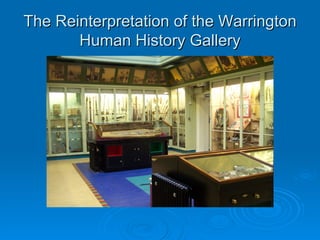
Introduction Warrington Human History Gallery Today Exhibiting ‘other’ cultures Re-interpreting the Gallery
History Beginnings Display Techniques Courting Controversy
Ethics Conservation Issues Ethics- Human Remains
Display Case Panel Label Writing Text Panel
Display and Interpretation The Gallery was established in 1936 and has remained mainly untouched since then. This central display is part of a new project aiming to reinterpret it. It presents a selection of artefacts from the Gallery.  Every three months new objects will be chosen to be reinterpreted.  The aim of the project is to address contemporary issues  concerning the objects and their displays,  while preserving the historical value of the Gallery.  This first selection of objects addresses the following issues:  Are artefacts made for tourists, really representative of a culture?  Should human remains be displayed to the public? Should religious objects sacred to a culture be displayed?  Do these objects still have a significance for contemporaries societies?  Press the green button to see the pictures around the Gallery showing a modern perspective on world cultures.
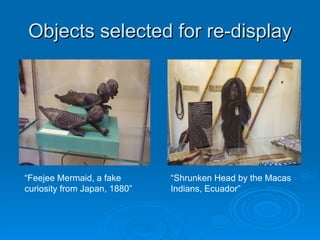
Objects selected for re-display “ Feejee Mermaid, a fake curiosity from Japan, 1880” “ Shrunken Head by the Macas Indians, Ecuador”
Objects selected for re-display “ Clay Shrine of a Buddah, Burmah, late nineteenth century” “ Plastercast of Maori (New Zealand Native)…shewing tattooing”
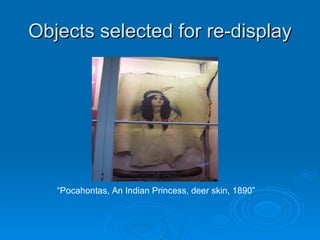
Objects selected for re-display “ Pocahontas, An Indian Princess, deer skin, 1890”
Example of proposed label Original label: A FEEJEE MERMAID. A grotesque human head on the body of a fish. A fake curiosity from Japan. c. 1880. FEEJEE MERMAIDS   Japan, c. 1880. It is said in Japan that eating the flesh of a Mermaid can grant unaging immortality. These Feejee Mermaids (also Fiji Mermaids) are  made from the body of fish with a spiny dorsal fin and have monkey  heads made from papier-mâché. Traffic in artificial mermaids was a further  source of income for Japanese fishermen. Many of these manufactured mermaids were presented at public shows in Europe  and the United States during the 18th and 19th centuries. Acc No. 1913.225.
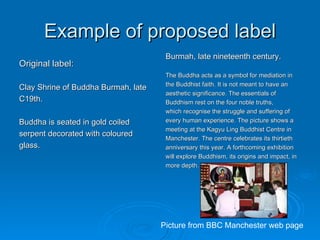
Example of proposed label Original label: Clay Shrine of Buddha Burmah, late C19th.  Buddha is seated in gold coiled serpent decorated with coloured glass. Burmah, late nineteenth century. The Buddha acts as a symbol for mediation in the Buddhist faith. It is not meant to have an aesthetic significance. The essentials of Buddhism rest on the four noble truths, which recognise the struggle and suffering of  every human experience. The picture shows a meeting at the Kagyu Ling Buddhist Centre in Manchester. The centre celebrates its thirtieth anniversary this year. A forthcoming exhibition  will explore Buddhism, its origins and impact, in more depth. Picture from BBC Manchester web page
Example of proposed label Original label: Pocahontas, An Indian Princess, deer skin, 1890 Pocahontas was the daughter of chief Powhatan. She saved Captain John  Smith, an English settler, from death and married another settler John Rolfe. Pocahontas died in England of small pox  early in the seventeenth century. This  portrait was painted on deer skin about  1890-probably to sell to tourists. She is  shown wearing a reversed swastika which  many ancient civilizations used as a good  luck charm. Pocahontas portrait, 1890 This painted portrait does not fit with the everyday items and traditional artwork in  the original case. A Native American  gentleman confirmed this is not a genuine  cultural artefact, but part of the tourist  trade. The words “Seattle, WA” were  written on the object with a poker. The  Pocahontas legend was used as material  for popular literature and theatrical  presentations throughout the nineteenth  century. Did the Anglo-American  depictions of the romantic Indian influence  this tourist collectable?
Example of proposed label PLASTER CAST OF HEAD New Zealand, 1854.  This cast was taken of a Maori man to show his Moko (tattoo).Ta Moko is a  sacred act of ingraving the skin.  Each Moko is unique to the wearer.  It  maps the person’s identity and  heritage.European travellers were  fascinated by the Maori’s tattoos.  Not  only plaster casts ended up in  Western museums but also tattooed  Maori heads or mokomokai.Do you  think that museums have the right to  own these sacred Mokomokai? Acc No. 25107.  Original label: Plastercast of Maori (New Zealand Native) from life, shewing tattooing.  Original taken at Rotoua, 1854, by Sir  Geoffrey Grey. New Zealand.
Example of proposed label Original label: HUMAN HEAD. Skull removed,  And skin shrunk to about  One quarter real size. Macas Indians, Ecuador, 163’05 Shrunken Head Macas Indians Ecuador In many cultures the taking of human heads from enemies has been socially  approved ritual with deep religious and  cultural meanings. The act of taking and shrinking a head  was not seen as murder, but a method for  maintaining social order.  Making a shrunken head, also known as a  Tsantas, was accompanied by elaborate  ritual linking together enemies and the  living and the dead through spirituality. Acc. No. 163’05
Alternative Images Current pictures Proposed changes


Quote ??? Picture from Japan news correspondent Kjeld Duits’ website www.ikjeld.com
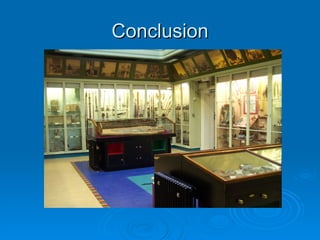
Conclusion

Warrington Gallery Proposal

  • 1.
    The Reinterpretation ofthe Warrington Human History Gallery
  • 2.
    Presentation Kelly Edwards-Introduction Sally Purcell- History Lucy Wiffen- Ethics Christelle Hyppolite- Display Case Panel Group- Individual Labels Rachel Freundt- Alternative Images Kelly Edwards-Conclusion
  • 3.
    Introduction Warrington HumanHistory Gallery Today Exhibiting ‘other’ cultures Re-interpreting the Gallery
  • 4.
    History Beginnings DisplayTechniques Courting Controversy
  • 5.
    Ethics Conservation IssuesEthics- Human Remains
  • 6.
    Display Case PanelLabel Writing Text Panel
  • 7.
    Display and InterpretationThe Gallery was established in 1936 and has remained mainly untouched since then. This central display is part of a new project aiming to reinterpret it. It presents a selection of artefacts from the Gallery. Every three months new objects will be chosen to be reinterpreted. The aim of the project is to address contemporary issues concerning the objects and their displays, while preserving the historical value of the Gallery. This first selection of objects addresses the following issues: Are artefacts made for tourists, really representative of a culture? Should human remains be displayed to the public? Should religious objects sacred to a culture be displayed? Do these objects still have a significance for contemporaries societies? Press the green button to see the pictures around the Gallery showing a modern perspective on world cultures.
  • 8.
    Objects selected forre-display “ Feejee Mermaid, a fake curiosity from Japan, 1880” “ Shrunken Head by the Macas Indians, Ecuador”
  • 9.
    Objects selected forre-display “ Clay Shrine of a Buddah, Burmah, late nineteenth century” “ Plastercast of Maori (New Zealand Native)…shewing tattooing”
  • 10.
    Objects selected forre-display “ Pocahontas, An Indian Princess, deer skin, 1890”
  • 11.
    Example of proposedlabel Original label: A FEEJEE MERMAID. A grotesque human head on the body of a fish. A fake curiosity from Japan. c. 1880. FEEJEE MERMAIDS Japan, c. 1880. It is said in Japan that eating the flesh of a Mermaid can grant unaging immortality. These Feejee Mermaids (also Fiji Mermaids) are made from the body of fish with a spiny dorsal fin and have monkey heads made from papier-mâché. Traffic in artificial mermaids was a further source of income for Japanese fishermen. Many of these manufactured mermaids were presented at public shows in Europe and the United States during the 18th and 19th centuries. Acc No. 1913.225.
  • 12.
    Example of proposedlabel Original label: Clay Shrine of Buddha Burmah, late C19th. Buddha is seated in gold coiled serpent decorated with coloured glass. Burmah, late nineteenth century. The Buddha acts as a symbol for mediation in the Buddhist faith. It is not meant to have an aesthetic significance. The essentials of Buddhism rest on the four noble truths, which recognise the struggle and suffering of every human experience. The picture shows a meeting at the Kagyu Ling Buddhist Centre in Manchester. The centre celebrates its thirtieth anniversary this year. A forthcoming exhibition will explore Buddhism, its origins and impact, in more depth. Picture from BBC Manchester web page
  • 13.
    Example of proposedlabel Original label: Pocahontas, An Indian Princess, deer skin, 1890 Pocahontas was the daughter of chief Powhatan. She saved Captain John Smith, an English settler, from death and married another settler John Rolfe. Pocahontas died in England of small pox early in the seventeenth century. This portrait was painted on deer skin about 1890-probably to sell to tourists. She is shown wearing a reversed swastika which many ancient civilizations used as a good luck charm. Pocahontas portrait, 1890 This painted portrait does not fit with the everyday items and traditional artwork in the original case. A Native American gentleman confirmed this is not a genuine cultural artefact, but part of the tourist trade. The words “Seattle, WA” were written on the object with a poker. The Pocahontas legend was used as material for popular literature and theatrical presentations throughout the nineteenth century. Did the Anglo-American depictions of the romantic Indian influence this tourist collectable?
  • 14.
    Example of proposedlabel PLASTER CAST OF HEAD New Zealand, 1854. This cast was taken of a Maori man to show his Moko (tattoo).Ta Moko is a sacred act of ingraving the skin. Each Moko is unique to the wearer. It maps the person’s identity and heritage.European travellers were fascinated by the Maori’s tattoos. Not only plaster casts ended up in Western museums but also tattooed Maori heads or mokomokai.Do you think that museums have the right to own these sacred Mokomokai? Acc No. 25107. Original label: Plastercast of Maori (New Zealand Native) from life, shewing tattooing. Original taken at Rotoua, 1854, by Sir Geoffrey Grey. New Zealand.
  • 15.
    Example of proposedlabel Original label: HUMAN HEAD. Skull removed, And skin shrunk to about One quarter real size. Macas Indians, Ecuador, 163’05 Shrunken Head Macas Indians Ecuador In many cultures the taking of human heads from enemies has been socially approved ritual with deep religious and cultural meanings. The act of taking and shrinking a head was not seen as murder, but a method for maintaining social order. Making a shrunken head, also known as a Tsantas, was accompanied by elaborate ritual linking together enemies and the living and the dead through spirituality. Acc. No. 163’05
  • 16.
    Alternative Images Currentpictures Proposed changes
  • 17.
  • 18.
  • 19.
  • 20.
    Quote ??? Picturefrom Japan news correspondent Kjeld Duits’ website www.ikjeld.com
  • 21.