WAQFPresented By:AbidRehman
ObjectivesBy the end of this presentation, participants would be able to:Define waqfDiscuss the mussalmanwakf validating act, 1913-act no. ViExplain who can make a WaqfDescribe when Waqf is considered a complete TransactionDiscuss Registration ActExplain classification of Waqf in beneficiaryDiscuss Waqf—Historical Experience Describe Waqf and Poverty AlleviationList the Importance of AuqafDiscuss utility of the Institution of Trust under present conditions Describe the essentials of Waqf
WaQfDefinition:Waqf literally means ‘detention’ but in Islamic law it means:State land which are inalienable, used for charitable purposes and pious endowments.OR Things, movable or immovable, which are donated in the way of Allah are called ‘Wakf’ in Islamic terminology.
THE MUSSALMAN WAKF VALIDATING ACT, 1913-ACT No. VI" Wakf " means the permanent dedication by a person professing the Muslim faith of any property for any purpose recognized by the Muslim law as religious, pious or charitable.
Who can make a WaqfAny Muslim who has attained majority  and is of sound mind can make a waqf.
When WaQf IS considered a complete TransactionCompletionDeclaration coupled withAppointment of MutawallisDelivery of possessionHigh court decision
Registration ACtWaqf requires to be Registered.PerpetuityIrrevocabilityInalienabilityContingency
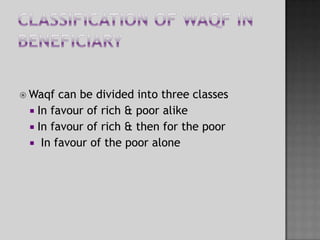
Classification of Waqf in beneficiary Waqf can be divided into three classesIn favour of rich & poor alikeIn favour of rich & then for the poor In favour of the poor alone
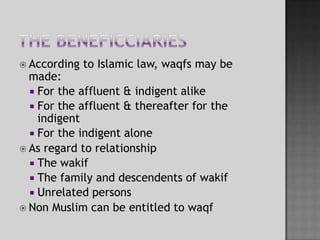
The beneficciariesAccording to Islamic law, waqfs may be made:For the affluent & indigent alikeFor the affluent & thereafter for the indigent For the indigent aloneAs regard to relationshipThe wakifThe family and descendents of wakifUnrelated personsNon Muslim can be entitled to waqf
Historical backgroundAll income from Auqaf which has been assigned to Bait-al-Mal is the right of Bait-al-Mal In Islam HazratUmar (RA) was the first creator of a Wakf (a Wakif) or Donor
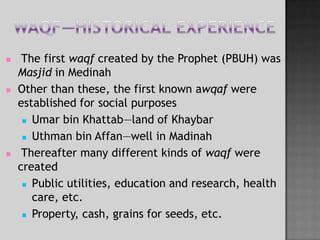
Waqf—Historical Experience The first waqf created by the Prophet (PBUH) was Masjid in Medinah
Other than these, the first known awqaf were established for social purposes
Umar bin Khattab—land of Khaybar
Uthman bin Affan—well in Madinah
 Thereafter many different kinds of waqf were created
Public utilities, education and research, health care, etc.
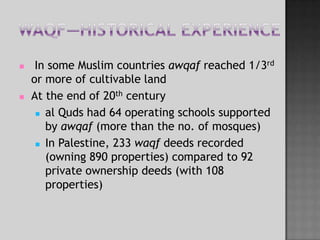
Property, cash, grains for seeds, etc. Waqf—Historical Experience  In some Muslim countries awqaf reached 1/3rd or more of cultivable land
At the end of 20th century

Waqf

  • 1.
  • 2.
    ObjectivesBy the endof this presentation, participants would be able to:Define waqfDiscuss the mussalmanwakf validating act, 1913-act no. ViExplain who can make a WaqfDescribe when Waqf is considered a complete TransactionDiscuss Registration ActExplain classification of Waqf in beneficiaryDiscuss Waqf—Historical Experience Describe Waqf and Poverty AlleviationList the Importance of AuqafDiscuss utility of the Institution of Trust under present conditions Describe the essentials of Waqf
  • 3.
    WaQfDefinition:Waqf literally means‘detention’ but in Islamic law it means:State land which are inalienable, used for charitable purposes and pious endowments.OR Things, movable or immovable, which are donated in the way of Allah are called ‘Wakf’ in Islamic terminology.
  • 4.
    THE MUSSALMAN WAKFVALIDATING ACT, 1913-ACT No. VI" Wakf " means the permanent dedication by a person professing the Muslim faith of any property for any purpose recognized by the Muslim law as religious, pious or charitable.
  • 5.
    Who can makea WaqfAny Muslim who has attained majority and is of sound mind can make a waqf.
  • 6.
    When WaQf ISconsidered a complete TransactionCompletionDeclaration coupled withAppointment of MutawallisDelivery of possessionHigh court decision
  • 7.
    Registration ACtWaqf requiresto be Registered.PerpetuityIrrevocabilityInalienabilityContingency
  • 8.
    Classification of Waqfin beneficiary Waqf can be divided into three classesIn favour of rich & poor alikeIn favour of rich & then for the poor In favour of the poor alone
  • 9.
    The beneficciariesAccording toIslamic law, waqfs may be made:For the affluent & indigent alikeFor the affluent & thereafter for the indigent For the indigent aloneAs regard to relationshipThe wakifThe family and descendents of wakifUnrelated personsNon Muslim can be entitled to waqf
  • 10.
    Historical backgroundAll incomefrom Auqaf which has been assigned to Bait-al-Mal is the right of Bait-al-Mal In Islam HazratUmar (RA) was the first creator of a Wakf (a Wakif) or Donor
  • 11.
    Waqf—Historical Experience Thefirst waqf created by the Prophet (PBUH) was Masjid in Medinah
  • 12.
    Other than these,the first known awqaf were established for social purposes
  • 13.
  • 14.
  • 15.
    Thereafter manydifferent kinds of waqf were created
  • 16.
    Public utilities, educationand research, health care, etc.
  • 17.
    Property, cash, grainsfor seeds, etc. Waqf—Historical Experience In some Muslim countries awqaf reached 1/3rd or more of cultivable land
  • 18.
    At the endof 20th century