

INTRODUCTION TO USULAL FIQH
(RKFQ 4090)
Group members:
Fasiha Binti Bustami (1318146)
Fitriani Binti Shifollah (1312440)
Halimaton Mohamad Hanafi (1412280)
Haziqah Yusra Binti Abdul Razak (1413194)
Nurul Maizatul Shuhadah Binti Abu Zaid (1417710)
Classification of Islamic Law
Wajib (obligatory act)
The Meaning of Wajib (ObligatoryAct)
• Wajib refers to an act whose performance is absolutely demanded by the
Lawgiver in certain and binding terms.
• The binding and certain nature of the demand may be inferred from the syntax
or form of expression used in the text of communication ie. Al-Quran and
Sunnah.
• Examples: the performance of solat, the payment of zakat
The hukm or rule of the wajib
• There is reward for those who commiting it, while omitting it without legal
excuse entails a penalty.
• Wajib and fard are identical according to the majority of the jurists, but Hanafis
differentiate between them.
• The wajib, according to the Hanafis is what has been made binding for the
subject by the Lawgiver, but which has been established through a probable
(zanni) evidence.
• Examples: saqadat al-fitr, witr prayer and reciting surah al-Fatihah in prayers.
• The fard according to them has been made binding for the subject and is
established through a definitive (qati) evidence.
• Examples: the five daily prayers, zakat, hajj, recitation of the Quran in prayer
THE CLASSIFICATION BASED
ON THE TIME AVAILABLE
Mutlaq (obligatory act independent of time)
• Performance has been demanded by the Lawgiver, but He has not fixed the definite time
for its performance.
• Eg: the payment of expiation(kaffarah) and The payment of nadhr for fasting sometimes
in the future
• Rule:
>The subject may perform the act whenever he likes.
Eg: if he took an oath to do spmething and he broke his oath, he may
pay kaffarah, for which he is liable, anytime he wishes to do.
Muqayyad (obligatory act limited by time)
• Obligatory act demanded by the Lawgiver from the subject for which a time period
is also determined having a beginning and as end.
• Eg: the daily prayers, fasting during Ramadhan and Hajj
• Wajib muqayyad gives rise the two further subdivisions depending on the
performance of the act within the time and depending on the time available for the
performance of the act, that is , whether the time just enough for the act or exceed
the time require.
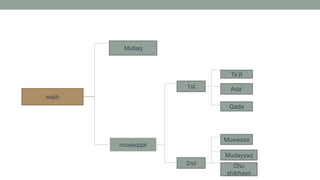
wajib
Mutlaq
muwaqqat
1st
2nd
Ta’jil
Ada’
Qada
Muwassa
Mudayyaq
Dhu
shibhayn
1st subdivision: ta’jil, qada’, ada’ (early, timely and
delayed performance)
• Ta’jil > if permitted by the Lawgiver, amounts to performance in time, like the early payment of the
sadaqat al fitr
• Ada’> the time that the Lawgiver has fixed for it, without there being shortfail
in such performance
> if the act not properly perform and is repeated within the time and is
properly, it is called I’adah (repetition).
>eg: a person praying with tayammum finds water, perform ablution and
prays again within time.
> there are some fine distinction about the term I’adah among the majority
of Hanafis, ; I’adah and ada’.
• Qada > the jusrist agree that one who misses
the determined time is obliged to offer
the act of qada’ and if they delay was
without the valid excuse, he is liable for
blame.
> Zahiri jurists confined the excuse only to the
one who forgot or one who misses the act because he was
asleep not for those who intentionally misses it.
>eg: offering morning payer after the sun has risen, offering zuhr
in the time of asr.
2nd subdivision: muwassa , mudayyaq, dhu shibhayn
(wide,narrow and dual duration for the performance of
the act)
• Muwassa’ (obligatory act with extra time) > the time given by
Allah is enough fot this act and others like it. According to the Hanafis , the time for
the act is called zarf .
> eg: a time of zuhr prayer. The subject is permitted to perform required act in any
part of this time of period. After agreeing on this, the jurist disagreed as to which part
is wajib (obligaton) connected to the beginning or the end of the period.
• Mudayyaq (obligatory act with time sufficient for a single performance)
> the time granted by Allah is just enough for its performance and for no other.
>eg: fasts during Ramadhan. The time granted itself becomes the standard
(mi’yar) for the validity of this act.
• Dhu shibhayn (obligatory act with extra time from one aspect and sufficient
time from another)
>also called the act that can be performed once in a period of time, yet it permits
other acts.
>eg : performing Hajj. It can be performed once in a year in known months, but it
permits the subject to perform act like tawaf a number of time during this period.
The reason of distinction:
• wajib muwassa is not valid without niyyah. This is because the time available may
include other act and the act has to be identified.
• Wajib muqayyad is valid with a general niyyah or even the niyyah for another act
of the same kind. The niyyah will be redirected; towards the act for which the time
is just sufficient.
Classification based on the extent
of the required act
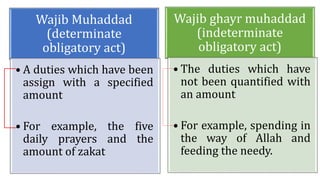
Wajib Muhaddad
(determinate
obligatory act)
• A duties which have been
assign with a specified
amount
• For example, the five
daily prayers and the
amount of zakat
Wajib ghayr muhaddad
(indeterminate
obligatory act)
• The duties which have
not been quantified with
an amount
• For example, spending in
the way of Allah and
feeding the needy.
CLASSIFICATION BASED ON
THE IDENTIFICATION OF THE
OBJECT OF THE REQUIRED
ACT
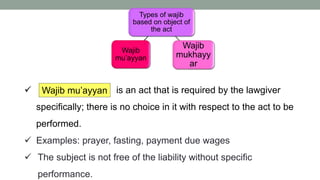
Types of wajib
based on object of
the act
Wajib
mu’ayyan
Wajib
mukhayy
ar
 is an act that is required by the lawgiver
specifically; there is no choice in it with respect to the act to be
performed.
 Examples: prayer, fasting, payment due wages
 The subject is not free of the liability without specific
performance.
Wajib mu’ayyan
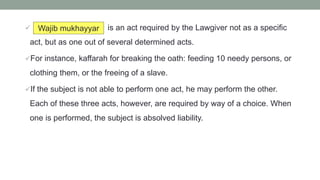
 is an act required by the Lawgiver not as a specific
act, but as one out of several determined acts.
For instance, kaffarah for breaking the oath: feeding 10 needy persons, or
clothing them, or the freeing of a slave.
If the subject is not able to perform one act, he may perform the other.
Each of these three acts, however, are required by way of a choice. When
one is performed, the subject is absolved liability.
Wajib mukhayyar
CLASSIFICATION BASED ON THE
SUBJECTS WHO ARE REQUIRED TO
PERFORM
Haziqah Yusra binti Abdul Razak (1413194)
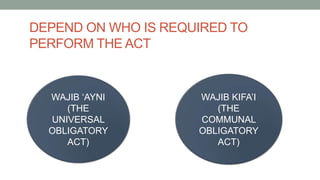
DEPEND ON WHO IS REQUIRED TO
PERFORM THE ACT
WAJIB ‘AYNI
(THE
UNIVERSAL
OBLIGATORY
ACT)
WAJIB KIFA’I
(THE
COMMUNAL
OBLIGATORY
ACT)
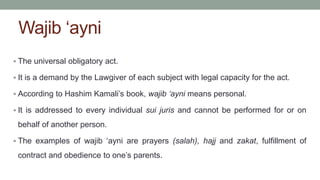
Wajib ‘ayni
 The universal obligatory act.
 It is a demand by the Lawgiver of each subject with legal capacity for the act.
 According to Hashim Kamali’s book, wajib ‘ayni means personal.
 It is addressed to every individual sui juris and cannot be performed for or on
behalf of another person.
 The examples of wajib ‘ayni are prayers (salah), hajj and zakat, fulfillment of
contract and obedience to one’s parents.
WAJIB KIFA’I
The communal obligatory set.
It is an act whose performance is required from the whole
community and not from each individual.
For example, the duty of participating in jihad (holy struggle), funeral
prayers, the hisbah (the promotion of good and prevention of evil),
building hospitals, giving testimony and serving as a judge, etc.
CONT…
The rule for wajib kifa’i is that it is performed by some
individuals in the community.
The rest are no longer liable for it.
The communal obligation may turn into a universal obligation,
but in certain cases.
For example, if there is only one doctor in the community, it will
be his personal obligation to look after a patient.
CONT…
Other example:
When a person dies, leaving no property to meet the cost of his burial,
it is wajib (kifa’i) for the community to provide it and to give him a
decent burial.
Even though only some members of the community may actually
contribute toward the costs, but the duty nevertheless discharged
from the whole community.

Wajib

  • 1.
    INTRODUCTION TO USULALFIQH (RKFQ 4090) Group members: Fasiha Binti Bustami (1318146) Fitriani Binti Shifollah (1312440) Halimaton Mohamad Hanafi (1412280) Haziqah Yusra Binti Abdul Razak (1413194) Nurul Maizatul Shuhadah Binti Abu Zaid (1417710)
  • 2.
    Classification of IslamicLaw Wajib (obligatory act)
  • 3.
    The Meaning ofWajib (ObligatoryAct) • Wajib refers to an act whose performance is absolutely demanded by the Lawgiver in certain and binding terms. • The binding and certain nature of the demand may be inferred from the syntax or form of expression used in the text of communication ie. Al-Quran and Sunnah. • Examples: the performance of solat, the payment of zakat
  • 4.
    The hukm orrule of the wajib • There is reward for those who commiting it, while omitting it without legal excuse entails a penalty. • Wajib and fard are identical according to the majority of the jurists, but Hanafis differentiate between them. • The wajib, according to the Hanafis is what has been made binding for the subject by the Lawgiver, but which has been established through a probable (zanni) evidence. • Examples: saqadat al-fitr, witr prayer and reciting surah al-Fatihah in prayers.
  • 5.
    • The fardaccording to them has been made binding for the subject and is established through a definitive (qati) evidence. • Examples: the five daily prayers, zakat, hajj, recitation of the Quran in prayer
  • 6.
    THE CLASSIFICATION BASED ONTHE TIME AVAILABLE
  • 7.
    Mutlaq (obligatory actindependent of time) • Performance has been demanded by the Lawgiver, but He has not fixed the definite time for its performance. • Eg: the payment of expiation(kaffarah) and The payment of nadhr for fasting sometimes in the future • Rule: >The subject may perform the act whenever he likes. Eg: if he took an oath to do spmething and he broke his oath, he may pay kaffarah, for which he is liable, anytime he wishes to do.
  • 8.
    Muqayyad (obligatory actlimited by time) • Obligatory act demanded by the Lawgiver from the subject for which a time period is also determined having a beginning and as end. • Eg: the daily prayers, fasting during Ramadhan and Hajj • Wajib muqayyad gives rise the two further subdivisions depending on the performance of the act within the time and depending on the time available for the performance of the act, that is , whether the time just enough for the act or exceed the time require.
  • 9.
  • 10.
    1st subdivision: ta’jil,qada’, ada’ (early, timely and delayed performance) • Ta’jil > if permitted by the Lawgiver, amounts to performance in time, like the early payment of the sadaqat al fitr • Ada’> the time that the Lawgiver has fixed for it, without there being shortfail in such performance > if the act not properly perform and is repeated within the time and is properly, it is called I’adah (repetition). >eg: a person praying with tayammum finds water, perform ablution and prays again within time. > there are some fine distinction about the term I’adah among the majority of Hanafis, ; I’adah and ada’.
  • 11.
    • Qada >the jusrist agree that one who misses the determined time is obliged to offer the act of qada’ and if they delay was without the valid excuse, he is liable for blame. > Zahiri jurists confined the excuse only to the one who forgot or one who misses the act because he was asleep not for those who intentionally misses it. >eg: offering morning payer after the sun has risen, offering zuhr in the time of asr.
  • 12.
    2nd subdivision: muwassa, mudayyaq, dhu shibhayn (wide,narrow and dual duration for the performance of the act) • Muwassa’ (obligatory act with extra time) > the time given by Allah is enough fot this act and others like it. According to the Hanafis , the time for the act is called zarf . > eg: a time of zuhr prayer. The subject is permitted to perform required act in any part of this time of period. After agreeing on this, the jurist disagreed as to which part is wajib (obligaton) connected to the beginning or the end of the period.
  • 13.
    • Mudayyaq (obligatoryact with time sufficient for a single performance) > the time granted by Allah is just enough for its performance and for no other. >eg: fasts during Ramadhan. The time granted itself becomes the standard (mi’yar) for the validity of this act. • Dhu shibhayn (obligatory act with extra time from one aspect and sufficient time from another) >also called the act that can be performed once in a period of time, yet it permits other acts. >eg : performing Hajj. It can be performed once in a year in known months, but it permits the subject to perform act like tawaf a number of time during this period.
  • 14.
    The reason ofdistinction: • wajib muwassa is not valid without niyyah. This is because the time available may include other act and the act has to be identified. • Wajib muqayyad is valid with a general niyyah or even the niyyah for another act of the same kind. The niyyah will be redirected; towards the act for which the time is just sufficient.
  • 15.
    Classification based onthe extent of the required act
  • 16.
    Wajib Muhaddad (determinate obligatory act) •A duties which have been assign with a specified amount • For example, the five daily prayers and the amount of zakat Wajib ghayr muhaddad (indeterminate obligatory act) • The duties which have not been quantified with an amount • For example, spending in the way of Allah and feeding the needy.
  • 17.
    CLASSIFICATION BASED ON THEIDENTIFICATION OF THE OBJECT OF THE REQUIRED ACT
  • 18.
    Types of wajib basedon object of the act Wajib mu’ayyan Wajib mukhayy ar  is an act that is required by the lawgiver specifically; there is no choice in it with respect to the act to be performed.  Examples: prayer, fasting, payment due wages  The subject is not free of the liability without specific performance. Wajib mu’ayyan
  • 19.
     is anact required by the Lawgiver not as a specific act, but as one out of several determined acts. For instance, kaffarah for breaking the oath: feeding 10 needy persons, or clothing them, or the freeing of a slave. If the subject is not able to perform one act, he may perform the other. Each of these three acts, however, are required by way of a choice. When one is performed, the subject is absolved liability. Wajib mukhayyar
  • 20.
    CLASSIFICATION BASED ONTHE SUBJECTS WHO ARE REQUIRED TO PERFORM Haziqah Yusra binti Abdul Razak (1413194)
  • 21.
    DEPEND ON WHOIS REQUIRED TO PERFORM THE ACT WAJIB ‘AYNI (THE UNIVERSAL OBLIGATORY ACT) WAJIB KIFA’I (THE COMMUNAL OBLIGATORY ACT)
  • 22.
    Wajib ‘ayni  Theuniversal obligatory act.  It is a demand by the Lawgiver of each subject with legal capacity for the act.  According to Hashim Kamali’s book, wajib ‘ayni means personal.  It is addressed to every individual sui juris and cannot be performed for or on behalf of another person.  The examples of wajib ‘ayni are prayers (salah), hajj and zakat, fulfillment of contract and obedience to one’s parents.
  • 23.
    WAJIB KIFA’I The communalobligatory set. It is an act whose performance is required from the whole community and not from each individual. For example, the duty of participating in jihad (holy struggle), funeral prayers, the hisbah (the promotion of good and prevention of evil), building hospitals, giving testimony and serving as a judge, etc.
  • 24.
    CONT… The rule forwajib kifa’i is that it is performed by some individuals in the community. The rest are no longer liable for it. The communal obligation may turn into a universal obligation, but in certain cases. For example, if there is only one doctor in the community, it will be his personal obligation to look after a patient.
  • 25.
    CONT… Other example: When aperson dies, leaving no property to meet the cost of his burial, it is wajib (kifa’i) for the community to provide it and to give him a decent burial. Even though only some members of the community may actually contribute toward the costs, but the duty nevertheless discharged from the whole community.