THE APPLICATION
OF MASLAHAH
Siti Nur Jannah Binti Hasanuddin
G1813858
Semester II 2018 / 2019
Contents
• Definition of maslahah
• Authorities of maslahah
• Classification of maslahah
• Validity of maslahah
• Relationship between maslahah, and
Qiyas(Analogy) Istihsan, Urf
• Application of maslahah in classical and modern
era
• Conclusion
Definition
• The root word salaha (‫صلح‬) or saluha indicate to
good, right, virtuous, honest.
• Literally maslahah means benefit, interest, welfare
or manfa’ah.
• In broader sense it is the consideration of public
interest or general good
• Maslahah is synonymous with istislah or Maslahah
Mutlaqah.
• Istislah (‫استصلح‬) is a method apply by the Muslim
jurists to solve problems that have no clear answers
in sacred religious text.
• Imam al-Ghazali; maslahah means seeking manfa'ah (utility)
or removing madarrah (harm) that in line with syariah aims .
What assures the preservation of these five usul (principles) is
maslahah and whatever fail to preserve them is mafsadah and
its removal is also maslahah. - preservation of religion, life,
reason, descendants and property.
• Imam Ar-Razy; maslahah as a beneficial act that has been
ordered by Musyarri' (Allah) to His slave about his religious
observance, his soul, his mind, his descendants and their
property.
• Al-Syatibi; maslahah as a principle that concerns the
subsistence of human life, the completion of livehood and the
acquisition of what a person’s emotional and intellectual
qualities require him/her in an absolute sense.
• Ibn Ashur; maslahah means utmost righteousness and
goodness. It is and attribute of an act realizing righteousness
and goodness for example for benefits usually realized for the
public or individuals.
Authorities
• There are no specific verses in the Qur’an or the Sunnah
which explicitly validate the usage of Maslaha as a source of
Shariah law.
• However there are many general verse or practices of the
Prophet (PBUH) that have been quoted as a basis for the use
it.
 Al-Ma’idah
“Allah never intends to impose hardship upon people.” – 5:6
 Al-Hajj
“…He has not laid upon you in religion any hardship…” – 22:78
 Al-Baqarrah
“..Allah intends for you ease, and He does not want to make
things difficult for you….” – 2:185
Hadith
 “‫ضرار‬ ‫وال‬ ‫ضرر‬ ‫”ال‬ Harm is neither inflicted nor propagated in Islam
(Narrated by Ibn Majah and Ahmad Bin Hanbal)
 Narrated `Aisha: Whenever Allah's Messenger ‫ﷺ‬) ) was given the choice of
one of two matters, he would choose the easier of the two, as long as it was
not sinful to do so, but if it was sinful to do so, he would not approach it (Sahih
Bukhari)
Legal Maxims
 “‫التيسير‬ ‫تجلب‬ ‫المشقة‬”
Hardship begets facility.
 “ ‫يدفع‬ ‫بقدر‬ ‫االمكان‬‫الضرر‬ ”
Harm is eliminated to the extent that is possible
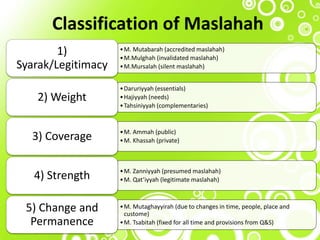
Classification of Maslahah
•M. Mutabarah (accredited maslahah)
•M.Mulghah (invalidated maslahah)
•M.Mursalah (silent maslahah)
1)
Syarak/Legitimacy
•Daruriyyah (essentials)
•Hajiyyah (needs)
•Tahsiniyyah (complementaries)
2) Weight
•M. Ammah (public)
•M. Khassah (private)3) Coverage
•M. Zanniyyah (presumed maslahah)
•M. Qat’iyyah (legitimate maslahah)4) Strength
•M. Mutaghayyirah (due to changes in time, people, place and
custome)
•M. Tsabitah (fixed for all time and provisions from Q&S)
5) Change and
Permanence
i) Maslahah Mu’tabarah (accredited maslahah)
o It is the type of maslahah to constitute the basis
of Qiyas in which it has an evidence of its validity
Qur’an, Sunnah and Ijma’.
o Its supported in the Shari’ah and not opened to
debate.
o Example protecting life by enacting law of
retaliation, defending the right ownership by
penalizing the thief.
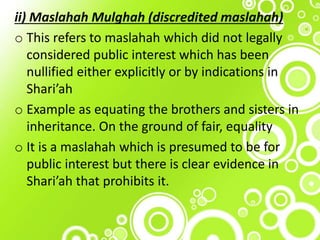
ii) Maslahah Mulghah (discredited maslahah)
o This refers to maslahah which did not legally
considered public interest which has been
nullified either explicitly or by indications in
Shari’ah
o Example as equating the brothers and sisters in
inheritance. On the ground of fair, equality
o It is a maslahah which is presumed to be for
public interest but there is clear evidence in
Shari’ah that prohibits it.
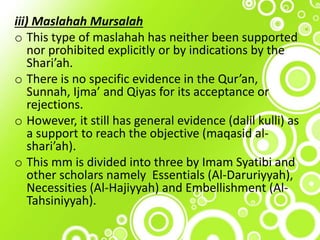
iii) Maslahah Mursalah
o This type of maslahah has neither been supported
nor prohibited explicitly or by indications by the
Shari’ah.
o There is no specific evidence in the Qur’an,
Sunnah, Ijma’ and Qiyas for its acceptance or
rejections.
o However, it still has general evidence (dalil kulli) as
a support to reach the objective (maqasid al-
shari’ah).
o This mm is divided into three by Imam Syatibi and
other scholars namely Essentials (Al-Daruriyyah),
Necessities (Al-Hajiyyah) and Embellishment (Al-
Tahsiniyyah).
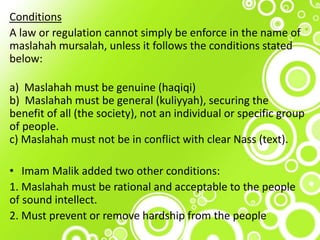
Conditions
A law or regulation cannot simply be enforce in the name of
maslahah mursalah, unless it follows the conditions stated
below:
a) Maslahah must be genuine (haqiqi)
b) Maslahah must be general (kuliyyah), securing the
benefit of all (the society), not an individual or specific group
of people.
c) Maslahah must not be in conflict with clear Nass (text).
• Imam Malik added two other conditions:
1. Maslahah must be rational and acceptable to the people
of sound intellect.
2. Must prevent or remove hardship from the people
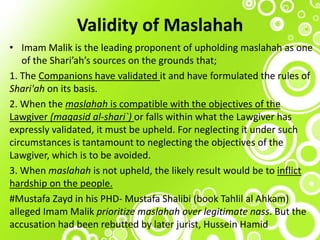
Validity of Maslahah
• Imam Malik is the leading proponent of upholding maslahah as one
of the Shari’ah’s sources on the grounds that;
1. The Companions have validated it and have formulated the rules of
Shari'ah on its basis.
2. When the maslahah is compatible with the objectives of the
Lawgiver (maqasid al-shari`) or falls within what the Lawgiver has
expressly validated, it must be upheld. For neglecting it under such
circumstances is tantamount to neglecting the objectives of the
Lawgiver, which is to be avoided.
3. When maslahah is not upheld, the likely result would be to inflict
hardship on the people.
#Mustafa Zayd in his PHD- Mustafa Shalibi (book Tahlil al Ahkam)
alleged Imam Malik prioritize maslahah over legitimate nass. But the
accusation had been rebutted by later jurist, Hussein Hamid
• Malikis and Hanbalis – approved as long as
Maslahah meet the requirements..
• However, Shafi`is and Hanafis –does not
approved maslahah. – difference in
procedure/application
• Imam Shafi’is approves maslahah only within
the general scope of qiyas whereas Imam Abu
Hanifah validates it as a variety of Istihsan.
• To Al-Shafi‘i, applying the concept of maslahah
would exceed the limitations of permitted use
of human legal reasoning in deducing new
hukm.
Relationship between Maslahah,
Qiyas,Istihsan, Urf
• Similarities
 They are applicable to cases on which there is no clear ruling available in nusus
or ijma’
• Differences
Maslahah
 the benefit/ruling which is sought through maslahah has no specific basis in the
established law whether in favour or against. Stands on its own justification.
Nature – public interest
Qiyas and Istihsan
 founded in an indication from the Lawgiver and a specific ‘illah is identified to
justify the analogy to the nass - the extension of a ruling are already exists.
Urf
 Based on people custom – on specific area/tribe
Application of Maslahah
 Historically, the notion of maslahah mursalah originated in the
practice of the Companions but some scholar said originated in
Prophet time – distribution of ghanimah after battle of Hunanyn
 Classical era
 the establishment of the Caliphate and the Imamate institutions
 Abu Bakar - Efforts to collect the verses of the Qur'an in Mushaf and fighting
dissidents in paying zakat
 Umar al Khatab - Impose Kharaj, held officials responsible for abuse of public
office.
 Uthman - distributed the authenticated Qur'an and destroyed all the variant
versions of the text, validated the right to inheritance of a woman whose
husband had divorced her in order to be disinherited.
 Ali - having held craftsmen and traders responsible for the loss of goods that
were placed in their custody.
 Modern era
Muamalah– Islamic Banking, Consumer protection
law, Insurance
Family – Minimum age for marriage, Appointment
of Wali in marriage, Registration of marriage and
divorce, IVF, Vaccination to babies
Medical - Blood transfusion, Organs transplant
Others –
• Road Transportation Act – traffic light, wearing
helmet
• Animals welfare act 2016
• Prohibition of smoking in public places – fine
RM10,000 or prison not exceed 2 years
Conclusion
• Maslahah is one of the legal sources of Islamic
law. It is agreed by the majority jurists.
• Things that have not been explicitly stated in
Quran and hadith can be justified on the ground
of maslahah.
• HOWEVER, maslahah should not be used
arbitrarily or based on self interest to justify
things that contrary to islamic rules.

application of Maslahah

  • 1.
    THE APPLICATION OF MASLAHAH SitiNur Jannah Binti Hasanuddin G1813858 Semester II 2018 / 2019
  • 2.
    Contents • Definition ofmaslahah • Authorities of maslahah • Classification of maslahah • Validity of maslahah • Relationship between maslahah, and Qiyas(Analogy) Istihsan, Urf • Application of maslahah in classical and modern era • Conclusion
  • 3.
    Definition • The rootword salaha (‫صلح‬) or saluha indicate to good, right, virtuous, honest. • Literally maslahah means benefit, interest, welfare or manfa’ah. • In broader sense it is the consideration of public interest or general good • Maslahah is synonymous with istislah or Maslahah Mutlaqah. • Istislah (‫استصلح‬) is a method apply by the Muslim jurists to solve problems that have no clear answers in sacred religious text.
  • 4.
    • Imam al-Ghazali;maslahah means seeking manfa'ah (utility) or removing madarrah (harm) that in line with syariah aims . What assures the preservation of these five usul (principles) is maslahah and whatever fail to preserve them is mafsadah and its removal is also maslahah. - preservation of religion, life, reason, descendants and property. • Imam Ar-Razy; maslahah as a beneficial act that has been ordered by Musyarri' (Allah) to His slave about his religious observance, his soul, his mind, his descendants and their property. • Al-Syatibi; maslahah as a principle that concerns the subsistence of human life, the completion of livehood and the acquisition of what a person’s emotional and intellectual qualities require him/her in an absolute sense. • Ibn Ashur; maslahah means utmost righteousness and goodness. It is and attribute of an act realizing righteousness and goodness for example for benefits usually realized for the public or individuals.
  • 5.
    Authorities • There areno specific verses in the Qur’an or the Sunnah which explicitly validate the usage of Maslaha as a source of Shariah law. • However there are many general verse or practices of the Prophet (PBUH) that have been quoted as a basis for the use it.  Al-Ma’idah “Allah never intends to impose hardship upon people.” – 5:6  Al-Hajj “…He has not laid upon you in religion any hardship…” – 22:78  Al-Baqarrah “..Allah intends for you ease, and He does not want to make things difficult for you….” – 2:185
  • 6.
    Hadith  “‫ضرار‬ ‫وال‬‫ضرر‬ ‫”ال‬ Harm is neither inflicted nor propagated in Islam (Narrated by Ibn Majah and Ahmad Bin Hanbal)  Narrated `Aisha: Whenever Allah's Messenger ‫ﷺ‬) ) was given the choice of one of two matters, he would choose the easier of the two, as long as it was not sinful to do so, but if it was sinful to do so, he would not approach it (Sahih Bukhari) Legal Maxims  “‫التيسير‬ ‫تجلب‬ ‫المشقة‬” Hardship begets facility.  “ ‫يدفع‬ ‫بقدر‬ ‫االمكان‬‫الضرر‬ ” Harm is eliminated to the extent that is possible
  • 7.
    Classification of Maslahah •M.Mutabarah (accredited maslahah) •M.Mulghah (invalidated maslahah) •M.Mursalah (silent maslahah) 1) Syarak/Legitimacy •Daruriyyah (essentials) •Hajiyyah (needs) •Tahsiniyyah (complementaries) 2) Weight •M. Ammah (public) •M. Khassah (private)3) Coverage •M. Zanniyyah (presumed maslahah) •M. Qat’iyyah (legitimate maslahah)4) Strength •M. Mutaghayyirah (due to changes in time, people, place and custome) •M. Tsabitah (fixed for all time and provisions from Q&S) 5) Change and Permanence
  • 8.
    i) Maslahah Mu’tabarah(accredited maslahah) o It is the type of maslahah to constitute the basis of Qiyas in which it has an evidence of its validity Qur’an, Sunnah and Ijma’. o Its supported in the Shari’ah and not opened to debate. o Example protecting life by enacting law of retaliation, defending the right ownership by penalizing the thief.
  • 9.
    ii) Maslahah Mulghah(discredited maslahah) o This refers to maslahah which did not legally considered public interest which has been nullified either explicitly or by indications in Shari’ah o Example as equating the brothers and sisters in inheritance. On the ground of fair, equality o It is a maslahah which is presumed to be for public interest but there is clear evidence in Shari’ah that prohibits it.
  • 10.
    iii) Maslahah Mursalah oThis type of maslahah has neither been supported nor prohibited explicitly or by indications by the Shari’ah. o There is no specific evidence in the Qur’an, Sunnah, Ijma’ and Qiyas for its acceptance or rejections. o However, it still has general evidence (dalil kulli) as a support to reach the objective (maqasid al- shari’ah). o This mm is divided into three by Imam Syatibi and other scholars namely Essentials (Al-Daruriyyah), Necessities (Al-Hajiyyah) and Embellishment (Al- Tahsiniyyah).
  • 11.
    Conditions A law orregulation cannot simply be enforce in the name of maslahah mursalah, unless it follows the conditions stated below: a) Maslahah must be genuine (haqiqi) b) Maslahah must be general (kuliyyah), securing the benefit of all (the society), not an individual or specific group of people. c) Maslahah must not be in conflict with clear Nass (text). • Imam Malik added two other conditions: 1. Maslahah must be rational and acceptable to the people of sound intellect. 2. Must prevent or remove hardship from the people
  • 12.
    Validity of Maslahah •Imam Malik is the leading proponent of upholding maslahah as one of the Shari’ah’s sources on the grounds that; 1. The Companions have validated it and have formulated the rules of Shari'ah on its basis. 2. When the maslahah is compatible with the objectives of the Lawgiver (maqasid al-shari`) or falls within what the Lawgiver has expressly validated, it must be upheld. For neglecting it under such circumstances is tantamount to neglecting the objectives of the Lawgiver, which is to be avoided. 3. When maslahah is not upheld, the likely result would be to inflict hardship on the people. #Mustafa Zayd in his PHD- Mustafa Shalibi (book Tahlil al Ahkam) alleged Imam Malik prioritize maslahah over legitimate nass. But the accusation had been rebutted by later jurist, Hussein Hamid
  • 13.
    • Malikis andHanbalis – approved as long as Maslahah meet the requirements.. • However, Shafi`is and Hanafis –does not approved maslahah. – difference in procedure/application • Imam Shafi’is approves maslahah only within the general scope of qiyas whereas Imam Abu Hanifah validates it as a variety of Istihsan. • To Al-Shafi‘i, applying the concept of maslahah would exceed the limitations of permitted use of human legal reasoning in deducing new hukm.
  • 14.
    Relationship between Maslahah, Qiyas,Istihsan,Urf • Similarities  They are applicable to cases on which there is no clear ruling available in nusus or ijma’ • Differences Maslahah  the benefit/ruling which is sought through maslahah has no specific basis in the established law whether in favour or against. Stands on its own justification. Nature – public interest Qiyas and Istihsan  founded in an indication from the Lawgiver and a specific ‘illah is identified to justify the analogy to the nass - the extension of a ruling are already exists. Urf  Based on people custom – on specific area/tribe
  • 15.
    Application of Maslahah Historically, the notion of maslahah mursalah originated in the practice of the Companions but some scholar said originated in Prophet time – distribution of ghanimah after battle of Hunanyn  Classical era  the establishment of the Caliphate and the Imamate institutions  Abu Bakar - Efforts to collect the verses of the Qur'an in Mushaf and fighting dissidents in paying zakat  Umar al Khatab - Impose Kharaj, held officials responsible for abuse of public office.  Uthman - distributed the authenticated Qur'an and destroyed all the variant versions of the text, validated the right to inheritance of a woman whose husband had divorced her in order to be disinherited.  Ali - having held craftsmen and traders responsible for the loss of goods that were placed in their custody.
  • 16.
     Modern era Muamalah–Islamic Banking, Consumer protection law, Insurance Family – Minimum age for marriage, Appointment of Wali in marriage, Registration of marriage and divorce, IVF, Vaccination to babies Medical - Blood transfusion, Organs transplant Others – • Road Transportation Act – traffic light, wearing helmet • Animals welfare act 2016 • Prohibition of smoking in public places – fine RM10,000 or prison not exceed 2 years
  • 17.
    Conclusion • Maslahah isone of the legal sources of Islamic law. It is agreed by the majority jurists. • Things that have not been explicitly stated in Quran and hadith can be justified on the ground of maslahah. • HOWEVER, maslahah should not be used arbitrarily or based on self interest to justify things that contrary to islamic rules.