ANALOGICAL REASONING
SOURCES OF LAW
[UTILIZATION]
AGREED UPONAGREED UPON
AL-QUR’AN AL-SUNNAH
AL-IJMA’ AL-QIYAS
AL-QIYASAL-QIYAS
 The Meaning
 The Basis [Hujjiyyat al-Qiyas]
 The Pillars [Arkan al-Qiyas]
 Conditions pertaining to the Pillars
 Types of al-Qiyas
 Examples
THE MEANING OF AL-QIYAS - LITERAL
 Literal Meaning

1. Measuring or estimating the length, weight or
quality of something.
2. Comparing or making two things equal
 Technical Meaning
The extension of a Shariah value from the original
case (al-Asl), to a new case (al-Far’), because the
latter has the same effective cause (‘illah) as the
former.
Click
THE MEANING OF AL-QIYAS - TECHNICAL
The equality of a case, whose hukm is not mentioned
explicitly in the texts, with a case whose hukm is
mentioned, on the basis of equality between effective
causes found in these two cases.
THE MEANING OF AL-QIYAS - TECHNICAL
Original Case
]al-Asl[
New Case
]al-Far’[
Effective Cause
]al-’Illah[
Ruling
]al-Hukm[
Ruling
]al-Hukm[
?
THE MEANING OF AL-QIYAS [Cont’d[
 The original case is ruled by the text whether from al-Qur’an and al-
Sunnah
 al-Qiyas extends the same ruling to the new case based on the
shared illah (effective cause)
 Being an extension of the existing law, al-Qiyas discovers and
develops the existing law but does not create a new law.
 al-Qiyas is a subordinate of al-Qur’an and al-Sunnah. The
original sources of Islamic Law remain with the scripture.
 Muslim jurists have concluded that some of the rulings in Islamic
law follow certain objectives, which are in harmony with reason
and logic. They called it as Illah.
 Therefore in Qiyas the illah must be clear and understood,
otherwise it is not valid to derive any hukm on the basis of qiyas
THE BASIS OF AL-QIYASTHE BASIS OF AL-QIYAS
 ‫ءف‬‫ء‬‫ء‬‫ء‬‫ء‬‫ء‬‫ء‬‫ء‬‫ءء‬‫ء‬‫ء‬‫ء‬‫ء‬‫ءءء‬‫ء‬ ‫ف‬‫ء‬‫ء‬‫ء‬‫ء‬‫ء‬‫ءء‬  ‫ءءف‬‫ء‬‫ء‬‫ء‬ ‫ف‬‫ء‬‫ء‬‫ءء‬‫ء‬‫ء‬‫ء‬‫ء‬‫ء‬‫ء‬‫ء‬[
59]
O you who believe! Obey Allah and obey the Messenger and those in
authority from among you; then if you quarrel about anything, refer
it to Allah and the Messenger, if you believe in Allah and the last
day; this is better and very good in the end. [al-Nisa’, 4:59]
THE BASIS OF AL-QIYAS [cont’d[
"...[:105]
We have sent to you the book with
the Truth so that you my judge
among people by means of what
Allah has shown you”.
[Al-Nisa’: 105]
THE BASIS OF AL-QIYAS [AL-SUNNAH[
 Qiyas is a form of personal reasoning (ijtihad) which the
Prophet s.a.w expressly validates in the famous Hadith of
Muaz Ibn Jabal when he was send to Yemen.
 Another important hadith in this regard is the following
hadith:
 A woman came to the Prophet s.a.w. and said that her father
died without performing the Hajj. Will it benefit him if she
performed the Hajj on her father’s behalf? Here the Prophet
provided her an analogy: The Prophet said to her:
“Supposing your father had a debt to pay and you paid it
on his behalf, would this benefit him?” To this her reply
was affirmative and the Prophet then said, “The debt owed
to Allah merits even greater consideration”.
THE BASIS OF AL-QIYAS [AL-SUNNAH[
 Another similar example is about the following hadith:
 )
 A woman came to the Prophet s.a.w. and said that her mother
had made nazar to perform the hajj, but she died without
performing the Hajj. Will it benefit him if she performed the
Hajj on her mother’s behalf? Prophet then said: Yes perform
the hajj on her’s behalf. Here the Prophet provided her the
same analogy: The Prophet said to her: “Supposing your
mother had a debt to pay for someone and you paid it
on his behalf, would this benefit him?” The Prophet then
said, “The debt owed to Allah merits even greater
consideration”.
THE PILLARS OF AL-QIYAS
 The original case (al-Asl), on which a ruling is given in the
text and analogy seeks to extend it to a new case.
 The new case (furu’) on which a ruling is needed and it is
the extension of the same ruling which is applied in the
original case.
 The effective cause (‘illah), which is an attribute of the
original case and it is found to be in common between the
original and the new case.
 The rule (hukm) governing the original case, which is to be
extended to the new case.
CONDITIONS OF THE PILLARS
Not an extension
AL-ASL
Established
by
primary sources
Not restricted
or specified
Determined 'illah
should be found
in it
Not an
exemption
Operative
]not abrogated[
Not pertaining
to
criminal law
AL-HUKM
No stipulated
hukm
in the Source
Determined 'illah
should be found
in it
AL-FAR'
Apparent cause Extendible
]not confined
to al-Asl[
Constant
and
Stable
Compatible
AL-'ILLAH
AL-QIYAS
CONDITIONS OF AL-ASL
 The base case should not be an extension (far’) of another
case mentioned in the text.
 Al-Qiyas is constructed upon the original case and not upon
the extension
CONDITIONS OF AL-FAR’
 The hukm should not be expressly mentioned in the
texts.
 The ‘illah (effective cause) of the asl should be found in
the far’
CONDITIONS OF AL-HUKM
 The hukm should be established directly from the Qur’an or
Sunnah.
 The jurist should able to determine an ‘illah (cause) for the
hukm and the ‘illah should be rationally understood to be the
cause of the hukm.
 The hukm should not have been abrogated.
 The hukm should not be restricted to a specific case by
another
 The hukm should not be constructed with an exemption
CONDITIONS OF AL-’ILLAH
 The ‘illah must be an apparent cause
It can easily be perceived by the senses, an outward
attribute and not something internal or concealed.
 The ‘illah should be a constant and stable attribute
Doesn’t change according to circumstances and doesn’t
vary from person to person
 The ‘illah should be extendible and not confined to the
asl.
CONDITIONS OF AL-’ILLAH [cont’d[
 The ‘illah should be an attribute that is compatible with
the purpose of the law (munasib)
The ‘illah derived by a jurist must meet with the purpose of
Islamic law (maqasid shari’ah) which provide the underlying
rationale of the rules.
E.g. Intoxication as an ‘illah for the prohibition of khamr is
compitable with the protection/preservation of the intellect.
Its colour or smell, in contrast have no compatibility with the
purpose, there doesn’t constitute a suitable illah.
TYPES OF AL-QIYAS
 Qiyas al-Awla
Analogy of the superior
 Qiyas al-Musawi
Analogy of equals
 Qiyas al-Adna
Analogy of the Inferior
AL-ISRA’ 23 PUNISHMENT OF
ADULTERY
THE RULES OF
RIBA
The effective cause in
the new case is more
evident than the
original case.
TYPES OF
AL-QIYAS
The ‘Illah is equally
effective in both new
and original cases.
The effective cause is
less clearly effective
in the new case than
the original.
QIYAS AL-AWLA - ANALOGY OF THE SUPERIOR
 The effective cause in the new case is
more evident than the original case.
And that you be dutiful to your parents. If one of them or both of
them attain old age in your life, say not to them a word of
disrespect, nor shout at them but address them in terms of honor.
[al-Isra’: 23]
The verses provides that “Say not to parents a word of disrespect,
nor shout at them but address them in terms of honor”
By analogy it may be deduced that the prohibition against lashing or
beating them is even more obvious than verbal abuses.
QIYAS AL-MUSAWI - ANALOGY OF EQUALS
 The ‘Illah is equally effective in both new and
original cases.
Example:
Analogy for The punishment of adultery for a male slave is
similar to the punishment of female slave.
QIYAS AL-ADNA - ANALOGY OF THE INFERIOR
 The effective cause is less clearly effective in
the new case than the original.
Example:
The rules of riba prohibit the exchange of rice and of other
specified commodities unless the two amounts are equal and
delivery is immediate.
By analogy this rule is extended to other type of food and
fruits such as apple, since both rice and apple are edible
[safe to eat] and measurable (according to Shafi’I mazhab),
but the apples are lower in term of human needs as
compared to rice.
THE PROHIBITION OF MAKING BUSINESS PROPOSAL OVER
OTHER’S PROPOSAL
 The original case: The proposal for marriage or buy and purchase
 The new case:The proposal for hiring service or property
 The effective cause: Causing harm to other’s interest
 The rule: Prohibition – haram
The Prophet s.a.w said:
‫للل‬ ‫للل‬ ‫لللللل‬ ‫للل‬ ‫لللللل‬
‫للل‬ ‫للل‬ ‫للللل‬ ‫لل‬ ‫لللللل‬
‫لللل‬ ‫لللل‬ ‫للل‬ ‫لللل‬ ‫للل‬ ‫لللل‬
‫للل‬ ‫للل‬
A believer is a brother to his believer, thus, is not permitted for a
believer to make a proposal (for marriage) where the proposal of his
brother is still pending, or to make an offer of sale where his brother’s
offer is pending.
The prohibition of narcotic drug through the
application of al-Qiyas
”90)
 The original case: wine drinking
 The new case: consumption of drugs or other similar substance
 The effective cause: the intoxicating effect which damage the
capability of human mind
 The rule: prohibition - haram
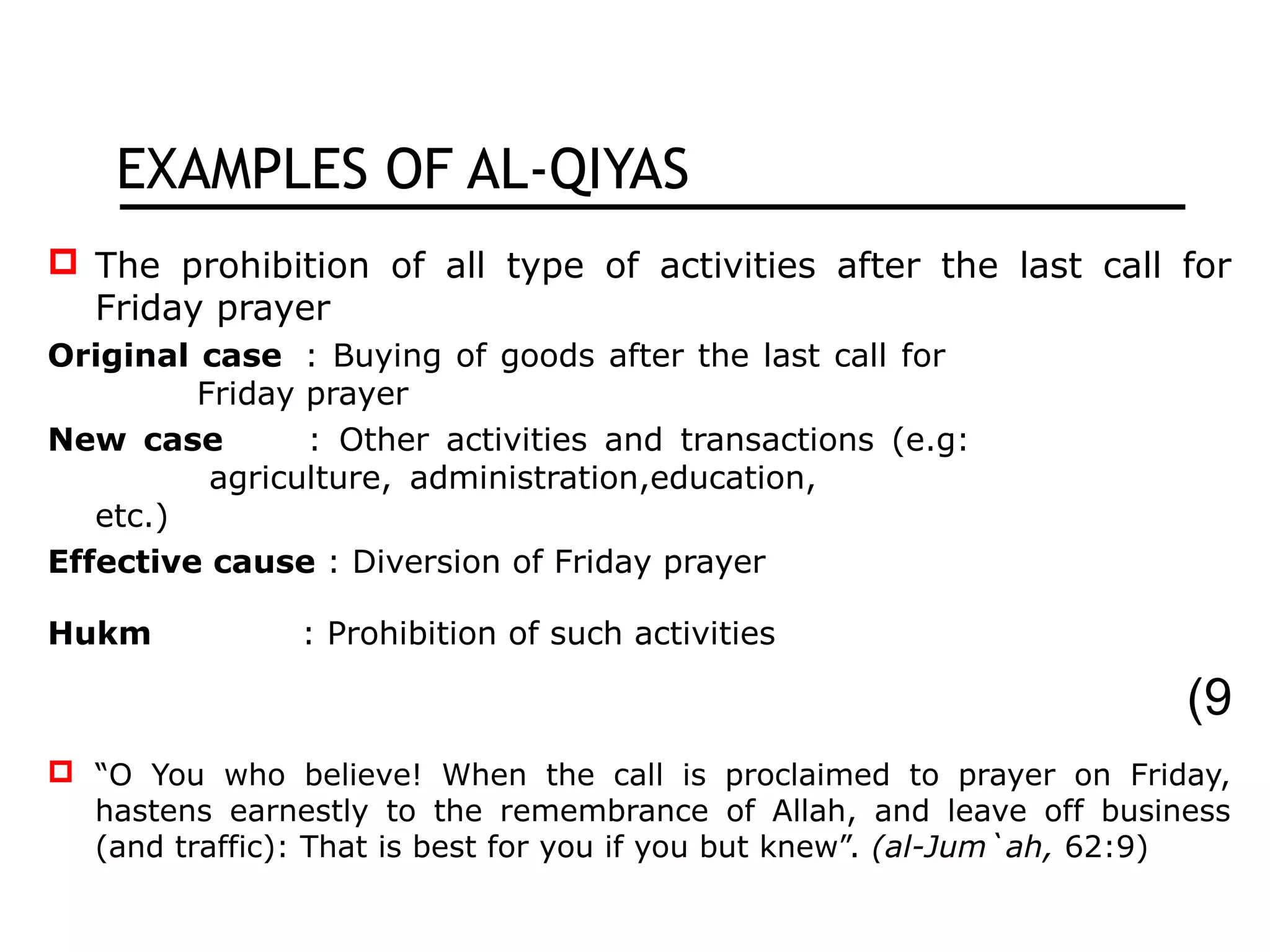
EXAMPLES OF AL-QIYAS
 The prohibition of all type of activities after the last call for
Friday prayer
Original case : Buying of goods after the last call for
Friday prayer
New case : Other activities and transactions (e.g:
agriculture, administration,education,
etc.)
Effective cause : Diversion of Friday prayer
Hukm : Prohibition of such activities
9(
 “O You who believe! When the call is proclaimed to prayer on Friday,
hastens earnestly to the remembrance of Allah, and leave off business
(and traffic): That is best for you if you but knew”. (al-Jum`ah, 62:9)
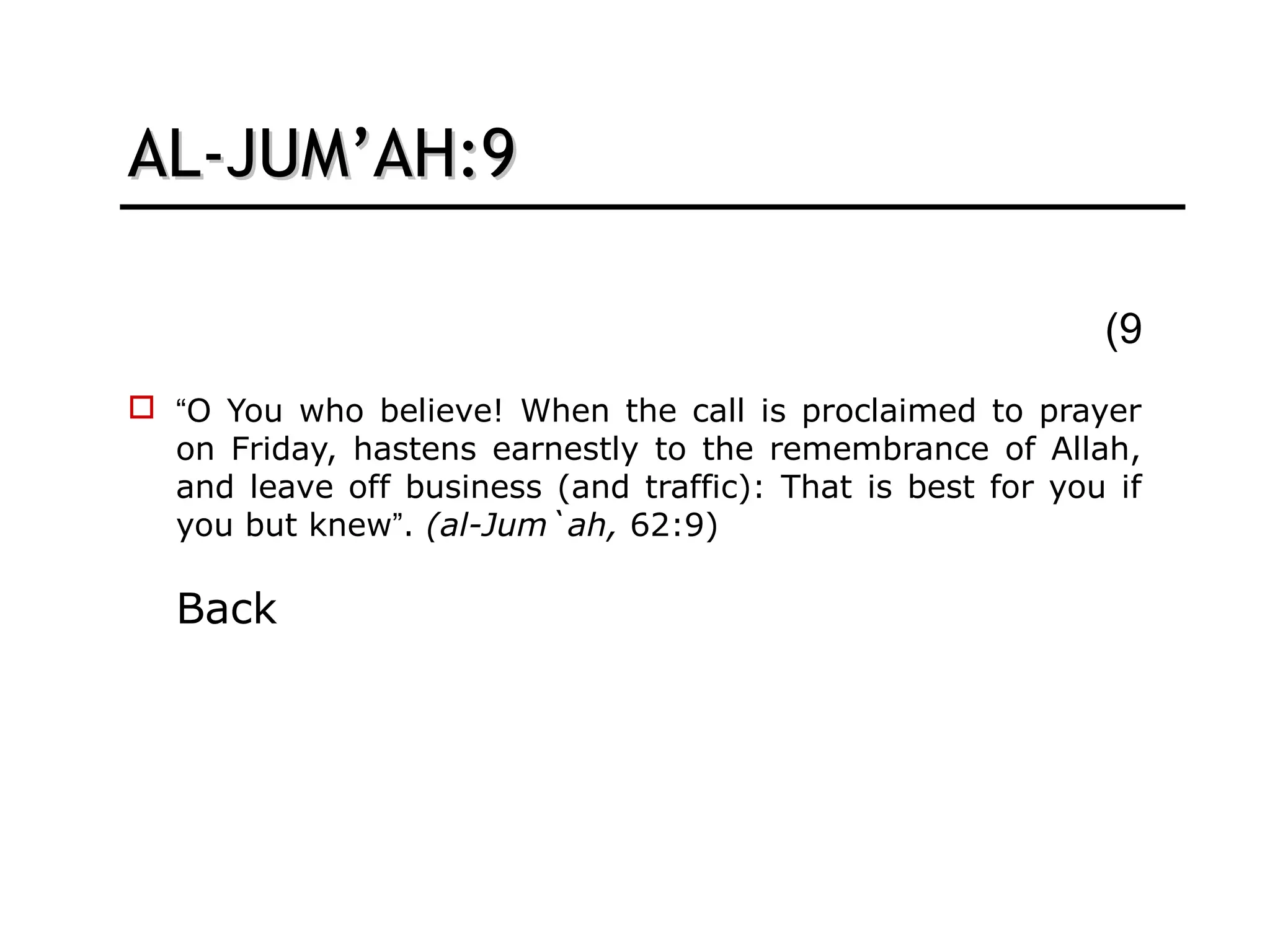
al-Jum’ah:9
9(
 “O You who believe! When the call is proclaimed to prayer on
Friday, hastens earnestly to the remembrance of Allah, and leave
off business (and traffic): That is best for you if you but knew”.
(al-Jum`ah, 62:9)
Back
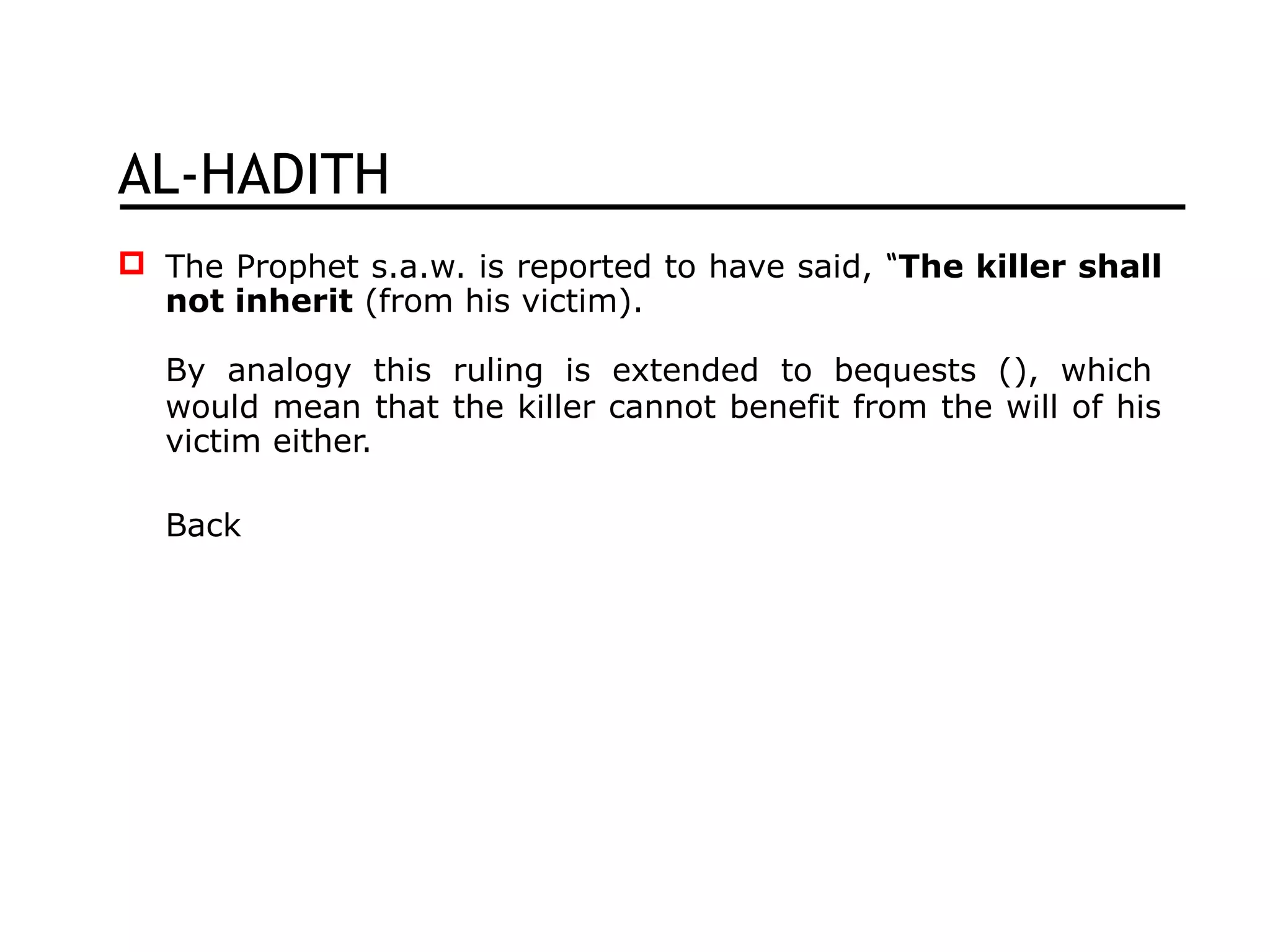
AL-HADITH
 The Prophet s.a.w. is reported to have said, “The killer shall
not inherit (from his victim).
By analogy this ruling is extended to bequests (), which
would mean that the killer cannot benefit from the will of his
victim either.
Back
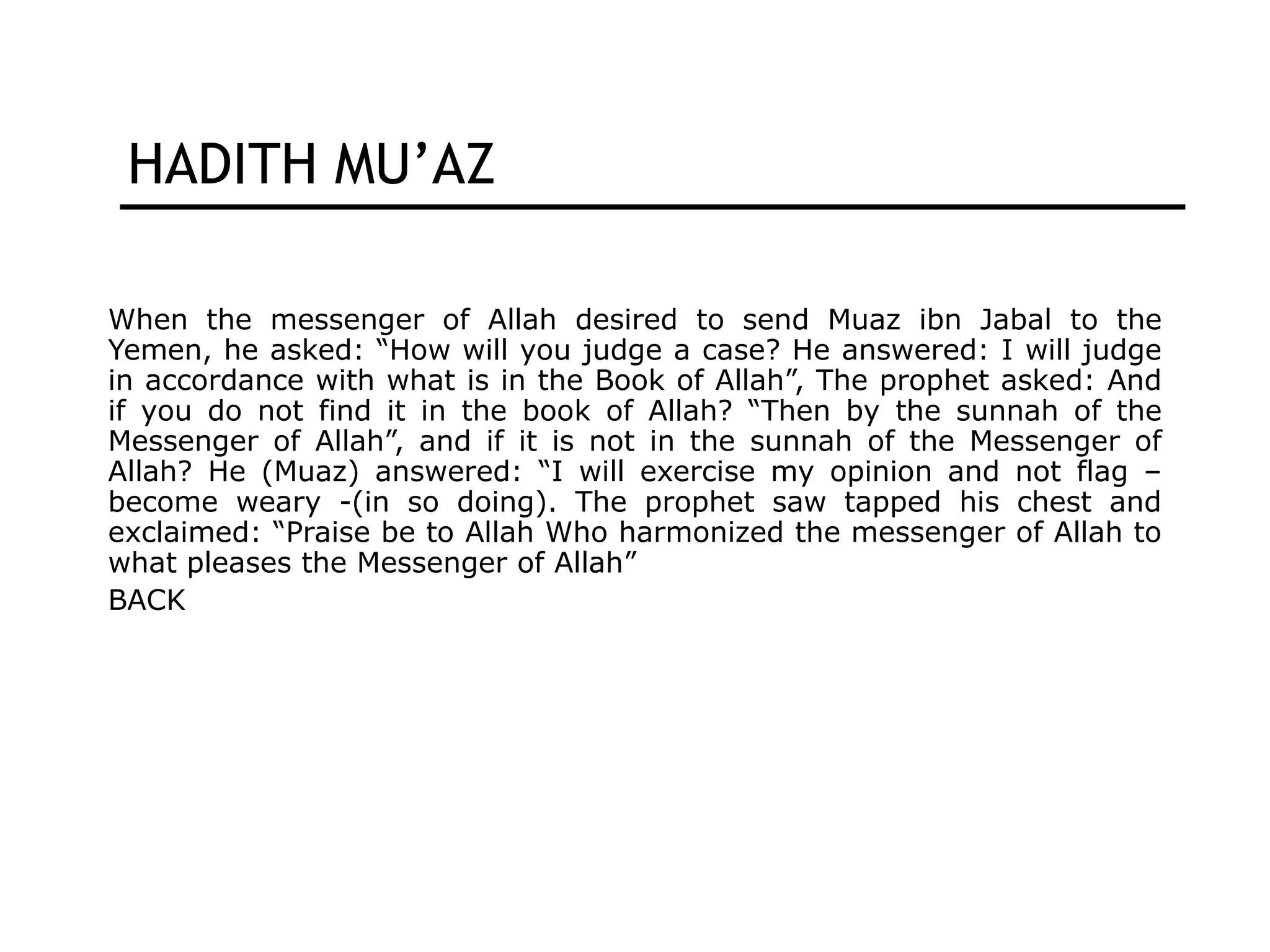
HADITH MU’AZ
When the messenger of Allah desired to send Muaz ibn Jabal to the
Yemen, he asked: “How will you judge a case? He answered: I will judge
in accordance with what is in the Book of Allah”, The prophet asked: And
if you do not find it in the book of Allah? “Then by the sunnah of the
Messenger of Allah”, and if it is not in the sunnah of the Messenger of
Allah? He (Muaz) answered: “I will exercise my opinion and not flag –
become weary -(in so doing). The prophet saw tapped his chest and
exclaimed: “Praise be to Allah Who harmonized the messenger of Allah to
what pleases the Messenger of Allah”
BACK
AL-ISRA’: 23
And that you be dutiful to your parents. If one of them or both of them
attain old age in your life, say not to them a word of disrespect, nor shout
at them but address them in terms of honor.
[al-Isra’: 23]
Back
Al-Qur’an
Hukm
]Rule[
Al-Sunnah
Hukm
[Rule]
Original Case
[Al-Asl]
New Case
]Al-Far’[
Effective Cause
]‘Illah[
THE PROHIBITION OF NARCOTIC DRUG THROUGH THE
APPLICATION OF AL-QIYAS
[90]
 The original case
Wine drinking
 The new case
Consumption of drugs or other similar substance
 The effective cause
The intoxicating effect which damage the capability of human mind
 The rule
Prohibition - haram
EXAMPLES OF AL-QIYAS
 The prohibition of all type of
activities after the last call for
Friday prayer
Original case : Buying of goods after the last call for
Friday prayer
New case : Other activities and transactions (e.g:
agriculture, administration,education,
etc.)
Effective cause : Diversion of Friday prayer
Hukm : Prohibition of such activities
EXAMPLES OF AL-QIYAS [CONT’D]
 Removal of Devisee / Beneficiary
Original case : Disinheritance of killer
New case : Removal of Beneficiary
Effective cause : Killing in order to rush in obtaining
one’s rights
Hukm : Disinheritance or deposition of
beneficiary
AL-JUM’AH:9AL-JUM’AH:9
9(
 “O You who believe! When the call is proclaimed to prayer
on Friday, hastens earnestly to the remembrance of Allah,
and leave off business (and traffic): That is best for you if
you but knew”. (al-Jum`ah, 62:9)
Back
AL-HADITHAL-HADITH
 The Prophet s.a.w. is reported to have said, “The
killer shall not inherit (from his victim).
By analogy this ruling is extended to bequests (),
which would mean that the killer cannot benefit
from the will of his victim either.
Back

Introduction of Usul Fiqh :al-qiyas

  • 1.
  • 2.
    SOURCES OF LAW [UTILIZATION] AGREEDUPONAGREED UPON AL-QUR’AN AL-SUNNAH AL-IJMA’ AL-QIYAS
  • 3.
    AL-QIYASAL-QIYAS  The Meaning The Basis [Hujjiyyat al-Qiyas]  The Pillars [Arkan al-Qiyas]  Conditions pertaining to the Pillars  Types of al-Qiyas  Examples
  • 4.
    THE MEANING OFAL-QIYAS - LITERAL  Literal Meaning  1. Measuring or estimating the length, weight or quality of something. 2. Comparing or making two things equal
  • 5.
     Technical Meaning Theextension of a Shariah value from the original case (al-Asl), to a new case (al-Far’), because the latter has the same effective cause (‘illah) as the former. Click THE MEANING OF AL-QIYAS - TECHNICAL
  • 6.
    The equality ofa case, whose hukm is not mentioned explicitly in the texts, with a case whose hukm is mentioned, on the basis of equality between effective causes found in these two cases. THE MEANING OF AL-QIYAS - TECHNICAL
  • 7.
    Original Case ]al-Asl[ New Case ]al-Far’[ EffectiveCause ]al-’Illah[ Ruling ]al-Hukm[ Ruling ]al-Hukm[ ?
  • 8.
    THE MEANING OFAL-QIYAS [Cont’d[  The original case is ruled by the text whether from al-Qur’an and al- Sunnah  al-Qiyas extends the same ruling to the new case based on the shared illah (effective cause)  Being an extension of the existing law, al-Qiyas discovers and develops the existing law but does not create a new law.  al-Qiyas is a subordinate of al-Qur’an and al-Sunnah. The original sources of Islamic Law remain with the scripture.  Muslim jurists have concluded that some of the rulings in Islamic law follow certain objectives, which are in harmony with reason and logic. They called it as Illah.  Therefore in Qiyas the illah must be clear and understood, otherwise it is not valid to derive any hukm on the basis of qiyas
  • 9.
    THE BASIS OFAL-QIYASTHE BASIS OF AL-QIYAS ‫ءف‬‫ء‬‫ء‬‫ء‬‫ء‬‫ء‬‫ء‬‫ء‬‫ءء‬‫ء‬‫ء‬‫ء‬‫ء‬‫ءءء‬‫ء‬ ‫ف‬‫ء‬‫ء‬‫ء‬‫ء‬‫ء‬‫ءء‬ ‫ءءف‬‫ء‬‫ء‬‫ء‬ ‫ف‬‫ء‬‫ء‬‫ءء‬‫ء‬‫ء‬‫ء‬‫ء‬‫ء‬‫ء‬‫ء‬[ 59] O you who believe! Obey Allah and obey the Messenger and those in authority from among you; then if you quarrel about anything, refer it to Allah and the Messenger, if you believe in Allah and the last day; this is better and very good in the end. [al-Nisa’, 4:59]
  • 10.
    THE BASIS OFAL-QIYAS [cont’d[ "...[:105] We have sent to you the book with the Truth so that you my judge among people by means of what Allah has shown you”. [Al-Nisa’: 105]
  • 11.
    THE BASIS OFAL-QIYAS [AL-SUNNAH[  Qiyas is a form of personal reasoning (ijtihad) which the Prophet s.a.w expressly validates in the famous Hadith of Muaz Ibn Jabal when he was send to Yemen.  Another important hadith in this regard is the following hadith:  A woman came to the Prophet s.a.w. and said that her father died without performing the Hajj. Will it benefit him if she performed the Hajj on her father’s behalf? Here the Prophet provided her an analogy: The Prophet said to her: “Supposing your father had a debt to pay and you paid it on his behalf, would this benefit him?” To this her reply was affirmative and the Prophet then said, “The debt owed to Allah merits even greater consideration”.
  • 12.
    THE BASIS OFAL-QIYAS [AL-SUNNAH[  Another similar example is about the following hadith:  )  A woman came to the Prophet s.a.w. and said that her mother had made nazar to perform the hajj, but she died without performing the Hajj. Will it benefit him if she performed the Hajj on her mother’s behalf? Prophet then said: Yes perform the hajj on her’s behalf. Here the Prophet provided her the same analogy: The Prophet said to her: “Supposing your mother had a debt to pay for someone and you paid it on his behalf, would this benefit him?” The Prophet then said, “The debt owed to Allah merits even greater consideration”.
  • 13.
    THE PILLARS OFAL-QIYAS  The original case (al-Asl), on which a ruling is given in the text and analogy seeks to extend it to a new case.  The new case (furu’) on which a ruling is needed and it is the extension of the same ruling which is applied in the original case.  The effective cause (‘illah), which is an attribute of the original case and it is found to be in common between the original and the new case.  The rule (hukm) governing the original case, which is to be extended to the new case.
  • 14.
    CONDITIONS OF THEPILLARS Not an extension AL-ASL Established by primary sources Not restricted or specified Determined 'illah should be found in it Not an exemption Operative ]not abrogated[ Not pertaining to criminal law AL-HUKM No stipulated hukm in the Source Determined 'illah should be found in it AL-FAR' Apparent cause Extendible ]not confined to al-Asl[ Constant and Stable Compatible AL-'ILLAH AL-QIYAS
  • 15.
    CONDITIONS OF AL-ASL The base case should not be an extension (far’) of another case mentioned in the text.  Al-Qiyas is constructed upon the original case and not upon the extension
  • 16.
    CONDITIONS OF AL-FAR’ The hukm should not be expressly mentioned in the texts.  The ‘illah (effective cause) of the asl should be found in the far’
  • 17.
    CONDITIONS OF AL-HUKM The hukm should be established directly from the Qur’an or Sunnah.  The jurist should able to determine an ‘illah (cause) for the hukm and the ‘illah should be rationally understood to be the cause of the hukm.  The hukm should not have been abrogated.  The hukm should not be restricted to a specific case by another  The hukm should not be constructed with an exemption
  • 18.
    CONDITIONS OF AL-’ILLAH The ‘illah must be an apparent cause It can easily be perceived by the senses, an outward attribute and not something internal or concealed.  The ‘illah should be a constant and stable attribute Doesn’t change according to circumstances and doesn’t vary from person to person  The ‘illah should be extendible and not confined to the asl.
  • 19.
    CONDITIONS OF AL-’ILLAH[cont’d[  The ‘illah should be an attribute that is compatible with the purpose of the law (munasib) The ‘illah derived by a jurist must meet with the purpose of Islamic law (maqasid shari’ah) which provide the underlying rationale of the rules. E.g. Intoxication as an ‘illah for the prohibition of khamr is compitable with the protection/preservation of the intellect. Its colour or smell, in contrast have no compatibility with the purpose, there doesn’t constitute a suitable illah.
  • 20.
    TYPES OF AL-QIYAS Qiyas al-Awla Analogy of the superior  Qiyas al-Musawi Analogy of equals  Qiyas al-Adna Analogy of the Inferior
  • 21.
    AL-ISRA’ 23 PUNISHMENTOF ADULTERY THE RULES OF RIBA The effective cause in the new case is more evident than the original case. TYPES OF AL-QIYAS The ‘Illah is equally effective in both new and original cases. The effective cause is less clearly effective in the new case than the original.
  • 22.
    QIYAS AL-AWLA -ANALOGY OF THE SUPERIOR  The effective cause in the new case is more evident than the original case. And that you be dutiful to your parents. If one of them or both of them attain old age in your life, say not to them a word of disrespect, nor shout at them but address them in terms of honor. [al-Isra’: 23] The verses provides that “Say not to parents a word of disrespect, nor shout at them but address them in terms of honor” By analogy it may be deduced that the prohibition against lashing or beating them is even more obvious than verbal abuses.
  • 23.
    QIYAS AL-MUSAWI -ANALOGY OF EQUALS  The ‘Illah is equally effective in both new and original cases. Example: Analogy for The punishment of adultery for a male slave is similar to the punishment of female slave.
  • 24.
    QIYAS AL-ADNA -ANALOGY OF THE INFERIOR  The effective cause is less clearly effective in the new case than the original. Example: The rules of riba prohibit the exchange of rice and of other specified commodities unless the two amounts are equal and delivery is immediate. By analogy this rule is extended to other type of food and fruits such as apple, since both rice and apple are edible [safe to eat] and measurable (according to Shafi’I mazhab), but the apples are lower in term of human needs as compared to rice.
  • 25.
    THE PROHIBITION OFMAKING BUSINESS PROPOSAL OVER OTHER’S PROPOSAL  The original case: The proposal for marriage or buy and purchase  The new case:The proposal for hiring service or property  The effective cause: Causing harm to other’s interest  The rule: Prohibition – haram The Prophet s.a.w said: ‫للل‬ ‫للل‬ ‫لللللل‬ ‫للل‬ ‫لللللل‬ ‫للل‬ ‫للل‬ ‫للللل‬ ‫لل‬ ‫لللللل‬ ‫لللل‬ ‫لللل‬ ‫للل‬ ‫لللل‬ ‫للل‬ ‫لللل‬ ‫للل‬ ‫للل‬ A believer is a brother to his believer, thus, is not permitted for a believer to make a proposal (for marriage) where the proposal of his brother is still pending, or to make an offer of sale where his brother’s offer is pending.
  • 26.
    The prohibition ofnarcotic drug through the application of al-Qiyas ”90)  The original case: wine drinking  The new case: consumption of drugs or other similar substance  The effective cause: the intoxicating effect which damage the capability of human mind  The rule: prohibition - haram
  • 27.
    EXAMPLES OF AL-QIYAS The prohibition of all type of activities after the last call for Friday prayer Original case : Buying of goods after the last call for Friday prayer New case : Other activities and transactions (e.g: agriculture, administration,education, etc.) Effective cause : Diversion of Friday prayer Hukm : Prohibition of such activities 9(  “O You who believe! When the call is proclaimed to prayer on Friday, hastens earnestly to the remembrance of Allah, and leave off business (and traffic): That is best for you if you but knew”. (al-Jum`ah, 62:9)
  • 28.
    al-Jum’ah:9 9(  “O Youwho believe! When the call is proclaimed to prayer on Friday, hastens earnestly to the remembrance of Allah, and leave off business (and traffic): That is best for you if you but knew”. (al-Jum`ah, 62:9) Back
  • 29.
    AL-HADITH  The Prophets.a.w. is reported to have said, “The killer shall not inherit (from his victim). By analogy this ruling is extended to bequests (), which would mean that the killer cannot benefit from the will of his victim either. Back
  • 30.
    HADITH MU’AZ When themessenger of Allah desired to send Muaz ibn Jabal to the Yemen, he asked: “How will you judge a case? He answered: I will judge in accordance with what is in the Book of Allah”, The prophet asked: And if you do not find it in the book of Allah? “Then by the sunnah of the Messenger of Allah”, and if it is not in the sunnah of the Messenger of Allah? He (Muaz) answered: “I will exercise my opinion and not flag – become weary -(in so doing). The prophet saw tapped his chest and exclaimed: “Praise be to Allah Who harmonized the messenger of Allah to what pleases the Messenger of Allah” BACK
  • 31.
    AL-ISRA’: 23 And thatyou be dutiful to your parents. If one of them or both of them attain old age in your life, say not to them a word of disrespect, nor shout at them but address them in terms of honor. [al-Isra’: 23] Back
  • 32.
  • 33.
    THE PROHIBITION OFNARCOTIC DRUG THROUGH THE APPLICATION OF AL-QIYAS [90]  The original case Wine drinking  The new case Consumption of drugs or other similar substance  The effective cause The intoxicating effect which damage the capability of human mind  The rule Prohibition - haram
  • 34.
    EXAMPLES OF AL-QIYAS The prohibition of all type of activities after the last call for Friday prayer Original case : Buying of goods after the last call for Friday prayer New case : Other activities and transactions (e.g: agriculture, administration,education, etc.) Effective cause : Diversion of Friday prayer Hukm : Prohibition of such activities
  • 35.
    EXAMPLES OF AL-QIYAS[CONT’D]  Removal of Devisee / Beneficiary Original case : Disinheritance of killer New case : Removal of Beneficiary Effective cause : Killing in order to rush in obtaining one’s rights Hukm : Disinheritance or deposition of beneficiary
  • 36.
    AL-JUM’AH:9AL-JUM’AH:9 9(  “O Youwho believe! When the call is proclaimed to prayer on Friday, hastens earnestly to the remembrance of Allah, and leave off business (and traffic): That is best for you if you but knew”. (al-Jum`ah, 62:9) Back
  • 37.
    AL-HADITHAL-HADITH  The Prophets.a.w. is reported to have said, “The killer shall not inherit (from his victim). By analogy this ruling is extended to bequests (), which would mean that the killer cannot benefit from the will of his victim either. Back