FATWA AL-SAHABI
(RULING OF A
COMPANION)
Who is ‘sahabi’ – companion?
• Someone who met the Prophet, believed in
him and dies as a believer. (majority)
• Someone who narrated hadith from Prophet
Muhammad
• Someone who narrated hadith from the
Prophet and joined him in a battle.
05/07/14 © Souva Chattopadhyay
• He is the one who stayed with the Prophet
(peace and blessings be upon him) for one
year upward or accompanied him in one
Ghazwah (battle) or more.
• Companionship is only established through
long meeting with the Prophet (peace and
blessings be upon him) and the narration of
Hadith on his authority.
05/07/14 © Souva Chattopadhyay
• Is it limited to man?
• Is it limited to an adult?
• Is it limited to a person who can see?
05/07/14 © Souva Chattopadhyay
What is fatwa al-sahabi?
• Fatwa al-sahabi or qawl al-sahabi means an
opinion that the companion has arrived at by
way of ijtihad.
• It may be a saying or a considered opinion or
a judicial decision that the companion has
taken on matters in the absence of a ruling in
the Quran or Sunnah.
05/07/14 © Souva Chattopadhyay
• After the demise of the Prophet, the
Companions were the ones who interpreted
the law and developed it where needed.
• They undertook ijtihad, issued rulings, settled
cases and became a source of guidance for
later generation.
05/07/14 © Souva Chattopadhyay
• Fatwa al-sahabi is a proof which commands
obedience once it is agreed by all companions
(no companion opposed it).
• Example:
– Grandmother’s share in inheritance.
05/07/14 © Souva Chattopadhyay
• Jurists agree that the ruling of one companion
is not a binding proof over another, regardless
as to whether the ruling in question was
issued by one of the caliphs, a judge or a
leading mujtahid among them.
05/07/14 © Souva Chattopadhyay
Fatwa of the leading companion
• Sayyidina Ali on the issue of punishment of
drinking wine – 80 lashes = qazf punihsment
• Sayyidina Abu Bakr on the issue of inheritance
for grandparents
• Sayyina Abu Bakr, the issue of riddah/apostate
• Sayyina ‘Uthman, on the issue of compilation
of al-Quran to one mashaf- mashaf ‘Uthmani
05/07/14 © Souva Chattopadhyay
Other examples
• The rates of zakah
• The determination of dower (mahr)
• The determination of the post-natal period
• The determination of the minimum and
maximum for the period of menstruation
05/07/14 © Souva Chattopadhyay
• It is reported that 'Umar used analogy with
respect to zakah when he ordered zakah on
horses after he realized that they had become
high in value, saying,
• "Should we only take one sheep out of every
forty sheep and leave horses with nothing?"
'Umar was followed in that respect by Abu
Hanifah13.
05/07/14 © Souva Chattopadhyay
• Mu'adh bin Jabal when he was sent by the Messenger, (p) to
Yemen the Messenger ordered him to collect zakah from the
rich and render it to the poor. He also told him "Take payment in
grains out grain holdings, sheep out of sheep holdings, and
camel out of camel holdings". Mu'adh understood this saying
to mean make it easy for people; take zakah out of what is
available. When he found out that people liked to pay the
value of zakah (instead of paying in kind) because it was easier
for them he welcomed it. When Mu'adh stood in Yemen, he
said "You may give me cloth and fabrics instead of corn and
rye as long as it is easier for you and beneficial for the
migrants in Madinah
05/07/14 © Souva Chattopadhyay
• Aisyah: She gave fatwa that the maximum period of
pregnancy is 2 years. She said which means: “a child
will not be in its mother’s womb more than two
years”.
• Anas bin Malik gave a fatwa that the minimal period
of menstruation is 3 days
• Umar al-Khattab: the marriage of a man to a woman
who’s observing the period of iddah should be ended
and he is not allowed to marry her forever.
05/07/14 © Souva Chattopadhyay
Is the Fatwa al-Sahabi binding or
not?
• Jurists unanimously agreed that the fatwa al-
sahabi is a proof (which commands obedience)
and binding when it is accepted by all other
companions
– Eg: the ruling of Sayyidina Abu Bakr that the
portion for a grandmother in inheritance is one-
sixth.
05/07/14 © Souva Chattopadhyay
The question is:
• WHETHER THE SAYING OR FATWA OF A
SINGLE COMPANION SHOULD ALSO BE
RECOGNISED AS A PROOF AND GIVEN
PRECEDENCE OVER EVIDENCES SUCH AS
QIYAS OR THE FATWA OF OTHER
MUJTAHIDUN?
05/07/14 © Souva Chattopadhyay
FIRSTVIEW
• A number of leading jurists from various
schools held the view that the fatwa of
companion is a proof (hujjah) which must be
followed.
• Arguments:
– Following the demise of the Prophet, the
leadership of the Muslim community fell in their
shoulders.
05/07/14 © Souva Chattopadhyay
– A number of them with their intimate knowledge
of the Quran and the teachings of the Prophet
were able to formulate fatwa and issue decisions
on many issues because of their direct access to
the Prophet.
– Their views were ocassionally upheld and
confirmed by the Quran.
• Eg: al-Anfal (8):67 – confirmed the view of S.Abu Bakr
in giving his opinion concerning the treatment that was
to be accorded to the prisoners of war following the
battle of Badr.
05/07/14 © Souva Chattopadhyay
• Imam Malik, one of the two views of imam
Shafi’e, one of the two views of Imam Ahmad
bin Hanbal and some Hanafi Jurists – the fatwa
al-sahabi is a proof absolutely and takes
priority over Qiyas regardless as to whether it
is in agreement with the Qiyas in question or
otherwise.
• Fatwa al-sahabi is a proof of Shari’ah.
05/07/14 © Souva Chattopadhyay
• Arguments: Quranic verses
– Al-Taubah (9) : 100 – reference to the companions
was made as “…the first and foremost among the
Emigrants and Helpers and those who followed
them in good deeds, God is well-pleased with
them as they are with Him.”
– See page 300 of Prof HK
05/07/14 © Souva Chattopadhyay
– A-Li Imran (3) : 109 – “You are the best
community that that has been raised for mankind;
you enjoin right and you forbid evil.”
– The Quran praises them as ‘the best community’
and as such their example commands authority
and respect.
05/07/14 © Souva Chattopadhyay
• Conclusion based on the verses:
– Following the fatwa of companion is obligatory,
otherwise the Quran would not praise those who
followed it in such terms.
05/07/14 © Souva Chattopadhyay
• The Prophet said:
– “My Companions are like stars, whoever that you
follow will lead you to the right path.
– “Honour my Companions, for they are the best
among you, and then those who follow them and
then the next generation, and then corruption will
proleferate after that…”
05/07/14 © Souva Chattopadhyay
– Based on these ahadith, following the way of the
Companions is equated with correct guidance,
which would imply that their sayings, teachings and
fatwa constitute a proof that commands
adherence.
05/07/14 © Souva Chattopadhyay
SECONDVIEW
• Ash’arites, Mu’tazilah, Imam Ahmad bin Hanbal
(one of two views), Hanafi jurist (al-Karkhi) –
said that ijtihad of a companion is not a proof
and it does not bind the succeeding
generations of mujtahidun or anyone else.
05/07/14 © Souva Chattopadhyay
• Arguments – Quranic verses
– Al-Hasyr (59) : 2 – “Consider O you who have
vision”
• It is argued that this verse makes ijtihad the obligation
of everyone who is competent for it and it makes no
distinction whether the mujtahid is a companion or
anyone else. What is obligatory is ijtihad itself, not
adhering to the ijtihad of anyone in particular.
• Secondly, mujtahid must rely directly on the sources
and not imitate anyone, including the companion.
05/07/14 © Souva Chattopadhyay
• This view find support from al-Ghazali and al-
Amidi who said that those who had view
different from this have resorted to evidence
which is generally weak.
• Al-Shawkani said that the fatwa of companion
is not a proof because Muslims are required
to follow the Quran and Sunnah. Only sunnah
of the Prophet is binding.
05/07/14 © Souva Chattopadhyay
• No other individual, whether a companion or
not has been accorded a status similar to that
of the Prophet.
– The opinion of al-Shawkani is criticised by Abu
Zahrah who said that the fact that the saying of
companion is an authoritative proof does not
render the companions rivals to the Prophet.
Their fatwa is more authoritative than other
mujtahidun because they were most diligent in
observing the Quran and Sunnah due to their
closeness to the Prophet.05/07/14 © Souva Chattopadhyay
THIRDVIEW
• Abu Hanifah – fatwa sahabi is a proof when it
is in conflict with Qiyas but not so when it
agrees with it.
• Why?
– (i) when fatwa sahabi conflicts with Qiyas, it is
usually for a reason and it indicates the weakness
of the Qiyas.
– (ii) if it agrees with Qiyas then fatwa sahabi is not
a separate authority but merely concurs with it.
05/07/14 © Souva Chattopadhyay
FOURTHVIEW
• Only the rulings of the four Rightly-Guided
Caliphs command authority
– The Prophet said ordering the believers that “You
are to follow my Sunnah and the Sunnah of the
Khulafa’ al-Rashidun after me.”
05/07/14 © Souva Chattopadhyay
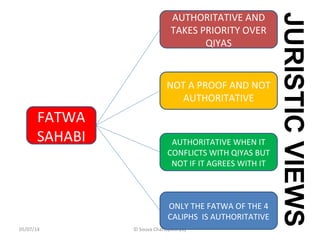
FATWA
SAHABI
ONLY THE FATWA OF THE 4
CALIPHS IS AUTHORITATIVE
NOT A PROOF AND NOT
AUTHORITATIVE
AUTHORITATIVE WHEN IT
CONFLICTS WITH QIYAS BUT
NOT IF IT AGREES WITH IT
AUTHORITATIVE AND
TAKES PRIORITY OVER
QIYAS
JURISTICVIEWS
Opinions of each of 4 Imams
• Imam Shafi’e
– “We find that the ulama’ have sometimes followed
the fatwa of companion and have abandoned it at
other times; and even those who have followed it
are not consistent in doing so.”
– “I follow the ruling of the companion when I find
nothing in the Quran, Sunnah or Ijma’, or anything
which carries through the implications of these
sources.”
05/07/14 © Souva Chattopadhyay
– He even preferred the rulings of the first three
caliphs over those of the other companions.
05/07/14 © Souva Chattopadhyay
• Imam Abu Hanifah
– “When I find nothing in the book of God or the
Sunnah of the Prophet, I resort to the sayings of
the companions. I may follow the ruling which
appeals to me and abandon that which does not,
but I do not abandon their views altogether and I
do not give preference to others over them.”
• Fatwa sahabi takes priority over Qiyas.
05/07/14 © Souva Chattopadhyay
• Imam Ahmad bin Hanbal
– He divide fatwa al-sahabi into two:
• Fatwa which is not opposed by any other companions.
This kind of fatwa is authoritative. Example is the
admissibility of the testimony of slaves that is a fatwa of
Anas bin Malik. Ibnu Hanbal quoted that he had not
known of any one to have rejected the testimony of a
slave. It is therefore admissible.
05/07/14 © Souva Chattopadhyay
• Secondly the fatwa al-sahabi on which the companions
have disagreed and there are more than one different
rulings concerning same problem. The Imam consider
them all as valid and equally authoritative unless it is
known that the 4 caliphs have adopted one in
preference of the others.
– Example : the allocation of shares allocated to grandfather in
the presence of agnatic siblings. There are three views: Abu
Bakar, Zayd binThabit and Ali.
05/07/14 © Souva Chattopadhyay
• Imam Malik
– Not only he upheld the fatwa of companions but
almost equated it with the sunnah of the Prophet.
05/07/14 © Souva Chattopadhyay
• The 4 Imams agreed that fatwa sahabi is
authoritative but nobody said that it is binding.
05/07/14 © Souva Chattopadhyay

Fatwa sahabi

  • 1.
  • 2.
    Who is ‘sahabi’– companion? • Someone who met the Prophet, believed in him and dies as a believer. (majority) • Someone who narrated hadith from Prophet Muhammad • Someone who narrated hadith from the Prophet and joined him in a battle. 05/07/14 © Souva Chattopadhyay
  • 3.
    • He isthe one who stayed with the Prophet (peace and blessings be upon him) for one year upward or accompanied him in one Ghazwah (battle) or more. • Companionship is only established through long meeting with the Prophet (peace and blessings be upon him) and the narration of Hadith on his authority. 05/07/14 © Souva Chattopadhyay
  • 4.
    • Is itlimited to man? • Is it limited to an adult? • Is it limited to a person who can see? 05/07/14 © Souva Chattopadhyay
  • 5.
    What is fatwaal-sahabi? • Fatwa al-sahabi or qawl al-sahabi means an opinion that the companion has arrived at by way of ijtihad. • It may be a saying or a considered opinion or a judicial decision that the companion has taken on matters in the absence of a ruling in the Quran or Sunnah. 05/07/14 © Souva Chattopadhyay
  • 6.
    • After thedemise of the Prophet, the Companions were the ones who interpreted the law and developed it where needed. • They undertook ijtihad, issued rulings, settled cases and became a source of guidance for later generation. 05/07/14 © Souva Chattopadhyay
  • 7.
    • Fatwa al-sahabiis a proof which commands obedience once it is agreed by all companions (no companion opposed it). • Example: – Grandmother’s share in inheritance. 05/07/14 © Souva Chattopadhyay
  • 8.
    • Jurists agreethat the ruling of one companion is not a binding proof over another, regardless as to whether the ruling in question was issued by one of the caliphs, a judge or a leading mujtahid among them. 05/07/14 © Souva Chattopadhyay
  • 9.
    Fatwa of theleading companion • Sayyidina Ali on the issue of punishment of drinking wine – 80 lashes = qazf punihsment • Sayyidina Abu Bakr on the issue of inheritance for grandparents • Sayyina Abu Bakr, the issue of riddah/apostate • Sayyina ‘Uthman, on the issue of compilation of al-Quran to one mashaf- mashaf ‘Uthmani 05/07/14 © Souva Chattopadhyay
  • 10.
    Other examples • Therates of zakah • The determination of dower (mahr) • The determination of the post-natal period • The determination of the minimum and maximum for the period of menstruation 05/07/14 © Souva Chattopadhyay
  • 11.
    • It isreported that 'Umar used analogy with respect to zakah when he ordered zakah on horses after he realized that they had become high in value, saying, • "Should we only take one sheep out of every forty sheep and leave horses with nothing?" 'Umar was followed in that respect by Abu Hanifah13. 05/07/14 © Souva Chattopadhyay
  • 12.
    • Mu'adh binJabal when he was sent by the Messenger, (p) to Yemen the Messenger ordered him to collect zakah from the rich and render it to the poor. He also told him "Take payment in grains out grain holdings, sheep out of sheep holdings, and camel out of camel holdings". Mu'adh understood this saying to mean make it easy for people; take zakah out of what is available. When he found out that people liked to pay the value of zakah (instead of paying in kind) because it was easier for them he welcomed it. When Mu'adh stood in Yemen, he said "You may give me cloth and fabrics instead of corn and rye as long as it is easier for you and beneficial for the migrants in Madinah 05/07/14 © Souva Chattopadhyay
  • 13.
    • Aisyah: Shegave fatwa that the maximum period of pregnancy is 2 years. She said which means: “a child will not be in its mother’s womb more than two years”. • Anas bin Malik gave a fatwa that the minimal period of menstruation is 3 days • Umar al-Khattab: the marriage of a man to a woman who’s observing the period of iddah should be ended and he is not allowed to marry her forever. 05/07/14 © Souva Chattopadhyay
  • 14.
    Is the Fatwaal-Sahabi binding or not? • Jurists unanimously agreed that the fatwa al- sahabi is a proof (which commands obedience) and binding when it is accepted by all other companions – Eg: the ruling of Sayyidina Abu Bakr that the portion for a grandmother in inheritance is one- sixth. 05/07/14 © Souva Chattopadhyay
  • 15.
    The question is: •WHETHER THE SAYING OR FATWA OF A SINGLE COMPANION SHOULD ALSO BE RECOGNISED AS A PROOF AND GIVEN PRECEDENCE OVER EVIDENCES SUCH AS QIYAS OR THE FATWA OF OTHER MUJTAHIDUN? 05/07/14 © Souva Chattopadhyay
  • 16.
    FIRSTVIEW • A numberof leading jurists from various schools held the view that the fatwa of companion is a proof (hujjah) which must be followed. • Arguments: – Following the demise of the Prophet, the leadership of the Muslim community fell in their shoulders. 05/07/14 © Souva Chattopadhyay
  • 17.
    – A numberof them with their intimate knowledge of the Quran and the teachings of the Prophet were able to formulate fatwa and issue decisions on many issues because of their direct access to the Prophet. – Their views were ocassionally upheld and confirmed by the Quran. • Eg: al-Anfal (8):67 – confirmed the view of S.Abu Bakr in giving his opinion concerning the treatment that was to be accorded to the prisoners of war following the battle of Badr. 05/07/14 © Souva Chattopadhyay
  • 18.
    • Imam Malik,one of the two views of imam Shafi’e, one of the two views of Imam Ahmad bin Hanbal and some Hanafi Jurists – the fatwa al-sahabi is a proof absolutely and takes priority over Qiyas regardless as to whether it is in agreement with the Qiyas in question or otherwise. • Fatwa al-sahabi is a proof of Shari’ah. 05/07/14 © Souva Chattopadhyay
  • 19.
    • Arguments: Quranicverses – Al-Taubah (9) : 100 – reference to the companions was made as “…the first and foremost among the Emigrants and Helpers and those who followed them in good deeds, God is well-pleased with them as they are with Him.” – See page 300 of Prof HK 05/07/14 © Souva Chattopadhyay
  • 20.
    – A-Li Imran(3) : 109 – “You are the best community that that has been raised for mankind; you enjoin right and you forbid evil.” – The Quran praises them as ‘the best community’ and as such their example commands authority and respect. 05/07/14 © Souva Chattopadhyay
  • 21.
    • Conclusion basedon the verses: – Following the fatwa of companion is obligatory, otherwise the Quran would not praise those who followed it in such terms. 05/07/14 © Souva Chattopadhyay
  • 22.
    • The Prophetsaid: – “My Companions are like stars, whoever that you follow will lead you to the right path. – “Honour my Companions, for they are the best among you, and then those who follow them and then the next generation, and then corruption will proleferate after that…” 05/07/14 © Souva Chattopadhyay
  • 23.
    – Based onthese ahadith, following the way of the Companions is equated with correct guidance, which would imply that their sayings, teachings and fatwa constitute a proof that commands adherence. 05/07/14 © Souva Chattopadhyay
  • 24.
    SECONDVIEW • Ash’arites, Mu’tazilah,Imam Ahmad bin Hanbal (one of two views), Hanafi jurist (al-Karkhi) – said that ijtihad of a companion is not a proof and it does not bind the succeeding generations of mujtahidun or anyone else. 05/07/14 © Souva Chattopadhyay
  • 25.
    • Arguments –Quranic verses – Al-Hasyr (59) : 2 – “Consider O you who have vision” • It is argued that this verse makes ijtihad the obligation of everyone who is competent for it and it makes no distinction whether the mujtahid is a companion or anyone else. What is obligatory is ijtihad itself, not adhering to the ijtihad of anyone in particular. • Secondly, mujtahid must rely directly on the sources and not imitate anyone, including the companion. 05/07/14 © Souva Chattopadhyay
  • 26.
    • This viewfind support from al-Ghazali and al- Amidi who said that those who had view different from this have resorted to evidence which is generally weak. • Al-Shawkani said that the fatwa of companion is not a proof because Muslims are required to follow the Quran and Sunnah. Only sunnah of the Prophet is binding. 05/07/14 © Souva Chattopadhyay
  • 27.
    • No otherindividual, whether a companion or not has been accorded a status similar to that of the Prophet. – The opinion of al-Shawkani is criticised by Abu Zahrah who said that the fact that the saying of companion is an authoritative proof does not render the companions rivals to the Prophet. Their fatwa is more authoritative than other mujtahidun because they were most diligent in observing the Quran and Sunnah due to their closeness to the Prophet.05/07/14 © Souva Chattopadhyay
  • 28.
    THIRDVIEW • Abu Hanifah– fatwa sahabi is a proof when it is in conflict with Qiyas but not so when it agrees with it. • Why? – (i) when fatwa sahabi conflicts with Qiyas, it is usually for a reason and it indicates the weakness of the Qiyas. – (ii) if it agrees with Qiyas then fatwa sahabi is not a separate authority but merely concurs with it. 05/07/14 © Souva Chattopadhyay
  • 29.
    FOURTHVIEW • Only therulings of the four Rightly-Guided Caliphs command authority – The Prophet said ordering the believers that “You are to follow my Sunnah and the Sunnah of the Khulafa’ al-Rashidun after me.” 05/07/14 © Souva Chattopadhyay
  • 30.
    05/07/14 © SouvaChattopadhyay FATWA SAHABI ONLY THE FATWA OF THE 4 CALIPHS IS AUTHORITATIVE NOT A PROOF AND NOT AUTHORITATIVE AUTHORITATIVE WHEN IT CONFLICTS WITH QIYAS BUT NOT IF IT AGREES WITH IT AUTHORITATIVE AND TAKES PRIORITY OVER QIYAS JURISTICVIEWS
  • 31.
    Opinions of eachof 4 Imams • Imam Shafi’e – “We find that the ulama’ have sometimes followed the fatwa of companion and have abandoned it at other times; and even those who have followed it are not consistent in doing so.” – “I follow the ruling of the companion when I find nothing in the Quran, Sunnah or Ijma’, or anything which carries through the implications of these sources.” 05/07/14 © Souva Chattopadhyay

  • 32.
    – He evenpreferred the rulings of the first three caliphs over those of the other companions. 05/07/14 © Souva Chattopadhyay
  • 33.
    • Imam AbuHanifah – “When I find nothing in the book of God or the Sunnah of the Prophet, I resort to the sayings of the companions. I may follow the ruling which appeals to me and abandon that which does not, but I do not abandon their views altogether and I do not give preference to others over them.” • Fatwa sahabi takes priority over Qiyas. 05/07/14 © Souva Chattopadhyay
  • 34.
    • Imam Ahmadbin Hanbal – He divide fatwa al-sahabi into two: • Fatwa which is not opposed by any other companions. This kind of fatwa is authoritative. Example is the admissibility of the testimony of slaves that is a fatwa of Anas bin Malik. Ibnu Hanbal quoted that he had not known of any one to have rejected the testimony of a slave. It is therefore admissible. 05/07/14 © Souva Chattopadhyay
  • 35.
    • Secondly thefatwa al-sahabi on which the companions have disagreed and there are more than one different rulings concerning same problem. The Imam consider them all as valid and equally authoritative unless it is known that the 4 caliphs have adopted one in preference of the others. – Example : the allocation of shares allocated to grandfather in the presence of agnatic siblings. There are three views: Abu Bakar, Zayd binThabit and Ali. 05/07/14 © Souva Chattopadhyay
  • 36.
    • Imam Malik –Not only he upheld the fatwa of companions but almost equated it with the sunnah of the Prophet. 05/07/14 © Souva Chattopadhyay
  • 37.
    • The 4Imams agreed that fatwa sahabi is authoritative but nobody said that it is binding. 05/07/14 © Souva Chattopadhyay