Definition
• Taken from the root word salaha (‫)صلح‬ or
saluha which is to be good, to repair or to
improve.
• Istislah (‫)استصل(ح‬ is a method employed by
the Muslim jurists to solve problems that
find no clear answer in sacred religious text.
• Maslahah means benefit or interest.
• So Istislah involves the acquisition of
benefit and repulsion of the harm to the
public based on the benefit or interest that
will be enjoyed by the public.
– From many contexts – economy, legal,
procedures, medical etc.
Definition by al-Ghazali
• Maslahah consists of considerations which secure
a benefit or prevent harm but are in the meantime,
harmonious with the objectives of the Shari’ah
( ‫ﺍﻟﺸﺮﻴﻌﺔ‬‫مقاصد‬ ) - Protecting 5 ‘essential values: religion, life,
intellect, lineage and property’
– The concept of maslahah has a very close relationship
with maqasid al-shari’ah as MS are defined briefly as
obtaining maslahah (benefit) and preventing mafsadah
(evil)
• Any measures which secure these values
falls within the scope of maslahah and
anything violates them is called
mafsadah( ‫مفسد‬‫ۃ‬ ). Preventing mafsadah is
also maslahah.
Juristic views
• Majority of ‘ulama:
- Istislah is a proper ground for legislation
when a maslahah is identified
- Istislah is not a proof in respect of
devotional matters (‘ibadah) and the
specific injunctions of the Shari’ah
(muqaddarat)
- Hudud penalties
– Kaffarat
– Entitlement in inheritance
– Specified period of iddah
– Number of raka’at in solat
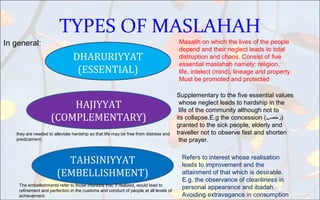
TYPES OF MASLAHAH
DHARURIYYAT
(ESSENTIAL)
TAHSINIYYAT
(EMBELLISHMENT)
HAJIYYAT
(COMPLEMENTARY)
Masalih on which the lives of the people
depend and their neglect leads to total
distruption and chaos. Consist of five
essential maslahah namely: religion,
life, intelect (mind), lineage and property.
Must be promoted and protected
Supplementary to the five essential values
whose neglect leads to hardship in the
life of the community although not to
its collapse.E.g the concession ( ‫رخص‬‫ۃ‬ )
granted to the sick people, elderly and
traveller not to observe fast and shorten
the prayer.
Refers to interest whose realisation
leads to improvement and the
attainment of that which is desirable.
E.g. the observance of cleanliness in
personal appearance and ibadah.
Avoiding extravagance in consumption
In general:
The embellishments refer to those interests that, if realized, would lead to
refinement and perfection in the customs and conduct of people at all levels of
achievement.
they are needed to alleviate hardship so that life may be free from distress and
predicament.
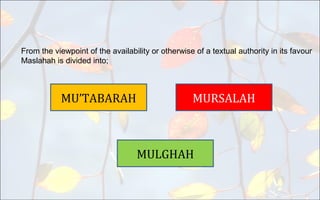
MU’TABARAH MURSALAH
MULGHAH
From the viewpoint of the availability or otherwise of a textual authority in its favour
Maslahah is divided into;
Maslahah Mu’tabarah
• Maslahah which the Law Giver has
expressly upheld and enacted a law for its
realisation.
– Protecting life by enacting the law of retaliation
or defending the right of ownership by
penalising the thief or protecting the dignity
and honour of the individual by penalising
adultery and false accusation. (Maslahah
dharuriyyah)
• The lawgiver has upheld that each offence
constitute proper ground for punishment in
question.
• The validity of maslahah in these cases is
definitive (‫)ﻗﻂﻌﻰ‬ and no longer open to
debate.
• Shortening and combining of prayers or
break fasting when travelling – parts of
rukhsah – maslahah hajiyyah
• Polygamy?
• Written agreement/contract?
Maslahah Mulghah
• It is a maslahah which the Lawgiver has
nullified either explicitly or by indication
that could be found in the shariah.
• Ulama’ agree that legislation in pursuant of
such interests is invalid and no judicial
decree maybe issued in their favour
• Example:
– An attempt to give the son and daughter equal
share in inheritance on the assumption that this
will secure a public interest.
– Since there’s a clear nass in the Quran which
assigns to the son double the portion of the
daughter, the maslahah in this case is clearly
nullified.
• Right to divorce
– Some said it should also be given to the wife
because of maslahah
– Is there a maslahah?
– Maslahah mulghah.
Maslahah Mursalah
• Maslahah which has been validated after the
divine revelation came to an end.
• MM is unrestricted public interest in the
sense of it not having been regulated by the
Lawgiver insofar as no textual authority can
be found on its validity or otherwise.
• The Lawgiver has neither upheld nor
nullified the necessary legislation.
• More technically, MM is defined as a
consideration which is proper and
harmonious with the objectives of the
Lawgiver; it secures a benefit and prevents
a harm; and the Shariah provides no
indication as to its validity or otherwise.
Authority of MM
• Surah al-Anbiya’ (21):107
– “ We have not sent you but a mercy for all
creatures”
– ( ‫ﻟﻟﻌﺎﻠﻤﻴﻦ‬‫ﺮﺤﻤﺔ‬‫ﺍﻻ‬‫ﺍﺮﺴﻟﻨﺎﻙ‬‫ﻮﻤﺎ‬ )
• Surah al-Maidah : 6
– “God never intends to impose hardship upon
people.”
– (… ‫ﺤﺮﺝ‬‫ﻤﻦ‬‫ﻋﻟﻴﻜﻢ‬‫ﻠﻴﺟﻌﻞ‬‫ﺍﻟﻟﻪ‬‫ﻴﺮﻴﺪ‬‫ﻤﺎ‬ …)
• Hadith:
– “ La dharar wa la dhirar fil Islam”
• “harm is neither inflicted nor tolerated in Islam”
- The hadith encompasses the essence of maslahah in
all varieties
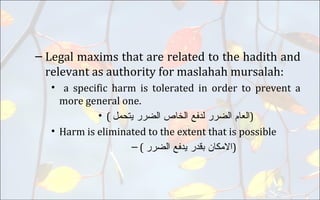
– Legal maxims that are related to the hadith and
relevant as authority for maslahah mursalah:
• a specific harm is tolerated in order to prevent a
more general one.
• ( ‫ﺍﻠﻌﺎﻡ‬‫ﺍﻟﺿﺮﺮ‬‫ﻠﺪﻔﻊ‬‫ﺍﻟﺨﺎﺺ‬‫ﺍﻠﺿﺮﺮ‬‫ﻴﺘﺤﻤﻞ‬ )
• Harm is eliminated to the extent that is possible
– ( ‫ﺍﻻﻤﻜﺎﻦ‬‫ﺒﻗﺪﺮ‬‫ﻴﺪﻔﻊ‬‫ﺍﻠﺿﺮﺮ‬ )
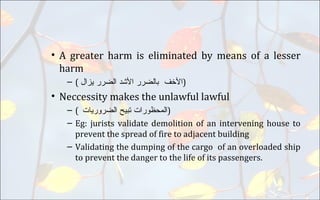
• A greater harm is eliminated by means of a lesser
harm
– ( ‫ﺍﻷﺧﻑ‬‫ﺑﺎﻠﺿﺮﺮ‬‫ﺍﻷﺷﺪ‬‫ﺍﻠﺿﺮﺮ‬‫ﻴﺰﺍﻞ‬ )
• Neccessity makes the unlawful lawful
– ( ‫ﺍﻠﻤﺤﻇﻮﺮﺍﺖ‬‫ﺘﺑﻴﺢ‬‫ﺍﻠﺿﺮﻮﺮﻴﺎﺕ‬ )
– Eg: jurists validate demolition of an intervening house to
prevent the spread of fire to adjacent building
– Validating the dumping of the cargo of an overloaded ship
to prevent the danger to the life of its passengers.
• Sayyiditina Aishah said:
• “The Prophet did not choose but the easier of the two
alternatives so long as it did not amount to a sin.”
• Practice of companions
• Examples of maslahah mursalah introduced
by companions:
– Introduction and the use of currency
– Establishment of prison
– Imposition of tax (kharaj) on agricultural lands
in the conquered territories despite absence of
textual authority.
Other examples of MM
• The collection and compilation of al-Quran
in a single volume
• The introduction of land tax
• The right to inheritance of a woman whose
husband had divorced her during death
sickness
• War on those who refused to pay zakat
• Nomination of Umar to replace Abu Bakar
as caliph
• The ruling of Umar that his officials must be
accountable for the wealth they had
accumulated in abuse of public office and
expropriation of such wealth
• Establishment of an organised military force
department or defence ministry (Diwan al-
Jund) and Diwan al-Ata’ (sort like ministry
of finance) but to distribute money to the
public – established by Sayyidina Umar
• Administration of justice
Conditions of Maslahah
• The maslahah must be genuine (haqiqiyyah)
– Protecting the faith – necessitates prevention of
sedition (fitnah) and propagation of hearsay
– Protecting intellect – promotion of learning, providing
education
– Protecting of lineage – creation of favourable
environment for care and custody of children
– Protecting property – facilitating fair trade and lawful
exchange of goods and services in the community.
– Examples:
• registration of marriage in the court and the issue of marriage
certificate
• the recording of land transfer in the Registry departments -
prevents false testimony and fraudulent land transfer.
• consumer protection law
• day care centers at the government offices and agencies
• regulation on wearing of helmets and fastening of seatbelt.
• The maslahah must be general (kulliyyah)
– It secures benefit or prevent harms to the
people as a whole and not to a particular person
or group of persons
• Acquisition of land for the purpose of development?
• Minimum age for marriage
• Not in conflict with the nusus
– ? - the legalisation of usury (riba’) on account of
the change in circumstances?
– Is there any maslahah?
– Conflict? Yes; it’s practice comes into conflict
with the clear nass of the Quran
– ١‫لربى‬‫وحرم‬‫و‬‫ٲحل‬‫ا‬‫ل‬١‫لبيع‬
– Working as a bartender? Waiter/waitress
serving khamr?
– Prostitution as an occupation?
• Is there maslahah?
– Protecting life?
• Conflicting with nusus?
Continue…
• Imam Malik added two other conditions:
1. Maslahah must be rational and acceptable to
the people of sound intellect.
2. Must prevent or remove hardship from the
people
Continue…
• Al-Ghazali only permits maslahah al-
dharuriyyah and fulfilled three elements;
darurah (necessity), qat'iyyah (absolute
certainty) and kuliyyah (universality).
• Al-Ghazali illustrated a classical example from the
law of war whereby some Muslims were kept
captives and used as human shield.
• Muslim soldiers encounter predicament whether:
– to attack unbelievers' army who were shielding
themselves with a group of Muslim captives; or
– to refrain from attacking.
• The first course of action would kill the innocent Muslims
whereas the second would give opportunity to the
unbelievers to conquer more Muslim territory. In such a
situation, al-Ghazali thought that the Muslim soldiers
should attack the unbelievers in view that the action would
preserve a more important maslahah. In addition, the
attack is considered daruri because it protects Muslim life,
qat'i as it the only method of saving Muslims and kulli
because it takes consideration of the whole community (al-
Ghazali, 1993, p. 177).
– His view was rejected by majority of Muslim jurists
Al-Tufi’s view of maslahah al-
mursalah
• A prominent Hanbali jurists- authorises
recourse to maslahah with or without the
existence of a nass.
• He argues that the hadith la dharar wa la
dhirar enables the maslahah to take
precedence over all other considerations.
Continue…
• However, he precludes devotional matters,
specific injunction and prescribed penalties
from the scope of maslahah.
• These matters can only be established by
nass and ijma’
Continue…
• As for transaction and temporal affairs- if
the text conform the maslahah of the
people, they should be applied forthwith,
but if they oppose, the maslahah should
take precedence over them.
Continue…
• In the areas of transactions and temporal
affairs including governmental affairs,
maslahah constitutes the goals.
• When there is a conflict between a
maslahah and nass, the hadith “la dharar wa
la dhirar” must take priority.
Similarities of MM and Qiyas
• They are applicable to cases on which there
is no clear ruling available in nusus or ijma’
• The benefit that is secured by recourse to
them is based on probability
Differences
Maslahah Mursalah
• the benefit which is
sought through MM
has no specific basis in
the established law
whether in favour or
against.
Qiyas
• The benefit which is
secured by Qiyas is
founded in an
indication from the
Lawgiver and a
specific ‘illah is
identified to justify the
analogy to the nass
Differences between MM and
Istihsan
Maslahah Mursalah
• The ruling which is based
on MM is original in the
sense that it does not
follow, or represent a
departure from, an
existing precedent
Istihsan
• It only applies to cases on
which there is a precedent
available (usually in the form
of Qiyas), but Istihsan seeks a
departure from it in favour of
an alternative ruling in a
form of a hidden analogy or
an exception to a ruling of
existing law
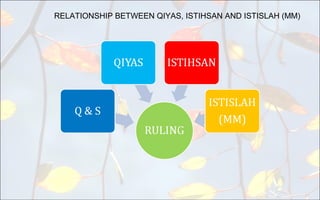
RELATIONSHIP BETWEEN QIYAS, ISTIHSAN AND ISTISLAH (MM)
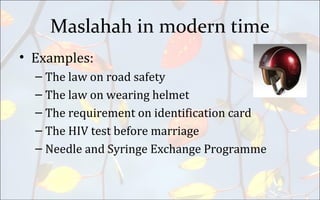
Maslahah in modern time
• Examples:
– The law on road safety
– The law on wearing helmet
– The requirement on identification card
– The HIV test before marriage
– Needle and Syringe Exchange Programme
– Pre – marital course
– Marriage certificate
– wearing bangle/bracelet/neclace for male
pilgrims
– Separate coach/section for women in public
transport
• Islamic Banking system and products
• Increase in the price of cigarettes
• ISA?
• Income tax
• Insurance
• Manufacturing contract
• Business contracts through modern
telecommunication
• Payment by installment
• Warranty on purchased goods
• Permission from the first wife before a man
can marry a second or subsequent wife
ISSUES
• Special school for pregnant students?
• Baby hatch?
Opponents of Istislah
• The Zahiri and some Shafi’e and Maliki
Jurists do not recognise maslahah as a proof
in its own right.
• To them there is no maslahah outside the
shariah because the shariah itself is all
inclusive.
• The Hanafi and Shafie jurists adopted a relatively
more flexible stance as they maintain that the
masalih are either validated in the explicit nusus
or indicated in the rationale (‘illah) of a given text,
or even in the general objectives of the Lawgiver.
• Only in the presence of a textual indication can
maslahah constitute a valid ground for legislation.
• Specifically Imam Shafie approves of
maslahah only within the scope of qiyas;
whereas Imam Abu Hanifah validates it as a
variety of Istihsan.

Maslahah mursalah

  • 2.
    Definition • Taken fromthe root word salaha (‫)صلح‬ or saluha which is to be good, to repair or to improve. • Istislah (‫)استصل(ح‬ is a method employed by the Muslim jurists to solve problems that find no clear answer in sacred religious text. • Maslahah means benefit or interest.
  • 3.
    • So Istislahinvolves the acquisition of benefit and repulsion of the harm to the public based on the benefit or interest that will be enjoyed by the public. – From many contexts – economy, legal, procedures, medical etc.
  • 4.
    Definition by al-Ghazali •Maslahah consists of considerations which secure a benefit or prevent harm but are in the meantime, harmonious with the objectives of the Shari’ah ( ‫ﺍﻟﺸﺮﻴﻌﺔ‬‫مقاصد‬ ) - Protecting 5 ‘essential values: religion, life, intellect, lineage and property’ – The concept of maslahah has a very close relationship with maqasid al-shari’ah as MS are defined briefly as obtaining maslahah (benefit) and preventing mafsadah (evil)
  • 5.
    • Any measureswhich secure these values falls within the scope of maslahah and anything violates them is called mafsadah( ‫مفسد‬‫ۃ‬ ). Preventing mafsadah is also maslahah.
  • 6.
    Juristic views • Majorityof ‘ulama: - Istislah is a proper ground for legislation when a maslahah is identified - Istislah is not a proof in respect of devotional matters (‘ibadah) and the specific injunctions of the Shari’ah (muqaddarat) - Hudud penalties
  • 7.
    – Kaffarat – Entitlementin inheritance – Specified period of iddah – Number of raka’at in solat
  • 8.
    TYPES OF MASLAHAH DHARURIYYAT (ESSENTIAL) TAHSINIYYAT (EMBELLISHMENT) HAJIYYAT (COMPLEMENTARY) Masalihon which the lives of the people depend and their neglect leads to total distruption and chaos. Consist of five essential maslahah namely: religion, life, intelect (mind), lineage and property. Must be promoted and protected Supplementary to the five essential values whose neglect leads to hardship in the life of the community although not to its collapse.E.g the concession ( ‫رخص‬‫ۃ‬ ) granted to the sick people, elderly and traveller not to observe fast and shorten the prayer. Refers to interest whose realisation leads to improvement and the attainment of that which is desirable. E.g. the observance of cleanliness in personal appearance and ibadah. Avoiding extravagance in consumption In general: The embellishments refer to those interests that, if realized, would lead to refinement and perfection in the customs and conduct of people at all levels of achievement. they are needed to alleviate hardship so that life may be free from distress and predicament.
  • 9.
    MU’TABARAH MURSALAH MULGHAH From theviewpoint of the availability or otherwise of a textual authority in its favour Maslahah is divided into;
  • 10.
    Maslahah Mu’tabarah • Maslahahwhich the Law Giver has expressly upheld and enacted a law for its realisation. – Protecting life by enacting the law of retaliation or defending the right of ownership by penalising the thief or protecting the dignity and honour of the individual by penalising adultery and false accusation. (Maslahah dharuriyyah)
  • 11.
    • The lawgiverhas upheld that each offence constitute proper ground for punishment in question. • The validity of maslahah in these cases is definitive (‫)ﻗﻂﻌﻰ‬ and no longer open to debate.
  • 12.
    • Shortening andcombining of prayers or break fasting when travelling – parts of rukhsah – maslahah hajiyyah • Polygamy? • Written agreement/contract?
  • 13.
    Maslahah Mulghah • Itis a maslahah which the Lawgiver has nullified either explicitly or by indication that could be found in the shariah. • Ulama’ agree that legislation in pursuant of such interests is invalid and no judicial decree maybe issued in their favour
  • 14.
    • Example: – Anattempt to give the son and daughter equal share in inheritance on the assumption that this will secure a public interest. – Since there’s a clear nass in the Quran which assigns to the son double the portion of the daughter, the maslahah in this case is clearly nullified.
  • 15.
    • Right todivorce – Some said it should also be given to the wife because of maslahah – Is there a maslahah? – Maslahah mulghah.
  • 16.
    Maslahah Mursalah • Maslahahwhich has been validated after the divine revelation came to an end. • MM is unrestricted public interest in the sense of it not having been regulated by the Lawgiver insofar as no textual authority can be found on its validity or otherwise. • The Lawgiver has neither upheld nor nullified the necessary legislation.
  • 17.
    • More technically,MM is defined as a consideration which is proper and harmonious with the objectives of the Lawgiver; it secures a benefit and prevents a harm; and the Shariah provides no indication as to its validity or otherwise.
  • 18.
    Authority of MM •Surah al-Anbiya’ (21):107 – “ We have not sent you but a mercy for all creatures” – ( ‫ﻟﻟﻌﺎﻠﻤﻴﻦ‬‫ﺮﺤﻤﺔ‬‫ﺍﻻ‬‫ﺍﺮﺴﻟﻨﺎﻙ‬‫ﻮﻤﺎ‬ ) • Surah al-Maidah : 6 – “God never intends to impose hardship upon people.” – (… ‫ﺤﺮﺝ‬‫ﻤﻦ‬‫ﻋﻟﻴﻜﻢ‬‫ﻠﻴﺟﻌﻞ‬‫ﺍﻟﻟﻪ‬‫ﻴﺮﻴﺪ‬‫ﻤﺎ‬ …)
  • 19.
    • Hadith: – “La dharar wa la dhirar fil Islam” • “harm is neither inflicted nor tolerated in Islam” - The hadith encompasses the essence of maslahah in all varieties
  • 20.
    – Legal maximsthat are related to the hadith and relevant as authority for maslahah mursalah: • a specific harm is tolerated in order to prevent a more general one. • ( ‫ﺍﻠﻌﺎﻡ‬‫ﺍﻟﺿﺮﺮ‬‫ﻠﺪﻔﻊ‬‫ﺍﻟﺨﺎﺺ‬‫ﺍﻠﺿﺮﺮ‬‫ﻴﺘﺤﻤﻞ‬ ) • Harm is eliminated to the extent that is possible – ( ‫ﺍﻻﻤﻜﺎﻦ‬‫ﺒﻗﺪﺮ‬‫ﻴﺪﻔﻊ‬‫ﺍﻠﺿﺮﺮ‬ )
  • 21.
    • A greaterharm is eliminated by means of a lesser harm – ( ‫ﺍﻷﺧﻑ‬‫ﺑﺎﻠﺿﺮﺮ‬‫ﺍﻷﺷﺪ‬‫ﺍﻠﺿﺮﺮ‬‫ﻴﺰﺍﻞ‬ ) • Neccessity makes the unlawful lawful – ( ‫ﺍﻠﻤﺤﻇﻮﺮﺍﺖ‬‫ﺘﺑﻴﺢ‬‫ﺍﻠﺿﺮﻮﺮﻴﺎﺕ‬ ) – Eg: jurists validate demolition of an intervening house to prevent the spread of fire to adjacent building – Validating the dumping of the cargo of an overloaded ship to prevent the danger to the life of its passengers.
  • 22.
    • Sayyiditina Aishahsaid: • “The Prophet did not choose but the easier of the two alternatives so long as it did not amount to a sin.” • Practice of companions
  • 23.
    • Examples ofmaslahah mursalah introduced by companions: – Introduction and the use of currency – Establishment of prison – Imposition of tax (kharaj) on agricultural lands in the conquered territories despite absence of textual authority.
  • 24.
    Other examples ofMM • The collection and compilation of al-Quran in a single volume • The introduction of land tax • The right to inheritance of a woman whose husband had divorced her during death sickness
  • 25.
    • War onthose who refused to pay zakat • Nomination of Umar to replace Abu Bakar as caliph • The ruling of Umar that his officials must be accountable for the wealth they had accumulated in abuse of public office and expropriation of such wealth
  • 26.
    • Establishment ofan organised military force department or defence ministry (Diwan al- Jund) and Diwan al-Ata’ (sort like ministry of finance) but to distribute money to the public – established by Sayyidina Umar • Administration of justice
  • 27.
    Conditions of Maslahah •The maslahah must be genuine (haqiqiyyah) – Protecting the faith – necessitates prevention of sedition (fitnah) and propagation of hearsay – Protecting intellect – promotion of learning, providing education – Protecting of lineage – creation of favourable environment for care and custody of children – Protecting property – facilitating fair trade and lawful exchange of goods and services in the community.
  • 28.
    – Examples: • registrationof marriage in the court and the issue of marriage certificate • the recording of land transfer in the Registry departments - prevents false testimony and fraudulent land transfer. • consumer protection law • day care centers at the government offices and agencies • regulation on wearing of helmets and fastening of seatbelt.
  • 29.
    • The maslahahmust be general (kulliyyah) – It secures benefit or prevent harms to the people as a whole and not to a particular person or group of persons • Acquisition of land for the purpose of development? • Minimum age for marriage
  • 30.
    • Not inconflict with the nusus – ? - the legalisation of usury (riba’) on account of the change in circumstances? – Is there any maslahah? – Conflict? Yes; it’s practice comes into conflict with the clear nass of the Quran – ١‫لربى‬‫وحرم‬‫و‬‫ٲحل‬‫ا‬‫ل‬١‫لبيع‬
  • 31.
    – Working asa bartender? Waiter/waitress serving khamr? – Prostitution as an occupation? • Is there maslahah? – Protecting life? • Conflicting with nusus?
  • 32.
    Continue… • Imam Malikadded two other conditions: 1. Maslahah must be rational and acceptable to the people of sound intellect. 2. Must prevent or remove hardship from the people
  • 33.
    Continue… • Al-Ghazali onlypermits maslahah al- dharuriyyah and fulfilled three elements; darurah (necessity), qat'iyyah (absolute certainty) and kuliyyah (universality).
  • 34.
    • Al-Ghazali illustrateda classical example from the law of war whereby some Muslims were kept captives and used as human shield. • Muslim soldiers encounter predicament whether: – to attack unbelievers' army who were shielding themselves with a group of Muslim captives; or – to refrain from attacking.
  • 35.
    • The firstcourse of action would kill the innocent Muslims whereas the second would give opportunity to the unbelievers to conquer more Muslim territory. In such a situation, al-Ghazali thought that the Muslim soldiers should attack the unbelievers in view that the action would preserve a more important maslahah. In addition, the attack is considered daruri because it protects Muslim life, qat'i as it the only method of saving Muslims and kulli because it takes consideration of the whole community (al- Ghazali, 1993, p. 177). – His view was rejected by majority of Muslim jurists
  • 36.
    Al-Tufi’s view ofmaslahah al- mursalah • A prominent Hanbali jurists- authorises recourse to maslahah with or without the existence of a nass. • He argues that the hadith la dharar wa la dhirar enables the maslahah to take precedence over all other considerations.
  • 37.
    Continue… • However, heprecludes devotional matters, specific injunction and prescribed penalties from the scope of maslahah. • These matters can only be established by nass and ijma’
  • 38.
    Continue… • As fortransaction and temporal affairs- if the text conform the maslahah of the people, they should be applied forthwith, but if they oppose, the maslahah should take precedence over them.
  • 39.
    Continue… • In theareas of transactions and temporal affairs including governmental affairs, maslahah constitutes the goals. • When there is a conflict between a maslahah and nass, the hadith “la dharar wa la dhirar” must take priority.
  • 40.
    Similarities of MMand Qiyas • They are applicable to cases on which there is no clear ruling available in nusus or ijma’ • The benefit that is secured by recourse to them is based on probability
  • 41.
    Differences Maslahah Mursalah • thebenefit which is sought through MM has no specific basis in the established law whether in favour or against. Qiyas • The benefit which is secured by Qiyas is founded in an indication from the Lawgiver and a specific ‘illah is identified to justify the analogy to the nass
  • 42.
    Differences between MMand Istihsan Maslahah Mursalah • The ruling which is based on MM is original in the sense that it does not follow, or represent a departure from, an existing precedent Istihsan • It only applies to cases on which there is a precedent available (usually in the form of Qiyas), but Istihsan seeks a departure from it in favour of an alternative ruling in a form of a hidden analogy or an exception to a ruling of existing law
  • 43.
    RELATIONSHIP BETWEEN QIYAS,ISTIHSAN AND ISTISLAH (MM)
  • 44.
    Maslahah in moderntime • Examples: – The law on road safety – The law on wearing helmet – The requirement on identification card – The HIV test before marriage – Needle and Syringe Exchange Programme
  • 45.
    – Pre –marital course – Marriage certificate – wearing bangle/bracelet/neclace for male pilgrims – Separate coach/section for women in public transport
  • 46.
    • Islamic Bankingsystem and products • Increase in the price of cigarettes • ISA? • Income tax • Insurance • Manufacturing contract
  • 47.
    • Business contractsthrough modern telecommunication • Payment by installment • Warranty on purchased goods • Permission from the first wife before a man can marry a second or subsequent wife
  • 48.
    ISSUES • Special schoolfor pregnant students? • Baby hatch?
  • 49.
    Opponents of Istislah •The Zahiri and some Shafi’e and Maliki Jurists do not recognise maslahah as a proof in its own right. • To them there is no maslahah outside the shariah because the shariah itself is all inclusive.
  • 50.
    • The Hanafiand Shafie jurists adopted a relatively more flexible stance as they maintain that the masalih are either validated in the explicit nusus or indicated in the rationale (‘illah) of a given text, or even in the general objectives of the Lawgiver. • Only in the presence of a textual indication can maslahah constitute a valid ground for legislation.
  • 51.
    • Specifically ImamShafie approves of maslahah only within the scope of qiyas; whereas Imam Abu Hanifah validates it as a variety of Istihsan.