DECARBONIZED FUTURE
ENERGY SYSTEMS:
Solar And Wind Energy Toward A Renewable-
Powered Future For The Philippines
John Angelo S. Buscado
MEE 422 Student
Engr. Rafael P. Rebutada
Instructor
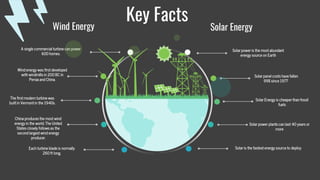
Key Facts
A single commercial turbine can power
600 homes.
Wind energy was first developed
with windmills in 200 BC in
Persia and China.
The first modern turbine was
built in Vermont in the 1940s.
China produces the most wind
energy in the world. The United
States closely follows as the
second largest wind energy
producer.
Each turbine blade is normally
260 ft long.
Solar power is the most abundant
energy source on Earth
Solar panel costs have fallen
99% since 1977
Solar Energy is cheaper than fossil
fuels
Solar power plants can last 40 years or
more
Solar is the fastest energy source to deploy
Solar Energy
Wind Energy
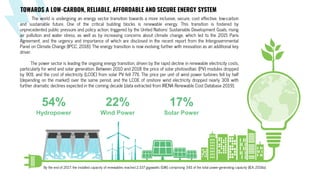
Wind Power
Hydropower Solar Power
54% 22% 17%
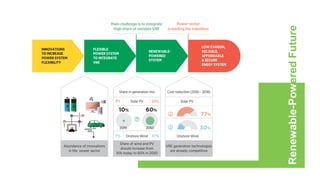
The world is undergoing an energy sector transition towards a more inclusive, secure, cost effective, low-carbon
and sustainable future. One of the critical building blocks is renewable energy. This transition is fostered by
unprecedented public pressure and policy action, triggered by the United Nations’ Sustainable Development Goals, rising
air pollution and water stress, as well as by increasing concerns about climate change, which led to the 2015 Paris
Agreement, and the urgency and importance of which are disclosed in the recent report from the Intergovernmental
Panel on Climate Change (IPCC, 2018). The energy transition is now evolving further with innovation as an additional key
driver.
The power sector is leading the ongoing energy transition, driven by the rapid decline in renewable electricity costs,
particularly for wind and solar generation. Between 2010 and 2018 the price of solar photovoltaic (PV) modules dropped
by 90%, and the cost of electricity (LCOE) from solar PV fell 77%. The price per unit of wind power turbines fell by half
(depending on the market) over the same period, and the LCOE of onshore wind electricity dropped nearly 30% with
further dramatic declines expected in the coming decade (data extracted from IRENA Renewable Cost Database 2019).
By the end of 2017, the installed capacity of renewables reached 2 337 gigawatts (GW), comprising 34% of the total power-generating capacity (IEA, 2018a).
TOWARDS A LOW-CARBON, RELIABLE, AFFORDABLE AND SECURE ENERGY SYSTEM
Renewable-Powered
Future
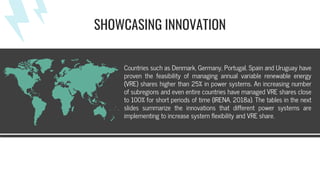
SHOWCASING INNOVATION
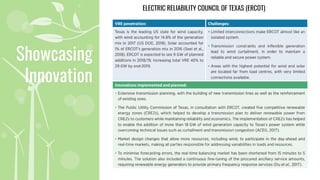
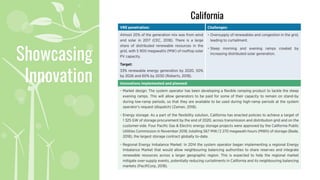
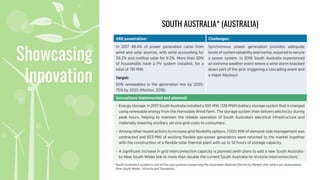
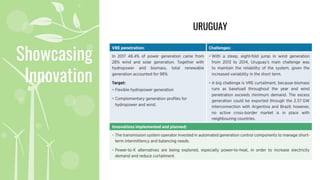
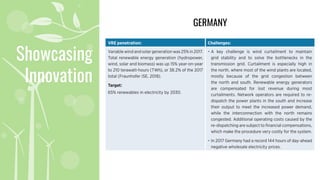
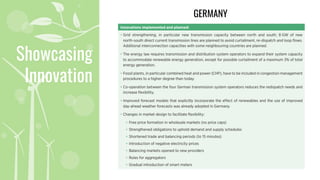
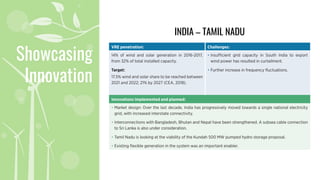
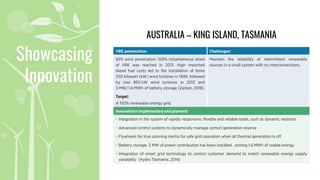
Countries such as Denmark, Germany, Portugal, Spain and Uruguay have
proven the feasibility of managing annual variable renewable energy
(VRE) shares higher than 25% in power systems. An increasing number
of subregions and even entire countries have managed VRE shares close
to 100% for short periods of time (IRENA, 2018a). The tables in the next
slides summarize the innovations that different power systems are
implementing to increase system flexibility and VRE share.
Showcasing
Innovation
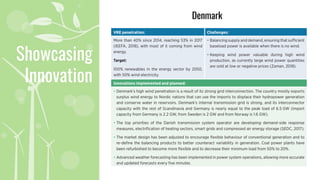
Denmark
Showcasing
Innovation
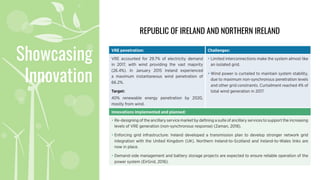
REPUBLIC OF IRELAND AND NORTHERN IRELAND
Showcasing
Innovation
ELECTRIC RELIABILITY COUNCIL OF TEXAS (ERCOT)
Showcasing
Innovation
California
Showcasing
Innovation
SOUTH AUSTRALIA* (AUSTRALIA)
Showcasing
Innovation
URUGUAY
Showcasing
Innovation
GERMANY
Showcasing
Innovation
GERMANY
Showcasing
Innovation
INDIA – TAMIL NADU
Showcasing
Innovation
AUSTRALIA – KING ISLAND, TASMANIA
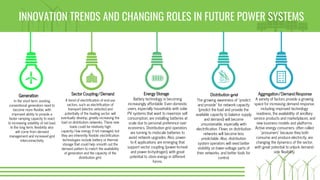
In the short term, existing
conventional generators need to
become more flexible, with
improved ability to provide a
faster ramping capacity to react
to increasing volatility of net load.
In the long term, flexibility also
will come from demand
management and increased grid
interconnectivity
Generation
Battery technology is becoming
increasingly affordable. Even domestic
users, especially households with solar
PV systems that want to maximize self
consumption, are installing batteries at
scale due to personal preference over
economics. Distribution grid operators
are turning to midscale batteries to
avoid network upgrades. Also, power-
to-X applications are emerging that
support sector coupling (power-to-heat
and power-to-hydrogen), with great
potential to store energy in different
forms.
Energy Storage
The growing awareness of “predict
and provide” for network capacity
(predict the load and provide the
available capacity to balance supply
and demand) will become
unsustainable, especially with
electrification. Flows on distribution
networks will become less
predictable. Also, distribution
system operators will need better
visibility on lower-voltage parts of
their networks, and better tools for
control.
Distribution grid
A trend of electrification of end-use
sectors, such as electrification of
transport (electric vehicles) and
potentially of the heating sector, will
eventually develop, greatly increasing the
load on distribution networks. These new
loads could be relatively high
capacity/low energy if not managed, but
they are inherently flexible: electrification
technologies include battery or thermal
storage that could help smooth out the
demand pattern to match the availability
of generation and the capacity of the
distribution grid.
Sector Coupling/Demand
A variety of factors provide a growing
space for increasing demand response,
including improved technology
readiness, the availability of ancillary
service products and marketplaces, and
new business models and platforms.
Active energy consumers, often called
“prosumers” because they both
consume and produce electricity, are
changing the dynamics of the sector,
with great potential to unlock demand-
side flexibility.
Aggregation/Demand Response
INNOVATION TRENDS AND CHANGING ROLES IN FUTURE POWER SYSTEMS
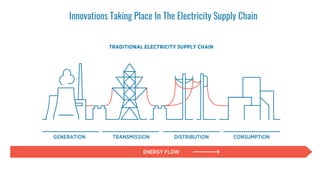
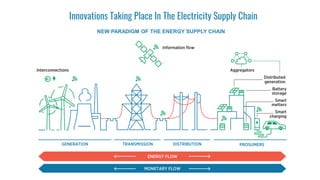
Innovations Taking Place In The Electricity Supply Chain
NEW PARADIGM OF THE ENERGY SUPPLY CHAIN
Solar And Wind Energy In The Philippines
By 2022, the country aims at an estimated 3 GW of installed solar PV capacity. The wind power capacity in 2018 was 427 MW. Despite having an estimated
potential of 76 GW, the Government’s plans are targeting just 2.3 GW by 2030. In 2011, the country adopted an ambitious plan aiming at 15.3 GW renewable power
capacity by 2030 and over 20 GW by 2040.
According to the WWF-Philippines’ Building Momentum for Low Carbon Development study, an even more ambitious scenario of 100% renewable energy is
feasible. The reason for optimism is rooted in the country’s vast potential. The report suggests that the Philippines can further develop 1,200 MW geothermal, 2,308
MW hydropower, 235 MW biomass, and 7,404 MW wind generation capacity before 2030 (Energy Tracker Asia, 2021). And also, Philippines' solar energy capacity
increased exponentially over the past decade. From just two megawatts in 2011, this figure reached 1,048 megawatts in 2020. The Renewable Energy Act of 2008
boosted the country's renewable energy capacity, further shifting its energy grid away from traditional sources (Statista Research Department, 2021).
Advantages and Challenges in front of the Renewable Energy Sources Transition
The Philippines’ ambitious renewable energy transition will guarantee energy security and self-sufficiency, accompanied by reduced reliance on imports. It will
boost the local economic development and promote a favorable investment climate. Naturally, this will lead to more jobs and will reduce the health and welfare costs.
Currently, the country has some of the most lucrative government incentives for rural electrification. At least on paper, these should turn it into an attractive
opportunity for private investments. However, private companies are yet to show a strong interest in energy access initiatives.
Access to financing remains a massive problem. Currently, only a few domestic banks support renewable energy projects in the region. Furthermore, recent
years saw significant downturns in investments. In 2019, they were down 77% to USD $300m. According to the Government, the main challenges include high
upfront and technology costs, inaccessible financing and lack of competitiveness in the market.
Solar And Wind Energy In The Philippines
The Enablers for the Philippines’s Renewable Energy Transition
To overcome those challenges and capitalize on the opportunities, the Government has developed a framework of fiscal
and non-fiscal incentives. Among these are an income tax holiday, a duty-free importation of equipment and VAT-zero rating, tax
credits on domestic capital equipment, tax exemption on carbon credits, priority connection to the grid, Green Energy Option
Program (GEOP), and more.
The Philippines discontinued its Feed in tariff (FIT) program and instead switched to reverse auctions. The goal is to
ensure better support for large-scale solar projects. This strategy resulted in more competitive costs for solar and wind
generation at a grid-parity level. Currently, the country has the lowest bid within the region (USD $0.044 per 50 MW solar plant).
To accelerate renewables adoption, the country is also looking for alternative financing models. These include
crowdfunding through platforms like Kiva, which has helped raise over $250 000 for renewable energy projects development in
the Philippines and India.
Solar And Wind Energy In The Philippines
The Department of Energy (DoE)
In 2018, the Department of Energy issued guidelines for the establishment of a Renewable Energy Trust Fund. Its goal is
to accelerate the renewable energy transition through R&D. The scheme is funded through various sources, including grants,
donations, emission fees, and contributions.
The Department of Energy also has other on-going initiatives to support the adoption of smart grid technologies across
the country’s islands. Currently, the Philippines, alongside Myanmar, are the largest markets for off-grid solar in Southeast Asia.
The countries have sold between 30,000 to 40,000 units only in the second half of 2019.
Thank You
References:
“INNOVATION LANDSCAPE FOR A RENEWABLE-POWERED FUTURE: SOLUTIONS TO INTEGRATE VARIABLE RENEWABLES”
https://www.statista.com/statistics/1006143/philippines-total-solar-energy-capacity/
https://energytracker.asia/renewable-energy-in-the-philippines-current-state-and-future-roadmap/
https://www.energy.gov
https://www.irena.org
https://www.worldenergy.org

VRE: Solar and Wind Energy

  • 1.
    DECARBONIZED FUTURE ENERGY SYSTEMS: SolarAnd Wind Energy Toward A Renewable- Powered Future For The Philippines John Angelo S. Buscado MEE 422 Student Engr. Rafael P. Rebutada Instructor
  • 2.
    Key Facts A singlecommercial turbine can power 600 homes. Wind energy was first developed with windmills in 200 BC in Persia and China. The first modern turbine was built in Vermont in the 1940s. China produces the most wind energy in the world. The United States closely follows as the second largest wind energy producer. Each turbine blade is normally 260 ft long. Solar power is the most abundant energy source on Earth Solar panel costs have fallen 99% since 1977 Solar Energy is cheaper than fossil fuels Solar power plants can last 40 years or more Solar is the fastest energy source to deploy Solar Energy Wind Energy
  • 3.
    Wind Power Hydropower SolarPower 54% 22% 17% The world is undergoing an energy sector transition towards a more inclusive, secure, cost effective, low-carbon and sustainable future. One of the critical building blocks is renewable energy. This transition is fostered by unprecedented public pressure and policy action, triggered by the United Nations’ Sustainable Development Goals, rising air pollution and water stress, as well as by increasing concerns about climate change, which led to the 2015 Paris Agreement, and the urgency and importance of which are disclosed in the recent report from the Intergovernmental Panel on Climate Change (IPCC, 2018). The energy transition is now evolving further with innovation as an additional key driver. The power sector is leading the ongoing energy transition, driven by the rapid decline in renewable electricity costs, particularly for wind and solar generation. Between 2010 and 2018 the price of solar photovoltaic (PV) modules dropped by 90%, and the cost of electricity (LCOE) from solar PV fell 77%. The price per unit of wind power turbines fell by half (depending on the market) over the same period, and the LCOE of onshore wind electricity dropped nearly 30% with further dramatic declines expected in the coming decade (data extracted from IRENA Renewable Cost Database 2019). By the end of 2017, the installed capacity of renewables reached 2 337 gigawatts (GW), comprising 34% of the total power-generating capacity (IEA, 2018a). TOWARDS A LOW-CARBON, RELIABLE, AFFORDABLE AND SECURE ENERGY SYSTEM
  • 4.
  • 5.
    SHOWCASING INNOVATION Countries suchas Denmark, Germany, Portugal, Spain and Uruguay have proven the feasibility of managing annual variable renewable energy (VRE) shares higher than 25% in power systems. An increasing number of subregions and even entire countries have managed VRE shares close to 100% for short periods of time (IRENA, 2018a). The tables in the next slides summarize the innovations that different power systems are implementing to increase system flexibility and VRE share.
  • 6.
  • 7.
  • 8.
  • 9.
  • 10.
  • 11.
  • 12.
  • 13.
  • 14.
  • 15.
  • 16.
    In the shortterm, existing conventional generators need to become more flexible, with improved ability to provide a faster ramping capacity to react to increasing volatility of net load. In the long term, flexibility also will come from demand management and increased grid interconnectivity Generation Battery technology is becoming increasingly affordable. Even domestic users, especially households with solar PV systems that want to maximize self consumption, are installing batteries at scale due to personal preference over economics. Distribution grid operators are turning to midscale batteries to avoid network upgrades. Also, power- to-X applications are emerging that support sector coupling (power-to-heat and power-to-hydrogen), with great potential to store energy in different forms. Energy Storage The growing awareness of “predict and provide” for network capacity (predict the load and provide the available capacity to balance supply and demand) will become unsustainable, especially with electrification. Flows on distribution networks will become less predictable. Also, distribution system operators will need better visibility on lower-voltage parts of their networks, and better tools for control. Distribution grid A trend of electrification of end-use sectors, such as electrification of transport (electric vehicles) and potentially of the heating sector, will eventually develop, greatly increasing the load on distribution networks. These new loads could be relatively high capacity/low energy if not managed, but they are inherently flexible: electrification technologies include battery or thermal storage that could help smooth out the demand pattern to match the availability of generation and the capacity of the distribution grid. Sector Coupling/Demand A variety of factors provide a growing space for increasing demand response, including improved technology readiness, the availability of ancillary service products and marketplaces, and new business models and platforms. Active energy consumers, often called “prosumers” because they both consume and produce electricity, are changing the dynamics of the sector, with great potential to unlock demand- side flexibility. Aggregation/Demand Response INNOVATION TRENDS AND CHANGING ROLES IN FUTURE POWER SYSTEMS
  • 17.
    Innovations Taking PlaceIn The Electricity Supply Chain
  • 18.
    Innovations Taking PlaceIn The Electricity Supply Chain NEW PARADIGM OF THE ENERGY SUPPLY CHAIN
  • 19.
    Solar And WindEnergy In The Philippines By 2022, the country aims at an estimated 3 GW of installed solar PV capacity. The wind power capacity in 2018 was 427 MW. Despite having an estimated potential of 76 GW, the Government’s plans are targeting just 2.3 GW by 2030. In 2011, the country adopted an ambitious plan aiming at 15.3 GW renewable power capacity by 2030 and over 20 GW by 2040. According to the WWF-Philippines’ Building Momentum for Low Carbon Development study, an even more ambitious scenario of 100% renewable energy is feasible. The reason for optimism is rooted in the country’s vast potential. The report suggests that the Philippines can further develop 1,200 MW geothermal, 2,308 MW hydropower, 235 MW biomass, and 7,404 MW wind generation capacity before 2030 (Energy Tracker Asia, 2021). And also, Philippines' solar energy capacity increased exponentially over the past decade. From just two megawatts in 2011, this figure reached 1,048 megawatts in 2020. The Renewable Energy Act of 2008 boosted the country's renewable energy capacity, further shifting its energy grid away from traditional sources (Statista Research Department, 2021). Advantages and Challenges in front of the Renewable Energy Sources Transition The Philippines’ ambitious renewable energy transition will guarantee energy security and self-sufficiency, accompanied by reduced reliance on imports. It will boost the local economic development and promote a favorable investment climate. Naturally, this will lead to more jobs and will reduce the health and welfare costs. Currently, the country has some of the most lucrative government incentives for rural electrification. At least on paper, these should turn it into an attractive opportunity for private investments. However, private companies are yet to show a strong interest in energy access initiatives. Access to financing remains a massive problem. Currently, only a few domestic banks support renewable energy projects in the region. Furthermore, recent years saw significant downturns in investments. In 2019, they were down 77% to USD $300m. According to the Government, the main challenges include high upfront and technology costs, inaccessible financing and lack of competitiveness in the market.
  • 20.
    Solar And WindEnergy In The Philippines The Enablers for the Philippines’s Renewable Energy Transition To overcome those challenges and capitalize on the opportunities, the Government has developed a framework of fiscal and non-fiscal incentives. Among these are an income tax holiday, a duty-free importation of equipment and VAT-zero rating, tax credits on domestic capital equipment, tax exemption on carbon credits, priority connection to the grid, Green Energy Option Program (GEOP), and more. The Philippines discontinued its Feed in tariff (FIT) program and instead switched to reverse auctions. The goal is to ensure better support for large-scale solar projects. This strategy resulted in more competitive costs for solar and wind generation at a grid-parity level. Currently, the country has the lowest bid within the region (USD $0.044 per 50 MW solar plant). To accelerate renewables adoption, the country is also looking for alternative financing models. These include crowdfunding through platforms like Kiva, which has helped raise over $250 000 for renewable energy projects development in the Philippines and India.
  • 21.
    Solar And WindEnergy In The Philippines The Department of Energy (DoE) In 2018, the Department of Energy issued guidelines for the establishment of a Renewable Energy Trust Fund. Its goal is to accelerate the renewable energy transition through R&D. The scheme is funded through various sources, including grants, donations, emission fees, and contributions. The Department of Energy also has other on-going initiatives to support the adoption of smart grid technologies across the country’s islands. Currently, the Philippines, alongside Myanmar, are the largest markets for off-grid solar in Southeast Asia. The countries have sold between 30,000 to 40,000 units only in the second half of 2019.
  • 22.
    Thank You References: “INNOVATION LANDSCAPEFOR A RENEWABLE-POWERED FUTURE: SOLUTIONS TO INTEGRATE VARIABLE RENEWABLES” https://www.statista.com/statistics/1006143/philippines-total-solar-energy-capacity/ https://energytracker.asia/renewable-energy-in-the-philippines-current-state-and-future-roadmap/ https://www.energy.gov https://www.irena.org https://www.worldenergy.org