Genetic elements in human evolution
Konstantinos Voskarides, PhD
Molecular Medicine Research Center
University of Cyprus
The Second Cyprus Symposium
‘Pathways to Indefinite Lifespans’
University of Nicosia
24 May 2014
What is the relevance between
longevity/aging and evolution?
• There is strong evidence that longevity and
aging rate are highly heritable traits
• There is also evidence that longevity and aging
rate are selectionable traits
• Different species and even different human
populations have different age limits and age
medians. Evolutionary history counts!
“Big data” help to study human evolution
• A huge DNA information is now publicly available,
regarding the human and other species’ genomes
• HapMap project, 1000 genomes project,
Neanderthal project, other organisms’ genomes
• Next Generation Sequencing enhanced
exponentially the production of massive genetic
information
• Productivity rate is continuously increasing: A new
company being started by J. Craig Venter (called
“Human Longevity”) aims at releasing 100,000
genomes per year! From infants to centenarians
• Despite the vast available genetic information
(healthy individuals, patients, fossils), genetic
associations found are proportionally few
• For most common multifactorial diseases, the
discovered genetic variants explain only 5-10% of
heritability
• Known genetic loci under selection, with strong
evidence for this, are few
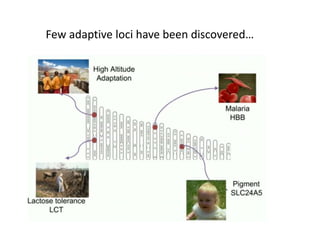
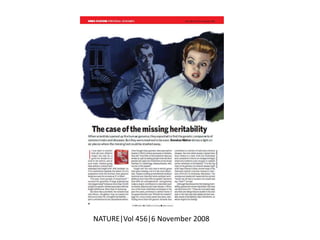
Few adaptive loci have been discovered…
NATURE|Vol 456|6 November 2008
So, can we trace more
efficiently human evolution?
Many geneticist believe (I do!)
that the key is to understand
better the function of genetic
regulatory elements.
Hypothesis: “Human genome (probably all
species’ genomes) is highly governed by specific
genetic elements that can influence dynamically
the function of genes. These elements may have
contradictory roles and co-evolve through
evolutionary time”
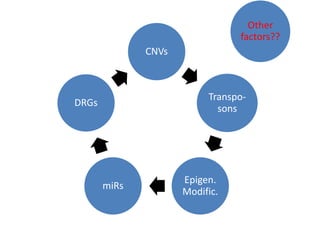
Known “Genetic elements” with qualitative or
quantitative action in genomes
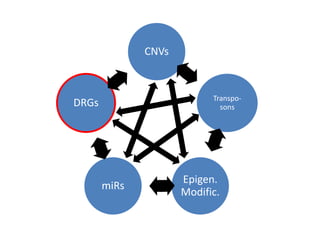
• Copy Number Variations (CNVs): Discovered on 2006. Gains
and losses of large chunks of DNA sequence. Gains can
increase gene expression through multiple gene copies.
• microRNAs and other non-coding RNAs: Affect negatively
mRNA translation. They fine tune gene expression.
• Transposons: DNA fragments moving through the genome.
They can potentially affect the expression of nearby genes, or
they can incorporate regulatory elements (e.g. microRNAs).
• DNA Repair Genes (DRGs): Eliminate the randomly inserted
mutations. Master regulators of mutagenesis rate in genomes.
• Genes acting at epigenetic level: Can affect positively or
negatively gene expression.
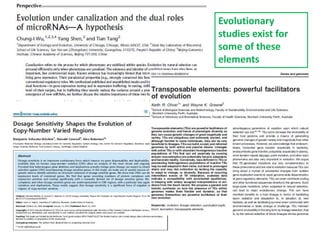
Evolutionary
studies exist for
some of these
elements
CNVs
Transpo-
sons
Epigen.
Modific.
miRs
DRGs
Other
factors??
CNVs
Transpo-
sons
Epigen.
Modific.
miRs
DRGs
Other
factors??
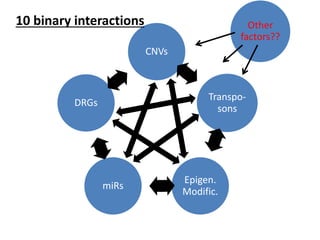
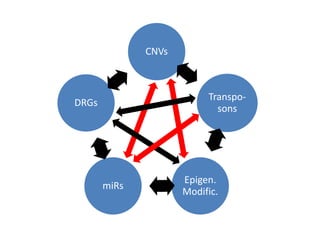
10 binary interactions
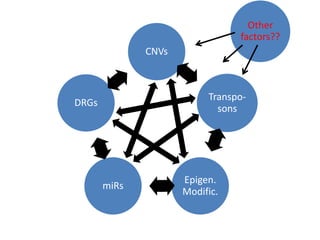
Examples of studied binary
interactions
CNVs
Transpo-
sons
Epigen.
Modific.
miRs
DRGs
Other
factors??
CNVs
Transpo-
sons
Epigen.
Modific.
miRs
DRGs
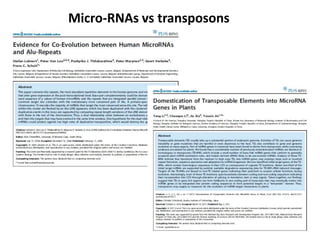
Micro-RNAs vs transposons
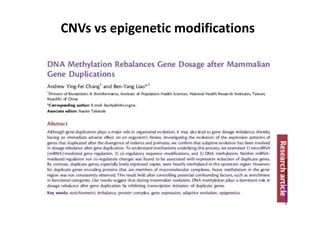
CNVs vs epigenetic modifications
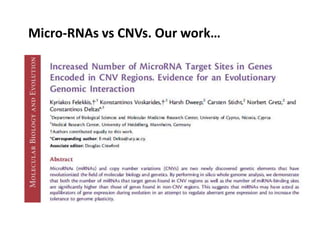
Micro-RNAs vs CNVs. Our work…
CNVs
Transpo-
sons
Epigen.
Modific.
miRs
DRGs
DNA repair genes: Masters regulators
of mutagenesis rate.
Is mutagenesis rate changing through
evolutionary time?
DNA repair genes (DRGs)
176 known human DNA repair genes
Main types of repair:
• Direct reversal
• Single-strand damage
• Double-strand breaks
- non-homologous end joining (NHEJ)
- microhomology-mediated end joining (MMEJ)
- homologous recombination
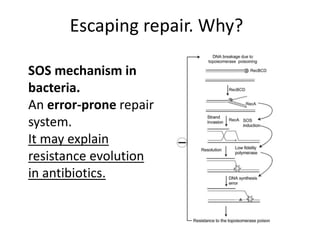
Escaping repair. Why?
SOS mechanism in
bacteria.
An error-prone repair
system.
It may explain
resistance evolution
in antibiotics.
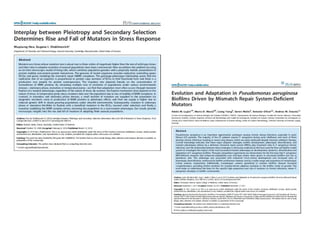
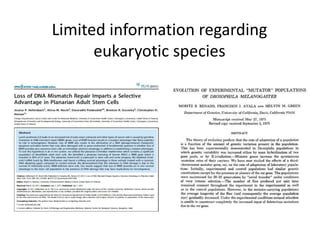
Limited information regarding
eukaryotic species
DRGs & cancer
• Mutations in DRGs can cause cancer
• BRCA1, WRN, FANCB, FANCF, MGMT, MLH1, MSH2, MSH4,
ERCC1, XPF, NEIL1, ATM
• Epigenetic changes in the above genes can also cause cancer
• Breast cancer, colorectal cancer and others
• Deficiencies in expression of ERCC1, XPF and/or PMS2 occur
simultaneously in a big % of colon cancers (Facista et al, 2012)
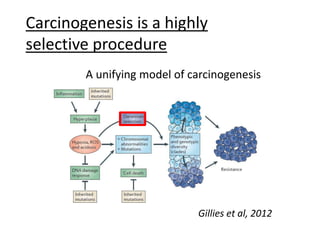
Gillies et al, 2012
A unifying model of carcinogenesis
Carcinogenesis is a highly
selective procedure
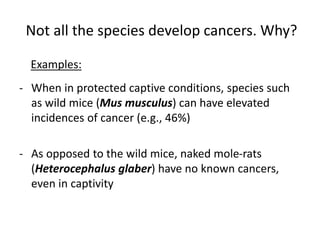
Not all the species develop cancers. Why?
- When in protected captive conditions, species such
as wild mice (Mus musculus) can have elevated
incidences of cancer (e.g., 46%)
- As opposed to the wild mice, naked mole-rats
(Heterocephalus glaber) have no known cancers,
even in captivity
Examples:
Hypothesis: “Under extreme environmental
conditions, individuals (and their offspring) with
accumulated genetic variation in their DRGs may
have a higher probability to survive. Increased
mutagenesis -> advantageous mutation/s can appear”
“As a consequence, when environmental
conditions are back to normal and individuals live
longer, a “side-effect” of this evolutionary
phenomenon maybe the increased carcinogenesis
due to the increased genetic variability in the
DRGs.”
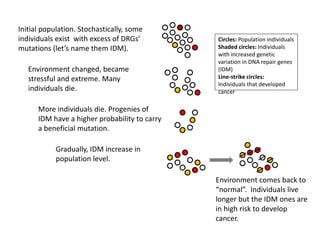
Initial population. Stochastically, some
individuals exist with excess of DRGs’
mutations (let’s name them IDM).
Environment changed, became
stressful and extreme. Many
individuals die.
More individuals die. Progenies of
IDM have a higher probability to carry
a beneficial mutation.
Gradually, IDM increase in
population level.
Environment comes back to
“normal”. Individuals live
longer but the IDM ones are
in high risk to develop
cancer.
Circles: Population individuals
Shaded circles: Individuals
with increased genetic
variation in DNA repair genes
(IDM)
Line-strike circles:
Individuals that developed
cancer
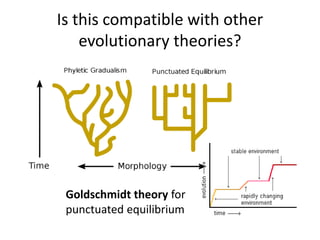
Is this compatible with other
evolutionary theories?
Goldschmidt theory for
punctuated equilibrium
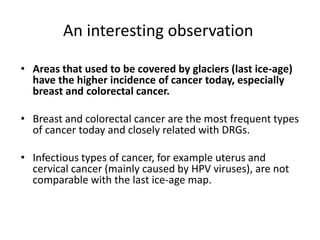
An interesting observation
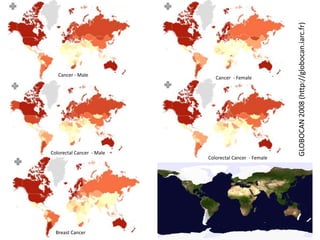
• Areas that used to be covered by glaciers (last ice-age)
have the higher incidence of cancer today, especially
breast and colorectal cancer.
• Breast and colorectal cancer are the most frequent types
of cancer today and closely related with DRGs.
• Infectious types of cancer, for example uterus and
cervical cancer (mainly caused by HPV viruses), are not
comparable with the last ice-age map.
Cancer - Male
Cancer - Female
Colorectal Cancer - Male
Colorectal Cancer - Female
Breast Cancer
GLOBOCAN2008(http://globocan.iarc.fr)
In press
Conclusions
• We have to increase our knowledge on Genetic
Regulatory Elements. They may explain a big part
of heritability.
• Genomic elements co-evolve through time. Only
by designing specific studies we can trace co-
evolution.
• Under this view, we can proceed to detect
specific adaptations (skin color, nutrition,
behavior, longevity etc).
Thank you!

Voskarides 2nd aging symposium-unic 240514

  • 1.
    Genetic elements inhuman evolution Konstantinos Voskarides, PhD Molecular Medicine Research Center University of Cyprus The Second Cyprus Symposium ‘Pathways to Indefinite Lifespans’ University of Nicosia 24 May 2014
  • 2.
    What is therelevance between longevity/aging and evolution? • There is strong evidence that longevity and aging rate are highly heritable traits • There is also evidence that longevity and aging rate are selectionable traits • Different species and even different human populations have different age limits and age medians. Evolutionary history counts!
  • 3.
    “Big data” helpto study human evolution • A huge DNA information is now publicly available, regarding the human and other species’ genomes • HapMap project, 1000 genomes project, Neanderthal project, other organisms’ genomes • Next Generation Sequencing enhanced exponentially the production of massive genetic information • Productivity rate is continuously increasing: A new company being started by J. Craig Venter (called “Human Longevity”) aims at releasing 100,000 genomes per year! From infants to centenarians
  • 4.
    • Despite thevast available genetic information (healthy individuals, patients, fossils), genetic associations found are proportionally few • For most common multifactorial diseases, the discovered genetic variants explain only 5-10% of heritability • Known genetic loci under selection, with strong evidence for this, are few
  • 5.
    Few adaptive locihave been discovered…
  • 6.
  • 7.
    So, can wetrace more efficiently human evolution? Many geneticist believe (I do!) that the key is to understand better the function of genetic regulatory elements.
  • 8.
    Hypothesis: “Human genome(probably all species’ genomes) is highly governed by specific genetic elements that can influence dynamically the function of genes. These elements may have contradictory roles and co-evolve through evolutionary time”
  • 9.
    Known “Genetic elements”with qualitative or quantitative action in genomes • Copy Number Variations (CNVs): Discovered on 2006. Gains and losses of large chunks of DNA sequence. Gains can increase gene expression through multiple gene copies. • microRNAs and other non-coding RNAs: Affect negatively mRNA translation. They fine tune gene expression. • Transposons: DNA fragments moving through the genome. They can potentially affect the expression of nearby genes, or they can incorporate regulatory elements (e.g. microRNAs). • DNA Repair Genes (DRGs): Eliminate the randomly inserted mutations. Master regulators of mutagenesis rate in genomes. • Genes acting at epigenetic level: Can affect positively or negatively gene expression.
  • 10.
  • 11.
  • 12.
  • 13.
    Examples of studiedbinary interactions
  • 14.
  • 15.
  • 16.
  • 17.
    CNVs vs epigeneticmodifications
  • 18.
  • 20.
  • 21.
    DNA repair genes:Masters regulators of mutagenesis rate. Is mutagenesis rate changing through evolutionary time?
  • 22.
    DNA repair genes(DRGs) 176 known human DNA repair genes Main types of repair: • Direct reversal • Single-strand damage • Double-strand breaks - non-homologous end joining (NHEJ) - microhomology-mediated end joining (MMEJ) - homologous recombination
  • 23.
    Escaping repair. Why? SOSmechanism in bacteria. An error-prone repair system. It may explain resistance evolution in antibiotics.
  • 25.
  • 26.
    DRGs & cancer •Mutations in DRGs can cause cancer • BRCA1, WRN, FANCB, FANCF, MGMT, MLH1, MSH2, MSH4, ERCC1, XPF, NEIL1, ATM • Epigenetic changes in the above genes can also cause cancer • Breast cancer, colorectal cancer and others • Deficiencies in expression of ERCC1, XPF and/or PMS2 occur simultaneously in a big % of colon cancers (Facista et al, 2012)
  • 27.
    Gillies et al,2012 A unifying model of carcinogenesis Carcinogenesis is a highly selective procedure
  • 28.
    Not all thespecies develop cancers. Why? - When in protected captive conditions, species such as wild mice (Mus musculus) can have elevated incidences of cancer (e.g., 46%) - As opposed to the wild mice, naked mole-rats (Heterocephalus glaber) have no known cancers, even in captivity Examples:
  • 31.
    Hypothesis: “Under extremeenvironmental conditions, individuals (and their offspring) with accumulated genetic variation in their DRGs may have a higher probability to survive. Increased mutagenesis -> advantageous mutation/s can appear” “As a consequence, when environmental conditions are back to normal and individuals live longer, a “side-effect” of this evolutionary phenomenon maybe the increased carcinogenesis due to the increased genetic variability in the DRGs.”
  • 32.
    Initial population. Stochastically,some individuals exist with excess of DRGs’ mutations (let’s name them IDM). Environment changed, became stressful and extreme. Many individuals die. More individuals die. Progenies of IDM have a higher probability to carry a beneficial mutation. Gradually, IDM increase in population level. Environment comes back to “normal”. Individuals live longer but the IDM ones are in high risk to develop cancer. Circles: Population individuals Shaded circles: Individuals with increased genetic variation in DNA repair genes (IDM) Line-strike circles: Individuals that developed cancer
  • 33.
    Is this compatiblewith other evolutionary theories? Goldschmidt theory for punctuated equilibrium
  • 35.
    An interesting observation •Areas that used to be covered by glaciers (last ice-age) have the higher incidence of cancer today, especially breast and colorectal cancer. • Breast and colorectal cancer are the most frequent types of cancer today and closely related with DRGs. • Infectious types of cancer, for example uterus and cervical cancer (mainly caused by HPV viruses), are not comparable with the last ice-age map.
  • 36.
    Cancer - Male Cancer- Female Colorectal Cancer - Male Colorectal Cancer - Female Breast Cancer GLOBOCAN2008(http://globocan.iarc.fr)
  • 37.
  • 38.
    Conclusions • We haveto increase our knowledge on Genetic Regulatory Elements. They may explain a big part of heritability. • Genomic elements co-evolve through time. Only by designing specific studies we can trace co- evolution. • Under this view, we can proceed to detect specific adaptations (skin color, nutrition, behavior, longevity etc).
  • 39.