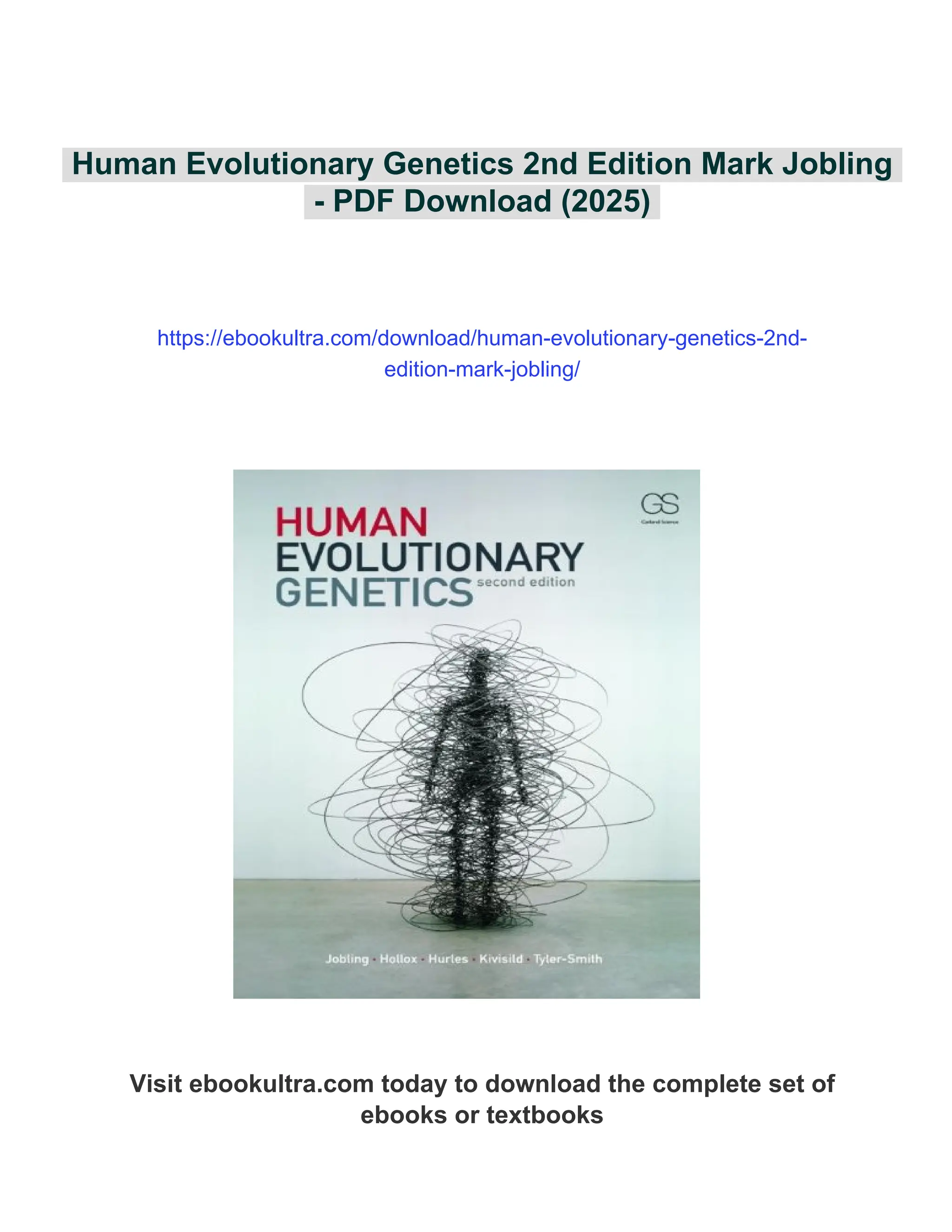
Human Evolutionary Genetics 2nd Edition Mark Jobling
Human Evolutionary Genetics 2nd Edition Mark Jobling
Human Evolutionary Genetics 2nd Edition Mark Jobling
Human Evolutionary Genetics 2nd Edition Mark Jobling
Human Evolutionary Genetics 2nd Edition Mark Jobling
1.
Human Evolutionary Genetics2nd Edition Mark Jobling
- PDF Download (2025)
https://ebookultra.com/download/human-evolutionary-genetics-2nd-
edition-mark-jobling/
Visit ebookultra.com today to download the complete set of
ebooks or textbooks
2.
We have selectedsome products that you may be interested in
Click the link to download now or visit ebookultra.com
for more options!.
Essentials of human genetics 2nd Edition Hema Purandarey
https://ebookultra.com/download/essentials-of-human-genetics-2nd-
edition-hema-purandarey/
Reproductive Ecology and Human Evolution Evolutionary
Foundations of Human Behavior 1st Edition Ellison
https://ebookultra.com/download/reproductive-ecology-and-human-
evolution-evolutionary-foundations-of-human-behavior-1st-edition-
ellison/
Human Evolutionary Biology 1st Edition Michael P.
Muehlenbein (Ed.)
https://ebookultra.com/download/human-evolutionary-biology-1st-
edition-michael-p-muehlenbein-ed/
An introduction to human molecular genetics mechanisms of
inherited diseases 2nd Edition Jack J. Pasternak
https://ebookultra.com/download/an-introduction-to-human-molecular-
genetics-mechanisms-of-inherited-diseases-2nd-edition-jack-j-
pasternak/
3.
Craniosynostoses Molecular GeneticsPrinciples of
Diagnosis and Treatment Monographs in Human Genetics 1st
Edition M. Muenke
https://ebookultra.com/download/craniosynostoses-molecular-genetics-
principles-of-diagnosis-and-treatment-monographs-in-human-
genetics-1st-edition-m-muenke/
Human Biology An Evolutionary and Biocultural Perspective
Second Edition Sara Stinson
https://ebookultra.com/download/human-biology-an-evolutionary-and-
biocultural-perspective-second-edition-sara-stinson/
Sense and Nonsense Evolutionary Perspectives on Human
Behaviour Kevin N. Laland
https://ebookultra.com/download/sense-and-nonsense-evolutionary-
perspectives-on-human-behaviour-kevin-n-laland/
Atlas of Human Anatomy 1st Edition Mark Nielsen
https://ebookultra.com/download/atlas-of-human-anatomy-1st-edition-
mark-nielsen/
Mark Twain and Human Nature 1st Edition Tom Quirk
https://ebookultra.com/download/mark-twain-and-human-nature-1st-
edition-tom-quirk/
5.
Human Evolutionary Genetics2nd Edition Mark Jobling
Digital Instant Download
Author(s): Mark Jobling, Edward Hollox, MatthewHurles, Toomas Kivisild,
Chris Tyler-Smith
ISBN(s): 9780815341482, 0815341482
Edition: 2
File Details: PDF, 65.48 MB
Year: 2013
Language: english
preface
This book isa completely revised edition of Human Evolutionary Genetics,
first published in 2004. We decided to write the first edition because there
were no textbooks available covering the areas that interested us. Once we had
embarked upon the Herculean task of producing it, we realized why nobody had
attempted to summarize this forbiddingly broad and contentious field before.
But luckily the reception was positive, one eager person (our ideal reader and
not, we point out, one of the authors in disguise) writing on Amazon that “I
bought a copy for myself, and another one for my advisor. I have read it twice in
a week!” A revised version seemed like a pretty good idea.
We cheerfully imagined that the second edition would be easier to write than the
first. How wrong we were. First, all three original authors (MJ, MH, and CTS) had
accumulated additional responsibilities that reduced the available time for writ-
ing. Second, the field obstinately continued to grow, and scarcely a week went
by without some interesting and important development—the genomes of new
species, genomewide surveys of human variation, next-generation sequencing
and its data tsunami, spectacular ancient DNA discoveries, large-scale popu-
lation studies, novel statistical methods, archaeological and paleontological
revelations—the list goes on. We sometimes wished everyone would just stop
working for a bit, so we could catch up. So, our deadline for the second edition
passed, was revised, and passed again. HEG1 was becoming more and more out
of date. We needed help.
The cavalry duly arrived in the form of two sterling new recruits to the autho-
rial team—EH and TK. They brought their own areas of interest and expertise,
but also a more efficient and energetic approach to the writing process, which
revitalized the whole project. So, after a lengthy and difficult gestation, here is
HEG2.
Following an initial introductory chapter, the book is divided into five sections,
allowing it to be read by interested students and researchers from a broad range
of backgrounds. “How do we study genome diversity?” (Chapters 2–4) and “How
do we interpret genetic variation?” (Chapters 5–6) together provide the neces-
sary tools to understand the rest of the book. The first of these sections surveys
the structure of the genome, different sources of genomic variation, and the
methods for assaying diversity experimentally. The second introduces the evolu-
tionary concepts and analytical tools that are used to interpret this diversity. The
subsequent two sections take an approximately chronological course through
the aspects of our current state of knowledge about human origins that we con-
sider most important. The section “Where and when did humans originate?”
(Chapters 7–9) first considers our links to our closest living nonhuman relatives,
the other great apes, then investigates the genetic changes that have made us
13.
vi
human, and finallydetails the more recent African origin of our own species.
“How did humans colonize the world?” (Chapters 10–14) describes how human
genetic diversity is currently distributed globally and then discusses the evi-
dence for early human movements out of Africa, and the subsequent processes
of expansion, migration, and mixing that have shaped patterns of diversity in
our genomes. Finally, “How is an evolutionary perspective useful?” (Chapters
15–18) demonstrates the wider applications of an evolutionary approach for
our understanding of phenotypic variation, the genetics of diseases both simple
and complex, and the identification of individuals. Extensive cross-referencing
between these sections facilitates different routes through the book for readers
with divergent interests and varying amounts of background knowledge.
An important feature is the use of “Opinion Boxes”—short contributions by
guest authors who are experts in different aspects of this diverse subject area.
These help to give a flavor of scientific enquiry as an ongoing process, rather
than a linear accumulation of facts, and encourage the reader to regard the
published literature with a more critical eye. Opinions about how data should
be interpreted change, and often an objective way to choose between differ-
ent interpretations is not obvious. This is particularly true of genetic data on
human diversity. Many of the debates represented in the Opinion Boxes scat-
tered through this book derive from methodological differences.
Additional resources have been incorporated to permit interested readers to
explore topics in greater depth. Each chapter is followed by a detailed bibliog-
raphy, within which the sources that should be turned to first for more detail
are highlighted in purple text. Electronic references to internet sites are given
throughout the book, both for additional information and for useful software and
databases. We explain specialist terms where they are first used, and include an
extensive glossary at the back of the book that defines all terms in the text that
are in bold type. At the end of each chapter is a list of questions (some short-
answer, and some prose) that allow the reader to test their knowledge as they
proceed. Teachers may be interested to know that most of the figures are freely
available from the Garland Science Website (www.garlandscience.com) for use
in teaching materials.
An obvious difference from the first edition is the presence of two extra chapters,
reflecting developments in understanding the human genome in the context of
other hominid genomes, and in complex disease. A very welcome development
is the availability of full-color printing, which makes complex figures much eas-
ier to understand.
PREFACE
14.
acknowledgments
We have manypeople to thank for contributions to this book. Twenty-five
researchers found time to write Opinion Boxes; we are very grateful to:
Mark Achtman, Elizabeth Cirulli & David Goldstein, Graham Coop & Molly
Przeworski, Dorian Fuller, Tom Gilbert, Boon-Peng Hoh & Maude Phipps,
Doron Lancet & Tsviya Olender, Daniel MacArthur, Andrea Manica & Anders
Eriksson, Linda Marchant & Bill McGrew, John Novembre, Bert Roberts, Aylwyn
Scally & Richard Durbin, Sarah Tishkoff, George van Driem, Bernard Wood, and
Richard Wrangham & Rachel Carmody. We must stress that any opinions out-
side these Boxes are our own, and not necessarily endorsed by the Opinion Box
contributors.
We are very grateful to the external specialists who helped improve the man-
uscript by providing data and advice, commenting on figures and questions,
and reviewing draft chapters. Of course, despite the efforts of reviewers, errors
and omissions will remain, and we take full responsibility for these. Thanks
to: John Armour (University of Nottingham), Chiara Batini (University of
Leicester), Stefano Benazzi (University of Vienna), Antonio Brehm (University
of Madeira), John Brookfield (University of Nottingham), Terry Brown
(University of Manchester), Anne Buchanan (Pennsylvania State University),
John M. Butler (The National Institute of Standards and Technology), Lucia
Carbone (Oregon Health and Science University), Susana Carvalho (University
of Oxford), Vincenza Colonna (Wellcome Trust Sanger Institute), Murray Cox
(Massey University), Todd R. Disotell (New York University), Michael Dunn
(Max Planck Institute for Psycholinguistics), Wolfgang Enard (Max Planck
Institute for Evolutionary Anthropology), Greg Gibson (Georgia Institute of
Technology), Tom Gilbert (Natural History Museum of Denmark), Bernard
Grandchamp (University of Paris Diderot), Ryan Gutenkunst (University of
Arizona), Wolfgang Haak (University of Adelaide), Phillip Habgood (University
of Queensland), Pille Hallast (University of Leicester), Terry Harrison (New
York University), Simon Hay (University of Oxford), Andy I.R. Herries (La
Trobe University), Sarah Hill (University of Cambridge), Hirohisa Hirai (Kyoto
University), Rosalind Howes (University of Oxford), Arati Iyengar (University
of Central Lancashire), Peter de Knijff (Leiden University Medical Center),
Vincent Macaulay (University of Glasgow), Ripan Malhi (University of Illinois
Urbana-Champaign), Nicola Man (University of New South Wales), Tomas
Marques-Bonet (University Pompeu Fabra), Celia May (University of Leicester),
Patrick McGrath (Georgia Tech), Bill McGrew (University of Cambridge), Pierpaolo
Maisano Delser (University of Leicester), Mait Metspalu (University of Tartu),
Darren Monckton (University of Glasgow), Maru Mormina (University of East
Anglia), Connie Mulligan (University of Florida), David Nelson (Baylor College
of Medicine), Barbara Ottolini (University of Leicester), Svante Pääbo (Max
15.
viii
Planck Institute forEvolutionary Anthropology), Luca Pagani (Wellcome Trust
Sanger Institute), Luisa Pereira (University of Porto), Fred Piel (University of
Oxford), Sohini Ramachandran (Brown University), Christine Rees (Illumina),
Tim Reynolds (Birkbeck, University of London), Jorge Macedo Rocha (University
of Porto), Rebecca Rogers Ackermann (University of Cape Town), Alexandra
Rosa (University of Madeira), Mark Seielstad (University of California San
Francisco), Giorgio Sirugo (Tor Vergata University Medical School), Roscoe
Stanyon (University of Florence), Jay Stock (University of Cambridge), Peter
Sudbery (University of Sheffield), Dallas Swallow (University College London),
Martin Tobin (University of Leicester), Richard Villems (University of Tartu),
Cynthia Vigueira (Washington University St. Louis), Bence Viola (Max Planck
Institute for Evolutionary Anthropology), Tim White (University of California,
Berkeley), Mike Whitlock (University of British Columbia), Jinchuan Xing
(Rutgers University), Yali Xue (Wellcome Trust Sanger Institute), and Bryndis
Yngvadottir (Wellcome Trust Sanger Institute).
We thank Liz Owen at Garland for her persistence, pragmatism, and practical
help in bringing HEG2 to fruition. Dave Borrowdale’s efficient administration
of the review process of text and figures has also been greatly appreciated.
We thank the artist, Matt McClements, for the professional job he has done in
redrawing our figures. We also thank Georgina Lucas for helping us through the
proof stage.
We are also grateful for the funding bodies and institutions that have allowed us
to maintain our research interests in human evolutionary genetics, and to pro-
duce this book. In particular, MJ thanks the Wellcome Trust for funding through
a Senior Fellowship, and the University of Leicester for providing a collegial
working environment. EH thanks the same institution for giving him gainful
employment. TK thanks colleagues from the Division of Biological Anthropology,
University of Cambridge, for their support; and MH and CTS thank the Wellcome
Trust both for its direct support and for its creation of the stimulating environ-
ment of the Sanger Institute.
Writing a textbook is undoubtedly interesting and educational, but also oner-
ous. Much of this burden has fallen on our families and colleagues, as well as
ourselves. We all thank our current and former group members for putting up
with the distractions of book preparation, and for interesting delicacies from
around the world. In addition, MJ thanks Nicky, Bill, and Isobel, EH thanks Gill
and Kirsten, MH thanks Liz, Edward, Jenny, and Audrey, TK thanks Dagne and
Uku, and CTS thanks Yali and Jack. Perhaps this book can now provide an
explanation for our preoccupations and absences.
acknowledgments
16.
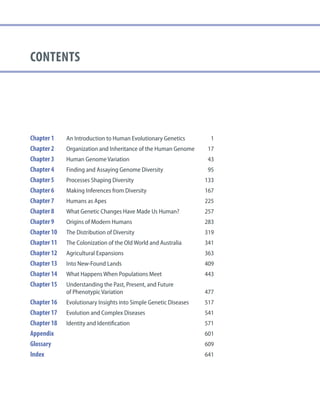
contents
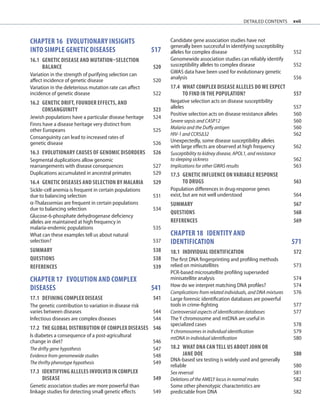
Chapter 1 AnIntroduction to Human Evolutionary Genetics 1
Chapter 2 Organization and Inheritance of the Human Genome 17
Chapter 3 Human Genome Variation 43
Chapter 4 Finding and Assaying Genome Diversity 95
Chapter 5 Processes Shaping Diversity 133
Chapter 6 Making Inferences from Diversity 167
Chapter 7 Humans as Apes 225
Chapter 8 What Genetic Changes Have Made Us Human? 257
Chapter 9 Origins of Modern Humans 283
Chapter 10 The Distribution of Diversity 319
Chapter 11 The Colonization of the Old World and Australia 341
Chapter 12 Agricultural Expansions 363
Chapter 13 Into New-Found Lands 409
Chapter 14 What Happens When Populations Meet 443
Chapter 15 Understanding the Past, Present, and Future
of Phenotypic Variation 477
Chapter 16 Evolutionary Insights into Simple Genetic Diseases 517
Chapter 17 Evolution and Complex Diseases 541
Chapter 18 Identity and Identification 571
Appendix 601
Glossary 609
Index 641
17.
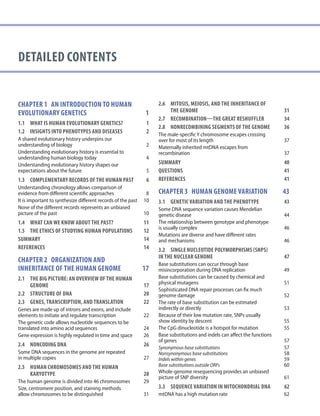
DETAILED contents
Chapter 1AN INTRODUCTION TO HUMAN
EVOLUTIONARY GENETICS 1
1.1 WHAT IS HUMAN EVOLUTIONARY GENETICS? 1
1.2 INSIGHTS INTO PHENOTYPES AND DISEASES 2
A shared evolutionary history underpins our
understanding of biology 2
Understanding evolutionary history is essential to
understanding human biology today 4
Understanding evolutionary history shapes our
expectations about the future 5
1.3 COMPLEMENTARY RECORDS OF THE HUMAN PAST 6
Understanding chronology allows comparison of
evidence from different scientific approaches 8
It is important to synthesize different records of the past 10
None of the different records represents an unbiased
picture of the past 10
1.4 WHAT CAN WE KNOW ABOUT THE PAST? 11
1.5 THE ETHICS OF STUDYING HUMAN POPULATIONS 12
SUMMARY 14
REFERENCES 14
chapter 2 ORGANIZATION AND
INHERITANCE OF THE HUMAN GENOME 17
2.1 THE BIG PICTURE: AN OVERVIEW OF THE HUMAN
GENOME 17
2.2 STRUCTURE OF DNA 20
2.3 GENES, TRANSCRIPTION, AND TRANSLATION 22
Genes are made up of introns and exons, and include
elements to initiate and regulate transcription 22
The genetic code allows nucleotide sequences to be
translated into amino acid sequences 24
Gene expression is highly regulated in time and space 26
2.4 NONCODING DNA 26
Some DNA sequences in the genome are repeated
in multiple copies 27
2.5 HUMAN CHROMOSOMES AND THE HUMAN
KARYOTYPE 28
The human genome is divided into 46 chromosomes 29
Size, centromere position, and staining methods
allow chromosomes to be distinguished 31
2.6 MITOSIS, MEIOSIS, AND THE INHERITANCE OF
THE GENOME 31
2.7 RECOMBINATION—THE GREAT RESHUFFLER 34
2.8 NONRECOMBINING SEGMENTS OF THE GENOME 36
The male-specific Y chromosome escapes crossing
over for most of its length 37
Maternally inherited mtDNA escapes from
recombination 37
SUMMARY 40
QUESTIONS 41
REFERENCES 41
chapter 3 HUMAN GENOME VARIATION 43
3.1 GENETIC VARIATION AND THE PHENOTYPE 43
Some DNA sequence variation causes Mendelian
genetic disease 44
The relationship between genotype and phenotype
is usually complex 46
Mutations are diverse and have different rates
and mechanisms 46
3.2 SINGLE NUCLEOTIDE POLYMORPHISMS (SNPS)
IN THE NUCLEAR GENOME 47
Base substitutions can occur through base
misincorporation during DNA replication 49
Base substitutions can be caused by chemical and
physical mutagens 51
Sophisticated DNA repair processes can fix much
genome damage 52
The rate of base substitution can be estimated
indirectly or directly 53
Because of their low mutation rate, SNPs usually
show identity by descent 55
The CpG dinucleotide is a hotspot for mutation 55
Base substitutions and indels can affect the functions
of genes 57
Synonymous base substitutions 57
Nonsynonymous base substitutions 58
Indels within genes 59
Base substitutions outside ORFs 60
Whole-genome resequencing provides an unbiased
picture of SNP diversity 61
3.3 SEQUENCE VARIATION IN MITOCHONDRIAL DNA 62
mtDNA has a high mutation rate 62
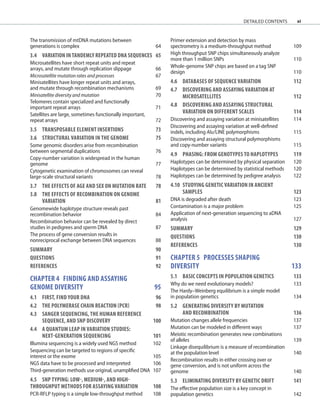
18.
xi
The transmission ofmtDNA mutations between
generations is complex 64
3.4 VARIATION IN TANDEMLY REPEATED DNA SEQUENCES 65
Microsatellites have short repeat units and repeat
arrays, and mutate through replication slippage 66
Microsatellite mutation rates and processes 67
Minisatellites have longer repeat units and arrays,
and mutate through recombination mechanisms 69
Minisatellite diversity and mutation 70
Telomeres contain specialized and functionally
important repeat arrays 71
Satellites are large, sometimes functionally important,
repeat arrays 72
3.5 TRANSPOSABLE ELEMENT INSERTIONS 73
3.6 STRUCTURAL VARIATION IN THE GENOME 75
Some genomic disorders arise from recombination
between segmental duplications 76
Copy-number variation is widespread in the human
genome 77
Cytogenetic examination of chromosomes can reveal
large-scale structural variants 78
3.7 THE EFFECTS OF AGE AND SEX ON MUTATION RATE 78
3.8 THE EFFECTS OF RECOMBINATION ON GENOME
VARIATION 81
Genomewide haplotype structure reveals past
recombination behavior 84
Recombination behavior can be revealed by direct
studies in pedigrees and sperm DNA 87
The process of gene conversion results in
nonreciprocal exchange between DNA sequences 88
SUMMARY 90
QUESTIONS 91
REFERENCES 92
chapter 4 FINDING AND ASSAYING
GENOME DIVERSITY 95
4.1 FIRST, FIND YOUR DNA 96
4.2 THE POLYMERASE CHAIN REACTION (PCR) 98
4.3 SANGER SEQUENCING, THE HUMAN REFERENCE
SEQUENCE, AND SNP DISCOVERY 100
4.4 A QUANTUM LEAP IN VARIATION STUDIES:
NEXT-GENERATION SEQUENCING 101
Illumina sequencing is a widely used NGS method 102
Sequencing can be targeted to regions of specific
interest or the exome 105
NGS data have to be processed and interpreted 106
Third-generation methods use original, unamplified DNA 107
4.5 SNP TYPING: LOW-, MEDIUM-, AND HIGH-
THROUGHPUT METHODS FOR ASSAYING VARIATION 108
PCR-RFLP typing is a simple low-throughput method 108
Primer extension and detection by mass
spectrometry is a medium-throughput method 109
High throughput SNP chips simultaneously analyze
more than 1 million SNPs 110
Whole-genome SNP chips are based on a tag SNP
design 110
4.6 DATABASES OF SEQUENCE VARIATION 112
4.7 DISCOVERING AND ASSAYING VARIATION AT
MICROSATELLITES 112
4.8 DISCOVERING AND ASSAYING STRUCTURAL
VARIATION ON DIFFERENT SCALES 114
Discovering and assaying variation at minisatellites 114
Discovering and assaying variation at well-defined
indels, including Alu/LINE polymorphisms 115
Discovering and assaying structural polymorphisms
and copy-number variants 115
4.9 PHASING: FROM GENOTYPES TO HAPLOTYPES 119
Haplotypes can be determined by physical separation 120
Haplotypes can be determined by statistical methods 120
Haplotypes can be determined by pedigree analysis 122
4.10 STUDYING GENETIC VARIATION IN ANCIENT
SAMPLES 123
DNA is degraded after death 123
Contamination is a major problem 125
Application of next-generation sequencing to aDNA
analysis 127
SUMMARY 129
QUESTIONS 130
REFERENCES 130
chapter 5 PROCESSES SHAPING
DIVERSITY 133
5.1 BASIC CONCEPTS IN POPULATION GENETICS 133
Why do we need evolutionary models? 133
The Hardy–Weinberg equilibrium is a simple model
in population genetics 134
5.2 GENERATING DIVERSITY BY MUTATION
AND RECOMBINATION 136
Mutation changes allele frequencies 137
Mutation can be modeled in different ways 137
Meiotic recombination generates new combinations
of alleles 139
Linkage disequilibrium is a measure of recombination
at the population level 140
Recombination results in either crossing over or
gene conversion, and is not uniform across the
genome 140
5.3 ELIMINATING DIVERSITY BY GENETIC DRIFT 141
The effective population size is a key concept in
population genetics 142
detailed contents
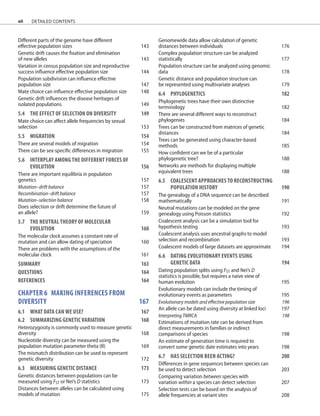
19.
xii
Different parts ofthe genome have different
effective population sizes 143
Genetic drift causes the fixation and elimination
of new alleles 143
Variation in census population size and reproductive
success influence effective population size 144
Population subdivision can influence effective
population size 147
Mate choice can influence effective population size 148
Genetic drift influences the disease heritages of
isolated populations 149
5.4 THE EFFECT OF SELECTION ON DIVERSITY 149
Mate choice can affect allele frequencies by sexual
selection 153
5.5 MIGRATION 154
There are several models of migration 154
There can be sex-specific differences in migration 155
5.6 INTERPLAY AMONG THE DIFFERENT FORCES OF
EVOLUTION 156
There are important equilibria in population
genetics 157
Mutation–drift balance 157
Recombination–drift balance 157
Mutation–selection balance 158
Does selection or drift determine the future of
an allele? 159
5.7 THE NEUTRAL THEORY OF MOLECULAR
EVOLUTION 160
The molecular clock assumes a constant rate of
mutation and can allow dating of speciation 160
There are problems with the assumptions of the
molecular clock 161
SUMMARY 163
QUESTIONS 164
REFERENCES 164
chapter 6 MAKING INFERENCES FROM
DIVERSITY 167
6.1 WHAT DATA CAN WE USE? 167
6.2 SUMMARIZING GENETIC VARIATION 168
Heterozygosity is commonly used to measure genetic
diversity 168
Nucleotide diversity can be measured using the
population mutation parameter theta (θ) 169
The mismatch distribution can be used to represent
genetic diversity 172
6.3 MEASURING GENETIC DISTANCE 173
Genetic distances between populations can be
measured using FST or Nei’s D statistics 173
Distances between alleles can be calculated using
models of mutation 175
Genomewide data allow calculation of genetic
distances between individuals 176
Complex population structure can be analyzed
statistically 177
Population structure can be analyzed using genomic
data 178
Genetic distance and population structure can
be represented using multivariate analyses 179
6.4 PHYLOGENETICS 182
Phylogenetic trees have their own distinctive
terminology 182
There are several different ways to reconstruct
phylogenies 184
Trees can be constructed from matrices of genetic
distances 184
Trees can be generated using character-based
methods 185
How confident can we be of a particular
phylogenetic tree? 188
Networks are methods for displaying multiple
equivalent trees 188
6.5 COALESCENT APPROACHES TO RECONSTRUCTING
POPULATION HISTORY 190
The genealogy of a DNA sequence can be described
mathematically 191
Neutral mutations can be modeled on the gene
genealogy using Poisson statistics 192
Coalescent analysis can be a simulation tool for
hypothesis testing 193
Coalescent analysis uses ancestral graphs to model
selection and recombination 193
Coalescent models of large datasets are approximate 194
6.6 DATING EVOLUTIONARY EVENTS USING
GENETIC DATA 194
Dating population splits using FST and Nei’s D
statistics is possible, but requires a naive view of
human evolution 195
Evolutionary models can include the timing of
evolutionary events as parameters 195
Evolutionary models and effective population size 196
An allele can be dated using diversity at linked loci 197
Interpreting TMRCA 198
Estimations of mutation rate can be derived from
direct measurements in families or indirect
comparisons of species 198
An estimate of generation time is required to
convert some genetic date estimates into years 198
6.7 HAS SELECTION BEEN ACTING? 200
Differences in gene sequences between species can
be used to detect selection 203
Comparing variation between species with
variation within a species can detect selection 207
Selection tests can be based on the analysis of
allele frequencies at variant sites 208
detailed contents
20.
xiii
Comparing haplotype frequencyand haplotype
diversity can reveal positive selection 209
Analysis of frequency differences between
populations can indicate positive selection 209
Other methods can be used to detect ongoing
or very recent positive selection 214
How can we combine information from different
statistical tests? 214
Tests for positive selection have severe limitations 215
6.8 ANALYZING GENETIC DATA IN A GEOGRAPHICAL
CONTEXT 216
Genetic data can be displayed on maps 217
Genetic boundary analysis identifies the zones of
greatest allele frequency change within a genetic
landscape 219
Spatial autocorrelation quantifies the relationship
of allele frequency with geography 219
Mantel testing is an alternative approach to examining
a relationship between genetic distance and other
distance measures 220
SUMMARY 220
QUESTIONS 221
REFERENCES 222
chapter 7 HUMANS AS APES 225
Which nonhuman animals are the closest living
relatives of humans? 225
Are humans typical apes? 225
7.1 EVIDENCE FROM MORPHOLOGY 226
Primates are an Order of mammals 226
Hominoids share a number of phenotypic
features with other anthropoids 228
Ancestral relationships of hominoids are difficult
to resolve on morphological evidence 230
7.2 EVIDENCE FROM CHROMOSOMES 232
Human and great ape karyotypes look similar, but
not identical 232
Molecular cytogenetic analyses support the picture
from karyotype comparisons 233
7.3 EVIDENCE FROM MOLECULES 236
Molecular data support a recent date of the
ape–human divergence 237
Genetic data have resolved the gorilla–chimpanzee–
human trichotomy 237
Sequence divergence is different among great apes
across genetic loci 239
Great apes differ by gains and losses of genetic
material 241
The DNA sequence divergence rates differ in
hominoid lineages 241
7.4 GENETIC DIVERSITY AMONG THE GREAT APES 242
How many genera, species, and subspecies are there? 247
Intraspecific diversity in great apes is greater than in
humans 247
Signatures of lineage-specific selection can be
detected in ape genomes 250
SUMMARY 254
QUESTIONS 254
REFERENCES 254
chapter 8 what geneTic changes
have made us human? 257
8.1 MORPHOLOGICAL AND BEHAVIORAL CHANGES
EN ROUTE TO HOMO SAPIENS 258
Some human traits evolved early in hominin history 260
The human mind is unique 263
Only a few phenotypes are unique to modern humans 265
8.2 GENETIC UNIQUENESS OF HUMANS AND HOMININS 265
The sequence and structural differences between
humans and other great apes can be cataloged 265
Humans have gained and lost a few genes
compared with other great apes 266
Humans differ in the sequence of genes compared
with other great apes 269
Humans differ from other apes in the expression
levels of genes 270
Genome sequencing has revealed a small number
of fixed genetic differences between humans and
both Neanderthals and Denisovans 272
8.3 GENETIC BASIS OF PHENOTYPIC DIFFERENCES
BETWEEN APES AND HUMANS 273
Mutations causing neoteny have contributed to the
evolution of the human brain 273
The genetic basis for laterality and language remains
unclear 275
What next? 278
SUMMARY 278
QUESTIONS 279
REFERENCES 279
chapter 9 origins of modern humans 283
9.1 EVIDENCE FROM FOSSILS AND MORPHOLOGY 284
Some fossils that may represent early hominins from
4–7 MYA are known from Africa 285
Fossils of australopithecines and their contemporaries
are known from Africa 287
The genus Homo arose in Africa 290
The earliest anatomically modern human fossils
are found in Africa 294
The morphology of current populations suggests
an origin in Africa 295
9.2 EVIDENCE FROM ARCHAEOLOGY AND LINGUISTICS 295
Paleolithic archaeology has been studied extensively 298
detailed contents
21.
xiv
Evidence from linguisticssuggests an origin of
language in Africa 299
9.3 HYPOTHESES TO EXPLAIN THE ORIGIN OF
MODERN HUMANS 300
9.4 EVIDENCE FROM THE GENETICS OF PRESENT-DAY
POPULATIONS 301
Genetic diversity is highest in Africa 301
Genetic phylogenies mostly root in Africa 304
Mitochondrial DNA phylogeny 304
Y-chromosomal phylogeny 305
Other phylogenies 305
Insights can be obtained from demographic models 306
9.5 EVIDENCE FROM ANCIENT DNA 307
Ancient mtDNA sequences of Neanderthals and
Denisovans are distinct from modern human variation 308
A Neanderthal draft genome sequence has been
generated 309
A Denisovan genome sequence has been generated 310
SUMMARY 313
QUESTIONS 315
REFERENCES 315
chapter 10 the distribution of
diversity 319
10.1 STUDYING HUMAN DIVERSITY 319
The history and ethics of studying diversity are
complex 319
Linnaeus’ classification of human diversity 320
Galton’s “Comparative worth of different races” 320
Modern attitudes to studying diversity 320
Who should be studied? 323
A few large-scale studies of human genetic variation
have made major contributions to human evolutionary
genetics 323
What is a population? 326
How many people should be analyzed? 327
10.2 APPORTIONMENT OF HUMAN DIVERSITY 328
The apportionment of diversity shows that most
variation is found within populations 328
The apportionment of diversity can differ between
segments of the genome 329
Patterns of diversity generally change gradually from
place to place 330
The origin of an individual can be determined
surprisingly precisely from their genotype 331
The distribution of rare variants differs from that of
common variants 332
10.3 THE INFLUENCE OF SELECTION ON THE
APPORTIONMENT OF DIVERSITY 333
The distribution of levels of differentiation has been
studied empirically 334
Low differentiation can result from balancing
selection 334
High differentiation can result from directional
selection 335
Positive selection at EDAR 336
SUMMARY 338
QUESTIONS 339
REFERENCES 339
chapter 11 THE COLONIZATION OF THE OLD
WORLD AND AUSTRALIA 341
11.1 A COLDER AND MORE VARIABLE ENVIRONMENT
15–100 KYA 341
11.2 FOSSIL AND ARCHAEOLOGICAL EVIDENCE FOR
TWO EXPANSIONS OF ANATOMICALLY MODERN
HUMANS OUT OF AFRICA IN THE LAST ~130 KY 344
Anatomically modern, behaviorally pre-modern
humans expanded transiently into the Middle East
~90–120 KYA 345
Modern human behavior first appeared in Africa
after 100 KYA 346
Fully modern humans expanded into the Old World
and Australia ~50–70 KYA 347
Modern human fossils in Asia, Australia, and Europe 347
Initial colonization of Australia 349
Upper Paleolithic transition in Europe and Asia 352
11.3 A SINGLE MAJOR MIGRATION OUT OF AFRICA
50–70 KYA 353
Populations outside Africa carry a shared subset of
African genetic diversity with minor Neanderthal
admixture 353
mtDNA and Y-chromosomal studies show the
descent of all non-African lineages from a single
ancestor for each who lived 55–75 KYA 355
11.4 EARLY POPULATION DIVERGENCE BETWEEN
AUSTRALIANS AND EURASIANS 357
SUMMARY 360
QUESTIONS 361
REFERENCES 361
chapter 12 AGRICULTURAL EXPANSIONS 363
12.1 DEFINING AGRICULTURE 363
12.2 THE WHERE, WHEN, AND WHY OF AGRICULTURE 365
Where and when did agriculture develop? 365
Why did agriculture develop? 366
Which domesticates were chosen? 368
12.3 OUTCOMES OF AGRICULTURE 369
Agriculture had major impacts on demography and
disease 369
Rapid demographic growth 369
detailed contents
22.
xv
Malnutrition and infectiousdisease 369
Agriculture led to major societal changes 371
12.4 THE FARMING–LANGUAGE CO-DISPERSAL
HYPOTHESIS 372
Some language families have spread widely and rapidly 372
Linguistic dating and construction of proto-
languages have been used to test the hypothesis 373
What are the genetic implications of language spreads? 373
12.5 OUT OF THE NEAR EAST INTO EUROPE 374
Nongenetic evidence provides dates for the
European Neolithic 374
Different models of expansion give different
expectations for genetic patterns 377
Models are oversimplifications of reality 378
Principal component analysis of classical genetic
polymorphisms was influential 379
Interpreting synthetic maps 379
mtDNA evidence has been controversial, but ancient
DNA data are transforming the field 380
Data from ancient mtDNA 382
Y-chromosomal data show strong clines in Europe 384
New developments for the Y chromosome 384
Biparentally inherited nuclear DNA has not yet
contributed much, but important ancient DNA data
are now emerging 386
Ancient DNA data 387
What developments will shape debate in the future? 388
12.6 OUT OF TROPICAL WEST AFRICA INTO SUB-
EQUATORIAL AFRICA 388
There is broad agreement on the background to
African agricultural expansion 388
Rapid spread of farming economies 389
Bantu languages spread far and rapidly 390
Genetic evidence is broadly consistent, though
ancient DNA data are lacking 392
Genomewide evidence 392
Evidence from mtDNA and the Y chromosome 393
12.7 GENETIC ANALYSIS OF DOMESTICATED
ANIMALS AND PLANTS 394
Selective regimes had a massive impact on
phenotypes and genetic diversity 395
Key domestication changes in crops 396
Effects on crop genetic diversity 398
Phenotypic and genetic change in animals 399
How have the origins of domesticated plants been
identified? 400
How have the origins of domesticated animals been
identified? 401
Cattle domestication 403
SUMMARY 404
QUESTIONS 405
REFERENCES 405
chapter 13 INTO new-found lands 409
13.1 SETTLEMENT OF THE NEW TERRITORIES 409
Sea levels have changed since the out-of-Africa
migration 409
What drives new settlement of uninhabited lands? 411
13.2 PEOPLING OF THE AMERICAS 412
The changing environment has provided several
opportunities for the peopling of the New World 413
Fossil and archaeological evidence provide a
range of dates for the settlement of the New World 415
Fossils 415
Archaeological remains 416
Clovis and the Paleoindians 416
Pre-Clovis sites 416
Unresolved issues 417
Did the first settlers go extinct? 418
A three-migration hypothesis has been suggested
on linguistic grounds 419
Genetic evidence has been used to test the single-
and the three-wave migration scenarios 419
Mitochondrial DNA evidence 420
Interpretation of the mtDNA data 422
Evidence from the Y chromosome 422
Evidence from the autosomes 424
Conclusions from the genetic data 425
13.3 PEOPLING OF THE PACIFIC 425
Fossil and archaeological evidence suggest that Remote
Oceania was settled more recently than Near Oceania 427
Two groups of languages are spoken in Oceania 428
Several models have been proposed to explain the
spread of Austronesian speakers 430
Austronesian dispersal models have been tested
with genetic evidence 431
Classical polymorphisms 431
Globin gene mutations 432
Mitochondrial DNA 433
The Y chromosome 436
Autosomal evidence 437
Evidence from other species has been used to test
the Austronesian dispersal models 438
SUMMARY 440
QUESTIONS 441
REFERENCES 441
chapter 14 WHAT HAPPENS WHEN
POPULATIONS MEET 443
14.1 WHAT IS GENETIC ADMIXTURE? 443
Admixture has distinct effects on genetic diversity 445
14.2 THE IMPACT OF ADMIXTURE 447
Different sources of evidence can inform us about
admixture 447
detailed contents
23.
xvi
Consequences of admixturefor language 447
Archaeological evidence for admixture 448
The biological impact of admixture 449
14.3 DETECTING ADMIXTURE 450
Methods based on allele frequency can be used to
detect admixture 450
Admixture proportions vary among individuals and
populations 453
Calculating individual admixture levels using multiple loci 453
Calculating individual admixture levels using genomewide
data 454
Calculating admixture levels from estimated ancestry
components 456
Problems of measuring admixture 457
Natural selection can affect the admixture
proportions of individual genes 458
14.4 LOCAL ADMIXTURE AND LINKAGE
DISEQUILIBRIUM 460
How does admixture generate linkage
disequilibrium? 461
Admixture mapping 462
Admixture dating 463
14.5 SEX-BIASED ADMIXTURE 464
What is sex-biased admixture? 464
Detecting sex-biased admixture 465
Sex-biased admixture resulting from directional mating 465
The effect of admixture on our genealogical ancestry 467
14.6 TRANSNATIONAL ISOLATES 467
Roma and Jews are examples of widely spread
transnational isolates 468
European Roma 468
The Jews 469
SUMMARY 471
QUESTIONS 472
REFERENCES 473
Chapter 15 UNDERSTANDING THE PAST,
PRESENT, AND FUTURE OF PHENOTYPIC
VARIATION 477
15.1 NORMAL AND PATHOGENIC VARIATION IN AN
EVOLUTIONARY CONTEXT 477
15.2 KNOWN VARIATION IN HUMAN PHENOTYPES 478
What is known about human phenotypic variation? 478
Morphology and temperature adaptation 479
Facial features 479
Tooth morphology and cranial proportions 480
Behavioral differences 481
How do we uncover genotypes underlying
phenotypes? 483
What have we discovered about genotypes
underlying phenotypes? 485
15.3 SKIN PIGMENTATION AS AN ADAPTATION TO
ULTRAVIOLET LIGHT 485
Melanin is the most important pigment influencing
skin color 486
Variable ultraviolet light exposure is an adaptive
explanation for skin color variation 486
Several genes that affect human pigmentation are
known 489
Genetic variation in human pigmentation genes is
consistent with natural selection 492
Does sexual selection have a role in human
phenotypic variation? 493
15.4 LIFE AT HIGH ALTITUDE AND ADAPTATION
TO HYPOXIA 495
Natural selection has influenced the overproduction
of red blood cells 495
High-altitude populations differ in their adaptation
to altitude 496
15.5 VARIATION IN THE SENSE OF TASTE 496
Variation in tasting phenylthiocarbamide is mostly
due to alleles of the TAS2R38 gene 498
There is extensive diversity of bitter taste receptors
in humans 499
Sweet, umami, and sour tastes may show genetic
polymorphism 499
15.6 ADAPTING TO A CHANGING DIET BY DIGESTING
MILK AND STARCH 500
There are several adaptive hypotheses to explain
lactase persistence 501
Lactase persistence is caused by SNPs within an
enhancer of the lactase gene 502
Increased copy number of the amylase gene reflects
an adaptation to a high-starch diet 504
15.7 THE FUTURE OF HUMAN EVOLUTION 506
Have we stopped evolving? 506
Natural selection acts on modern humans 506
Can we predict the role of natural selection in the
future? 507
Climate change 507
Dietary change 507
Infectious disease 507
What will be the effects of future demographic
changes? 508
Increasing population size 509
Increased mobility 510
Differential fertility 510
Differential generation time 511
Will the mutation rate change? 512
SUMMARY 512
QUESTIONS 513
REFERENCES 513
detailed contents
24.
xvii
CHAPTER 16 EVOLUTIONARYINSIGHTS
INTO SIMPLE GENETIC DISEASES 517
16.1 GENETIC DISEASE AND MUTATION–SELECTION
BALANCE 520
Variation in the strength of purifying selection can
affect incidence of genetic disease 520
Variation in the deleterious mutation rate can affect
incidence of genetic disease 522
16.2 GENETIC DRIFT, FOUNDER EFFECTS, AND
CONSANGUINITY 523
Jewish populations have a particular disease heritage 524
Finns have a disease heritage very distinct from
other Europeans 525
Consanguinity can lead to increased rates of
genetic disease 526
16.3 EVOLUTIONARY CAUSES OF GENOMIC DISORDERS 526
Segmental duplications allow genomic
rearrangements with disease consequences 527
Duplications accumulated in ancestral primates 529
16.4 GENETIC DISEASES AND SELECTION BY MALARIA 529
Sickle-cell anemia is frequent in certain populations
due to balancing selection 531
α-Thalassemias are frequent in certain populations
due to balancing selection 534
Glucose-6-phosphate dehydrogenase deficiency
alleles are maintained at high frequency in
malaria-endemic populations 535
What can these examples tell us about natural
selection? 537
SUMMARY 538
QUESTIONS 538
REFERENCES 539
chapter 17 evolution and complex
diseases 541
17.1 DEFINING COMPLEX DISEASE 541
The genetic contribution to variation in disease risk
varies between diseases 544
Infectious diseases are complex diseases 544
17.2 THE GLOBAL DISTRIBUTION OF COMPLEX DISEASES 546
Is diabetes a consequence of a post-agricultural
change in diet? 546
The drifty gene hypothesis 547
Evidence from genomewide studies 548
The thrifty phenotype hypothesis 549
17.3 IDENTIFYING ALLELES INVOLVED IN COMPLEX
DISEASE 549
Genetic association studies are more powerful than
linkage studies for detecting small genetic effects 549
Candidate gene association studies have not
generally been successful in identifying susceptibility
alleles for complex disease 552
Genomewide association studies can reliably identify
susceptibility alleles to complex disease 552
GWAS data have been used for evolutionary genetic
analysis 556
17.4 WHAT COMPLEX DISEASE ALLELES DO WE EXPECT
TO FIND IN THE POPULATION? 557
Negative selection acts on disease susceptibility
alleles 557
Positive selection acts on disease resistance alleles 560
Severe sepsis and CASP12 560
Malaria and the Duffy antigen 560
HIV-1 and CCR5Δ32 562
Unexpectedly, some disease susceptibility alleles
with large effects are observed at high frequency 562
Susceptibility to kidney disease, APOL1, and resistance
to sleeping sickness 562
Implications for other GWAS results 563
17.5 GENETIC INFLUENCE ON VARIABLE RESPONSE
TO DRUGS 563
Population differences in drug-response genes
exist, but are not well understood 564
SUMMARY 567
QUESTIONS 568
REFERENCES 569
chapter 18 IDENTITY AND
IDENTIFICATION 571
18.1 INDIVIDUAL IDENTIFICATION 572
The first DNA fingerprinting and profiling methods
relied on minisatellites 573
PCR-based microsatellite profiling superseded
minisatellite analysis 574
How do we interpret matching DNA profiles? 574
Complications from related individuals, and DNA mixtures 576
Large forensic identification databases are powerful
tools in crime-fighting 577
Controversial aspects of identification databases 577
The Y chromosome and mtDNA are useful in
specialized cases 578
Y chromosomes in individual identification 579
mtDNA in individual identification 580
18.2 WHAT DNA CAN TELL US ABOUT JOHN OR
JANE DOE 580
DNA-based sex testing is widely used and generally
reliable 580
Sex reversal 581
Deletions of the AMELY locus in normal males 582
Some other phenotypic characteristics are
predictable from DNA 582
detailed contents
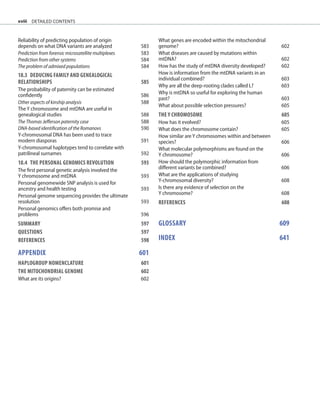
25.
xviii
Reliability of predictingpopulation of origin
depends on what DNA variants are analyzed 583
Prediction from forensic microsatellite multiplexes 583
Prediction from other systems 584
The problem of admixed populations 584
18.3 DEDUCING FAMILY AND GENEALOGICAL
RELATIONSHIPS 585
The probability of paternity can be estimated
confidently 586
Other aspects of kinship analysis 588
The Y chromosome and mtDNA are useful in
genealogical studies 588
The Thomas Jefferson paternity case 588
DNA-based identification of the Romanovs 590
Y-chromosomal DNA has been used to trace
modern diasporas 591
Y-chromosomal haplotypes tend to correlate with
patrilineal surnames 592
18.4 THE PERSONAL GENOMICS REVOLUTION 593
The first personal genetic analysis involved the
Y chromosome and mtDNA 593
Personal genomewide SNP analysis is used for
ancestry and health testing 593
Personal genome sequencing provides the ultimate
resolution 593
Personal genomics offers both promise and
problems 596
SUMMARY 597
QUESTIONS 597
REFERENCES 598
APPENDIX 601
HAPLOGROUP NOMENCLATURE 601
THE MITOCHONDRIAL GENOME 602
What are its origins? 602
What genes are encoded within the mitochondrial
genome? 602
What diseases are caused by mutations within
mtDNA? 602
How has the study of mtDNA diversity developed? 602
How is information from the mtDNA variants in an
individual combined? 603
Why are all the deep-rooting clades called L? 603
Why is mtDNA so useful for exploring the human
past? 603
What about possible selection pressures? 605
THE Y CHROMOSOME 605
How has it evolved? 605
What does the chromosome contain? 605
How similar are Y chromosomes within and between
species? 606
What molecular polymorphisms are found on the
Y chromosome? 606
How should the polymorphic information from
different variants be combined? 606
What are the applications of studying
Y-chromosomal diversity? 608
Is there any evidence of selection on the
Y chromosome? 608
REFERENCES 608
Glossary 609
INDEX 641
detailed contents
Welcome to ourwebsite – the ideal destination for book lovers and
knowledge seekers. With a mission to inspire endlessly, we offer a
vast collection of books, ranging from classic literary works to
specialized publications, self-development books, and children's
literature. Each book is a new journey of discovery, expanding
knowledge and enriching the soul of the reade
Our website is not just a platform for buying books, but a bridge
connecting readers to the timeless values of culture and wisdom. With
an elegant, user-friendly interface and an intelligent search system,
we are committed to providing a quick and convenient shopping
experience. Additionally, our special promotions and home delivery
services ensure that you save time and fully enjoy the joy of reading.
Let us accompany you on the journey of exploring knowledge and
personal growth!
ebookultra.com




![Garland Science
Vice President: Denise Schanck
Senior Editor: Elizabeth Owen
Assistant Editor: Dave Borrowdale
Production Editor: Georgina Lucas
Illustrator: Matthew McClements, Blink Studio Ltd.
Cover Design: Matthew McClements, Blink Studio Ltd.
Copyeditor: Sally Huish
Typesetting: EJ Publishing Services
Proofreader: Jo Clayton
Indexer: Medical Indexing Ltd.
© 2014 by Garland Science, Taylor & Francis Group, LLC
This book contains information obtained from authentic
and highly regarded sources. Every effort has been made to
trace copyright holders and to obtain their permission for
the use of copyright material. Reprinted material is quoted
with permission, and sources are indicated. A wide variety of
references are listed. Reasonable efforts have been made to
publish reliable data and information, but the author and the
publisher cannot assume responsibility for the validity of all
materials or for the consequences of their use.
All rights reserved. No part of this book covered by the
copyright herin may be reproduced or used in any format in
any form or by any means—graphic, electronic, or mechanical,
including photocopying, recording, taping, or information
storage and retrieval systems—without permission of the
publisher.
ISBN: 978-0-8153-4148-2
Library of Congress Cataloging-in-Publication Data
Human evolutionary genetics / Mark Jobling ... [et al.]. -- 2nd
ed.
p. ; cm.
Rev. ed. of: Human evolutionary genetics / Mark A. Jobling,
Matthew Hurles, Chris Tyler-Smith. c2004.
Includes bibliographical references and index.
ISBN 978-0-8153-4148-2
I. Jobling, Mark A. II. Jobling, Mark A. b Human evolutionary
genetics.
[DNLM: 1. Evolution, Molecular. 2. Adaptation, Biological.
3. Anthropology, Physical. 4. Genetic Variation. 5. Genome,
Human. QU 475]
QH431
599.93’5--dc23
2013008586
Published by Garland Science, Taylor & Francis Group, LLC,
an informa business, 711 Third Avenue, New York, NY 10017,
USA, and 3 Park Square, Milton Park, Abingdon, OX14 4RN, UK.
Printed in the United States of America
15 14 13 12 11 10 9 8 7 6 5 4 3 2 1
Visit our web site at http://www.garlandscience.com
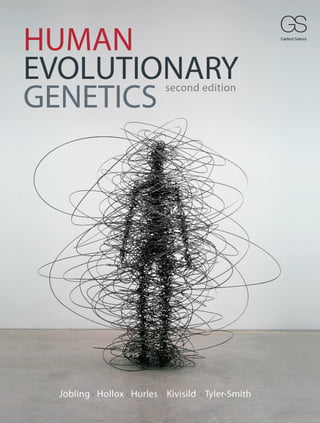
Front Cover
Antony Gormley
FEELING MATERIAL XIV, 2005
4 mm square section mild steel bar
225 x 218 x 170 cm (unextended size). 70 Kg
Photograph by Stephen White, London
© the artist
The authors
Professor Mark A. Jobling
Department of Genetics
University of Leicester, UK
Dr. Edward Hollox
Department of Genetics
University of Leicester, UK
Dr. Matthew Hurles
Wellcome Trust Sanger Institute
Hinxton, UK
Dr.Toomas Kivisild
Division of Biological Anthropology
University of Cambridge, UK
Dr. Chris Tyler-Smith
Wellcome Trust Sanger Institute
Hinxton, UK](https://image.slidesharecdn.com/68204-250727230926-d8c9fbff/85/Human-Evolutionary-Genetics-2nd-Edition-Mark-Jobling-11-320.jpg)